




Abstract
This article explores imagined selfhood, mobility and futurities through creative practice in ethnography. Globalisation allows people with varying socio-economic and geographical backgrounds to imagine themselves with more possibilities. How can creative practice such as improvisation in ethnofictions, storytelling and participatory animation be applied in ethnographic research to explore the imaginary realm of selfhood and expectations on being elsewhere? Drawing on fieldwork on migration from Africa to Europe, Brazilian transgender mobility and British youth in environmental transformation, the article will show how existential immobility inspires production of global horizons through imagination.
Keywords
Introduction
The conditions under which anthropological research is taking place today are very different from those when anthropology first was instituted as a distinct academic discipline. First of all, ‘the field’ no longer refers to an area which is strictly delineated geographically or culturally. The social worlds of the people anthropologists set out to explore are increasingly linked to the effects of modernity, capitalism and globalisation posing a challenge to previous scholarly approaches to identity and locality as territorially bounded, self-contained and structured. As people move and engage with more than one place simultaneously, the changing landscapes of group identity, so-called contemporary ‘ethnoscapes’ (Appadurai, 1991), ask for new approaches in the practice of anthropology to recognise the central role played by imagination in social life. Globalisation, Appadurai (1997) argues, has provoked the imagination to grow in scale, reflected in the observation that ‘[m]ore persons in more parts of the world consider a wider set of “possible” lives than they ever did before’ (p. 197). This emphasises the role of imagination in the way ordinary people construct their biographies, selfhoods and strategies for the future interweaving experiences around events that often carry an array of different imaginative possibilities. As a result, the most conventional methods of fieldwork have also been challenged as they have become insufficient in exploring the often intangible and ever fleeting realms of imagination, which cannot be captured through verbal exchange and participatory observation alone.
Carrying out our research in very different ethnographic contexts with migrants travelling from rural villages of Egypt to Milan in Italy, transgendered sex workers in São Paulo, Brazil and British youth in Yorkshire, UK, the authors of this article have conducted co-creative practice with the participants. Through the participants’ stories and dilemmas, the creative practice aims to explore the ‘imaginative horizons’ that have taken hold of their perceptions of reality, influencing the ways they interpret their life trajectories and question their life purposes. Although always constitutive of human experience, people’s imaginative and interior life-worlds are transient and ever changing; they resist full articulation. Also in terms of (re)presentation, anthropologists such as Andrew Irving and Nigel Rapport (2009) have asked the wider community of social scientists whether there are ways our critical analysis can reflect the importance of people’s interior dialogue, fantasies, reverie and imagination ‘without turning them into reified states or static properties’. 1 By acknowledging these challenges and the interdependence of reality with our projections of what lies beyond the horizon, which Crapanzano (2004) poetically analyses in his book Imaginative Horizons, our article wishes to reflect on possible ways for researchers to engage their field participants in more collaborative and creative relationships. We set the ethnographic context for imagination and memories to emerge through a series of co-creative processes during fieldwork including ethnofiction and ethno science fiction films (Sjöberg, 2008, 2017), and other artistic expressions such as applied theatre, storytelling, photography, film-making and animation (D’Onofrio, 2017). Our separate fieldwork research aimed at developing these methods to gain access to the imaginary worlds of the participants in relation to migration.
The first two examples are from films by Johannes Sjöberg. They are primarily dealing with topics not necessarily related to migration. While Transfiction (Sjöberg, 2010) explores performance, identity and discrimination among transgendered Brazilians, Call Me Back (Sjöberg, 2020) approaches environmental threat among British youth. Two scenes in these films do, however, deal explicitly with the imaginary context of mobility and imagination as a preparation for migration. It Was Tomorrow by Alexandra D’Onofrio (2018) focuses exclusively on migration which is why it stands at the centre of the analysis. It shows how co-creative processes such as participatory animation reveals the imagined pasts and futures of migrants that already reached their destination.
Accessing imagined mobilities through co-creative practice
Imagination has been recognised as central to mobility studies from its launch as an academic field. John Urry (2007) commented on the impact of art and media on the imaginative aspects of mobility and saw imagination as a prerequisite for mobility as it allows human beings to conceptualise and connect separate spaces (pp. 20–21). Baas (2010) suggested the term ‘imagined mobility’ to argue that ‘imagination is crucial in understanding people’s desire to be transnationally mobile’ (p. 2). While this and other research acknowledge the importance of imagination for mobility, there are less concrete suggestions on how to develop methods to explore the imaginary contexts of mobility. This article is primarily interested in how co-creative practice can be used a method as part of ethnographic fieldwork research to gain access to the imagined mobility, and more specifically, the imaginary realm of migration.
The three ethnographic films in this article suggest how different stages of migration are imagined: dreaming about leaving illustrated by Transfiction (Sjöberg, 2010), dreaming about a successful return as in Call Me Back (Sjöberg, 2020) and imagining pasts and futures after arriving to the destination in It Was Tomorrow (D’Onofrio, 2018). The three films are all inspired by the ethnofictions of French Visual Anthropologist Jean Rouch. Ethnofiction is a genre of ethnographic films in which the fieldwork informants act out their experiences in front of the camera. Ethnofiction does thus provide an opportunity for the participants to express the imaginary context of their experiences of mobility and reflect on them, while the researcher taps into the improvisations and interprets them. Unlike traditional observational methods in anthropology, ethnofiction is openly inter-subjective and draws on play and provocation to offer alternative methods to access imagined mobilities.
Ethnofiction film has been concerned with migration since its conception in the mid-1950s. Rouch (1957–1967) first started to film the enactments of his protagonists after his ethnographic fieldwork on seasonal migration in West Africa for the film Jaguar. He asked his three friends Demure Zika, Lam Ibrahim and Lilo Goudel’ize to re-enact the process of seasonal migration in the Sahel region. Every year many young Africans of the Sahel region travelled to the cities of the African west coast, to earn money and prestige as guest labourers and return to their villages as heroes at the end of the season. The title ‘Jaguar’ expressed this feeling of success and prestige of the travellers in the film as it refers to the contemporary ideal of a clever and elegant young man (Stoller, 1992, p. 143).
Rouch simply brought his friends in a Land Rover along the trail of seasonal migration and recorded the trip and the enactments with a hand cranked camera: I asked them to act and it was very easy for them to do it but we were always in a false situation. For example, when the boys were crossing the border at the customs office by the police station I just went up and said, ‘I am shooting a film of some people, do you mind?’ And they said, fine. They didn’t know what was going on: when the boy crossed the border I was actually filming the man in front and he didn’t see what happened behind him. So they did cross the border illegally but I was with the camera and if something happened, everything would have been all right, they had identity cards and so on. But we were so happy about it that we never went back to cross legally. We were absolutely happy because we knew that it was possible. (Rouch, 1978, p. 1005)
Jean Rouch and sociologist Edgar Morin would later compare this process to the psychodrama (Morin, 1985; p. 6; Sjöberg, 2018, p. 9) of Jacob Moreno. Rouch encouraged the participants to improvise their acting in front of the camera to make implicit information explicit (Sjöberg, 2008) through a process Loizos (1993) referred to as ‘projective improvisation’ (p. 50) showing how the three participants related to seasonal migration through their imagination. Drawing on these hypothetical situations as starting points for the drama, Jaguar would take the form of a light-hearted adventure. Rouch’s following ethnofiction Moi, un noir (1958) would show darker sides of labour migration in West Africa. Oumarou Ganda and his fellow protagonists took on roles from popular francophone culture to express not only their dreams of a better life but also their bitterness in relation to the colonial authorities. Stuck in the immobility of labour migration, the participants would dream up a future together.
The two following examples from the films by Sjöberg represent situations when the participants of the fieldwork were imagining mobility but had not yet attempted to realise their dreams. Ethnofiction was used as an ethnographic method to gain access to the imaginary aspect of mobility in both cases. In the fall of 2006, towards the end of the production of the ethnofiction Transfiction after nearly one and a half year of fieldwork research and film-making among transgendered Brazilians in São Paulo, one of the main protagonists Savana ‘Bibi’ Meirelles was asked to express her own dreams about the future. In the interview preparing for the filmed improvisation, she explained her wish to go to Paris in France. Bibi’s main motivation was that she wanted to escape the poverty and discrimination she experienced as a transsexual (male to female) sex worker in São Paulo, Brazil (Sjöberg, 2010). But the dream of going to Paris was also motivated by a process of self-realisation. Bibi would meet a French man that she could marry and share a comfortable life with. She envisioned herself as another person in Paris, in a glamourous context where she finally would be allowed to become the woman she had always dreamt of being (Figure 1).
Zilda travels to Paris.
5
Photo: Brochu, 2006.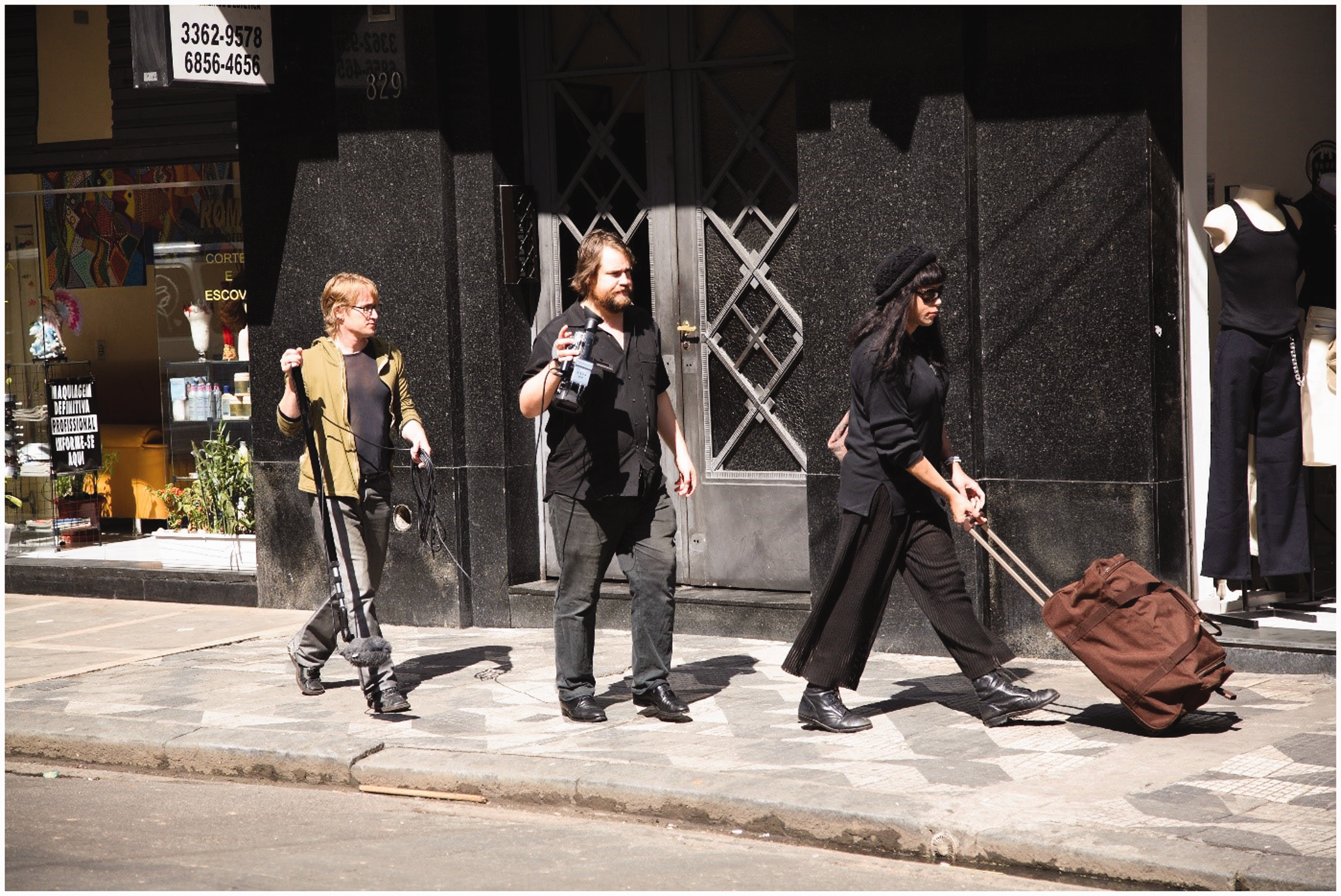
Bibi was not the only transgendered sex worker in Brazil that dreamt about Europe. The Latin American vision of Europe originates from a colonial heritage. Europe represented power and a better quality of life. This heritage has been adopted by many transgendered sex workers in Brazil. For them, Paris represented the epitome of glamour illustrated by the word ‘chic’. The trafficking of transgendered sex workers going from Brazil to Europe is a lucrative business and provides a possibility for young transgendered people to earn money and to realise their gender and sexuality in a more tolerant context. After earning money in Europe, they would be able to afford plastic surgery that could make their bodies more feminine and allow them to buy a car or a flat where they could work more securely (Sjöberg, 2011).
The actual reality of the many young transgendered Brazilians suffering from the harsh consequences of sex trafficking was, however, ignored in these shared visions of a better life in Europe. These idealised images remained untainted in spite of the many reports of exploitation and violence in the European sex trade.
In Transfiction, Bibi expresses this through the projective improvisations of her character Zilda that complains over the difficult situation of transgendered sex workers in Brazil. For Bibi, Zilda provided an opportunity to be the glamourous woman she dreamt of becoming. And while Bibi is forced to stay and struggle in Brazil, her imaginary character Zilda meets a French man in São Paulo that asks her to go and live with him in Paris. They walk hand in hand through the streets of São Paulo in spite of people staring at them and eventually travel to Paris where Zilda supposedly lives happily ever after. In this context, migration is not only driven by a wish for a ‘good life’ (Fischer, 2014) but also as part of the continuous process of crafting selfhood.
Eight years later in 2014, 18-year-old James Hudson-Wright would take part in an ethno science fiction based on ethnographic fieldwork research on British youth and their relation to environmental threats in Yorkshire, such as flooding (Sjöberg, 2017). The research resulted in the film Call Me Back (Sjöberg, 2020) recorded between 2014 and 2019 in which James enters into a dialogue with his future selves in a phone box outside his house. Eighteen-year-old James from 2014 is intercut in discussions with James 2015, 2016 and 2018. They talk about the development of their immediate environment in their hometown Shipley, and the impacts of climate change including the 2015 Boxing Day flooding of River Aire that severely damaged his home. James expresses disappointment and distrust in politicians that have forgotten about the interests of the people in Shipley and only are interested in money and power. As a result, his neighbourhood, with heritage from the Victorian golden era of wool industries in Shipley, is forgotten and shadowed by the development of the commercial centres now surrounding him. He sees no opportunities to develop the career in music he dreamed of in Shipley and he imagines going to Australia or the US to realise his aspirations.
Unlike ethnofiction, the ethno science fiction is exclusively concerned with the protagonists’ imagination about the future as the participants create their own science fictions through projective improvisations (Sjöberg, 2017). Forty-year-old James from 2036 and 60-year-old James from 2056 also enter the phone box to share their futures.
James imagines a future in which he has returned from Los Angeles (LA) to Shipley as a world-famous rock star. He has come to help the people of Shipley and to save them from a life in misery due to the many floods and the commercial exploitation of the area. Dressed as a rock star in leather jacket and bandana James 2036 reminds very much of Damouré Zika as he imagines what it is to be ‘jaguar’ and Zilda’s glamorous vision of being chic. Like Damouré, James has returned to his home town as a wealthy man intending to help people. James 2036 does not only want to save Shipley from the flooding but also to help young people realise their dreams (Figure 2).

In 2036, James Hudson-Wright returns to Shipley (UK) as a world-famous rock star. Photo: Sjöberg, 2016.
The outcome of the ethnofiction and ethno science fiction research projects hints on how co-creative practices based on projective improvisation can provide access to the imaginary realm of migration. Bibi never made it to Paris and James has not left for LA, yet … but the projective improvisations in the above films suggest how the vision of the self in other places and the successful return, form powerful driving forces behind mobility. Migration is preceded by the crafting of selfhood by imagining the self in other places. The persona of the imagined self, living in Paris or LA, co-exists with the current perceived self, to spark self-realisation and hope. Eighteen-, 19-, 20- and 22-year-old James, respectively, exist in dialogue with his imaginary rock star self in LA; so does Bibi with glamorous and happily married Zilda in Paris. Imagination ‘anticipates and previews, views, serves action, draws before us the configuration of the realizable before it can be realized’ and ‘[…] facilitates our practical domination over the real’ (Starobinski, 1970, pp. 173–174, quoted in Crapanzano, 2004, p. 19). The process of imagining selfhood in other places becomes the dress rehearsal for migration and stays relevant even if it never actually happens. The crafting of self in other places contributes to our creation and understanding of ourselves regardless if we ever leave.
Imagined pasts and futures in It Was Tomorrow
In order to explore and capture how the experience of crossing borders affects participants’ imagination and forms their subjectivities, D’Onofrio realised a co-creative ethnographic documentary drawing on participatory animation as part of her doctoral research in anthropology, media and performance.
As Rouch, D’Onofrio intended to document the manifestations of the surreal in the forms of the real, in order to produce what he poetically described as ‘a postcard at the service of the imaginary’ (Fieschi & Téchiné, 1967, p. 19). 2 The film traces the moment when an amnesty decreed by the Italian government allowed her research participants to legalize their status after almost 10 years had passed from their arrival to Italy from Egypt. At that moment, their future was re-inhabited by possibilities. As part of their need to rediscover their dreams and hopes they decided to take the journey back to the first places of arrival, where they disembarked from the boats that had brought them as teenagers to Italy after crossing the Mediterranean. The film follows them back to the emblematic places of the past, where memories are intertwined with fantasies about what could be, or could have been, their possible new life.
The three protagonists of the film It Was Tomorrow; Ali, Mohamed and Mahmoud, all come from rural areas in the northern part of Egypt. Like the majority of the 36,000 Egyptians living in Milan, Mohamed and Mahmoud are from Tatoun, a town of about 85,000 residents in the wider province of Faiyum, approximately 150 km south west of Cairo. Ali instead comes from Qasabi, a small village in the Delta region, around 180 km north of Cairo, whose young people mostly have migrated to the Gulf countries and a fewer number to Europe. Ali seems to be the only man in the village to have chosen Italy as his destination.
Their relationship to Egypt has been further complicated by the fact that in Italy they often had to endure hardship, loneliness and exploitation at work, without being able to easily return to their families. This reminded them of a place they felt they belonged to, but that at the same time had rejected them and bore the responsibility of their situation. To their mind, Egypt was the country that denied them a future, a sense of personal and collective trajectory and growth. In Egypt, but also in Italy where these men without documents were confined in the periphery of the world they wished to access, this lack of future is often translated into a sense of great frustration and unfulfillment. By critically analysing the sense of hope, frustration and ambivalence in the Egyptian rural context, Samuli Schielke (2008) gives us a picture of what his interlocutors mean when they say they are bored and desperate for something to happen, for a change to occur in their lives. According to their reflections, this sense of monotony and frustration derives from the desires and promises introduced into the rural context during the advent of modernity and capitalism, and the villagers’ ensuing feelings that it is impossible for them to meet ‘the aspirations for a better and more exciting life’ (Schielke, 2008, p. 258).
In the pre-revolutionary setting of the Egyptian rural towns, Schielke describes how people’s lived experience is often felt as ineffective and immobile, no matter how much social and personal imaginaries have been inhabited by ideals and hopes of progress and mobility. These descriptions resonate with what Ghassan Hage (2005) has termed as ‘existential immobility’, when he worked with diasporic families in two rural villages of Lebanon. Other scholars researching the narratives of migrants in rural and suburban Morocco have reported similar accounts of a frustrated, wasted life by migrants and migrants to-be. For example, in the Maghreb, the term used to define the experience of border crossing, l-harg, means ‘the burning’ and also refers ‘to a heterogeneous configuration relating to the figure of a “burned” life – a life without name, and without legitimacy; a life of enclosure in physical, genealogical and cultural spaces perceived as uninhabitable’ (Pandolfo, 2007, p. 333). It is in order to avoid burning out due to this existential immobility, as Hage would put it, that people start fantasizing about possible lives elsewhere. Life has a ‘taste’, as his Lebanese interlocutors would put it, and a meaning as long as one has a sense of a trajectory, a sense of ‘going somewhere’. In many languages, as in English, when we want to find out if someone is well, we ask ‘how is it going?’, meaning ‘how is life going?’. In fact, there seems to be this common understanding that life goes well and one is happy as long as there is this sense of socio-existential movement. This sense of movement is something a revolution can also bring into being in a nation perceived as economically and socio-politically stagnant for the majority of the population. When people experience a crisis in ‘their sense of existential mobility’ they decide to move physically and by any means necessary and available. Without taking in to account this inverse relationship between physical and existential mobility, Hage argues we would be unable to understand the movement we call migration. The traumatic experiences of migration coincide with the action people have taken to move in order to change their situation, and they end up, once again, feeling trapped in a life without possibility.
After being repeatedly disappointed in being unable to reach his aspirations in Egypt, Ali started to consider Italy as his only chance of speeding up a process that would otherwise take forever. Italy, as he described it, was the country that occupied his imaginative horizon, not just for the possibility of getting a job that would offer him better economic return, but Italy, and Milan specifically, represented for him a place of human rights, culture, freedom and especially fashion. All aspects of a socio-political milieu had to be reached by crossing the Mediterranean Sea.
Tatoun, Mohamed and Mahmoud’s hometown had an established history of international migration conditioned by thousands of people having migrated to Italy. The existing network, which provided financial support for travelling expenses, and the logistical support in finding jobs and shelter, enabled other relatives to migrate. This not only helps to forge a sense of locality (Ghannam, 1998) and community but also works in creating further pressure and control on migrants, dictating that work and sending back remittances to their family and the village should remain the main purpose for migrating. When visiting their families on holiday back home, the ones who have achieved their legal papers in Italy drive private cars (still a luxury for most Egyptians) with Italian plates, buy land and re-invest their earnings in building new properties. In the meantime, their families look for brides and inform them on the needs of the household. This continued interaction between migrants and their families forges a sense of belonging, which Ali, Mohamed and Mahmoud feel they need, but not without ambivalence.
Migrants’ remittances and the outer world of possibility are having an enormous impact on the collective imagination. The act of seeing and hearing about those who had succeeded overseas motivated brothers, nephews, cousins and neighbours to conceptualize their future, and their life in general, as only viable through migration. Even when this implied crossing borders and the Mediterranean Sea illegally on life-threatening journeys. Mohamed and Mahmoud often said: ‘For us it was best to die at sea, whilst trying to achieve a better life, than dying slowly, day by day, with no prospects in our villages’, echoing many other friends who had also crossed the sea on makeshift boats. In the crossing, they saw a righteous act of defiance against the limiting and unjust conditions of their livelihoods, so much as to ascribe the title of shahid (martyrs) to travellers who had lost their lives in the journey.
D’Onofrio first met Mahmoud, Ali and Mohammed during Theatre of the Oppressed workshops (Boal, 1993) that she co-facilitated in 2010. 3 When they began working as part of the fieldwork in 2012, they started experimenting with the already familiar theatre and storytelling techniques. They applied physical and verbal theatre improvisations to explore different possible futures and existential options.
D’Onofrio also co-facilitated workshops in participatory photography, with the objective of exploring autobiographical storytelling through still images. After this process, she recorded documentary footage during the journeys to re-visit the first places of arrival. As D’Onofrio filmed Mohamed, Ali and Mahmoud react to places that had been meaningful for the beginning of their lives in Italy, she realised how the environment was triggering the associations the subjects were making. Similarly, to how Jaguar was inspired by the surrealist idea of ‘rencontre’, her participants engaged in a creative flow that was the outcome of the dialogic relationship between their material surroundings and their subconscious and also an interplay between memories and imaginings. During these journeys, D’Onofrio asked them to take photographs of the most significant places as they passed them. Through photos and verbal associations, they captured memories and imagined futures associated with their past experiences. The gaps between the stories and the empty places through which the actors moved were consciously reproduced in order to invite the audience to recreate these experiences in their imagination in the film. The final creative process entailed the imaginative exploration of those ‘gaps’ through participatory animation.
The participants chose a moment they wished to re-elaborate on, with the animation technique of ‘paint on glass’. 4 The chosen photograph would serve as a background, a starting point and as a constant reference to the storytelling. They worked without a storyboard so that the process could remain open to improvisation and a variety of possibilities.
The act of drawing created the condition for the next drawing and for the progression of remembering and building a narration. Memories and imagination emerged during the act of animating, in an active process where the memory of an event was renegotiated and redefined. This progressed continuously in present time through every single line that was drawn to compose the story. What cannot be verbalised, finds a shape thanks to the freedom of association while animating in a mental state similar to Rouch’s ‘cine trance’ (Yakir, 1978, p. 10).
John Berger (2005) wrote about the drawn image containing the experience of looking, that it encompasses time, that it is an experience of discovery. Therefore, we could argue that animation without a storyboard seems to contain the experience of remembering, the exploration of deep layers of memories set free by the act of producing a sequence of drawings that are made and cancelled and recreated again, in a suspended time and state of mind.
The hand that composes progressively the drawings and their animation acts like a seismograph tracing the flow of one’s thoughts, imaginations and memories.
It is important to notice that this type of creative process also relates to the body in very specific ways since animation and drawing in general are physical processes. While the photograph captured by D’Onofrio’s participants was frozen by framing the specific moment and place in time, the drawings acted in the opposite direction re-enabling a process of discovery of other existential and experiential potentialities of that same event. Similarly to what other scholars in anthropology (Ingold, 2011; Taussig, 2009) have argued, the process of drawing initiates a movement ‘toward and into the subject, a merging that is transformative of both drawer and that which is drawn’ (Grimshaw & Ravetz, 2015, p. 260). While animating, the body of the animator is fully inhabiting the space and the time of the creative process. ‘Yves, where are we when we draw?’ Berger (2005, p. 124) asks his son in a letter where he provokes him to think whether one is in the place where she/he draws or in the place represented by the drawing. Perhaps, Berger proposes, we should consider venturing beyond a spatial answer to this question as the act of drawing, as well as the drawing itself, evolves and flows with time and might be ‘more about becoming rather than being’ (Berger, 2005).
The bodies of the participants, that had been initially activated by returning to the places of arrival and by re-living through the physical and emotional experience, were put through an immersive creative, mental and physical, space and time defined by the practice of animation. For several days, Mohamed, Ali and Mahmoud worked in a dark room illuminated by a soft light, where they performed a long repetition of similar movements and actions with their arms and fingers, in a cyclical flow of draw, wipe off, draw, wipe off, draw. This long and slow process revealed to be crucial in creating the conditions for us to reflect on memories and imagination at work.
During one of these occasions, Mahmoud animated the story of his escape from the reception centre for minors where he had been enclosed. The particularity of this story was that the escape expressed an unexplored desire of something he had thought a lot about with his friends at the reception centre. As minors, after disembarking on Italian soil, they had been taken to the closest reception centre where they were told to stay a wait. Everything was provided for them, shelter, food, entertainment, language classes and phone cards to be able to talk to their relatives in Egypt. They were told never to leave the premises and to wait for an indefinite time before they could have a response from the authorities regarding their successful or unsuccessful request of legal permit to stay. To Mahmoud’s perception, the days were long, monotonous and he felt isolated from the rest of the world he had crossed the sea, risking his life for (Figure 3). His animation represented the possibility of re-writing the past and making a desire come true. Jackson (2002) recognises the existential qualities of storytelling ‘as a vital strategy for sustaining a sense of agency in the face of disempowering circumstances’ (p. 15). Mahmoud’s imagined and animated escape enabled him to actively re-elaborate events in a story, and no longer to live those events in passivity, providing a sense of mobility to an experience he associated with a feeling of being entrapped. ‘I didn’t come all the way here to stay put and comfortable, I came here to run and grab life in my own hands’, he said as his words were recorded with a video camera that followed him around the building.
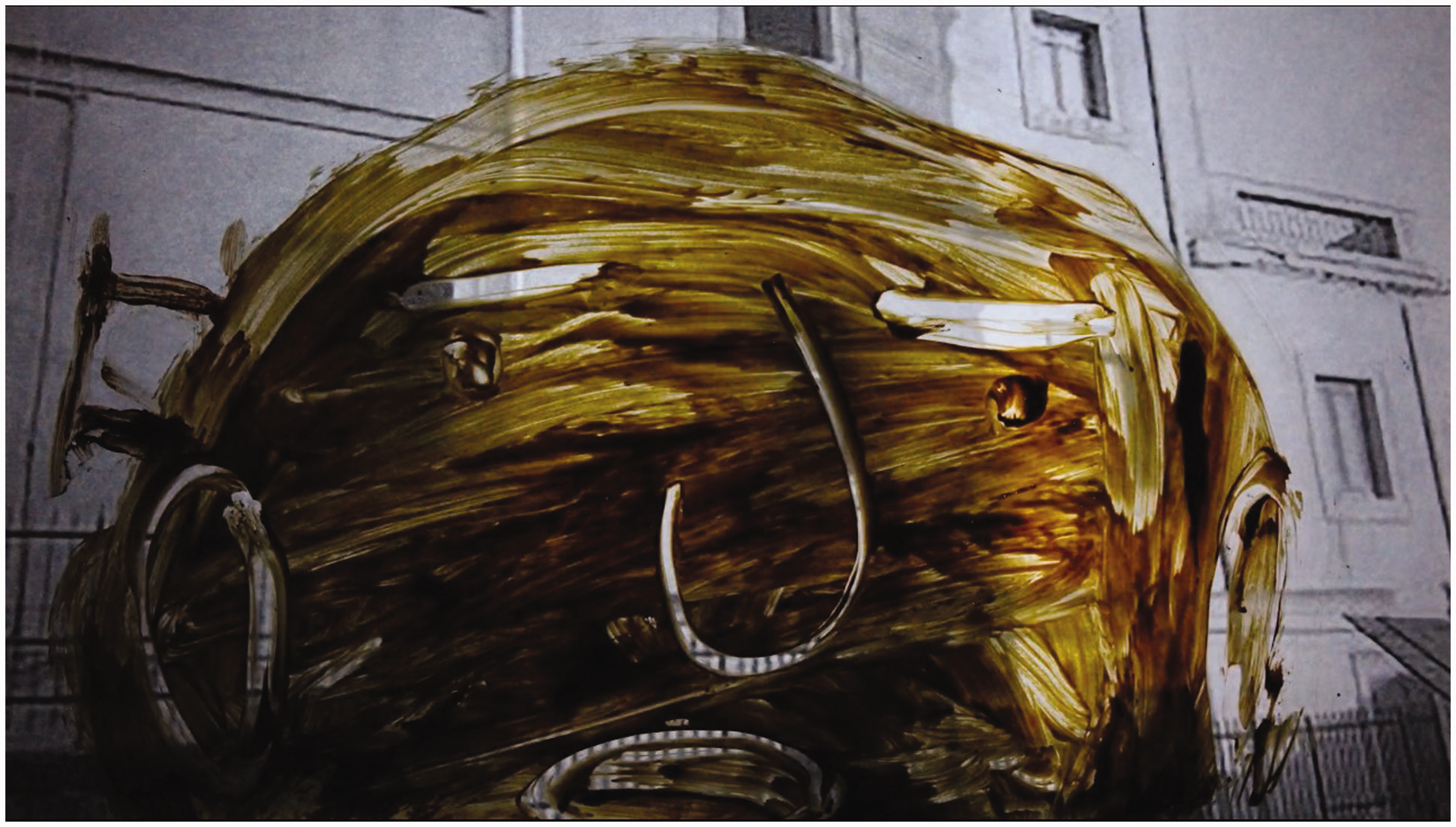
Mahmoud’s escape, Animation: Mahmoud, 2015. 6
The intertwining of different layers – reality and dreams, past and futures – seems to be one of the most important qualities of this open animation process, creating the context for a narration that moves from a single place/event/memory, to a multitude of possibilities. The mental (and graphic) process of representing a variety of different possibilities and views instead of just framing a more singular, factual reality can be understood as activating change in the participants’ lives because it re-engages their imagination to envisage other personal and collective futures. The act of drawing and animating dreams, desires and possible futures (as seen from the past) may provide participants with a more determined will and possible paths towards achieving their goals. Both Mahmoud and Ali reflected upon how different it was for them to remember when they were closed up in the studio, compared to when they were walking around in the harbours and reception centres. ‘But with the drawings other things come to mind,’ Mahmoud pointed out. ‘It doesn’t have to be something you experienced in that moment. An image comes to your head: I wanted to be like that!’ His imagined escape from the reception centre did, in fact, emerge through drawing.
The ability to re-write the past and future through the animation process became a powerful way to reflect on personal experiences and to encourage changing autobiographies, as the story took shape through the animations in the ethnographic film.
Working in collaboration with people who have experienced migration, animation allowed the research to escape from what has been coined as ‘reality syndrome’ (Gallagher, 2007; Thompson, 2003; Jeffers, 2012) which is very common in many productions and projects in the creative arts that deal with issues of migration.Approaching experiences and stories through an imperative of narrative and testimony not only often paralyses imaginative processes but also, and more importantly, may re-traumatize the people involved. Like the surrealist ethnofictions of Jean Rouch animations facilitate the freedom to remember and to forget, to tell anecdotes, but also to find refuge in an expression through metaphors, to choose a new tale about one’s past and future and finally, about one’s self.
Human imagination itself has the ability to contradict reality, allowing space for other possibilities to take hold of the present. In his phenomenological account of imagination, Sartre (1940) notices that the key feature of our imaginative process is the ability of our mind to imagine what is not the case. This aspect vividly emerged out of the animation process where black and white photographs devoid of colour or of actions and emotions that were part of the experience activated the participants’ memory and imagination to tell the story of what was not on the screen and animate it. This is the expressive potential of imaginative and creative processes such as participatory animation, ethnofiction and other forms of projective improvisation (Sjöberg, 2008). Mahmoud said that the photograph of the reception centre, for example, dragged him right into the situation and helped him imagine what was happening in that place again.
Conclusion
This article has demonstrated how co-creative practices can be applied in ethnographic film and research to provide access to imaginary worlds of mobility. The imaginary realm of cultural meaning has traditionally been neglected in ethnographic research on migration and mobility in general. The intangible aspects of imagination have made it a difficult research area due to the demand on empirical evidence required during the positivist paradigm of the social sciences. The acceptance of ethnography as an interpretative and intersubjective discipline has, however, gradually paved the way for the ethnographic film methods described in this article.
The three ethnographic films Transfiction, It Was Tomorrow and Call Me Back all demonstrate how different creative practices inspired by the projective improvisations in Jean Rouch’s ethnofictions could be applied to approach different stages of mobility. The example from Transfiction shows how an imaginary selfhood in other places is crafted among transgendered Brazilians as mobility is rehearsed. It Was Tomorrow draws on participatory animation to show how young Egyptian migrants draw on their imagination to understand and make new meanings of their past experiences and futures selves. The scene from Call Me Back invokes the idea of mobility and prestige from the film Jaguar. A young man from North England expresses his dissatisfaction with his current situation and environment and creates a future self that returns from the US as a world-famous rock star to save his town and its inhabitants from floods and misery.
Although the imagined mobility in all three films is motivated by dissatisfaction with the current situation, imagination is not merely an escape. In all three examples, imagination forms an essential part of the continuous process of crafting selfhood and concrete strategies for future mobility. The past is reimagined, and futures are shaped to create new opportunities elsewhere.
Footnotes
Declaration of Conflicting Interests
The author(s) declared no potential conflicts of interest with respect to the research, authorship, and/or publication of this article.
Funding
The author(s) received no financial support for the research, authorship, and/or publication of this article.
