




Abstract
In this article, we, Olga Lehmann, Mixo Hansen and Helena Hurme, engage in a process of collaborative reflexivity upon living, aging, and dying as we attempt to make sense of the illnesses of the last author. The companionship that emerged between us in the plurality of our identities as friends, colleagues, coauthors, and women, encouraged us to revisit aspects of the theories in developmental-cultural psychology such as (a) the process of meaning-making, (b) the equifinality model in relation to aging and dying, and (c) the notion of personal life philosophies in relation to virtues. Based on our personal experiences as well as our collaborative reflexivity as scholars, we highlight that developmental-cultural psychology could more explicitly address existential transitions, such as dying and existential givens, such as uncertainty in its theories. We present as well some preliminary integrations between existential and cultural perspectives of meaning-making.
Keywords
Companionship. Writing this article became a practice of companionship in the midst of the uncertainty of our lives. These pages are a process of collaborative reflexivity written by us: Olga Lehmann, Mixo Hansen, and Helena Hurme, in the plurality of our identities as friends, colleagues, researchers, and women. In doing so, the two first authors are honoring the courage of the third one, a professor and friend, while she is aging and facing chronic lymphocytic leukemia as well as myelodysplastic syndrome, a precursor of bone marrow cancer. Professor Helena Hurme is a developmental psychologist, who worked at the Department of Developmental Psychology at Åbo Akademi University and later on as the dean of the Faculty of Social Sciences at the same university. It was there where she first met Mixo Hansen. Then, Olga Lehmann met both of them in Italy during a Summer School of Cultural Psychology in 2015. In 2018, we decided to honor Helena’s life and to let her courage serve to developmental-cultural psychology as an exemplar of the ways in which an academic career shapes our understanding of life in itself, of our human condition. To begin with, the purpose of our encounters was to make an interview to be published as a tribute to Helena. However, as we engaged in this collaborative series of in-depth interviews, it became impossible for us not to influence the ways in which we are making meaning about our own life trajectories. Sharing perspectives and similarities in our journeys as women in particular and as human beings in general has expanded our capacity to feel, to empathize, and to feel compassionate with one another and with ourselves. This also made us question the possible ways in which these events can inform theories in developmental-cultural psychology. The creative process of writing this article extended over one year via e-mail, Facebook messages, online meetings, and personal visits, which has helped us make sense of the impending finitude of life, and the integration of personal life philosophies and values across our life trajectories.
In the interlude of boundary situations and existential transitions, writing this article has become a supporting enterprise for all of us, a source of nourishment, meaning-making, and insight. Therefore, our efforts transcend a mere exploration of illness, dying, and aging: this article is about the three of us still being alive. In the following pages, we shape our stories, more explicitly emphasizing the process of sharing and accompanying each other in the past 15 months.
Methodological remarks
Collaborative reflexivity
The co-constructive nature of meaning-making (e.g., Bruner, 1990) and the multivoicedness of the self (Hermans, 2001) are the ground for our methodological approach. This article is co-constructed as a process of collaborative reflexivity between the three authors of the article, acknowledging the plurality of our positionings of the self. This multivoicedness comes into focus as we are psychologists but also friends and women. The accompanying illness of one of us made us reflect upon some premises of developmental-cultural psychology as well as about our womanhood and our human condition. Such sense of companionship among us, researchers in different stages of our life course, brings into question the processes of living, aging, and dying. Similar to some ethnographers, the intentional use of interpersonal dialogues and human connection can serve transformative learning processes which open up innovative ways of gaining insight in research (Blalock & Akehi, 2018). Our methodological approach then also resembles that of having participants as co-researchers, where the active role of a participant in providing both information and interpretations is said to improve the credibility of the findings (Boylorn, 2012; Sato et al., 2012). That is, our participant is also a colleague and co-author, with her career in psychology having made it possible for us to meet in the first place.
In early stages of this collaborative project, Olga Lehmann interviewed Helena Hurme in December 2018, and both recorded together 4 hours and a half of interviews, following through McAdams’ (2008) Life Story Interview. In addition, the three of us had previously suggested other questions to be addressed at the interviews, based on our knowledge of Helena’s life (e.g., the illnesses she is dealing with). Then, Mixo Hansen listened to and wrote a summary of the recordings. She also visited Helena in May 2019, and both of them discussed together a preliminary draft of this article, so as to give shape to our conclusive remarks. Since the in-depth interviews were the starting point of our collaborative process of reflecting and writing, and since the “interviewee” is also an author of the article, we did not focus on transcribing the recordings and analyzing the transcripts. We rather focused on the joint process of meaning-making. We explicitly addressed an individual and inter-individual process of reflexivity upon the values and the turning points that have shaped Helena’s life, and the crossroads between her stories and history, with those of the other two authors, Olga and Mixo.
Analysis of a collaborative reflexivity in the making
In order to analyze the process of collaborative reflexivity that we have been involved in, we created three theoretically driven themes inspired in theories in developmental-cultural psychology. These were (a) meaning-making, (b) equifinality points (EFPs), and (c) virtues and personal life philosophies. The choice of these themes was induced from our communications (i.e., e-mails, Facebook messages, video calls, interviews, and e-mails).
Meaning-making in its experiential and existential nuances
Even though developmental-cultural psychology and sociocultural psychology study the life course (e.g., Zittoun et al., 2013), perspectives upon aging are still to be advanced in parallel to theories in child and adult development. Recently, some scholars in the field have focused on integrative approaches to a cultural psychology of aging (e.g., Boll et al., 2018). Such integrative approaches could benefit further from explicitly including existential perspectives into what aging and facing illnesses represents for human beings (Lehmann, 2018b). For example, it is recognized in this field that older adults who recognize their mortality as they age can feel motivated to make the best out of their possibilities until their death comes (Valsiner, 2018). However, the existential aspects that shape human development as a twofold process—both living and dying—are seldom theorized in developmental-cultural psychology. For example, cultural and existential approaches have been combined in order to explore the phenomenological implications of having an ill parent while being a teenager, emphasizing the notion of hope (Winther‐Lindqvist, 2017). Similarly, in the Life Trajectory Approach, cultural psychologists focus on the living process of patients and do not explicitly elaborate upon the polarity that dying represents when one is experiencing an illness (Sato et al., 2012). We consider living and dying as polarized equifinalities which have a crucial role in the processes of meaning-making about our experiences and our existence. As we exemplify through Helena’s case, the coexistence of living and dying becomes amplified in the meaning-making processes of facing aging and illnesses. As Sato et al. (2012) suggest, having an illness evokes the evaporation of an imagined directionality of one’s life and therefore uncertainty emerges. However, receiving the prognosis of having few years of life left leads to the emergence of a new certainty as well. This is the certainty of having a “death-line,” as Helena named it, even if this confirmation of closeness to one’s impending finitude of life represents a challenge. Here, we emphasize that such uncertainty is an existential given, as death can come in the most unexpected ways and at any age, even if we might not like to think too much about it. Through developmental lenses, as we age, the probability for us to face some constraints (e.g., illnesses, disability) increases, which might also affect the possibilities for bringing imaginary futures into one’s life. Indeed, research suggests that after being diagnosed with incurable diseases, people perceive a change in their experience of time through an awareness of impending finitude (Ellingsen et al., 2014). At the same time, aging brings an opportunity: that of pursuing a sense of existential meaning where one also seeks for making sense of the life one has lived, even if this was not the life one had imagined.
A preliminary model of meaning-making and aging
After reflecting upon Helena’s case, and the ways in which she is facing her diagnoses of chronic lymphocytic leukemia and myelodysplastic syndrome, we created a preliminary model, which we present in Figure 1. This illustration highlights the coexistent tension that facing an illness as well as feeling alive and wanting this sense of aliveness to endure while acknowledging dying and death. Thus, we suggest this preliminary model as an alternative to the Life Trajectory Approach, which denotes how the meaning-making process of people, such as Helena, could look like as they cope with incurable diseases at an advanced stage. Here, meaning-making is seen as a movement between the past, present, and future. It involves both the acknowledgment of the current status of the illness and anticipations of its progress and the arrival of death.
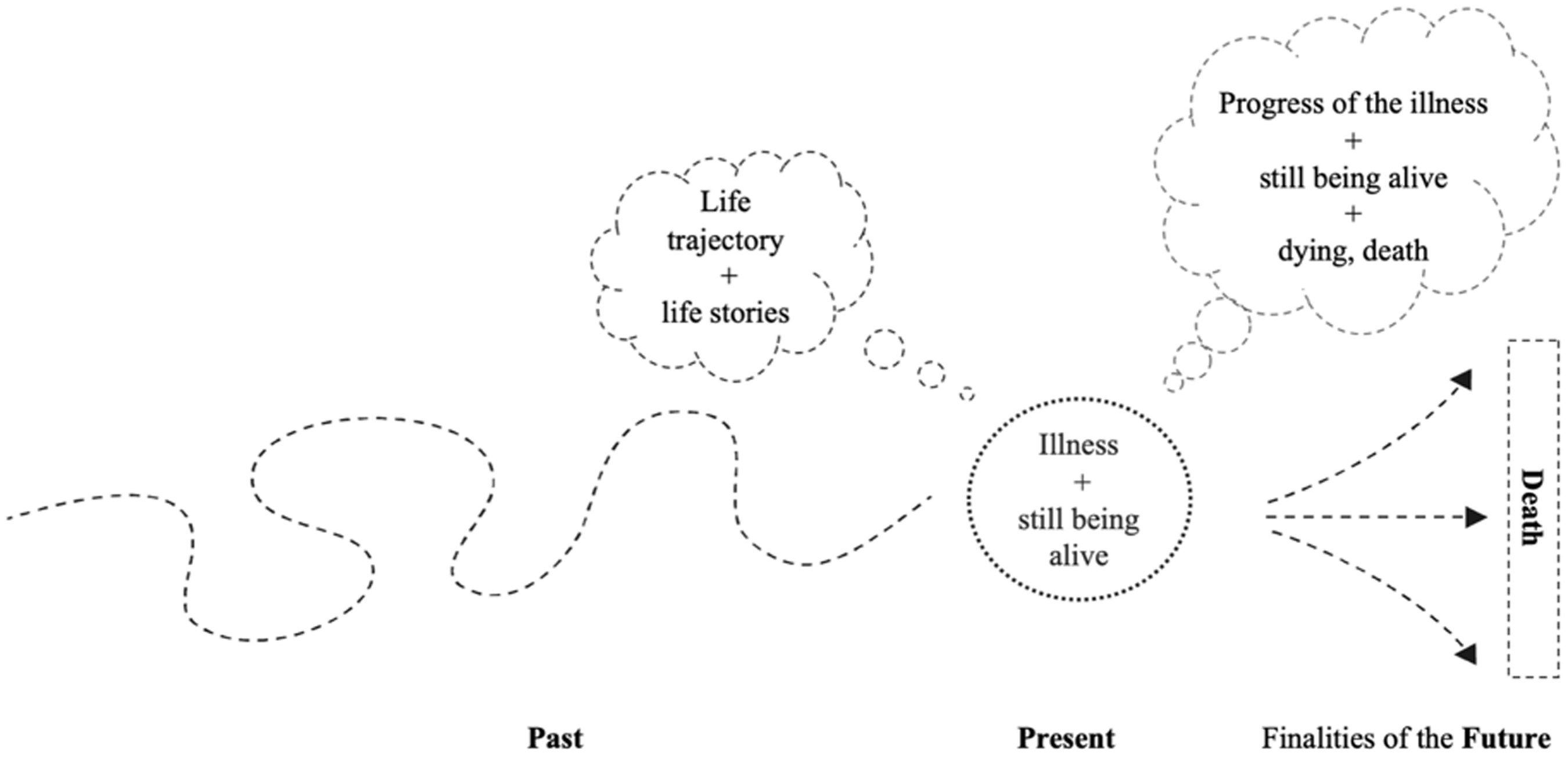
Meaning-making among older adults facing a chronic illness at advanced stage.
Meaning-making is a creative act that we humans use as a possibility to stand in opposition to physical and psychosocial constraints (Van Der Veer & Valsiner, 1993), and which involves both an effort to convey meaning to our experiences and to our existence (Lehmann, 2018a). However, the existential nuances of meaning-making are seldom acknowledged in developmental-cultural psychology. Both in the interviews and in the communication we have maintained along the last 15 months, Helena’s narratives give account of existential nuances in her meaning-making: still being alive while facing the illnesses she has, making sense of her life trajectory and life stories, and making sense of the progress of illnesses as well as of dying and death. For example, on the threshold to start a new treatment, she would say before leaving a call, “I might live another two years, and this I hope. Yet if I die now, as some patients do from the first dose of this treatment, you have all my instructions on how to continue with this article.”
Illnesses are a core example of boundary situations which confront human beings with death and, at the same time, are gates for living a more authentic existence (Yalom, 1980). These boundary situations are confrontations that invite human beings to expand the realm of their consciousness toward wider spectrums of understanding reality (Thornhill & Miron, 2018). Integrating existential perspectives reflects such a process as it invites the person to transform his or her beliefs, values, and goals by shifting attitudes of hope and courage (Wong, n.d.; Wong, 2012).
Bringing death back into the meaning-making scene
The awareness of the fragility and uncertainty of life which Helena’s story brings into scope inspires the other two authors of this article to reflect upon our own lives to build upon current perspectives in life course cultural psychology. For instance, Helena quoted her grandmother who used to say in Swedish “någo skäl ska ju döden ha,” “death must have a cause” when speaking of her own death. Death is an existential given, yet the meanings we attach to death and dying as well as the modes in which we accept and cope with their impending arrival has a great impact on our well-being (Wong, 2012). After all, recognizing ourselves as mortals can be a motivation to create a meaningful existence and use time effectively (Van Deurzen, 2012). This is the great potential for integrating humanistic and existential approaches to psychology, altogether with developmental-cultural ones. In the next section, we bring together some reflections upon life’s uncertainty and death, introducing some aspects of Mixo’s and Olga’s life stories, which we then link to the notion of EFPs in cultural psychology.
Rethinking the Trajectory Equifinality Approach: Existential nuances
The unfolding of our life trajectories in the midst of irreversible time involves the contrast between the lives we imagine we could live, and the life-stories we are making meaning of, while facing with constraining circumstances, by choice, chance, or catastrophe. The notion of equifinality indicates that any finality in human development could be reached through a diversity of conditions and paths (von Bertalanffy, 1968). Thus, the Trajectory Equifinality Approach (TEA, see Sato, 2017) gives scholars in developmental-cultural psychology a perspective to understand the ways in which human life trajectories differ (i.e., bifurcation points) and coincide (i.e., EFPs) (Zittoun & Gillespie, 2016). Given the realm of possibilities for the unfolding in human development, exploring the ways in which embracing uncertainty affects us as human being becomes crucial for developmental-cultural psychology. However, the notion of uncertainty could be treated as an existential given more explicitly when theorizing about human development. Experiencing uncertainty often involves tension between different positionings of the self. These positionings of the self are then in themselves vectors, rather than “static coordinates” of the landscape of the mind, which indicate a certain future orientation the person wants to afford despite the inherent tensions that the uncertainty of life brings in (Lehmann & Valsiner, 2017). One major existential given in relation to the uncertainty of life is our impending finitude. That is: There are only two fundamentally general equifinality points in each human life that are universally shared by all (birth, death). But in most psychological studies, these two points may not be investigated too often. (Sato, 2017, p. 186)
Embracing the desired, the undesired, and the impending nuances of life
Given the progression of Helena’s illnesses, and also given her age, 74 years in 2020, the questions of dying and death emerge as a mediator of meaning-making of her life. Reflecting upon her dying process, in tension with her sense of still being and feeling alive, the other authors considered the fragility of life in a deeper way. In addition to our reflections upon dying, which was our initial EFP, we also started to question what made us feel alive in opposition to it. We then found two other EFPs present in our process of collaborative reflexivity. Thus, in Figure 2, we zoom into our life trajectories and focus on three EFPs and their (expected) unfolding in chronological time: getting married (EFP1), having children (EFP2), and dying (EFP3). The figure also points at the crossroads between our life trajectories, such as when Mixo and Helena first met in Finland, and the latter one when both of them met Olga in Italy. The topics addressed in our communications served for further meta-reflections upon our developmental trajectories and our human condition. EFP1 and EFP2 appear as decisive processes in our experiences as women; processes that have taken or will take years to unfold, which evoke great degrees of uncertainty. For instance, the wish of getting married and being married long-term may involve a long developmental trajectory including breakups, dating, getting engaged, even divorces and the possibility of beginning anew, or even the death of one’s partner, such as in Helena’s case. Similarly, the wish of having children might involve trial periods to get pregnant, the fulfilment of pregnancy, abortions, artificial insemination, adoption, or even the acceptance of not having children even if that was desired, as in Helena’s case. Thus, Helena’s life trajectory shows that the meaning of life as a general existential process might be influenced by important and desired and undesired turns. Getting married (EFP1) is an experience which Helena and Mixo have had in the past, and which Olga wishes for in the present/future. Having children (EFP2) is an experience that Helena desired, Mixo is currently experiencing, and which Olga contemplates as a future possibility if she ever gets married (i.e., assuming the fulfillment of EFP1 as a precondition of EFP2).
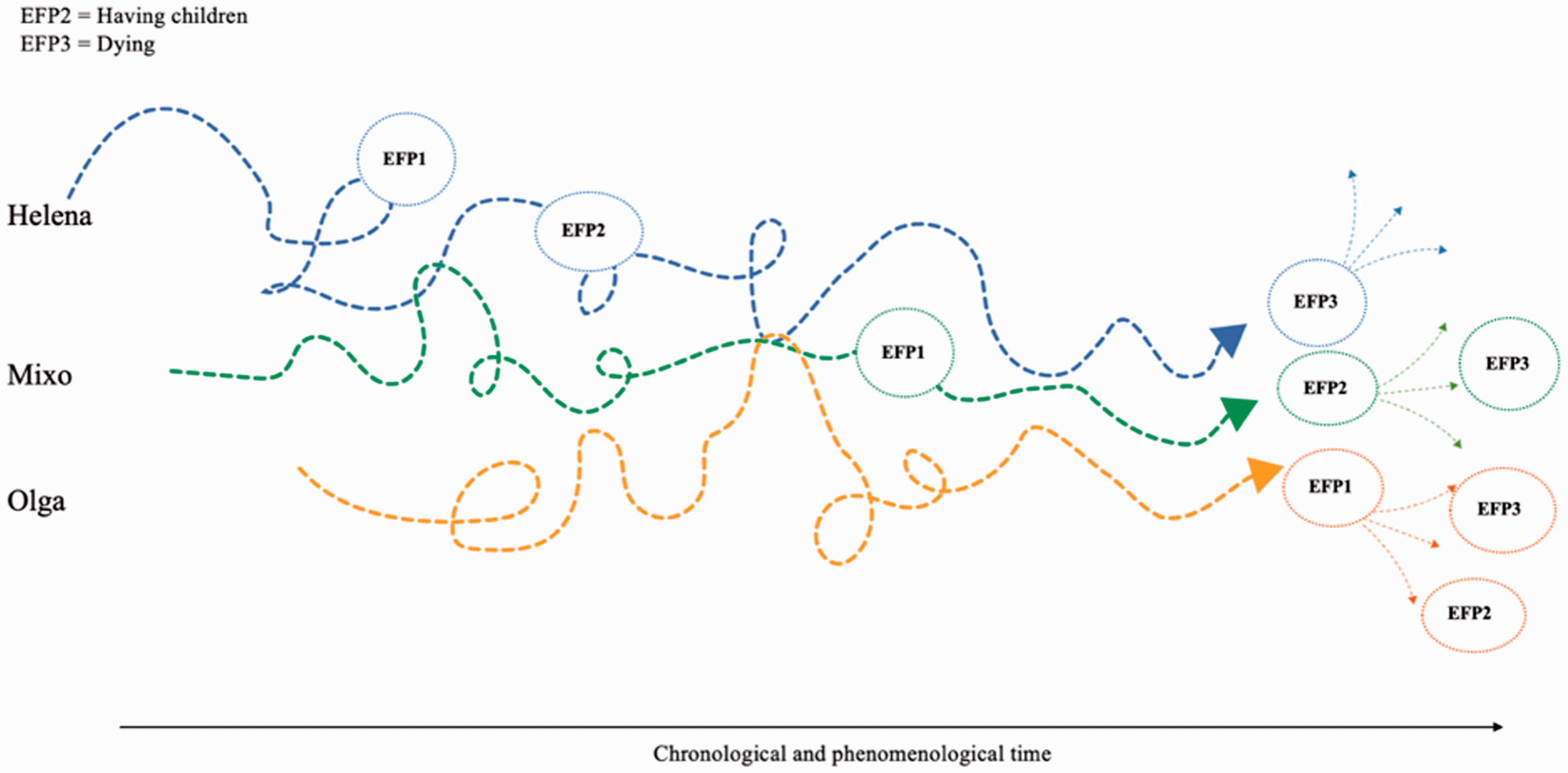
Equifinality points in diverse life trajectories. EFP: equifinality point.
Inter-generational dialogues as catalysts of existential meaning
The awareness of the diverse paths in which life unfolds, and which the notion of equifinality aims at theorizing, does not conceal in itself the struggle of accepting with patience and—sometimes with surrender—that imagined realities do not come (yet) to terms. However, such an awareness can expand our understanding and embracing of our human condition, making our struggles bearable; an opportunity to find new meanings in our lives. This inter-generational dialogue became a catalyst of experiential and existential meaning-making. Helena’s life trajectory shed light into diverse confrontations between desired and undesired experiences, such as having been in love many times in her life before and after being married, and now being a widow; or not having had children even if she wanted to. The process of collaborative reflexivity about such confrontations helped us to deconstruct our imagined life trajectories, which we experienced as ruptures in our imagined lives. In line with Abbey (2012), we consider the developmental dynamics of women as a process of distancing from social and personal constructions of what the life course should be about while overcoming ruptures and moving toward unpredictable realities. Our conversations, interviews, and exchanges made us aware of different crossroads of imaginary and desired trajectories and the realization of how ephemeral these are. That is, this process of meaning-making involved not only the desire for relational experiences (e.g., I-as-a-wife; I-as-a-mother) but also the awareness of the ephemeral character of these have (or have not) experiences.
Once again, during the process of writing the outcomes of our collaborative reflexivity, existential meaning flourished within us. Looking at our experiences of suffering, this way has also made us aware of the fragility and vulnerability and beauty of the human condition (Lehmann & Brinkmann, 2019b). For example, for Olga, revisiting her memories and desired life trajectories have been difficult. Her ideals of finding her soulmate are wishes which do not protect her from the uncertainty of life and the possibilities of this not happening as fast as she wants (if at all). Through the intergenerational dialogue with Helena, Olga found serenity to her desires as she reflected upon Helena’s courage, her activism, and how much she puts into staying up in her solitude. Helena has experienced uncertainties alike, both before getting married and after becoming a widow. Mixo has also been there, and her stories are also consoling, as she had similar wonders after the break-ups she experienced before meeting her current partner. In terms of the Trayectory Equifinality Approach (Sato, 2017), the experience of heartbreaks could be conceptualized as a polarized EFP. Heartbreaks are a finality which can appear in opposition to the experience of getting married. The nuance that we are adding into such theorization relates to the existential implications of desired experiences, such as getting married, and the undesired oppositions or contradictions, such as heartbreaks, which we are called to make sense of as we live. In addition, our process of collaborative reflexivity has served as a catalyst for existential meaning. It expanded our understanding of virtues, such as love. The longing for love and the experience of love relate to both the stories that had occurred to us, the way in which we remember they have occurred, as well as in the stories that had not occurred, or do not occurred as planned. After all, meaning-making processes take place in the dynamics between real and imaginary experiences (Zittoun et al., 2013). Shadow trajectories shape our development as well, them being imagined realities that do not come into term but that influence our meaning-making and decision-making processes (Bastos, 2017).
Virtues and personal life philosophies: Reconsidering the notion of values in developmental-cultural psychology
Our process of collaborative reflexivity made us aware of some desired realities that we share as women, such as getting married (to a good partner, not to whomever) and becoming mothers (and wanting to give birth and raise a healthy child). At the same time, our life trajectories put into perspective these ideals, through the lens of the existential question about the meaning of life. Helena’s life trajectory makes it evident that the existential nuances of meaning-making, such as embracing the meaning of life, can be experienced even if not having children or a partner (in the present, she is a widow). This insight sheds light into the existential nuances of meaning-making. This is so, since Mixo was trying to have children with her partner during the process of writing this article, and gave birth to twins just as this text was about to being published, while Olga had experienced a break-up at the onset of this article, and is now giving herself chances to date again. Even if undesired, nuancing uncertainty as an existential given can be liberating, as it can reconcile the tensions inherent to our human condition, becoming motivational: there is still a life to be lived and meanings to be fulfilled despite the constraints that challenged the ways in which we imagine and idealize our future. Through aging and reflection, we can embrace the ephemeral character the EFPs we have reached or those we imagined to reach but have not. In doing so, we can acknowledge that the meanings given to certain goals and experiences are transformed through time. Such existential nuances of meaning-making, touching upon the uncertainty of life and its transitory nature, could be addressed more explicitly in developmental-cultural psychology.
As part of the focus of the Life Story Interview (McAdams, 2008), we asked Helena about the values she has found consistent along her life trajectory. In answering such questions, she suggested that an existential meaning is afforded in the experience of values and not in the permanence of relationships. For example, a while after Helena had received her diagnoses, and already being a widow, she wrote on her Facebook wall It feels like I’m in love, but not in a man, but in life! Everything is so beautiful, all colors are clear, all scents are delightful … I wonder if this is a part of living with an incurable illness, but one doesn’t die directly?
Even if values are experienced through our sense of otherness (Frankl,1946/1985; Freeman, 2014), the ephemeral nature of our experiences does not define in itself the values we have embraced through them. On a theoretical level, this sheds light to a possibility for reconciling at least two of the ambiguities with which the notion of values is used in psychology. On the one hand, the literature about values in psychology seldom addresses the ways in which these values develop within cultural and personal dynamics over time (Branco & Valsiner, 2012). In a nutshell, such a focus on temporality could address the ephemeral character of life as an existential given, which can lead to a further appreciation of instants, and allow us to shape the meaning we give to our past, as well as the ways in which we embrace the uncertainty of the future. On the other hand, the relational nature of the experience of values brings in ethical considerations. In order to address more explicitly these ethical considerations, we support the use of the notion of virtues instead of values. We do so in order to highlight the philosophical inquiry about ethical matters which we undergo as human beings as well as to highlight the importance of cultivating and practicing “values” being what makes us virtuous (Lehmann & Brinkmann, 2019a).
Cultivating virtues as we age: Personal life philosophies
Helena’s narratives upon the values that she considers to be at the core of her life story bring into scene a notion in cultural psychology which requires further development: personal life philosophies. This notion, which holds particular relevance in adulthood, refers to the process of internalizing and transforming social guidance, often exemplified in terms of values that guide our life trajectories, fostering resilience as we face adversity (Zittoun et al., 2013). Personal life philosophies are also considered the process of synthesis of one’s past experiences and one’s imagined future, becoming a kind of signature of one’s life, often in not-conscious ways (Zittoun, 2017). Since “values become emotionally laden along ontogeny” (Branco & Valsiner, 2012, p. xii), we assume that personal life philosophies are closely related to the cultivation of virtues. By looking back into her biography, Helena condensed her life story as shaped by four virtues—curiosity, independence, courage, and love—which she pursues even in her current life situation. These virtues reflect Helena’s engagement in life and the ways in which the awareness of our impending finitude can catalyze the human quest to make effective and creative use of time so as to feel one is living a meaningful existence (Van Deurzen, 2012).
Curiosity
Helena grew up in a house with plenty of books to read. Nowadays, she still keeps the children’s books given by her mother. She has also been a passionate traveler and has learned many languages. After receiving her diagnoses, and reflecting upon the uncertainty of how many years she had left, she decided to start studying Spanish and is currently reading Moomin (a character in a series of Finnish children’s books by Tove Jansson) simultaneously in Spanish and Swedish, the original language of the books, so she can practice her Spanish. This sense of curiosity, in becoming motivational at this phase of her life, is a virtue that helps her feel alive and active, despite her awareness that death will come sooner rather than later. In her teenage years, she traveled alone to Hannover, through Sweden and Denmark, and stayed with some family friends of her dad, whom she herself had not met before. This interest in traveling and experiencing new adventures continued during her young adulthood. Helena made numerous trips and lived in Paris, in London, and in the United States of America. When she retired, she started a new adventure again. She sold her apartment and moved to a new city, Helsinki. At the age of 70, she also traveled alone to Scotland, where she rented a car and drove around for three weeks, so as to experience the country as much as possible. Again, as in the case of curiosity, Helena recalls this sense of adventure as motivational because it makes her feel alive and remember that she felt alive to the fullest in many occasions in the past.
Independence
In the early 80s, on her way back from London, Helena bought a computer in Holland, which was an uncommon acquisition at the time. Years after, while being in the United States of America in the early 90s for 14 months, she drove 22,000 km around to see New York and Washington. Her many stays abroad, Helena emphasized, gave her a profound sense of independence, which was also possible because she had a very understanding husband, who enabled her to feel free. Revisiting these memories of independence and recognizing the ways in which she aims at feeling independent despite of her health condition became motivational for her as well.
Courage
Through Helena’s life story, she has repeatedly perceived herself as courageous when meeting challenges and starting new adventures. She believes that a person can do almost anything, and lives by that belief. She says “you just have to start, use your head, and be persistent” and points at the same time to her dress that she just finished sewing. This is the courage she also lives by now with the diagnosis and prognosis of her illnesses. In addition, as she underwent different treatments, she learnt that the medicines she was asked to take involved great risks to her life, amplifying her sense of uncertainty and ambiguity upon her dying and death. “Now we have a real death-line,” she added one night as we met online to work on the article. Playing with words, she suggested that if she would die before this article would be finished, we would have enough information and perspective to continue and publish it, as this text would also be her legacy.
Love
Helena’s life story with her husband, and also with other men, reflect aspects of love that we seldom explicitly honor. Some of them relate to the transitions of romantic relationships, their ephemeral nature, and also the human capacity to fall in love several times during one’s life course. For instance, she reminds us of the ephemeral character of love, since her husband died years ago. Yet, she also reminds us that the meaning of love can be revived by focusing on special memories of serving, giving, and receiving. As she unveils secrets about her love life, we question the real and imagined trajectories of our own life as well. Helena, when listening, reassures us that life is a surprise and it happens in unexpected ways (i.e., following the premise of the Trajectory Equifinality Model), and that giving someone happiness, even if not necessarily in romantic terms, is one of the greatest ways of fulfilling meaning in life. Together, we reflect upon the fact that love as a virtue does neither depend necessarily of the outcome nor of the number of people who are addressees of our love, but about the act of loving in itself. That is: The answer to the riddle of love, if there is any, does not lie in pursuing this finality. There are possibilities to find meaning and purpose in life even when if life does not unfold as we had hoped and planned, and this is possible despite our experiences of love having had a price: waiting, heartbreaks, or confronting one’s sense of freedom. (Lehmann & Brinkmann, 2019a, p. 3–4)
As the process of collaborative reflexivity continues, Olga Lehmann in 2018 wrote this in her field notes: Being back to that beautiful hotel in Helsinki by the beach, and feeling alone. Then receiving the messages from my now, again, ex, for whom I have felt twice a love that is so deep and at the same time seems so impossible. He was so curious about Helena’s life, he has always been so interested about my life and my work. He is a fantastic listener. I write this because I am grieving. I grieve these beautiful months of re-encountering each other and ourselves. Everything is beautiful with this man, even our farewells. I’ve thought about him while doing the interviews, we even spoke briefly about him with Helena, as some of the stories about her lovers resemble him. Listening to Helena’s stories helps me to reflect a lot about romantic relationships, and decisions to be made in this area of my life. It impresses me the way in which sitting and listening to Helena reminds me that we human beings have the capacity to love again. She reminds me that the intensity of some love stories transcends the duration of the stories in themselves. The meaningfulness of some love stories is somehow independent of whether or not lovers stay together or not. This is the merging of the ephemeral and the eternal that some poets speak about, and that I am asked to embrace, once again. Perhaps what I learnt are that virtues such as love, that we pursue with ideals of their shape soften and question our human condition.
Such narrative turn toward integrating one’s personal life philosophies could even be considered a poetic turn (Lehmann & Brinkmann, 2019a). Opposite realities are like verses of a poem, the tune of which magnifies life, even in its paradoxical and tragic nature (Lehmann & Brinkmann, 2019a). Yet, we can reconcile with uncertainty and the tensions that coexist within as questions. Similarly, notions such as poetic motion already suggest that the fabrics of experience which are at the core of human development can be ambivalent and ambiguous (Abbey & Bastos, 2017). In addition, these narratives reflect also existential layers of meaning-making, as the meaning of life is more related to the cultivation of virtues, rather than to the permanence of relationships, jobs, landscapes, or stories. In the midst of the uncertainty that the diagnosis and prognosis of her illnesses represents, Helena turns toward her biography with the lenses of virtues that have been somehow consistent along her life course and which could give account of her personal life philosophies. Given that illnesses are boundary situations which confront us with death and invite us to live more authentically (Yalom, 1980), Helena appears to have catalyzed narrative and poetic turns as she makes meaning of her experiences and her existence.
Thus, the meaning of life, as existential psychology suggests, lies in giving ourselves to causes bigger than ourselves, such as loving independently of the ephemeral character of relationships, or creating legacies for others, even if those legacies are not “children” but other masterpieces (Frankl,1969/2014). This process of collaborative reflexivity enabled a collaborative merging of existential meaning, acknowledging how sharing our stories with others, in the bonding vulnerability of our narratives, shapes the way we perceive life. Therefore, in this article, we also illustrate the social guidance of both experiential and existential meaning-making.
Conclusive remarks
In this article, we have introduced a process of collaborative reflexivity, which, as a methodological tool, has enabled us as authors to explore the plurality of our identities while writing upon tender aspects of human existence, such as living, aging, and dying. We have aimed at contributing to the field of collaborative research by means of emphasizing the multivoicedness of the self as a resource in the processes of reflexivity and analysis of life trajectories. We have experienced such collaborative reflexivity to deepen the sense of companionship and understanding of the human condition.
Honoring the life of Helena Hurme as she makes sense of her life, her illness, and the nearness of her death enabled the other two authors, Mixo Hansen and Olga Lehmann, to also reflect upon their life trajectories and question their sense of womanhood, within the tension of imagined trajectories, and the real unfolding of their lives. Our collaborative merging of existential meaning enabled us to explore the relational and co-constructive nature of meaning-making as one leans into companionship and vulnerability. Building on this, we then discussed some premises of developmental-cultural psychology such as meaning-making, the equifinality model, and personal life philosophies. For Mixo and Olga, being in touch with someone at another developmental phase expanded their understanding of life itself and therefore their possibilities of meaning-making. We consider this intergenerational dialogue to have an educative function in triggering/activating thoughts that members of a younger generation would otherwise not have thought. It is possible that intergenerational relationships can catalyze such mixing of existential meaning, and further research could address the potential of such intergenerational reflections upon life.
The uncertainty of life and our impending finitude are existential givens. Facing incurable disease(s) is a boundary situation, which changes the course of life course, shaping our processes of meaning-making of experience and existence. As we age, the nearness of death is somehow more expected, even if not necessarily desired. This brings into focus the importance of imagination processes and shadow trajectories when addressing personal life philosophies. By questioning the tension between desired and imagined life trajectories, and the challenges we face as women to bring them into terms, we have also discussed the importance of exploring the existential nuances of meaning-making in developmental-cultural psychology. Love, for example, being one of the greatest questions of human existence, and one of the most challenging virtues to embrace—because of its complexity and because of its ephemeral character—invites us to connect with existential premises more consistently.
Similarly, EFPs such as getting married, having children or dying, are experienced differently among individuals. Even if dying is an unavoidable constrain to the life course, human beings have some degrees of freedom to make sense of other EFPs. Even if desiring to become wives or mothers and not being able to actualize this in the present, existential meaning blossoms in the process. These expansive nuances of meaning making can give us new answers to the questions about the meaning of love and the decision to give ourselves to other causes that make life fulfilling.
Last but not least, we have also argued that theories in developmental-cultural psychology could treat uncertainty as an existential given. In this article, we aimed at portraying some preliminary integrations between existential psychology and cultural-developmental psychology. These efforts are to be carried forward in the future. For instance, we have suggested that the act of revisiting our life stories can represent both narrative and poetic turns in meaning-making, as we surrender into the mysteries of life, and the coexistent tensions that form our everyday life experiences. Thus, efforts for integrating personal life philosophies are conscious narrative and poetic turns toward existential meaning.
Acknowledging these existential nuances is then crucial for the development of theories of aging in cultural psychology, which seldom focus on existential givens. Yet, the development of personal life philosophies does not belong solely to the aging phase, even if it covers special relevance there. There are some virtues and aspirations that are more generally present along the life course and others more related to the development of our personality. Our intuitions have been the beginning of a needed theoretical and empirical exploration, and more collaborative enterprises or comparative case studies could enhance the generalizations in this crossroad between humanistic-existential psychology and developmental-cultural psychology. In relation to this, a limitation of this process of collaborative reflexivity is that we did not explicitly address aspects such as gender and the cultural guidance of womanhood. It is possible that other historical and social aspects of meaning-making might influence the arguments that we developed here.
All in all, this article could lead to a change in how developmental-cultural psychology tackles aging methodologically and theoretically, as views on death and dying are seldom addressed in their dialogical and dialectical dance with life. The question is: how do we create meaning between different truths, design our life as a whole, as a totality, based on the inherent tensions between life and death which permeate our life course? To us, it seems that virtues such as love, and attitudes such as hope, are the ink with which we can craft the narratives and verses of our personal life philosophies and let life happen through and with us across aging.
Footnotes
Acknowledgements

Declaration of Conflicting Interests
The author(s) declared no potential conflicts of interest with respect to the research, authorship, and/or publication of this article.
Funding
The author(s) received no financial support for the research, authorship, and/or publication of this article.