



Abstract
Endings give meaning. We read significance into stories—moral, political, analytical, biographical, historical—from how they conclude. Politics too is in this sense shaped or defined by eschatology: the possibility that the present story has a terminus and may be approaching it. Drawing on philosophy of history and literary theories of narrative structure, we argue International Relations (IR) theorists must take endings seriously as core aspects of how we construct theories to make sense of world politics. We develop a typological account of how endings shape historical theories in IR. We distinguish endings as either optimistic or pessimistic and as either determinate or indeterminate. This yields a two-by-two matrix, in which endings are classified as triumphalist, catastrophic, disenchanted, or renewalist. We unpack these with historical, theoretical, and literary examples. We then consider a countervailing approach, in which theorists attempt to refuse or reject endings. We consider two strategies of refusal: repetition and counter-narrative, again illustrating with examples. We conclude with a brief discussion of implications for historical research in IR.
Introduction
Theories tell stories. Stories conclude—they end, usually in consequential ways. Endings in turn give stories meaning. 1 Scholars and publics alike read significance into narratives—moral, political, analytical, biographical—from how they conclude. Comedy and tragedy are defined by their ends. Political life too is shaped by eschatology: the belief that the present story has a terminus and may be approaching it. These political stories are marked by the search for a good ending, fear of a bad one, or attempts to forestall conclusion altogether. Like journeys, political stories are defined by their final destinations—even if their narrators and participants try to reject, refuse, or evade them.
This article argues that, to take history seriously, International Relations (IR) theorists must take endings seriously, too. 2 Where narratives are globe-spanning, endings may be as well, signaling the ends of eras, empires, or forms of international political life. Public discourse in world politics today features eschatological talk—of epochal conflict between democracy and autocracy, or apocalyptic dread about catastrophic threats (Avin et al., 2018; Sears, 2021). We argue that the meaning-making power of endings makes them central to IR’s many theoretical narratives.
Core IR theories commonly imply endings, although they may be ambivalent in doing so. We develop a typology of them, showing how they shape theories. Liberals, for example, imply optimistic endings to their gradualist narratives of progress (Keohane, 1984) or theorize a democratic-capitalist “end of history” (Fukuyama, 1989). Realists often confront what Alison McQueen (2018: 8) calls “apocalypticism,” sometimes rejecting it and other times participating in it themselves. Nuclear apocalypticism motivated some realists toward “one worldism” (Deudney, 2019). Among constructivists, Alexander Wendt (2003) plots an eschatological transcendence of anarchy through a world state that is both inevitable and normatively good. Critical theories often face a tension between critiques of grand narratives and normative commitments to revolutionary, liberatory eschatology (e.g. Ashley, 1986; Burke et al., 2016).
Endings are central in historical IR, too. Work on pre- or early modern international orders often ends with encroaching modernity, as when East Asian and western-centric world orders collide (Kang, 2010). Ayşe Zarakol (2022) encourages her readers to imagine a counter-narrative in which East Asia, not the West, “experienced . . . radical lift-off in the nineteenth century” (p. 1), producing a different outcome. Most starkly, histories of Indigenous dispossession are in effect stories of worlds ending. Some Indigenous accounts thus locate themselves in postapocalyptic time, or treat ambiguously the possible end of the present world (Mitchell and Chaudhury, 2020).
To map these possibilities, we develop a typology of historical narrative endings, varying on two dimensions. Endings may be optimistic or pessimistic, on a given theory’s own terms: one may want to either pursue or avoid them. Endings may also be either determinate or indeterminate in their specific content. A determinate ending leaves the narrative world in an unambiguous state. An indeterminate ending leaves the scope of possibility substantially open. Endings then take one of four forms: triumphal (determinate and optimistic, ending in victory or transcendence), catastrophic (determinate and pessimistic, ending in disaster), disenchanted (indeterminate and pessimistic, ending in uncertain disillusion or loss), or renewalist (indeterminate and optimistic, ending in uncertain potential or possibility). We unpack and assess the four, showing their limits and possibilities. Endings, like theories themselves, are plural. We may have “wagers” on which is right, but the field has no easy consensus on them. 3
All narratives emerge from one another. They are intertextual and relational. 4 We thus also identify two common strategies of narrative change or contestation that take advantage of this relationality to forestall, evade, or invert given endings, rather than inscribe them. The first proceeds by reversion or cyclicality, aiming to reimpose past conditions or render narratives cyclical and thus chronic, resisting transformational endings. Some realists thus hope to forestall a disastrous ending be repeating political dynamics indefinitely. Other stories, such as those promoted by today’s populist right, promise a permanent return to an idealized or mythologized past.
A second strategy poses a revisionist counter-narrative. Here, one reframes or replaces an existing, perhaps hegemonic, narrative arc from outside it, inverting and challenging its claims. The result changes the story’s meaning. Enlightenment theorists sought to replace Christian eschatologies with modern, progressive ones. Postcolonial theorists likewise critiqued modernity’s narratives through the construction of their own counter-narratives (Said, 1979). More recently, Indigenous authors take this approach when they problematize Western eschatologies by noting their own lifeworlds are already substantially postapocalyptic (e.g. Dillon, 2012: 9).
These revisionist strategies overlap with each other—and our typology. Narratives come into being and pass away in intertextual relation to what they critique or reject. Whether a given narrative is hegemonic or revisionist often stems from the internal presentation of the narratives themselves. Illiberal reactionary narratives, for example, challenge liberal triumphalism but may at the same time promise a permanent return to glorious past—an alternative triumphal ending that emerges from its critique of the liberal one. Rather than give a full account of this narrative relationality, our ideal types aim to first clarify the messy practice of storytelling by isolating endings and modes of revision.
Our argument has at least three implications for the field. First, we clarify how endings shape theoretical accounts of world politics. Second, we show how endings shape the range of possibilities in the field, past and present, disclosing some while concealing others. Third, our argument helps explain how the field has handled the possibility of catastrophe—past or future—as existential concerns of planetary scale move closer to the center of its focus.
We proceed in three sections. We first unpack the theoretical role of narrative endings in IR, recovering theoretical resources from theorists of history and literature. Second, we develop a typology of narrative endings in the field. Third, we consider reversion or repetition and counter-narrative as strategies for resisting narrative terminus.
IR and endings
Narrative scholarship is now widespread, both in IR and across the social sciences. While it defies simple categorization, throughlines include examinations of how narrative structures knowledge and suggestions of often radical new lenses in the study of world politics (Dauphinee, 2015; Kessler and Leira, 2024; Kuusisto, 2019; Ravecca and Dauphinee, 2018; Roberts, 2006; Suganami, 2008). 5 Narratives create meaning—for subject, researcher, and reader alike—against a background of putatively “empty” or natural time. As Benedikt Franz (2022) writes, “narratives synthesize, create continuity, differentiate within this continuity and, finally, inversely read beginning and end” (pp. 762–763). Stories on this account are the “organizing principle” for life: “human beings think, perceive, imagine, and make moral choices according to narrative structures” (Sarbin, 1986: 8).
Scholars of narrative in IR theory have mapped its major traditions and concepts across dominant narrative themes and plot structures—realism as tragedy akin to King Lear and Oedipus Rex, for example (Kuusisto, 2019: 18–36; see also Freistein et al., 2024; Prochniak and Nitoiu, 2023). Riikka Kuusisto (2019: 10–14), like Hayden White (2014), draws a typology of genre, and thus endings, from Northrop Frye (1957). Others have given IR-oriented accounts of specific literary genres, from gothic (Devetak, 2005) to satire (Hall, 2014), melodrama (Levine, 2019), and beyond (Ringmar, 2012). Here, we turn from stories’ middles and beginnings to their ends. Stories’ endings signal completion. They close off a given narrative as finished (Kermode, 2000). They thereby imbue meaning. In “Western narratology’s founding text” (Davis, 2012: 7), Aristotle emphasizes not only the importance of story but the completeness of the action depicted. 6
Attention to endings broadly conceived is not in itself new in IR. “The End of History,” for example, was a central prop for debating the end of the Cold War (Fukuyama, 1989). The history of the modern international system was often recounted as the convergence of different regional systems on the logic of the modern, Eurocentric one (e.g. Bull and Watson, 1984), a narrative now much contested (Buzan, 2014: 60–75; Getachew, 2019; Phillips and Sharman, 2015). Endings may also function as framing devices, as with a special issue of this journal on the “end of IR theory” (Dunne et al., 2013). Multiple recent studies deal with existential threats (Sears, 2020, 2021), apocalyptic storytelling (Aistrope and Fishel, 2020; Mitchell and Chaudhury, 2020), and related eschatological matters (Simangan, 2023). Yet the theoretical role of endings—the narrative devices with which all stories conclude—has received less attention in IR. This is surprising because the field’s theories, especially historical ones, tell stories. 7 Stories, in the most basic sense of the word, are contained things, with a beginning, a middle, and an end. 8
To theorize all this, we focus on contributions by two 20th-century narrative theorists: Hayden White and Frank Kermode. White provides perhaps the most widely cited account of narrative structure by a historian and a frequent starting point for narrative IR scholars. Drawing on literary criticism, White developed an account of narrative-building by historians and philosophers of history. Structuring historical narratives into genres—what White calls “emplotment”—generates the range of possible endings. Stories, to count as stories, must be structured by rhetorical devices that signal beginning, changing, and ending. The terminating motif that closes a story invests it with significance: the final state of play provides a basis for assessment or judgment. Only the ending, that is, can fix meaning durably. 9
Drawing on sources from the Book of Revelation to Sartre, Kermode (2000) aimed to explain how and why endings shaped a given narrative’s overall significance. Kermode argued literary and historical storytelling are motivated by a desire to invest human life with meaning, by locating it in the largest narrative structures. For Kermode, individual, historical human life finds meaning in end-states: in the conditions produced at a given story’s terminus. 10 Human beings find themselves in midstream, born into and dying out of a world already ongoing. To give their lives meaning, they attempt to locate themselves with reference to larger historical patterns of beginnings and endings: “to make sense of their span they need fictive concords with origins and ends” (Kermode, 2000: 7). 11 This leads them to locate themselves temporally on eschatological terms—that is, in relation to a bigger, broader ending and its significance.
It seems to be a condition attaching to the exercise of thinking about the future that one should assume one’s own time to stand in an extraordinary relation to it . . . We think of our own crisis as pre-eminent, more worrying, more interesting than other crises (Kermode, 2000: 94).
The stories we tell about our times tend to render them final and thereby meaningful. Yet because they are in practice situated in a given historical context, “The End they imagine will reflect their irreducibly intermediary preoccupations” (Kermode, 2000: 7). Their imagined endings will carry a social load from the times in which they were conceived. For Kermode however, unlike Frye and his descendants, not all stories offer simple, unambiguous endings. Modernist literature’s endings are often ambiguous or indeterminate, perhaps reflecting ambivalent experiences of the modern world. Below, we aim to capture these as well.
Kermode’s concern for endings is eschatological. 12 His diagnostic example is the Christian theological apocalypse, an ending that provides absolute closure (Kermode, 2000: 5–13). He suggests all narrative endings prefigure or stand in for big endings associated with the ends of epochs, ways of life, or human history. Endings in general give meaning by standing in rhetorically for endings on a grand scale. When the story scales up to the world, what ends is the world itself, or whatever large part of it is significant to the theory. Endings, desirable or otherwise, allow the storyteller to invest stories with significance: large endings generate meaning on a large scale. Kermode (2000: 43, 51) aims to explain narrative structures in fiction as well as, he strongly implies, historical narrative-building. He thus explains not just how stories work internally, but how they acquire significance in the world.
Kermode (2000: 12) also invokes a specific, pre-apocalyptic moment he terms the “transition,” in which the ending becomes evident and thus subject to anticipation and analysis. 13 It is “the historical ancestor of modern crisis”—that is, its secular correlate is a historical moment in which an epoch or long process appears to face collapse or terminus (Kermode, 2000: 28). Such periods see predictions of catastrophe or political narrative completion—for example, the disasters of climate change and the liberal-capitalist “end of history.” In Marxist analysis, the phrase “late capitalism” captures something similar. When the end seems at hand, discussion, theorization, and anticipation of it—for good or ill—flourishes.
Despite his apocalyptic focus, neither international theory nor Kermode’s account necessitate scale. His analysis implies not that larger endings actually matter more, but that smaller, more local, more personal endings acquire meaning by analogy or linkage to larger, more apocalyptic ones. The task of narrative-building, and especially ending making, is to invest individual, often idiosyncratic experience with meaning. Similarly, feminist and ethnographic scholars of “everyday” IR know well that quotidian and otherwise specific experiences of the international are no less significant for not operating at a vast scale. 14 Storytelling invests research on the local and the specific with powers of meaning-making, linking them to larger phenomena or greater numbers, or investing them with autonomous narrative significance of their own.
Endings are narrative or theory-building interventions, not features of the world or the historical record as it “really is.” What matters is not the bare record of events, but how storytellers shape an ending that produces meaning. History requires endings as matters of analysis and narrative making. In what White (2014) calls “the unprocessed historical record” (pp. 5, 182), few if any endings are matters of brute fact. Instead, they are made things, marked by how and why we construct our theoretical stories. Graham Greene (2004) begins a story putatively about an ending by telling us that “A story has no beginning or end: arbitrarily one chooses that moment of experience from which to look back or from which to look ahead” (p. 1). Paraphrasing Quentin Skinner (1969: 52), we must make our endings for ourselves.
Once made however, endings are powerful things, motivating belief and action alike. Endings make meaning by foreclosing—tying off and concluding—their own central features. Biographies, except those of the living, all but necessarily end with a death. Histories of major world political events must determine when and how an event concludes. While later events may be related, the marking out of an ending necessarily places them outside the story. As Cormac McCarthy (2022) has a protagonist muse inwardly, The problem is that what drives the tale will not survive the tale. As the room dims and the sound of voices fades you understand that the world and all in it will soon cease to be. You believe that it will begin again. You point to other lives. But their world was never yours (p. 337).
No secular ending is absolute—other things go on, elsewhere. Yet if we locate ourselves in the stories we tell, their conclusions are necessarily the ends of something central about ourselves. They are thus unavoidably important.
Endings in international theory—a typology
We distinguish endings in IR theory on two dimensions. First, endings may be either optimistic or pessimistic, by the lights of the broader theory in question. Second, they may be determinate (unambiguous) about the ending’s specifics, or indeterminate (ambiguous) about them. Categorizing endings allows us to compare and critically assess them. We aim for a typology of endings only, not of narratives as such. Like other typologies, ours unavoidably simplifies. We hope that what it costs in nuance, it pays in clarification and insight.
The first distinction classifies the general outlook of an ending: its optimism or pessimism. Canonically, this distinguishes whether the central players in the drama come to some form of accord and productive, desirable settlement or are unable to do so—as for example in comedy and tragedy. 15 Optimistic endings result from stories driven, structured, and animated by problems open to some form of positive resolution. Elizabethan comedy, for example, runs largely on misunderstanding, mistaken identity, blocking actors, and the like. Comic plots are resolved—ended—when these confusions are rectified. Pessimistic endings result when the drivers of dramatic conflict are too great to overcome. In tragedy, a salutary ending is foreclosed by some combination of structural constraint—antithetical choices between “legitimate but incompatible goods” 16 —and individual mistake or “tragic flaw.” 17 While optimism and pessimism are not limited to comedy and tragedy, they are exemplified by these two narrative forms.
A second distinction deals with the determinacy or specificity of the ending. Some stories end with a clear and conclusive terminus: birth, death, or another core event in human life. Others are comparatively uncertain. They place only loose constraints on what might follow the story’s end. Determinate, unambiguous endings are associated with the classical dramatic forms. The deaths of Hamlet and Macbeth, and the marriages that end many Shakespearean comedies, provide closure, leaving relatively limited uncertainty about the conclusiveness of the course of events. Hamlet is “tragically divided between antithetical realms of value” (Cantor, 2017: 152), the pagan and the Christian, that truck no resolution, forcing a tragic ending. By contrast, some later narrative forms elide clear outcomes, only gesturing at an end state. While an ending unavoidably implies some final state of play, it may feature considerable uncertainty. Complete refusal of narrative closure may be impossible. A finite story must end somewhere, likely reflecting some meaning, however oblique (Kermode, 2000: 129). In literature, Kermode (2000: 101–18, 133–52) finds limit cases in the modernist poetry of T.S. Eliot and Ezra Pound, the beat novels of Jack Kerouac and William S. Burroughs, and Jean-Paul Sartre’s Nausea. Theoretical equivalents might include non-linear approaches such as poststructuralism and cognate critical theories.
These two distinctions yield four types or tendencies (Table 1) in which many standard theories, in whole or part, can be usefully categorized: triumphalist, catastrophic, disenchanted, and renewalist. The first two correspond to the stories and thus endings Frye and Kuusisto term epic or romantic and tragic. The second two correspond to more ambiguous endings described in Kermode. The resulting types are not absolutes. They reflect analytical ideal typification, not fixed or fluid realities. Importantly, while some theories neatly fit a type, others fragment across them. The typology thus serves to intervene critically in standard accounts, showing where they are ambivalent about their narrative and eschatological commitments. (Below, we argue this is true of some forms of both liberalism and realism.)
Typology of endings in IR theory.
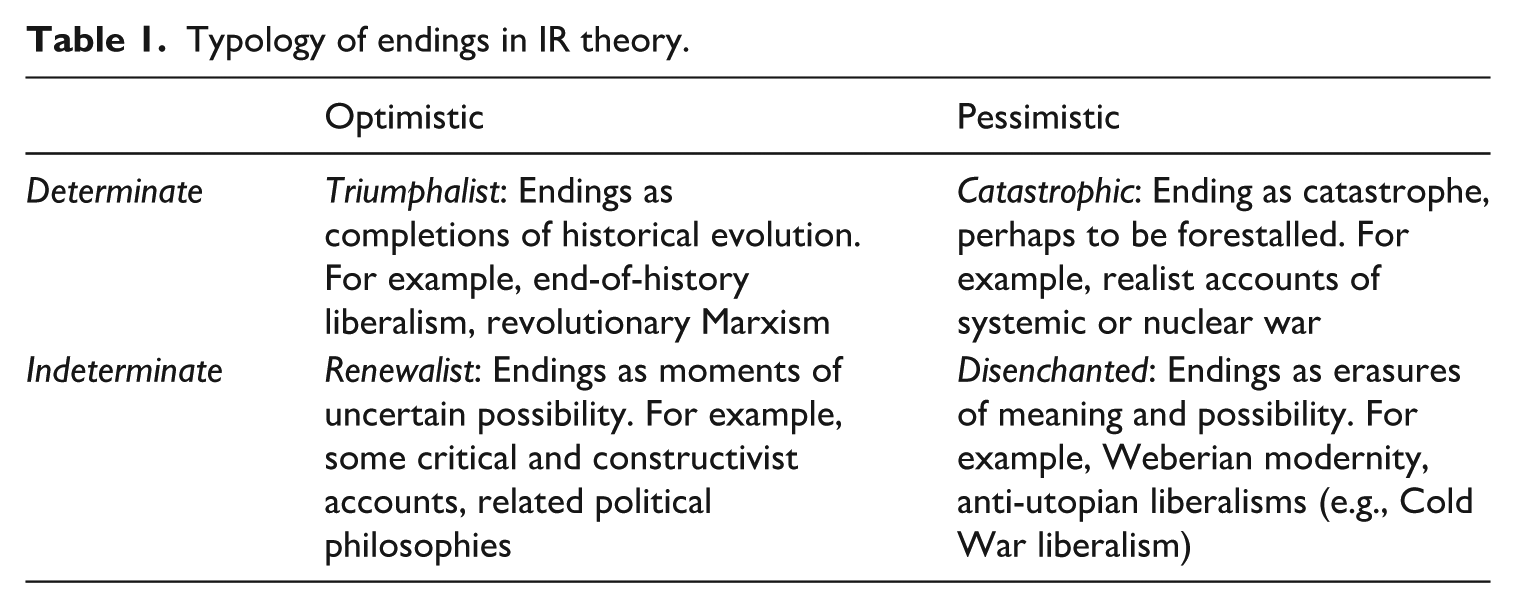
The typology is, unavoidably, not exhaustive. There are edge cases and cases that do not fit easily. 18 Some theorists bridge types, telling complex or polyvalent stories. In literary fiction, “Exclusive concentration on one form is rare” (Frye, 1957: 312).Others obstruct or refuse endings. We deal with these in the paper’s penultimate section. More broadly, narratives are relational, emerging from one another in contribution, adaptation, appropriation, and critique, creating a “messy” reality. By simplifying and isolating that complexity, our typology clarifies the range of recurring endings and how they shape IR and adjacent theories, past and present.
Triumphalist
Triumphal histories construct determinately optimistic or simply happy endings. For example, the victory of a putatively just ideological project may be understood as the “completion” of an evolutionary or dialectical historical process. Modern adherents include Hegel, Marx, and their liberal and radical descendants. The classic liberal variant is whig history: the reading of history as a progressive line toward greater freedom and justice, with scant attention to complexity or contingency, culminating teleologically in the modern liberal, constitutionalist British State (Butterfield, 1931). While the specific content of their endings varies, these theories do not differ in imagining a philosophical “completion” at the end of modern world history. In them, central matters come to a good, desirable conclusion, instilling optimism about anything after. While some questions may be left unanswered, these endings aim to answer those framed as most important. Marx famously says little about post-revolutionary politics. On Hegelian grounds, he suggests few of their specifics are predictable. Yet what matters is the eventuality of the revolution itself. On this, he was in little doubt.
In recent decades, the most famous and programmatic triumphalism is that of the liberal-capitalist “End of History,” derived in large part from Alexandre Kojève’s (1980) “Universal and Homogeneous State.” Francis Fukuyama (1989, 1992) argued the history of political ideologies ended with the victory of liberal-democratic capitalism in the Cold War. This ending, he claimed, completed an ideational historical process in which modern political ideologies, chiefly liberalism, fascism, and communism, had contended for global dominance. Western, liberal-capitalist victory meant the important, capital-H aspects of human history had ceased. Much would follow, but its history would be of secondary significance.
We find shades of Fukuyama in much liberal IR theorizing, though previous triumphalism is now more qualified or cautious (e.g. Ikenberry, 2024). Liberal peace theorists depict its development as a decisive historical break over the geopolitics of previous eras (Ikenberry, 2018; Moravcsik, 2020; Schake, 2022). 19 Drawing on Kant’s liberal philosophy of history, they present liberal internationalism as a kind of final stage of international politics—though how encompassing liberalism becomes, and the violence this portends, varies by theorist (Doyle, 2011; Russett and Oneal, 2001; cf. Behnke, 2012; Jahn, 2013; Lawson and Zarakol, 2023).
Perhaps because it is most explicit about its liberal triumphalism, Fukuyama’s thesis has been widely critiqued, mocked, and sometimes rehabilitated (Luban, 2015). Narrative endings are themselves often contested. We mark them in part by disputing their meanings. Endings, like theories, are also “always for someone and for some purpose.” Both are seen from a standpoint definable in terms of nation or social class, of dominance or subordination, of rising or declining power, of a sense of immobility or of present crisis, of past experience, and of hopes and expectations for the future (Cox, 1981: 128).
The victory of liberal capitalism was a triumph for its partisans. For committed communists and fellow travelers, it was something else entirely. Whatever the wrongs of the Soviet system, the passing of an entire ideological project of social, economic, and political solidarity was a kind of catastrophe for its supporters: the loss of the possibility of a different political ideal. Thus, for the political theorist Jodi Dean (2019), “The end of comradeship is the end of the world: nonmeaning, incoherence, madness, and the pointless, disorienting insistence on the I” (p. 135). Observers may thus agree that something has ended yet disagree entirely on what that ending means. For those not victorious in a world-historical struggle, the ending may belong not to this section, but to the next.
Catastrophic
Some narratives end in disaster: existential or cataclysmic challenges to human societies, locally, regionally, or globally, sometimes termed existential risks (Sears, 2020, 2021). Such stories are sometimes told by those hoping to prevent disasters such as catastrophic climate change, or global nuclear war—or by reactionaries who hope to stave off or reverse social transformations they see as catastrophic. 20 More recently, others focus on rogue AIs or other technological threats. Catastrophe is also the ghost that haunts IR’s modern founding. The field’s early postwar founders—liberal and conservative alike—imagined themselves as planning or theorizing in part to avoid catastrophic future wars (Carr, 2001; Mitrany, 1948). Catastrophism then is most readily associated with anticipated events—from nuclear war to global pandemics to climate change—and with preventing them. These real or imagined events need not be treated as inevitable. As critics note, to catastrophize about something is an analytical decision. Others in and around early IR rejected that catastrophism in part with counter-narratives that de-exceptionalized Europe as a site of 20th century catastrophies (below we take WEB du Bois as an example).
Crisis has a modern philosophical history of its own. Reinhart Koselleck (1988) mistrusted crisis as a form of secularized religious eschatology, repurposed to ideological ends—a reading he derived from Karl Löwith (1957). For Koselleck (1988), “crisis and the philosophy of history are mutually dependent and entwined” (p. 12). 21 Building on Koselleck in IR, Helge Jordheim and Einar Wigen (2018) argue that the temporal ordering work done by the concept of progress is perhaps being replaced by the concept of crisis or crises. Thus, world politics is increasingly ordered by attention to decisive moments, involving sharp temporal breaks, rather than gradual change. It is to this sense of crisis or impending disaster that catastrophic theorizing responds—a move Koselleck and others caution against.
The locus classicus of catastrophic thinking in IR is nuclear war. Standard accounts that center balancing and deterrence tend to downplay the prospect of an actual nuclear exchange. Many key IR figures here are realists and their close peers. Nuclear optimists and deterrence theorists tell a story about prospective Armageddon aimed, through their telling, to make actual nuclear war unthinkable. 22 Here, the prospect of catastrophe does both political and narrative work, making elites unlikely to do the unthinkable (see refusal by repetition, below). However, their critics tell alternative stories, in which misjudgment, organizational failure, or technical fault make deterrence unreliable—and a catastrophic nuclear ending possible (Pelopidas, 2017; Sagan, 1995). Here, politics is ordered by the possibility of an ending in nuclear catastrophe. We tell all such stories for political reasons: to raise warnings and render catastrophic events less likely. As Günther Anders (1962) prophesized, “although at any moment The Time of the End could turn into The End of Time, we must do everything in our power to make The End Time endless” (p. 494).
The other now-standard site of catastrophic storytelling is climate change. Thus, Bentley Allan (2017) explains how, among scientists, climate change became seen as “second only to nuclear war.” Environmental scientists point to the potentially catastrophic ecological damage of uncontrolled climate change, and the phenomenon is often grouped with other anthropogenic threats that pose catastrophic or existential risks to humanity (Avin et al., 2018). The “2023 state of the climate report” uses the words “catastrophic” and potentially “existential” to describe expected future effects of unchecked anthropogenic global heating (Ripple et al., 2023: 848). The Intergovernmental Panel on Climate Change (IPCC)’s latest synthesis report, though it does not use the term “catastrophic,” notes the widespread biodiversity and environmental loss threatened by climate change: “impacts on some ecosystems are approaching irreversibility” (Lee et al., 2023: 5).
The work of making those effects legible involves storytelling: the process of giving narrative form to political and environmental processes and events. We see this in part in disagreements over the specific political structure and plot points of the narrative. While classic accounts treat climate change as a collective action problem, prone to free-riding and bargaining failure, at least one recent study attributes failure to specific economic actors refusing to support emissions reductions—in effect, furnishing the story with villains (Aklin and Mildenberger, 2020). Such stories share an ending in unprecedented anthropogenic climate disaster. Nonetheless, how we tell the story matters, for who it blames and how the ending is disposed toward them.
Disenchanted
Where stories end in pessimism but also ambiguity, they offer a general direction of travel, but no firm closure. This is likely the orientation of much modern or modernist literature, which concludes with little certainty. Disenchantment, broadly defined, is the parallel terminus in social theory. Max Weber wrote that modernity was marked by “the disenchantment of the world”: a loss of the sacred. 23 If apocalypticism is associated with messianic faiths, then their loss involves a loss of finality. Pessimism may persist in modernity. Yet the indeterminacy of the secular makes for narrative formulations that are often more oblique than apocalyptic. Fictional endings in disenchantment vary—on average, they are “dull but safe.” 24 They leave open chiefly prosaic possibilities: in their darker forms, endings “not with a bang but a whimper” (Eliot, 1934: 128). 25 Following Weber, such stories may foreground the replacement of theological meaning, with the grind of the modern, secular world. They terminate, but with little conventional satisfaction. Samuel Beckett’s (1954) Waiting for Godot, a canonical modernist drama, ends pointedly without resolution—a sanctifying arrival that never comes.
In IR, this mode surfaces in the modern disenchantment of bureaucratic politics, prone to stabilizing permanence. Michael Barnett and Martha Finnemore, drawing on Weber, describe the bureaucratic pathologies of international organizations (IOs), in which patterns of narrowing or fixity make deep change unthinkable. They find IOs force-fitting existing scripts to new problems. IOs “necessarily flatten diversity because they are supposed to generate universal rules and categories that are, by design, inattentive to contextual and particularistic concerns” (Barnett and Finnemore, 1999: 721). Similarly, Ernst Haas (1991) shows IOs often fail to both adapt and to transform themselves across periods of historical change. 26 Recently, other scholars have turned to standardization and technocratic forms of rule in universal, modernizing narratives that destroy or conflict with local context (Steffek, 2021; Steffek and Wegmann, 2021). Even diplomatic interfaces may become rigid and hierarchical. Describing constraints on small state diplomats at NATO Headquarters, Vincent Pouliot (2017), quoting Erving Goffman, shows they find “much to be gained from venturing nothing” (p. 125). With incentives stacked against change, participants fall into lockstep. The narrative ends in attenuation, with the future holding only circumscribed possibilities.
Disenchantment also sometimes surfaces at the margins of more determinate endings. Fukuyama (1989) ends by noting the sting in the tail of his own triumphalism, adding a note of ambiguity to Kojève (1980).
27
“The end of history will be a very sad time,” Fukuyama (1989) writes, in which “Historical drama” will be replaced by economic calculation, the endless solving of technical problems, environmental concerns, and the satisfaction of sophisticated consumer demands. In the post-historical period there will be neither art nor philosophy, just the perpetual caretaking of the museum of human history (p. 18).
History here ends with the victory of “last man” Weberian administration and material accumulation over the “immense wars of the spirit”—or results in the return of “bestial ‘first men’” who wage “bloody and pointless prestige battles, only this time with modern weapons” (Fukuyama, 1992: xxiii, 328, 318–320, 300, cf. 387n13). Elsewhere, Fukuyama (1992: 334) argues that no “socioeconomic system” can satisfy all people: “those who remain dissatisfied will always have the potential to restart history.” Possibilities remain, but few compelling ones.
Renewalist
Sometimes the outcome is ambiguous and circumspect, but also optimistic—defined by indeterminate possibility or potential. These renewalist endings probe the uncertain and unexpected to find potential transformation beyond that of the story’s main action. China Achebe’s (1988) final novel, Anthills of the Savannah, ends on such ambiguous terms. The book follows political intrigue in an unnamed West African state, after a military coup. It ends with the assassination of a radical journalist, the overthrow and death of the coup leader, and the birth of the journalist’s child—a symbol of hope for the future. We cannot know what will follow, but this may be the point: this future remains unwritten. It is an expressly political signal, marked by uncertainty, and thus possibility. 28
Such endings are less common in IR, perhaps because uncertainty sits uncomfortably with the predictive impulses of social science. They sometimes surface in theories that find potential in uncertainty. When Felix Berenskoetter (2011) refers to constructivists as “students of the future,” he frames that future not as an object of prediction but as a zone of open and expansive possibility. Here, uncertainty is not a source of risk but of potential. More recently, in a concluding passage, Ida Danewid (2023: 151) defines her “antipolitics of refusal” as “a generative project of moving toward the ‘new society.’ This is neither escape nor return, but an opening . . . that lets in light and air . . .. [I]t hovers as an invitation to dream and imagine otherwise.” While they might imagine different futures, both insist on uncertainly as generative. Certainty, in contrast, would foreclose potential.
Importantly, hope and possibilities are attitudes toward the future, not diagnoses of the status quo. They may appear in wide-ranging places. Renewal can thus occur under the direst circumstances, and may be most significant when it does. It has sometimes done so in the historical record. In medieval Europe, the Black Death was understandably recorded as a cataclysm. However, some period authors also saw in it signs of novel transformation and social reinvention. A French Carmelite Friar, Jean de Venette (2005), wrote of a social and demographic renewal, such that when the said epidemic, pestilence, and mortality was over, the men and women who remained married each other. Throughout the world wives left behind conceived beyond measure. There was in effect no sterility; but here and there were seen pregnant women . . . the world and the human race has in some way been renewed by this great mortality of so many men and by their replacement with others and those who survived, so that we are in a new age (p. 83).
Venette and others found possibility in catastrophe. Not all change was good. He also recorded that “men were more greedy and grasping after the plague, since they could possess many more goods than before” (De Venette, 2005: 83). Still, the destroyed and transformed world opened new futures. This story’s end is one of uncertain, complex, but ultimately vast potential.
Some postapocalyptic narratives also take this unexpected form, finding possibility in disaster. Emily St. John Mandel’s (2014) postapocalyptic novel Station Eleven finds culture persisting after a humanity-destroying pandemic, in a traveling Shakespeare company—itself the bearer of comic and tragic narratives alike. It signals not just survival but human cultural persistence, through the elaborate labor of its performers. At the end, hope surfaces as something new on the postapocalyptic landscape: “a town, or a village, whose streets were lit up with electricity” (Mandel, 2014: 311). This ending opens rather than closes, offering not constraints but possibilities. 29
Similar patterns appear in IR. Cameron Harrington (2016) foregrounds new theories in the field that “offer considerable hope” (p. 497) in confronting the conditions of the Anthropocene. Maria Tanyag (2024: 150, 151) calls for a politics of global reproductive health based on “regeneration as a politics of flourishing” geared to “replenish and renew.” 30 As Aradau and Munster (2011) argue, to simply fixate on catastrophe is a choice that forecloses futures. All of them thus ask IR scholars to confront predicted disaster by imagining new possibilities and pursuing them. Renewalist endings thus carry a normative load: a commitment to taking seriously the world’s potential for transformation.
Against the end
Our typology aims to map the range of common endings in the stories IR theorists tell. They differ widely but are united in being narrative types or forms, and in telling stories through to their conclusions. Elsewhere however, some narration practices employ strategies to forestall stories’ conclusions. These are strategies of narrative refusal: attempts to cut off or forestall a given story’s apparent or intended ending. These strategies of narrative contestation aim to undermine, transform, or contest endings. They aim to change stories already in train. Here, one storyteller intervenes in the narrative project of another, forestalling its ending or otherwise transforming it.
Because all narratives are intertextual, all stories potentially emerge from, merge with, and intervene in others: they critique, transform, compliment, and contest other narratives in an intertwined process of story making and breaking. 31 The work of intertextuality involves strategies on the part of contending storytellers. Because we focus on endings, we focus here on strategies geared specifically to contesting narrative terminus. For example, the linear, optimistic vision of twentieth century liberalism faces alternatives that reject its historical premises. Realism replaces liberal endings with cyclical repetition. Liberalism itself emerged as a secular progressive narrative against previously prevailing understandings of time. More recently, contemporary movements on the new right and the left reject the linear, optimistic end-orientation of liberal ordering. Illiberal reactionaries critique liberal triumphalism as catastrophic, while promising a return to a lost, idealized past. In doing so, they rely on the liberal triumphalist ending to make their case, transforming its meaning through inversion (MacKay and LaRoche, 2018).
To exemplify these narrative contestations, we focus on two ideal-type strategies of narrative contestation we see at work today: repetition and counter-narrative. The strategies we focus on here do not imply that processes of narrative change must involve contestation or refusal, nor that they are always deliberate. Other strategies of change are no doubt possible—we offer these two as examples only. As with our typology, the analysis here aims to clarify through isolation and ideal typification—reality is much messier.
Refusal by repetition and reversion
Some narratives work to avoid conclusions by instead repeating or reverting to a prior state, thus evading a narrative transition. As Kermode (2000) puts it, “Ends are ends only when they are not negative but frankly transfigure the events in which they were immanent” (p. 175). If the status quo ante returns in full, we have not properly told a story—at least not with consequential, transformational stakes. This form of refusal aims to undo the forward motion of the story.
Repetition is perhaps the more common of the two in IR. It is central to the logic of, especially structural, realism. Per Kermode (2000), “apocalyptic thought belongs to rectilinear rather than cyclical views of the world” (p. 5)—inversely, so long as we are in a cycle, we are not heading for an end. Kenneth Waltz (1979) makes this a central premise of his realism: “The texture of international politics remains highly constant, patterns recur, and events repeat themselves endlessly” (p. 66). Similarly, Robert Gilpin (1983) asserted that “an underlying continuity characterizes world politics” (p. 211), and John Mearsheimer (2001) insists “that international politics has always been a ruthless and dangerous business, and it is likely to remain that way” (p. 2). This is true even after the advent of nuclear weapons: the “nuclear superiority” needed to challenge the cyclicality of international politics is, on Mearsheimer’s (2001: 130) account, “not likely to happen often, and when it does occur, it probably is not going to last for a long time.” Before structural realism, Hans Morgenthau (2004: 15–22) also emphasized the continuities of politics. 32
Realists have reason to want the story to continue. They frame most endings they foresee as dangerous or, in our terms, catastrophic: a world state or atomic oblivion. Persistence or cyclicality vouchsafes world politics against these cataclysms. Though conventionally this meant systemic conflict, it could also mean the collapse of anarchy into an authoritarian world state (Arendt, 1970: 81; Waltz, 1959: 15). Since 1945, it has meant nuclear war. This is the realist apocalypticism unpacked by McQueen (2018), who finds realists (both early modern and 20th century) adopting rhetorical strategies to manage or hold off apocalyptic ideas. There is a constrained sort of optimism here: if violence and the threat of it are chronic, at least they need not be acute. 33
Repetition occurs elsewhere in IR, too. In ontological security theory, repeating social scripts attempt to preserve stasis and thus hold off a transformative end (e.g. Mitzen, 2006; Steele, 2007). As in neorealism, repetition here is not an assumption, but a means to an objective: one works to attain it in order to stave off the possibility of an undesired change. 34 Repetition implies safety, if not salvation: it blocks fearful transformations with which the story might end.
In contrast, reversion is most common among political reactionaries, who, as a component of their counter-narratives, imagine the flow of narrative time can, in some large part, be reversed, undoing historical transformations of sociopolitical life, to recover a lost past (MacKay and LaRoche, 2018). 35 Repetition and reversion share a basic rejection of the forward motion of conventional storytelling. If the proclaimed patterns of events can be made to revert, recur, or persist, then a normal ending, and with it some transformation, will never absolutely arrive. 36
Refusal by counter-narrative
A second strategy of narrative change involves replying with a counter-narrative. Here, a second story acts to negate or undermine the first narrative’s terms of reference for conclusion. Counter-narratives may change not just the ending of the existing story but its entire narrative valence. A specific ending is latent in the events of any given comedy, tragedy, or otherwise emplotted narrative. Changing the ending means changing what produced it. One could not, for example, plausibly undo Hamlet’s death without rewriting the conditions that brought about his end. Effective counter-narratives thus tend to replace the frame of the prior narrative’s overall structure. They tell a different story by reimagining the narrative world’s scope.
Today’s grand narratives—liberal, Marxist, others—emerged as counter-narratives against prior stories and periodically return to their radical roots. 37 What is hegemonic and subaltern, then, varies with context, the positions often themselves constructed through narrative contestation. We have already noted how illiberal reactionaries invert liberal triumphalism to assert their own narrative. For the remainder of this section, we focus not on these but on traditions conventionally understood as “subaltern”—Black or Indigenous literatures, or those of peoples otherwise in positions of alterity to Euro-Atlantic modernity, that prominently feature counter-narratives. For example, some reimagine apocalyptic stories, imagine different narrative structures by disrupting, rejecting, or transforming the grand narrative of western modernity to which most secular apocalypses mark an end. Thus, Grace Dillon (2012) argues that “the Native Apocalypse, if contemplated seriously, has already taken place” (p. 9). Any account of a catastrophic ending yet to come must be different, if recounted by peoples who have already passed through such events and may thus already experience the world as postapocalyptic. In IR, Audra Mitchell and Chaudhury (2020) write that “Where white futurists see such mobilities and geographical ruptures as threats to the survival of ‘humanity,’ these narratives embrace multiple, hybrid, fluid forms of more-than-human being that move along with the rhythms of a changed and changing planet” (p. 326).
Alternately, counter-narratives may tell new stories that redefine old endings. Jean Rhys’s 1966 postcolonial novel Wide Sargasso Sea transfigures characters and events in Jane Eyre, by relocating them in postcolonial context. The novel follows its protagonist through a series of misfortunes, depreciations, and exclusions, from colonial Jamaica to England, where she becomes the “madwoman in the attic” in Charlotte Brontë’s novel. 38 By centering and refiguring a secondary character in a canonical novel, Rhys transforms the meaning of her fate. Edward Said (1993: 73–78) similarly shows how the British Empire is a permissive condition in 19th-century novels like Jane Eyre: their characters’ fortunes and social standing often rely on imperial possessions kept out of view. Rhys’s novel recenters them.
In IR, many historical, postcolonial, and critical historical accounts sometimes refuse or interfere with standard endings by retelling canonical stories to disrupt standard meanings. Zarakol (2022) reframes the emergence of modern, westernized international order—locating it after the long period of Eurasian rule by the Chinggisid Mongols and their many successor peoples. Any modern “end of history” thus becomes not the terminus of a linear process, but one of many possible outcomes from a historical pathway that was multidirectional over the long haul. Indeed, premodern Eurasian claimants to universal sovereignty repeatedly justified their rule by claiming to be “living in the end of days, delivering on millennial expectations” (Zarakol, 2022: 32). This suggests political ends of history are themselves recurring events—long rhythms of international political life, rather than terminations of it. Here, the premodern counter-narrative forces us to rethink a later story, including its ending.
In other instances, counter-narratives call for different endings yet to come. W. E. B. du Bois recounted the history of the United States in the world as a history of racism wholly inconsistent with proclaimed American values. That record in turn had normative implications, demanding an alternative ending in the future (Du Bois, 2022: especially 229–249). He also strips the West of its exceptional status, linking the two world wars to a wider global and colonial frame (Du Bois, 2022: 23–35). In other critical formulations, counter-narratives reframe the narrative history of the discipline itself. Cynthia Weber (2015) retells the history of the field since the neo-neo debate, such that, rather than increasing pluralism, IR theory at its end becomes a site of gentrification: a walled garden or gated community from which radicals are excluded.
It appears less common in IR for counter-narratives to imagine new endings as well as new stories. Nonetheless, there seems little reason the field could not write new endings. Doing so would likely require, among other things, taking seriously the potential scope of the field outside Western modernity, revising or setting aside its totalizing aspects. Historical IR would seem, at least in principle, well positioned to do so.
Conclusion
Stories necessarily end, and those endings invest narratives with meanings. Drawing on theorists of history and literature, we argue the stories that international theorists tell gain much of their significance—moral, political, and beyond—from how they conclude. We aim to provide conceptual tools for exploring the uses of endings in IR’s storytelling practices, as regards theory and history alike. To the extent IR scholars are participants in world politics, as observers, experts, or citizens, we too are implicated in these endings and their significance.
This analysis shows us unexpected commonalities and divergences between and within theories. Liberal and Marxian eschatologies share narrative forms. Realism, perhaps thought of as the most programmatic and uncomplicated IR theory, is deeply ambivalent in its relationship with endings, centering by turns cyclicality and nuclear Armageddon (McQueen, 2018). Some realists, such as Raymond Aron, highlighted these tensions (Hassner, 1985). Liberals, too, are divided. At their most triumphant, they find they must still admit the bureaucratic and disenchanted sting in the tail of their victory. Critical theorists sometimes countermand the endings of mainstream theorists, offering counter-narratives to them—and sometimes tell stories with renewalist endings of their own, full of possibility. Several theories then find they have more than one story to tell.
We conclude on the significance of taking endings seriously. Like many others before us, we are sometimes said to live in apocalyptic times—culturally, environmentally, and otherwise. That some aspects of apocalypticism are scientifically well grounded need not detract from the need to take seriously how those stories are told. Indeed, storytelling that makes genuine existential risks or catastrophic events real for audiences may be essential (Sears, 2020, 2021). At the same time, the form and content of that storytelling—what it reveals, conceals, distorts and clarifies—are important as well. It is significant both for its capacity to distort or clarify the historical record and to make invisible or visible the individuals, groups, movements, and whole peoples who participate in it (Kessler and Leira, 2024; Mitchell and Chaudhury, 2020). To experience the full range and scope of world politics, we need not just good stories, but many of them.
We thus join others in making an appeal for disciplinary pluralism. The range of narratives unpacked above reminds us, as in other aspects of the field, that we should avoid the “pretention. . . that the entirety of the world can be placed under a single scheme of interpretation or explanation” (Levine and McCourt, 2018: 103). A final story illustrates. The Yugoslav writer Danilo Kiš retells the story of one Baruch David Neumann who, in 1330, in the Jewish Quarter of Toulouse, France, was attacked in his home by a mob intent on forcibly converting him to Christianity.
I was busy reading and writing when a great number of these men burst into my chamber, armed with ignorance blunt as a whip, and hatred sharp as a knife. . .. [T]hey threw the books on the floor, stamped on them, and ripped them to shreds before my eyes. Those books were bound in leather, marked with numbers, and written by learned men; in them, had they wanted to read them, they could have found thousands of reasons why they should have killed me at once, and in them, had they wanted to read them, they could also have found the balm and cure for their hatred. I told them not to rip them apart, for many books are not dangerous, only one is dangerous; I told them not to tear them apart, for the reading of many books brings wisdom, and the reading of one brings ignorance armed with rage and hatred. (Kiš, 1987: 115–16)
Our larger point then is that, as a field, we need pressingly to stop looking for one and only one book. We are going to need more than one ending, and strategies to attain them, to navigate the future.
Footnotes
Acknowledgements
We would like to thank participants in a departmental workshop at Australian National University, other participants in the special issue, three anonymous reviewers, and the journal’s editors for feedback on this paper.
Funding
The authors received no financial support for the research, authorship, and/or publication of this article.
