



Abstract
The reception of Michel Foucault’s work has been extensive in International Relations (IR). Yet the bulk of Foucauldian scholarship has favored genealogy, discourse, and governmentality at the expense of archeology. As a result, the discipline’s engagement with Foucault’s early writings and the elaborate meta-theoretical reflections he assembled in The Archeology of Knowledge has remained sporadic and dispersed. Despite decades of productive Foucauldian research agendas in IR, the question what an archeological outlook entails and what it might offer to the discipline therefore remains unanswered. In this article, I address this research gap by exploring what is at stake in archeology as a mode of inquiry and I argue that it bears unrealized critical and creative potentials for IR, International Political Sociology, and the study of global politics. Specifically, I aim to show that archeology aids in the craft of political ontologies: it can be mobilized to formulate interpretive strategies and conceptual tools for rendering visible the relational constitution and power-ridden emergence of the social worlds that we study and inhabit. The article critically interrogates the reception of Foucauldian ideas in IR and formulates an innovative plea for (re)turning to archeology and taking it seriously as a way of conducting critical IR research. Moreover, the article also contributes to conversations on critical methodology and the art of scholarly inquiry in IR and beyond by providing an in-depth discussion of how archeology can be mobilized and what work it may perform in empirical research endeavors.
Introduction
Ever since the emergence of post-positivist approaches in the late 1980s (Lapid, 1989), the use of Michel Foucault’s work has been extensive in International Relations (IR) scholarship (Bonditti et al., 2017; Fournier, 2012). Yet this broad reception is marked by a puzzling imbalance. The bulk of Foucauldian IR has favored genealogy, governmentality, and more eclectic notions of discourse, at the expense of archeology. As a result, engagements with Foucault’s early archeological writings and the elaborate meta-theoretical reflections that he assembled in The Archeology of Knowledge (1972) have remained sporadic and dispersed across different corners of the discipline. Over the years, scattered pioneering contributions have probed Foucault’s account of the modern episteme and made selective use of theoretical notions borrowed from the archeological writings. Yet, despite decades of prolific Foucauldian research agendas in IR, the more fundamental and theoretically generative question what an archeological outlook entails and what it might offer to the study of international politics remains largely unanswered.
In this article, I address this research gap by exploring what is at stake in archeology as a critical mode of inquiry and I argue that returning to archeology bears unexplored, critical, and creative potentials for IR, International Political Sociology (IPS) and the study of global politics more broadly. Specifically, I aim to show that archeology aids in the craft of political ontologies: it invites us to study the power-ridden emergence of all things social, whose existence we may usually take for granted. Archeology can be mobilized to carve out interpretative strategies and conceptual tools that render visible how objects, concepts, peoples, and places that make up IR’s worlds are relationally constituted products of power and history. To spell out the potentials of archeology, I draw on Ian Hacking, Johanna Oksala, and left-Heideggerian interpretations of Foucault’s work in social theory and political philosophy. I propose to understand archeology as a mode of inquiry that is concerned with the emergence of social relations and aims to disrupt by rendering visible how the world we know, navigate, and study is imbued with and forged through power relations. Building on this reading of what archeology entails, I sketch out different routes for how it might be mobilized in empirical research endeavors. Drawing closely on The Archeology of Knowledge, as well as Foucault’s empirical archaeologies, I develop four interpretative strategies that archeological research endeavors may employ: (1) the formation of objects, (2) the formation of concepts, (3) the formation of subject positions, and (4) the formation of social realms. Moreover, I provide guidance on the wider research process of conducting archaeologies: I touch upon circularity as a characteristic of interpretative research processes, ponder what different kinds of data are suitable for archeological inquiries, discuss the notion of transversality, and elaborate on the reflexive ethics of archeology.
Returning to archeology and taking it seriously as a way of conducting critical (IR) research has several advantages. First, as I will argue at greater length below, archeology moves beyond linguistic interpretations of discourse as text and meaning that continue to haunt discursive approaches across IR and neighboring disciplines (Vaughan-Williams and Lundborg, 2015). Conceived as a counter-project to the history of ideas and hermeneutic interpretation, archeology invites us to conceive of discourse and matter as co-constituted and emergent in practice. Second, archeology allows to grasp constitutive power in ways that escape a genealogical gaze. Genealogies provide alternative destabilizing histories of the present by uncovering forgotten struggles and knowledges, hence allow to question the progressive nature of contemporary practices, truths, and value judgments (Bevir, 2008; Foucault, 1977; Saar, 2008a). The promise of archeology instead lies in illuminating the constitution of social entities through the analysis of local discursive formations, hence unearthing how they are always already imbued with and forged through power relations (see below, 7–8). Third, turning to archeology has creative potential since it offers conceptual resources and research strategies that are geared toward open-ended and context-sensitive analyses of power relations (Koopman, 2015). Archeology therefore circumvents the pitfall of borrowing substantial themes and diagnostic conclusions from Foucault’s work and applying them onto an ever-expanding range of social and historical contexts. This substantialist tendency and the associated difficulties in “scaling up” Foucault’s analyses to the international realm are particularly noticeable in studies of global governmentality, biopower, and the political subject (for pertinent discussions of such “applications” of Foucault and their limitations, see Death, 2013; Jaeger, 2023; Joseph, 2010a, 2010b; Shani, 2010; Zanotti, 2013). While work in this vein is sometimes hailed as more properly political and activist (Faustiano and Ferraro, 2020; Walker, 2022), archeology cautions against ahistorical universalizing applications of substantial themes in Foucault’s scholarship. It invites us to take seriously the understanding that power relations are specific and contingent, hence challenging—and, as I am to show, equipping us—to engage in an open-ended critical diagnostic of social constellations, including the multiple international political worlds of our own present.
In returning to archeology, this article speaks to two strands of IR scholarship. First and foremost, it advances the encompassing and prominent discussion of Foucault’s place in the study of international politics by critically reviewing the place of archeology in the discipline and suggesting how it may be popularized as a mode of inquiry. Second, in formulating interpretative strategies and practical guidance for how archeology may be mobilized by others, I join in recent calls for reconceptualizing and renewing attention to methodology broadly conceived as the art of conduct in critical IR research (Alejandro, 2021; Andrä, 2022a; Aradau and Huysmans, 2013, 2019; Austin and Leander, 2023; Gani and Khan, 2024; Weber, 2016a). In explicating what archeology entails as a philosophical outlook and sketching out how it can be drawn upon in empirical research endeavors, this article contributes to cultivating, pluralizing, further extending, and specifying the repertoire of approaches and interpretative tools that critically and historically inclined IR scholars find at their disposal.
The article proceeds as follows. First, I review the reception of archeology in IR, and I discuss the place of archeology in Foucault’s overall intellectual trajectory (2). Thereafter, I turn to the archeological writings and their reception social theory and philosophy to spell out what is at stake in archeology as a mode of inquiry (3). The next section elaborates upon how archeology can be mobilized in the study of international politics (4). Finally, the concluding epilogue reflects on the politics of archeology (5).
A state of the art: the place of archeology in IR scholarship and Foucault’s intellectual trajectory
Few social theorists have made a greater imprint on the social sciences and humanities during the last decades than Michel Foucault. This is also true for IR and international studies, where the reception of Foucauldian ideas has inspired a wealth of productive research programs (for an overview, see Bonditti et al., 2017; Fournier, 2012). Thereby, the bulk of Foucauldian IR scholarship has focused on later themes in Foucault’s writings, in particular on genealogy (Bartelson, 2015; Claudia and van Munster, 2011; Der Derian, 1987; Vucetic, 2011; Wedderburn, 2018) and governmentality (Bigo, 2002; Dean, 2017; Jaeger, 2023; Joseph, 2012; Merlingen, 2003; Sending and Neumann, 2006; Walters, 2012), but also biopolitics (Jaeger, 2010; Mavelli, 2017), sexuality (Weber, 2016b), and (neo-)liberalism (Gros, 2017; McFalls and Pandolfi, 2017; Mavelli, 2017). Despite IR’s continuous tendency toward an “untidy proliferation of research strategies” (Walker, 1993: 6), archeology never became a fashionable buzzword, or an organizing concept tying together one of the discipline’s many theoretical “turns” (Epstein and Wæver, 2025) or more dispersed “campfires” (Sylvester, 2007). Instead, the work that Foucault developed in Madness and Civilization (Foucault, 1988), The Birth of the Clinic (Foucault, 1973) and The Order of Things, (Foucault, 1966b), and reflects upon in The Archeology of Knowledge and The Discourse on Language (Foucault, 1972) has lead something of a secret life in the discipline. Over the years, several IR scholars have made productive use of the archeological writings. Yet despite decades of proliferating Foucauldian research agendas in IR, these contributions have remained sporadic and dispersed across different corners of the discipline. As a result, the more fundamental and theoretically generative question what an archeological outlook entails as a mode of inquiry and what it might offer to the study of international politics remains understudied and poorly understood.
To survey existing uses of the archeological writings, let us start with discursive IR. Since the “advent of discourse” in the 1990s and early 2000s (Holzscheiter, 2010: 6; Milliken, 1999), The Archeology of Knowledge and The Discourse on Language (Foucault, 1972) have provided important reference points for both poststructuralists and critical-constructivists who work with the notion of discourse. However, the art of inquiry and scholarly practice that underpinned Foucault’s own empirical archeologies is rarely an object of discussion in this scholarship. Instead, pertinent contributions to discourse-oriented IR have often drawn inspiration from a rather eclectic collection of sources reaching from Foucault, Jacques Derrida, Roland Barthes and Julia Kristeva, to Chantal Mouffe and Ernesto Laclau, Jürgen Habermas and Anthony Giddens (de Orellana, 2020; Der Derian and Shapiro, 1989; Dunn and Neumann, 2016; Epstein, 2008; Hansen, 2006; Holzscheiter, 2013; Jabri, 1996). Moreover, this prolific strand of scholarship has placed much emphasis on exploring—and sensitizing IR to—the import of language and text as productive social representation (Vaughan-Williams and Lundborg, 2015). The bulk of discursive IR therefore sits rather uncomfortably with archeology as a counter-project to the history of ideas and the analysis of language that destabilizes the separation of language and world, discourse and materiality (on this point, see below, section 3).
More in-depth engagements with the archeological writings can instead be found elsewhere in the discipline. These contributions can be divided into two main strands. First, historically inclined IR scholars have engaged with the empirical diagnostics that arose from Foucault’s (1966b) archeological work, notably his account of the human sciences as a new formation in the “history of the order imposed on things” (p. xxv). For both Beate Jahn and Nicholas Onuf, The Order of Things (Foucault, 1966b) functions as a starting point for theoretically sophisticated accounts that build on and extend Foucault’s reading of the modern episteme. While Jahn (2017) seeks to unearth how the fragmentation of knowledge that marks the modern episteme masks its imperial origins, Onuf (2017) critically engages with Foucault’s account of successive ages (epochs), reexamining the nature of transitions between them and the different ways in which they entangle knowledge and political rule.
Second, other pioneering contributions have made productive use of the archeological writings by selectively borrowing and tailoring some of the concepts, theoretical notions, or lines of reasoning that they offer. An early example of this second strand of archeologically inspired IR is Jens Bartleson’s (1995) A Genealogy of Sovereignty. Despite the privileging of genealogy in the title, Bartleson draws on both genealogical and archeological reasoning in Foucault, combined with a wealth of further theoretical points of departure that range from Nietzschean genealogy and Cambridge school contextualism to Derridean deconstruction. As part of this broader theoretical framework, Bartelson’s (1995) seminal treatise relies on an archeological understanding of concepts as historically malleable and constitutive to explore the function of sovereignty in modern political discourse and its shifting historical-discursive conditions of existence since the renaissance (pp. 69–73, 73–78). Andrew Neal’s (2006) article Foucault in Guantánamo is another instructive example in this regard. Neal works with the archeological notion that discursive formations and their constituent parts are relationally constituted. On this basis, he offers a sophisticated critique of “the new” and “the same” as quasi-transcendental categories underpinning exceptionalism as theoretical discourse in Schmitt, Agamben and securitization theory, and a set of political practices in the post 9/11 world. In a recent contribution to the project of decolonizing the discipline, Robbie Shilliam (2023) develops an “intellectual archeology” of IR “post-Black Lives Matter” (p. 1). Noting that archeology is “neither intellectual history nor an evolutionary presentation of ideas” (Shilliam, 2023), Shilliam conducts a re-reading of the IR archive that focuses on the raced concept of the “frontier” and the relation between republicanism and imperialism in the writings of historical IR authors. Further allusions to the archeological writings that mobilize selected theoretical notions and lines of reasoning in fruitful ways, but do not take an interest in the more fundamental question what archeology entails and what it might offer to the discipline at large, can also be found in objectual IR (Allan, 2017; Corry, 2013, Pantzerhielm, 2024), in some renderings of ontological IR theorizing (Prozorov, 2014a, 2014b; Zanotti, 2019), as well as in recent contributions focusing on “problematization” as an overarching theme in Foucault (Andrä, 2022b; Bonditti, 2017; Riemann, 2023).
While the bulk of Foucauldian IR has favored genealogy, governmentality and later themes in his work, a closer look at the different ways in which existing contributions have put the archeological writings to work lends further support to the contention that there is something valuable to be learnt from taking archeology more seriously as a way of conducting critical research into the workings of global politics. What is still lacking for the discipline to realize this critical and creative potential is a more in-depth and focused discussion of what archeology entails as a mode of inquiry that would open up a space for scholarly dialogue around the theoretical-political stakes and the “how to” of archeological work in the discipline. Notably, this would involve clarifying what archeology offers as a theoretical outlook, a research ethos, and a collection of conceptual tools and interpretative strategies that might guide and inspire future research endeavors.
In the rest of this article, I provide such a discussion in the hope inspiring scholars in IR, IPS and beyond to reengage with archeology. Thereby, the account of archeology and its creative potentials that I develop is not primarily a reconstruction of what, more exactly, Foucault might have intended for archeology to be, but rather a series of proposals, reflections and ideas for promising things to do with it today that can be used and further manipulated by others. Here, I take my cue from the Foucault’s unorthodox approach to his own writings. In a remark that is now widely referred to in Foucauldian scholarship, he described his books as “toolboxes” for others to use a manipulate to fit their own purposes: tous mes livres sont . . . si vous voulez, comme de petites boîtes à outils. Si les gens veulent bien les ouvrir, se servir de telle phrase, telle idée, telle analyse comme d’un tournevis ou d’un desserre-boulon pour court-circuiter, disqualifier, casser les systèmes de pouvoir, y compris éventuellement ceux-là mêmes dont mes livres sont issus . . . eh bien, c’est tant mieux. (Foucault, 1994: 309)
Although such a creative ethos of tailoring and appropriating is therefore very much in the spirit of Foucault, the reading of archeology that I develop below is not entirely uncontroversial. Notably, it deviates from influential early interpretations of Foucault that see archeology as a (failed) structuralist project that is concerned with “autonomous discourse” and privilege his later genealogical work from Discipline and Punish onwards as a more mature, critical and truly poststructuralist contribution (Dreyfus and Rabinow, 1982: 79–125).
Unlike such readings, I do not see archeology and genealogy as conflicting theoretical or political projects. Taking issue with descriptions of Foucault’s intellectual trajectory as a move from archeologies of knowledge to genealogies of power, I see archeology and genealogy as complementary modes of critical inquiry that are united through a sustained engagement with the historical and power-ridden nature of language and world (Foucault, 1976: 10–11, 1994; Oksala, 2022; Prozorov, 2004: 32). Genealogy invites us to question the “metaphysical origins” and progressive nature of contemporary practices by unearthing forgotten and subjugated knowledges, hence rewriting the history of the present (Foucault, 1976, 1977). As Martin Saar puts it, genealogies craft critical histories of the present that aim to confront their audience “with a narrative of power about its very own history” hence “call[ing] into question current judgments, institutions and practices” (Saar, 2008a: 95, 98). The promise of archeology, instead, lies in offering a wealth of interpretative tools and strategies for the analysis of local discursive formations (Foucault, 1976: 10), hence aiding in the craftmanship of historical ontologies. Archeology allows to grasp constitutive power in ways that escape a genealogical gaze: it politicizes the order of words and things, 1 rather than the writing of their histories. The fact that Foucault himself moved on to other themes in his later scholarship, thus, is no reason not to reengage with his early writings today. On the contrary, since genealogy is rather well rehearsed in IR and beyond (Bartelson, 1995; Bevir, 2008; Der Derian, 1987; Saar, 2008b; Vucetic, 2011), today, it seems much more urgent and promising to reengage with archeology as another central component in Foucault’s scholarly repertoire.
The promise of archeology: history, politics, and ontology
How can archeology be grasped as a mode of inquiry and what does it offer to IR today? Like many related fields of study, IR has been marked by a narrow, linguistic understanding of discourse as text and meaning that is “attached to,” interprets and represents material realities (for a notable exception, see Aradau et al., 2015; for an excellent discussion and thorough literature review, see Vaughan-Williams and Lundborg, 2015). It is therefore worth recalling that Foucault explicitly and repeatedly positioned archeology and the task of unearthing “discursive formations” as a counter-project to the “history of ideas,” hermeneutics, and the analysis of language (“langage,” Foucault, 1966b: x, 1972: 135–140, 2012: xvii). If we follow Foucault (1972), archeology: tries to define not the thoughts, representations, images, themes, preoccupations that are concealed or revealed in discourses; but those discourses themselves, those discourses as practices. (p. 138, emphasis added)
Archeology is therefore not concerned with text, perception or language as separable from practice or material realities. Instead, it directs our attention towards constitutive discursive “regularities” that are understood as “practices that systematically form the objects of which they speak” (Foucault, 1972: 48–49). Engaging in archeological inquiry thus involves seeking to grasp discursive relations that are “immanent in practice” and determine the conditions that make it possible for social entities to emerge as something that can be referred to, oriented toward or acted upon; something that is “manifest, nameable, and describable” (Foucault, 1972: 41, 46, see also Pantzerhielm, 2024).
Most properly, archeology can therefore be understood as a mode of analysis that is concerned with the emergence of social relations and with unearthing how social entities—things, people, matter and whatever else it is possible to speak about and to act upon—are constituted and result from contingent practices, “without reference to the ground, the foundation of things” (Foucault, 1972: 48). This underlying concern with the “groundlessness” of social relations can also be found in other articulations of poststructuralist theorizing, in post-Marxist notions of “ontological negativity” and left-Heideggerian theorizing on “the ontological difference” (Dreyer-Hansen, 2014; Glynos and Howarth, 2007; Kompridis, 2006; Marchart, 2007a, 2007b; Prozorov, 2004). In understanding discourse and matter as co-constituted and emergent in practice, archeology breaks with epistemological realism and ahistorical ontologies. 2 In this sense, archeology prefigures ideas that mark contemporary theorizing in new materialism, including Karen Barad’s feminist quantum-inspired work that extends relationism, performance and contingency from the “social” to the “natural” realm (Barad, 2007; for more in-depth discussions of the affinities and divergences between Foucault and different strands of new materialism, see Lemke, 2015, 2021; Pantzerhielm, 2017; Vaughan-Williams and Lundborg, 2015).
In social theory and philosophy, Ian Hacking and Johanna Oksala have developed sophisticated readings of Foucault that put questions of social ontology center stage. Hacking’s work draws inspiration from Foucault’s (1984) notion of an “historical ontology of ourselves” to ponder how “’we’ constitute ourselves” as subjects (Hacking, 2002: 2). For Hacking most things 3 that we usually take for granted come into being historically. Once they exist in an objectified form, they may unfold powerful effects that determine who it is “possible to be” in a particular context. Hacking’s examples are often taken from the history of science. Objects of scientific inquiry, such as “probability,” psychological “trauma,” and “childhood development,” he insists, did not exist in any recognizable form before they were, at a particular point in time, created as phenomena. Hacking’s reading of archeology is particularly useful since it underlines the materiality of such a historically created world, emphasizing that “we are not talking about language” as such, but of “institutions, practices, and very material objects” (Hacking, 2002: 22, 2006).
To highlight the political implications of the view that social phenomena and relations are ontologically contingent and historically produced, it is fruitful to turn to Johanna Oksala’s left-Heideggerian reading of Foucault’s critical project.
4
For Oksala, the main import of Foucault’s historical ontology of ourselves is that it “politicizes” social reality: it denaturalizes by rejecting all given foundations, instead inviting us to conceive of social constellations and forms of subjectivity as resulting from historically malleable power relations. In other words, social practices always incorporate power relations, which become constitutive of forms of the subject as well as domains and objects of knowledge. (Oksala, 2010: 447)
Following these readings, the promise of archeology is thus explicitly not to analyze “meaning” or linguistic representations of reality, but to unearth how social constellations are always already political by uncovering the relational constitution and historical emergence of social entities. It exposes how constitutive power relations bring forth social reality, insisting that “ontology is politics that has forgotten itself” (Oksala, 2010: 445). In this sense, I understand archeology as a mode of inquiry that aims to “disrupt” (Aradau and Huysmans, 2013) as it renders visible how the world we know, navigate, and study is imbued with and forged through power relations.
That said, language is still of outmost importance in archeology. Concepts, distinctions, and classifications order the realities that we inhabit, they allow for us to make sense of things, they help create phenomena. They delineate who it is possible to be and what it makes sense to do in a given place and time (Epstein, 2013a; Hacking, 2002). Yet the relation between language and world suggested by archeology is much more dynamic than is commonly assumed in linguistic interpretations of discourse, and it has little in common with the discursive idealism that undergirds constructivist allusions to the “power of ideas.” Language is powerful. But some concepts, textual and verbal descriptions are clearly more successful and politically consequential than others, and transformations in material things, buildings and artifacts, non-human events and processes, quantified economic relations, social practices, and institutions “speak back,” demanding and giving rise to new terms and characterizations.
To illustrate this point, consider Foucault’s (1988) “history of insanity” in Madness and Civilization. In this complex historical account, madness did not first appear as an idea or a terminology, before it successively spread and left its mark on the world. Rather, the emergence of madness as an object of discourse was only possible against the backdrop of previous transformations in practices, institutions, laws, and regulations. More specifically, the establishment of so-called “hopitals” and “Zuchthäuser” in major European cities of the 17th century was a condition of possibility for the proliferation of new knowledge about madness. These new institutions were aimed at curbing political unrest and the “sin of idealness” among the poor vagabonding masses (madmen, criminals, vagabonds, beggars), whom they held in confinement and used as forced labor in early capitalist manufacturing (Foucault, 1988: 38–64). Only later did these institutions become the place where madness could establish itself as an object of knowledge in its modern form.
Archeology as a mode of inquiry
Criticism is no longer going to be practiced in the search for formal structures with universal value, but rather as a historical investigation into the events that have led us to constitute ourselves and to recognize ourselves as subjects of what we are doing, thinking, saying. (Foucault, 1994:, n.p.)
Archeological inquiry therefore invites us to reconstruct discursive formations, understood as “practices that systematically form the objects of which they speak” with the goal of crafting political ontologies: that is, critical accounts of constitutive power relations that permeate and produce the social worlds that we inhabit (Foucault, 1972: 48, 1984). How can such a reading of archeology be mobilized in concrete research endeavors in IR, IPS and neighboring disciplines that grapple with understanding and critiquing the worlds of global politics? In this section, I develop four interpretative strategies that archeological research endeavors may employ: (1) the formation of objects, (2) the formation of concepts, (3) the formation of subject positions, and (4) the formation of social realms. Given the scant methodological reception of archeology (Koopman, 2015), I build directly on The Archeology of Knowledge (Foucault, 1972) and an in-depth reconstruction of Foucault’s methodological strategies in his empirical archaeologies (Foucault, 1966b, 1973, 2012).
In The Archeology of Knowledge, Foucault (1972) discusses two main entry-points for the analysis of discursive formations: ‘the rules of formation’ (pp. 21–70) and “the analysis of statements” (pp. 79–126). Statements (énoncés) refer to productive structuring assumptions that are located at the border of discourse. They establish possibilities and place limits on what it is possible do and to say in the context of a given discursive formation (Deleuze, 1988; Foucault, 1972: 27–28, 106–112). The notion of statements therefore directs our attention to epistemic transformations and constitutive exclusions, reminding us how discursive formations inevitably reflect a rarity: as Foucault (1972) puts it “everything is never said” (p. 119). The rules of formation can instead be understood as rules of existence that allow discursive entities to circulate and entertain relations with other elements (pp. 21–78). They present fruitful avenues for asking questions about the contingent emergence and political effects of entities that we usually taken for granted in the worlds of international politics: objects (like human rights, sovereignty, or the climate), different kinds of people (statesmen or diplomats, human rights defenders or dictators), as well as spatial and conceptual distinctions (foreign/domestic, global/local). The rules of formation are therefore at the center of my proposals for how archeology may be mobilized in IR research.
In the spirit of viewing theoretical concepts and interpretative strategies as dynamic lines of thinking and doing research, and as malleable devises to be shared, adjusted, and further manipulated, I therefore draw selectively on Foucault’s writings. Moreover, I read Foucault beyond Foucault in reflecting upon how the pathways he used and suggested can be (and have been) tailored to the needs and interests of contemporary IR and IPS researchers, along with other social scientists who grapple with the spatial (“global,” “international,” “transnational”) dimensions of politics.
Interpretative strategy I: the formation of objects
In an archeological sense, objects can be understood as socio-material entities that are rendered “manifest, nameable, and describable” through discursive practices (Foucault, 1972: 42, 44). Once forged, objects may be differently understood and valuated. But they constitute something that it is possible to speak about and oriented toward, and they unfold effects that go beyond a simple addition of human actions (Pantzerhielm, 2023). To the archeologist, objects are interesting for two interconnected reasons: first, they change, appear, and disappear over time. For instance, if we follow Foucault (1988), there was no such thing as “hysteria” before the 19th century, and, if we follow Hacking, no “probability” before the 17th century (Hacking, 2006). Second, objects have productive effects. It matters whether certain objects exist or not, for instance, whether people (mainly women) who exhibit certain characteristics and behaviors are diagnosed, medically treated and socially regarded as suffering from “hysteria.” Or whether pandemic response policies, practices of border security or economic governance can be organized, legislated, and policed according to “probability” calculations.
To render these insights fruitful and generative, the formation of objects can be mapped out and analyzed in three complementary ways:
Object emergence. To start, it can be useful to consider when and where a given phenomenon (that one aims to research) first appeared as a recognizable, namable “thing.” Foucault describes such sites as “surfaces of emergence,” or “fields of initial differentiation” where a discursive formation “finds a way of limiting its domain, of defining what it is talking about, of giving [something] the status of an object” (Foucault, 1972: 41). In conventional teleological historiographies, such emergences are often narrated as “discoveries,” or as overdue recognitions of universal truths. An archeological gaze, instead, invites us to uncover the work of power relations in such moments of sudden appearance by considering what other objects were disqualified, forgotten and replaced in the process of forging new ones.
Object relations. To grasp the formations of objects, their changing inter-connections and relations also merit sustained attention. In The Archeology of Knowledge, Foucault (1972) discusses how objects are “divided, contrasted, related, regrouped, classified, derived from one another” through contingent and malleable “grids of specification.” Here, he suggests to pay attention to “relations of resemblance, proximity, distance, difference” (Foucault, 1972: 42, 44). In practical terms, reconstructing object relations therefore means to consider the web of connections that enable objects to exist in relation to each other in given social context.
Reproduction and delimitation. Finally, analyses that seek to grasp the historical and political ontology of “things” may ask what specific bodies of knowledge and social relations enable a given object to appear and circulate. This means directing attention to the practical, material, and institutionalized ways in which objects are formed and inscribed. As Foucault (1972) notes, this kind of inquiry may include “relations [that] are established between institutions, economic and social processes, behavioral patterns, systems of norms, techniques, [or] types of classification,” all of which are not internal to language but characterize “discourse itself as a practice” (pp. 45, 46).
To illustrate how the formation of objects can be put to work, let us consider Madness and Civilization (Foucault, 1988) as a piece of scholarly craftsmanship. At the core of its research problématique, this history of insanity seeks to make sense of the sudden proliferation of new objects in medical discourse: How was it possible for a “whole group of highly complex, interwoven objects,” such as mania and melancholia, hysteria and hypochondria to enter the scene, to be suddenly “discovered,” classified and studied in the 18th century? To answer this question, the book surveys transformations in medical procedures and institutions, laws and regulations, ways of organizing knowledge and manipulating bodies and souls, it charts the changing object relations entailed in the unsettling proliferation of mental illnesses and cures that made it possible for madness to assume its modern form and place in (Western) society. In IR, Bentley Allan’s seminal study (2017) of how “the climate” emerged as an object that practices of a global governance could be directed toward may serve as an example of an object-oriented, archeologically inspired research endeavor.
Interpretative strategy II: the formation of concepts
Concepts, their inter-relations and transformations over time provide another fruitful interpretive toolset for archeological analysis. The scholarly and historical use of concepts is a central problem in a range of paradigms, including Koselleckian theorizing on basic historical concepts (“geschichtliche Grundbegriffe”), Cambridge school contextualism, Marxist accounts of reification and concrete abstraction, as well as methodological discussions in the social sciences on the critical, reflexive use of concepts (Alejandro, 2021; Bell, 2002; Berenskoetter, 2017; Kessler, 2021). To the archeologist, concepts are of interest since they are at once historically contingent and constitutive, thus intertwining with power relations. Through enactments in practices and materialization in social institutions, concepts provide classifications and distinctions that (re)order, render knowable and thus help bring forth social realities. Conceptual distinctions and classifications penetrate the realities we inhabit in different ways: depending on the context, they may tell us where things and people are (not) allowed, or supposed to circulate and reside, whether someone’s rights have been violated (or not), or what (if any) medical treatment they ought to receive.
In research-practical terms, the formation of concepts can be approached in three different ways that mirror those just discussed with regard to objects:
Concept emergence. First, tracing the emergence of concepts means asking where and at what point in time a specific concept (or a set of interrelated conceptual distinctions) emerged in a given form. To take an empirical example, one might ask when and how British colonial management started distinguishing between “native” and “non-native” settlements and ways of living among the colonized in British India. What difficulties, struggles or disputes gave rise to a perceived need for a new distinction and the resulting novel concept of nativism (for such an analysis, see Mamdani, 2012)?
Concept relations. Furthermore, an archeological inquiry of concepts may also concern itself with their inter-relations. These take on disparate, historically and socially specific forms: different “forms of succession,” “forms of coexistence” and “procedures of intervention” (Foucault, 1972: 56–58). In research-practical terms, the task of cartographing concept relations in empirical materials prompts us to consider ways in which concepts follow upon each other in space and time. That is, to map relations that enable concepts to circulate as parts of a common field and to reconstruct social practices by which concepts are ordered. Conducting cartographies of conceptual relations then, involves reconstructing the inter-connections that characterize constellations of concepts, without presupposing that these will follow any known, specific kind of ordering (such as, for instance, dichotomies).
Reproduction and delimitation. To grasp the materialization and political effects of conceptual distinctions and the contingent ways in which they order social relations, the concept-oriented archeologist may ask what specific bodies of knowledge and social relations enable concepts to appear and circulate in specific ways. Analogous to the reproduction and delineation of objects, this involves paying attention to the situated and context-specific practical, material, and institutionalized ways in which concepts are ordered, formed, and inscribed.
To understand how archeological analyses of concepts may unfold, The Order of Things (Foucault, 1966b) is perhaps the most instructive among Foucault’s early writings. As this work illustrates in great historical detail, concept relations take on markedly different forms across time and space. While the modern episteme operates through dichotomous conceptual relations that presume a split between world and its representation in thought/language, the classical episteme in Europe that it succeeded was “classificatory.” This is, it ordered through relations of conceptual resemblance and analogy that revealed themselves in language as a reflection of a divine tabula of the cosmos (Foucault, 1966b: xxvv–xxvi). In other words, each age, episteme, or discursive formation establishes a specific tabula of concept relations (Foucault, 1966b: xxvi). These tabulae of relations do not merely reflect but instead make the social world of a given place and time. In fact, if we follow Foucault’s account in The Order of Things, conceiving of the relation between words and things as being a matter of representation and correspondence, is a feature of one specific (modern, Western) world, rather than a transhistorical problem of epistemology.
Recently, ontological theorizing in anthropology has afforded similar insights in a synchronic and ethnographic, rather than diachronic and historical register (Henare et al., 2006; Holbraad and Pedersen, 2017). The central proposition of the so-called “ontological turn” in anthropology is that it is not only knowledge of the world, but also being and existence as such, that varies across contexts (“worlds as well as worldviews,” Heywood, 2017: 2). This sensitivity to multiple cosmologies in the present is a much-needed opening that may guide and inspire the conduct archeological inquiries that seek to decenter the Eurocentric one-world ontology that has marked both IR and Western philosophy, including Foucault writings. If Foucault made productive use of archeology to grasp the classical episteme as distinct from its modern successor, scholars working toward a “global” (Acharya and Buzan, 2019) or “pluriversal” turn in IR (Trownsell et al., 2022) may find it useful to uncover the coexistence of many worlds and constitutive conceptual “tabulae” in the present. In this sense, I see great potentials for archaeologies in IPS and IR to go beyond the European experience that constituted the privileged object of inquiry in Foucault’s writings (for two pertinent critiques, Said, 1986; Spivak, 1988).
Interpretative strategy III: the formation of subject positions
Another promising interpretive strategy that can be probed by archeologically inclined scholars is the formation of subject positions. As an approach that aims to “suspend of all accepted unities” (Foucault, 1972), archeology does away with the author, the rational actor and the Cartesian subject (for a pertinent discussion that theorizes divergent notions of agency in IR, see Epstein, 2013b). Instead, practices that bring forth modes of speaking, acting, and conducting oneself within a given discursive formation become the object of interest: the various statuses, the various sites, the various positions that he [the subject] can occupy or be given when making a discourse [. . .] the discontinuity of the planes from which he speaks. (Foucault, 1972: 54)
In the archeological writings, Foucault uses several synonymous and overlapping terms to describe this decentering of the subject. 5 Yet the essence of what is at stake here is perhaps most clearly and elegantly captured in Hacking’s notion of “making up people” (Hacking, 2002: 99–114). What kind of person one can be differs across social contexts: categories of people, like “multiple personalities” (Hacking’s example), “terrorists,” or “human rights defenders” are the result of historical processes. They need to be “invented” to exist in a social sense—their existence being ontologically premised and brought forth through the discursive formation that they form part of. The interest here is therefore not in specific “actors,” their thoughts or (social) identity, but in the “specificity of a discursive practice” (Foucault, 1972: 55) that makes it possible “to see and to say” within the horizon of a certain “experience” (Foucault, 1973: xiii–xiv).
The notion of subject positions therefore destabilizes the subject-object distinction central to the positivist social sciences ever since its first articulation in Comte (2022), instead inviting a view of both subject and object as relationally constituted products of power and history. More specifically, it differs from the broad constructivist and poststructuralist literature on the formation of collective identities in IR (through practices of othering, common/divergent values), as well as from governmentality-theoretical analyses of “subjectivation” that draw on Foucault’s (2009a, 2009b) later work. These strands of theorizing grapple with fundamental questions about subjectivity and authenticity, domination and resistance in the entanglements between historical technologies of government and technologies of the self (Dean, 1994; Lemke, 2007; Reckwitz, 2016; Rose, 1996).
In contrast, the task confronting the archeologist with regard to subject positions and their formation is to uncover the contingent emergence of possibilities for how one is placed in relation to others; ways of being that individuals may seek to enact, act as and become, or that they may be assigned to by others. Subject positions are of interest to the archeologist since they are intimately intertwined with power relations through the (re)drawing of boundaries between truth and falsehood, virtue and heresy. Some positions render persons assigned to them mute, excluded or the target of disciplinary, bureaucratic practices of control. Others enable the “discoursing subject” to advance authoritative truth claims.
The following three steps can serve as a heuristic guide for archeological analyses of subject positions:
Making up people. How, when and where did people first came to think of something as a specific ‘kind of person’? What alternative ways of being were dispelled through that very process? For instance, how did the medical “doctor” emerge in history, and what alternative conceptions of healing, knowing, caring subjects concerned with health/sickness disappeared through that very same process?
Subject relations. Another interpretative possibility is to consider how subjects are constituted through their inter-relations and relations with other discursive entities. While the specificities will vary across situated social contexts, certain histories, propensities, rights, duties and other characteristics will be assigned to some subjects rather than others.
Reproduction and delimitation. To understand the possibilities and limits that people experience depending on the position they occupy within a given discursive formation, institutionalized material relations need to be accounted for. In research-practical terms, this involves considering and recording the conditions that one has to fulfill to figure as specific kind of person, and the possibilities and limits associated with occupying a given subject position. For instance, what material, institutional and epistemic conditions are necessary for someone to “be” a medical doctor? How do these conditions enable and limit what doctors can and cannot say and do?
To illustrate what making subject positions the focus of archeological research might entail, The Birth of the Clinic (Foucault, 1973) provides an apt illustration. This “archeology of medical perception” 6 traces the changing enunciative forms of medical discourse (Foucault, 1972: 65). It unearths a historical transformation in the position that enables or disqualifies a given person and their situated performance from being perceived as an authoritative enactment of medical discourse: Simply put, the book traces a change in the conditions one must fulfill to “be a doctor” and uncovers the historical emergence of this subject position in its modern form.
Interpretative strategy IV: the formation of social realms
Ever since the emergence of post-positivist IR, Foucault has been a recurring source of inspiration for critical scholarship on the history and political import of a distinct “international” sphere (Ashley, 1988; Der Derian and Shapiro, 1989; Walker, 1993). At the same time, the “scaling up” of Foucault to IR has been the subject of debate and skepticism, while postcolonial scholars in IR and elsewhere have critiqued the absence of empire and colonial relations in Foucault’s analyses of modern power (Jabri, 2007; Said, 1986; Spivak, 1988). How can archeologically inspired research projects that situate themselves in IR, IPS or adjacent fields grapple with the scalar and spatial dimension of politics that are so much at heart of these disciplines?
Read as a mode of analysis that is concerned with the groundlessness and emergence of the worlds we inhabit, archeology suggests making distinctions between social realms an object of analysis rather than a theoretical a priori. Methodologically, this implies a patient deciphering of how distinct places, locations, and realms are delineated: how concepts, things and peoples are ordered across divides such as international/domestic, global/local and imperial/anarchic, but also state/society, politics/economy, public/private, and so forth. This move reads archeology beyond Foucault’s empirical work and his immediate theoretical and methodological reflections, 7 instead suggesting how the archeological gaze can be tailored to the needs of contemporary researchers.
Archeological inquiries into the formation of social realms can proceed along three lines:
Inventing places: A first task that the archeologist might set for herself is asking how, where and at what point in time, people first come to think of something as a distinct place or location, a distinguishable realm of the social world. How did the International, the battlefield, or the matrimonial home (the examples will depend on the research problem at hand) emerge in a specific form? What other spaces, places, scales or alternative renderings were forgotten as a result of this process?
Relations among social realms: The archeologist can also devote herself to considering how social realms are internally related. Are they known and acted upon as being hierarchically or horizontally ordered, nested in each other, or as otherwise connected? For instance, social spheres and locations may be separated by borders (in/out) or hierarchies (up/down), connected through paths (a-b-c-d) or blurred through transition and intermediate stages, just to mention some possibilities.
Reproduction and delimitation: Finally, analytical attention may also be devoted to considering concrete practical, material, and institutionalized ways in which social realms and the relations between them are reproduced, formed and inscribed. What knowledges, institutions and material relations help allocate objects, concepts and subjects to one sphere rather than another? The task here is thus to make visible how circulations and locations of persons and things are the product of contingent practices and institutions, rather than inert properties of things/peoples or the effect of naturalized objective social space.
To illustrate what making the formation of social realms an object of archeological inquiry might entail, it is useful to consider the work of one of Foucault’s foremost students and greatest critics: literary scholar and postcolonial theorist Edward Said. Said’s writings draw heavily on Foucault’s methodology and analysis of power (for an early appraisal of Foucault and his archeological method, see Said, 1972). But Said also grew vehemently opposed by what he saw as Foucault’s omission of colonial power relations and his privileging of the European intellectual and political tradition. In his vastly influential treaties Orientalism, he develops an “imaginative geography” of how the West/Occident constitutes the East/Orient as other; as a separable geographical space and realm of human experience (see also, Said, 1979, 1986). His theoretical starting points align well with the political view of social ontology as emergent that we discussed above drawing on Hacking and Oksala: (. . .) if we agree that all things in history, like history itself, are made by men, then we will appreciate how possible it is for many objects or places or times to be assigned roles and be given meanings that acquire objective validity only after the assignments are made. (Said, 1979: 54, emphasis in original)
More specifically, Said’s account illustrates that there can be no “West” without its Eastern, oriental” Other. As imagined, but real, social realms Orient and Occident are dichotomously constituted, one receiving meaning and form as a mirror picture of the other. Moreover, distinctions between them are inscribed and upheld through the attribution of things, peoples, and propensities to either side of this divide: the Orient becomes the home of ancient culture, fallen or oppressed women, irrational and despotic politics, while the West figures as the haven of rational inquiry, morality, freedom, and modernity. In terms of empirical materials considered, Said’s (1972, 1979) analysis cuts across practices of academic knowledge production, culture, (neo)colonial management, and control. His imaginative geography can thus serve as a point of inspiration and illustration for how to spatialize archeology as method, highlighting the emergent ontological and political quality of spatial and scalar distinctions.
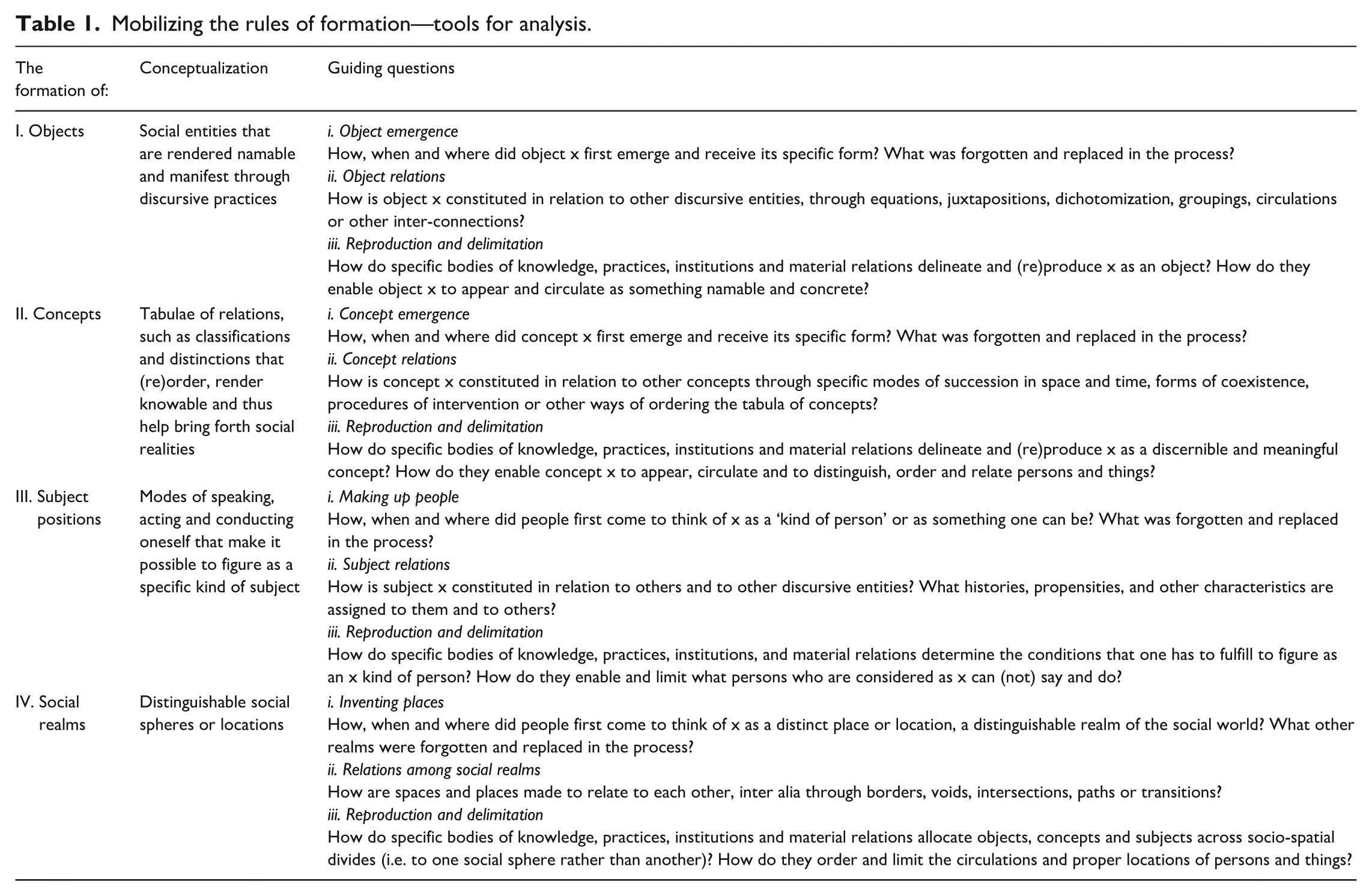
Table 1 summarizes the archeological toolbox that I have laid out in the preceding pages. The sensitizing “guiding questions” in the right-hand column can inform consecutive steps of analysis or be selectively drawn upon depending on the research interest at hand. They also offer possibilities and sources of inspiration for the formulation of research questions and problématiques. The interpretative tools assembled below are offered here in the spirit of sharing and experimentation, to be adjusted and remolded by others—not as a strict guideline for what one must do and see to “be an archeologist.”
Mobilizing the rules of formation—tools for analysis.
Practicing archeology: methodological principles and the research process
This section offers some more practical reflections on the wider process of archeological research endeavors. Thereby, I will touch upon circularity as a characteristic of interpretative research processes, discuss different kinds of empirical material that are suitable for archeological inquiries, introduce the notion of transversality and say some words about the reflexive ethics of archeology.
Circularity
The notion that theory and methods, empirical analysis, conclusions, and research problématiques entertain a dynamic, circular (rather than linear) relation is well established across post-positivist approaches in the social sciences (Glynos and Howarth, 2007; Schwartz-Shea and Yanow, 2011). This principle also holds true for archeological inquiries. In archeology, the relations from which entities derive their contours and existence are the very object of analysis, rather than an a priori theoretical proposition (Foucault, 1972: 31–37). The interpretative strategies and conceptual tools assembled above thus need to be probed, selected and adjusted through the very process of grappling with, exploring and defining the object of research. In this sense, archeologies emerge from circular and iterative “crafting and fitting” exercises that revisit, relate and adjust different aspects of a research project in multiple non-linear ways. In contrast to more rigid positivist notions of methodology and research design, attuning ourselves to archeology does not require us to discipline research processes into a linear, standardized, and ordered progression. As archeologists, we are not required to “behave like robots: we ask a question, we learn and apply a method, we gather and analyze data, and then we reach a conclusion” (Lisle, 2023: 2). At the place of such standardizing disciplining linearity, circularity as a methodological principle tells us that research processes are complex and “messy” (Squire, 2023), that they may be iterative, travel “backward” (say from empirical engagements to a new research problem) or lead us to places we did not expect (Glynos and Howarth, 2007; Herschinger, 2014).
What kinds of empirical material?
Scholarly inquiries that focus on epistemic, linguistic aspects of discourse can be fruitfully employed as text analyses in the narrower sense of the term. In such philosophically cautious, epistemic readings of discourse, the analyst devotes herself more narrowly to the (dis)continuities that constitute something as an object of knowledge, while “the object of study is (strictly speaking) held in suspense” (Bartelson, 1995: 53). However, as I argued above, crafting archaeologies of the multiple worlds that make up global politics both equip and require us to go beyond text as meaning and representation to consider the institutional, material relations and practical entanglements that enable social entities to exist in a given form and entertain specific relations among each other. Scholars who find this ontological potential of archeology productive for their research endeavors can—and need to—think more broadly and creatively about the kinds of data they collect and analyze.
To illustrate what this might look like, consider the materials Foucault discusses in The Birth of the Clinic (Foucault, 1973). To remind the reader, this book offers a detailed account of the many slow and abrupt, grand, and mundane transformations that enabled medical discourse and the empiricist medical “gaze” to receive its modern form. In this work, Foucault elaborates on the very practical and material ways of organizing and producing knowledge that respectively marked the “old” classical classificatory medicine and later modern medicine, as its replacement and successor.
The empirics analyzed to unearth this transformation are markedly heterogenous. They include different ways of dissecting brains and bodies, practices of medical treatment, diagnostics and observation, buildings, rooms, tools and instruments, the shape of bodily tissues and fluids, laws and regulations of medical education, academic controversies, struggles over material resources among clerical and academic institutions, practices of control and information collection in early “policing,” appointments of health inspectors, as well as the emergence of new categories and distinctions, such as the modern opposition between “normal” and “pathological” (Foucault, 1973). Next to archival research and the analysis of scholarly writings, IR archaeologies can thus consider a wide range of different strategies for assembling empirical materials, such as narrative interviews, digital ethnographies, participant observation, analyses of visual art and performance, literature and theater, public buildings and (non)digital infrastructures, procedural appraisals of bureaucratic routines and quantitative accounts of financial relations—to provide an obviously incomplete list. In this regard, I believe there is considerable room for further experimentation and creativity.
Transversality
For archeological research endeavors, the nature of the delineation process itself might be more crucial than the kind of empirical materials one chooses to analyze. Tracing discursive formations in the archeological sense makes it necessary to reconstruct relations and the entities that emerge from them, rather than to presuppose their existence. The delineation and analysis of empirical materials therefore need to be closely intertwined. Instead of taking familiar distinctions and entities for granted, the archeological gaze invites us to trace relations across familiar conceptual distinctions, institutional venues and realms of knowledge. That is, to “question all those divisions and groups with which we have become so familiar” (Foucault, 1972: 22). The aim here is to “individualize” a discursive formation, that is to determine its borders inductively, based in the very practices and materials one has chosen to study (on the notion of transversality as “cutting across” spaces and framings, see Bigo and Walker, 2007; Hoffmann, 2022). A useful technique to put this into concrete research practice is to read “at the borders” of what is said and enacted (Der Derian and Shapiro, 1989; Hansen, 2006; Herschinger, 2011). In practical terms, “reading across” involves paying close attention to shared assumptions and unexpected commonalities among seemingly opposed positions and disparate practices. To speak with Foucault, reading across aims at excavating the borders of discursive formations, i.e. what it makes sense to say and do in a given social context (Foucault, 1972).
Reflexivity
How can the aspiring archeologist be reflexive about her social positionality? IR engagements with “reflexivity” add up to a substantial literature and understandings of what reflexivity implies varies (for two pertinent discussions, see Alejandro, 2021; Hamati-Ataya, 2013). Therefore, it is instructive to note that archeology shares with the broader range of Foucauldian approaches the ethical commitment to ‘dig under one’s own feet.’ In a discussion of Nietzsche’s genealogy, Foucault set out to perform: “un travail d’excavation sous ses propres pieds pour établir comment s’etait constitué” (Foucault, 1969). The ethical starting point is thus to provide a destabilizing diagnostic of the present. In this sense, archaeologies can be employed to question and estrange the researcher from her own received ethical and normative commitments, as part of a given society or a certain age. Archaeologies, of course, cannot start from “nowhere” (Nagel, 1986). However, if conducted well, archeology can be used as a toolbox to actively displace one’s starting points by unearthing their contingent and power-ridden emergence.
An archeological commitment to reflexivity thus implies a critical engagement with the specificity and non-necessity of the social worlds we analyze and inhabit. However, it is not “reflexive” in an auto-biographical or dialectic sense of the word. In a stricter sense, it does not do much to help the researcher to grapple with her own individual position across race, class, gender or other social markers, or offer tools to consider the embeddedness of researchers in concrete life worlds (Horkheimer, 1937).
Epilogue: notions of critique and the politics of archeology
In this article, I have made the case for returning to archeology and taking it seriously as a mode of inquiry that aids in the craft of political ontologies and bears untapped critical and creative potentials for the study of global politics. Thereby, my aim was explicitly not to police the art of scholarly inquiry by providing any strict advice on “does and don’ts” or a linear “application” of archeological theory to IR (for a critique of applicationist research strategies, see Leander, 2020). Instead, by explicating what archeology entails and developing detailed guidance for how it can be mobilized by others, I have sought to open up a space for scholarly dialogue around the theoretical-political stakes and the “how to” of archeological work in the discipline. In doings so, I have sought to push the broad reception of Foucauldian ideas in the discipline in novel, creative and theoretically generative directions. Moreover, I also joined in recent calls for an intensified, creative and unorthodox exchange about the analytical tools and interpretive procedures that enable and coproduce IR as a discipline.
To conclude, I would like to dwell briefly on the specific notion of critique that informs archeology. In what sense is archeology a critical approach? What ethical and analytical purchase does turning to archeology imply? Does the archeological gaze have enough to offer in a historical era such as ours, plagued as it is by spiraling material inequalities and ecological disaster, heightened polarization, resurging geopolitical conflict, structural racism, and genocide? As a mode of inquiry, I have argued that archeology offers productive inroads for scholars of a critical devotion in the sense that it aims to politicize knowledge and ontology. In other words, archeology seeks to render visible how the materialized social worlds we inhabit, along with the possibilities they grant and the restrictions they impose on social agents, are products of historically built and principally malleable power relations. Archeology is a diagnostic, post-foundational mode of critique that is concerned with the intricate entanglement of power and ontology. It does not share traditional (“scientific”) Marxism’s commitment to universal emancipation and historical progress (Teschke, 2014), nor is it compatible with the late Frankfurt School’s liberal-rationalist turn to discourse ethics (Habermas, 1991). It has little in common with the pragmatist concern with elucidating the “critical capacities’ (of) ordinary actors” in political life (Boltanski, 2011; Gadinger, 2016) and it stands in explicit opposition to normative critiques that operate within a liberal universalist register (for recent IR contributions on the purposes and possibilities of critique, see Anderl and Wallmeier, 2018; Jahn, 2021; Koddenbrock, 2014; Schindler and Wille, 2019).
As with any theoretical inroad or art of inquiry, archeology renders some struggles present, while others are concealed. As Anna Leander (2008) puts it: “One does not drill holes with a hammer or fix nails with a drill” (p. 12). Indeed, there are many legitimate, even urgent, tasks of critical inquiry in the present that archaeologies are ill-suitable to achieve. To mention just one example, neo-Marxist approaches are much better suited to account for the persistence of staggering global inequalities, the entrenched powers of transnational elites and the coevolution of capitalist development and the international sphere (Cox, 1981; Rosenberg, 2021; Sklair, 2001; Teschke, 2003) in ways that necessarily escape the archeological gaze. As a research field and community, IR is thus well advised to retain, care for, pluralize and further extend the collection of interpretative tools at its disposal. Yet, within that multitude of critical approaches, archeology’s more detached and skeptical relation to concrete political antagonisms of the day can also be viewed as a virtue: it offers us ways to see anew, to reevaluate our received commitments and thus to go on differently.
Footnotes
Acknowledgements
I would like to thank Audrey Alejandro, Claudia Aradau, Alejandro Esguerra, Beate Jahn, Mattia Pinto, and Anam Soomro for insightful conversations about this project.
Author’s note
Earlier versions of this article were presented at the 16th EISA Pan-European Conference on International Relations (PEC) in Potsdam, Germany, 5–9 September 2023, and the CEEISA-ISA Joint International Conference in Rijeka, Croatia, 18–21 June 2024.
Funding
The author(s) disclosed receipt of the following financial support for the research, authorship, and/or publication of this article: The research presented in this article was supported by a Postdoctoral Research Grant awarded by the German Academic Exchange Service in 2023 (Deutscher Akademischer Auslandsdienst, DAAD).
