



Abstract
This paper offers insights into the Crisis of Liberal International Order by combining Ibn Khaldun’s theory of change with scholarship on liberalism and race. We argue that the crisis emerges from the incongruence of two features of liberal order: a binding feature (or ‘assabiyya) of white supremacy and liberalism’s principles of equality. The crisis is an outcome of a normative political order that can no longer balance a material and discursive reality of racialised hierarchy with ideals of equality. The crisis cannot be reduced to bad leadership or a technical failure to enact liberal values. Instead, attempts to think beyond the crisis must acknowledge the incongruence between white supremacy and liberal equality. Through this diagnosis, we gesture towards the constructive use of ‘non-Western’ theory in the discipline of International Relations.
Keywords
The Liberal Dynasty is in crisis. While some argue that the dynasty is shifting from a kingship based on liberal law (mulk siyasi) to an unbridled ‘illiberal’ kingship (mulk tabi’i), the reality is that the dynasty’s group feeling (‘assabiyya) is fragmenting. In the 18th and 19th centuries, the ‘assabiyya of the Liberal Dynasty was sustained by the authority of the British Empire and animated by white supremacy. With the end of the British empire, leadership passed to the USA, and the ‘assabiyya of the Liberal Dynasty became explicitly non-racial and egalitarian, while maintaining an implicit racism. This tension can be avoided no longer. Life outside of the centres of the Liberal Dynasty is developing alternative ‘assabiyya, threatening to capture the authority of, and replace, the Liberal Dynasty. The nature the new dynasty’s rule remains to be seen.
Introduction
The above text is a sketch of the Crisis of the liberal international order (LIO) interpreted poetically through the political thought of Ibn Khaldun, a 14th-century historian and sociologist. While the LIO has faced crises before, what appears peculiar about this moment of crisis is the manifestation of ostensibly illiberal tendencies both inside and out: a centre that ‘thinks the LIO has undermined Western supremacy’ and a periphery that sees LIO ‘as another manifestation of Western supremacy’ (Adler-Nissen and Zarakol, 2021: 622). Using Ibn Khaldun’s conceptual tools of ‘assabiyya (group feeling) and ‘umran (theory of change 1 ), we connect the literatures on the crisis, liberalism and race to provide insights into this crisis.
We argue that what underpins the current crisis is an unavoidable tension between liberalism’s mythical principles of equality and the operative racism of LIO. Despite the many benefits attributed to LIO in terms of security, free trade and human rights advocacy (Lake et al., 2021: 266), scholars argue that LIO remains ‘merely a friendlier version of previous Western-centric and hierarchical international orders extending back to the nineteenth-century colonial order’ (Adler-Nissen and Zarakol, 2021: 612; Eilstrup-Sangiovanni and Hofmann, 2020). It is important to acknowledge that race is just one of these hierarchies, alongside gender and class, 2 although this paper responds to calls to explicitly situate racial hierarchy in LIO’s (dis)ordering (Barder, 2021; Vitalis, 2015). Sometimes considered a ‘regrettable’ side effect (Duncomes and Dunne, 2018: 33), racial hierarchy is part of a dialectic in which liberal order secures white freedoms while denying those freedoms to non-white populations (Barder, 2021: 18–19; Hobson, 2012: 304; Mill, 1996: 20; Rutazibwa, 2016: 198; Shilliam, 2013: 156; Wai, 2014: 492). For some, this hierarchy of ‘civilised’ and ‘barbarous’ peoples leaves liberal ethics unsalvageable for practical purposes (Jahn, 2005; Mills, 2008). Ibn Khaldun’s theoretical repertoire offers a reframing of this problem.
Our argument unfolds in three steps. First, we review the crisis of LIO literature to identify three perspectives. A ‘renewal’ view, aligned with Liberal Internationalism, sees LIO as salvageable and blames the current crisis on flaws in governance rather than principles. A ‘return’ view predicts a reversion to great power politics or class struggle and suggests that liberal order is based on a misunderstanding of power. Finally, a ‘reimagine’ view seeks alternative, non-universalist forms of international order. This paper aligns with the ‘reimagine’ perspective, exploring the relevance of Ibn Khaldun’s thought in this context.
Second, we introduce Ibn Khaldun as a ‘non-Western’ 3 theorist and outline his concepts of ‘assabiyya (group feeling) and ‘umran (theory of change). Significantly, Ibn Khaldun’s theory of order rejects universalist and static identity constructs that are often found within International Relations (IR), which can otherwise impair the reimagination of new forms of order.
Third, we use ‘assabiyya to frame LIO’s crisis as neither a failure of governance nor a sign that liberal order is epiphenomenal to the realities of IR. Rather, liberal order faces a crisis of its own internal cohesion or ‘assabiyya. LIO’s success in the 18th and 19th centuries was based, among other things, on white supremacy. The post-1945 LIO remained structurally racist despite its anti-racist principles, resulting in a disconnect between an explicit race equality narrative and an implicit white supremacy. Accordingly, even as liberalism pushed for greater racial equality globally, it continued to rely on racialised distinctions, particularly in its foreign policies that disproportionately harm racialised populations and its economic practices that exploit Global South populations to benefit the Global North.
Significantly, this analysis also provides insight into the meaning of ‘illiberal’ regimes in Europe and North America, which are often considered to be organised against liberal order (inter alia Baldini, 2024: 406–407Boyle, 2021: 62–65; Fassi et al., 2023: 2277–2278; Karkour, 2020: 541–544; Paris, 2022; Pirro and Stanley, 2022). Illiberalism is not a straightforward rejection of liberalism but emerges in relation to, is enabled by, and even embraces certain aspects of liberalism (Laruelle, 2022; Mondon, 2025). ‘Assabiyya helps us argue that ‘illiberalism’ from within is not a rejection of liberal order but an attempt to re-establish the historical hierarchies of that order – such as white supremacy. The point, then, is not (or not only) that certain practices in Western regimes are mislabelled as ‘illiberal’, but that this illiberalism is falsely portrayed as alien to or in opposition to the liberal order.
More broadly, our contribution demonstrates how Ibn Khaldun’s work provides valuable insights for the discipline of IR. A lesser-known figure within the discipline, his intellectual legacy is contested. 4 His work, The Muqaddimah (translated as ‘An Introduction to History’), has been considered both realist (Kalpakian, 2008: 368; Mufti, 2009: 408) and postmodernist (Ardiç, 2017: 77; Kalpakian, 2008: 364), while others argue that Ibn Khaldun represents neither and warn against squeezing his thought into modern categories or a ‘Western-style grand theory of history and society’ (Chauch, 2008: 279; Rosen, 2005: 599). What is certain is that Ibn Khaldun relies on a pre-enlightenment theory of history that is very different to that which underpins the liberal, teleological tradition. For Ibn Khaldun, political orders will inevitably collapse as they reach their pinnacle of progress and triumph, and this should inspire transformation. This is not a merely relativist and cyclical account of order: Ibn Khaldun provides a normative distinction between good and bad orders, and our analysis indicates that any positive resolution to the crisis of LIO must begin with an explicit acknowledgement of the unresolved and destructive tension between LIO’s mythical claim to universalism and its entrenched whiteness.
Deploying the ‘R-word’: a note on terminology
We begin by clarifying the terminology we draw from race and racism scholarship. The concepts we use in IR, this paper notwithstanding, are burdened by political modernity’s racial and colonial politics (Bhambra, 2017; Howell and Richter-Montpetit, 2020; Jung, 2011). Political modernity produces a default human subject (the white ‘Western’ man) as normal, neutral and universal, while non-white ways of being are cast as deficient, aberrant, or surplus to the modern world (Barder, 2021: 3; Howell and Richter-Montpetit, 2020: 11; Mills, 2014: 207; Pallister-Wilkins, 2021: 100; Sabaratnam, 2013: 10; Wynter, 2003: 260). A chain of relationships embeds these subjectivities within contemporary international order: LIO is intertwined within (albeit should not be equated with) the principles of liberalism, liberalism within modernity, modernity within colonialism and colonialism within racism (Quijano, 2007: 176). While critical literature on LIO readily deploys terms such as colonialism, imperialism, and racism, we align with research that goes further by arguing it is ‘white supremacy’ specifically that animates both IR and ‘ir’ (Henderson, 2014).
White supremacy is ‘an internally complex, historically dynamic logic of social organisation rather than as a singular ideological or political category’ (Rodríguez, 2011: 47). This systemic nature of white supremacy is not about the personal, discriminatory beliefs held by individuals but about ‘systems of power’ (Howell and Richter-Montpetit, 2020: 4), ‘racial ideology’ (Le Melle, 2009: 78), ‘socio-intellectual structures’ (Srdjan, 2014: 99), or colonial hierarchies (Younis, 2022: 19) which implicitly justify the ordering of the world through race. Similarly, while white supremacy operationalises whiteness in world order, ‘[naturalising] whites as the dominant group in society (and . . . at the top of a racial hierarchy)’ (Meier, 2020: 500), ‘whiteness’ (as well as race, racism, Blackness, etc.) does not refer to biological characteristics but refers to social definitions of groups derived from phenotypical characteristics (Le Melle, 2009: 77). The meaning of whiteness changes over time, ‘through several distinct but often overlapping and at times mutually reinforcing rationalisations rooted initially in theology, then biology, and subsequently in anthropology’ (Henderson, 2014: 22), with corresponding changes to who was and was not considered ‘white’.
Accordingly, white supremacy can offer more explanatory power and specificity than differentiated terms – such as colonialism, imperialism, or racism – as to why some peoples were perceived more inferior than others. Taking the United States as an example, ‘colonialism’ struggles to conceptually contain the racial domination of Black slaves, alongside expropriation of Native American land and differentiated rule over Hawai’i and formally Spanish territories. What unites these different instances of racial differentiation is white supremacy (Jung, 2011: 10–11). Whiteness, and perceived proximity to it, ‘ranks’ peoples as entirely ‘tribal’, deserving of some (lesser) ‘civilisation’ (Mills, 2014: 207), or distinguishes the ‘white-but-not-quite’ such as Eastern Europeans from Western European neighbours (Kalmar, 2022: 5). Ibn Khaldun’s concept of ‘assabiyya, linking order to shared identity and solidarity, offers a framework for understanding this systemic whiteness in the crisis of LIO.
Making sense of the crisis: renewal, return or reimagination
Before introducing Ibn Khaldun’s framework, we outline how the crisis of LIO is understood in the existing literature. LIO is broadly defined as ‘a liberal hegemonic order’ (Ikenberry, 2015: 450) built on core liberal principles of democracy, market economies, free trade (Ikenberry, 2011: 17; Lake et al., 2021: 266), global institutions and multilateralism (Sørensen, 2011) and explicit claims to egalitarianism, be that through philosophical commitments to universal equality (Lake et al., 2021: 229), rights for marginalised groups (Cooley and Nexon, 2022: 111), or the reduction of economic inequality (Flaherty and Rogowski, 2021: 497). Despite broad agreement that LIO is in crisis, the causes are disputed. Scholars locate various crises of LIO in the growth of economic inequality (Flaherty and Rogowski, 2021), trade wars (Goldstein and Gulotty, 2021), the rise of China (Layne, 2018), failures of leadership (Stokes, 2018), structural racism (Búzás, 2021; Mills, 2008), the retreat of multilateralism (Börzel and Zürn, 2021) and more besides. The possibilities for change rest not only on competing explanations of the causes but also on whether it is possible to imagine an alternative. Based on the literature, we suggest three ways in which the crisis, and appropriate responses to the crisis, is given meaning: a ‘renewal’ view, aligned with Liberal Internationalism, which sees LIO as salvageable through crisis management; a ‘return’ view, critiquing liberal IR’s understanding of power and anticipating a shift to great power politics or class struggle, and a ‘reimagine’ view, advocating for alternative, non-universalist forms of international order (see Table 1).
Categories of literature on the Crisis of the Liberal International Order.
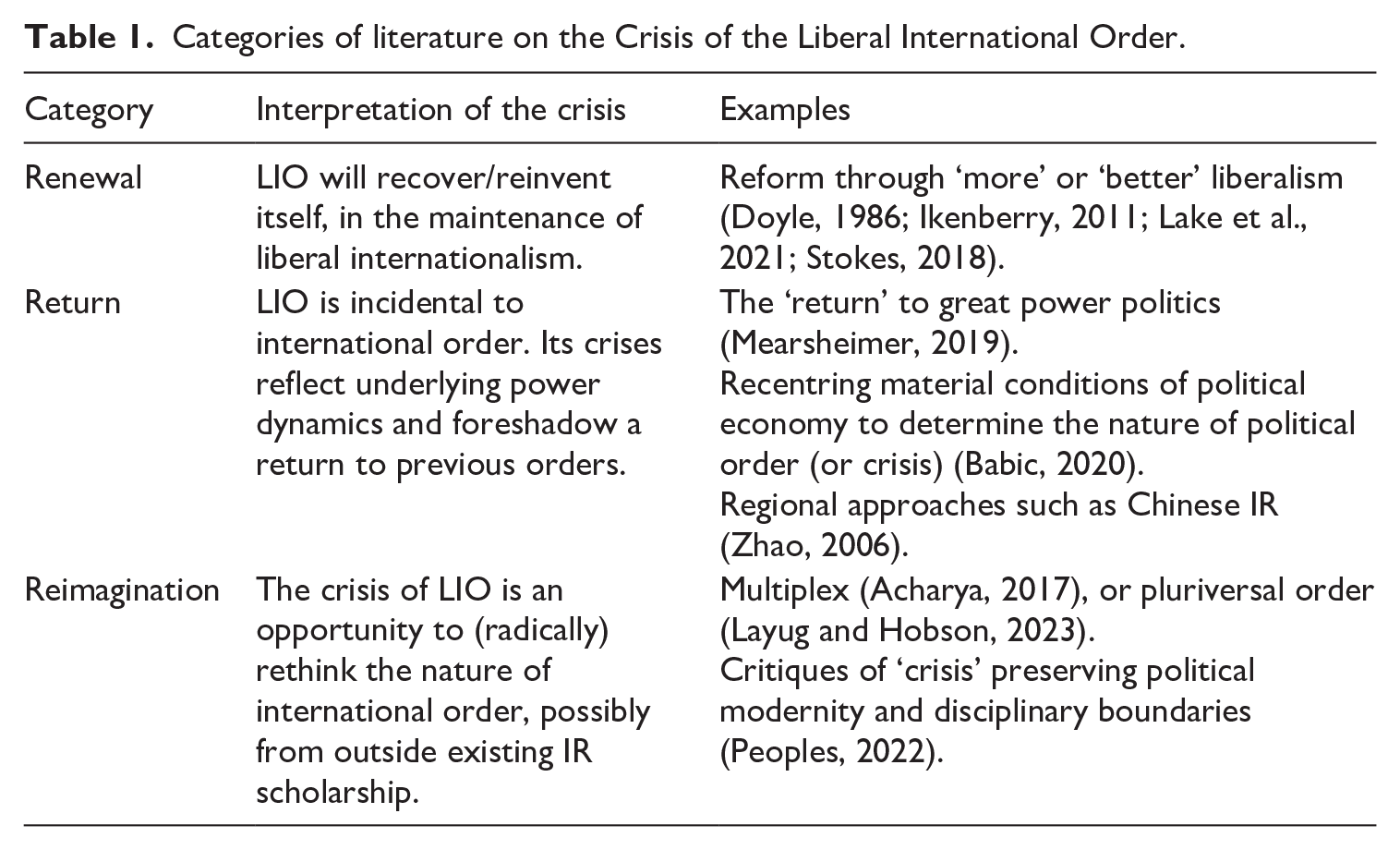
The first category of literature, ‘renewal’, argues that LIO can endure the crises it is facing. For some, liberal hegemony is tied to US power in the international system (Ikenberry, 2018: 8; Norrlof, 2018: 63; Stokes, 2018: 133). Yet, irrespective of who wields hegemonic power, liberal principles are understood as the best guarantor of peace, security and justice (Doyle, 1986; Nye, 2017). This occurs as ‘order’ is conflated with the ‘Western’, originally-European construct of order, such that there can be no order without its ‘foundational’ liberal principles of ‘national sovereignty, economic liberalism and inclusive, rule-based multilateralism’ (Peoples, 2022: 14). Liberal internationalists acknowledge many of the causes for the crisis mentioned above, such as US decline and rising authoritarian regimes (Boyle, 2016; De Graaff and Van Apeldoorn, 2018; Ikenberry, 2018, 2020); nascent imperialism and growing economic inequality (Duncomes and Dunne, 2018; Flaherty and Rogowski, 2021); as well as internal contestation over norms, laws and institutions of liberal order (Börzel and Zürn, 2021; Sørensen, 2011).
Crucially, these causes are understood as malfunctions in technique or the result of external pressures. In Ikenberry’s (2011: 334) words, the problem is ‘a crisis of authority – a struggle over how liberal order should be governed, not a crisis over the underlying principles of liberal international order’ (see also Flockhart, 2020). For example, despite the illiberal rhetoric featured in Trump’s first presidency, scholars argued in 2018 that ‘we do not yet observe a wholesale replacement of America’s post-Cold War globalist and “liberal engagement”’ (De Graaff and Van Apeldoorn, 2018: 128). Similarly, while LIO has become defined by ‘top-heavy inequality’, sparking widespread opposition to open trade and migration, this is not seen as an indictment of liberal economics and multilateralism but as a call to correct these ‘blind spots’ (Flaherty and Rogowski, 2021: 517). Such analysis ‘preserves the fundamental parameters of the contemporary Liberal International Order’ (Peoples, 2022: 13), situating the current crises alongside other, externally generated ones: the Soviet Union during the Cold War, al-Qaeda during the Global War on Terror or even deviant Wall Street cultures during the Financial Crisis. In this way, crises are understood as external challenges, rationalising the reassertion, adaption and growth of liberal order.
The second category of literature, ‘return’, interprets the crisis as foreshadowing a resurgence of political orders supposedly transcended by liberalism. This critique appears in realist accounts that characterise LIO as a myth, false promise or failed enterprise that contributed to the current crisis (Mearsheimer, 2018; Porter, 2020). Parallels are drawn to E H Carr’s The Twenty Years’ Crisis. While Ikenberry (2011: 337–338) rejects this interpretation of ‘a moment when realists can step forward and say that liberal idealists had it all wrong’, others find the comparison apt. For Layne, proponents of LIO labour under the false belief that ‘Great Power competition and conflict are transcended by international institutions, rules, and norms . . . This is not how the real world works’ (Layne, 2018: 110). Mearsheimer (2019) similarly advocates a return to ‘realist orders that must be fashioned to serve the United States’ interests’ (p. 50). The ‘return’ framing also appears in critical approaches that interpret the crisis through transnational class hierarchies (Babic, 2020). Parmar (2018: 158) argues that by overlooking class, liberal internationalists misunderstand the dynamics of power, thereby misdiagnosing inequality as a threat to LIO rather than ‘a dynamic of the system itself: market-driven class inequality, exacerbated in a society in which racialized class politics is salient’. In different ways, these diagnoses of the underpinnings of international order predict a return to struggle – in statist or class terms – familiar to the ‘great debates’ of IR.
The third and final category of literature, ‘reimagination’, calls for a revaluation of universalism in IR – in Acharya’s (2014) terms, ‘monistic universalism, in the sense of “applying to all”’ (p. 649). The crisis of the LIO is taken as a crisis of, and an opportunity to reimagine, political modernity: it is not liberalism itself that must be rejected, but liberal universalism (Gray, 2010: 18). Liberal internationalists claim that LIO can offer everyone a secure and universally appealing identity and promise of the ‘good life’, centred on interdependence. This belief in interdependence fails to account for historical injustices and the perpetuation of inequalities rooted in colonial, racial and gendered hierarchies. Scholars have shown how these hierarchies persist within liberal order, not only on the periphery of ‘the West’, but throughout its empire (e.g. Danewid, 2017; Johnston and Meger, 2024; Tavares Furtado, 2022). Lawson and Zarakol (2023) articulate this as a ‘hypocrisy charge’ in which hierarchical social structures and selective adherence to its proclaimed principles of justice and equality undermine LIO’s legitimacy and fuel the crises it faces. This explains how LIO has produced a dichotomy between states on the periphery of ‘the West’ that blame LIO for failing to fulfil its promise of social and economic equality, and a core group of states that feel ownership of ‘the West’ and blame LIO for failing to protect the privileges to which they feel entitled (Adler-Nissen and Zarakol, 2021: 622). Moreover, the emergence of new forms of ‘South-South’ cooperation (some of which display similar hierarchical and asymmetric relations) reveals the existence of alternatives to liberal order (Sabaratnam and Laffey, 2023). Reimagination begins from the ‘acceptance that the liberal international order will not be a universal order with global reach but is more likely to be just one of several orders’ (Peoples, 2022: 13).
By locating the crisis of LIO as ‘outside’ the underlying principles of liberal order, the first, ‘renewal’ perspective, is a form of ‘crisis management’ that treats disorder as something that can be addressed through ‘attempts to problem solve, to design and devise technical fixes’ to maintain the status quo (De Genova, 2018; Johnson et al., 2022: 616). As Peoples explains, ‘rather than disrupting narratives and assumptions of liberal progress and order, invocations of crisis within Crisis of the Liberal International Order scholarship more often tend towards recapitulating those same narratives and assumptions’ (Peoples, 2022: 3). Even the second, ‘return’ literature, is Eurocentric in their ostensibly universalist ontologies (Boucher, 2009: 11). Crucially, one cannot ‘crisis manage’ a problem caused by a status quo one seeks to maintain.
Reimagining an alternative to LIO is a substantial challenge. As Flockhart has shown using ontological security theory, the crisis management response is inviting to those whose identity is tied to liberalism’s universalist vision. Reimagining international order, by contrast, would entail an abandonment of the principles that have hitherto provided a narrative of security and stability (Flockhart, 2020: 218). Faced with the spectre that the universalism of LIO is a cause of its own demise, a paradox ensues: a reimagination of a non-universal order requires agency, which requires a secure identity, which has rested upon liberal principles of universalism. For many, exercising agency to reimagine LIO would require relinquishing the very thing (universalism) upon which liberal security and, therefore, agency depend. This task of reimagination is where we locate this paper.
‘Assabiyya and order: Ibn Khaldun’s escape from crisis management of LIO
For Ibn Khaldun, order is not found in the preservation of a homeostatic identity, but in the expectation that values will change. As such, continuing to pursue a set of ordering values that are no longer functional or coherent leads to disorder. Ibn Khaldun’s theory thus expects agents to pursue substantive subjectivities and critique values without jeopardising their ontological security. In this section, we explain and apply Ibn Khaldun’s conceptual tools, ‘assabiyya (group feeling) and ‘umran (theory of change). 5 Through these tools, we will argue that one element of the crisis of LIO is the incongruity between its white supremacist group feeling and its claim to universalism.
‘Assabiyya is defined as kinship, loyalty, group feeling or group solidarity. Ibn Khaldun argues that humanity is necessarily formed of discrete groups and seeks to explain the dominance of some groups over others (Sheikh, 2016: 113), noting that humans ‘cannot live and exist except through social organization’ (Ibn Khaldun, 1958: 151). It is through ‘assabiyya that political stability is created. At one level, such stability is linked directly to bloodties in The Muqaddimah: ‘[r]espect for blood ties is something natural among men . . . . 6 It leads to affection for one’s relations’ (Ibn Khaldun, 1958: 98). However, while ‘assabiyya can originate in blood relations, it is also applicable to societies and polities. ‘Assabiyya is, in fact, about how that relationship ‘moves the imagination’ (Ibn Khaldun, 1958: 99). Ibn Khaldun (1958) claims that ‘the only meaning of belonging to one or another group is that one is subject to its laws and conditions . . . . In the course of time, the original descent is almost forgotten’ (p. 100). Reference to common laws and conditions as a substitute for blood ties quite readily applies to larger social constructions like the nation, leading to a more socially constructed and systemic understanding of the role of race in Ibn Khaldun’s thought. In this regard, ‘assabiyya can be understood as analogous to collective signifiers such as nationality (Kalpakian, 2008: 370), the ‘nascent political community’ (Ikenberry, 2018: 17) of liberal internationalists or, as we will argue, a global norm of white supremacy (Vitalis, 2000: 337).
Ibn Khaldun claims that the primary function of ‘assabiyya is that it ‘produces the ability to defend oneself, to offer opposition, to protect oneself’ (Ibn Khaldun, 1958: 289). There are clear parallels here to ontological security theory’s emphasis that social actors require and produce biographical narratives that offer ‘security of the self’ and a wider capacity for agency (Huysmans, 1998; Mitzen, 2006: 341; Steele, 2008). Such narratives provide ‘emotional inoculation against existential anxieties’ (Giddens, 1991: 39); a cognitive framework through which actors can make sense of their experiences and relationships, giving a ‘sense of confidence and trust that the world is what it appears to be’ (Kinnvall, 2004: 746). A sense of self is found within collective signifiers such as conventions, norms and institutions in LIO. By contrast, an ontologically insecure actor is easily overwhelmed by anxiety and is reluctant to do anything outside of the field of action required to preserve their immediate interests (Giddens, 1991: 39–41).
Just as ontological security theory derives an analysis of international order from the study of individual anxiety, Ibn Khaldun describes an order based on blood ties, lineages and dynasties that start at the individual level and work up to larger political units. We can be more methodologically precise by drawing on existing scholarship. ‘Assabiyya is operationalised as solidarity based on ‘similar rather than dissimilar factors’ (Rabi, 1967: 58; see also Dale, 2015). Different aspects of social life that create this similarity include social norms and behaviours, principles concerning the legitimate exercise of power and ownership, public morality and modes of interdependence (Malešević, 2015: 87; Rabi, 1967: 56–58). Curiously, Korkusuz (2015) presents liberal internationalism as a global ‘assabiyya centred upon Kantian values and free-market economics (p. 283).
These characteristics of ‘assabiyya can be applied to whiteness. As stated above, whiteness is not the only hierarchy present in LIO, but it is the hierarchy that Ibn Khaldun seems best placed to analyse. Whiteness can be thought of as part of the ‘assabiyya of LIO because it provides similarity. While being liberal may be commonly understood as being a rights-bearing citizen possessing individual sovereignty, whiteness can more easily explain the continuity of liberal order than any concept of rights. The trope of ‘civilisation’ described and defined the white peoples of the world as a coherent entity in the 18th and 19th centuries. In doing so, whiteness was presented as the sharing of some essential element of the soul, intellect, or way of life (Tan, 2024). In 1911, for example, Hobhouse (1911: 329) wrote that the British empire was held together by the ‘sentiment of unity pervading its white population’. Similarly, whiteness became a tool for forging Anglo-American cultural and political ties amid British anxieties about its decline of power and prestige (Bell, 2020: 9). This racism is as enduring and coherent a part of liberal order as rights-bearing citizens (Shilliam, 2017). Such links help us avoid a discussion of racism as a violation of the principles of liberal order (Mills, 2015: 98), as is commonly done in the ‘renewal’ literature.
Even as we argue for a level of coherence (whiteness) through the history of LIO, it is essential to acknowledge that liberalism is as pervasive as it is multiple and contradictory. While LIO can be broadly defined, no such sweeping generalisations can be given for liberalism as a set of ideological principles. 7 At best, liberalism is ‘the sum of the arguments that have been classified as liberal’ (Bell, 2016: 33). Along these lines, Mondon uses liberalism and illiberalism as ‘empty signifiers’ (Mondon, 2025: 2). Nonetheless 19th- and 20th-century architects of liberal order employed a ‘racial vision of global governance’ to justify the violence required to establish and maintain it (Bell, 2016: 11). Thus, we do not claim that white supremacy is the sole ideological structure of liberal order, but that it is one persistent feature of the ‘assabiyya of liberal order, among others, that must be taken seriously to understand the crisis of LIO.
From ‘assabiyya to ‘umran
While we argue that Ibn Khaldun’s theoretical repertoire can resonate with existing IR scholarship, there are productive differences. ‘Assabiyya inevitably rises and falls, and with it, new dynasties with new rulers and new sources of authority. As noted above, taking radical action to re-envision international order is challenging because doing so would entail abandoning a secure and stable identity (Flockhart, 2020: 218). Indeed some perspectives in IR, such as that of ontological security theory, contain an implicit conservatism that normalises the status quo, foreclosing alternative subjectivities or political change. This occurs when ontological security-seeking is considered a natural behaviour, normalising an approach to political (dis)order based on governing the symptoms of anxiety (identifying dangerous or risky objects of insecurity) rather than questioning the foundations of political order that may be a root cause (Kinnvall and Mitzen, 2020).
8
By contrast, significant socio-political change relies on abandoning a hitherto secure, homeostatic self (Rossdale, 2015). As Zarakol (2017) argues, the expectation of a secure identity ‘is not a timeless element of the human condition but . . . grew out of particular historical and sociological conditions of a particular time in a particular place, that is, in Western Europe’ (p. 49). The naturalisation of these elements as the basis of security ‘foreclose[s] the possibility of seeing and learning from the perspective of Otherness’ (Untalan, 2020: 43). Such an approach is inherently averse to radical change because: ‘It portrays the existential satisfaction of the Self as primarily dependent on egotistic notions of who she thinks she is and should be . . . [thus] . . . [v]iolence and nonengagement, when viewed as keys to stabilize the state’s self identity, perpetuate the colonialistic logic of survival and power accumulation’ (Untalan, 2020: 44).
Ibn Khaldun escapes this trap because ‘assabiyya is expected to change. As such, his conceptual repertoire responds to those who seek a different perspective towards the Other, which could realise mutual coexistence (Untalan, 2020) or abandon the requirement of a fixed subjectivity (Rossdale, 2015).
The mechanism of this change is found in the second of Ibn Khaldun’s concepts, ‘umran, which offers a ‘non-Western’ approach to theorising political order. Ibn Khaldun distinguishes between two types of society: desert and city (Ibn Khaldun, 1958: 42). Desert life is prior to city life, as the wealthy and powerful people of the desert move to and establish cities for the comfort that such a life can provide (Ibn Khaldun, 1958: 93). Leaving aside the differences that Ibn Khaldun makes between the two types of life, 9 what is important for understanding changes in political order is that desert life creates robust ‘assabiyya, which enables the conquest of wealthy cities. City life then weakens the ‘assabiyya of the conquerors, who are, in turn, conquered by the next iteration of desert life (Ibn Khaldun, 1958: 141). A mixture of internal complacency or decay, alongside external challenge, animates Ibn Khaldun’s theory of political change (Aranson and Stauth, 2004: 36).
We posit that Ibn Khaldun’s mechanisms for the degradation of ‘assabiyya are analogous to our contemporary global politics. We lack the space to unpack this point fully, but some examples follow. Ibn Khaldun warns that dynasties can disintegrate through abuse of power, corruption and internecine rivalry (Ibn Khaldun, 1958: 250). Such diagnoses are frequently employed in contemporary scholarship to explain the collapse of autocratic regimes with highly concentrated power (Escribà-Folch, 2016). There are also direct parallels with contemporary literature on the crisis of LIO. Ibn Khaldun warns that leaders who put their faith in laws run the risk of losing the “fortitude” needed to generate strong ‘assabiyya (Ibn Khaldun, 1958: 96). This bears a strong resemblance to analyses discussed above, which claim that LIO cannot be maintained through blind adherence to rules-based institutions. In this analysis, the emergence of LIO as a hegemonic dynasty was based on a self-interested and racial vision of global governance protected by those rules and institutions (Adler-Nissen and Zarakol, 2021; Bell, 2016; Layne, 2018). Continuing adherence to those rules and institutions is now perpetuating dissatisfaction among those within the core who see their (white) supremacy undermined and who are attracted to the rhetoric of leaders who promise to restore this privilege. This is visible within the contemporary political terrain of Western democracies. Centrist political leaders have responded to this dissatisfaction by reaffirming their commitment to the rules, laws, and values of LIO. Such a commitment to rule-following is a conspicuous retreat from the terrain of politics and transformative change (see, for instance, Johnson et al.’s (2024) recent analysis of Kier Starmer’s leadership). It reflects the ‘renewal’ perspective on LIO’s crisis, which attributes instability to past failures in technique rather than systemic contradictions. Such an approach fails to recognise that these very rules are embedded in the broader systemic problems of liberal order we have outlined in this paper. At the same time, a well-organised global right is gaining momentum by exploiting these anxieties about identity and status by, for instance, portraying multiculturalism as a cultural threat and a tool of managerial elites (Abrahamsen et al., 2024: 67–107; Mondon, 2025: 6). Such developments mirror Ibn Khaldun’s claim that ‘assabiyya degrades through internal fragmentation caused by the polarisation of wealth and a sense that rulers (and rules) have foregone their commitment to group solidarity (Aranson and Stauth, 2004).
As a theory of change, ‘umran relies on a very different theory of history to that which underpins the liberal tradition. ‘Western’ accounts of ontological security implicitly or explicitly reify European post-Westphalian statism or liberal imaginations of the self as universally superior forms of order. ‘Assabiyya contains no such telos – liberal or otherwise. The theory of change derived from ‘umran expects that ‘assabiyya cannot have infinitely stable features. It is inevitable that political orders will change, and this change occurs as an order reaches a pinnacle of progress and triumph. As Şentürk and Nizamuddin argue, ‘umran rests on a paradox that drives change in international politics: ‘[societies] begin to collapse not as a result of their backwardness, but after they have reached the apex of progress. . . [h]ence, supreme triumph is tantamount to the end of a [society]’ (Şentürk and Nizamuddin, 2008: 544). Ibn Khaldun thus maintains a theory of how identity is secured – as ‘assabiyya – but inevitably changes, from desert to city, strong to weak, and is then replaced. ‘Umran thus helps to mitigate the problems of agency and reimagination in the extant literature on LIO in two ways: first, ‘umran is inherently amenable to fundamental shifts in subjectivities and structural change; second, ‘umran side steps the issue of identities defined by hostility towards the Other. Such identities/‘assabiyya have their own life cycle. An inherently conflictual ‘assabiyya, formed in opposition to an Other, is something that Ibn Khaldun himself criticises as a lesser form of ‘assabiyya, doomed to burden its people and come to a swift end.
Having introduced the concepts of ‘assabiyya and ‘umran, we now apply these concepts to the crisis in LIO. Ibn Khaldun’s account of world order is not purely cyclical or relativist. Ibn Khaldun’s account is productive: with every iteration comes the agency to make order better. The crisis of LIO can be productive if those who seek to replace it acknowledge how the crisis is linked to the tension between liberal order’s myths and its inherent whiteness.
Not a crisis of ‘illiberalism’ from within, but a crisis of liberal ‘assabiyya
The idea that ‘assabiyya weakens precisely because of its success is explicit in scholarly debates on the crisis. Ikenberry, for example, refers to the crisis of LIO as ‘a crisis of success’ (Ikenberry, 2015: 451). Yet such analysis diverges from ours because it locates the solution to the crisis in either better leadership (Ikenberry, 2015: 451) or renewed social purpose (Ikenberry, 2018: 19). What goes unacknowledged in such analysis is that the expansion of liberal order must, paradoxically, also undermine liberal order because “liberalism requires a non-liberal environment” (Jahn, 2018: 61). The liberal core cannot exploit and appropriate benefits from a periphery to which it has now extended the promise social and economic equality. The fragmentation of liberal order that follows is explained through Ibn Khaldun.
Building on Jahn, we draw on scholarship on the rise of ‘illiberal’ democratic regimes in the ‘core’ of LIO. Laruelle (2022) has troubled the clean distinction-by-opposition between liberalism and illiberalism (Laruelle, 2022: 304). Illiberalism is not the opposite to liberalism, but rather is in relation to it as ‘postliberal’ (Laruelle, 2022: 311). So-called ‘core’ states within LIO ‘have always engaged in practices that have questioned the validity of an all-encompassing liberalism, whether the exclusion of women, racial segregation, or the marginalisation of minorities’, and these should be understood as a product of translating the contested ideals of liberalism into practical realities. Put simply, ‘there are illiberal trends inside liberalism itself’ (Laruelle, 2022: 314). Thus troubled, we follow Mondon (2025) in further destabilising the distinction between liberalism and illiberalism. Mondon (2025) argues that in contrast to the mythical relationship between liberalism and illiberalism, ‘really existing liberalism has been a more or less active enabler rather than a bulwark’ (p. 2, original emphasis) to illiberalism. For our argument, rather than view illiberal regimes as opposed to or otherwise undermining LIO, it is ‘assabiyya that helps us argue that the emergence of ‘illiberal’ regimes in Europe and North America is a restatement of liberal order’s white supremacy. Such an argument follows Gawthorpe’s (2025) own troubling of the distinction between US liberal foreign policy after 1945 and the supposed ‘rupture’ from this policy legacy during Trump’s first term as President. Rather, there is a racial logic of hierarchies and ‘civilisationalism’ which represents continuity between Trump and US foreign policy that came before him (Gawthorpe, 2025: 193–194). In what follows, we will show how Ibn Khaldun allows us to make similar arguments, with an explicit reference to change in international order.
Ibn Khaldun describes two types of governing structures, or dynasties. Ibn Khaldun refers to both types of dynastic rule as mulk (understood as the authority of kingship, distinct from the authority of the Caliph). The first of these kingships is governed by laws that mediate the ruler’s power and influence. This is ‘kingship based on law’ (mulk siyasi) (Ibn Khaldun, 1958: 155). The second is run without laws, a type of ‘absolute sovereign’ that Ibn Khaldun refers to as ‘unbridled kingship’ (mulk tabi’i) (Ibn Khaldun, 1958: 155). Ibn Khaldun warns against dynasties based on the latter, unbridled kingship, because such order can only be achieved through ‘superiority and force’, resulting in the ruler deviating ‘from what is right’ (Ibn Khaldun, 1958: 155). He explains that the decisions of the unbridled ruler ‘will be ruinous to the worldly affairs of the people under his control’ (Ibn Khaldun, 1958: 155). By contrast, a kingship based on law will be better for subjects and thereby the cultivation of society (Ibn Khaldun, 1958: 155). Without political norms to govern their behaviour, the unbridled ruler must contend with disobedience, ‘trouble and bloodshed’ (Ibn Khaldun, 1958: 155).
It may appear that disruptive, ‘illiberal’ democratic regimes signify a shift towards unbridled kingship (mulk tabi’i). Recent examples of ‘illiberal’ behaviour in global politics seem to fit this category of an unbridled ruler deviating from ‘what is right’. The ‘War on Terror’, prosecuted in the name of LIO, enabled the enactment of colonial fantasies such as the Abu Ghraib prisoner torture (Richter-Montpetit, 2007) and codified the use of torture more widely through ‘enhanced interrogation’ (Blakeley, 2011). More recently, President Trump has not only endorsed these policies but continued ‘to extend American dominance through predominantly illiberal means’, abandoning human rights promotion, showing contempt for international institutions and flattering or even mimicking the practices of authoritarian regimes (Boyle, 2021: 63; Karkour, 2020). Domestically, movements for racial equity have been met by a backlash (or ‘whitelash’) characterised by a celebration of empire and hostility towards non-white migrants and asylum-seekers (Sabaratnam and Laffey, 2023: 176–178; Walker, 2022). In Europe, Viktor Orbán in 2014 proclaimed that ‘the new state that we are building is an illiberal state’ (Orbán, 2014). Hungary and Poland have displayed elements of an ‘illiberal playbook’ to dismantle the rule of law and human rights (Paris, 2022; Pirro and Stanley, 2022). Illiberalism can be detected in the policies of Giorgia Meloni’s government in Italy, curtailing the rights of some in areas such as gender and immigration (Baldini, 2024). Others warn that the EU’s bordering practices have become fundamentally at odds with liberal principles of non-domination (Fassi et al., 2023).
Yet these events, supposedly disruptive or ‘illiberal’, are, in fact, ‘lawful’ from Ibn Khaldun’s perspective, even if these policies are accompanied by political rhetoric that is ambivalent, if not hostile, to the liberal discourse of equality. We argue that such ‘illiberalism’ is not kingship without laws. Rather, these ‘illiberal’ dynamics are kingship without mythical-liberal laws. Such regimes are, in fact, restating liberal ‘laws’ (‘really existing liberalism’, as Mondon, 2025: 2; uses the term) as understood through ‘assabiyya (white supremacy).
This claim may prompt a question of how we are drawing the boundaries of, and who should be considered representatives of, the liberal order. Some of these ‘illiberal’ leaders that we identify are situated at the ‘semi-peripheries’ of LIO. Eastern Europe, Latin America, the Middle East and North Africa could be considered beyond or outside the racialised dynamics of liberalism insofar as they are not complicit in the history of ‘Western’ imperialism. Yet a commitment to whiteness is found in semi-peripheral spaces, often in ways that demonstrate how whiteness functions to create and preserve hierarchical power structures (Baker et al., 2024: 4–6). Our argument is that ‘illiberal’ leaders share heavily racialised policies that are rooted in LIO’s commitment to whiteness as an ordering principle. The politics of a resurgent ethno-nationalism in Hungary, Italy and elsewhere are facilitated by the liberal tradition (Mondon, 2025: 6), as was the racism and imperialism in earlier liberal world orders that explicitly rejected some of those regions from membership (Henderson, 2014; Kalmar, 2022). In both cases, policies that are decried as ‘illiberal’ are a product of whiteness because they hinge upon racialised distinctions of (dis)orderly or (un)civilised subjectivity.
The broad ‘laws’ that unify liberal order’s ‘assabiyya are those of white supremacy, which was one reason for the liberal dynasty’s success in the 18th and 19th centuries (Búzás, 2021: 442; Duncomes and Dunne, 2018: 33; Jahn, 2018: 51; Losurdo, 2011: 210; Le Melle, 2009: 78). We might call the liberal dynasty at this time a ‘European-settler dynasty’, and white supremacy was a core component of its ‘assabiyya, given the explicit acceptance of slavery and settler colonialism in this LIO. The European-settler dynasty could acquiesce (eventually) to white colonial independence in North America and New Zealand, for example (Losurdo, 2011: 210), while simultaneously denying (and isolating) Black independence, as in Haiti (Shilliam, 2012). The success of the liberal European-settler dynasty led to significant contradictions within it, its ‘assabiyya weakening as competition between imperial powers increased, independence movements in the colonies gained strength and the WWI led to economic protectionism and an economic crisis (Jahn, 2018: 55).
For some, the liberal dynasty we live in today is the only liberal dynasty there has been, and its genesis was not in the colonialism of the 18th and 19th centuries but in the aftermath of the WWII (Ikenberry, 2018: 7; (Lake et al., 2021: 226). Nonetheless there is a continuity that is entertained. This 20th century liberal order is referred to by Búzás as ‘LIO 2.0’, ‘favouring racial equality and nonracial nations’ (Búzás, 2021: 442) but maintaining ‘embedded racism’ (Búzás, 2021: 458), which we might call structural racism, as an organising principle. This ‘LIO 2.0’, was not an explicit European-settler dynasty as in the 18th and 19th centuries, as ‘the struggle against the Nazi version of the doctrine of white supremacy, led the major European powers to question their belief in their destiny as the bringers of civilization to the rest of the world’ (Keene, 2002: 147). While Duncomes and Dunne do not use the term racism, but imperialism, to describe the ‘darker’ aspect of this post-1945 liberal order, their observation of the racist/imperialist elements of humanitarianism apply: ‘even with the advance of the norm of self-determination . . ., the idea that the rich, white North held in “trust” the fate of the peoples at risk in the global South continued to be part of the repertoire of the UN’ (Duncomes and Dunne, 2018: 33; see also Tudor, 2023).
We might then call the post-1945 LIO the ‘structurally racist dynasty’, whose ‘assabiyya is defined by implicit white supremacy. Hobson refers to similar dynamics as ‘subliminal Eurocentrism’: a shift from the pre-1945 European-settler dynasty, which was both explicitly and implicitly racist and imperialist, to a post-1945 implicitly (structurally) racist dynasty yet explicitly anti-imperialist and anti-racist (Hobson, 2012: 5–10). Thus racism, in the context of white supremacy, is constituted through systemic, hierarchical and racialised practices (noting, as mentioned earlier, that race is not the only hierarchy inherent to LIO).
For instance, assertions of liberal equality are undermined by scholarly observations that capitalist markets rely upon racialised hierarchies of labour: accumulating wealth and security for the Global North through the exploitative economic practices in spaces and societies discursively constructed as inferior (Danewid, 2017; Khalili, 2023; Wearing, 2021). Assumptions such as ‘homo economicus’ – the principle that individuals have broad agency to make and be held responsible for their decisions – erase the structural, racialised inequalities in life chances that explain divisions of labour, wealth accumulation, property ownership, environmental degradation and global debt (Coleman, 2007; Tilley and Shilliam, 2018). Similarly, despite claims to protect fundamental liberties from arbitrary power, liberal ideas grant the revocation of liberties – including the right to life – from those deemed risky, strange or dangerous (Neal, 2010; Neocleous, 2007). The intensification of violent border regimes in response to the ‘migrant crisis’ – often framed as a crisis to, rather than of, liberal societies – exemplifies this implicit racism enacted through liberal international laws and norms (De Genova, 2018; Stachowitsch and Sachseder, 2019). Meanwhile, the oft-cited controversies surrounding the Global War on Terror can be understood as a continuation of the norms of liberal order (Porter, 2020). Extraordinary rendition, so-called targeted killing, and the entirely foreseeable killing of civilians under the principles of International Humanitarian Law are a continuation of a fundamental inequality in liberalism’s ‘lawful’ principles whereby ‘non-Western’ peoples are exposed to far greater harm and insecurity (Crawford, 2013; Johnson, 2017). This hierarchy of harm reflects a deeper historical continuity in international law, where ‘non-civilized’ peoples were explicitly excluded from full legal protection (Mégret, 2006). Today, a similar logic of intentional exclusion persists in the use of targeted killings, where international society maintains a ‘firewall’ that normalises the practice against violent non-state actors while the norm against assassination remains strong between states (Keating, 2022). Meanwhile, claims to US exceptionalism have been invoked to reject treaties designed to avert racialised climate catastrophe or guarantee international legal accountability, or to violate international law altogether (Jahn, 2018: 46). This selective application of legal norms reinforces the systemic inequalities embedded in liberal internationalism, echoing archetypal claims that ‘[d]espotism is a legitimate mode of government in dealing with barbarians’ in the name of liberal peace (Mill, 1996: 20). For example, Israel’s genocide of Palestinians is conducted in the name of a liberal world order, as Israeli President Isaac Herzog elaborated: ‘This war is a war that is not only between Israel and Hamas. It’s a war that is intended, really, truly, to save Western civilisation, to save the values of Western civilisation’ (in Clines, 2024).
In this sense, there is an analogy between the ‘illiberal’ Islamophobia of Trump, Meloni or Orban’s immigration policies and everyday practices of liberal governance that nonetheless rely upon exclusionary categories of whiteness (Gawthorpe, 2025: 187). The notion that ‘illiberal regimes’ can be separated from LIO assumes the ‘paradox of liberalism’: that liberalism’s shortcomings can be mitigated ‘through some middle ground or “proper” liberalism of the past’ (Sabaratnam, 2013: 270). This paradox hinges upon an externalisation of the sources of LIO’s crises and presents ‘more’ or ‘better’ liberalism as the solution. By contrast, we argue that the crisis of LIO is, at least in part, driven by the internal contradictions of liberal ‘assabiyya, with the policies of ‘illiberal’ leaders representing an extreme manifestation rather than an aberration. These policies, therefore, are not inconsistencies to be ‘crisis-managed’ by new or better leadership.
If white supremacy is the enduring link between the pre- and post-1945 liberal dynasties, then we can draw connections between pre- and post-1945 LIOs and recognise an enduring element of its ‘assabiyya: white supremacy. The crisis of LIO can be partly understood as an internal contradiction between the explicit, anti-racist formulation of the post-1945 liberal dynasty and the structural racism it inherited from the pre-1945 liberal dynasty. The discontinuity between the external narrative and the internal logics has weakened liberal ‘assabiyya. The liberal dynasty at once embraced its egalitarian spirit and its racial hierarchies, precisely because of its success after the end of WWII. When the European-settler dynasty transitioned to the structurally racist dynasty, it did so, in part, to counter the dynasty’s greatest rival, the USSR. At the end of the Cold War, LIO successfully incorporated an anti-colonial ‘assabiyya into its own, liberal ‘assabiyya. The liberal dynasty promised the extension of egalitarian society to the former colonial and Soviet spaces, but driven as it is by racial hierarchies, it has failed to deliver on these promises. After successfully uniting most of the world, and after over three decades of uncontested rule, the liberal dynasty has no more excuses for the failure of its egalitarian vision. As wealth inequality grows (Oxfam, 2023) it becomes clear that for some, indeed for most people on the planet, this egalitarianism will never be realised. The fact of this comes as no surprise to the critical literature on liberalism (Jahn, 2018; Rutazibwa, 2019: 67; Wai, 2014: 492). The colony always understood that ‘liberal” peace came with violence; the metropole is now experiencing this reality (Bhattacharyya et al., 2021). The crisis of LIO is a crisis of ‘assabiyya: a simultaneous rejection and restatement of white supremacy.
Conclusion
In the context of extant scholarly debates which have called for substantive engagement with ‘non-Western’ IR (Acharya, 2017; Dalacoura, 2021; Shilliam, 2011), our contribution is not a survey of Ibn Khaldun’s thought as an alternative global perspective. Indeed, we have not attempted to compare Ibn Khaldun with other classical theorists of IR. Instead, we claim that Ibn Khaldun’s thought – particularly the conceptual tools of ‘umran and ‘assabiyya – offer substantive theoretical frameworks that provide widely applicable insights into the crises, power relations and practices of contemporary and historical IR.
We have sought to demonstrate this through an engagement with scholarly debates on the crisis of LIO. Ibn Khaldun’s thought offers a way of escaping the conservatism of extant perspectives, buttressing a diagnosis of the crisis of LIO that rests on its fundamental nature. Ibn Khaldun’s concept of ‘assabiyya denies homeostatic identity. As such, this perspective rejects the validity of a ‘crisis management’ approach to the crisis and invites a more substantive critique of how liberal order must decline. ‘Assabiyya explains how racism is a dynamic organising principle of solidarity in international order. We argue that ‘illiberal’ democratic regimes do not represent a retreat from LIO but restate a core component of liberalism’s ‘assabiyya – white supremacy. White supremacy was critical to LIO’s success in the 18th and 19th centuries as a European-colonial liberal dynasty. This dynasty changed after WWII, explicitly expanding its promises of egalitarianism and equality for all, but not fundamentally shifting away from the racism at its core. This structural racism can be summarised as: to be a member of LIO is to be white (whiteness being more than a feature of the epidermis). The contradiction between the implicit structural racism of LIO and its explicit egalitarianism has led to contradictions and weakened LIO’s ‘assabiyya, precipitating the crisis.
In tandem with the concept of ‘umran, Ibn Khaldun allows us to escape liberal telos alongside the resultant anxiety and normatively negativity around the crisis of LIO. Embracing the inevitability of change, even the requirement for change to generate strong ‘assabiyya, Ibn Khaldun’s thought shows how solutions to the crisis of LIO must be imaginative. The racism of liberal order cannot be addressed by returning to a purer form of liberalism from the past or by finding a middle ground: LIO is racist.
If racism is central to the failing of liberal ‘assabiyya, it does not follow that, after inevitable change, we will usher in an anti-racist world order. The ‘assabiyya of the outgroups, such as China, that seek to challenge and claim the authority of the USA as their own, are based on their own exclusionary or ethnocentric logics. To overcome racism in the next iteration or evolution of world order might entail the communitarian embrace of value pluralism (Sheikh, 2016: 187), or any number of alternatives posited in the ‘reimagination’ literature of the crisis of LIO. Such possibilities are at the forefront of contemporary Global IR research, which has brought together a variety of efforts in critical IR to identify and critique Eurocentrism in the discipline (Bilgin and Smith, 2024). 10 As this so-called Global IR charts a path apart from the Eurocentrism which has hitherto been foundational to the discipline, it is attempting something akin to creating an ‘assabiyya not just distinct from the racialisation which is inherent to white supremacy and liberalism, but also distinct from other racialisations and hierarchies (Sinocentrism (Chu, 2022), for example) that might replace it (Barkawi et al., 2023; Barnett and Zarakol, 2023). It is pertinent, therefore, to look to those debates to theorise a more just and less exclusive ‘assabiyya for world order.
We conclude that much of the anxiety around changes to LIO blinds us from the transformative potential of change and the ability to remedy the racism that has defined much of the liberal dynasty’s reign. It is the end of the world as we know it, but Ibn Khaldun feels fine.
Footnotes
Acknowledgements
The authors would like to thank Linda Tabar, dyuti a, Amira Abdelhamid and Beate Jahn for providing invaluable feedback. We also thank the three anonymous reviewers and the journal’s editorial team for helping to refine the scope and contribution of this article.
Funding
The author(s) received no financial support for the research, authorship, and/or publication of this article.
Notes
Author biographies
 ), he recently completed a Leverhulme Research Project on British official inquiries, Warnings from the Archive: A Century of British Intervention in the Middle East.