



Abstract
How does social actors’ engagement with the technical dimensions of world politics—from material infrastructures to modeling, engineering, bureaucracy, and discourses of expertise—bring about specific social configurations and political effects? To answer this research problem, International Relations scholars have growingly mobilized the idea of technicization to investigate the relationship between knowledge, governance, socio-political reproduction, and social change. However, despite this interest, technicization has been neither conceptualized nor theorized. I argue that this absence limits our understanding of how technicality affects world politics and leads to the literature taking depoliticization as the default interpretation. To address this issue, this article develops three conceptualizations of technicization by distinguishing between the theoretical traditions underpinning this idea across social sciences. I introduce to International Relations the concept of technicization as desociologization based on the Habermassian concepts of technique and practice, which I distinguish from technicization as depoliticization (Weberian) and technicization as disciplinarization (Foucauldian) most commonly encountered in the literature. I illustrate the utility of disentangling these approaches through the case study of the history of the medicalization of male circumcision and its use as a global health anti-HIV policy since 2007. Overall, this article lays solid theoretical foundations for a more structured conversation about knowledge- and discourse-related processes dealing with the technical dimensions of world politics and beyond.
Introduction
How does social actors’ engagement with the technical dimensions of world politics—from material infrastructures to modeling, engineering, bureaucracy, and discourses of expertise—bring about specific social configurations and political effects? This research problem has emerged as part of the growing literature in International Relations (IR) seeking to investigate the relationship between governance, knowledge, socio-political reproduction, and social change (Allan, 2018; Botcheva, 2001). To address this question, scholars have introduced the idea of “technicization,” either directly or indirectly, via references to technicality and technicity (Best, 2004; Guilbaud, 2017; Leander, 2011). In the literature, technicization is commonly conceived of as a process through which the “articulation of technical and political registers” of a political problem enables its “technical management” by expert communities (Dufournet, 2014: 43,32). As such, technicization is generally understood as a process of depoliticization (Louis and Maertens, 2021: 10; Maertens and Parizet, 2017; Papadopoulos, 2017). Such scholarship has, therefore, elicited a need to explore how techniques and technical language contribute to shaping world politics in domains such as global governance and authority (Sending, 2015), international organizations (IOs) and bureaucracies (Bakonyi, 2018), post-conflict interventions (Hughes, 2011), legitimation and expertise (Eijking, 2023), gender inequality and policymaking (Scott and Olivius, 2023), objects of expertise (Esguerra, 2024), and infrastructural geopolitics (De Goede and Westermeier, 2022)
However, despite this interest, technicization has neither been conceptualized nor theorized. I argue that this absence inadvertently elides the differences between theoretical traditions underpinning the idea of technicization and leads to the literature taking depoliticization as the default interpretation. As a result, it limits our capacity to explain case studies that do not fit within this single framework and flattens the heuristic potential that explicit discussions between different interpretations of technicization could yield.
To support this argument, I use as a case study the history of the medicalization of male circumcision. Male circumcision refers to a wide range of practices of genital cutting, from the clipping of 1 or 2 cm of skin to the complete removal of the skin surrounding the penis. It has been used for millennia as a ritual organizing the societies that have adopted it, through the meanings it carries and the identities and norms it produces. The practice was introduced to Western medicine in the 19th century via the British Empire to cure what was then perceived as the illness of masturbation. Since then, pro-circumcision groups within the medical sector have been on a quest to find a medical rationale to justify male circumcision in relation to Sexually Transmissible Diseases (STIs), a field of research where medical expertise has traditionally been accompanied by the production of sexual norms (Carpenter, 2010: 621; Esacove, 2013; Hankins, 2007: 63). A breakthrough finally happened in 2007–2008, when three Randomized Control Trials (RCTs) in Kenya, Uganda, and South Africa showed a 50%–60% reduction in female-to-male HIV transmission for a follow-up period of 21–24 months after circumcision (Wamai et al., 2008). Based on these results, male circumcision became a global health policy endorsed by the World Health Organization (WHO) and the Joint United Nations Program on HIV and AIDS (UNAIDS) in 2007: the Voluntary Medical Male Circumcision program (VMMC). As of 2023, more than 35 million adolescents and men had been circumcised via the program in 15 countries, making male circumcision the first mass surgery in human history (WHO, 2023). 1
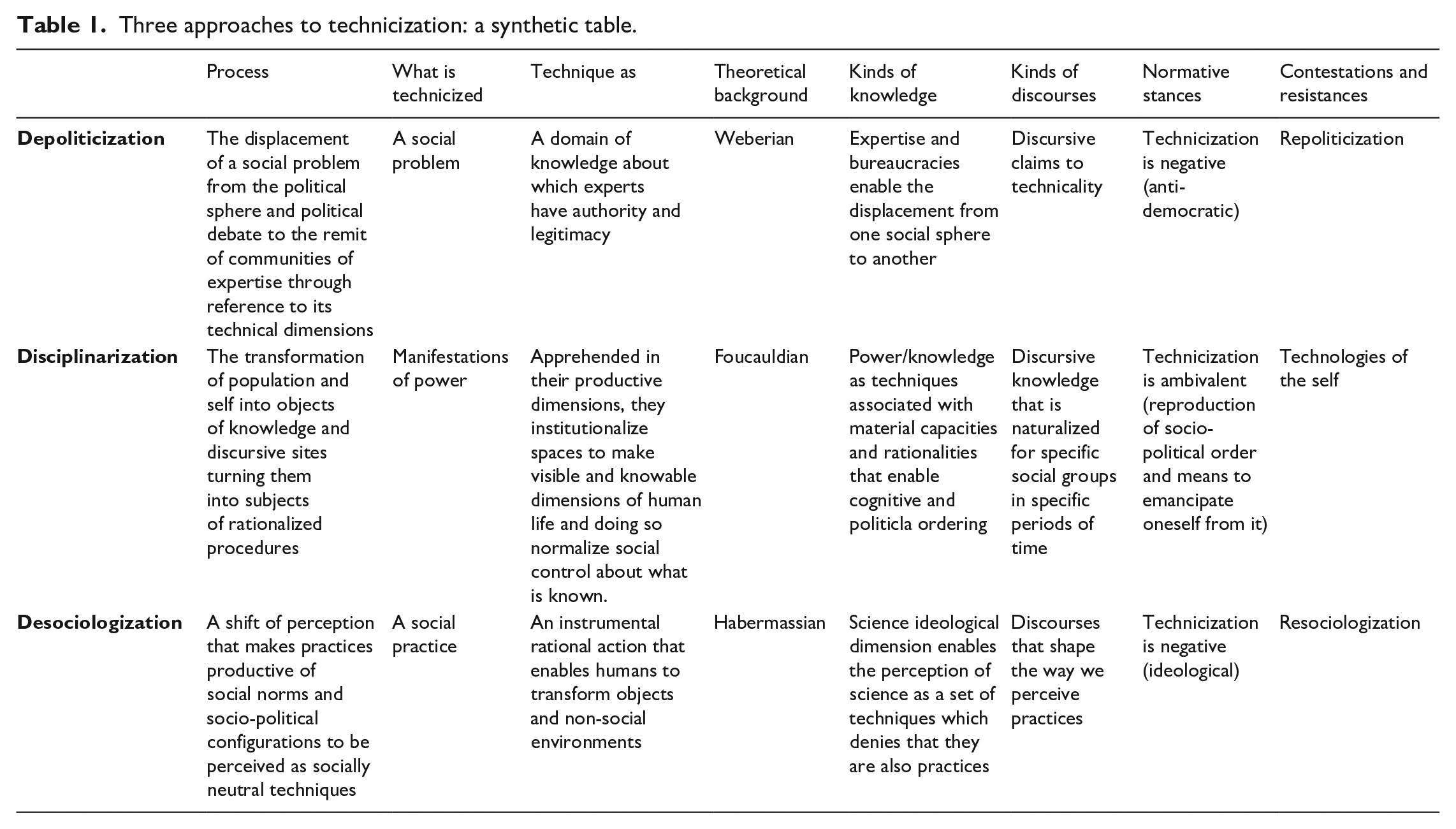
More specifically, I show that the medicalization of male circumcision does not fit neatly within the dominant understandings of technicization. To do so, I develop three conceptualizations of technicization through an exercise of ideal-typification (Jackson and Nexon, 2009; Weber, 1904). Namely, I create a typology based on three types that I design by making explicit the theoretical premises underpinning the literature engaging with technicization and that I distinguish according to eight analytical dimensions (see Table 1 for a systematic overview):
Technicization as depoliticization, which conceptualizes technicization as the displacement of a social problem from the remit of the political sphere and political debate to the remit of communities of expertise through reference to its technical dimensions— a conceptualization based on the Weberian understanding of society as social spheres;
Technicization as disciplinarization, which conceptualizes technicization as the transformation of populations and selves into objects of knowledge and discursive sites, turning them into subjects of rationalized, dedicated procedures—a conceptualization based on a Foucauldian understanding of power in society;
Technicization as desociologization, which conceptualizes technicization as a shift of perception that enables practices productive of social norms and socio-political configurations to be perceived as socially neutral techniques—a conceptualization based on Habermas’ conceptualization of “technique” versus “practice.”
I argue that the history of the medicalization of male circumcision is a case of technical policy-making where a social practice became perceived as a socially neutral procedure, despite still being productive of norms regarding gender and sexuality as well as productive of social hierarchies. Based on secondary data (collected by historians, sociologists, ethicists, and health practitioners), as well as primary data (documents produced by IOs and medical associations), I demonstrate how the technicization of medicalized male circumcision is best explained as a case of desociologization, rather than as a case of depoliticization (section II) or disciplinarization (section III).
This article, thus, makes three main contributions. First, I introduce a new way of thinking about technicization in IR—technicization as desociologization. This conceptualization focuses on a question overlooked by the literature on technicization: Is a social practice represented as a socially neutral procedure in a way that enables it to hide, normalize, or naturalize its sociological effects and/or ideological dimensions? To illustrate the usefulness of this conceptualization, I demonstrate that technicization as desociologization enables us to make sense of the case study, while the other conceptualizations do not.
Three approaches to technicization: a synthetic table.
Second, by formalizing three ways of conceptualizing technicization, I offer a starting point to structure a cumulative debate that has so far been conducted mainly at the margins of other questions in IR (e.g. expertise, governance, depoliticization). By shedding light on unacknowledged differences between these approaches, I solidify the theoretical foundations of questions relative to anything technical in IR and beyond. I also show that underconceptualized references to technicization fail to explain the nuances and complexity of processes involving techniques in world policy. This commitment to embracing the diverse ways technicization can be conceptualized broadens the focus of analysis and problematizes depoliticization as the approach by default. Overall, I make this fuzzy concept clearer and facilitate a more sophisticated account of knowledge- and discourse-related processes involving technicality.
Third, as the case illustrates a process of medicalization—a process through which dimensions of human life are turned into objects of medical expertise—I question assumptions related to this concept, for example, the association of medicalization with securitization processes in IR (see Elbe, 2010; Elbe and Voelkner, 2014). In the first section, I show how each conceptualization of technicization provides a lens that requires us to (re)conceptualize medicalization differently. Through the case study, I then problematize the assumption that medicalization necessarily involves technicization. I demonstrate how the initial medicalization of male circumcision did not correlate with its technicization—as it happened for explicit moral reasons (sexual temperance)—and that the technicization of male circumcision only happened one century later with its remedicalization in the United States.
Before going further, I would like to offer a point of terminological clarification. In contrast with the literature that sometimes uses technicization interchangeably with technologization and technocratization, I find it more useful to distinguish the three terms. I define technologization as a process through which technological solutions are offered to socio-political problems—for instance, the proliferation of technologies such as wheelchairs and hearing aids as responses to vulnerabilities in eldercare (see Hämäläinen, 2020). 2 I define technocratization as a societal process that allocates governing roles to so-called “technocrats” and “toward exclusive use of causal reasoning by scientific-technical experts to make and administer state policy” (Stryker, 1989: 342). For clarity, this article focuses on technicization only.
Introducing three conceptualizations for technicization
Following an ideal-typification approach, I identified three theoretical traditions underpinning current understandings of technicization and used these traditions as a starting point for the conceptualization developed in this article: technicization as depoliticization, technicization as disciplinarization, and technicization as desociologization. While interpreting technicization as a process of depoliticization is dominant in IR, and interpreting it as a process of disciplinarization is also marginally present in the discipline, interpreting technicization as a process of desociologization is so far absent. Moreover, while IR scholarship leads the conversation on technicization, it does so by drawing on literature from across the social sciences. As such, the stakes of this conversation go beyond interrogating the specificities of technicity in world politics to addressing fundamental questions of political and social theory across the social sciences.
I synthesize the three ideal types in Table 1. In line with the ideal-typification approach, I offer a strategic reading of Weber, Foucault, and Habermas that focuses only on the dimensions of their work contributing to the dimensions chosen for the typology. As can be seen in the table, the different conceptualizations enable us to analyze different processes, focus on different objects, and adopt a different definition of “technique” as a starting point. Each also stems from a different theorization of society and adopts a different normative stance toward technicization. They also emphasize different kinds of knowledge and discourse. Accordingly, the practices identified as contestations and resistances to technicizations also differ. In addition to following IR’s existing use of the term “depoliticization,” I identified “disciplinarization” and “desociologization” as the most relevant existing terms to characterize the two other conceptualizations of technicization.
Technicization as depoliticization
The term technicization is mostly found in the literature focusing on depoliticization. In this context, technicization is understood as the displacement of a problem, object, or policy out of the public debate (e.g. a debate involving non-expert political bodies and the general public) to the remit of communities of expertise through its representation or framing as something “technical.” Rather than a focus on “techniques” per se, it is the perception of the technical dimension of a question—its technicity, understood as the perception of its neutral and scientific character—that technicization refers to. Such a focus enables the redefinition of a social problem, and the correlated identification of the agents capable of governing it: the “neutral” and “apolitical” experts.
As such, technicization represents one of the processes involved in the broader phenomenon of depoliticization. Through this process, the displacement of problems also displaces the responsibility of those granted the authority to deal with these problems. Expert communities (who are either leading this process, jointly engaging in the process with other actors, or instrumentalized by political/private actors) contribute to this displacement through the mobilization of expert knowledge, discourses capable of making something be perceived as “technical” (e.g. discourses of neutrality, expertise, scientificity, objectivity or bureaucracy), and the associated practices and objects which are given meaning along these lines. In this sense, struggles against technicization represent struggles for the re-politicization of social problems and their recharacterization as objects of public debate.
This approach to technicization relies on an understanding of society in terms of social spheres, with each operating under specific logics of action. Such an understanding of social organization stems from Weber’s (1920, 1946) theorization of society as constituted by separate, historically evolving spheres of life—i.e. the political sphere, the scientific sphere, and the religious sphere—and his normative reflection about the consequences of giving authority to certain spheres to deal with problems that are not within their remit—e.g. the religious sphere commenting on scientific questions. This approach is also influenced by other ideas, such as Schmidt’s interest in the social appeal of technicity: “it is easy to understand why there is a tendency to take refuge in technicity from the inextricable problems of all other domains” (Schmidt, 2007: 91) or Habermas’s work on technology and the “depoliticization of the public” (Habermas, 1973b, 4) (see Flinders and Wood, 2014; Maertens and Parizet, 2017).
This theorization of society as spheres of life constitutes the framework within which depoliticization, and therefore technicization, is understood. Building on Hay’s (2007) definition of politics as “the realm of contingency and deliberation,” Wood and Flinders (2014: 157) identify three types of depoliticization represented as three spheres embedded within each other: depoliticization from “the government sphere to the public (non-government) sphere,” from “the public (non-government) sphere to the private sphere” and from “the private sphere to the realm of necessity.”
Such an approach to technicization is illustrated by IR scholarship focusing on the depoliticization of IOs. The research conducted by Louis and Maertens (2021) and the literature they review in their book Why International Organizations hate politics exemplify this line of literature. Louis and Maertens (2021: 11) define depoliticization as “the process in which a situation, an actor or an issue is considered outside of politics and framed as apolitical” which involves different types of practices such as “downplaying an apparently sensitive topic, putting forward the economic utility of an issue, [and] stressing the functionality of certain practices such as consensus and pragmatism while stigmatizing dissent.” Thus, within depoliticization, technicization represents a process through which agents such as IOs put forward “the technical dimensions of a problem which implies its management by experts (often themselves), whose knowledge and technical know-how are the foundation of the legitimacy of their action” (Maertens and Parizet, 2017: 45). In that sense, technicization is part of a strategy for IOs to legitimize themselves and their policy, following the idea that depoliticization is a way for them to function and establish themselves as efficient and neutral service providers. In doing so, IOs and associated communities of expertise construct objects of expertise to establish/maintain themselves as the legitimate governing actors of these objects.
Based on these premises, Louis and Maertens illustrate the diverse effects of technicization as depoliticization through different case studies, which I summarize as follows. First, technicization as depoliticization is a process through which IOs operate with “discretion away from national political battles, public opinion and the media, [as] they conceal the choices and biases that shape their activities while failing to answer the growing demand for transparency, accountability and democracy at the international level” (Louis and Maertens, 2021: 3). The depoliticization of political problems through technicity occurs, for instance, when IOs prioritize the funding of dimensions of problems that are perceived as technical (e.g. infrastructure), rather than those dimensions perceived as socio-political—as illustrated by Parizet (2013) in her work about development indicators and indigenous policies in Mexico. Second, technicization can also enable overcoming political obstacles and tensions by involving technical actors. This is illustrated, for instance, by the case of the United Nations Environment Program’s handling of the salinization of soil in the Palestinian territories (Maertens and Parizet, 2017: 54). Third, technicization contributes to producing whole institutional regimes—such as multilateralism—whose conditions of existence rely on a “myth of depoliticization” of which technicization represents an important dimension (Louis and Maertens, 2021).
Beyond explicit mentions of technicization, IR literature has also shown how “interventions are removed from the political realm of contestation and decision making and presented as technical solutions to mainly technical problems,” for example in the case of state-building programs (Bakonyi, 2018: 256). Authors have investigated how the construction of objects of expertise constrain possible futures based on what is deemed “technically feasible,” for example, how “carbon” or “Integrated Assessment Models” contribute to specific global visions of climate change with related governance measures ((Esguerra, 2024) citing (Beck and Oomen, 2021: 169; Jernnäs, 2024). Finally, Scott and Olivius (2023)) show how seemingly neutral techniques such as workshops can “silence more political solutions to gender inequalities” by aligning stakeholders to technical understandings of the problem.
Regarding the relationship between technicization and medicalization, we see through the lens of depoliticization that medicalization refers to the displacement of a problem or its solution out of the public debate through medical expertise. This is illustrated by the depoliticization of COVID-19 by the UK government “through repeated assertions that decisions were being guided by the scientific and medical advice given to the government by its committee of experts,” in this case as a strategy “to rapidly and continually shift the balance between avoiding blame and taking credit” (Kettell and Kerr, 2022).
Technicization as disciplinarization
The second approach focuses on a different mechanism and relies on different theoretical premises than the first. More specifically, technicization as disciplinarization describes the process through which modern societies produce social discipline through techniques of power—consisting of discourses, knowledge, practices, and physical objects—that enable the behavioral control of individuals and populations through the production of knowledge about them.
This approach to technicization relies on a Foucauldian understanding of power and knowledge in society. At the core of Foucault’s contribution to thinking technicization is the idea that something needs to be known to be governed—a contribution made through his theorization of power/knowledge and governmentality. More specifically, the term disciplinarization refers to Foucault’s theoretical apparatus which understands techniques as tools of knowledge-based power that are productive of socio-political orders (dispositifs). I, therefore, term this approach technicization as disciplinarization, first, because Foucault’s incisive conceptual framework relies on a “paradigmatic modern power formation that he called ‘discipline’” (Behrent, 2013), and also because the term “discipline” is commonly mentioned by the literature operating within this theoretical framework when referring to technicization (Humphreys, 2017; Lascoumes, 2004; Rose and Miller, 1993).
If things must become objects of knowledge to be governed, technologies/techniques of power both define the scope of the knowable and enable the socio-political and epistemic ordering of the world. As such, techniques refer to “procedures by which the knowing subject apprehends the object of its knowledge” (Behrent, 2013). One can note that IR literature mobilizing Foucault often engages with the terms “techniques” and “technologies of power” interchangeably (see Bonditti et al., 2017; Mälksoo, 2021), which Foucault himself also did (Behrent, 2013).
Technicization as disciplinarization, therefore, refers to the transformation of the human population and self into objects of knowledge and discursive sites—making them subjects of rationalized dedicated procedures that contribute to the production of related socio-political orders. In this interpretation, techniques produce institutions and social spaces that enable to make visible and knowable dimensions of human life and, in doing so, make them conducive to social control.
Here we see that the use of the term “technique” by Foucault is not metaphorical. According to Foucault, the process of technicization has a historical point of origin: in the nineteenth century, the “bourgeoisie” invoked, at a theoretical level, the juridical category of the contracting individual to assert its political legitimacy, while, at a practical level, employed disciplinary technologies to create a form of individuality consistent with the requirements of capitalist production (Behrent, 2013). Through this historical process, the human population in specific contexts started to become a political and economic resource organized through management procedures and structured by industry and engineering to develop wealth (Lascoumes, 2004: 4).
This conceptualization of technicization as disciplinarization relies on Foucault’s anti-humanist premise that humans cannot exist outside power relations nor love being self-governed (Behrent, 2013). It therefore does not hold the same normative aspirations as the two other conceptualizations of technicization. Indeed, technicization as disciplinarization is not conceptualized only as a harmful phenomenon. Rather, technicization produces ambivalent self-control mechanisms that contribute to the (re)production of the socio-political order while also representing potential resources to emancipate oneself from it, given that techniques/technologies of self can be developed to transform the self into a crafted subject of one’s own discipline. As such, this framework accounts for forms of technicization, such as technologies of the self, that can produce emancipatory outcomes while running the risk of further internalizing existing dispositifs.
In IR, the idea of technicization as disciplinarization—albeit often not explicitly named—has been explored in the literature engaging the concept of governmentality, i.e. “in the technical sense of experts and epistemic communities that render the world thinkable through their reports, research, and policy recommendations” (Vrasti, 2013: 65). Albert and Vasilache (2018: 12–13) show that diverse and specialized scientific expertise regarding the Arctic led to its normalization as an object of governance and securitization. In his Foucauldian analysis of international regimes construction, Keeley (1990) puts forward the idea that the ordering techniques provide means for observing, documenting, classifying, comparing, assessing, and individualizing target actors as well as for correcting behavior, punishing or repressing undesired behavior, and producing desired behavior [through which] a regime gives specific definition and order to a public space or realm of action (p. 92).
From a more biopolitical perspective, Merlingen (2003) argues that “techniques cultivate a population, they also reduce it, through surveillance and policing” (p. 368). Dillon and Lobo-Guerrero (2008) illustrate this phenomenon through the history of the biopolitics of security in which different “problematic[s] of security” such as “life” or “the human” are addressed via “different mechanisms, techniques, instrumentalities, rationalities and discursive formations” (p. 274). However, the specific processes through which technicization happens are generally overlooked in this literature.
Interpreted via the framework of technicization as disciplinarization, medicalization is a process through which medical knowledge creates new discursive sites that open up populations’ behavior to new forms of governance. Interestingly, the concept of medicalization itself largely stems from Foucault’s (1979) use of medicine as a case study: a ‘knowledge’ of the body that is not exactly the science of its functioning, and a mastery of its forces that is more than the ability to conquer them: this knowledge and this mastery constitute what might be called the political technology of the body (p. 26).
In his genealogy of psychiatry, for example, Foucault (1965, 1979) demonstrates that techniques to cure madness presuppose knowledge about human nature that they naturalize, as well as norms and procedures that they implement. In this way, knowledge about the human becomes a science of government.
Technicization as desociologization
Finally, I define technicization as desociologization as the process through which social practices productive of norms, socio-political configurations, and institutions are made to be perceived as techniques. In this case, techniques are defined as socially neutral procedures guided by instrumental rational action through which humans use scientific knowledge to take control of their environment. While technicization as depoliticization highlights how the process hides the political dimensions of a phenomenon, technicization as desociologization focuses on the concealing of its social origins and effects. Rather than focusing on the transformation of practices into something else, technicization as desociologization sheds light on knowledge- and discourse-related processes that change the way we perceive these practices—i.e. processes that do something to practices that prevent us from perceiving their social dimensions. 3 As a result, this process enables the invisibilization of the norms, power relations, and ideologies produced by these practices.
Habermas’s work offers fertile grounds for this conceptualization. In contrast to the use of Habermas in relation to depoliticization processes, the conceptualization of technicization as desociologization relies on a work less often discussed in the literature: “Technology and Science as Ideology” In this work, Habermas questions the relationship between science and society. More specifically, he problematizes two visions of science common in contemporary Western societies: science as a tool of domination, and science as a vector of progress (Habermas, 1973a, 17). This problematization has three theoretical foundations. First, from Marx, Habermas (1973a: 59) takes the dialectic relationship between “productive forces” and “relations of production” that he substitutes with the terms “work” and “interaction,” which, in his understanding, are better suited to contemporary contexts where work not being based on physical force has become more common. Second, he relates this idea to Weber’s reflection on the depoliticization of administration and builds upon his conceptualization of rationalization (Habermas, 1973a, 19). Finally, he follows Marcuse’s (1966) questioning of the acceptance of the one-dimensional man for which all logics are subsumed under the logic of rationality: “The scientific method which led to the ever-more-effective domination of man by man through the domination of nature. . . Today, domination perpetuates and extends itself not only through technology but as technology” (p. 158, cited by Habermas, 1971: 84).
His argument can be summarized as follows. On the one hand, work represents a rational-purposeful action that deploys techniques that enable humans to dominate the objects of their environment to produce new objects and transform this environment. On the other hand, social agents internalize practices that enable them to communicate via symbolic interactions in an institutional framework. At the crossroads of these activities, science represents both a type of work and a set of interactions: It is a multidimensional activity that carries out both techniques and practices. Through scientific work, humans have developed techniques that afford them some degree of emancipation toward their natural environment. This has resulted in enthusiasm for the technical progress generated by science. It is the emphasis on the supposedly emancipatory character of technique, and failure to perceive the institutional dimensions of science that Habermas (1973a) considers problematic: “liberation from hunger and misery does not necessarily converge with liberation from servitude and degradation, for there is no automatic developmental relation between labor and interaction” (p. 169).
According to Habermas, therefore, the contemporary lack of differentiation between the practical and technical dimensions of science is not a by-product of a situation that chiefly aims for emancipation but rather is a core dimension of its ideological role. What Habermas refers to as the “unidimensionalization” of science puts science in service of “technical imperatives” that prevent it from being perceived as productive of specific types of social interactions. However, science is a transformative activity not only because of its technical dimensions but also because of its practical dimensions, which produce social effects. Hindering the practical dimensions of science enables science to hide its ideological dimensions. Put differently, framing scientific knowledge and activities only as a set of techniques (through which researchers account for and transform objects in the world) and denying them as a set of practices (through which researchers interact with other subjects and engage in relationships that produce social configurations and institutions) is not socio-politically neutral. Within the technicization of science—resulting from the denial of science as a set of practices and resulting in the perception that scientific work is socially neutral—lies its ideological power: “a rationality that disposes of things (Verfugung), a rationality of domination” (Habermas, 1973a, 10) that dehumanizes humans relations; a system that “erases from the conscience of man the dualism between work and interaction [. . .] not only from the consciousness of human science but from the consciousness of men themselves” (Habermas, 1973a: 44–49). The consequence is that humans become “things” for other humans and consider it normal to be treated as things.
Technicization as desociologization enables us to answer a question neglected by the other approaches: is a social practice represented as a socially neutral procedure in a way that enables it to hide, normalize, or naturalize its sociological effects and/or ideological dimensions? This question might seem narrower than those answered by the other conceptualizations, yet the fact that it is more bounded also represents its strengths as this boundedness brings focus to multidimensional projects and facilitates empirical operationalization. It also helps rethink other traditional questions such as those related to contestation and resistance: what is the nature of this social struggle? Is this resistance about the fact that a seemingly “technical” procedure has social meanings and effects that should be acknowledged?
Technicization as desociologization is rarely mentioned in relation to IR questions (for an exception see Alejandro, 2021; Alejandro 2025). However, we believe it directly contributes to two research programs that encompass and go beyond technicization. First, it enables a thin-grained lens into the political and social effects of the idea that progress and science are socially neutral. This aligns, for instance, with critiques of (capacity) development “which assume that better public services require only a transfer of technical knowledge” (Hughes, 2011: 1498). Technicization as desociologization also contributes nicely to practice theory. Here, I build upon Adler and Pouliot’s (2011) idea that “for practices to make sense, then, practitioners must establish (contest, negotiate, and communicate) their significance” (p. 15). However, rather than associating the study of practice(s) with background knowledge only—e.g. “the inarticulate know-how from which reflexive and intentional deliberation becomes possible” as theorized in Pouliot’s (2008: 258) logic of practicality, technicization as desociologization sheds light on scenarios that require the joint analysis of background and representational knowledge. More specifically, I conceptualize technicization as sociologization as a way to think about the process through which representational discourse and knowledge endow a practice with the meaning that this practice has no meaning. This results in making the “logic of practicality” more or less visible, depending on the audience, due to its ideological nature (see for instance Alejandro and Feldman (2024) for a computational discourse analysis of the representations of male circumcision in VMMC documents).
Through the lens of technicization as desociologization, medicalization refers to the process through which medical procedures and interventions that are embedded in and productive of social norms, roles, and meanings, become perceived as socially neutral techniques. Illustrative of this process is the research conducted by Gout (2015: 199), which shows how the technicization of professional medical practices occurring through organizational rationalization in French hospitals reorganizes the value systems through which medical staff perceive the quality of their service, from prudence to probability.
To conclude, these three conceptualizations focus on different processes and stem from different theorizations of techniques and their role in society. For example, technicization as disciplinarization approaches techniques in their productive dimension in contrast with the two other approaches which focus on what technicity takes away/hides from a specific context (e.g. the capacity to debate a problem or the capacity to perceive the social role of a technique). While these conceptualizations can potentially be used jointly when relevant, in some cases like the one mobilized in this article, one conceptualization may prove more useful than the others.
One article alone cannot do justice to the history of the conceptualizations introduced in this article and the potential overlaps between the social theories underpinning them. For example, ideas underpinning Foucault’s contribution to technicization can be found in Nietzsche’s (1887) work on morality as a regulatory mechanism, Ellul’s (1954) reflection on the systemic interdependency of techniques and their relation to efficacy in capitalist societies, and Elias’s (1939) demonstration of the emergence of a self-regulatory discourse about civility shaping body usage and social configurations in Western Europe since the end of the Middle Ages. This is also true for cross-pollination between the authors referenced across the three approaches (for instance, Habermas referencing Weber). Finally, it is important to stress that the authors mentioned here do not themselves conceptualize technicization, and other readers of the same authors may therefore offer alternative conceptualizations than mine based on the same sources. Similarly, mentions of technicity in IR literature might fall outside of this typology, for example, research that recognizes the “agentic capacity” of technical infrastructures (De Goede and Westermeier, 2022: 3).
In the following sections, I demonstrate the utility of disentangling these approaches by showing that the case of the medicalization of male circumcision is better explained through the lens of technicization as desociologization than through the two other conceptualizations.
(Medicalized) male circumcision as a social practice
In this section, I show that technicization as desociologization is a much more adequate approach than technicization as depoliticization for this case study. Male circumcision was the remit of initiatory and religious authorities and became medicalized for explicit social/moral purposes as part of Britain’s anti-masturbation movements in the 19th century. Both as an international and domestic practice, male circumcision is productive of power relations and identities that precede and co-exist with its medicalization. Therefore, what is technicized is best characterized as a social practice productive of norms and relations rather than a social issue publicly debated that became displaced out of the public sphere via technical discourse and knowledge. Male circumcision was not a politicized issue that became depoliticized through becoming the remit of medical experts.
Male circumcision as a social practice: its roles and meanings in local and inter-national settings
Male circumcision is better conceptualized as a social practice that contributes to the structuring of the societies practicing it through the production of identities, norms, and hierarchies, rather than a social problem debated in the public sphere. As a genital practice, it is often directly involved in the (re)production of norms relating to sex and the “management of male sexuality” (Fox and Thomson, 2009: 205). In religions practicing male circumcision such as Judaism and Islam, male circumcision has long represented a means to and symbol of sexual temperance and restraint (Aggleton, 2007). It is also commonly performed as a “rite of passage to manhood” (Fox and Thomson, 2009: 196) that offers an opportunity for specific forms of socialization such as testing boys’ readiness to display the normative characteristics attached to adult masculinity (Hellsten, 2004: 251). Male circumcision changes the status of the circumcised “from a lower status to higher one” and can play a generational role in that it “represents a moment of controlled implosion, of social realignment and recomposition” (Niang and Boiro, 2007: 25–26). Interpreting male circumcision as a threshold of masculine adulthood correlates with the representation of uncircumcised men as less mature, less responsible, and less sexually performing than their counterparts (Hellsten, 2004). Overall, as a gendered symbol that produces social hierarchy, male circumcision is a practice at the core of the social organization of the societies that have adopted it. Niang and Boiro (2007: 25) highlight how male circumcision enables the circumcised to access new types of relations, such as with his mother and other women, as well as with people circumcised in the same group.
These social roles also apply in the region where male circumcision is implemented as a global health policy. It could be, for example, through removing the perceived “feminine” foreskin in Sudan (Boddy, 2007: 60), through derogatory terminology toward non-circumcised populations (Ahlberg and Njoroge, 2013), or as part of nationalist movements such as for the Basotho in South Africa (Rankhotha, 2004).
These social meanings inform the use of male circumcision as an international practice in inter-group and intercultural settings. As it is mainly associated with negative meanings in these situations, it is essential to mention their existence in a context where male circumcision has recently been implemented on a large scale as an international policy. The history of Christianism is filled with morbid fantasies associated with the use of the practice in Jewish and Muslim communities (Darby, 2005). In times when circumcision was confused with castration, it was surrounded by legends and rumors and treated with contempt similarly to the people practicing it (Gollaher, 2000: 14). It was used as a marker against discriminated communities, for instance during World War II against the Jews, and during strife against Muslim communities in India (Chandhiok and Gangakhedkar, 2017; Gollaher, 2000). More broadly, male circumcision has been associated with anti-colonial resistance and sovereignty in several imperial contexts such as in South Asia where forced male circumcision was used against the British colonizer, or in Bulgaria where laws against circumcision were passed after the independence from the Ottoman Empire and continued under communism (Aggleton, 2007). As a practice of sexual violence against men, forced male circumcision is used in armed conflict to send a message to the victim’s community (Eichert, 2019). Considering these circumstances, national actors who do not traditionally circumcise have raised concerns regarding the VMMC program and the sociocultural implications of this perceived foreign imposition of male circumcision (Wang et al., 2009: 599).
In contrast with the conceptualization of technicization as depoliticization, male circumcision is not a social problem debated in the public sphere. On the opposite, its traditional use is tabou (Nkosi, 2008), in peacetime as a part of a sacred ritual, and in times of conflict as an act of violence aimed to inflict shame. Moreover, in contrast with processes of depoliticization through which communities of expertise acquire authority over a public question through the use of technical expert knowledge, prior to its medicalization, male circumcision is already the remit of communities with specialized—sacred and religious—knowledge. This non-technical knowledge is at the core of the political and social traditional use of male circumcision as it legitimizes certain forms of social authority within cosmologically relevant organizing principles. In the Semitic religions, for example, male circumcision represents the covenant with God (Aggleton, 2007) while in other social groups such as the Manding people in West Africa, it symbolizes the relation to earth and fertility (Niang and Boiro, 2007: 24). Framing male circumcision as a practice that gives meaning to existence enables the framing of other sociopolitical activities through the sacred significative dimensions of male circumcision. This process of co-legitimization turns male circumcision into an “act of power” (Aggleton, 2007) at the core of sociopolitical orderings. As such, male circumcision has social-political effects for more than the circumcised, as the ceremony offers a cyclical opportunity to symbolically assert the institutions associated with the practice, and provide status to the circumciser and the other actors involved (Margalit and Tziraki-Segal, 2019; Niang and Boiro, 2007).
The medicalization of male circumcision as a “secularised religious” practice
A second point that prevents male circumcision from neatly fitting within technicization as depoliticization as an explanatory framework is that the mobilization of technical knowledge that made it the remit of the community of medical experts did not technicized it. Indeed, rather than devoiding male circumcision of the sexual temperance connotations it acquired through its religious promotion, the introduction of the practice into medical expertise in the 19th century turned male circumcision into a “secularised religious” practice (Dozor, 1990: 820) through the “interconnection of sacred and secular justifications” (Fox and Thomson, 2009: 202)
In alignment with Church discourses, male circumcision was medicalized during Britain’s “great masturbation panic” in the 19th century as a “cure” to what was then perceived as the moral/physical illness of masturbation (Hunt, 1998: 575; Miller, 2003). While medicine and religion were competing to assert institutional power over different sectors of society in most of Western Europe, they formed a “grand alliance” over the promotion of the social benefits of male circumcision (Hunt, 1998: 608). The desensitization of the penis became part of an inter-institutional moral project for sexual temperance and restraint and was promoted as such (see Chapman, 1882: 317).
As the Church legitimized male circumcision, medical discourses and expertise came to support this legitimization. And as anti-masturbation movements grew throughout the medical sector, so did the list of masturbation’s alleged ill effects. The quest to find a cure for masturbation led to the medicalization of practices already perceived as preventing masturbation such as male circumcision (Kennedy and Sardi, 2016: 4). Investigating the medical archives, historians shed light on the representations of male circumcision as a miraculous prophylactic and curative solution justifying the expansion of the practice for medical purposes. Its moral role is defended alongside its promotion as a cure for all kinds of diseases (see Cockshut, 1935: 764) such as paralysis, edema, elephantiasis, gangrene, tuberculosis, hip-joint disease, impotence, and hystero-epilepsy as well as a variety of other mental disorders (see Ricketts, 1894).
Aside from its use in the crusade toward sexual temperance and the management of male sexuality, other social factors also contributed to the success of medicalized male circumcision within and outside the medical sector such as its social function as a practice of inflicting pain and punishment (Aggleton, 2007) and the aggressive expansion of surgery as a medical domain (Gollaher, 2000: 79).
By the end of the 19th century, the social meanings and uses associated with medicalized male circumcision became transnationalized through the British Empire. The transnationalization of medical doctors and their educational trajectories from Britain to North America, Australia, and New Zealand led to the transnationalization of the medical representations of the foreskin and its clinical governance. The evolution of the practice in these territories followed Britain with a delay: Male circumcision appeared later in the British dominions but endured longer than in Britain. In Australia and New Zealand, for example, male circumcision reached its peak around the 1950s with more than 80% of men circumcised in that period (Darby, 2005: 314–315).
To conclude, male circumcision is a social practice productive of social norms and identities, which have existed prior to its medical meaning and have been reconfigured by it. At the global level, these social roles are diverse and evolving, yet they have been both present in European societies in which the practice was first medicalized and African societies in which male circumcision was first implemented as a global health policy. In contrast, if technicization as depoliticization means the displacement of a social problem from the political sphere to the remit of communities of expertise through reference to its technical dimensions, the medicalization of male circumcision does not fit within this conceptualization. Indeed, male circumcision has become only growingly debated in the public space in the last decades, for example via “intactivist” social movements resisting the practice in the United States since the 1980s (Kennedy, 2016).
How medicalized male circumcision became perceived as a socially neutral procedure
After male circumcision was demedicalized transnationally mid 20th century, the practice became technicized through its controversial remedicalization in the United States and subsequently the anti-HIV VMMC program in Africa, where it became framed as a routine surgery and technical procedure while still being productive of social norms, relations, and identities. As such, the case is better explained by approaching its technicization as a process of desociologization rather than disciplinarization. Indeed, the medicalization of male circumcision does not reflect the emergence of a modern dispositif.
The demedicalization of male circumcision based on medical expertise
The history of medicalized male circumcision shows that the emergence of expert knowledge around this question actually led to the demedicalization of the practice, rather than a situation where technical knowledge and social order go hand in hand through the emergence of a dispositif (technicization as disciplinarization). Indeed, the emergence of a field of expertise about the penis/foreskin resulted in a loosening of its governance by medical authorities.
The transnational success of medicalized male circumcision came to an end when new generations of British doctors started investigating the actual medical benefits of the practice, initiating what Carpenter (2010) refers to as a process of “demedicalization” of male circumcision in Britain. Theories supporting the medicalized use of male circumcision and the prescientific notions underlining them did not survive the transition from “traditional” to “scientific” evidence-based medicine (Darby, 2005). In 1949, a medical report questioning the procedure was published in the United Kingdom, highlighting that phimosis—the main concern that justified preventive male circumcision—had been misdiagnosed so far as most boys do not have retractable foreskin before age 3-4 (Gairdner, 1949). As Darby (2005) formulates, routine male circumcision ended “gradually amid the grumbling of those who still believed in it and the sighs of relief from those who had ceased to regard it as valid medical treatment” (p. 311). The impact of the Gairdner report followed with a generation’s delay in the dominions (Darby, 2005: 315). In 1975, the American Association of Pediatrics issued a statement emphasizing the lack of “absolute medical indication for routine circumcision” (Thompson et al., 1975).
A broader shift of social context also favored the positive reception of new knowledge about the role of the foreskin and men’s health. On the one hand, economic and institutional factors contributed to the demedicalization of male circumcision in the United Kingdom with the National Health Service (NHS) declining to allocate funds to routine male circumcision due to a lack of evidence of its medical properties and the existence of efficient non-surgical alternative procedures (Gollaher, 1994). On the other hand, cultural norms regarding sexuality were shifting away from sexual disciplining and temperance, which made procedures for the desensitization of the penis a less appealing proposition (D’Emilio and Freedman, 1988; Fox and Thomson, 2009: 205). The demedicalization of male circumcision lasted until today in the British context as doctors are allowed to refuse to perform the surgery on the basis that it represents “harm, or assault, of the patient” (Ahmad, 2014: 68).
The technicization of male circumcision in the United States via its remedicalization
In contrast with the conceptualization of technicization as a process of disciplinarization, medicalized male circumcision is promoted while knowledge about it is missing/non-consensual. The second stage of the medicalization of male circumcision which started in the 20th century differs from its first medicalization as it does not follow an explicit social project.
After its demedicalization worldwide, male circumcision was remedicalized in the United States as a “routine neo-natal procedure” following the technical terminology commonly used in the American medical sector. While the American Association of Pediatrics (AAP) stated in 1971 that “there are no valid medical indications for circumcision in the neonatal period” and confirmed this position in 1975, 1977, and 1983, it started departing from the medical consensus regarding male circumcision in 1989 (Shapiro, 1999). The context of declining rates in the United States from the 1960s onward did not prevent “advocates for circumcision” from continuing their quest for a medical reason to perform male circumcision as a kind of “vaccination that offered a lifetime of protection against cancer, urinary tract infections, sexually transmitted diseases” (Gollaher, 2000: xii). Research shows that pro-male circumcision United States doctors have been often older, male, and circumcised (Goldman, 2002; Stein et al., 1982). At the beginning of the VMMC program, 75% of the 98% non-Muslim and non-Jewish United States male population over 15 years old was circumcised (WHO et al., 2007).
In this context, scholars abroad question why medicalized male circumcision “is still practiced in the United States at a time when evidence-based medicine is the global standard” since “there is no scientific evidence that a possible minimal advantage of circumcision counterbalances the disadvantages” (Dekkers, 2009: 130–131). A review of the 1095 articles about male circumcision indexed on Medline between 1996 and 2006 shows that the sector considers it a “complex, problematic and contested procedure” (Dowsett et al., 2007: 35). Indeed, the medical community in other countries recommends non-surgical interventions for the predicaments male circumcision has been allegedly supposed to prevent and cure. 4 As a result, the medical sector worldwide tends to consider United States’ male genitalia exceptionalism as a “cultural bias” and “cultural prejudice” (Frisch et al., 2013; Holm, 2004: 237).
However, this does not mean that male circumcision, as a medicalized practice, has become a socially neutral procedure. Indeed, the practice has become technicized in the Habermassian sense. While specialists in the history of male circumcision in the United States are divided about the specific reasons why remedicalization occurred in this context and not others, their work converges toward explaining the exceptionalism of the United States male genital regime via the social meanings and role medicalized male circumcision has acquired in this country. These include social pressure on the mother, for example for sons to look like their father and peers (Avenado, 2016: 3; Dekkers, 2009: 139; Newman and Carpenter, 2014: 445–446), the “fear that anti-circumcision efforts might offend the Jewish community“ (Carpenter, 2010: 625–626), the influence of for-profit insurance systems, and the fact that medicalized circumcision lasted longer than in other contexts and people became unfamiliar with uncircumcised penises (Darby, 2005).
Indeed, research shows that medicalized male circumcision has served social dynamics outside the logic of evidence-based medicine in the United States. Male circumcision was historically medicalized in the context of increased discriminative competition regarding different waves of immigration and became a symbolic marker of social status for the white middle class (Gollaher, 1994: 22–23). As Fox and Thomson (2009) comment: the health of a white middle-class population was increasingly regarded as enfeebled and challenged by more ‘robust’ immigrant communities. As a racist discourse of pollution and contagion emerged, in response to growing immigration to the United States from Southern and Eastern Europe, circumcision was adopted by the white middle classes (p. 204).
As Kennedy and Sardi (2016: 6) explain, the long-lasting normalization of male circumcision was “somewhat ironically” “tied to racism, nativism, classism, heterosexism, and male dominance. A practice that has roots in Judaism and Islam was taken up by doctors in the United States to enhance the performance of white, “native”-born, mostly Christian, middle-class men in the economy and public sphere by keeping them “clean” and distinct from “dirty” European migrants, and by redirecting masturbatory energy into economic productivity.”
Overall, medicalized male circumcision became dominant in the United States because of its use and functions as a social practice rather than consensual medical evidence. However, contrary to the first stage of the medicalization of the practice, these social meanings and roles were not explicitly promoted in the remedicalization of the practice. The practice became technicized in the Habermassian sense.
The transnationalization of male circumcision’s technicization via the VMMC program
Knowledge to justify the use of the practice remains a long-time quest for pro-male circumcision doctors, at odds with the conceptualization of technicization as a process of disciplinarization where naturalized knowledge and social order go hand in hand through the emergence of a dispositif.
Male circumcision has remained “a procedure in search of a biomedical rationale” throughout its remedicalization (Fox and Thomson, 2010: 798). As Carpenter (2010) underlines: “after a phenomenon has been demedicalized, subsequent rounds of medicalization do not start from scratch” (p. 627). Illustrative of this argument is the persistent attempt to justify male circumcision mass implementation by associating it with sexually transmissible infections. This domain of research was both critical to the initial medicalization of the practice (as it enabled medical experts to enter normative debates about sexual management) and at the core of the latest stage of the transnationalization of the (re)medicalized practice as a global health policy.
Indeed, RCTs starting in 2007 in Kenya, Uganda, and South Africa finally provided a rationale that pro-male circumcision doctors had been looking for a hundred years: a “new etiology for HIV, positing the foreskin as a disease vector and circumcision as the treatment” (Carpenter, 2010: 623). These experiments propelled the remedicalization of male circumcision to a new level by concluding a 50%–60% reduction in female-to-male HIV transmission for a follow-up period of 21 to 24 months after circumcision (Wamai et al., 2012). The results of these experiments were met with skepticism from a large part of the medical community, who highlighted the limits of the experiments—e.g. the sample was too small, the duration of the experiments was too short, and the supposed process through which male circumcision prevents HIV transmission was unknown—and produced counter-evidence (Green et al., 2008). The concerns of global health experts regarding the generalizability of the results were accentuated by the failure to account for the contextual factors involved in a large-scale implementation of male circumcision for anti-HIV purposes, considering the documented beliefs and behaviors regarding male circumcision in the region—for example, the idea that male circumcision works as a “natural condom”—and the impact of such belief on men’s partners (Berer, 2008).
Despite these concerns, male circumcision became the first mass surgical campaign in human history. The President’s Emergency Plan for AIDS Relief of the United States government (PEPFAR) started funding VMMC interventions the same year the results of the RCTs were published (Haacker et al., 2016). Soon after, WHO and UNAIDS endorsed the initiative in partnership with national governments and NGOs.
Alejandro and Feldman’s (2024) computational discourse analysis of 396 documents supporting the VMMC program between 2007 and 2017 demonstrates that the policy discourses officially promoting medicalized male circumcision represent it as an evidence-based technical procedure, a “medical service,” in opposition to the “traditional practice” already in use in the region. However, the authors show that the documents also legitimize sexual norms and masculine identities associated with the “traditional practice,” such as the idea that male circumcision enhances sexual performance. This aligns with the literature investigating how anti-HIV interventions in Africa facilitate the production of sexual norms disguised as medical advice. For example, Rudrum et al. (2017), show that “sexual relationships and values, as well as norms of feminity and masculinity, have often been the target of HIV-prevention campaigns” (p. 226) in South and Eastern Africa (see also Chong and Kvasny, 2007; Esacove, 2013).
The fact that male circumcision takes place in a medical setting does not erase the social meanings and roles the practice has already acquired, as VMMC promotes medicalized male circumcision in contexts where social agents are socialized into meanings and uses preexisting its medicalization (Ahlberg et al., 1997; Kamau, 2007). Indeed, most countries in which the VMMC program has been implemented have traditionally practiced male circumcision before the policy, although with important differences in male circumcision rates between countries. For example, 12.8% of men and boys were circumcised in Zambia and 9.2% in Zimbabwe before the start of the program against 92.2% in Ethiopia and 84% in Kenya (Morris et al., 2016). The need to account for these social dimensions has been demonstrated brilliantly by Ahlberg and Njoroge (2013) who show how VMMC has been introduced in Kenya while the International Criminal Court was judging a case for forced male circumcision. Ignoring that medicalized male circumcision is a social practice with social uses not only furthers the legitimization of (patriarchal) norms preexisting its medicalization, but it also runs the risk of making the anti-HIV policy counterproductive. For instance, Gilliam et al.’s (2010: 1210) work highlights the sexual practices surrounding male circumcision in VMMC contexts such as the idea that men should have “excessive and vigorous sex before circumcision surgery” and “that the first sexual episode after surgery should not be with a man’s regular partner.” As a result, global health specialists have urged global health organizations to coordinate the program to better account for the social uses of the practice (Berer, 2008). Despite being presented as a socially neutral procedure in specific national contexts and as a global health policy, the practice is still productive of social norms, identities, and social relations.
Conclusion
This article disentangled three latent approaches to technicization and developed conceptualizations that inform a wide range of case studies to support empirical operationalization and nuanced analyses. I introduced to IR the concept of technicization as desociologization and showed that it helps make sense of the medicalization of male circumcision in a way that the other conceptualizations are not able to capture. Through this, I demonstrated the theoretical and empirical benefits of conceptualizing technicization and disentangling its theoretical influences for the study of world politics and beyond.
Throughout its history, male circumcision has remained a social practice embedded in and productive of social norms, for example relating to the management of sexuality. During the first stage of its medicalization, male circumcision was explicitly associated with such social/moral roles. It is during the remedicalization of male circumcision that it became technicized (in the Habermassian sense)—presented as a socially neutral procedure while continuing to perform some of its pre-medicalized social roles and acquiring new ones. On the one hand, the medicalization of male circumcision does not fit a case of technicization as depoliticization. Male circumcision has traditionally been the remit of initiatory and religious authorities before becoming the remit of medical experts, without being the object of public debate. On the other hand, the medicalization of male circumcision does not fit a case of technicization as disciplinarization either. Medicalized male circumcision has been used as a tool of social organization long before the emergence of modern states and their techniques of power—i.e. its non-technicized roles produce social order while pre-existing the emergence of modern forms of governmentality. Moreover, the relation between technicization and knowledge in this case does not follow the Foucauldian model. Rather than regulating behaviors by making an object of governance visible through knowledge, the practice is promoted while knowledge about it is either missing or non-consensual.
Rather than an attempt to close conversations about technicization, this work of clarification is a starting point for further conversation in IR and beyond. First, the illustrative case shows a process of technicization that is dynamic and incomplete. Further work could illustrate the resistances to technicization fleshed out in the conceptualizations here developed and touched upon in the case. Second, a more thin-grained theorization of the articulation between individual and societal dimensions would enable more precise analysis as well as engage more directly with questions of agency across the different approaches. Third, the three conceptualizations have mainly been developed based on theoretical references already mentioned in the literature. More work needs to be done to include other authors and literature relevant to this conversation that the literature has not fully engaged with yet (for example Luhman as an expansion of the Weberian theorization of society, or the feminist and post-colonial literature interested in such processes). Fourth, further research could investigate how the underconceptualization of technicization in the literature might have weakened other concepts relevant to IR within which the idea of technicization is often embedded—such as securitization, legalization, financialization, or bureaucratization. Finally, implementing the conceptualizations to more cases would help increase their analytical value through empirical operationalization and therefore increase their generalizability. I anticipate that cases where transnational legal and economic dimensions are more clearly accounted for would help illustrate the relevance of the conceptualizations for more aspects of international political life.
Footnotes
Acknowledgements
This article benefited from the constructive feedback of many. I would like to thank Pinar Bilgin, Chris Deacon, Alejandro Esguerra, Matthias Kranke, Katja Freistein, Andrea Liese, Laura Pantzerhielm, Alex Stoffel, the participants of the 2021 ECPR panel “Knowledge and International Organizations,” of the 2022 workshop “Objects of Expertise,” of the research colloquium of the Center for global cooperation (University of Duisburg-Essen) and Interdisciplinary Colloquium on Science Studies (University of Bielefeld), as well as the EJIR reviewers for their useful feedback on previous versions of the article. I would also like to thank the center for global cooperation (University of Duisburg-Essen) for hosting me as a Senior Visiting Fellow in the latest stages of writing this manuscript.
Funding
The author(s) received no financial support for the research, authorship, and/or publication of this article.
