




Abstract
How do international organizations (IOs) govern transnational challenges? Most theories maintain that IOs exercise authority to govern. What these authority-focused accounts tend to overlook, however, are instances of de facto governance. Especially in emerging, contested, and crisis-ridden issue areas, authority has often not been established or become unsettled. Yet, IOs govern here, too. Take the example of migration and asylum: This policy field is characterized by institutional and policy gaps. During the crisis at Europe’s border in 2015–2016, IOs governed mixed movements nonetheless. Through organizing collective action on the ground, they not only created direct regulative impacts on the lives of people on the move (the final addressees of international politics) but also defined what mixed migration means as a global policy concern. I draw on practice theory and fieldwork at the European external border in Greece to draw attention to governing modes that operate at a very low institutional threshold. I propose a minimal conception of governance that shifts attention from authority sources to governing effects to account for such governance forms. This re-conceptualization makes the study of how IOs govern outside their established authority, in concrete geographical places, possible.
Keywords
Introduction
To respond to global problems, international organizations (IOs) set standards, contribute to law-making, provide expertise, and create benchmarks. Yet, IO staff not only address global issues through numbers, standards, policies, and rules, they also use their access to the field and their professional skill sets to improvise collective action on global policy concerns. For example, naval officers affiliated with multinational forces created by NATO and the EU undertake interaction patrols and conduct search-and-seizure operations in the West Indian Ocean to respond to maritime threats, including piracy and illicit arms trafficking. What they do is highly informal and experimental: “Counter-piracy was not a formal UN naval peacekeeping mission”; they “work in the absence of any shared command structures or formal commitments of states” (Bueger and Edmunds, 2021: 184). Since the International Maritime Organization lacked the means to authorize or organize any large-scale, multilateral response, “No one is in charge” (Bueger and Edmunds, 2021: 185). Still, seafarers constructively work together off the Coast of Somalia. Relying on their nautical skills, they developed new patrolling techniques, conduct boarding operations, assist distressed mariners, and detain piracy suspects to secure international shipping. Similarly, humanitarian professionals working in Haiti and other crisis zones informally redefine which areas are “safe enough” for humanitarian action (Beerli, 2018: 79). Frontline humanitarians use their decisional autonomy on the ground and their personal, professional know-how to contest “no-go zones,” effectively determining which communities receive aid. In the issue area of migration and asylum, border guards, rescue professionals, migration lawyers, asylum caseworkers, and humanitarian professionals spontaneously organized collective action on mixed migration at the European external border during the migration and refugee crisis. Field-based staff—employed by various international organizations (IOs), both public and private—improvised extensively to conduct search-and-rescue operations, develop asylum procedures, and accommodate people on the move. Given the confusion at the border and because their organizations have limited authority on mixed migration, they utilized their practical knowledge to find interim solutions.
What should we make of field-based staff improvising to handle migration movements at the border, going off script to “define the legitimate means of thinking and doing security in the humanitarian space” (Beerli, 2018: 71), and experimenting to respond to security threats at sea? I argue in this article that the daily, ad hoc activities of those working at the frontlines of transnational challenges are a form of governance in its own right. Rather than IO personnel “just doing stuff” or implementing pre-defined rules and mandates, they govern on the ground. This way of governing is rooted in IO employees’ personal, professional competence rather than their organization’s collective authority. It is geared at finding pragmatic solutions in complex everyday work contexts and is not necessarily consciously intended to be governance. Nonetheless, it has regulative impacts on the lives of target populations. It coordinates behavior, reduces uncertainty, and defines global challenges as concrete policy concerns. Therefore, I view it as a form of governance—global governance through practice on the ground.
Most theories of IOs and global governance have overlooked instances of IO staff governing through practice on the ground. As the examples above indicate, improvised collective action and decision-making in the field often extend beyond the established authority of an IO. Because institutionalist and constructivist approaches focus on the exercise of authority to understand how IOs govern specific issues in world politics (Barnett and Finnemore, 2004; Hawkins et al., 2006; Sending, 2023; Zürn, 2018), they have paid little attention to IO activities that occur outside their accepted jurisdictions. Accordingly, they are analytically blind to IO staff governing in operational spaces and similar forms of de facto governance (see Gupta and Möller, 2019).
In line with my key argument and the gap in the literature, the article has two main ambitions and makes two conceptual contributions to the debate on how IOs govern: First, it draws analytical attention to operational spaces as sites of governance and demonstrates that IOs govern through on-the-ground practice—it sheds new light on a previously neglected mode of governance. Second, it advocates a shift in analytical perspective to make conceptual space for this governance mode and similar improvised ways of regulating global issues. Instead of treating authority—generally defined as the recognized right to rule (Hurd, 1999)—as the starting point for thinking about global governance, it suggests conceptualizing governance with a view to what it does: constraining and coordinating behavior to achieve common goals. This more minimalist definition can accommodate ad hoc, provisional, and non-authorized forms of organizing collective action on public issues, such as governance on the ground. This is important because these spontaneous, preliminary modes of governance are consequential (see Best, 2014; Feldman, 2008) and likely to increase in times of global disorder (Barnett et al., 2021: 4; Pouliot and Thérien, 2023). However, we can only study them empirically as governance and think about how they can be legitimized (see White, 2022), if we take them seriously, conceptually speaking. This is what this article does.
Empirically, the article provides new insights into how international actors govern “mixed migration.” Mixed migration is a political and analytical category introduced by practitioners and policy analysts in the late 1990s to designate the flow of refugees, asylum-seekers, and migrants as increasingly difficult to separate (Van Hear, 2011). It highlights that irregular cross-border movements include different types of people on the move, whose motives for migrating range from forced to voluntary and change en route.
To develop and demonstrate the argument and conceptual proposition, I proceed in five steps. In Section 1, I begin by reviewing the institutionalist and constructivist literature on IOs as well as global governance scholarship. I show they have difficulty accounting for de facto governing dynamics in operational spaces and argue that this is because they conflate governance and authority. I then propose an alternative definition of governance centered on governing effects rather than authority sources to lay the conceptual groundwork for my argument of governance through on-the-ground practice. Next, I draw on practice theory’s concept of “competence” (Adler-Nissen and Pouliot, 2014; Gross Stein, 2011; Pouliot, 2008) to emphasize the importance of everyday decision-making by the transnational professionals who work in organizations. I argue that IO field staff use their personal, professional competence to deal with global problems in the spaces where they become acute. Instead of negotiating authority for their organization (with state representatives or other IOs), they improvise collective action to regulate global issues in direct interaction with governance addressees, thereby defining how these issues are treated in practice.
In Section 2, I move on to the case study on migration and asylum governance: I discuss why the case of staff members from various intergovernmental organizations (IGOs), non-governmental organizations (NGOs), and regional agencies addressing mixed migration at the European external border during the migration and refugee crisis 2015–2016 is instructive for studying global governance in the field. The governance of mixed migration is unique in its intense politicization but at the same time it is useful for establishing that IOs govern on the ground, especially in emerging, contested, and crisis-ridden issue areas where IO authority often has not been established or drastically become unsettled. I also explain my strategies for data collection and analysis. In Section 3, I present the key findings of the case study to illustrate my argument that governance not only flows from the authority of IOs—understood as collective actors—but also emerges from the daily activities of those who work in close physical proximity to a governance problem.
Authority and space in global governance
The IO and global governance literature tends to overlook instances of people in organizations de facto governing transnational challenges: that governance results from the daily activities of a dense network of fieldworkers is surprising for rational-institutionalist and constructivist accounts. I argue in this section that this is because they pay too much conceptual attention to authority and too little to geographical places. I suggest foregrounding professional practice in the field instead, shifting the perspective from collective actors and their authority to issues and how they are governed by competent individuals in concrete geographical spaces.
IO studies
The two main approaches to IOs in International Relations (IR), rational-institutionalism and social-constructivism, are centered on how IOs obtain, exercise, and extend authority to account for how they govern in different policy fields. Rational-choice approaches, particularly principal-agent frameworks, focus on states delegating competence to IOs to explain how they become global governors (Green, 2018; Hawkins et al., 2006). They analyze why and how states decide to outsource tasks to IOs—as well as operational units within IOs or non-state sub-contractors—and turn to institutional design processes to study IOs’ agency and influence in international politics, measuring their degree of autonomy in relation to states (Olsson and Verbeek, 2018). Accordingly, the main focus lies on analyzing how much authority IOs wield over states qua their institutional features. For instance, Hooghe et al. (2017) developed a comparative measure and extensive data set of IO authority (cp. Zürn et al., 2021). This allows for comparison of the degree of formal authority across IOs as well as over time, which is very productive for researching not only how the institutional characteristics of IOs vary and evolve but also for studying the link between authority and politicization (Zürn et al., 2012) or their likeliness to “die” (Debre and Dijkstra, 2021).
However, this research tends to neglect what IOs do with their authority: It tells us little about how IOs govern particular problems in world politics. Taking state preferences as the point of departure, the focus lies on IO formation or decline, and agent behavior is rarely taken into account. 1 Even when IOs make use of their discretion or engage in agency slack, institutionalist scholars tend to research which losses this incurs upon states and how runaway agents can be brought back under control (e.g. Da Conceição-Heldt, 2017). In other words, the starting and ending points for thinking about IOs in global governance are state interests and their incentives to cooperate. As a result, institutionalist approaches are very helpful for understanding how IOs come about in the first place and how they need to be designed to foster multilateral cooperation and perform well (Heinzel, 2022; Honig, 2019). However, they overlook the relations between IO personnel and individual governance addressees unless they are a cause of concern for states. Thus, they do not offer the tools for researching how independent action by IO staff members at concrete organizational sites shapes governance outcomes—in terms of how issues are addressed.
Social-constructivist approaches, for their part, and specifically those that define IO secretariats as bureaucracies, concentrate on the social relations between governors and governance addressees. They stress IOs’ legal-rational capabilities to explain why the governed (be it states, non-state actors, or individuals) have reason to recognize IO claims to authority and, accordingly, how IOs become autonomous actors in international politics (e.g. Bauer et al., 2017). In their seminal work on the power of IO secretariats, Barnett and Finnemore (2004: 20–34) have reconstructed the forms of authority that IOs embody. They have shown that these go beyond delegated or institutional authority and include moral and epistemic forms. They have also drawn attention to the concrete practices of classifying the world, fixing meaning, and diffusing norms through which IOs not only exercise their authority but also consolidate and extend it.
These arguments have been extended to non-state organizations, showing that NGOs and other private actors can establish international authority, too (Avant et al., 2010; Balboa, 2018; Stroup and Wong, 2017). Authority is thus not tied to a formal, public position. Relatedly, official competence does not always translate into actual social recognition and influence. Scholars use the distinction between de jure and de facto authority to highlight that international actors’ delegated or legal authority is not always recognized in practice (Alter et al., 2016; Busch et al., 2022; see also Witt, 2022). They research the conditions that make a formal, institutional mandate more likely to become socially accepted.
New, empirical studies that use survey data and experimental methods build on these earlier insights and assess which bureaucratic credentials are essential for different audiences to consider IOs as legitimate governors. They provide us with nuanced understandings of when domestic elites, citizens, or the general public recognize an IO’s authority (see Dellmuth et al., 2022). For example, Herold et al. (2021) have shown that civil servants in national ministries defer their judgment and listen to the advice of IO staff when they perceive them to be experts.
What these studies of IO secretariats largely overlook, however, are interactions with target populations in operational spaces. Studies of mission creep (Hall, 2016; Littoz-Monnet, 2021) or sudden authority expansions during emergencies (Kreuder-Sonnen, 2019) certainly investigate how IO practice can extend formal jurisdiction—or undermine authority in the long run (Bradley, 2020). Yet, they usually restrict their analyses to cases where governing activities outside an IO’s mandate later lead to changes in the authority structure. They are less interested in how particular issues are governed even before a claim to competence has been translated into an extended/curtailed mandate. It follows that ad hoc governing rooted in professional practice on the ground is not accounted for as such.
In sum, although their explanations regarding authority sources differ, rational-institutionalist and social-constructivist approaches subscribe to the general assertion that authority—broadly defined as the legitimate or socially accepted right to rule (Hurd, 1999; Lake, 2010)—positions IOs to govern. Accordingly, they research how authority comes about and is sustained over time. This is, of course, a key question in IO studies. However, it also entails that governing as practice is almost universally equated with the exercise of authority and that improvised forms of organizing collective action, outside of IOs’ established authority, are overlooked as a specific mode of global governance. We know a lot about how standards, benchmarks, indicators, policies, treaties, and informal law-making function as governance modes (e.g. Abbott and Snidal, 2001; Lesch and Reiners, 2023), but it is still unclear how street-level decision-making by IO staff, which is often not consciously intended or recognized as governance, influences the governing of concrete issues.
Global governance scholarship
IR theories of global governance, too, commonly define governance as “the exercise of authority across national borders as well as consented norms and rules beyond the nation-state, both of them justified with reference to common goods or transnational problems” (Zürn, 2018: 3–4, emphasis added). Early accounts of global governance follow the logic that because public issues have become globalized, the authority to deal with them has, too (e.g. Kahler and Lake, 2003). Starting from the assumption that the international system is anarchical because, unlike the domestic polity, it lacks centralized enforcement mechanisms, first-generation global governance scholars argued that for collective decisions to be complied with, rule addressees need to voluntarily defer to global governors and their norms, rules, and procedures. Therefore, global governors must have authority, a form of political power that, unlike coercion, works on the basis of social recognition. In other words, to organize collective action on international issues, IOs must be able to create binding rules and, therefore, need to be socially accepted as legitimate. Otherwise, it is conceptually inconceivable that they could claim obedience. Since this understanding of global governance ultimately describes authority relations of prescription and deference, it rests on legitimacy beliefs (Hurd, 1999; Lake, 2010).
More recently, scholars like Zürn (2018), Krisch (2017), Sending (2015), and Deitelhoff and Daase (2021) have started to promote a more dynamic understanding that does not emphasize structural changes of the global order or the emergence of new governors. They have begun to re-conceptualize global authority as “liquid” and “reflexive” and turned to practices of legitimation, contestation, and recognition instead of considering legitimacy beliefs as given (cp. Dingwerth et al., 2019). These authors are more interested in how different actors in world politics are able to induce deference in concrete social relations, for example, by making requests or competing for peer recognition. Yet they continue to treat authority as the “founding principle” of global governance, which first must be understood before governing can be examined.
Thinking beyond authority: IOs governing in concrete spaces
To conceptually allow that IOs govern on the ground, I suggest turning this train of thought on its head. The reason behind this proposition is that if we assume, for example, that (1) IOs are public administrations that employ experts (actor type) and, therefore, (2) hold epistemic authority in a particular domain (authority type), then (3) we only perceive the governing activities based on exercising this type of authority. We are analytically blind toward the knowings and doings that also “affect [. . .] the daily lives and fortunes of people” (Ruggie, 2004: 499) but stem from other sources. If, however, we begin at the opposite end of the conceptual equation and investigate the IO activities that have governing effects on the lives of target populations and trace them to their origins, we can be analytically receptive toward other sources of IO agency and influence besides authority. Therefore, I propose understanding governance as a series of activities that have the same effect as the exercise of authority—instead of treating governing as the result of a particular type of authority that flows from a particular type of actorness (cp. Seabrooke and Henriksen, 2017: 3–5; Sending, 2015: 14–18).
What, then, is governance? Generally, governing happens when people organize collective action on issues of common concern that open up or restrict courses of action for governance addressees. This decidedly minimalist definition is open to different modi operandi and sources of agency. It emphasizes that global governance is primarily about achieving collective action to address problems of shared concern by various public and private actors—who have not necessarily been authorized to do so. In that sense, my understanding is close to early accounts, as expressed by Czempiel (1992: 250), who understood “‘governance’ to mean the capacity to get things done without the legal competence to command that they be done.” It is guided by Zürn’s (2017: 8) notion that authority relationships “may, in some cases, emerge spontaneously—for instance, in crisis situations.” He acknowledges the improvisational side of global governance, arguing: If there is a fire in a theater, a few may turn out to coordinate the exit movement without any such pre-assignment. If the same group of people that spend the evening in the theatre would sit in an airplane and an emergency evolves, it would be likely that the passengers look at the same people asking for injunctions.
This thought experiment illustrates how competent people who are directly confronted with an issue make decisions that have enabling or restraining impacts on the lives of others without being explicitly tasked to do so. Whereas Zürn is mainly interested in how such spontaneous relations of deference stabilize over time (see also Sending, 2023), the definition of governance I propose here allows us to conceptually take these ad hoc interactions themselves seriously.
Ad hoc decisions lie at the heart of global governance through practice on the ground. For spontaneous decision-making to result in governance, competence matters. Competence—also described as practical knowledge in international practice theory (Adler and Pouliot, 2011)—is “a skill acquired through experience. It ensures that we know how to go on; it enables us to handle situations” (Kustermans, 2016: 11). Competence is thus a functional resource; it describes “specific skill sets to address tasks” (Seabrooke and Henriksen, 2017: 10). The practitioners that work in IOs can use it to deal with transnational challenges as they play out in their everyday work contexts. In addition, competence has a social component: being accepted as competent empowers people to go into certain situations and expect others to follow their lead (Adler and Pouliot, 2011: 6–7). Therefore, people often explicitly struggle for competence to wield influence in specific social contexts (Adler-Nissen and Pouliot, 2014: 893–896; Martel and Glas, 2023: 235–236). Given the pre-reflexive nature of practical knowledge (Pouliot, 2008: 270), claiming competence and recognizing someone as skilled also proceed pre-intentionally, however, as in Zürn’s example above.
The functional and relational dimensions of competence mean that IO staff can use their skills to organize collective action on specific governance problems. Especially when facing unforeseen issues, they can rely on their previous work experience and professional know-how to improvise in practice (see Cornut, 2018). 2 In doing so, they make practical propositions and (implicitly or openly) compete about what constitutes competent professional action in relation to a concrete challenge. Among them, and in confrontation with governance addressees, they test different ways of doing things and quarrel over what is feasible and acceptable practice (see Gross Stein, 2011; Pouliot, 2021: 4–5). If they come to an understanding of how to handle specific situations, their impromptu actions, geared toward coping with unexpected problems in their operational environment, then form improvised, practical solutions that coordinate and constrain target populations’ behavior. Governance, in this form, thus emerges from the everyday problem-solving by competent professionals who work in close physical proximity to a global public challenge.
With its focus on improvisation, my specific argument of governance through on-the-ground practice resonates with recent attempts at analytically capturing the provisional side of governing. It acknowledges that global governance often happens in the gray areas between established rules and institutions, continuously responding to the immanent messiness of global affairs (see Best, 2014; Pouliot and Thérien, 2023). Those who govern have to contend with ambiguity and uncertainty, “effectively building the plane while flying it,” in Pouliot’s words (2021: 2). Because they change how particular topics are governed in and through practice, these changes often remain “clandestine” (Kentikelenis and Babb, 2019) and are never translated into (formal or informal) organizational documents. It also ties in with recent research on how non-state actors take independent and direct action in global law enforcement (Eilstrup-Sangiovanni and Sharman, 2022; Rankin, 2022). These actors use their specific professional resources—such as knowing how to file a lawsuit in a domestic court under universal jurisdiction or blocking fishing vessels at sea to protect endangered species. Finally, my argument is akin to qualitative peacekeeping research that has stressed for a long time that IO staff who implement international mandates have to interpret and adapt them extensively to put them into practice (Autesserre, 2014; Bode and Karlsrud, 2018; Campbell, 2018; Ruffa and Rietjens, 2023). Like these studies, my argument highlights that we need to take field staff seriously as policy-makers, going one step further by conceptually treating their practice as governance.
Overall, the conceptual advantage of the general governance definition proposed above is that it does not blind us to those forms of governance that, though highly consequential, do not directly flow from an organization’s mandate or informally claimed jurisdiction (cp. Feldman, 2008; Scholte, 2021). It can accommodate cases of individual actors governing de facto by using their access to the field and substantive professional know-how. At the same time, it is not fundamentally at odds with more traditional understandings of governance. Rosenau (1990: 9) already pointed out that institutions “connote the presence of authoritative principles, norms, rules, and procedures, thereby running the risk of obscuring the informal, non-authoritative dimensions that are so essential to the functioning of international orders and regimes.” In other words, I do not seek to eliminate authority from thinking about global governance. I want to highlight the governing dynamics that occur before IOs have established authority on specific topics and those beyond formal mandates and frameworks.
Relatedly, with the uncoupling of the authority-governance nexus, I want to draw attention to the concrete places where governance is made. While social spaces have been researched intensively over the past decade, especially in IR studies that draw inspiration from social theory, geographical sites have been neglected. First-generation governance theorists like Rosenau (1990), Ruggie (1993), and Cerny (1995) made significant theoretical and analytical innovations by arguing that rule and collective action are not bound by territoriality. Their ideas of immaterial “domains” (Ruggie, 2004) and “spheres of authority” (Rosenau, 1997: 145) have been very productive for overcoming the “territorial trap” in IR theory. Yet, and perhaps ironically, this way of thinking has stripped places of decision-making from their physical connotations and introduced an implicit hierarchical ordering among “global” and “local” sites—equating the latter with places of implementation, where decisions made elsewhere are simply carried out and, at times, resisted. Only very recently have global governance scholars taken up the “spatial turn” in peace and conflict studies, arguing that it makes sense to examine how spatial constellations influence the form and substance of governing (e.g. Kimber and Maertens, 2021; Liste, 2016). Smirl (2015), for example, argues that being bound up in specific natural and built environments influences how decisions are made. Building on these insights, my re-conceptualization allows for conceiving different “levels” of decision-making as concrete places rather than abstract spheres. This draws attention to unexplored policy-making sites—such as borders and camps, but also forests, factories, oceans, embassies, training academies, board rooms, and universities—and it moves under-researched actors and their practices, such as fieldworkers, trainers, labor inspectors, and consular staff, to the center of analysis. That, in turn, allows inquiry into fast-paced, informal governing dynamics, such as global governance on the ground, as it (re-)shifts attention from institutions to issues.
Studying global governance through practice on the ground
In the previous section, I argued that existing accounts of how IOs govern are ill-equipped for studying global governance through on-site practice—a distinct mode of governance that works through competence-based improvisation. In the remainder of the article, I provide empirical evidence for the existence of this phenomenon in the case of migration and asylum governance. To do so, I first explain why that case is useful for establishing that this form of governance occurs in global politics. I also sketch the case study’s broader applicability to other issue areas to reflect on potential conditions that make its occurrence more likely. I conclude this section by presenting the empirical material on which it is based.
Case selection
Border guards, lifesavers, migration lawyers, humanitarian professionals, asylum caseworkers, protection officers, paramedics, and social workers—employed by different regional agencies, IGOs, and NGOs—improvised extensively to respond to mixed migration at the European external border during the emergency of 2015–2016. Confronted with mixed movements in their daily work, international field staff relied on their professional know-how to find ad hoc solutions to this transnational issue. Not equipped with specific policies and mandates and not consciously intending to govern, they went off script to cope with situational challenges at the border—thereby developing provisional practices that coordinated and restrained the behavior of people on the move. As I show in detail below, they resorted to strategies in line with governance on the ground, making this a “paradigmatic case” (Flyvbjerg, 2006: 229), which helps establish that this governing type exists in world politics.
At the same time, the case of IO personnel governing migration and asylum at the European external border during the emergency is also idiosyncratic because mixed migration is a new and deeply politicized issue area, the crisis caused strong political and institutional disruption, and a high number of IOs responded on the ground. This limits the scope of inference regarding the conditions under which this mode of governance occurs. However, initial empirical evidence demonstrates that people in organizations govern in the field—beyond migration and asylum. For example, Bartley (2018: 108–115) demonstrates that sustainable forestry auditors, who are tasked to verify compliance with international sustainability standards by local forest managers, effectively negotiate land rights between indigenous communities and multinational logging, paper, and furniture companies. Taking a “pragmatic approach” (Bartley, 2018: 109), these transnational professionals, supported by NGO representatives, become on-the-ground brokers encouraging agreements between companies and community leaders. Mandated to check compliance with standards for responsible forest stewardship, they “have been forced to attend to thorny issues surrounding the rights of communities” and colonial redress (Bartley, 2018: 116). In UN peace missions (Autesserre, 2014), in humanitarian operations by NGOs, the Red Cross, and UN agencies (Beerli, 2018), during the deployment of World Health Organization experts to the sites in which epidemics broke out (Kreuder-Sonnen and Tantow, 2022), and in development aid projects by the World Bank and national agencies (Honig, 2019; Sondarjee, 2021), IO field staff, too, manage moments of crisis and contention, find new ways to address situational challenges, and fill gaps in policy frameworks through trial-and-error. These activities often extend beyond the established authority of their IOs and directly influence the life choices of governance addressees. In short, there are several issues in international politics, ranging from global health, humanitarianism, peacekeeping, and state-building to food security, development, and environmental protection, where we are likely to encounter international field staff governing through professional practice.
These examples and the case study that follows also point us to potential conditions under which global governance on the ground emerges. They indicate that policy areas that are new or crisis-ridden—and therefore under-regulated with no clear focal IO—and those with a strong operational dimension, in particular, make governing on the ground necessary and possible. Field-based staff are removed from headquarters oversight, providing them “with substantial leeway in conducting their operations” (Autesserre, 2014: 26; cp. Campbell, 2018; Honig, 2019). Located at the organizational periphery, they have autonomy and are the first to be confronted with novel challenges or changes in the problem structure (Cooper and Cornut, 2019: 309).When new issues emerge for which no IOs have clear mandates and policy instructions, fieldworkers act as “first responders,” testing new ways of doing things. In short, we are most likely to find global governance through on-the-ground practice in the field missions of various UN agencies, IGOs, and NGOs, as well as in consulates and embassies (Cooper and Cornut, 2019; Hofius, 2022), technical agencies (Bartley, 2018; Gupta and Möller, 2019), and other institutions that directly deal with emerging or unsettled transnational challenges in the everyday. Notably, “the field” does not have to be located in “distant places” but can be found wherever IO staff are confronted with a concrete governance problem and improvise to develop local solutions (Yanow, 2004: 15), despite not having been authorized to do that. Crises, especially “fast-burning ones” (Seabrooke and Tsingou, 2019), are likely to exacerbate these dynamics—not only because they uncover governance gaps but also because they pressure fieldworkers to act (see Kalkman, 2024). In sum, there are compelling indications that those interested in the processes and outcomes of international policy-making have much to gain from studying how transnational professionals provisionally govern in these diverse issue areas and organizational sites. 3
Methods and data
With this suggested shift in analytical focus comes the challenge of getting close to practitioners in the field. To investigate whether IOs govern mixed migration on the ground, I conducted ethnographic fieldwork at the European external border in Greece in the spring of 2016. 4 Ethnographic methods have made significant inroads into the discipline of IR because they are useful for collecting data on experience-near phenomena: they allow us to reconstruct how practical knowledge organizes the work practices that make up international politics (Adler-Nissen and Eggeling, 2022). The primary fieldwork strategy is “being there” or “hanging out” to observe and participate in the daily activities of practitioners (Nair, 2021). To do that, I joined a small humanitarian NGO on the Aegean island Chios that specialized in “shore patrol,” the spotting and assistance of migrant boats, as a volunteer. Chios is a central border-crossing point along the Eastern Mediterranean migration route and one of the EU’s “hotspot” sites. During the height of the crisis, an average of about 700 people arrived on the island a day. It was one of the places where mixed migration became the most virulent, and several international actors started working there—thus constituting a “microcosm” of IOs governing migration and displacement in the field (cp. Bueger and Edmunds, 2021: 182).
Volunteering on Chios proved to be an effective strategy for accessing that microcosm. It allowed me to quickly familiarize myself with key landing sites, the refugee camps, the town hall meeting room where coordination meetings took place, as well as the local café and bar where international practitioners went for lunch and after-work-drinks: I soon became an active member of inter-organizational community of international migration, asylum, and border professionals working at the border. Yet, there are some limitations to this strategy. Being a volunteer influenced how I moved within the organizational field and experienced the role of organizational boundaries and formal mandates because I was not officially accountable to a superior or dependent on a salary. At the same time, this independence made it possible to immerse myself in different practices and to speak to all the practitioners involved in the response at the border. 5
On Chios, I participated in patrolling the shoreline by car, helped with beach landings and port disembarkations, attended the weekly IO coordination meeting, worked in the open campsites, accompanied people on the move to get registered and claim asylum in the hotspot center, participated in several IO working groups, had lunch with asylum caseworkers, joined a Frontex crew for breakfast on their boat after a night shift, and took part in search and rescue exercises. In sum, I collected 530 hours of observations. I left the island when I felt that experiences started repeating themselves. During my stay on Chios, I also conducted over 60 conversational and 16 formal interviews with staff members from the European Border and Coast Guard Agency (Frontex), the European Asylum Support Agency (EASO), 6 four humanitarian NGOs, and a search and rescue organization as well as the United Nations High Commissioner for Refugees (UNHCR) and the International Organization for Migration (IOM). The interviews were conducted with people who are experts in a practice due to their long-term participation in it. I aimed for organizational and professional balance, triangulating information about key processes, and stopped when I started hearing and seeing the same explanations and experiences. I disclosed my role as a researcher as openly as possible to everyone I encountered in the field and obtained verbal or written consent from the interviewees, who have been pseudonymized for research ethics reasons. 7
Mixed migration: governing an under-regulated issue in international politics
In the following illustrative case study, I show that different IGOs, regional agencies, and NGOs organize collective action on migration and asylum at the border. I demonstrate that the daily decision-making of their field-based staff is a form of governance in its own right, discussing how it differs from discretion (Hawkins et al., 2006) and mission creep (Hall, 2016)—the main institutionalist and constructivist explanations for field staff behavior (see Section 1). I begin this section with an overview of the existing governance arrangements, highlighting the gaps between them. In line with the conceptual literature discussed above, governance gaps are understood here as limited formal and informal IO authority: There are gaps in official mandates and policies, and the IOs active in this policy field have little informal recognition on mixed migration. Mixed migration is thus clearly under-regulated, with no focal IO. At the same time, several IOs operate in this issue area, on the ground. Next, I analyze how those working at the border navigate these gaps and demonstrate that their everyday problem-solving has governing effects. In brief, the case study illustrates that under conditions of crisis and contestation—and thus under-regulation—IOs still govern, through competence-based improvisation in the field. While it cannot specify the exact conditions under which they resort to this governance mode or the factors that ensure that it produces good outcomes, it helps establish that this governance type exists.
Mixed migration: the missing regime
Migration is heavily politicized, making institutionalized forms of global cooperation on the topic near impossible (Kainz and Betts, 2021)—despite an apparent demand for global collective action (Betts, 2016). Especially large movements by migrants and asylum-seekers that irregularly cross international borders have become a salient global concern. The joint movement of people who cannot travel through regular labor migration programs or humanitarian corridors but have to rely on smuggling networks and other illegal brokers has become known as “mixed migration”—a new category introduced to acknowledge the fact that refugee and migrant movements are difficult to separate in practice (Van Hear, 2011). Here, “mixed” refers to two dimensions. First, refugees, asylum-seekers, stateless persons, returnees, victims of trafficking, unaccompanied children, low-skilled migrant workers, “climate refugees,” and other (non-classified) types of migrants often travel together: Irregular migration flows are mixed. Second, it denotes the fact that motives for migrating cannot be neatly separated into categories such as economic objectives on one hand and experiences of human rights violations, oppression, and persecution on the other. The reasons for irregular migration include a spectrum of motives—from forced to voluntary. 8
Mixed migration falls outside the scope of the international refugee and labor migration regimes (Koslowski, 2011). Only minimal policy tools exist that could address ongoing challenges such as the disappearance of children traveling alone, rising numbers of border deaths as well as limited reception, integration, and return capacities in transit and host countries (Betts, 2010). Therefore, the UN Secretary-General Ban Ki-Moon launched a new initiative in 2016 to address “large movements by migrants and refugees” that resulted in the adoption of the Global Compacts for Migration and on Refugees in late 2018. However, minimal agreement on which global public good is at stake when addressing migration and asylum (see Düvell, 2011) means that the compacts are legally non-binding. Heads of state fight over whether the global governance of migration and displacement should primarily protect people on the move or reinforce border security. Some go as far as disputing that migration is an acknowledged fact. These deeply conflicting views about what has to be governed, how, and for what purpose make even minimal agreement on the baselines for joint problem-solving on mixed migration extremely difficult. As a result, there are still no comprehensive and legally binding international norms, and no IO has been tasked to deal with mixed movements. 9
Of course, several IOs hold partial mandates on mixed migration matters. The UNHCR has a strong normative mandate to protect asylum-seekers, returnees, and refugees. It thus disposes of formal, delegated authority for governing displacement, and, as the guardian of the UN Refugee Convention, the UNHCR also enjoys recognition of its moral standing as the protector of refugee rights. In addition, it has proven its legal and operational expertise in this issue area, fostering and expanding its epistemic authority on the matter (Barnett and Finnemore, 2004; Hall, 2016). But low- and unskilled migrant workers and people fleeing gang violence, for example, are outside the UNHCR’s formal jurisdiction, and the organization has been very reluctant to claim authority for international migration, fearing this would limit protection space for people who have been forced to flee. The UNHCR has been keen to keep the legal-political distinction between refugees and migrants intact (Feller, 2005; Van der Klaauw, 2010). The IOM also holds delegated authority on questions of mixed migration as it has officially been tasked with supporting migrants who are unlikely to receive asylum. It has extensive operational expertise on migrant returns, border control, crisis management, and increasingly also humanitarian aid, but it has no normative or policy-making mandate (Frowd, 2017; Kreuder-Sonnen and Tantow, 2022). While it has proven its technical knowledge and usefulness as a service provider to the international community, continuously expanding its remit, the IOM did not try to establish itself as a protection agency, working and presenting itself “like a private company”(Pécoud, 2017: 1622) instead; designing and implementing projects for states.
Regional agencies like Frontex also address mixed migration. Frontex patrols central migration routes, registers incoming migrants at the EU’s border, returns rejected asylum-seekers, and sets up border control systems—also outside the EU. EASO supports and conducts refugee status determination procedures and trains asylum experts in EU member states and third countries. However, their organizational tasks are restricted to partial aspects of a highly complex and compartmentalized issue area. And while they have extended their spheres of influence, especially in terms of geographical scope, they did not seek formal or informal competence beyond their core tasks, which already confronts these organizations with competing demands that are difficult to reconcile (Perkowski, 2019; Tsourdi, 2020).
To this list must be added the high number of NGOs that conduct search and rescue missions, offer assistance to displaced communities, and have recognized expertise as humanitarian service providers and migrant and refugee advocates. They moved into some of the empty spaces that had not been filled by public actors and also founded the Mixed Migration Center, which collects data and offers analyses on mixed migration patterns. However, as states fear high sovereignty costs regarding international migration, they restrict space for civil society actors so that NGOs continue to operate in tightly controlled niches (Cusumano and Bell, 2021; Kalm, 2010).
Myriad public, private, and regional organizations hold different degrees of delegated, moral, and expert authority (Barnett and Finnemore, 2004: 22–27) and deal with partial aspects of the migration-asylum nexus. Still, no clear focal organization with formal or informal authority for mixed migration exists, which creates overlaps and gaps.
Mixed migration’s under-regulation means that large movements quickly lead to crisis scenarios. The recent European migrant and refugee crisis is just one example of how the absence of effective and integrated international institutions leads to humanitarian emergencies and crises in governance (Cantat et al., 2023). Rather than being temporary or exceptional, crises thus appear to result from politicization, creating further uncertainty about institutional responsibilities and necessary policy solutions.
Does this mean that international actors do not govern mixed migration, as some would argue (Düvell, 2011; Kainz and Betts, 2021)? Or do we see new modes of governance emerge out of crisis, contestation, and gridlock? In the remainder of this section, I show that various IGOs, regional agencies, and NGOs indeed organize collective action on migration and asylum—through their practice in the field. I reconstruct from the perspective of international field staff how they coped with the simultaneity of the need for collective action and governance gaps to show that their spontaneous decision-making in the field reduces uncertainty, defines mixed migration as a concrete policy problem, and steers the behavior of migrants and refugees.
Governing mixed migration at the border
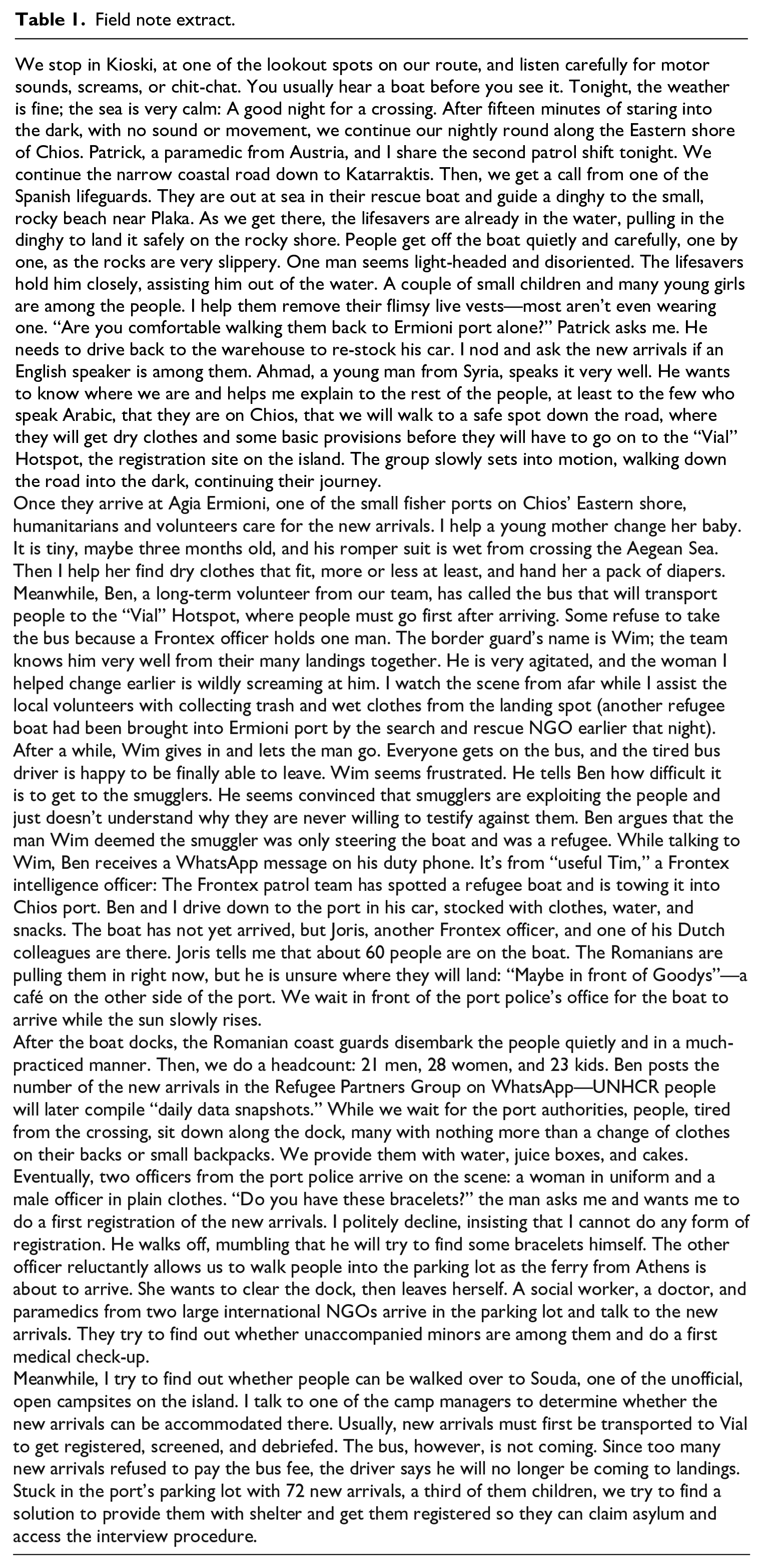
IO staff based on Chios improvised to handle the large number of people crossing from Turkey to Europe, establishing several routines for dealing with mixed movements at the border. As the field note extract begins to illustrate (see Table 1), border guards, screeners, debriefers, fingerprinting experts, and return escorts deployed by Frontex; asylum caseworkers affiliated with EASO; UNHCR protection officers; IOM reintegration experts; as well as humanitarian professionals, migration lawyers, rescue professionals, and medical personnel working for international NGOs tried out in practice how to manage migration and asylum. How did they experience the governance gaps outlined above, and how did they respond?
Field note extract.
Field staff working at the European external border described the situation on the ground as “chaotic,” “messy,” and “confusing.”
10
Their situation was characterized by an authority dilemma: Working on a sovereign state’s territory, they were bound by the directions of Greek officials. Yet the Greek authorities were reluctant to assume the responsibility that comes with their position—and hindered international staff from doing so in their stead. As a humanitarian worker put it: It’s a bizarre situation because the reason that the NGOs are here is because the European Union and the Greek government are overwhelmed. They can’t deal with the influx of people on their own. Otherwise, there would be no need for us to be here and they would delegate us different tasks—maybe on the mainland. But at the same time, all of the organizations have to fairly humbly ask permission to do anything. So it’s kind of this bizarre situation: I think that the authorities acknowledge that they need us here, but at the same time, they don’t want to be seen to be condescended to by the humanitarian machine.
11
Greek authorities were officially in charge but shirked responsibility, and at the same time, they hesitated to transfer formal competencies to international actors. Thus, fieldworkers were left with extremely vague organizational responsibilities and had to navigate a confused competence structure: “Decisions are made in Brussels; decisions are made in Athens. But at the moment there is a lot of gray area where we don’t know who is actually responsible for what.” 12
This authority dilemma was associated with pronounced short-termism, in which policy-making is reactive. Frontline workers lamented the “lack of management, planning, and foreseeing.” They criticized that “the authorities [were] almost completely absent” 13 at the border and failed to anticipate migration dynamics and the related governance challenges. When asked for policy guidance and strategies, decision-makers in headquarters responded, “Nobody thought of that!” 14 and “Yeah, it can take several months.” 15 Field staff from all organizations expressed that they could not rely on clear mandates, coordination structures, and policy instructions.
At the same time, the lack of a clear institutional framework provided them with ample room for maneuver. The observational data reveal they were keenly aware that state inaction and the absence of a central coordinating entity opened lots of space for independent action. On the ground, they held broad discretionary powers—albeit involuntarily. 16
In addition, frontline staff faced time constraints and the acute need to act because they were dealing with people who required immediate protection or were actively demanding answers; as a UNHCR protection officer recounted: “People expect us to be responsible and to respond to their needs.” 17 Unlike official policy-makers in the European Commission or at the UN and headquarter staff, their direct contact with migrants and refugees made it impossible for them to dodge decision-making. An EASO asylum expert put this in a nutshell: “They were in your face every day! [. . .] So, we had to do something. We couldn’t just sit around and do nothing.” 18
To remain capable of acting in this context, IO field staff experimented with new ways of handling things. In accordance with what I observed, they asserted, “[We] work in an environment where everything changes a lot, and you have to make decisions, and you have to improvise a lot.”
19
One example was search and rescue, the spotting of boats in distress at sea and the safe disembarkation of all passengers, as one of the rescue professionals recounts: That was all self-organized: Trial and error. At the end of the day, we were taking on a role that the coastguard should have been doing. [. . .][We] just kind of stepped into that role [and] have gained a huge amount of experience [because we] have taken on massive responsibilities and [were free not only to make our] own decisions but also to make mistakes and to learn from them.
20
Through learning-by-doing on the ground, fieldworkers developed detailed routines for patrolling the shore, spotting boats crossing from Turkey, going out at sea in their rescue boats to intercept them, steering them to safe landing sites, and assisting them in getting out of the water. Performing these search and rescue practices affected the life choices of people on the move in a very straightforward way: Without helping them to land safely, many would have drowned.
Very similarly, IOM, UNHCR, EASO, Frontex, and NGO staff members organized the onward transportation from the shore to the registration site, the registration itself, the accommodation of people on the move, the provision of basic goods—ranging from water, food, hygiene products, and medical care to clothes and blankets—as well as the protection of unaccompanied minors, psycho-social support, provisional education programs, legal aid, asylum interviews, family reunifications, and returns to Turkey or countries of origin. These activities are, of course, in parts foreseen in mandates, mission statements, host country agreements, and policies such as the EU Return Directive. However, even where such instructions existed, these are usually vague, incomplete, and not easily implemented, and therefore, putting them into practice means that those stationed on the ground need to be creative and deviate from the few existing policy scripts. As one of the humanitarian workers put it: “I think the EU has [agreed on] a policy in their sort of ivory tower. [. . .] And they’ve largely stepped back from dealing with the day-to-day issues [. . .] There’s such a disconnection between policy and reality.” 21
To reconcile “policy” and “reality” and close governance gaps, they relied on previous work experience and their professional skills. To organize the asylum interviews, for example, EASO staff and colleagues from other organizations improvised considerably to map the refugee population on the island, register new arrivals, ensure they could officially file asylum claims, set a sequence in which to interview people, and determine the admissibility of the asylum claims in Europe—using their experiential knowledge of having worked in airport reception centers, other campsites, and urban refugee contexts. 22 In so doing, they determined who got to claim asylum in Europe—which many observers describe as EASO staff clearly overstepping their mandates. 23 Practical knowledge—rather than organizational authority—thus turned out to be an essential resource for handling mixed migration at the border: Field-based staff utilized it to improvise, provisionally governing in the “ungoverned spaces” in between the limited mandates and rules.
Discretion and mission creep?
Autonomous action by the people working for different types of international organizations is, of course, desired by states and other principals that charge these organizations with performing certain tasks (Barnett and Finnemore, 2004: 5; Nielson and Tierney, 2003: 8). Because tasking an IO to deal with particular issues necessarily relies on incomplete contracts and ambiguous mandates, IO personnel always enjoy a certain degree of discretion. Thus, a certain amount of improvisation is expected when IOs govern.
Yet, this autonomy is usually constrained by organizational control mechanisms that monitor whether it contributes to good organizational performance—to prevent agency slack; autonomous action that is “undesired” (Hawkins et al., 2006: 8). In the context of an under-regulated issue area like mixed migration, goals and standards for successful performance have hardly been set, however (cp. Honig, 2019: 194). In fact, interviewees stressed how much it was up to them to decide what was at stake and required collective action in the first place—from saving lives at sea and registering incoming migrants to providing them with legal aid during the asylum procedures. A humanitarian professional expressed this when describing which organization is doing what at the border: The volunteer organizations are responsible for greeting the boats when they come in [. . .]. Other actors are responsible for—and “responsible” really isn’t the right word because it’s a strange situation in that the Greek government and the European Union should be responsible for all this. So, when I say responsible, I mean they’ve chosen to take on these tasks.
24
Overall, the interview and observational data make clear that fieldworkers felt obliged to “take up the slack” left by official policy-makers. Because the authorities “are so afraid to take decisions,” 25 they chose to take on tasks in their stead because they considered them essential. Often acting as private persons—but in a perceived public capacity—they improvised to find everyday solutions to situational challenges, thereby effectively defining what required a public response. Fieldworkers defined organizational goals and tasks, which arguably goes beyond the discretionary power of putting policies into practice.
In addition, their impromptu actions, which slowly became routinized at the border to regulate the large number of incoming migrants and asylum-seekers, were not directed at expanding their authority. A humanitarian worker expressed this clearly: “People seem reluctant to want authority—because it’s an impossible situation for almost everybody right now. So whoever takes authority has to fix a problem—and it’s a problem that’s unfixable.” 26 While it seems intuitive to assume that IO actors would seek to enlarge their influence by exploiting the opportunities that arose from the ill-defined competence distribution and the ongoing emergency (Kreuder-Sonnen, 2019; Sending, 2015), the observational and interview data show instead that “people keep bouncing the ball.” 27
In contrast to instances of mission creep, where IO staff “want to expand” (Littoz-Monnet, 2021: 860), border workers’ activities were not driven by potential authority gains. For example, a psychologist employed by the IOM said: “Our main work [was] AVRR [assisted voluntary return and reintegration]. However, it was clear to me that I want[ed] to do my work, the thing I know.” 28 Together with staff members from other IOs, he organized psycho-social counseling and stress-management focus groups—not because his organization was tasked to do that or because he wanted to extend IOM’s jurisdiction but, much simpler, because he faced an apparent need and had “the knowledge to do the things.” 29 This final example illustrates that the spontaneous decision-making of field-based staff, rooted in their professional skills, was geared toward coping with the pressure of having to respond to local demands without adequate organizational and policy resources at hand rather than taking over formal competence. Nonetheless, because these activities have a clear impact on how access to fundamental rights, public health, and education is distributed, IO field staff are “affect[ing] the daily lives and fortunes of people” (Ruggie, 2004: 499). 30
Governing through on-the-ground-practice, before and after authority has been established
The brief case study demonstrates that international actors organize collective action on migration and displacement. From search and rescue, registration, and camp management to asylum interviews, family reunification, and returns, fieldworkers develop and perform routines that bring some degree of order to spontaneous, undocumented migration and the turmoil it causes at transit and destination sites in the absence of safe migration pathways. Through everyday problem-solving, they reduce uncertainty, define shared goals, and coordinate behavior. In addition, their professional practices restrict and enable new courses of action for people on the move, thereby creating immediate regulative impacts on their lives. Instead of doing nothing, letting chaos and confusion unfold, they steer behavior to achieve common goals. Therefore, I view their practice in the field as a form of governing.
These governing activities go beyond IO authority on mixed migration. Fieldworkers are, of course, endowed with partial mandates, have some recognized expert knowledge and moral standing in this issue area, and their superiors have signed formal host country agreements for them to gain access to the field in the first place. Yet, while these explicit governance instruments might explain their very presence at the border, they cannot account for the extensive regulatory activities on the ground that extend well beyond their initial authorization and the recognized competence of their organizations. In addition, while these provisional ways of addressing migration and asylum at the frontlines of global governance might become institutionalized in a post hoc fashion (i.e. subsumed under existing mandates retroactively), they themselves have governing effects even before they are incorporated into existing authority structures: field staff use their professional skills to govern at the border, after and before authority has been established.
Conclusion
In this article, I argue that international organizations govern not only through laws, rules, expertise, standards, and numbers but also through practice on the ground. Drawing on practice theory’s concept of “competence” and using original empirical material from a case study of how several IGOs, regional agencies, and NGOs governed mixed migration at Europe’s border, I maintain and demonstrate that governance can emerge from the spontaneous organizing of collective action on site and the ad hoc decision-making by fieldworkers: IOs govern trough on-the-ground practice.
To account for this improvisational, practice-based mode of governance, I have proposed a minimalist definition of governing that does not focus on collective actors and questions of global order. This definition shifts analytical attention from authority—and how it is delegated, negotiated, maintained, exercised, and extended—to how particular issues are treated in practice in concrete places of governance. On the basis of this conceptual groundwork, we can now study preliminary, informal governing dynamics that otherwise would go unnoticed but which are consequential and likely to increase in times of global disorder. It also allows us to think about how they can be rendered more accountable to those people whose lives are permanently changed by this type of global decision-making.
Further research is needed to determine the conditions under which governing on the ground and similar forms of de facto governance emerge and successfully produce collective action on public problems. When does field staff decide to improvise and try to close governance gaps? Which factors determine whether their attempts succeed or fail? Relatedly, more knowledge is required about the normative consequences of the de-institutionalization and informalization of governance (see Brosig and Karlsrud, 2024; White, 2022). If global governance takes place outside established pathways, in personalized networks and ad hoc coalitions, who can participate in and benefit from it?
Those interested in the dynamics and outcomes of global governance have much to gain from studying provisional, messy, and difficult-to-institutionalize forms of governing. In terms of effectiveness and legitimacy, they are probably second-best to most types of governance, but under conditions of contestation, crisis and gridlock, they are often the only governance tools available to IOs—thus determining how global problems are addressed. Less ambitious in reach and normative quality, they are an empirical reality that warrants our analytical attention and critical scrutiny.
Footnotes
Acknowledgements
I want to thank Jens Steffek, Leonard Seabrooke, Catherine Liu, David Welch, Mark Raymond, Lisbeth Zimmermann, Marcela Oliveira Silva, Hande Abay, Ben Christian, Tobias Wille, Alex Tokhi, and Max Lesch for valuable feedback on earlier versions of this article. My heartfelt thanks go to all my interlocutors.
Interviews
Funding
The author(s) received no financial support for the research, authorship, and/or publication of this article.
