




Abstract
Our understanding of the contestation of liberal international order relies on an intuitive dualism. Technocratic norms underpin the legitimation of international organizations (IOs) because IOs embody a functional and depoliticized mode of problem-solving based on expertise and non-majoritarianism. Populist norms challenge IO authority as IOs create constraints on the popular will of the “true people.” We empirically examine whether this duality extends to the actors engaging in IO (de)legitimation by leveraging a novel and unprecedentedly fine-grained database on IO (de)legitimation by national governments. We find that (de)legitimation patterns of governments with technocratic or populist tendencies are far more dynamic and diverse than a dualistic account suggests. In particular, we find complex patterns of (de)legitimation that suggest challenges to and defenses of IO authority are driven more by a strategic, as opposed to an ideological, logic. We outline implications for the literatures on the international liberal order, technocracy, and populism.
The international organizations (IOs) that underpin the international liberal order require legitimacy to function. 1 When such legitimacy is absent, for example during periods of legitimacy crisis (Sommerer et al., 2022), state and non-state actors may turn away from international cooperation, subvert international law, or exit international institutions altogether. Political discourse on IOs matters in this regard, as how political leaders talk about IOs shapes the attitudes of their constituencies toward these institutions. When general publics no longer believe the exercise of authority by IOs is justifiable, they may reject further international cooperation at the polls (Dellmuth et al., 2022a; De Vries et al., 2021; Zürn, 2018). 2 This makes the contestation of IOs—the iterative process, that is sequences and exchanges, of legitimation and delegitimation of IO authority by state and non-state actors—an important area of research in International Relations (IR; e.g. Börzel and Zürn, 2021; Söderbaum et al., 2021; Tourinho, 2021).
But who contests IO authority, and why? Recent research has turned to explaining the contestation of IOs in terms of its institutional, discursive, and behavioral practices (see e.g. Bexell et al., 2022; Dellmuth et al., 2022b; Rauh and Zürn, 2020; Tallberg and Zürn, 2019). Both technocracy and populism play important roles in these analyses of IO contestation, if often implicitly. Traditionally, IO legitimation has a strong basis in technocratic norms and ideas (Rauh and Zürn, 2020: 587; Zürn, 2018: 77–84). In turn, norm entrepreneurs have been key to the emergence and wide-spread acceptance of IO authority, and experts within IOs have shaped the norms that IOs uphold (Finnemore and Sikkink, 1998: 899): in particular, both technocratically minded bureaucrats and incumbent politicians have played an important role in advocating for, and subsequently defending, the delegation of state authority to IOs from the outset (see e.g. Steffek, 2021: 129), and more recently during episodes of international crisis (Bickerton and Accetti, 2021: 124–126). Such delegation places public authority at arm’s length from citizens and national legislatures, transferring it instead to entities that promise to deliver effective solutions to cross-border policy problems by virtue of their political neutrality and sectoral expertise. Today, IOs still legitimate much of their activities by appealing to technocratic ideas, such as nonpartisanship, rationality, and performance (Bexell et al., 2022).
Populists’ norms and ideas, in turn, are generally assumed to play a key role in the global backlash against IOs. Where technocracy constrains popular sovereignty, populists are argued to contest what they cannot directly influence (Börzel and Zürn, 2021). Specifically, populists reject IOs by projecting the basic Manichean antagonism of the “people” versus the “elite” which forms the basis of populist politics at home onto the international sphere (Copelovitch and Pevehouse, 2019; Hafner-Burton et al., 2019). They target policies and organizations whose “inherent multilateralism and internationalism populist anti-globalists reject in the name of reclaiming national sovereignty and popular authority” (Löfflmann, 2022: 2; also: Destradi et al., 2022; Jenne, 2021). IOs in particular promote and safeguard core values and practices of international order which different populists (from the left and right of the political spectrum) challenge as part of a supposedly (neo)liberal elite project, such as collective security, international law and human rights, or free-trade agreements (Ikenberry, 2017; Voeten, 2020). Donald Trump’s subversion of the World Health Organization (WHO) during the pandemic and Nigel Farage’s successful Brexit campaign are stark and oft-cited examples.
The above points to an (at least implicit) assumption in the literature that suggests technocrats should be expected to legitimate IOs, whereas populists delegitimate them. We suggest that this view aligns with mainstream understandings of populism and technocracy as primarily ideological drivers of behavior.
Yet such dualism sits uneasily with recent insights on from the literatures on technocracy and populism, which we review in the next section. First, there are ongoing debates as to whether technocracy and populism should primarily be understood as ideologies, or, variously, as political strategies, styles, discourses, or traditions, and by extension, the extent to which actors that exhibit technocratic or populist behavior empirically are driven mainly by ideological or strategic considerations (Aslanidis, 2015; Mudde, 2017a; Rummens, 2023; Steffek, 2021; Weyland, 2017). Second, scholars increasingly question the assumed antagonism between the two; some even identify an intimate affinity between technocracy and populism as anti-pluralist modes of political representation (Bertsou and Caramani, 2020; Bickerton and Accetti, 2021; Caramani, 2017). These theoretical developments raise doubts on the casting of technocrats and populists as, respectively, defenders and challengers of IO authority. Indeed, recent scholarship has started to illustrate more complex patterns of contestation in detailed case studies, for example regarding populist leaders (Söderbaum et al., 2021; Spandler and Söderbaum, 2023; Wajner and Wehner, 2023).
In this article, we draw on these advances to investigate to what extent technocracy and populism are indeed systematically related to the (de)legitimation of IOs empirically. We do so by examining a crucial set of actors in international politics, namely national governments. We use “technocrats” and “populists” to mean those governments with a presentational propensity toward technocracy and populism, respectively. We suggest that a dualist assumption, that is that governments with stronger populist tendencies are more likely to challenge, and those with technocratic tendencies are more likely to defend, IO authority, is unlikely to hold up to systematic empirical scrutiny. While populist and technocratic ideas may indeed be systematically linked to IO legitimacy in theory, a systematic relationship between the actors publicly appealing to technocratic or populist ideas and their subsequent behavior vis-à-vis IOs, that is (de)legitimation, remains to be established empirically. Indeed, we argue that most empirical manifestations of technocracy and populism seem more congruent with what we term a discursive strategy explanation (Bickerton and Accetti, 2021; Mudde, 2007; Rummens, 2023). In the below analysis, we test this argument using a novel global dataset on IO (de)legitimation that tracks the contestation of the International Atomic Energy Agency (IAEA) and World Trade Organization (WTO) on a day-to-day basis across 2019–2020.
Our findings indicate that the (de)legitimation patterns of national governments exhibiting technocratic or populist tendencies are dynamic and heterogenous. In particular, we find complex patterns of (de)legitimation that suggest challenges and defenses of IO authority are driven more by a strategic than an ideological logic. Conceptually, this implies that we should be wary of classifying populists and technocrats by their stance toward IOs. That actors (de)legitimate IOs regardless of their propensity for populist or technocratic discourse may also be suggestive of a combined technopopulist discourse making its way into international politics. Finally, that policymakers find it in their interest to contest or defend IOs depending not on prior ideological commitments, but on strategic logics (e.g. in terms of electoral benefits at home) means that we see contestation from what may at the outset seem unlikely candidates. On the one hand, this may further erode taken-for-granted IO authority as the liberal international order is challenged more widely. On the other, it may also create a more permissive environment for necessary adaptation and reform on the part of IOs. In sum, we contribute to a growing literature on the patterns of populist contestation of liberal international order by adding a distinct focus on technocracy as populism’s supposed counterpart, and to the literature on IO (de)legitimation by offering unprecedented insight into the complexity of patterns of contestation.
Technocracy and populism in IO (de)legitimation
The growing contestation of IOs over recent decades has made the legitimacy of these organizations a staple feature of scholarly interest. Much of the research on IO legitimacy follows a sociological understanding, in which an IO is considered legitimate when it is widely believed to have a “right to rule” (Buchanan and Keohane, 2006). Hence, the growing contestation of multilateralism by anti-globalist challengers places IOs and their proponents under growing pressure to justify their exercise of authority for increasingly heterogenous audiences (Rauh and Zürn, 2020; Van der Veer, 2021; Zürn, 2018). There is visible conflict over IOs’ right to rule, played out through processes of (de)legitimation in which a wide range of actors, including governmental actors, bureaucratic elites, experts, scientists, activists, or journalists, support/defend (legitimation) or challenge (delegitimation) claims that the rule of IOs is acquired and exercised appropriately (Bexell et al., 2022: 26; Tallberg and Zürn, 2019: 585–586). By openly (de)legitimizing IOs, these actors intentionally or unintentionally shape the legitimacy beliefs that broader audiences, such as citizens, hold toward IOs. 3
Much of the literature on IO legitimacy suggests the legitimation of IOs is primarily based on technocratic norms and ideas (Bexell et al., 2022; Dingwerth et al., 2019a). As an ideology, technocracy entails a distrust of citizens and their competence in making political decisions, and instead elevates a knowledge elite that identifies the common good objectively through reason and which relies on competence, neutrality, efficiency, and expertise as their source of legitimacy (Fischer, 1990; Putnam, 1977). Moreover, it does not only revere science and expertise, but it is also elitist and deeply opposed to political pluralism (Caramani, 2017). Technocracy advocates for a knowledge elite to decide on both the means and ends of public policy, yet it does so under the auspices of “objectivity” and “evidence-based decision-making.” Hence, while technocratic ideology is presented as apolitical and neutral, it remains a fundamentally political standpoint at heart. A technocratic approach to political institutions furthermore favors the curtailing of their political responsiveness under the auspices of “responsible” and expertise-driven governance.
Justifications for IO authority are argued to be primarily technocratic in the sense that they are often grounded in a functional, Weberian logic that centralizes the efficiency gains brought about by shifting problem-solving capacity to the international level, as well as the expertise, rational-legal authority, and the political neutrality of IOs (Barnett and Finnemore, 2004; Rauh and Zürn, 2020: 587; Zürn, 2018: 77–84). However, this does not make IOs neutral or apolitical. Technocracy relies on “covert politicization” (Tortola in Bertsou and Caramani, 2020: 69), which is what may make IOs attractive: these traditionally depoliticized institutions offer actors that favor technocratic governance ways to shield their agenda from national politics. Indeed, from the outset, advocates of technocratic governance, such as France’s Jean Monnet, Britain’s Arthur Salter, but also the Roosevelt administration in the United States, strongly supported and defended delegation to IOs as a means to circumvent partisan and nationalist tendencies that were regarded as the root cause of many social problems (Steffek, 2021). Similar arguments have been made about why EU governments defended the strengthening of technocratic governance arrangements in the European Union during the Euro Area Financial crisis (Bickerton and Accetti, 2021; Sanchez-Cuenca, 2017). Finally, another technocratic feature of IOs is the domination of decision-making by executive and judicial powers. Accordingly, IOs have been characterized as “anticipatory depoliticization machines” (Schimmelfennig, 2020) and “technocratic utopia” (Steffek, 2021). 4
Conversely, the delegitimation of IOs is often viewed as closely tied to populism. 5 While there is considerable ongoing debate as to the conceptual nature of populism (which we discuss further below), a loose consensus seems to have emerged around the centrality of populism’s “Manichean divide”: Populists claim to promote the interest of a virtuous, “true people” that has been forgotten or actively ignored by unaccountable, self-serving, corrupt elites and dysfunctional institutions (Canovan, 1999). The populist leader supposedly personifies the authentic voice of the true people’s interests and collective will, to which he or she alone has direct and unmediated access (Lacatus and Meibauer, 2022). Populist electoral success is then understood as a quasi-plebiscitary mandate that allows the populist leader to do away with corrupt elites, and build a new, better political order that resonates with the longings and aspirations of the true people (Moffitt, 2015; Rooduijn, 2014).
Populists project the Manichean dualism between the “true people” and the “corrupt elites” to the international level by suggesting that supranational governance has eroded popular sovereignty. While populists’ specific gripes with IOs vary across economic, cultural, and institutional dimensions (De Vries et al., 2021), they tend to be deeply related to the technocratic features of IOs as outlined above (Neblo and Wallace, 2021; Zürn, 2018). In particular, populists paint IOs as elitist organizations that insulate decision-making from the will of the people (Dellmuth and Tallberg, 2021). The challenge to any one specific IO is thus usually connected to the populist’s wider criticism of elitist multilateralism. Left-wing populists denounce, for example, the embeddedness of neoliberalism in IOs or paint them as hindrances to more transgressive and inclusive transnational politics (Katsambekis, 2022). Right-wing populists target the political liberalism these IOs represent, most notably in the domains of immigration and trade integration (Chryssogelos, 2020; Jenne, 2021). Populists beyond the West may paint IOs as instruments of neocolonial domination (Zürn, 2018).
The commonality lies in the constraints IOs are argued to place on the “will of the people”: populists are likely to demand, for example, the nationalization of political control in the form of reduced out-group solidarity and cooperation, or even withdrawal of membership (Chryssogelos, 2020; Löfflmann, 2022). In turn, recent scholarship has argued that the growing contestation of IO authority, often driven by and in turn driving these populists challengers, has led IO defenders to expand the norms and ideas underpinning legitimation from technocratic to democratic ones (Dingwerth et al., 2019a; Rauh and Zürn, 2020; Tallberg and Zürn, 2019). It has also arguably increased the policy responsiveness of IOs (Rauh, 2016; Van der Veer, 2022). Indeed, IOs have increasingly engaged in extensive self-legitimation (Ecker-Ehrhardt, 2018; Sommerer et al., 2022; Von Billerbeck, 2020).
The above discussion indicates that existing scholarship suggests strong ideological affinities between technocracy and IO legitimation on the one hand, and populism and IO delegitimation on the other. However, while these affinities may exist at a theoretical level, we argue there are two good reasons why we should not automatically expect such affinities to travel to and be systematically observable at an empirical level. The first is related to the conceptual nature of both technocracy and populism, and the second to the affinity between them (“technopopulism”).
Ideologies or strategies?
The first factor problematizing the linkage of technocracy and populism to IO (de)legitimation empirically is the fact that they remain essentially contested concepts. Much of the preceding scholarship views them as primarily a type of ideology, and therefore tethered to individual or collective belief. Populism is most often conceptualized as a “thin” ideology (per Mudde’s (2004, 2007) influential definition) that combines with other, “thicker” political ideologies across the cultural and economic left–right spectrum depending on the particular populist leader or movement in question (Löfflmann, 2022: 406). “Thin” here refers to the notion that populism does not itself constitute a comprehensive political program for society but argues for a specific understanding of legitimate political power. Both Bertsou and Caramani (2020: 8) and Rummens (2023) have recently argued that technocracy should similarly be understood as a thin ideology, which has successfully latched onto neoliberalism as its host (“thick”) ideology.
If the behavior of ostensible technocrats and populists is driven primarily (or at least to a considerable part) by underlying ideology, we should expect two patterns to emerge which mirror expectations in the literature on IO (de)legitimation we discuss above: first, that politicians externalize their ideological positions, including populism or technocracy, into the international arena (Löfflmann, 2022), and second, that they (aim to) do so largely consistently given (as “true believers”) they should be expected to seek congruence between their ideology and behavior across different contexts (Lacatus and Meibauer, 2023: 253). For example, if a populist truly believes that some IO unfairly limits the sovereignty of the “true people,” one would expect them to (try to) consistently challenge it, not least also because their followers or voters are likely to punish inconsistency (Sorek et al., 2018: 660–661). Based on an ideological lens, technocrats should be systematically more likely to legitimate IOs, and less likely to delegitimate them, than populists (and vice versa). Extant literature has identified considerable confirmatory evidence of these linkages, but often in small-n research rather than across actors and cases.
However, especially populism scholarship has questioned the still-dominant ideological conceptualization on both theoretical and, more tentatively, empirical grounds (Aslanidis, 2015; Stanley, 2008). Populists show a high degree of flexibility in the policy positions they espouse, likely for strategic reasons and/or to curry electoral favor (Hadiz and Chryssogelos, 2017; Lacatus and Meibauer, 2021; Taggart, 2000; Weyland, 2001). Populists may delegitimate IO authority simply because this allows them to mobilize popular discontent, legitimate themselves, gain access to transnational supporters, or perpetuate a sense of systemic failure and existential crisis that is electorally advantageous to them (Wajner, 2022). Yet recent history has also seen examples of populists engaging in cooperation with IOs, especially at the regional level. For example, in 2015, Greek Prime Minister Alexis Tsipras signed a new bailout package even though he campaigned against it (Chryssogelos, 2021), which Mudde (2017b) characterizes as a “failure of the populist promise.” Some populist leaders not only cooperate with, but even actively legitimate IOs where it suits their political goals (Söderbaum et al., 2021). Similarly, ostensibly technocratic politicians also delegitimate IOs, such as when French President Emmanuel Macron openly criticizes the North Atlantic Treaty Organization (Perottino and Guasti, 2020). These inconsistencies are at odds with the behavioral expectations derived from treating populism and technocracy as ideologies.
In response, instead of conceiving of populism in particular as a (thin) ideology, scholars have conceptualized the phenomenon in two alternative ways. 6 First, some scholars consider populism a strategy available to largely unideological actors seeking to maximize current and/or future political standing (e.g. electoral gains; Weyland, 2001, 2017) This conceptualization views populism as a politico-strategic choice. It can explain inconsistency and sudden changes in policy positions as well as coherence depending on the particular political contexts within which actors operate, that is through the salience of specific issues, voter expectations, or stability of democratic institutions (for overviews, see: Rueda, 2021; Weyland, 2021). This is because it does not assume that behavior is (by and large) the result of externalized ideological commitment but rather a strategic adaptation to ever-changing circumstances. It also means that a wide array of actors, including those not conventionally conceived of as populist, can employ a populist strategy where it suits them. Empirically, scholars have sought to infer the power-maximization motive through what leaders say and do.
Here, second, they find overlap with scholars treating populism as primarily a discursive and/or performative style (among others: Brubaker, 2017; Laclau, 2005; Ostiguy, 2017). Similar theoretical moves can be identified for the concept of technocracy, which some argue is un-, anti-, or post-ideological (Bertsou and Caramani, 2020; Bickerton and Accetti, 2021), and should be conceptualized as a political tradition (Steffek, 2021: 186–187) or style (Rummens, 2023: 9–12). What unites these approaches is an emphasis on the discursive, rhetorical, and performative strategies and choices of actors that are not (only) motivated by ideology, but (also) more instrumentally by political interest—for example, populist rhetoric is an output of a leader’s strategic calculations, not primarily ideological commitment (Lacatus and Meibauer, 2021). The focus then shifts from what might constitute the ideology of populism or technocracy to how and why it is employed discursively (de Vreese et al., 2018). Indeed, as Aslanidis (2018) points out, definitions of populism as ideology are “unable to escape discursive implications, and are almost always couched in terms of rhetoric” (p. 1244). To highlight the conceptual complementarity and combination of political strategy and discursive choice (in terms of (de)legitimating IOs), we refer to this understanding as a discursive strategy.
The above suggests that political actors (de)legitimating IOs might do so driven not (solely) by ideological conviction but (also) by strategic considerations. These strategic considerations are underpinned by a preference assumed to be shared across political actors for gaining or holding on to political power. For our purposes, this has two important implications. First, even if ostensible technocrats and populists were primarily driven by ideology, the notion that this conviction is a combination of technocracy or populism plus a “thicker” host ideology would mean that empirical patterns of engagement with IOs should problematize a dualist assumption that populists challenge and technocrats defend IOs. Second, if political actors tapped into technocratic or populist discourse strategically, we should expect even less consistency in how technocrats and populists engage with IOs.
Complementary discursive strategies?
Recent scholarship also gives reason to reconsider whether technocracy and populism are contradictory at all. Caramani (2017) argues that populism and technocracy are two sides of a singular challenge to the political pluralism that representation via political parties provides in democratic systems. Populism and technocracy thus have important commonalities: both claim a unitary common good that is discernable through the unmediated responsiveness to the will of the “true people” as understood by the populist leader, or deduced by the technocrat via rational speculation and superior expertise. Both are also anti-pluralist in that they reject interest mediation and view political compromise as a problem rather than a solution. These commonalities have led Bickerton and Accetti (2021) to argue that populism and technocracy “should not be seen merely as characteristic features of a specific category of actors [. . .] [T]hey have become constitutive elements of a new political grammar—or logic—that affects the behavior of all political actors in contemporary democratic regimes” (p. 2).
These scholars view technopopulism not as an ideology, but as a distinct discursive strategy superimposed over ideologically motivated cleavage politics, and available to actors across the political spectrum. Actors can and often do tap into both populist and technocratic discourses simultaneously, in complementary fashion. For example, Bickerton and Accetti (2021) point to French President Emmanuel Macron, who claimed he ran against the French political establishment while cultivating an image as a competent, unideological caretaker of the public good, but also to Italy’s Five Star Movement, which simultaneously claimed to embody “the people” as well as have superior expertise and be more competent than Italy’s political elites.
In conclusion, whereas it is possible to systematically link (de)legitimation of IOs to populist and technocratic ideas in theory, our discussion indicates that an extrapolation of this duality to the level of political actors and their behavior is unlikely to manifest empirically across cases. This is because it is difficult to assess whether actors (de)legitimating IOs do so primarily out of ideological conviction or (also) strategic motivations. Indeed, actors may delegitimize an IO one moment and legitimize it the next, or legitimize one IO and in the same breath delegitimize another.
This has two important implications: first, it does not necessitate that populists may not find it profitable to delegitimate IOs, or that technocrats will not defend IOs when their authority is challenged. It merely implies that there is not necessarily something distinctly populist about those who delegitimate IOs, or technocratic about those who legitimate them. Moreover, while much of the debate on populism and technocracy focuses on Western liberal democratic systems, we see little reason why the above should not apply to technocratic or populist actors beyond the West—even if they hail from hybrid, autocratic, or illiberal regimes. Second and importantly, to investigate the relationship between technocracy, populism, and the (de)legitimation of IOs empirically, we must disentangle who counts as “populist” or “technocrat” from their subsequent (de)legitimation of IOs. Hence, we formulate the following two hypotheses to guide our empirical analysis.
Hypothesis 1: Political actors that exhibit a stronger propensity toward technocracy are not systematically more likely to legitimate IOs, nor are they less likely to delegitimate them.
Hypothesis 2: Political actors that exhibit a stronger propensity toward populism are not systematically more likely to delegitimate IOs, nor are they less likely to legitimate them.
Methodology
We test these hypotheses by constructing a novel global dataset on mediatized instances of (de)legitimation of the WTO and the IAEA. Our analysis is restricted to (de)legitimation by national governments, tracked on daily basis across 2019–2020 as reported in both print and web news. Our focus on mediatized instances of (de)legitimation has the distinct advantage that it does not instill a bias toward acts based on their underlying motivation (ideological or otherwise). 7
We select the WTO and IAEA as our targets for several key reasons. For one, there is extensive literature on the contestation of the WTO and the IAEA, respectively, especially by but not limited to populist leaders. The WTO in particular, just like cooperation on trade more generally, has faced considerable (de)legitimation challenges (Dingwerth, 2019); more recently, Trump’s populist-nationalist protectionism stands out (Skonieczny, 2018). 8 The IAEA has come under pressure by a wide variety of actors, especially regarding verification and inspection activities (Weise, 2019). The WTO and IAEA have three important commonalities. They (1) have no geographical restrictions to membership (unlike e.g. the European Union), (2) are part of the set of IOs that make up the international liberal order, 9 and (3) have traditionally legitimated their authority in technocratic terms (Dingwerth et al., 2019b: 45, 246). This last commonality is important because it mimics a crucial case logic: if we find no dualist pattern of (de)legitimation for these IOs, it is unlikely that such a pattern does exist for less “technocratic” IOs.
Yet the WTO and IAEA also offer two important sources of variation: first, recent research indicates that IOs engaged in security governance, such as the IAEA, tend to enjoy more legitimacy than IOs engaged in economic governance (Dellmuth et al., 2022a: 217). Second, the WTO enjoys considerably more delegated authority than the IAEA (for details, please see the “Measuring International Authority” dataset, Hooghe et al., 2017), which gives it greater capacity to constrain the agency of national governments and by extension increases the visibility of the organization. Given the above, we expect the WTO to face more contestation than the IAEA and consider the inclusion of both IOs a good test for our argument in both a high-contestation scenario and a low-contestation scenario.
Measuring (de)legitimation by national governments using GDELT
Our data regarding acts of (de)legitimation are derived from the Global Database on Events, Language and Tone (GDELT). Our Supplemental Appendix provides a detailed discussion of this dataset, its advantages and limitations, and the hand-coding process by which we construct our measures of (de)legitimation. Our dependent variable consists of 31,438 country-day dyads nested in 43 countries and 730 days, 30,885 of which are dyads where no (de)legitimation was observed. It includes 553 instances of (de)legitimation, 370 of which are acts by actors in national government, mostly national leaders. This is consistent with previous research indicating that national governments make up the majority of observed (de)legitimation instances in global governance; their communication is more impactful in shaping legitimacy beliefs of audiences than the communication of IOs themselves (Sommerer et al., 2022). Our final measures of (de)legitimation thus capture acts of (de)legitimation targeted at the IAEA or WTO by national governments in terms of their intensity (the number of distinct acts) and tone (legitimation or delegitimation; see Tallberg and Zürn, 2019). 10
Measuring governments’ propensity toward technocracy and populism
For our measures of governments’ propensity toward technocracy and populism, that is to what extent we consider them “technocratic” or “populist” for our purpose, we turn to the Varieties of Democracy dataset (V-Dem, see Coppedge et al., 2021) and Varieties of Party Identity and Organization datasets (V-Party, see Lindberg, 2023). Both provide reputational measures of the populist and technocratic tendencies of governments and governing parties, which is crucial because this approach is agnostic about whether the underlying motivations are ideological or strategic. 11 This gives us a clean method to examine whether governments that publicly appeal to technocratic or populist ideas are also more likely to legitimize or delegitimize IOs, respectively. Note that it does not matter if our measures of governments’ propensity toward technocracy or populism are also driven by strategy: our goal here is to assess whether governments that appear technocratic or populist also systematically legitimate or delegitimate IOs. As explained above, should these governments indeed be primarily motivated by ideology, we would assume that they (de)legitimate IOs consistent with their populist or technocratic ideas.
We measure governments’ propensity toward technocracy using V-Dem, which is based on expert surveys and thereby provides reputational measures of, among others, legitimation by national governments. This makes it the perfect source of data on whether governments present themselves as technocratic. We use three continuous measures to construct our technocracy measure. The first captures the extent to which a government promotes a specific ideology (v2exl_legitideol). Governments scoring low on this indicator thus have a reputation for using discourse that is free of ideology, which we use as an indicator for technocracy’s purported a-politicalness. The second captures the extent to which a government legitimates itself using performance (v2exl_legitperf), including effectiveness and efficiency. This measure thus directly captures technocracy’s focus on competence and output legitimacy. The third measures the extent to which a government justifies its actions by appealing to legal norms and regulations (v2exl_legitratio); the appeal to a depoliticized “rule of rules” is often regarded as key legitimation strategy by technocratic actors, especially during crisis (see e.g. Sanchez-Cuenca, 2017; Scicluna and Auer, 2019; Steffek, 2021: 7).
We use these indicators to calculate a measure that captures technocracy’s anti-ideological, performance, and rational-legal orientations as follows (Bertsou and Caramani, 2020; Bickerton and Accetti, 2021):

Consequently, a government scoring highly on this indicator is a government that has a reputation of justifying itself using apolitical, performance-oriented, and legalized discourse.
Governments’ propensity toward populism is captured using the v2xpa_popul variable in the V-Party dataset, which captures the level of populist discourse of the representatives of (governing) parties. We opt for this dataset because it is the most comprehensive dataset on populism in terms of global coverage. This measure runs from 0 to 1, with higher scores indicating more use of populist discourse. 12 Note that these measures of technocratic and populist rhetoric are not mutually exclusive: given that technopopulism is a theoretical possibility (Bickerton and Accetti, 2021), it is empirically possible that governments score highly on both indicators simultaneously.
Finally, we add two further indicators to control for the degree to which the state that the (de)legitimating government represents is a liberal democracy (v2x_libdem in V-Dem) and its gross domestic product (GDP) per capita in U.S. dollars (World Bank, 2022). We also include a lagged measure capturing whether the IO in question was legitimated at t − 1 (the day before) when predicting delegitimation (and vice versa) to control for the possibility that (de)legitimation events are responsive. We provide descriptives in the Supplemental Appendix.
Below, we first provide a descriptive analysis of our dataset in which we include qualitative observations from our coding process. This is followed by statistical modeling, where we rely on a series of logistic regression models that predict (de)legitimation. For all models, we center our predictors and standardize continuous measures by two standard deviations (Gelman and Hill, 2006). We specify two random intercepts to control for the cross-classified nesting structure of our data: one for countries, and one for weeks. 13 We estimate these models on the pooled, as well as unpooled (IO-specific), subsets of the data. We use listwise deletion to drop missing values, which restricts our sample for the fully specified models due to the limited coverage of our populism variable (N = 24,751 across 34 countries). No modeling assumptions were violated by the models presented below.
Analysis
Figure 1 plots our observations of (de)legitimatin of both IOs by national governments against governments’ technocracy and populism scores, respectively. These descriptives already indicate some interesting patterns. Foremost, national governments that score lower on the technocracy measure indeed appear to delegitimate IOs more compared to those scoring higher on the technocracy scale—but this also holds for legitimation. This is incongruent with a simplistic view on technocracy as an ideology, where we would expect technocrats to engage in legitimation and avoid delegitimation. Instead, we appear to observe a technocratic preference for depoliticization: more technocratic governments appear to be reluctant to openly engage with IO legitimacy.
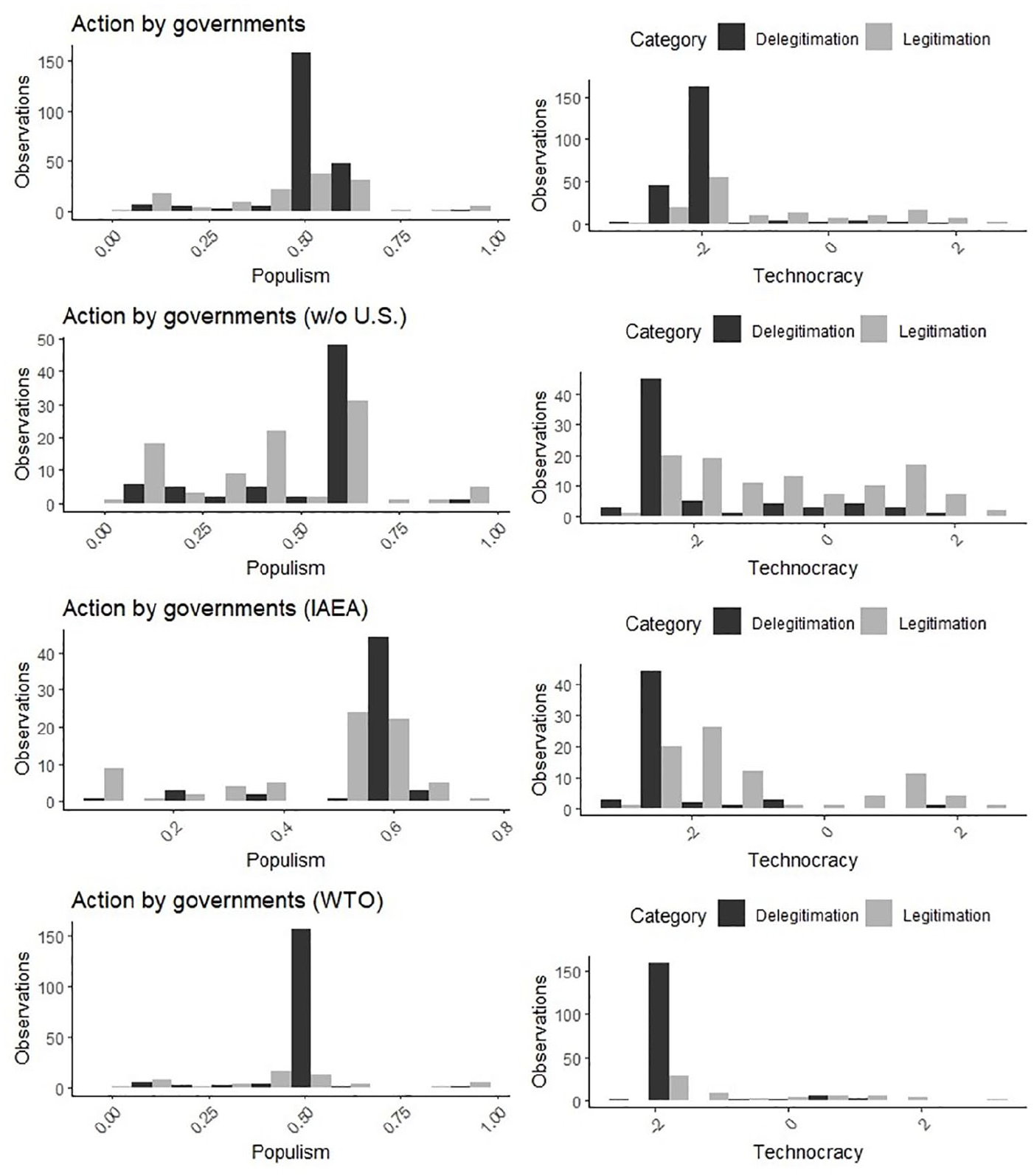
(De)legitimation by governments.
Turning to populism, we again observe an ambiguous association with IO (de)legitimation. The majority of our observations are tied to the Trump administration, which scores midway on the populism scale (0.538) and largely defines the distribution. In terms of legitimation, the Trump administration was often willing to legitimate IAEA efforts perceived to be directed against Iran (and to a lesser extent, laud the WTO’s willingness to countenance reform). If we exclude the United States, this ambiguous pattern holds: we observe (de)legitimation across the populism scale, with both legitimation and delegitimation occurring most frequently at the high end of the scale. 14
These patterns of (de)legitimation by governmental actors seem on the surface to be more instrumental and context specific. If we look at IO-specific patterns, we see that engagement varies. At first glance, more populist governments do seem to delegitimate the IAEA. This may in fact be surprising given the organization’s comparatively lower authority and reduced salience to many domestic audiences. A closer look reveals that IAEA (de)legitimation is largely driven by verification and inspection activities (especially concerning Iran in our timeframe). While Iran overwhelmingly delegitimates the IAEA, it does also legitimate it on occasion (e.g. where inspection reports include findings interpreted as Iran friendly). Some legitimation elsewhere is also the product of the IAEA’s technical assistance, for example for nuclear power generation (Weise, 2019). Even beyond Iran, whose government can be expected to be critical of IAEA authority generally, we find that populist governments are quite willing to legitimate the IAEA where the IO’s activity aligns with their political agenda. As illustrated above, the Trump administration is similarly willing to voice support of the IAEA in instances where the organization happens to align with U.S. interests. No clear pattern emerges across the populist and technocratic spectrums when it comes to the IAEA: issue-specific strategic positioning seems to override ideological conviction, and (de)legitimation dynamics fluctuate widely. This could in principle be related to the IAEA’s scope, as it governs security issues, including nuclear weapons, which are often assumed to trump domestic politics.
However, the same dynamic also holds for the WTO, though to a lesser extent: for example, the Trump administration repeatedly attacks or downright sabotages the WTO, especially via its refusal to nominate judges to the IO’s important appellate body. This is consistent with its populist tendencies. Concurrently, in instances where the WTO’s activities work in the Trump administration’s favor, we find instances in which the administration willingly legitimates WTO authority. It tends to do so by stressing personal connections, which may be typical for populist foreign policy (Destradi and Plagemann, 2019). For example, Trump repeatedly highlights his “tremendous relationship” with WTO Director Azevêdo at the same time as he harshly criticizes the WTO’s record, procedures, and authority (Arter, 2020). The populist Duterte government of the Philippines, in turn, repeatedly legitimates the WTO as an organization. In March 2020, connected to a trade dispute with Thailand, the Philippines’ trade secretary notes the WTO’s frailty but also suggests that his government is “fighting for [. . .] the relevance of a responsive WTO,” and tries to demonstrate that “the WTO works” (Canivel, 2020; Ibanez, 2020). Here, we see a willingness of populist governments to strategically legitimate IOs where their authority and activity happen to align with the government’s foreign policies and/or electoral appeal.
We find similar complexity when it comes to more technocratic governments. For example, various governments scoring higher on our technocracy measure also harshly criticize the WTO and question its continued relevance in global governance; they appear to engage in anticipatory delegitimization in an effort to undercut challenges by populist governments. This seems intended both to steal the populists’ thunder and to demonstrate responsiveness. Where such challenges relate to the IO’s actual performance and behavior, such as in arbitrating trade disputes effectively, the WTO indeed came under attack from various populist challengers. Some non-populist governments then join in but employ more conciliatory stances, presumably to soften the blow. Our observations of non-populist delegitimation are usually paired with calls for reform or other progressive policy proposals—they are aimed at the IO’s current format, leadership, or processes rather than the organization’s authority or existence as such. IOs themselves also engage in such conciliatory self-delegitimation by admitting alleged failures and even responsibility for them (Heinkelmann-Wild and Jankauskas, 2022). For example, WTO Director-General Azevêdo, in response to criticism of the WTO, suggests at the 2020 World Economic Forum that the IO is in need of serious change because it is indeed not functioning properly: “If the WTO is to deliver and perform its role in today’s global economy, it has to be updated [. . .] We are committed to effect those changes” (Heavey, 2020). This appears aimed at evading further escalation and possible sanctions from challengers.
Next, we turn to statistical analysis. Figure 2 plots the fixed-effect estimates of our multilevel models, including 95 percent confidence intervals. 15 In line with our descriptive analysis, we find that more technocratic governments are less likely to publicly legitimate (p = 0.052) and delegitimate (p = 0.002) IOs in our pooled model. The estimates from our unpooled models suggest the lower propensity toward legitimation is driven most strongly by the observations regarding the IAEA, while the lower propensity toward delegitimation by technocratic governments appears driven in equal parts by both the IAEA and WTO observations. These findings corroborate Hypothesis 1 in the sense that we find no evidence that technocratic governments are more likely to defend IOs (although they are less likely to delegitimize them). However, they do not support Hypothesis 1 in that we find a systematic tendency toward non-engagement concerning our IOs by national governments tending toward technocracy. This is congruent with a technocratic preference for depoliticization often discussed in relevant literature (Tortola, 2020): a technocratic discursive strategy vis-à-vis IO authority is then characterized not so much by a defensive or legitimating stance, but more so as an attempt to say as little as possible about IO authority in the first place. This may serve to avoid a public confrontation of alternatives or even indirect or direct electoral choice (Bertsou, 2020: 265).
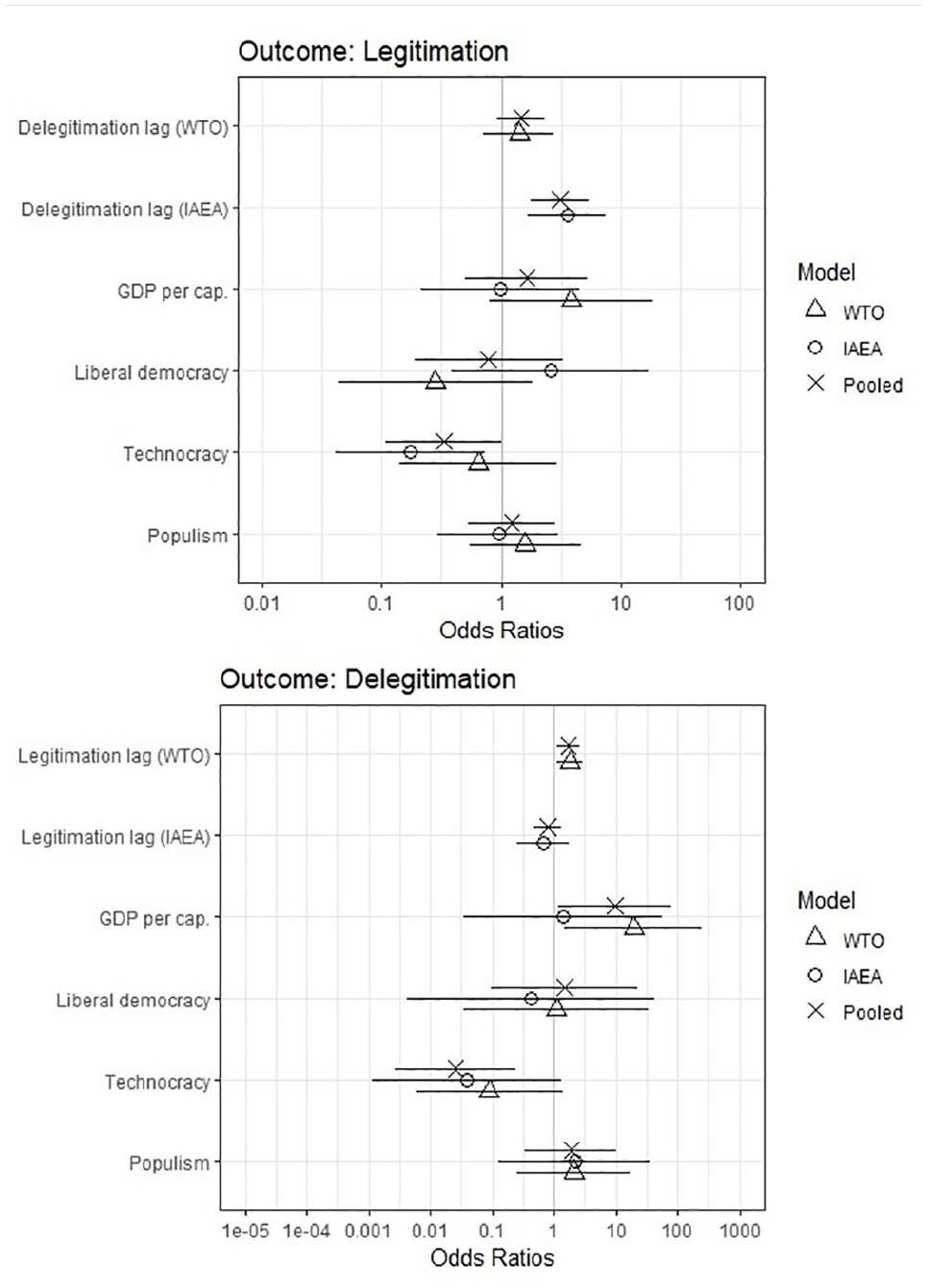
Logistic models predicting (de)legitimation.
Our results with regard to populism are equally striking. Our models indicate that governments scoring higher on our populism scale are not more likely to legitimate or delegitimate IOs. This finding is consistent for the models based on the pooled data, as well as those for the IAEA and WTO subsets. These results fully corroborate Hypothesis 2.
Moving beyond our main results, our models also show that delegitimation at t − 1 significantly predicts legitimation at t in case of the IAEA, whereas legitimation at t − 1 significantly predicts delegitimation in case of the WTO. This again highlights the strongly IO-specific dynamics of (de)legitimation processes, but also suggests (de)legitimation is primarily a response to off-norm action: legitimation triggers delegitimation in cases where the IO is undergoing a period of strong contestation (WTO), whereas delegitimation may trigger legitimation if the key actors on the international stage broadly accept an IO’s authority (IAEA). We also find that a higher GDP per capita is positively associated with delegitimation (p < 0.05). This effect again is strongly driven by the WTO, suggesting that governments from developed economies are more likely to contest the organization during our period of observation, which coincides with (Western) criticism of China’s status as a developing country under WTO rules. 16
As a final step, we conduct several robustness checks by cross-checking these results with those of models with alternative specifications. First, we added interaction effects between populism and technocracy to the models presented above, to gauge whether IO (de)legitimation was a distinctly technopopulist phenomenon. These models did not provide any evidence for such a notion (see Supplemental Appendix Figure C1). Second, we also varied the specification of our models to include a random intercept for days rather than weeks. While this caused our indicators of (de)legitimation at t − 1 to lose significance across models, our results regarding technocracy and populism remained substantively unchanged (see Supplemental Appendix Figure C2).
Finally, we also ran a series of multilevel models using a Bayesian specification, which allow for the inclusion of statistical priors (McElreath, 2016). While the use of priors can be controversial, in our case they offer the distinct advantage that we can leverage them to create a more difficult test for our hypotheses. We do so by setting informative priors to be in line with a simplistic account of how technocratic and populist governments engage with IOs, that is priors that expect a positive/negative effect of technocracy on legitimation/delegitimation, respectively, and the inverse for populism. This exercise again left our findings substantively unaffected, although the negative effect of technocracy on legitimation was no longer credibly distinguishable from zero. These results, as well as details on the specification of priors, can be found in the Supplemental Appendix (see Supplemental Appendix Figure C3).
Discussion
Our analysis has investigated the relationship between populism, technocracy, and the (de)legitimation of IOs. We find no structural relationship between the (de)legitimation of IOs and the degree to which national governments are prone to tapping into populist discourse. Concerning technocracy, our findings are mixed: governments with a higher propensity toward technocracy are not more likely to legitimate IOs. They are, however, less likely to engage in contestation of IO authority altogether, which is congruent with a technocratic preference for depoliticization (Bertsou, 2020; Tortola, 2020). These findings are largely consistent for both the IAEA and WTO despite the considerable level of variation in terms of scope, authority, salience, and contestation associated with these IOs.
Moreover, we find complex, issue-, and IO-specific dynamics of (de)legitimation that match more recent, nuanced accounts in the literature on populist engagement with IOs (e.g. Spandler and Söderbaum, 2023), as well as contributions questioning the ideological nature of populism and technocracy, respectively (e.g. Rummens, 2023; Weyland, 2021). These dynamics are suggestive of a more strategic approach taken by technocratic and populist governments toward discursively engaging with IOs. Ostensible populists defend IOs when it suits them, for example where the IO happens to align with their political agendas or domestic electoral incentives. Similarly, ostensible technocrats delegitimate IOs when a challenge may yield domestic political gains, in anticipation of populist challenges, and/or where they see potential for reform.
While with very few exceptions (e.g. Brexit), contesting IOs is unlikely to singlehandedly decide elections, it can be domestically advantageous in two key ways: first, as outlined above, the challenge or defense of any specific IO may stand in for a larger idea (e.g. “taking back control” or “follow the experts”). Second, more specifically, challenging or defending a specific IO may help mobilize particular voters in a largely risk-free fashion—by demonstrating consistency with previous rhetoric and/or by signaling that, for example challenging the WTO is evidence of a wider agenda (e.g. protecting blue-collar workers). Of course, investigating the exact motivation for any one ostensible populist or technocrat to (de)legitimate a specific IO, and/or their choice of discursive strategy (e.g. which IO to defend or challenge when and how), likely requires in-depth, within-case research, but presents a potentially fruitful avenue for further research. Across cases, these patterns are largely inconsistent with an ideological approach to populism and technocracy, respectively, and more easily explained by the discursive-strategic lens we outlined above.
This suggests that we need to shift our conceptual understanding of who contests IO authority: while there may be something distinctly technocratic or populist respectively about the legitimation of IOs in terms of ideas (e.g. Steffek, 2021; Zürn, 2018), there is no systematic relationship between the actors drawing on technocratic or populist discourses and their subsequent behavior in terms of (de)legitimation of IOs. This also implies that we should be wary of classifying populists and technocrats by their stance toward IOs. Our findings thus nuance much of the recent scholarship on populism in IR, which tends to rely on conceptions of populism as ideology (Destradi et al., 2021; Löfflmann, 2022).
They also put scholarship on technocracy into conversation with both that on populism and on IOs, which may further elucidate the discursive dynamics of technopopulism in IR. While it is important to note that our statistical analyses do not support a technopopulist account in a stricter sense (i.e. that actors combining technocracy and populism are more likely to (de)legitimate IOs), the empirical complexity we observe is suggestive of technopopulist discourse as “an organizing logic of [political] competition based on the combination of populist and technocratic discursive tropes [. . .]” (Bickerton and Accetti, 2021: 17) on which actors rely in the contestation of IOs.
Finally, the above dynamics are reactive to, and productive of, narratives of crisis surrounding and regarding specific IOs. Types of legitimacy crises vary strongly across issue areas, organizations, and over time (Sommerer et al., 2022). Analytically, the relative stability of the IAEA’s legitimation discourse in a highly turbulent political environment confirms our suspicion that field-specific legitimation cultures matter, and that international security governance remains more stable than most other fields (Dingwerth et al., 2019b). In turn, (de)legitimation of the WTO has long proved an electorally attractive playing field for, inter alia, political leaders seeking to raise their populist and/or technocratic profiles. The way this contestation plays out in our data suggests, first, that (de)legitimating the WTO may be more easily leveraged for domestic political gain, and second, that how and by whom this is done in turn depend on particular (domestic) contexts (Hooghe et al., 2019: 732).
Our findings are subject to three main limitations. First, their generalizability is limited: they are likely applicable only to IOs that are part of the international liberal order, and only apply to recent history. It may be the case that a more explicitly dualist pattern of (de)legitimation by populist and technocratic governments respectively was observable at some point in the past. Our data simply suggest it is no longer today. We cannot currently exclude that there may have been a shift in how IOs are contested, and by whom. For example, the increasingly global nature of contemporary challenges (e.g. pandemics, financial crises, nuclear war, etc.) may increasingly turn the spotlight on IOs. Also, the return of populists to government especially in leading countries of the Global North, like the United States and United Kingdom, may have helped to normalize (de)legitimation of IOs (i.e., their political instrumentalization for domestic purposes) across the political spectrum, both by highlighting the potential political utility of challenging IO authority and by underlining to others the necessity to engage in its defense. This may have made it more attractive and acceptable for opportunistic technocrats to engage in challenging IOs for domestic political gain, and in turn means populists may have found it useful to defend those IOs they thought aided their electoral chances. Future research covering a more extensive time span is needed to pinpoint exactly if and when such a shift occurred.
Second, there may be structural differences in terms of the objects of contestation that are targeted by the (de)legitimation practices of populists and technocrats, such as differences between regime and policy contestation concerning IOs (De Wilde et al., 2016). While we did not find clear indications to this effect in our data, this may prove a fruitful avenue for future research. It lends further credibility to our claim that the dynamics surrounding populists, technocrats, and the (de)legitimation of IO authority are far more intricate than a dualist account would suggest.
Third, the dataset we employ approaches (de)legitimation through reports in worldwide media. This could bias the data, for example because media overreports delegitimation, or delegitimation specifically by populists—so that media reports are not a measure of “true” contestation. However, given the central role media play in constructing and sustaining discourses, what the media reports is, to a considerable degree, the discourse on IO authority. Moreover, we do not observe disproportionally more delegitimation in our dataset, which is in part due to the unique data source we employ: GDELT has allowed us to sample across an unprecedentedly diverse amount of data. This makes for a far more fine-grained analysis of (de)legitimation dynamics compared to a more traditional media analysis approach based on monitoring smaller samples of purposefully selected newspapers. The only clear bias in our dataset is toward Anglophone sources: whereas GDELT claims to also scan and include non-English source material, we find no such occurrence in our dataset. This finding is congruent with existing critiques of the GDELT project (Wang, 2018).
Conclusion
IOs have underpinned the rules-based international order since World War II. Legitimacy is an important precondition for the proper functioning of these IOs: if IOs lack legitimacy, they face dissent, subversion, and exits. How political leaders publicly talk about and engage with IOs is crucial in this regard, as it shapes the beliefs of audiences, including those of general publics, about the legitimacy of those IOs. This contribution sought to examine whether an intuitive dualism implicit across the literature on IO contestation, which is rooted in an understanding of populism and technocracy as ideologies, extends from the level of ideas to the actors advocating them, and their subsequent behavior vis-à-vis IOs. Such an account would suggest that populists are more likely to contest IOs because they truly believe them to be elitist organizations that constrain popular sovereignty and the national will, while technocrats are more likely to defend IOs because of their deeply held conviction that IOs rely heavily on sectoral expertise and provide useful vehicles to insulate decision-making from short-term political pressure.
This account is incongruent with tentative recent advances in the literatures on populism and technocracy. Political actors are argued to often employ populist or technocratic rhetoric strategically—not necessarily out of ideological conviction. They may even tap into both simultaneously (Bickerton and Accetti, 2021). For these reasons, we argued that patterns of IO (de)legitimation by ostensibly populist or technocratic actors respectively are likely to be much more complex and heterogenous than the dualist account suggests. Indeed, our analysis of day-to-day (de)legitimation dynamics by national governments in relation to the IAEA and WTO—globally over 2019–2020—indicates that a dualism between populists as challengers and technocrats as defenders of IO authority does not hold when empirically tested against large-scale datasets on IO (de)legitimation.
Our finding that political actors (de)legitimate IOs regardless of their propensity for populist or technocratic discourses respectively—despite ample single-case evidence to the contrary—should not be interpreted as proof that discourse (whether populist, technocratic, or technopopulist) does not shape international politics: both technocracy and populism provide an important normative basis for contemporary arguments against or in favor of IOs. As Bickerton and Accetti (2021) suggest, they provide the underlying logic, tropes, and ideas with which much of the contestation of IO operates, and which both challengers and defenders of IO authority may tap into strategically.
This may point to a world characterized less by inherent or self-evident international cooperation, where defenders of IO authority easily co-opt discourses surrounding these institutions. Rather, IO authority becomes more brittle—prone to surprising challenges (and defenses) depending on particular contexts, issues, and, importantly, domestic political circumstances. Political leaders across the globe may find it in their interest to contest or defend IO authority depending not on deeply held ideological or normative convictions, but on strategic calculus—in terms of the political or electoral benefits such moves may be likely to accrue at home or abroad. This increases the volatility of support for international institutions, which in turn may further challenge the success of international cooperation in a more fragmented, deglobalized world order. Fortunately, despite the relative frequency of IO dissolution, the IOs that have underpinned the international liberal order have so far proven resilient (Debre and Dijkstra, 2023; Eilstrup-Sangiovanni, 2020). 17 Indeed, if IO contestation is not bound to ideological camps, it may yield a permissive environment to increase this resilience though the adaptation and reform of the international liberal order and the IOs that underpin it.
Supplemental Material
sj-pdf-1-ejt-10.1177_13540661241278208 – Supplemental material for Technocracy, populism, and the (de)legitimation of international organizations
Supplemental material, sj-pdf-1-ejt-10.1177_13540661241278208 for Technocracy, populism, and the (de)legitimation of international organizations by Reinout van der Veer and Gustav Meibauer in European Journal of International Relations
Footnotes
Acknowledgements
The authors wish to thank the anonymous reviewers, as well as Bertjan Verbeek, Corina Lacatus, Michal Onderco, and the audiences attending the ISA Annual Convention 2022, the Politicologenetmaal 2022, and the Annual Conference of the Netherlands Institute of Governance 2022 for their helpful comments on earlier versions of this article. They are especially grateful to Kia Kouyoumjian and Olaf Knoester for their excellent research assistance.
Declaration of conflicting interests
The author(s) declared no potential conflicts of interest with respect to the research, authorship, and/or publication of this article.
Funding
The author(s) disclosed receipt of the following financial support for the research, authorship, and/or publication of this article: This work was supported with funding from Radboud University Nijmegen’s Global-Local Divides and Connections (GLOCAL) hotspot and with funding from the Dutch Research Council (grant no. V I.Veni.221R.014).

Data availability
Supplemental material
Supplemental material for this article is available online.
Notes
References
Supplementary Material
Please find the following supplemental material available below.
For Open Access articles published under a Creative Commons License, all supplemental material carries the same license as the article it is associated with.
For non-Open Access articles published, all supplemental material carries a non-exclusive license, and permission requests for re-use of supplemental material or any part of supplemental material shall be sent directly to the copyright owner as specified in the copyright notice associated with the article.
