




Abstract
How do foreign policies and transnational projects become resistant to critique? This article seeks to better understand the legitimation of policies by studying the work involved in justifying public funding of migration and development initiatives. Government expenditures on migration and development have been increasing in recent years, despite widely shared concerns regarding the merits of such initiatives. In this article, we focus our attention on the European Union Emergency Trust Fund for Africa (EUTF). The EUTF has been assessed by EU agencies as a successful intervention, while never hiding its inability to achieve demonstrable progress toward its goals of addressing the “root causes” of the 2015–2016 migration “crisis” in the Mediterranean. We argue that this fund was legitimized as a valuable policy intervention through the efforts of European officials and Monitoring and Evaluation experts to, borrowing from Bourdieu, “convert capital”: translate one form of power resource into another form. Based on document analysis and 25 key informant interviews, we trace how EUTF officials successfully converted capital by, first, mobilizing political resources to generate economic capital for migration-related projects in Africa; and second, transforming some of this economic capital into more lasting symbolic capital which justifies long-term migration and development initiatives. In short, money becomes legitimacy. We argue that this “conversion work” helps us to better understand the continued growth and upholding of migration and development financing which consists not only of raw funds but also involves continuous efforts to legitimize these expenditures as inherently valuable policy interventions.
Keywords
Introduction
Migration management is reshaping European cooperation with Africa. As countries in Europe have politicized the migration of people from the African continent, the European Union (EU) and its member states have been diverting official development aid to migration management beyond their borders and making assistance contingent on recipients’ compliance with readmission agreements (Carrera et al., 2018; Den Hertog, 2016).
These policies, and the expenditures and projects that they generate, have been curiously resistant to critique. Social scientific research and internal oversight agencies have questioned the basic premises of projects that aim to limit migration through development assistance, arguing that development may stimulate rather than curb mobility (e.g. de Haas, 2005). And yet, the “narrative” of using aid to “address the root causes” of migration (Zaun and Nantermoz, 2022) remains a powerful and seemingly common-sensical device for legitimating Europe’s development assistance. Indeed, migration has now been mainstreamed in European development budgets, with the dedication of 10 percent of Europe’s €79 billion Neighbourhood, Development and International Cooperation Instrument for 2021–2027 to migration. It seems that expenditures on development-migration projects have become valuable in and of themselves, regardless of their success in curbing migration to Europe. How did they acquire such inherent worth?
Our efforts to understand this outcome take inspiration from, and endorse, the argument that EU development funding serves a signaling role, assuring external and internal observers that the EU is “doing something” about migration (Andreas, 2011; Boswell, 2007). We also note that even after implementation of projects, expenditures are being evaluated as successful initiatives of migration management, despite a lack of demonstrable progress in addressing mobility aspirations or patterns. What form of political “magic” explains this outcome?
We became intrigued with this dimension of the problem in our study of the European Union Emergency Trust Fund for Africa (EUTF). The EUTF is a temporary pool of donor resources. It was established in November 2015, as part of the EU response to the so-called “refugee crisis.” EUTF-funded programs and projects have been approved in 26 African partner countries to a value of €4.9 billion (European Commission, 2022a). EUTF fund managers present an overall positive assessment of the performance of the fund. For example, the EUTF website offers extensive measures of the achievements of its programs in terms of migrants assisted, jobs created, and social services provided (European Commission, 2022b). These metrics of the fund’s overall performance carefully evade the fact that the fund’s managers could offer no evidence regarding the achievement of a foundational objective: addressing the root causes of migration from Africa to Europe through development cooperation.
These types of outcomes cannot be explained as the consequence of wishful thinking or obfuscation alone. Instead, our work highlights the creative mobilization of resources that goes into attributing value to migration and development work in Africa and into institutionalizing this approach as legitimate and (almost) taken-for-granted. Theoretically, we take inspiration from Bourdieu (1986, 1991) to ask how the sustained political legitimacy and “common-sensicalness”—“doxa” for Bourdieu—of linking migration and development came about. Moreover, our theoretical approach draws attention to the conversion of different capital forms, that is, the transformation of one form of capital into another. In particular, we are interested in the interplay of economic capital (funds spent), political capital (the resources invested in sustaining political power), and symbolic capital (recognition and appreciation) in the field of international politics.
In line with other Bourdieu-inspired scholarship in International Relations (IR), we consider Bourdieu’s theories particularly fruitful to highlight the relational, material, and practice-based nature of international cooperation. Studying the habitual routines and symbolic encounters that constitute diplomatic practice, this literature has shown how even seemingly empty negotiations and mundane practices have real, political effects (Bigo, 2011; Neumann, 2012; Pouliot, 2016; Sending et al., 2015). Empirically, we use these elements of Bourdieu’s theory to explore the institutionalization of migration-development initiatives as common-sensical through the life cycle of the EUTF. Two moments of capital conversion are particularly important for this story. First, the political demand for a solution to Europe’s “refugee crisis” during 2015 temporarily altered the rules of the game through which development cooperation is normally negotiated. This allowed European leaders to convert capital of different sorts into economic capital to spend on migration and development initiatives on the African continent which in turn sustained symbolic capital—recognition and appreciation—for the EU. Second, the economic expenditures on the fund’s comprehensive monitoring and evaluation (M&E) system aimed to further increase recognition of the fund as a useful intervention and “learning resource” for future policy agendas. By zooming in on the establishment and evaluation of the EUTF, we explore how development-migration projects became institutionalized in EU policy as valuable and common-sensical, despite their lack of measurable “success.”
The empirical analysis of this article draws on a larger research project on the EUTF and its approach to migration governance. Within the project, authors 1 and 2 have focused on the initial creation of the Trust Fund and its fusion of migration governance with development cooperation. This included the collection and analysis of legal documents, meeting minutes, press releases, and official communications relevant to the establishment of the Trust Fund (see Annex) as well as 11 key informant interviews with EU policy actors. The research of authors 3 and 4 focused on the M&E system of the EUTF. This analysis relied on a close read of policy documents, M&E reports and visual material as well as 14 interviews with EU policy-makers, M&E actors and implementing organizations. All interviews were conducted online through Zoom in 2021 (for a complete list, see online Supplemental Appendix 2). In the following section, we explain how Bourdieu’s conception of capital helps us understand how what appears to be substantively empty signaling acts—to show responsiveness to a perceived crisis—may in fact yield durable change in EU development cooperation with African countries.
Unpacking the value of migration-development initiatives: conversion of capital
From the moment of the EUTF’s inauguration, NGOs and academics have critically exposed its many flaws. Its ambitions were described as “unrealistic” (Castillejo, 2017; cf. Kipp, 2018) since “the EUTF is based on the flawed premise that development assistance can prevent migration” (Castillejo, 2018) and since an “emergency” Fund seemed inadequate to address structural “root causes” (Carrera et al., 2018). These critiques further include that the EUTF has diverted funds away from (1) poverty alleviation strategies (De Guerry et al., 2018; Kervyn and Shilhav, 2017; Raty and Shilhav, 2020); (2) the poorest African countries and regions (Bartels, 2019; Martens et al., 2020); and (3) actors with more experience in implementing developmental projects such as the United Nations Development Program (UNDP; Spijkerboer, 2022). Furthermore, few EUTF funds have been allocated to promoting migration in the interests of maximizing its developmental potential (Castillejo et al., 2019), while a lot of resources have gone into control-oriented interventions that negatively affect migrant aspirations and refugee rights (Atger, 2019; Barana, 2017; Bøås, 2021; Zanker, 2019).
While it is not surprising that politicians sometimes remain faithful to policies that receive criticism from NGOs and academics, we believe that the EUTF has been peculiarly resistant to critique. European Union executive bodies have consistently stressed the need for financial accountability, or “how much was spent, on what, and with which result” (Stephenson et al., 2020: xii). And yet, even in this important respect, the EUTF failed to pass muster. Members of national parliaments have criticized the fund’s managers for their inability to demonstrate results or value for money (Lauwers et al., 2021). Meanwhile, the European Court of Auditors report on the EUTF found “serious deficiencies, such as the lack of audit trails, unclear or unidentified objectives, the absence of overviews of funding and funds not supporting human rights” (Den Hertog, 2016: 9). When adjudicated in terms of its own objectives, the EUTF was repeatedly adjudged, by internal EU accountability systems, to have failed to meet basic standards of financial accountability.
It is therefore intriguing to us that these critiques have done little to impact EUTF expenditures or dilute continuing commitments to its core funding model or logics. To the contrary, analyses of European budgetary planning suggest that migration management stands to consume a much larger portion of European aid budgets in years to come (Hadfield and Lightfoot, 2020; Knoll and Veron, 2019) and it is likely that the EUTF will provide the model to be used in the design of future migration and development initiatives (Claes, 2020). Furthermore, national parliaments and European policy-makers remain wedded to the idea that development aid can be an effective means of addressing migration (Lauwers et al., 2021; Zaun and Nantermoz, 2022). 1
It seems that migration and development initiatives like the EUTF have not only become impervious to critique, but “common-sensical.” In particular, it has become an almost self-evident truth that in order to decrease migration toward Europe, the “root-causes” of migration need to be addressed. The “root-causes” narrative describes the idea that development funding can improve conditions in countries of origin and thereby reduce migration—a heavily contested idea in scholarship and evaluations (de Haas, 2005; Fratzke and Salant, 2018). Indeed, the academic consensus is rather that development fuels migration, as it provides people with the social and economic resources they need to migrate (Zaun and Nantermoz, 2022: 2, see also de Haas, 2005; Fratzke and Salant, 2018; Nyberg Sørensen et al., 2003). Nevertheless, the root-causes narrative has gained popularity as a politically useful storyline, because it bridges gaps between pro-development actors on one hand and pro-migration-control actors on the other hand, presenting policy solutions that are palatable to both (Fratzke and Salant, 2018; Zaun and Nantermoz, 2022).
The “root-causes narrative” is thus a crucial reason why the migration and development agenda can be suitably matched with a wide variety of policy goals that are pursued by different actors, which makes the question of project outcomes in terms of “success” or “failure” impossible to answer. Reslow’s (2017) work on EU externalization policies highlights that “success is in the eye of the beholder” (p. 166). A policy may yield “political success” in that it advances a political actor’s “electoral prospects, reputation or overall governance project,” regardless of whether it achieves its intended outcomes on the ground (Reslow, 2017: 161). While our analysis concurs with the finding that the migration and development agenda has been politically useful, we argue that the malleability of political agendas alone does not suffice to explain the sustained legitimacy of the approach, undergirded by millions of EU funds spent.
Thomas Spijkerboer’s (2022) forensic analysis of Trust Fund budgeting procedures and implementation processes offers a more fine-grained explanation. He identified three relevant factors for the continued commitment to the flawed root-causes approach. First, the patron–client relationships between the EU and a small number of International Organizations and Europe-based national and transnational development agencies (GIZ, IOM, UNHCR etc.), whose projects were selected for funding bound these organizations to the EU’s migration management agenda. Second, path-dependent dynamics ensured that once European actors committed to a “root-causes” approach, they would—even following serial failures—unreflectively redeploy the same strategies. Finally, the inherently neo-colonial political identity adopted by European policy-makers leads them to tend to perceive any policies that increase European authority in Africa as “good.”
While we agree with Spijkerboer’s interpretation that interests, history and identity buttress support for migration and development work, we also believe that this approach downplays the challenges involved in sustaining political and economic support for a political agenda in a highly competitive policy field like the EU. In particular, we note that opportunities for major expenditures on migration in Africa have come in fits and starts, yet actors with a shared interest in this agenda have been able to transform migration and development into a relatively unquestioned, common-sensical public good: a major line item in the overall EU budget. We argue that in order to fully understand why migration and development projects have become taken for granted as valuable, we need to analytically capture how actors transform brief, sometimes fleeting moments of urgent demand for policy reform or political action into more lasting, institutionalized forms of governmental legitimacy. We contend that this requires more than just rhetorical work, or framing, during promising “windows of opportunity,” and that we need to widen our analytical attention toward the mobilization and transformation of political and material resources in contingent policy dynamics.
To do so, we draw inspiration from Bourdieu’s (1986) work on “forms of capital,” and from scholarship that builds on his work to understand how “capital” is generated, stored, recognized, and converted in the fields of domestic and international politics (Casey, 2005; Cohen, 2018; Guzzini, 1993, 2000, 2013; Leander, 2008, 2011; Ocasio et al., 2020). Bourdieu (1986) distinguishes different forms of capital—most famously, economic, social, and cultural capital—and suggests that capital can be accumulated, stored, and deployed in various ways—in social networks, cultural competencies, and property. A fourth, more overarching form of capital is symbolic capital which describes the recognition and/or misrecognition of other forms of capital (Bourdieu, 1991), or the “esteem, recognition, belief, credit, confidence of others” (Bourdieu, 1986: 166). For Bourdieu (1991), symbolic capital constitutes “an almost magical power which enables one to obtain the equivalent of what is obtained through force” (p. 170). In the case of the EUTF, we can think of political elites in Brussels and EU heads of states seeking recognition from EU publics or powerful non-European political players to sustain their power. In times of multiple crises that question the EU’s legitimacy, the search for such recognition intensifies.
A fifth form of capital relevant for our analysis of the EUTF is political capital, briefly conceptualized by Bourdieu in his 1991 volume “Language & Symbolic Power.” In Bourdieu’s theory, this form of capital is specific to the political field wherein institutionalized procedures and divisions of power are accompanied by more temporary policies and demands. In the context of this article, we draw on those that further theorized Bourdieu’s notion of political capital as an “amalgamation” of other forms of capital (Casey, 2005) which can be accumulated, stored, and mobilized to generate, expand, or sustain (political) power, for example, to have control over agenda setting or to define and redefine the “rules of the game” within the field (Ocasio et al., 2020). We understand the EUTF to be situated in the broader field of international politics, which in turn is composed of various actors inside and outside the EU and embedded in different but partly overlapping sub-fields. Particularly relevant for our analysis are European policy actors working in the field of either migration or development, as well as the consultancy firms, involved in monitoring and evaluating the EUTF.
Every social field has its own “doxa” or taken-for-granted, unquestioned rules. In Bourdieusian analysis, “doxa refers to what appears ‘naturally’” legitimate, needless to explain (unless to an outsider) and “central to the production of social hierarchies, politics and power precisely because it is common-sense—and hence unquestioned” (Leander, 2011: 304). Yet, doxa are neither set in stone, nor deterministic and can be challenged through “heterodox” advances (Bourdieu, 1988). What we are interested in here is the doxa of the migration and development approach, that lies at the core of the EUTF and that despite widespread critique has become a largely unquestioned, institutionalized item on EU policy agendas.
In explaining this outcome, two elements of Bourdieu’s theorization of “capital” are particularly fruitful for our analysis. First, capital is relationally produced and recognized, or misrecognized, within the tacit “rules of the game” of the fields in which it is deployed (Bourdieu, 1991; Guzzini, 2013). For instance, social connections or skills which are priceless in academia may be worthless in business. Second, capital is convertible, that is, it can be transformed from, for instance, economic to cultural and symbolic capital.
Some forms of capital (e.g. gold, land, hereditary titles etc.) have been rather consistently recognized over time, and between fields. Many other forms of capital (e.g. furniture, social connections, political support) gain or depreciate in value over time as the demands and legitimate course of actions within the field change. For example, consider the politician who has been recently elected to office, and has a short time frame in which to implement their personal political agenda, or leverage their office for personal financial gains—before the recognition of their position and/or demand for particular reforms change (Casey, 2005). We suggest that temporary possibilities for large-scale action at low (political and/or economic) costs should be understood in as powerful efforts to legitimate political action relationally.
We analyze such fleeting moments and the political outcomes they make possible through “conversion of capital.” Taking inspiration from Bourdieu, we conceptualize conversion as the creative, relational work of political actors to transform one form of capital into another and to store and repurpose capital. This allows us to better understand the interaction between material and immaterial resources in politics. For instance, different forms of immaterial political capital—reputation, knowledge, social connections—may be invested by political actors to produce material capital—such as a policy budget, bricks and mortar, or raw cash. This material capital may then in turn be invested in the hope of returns in the form of symbolic and political capital—such as electoral support.
These different components of Bourdieu’s theory, which we refined to suit the specific context at hand, help us address some of the extant questions in the literature about the migration and development agenda. They draw our attention to the work and resources involved in sustaining support for migration and development initiatives in the European context. Migration and development work has not come to be seen as valuable merely due to its rhetorical appeal, family resemblances with colonial power structures, fit with specific sets of interests or through historical inertia. As we show in this piece, its power has also been built through the ability of specific actors to capitalize upon fleeting political moments and continuously reinvest capital to institutionalize development and migration work as a legitimate agenda item. The empirical analysis presented in the following sections explores this conversion work during two moments when EUTF expenditures were legitimated: establishment and evaluation.
Establishing an Emergency Trust Fund For Africa
The EUTF story begins with the so-called “refugee crisis” of 2015. That year, an estimated 1 million migrants arrived in Europe, mostly from Syria, Afghanistan, and Iraq. Nearly 4,000 people died attempting to cross the Mediterranean. This crisis created a substantial impetus for urgent political interventions in the sphere of migration management. The political leaders in the EU responded to, and reinterpreted this crisis by mobilizing two sets of resources which were available to them in light of their positions within the political field. On one hand, they mobilized the heavily criticized root-causes narrative, which earned its legitimacy as a compromise between development actors and actors favoring migration management. On the other hand, they activated a bureaucratic resource: the prerogative to establish Union trust funds. We refer to these resources as “political capital.” In the context of the EUTF, political actors could capitalize upon the “refugee crisis” to institutionalize the value of migration-development projects because the necessary funding jurisdictions and discursive tools were already in place.
Reinterpreting the “refugee crisis,” or: how a European border emergency became an African continental emergency
In April 2015, the European Heads of State and Government gathered at an extraordinary Council meeting to discuss “the recent tragedies in the Mediterranean” and what the EU could do to “bring immediate relief” (European Council, 2015a). The European Council defined the prevention of further loss of lives as “our immediate priority.” This was to be achieved by “strengthening our presence at sea,” for example, by increasing the funding of FRONTEX search and rescue operations, and by “fighting the traffickers” (European Council, 2015b). In addition to urgent actions in the Mediterranean Sea, the EU leaders agreed to a number of more long-term commitments to “tackle the root causes of the human emergency” (European Council, 2015b). One of these was to “reinforce our political cooperation with African partners [. . .] in order to tackle the cause of illegal migration” (European Council, 2015b) by organizing—what came to be named as—the Valletta Summit on Migration. One of the officials who worked on preparing this EU-African summit explained that this summit was originally aimed at reducing migration (Interview Valletta Summit Negotiator, 4th May): It all started in a European Council, in 2015. . . . The migration pressure was growing. And interestingly enough, it was Angela Merkel, who came out during that European summit saying that something should be done with this inflow of migration [. . .]. At that time [the inflow] was coming out of Africa, mostly through Libya [. . .] Thus, she came with this idea that there should be a meeting with African countries to discuss this.
This quote indicates that whereas it was the humanitarian emergency in the Mediterranean that was named the “immediate priority,” there were different emergencies which the EU sought to address in the early months of 2015. The agreed framework for doing so, was through an EU-African summit on migration, to be held in November 2015 in Valletta, Malta. A “task force” of high-ranking EU officials and diplomats began an intense period of negotiations with their African counterparts to set the terms of the agreement which would be signed in Valletta. In parallel, the European Commission started mobilizing funds for an emergency trust fund mechanism to be launched at the Summit, alongside the political agreement.
As the sense of a migration crisis at European borders began to gain in salience, migration to Europe was increasingly seen as part of a wider emergency affecting the African continent (Carrera et al., 2018). In 2015, European Council (2015c) and Commission documents drew explicit linkages between these two emergencies, with the Council stating that “it is crucial to reinforce our overall cooperation with countries of origin and transit, both on stemming the flows of irregular migrants and on tackling the root causes of migration.” Meanwhile, the European Commission (2015a) made clear that using development assistance to tackle crises in Africa was a relevant response to the problems in the Mediterranean: “EU external cooperation assistance, and in particular development cooperation, plays an important role in tackling global issues like poverty, insecurity, inequality and unemployment which are among the main root causes of irregular and forced migration” (p. 8). Thus, the widespread demands among European member states to find a solution to the “refugee crisis” allowed EU leaders to reinterpret the crisis and mobilize political resources into economic capital for more long-term goals.
This reinterpretation—and the linking of the humanitarian emergency at Europe’s borders with development policy in Africa—necessitated an expansion of the understanding of which countries in Africa were in a “state of crisis.” When ideas began to circulate of a “trust fund” in Africa, conflicts in the Sahel were the principal focus (Carrera et al., 2018). As the purpose of the fund was expanded to other countries seen as current and potential origins and transit routes for migrants, these other countries were also defined as being in “emergency” conditions. Crucially, in the document establishing the fund, the 26 recipient countries were explicitly defined as being in a state of crisis for the planned 5-year duration of the fund, regardless of whether—in countries like Ghana, Morocco, or Kenya—this designation could be meaningfully applied to describe conditions in these countries. This establishment of a link between the “crises” at Europe’s border and on the African continent was key to the mobilization and activation of capital for migration control, to which we now turn.
Mobilizing language to legitimate the new course of action: the root-causes narrative
The redefinition of the “emergency” from a humanitarian crisis at Europe’s borders to a continental crisis in Africa was made possible by the “root-causes” narrative. The idea of addressing the “root causes” of migration is a particular version of the migration and development discourse which has been on EU agendas as a form of doxa since the early 2000s and which is heavily contested in scholarship and evaluations (de Haas, 2005; Fratzke and Salant, 2018; Lavenex and Kunz, 2008).
The long-standing critique notwithstanding, the “refugee crisis” of the mid 2010s gave this approach a new impetus. Pressed to act quickly, the Commission turned to the “root-causes” narrative—which conveyed legitimacy if only because it had been repeated like a mantra in EU documents for over 10 years—as the core rationale for its proposed policy solution: the EU Trust Fund. Often well aware that development is more likely to increase than decrease migration, development-minded actors in Member States and the Commission still supported the “root-causes” narrative, because it assured that a substantive part of the EUTF would be spent on traditional development objectives such as poverty reduction (Zaun and Nantermoz, 2022). Meanwhile, the more migration management-oriented member states were assured that funds distributed through the EUTF would contribute to reducing migration from Africa to Europe.
Thinking with Bourdieu (1991), the “root-causes” narrative was mobilized to “respond to the demands of a certain market” (p. 78) in which narratives function as “compromise formations resulting from a transaction between the expressive interest (what is to be said) and the censorship inherent in particular relations of linguistic production” (Bourdieu, 1991: 78–79, emphasis in original). It neatly aligned with the doxa of migration-development discourses while allowing different actors their own use and interpretation of the narrative. For example, one official involved in preparing the Valletta Summit told us that the trust fund was meant to “supply some oil for the machine” because “the machine had to produce all-encompassing agreements on migration” (Interview Member State official, 21st April). This seems to indicate that—drawing lessons from mostly fruitless negotiations with African governments in previous years—the Commission wanted to have something to offer African governments to entice them to collaborate with European migration policies. Another official in the task force told us that it was important for the Commission to make a concrete contribution to the Valletta summit, at a time when EU member states were acting largely by themselves. Thus, the “root-causes” narrative was mobilized as a compromise to redefine the legitimate course of action at a moment when a variety of actors with different interests were calling for a solution to the “refugee crisis.”
Activating financial regulations: the formal establishment of the EU Trust Fund for Africa
EU Trust funds are a recently minted prerogative. They were established in a 2012 Regulation (2012) “to strengthen the international role of the Union in external actions and development and to increase its visibility and efficiency” (p. 16). Delputte and Orbie (2020) write that Trust Funds were created to strengthen the legitimacy of EU development policies, notably in response to “the realization that the efficiency of EU aid sometimes leaves much to be desired, especially in emergency situations within specific regions and countries” (p. 247). To allow for speed and flexibility, Trust Funds are not subjected to democratic decision-making nor to standard financial regulations or budget accountability procedures.
It was only through the redefinition of the European border emergency into an emergency encompassing the African continent, that the deployment of this financial instrument could be justified within the doxa of financially and legally regulated EU development cooperation. As Spijkerboer and Steyger (2019) point out, the redefinition of large parts of Africa as a zone of “crisis” was crucial in justifying the exceptional leeway that fund managers have had, for instance, to disburse funds without complying with European public procurement law. The Trust Fund instrument also allowed for funds to be distributed to countries that were not experiencing emergencies and therefore could not have otherwise justified receiving European development assistance on such exceptional terms.
Thus, EU legislators creatively removed what had until then been an obstacle to migration-oriented development work, namely, the legal frameworks. Much to the frustration of some member states, internal EU rules and broader regulations for Official Development Assistance (ODA) made it practically impossible to use finances reserved for development assistance and aid to target migration objectives (Shenfeldt, 2018). Thanks to the new legal framework of “union trust funds,” development funds could now be employed to address emergencies of high political salience, including those revolving around migration (Shenfeldt, 2018). This was much welcomed by some actors. As formulated by one of our respondents, the EUTF posed an answer to a long-term “. . . demand from the Member States who wanted it, because it was not possible to get (migration management) through the existing frameworks, into the EU’s traditional development policy” (Interview Advisor to MEP, 30th April). Thus, whereas the trust fund is often understood as geared toward the short-term goal of reducing migration to Europe (Shenfeldt, 2018), the EUTF was also a welcome response to long-term goals among some EU actors to use development funding for migration management.
The mix of long-term and short-term goals becomes clearer when considering the broader political developments leading up to the announcement of the EUTF. While the task force and Commission continued their work of redefining the “crisis” and activating financial frameworks for addressing the “root causes” of migration in Africa, the humanitarian emergency at Europe’s borders moved. During the summer of 2015, the political demand for a response to the regional migration crisis was reoriented toward the eastern Mediterranean and the migratory routes through Serbia and Hungary. One of the negotiators who worked in the task force preparing the Valletta Summit, explained this change as follows (Interview Valletta Summit Negotiator, 4th May): Now, of course, one thing that wasn’t foreseen at the time and came out as months went ahead, is that the migration inflow moved from central Mediterranean to Eastern Mediterranean. Therefore, the pressure became much more Turkey, and the Western Balkans. . . . To some extent, we were left a little bit on our own, which was not all that bad, because we could organize the whole preparation, in a more steady and tidy way, without too much pressure from the political circles.
As the migration inflow to Europe changed route, the political demand for a solution turned to EU negotiations with Turkey, and impetus faded for the broad and all-encompassing Valletta summit with the African Union and the 26 selected partner countries. Thus, before the EU Emergency Trust Fund for Africa was even announced, the political capital upon which the trust fund was built, had depreciated in value. Nonetheless, the work toward setting up the fund continued and the EUTF was officially announced by the President of the European Commission on the 9th of September 2015 to a value of €1.8 billion (European Commission, 2015b). Subsequently, it passed through the legislative procedures of official establishment in October and was launched at the Valletta Summit on Migration in November. This underscores that the work involved in converting the political capital of the “refugee crisis” into economic capital was not a “one off” one-directional response to a clear-cut political demand, but an open ended and creative process. By activating the financial regulation of “union trust funds,” the European Commission shielded the capital mobilized for the EUTF from standard accountability frameworks. This made it less prone to lose value and legitimacy than traditional migration initiatives and allowed different sets of actors to (re)define what policy interventions were needed and valuable.
Constructing a market for the EUTF
Once established, the EUTF constituted a relatively flexible source of economic capital for exploitation by international and European actors providing a variety of goods and services in African countries. The pooling of different money streams made available for the fuzzy purpose of “stability and addressing root causes of irregular migration and displaced persons in Africa” created a market for NGOs, international organizations and state development agencies that could transform these economic resources into developmental projects seeking to affect or “better govern” migration. Thereby, they converted economic capital into other resources, including symbolic capital, whereby the EU was recognized as “doing something” in line with the doxa of the development-migration discourse. The market which was constructed turned out to be quite favorable for the implementing partners, who were exempted from normal accountability mechanisms and measurements of “success” in development cooperation, instead working from the primary goal of speed. For the European policy-makers who had promoted the fund, it was important that implementation began rapidly so that the fund could start delivering on its commitments.
Thus, almost immediately after Valletta, the EUTF started launching projects with diverse objectives in the 26 African countries that had been selected as beneficiaries. Speed was aided by the circumvention of normal operating procedures of accountability and transparency that usually apply to EU external actions and contracting of partners. The emergency procedures of the trust fund allowed the EU to write speedy and direct agreements with implementing partners, meaning that programs and projects were launched faster than in normal operating procedures. One of the Commission officials we spoke to explained the difference between “emergency procedures” and “normal operating procedures” as follows: Instead of tendering, you enter into a direct negotiation, and write a delegation agreement contract with a partner [. . .] emergency procedures allow us to do this anytime. Under the normal procedures, you can still do direct agreements, but you need to justify that on the basis of necessity, or on the basis of sole competence. [. . .] For example, [with], monitoring and evaluation of the various projects—under the emergency rule, you could say: Okay, I pick this partner and they do it. (Interview DG Near Official, 18th May)
As the official explains, the contracting of implementing partners under the EUTF was less transparent and less open for different bidders than in normal EU external actions. In other words, the specific emergency framework of the EUTF produced a “market” in which demand for a certain service was met, not through an open process of competition between different service providers, but through non-transparent “direct agreements.” Following Spijkerboer’s (2022) argument, this procedure of contracting implementing partners could be seen as part of wider client/International Organization (IO) relations, in which it is the service provider which dictates the terms of agreement, rather than the other way around. Especially at the time of the creation of the EUTF, when the EU wished to demonstrate responsiveness to what was perceived as a major internal and external political crisis, the capacity to enter into speedy and direct agreements with partners was a top priority. Meanwhile, the partners who were selected to enter into such contracts could insert ready-made projects into the flexible funding structure of the EUTF (Spijkerboer, 2022). As reports have shown, the opaque governance structure and tendering process of the EUTF has largely benefited already established IOs, such as IOM and UNHCR, and Member States’ development agencies, such as GIZ (Germany), ENABEL (Belgium), or Agence FranÇaise de Développement (France; for example, Kipp, 2018).
Summarizing the establishment of the EUTF
When the EUTF for Africa and the EU-African Valletta Summit on Migration were proposed, it was the humanitarian emergency in the Mediterranean that was at the top of the political agenda. European member states and other constituencies were calling for speedy political action to curb the crisis. This allowed political leaders to capitalize upon vague demands for a solution to “the crisis,” to redefine what was needed and valuable, activating political capital which was already available to them within their field. On the one hand, EU actors mobilized the “root-causes” narrative to redefine the “crisis” to be addressed, from the humanitarian emergency of people drowning at Europe’s borders, into a perceived “state of emergency” across the African continent. On the other hand, and building upon the reinterpretation of the “crisis,” the Commission activated bureaucratic resources in the form of a recently minted financial prerogative—the trust fund—to establish a flexible instrument which allowed economic capital to be transferred to implementing partners and projects outside of usual democratic and accountability constraints. Thus, through the conversion and reinvestment of capital, EU leaders capitalized upon the “refugee crisis” to reinforce migration-development work as valuable.
Evaluating the EU Trust Fund For Africa
Once the EU had launched the EUTF and contracted the first programs, the Commission began to come under pressure to demonstrate the fund’s usefulness. This led to further conversion practices: in a first phase, the Commission heavily invested into M&E to evaluate and demonstrate the usefulness of the fund—a demand consultancy firms capitalized on. Subsequently, M&E was mobilized to increase political and symbolic capital both for the EUTF as a policy and for the EU and the Commission as policy actors. Finally, M&E actors pushed for more development-oriented doxa in the concluding phase of the EUTF to generate political capital for the next funding cycle.
Investing economic capital for monitoring and evaluation
By the time the EUTF was launched, the political capital that had initially led to its creation had already expired. At the same time, the critique of the EUTF by think tanks, NGOs, researchers, and EU institutions such as the Court of Auditors began to increase, so that the Commission was soon in dire need of legitimacy for the substantive economic capital that was being spent. In particular, the Commission faced persistent criticism regarding the EUTF’s opaque governance structure and limited accountability mechanisms (Interviews European Commission 1, 31 March; European Commission 2, 28 April). In response, the EU Commission dedicated large funds to monitoring, evaluation and learning activities, which were intended to trace individual projects’ outputs and demonstrate the fund’s usefulness as a whole. In the absence of democratic and judicial oversight or standard accountability mechanisms, the Commission invested in an extensive M&E infrastructure “to ensure maximum transparency and accountability” (European Commission, 2022b).
Generally speaking, monitoring practices trace the outputs of different projects (e.g. number of goods delivered or number of border guards trained), whereas evaluation measures outcomes, that is, the impact of a policy intervention. In M&E systems, “learning” refers to reflecting what can be learned from previous projects for future programs. Compared to other EU external policy responses to the “refugee crisis” of 2015, the EUTF’s M&E system is remarkable in its scope and comprehensiveness, as representatives of the EU Commission also pointed out to us. In total, 18 million euros were spent on the Monitoring and Learning System of the EUTF, which involves a variety of M&E activities by public and private M&E actors across different levels of the Trust Fund (European Commission, 2022b). In particular, Altai Consulting benefited from the Commission’s investment into M&E with a total budget of 15.4 million euros (European Commission, personal communication). 2
M&E experts generally recommend building M&E into the policy from the outset. However, it took the Commission from October 2016 to October 2018 to put into motion the Monitoring and Learning systems for the EUTF’s three regional “windows.” Yet, today, the EU Commission presents its M&E system as a coherent ensemble, with activities on the level of individual programs, the regional “windows” 3 and the EUTF for Africa as a whole (European Commission, 2022b). In Figure 1 below, we summarize the different components, actors, and activities of the EUTF’s M&E system, based on our document analysis and key informant interviews.
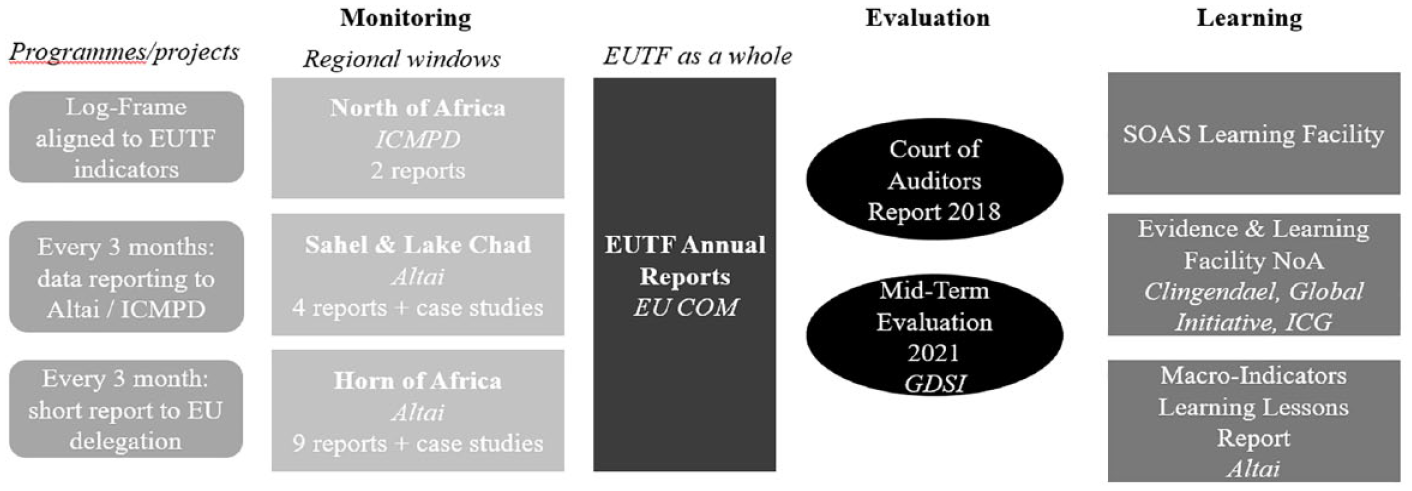
Architecture of the EUTFs monitoring, evaluation, and learning system (from Welfens & Bonjour, 2023).
Over the course of the EUTF, the EU mobilized substantial economic capital from the overall EUTF budget for M&E activities, within individual projects as well as at the regional and Trust Fund level. As someone from IOM explained, Initially our M&E portfolio was very limited. When the program started the original funding was €25 million to cover 3 years and then we received the first top-up funding of €18 million in April 2019 [. . .] and the EU was so generous enough to give us €4 million dedicated funding for M&E. [. . .] It has been a crazy evolution in the last 3-4 years and it continues to do so. (Interview IOM, 5th March)
Other implementing actors report that for certain projects the balance between what was actually being done, and the knowledge services assessing this work seemed off, causing a certain evaluation fatigue on the ground (Interview GIZ, Interview Altai Tunisia). For instance, after a relatively small activity on the ground took place, different monitoring and evaluation stakeholders would assess this activity. Thus, in some instances, M&E actors’ services of producing knowledge about what was being done seemed even more politically valuable than the activity itself. Objectively this seems counter-intuitive, but when we consider this as an attempt to “reinvest” expiring economic capital in more enduring symbolic capital—legitimating the EUTF spending through M&E activities—the logic becomes clear.
Thus, M&E activities were crucial for converting the economic capital that had been invested in the EUTF’s portfolio of projects into a particular form of political capital: political legitimacy not only for the EUTF as a policy instrument but also for the EU Commission as a savvy and evidence-based policy actor (Welfens & Bonjour, 2023). Especially Altai consulting—the M&E actor who contributed to all three pillars of the EUTF’s M&E system (cf. Figure 1)—promised to have the skills and expertise to respond to this quest of political legitimacy and recognition. As an Altai consultant explained, So [person A from the Commission] had this logic [of creating an M&E system with output indicators] and we clicked. We thought it was great and we knew how to do it. That was the chance of the story, because we had this combined experience of field experience, knowledge of migration issues and the data management capacities of some of our team members. (Respondent 3) is very much [. . .] our data guru, he knew exactly how to turn it into action, into database and systems etc. [. . .] So, to the question of the vision of [person A], we needed to capture the results of these 200 projects on a very regular basis, not every year but every quarter, to really measure progress and reassure our constituencies—[. . .]) reassure the member states who needed to see something out of the EUTF—we were able to bring an answer. (Interview Altai Consulting, 26th February)
The quote highlights the conversion work in action. When the need for legitimating the EUTF as a financial expenditure and political intervention arose, Altai could capitalize on the combination of its ties to the Commission (social capital), expertise (cultural capital), and self-proclaimed skills to perform exactly the kind of conversion work that was needed: to gather and analyze data in a way that would “measure progress” and, maybe more importantly, “reassure . . . constituencies” and “member states who needed to see something [coming] out of the EUTF.” Rather than proving local impact and garnering approval from African publics, M&E should ensure that EU member states and their constituencies recognized the EUTF- and the economic capital spent- as a valuable policy intervention. Whether or not M&E could prove actual results, it was deemed symbolically and politically valuable and thus, from the Commission’s perspective, worth €18 million of the EUTF budget. It is this particular political demand that Altai capitalized on and which constitutes the value of its services as they “brought the answer,” as the respondent puts it.
Once the M&E system was put in place, the Commission and Member States could use it in different ways to create and sustain more lasting political capital for the EUTF and its migration and development approach—notably without M&E being able to measure actual policy impact.
Converting M&E into symbolic and political capital for the EUTF
Measuring policy outputs and outcomes is a tricky business. The basic premise of M&E activities is to trace a certain “intervention logic,” that is, a set of “assumptions about how [a policy measure] is supposed to achieve its intended outcomes” (Schwandt, 2015: 37). However, as we have noted, the primary issue with the EUTF’s overall intervention logic—investing in development to reduce unwanted migration by fighting its root causes—was that it was flawed from the outset. The European Court of Auditors (ECoA) (2018), for instance, found that the deliberately vague formulation of the Trust Fund’s objectives increased flexibility but was “less useful when it comes to steering action across the three windows and for measuring impact” (p. 4). In addition, due to the creation of the trust fund and time pressure to implement projects on the ground, no systematic baseline survey was conducted. Without that, M&E firms could not meaningfully assess the impact of EUTF-funded projects. Consequently, despite significant investments, the exhaustive M&E system of the EUTF has not been able to deliver insight into whether or not the objectives of the Trust Fund are being met. Again, this seems like a highly dissatisfying outcome, until we understand that the added value of the M&E investments within the EUTF was not necessarily to prove that the fund had tackled the root causes of migration, but to symbolically recognize the EUTF as a useful instrument, and thereby contribute to further institutionalizing migration and development work as politically valuable and common-sensical.
Most basically, the comprehensive M&E system symbolically demonstrated the EU’s commitment to measure outputs and outcomes of the economic capital spent. The investments in M&E resulted in an ever-growing number of M&E products, such as the quarterly report for different regional windows, evaluation and learning reports as well as infographics on M&E methodology. The reporting on individual projects through the publicly available online platform AKVO was especially impressive (European Commission, 2021). This platform allows visitors to click through interactive maps and lists, to identify individual programs, their budgets and their results, in terms of quantitative indicators such as “jobs created” or “number of people benefitting from social services.” While the raw data are presented without context or conclusions, the website “performs transparency in a powerful way: its interactive flashy format suggests that all relevant information about the EUTF is knowable and accessible” (Welfens & Bonjour, 2023). Investing economic capital into visible and publicly accessible M&E formats was crucial for the EU Commission and its Member States to become recognized as savvy and transparent policy actors in the field of migration and development and for sustaining political support. As an Altai consultant explains about the regional reports they produce, We know that [EU Member States] are using those reports to present to their constituencies what’s happening. And in that sense, I think it was a game changer, [. . .] I think it really gave them the chance to have something readable, visual, easy to share, they can extract, they can take some screenshots. [. . .] There is a dashboard which you haven’t seen because it’s not public, which is bringing the information of the report in online version. So [the Member States] can play with the dashboard, they can play with the data. (Interview Altai Consulting, 26th February)
The quote illustrates M&E’s conversion work: the money invested particularly into Altai’s services produced accountability in the form of “reports,” a “dashboard,” and “screenshots” to show “constituencies what’s happening.” The “game changer” here seems to be less the substance of the data than the form. The accessibility and user-friendliness of the data allow for showcasing what was being done, though without saying anything about the actual policy impact.
The Commission presents the EUTF’s M&E system as unique and setting new standards for reporting on EU migration and development policies. For instance, on the EUTF’s website a “Focus”-box (Figure 2) underscores that the “innovative and reactive Monitoring system” with its 41 indicators “measure[s] precisely the progress achieved,” “allows stakeholders to learn collectively from [the TF’s] results,” and “enhances the transparency, flexibility, and speed of EUTF activities.”
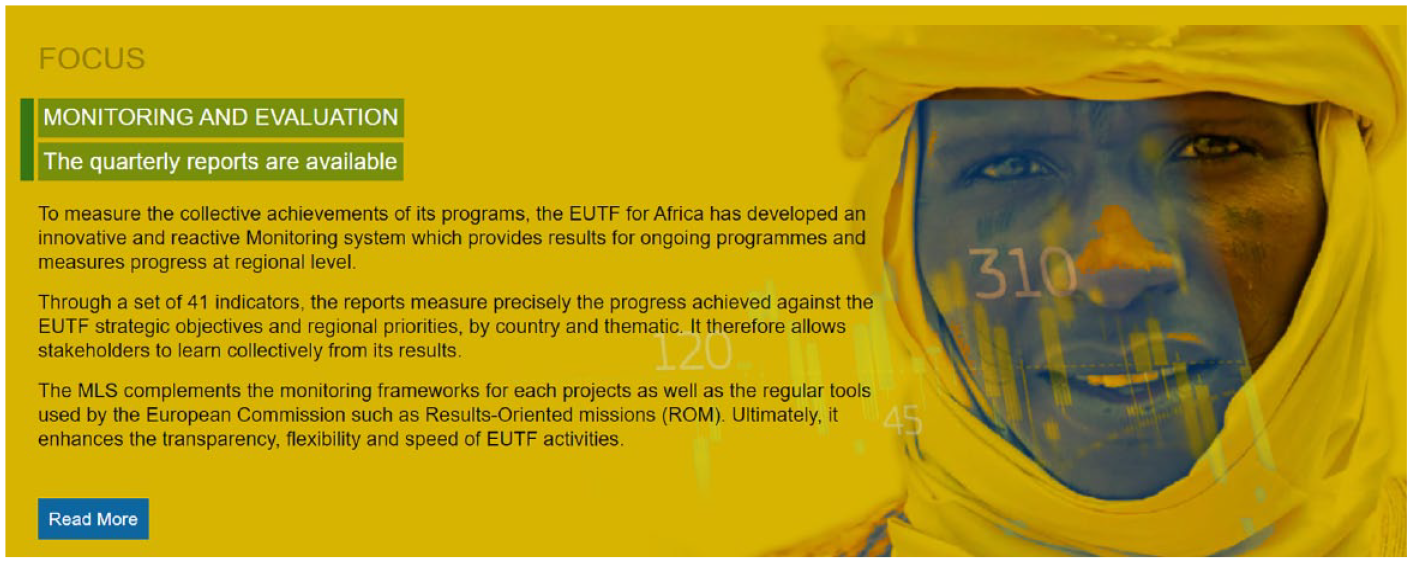
Section of EUTF website, retrieved 17 June 2021 from https://ec.europa.eu/trustfundforafrica/index_en.
Illustrated with the image of what appears to be a Tuareg man with numbers and statistical bars on his face, the EU presents its M&E system as an effective tool for evidence-driven policy making and transparency. Investments in M&E products thus created, beyond their immediate findings, a more sustained symbolic and political capital: boosting the EUTF’s recognition as a prestigious, pioneering project and thereby politically legitimating the Commission and member states’ actions vis-à-vis European publics (see also Welfens & Bonjour 2023).
Another component of Altai’s and the Commission’s joint efforts to boost EU public’s recognition for the EUTF as a valuable policy, in other words, its symbolic capital, were the EUTF Macro Output Indicators, later relabelled into “Common Output Indicators.” While initially, each of the three regional windows had a distinct set of output indicators, eventually the Commission and Altai merged the three lists into a set of 19 “Macro Output Indicators” (Figure 3), mirroring the following four key objectives of the EUTF: (1) Greater economic and employment opportunities, (2) strengthening resilience, (3) improving Migration Management, and (4) improved governance.
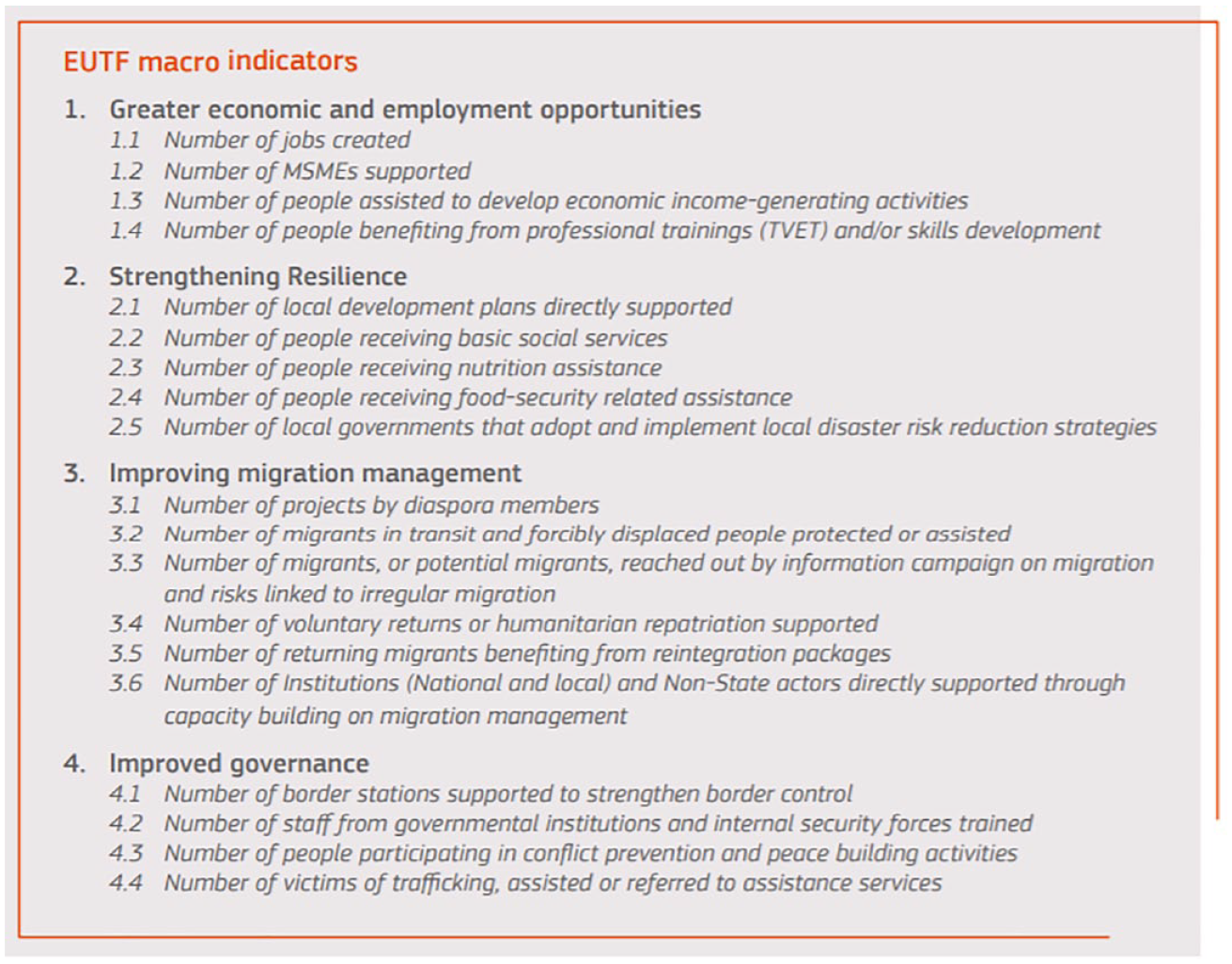
Overview of EUTF macro indicators, presented in (European Commission, 2018, p.16).
These numerical indicators aimed to capture the outputs—jobs created, courses delivered, border guards trained—numerically representing how much was being done and thereby aiming to boost the EU’s symbolic capital, that is, its reputation and recognition as a transparent, target-oriented migration and development actor. In 2020, the Commission issued a list of 41 “Revised Common Output Indicators,” which asked for an even more fine-grained disaggregation of all indicators. Yet, none of the newly introduced metrics were able to say anything about the actual outcomes or effect of the trust fund. Without a standardized baseline survey and with different M&E practices across implementing partners, the initial hope to use these indicators for aggregated insights of the EUTF’s overall impact failed.
The fact that M&E activities could not deliver tangible results about the Trust Fund’s impact, notably about its initial aim to reduce migration from the African continent to the EU, was not kept a secret. For instance, in an overview on “outcomes and impacts,” the European Commission and Altai highlighted the lack of common output and effect indicators as a central challenge to measure the EUTF’s impact, stating that “Given the caveats highlighted [. . .], the MLS and EUTF management agreed not to go forward with a qualitative aggregation of outcome indicators across projects” (European Commission / ALTAI, 2020). Yet, by that time, the elaborate M&E system was already successful (enough) to generate symbolic and political capital, so that its flaws went largely unnoticed.
Furthermore, EU policy making elites as well as M&E actors themselves told us that they knew from the start that the EUTF could not achieve what it had initially promised and that—even beyond the methodological challenges—M&E activities could not prove policy impact. Altai, in particular, seemed perfectly aware that the original objectives of the EUTF were too broad and the Fund’s financial scope and time horizon too short to really affect root causes in ways which would curb migration from Africa to Europe. As an Altai consultant explained, In fact, if I can say a word about the design of the EUTF, [. . .] it is true that there was this attempt to respond to the 2015 crisis, to build on the Valletta Summit, but the way things were then organized on the ground, according to me, were actually a little bit strategy. I mean, a lot of money was put in place to try to address the root causes of migration, build better migration management systems, address instability as well. That’s already too many things to address with one single instrument, or things which are too ambitious for an emergency [instrument]. (Interview Altai Consulting, 26th February)
Resonating with this quote, in its 2021 learning lessons report, Altai Consulting (2021) reports that “Many interlocutors, notably from the [EU Delegations], pointed out that the EUTF’s time frame was too short to show concrete achievements and even more so for desired systemic change” (p. 25). It is against this background that developmental doxa regained salience toward the end of the EUTF to further sustain political capital beyond the fund’s life cycle.
Mobilizing capital to change the doxa of EU development cooperation
An essential strategy for making the information collected through the M&E system valuable was to reinterpret the very aim of the EUTF. Whereas initially, the declared aim of the EUTF was to fight “root causes of migration,” consultancy company Altai, in particular, formulated the new aim of learning to “better manage” migration on, instead of just blocking migration from, the African continent. Thus, in the tension between migration control-oriented actors and development actors, the doxa of the latter gained in salience again. This was essential for continued creation of political and symbolic capital through the EUTF. The value of the fund and its M&E activities were now seen in light of the opportunity it offered to learn about migration management in Africa and inform future policy agendas. This strategy became most apparent in the final stages of M&E, oriented at formulating policy recommendations for the future.
Altai’s Consulting (2021) “Learning Lessons from the EUTF” report explicitly states that the EUTF could never really offer a solution to Europe’s “migration ‘crisis’” [sic], as irregular migration was “mostly attributable to increased mixed migration from the Middle East, not Africa.” However, Altai argues that “in the coming decades, migration, mobility and forced displacement-related challenges are likely to increase” within the African continent. For that reason, the report suggests that “a sustained and even increased EU response to migration, forced displacement and mobility-related challenges” in Africa is needed and that the data gathered from the EUTF-funded projects is still valuable for future planning. The conversion work that we observe here is an ex-post rationalizing of the financial resources the EU invested into the EUTF, despite its failures to verifiably fight root causes and reduce migration to the EU. Altai, enabled by the substantive economic capital invested into its M&E services and the political value of the different M&E products and “findings” it produced, creatively invents a new raison d’etre for EU migration and developments expenditures on the African continent.
Altai also acknowledged that it had been de facto impossible to measure the actual impact of the EUTF. Yet, to demonstrate that both Altai’s M&E services and the EUTF-funded projects were and are of continuous value, the report simply reinterprets how and what kind of value was created: The broader impact of the EUTF is even more difficult to capture, but will have to be considered and analysed over the next few years. Perhaps more importantly, our research suggests more “intangible” but highly significant effects generated by the EUTF, including the new dynamics of collaborations being created across governments and the improved capacity and influence of institutions, [. . .] the political access being gained with governments and new dynamics of collaboration around subjects that were until recently deemed too sensitive or EU-centered. These effects will have to continue to be measured in the future as projects funded by the EUTF come to maturity. This longitudinal analysis should be integrated into the design of future programs.
The initial aim of the EUTF—to fight root causes to reduce migration to Europe—as well as the factual impossibility of measuring it (inter alia due to the lack of baselines) is not even explicitly mentioned here. Instead, the EUTF’s more “intangible” effects and the need to integrate them in longitudinal research of future programs is foregrounded. By somewhat paradoxically claiming that their research has found these “intangible” effects to be “perhaps more important” than the continuous attempt to measure the EUTF’s impact, Altai reinterpreted what makes the EUTF a valuable policy instrument and the consultants’ knowledge services a valuable investment—also in the future.
Indeed, the policy agenda put forward by Altai centers migration as a core development issue, in a way that suits the doxa of development policy actors rather than migration policy actors. Instead of “addressing root causes,” which Altai consultants described as “a century of work,” EU development policies should “improve migration and mobility: make it safer, more legal, more organized in Africa.” Promoting “good migration governance” thus becomes part of promoting “good governance,” a long-standing policy aim, or doxa, in EU development policies. This policy agenda fits the commercial interests of Altai, as a company that sells “Strategy, Research, Monitoring & Evaluation in the Developing World” and that prides itself on 18 years of building up expertise that “allows us to help international organizations and governments in the monitoring of large-scale programs and in the design of strategies and policies that are best adapted to evolving migration and mobility related issues in Africa and the Middle East” (Altai Consulting, 2022).
In principle, Altai’s future-oriented perspective follows the traditional policy cycle model in which monitoring, evaluation and learning mechanisms ultimately feed into agenda setting. What is striking, however, is how Altai capitalized on its role as a knowledge service provider to construe future migration related “policy problems” that will require Altai’s expertise and skills.
Summarizing the evaluation of the EU Trust Fund for Africa
Through M&E, the economic capital of the Trust Fund was converted into political capital—legitimacy—not only for the Fund but for long-term investment in migration and development policies. The Commission invested in an extensive M&E system aimed to ensure that EU member states and their constituencies recognized the EUTF as a valuable policy intervention. While M&E failed to assess policy impact, it did advertise how much was being done, thus boosting the EU’s symbolic capital, that is, its reputation as a transparent, target-oriented migration, and development actor. In the final stages of M&E, developmental doxa was reinforced to further sustain this political capital beyond the Fund’s life cycle.
Conclusion
As migration management makes its seemingly inexorable rise up national and global political agenda, scholars have paid attention to the increasing efforts of states and international organizations to manage migration beyond the borders of recipient states. In some cases, these efforts seek to impact migration before “potential migrants” have left their countries of origin by addressing “root causes” of migration through development projects. Scholars, NGOs, and governmental accountability institutions have cast doubt on the effectiveness of these initiatives. In this article, we have examined how such expenditures have become resistant to critique, and how development-migration projects have become valued as inherently good. Our analysis draws attention to the material and immaterial resources invested in legitimating criticized policies, and the creative work that goes into attributing value to migration and development initiatives.
Theoretically, we contribute to understandings of legitimacy and institutionalization in international politics, by drawing on the work of Pierre Bourdieu around forms of capital. Inspired by his work on the (mis)recognizability and convertibility of capital, we have highlighted how, under certain conditions, actors can capitalize upon power resources to not only “respond to a demand”—or a crisis, but also to shape future demands. Within the political field of the EU, the doxa of the migration-development discourse facilitated compromise formations between a variety of interests through the narrative of addressing “root causes” but was also reinforced and strengthened through the active mobilization of economic and symbolic resources in the framework of the EUTF. The EU trust fund, officially established as a response to the 2015–2016 “refugee crisis,” has contributed to institutionalizing the value and “common-sensicalness” of migration-development initiatives on the African continent.
Much of the criticism toward migration and development initiatives such as the EUTF has been guided by the good faith assumption that critical evaluation, when combined with working accountability mechanisms, will change the way public funds are deployed in relation to migration: either separating out “pure” development projects from “migration outcomes,” or diverting migration spending to more “impactful” or “rights regarding” projects. The convertibility and (mis)recognition of capital, which we have identified in this article gives us reason to question the relevance of such critiques and leads to a more complex set of normative questions. As we have suggested here, EU officials and M&E workers have successfully developed the means to convert the political capital they have gathered for the purpose of migration control into capital for migration and development work in Africa. Based on this observation, it seems reasonable to assume that so long as fund managers and implementing partners can, within the criteria developed by firms like Altai, demonstrate that they are performing “migration-related” work, they will be able to validate continued expenditures. Implementing partners will thereby develop valuable “track records” of effective performance, which they can use to substantiate claims for further rounds of funding from the EU. Of course, critical research and the effective working of accountability mechanisms within European institutions may ultimately expose that this migration management funding is doing little to prevent future migration “crises” in the Mediterranean or elsewhere. However, we would suggest that government critics ought to carefully consider how such critiques might be received and processed. While it may seem somewhat farcical that billions of good Euros are being thrown after bad in migration and development work in Africa, perhaps this outcome is no worse than a conceivable alternative use of those funds: more targeted and “effective” measures to control and/or divert specific migration flows in the form of more money for border guards, fences, surveillance, detention facilities, and so on.
While a large part of what we observed in our analysis was the validation of development spending under migration-control agendas, we also observe changes in the nature of the work done by development actors, as they integrate migration rationales into their perspectives and practices. Altai’s focus on promoting “good migration governance” in Africa is a strong example of this. This raises the question whether such new orientations in development work will yield improvements in the lives of migrants and others who may or may not be mobile on the African continent.
Supplemental Material
sj-docx-1-ejt-10.1177_13540661241260606 – Supplemental material for Capitalizing on a crisis: the European Union Trust Fund for Africa
Supplemental material, sj-docx-1-ejt-10.1177_13540661241260606 for Capitalizing on a crisis: the European Union Trust Fund for Africa by Darshan Vigneswaran, Nora Söderberg, Natalie Welfens and Saskia Bonjour in European Journal of International Relations
Footnotes
Funding
The author(s) disclosed receipt of the following financial support for the research, authorship, and/or publication of this article: This research was funded by the Swedish Research Council Vetenskapsrådet (grant agreement no. 2019-02163) and by the European Research Council (RefMig, grant agreement no. 716968).

Supplemental material
Supplemental material for this article is available online.
Notes
Author biographies
References
Supplementary Material
Please find the following supplemental material available below.
For Open Access articles published under a Creative Commons License, all supplemental material carries the same license as the article it is associated with.
For non-Open Access articles published, all supplemental material carries a non-exclusive license, and permission requests for re-use of supplemental material or any part of supplemental material shall be sent directly to the copyright owner as specified in the copyright notice associated with the article.
