




Abstract
Studies of United Nations (UN) peacekeeping operations (PKOs) typically give scant attention to an important aspect of host states’ development: their external affairs. This article identifies ways in which UN PKOs can shape the external affairs of host states, focusing on UN peacekeeping in the post-Cold War period. We present the findings of a quantitative content analysis of key UN peacekeeping documents to establish which aspects of host state external affairs have been of concern to the UN. We then provide a conceptual framework that maps three areas of external affairs in which PKOs are particularly influential: relationship-building; institution- and diplomatic capacity-building; and the shaping of policy in domains of external affairs. We identify three pathways through which PKOs shape the external affairs of host states: mandated roles, improvised actions, and unintended consequences. Drawing on documentary analysis and original interview data, we illustrate our conceptual framework through an exploration of the impact of peacekeeping on the external affairs of two countries that have hosted large-scale UN-led peacekeeping missions in recent decades: Timor-Leste (East Timor) and Liberia.
Introduction
In studies of United Nations (UN) peacekeeping operations (PKOs) after the Cold War, scholars and other analysts typically give scant attention to one particular aspect of host states’ development: their external affairs (see, for example, treatments in Bellamy and Williams, 2010; Di Salvatore and Ruggeri, 2017; Druckman and Diehl, 2013; Koops et al., 2015). This is, to some extent, understandable; after all, the overwhelming majority of post-Cold War UN PKOs have been deployed in response to armed conflicts within, rather than between, states. As a result, a majority of UN PKO activities (and studies thereof) have focused on addressing the internal challenges of host states in the short term and building the capacity of those states to manage their internal affairs peacefully and productively over the longer term. Indeed, support for external affairs does not feature explicitly in the core activities of multidimensional UN PKOs as laid down in the UN’s peacekeeping principles and guidelines (UN DPKO, 2008: Ch. 2.3).
It would be wrong, however, to think that UN peacekeeping is not concerned with, or has no implications for, host states’ external affairs. For one, peacekeeping in its traditional form—as an observer or interposition force following a ceasefire—has typically been deployed in response to conflicts between two belligerent states and so it has, in essence, been concerned with external affairs. While traditional PKOs were mostly established prior to the transformation of the international environment in the late 1980s, some legacy operations are ongoing and they continue to inform relations between states. The United Nations Military Observer Group in India and Pakistan (UNMOGIP), for example, supervises the ceasefire between India and Pakistan in the State of Jammu and Kashmir, while the United Nations Disengagement Observer Force (UNDOF) helps to maintain the ceasefire between Israeli and Syrian forces in the Golan Heights (Bellamy and Williams, 2010: 86). Beyond such traditional missions, today’s more common multidimensional PKOs can—and do—also influence aspects of host states’ external affairs. That influence can come through the realization of mandated activities that, by their very nature, pertain to the external affairs of hosts, such as monitoring borders or the repatriation of refugees. PKOs can also influence their hosts’ external affairs by taking deliberate but un-mandated actions (e.g. promoting regional cooperation) in response to unexpected external challenges that arise in the course of deployments (e.g. border skirmishes and insecurity). Peacekeeping can also have unintended consequences for a host state’s external relations/affairs by, for example, providing a forum for interactions between a host state and troop-contributing countries. Those interactions, in turn, can give rise to new or deepened bilateral ties between hosts and contributors.
Given the potential for PKOs to influence external affairs, it is striking that there have been few, if any, efforts from scholars and policy analysts to document, categorize, and analyze ways in which UN PKOs can shape the external affairs of host states. This article takes a first step toward addressing that lacuna in the literature by identifying and illustrating ways in which PKOs have influenced host states’ external affairs in the post-Cold War period. In so doing, we hope to highlight a set of potentially new areas of investigation in the study of peacekeeping and peacebuilding.
With these goals in mind, after specifying the aims and parameters of our study, we present the findings of a quantitative content analysis of key UN peacekeeping documents to establish which aspects of host state external affairs have been of concern to the UN. We then offer a conceptual framework that maps three areas of external affairs in which PKOs are particularly influential: relationship-building; institution- and diplomatic capacity-building; and the shaping of policy in domains of external affairs. We also identify three pathways through which PKOs shape the external affairs of host states: mandated roles, improvised actions, and unintended consequences. Drawing on documentary analysis and original interview data, we then illustrate our conceptual framework through an exploration of the impact of peacekeeping on the external affairs of two countries that have hosted large-scale UN-led peacekeeping missions in recent decades: Timor-Leste (East Timor) and Liberia. A short conclusion follows.
Aims and parameters of the study
Why should scholars and practitioners be concerned with the implications of PKOs for the external affairs of host states? We see at least three reasons. First, the nature of a host state’s transnational activities and relations can have direct bearing on the capacity of a PKO to manage active armed conflict within the host state and associated humanitarian challenges. This is most evident in relation to active interstate conflicts but also relevant where peacekeepers are deployed to states that are experiencing ongoing civil wars with a transnational dimension (see Adebajo, 2011; Obi, 2009). Second, and relatedly, external relations can have consequences for the durability and quality of peace that is established in post-conflict states (Caplan, 2019). Recovery from violent conflict and the consolidation of peace often require bilateral or multilateral efforts to confront transborder threats to security and stability; thus, it is important to understand if, and how, peacekeeping deployments might influence such transnational efforts. Third, external relations can inform post-conflict reconstruction and development, most evidently in the provision of foreign aid and investment (World Bank, 2011). If UN PKOs sometimes play an important role in fostering critical relationships with external parties, then that relationship-building role should be recognized and explored as it pertains to development goals, which are now core aspects of positive peacebuilding (Gledhill et al., 2021).
Given the lack of systematic studies of peacekeeping and external affairs in the post-Cold War era, a first step toward establishing this topic as an area of investigation is to document, describe, and categorize ways in which PKOs can influence the external affairs of their hosts. These are our aims in this article and, in support of those aims, we place some conceptual parameters around our study. First, we limit our investigation to a study of UN PKOs, in particular, and the external affairs of states that have hosted UN missions since the end of the Cold War, when UN peacekeeping became “multidimensional,” often by integrating the activities of UN development and humanitarian agencies with those of the PKO. We do so partly to facilitate comparisons and partly due to the prominence of the UN as a peacekeeping actor, although we recognize that what holds true for UN PKOs is likely to have relevance for PKOs led by regional organizations such as the European Union (EU), the African Union (AU), or the Economic Community of West African States (ECOWAS). While we restrict our understanding of peacekeeping, we also open up our understanding of “external affairs” to a wide set of activities, relationships, and issue areas. We do so due to the exploratory nature of our study and our wish, as part of that exploration, to identify the broadest range of ways in which UN peacekeeping can shape the external affairs of host states. Thus, for the purposes of our analysis, we understand “external affairs” to mean any objectives, activities, cooperative arrangements, relationships, and/or communications by a host state which engage with or pertain to foreign parties—be they foreign states, inter-governmental organizations, international institutions, non-governmental organizations, or even individuals who are situated outside of the host state. Issue areas that pertain to external affairs can include—but are not limited to—trade, external security, diplomacy, border management, migration, and regional cooperation.
Areas of peacekeeping engagement with external affairs
Quantitative content analysis—methods
To gain an understanding of how UN PKOs engage with the external affairs of host states, we start by presenting the results of a content analysis of UN Secretary-General (SG) progress reports on UN PKOs. SG progress reports provide regular updates on the situation in PKOs and progress toward mandate implementation, and hence are valuable sources of information about the activities of PKOs on the ground and developments related thereto. To produce the analysis, we worked with independent coders to review 20,000 randomly selected paragraphs of SG progress reports that were written between 1989 and 2019, 1 with the aim of identifying and classifying the engagement of PKOs in domains that pertain to external affairs. This sample covers 56 different PKOs, draws from 1,287 SG progress reports (a complete compilation of reports from 1989 to 2019), 2 and constitutes roughly one-third of all SG progress report paragraphs written in this period.
When reading this material, coders first classified each paragraph as either pertaining to external affairs 3 or not. When paragraphs did relate to external affairs, we then coded whether a UN PKO was actively engaged in the matter described in the paragraph or whether the paragraph was merely reporting on an external relationship or activity that had been observed. This was necessary because SG progress reports record not only the activities of PKOs but also the general situation in the host country. Next, we coded the specific facets or areas of external affairs described in a paragraph. The categories that we used as a basis for this coding—19 in total—were identified and specified in advance of the coding process, based on an initial close reading of more than 100 SG progress reports. Adopting a largely inductive approach, we first added descriptive labels to all paragraphs pertaining to external affairs/relations; in a second step, we harmonized the labels; and, finally, we merged the very smallest categories with larger ones to establish the 19 categories that we used for our coding. A single event or activity was coded as falling under more than one of our areas of engagement, where applicable. 4
We note that SG reports are political documents, which are intended to inform the UN Security Council, and they may therefore suffer from biases in reporting specific events such as problematic developments within host states. They may also suffer from incompleteness. For these reasons, while our analysis reveals the relative frequency with which specific external affairs issues are described in SG progress reports, we recognize that this does not necessarily equate to the relative “importance” of the issues discussed or the relative weight given to those issues by peacekeeping missions.
Quantitative content analysis—findings
Overall, we find that 8.38 percent of the 20,000 paragraphs reviewed describe activities pertaining to external affairs. We also find that UN PKOs were actively involved in the matters described in roughly half of those paragraphs (3.94%). While we did not have any baseline expectations about the volume and frequency of references to external affairs that we might find in the progress reports, our content analysis shows that peacekeeping missions are indeed concerned with the external affairs of host states. At the same time, our analysis also suggests that UN PKOs’ engagement with external affairs should not be overstated; only a minority of discussions in progress reports relate to host state external affairs and so, by implication, the vast majority of discussions, activities, and impacts of PKOs that appear in the reports are focused on internal affairs.
While the overall volume of external affairs discussions in progress reports may be limited, our content analysis shows that when UN PKOs do engage with the external affairs of host states, engagement takes diverse forms and relates to diverse issue areas. This is reflected in Figure 1, which shows the relative frequency with which specific issues are discussed in SG progress reports. Those issues include themes ranging from bilateral and multilateral foreign relations to hard security (as it relates to borders and external actors) and the management of inherently transnational issues such as trade, migration, and diplomacy.
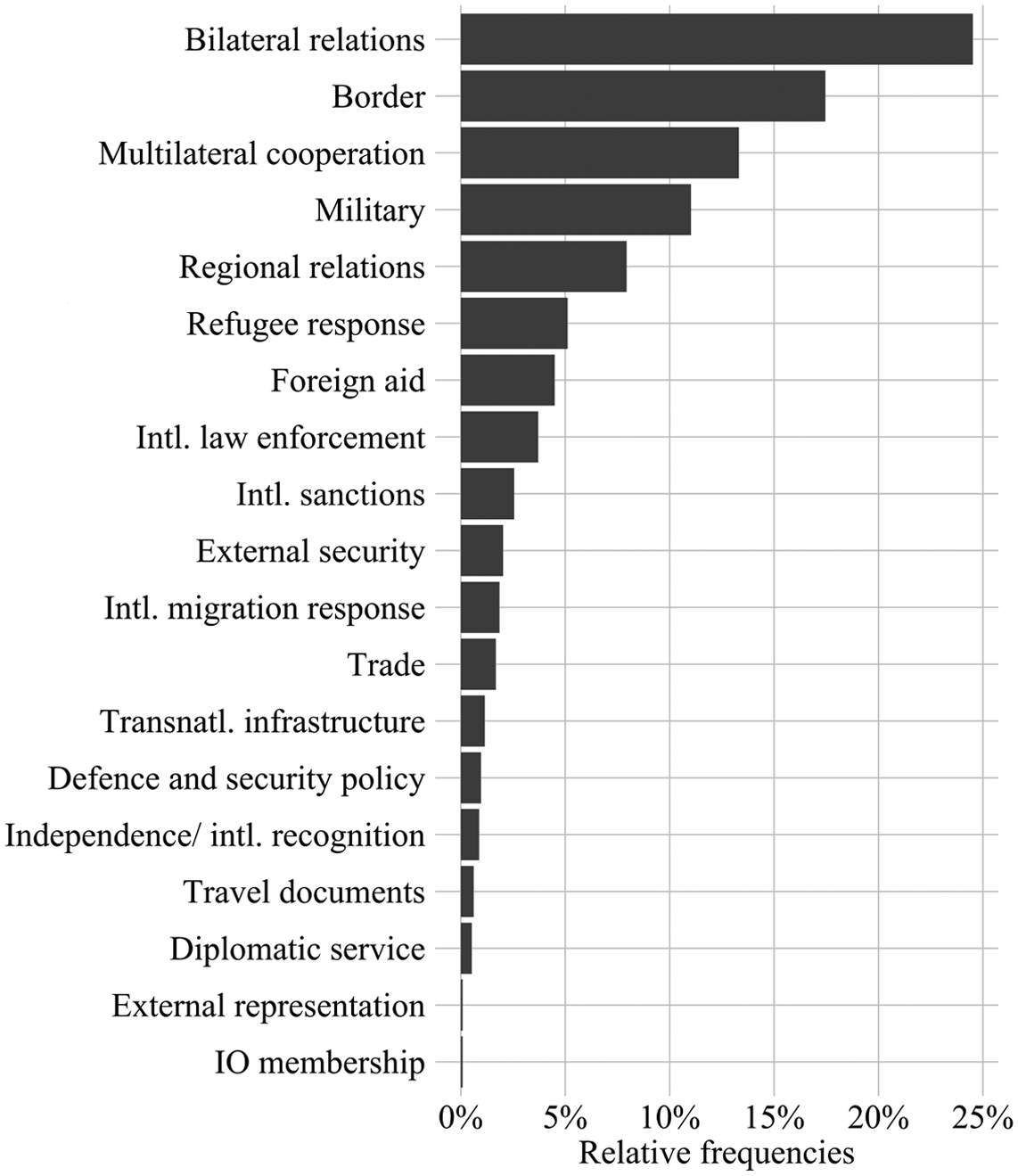
Relative frequencies of areas of external affairs described in samples of SG progress reports, with active engagement of the peacekeeping operation.
Although these activities are eclectic, we believe that it is possible—and analytically useful—to aggregate the activities and relationships identified through our content analysis into three broad “areas of engagement” by PKOs with external affairs. Thus, in the next section, we combine findings from the content analysis with our wider reading of cases to introduce and unpack those three areas. In so doing, we note that there can be overlap and inter-dependence between the three categories, and we recognize that the activities that we discuss do not constitute an exhaustive list of PKO engagements in relation to external affairs.
Areas of engagement (I): relationship-building
Figure 1 shows that the most common external affairs themes that are discussed in UN peacekeeping progress reports pertain to the building of relationships between host states and external actors. While bilateral relations stand alone as the most frequently mentioned issue area, there are also regular mentions of multilateral cooperation and regional relations. When combined, these relationship-building dynamics constitute almost half (46%) of all external affairs issues described in SG progress reports.
If UN peacekeeping missions are regularly engaged in building relations between host states and external parties, then how might that be the case? We argue that there can be direct and indirect forms of PKO influence in this area, for bilateral and multilateral relations alike.
In terms of bilateral relations, direct influence can take the form of PKOs actively encouraging and facilitating host state relations with other countries—particularly countries in their neighborhood—either to gain the cooperation of neighboring states with the day-to-day governance of the host state (e.g. border controls, immigration) or to elicit foreign assistance in an effort to consolidate a fragile peace and promote security in the wider region. The UN Mission of Support in East Timor (UNMISET), for example, supported efforts by the governments of Timor-Leste and Indonesia to resolve pending bilateral issues relating to border demarcation and transitional justice (UN Security Council, 2004c: §19), and in Ethiopia and Eritrea, UNMEE facilitated the adoption of confidence-building measures to improve relations between the two countries (UN Security Council, 2001b: §57). In terms of indirect influence over bilateral relations, the deployment of a peacekeeping mission sometimes shapes relations between host states and PKO troop-contributing countries. Former colonial powers in particular—Britain, Portugal, France—have arguably used the peacekeeping experience as a vehicle for maintaining or enhancing influence in their former colonies and the broader region (see Adebajo, 2011; MacQueen, 2020; Olonisakin, 2008; Pinto, 2011). 5 Regional powers too have sometimes sought to build on their experience as peacekeepers to exert political and cultural influence within host states (e.g. Turkey in Bosnia and Herzegovina, see Sezer, 1994).
On the multilateral front, we again see direct and indirect mechanisms of PKO influence in the domain of relationship-building. Directly, UN PKOs can facilitate host state engagement with, and participation in, inter-governmental and non-governmental organizations across a range of policy domains, including human rights, criminal justice, media regulation, banking, finance, export development, and beyond. UNMIK, for instance, facilitated Kosovo’s participation in regional and international forums, despite divided international opinion over Kosovo’s standing in international society (UN Security Council, 2010a: §47–49). UN missions in Sierra Leone, Côte d’Ivoire, and Liberia, meanwhile, all contributed to regional cooperation in West Africa by supporting the revitalization and activities of the Mano River Union (MRU) (UNOWA, n.d.). And, on a smaller scale, the police component of the UN Observer Mission in Georgia (UNOMIG) organized an international round-table discussion on cooperation between civil society institutions and law enforcement agencies, bringing together countries from the region, the EU, and the Organisation for Security and Co-operation in Europe (UN Security Council, 2009: §39).
In terms of indirect influence over multilateral relations, there is evidence to suggest that host states may be more internationalist in their outlook as a consequence of their experience of interacting with a peacekeeping mission and other international organizations (IOs) that deploy alongside PKOs. Specifically, host state authorities may become more mindful of the important role that IOs can play in the consolidation of peace and more willing to contribute to the work of these organizations, although not necessarily as uncritical supporters. The UN has been particularly receptive to the perspectives of host states with regard to the work of the UN Peacebuilding Commission, for example. Moreover, a number of former host states (e.g. Burundi, Côte d’Ivoire, Cambodia, Ethiopia, Liberia, Rwanda) have gone on to become leading troop contributors to UN peacekeeping missions deployed in other countries. 6 According to a senior military officer from Liberia, his country’s transition from peacekeeping host to troop contributor was built on the belief of then-president Ellen Johnson Sirleaf that Liberia had benefited from peacekeeping and, as such, there was a need for Liberia to contribute troops to other PKOs (initially, in Mali). 7
Areas of engagement (II): institution- and diplomatic capacity-building
A second relevant area where we see active engagement from PKOs relates to supporting the institutional and diplomatic capacity of host states to manage their external affairs. Such capacity-building efforts can be seen in Figure 1, which shows evidence of PKO involvement in developing diplomatic services, external representation of the host state, the issuance of travel documents (including passports and visas), and construction of transnational infrastructure such as cross-border pipelines or land access routes. We note, at the same time, that altogether these activities constitute only about 2 percent of external affairs activities described in SG progress reports.
When PKOs do actively engage with and support the institutional capacity of host states to manage their external affairs, how and why might that be the case? We propose that there can be two broad dynamics at play. The first may be observed where local institutional capacity is weak or absent (either due to the impact of conflict or because PKOs are deployed to nascent states), and it sees peacekeeping missions assume direct responsibility for key state tasks until sufficiently strong domestic institutions are in place. While such substitution for the state ordinarily relates to internal security, governance, and development functions (Caplan, 2005), UN peacekeeping actors occasionally substitute for, or support, the state in functional areas that pertain to external affairs, such as immigration, customs, and border patrol. The wide-reaching UN Transitional Authority in Cambodia (UNTAC), for example, was mandated to assume control of the country’s foreign affairs during its 18-month period of deployment, as part of the mission’s role in managing civil administration (Acharya, 1994: 298–299; UNTAC, n.d.). And on a more finite level, UNMIK helped provisional local authorities to issue hundreds of thousands of identification cards and travel documents to Kosovars, given limited domestic capacity to execute these tasks (UN Security Council, 2002a: §5).
In addition to temporarily substituting for the host state, a second institutional dynamic sees peacekeeping missions work with local authorities to create and/or capacitate state institutions, which can then autonomously manage the host state’s external affairs. These capacity-building efforts are predicated on the assumption that strengthening the empirical sovereignty of conflict-affected states—including in the domain of external affairs—will enhance both domestic and international stability (Barnett, 1995; also see Call and Wyeth, 2008). To that end, PKOs may contribute to: the design of state institutions, such as ministries of foreign affairs and trade; the (re-)establishment and reform of such institutions; and/or the training of individuals responsible for managing these institutions. In the Democratic Republic of the Congo, for example, the UN Development Programme (UNDP)—which was “integrated” within MONUC from the end of 2004 (Faubert, 2006: 17)—worked with the Congolese Ministry of Foreign Affairs to run a short training course for the new chiefs of diplomatic missions (UN Security Council, 2005a: §57). In South Sudan, meanwhile, UNMISS provided training for the newly established diplomatic protection unit (UN Security Council, 2012a: §39), and in Mali, MINUSMA’s police unit worked alongside Malian transnational organized crime-related police units, building local capacity (UN Security Council, 2015: §31).
Areas of engagement (III): shaping policies and activities related to external affairs
A third broad way in which UN PKOs can influence the external affairs of host states is by taking direct actions and/or positions in policy areas that are intrinsically “external.” One prominent such area, which constitutes around 17 percent of external activities described in the SG reports (see Figure 1), relates to borders—monitoring the international borders of host states through patrols, implementing border security arrangements, developing cross-border security strategies, or monitoring cross-border activities. Given the post-conflict context, it is unsurprising that border management regularly pertains to security concerns, in particular. Such a focus on security is also reflected in the regular treatment of (external dimensions of ) the military (11% of mentions in SG reports), such as military training and reform, assistance for national forces in patrolling and demilitarizing international security zones, facilitating cross-border cooperation of armed forces, and monitoring activities of foreign armed forces. Beyond security, PKO engagement is also observed in a wider set of external policy areas, including forced and voluntary migration, international cooperation on law enforcement, cooperation with international criminal tribunals, economic trade relations, and the facilitation of foreign aid and development assistance. In the Central African Republic, for example, MINUSCA and the Office of the UN High Commissioner for Human Rights mapped violations of international human rights and international humanitarian law to inform efforts of a Special Criminal Court (UN Security Council, 2017a: §29). And in Kosovo, UNMIK sought the cooperation of refugee-hosting countries, particularly Germany and Switzerland, to manage the organized and spontaneous return of refugees (UN Security Council, 2000b: §62).
The interventions of UN PKOs in a host state’s external policies and related activities are often more improvisational in comparison with the other forms of engagement, for two reasons. First, the need for UN PKOs to support particular foreign policies may not always be foreseen in advance of an operation but will, instead, arise in response to challenges that present themselves in the course of implementing a peacekeeping mandate. This was the case with the support that the UN Transitional Administration in East Timor (UNTAET) provided for renegotiation of the international agreement that restricted East Timor’s access to offshore oil and gas (detailed in the case study, below). Second, UN officials need to be circumspect in advocating for particular foreign policies because the actual conduct of external affairs is a sovereign state prerogative and the UN should not be seen to be taking steps that infringe on the sovereignty of a host state. UNMIK has taken care in this respect when facilitating Kosovo’s participation in multilateral organizations, which has been undertaken without prejudice to a determination of Kosovo’s legal status (i.e. independent or not) in deference to concerns about respecting the sovereign authority of Serbia. Thus, even when UN PKOs do advocate for the adoption of particular foreign policy goals by host states, that advocacy may be indirect and/or low-key, given concerns over political sensitivities.
Pathways of engagement
Having identified areas of UN PKO engagement in host state external affairs and conceptualized the broad nature of this engagement, we now turn to a consideration of the pathways through which PKOs can influence the external concerns of host states. That is, how might peacekeeping missions come to shape the external affairs of their hosts? We identify three pathways: mandated roles, improvised activities, and unintended consequences.
One way in which peacekeeping missions can become engaged with the external affairs of host states is by realizing activities that are mandated by the UN Security Council, either in a resolution that authorizes the mission or as part of a “concept of operations” that is endorsed by the Security Council. While this is the most direct path to engagement, the degree and scope of mandated external affairs activities is ordinarily quite limited. This is evidenced in Figure 2, which presents findings from our content analysis of all relevant UNSC resolutions for major UN peacekeeping missions over the past 30 years. 8 The figure shows that, for most UN PKOs, mandated external affairs activities tend to be restricted to border management, (reform of) the security sector, and the repatriation of refugees. Figure 2 also shows, however, that there is a degree of variation across different “types” of peacekeeping missions in the mandating of responsibilities related to external affairs. 9 Specifically, while traditional peacekeeping and observer missions tend to have few such responsibilities, transitional administrations/authorities (i.e. PKOs with broad governance and executive roles) have more expansive directives, which have included border management, foreign aid, foreign policy oversight, military training and withdrawal, refugee response, regional relations, trade, transnational infrastructure, and travel documents.
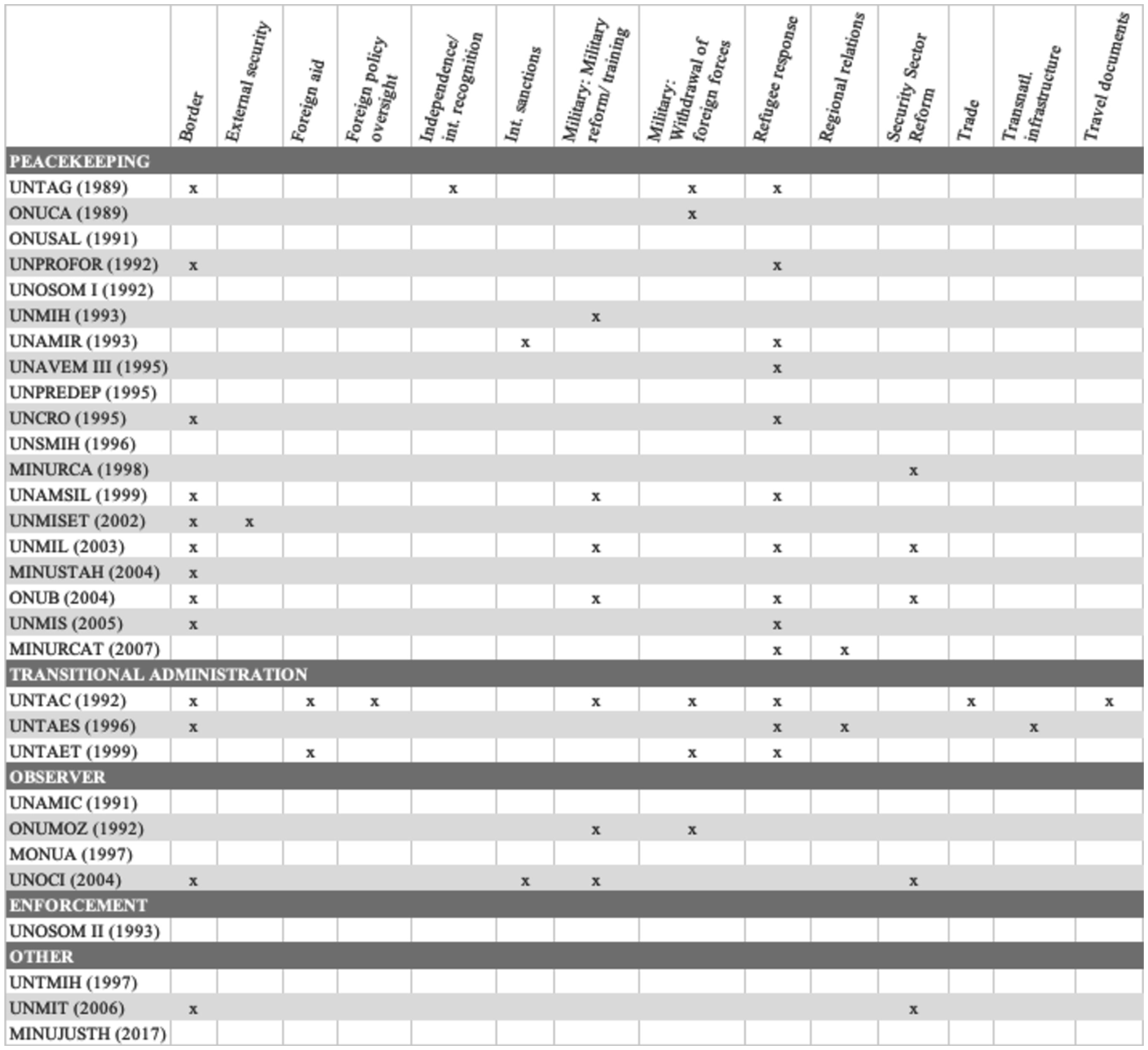
External affairs actions mandated in Security Council resolutions.
While mandates set the broad parameters of mission activities, it is not always possible to anticipate developments, challenges, and peacekeeping needs within the “fog of peace.” As such, PKOs sometimes pursue objectives that are not (initially) mandated, and those objectives sometimes have implications for external affairs. Thus, a second pathway to engagement involves improvised but deliberate actions by PKOs in domains of external affairs. Such an improvised action was taken by UNTAET in East Timor. When the Security Council first authorized the establishment of a PKO, it was not expected that the mission would have responsibility for the creation of a national defense force because the East Timorese leadership initially maintained that the country would not need such a force. However, the violence that swept the territory following the “popular consultation” on independence in 1999 changed their thinking and the UN found itself unexpectedly engaged in defense force (and defense strategy) development (Conflict, Security and Development Group, 2003: §2.E). Other PKOs have also had to cope with major unforeseen challenges that have demanded actions with implications for their external affairs. For instance, following persistent insecurity along the shared borders of Sierra Leone, Liberia, Guinea, and Côte d’Ivoire, PKOs in the region worked with regional actors to promote security cooperation among these states (UN Security Council, 2013b: §20).
Beyond mandated and improvised actions from peacekeeping missions, the presence and activities of PKOs and associated parties can unintentionally or indirectly shape the external affairs of host states. In relation to diplomatic capacity, for example, interactions between host state officials and staff from the UN and the wider international presence can arguably have trickle-down effects in terms of developing the diplomatic lexicon and practices of host state officials, some of whom may also cycle through the UN system and back to their own states, bringing further skills and new perspectives with them. 10 Relationship-building can also be an unintended consequence of PKOs. As discernible from Figure 2, Security Council mandates make few direct references to facilitating regional relations and yet these relationships are among the most frequently discussed domains of external affairs that receive attention in SG reports (see Figure 1). Also, while missions do occasionally encourage bilateral and multilateral relations in response to challenges that arise in the course of deployment, as suggested above, these relationships can also develop alongside—but not due to—the actions of the peacekeeping mission. Specifically, troop-contributing countries sometimes pursue the opportunities generated by the PKOs to establish or strengthen relations with the host state. UN (and the North Atlantic Treaty Organization) operations in Kosovo since 1999, for instance, have arguably facilitated the stepped-up engagement of Turkey and Saudi Arabia in the territory, commensurate with Serbia’s diminished influence there (Gall, 2016; Petrovic and Reljic, 2011).
PKOs and external affairs: two cases
Having surveyed and categorized various ways in which UN PKOs can influence the external affairs of host states, and mapped out the pathways through which such influence may occur, we now illustrate our claims by drawing on documentary and original interview data to present two cases in which UN peacekeeping has informed the host state’s external affairs: the UN Transitional Administration in East Timor (UNTAET) and the UN Mission in Liberia (UNMIL). Our aim in presenting the two cases is not to test the claims we make above but, rather, to further explore the dynamics that we describe by illustrating when and how they have played out on the ground. With that goal in mind, we structure the presentation of our cases around the three areas of peacekeeping engagement in external affairs that we introduced above: (a) institution- and diplomatic capacity-building; (b) shaping policies related to external affairs; and (c) bilateral and multilateral relationship-building. The two cases that we have selected provide a strong basis for illustration because they were both large-scale, expansive, multidimensional peacekeeping missions that were deployed to countries with weak or absent institutions and, as such, they are particularly likely to demonstrate at least some of the dynamics that we outline above. At the same time, we recognize that since these cases are “most likely” to feature examples of PKO influence over the external affairs of host states, we cannot claim that the dynamics we identify in these two cases are regularly observed in other missions/host states.
Case 1: UNTAET and East Timor/Timor-Leste
Background and the deployment of UNTAET
After centuries of Portuguese colonial administration and 24 years of Indonesian occupation, the people of East Timor were given an opportunity to vote on their future status in August 1999. When the popular consultation produced a strong majority in favor of independence, Indonesian authorities agreed to exit East Timor. However, the process of withdrawal was neither orderly nor peaceful (Kingsbury, 2009: 66–73). Rather, militias sponsored by the Indonesian state wreaked havoc during a short but intense period of violence that accompanied withdrawal (UN Security Council, 1999a). In response, the UN authorized the deployment of an Australian-led peace enforcement mission (Smith and Dee, 2003: 45–48). Soon thereafter, the UN Security Council established a multidimensional peacekeeping mission to administer the territory—UNTAET.
UNTAET was given a mandate of unprecedented scope, which included executive powers over the governance of East Timor until independent state structures could be established (UN Security Council, 1999b). While management of East Timor’s foreign relations was not specified in UNSC Resolution 1272, scope for ad hoc influence over the nascent state’s external affairs was written into a separate document prepared by the SG, which suggested that the UN could “conclude such international agreements with States and international organizations as may be necessary for the carrying out of the functions of UNTAET in East Timor” (UN Security Council, 1999a: §35).
Institution- and diplomatic capacity-building
Being East Timor’s transitional executive authority, UNTAET soon found that it needed to put in place improvised institutional arrangements that would facilitate the administration of issue areas that, by their very nature, had external dimensions. Responsibility within UNTAET for managing such arrangements often fell to Peter Galbraith, as Director of Political, Constitutional, and Electoral Affairs in the transitional authority. On his watch, UNTAET established institutions to manage external affairs as needs arose. For example, when enterprising actors started to bring goods into East Timor from northern Australia, a border authority was declared and tax was imposed on imports. 11 By the end of 2000, the Border Service, which was staffed by Timorese officers, had raised $6.8 million in taxes and duties (UN Security Council, 2001c: §35). Similarly, as foreign traffic began to flow in and out of the country, in early January 2000, passport controls were set up at Dili Airport with the assistance of UN member states, and training of customs officials began shortly thereafter (UN Security Council, 2000a: §54). 12
Alongside working with local actors and member states on improvised arrangements, UNTAET also contributed to a more structured building of state institutions and bureaucratic capacity in external affairs. To be sure, there was little need for capacity-building at the leadership level since a number of senior Timorese leaders had acquired vast diplomatic experience while advocating for Timorese independence over several decades. José Ramos-Horta, in particular, was able to employ that experience when, in October 2000, he took responsibility for foreign affairs in a joint UN/Timorese governing body that had been established some months earlier (UN Security Council, 2001c: §9). Beyond the leadership level, however, diplomatic and bureaucratic capacity was limited. As such, from mid-2000, UNTAET worked with partners to train some 50 Timorese through a short course in diplomacy; the program also allowed ministry staff to train and realize internships with foreign state missions and international organizations (UNTAET, 2000). Through these efforts, and beyond, the new Ministry of Foreign Affairs was fully staffed by the beginning of 2002, some months before independence (UN Security Council, 2002d: §19).
Shaping policies related to external affairs
Beyond contributing to institution-building, UNTAET directly shaped Timorese policies and positions on a number of key external issues. Most notably, UNTAET worked with Timorese leaders to renegotiate a treaty that had been signed between Indonesia and Australia years before, which pertained to the exploitation of offshore gas and oilfields situated in the Timor Sea. In the original treaty, Indonesia had agreed to evenly divide extraction revenue with Australia, despite the relative proximity of the fields to the coast of East Timor (which was then under Indonesian occupation) (Kennedy and Galbraith, 2013: 262–263). After Indonesia’s withdrawal and UNTAET’s deployment, Australia initially indicated that an independent East Timor should simply inherit Indonesia’s commitments under the treaty. This proposal was swiftly rejected, however, by future Timorese Prime Minister Mari Alkatiri on the grounds that the original treaty was illegal (King, 2003: 36); after all, Indonesia’s claim to East Timor (and its maritime territory) had never been recognized internationally. Consequently, a new agreement was needed.
Discussions with Australia over the terms of such an agreement began shortly thereafter and, in what was an unprecedented step, the UN took a leading role in representing a host country in its negotiations with another state (Kennedy and Galbraith, 2013: 264–266; King, 2003: 38–43). Specifically, the Timorese negotiating team was led by Galbraith, who acted for UNTAET on behalf of East Timor, along with Alkatiri as a direct representative of the state-in-waiting. Galbraith and Alkatiri were keen to see a new agreement in place while UNTAET remained in situ, partly so that the diplomatic weight of the UN could be leveraged in support of the Timorese negotiating position (Kennedy and Galbraith, 2013: 264). 13 With that deadline in mind, they met with Australian officials regularly across the course of 2000 and mid-2001 (UN Security Council, 2001c: §21). After months of sometimes contentious talks, Australia eventually agreed to increase East Timor’s share of the oilfield revenue from 50 percent to 90 percent (UN Security Council, 2001a: §12). The new deal was signed on 5 July 2001 before coming into effect on the day of Timor-Leste’s independence (20 May 2002).
Relationship-building: bilateral relations
UNTAET’s role in negotiating with Australia over Timor Sea oil demonstrated the willingness and capacity of Timorese authorities to leverage support from the international community in favor of their country’s external interests. In the case of relations with Australia, those interests (beyond access to oil and gas fields) amounted to the establishment of convivial and mutually respectful relations with its southern neighbor. Timorese leaders sought similarly cooperative relations with Indonesia (Strating, 2019: Ch. 5), 14 despite that country’s history of human rights violations against the Timorese population (Strating, 2014).
While the role of UN peacekeeping in facilitating Indonesian-Timorese relations after independence should not be overstated, early diplomatic interventions from UNTAET officials did facilitate functional cross-border cooperation with Indonesia, arguably creating an institutional basis upon which later cooperation could be built. For example, following negotiations between UNTAET and senior figures in the Indonesian government, the UN and Indonesia published a “Joint Communiqué” (29 February 2000). 15 The document stressed “the importance of the establishment and development of a long term and stable relationship between Indonesia and East Timor” and it laid out commitments to ongoing cooperation between UNTAET/East Timor and Indonesia through steps such as: establishing formal Indonesian representation in Dili; developing cross-border economic ties; establishing transportation and communications links, and beyond (UNTAET and Republic of Indonesia, 2000). Later in 2000, UNTAET and Indonesia also agreed to form a Joint Border Committee, where relevant issues could be discussed and technical issues could be resolved. Importantly, provisions were made for the work of the committee to continue after independence, with Timor-Leste effectively taking the place of UNTAET (Government of Indonesia, 2000)—and this was ultimately the case (UN Security Council, 2002b: §5).
While UNTAET’s improvised but deliberate interventions had a direct, albeit qualified, influence on Timor-Leste’s bilateral relations with Australia and Indonesia, the UN’s peacekeeping presence also created, arguably unintentionally, a mechanism through which Portugal was able to engage with its former colony and, in so doing, partly (re)build bilateral relations. That engagement came through Portugal’s leading role in UNTAET, as the second-largest troop contributor (after Australia) (Cravo and Freire, 2014: 52; Pinto, 2015: 131). Portugal also engaged financially, contributing €10.5 million to the civilian component of UNTAET (Cravo and Freire, 2014: 52). This particular support in East Timor constituted just one part of Portugal’s extensive engagement with post-Cold War UN peacekeeping—especially in missions deployed in its former colonies (Angola, Mozambique, and East Timor) (see Cravo and Freire, 2014; MacQueen, 2020; Pinto, 2011, 2015). In the case of Timor, Strating argues, Portugal’s contributions to state-building provided Lisbon with a form of soft power, which contributed to a reframing of Portugal’s previously colonial relationship with East Timor as one of cultural “ties” or “interactions,” rather than exploitation (Strating, 2019: Ch. 6). This was complemented by bilateral support from Lisbon for programs aimed at teaching the Portuguese language in Timor-Leste (Taylor-Leech, 2009: 38). These combined steps allowed Portugal to maintain a degree of influence in a region where it otherwise had few footholds. It also allowed Portugal to support the development of global colonial legacy institutions such as the Comunidade dos Países de Língua Portuguesa—the organization of Lusophone countries that Timor-Leste joined upon independence.
Relationship-building: multilateral relations
The newly independent Timor-Leste was an “enthusiastic joiner of international and regional organizations” (Smith, 2005: 27). While there was, no doubt, a range of interest-based and institutional reasons for such proclivity to multilateralism, it is possible to identify two mechanisms through which the presence of UNTAET (and two subsequent peacekeeping missions in Timor-Leste) contributed to that position. First, UNTAET laid institutional foundations for some of Timor-Leste’s multilateral ties by establishing relationships with major international organizations during its time as the transitional administrative authority; some of those links were then inherited, developed, and formalized by Timor-Leste following independence. Most notably, UNTAET liaised directly with the World Bank in the same way as sovereign governments do, and the two actors worked together to mobilize resources for reconstruction funds (Rohland and Cliffe, 2002). 16 As UNTAET’s tenure was coming to a close, Timorese officials made clear their preference to join the Bretton Woods institutions (UN Security Council, 2002c: §10), and membership followed shortly after independence (IMF, n.d.; World Bank, 2002). Within 18 months, the new country had also joined the Economic and Social Commission for Asia and the Pacific, the UN Industrial Development Organization, UNESCO, and other multilateral organizations (UN Security Council, 2003a: §13).
The second—less direct and less intentional—way in which UN peacekeeping seems to have encouraged East Timor’s multilateral relationships is through the reinforcement of norms of internationalism among leaders and citizens of the new state. To be sure, some Timorese leaders had already internalized such norms through decades of transnational advocacy for Timorese independence. 17 However, when the birth of the Timorese state then took place on the watch, and alongside the presence, of a large-scale UN peacekeeping mission, norms of internationalism and transnational cooperation were widely diffused among the local population and its new institutions. Also, regular interactions between Timorese authorities and UN actors meant that Timor-Leste’s new leaders and bureaucrats came to have an understanding of, and connection with, the UN system that went well beyond what one would ordinarily expect to find in a small, developing country. 18 This may have contributed to Timor-Leste’s capacity, over time, to assume prominent roles on the global stage—both inside and outside the UN system. In 2013, for example, José Ramos-Horta was appointed to head the UN Peacebuilding Office in Guinea-Bissau (Abdenur, 2017), while Mari Alkatiri and Xanana Gusmão visited the country the same year to offer support for democratization (Strating, 2019: 150). In 2014, Ramos-Horta was then appointed to chair the High-Level Independent Panel on UN Peace Operations (“HIPPO”), which provided the first comprehensive review of UN peacekeeping in over a decade. 19 Outside the framework of the UN, Timorese leaders were also instrumental in co-founding and chairing the “g7+,” which is an initiative that brings together fragile states to produce common positions on issues related to peace and development (Sahin, 2012: 353).
In sum, the presence of UNTAET (and its successor mission, UNMISET) in East Timor/Timor-Leste had an observable influence on the country’s external affairs, particularly during the new country’s early, formative years. That influence, in part, stemmed from the fact that East Timor had no prior experience as an independent state, and so formal external relations were effectively established alongside the presence of the peacekeeping mission(s). This experience contrasts with the case of Liberia, which had been an independent state for more than 150 years prior to the deployment of UNMIL in 2003.
Case 2: UNMIL and Liberia
Background and UNMIL’s mandate
Between late 1989 and 2003, Liberia experienced two periods of intense civil war, which formed part of a wider regional conflagration (see Call, 2010; Farrall, 2012: 313–317). In mid-2003, parties representing rebel groups and the incumbent government met in Accra, Ghana, to negotiate a Comprehensive Peace Agreement (CPA) (Jennings, 2015). It was agreed that ECOWAS peacekeepers would provide interim security arrangements until a multidimensional UN peacekeeping mission could be deployed (Adebajo, 2011: 146; Jennings, 2015). In October 2003, UNMIL then began operations, starting a 15-year presence that ended in 2018.
In accordance with the CPA, a transitional power-sharing government was installed for 2 years, until elections were held in 2005. That ballot was won by Ellen Johnson Sirleaf, who then held the post of president until 2018. Since governance was primarily left in the hands of Liberians, UNMIL did not have the same executive functions in Liberia as UNTAET had in East Timor. Nevertheless, the mission was given a very broad, multidimensional writ that included operational tasks with external dimensions (UN Security Council, 2003b). Overall, there is evidence that the presence and actions of UNMIL had a number of intended, improvised, and unintended influences over the trajectory of Liberia’s post-war external affairs across the three areas of engagement outlined above.
Institution- and diplomatic capacity-building
Decades of war, governmental cronyism, and regime instability had severely weakened the capacity of Liberia’s state institutions. Consequently, as had been the case in Timor-Leste, there were deliberate efforts from the peacekeeping mission and integrated UN agencies to bolster Liberia’s operational and technical capacities, including in the administration of external affairs.
On the operational front, one key area of UNMIL’s support related to border management. At times, UN forces effectively substituted for the lack of sufficient domestic border capacity by directly monitoring Liberia’s border regions (UN Security Council, 2006a: §15, 2006b: §9). UNMIL also worked with other UN missions that were based in neighboring countries to coordinate the management of borders between their respective host states (UN Security Council, 2004d: §53–55). In addition, UNMIL cooperated with the security forces of Sierra Leone and Guinea to jointly monitor shared borders (UN Security Council, 2006c: §12, 2007: §13), while continuing to work with the UN Operation in Côte d’Ivoire (UNOCI) to manage Liberia’s south-eastern border (UN Security Council, 2008: §26). As Liberian security services—which were effectively reconstructed from the ground-up by the UN and US contractors—developed capacity, they joined with UNMIL, neighboring missions, and/or border guards from adjacent states to jointly manage frontiers (UN Security Council, 2010b: §20, 2011a: §15–16, 2013a: §15–21). Later still, further resource and training assistance for border management was provided by bilateral donors (including Japan) but channeled through the UNDP 20 (Front Page Africa, 2016), which realized a range of programs aimed at building cross-border ties at the community level. 21
In terms of diplomatic capacity-building, the key institutional vehicle for the UN’s support was the Foreign Service Institute (FSI)—a branch of Liberia’s Ministry of Foreign Affairs. Although the Institute had been established in the 1950s, it had fallen into abeyance during the years of instability and war before it was reactivated in 2002 (UNMIL, 2004a). It then operated on a small scale during the early years of UNMIL’s deployment, before the government of Johnson Sirleaf decided to expand the scope of the FSI’s operations in 2009, with backing from the UNDP. 22 As part of that expansion, the FSI established a “development diplomacy” program, which offered months of classroom training to civil servants (often provided by foreign diplomatic staff) followed by a three-to-six-month secondment with an international organization based in the region (Front Page Africa, 2017). While the program was run out of the FSI, it received funding and support from the UNDP (to which the FSI had reporting duties). The program ultimately built the skills of some 200 graduates and, by often deploying them to neighboring counties, it helped foster Liberia’s regional relations. 23
Shaping policies related to external affairs
Given that UNMIL did not have the same executive powers as the UN’s transitional administration in Timor-Leste, there was more limited scope for the peacekeeping mission in Liberia to influence policies related to external affairs. Thus, the impact of UNMIL in this area should not be overstated. Nonetheless, UNSC Resolution 1509 did offer scope for the mission to guide and support the management of particular issues that carried external dimensions, such as refugee return and cross-border armed actors. The resolution also explicitly called on Liberia’s “transitional government to restore fully Liberia’s relations with its neighbours” (UN Security Council, 2003b: §14). In response to those provisions, UNMIL facilitated the return of Liberian refugees during its early days (e.g. from Ghana) (UNMIL, 2004b), before later overseeing the UN High Commissioner for Refugees (UNHCR)’s contribution to the return of Ivorians who took refuge in Liberia after the escalation of conflict in Côte d’Ivoire in 2010 and 2011 (UNMIL, 2011).
In 2012, UNMIL actively supported a policy of fostering neighborly relations by convening meetings between Liberia and Côte d’Ivoire. A trigger to that support was increased border insecurity, culminating in a set of fatal attacks on villagers and UN peacekeepers over the border from Liberia, in Côte d’Ivoire—in June 2012 (UN Security Council, 2012b: §11). Following the attacks, the heads of UNMIL and UNOCI convened a series of “Quadripartite” meetings between senior figures from UN missions on both sides of the border, along with senior government officials from Liberia and Côte d’Ivoire (Liberian Ministry of Foreign Affairs, n.d.-a; UN Security Council, 2012b, 2013b). The meetings aimed to coordinate the provision of border security. “Tripartite” meetings were also held on occasion between representatives of the respective governments and the UNHCR, with a focus on issues of displacement (UN Security Council, 2013b: §25, 2016a: §24). Beyond attending to their immediate policy goals, these sets of meetings also encouraged closer bilateral relations between Liberia and Côte d’Ivoire more generally. The Quadripartite meetings, for example, were followed by community-level cross-border initiatives (Executive Mansion, Government of Liberia, 2015; UN Security Council, 2014b: §21). And there are signs that the UN-sponsored summits deepened ties at the inter-governmental level, since a decision was taken to revive a 1972 Joint Commission for bilateral cooperation between the two countries (UNMIL, 2015).
Relationship-building: bilateral relations
In addition to UNMIL actively encouraging bilateral relations with Côte d’Ivoire, there is also evidence that UNMIL’s deployment indirectly contributed to an expansion of Liberia’s bilateral relations with other states by creating a context in which troop-contributing countries could increase their presence in, and engagement with, Liberia—thereby laying a platform for a warming of bilateral relations. Ireland, for example, had no formal diplomatic presence in Liberia prior to the peacekeeping deployment; however, after serving as a key contributor to UNMIL between 2003 and 2007 (Irish Defence Forces, n.d.), Ireland chose to establish a small aid office in Monrovia in 2010, which was then upgraded to embassy status after UNMIL’s closure (Irish Department of Foreign Affairs, n.d.). US contractors, meanwhile, took the lead in restructuring Liberia’s armed forces as part of a wider security sector reform effort that was overseen by UNMIL; according to Bøås and Stig (2010: 290) this step was seen by Liberia as an opportunity to lay the groundwork for ongoing US military support, which is an outcome that has been realized (Cook, 2018: 18).
China’s participation in UNMIL also went hand in hand with a strengthening of Sino-Liberian ties, although a causal link between the two processes is difficult to establish. With that qualification in mind, we note that China re-established diplomatic relations with Liberia in the immediate wake of UNMIL’s deployment in October 2003 (Embassy of the PRC, n.d.-a). 24 Shortly thereafter, China agreed to contribute over 500 personnel to UNMIL (Rogers, 2007; UN News, 2006) and, concurrently, China (re)opened an embassy in Monrovia. From that point on, there was an increase in high-level political exchanges, culminating in an official visit of Liberian President Johnson Sirleaf to China and a reciprocal visit of Chinese President Hu Jintao to Liberia (Embassy of the PRC, n.d.-a). There was also an increase in economic cooperation and development assistance from China to Liberia (Embassy of the PRC, n.d.-b; Liberian Ministry of Foreign Affairs, n.d.-b). Amid this warming of relations, Johnson Sirleaf noted China’s contributions to UNMIL, stating in 2007 that “Liberians will never forget the friendship of Chinese peacekeeping soldiers” (cited in Zhengyu and Taylor, 2011: 148).
Relationship-building: regional and multilateral relations
The UNSC resolution mandating UNMIL called for cooperation with regional actors (UN Security Council, 2003b) and, once deployed, UNMIL advocated for regional integration. Early on, for example, the UN supported efforts to revitalize the Mano River Union (MRU), which is a sub-regional organization that had become inactive during the years of conflict (UN Security Council, 2004b: §52, 61). Calls were also made for Liberia to participate in wider regional integration efforts, through engagement with ECOWAS in support of various efforts to consolidate peace and encourage good governance in Liberia (UN Security Council, 2004a: §14-15, 2005b: §7-12).
Again, direct causal links between UNMIL’s support for regional integration and outcomes on that front are difficult to substantiate. However, it seems likely that UN advocacy and engagement indirectly contributed to a strengthening of Liberia’s regional ties on three fronts. First, the MRU was indeed reactivated and Liberia’s relations with its direct neighbors strengthened after UNMIL’s deployment and advocacy (Mano River Union, n.d.). 25 Second, ECOWAS and the AU have worked with Liberian government and state actors in areas such as fighting organized crime and trafficking (UN Security Council, 2011b: §17), trade liberalization (UN Security Council, 2017b: §30), the pacific management of elections (UN Security Council, 2017b, 2018), good offices (Front Page Africa, 2019a, 2019b), human rights, and beyond. 26 Also, after UNMIL withdrew, ECOWAS took over responsibility for managing what had been UNMIL Radio, 27 with a view to gradually regionalizing the station and its output, albeit while remaining based in Liberia (UN Security Council, 2018: §59). 28 Third, in addition to ECOWAS supporting Liberia in various ways, Liberia has supported ECOWAS by contributing to regional crisis management operations (UN Security Council, 2014a: §12). Liberia’s prominence in the organization also increased in 2016, when Liberian President Johnson Sirleaf became ECOWAS Chair (UN Security Council, 2016b: §20).
UNMIL’s role in facilitating Liberia’s accession to multilateral organizations beyond the region seems to have been quite limited, and indirect. That said, UNMIL did work with the Liberian government to build institutional capacity that was needed for Liberia to join and (at least partly) fulfill its obligations to a number of international institutions and organizations. For example, UNMIL supported the government in setting up the Kimberley Process [Diamond] Certification Scheme in Liberia (UN Security Council, 2006a: §30), and it assisted in building the capacity of certification centers around the country (UN Security Council, 2007: §29). On human rights, UNMIL worked with local actors to facilitate Liberia’s compliance with international treaty obligations through capacity-building exercises, information, training, monitoring, and international networking (UN OHCHR Liberia, n.d.). 29 And, in terms of peacekeeping, Liberia had already begun to “give back” to the UN even before UNMIL’s exit by contributing peacekeepers to the UN mission in Mali (MINUSMA) (Liberia Permanent Mission to the UN, 2017). Since UNMIL’s exit, the Liberian Ministry of Defense has committed to expanding its contributions to UN peacekeeping, including by sending troops to the UN Mission in South Sudan (UNMISS) (Daily Observer, 2019).
In sum, UNMIL’s long-term presence and diverse array of activities seem to have had mandated, improvised, and unintended impacts on Liberia’s post-war external affairs. As a sovereign state, those affairs have ultimately been decided by Liberia’s governing actors. However, through institutional and technical support, advocacy, and networking, UNMIL and its contributing states have shaped the contours of Liberia’s external policies and relationships.
Conclusion
In this paper, we have sought to identify and illustrate ways in which PKOs can inform the external affairs of states that host peacekeeping missions. Given the exploratory nature of this study, our arguments and findings are both preliminary and qualified. That said, through quantitative content analyses and our studies of two cases, we have found evidence of diverse ways in which the conduct of a peacekeeping mission can impact external affairs. We have also found evidence to suggest that such an impact is sometimes mandated, sometimes improvised, and sometimes unintended.
Whatever the path to impact, however, we would argue that the relationship between peacekeeping and external affairs deserves greater attention by researchers and policy makers. Both communities have given little, if any, consideration to the phenomena discussed in this paper. With regard to scholarship, this means that the now-sizable literature that evaluates peacekeeping effects and effectiveness has largely neglected a significant area of investigation, and this has necessarily limited our understanding of the impact of peacekeeping on host states. Opening up further studies of PKOs and external affairs would partly remedy that shortcoming. And with regard to policy makers—both at the UN and within host states—a failure to recognize (or, at least, publicly acknowledge) the ways in which peacekeeping can inform external affairs means that key policy actors are not giving sufficient (critical) attention to a key area in which PKO deployments can and do shape the trajectories of host states. If that is indeed the case, then the UN’s capacity for self-reflection and organizational learning in relation to peacekeeping is necessarily limited, which would be a point of concern and an area for reform, going forward.
Supplemental Material
sj-pdf-1-ejt-10.1177_13540661241247801 – Supplemental material for Exploring the impact of United Nations peacekeeping operations on the external affairs of host states
Supplemental material, sj-pdf-1-ejt-10.1177_13540661241247801 for Exploring the impact of United Nations peacekeeping operations on the external affairs of host states by Richard Caplan, John Gledhill and Maline Meiske in European Journal of International Relations
Supplemental Material
sj-xlsx-2-ejt-10.1177_13540661241247801 – Supplemental material for Exploring the impact of United Nations peacekeeping operations on the external affairs of host states
Supplemental material, sj-xlsx-2-ejt-10.1177_13540661241247801 for Exploring the impact of United Nations peacekeeping operations on the external affairs of host states by Richard Caplan, John Gledhill and Maline Meiske in European Journal of International Relations
Footnotes
Acknowledgements
The authors gratefully acknowledge the feedback of Allard Duursma, Emily Paddon Rhoads, and the two anonymous reviewers of this article. They are also grateful to Joel Battle and Erik Paessler for their research assistance.
Funding
The author(s) disclosed receipt of the following financial support for the research, authorship, and/or publication of this article: The research for this article was funded by a grant from the UK Economic and Social Research Council (Grant No. ES/S009590/1).
Supplemental material
Supplemental material for this article is available online.

Notes
Author biographies
References
Supplementary Material
Please find the following supplemental material available below.
For Open Access articles published under a Creative Commons License, all supplemental material carries the same license as the article it is associated with.
For non-Open Access articles published, all supplemental material carries a non-exclusive license, and permission requests for re-use of supplemental material or any part of supplemental material shall be sent directly to the copyright owner as specified in the copyright notice associated with the article.
