



Abstract
Scholars contend that embedding human rights conditionality in trade agreements can improve human rights. We argue that human rights interests may collide with trade, investment, and security interests. We examine these claims in the context of the African Growth and Opportunity Act (AGOA), a unilateral trade preference program with robust human rights conditions, created in 2000 by the United States for up to 49 potentially eligible sub-Saharan Africa (SSA) states. US decisions to terminate AGOA beneficiary status are determined strongly by US trade, investment, and security interests. The country’s human rights record, including state-sponsored killings and other violations of physical integrity rights, has a less consistent and weaker effect.
Introduction
In a set of core multilateral agreements, ratifying states commit to upholding human rights such as freedom from slavery, torture or arbitrary detention, “disappearance,” and killing. 1 A critical challenge in promoting human rights, however, is that these core institutions lack provisions for enforcement (Downs et al., 1996; Hafner-Burton and Tsutsui, 2005; Hathaway, 2002, 2007; Neumayer, 2005). Human rights scholars and advocates maintain that embedding robust human rights conditionality in trade agreements can help solve the problem of enforcement (Barry and Reddy, 2008; Hafner-Burton, 2005, 2009; Lim et al., 2015; Postnikov and Bastiaens, 2014; Yap, 2013). More than 70 percent of countries are party to at least one trade agreement with human rights conditions (Aaronson, 2011: 443). Forty percent of these agreements in turn incorporate “hard” standards (ILO, 2015: 5)—ones that “tie agreement benefits to member compliance with specific human rights principles” and are not merely “voluntary” (Hafner-Burton, 2005: 594). But including a legal privilege (to sanction) does not mean states will exercise it.
We argue that even powerful states rarely elect to enforce human rights provisions in trade agreements in a way that is genuinely conditional on their partners’ human rights performance.
States often have little or no reciprocity-based interest in taking costly action to compel another to end human rights violations—even if the trade agreement has “hard” laws enabling such action. In addition, credible enforcement is difficult because states are not unitary actors but rather a multilayered system with a powerful set of private (trade and investment) and public (security) interests at work in trade agreements. A state’s firms that import preferentially from, export to, or maintain foreign direct investment in the partner would see their profitability harmed by the imposition of human rights sanctions. And if the partner is vital to the state’s national security—as a formal ally or host of military bases, as a collaborator in ongoing military operations, or as a bulwark against regional threats, receiving military aid—then the state would harm its self-interest by imposing human rights sanctions. Conversely, a state’s firms that compete with imports from the partner have a vested interest in invoking sanctions regardless of the actual human rights performance of the partner.
What do these political economy forces imply about the effectiveness of human rights trade linkage? We argue trade, investment, and security interests make it unlikely that a state’s decisions about invoking sanctions can be adequately conditioned on actual human rights performance abroad. Rather, the state may under-sanction a partner with a poor or worsening human rights record, if the trade agreement creates sizable profits for the state’s trading and investing firms, or if the partner is vital to the state’s security interests. The state may over-sanction a partner whose human rights are good or improving, if competition with imports from the partner, facilitated by the trade agreement, significantly harms domestic firms. Powerful vested economic or security interests, one way or the other, are likely to dominate decisions over the invocation of human rights sanctions in trade agreements. Such sanctions, when invoked, will be inconsistent, punishing one partner while another with a worse record goes unsanctioned.
We conduct an empirical assessment of these claims. Specifically, in a trade agreement with robust human rights linkage, under what conditions are sanctions imposed? How much are sanctions decisions influenced by the partner’s human rights violations, weighed against the state’s trade, investment, and security interests in the partner? We examine these questions in the context of the African Growth and Opportunity Act (AGOA), a unilateral trade preference program created in 2000 by the United States for up to 49 potentially eligible sub-Saharan Africa (SSA) states. In 2017, AGOA gave beneficiaries duty-free access to the US market for 5,374 specific products out of a total of 12,039 eight-digit Harmonized System tariff lines (USITC, 2018b). AGOA should be an “easy case” for the linkage argument for a variety of reasons. It is a model of robust human rights linkage, instructing the US president to terminate AGOA benefits not just for violations of worker rights but for “gross violations of internationally recognized human rights” more generally (US Congress, 2000, Sec 104(a)(3)). 2 Hafner-Burton (2005: 612), consequently, highlights AGOA’s “hard standards to promote the basic observance of human rights as a fundamental principle of trade.” In contrast to reciprocal trade agreements, AGOA frees the United States to sanction human rights violators unilaterally without the possibility of external review or adjudication. Furthermore, the vast asymmetry in market power between the United States, on the one hand, and the SSA beneficiary states, on the other, make the withdrawal of benefits less costly for the sanctioning state and more costly for the target than in nearly any other trade agreement. 3 Currently, the United States has fewer trade, investment, and security interests at stake in the SSA region than in any other region of the world, 4 so there should be less domestic pushback against human rights sanction decisions in AGOA than in more typical trade agreements.
Yet, the AGOA experience raises a number of questions about the efficacy of conditioning trade to improve human rights. Human rights performance in SSA has not improved on average in the AGOA years, even just for beneficiary states (See Supplemental Figure 3 in the Supplemental Appendix). Some countries with widely condemned human rights records have remained on the program, even while certain others with better records have been terminated. Our multivariate analysis of who gets sanctioned under AGOA reveals that indicators of “gross violations” of human rights, such as the number of state-sponsored killings or physical integrity rights violations more generally, have little discernible impact, while US trade, investment, and security ties to the partner protect it from being sanctioned. The United States does tend to sanction less democratic countries and those which have experienced successful coups, suggesting that some forms of human rights like access to electoral democracy and/or political stability matter. Relating to physical integrity rights violations, our results highlight the limits of linkage: even with robust provisions in the most favorable circumstances, states do not credibly commit to enforcing human rights conditionality in trade agreements.
Trade as a tool to enforce human rights
The proliferation of trade agreements has made trade linkage an important interstate diplomacy tool for the enforcement of human rights (Aaronson, 2011). 5 Typically, the linkage is to the worker or labor rights. 6 Other human rights, such as the freedom of movement, the right of cultural expression and political participation, and the rights of women and children are promoted in a wide variety of trade agreements as well (Aaronson, 2011). Some trade agreements, including, for instance, the European Union’s Cotonou accord with African, Caribbean, and Pacific (ACP) states, call upon signatories to uphold the broadest range of fundamental civil, political, economic, and cultural rights, often making specific reference to the core multilateral human rights treaty commitments (Hafner-Burton, 2005: 604–607). Most forms of human rights linkage in trade agreements are “promotional” or voluntary in nature and do not involve robust or “hard” standards calling for enforcement action in the event of non-compliance (ILO, 2015: 5). 7 A growing number of agreements nonetheless do contain robust enforcement provisions (Raess and Sari, 2018), and, most importantly for our purposes, the US trade preference program for SSA countries, AGOA, specifically refers to core human rights and not just labor rights, while also providing for strong enforcement.
Under what conditions, if any, does trade linkage promote human rights? In an important study, Hafner-Burton (2005, 2009) has argued that preferential trade agreements (PTAs) with “hard” human rights standards provide states with the coercive instruments needed to give their partners incentives to respect human rights (Barry and Reddy, 2008; Krasner and Weinstein, 2014). States that are party to such agreements indeed have better human rights records, but membership in PTAs with purely voluntary, or “soft,” human rights conditions has no such association. Of course, as Spilker and Böhmelt (2013) contend, it is possible that states already inclined to respect human rights disproportionately enter into PTAs with “hard” human rights linkage in the first place. Likewise, if human rights violations are chiefly the product of strategic interaction between a government and its domestic dissenters (e.g. Conrad and Ritter, 2019), then foreign sanctions encouraging dissent could produce a backlash rather than more respect for human rights under some conditions (Clay, 2018).
Subsequent research has built upon the foundation laid by Hafner-Burton (2005). Yap (2013) finds that linkage in the European Union’s trade arrangements with Sri Lanka helped improve human rights there. M. Kim (2012) and Postnikov and Bastiaens (2014) demonstrate that governments are more likely to bring their labor laws into compliance ex ante in order to enter into a trade agreement expected to have human rights conditions. Clay’s (2018) analysis reveals that, while target states do not see human rights improvements after economic sanctions more generally, similar/nearby audience states do. The coercive threat of trade sanctions for human rights violations varies across states and their partners. Sanctions threats are more effective in promoting labor rights, (Lim et al., 2015) show, when the partner is more economically dependent on the benefits provided by the trade agreement. Donno and Neureiter (2018: 337) likewise find that the more aid-dependent ACP countries have responded positively to human rights linkage in the EU’s Cotonou arrangement. 8
What really influences sanction decisions in economic agreements with human rights conditionality? Consistent with the linkage perspective, Hafner-Burton et al. (2019) show that countries violating worker rights are more likely to be withdrawn from the US GSP. Yet, pointing to the opposite conclusion, Gassebner and Gnutzmann-Mkrtchyan (2018) find that US decisions to remove countries from GSP eligibility are not shaped by those countries’ labor rights but rather by their foreign policy alignment with the United States. Relatedly, Peterson et al. (2018) reveal that repression reduces a state’s exports to its partners only if (a) that repression is the subject of an extensive “naming and shaming” campaign by human rights organizations and (b) its trade partners respect human rights themselves. Nielsen (2014) similarly emphasizes that aid sanctions are much less likely if the repressive state has close political ties with the donor. What we can say at this point is that, while the target’s human rights performance may affect decisions to enforce linkage arrangements with sanctions, a wider variety of considerations clearly plays an important role as well. 9
The broader literature on international institutions also embraces the proposition that a wide range of motives affect enforcement decisions. Institutional designs that incorporate linkage by definition involve multiple interests. Under certain conditions, some of those interests are more influential than others in the eyes of member-states whose consent is required for enforcement. For example, membership in regional intergovernmental organizations (IGOs) may help leaders of newly democratizing countries avoid reverting to authoritarian ways (Pevehouse, 2005). However, enforcement action by the IGO’s membership against such backsliding is less likely if (a) the target has a bigger population, (b) the target is allied to the IGO’s dominant regional power, or (c) it took place during the Cold War when the security stakes are thought to have been higher (von Borzyskowski and Vabulas, 2019). Along similar lines, Bearce and Tirone (2010) demonstrate that the strong security interests of donor states make it harder for them to withdraw foreign aid when “too-big-to-fail” recipients decline to implement the policy conditions attached to the aid program. Another illustration can be found in the “political lending” dynamic by which states vital to US interests tend to receive more generous IMF bailout arrangements and have more policy violations overlooked (Stone, 2011). Our examination of human rights linkage combines the core insights of this body of scholarship with a precise set of claims about the nature of the dominant state interests at work in trade agreements, as derived from the political economy literature.
This literature parallels a long-running scholarly analysis of the limitations on enforcement by intergovernmental organizations (IGOs) more generally. To what extent, and under what conditions, do IGO member-states take action to enforce another member-state’s commitments on, say, democratization or economic policy reforms? The credible commitments perspective is represented, for example, by Pevehouse (2005), who argues that regional IGOs with more democratic memberships will tend to sanction or otherwise pressure members who revert to authoritarian ways—which is one reason why new democracies are more likely to join such IGOs in the first place. However, it may be that the relevant IGO contains no official linkage provision requiring sanctions in such cases.
Our study enters this broader debate and its incarnation in the specific context of trade linkage for human rights promotion. This particular context, as we argue below, faces special challenges, given the prevailing interests (or lack of them) over human rights and the political economy motives at work in trade agreements. Do states ever actually use human rights sanction provisions in their trade agreements, and if so, under what conditions?
Enforcing human rights using trade linkage faces two fundamental challenges. First, unlike the basic nature of interstate relations on trade, currencies, alliances, and so many other matters, the human rights domain lacks this motor. There is no gain from retaliating in kind against another’s human rights violations, nor any direct harm to a state’s vital interests of witnessing such violations (Bhagwati, 1995: 753). The second fundamental challenge to the operation of trade linkage mechanisms to promote human rights is simple: trade policymaking is shaped by strong and well-understood political economy incentives that have nothing to do with human rights. These incentives emerge, broadly speaking, from the preferences of private trading and investing firms and the requirements of public security interests.
Sometimes these economic and security interests may coincide with the dictates of human rights linkage provisions, potentially finding human rights a convenient vehicle for other aims. At other times, such interests may work against the policy indicated by human rights alone. In many cases, these economic and security interests will be quite powerful, whereas, as noted above, states have few intrinsic motivations to take costly action to punish their partners’ human rights violations for their own sake. In all cases, however, these economic and security interests will in fact be unconditioned by the actual human rights performance of the partner.
Trade and investment
The dominant contemporary perspective in international trade economics, firm-level theory, tells a simple story (Bernard et al., 2018; Helpman, 2014): a liberalizing policy environment allows an economy’s most successful firms to leverage their productivity and market share advantages in global supply chains. These firms grow even larger and more powerful as they globalize, gobbling up more input factors and thus indirectly pricing smaller-scale enterprises out of business. Such leading firms, their shareholders, managers, and to a lesser extent their current and potential skilled workforce, benefit greatly from open markets (Baccini et al., 2017, Osgood, 2018). These giants in the economy also tend to wield heavyweight influence in politics because of their disproportionate resources, concentrated stakes, and lack of need for engaging in collective action, the result of their focus on differentiated goods and their dominant market shares (I. S. Kim, 2017; Osgood, 2018).
Accordingly, a firm’s position in the global supply chain determines whether it will gain or lose from trade sanctions against a partner country. Firms with direct investments in the partner produce there, often exporting from the partner back to the home country in intra-firm trade transactions. For example, Nigerian subsidiaries of ExxonMobil, Shell, and Chevron export crude petroleum to the United States for processing, distribution, and marketing by their US-based corporate affiliates (US EIA, 2016: 3).
Other firms, importers, may source from suppliers in the partner country on an arms-length basis. Apple Corporation, for example, outsources the assembly and testing of many of its consumer products to Foxconn, operating in mainland China (Culpan, 2019).
Consider the example of Columbia Sportswear Co. in 2005 (OTEXA, 2005b). Columbia is a US sporting apparel brand, importing finished clothing duty-free from AGOA-eligible countries. As an importer, Columbia lobbied to secure AGOA eligibility for its import suppliers (especially, in this case, those producing clothing made from woven bamboo/cotton fabric, HS 5516.42.0022). US firms competing with those imports, such as the Alice Manufacturing Co., represented by the National Council of Textile Organizations, took the opposite position. Ge-Ray Fabric in 2005 is another example (OTEXA, 2005a). This US firm was headquartered in Delaware, with sales offices in Los Angeles and New York and a manufacturing facility in Asheville, North Carolina. Ge-Ray imported an anti-microbial elastomeric filament yarn 10 from the Hyosung Corporation in Korea, then knitted, dyed, and finished fabric from this yarn at its Asheville plant, for export to an AGOA country where it would be made into apparel for import back to the United States. Ge-Ray hired the law firm Alston & Bird to advance its interest in securing eligibility for AGOA preferences for any AGOA apparel producers importing Ge-Ray’s fabric. Ge-Ray’s position in the global supply chain as an exporter induced it to support AGOA preferences. The case also illustrates the import competition side as well. Ge-Ray’s lobbying effort was opposed by the National Council of Textile Organizations, representing US import-competing fabric manufacturers, along with specific firms Invista, RadiciSpandex, and Milliken & Co.
We should categorize firms by their position in the global supply chain: firms invested abroad, often conducting intra-firm trade; and firms that import for sale in the home market (whether intermediate goods or final goods). These “internationalized firms” are most embedded in global supply chains. Then, we have two traditional categories: firms that produce at home for export and firms that chiefly produce for the domestic market and compete with imports. We argue we must be careful to draw precise distinctions among the various trading and investment interests at work.
Consider the internationalized firms for starters. They directly profit from home country’s low barriers to imports from the partner where these firms produce for export or source their goods. For human rights reasons or not, trade sanctions will harm the profitability of such firms doing business with that partner. Such firms can accordingly be expected to lobby strongly for the extension of trade benefits and against trade sanctions regardless of the human rights conditions abroad.
The set of firms profiting from trade and opposed to sanctions includes one more category often overlooked in the “disguised protectionism” view of linkage arrangements. This category consists of the state’s importing, not import-competing, firms—that is, those that source from the partner economy abroad and process and/or retail in the domestic market, arbitraging the margin of preference at work in the trade program (relative to other foreign supply sources). Indeed, the best estimates for the US and European Union (EU) unilateral preference programs for developing countries highlight how the lion’s share of rents from the margin of preference goes to the importing (that is, US or EU) firm, as opposed to the developing country producer. For AGOA, as Olarreaga and Özden (2005) show, US importers captured an average of two-thirds of the rents (out of a 20 percent margin of preference in apparel, for example); the export prices for African suppliers rose by about only one-third of the margin of preference for a given product. For the EU’s preference programs, the European importing firm captured 72 to 83 percent of the rents, though somewhat less for more differentiated goods (Cirera, 2014: 526). These figures are striking and important. For the kinds of trade agreements addressed by those empirical studies, if a state imposes sanctions for any reason, the costs of those sanctions will fall disproportionately upon its own importing firms, not those of the partner.
Importing firms can therefore be expected to oppose trade sanctions as a tool to promote human rights because such firms are among the primary beneficiaries of trade agreements, especially unilateral trade preference programs such as GSP or AGOA. 11
Note that the trade and investment interests described earlier should generally oppose, not support, trade sanctions. This claim stands in stark contrast to the dominant “disguised protectionism” view that trade interests will always tend to lead states to invoke labor or human rights sanctions when not actually merited.
Consider the preferences of exporters. They are motivated by foreign market access rather than the home country’s barriers. They may take a position on their home market’s barriers chiefly because of the dynamic of reciprocity or retaliation (Milner, 1988: 22). Namely, if their market access is jeopardized by protectionist policies abroad, they can be expected to try to push to make trade benefits reciprocal, indeed, to threaten to sanction the partner—but only as a tactic designed to induce foreign market concessions, not in any way actually conditioned on human rights levels. For example, the US National Pork Producers Council lobbied in 2015 for the removal of South Africa’s AGOA benefits in retaliation for South Africa’s phytosanitary restrictions banning the import of pork from the United States. See Van Rensburg (2015) and USITC (2014: 308–323).
Those preferences vary from those of import-competing firms. Firms that do not export or invest abroad, but which compete heavily with imports from the partner in question, will benefit from trade sanctions (Milner, 1988). These import-competing firms can be expected to lobby strongly for such sanctions even when there are few if any human or labor rights violations abroad, and they will oppose the relaxation of such sanctions even after any rights violations have been corrected. For example, Raess et al. (2018) show that labor rights linkages in PTAs are more likely when potential imports raise a competitive threat for domestic labor, although, interestingly, they also show that the degree of labor political organization and representation conditions this dynamic significantly.
Taken together, the observable implications of these trade and investment mechanisms are as follows:
Security
In addition to economic interests, states are likely hesitant to sanction security partners. States should be more likely to maintain open trade relations with allies and security partners, whom they would prefer to enrich; and they should be less likely to engage in freer trade with potential adversaries.
What form might such security ties take? The answer depends on the context, but may include such connections as a formalized alliance or strategic partnership, fighting on the same side of an ongoing armed conflict, offering logistical or base support for active military operations or intelligence gathering, volunteering ground forces for peacekeeping missions that the other wants, or just lending consistent diplomatic support for the other state’s regional security aims and initiatives. There is little question that states routinely construct trade agreements to promote these sorts of objectives, unrelated to trade, investment, or human rights. This is particularly true for trade deals between asymmetric states. If the partner has little market power over the state, then the partner’s reciprocal trade barrier reductions will have no effect on the other’s export prices. Why should the state bother entering a trade agreement under such circumstances? Positive security externalities arising from economic support for friendly partners is the likely answer. By some accounts, many recent US trade deals can be explained in exactly this way (Lederman and Özden, 2007; Ludema, 2007). Carnegie (2014)’s model of trade agreements between asymmetric pairs explicitly focuses on such trade-security linkage.
This article focuses on the empirical setting of US trade relations with SSA. What security ties matter most there? The US has no formal alliance with any country in Africa, maintains only one major SSA military base (Camp Lemmonier in Djibouti), and in general has fewer vital interests at stake in that large region than elsewhere in the world. US engagement in the region has instead tended to use cooperative partnerships. The US government advances its national security interests, and keeps its own security expenditures, troop deployments, and risks down, by inducing African countries to provide substantial peacekeeping forces. The main security interest of the United States is to reduce the spread of civil war and transnational terrorism without having to commit large numbers of its own ground forces. An AGOA beneficiary state can insulate itself from US human rights sanctions under AGOA auspices by making itself indispensable to broader US interests by providing peacekeepers.
Human rights
If trade linkage is to work, then partners who violate human rights should be more likely to be targeted for sanctions under the terms of the trade agreement. This is the conventional “linkage hypothesis”:
As noted earlier, states have few if any intrinsic incentives to take costly action against a partner’s violations of its own citizens’ rights. We, therefore, do not expect to find robust empirical support for the linkage hypothesis, although the possibility exists that states do condition their sanction decisions in part upon their partners’ human rights performance. We expect any association between the partner’s human rights performance and the odds of sanctions to be weak, in substantive terms, relative to that of trade, investment, and security ties.
Background: the AGOA program
The AGOA is a US unilateral trade preference program with robust human rights conditions, created in 2000 for up to 49 potentially eligible SSA states (see Figure 1). “Potentially eligible” means the US president may grant the country AGOA beneficiary status, subject to review and termination for violations of stipulated criteria (see below). Four “potentially eligible” states have never been designated as AGOA beneficiaries. 12 The other 45 have been on the AGOA program at some point since October 2, 2000, when AGOA entered into effect. As of July 2018, fifteen of these 45 countries have had their AGOA beneficiary status removed, although eleven later had AGOA beneficiary status restored (Mauritania, twice). See Supplemental Appendix Table 4.
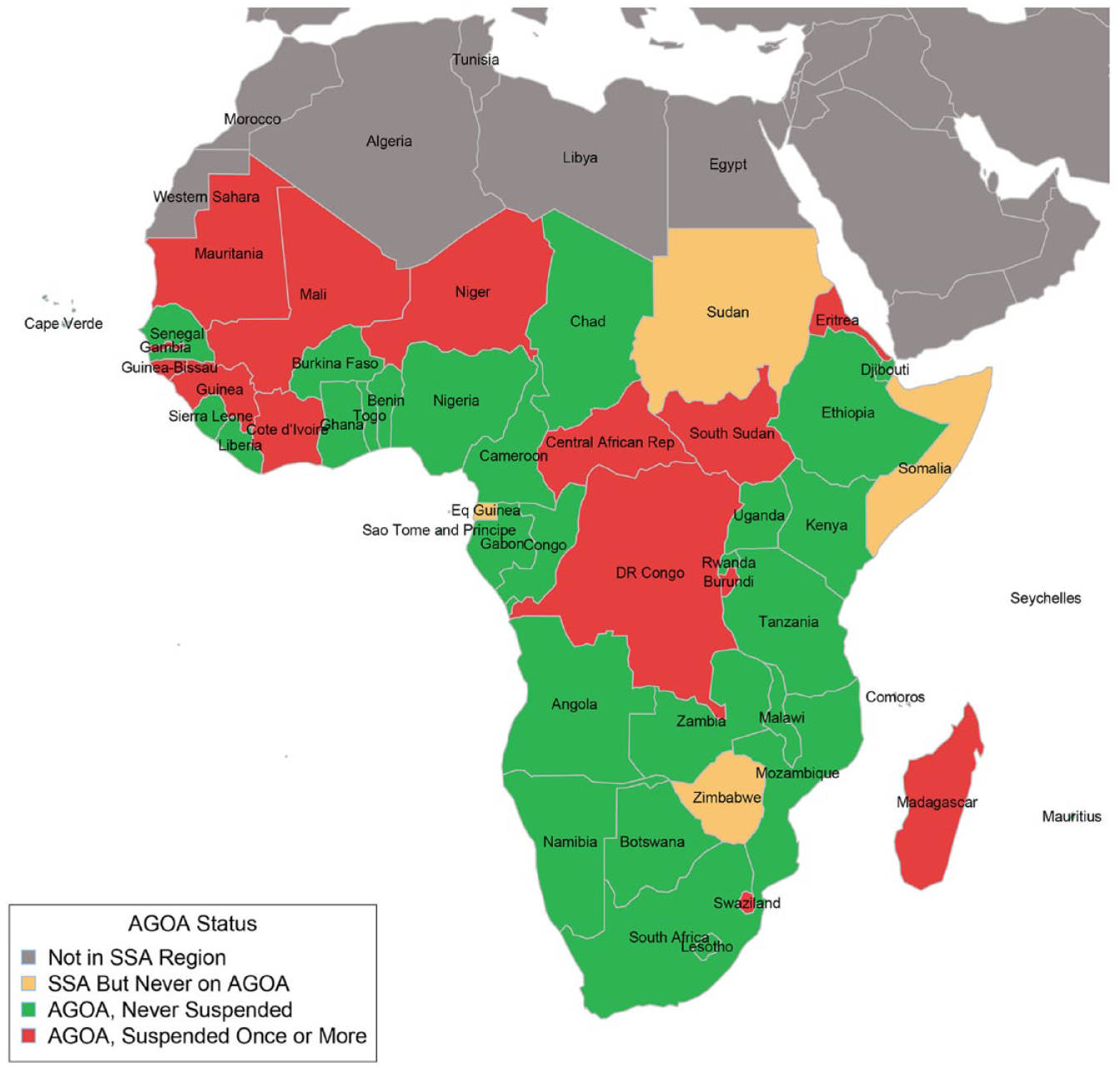
AGOA eligibility across the countries of Sub-Saharan Africa.
Being eligible for AGOA benefits means the country receives duty-free treatment on exports to the United States for 5,374 of 12,039 eight-digit Harmonized System tariff lines (USITC, 2018b). Most importantly, this list includes crude petroleum and many apparel and footwear items (USITC, 2014: 41), that go well beyond the benefits of the US Generalized System of Preferences available to most other developing countries. For the entire life of the program through 2017, petroleum and fuels accounted for 85.8 percent of all AGOA imports; apparel, 7.8 percent; and motor vehicle parts, 3.3 percent; with the small remainder consisting chiefly of metals, nuts, coffee, tobacco, and cereals (USITC, 2018a). (See Supplemental Appendix Table 6.) Through 2015, the top seven AGOA exporting countries (Nigeria, Angola, South Africa, Congo, Gabon, Lesotho, and Kenya) accounted for 94.3 percent of US AGOA imports, while 16 AGOA beneficiaries had never exported to the United States under the AGOA program (See Supplemental Appendix Table 7.).
Because AGOA is a unilateral program, it does not entail any international legal commitment or involve any international organization. Partners do not make any trade barrier reduction commitments of their own in order to become eligible (Özden and Reinhardt, 2005). This makes the threat to terminate AGOA benefits especially credible, compared to reciprocal, legally binding trade agreements (Hafner-Burton, 2005; Krasner and Weinstein, 2014). It also means that AGOA is well-suited to incorporate any linkage provision the US Congress desires. AGOA’s statutory eligibility criteria, as a result, are quite extensive. AGOA eligibility requires (US Congress, 2000: Sec. 104.a) that the country “has established, or is making continual progress toward establishing,” among other things, (a) “a market-based economy”; (b) “the rule of law, political pluralism, and the right to due process, a fair trial, and equal protection under the law”; and (c) “protection of internationally recognized worker rights.” Furthermore, AGOA countries must not pursue “activities that undermine United States national security or foreign policy interests” or—central for the human rights linkage hypothesis—commit “gross violations of internationally recognized human rights.” The US conducts an annual interagency review of these criteria for each AGOA beneficiary, supplemented by off-cycle updates as the situation merits, and the president makes AGOA eligibility determinations accordingly (US GAO, 2015: 7–12).
Research design
We evaluate our hypotheses more systematically using a Cox proportional hazards model of the time until a country is terminated from AGOA, as a function of human rights, political economy indicators, and other factors. To do so, we construct a dataset with one observation per designated AGOA beneficiary state,
Dependent variable
The dependent variable, AGOA
Independent variables
Investment
To capture the vested interests of US firms producing in the partner country, we include the variable FDI
Importer rents
US firms import billions of dollars of products (Supplemental Appendix Table 6) duty-free through the AGOA program in a given year. We calculate the tariffs those importers would have paid at MFN rates, if importing the same volumes and products from the country
Import competition
AGOA
Exporter market access
AGOA is not a reciprocal trade agreement. Beneficiaries make no commitment to lower their own trade barriers to US exports in turn. However, we can expect US exporting firms to lobby over AGOA eligibility decisions to further their own interests in maintaining and increasing access to AGOA countries’ markets. This is especially true given the one-sided market power advantage the US possesses relative to all AGOA beneficiaries. If country
Security interests
Although national security interests more broadly are best conceptualized as multidimensional, US security partnerships in the SSA region have disproportionately emphasized recruitment and training of local forces for peace operations, in great part so the United States might advance its interests with a minimum commitment of its own personnel. We thus operationalize US security interests with the variable UNPK
Human rights
This analysis focuses on the most severe form of “gross violations of internationally recognized human rights,” specifically, the right to be free from the fear of death from state repression, which is intrinsic to human rights more broadly (Cingranelli and Richards, 1999; Hill, 2010; McCormick and Mitchell, 1997; Mitchell and McCormick, 1988; Poe et al., 1999). A country willing to fatally repress its civilian population is also likely to engage in other repression tactics, such as torture and extrajudicial arrests and arbitrary detentions. Deaths from state repression, as testified by the internal State Department memos cited above, are also the most likely forms of rights violations to grab the attention of policymakers and human rights advocates calling for trade sanctions. 18 We draw on three distinct sources of data on such fatalities: the Social Conflict Analysis Database (SCAD), version 3.3 (Salehyan et al., 2012); the Armed Conflict Location & Event Data Project (ACLED), version June 2018 (Clionadh et al., 2010); and, as a backup, annual estimates from the Varieties of Democracy Project (V-Dem), version 8 (Coppedge et al., 2018). All three cover most of the SSA region for AGOA’s duration through the end of 2016. The events data framework of SCAD and ACLED, in particular, allows for a more fine-grained analysis than is possible with traditional country-year measures of human rights, such as the CIRI Physical Integrity Index (Cingranelli et al., 2014; Cingranelli and Richards, 2010), which we use for robustness tests. (Unlike V-Dem, the CIRI data is unavailable past 2011, which cuts off four years of our sample and 5 of the 14 AGOA terminations, a nontrivial amount of empirical leverage.)
From SCAD and ACLED, separately, our variable,
Alternative rights indicators
Given AGOA’s provision about “gross violations” of human rights, of which state-sponsored killings and other violations of physical integrity rights are likely the most fundamental and headline-grabbing, we believe the linkage hypothesis may be most easily upheld using the human rights indicators proposed above. To consider a broader set of physical integrity rights abuses, we also test a variety of broader human rights measures, including (lagged annual values of) CIRI’s Physical Integrity Rights score (Cingranelli and Richards, 2010) version 2014.04.14 and Fariss’ Human Rights Protection Score (Fariss, 2014a), version 2.04. In addition, as worker rights are the primary object of attention in most other trade agreements with human rights conditionality, such as the US GSP program, we also consider worker rights. Indeed, Hafner-Burton et al. (2019) find that worker rights violations are associated with the removal of GSP benefits by the United States. Such rights are also, as noted, explicitly part of the AGOA criteria. To measure worker rights, just as that study does, we use CIRI’s ordinal Worker Rights score from the prior calendar year, valued as
In case US decisions about removal are shaped more by improvements (or the lack thereof) rather than levels of worker rights, we also examine the impact of the change in worker rights over the prior year.
The “rule of law”
The AGOA statute makes “the rule of law” and “political pluralism” requirements for AGOA eligibility (US Congress, 2000: Sec. 104). If a country violates these standards, it is in principle subject to AGOA termination. Accordingly, we control for country i’s degree of democracy in month
The US might react to major constitutional irregularities in the form of violent seizures of power, specifically, successful coups d’état. Such events are widely reported and draw global attention, and thereby may spark more enforcement action than chronic abuses of power or routine repression. Our variable
Other variables
Our analyses include several other variables that may influence AGOA termination decisions. The United States is prone to “graduate” countries from the GSP program when their per capita incomes rise (Özden and Reinhardt, 2005). The country’s aggregate market size could conceivably play a role if a “too big to fail” dynamic were at work. Hence we include the variables
Empirical results
We estimate Cox proportional hazards models of the duration in months from a country’s first AGOA eligibility until its AGOA status is terminated, using the equation

where
Our main models in Table 1 include all the political economy variables and alternately examine the impact of our three principal indicators of human rights violations (SCAD’s and ACLED’s state-sponsored killings and V-Dem’s freedom from killings, in Models 1, 2, and 3, respectively).
Main results: cox models of AGOA termination.
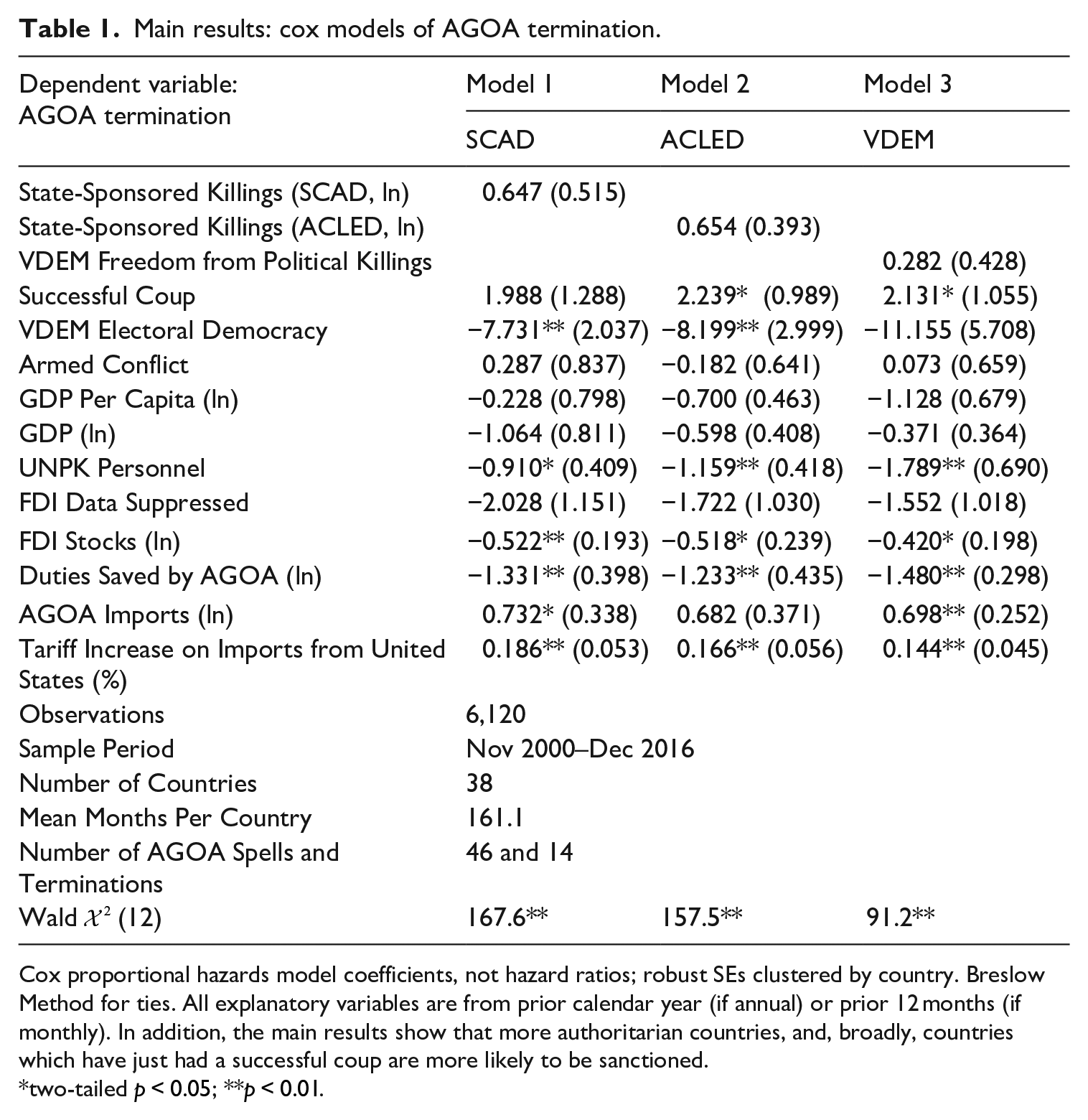
Cox proportional hazards model coefficients, not hazard ratios; robust SEs clustered by country. Breslow Method for ties. All explanatory variables are from prior calendar year (if annual) or prior 12 months (if monthly). In addition, the main results show that more authoritarian countries, and, broadly, countries which have just had a successful coup are more likely to be sanctioned.
two-tailed
The results of Models 1 - 3 largely comport with our concerns about human rights linkage and our arguments about the political economy influences on trade sanctions. The estimated coefficients for the human rights measures in each of the models are positive, as the linkage hypothesis would expect. The decision to terminate a country from AGOA appears to be unconditioned on the degree to which it commits these most extreme “gross violations” of human rights, even though other rights may matter as discussed below.
In contrast, our political economy indicators generally perform as hypothesized. FDI Stocks (ln), Duties Saved by AGOA (ln), and UNPK Personnel, all have negative and statistically significant coefficients. These results are consistent across all three models. US investment, importer rent, and security interests in the partner reduce the odds of AGOA termination, as we hypothesized. Moreover, as we hypothesized, AGOA Imports and Tariff Increase on Imports from United States have positive and statistically significant coefficients. Import competition and reduced exporter market access increase the odds of AGOA termination. 24
How does the substantive impact of these variables compare to one another? Figure 2 displays the estimated marginal impact on the cumulative hazard rate of a selection of covariates in Model 1. Specifically, the figure shows the mean estimated percent change, along with 95 percent confidence interval bounds, in the cumulative hazard
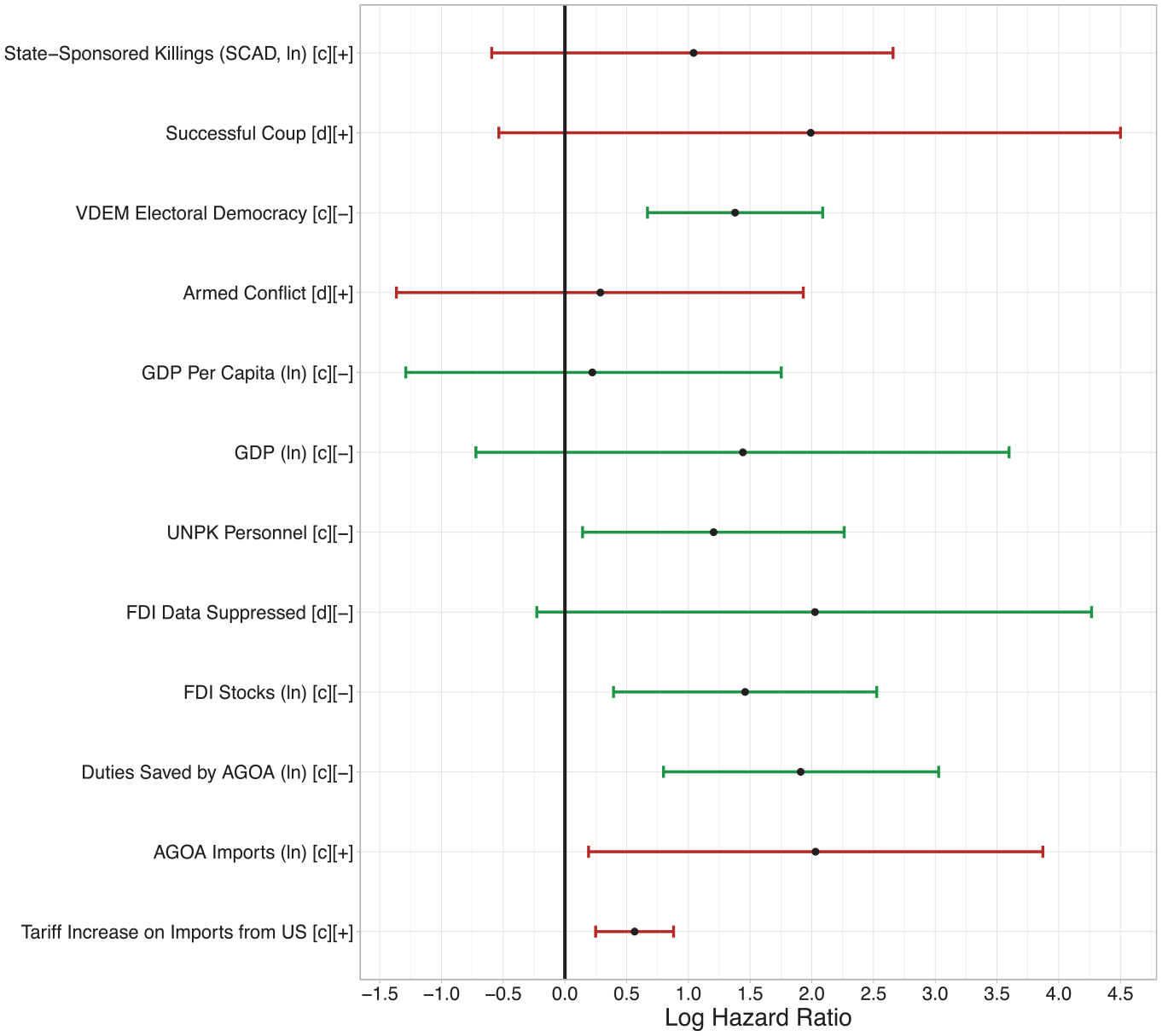
Model 1 estimated the marginal impact on AGOA termination.
Robustness checks
How do the results change, if at all, when we use alternative indicators of the partner’s human rights performance? Table 2 displays estimates using human rights indicators from the CIRI Project and Fariss’ Human Rights Protection Score. The CIRI and Fariss data are not available at the moment beyond 2011 and 2014, respectively. The alternative human rights indicators, CIRI PI (Model 4) and HR Score (Model 5), have no statistically significant influence on AGOA termination. Model 6 substitutes CIRI Worker Rights in place of State-Sponsored Killings. Unlike Hafner-Burton et al. (2019), we find that the partner’s worker rights protections has a positive and statistically significant influence on AGOA termination, which is the opposite of what the linkage hypothesis would expect. The last analysis is Model 7, which substitutes CIRI D Worker Rights for CIRI Worker Rights. Like the human rights indicators in Models 4 and 5, change in worker rights relative to the prior year has no statistically discernible effect on the odds of AGOA termination. Alternatively, aside from Model 5, all of the political economy variables remain statistically significant in their hypothesized directions. Even in Model 5, the political economy variables remain in the hypothesized directions and are generally statistically significant. 26
Cox models using alternative human rights indicators.
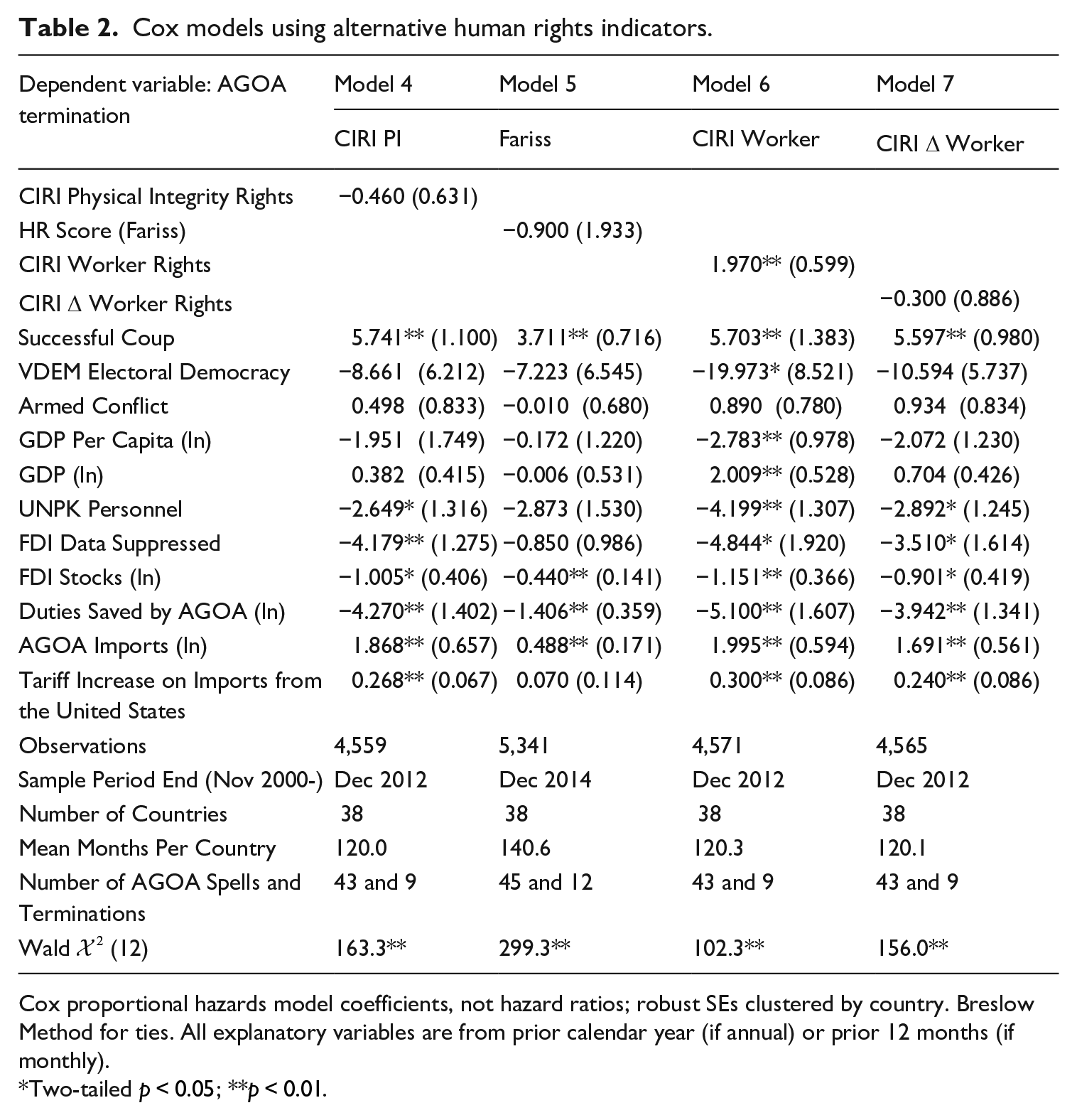
Cox proportional hazards model coefficients, not hazard ratios; robust SEs clustered by country. Breslow Method for ties. All explanatory variables are from prior calendar year (if annual) or prior 12 months (if monthly).
Two-tailed
Discussion and conclusion
We explore the politics of linkage perspective as applied specifically to the domain of human rights and trade. We argue that states do not typically have strong interests in making their trade policies conditional on their partners’ human rights conditions, specifically physical integrity rights violations. Rather, they have powerful trade, investment, and security interests that shape those decisions, and none of those interests are conditional upon actual human rights levels abroad. The dominant interests at work particularly in the unilateral trade preference programs, such as AGOA, will be for the state to preserve its partner’s trade benefits and avoid sanctions, even if the partner engages in physical integrity rights abuses. There may be special cases in which the partner is just not vital to any of the state’s economic or security interests, 27 and then, perhaps, the partner’s violations will induce sanctions. If the trade agreement has worked to promote trade and investment, however, then those special cases will indeed be rare.
We believe this paper makes several contributions. First, we have offered a general statement about the limits of linkage, as applied to human rights enforcement provisions in trade agreements in particular. This critique is rooted in prevailing ideas of international institutions and theories of the political economy of trade.
But the push to incorporate human rights linkage in trade agreements in policy practice, combined with the recent scholarly literature advancing linkage designs as credible, calls for a cautionary reflection that brings these critical ideas together. We show that violations of physical integrity rights have a weak to non-existent effect on AGOA suspension by the US. But this reflects the US’ broader lack of commitment to international human rights at home and abroad compared to other high-income democracies. While AGOA is a critical case, our study does not speak to potential linkage enforcement among states with higher levels of commitment to human rights.
In the debate over trade and human rights linkage, the theme of “disguised protectionism” has dominated previous criticism. There is some potential merit in that view, especially when applied to trade deals with major trade competitors. However, the strongest linkage provisions dealing with the most ambitious range of human rights matters, for example, the US AGOA or some of the EU’s preference arrangements, are usually in trade agreements with economies that do not constitute significant import competition threats. The “disguised protectionism” insight begins from the presumption that vested economic interests will tend to dominate human rights enforcement decisions—an idea we have adopted here—but those interests are far more diverse than that concept suggests. In particular, the economic interests in play are just as likely to be strongly in favor of trade, regardless of the partner’s human rights violations, as they are to be opposed to trade, again regardless of the partner’s human rights levels. This is certainly the case with the pattern of US economic interests over AGOA. The resulting tendency will be to practice “double standards”: failing to punish the brazen human rights violators who are, in economic terms, “too big to fail,” while other, smaller states get sanctioned for the same behavior. That is a dynamic destined to be read as no less hypocritical than “disguised protectionism,” but what it means is that sanctions will probably be rarer than we would expect otherwise.
Our study raises questions for future research. Namely, to what extent do linkage designs in formal intergovernmental institutions interact with the other major engine promoting human rights, i.e. advocacy and naming and shaming efforts by non-governmental organizations (NGOs)? We have proceeded on the reasonable assumption that states have no vital interests in taking costly action to enforce human rights abroad, but advocacy NGOs can constitute sources of pressure to do so, in principle. The interactions between NGO activity, advocacy, and naming-and-shaming campaigns and the formal incorporation of hard linkage enforcement provisions is a mechanism worth exploring, and one that could justify the rationale for such provisions in trade agreements, but that is a question for future research.
Supplemental Material
sj-zip-1-ejt-10.1177_13540661231193165 – Supplemental material for The politics of human rights trade sanctions: evidence from the African Growth and Opportunity Act
Supplemental material, sj-zip-1-ejt-10.1177_13540661231193165 for The politics of human rights trade sanctions: evidence from the African Growth and Opportunity Act by Travis Curtice and Eric Reinhardt in European Journal of International Relations
Footnotes
Acknowledgements
We thank Sam Bell, Deborah Avant, Daniel Arnon, Dara Kay Cohen, David Davis, Danielle Jung, Carla Machain, Greg Martin, Rodrigo Pinto, Shawn Ramirez, Dan Reiter, Dora Sari, and Cameron Thies for helpful comments and suggestions.
Funding
The author(s) received no financial support for the research, authorship, and/or publication of this article.

Supplemental material
Supplemental material for this article is available online.
Notes
Author biographies
References
Supplementary Material
Please find the following supplemental material available below.
For Open Access articles published under a Creative Commons License, all supplemental material carries the same license as the article it is associated with.
For non-Open Access articles published, all supplemental material carries a non-exclusive license, and permission requests for re-use of supplemental material or any part of supplemental material shall be sent directly to the copyright owner as specified in the copyright notice associated with the article.
