



Abstract
Why do transnational actors choose to campaign on specific issues, and why do they launch campaigns when they do? In this article, we theorize the membership, focus, timing and strategies used in transnational advocacy campaigns as a function of long-standing professional networks between NGOs and individual professional campaigners. Unlike previous scholarship that highlights the role of powerful ‘gatekeeper’ organizations whose central position within transnational issue-networks allows them to promote or block specific issues, we draw on recent work in organizational sociology to bring into focus a wider transnational community of individuals and organizations whose competition for professional growth and ‘issue-control’ is crucial in defining the transnational advocacy agenda. In doing so, we qualify existing notions of agenda-setting and gatekeeping in International Relations (IR) scholarship. To illustrate our theory we use a longitudinal network analysis approach, alongside extensive interviews and analysis of primary non-governmental organization (NGO) sources. Our empirical focus is on transnational disarmament advocacy. However, our theoretical analysis has implications for transnational advocacy more broadly.
Keywords
A series of transnational advocacy campaigns have been launched since the 1990s to pressure governments to outlaw specific weapons – from anti-personnel landmines and cluster bombs to small arms, blinding lasers, nuclear weapons and ‘killer robots’. Some campaigns have focused on disarmament issues that prominent advocacy groups have worked on for many decades; others have targeted issues which have not previously attracted much attention.
What determines which issues become the focus of transnational advocacy campaigns and when? A burgeoning international relations literature examines issue-adoption in transnational advocacy networks (TANs), pointing to intrinsic fit with pre-established norms and practices (Keck and Sikkink, 1998; Price, 2003), political expediency (Carpenter, 2014: 41–46; Carpenter et al., 2014; Shawki, 2010) and the interests of powerful advocacy organizations (Bob, 2005, 2009; Bower, 2016; Carpenter, 2011, 2014; Carpenter et al., 2014; Garcia, 2015; Haddad, 2013; Lake and Wong, 2009). Most extant studies, however, have focused on single campaigns or used structured comparisons of two or more campaigns to examine how issues ‘ripen’ and how the pivotal positions of well-connected advocacy organizations allow them to shape the transnational advocacy agenda.
This article takes a novel approach to understanding the factors that shape transnational advocacy campaigns. Rather than treating individual weapon-ban campaigns as discrete networks that can be isolated according to their membership and time span, we treat the global disarmament community as a single ‘issue-network’ that has linked and re-combined in successive campaign coalitions. Replacing ‘snapshot’ analyses of individual disarmament campaigns with a longitudinal analysis allows us to theorize processes of coalition-formation across multiple, sequential campaigns. In turn, this allows us to explore how membership, issue-adoption and campaign timing are influenced by long-established professional networks between advocacy organizations and between individual campaigners whose personal professional networks traverse organizational boundaries. We thereby shed new light on endogenous factors shaping transnational advocacy campaigns, which may be missed when adopting a more ‘static’ network analytical approach that treats individual campaigns as separate instances of a similar phenomenon.
Our longitudinal network analysis focuses on six disarmament campaigns: against landmines, cluster munitions, small arms, explosive weapons, nuclear weapons and Lethal Autonomous Weapons Systems (LAWS, also known as ‘Killer Robots’). These represent the six most prominent transnational disarmament campaigns over the past three decades. For each campaign, we examine links between organizations, between individuals and between individuals and organizations – both within and across campaigns.
This research design has several advantages. First, as already noted, previous studies have treated successive disarmament campaigns as distinct cases of a similar form of global civil society action. This masks important continuities in network structure and campaign formation. As Vedres and Stark (2010) observe in their work on structural folding 1 in social networks, ‘the conventional graph snapshot of network analysis does not distinguish robust and stable collectivities from transitory alignments; it only enables the distinction between denser or sparser network regions’. By treating successive transnational campaign coalitions as interconnected substructures within a larger issue-network, we can identify stable collectivities which form and solidify over time. Second, our longitudinal network analysis provides new insight into the endogenous drivers of issue-adoption and campaign formation. Previous research has pointed to exogenous ‘trigger’ events or favourable political opportunity structures as catalysts for transnational advocacy campaigns (Carpenter, 2014: 36; Garcia, 2012). However, the significance of such exogenous factors is easily distorted when considered separately from the wider temporal and organizational context in which campaigns form. Through a longitudinal analysis which situates individual campaigns in a temporally longer and wider context, we seek to distinguish endogenous drivers of transnational campaign-formation from exogenous triggers.
Our theoretical contributions are threefold. First, in contrast to existing theories that highlight external political salience or ‘issue-ripeness’ as a key driver of campaign formation, we show that both the substantive focus and timing of transnational advocacy campaigns are largely determined by dynamics internal to transnational issue-networks: by when time and resources are freed up across an issue-network, and by pre-established social ties and expertise, rather than by exogenous events. We thereby build upon and contribute to an emerging International Relations (IR) literature which uses ecological theories to understand the behaviour of transnational actors.
Second, whereas previous analyses of transnational campaigns have focused mainly on ties between advocacy organizations, we draw on work in organizational sociology to highlight the role of individual-level ties that exist within and across organizations, shaping transnational agenda-setting. Specifically, we demonstrate the recurrence of a small group of ‘issue-professionals’ (Henriksen and Seabrooke, 2016, 2017) who occupy central positions in successive advocacy campaigns. These individuals move frequently between organizations but stay centrally positioned within the wider issue-network, thanks to their high social capital, allowing them to steer transnational agendas towards issues that fit their personal expertise and career ambitions. By focusing on the individual staff level in parallel to relations between organizations, we specify the mechanisms through which familiar, but often undertheorized, processes of transnational agenda-setting unfold, providing new insights into the micro-level foundations of global civil society action.
Third, and relatedly, by revealing the porous borders of transnational advocacy organizations and the strength of the individual-level networks that traverse them, we show that the high-profile non-governmental organizations (NGOs) typically identified as ‘gatekeepers’ in the disarmament domain exert less agenda-control than previous studies suggest. Rather than a steep hierarchy in which a few ‘superpower’ NGOs approve or block issue-adoption at will (Bob, 2005, 2009; Carpenter, 2014), we find that transnational agenda-setting involves a wider network of both smaller and larger NGOs, interwoven by a ‘sub-network’ of issue-professionals that move frequently between these organizations, IOs and national government agencies. Owing to the diffused nature of transnational expertise, transnational agenda-setting often occurs through a decentralized process whereby peripheral actors launch new issues and powerful advocacy organizations ‘jump on the bandwagon’ to control how issues are presented. In sum, transnational agenda-setting is not always a hierarchical, top-down process as portrayed in extant literature but also happens from the bottom up.
The following section introduces the central concepts of our analysis. The section ‘What shapes transnational advocacy campaigns?’ outlines our two-level network theory from which we derive expectations about the composition, focus and timing of transnational advocacy campaigns. The ‘Methodology’ section explains our research methodology. To test our theory, the ‘Empirics: aggregate and case-based evidence’ section analyses six major disarmament campaigns using a combination of primary and secondary sources, personal interviews with campaigners 2 and longitudinal social network analysis based on hyperlink analysis, web-based content analysis and individual employment records. Beyond disarmament, our analysis has important implications for how we understand the dynamics of transnational advocacy campaigns more broadly, which we discuss in the conclusion.
Terms and definitions
We focus on transnational issue-networks defined by Lutz and Sikkink (1995) as ‘the set of relevant actors working internationally on an issue who are bound together by shared values, a common discourse, and regular exchanges of information and services’ (p. 413). Issue-networks may include, inter alia, NGOs, IOs, foundations, universities, think-tanks and individual government representatives. However, previous scholarship has found that it is mainly NGOs that initiate campaigns and pressure governments to take positions (Lutz and Sikkink, 1995, p. 414). We prefer the term transnational issue-network (TIN) to the related concept of a transnational advocacy network (TAN) introduced by Keck and Sikkink (1998) because the former highlights that such networks may be loosely bound, and that not all members may advocate collectively for the same things. Indeed, TINs may feature collaboration as well as competition (Hadden, 2015). In short, what defines a TIN is that actors address similar issue(s) and share a common discourse, rather than that they engage in collective action (Carpenter, 2014: 22). 3
A second concept is that of a transnational advocacy campaign. Actors in TINs often mobilize around specific campaigns, understood as ‘concerted efforts by multiple organizations lobbying for a specific outcome around a certain issue’ (Khagram et al., 2002: 7). Whereas TINs are defined loosely by shared values and regular information exchange, transnational advocacy campaigns involve formal ties, centralized mandate articulation and coordinated tactics to pursue a collective purpose. Often, campaigns feature a formal steering group tasked with making and implementing joint decisions.
What shapes transnational advocacy campaigns?
How do transnational issue-networks decide what issues to collectively campaign on – and when? Recent studies have focused on the structure of relationships between advocacy groups, highlighting the disproportionate influence of a few well-connected organizations whose privileged access to international decision-makers and state funding allows them to dictate which issues rise to the top of the transnational agenda (Bob, 2005, 2009; Carpenter, 2011, 2014; Carpenter et al., 2014; Garcia, 2015; Hadden, 2015; Murdie, 2014; Stroup and Wong, 2017; cf. Eilstrup-Sangiovanni, 2018). These ‘gatekeeper’ organizations typically have ‘the largest budgets, best staffs, and greatest credibility’, meaning that once they endorse an issue, others follow (Bob, 2009: 6). In the area of human security, Carpenter singles out Human Rights Watch (HRW) and the International Committee of the Red Cross (ICRC) as gatekeepers with authority to define what constitutes legitimate concerns in the issue-area (Carpenter, 2011: 76, 2014: 23). When deciding whether to endorse or reject specific issues, gatekeeper organizations often prioritize parochial interests such as whether an issue fits their pre-existing mandate or complements issues already on their agenda (Bob, 2005; Carpenter et al., 2014: 49, 56). Campaign timing, in turn, is determined by ‘issue-ripeness’: whether or not ‘the time is right to lobby decision-makers on an issue due to its growing political salience’ (Betsill, 2014; Carpenter, 2014: 67; Tarrow, 2005). Political salience is typically seen as a function of exogenous events such as major international conferences or policy reports, or dramatic ‘trigger events’ such as war or genocide (Carpenter et al., 2014: 13). According to Carpenter (2014: 46), such political opportunity structures are particularly salient for human security campaigners.
The notion that issue-adoption and campaign timing in TINs are determined by exogenous events, filtered through the organizational interests of powerful gatekeepers, is intuitively plausible, yet it has rarely been closely interrogated. In fact, a closer look at the timing of major transnational disarmament campaigns challenges the notion that exogenous factors are the primary drivers of campaigning. For example, Carpenter’s influential analysis of humanitarian disarmament efforts showed that – as of 2009 – depleted uranium weapons, blinding lasers, autonomous weapons, and explosive weapons had zero salience within the humanitarian disarmament community, a fact she attributes to lacking interest from powerful gatekeepers (Carpenter, 2011: 80). Contrary to what an exogenous ‘issue-ripeness’ explanation would suggest, no dramatic political events subsequently intervened to thrust these issues onto the international stage. Nevertheless, within a few years of her study, global campaigns were launched on all four issues.
To explain what prompts individual advocacy groups to launch or join transnational campaigns (TCs), we combine existing IR theories of transnational advocacy with research in organizational sociology. Our theoretical argument has two levels. The first focuses on relations between organizations. We argue that campaign ties at this level are shaped by pre-existing patterns of inter-organizational collaboration. Specifically, we point to increasing returns to collaboration to explain why advocacy groups often join TCs where they have close pre-existing partnerships, irrespective of whether they have a strong prior record of working on the issue(s) at stake. Previous investments in social and professional relationships lead to a pattern where campaign coalitions form among subsets of organizations with a history of working closely together, introducing significant path-dependency in campaign membership, preferred normative frames and strategies and tactics.
The second level focuses on relationships between individual campaigners. Here, we highlight the role of highly connected ‘issue-professionals’ whose experience working on specific issues has endowed them with specialized knowledge and personal–professional ties that are independent of specific organizations or organizational values (Henriksen and Seabrooke, 2016: 723; Suddaby and Viale, 2011). Thanks to their extensive professional networks, issue-professionals may build coalitions across organizational boundaries to pursue projects that fit their personal skillsets. The upshot is that powerful gatekeepers often exert less control over transnational agendas than extant studies contend. Instead, porous organizational boundaries mean that issue-adoption and campaign timing are strongly influenced by individual-level networks that develop between organizations. Building on this two-level framework, we now derive hypotheses about the membership, focus and timing of transnational campaign coalitions as well as the locus of transnational agenda-setting power.
Coalition membership
Individual NGOs often work on a broad portfolio of issues for many years before launching or joining a specific transnational campaign (Garcia, 2015). At what point, then, do organizations pool forces to campaign for a collective goal? A plausible hypothesis might be that, whenever the time seems ripe due to some exogenous event, organizations with a long-standing commitment to a given issue will join forces to pressure decision-makers (Haddad, 2013: 188). This would imply that the decision to join a campaign is primarily determined by an organization’s pre-existing work portfolio or mandate (Bob, 2009: 10).
We offer an alternative hypothesis: rather than being determined by existing work-portfolios, coalition membership is determined by prior inter-organizational ties. 4 Building effective campaign coalitions requires significant time and resources to establish formal and informal ties between organizations, agree on joint procedures and goals and institutionalize mechanisms for information exchange and collective decision-making. Once paid, these costs are not borne continuously but diminish over time as new procedures become routinized within organizations and trust develops between organizations, lowering the cost of collective action. Like other types of institutions, transnational campaign coalitions are therefore less costly to maintain than they are to create (Haddad, 2013: 188).
Like other institutions, TCs are also subject to increasing returns on initial investments. Scholars have highlighted a range of potential benefits from participation in transnational campaigns, including improved access to information, economies of scale from pooling resources and increased visibility and legitimacy due to ‘speaking with one voice’ (Yanacopulos, 2005). The value of such benefits likely increases over time, as members converge on shared routines and synchronize their political messages. Together, these dynamics (high start-up costs and increasing returns) provide incentives to keep existing coalitions alive rather than disband and build new ones (Haddad, 2013: 18). Although specific TCs may formally dissolve after their goals have been achieved, broader organizational and individual network ties persist. The upshot is that new coalitions are likely to form among similar collectivities as previous ones. Previous inter-organizational ties make coalition formation easier and cheaper, since routines of collaboration are familiar, reducing coordination costs (Vedres and Stark, 2010). Low entry costs in turn mean that organizations may be motivated to join a campaign featuring one or more previous collaborators irrespective of whether they themselves are actively working on the targeted issue(s). From this, we derive our first hypothesis:
H1. TCs tend to form among organizations that have worked closely together on previous campaigns, rather than among organizations with a long history of working on a target issue, leading to uniformity in membership across successive campaigns.
Issue-adoption and framing
We have argued that TCs, once formed, present relatively low-cost tools for further collective action. However, to stay alive, coalitions need to select new issues to target. Here, past investments are also likely to play an important role. Campaigning on specific issues requires NGOs to invest in issue-specific expertise: for example, in the case of disarmament, knowledge of technical standards, UN protocols, international law, and military data, along with access to relevant diplomatic fora and expert communities. This expertise and social capital do not lose relevance at the end of a campaign but accrue over time, lowering the cost of launching new campaigns aimed at similar targets and using similar tactics. As one campaign winds up and participants look for new issues to target, they are thus likely to look for problems that resemble ones they have recently campaigned on, allowing them to draw on existing expertise. This also means that successive campaigns are likely to use similar frames to address new issues, defining problems and presenting solutions in ways that allow members to rehash well-rehearsed collective strategies. 5
We are not the first to suggest that advocacy groups target issues that fit their pre-existing expertise (Bob, 2005, 2009; Carpenter, 2014: 49; Haddad, 2013). However, when it comes to campaign-formation, our argument challenges prominent explanations within the existing literature. For example, many scholars have argued that transnational advocacy campaigns target issues that closely resemble issues already subject to moral opprobrium, so new norms can be ‘grafted on’ to existing ones (Borrie, 2014; Finnemore and Sikkink, 2005: 897; Price, 1998: 628). Others have argued that campaign issues are selected or rejected based on their fit with the organizational agendas of powerful gatekeeper organizations (Carpenter, 2011, 2014). In contrast, we argue that judgements about ‘issue-fit’ are shaped by pre-established inter-organizational relationships. 6 This social aspect of issue-selection is reinforced by the fact that normative frames and campaign strategies must be agreed upon collectively by campaign members, favouring issues that allow groups to ‘recycle’ previously rehearsed strategies. On this basis, we hypothesize that new campaign targets are selected based on their fit with the collective agenda of existing TCs, rather than their fit with prior global norms or (as we elaborate below) based on ‘issue ripeness’:
H2. Besides comprising a similar cast of organizations, successive TCs are also likely to target similar issues, and to adopt similar normative frames and strategies, allowing activists to draw on pre-existing collective knowledge and social ties.
Campaign timing
Closely related to decisions about which issue(s) to target are decisions about when to launch transnational campaigns. To explain campaign timing, previous studies have emphasized political salience: specific campaigns are launched when the time is ‘ripe’ due to exogenous events such as the release of major policy reports, important legislative debates or catastrophic focal events like wars or other global crises (Betsill, 2014; Carpenter, 2014; Tarrow, 2005). Given the incentives to continue collective campaigning once a specific TC ends, we instead expect campaign timing to be determined by dynamics internal to TINs, specifically when organizational capacity is freed up to target new issues. Once active campaigning ends for one campaign, members must look for new issues to target to justify their ongoing work. Thus, coalition members are likely to seek out new issues that allow them to continue their joint work, irrespective of whether these issues appear politically ‘ripe’. In short, much like ‘issue-fit’, ‘issue-ripeness’ is a pliable notion, shaped by endogenous network dynamics as much as by exogenous events or objective facts. This leads to our third hypothesis:
H3. The timing of TCs is determined by when time and resources are freed up within existing campaign coalition networks, rather than by exogenous events.
The role of issue-professionals
Most analyses of transnational advocacy campaigns have taken organizations as the main unit of analysis. This omits the crucial role of networks among individuals in shaping transnational agendas. Why do we focus on individual-level networks? First, while some human security organizations specialize in specific disarmament problems, many work on a wide range of human security and human rights issues (Atwood, 2002). Groups like HRW, Women’s International League for Peace and Freedom and Amnesty International work not only on disarmament but also on women’s and children’s rights, political discrimination and development. In any given campaign, they therefore do not participate with their full organizational apparatus but only with a few specialist staff (Alcalde, 2014: 237). Thus, while TCs may count hundreds of organizations as members, their activities are often the result of collaboration between smaller networks of professionals (Alcalde, 2014).
A second reason to focus on individuals is that the boundaries of transnational organizations are often porous (Henriksen and Seabrooke, 2016). Activists may belong to one organization but work more closely with actors in the wider issue-network (DeMars and Dijkzeul, 2015). Individuals may also move frequently between organizations (e.g. between NGOs, think-tanks, government agencies and UN agencies), their professional careers defined more by their work on specific issues than belonging to a given organization (Alcalde, 2014: 237; Henriksen and Seabrooke, 2016). Sociologists refer to such individuals as ‘issue-professionals’ (Henriksen and Seabrooke, 2016: 723) or ‘boundaryless careerists’ (Suddaby and Viale, 2011), people whose professional experience endows them with expertise that is unbound by specific organizations. As Henriksen and Seabrooke (2016) explain, issue-professionals are often ‘multiple insiders’ through ‘shared membership or participation in events, organizations, committees, missions, expert groups, etc’ (p. 723). This means issue-professionals are rich on social capital which they can use to ‘broker’ coalitions across organizations (Goddard, 2009; Suddaby and Viale, 2011: 435) and to shape the stances of their organizational hosts in ways that promote their personal agendas (Levy and Scully, 2007). For example, if facing resistance within one organization, issue-professionals can use their multiple-insider status to move between organizations, selecting the most hospitable venues in which to advance their goals (Henriksen and Seabrooke, 2016: 16–17; Vedres and Stark, 2010). As a result, transnational agenda-setting power often rests with hyper-connected individuals who work across organizations rather than with organizations as such.
Again, we are not the first to call attention to the role of individuals in transnational advocacy. Extant scholarship has focused on individual campaigners in their role as ‘norm-entrepreneurs’ (Carpenter, 2014; Keck and Sikkink, 1998). 7 Issue-professionals differ from norm-entrepreneurs, however, in that they do not necessarily ‘invent’ new norms, but rather strive to promote projects that fit their personal expertise (Seabrooke, 2014). Networks of issue-professionals also differ from ‘traditional’ epistemic communities (Hass, 1992), insofar as their epistemic and social power is experience-based and relational – based on their past employment record rather than on scientific knowledge or a shared epistemic orientation (Harrington and Seabrooke, 2020).
H4. Transnational agenda-setting is strongly influenced by ‘issue-professionals’ who use their cross-organizational professional networks to steer transnational agendas towards issues that fit their expertise.
Competition for issue-control and decentralized agenda-setting
We have argued that TCs are likely to form among groups and around issues where pre-established social relationships exist. This, however, does not imply the absence of competition over issue-selection or strategic framing. Even organizations and individuals with long histories of collaboration often disagree over how to frame issues and what forms of expertise to draw on (Carpenter, 2014; Haddad, 2013: 191; Keck and Sikkink, 1998: 10). Once a collective frame has been chosen and centralized campaign structures created, it can be politically and financially costly to change tack. Hence, early involvement – as official campaign coordinators or steering committee members – can be vital in influencing collective frames.
Competition to influence how issues are framed and determine collective strategies and tactics implies that – regardless of where in a TIN the momentum for a new campaign originates – once a few organizations begin to campaign on an issue, others may feel pressure to get involved to influence framing. This competition for ‘issue-control’ (Henriksen and Seabrooke, 2016) suggests an important revision to existing understandings of gatekeeping in transnational politics. Rather than peripheral or ‘no-name’ NGOs tirelessly pitching issues to powerful gatekeepers who make authoritative judgements about whether to adopt them or ‘kill them off’ by withholding support (Bob, 2005; Carpenter, 2011, 2014; Carpenter et al., 2014), it suggests that campaign-formation may occur as peripheral actors launch new issues and powerful NGOs ‘jump on the bandwagon’ to control how campaign objectives are articulated or ‘framed’. This pressure to ‘jump onboard’ emerging campaigns also suggests that the timing of transnational campaign-formation may often appear out-of-step with exogenous political events, but instead mirror endogenous network dynamics. This leads to our fifth hypothesis:
H5. Once a group of actors in a TIN begin to actively campaign on an issue, this issue becomes likely to lead to wider campaign-formation due to competition for issue-control.
Although this hypothesis is not inconsistent with Carpenter’s observation that many transnational campaigns take off once major NGOs join, it suggests a different dynamic of agenda-setting than gatekeeping or ‘agenda-vetting’ by powerful NGOs. Specifically, it suggests that agenda-setting can also occur from the ‘bottom up’ as smaller NGOs launch new issues and powerful organizations jump on the bandwagon to influence framing. Indeed, given their public exposure and close ties to governments, we predict that powerful NGOs will often adopt a ‘wait-and-see’ position (Stroup and Wong, 2017), only to jump onboard campaigns once they gain momentum to assert retroactive issue-control.
Methodology
To test our theory, we analyse six disarmament campaigns between 1992 and 2014: The International Campaign to Ban Landmines (ICBL), the Coalition Against Cluster Munitions (CMC), the Control Arms Campaign (CAC), the International Coalition Against Nuclear Weapons (ICAN), the International Network on Explosive Weapons (INEW) and the Campaign to Stop Killer Robots (CSKR). We first present aggregate data on the composition of the campaigns before offering a case-based analysis to show how each campaign relates to previous ones.
Before presenting our data, we briefly specify the observable implications of our theory. Based on the notion of increasing returns to cooperation, we hypothesized that TCs tend to form among organizations that have collaborated closely on previous campaigns, rather than among organizations with an established track-record of working on a given issue. We therefore expect the membership of successive TCs to be highly similar. Conversely, if decisions to join campaigns were determined chiefly by organizational expertise, we would expect successive campaigns to feature different participants brought together by their unique expertise on a target issue rather than by previous experience of campaigning together. Second, we expect successive TCs to select and frame new issues in a manner that allows members to capitalize on existing collective strategies and relational capital. In short, we expect significant path-dependence both in terms of who campaigns and in terms of how they campaign. Third, we expect the timing of campaigns to be determined by when resources are freed up within an existing campaign network rather than by exogenous political events.
Turning to the role of individuals, we expect issue-adoption to be influenced by hyper-connected ‘issue-professionals’ who use their professional networks to build cross-organizational support for campaign-issues matching their personal skillsets. Hence, we expect successive TCs to feature a similar cast of individuals in central positions such as campaign managers or steering committee members. These individuals will have consistently high centrality in campaign governing bodies but move frequently between organizations to promote their personal agendas.
Finally, given strong ‘first-mover’ advantages in establishing issue-control, we expect transnational agenda-setting to be dispersed, with agenda-setting power resting with both major and minor NGOs. Observationally, if a few powerful gatekeepers systematically ‘vet’ the transnational agenda, as previous literature has argued (Carpenter, 2014), we would expect to see TCs form around issues that are high on these organizations’ agendas, whereas issues low on their agendas should be rejected (Carpenter, 2014). Conversely, dispersed agenda-setting will sometimes feature powerful NGOs swinging behind new issues once they gain traction (even if these issues were not previously on their agendas) to exercise issue-control.
Methodology and data
We are interested in understanding ties between advocacy organizations and individual campaigners across time. To map the sequential structure of disarmament campaign networks, we used three strategies: First, we mapped ties between organizations within and across campaigns via ‘hyperlink analysis’, using data extracted from links between organizational websites to understand what groups linked strongly to one another. 8 Coalition partners and steering committee members were identified using official lists on campaign websites. From this, we gathered information about the strength of ties between organizational nodes. For historical campaigns, including the Cluster Munition Coalition and Control Arms Coalition, we reconstructed networks using hyperlink analysis conducted with Internet archives from as close to the beginning of each campaign as was available on archive.org, combined with archived versions of organizational websites from the same period.
To understand how individual-level ties shape TCs, we used longitudinal network analysis to construct a sub-network of individual campaigners. We first constructed an affiliation network showing how individual campaigners were linked to each other (and to specific organizations), using interview data and open-source information from archived organizational and campaign websites, as well as Facebook and LinkedIn profile data. We supplemented these data with an online survey, which we circulated to organizations and individuals previously identified through hyperlink analysis or interviews as being active within one or more disarmament campaigns and asked them forward to current and former professional contacts (‘snowball method’). This wider dispersal of the survey allowed us to compensate for potential selection bias generated by collecting career data from interviews with campaigners pre-identified as central to campaigns. The survey asked campaigners about their past employment history and campaign involvement.
Third, we constructed narratives of campaign histories by drawing on official campaign material, secondary sources and interviews. Interviewees included present and former campaign leaders for all the campaigns we analysed, UN officials in the non-profit sector, founders or directors of NGOs with high network centrality in relevant campaigns, the former head of the ICRC and a former foreign minister of a country involved in humanitarian action with a long previous record of working in disarmament NGOs.
Empirics: aggregate and case-based evidence
Transnational disarmament advocacy has a long history. For example, the 1868 St. Petersburg Declaration banning exploding bullets was based on the ideas of Henry Dunant, founder of the ICRC. However, the phenomenon of global campaigns bringing together activists across borders to pressure states to outlaw specific weapons or technologies began with the ICBL in 1992. This was soon followed by campaigns against cluster bombs, small arms, explosive, robotic and nuclear weapons (Figure 1). At first glance, it may seem like the international disarmament community has moved from issue to issue since the 1990s in a series of isolated campaigns. Yet, on closer scrutiny, there are strong similarities between successive campaigns – both in terms of how actors select and frame issues, and in terms of the actors centrally involved. We illustrate with two network graphs.
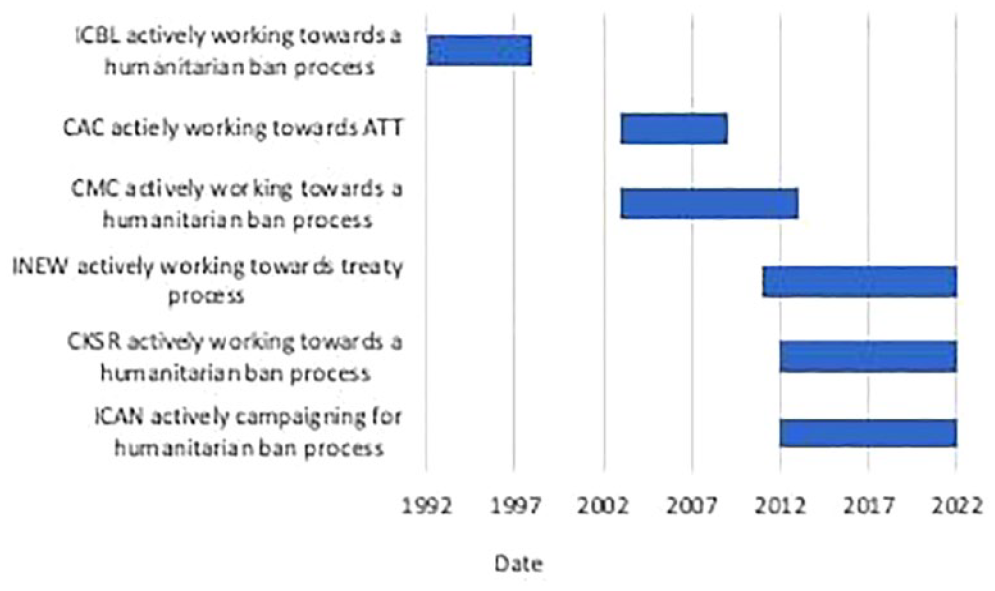
Timeline of transnational disarmament campaigns.
Figure 2 shows a two-mode affiliation network of Campaign Steering Groups. Individual TCs are one set of nodes (in red), and campaign steering group members are another set of nodes (in blue). A line from an organization to a campaign indicates that the organization is (or has been) a formal member of that TC’s steering committee. Node size is proportional to the number of steering committee memberships for each NGO. We exclude from the visualization ‘ordinary’ member organizations which are not represented on any steering committees, since their practical involvement is often limited and ties to other members weak (Hadden, 2015: 47–48) (these data are also shown in tabular form, Table 1).
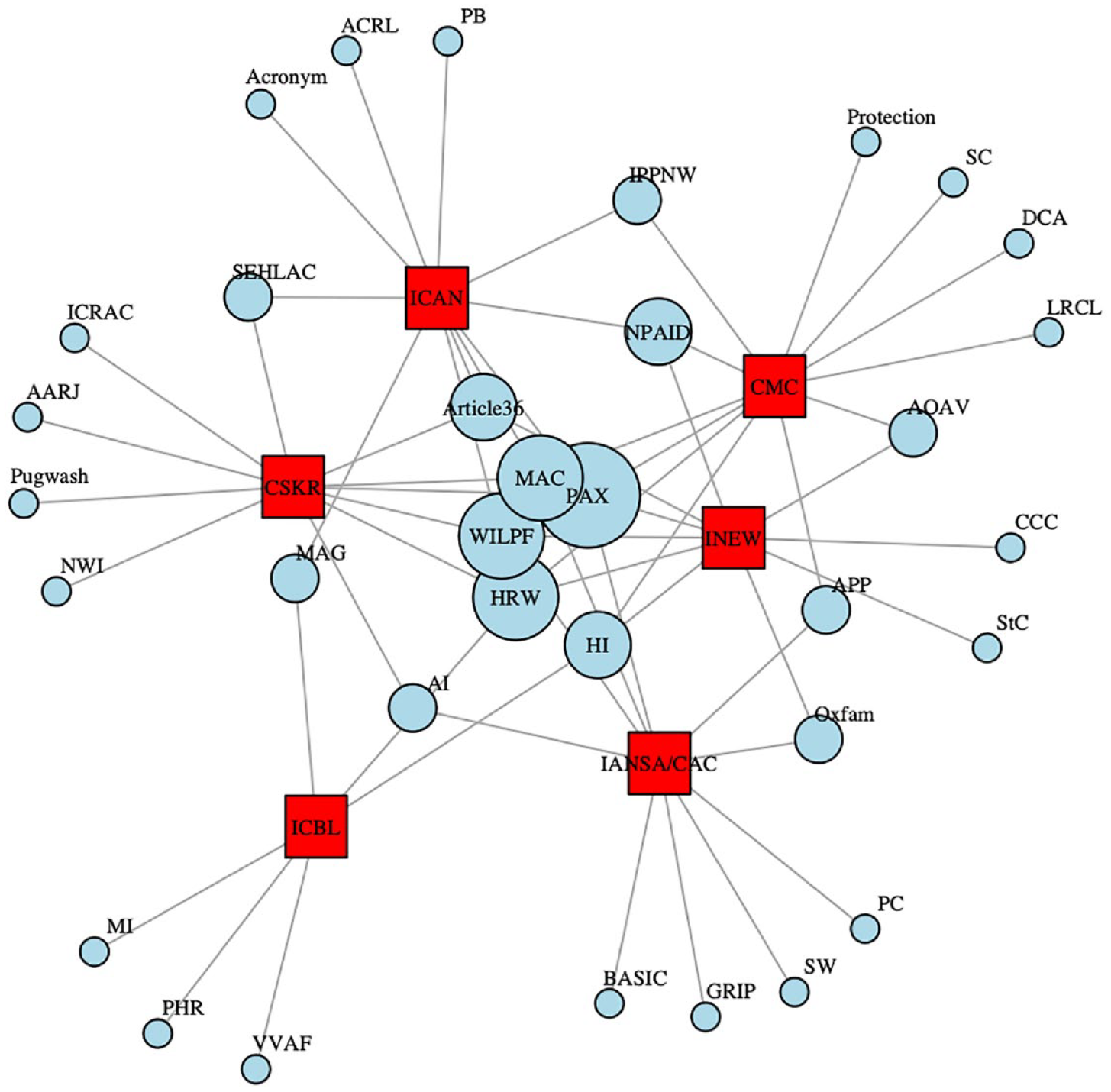
Organizational membership of campaign steering committees.
Recurring campaign steering group members.
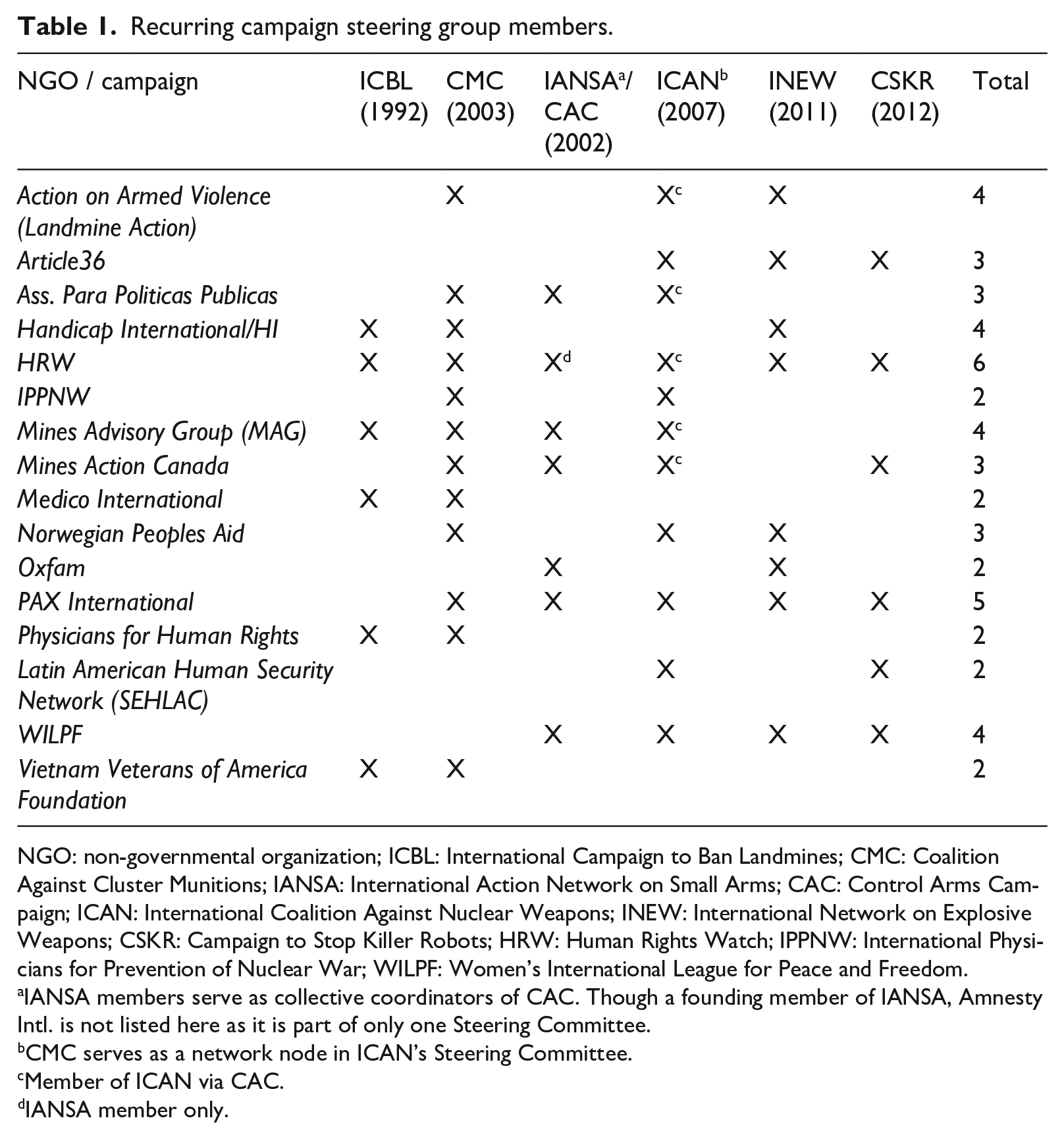
NGO: non-governmental organization; ICBL: International Campaign to Ban Landmines; CMC: Coalition Against Cluster Munitions; IANSA: International Action Network on Small Arms; CAC: Control Arms Campaign; ICAN: International Coalition Against Nuclear Weapons; INEW: International Network on Explosive Weapons; CSKR: Campaign to Stop Killer Robots; HRW: Human Rights Watch; IPPNW: International Physicians for Prevention of Nuclear War; WILPF: Women’s International League for Peace and Freedom.
IANSA members serve as collective coordinators of CAC. Though a founding member of IANSA, Amnesty Intl. is not listed here as it is part of only one Steering Committee.
CMC serves as a network node in ICAN’s Steering Committee.
Member of ICAN via CAC.
IANSA member only.
When steering groups are visualized across campaigns in this way, two things stand out: First, NGOs that are represented in one campaign steering group are likely to also be included on other steering committees. We identified more than 1000 organizations from over 100 countries as belonging to the disarmament TIN, based on their official endorsement of one or more disarmament TCs. 9 Nevertheless, Figure 2 (and Table 1) shows that a small group of organizations have been central players in most (and sometimes all) major weapon-ban campaigns since 1992. Thus, out of more than 1000 organizations involved in one or more disarmament campaigns as ‘ordinary’ members, we find a hard core of 16 organizations that are triple, quadruple or quintuple steering group members. In addition to HRW and ICRC (whose centrality has been highlighted in previous studies), these are Women’s International League for Peace and Freedom (WILPF) or their subsidiary Reaching Critical Will, PAX International, Action on Armed Violence (AOAV), the Campaign Against the Arms Trade (CAAT), Norwegian People’s Aid (NPAID), Humanity & Inclusion (HI, formerly named Handicap International) and Article 36. 10 Importantly, as we show in the following section, these organizations often lack a notable history of working on the specific disarmament issues in question. Rather, their central involvement has resulted from working closely with other steering group members in the past. These aggregate data lend clear support to our hypotheses about TC membership being determined by prior campaign collaborations among advocacy organizations, rather than exogenous factors or organizational mandates (Hypothesis 1).
Second, in addition to the repeated involvement of certain organizations, our sequential network analysis also reveals the repeated centrality of a small group of individuals within successive disarmament campaigns. Figure 3 shows the employment profile of individual staff members from campaign steering groups (or other central governing bodies) as a two-mode affiliation network. One set of nodes (blue) represents individual staff employed at organizations with high network centrality, or with personal roles as campaign directors/managers. A second set of nodes (red) shows organizations where these individuals are or were previously employed. Larger nodes represent individuals with connections to several organizations. While the organization-level network resembles that in Figure 2, Figure 3 reveals a sub-network of individuals who are centrally positioned in successive campaigns. Moving frequently between organizations, these individuals stay centrally connected in the wider TIN, playing pivotal roles in successive campaigns. Their central campaign involvement supports the hypothesis that individual-level connections often outweigh organizational ties in shaping campaign involvement (Hypothesis 4).
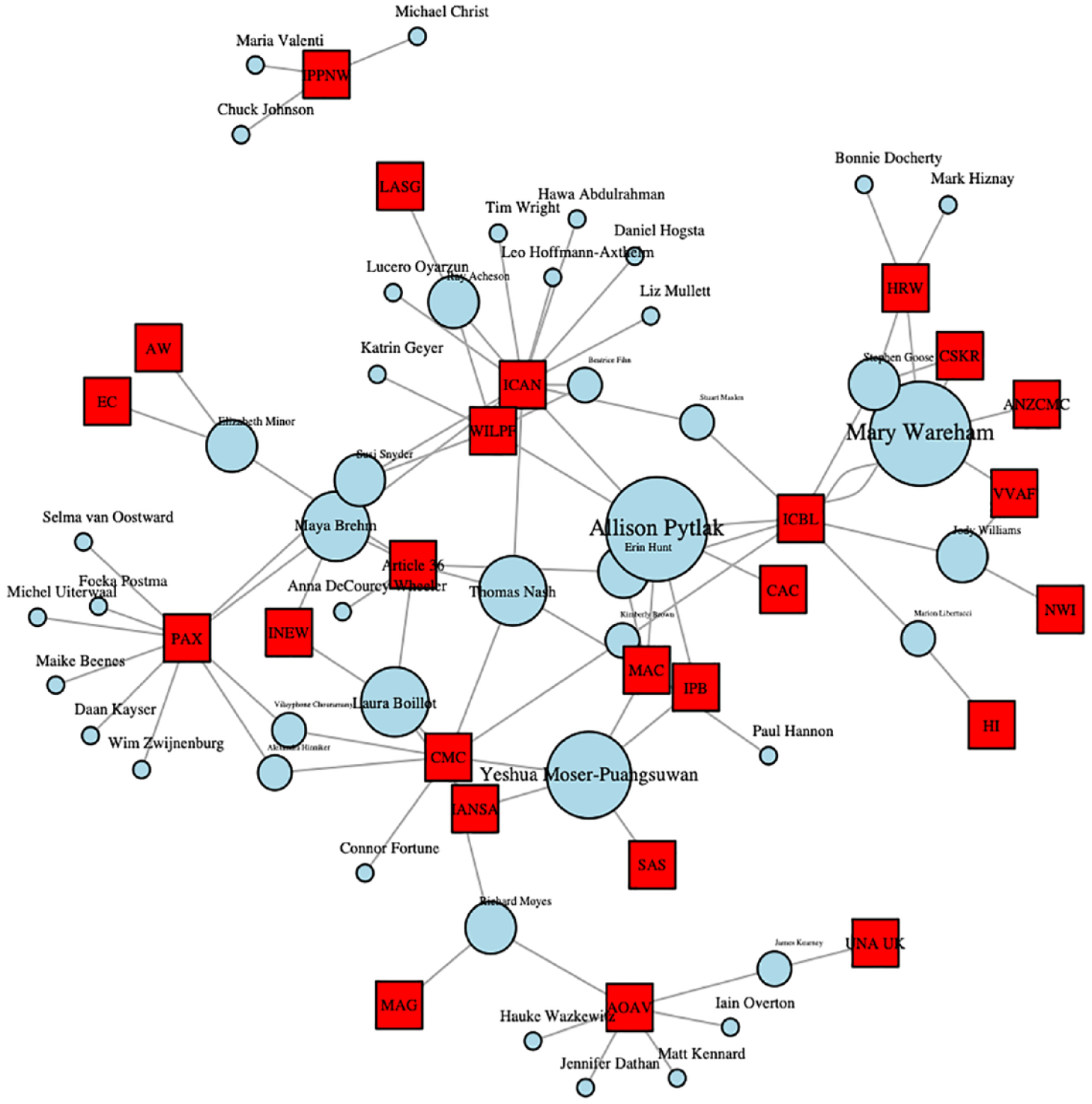
Individual staff network.
Next, we further unpack these data through brief case studies of individual disarmament campaigns.
International Campaign to Ban Landmines
The first global-scale campaign to ban a specific class of weapon was the ICBL in 1992. The foundation for the campaign was laid in 1989 when Raphael McGrath, a British expert in humanitarian conflict response, founded the Mines Advisory Group (MAG) to address suffering caused by landmines in Afghanistan and Cambodia. In 1991, Bobby Muller of the Vietnam Veterans of America Foundation (VVAF) hired Jody Williams to organize a global campaign, and in October 1992, six NGOs met in New York to form a steering committee. In addition to MAG and VVAF, these included Medico International, Handicap International, Physicians for Human Rights, and HRW (Hanson, 2022: 104).
Noticeably absent at this stage was the ICRC. The ICRC began to single out landmines as a weapon of grave humanitarian concern during the 1950s, producing detailed reports to educate governments on the adverse effects of landmines for civilian populations (Garcia, 2015; Price, 1998: 620). In the early 1990s, it was estimated that approximately 2000 civilians were killed or injured by landmines every month (HRW, 1993). In May 1993, the ICRC published a report titled Mines: A Perverse Use of Technology, which documented the extent of the problem. However, ICRC leadership were wary of seeking a ban on landmines, calling instead for regulation in the form of self-destruct mechanisms in anti-personnel mines so they would not endanger civilians post-conflict (Borrie, 2009: 28). Not until February 1994 – 16 months after the campaign launched – did the ICRC officially endorse the ICBL’s goal of banning landmines. Rather than acting as gatekeeper, this leading authority on landmines thus only joined in the campaign once it had gained traction.
Once onboard the campaign, the ICRC started to reshape its normative frame and strategic approach. From 1994 onwards, the ICBL Steering Committee developed its distinct humanitarian frame, building on data that the ICRC had been gathering for decades to develop powerful visuals highlighting the indiscriminate human suffering caused by landmines, and providing detailed data on victims, amputees, and survivors, along with losses of arable land (Borrie, 2009: 180; Garcia, 2015: 67; Hubert, 2000, 2007; ICRC 11 ; Paris, 2001). This re-framing – away from deep-rooted perspectives on landmines providing national security – to a focus on human security and compliance with international humanitarian law – would be applied within successive campaign coalitions afterwards (Alcalde, 2014; Borrie, 2009, 2014; Hanson, 2022: 103). The ICRC’s belated entry is consistent with Hypothesis 5, which predicts ‘bandwagoning’ by leading NGOs attempting to assert ‘issue-control’.
Cluster Munitions Coalition
Once the ‘Landmine Ban Treaty’ came into force in March 1999, the ICBL did not disperse but instead decided also target cluster bombs (Haddad, 2013: 188). The Steering Group of the Cluster Munitions Coalition (CMC), which formed in 2003, comprised the entire ICBL Steering Committee plus PAX-International. The campaign was soon joined by other former ICBL members, including Amnesty International, Norwegian People’s Aid, International Peace Bureau and Action on Armed Violence (AOAV) (formerly ‘Landmine Action’). Except for AOAV, we found no archival or interview evidence suggesting that any of these organizations had directly worked on cluster bombs before 2003. The lack of such evidence supports our hypothesis that prior campaign membership is often more important than substantive expertise in determining campaign involvement (Hypothesis 1).
The transition from the ICBL to the CMC illustrates how transnational coalitions – once formed – present a low-cost tool for further collective action. Once members had invested in an institutional framework for collaboration and developed a joint strategy and tactics, it seemed expedient to deploy these resources towards further collective action. Hence, as predicted (Hypothesis 2), strategic framing in the CMC closely mirrored the ICBL. The ICBL’s success has been widely attributed to its strategy of framing landmine use as an urgent humanitarian crisis (rather than a traditional arms-control issue) and in stating a single, clear goal: a total ban on landmine production, stockpiling and use, which was easy to communicate (Garcia, 2012, 2015: 67; Price, 2003). Cluster munitions were now similarly portrayed as an urgent humanitarian crisis (Bolton and Nash, 2010; Garcia, 2015; Nash, 2006). Yet, on closer inspection, the humanitarian logic behind the ban on landmines does not directly map onto a call to ban cluster munitions (Borrie, 2014). In contrast to landmines, which are relatively cheap and technologically unsophisticated, cluster munitions form a central part of the military arsenals of major powers (Borrie, 2014; Garcia, 2012). Unlike landmines, which are both enduring and untargeted, it is also more difficult to argue that cluster munitions are inherently indiscriminate (Borrie, 2014). Most importantly, whereas landmines could be shown to pose a significant hazard to civilians by the 1990s, harm from cluster munitions never became as widespread. As a result, advocates of a ban had to make their case without being able to demonstrate a clear and present threat to civilians (Borrie, 2014).
Path-dependent strategizing is evident not only in the humanitarian frame chosen for the CMC, but also in the campaign’s specific objectives. Although the CMC initially called merely for a moratorium on the use of cluster bombs, it soon adopted the ICBL’s formula of demanding a ‘complete ban on the use, production, stockpiling and transfer of cluster munitions’. 12 Tellingly, this was a departure from earlier policy for many coalition members. While Handicap International had called for a ban on cluster munitions in 1998, the HRW, Landmine Action and MAG had long rejected a ban as politically infeasible, arguing instead for the suspension of production and sale. 13 However, once these groups had developed and honed a collective strategy on landmines, it seemed logical to also apply this strategy to cluster munitions, even if this meant modifying previous organizational agendas. 14
The CMC illustrates how the timing of transnational advocacy campaigns is often dictated by when resources are freed up within an existing coalition network, rather than by exogenous events (Hypothesis 3). The most plausible exogenous trigger for a campaign against cluster bombs – the NATO-led bombing campaign in Kosovo in 1998–1999, which saw high civilian casualties from cluster bombs – occurred 5 years prior to the CMC’s launch. Both the ICRC and the HRW had documented the human suffering caused by unexploded cluster munitions during the Kosovo conflict without calling for a wider campaign (Borrie, 2009: 28). Yet, Mary Wareham (based at VVAF), who assisted Judy Williams in coordinating the ICBL, recounts how, once campaigning on landmines finished, cluster munitions seemed an ‘obvious next target for the coalition as different weapons with similar problems to landmines’ (Wareham, Interview, 2016).
The transition from the ICBL to the CMC also illustrates the influence of hyper-connected issue-professionals. According to John Borrie, who then worked in the Arms Unit of the ICRC, three individuals – Richard Moyes (Director of Policy at Landmine Action and previously working at MAG), Thomas Nash (Assistant to New Zealand’s Disarmament Ambassador during the ICBL, now working at Mine Action Canada) 15 and Raphael McGrath (working at MAG) – were central in shaping the strategy on cluster bombs, convincing other steering group members such as Steven Goose (Director of HRW’s Arms Division and married to Jody Williams, founding coordinator of the ICBL) to adopt the ICBL-frame for cluster bombs despite scepticism within their organizations (Borrie, 2009: 57–58, 123; Borrie, Interview, 2016). Another central player was Mary Wareham, who co-coordinated the ICBL while working for VVAF (1996–1997) and later worked on cluster munitions for Oxfam-New Zealand (HRW, 2018). Having occupied central leadership positions in the ICBL, these individuals now used their extensive professional networks to shape subsequent campaigns in ways that played to their personal skillsets (Hypothesis 4).
Small arms coalition
Momentum for a third campaign, on small arms, also coincided with the end of the ICBL. HRW and Amnesty International had highlighted the devastating effects of small arms in the Rwandan genocide in 1994, but found the issue lacked traction in the wider issue-network, where attention was firmly fixed on landmines (Krause, 2001: 17). Once active campaigning on landmines ended in 1998, they joined with other former ICBL members to create the International Action Network on Small Arms (IANSA) in 1999 (see Table 1).
The formation of IANSA confirms our hypotheses that increasing returns to ongoing collaboration leads to uniformity in TC membership (Hypothesis 1), and that the timing of new campaigns is determined by previous campaign activities rather than exogenous events (Hypothesis 3). As also predicted (Hypothesis 2), given the large overlap in membership between the ICBL and IANSA, the problem of small arms was framed similarly to landmines and cluster bombs, namely, as an urgent humanitarian crisis, allowing activists to rehash previous strategies of using statistical data and graphics to document widespread civilian suffering and calling for restrictions on small arms transfers. 17 This framing was, however, far from a natural fit. Among NGOs with a previous record of working on small arms, Amnesty International, Oxfam and Pax Christi had previously framed the problem of small arms as a development issue, whereas GRIP, Saferworld, BASIC and International Alert had adopted a traditional conflict-prevention frame, highlighting the role of small arms in fuelling civil and international wars (Krause, 2001: 24). However, drawing on previous strategies and working relationships established within the ICBL, the IANSA coalition now adopted a distinctly humanitarian frame, focusing on the ‘indiscriminate harm’ caused by small arms to civilians (Krause, 2001: 23). 18 This choice of framing is particularly notable insofar as, unlike landmines and cluster munitions, small arms are inherently discriminatory in the harm they cause and therefore cannot be as easily linked to humanitarian norms of civilian protection (Hill, 2006: 2).
Although it featured powerful NGOs like HRW at its centre, the small arms campaign also exemplifies elements of competition for issue-control and decentralized agenda-setting. Among members of IANSA, both Amnesty International and Oxfam called for treaty-based regulations of legal arms transfers, similar to the global supply-side restrictions placed on landmines and cluster bombs. However, top officials at HRW, based in New York, were wary of the political costs of campaigning for legal restrictions on small arms transfers in a US context (Stroup and Wong, 2017). To bypass HRW’s opposition, Amnesty International and Oxfam in 2003 created the parallel Control Arms Coalition (CAC) to campaign for an International Arms Trade Treaty (Waltz, 2014: 160–164). While excluding HRW, CAC included many organizations central to the ICBL, CMC and IANSA – such as PAX International, Saferworld and WILPF – and closely replicated the strategies of the ICBL through initiatives like the ‘Million Faces’ petition, which collected testimonies from civilians who had suffered from gun violence to build pressure of a treaty-based ban on legal arms transfers. By using their professional networks to launch the CAC, AI and Oxfam successfully asserted issue-control vis-à-vis HRW.
International campaign against nuclear weapons
After first peaking during the 1960s and 1970s, concerns about nuclear weapons rose again during the 1990s. In 1997, a group of NGOs, led by the Lawyers Committee on Nuclear Policy, drafted a notional Nuclear Weapons Convention (NWC). However, a concerted international campaign only began in 2007 with Felicity Hill, founder of Reaching Critical Will (the Disarmament Section of WILPF), as chief coordinator. 19 The initiative for a campaign came from International Physicians for Prevention of Nuclear War (IPPNW) – an organization outside the ICBL coalition. Thus, the campaign initially did not adopt a humanitarian frame. According to Beatrice Fihn, Executive Director of ICAN from 2013, it ‘was much more focused on the traditional model of nuclear issues’ with activists drawing on long-established anti-war slogans and highlighting the unreliability of nuclear deterrence (Fihn, Interview, 2014; Gibbons, 2018). During this time, ICAN’s frame was in flux, with a small group of activists favouring a nuclear ban treaty based on ICBL/CMC model (e.g. Richard Moynes and Thomas Nash), while others expressed doubt given the greater strategic importance of nuclear weapons (Cammileri et al., 2018; Gibbons, 2018: 18).
In July 2007, ICAN presented an updated version of the 1997 NWC to the UN, calling for negotiations at the Convention on Certain Conventional Weapons – the traditional UN arms-control forum (Gibbons, 2018). However, in 2012, ICAN was reframed through a so-called ‘Humanitarian Initiative’ which proposed that the ‘catastrophic, persistent effects of nuclear weapons on our health, societies and the environment must be at the centre of all public and diplomatic discussions about nuclear disarmament’ 20 (Ruzicka, 2019). This reframing may seem surprising. The humanitarian frames adopted in previous TCs rested firmly on campaigners’ ability to document widespread civilian suffering. This strategy did not map easily onto nuclear weapons, which were last used in 1945. However, ICAN’s reframing becomes easier to explain when considering that its timing coincided with the end of active campaigning on cluster munitions. According to Thomas Nash, then CMC coordinator, members of the CMC coalition paid little attention to nuclear weapons until late 2010, when the Cluster Munition Treaty became a reality (Nash, Interview, 2016). But once the CMC wound down, its members began to join ICAN, importing their existing professional networks and humanitarian frame with them.
In April 2010, ICRC-President Kellenberger gave a speech that highlighted Hiroshima’s tragic aftermath and argued that the ‘rights of States must yield to the interests of humanity’, 21 framing nuclear weapons as a distinctly humanitarian issue (Gibbons, 2018: 16; Kmentt, 2015; Ruzicka, 2019; Kellenberger, Interview, 2016). In September 2011, a small group of activists met in Amersham, England, to discuss how to change the discourse around nuclear disarmament. Participants—which did not include representatives from ICAN—came from organizations that had previously worked closely on the landmine and cluster-munitions bans. Though no official decisions were made, they converged on a humanitarian frame modelled on the ICBL/CMC (Egeland, 2019; Gibbons, 2018: 17).
‘Within the next year, a number of organizations with experience in banning other weapons, but not necessarily in nuclear disarmament, would join ICAN, bringing their vision and expertise’ (Gibbons, 2018: 17, our emphasis; Nash, Interview, 2016). A formal restructuring of ICAN took place in 2012, when a new Steering Committee was formed comprising organizations and individuals central to the ICBL/CMC (Borrie, 2014; Gibbons, 2018), including Norwegian People’s Aid, PAX Christi, Article36, and the Control Arms Coalition (CAC), which now operated as a network node in its own right (Carpenter, 2011: 85; Nash, Interview, 2016). Zambian Health Workers for Social Responsibility (a national affiliate of IPPNW) also helped set a new course for the campaign; the group was led by Robert Mtonga, who had served in a personal capacity on the ICBL and CMC boards. Many of these actors had not worked on nuclear disarmament before (Gibbons, 2018: 30). However, drawing on well-established connections and working routines at both the organizational and individual level, they spearheaded a campaign focused on nuclear weapons’ humanitarian costs (Borrie, 2014: 43). To do so, campaigners collected testimonies and medical reports from survivors of Hiroshima and Nagasaki and gathered data from health experts about long-term dangers of radiation from nuclear testing – mirroring tactics used in the ICBL (Garcia, 2015: 75). 22 During this phase, ICAN also changed its membership agreement so new partner organizations formally committed to support a ban treaty (Gibbons, 2018: 19) rather than the initially sought nuclear weapons convention (Egeland, 2019) Through 2012, ICAN’s website continued to promote an NWC as preferred by traditional ICAN ‘disarmers’, but in January 2013, a new website instead called for a legal ban on nuclear weapons (Gibbons, 2018: 17–18).
ICAN’s new humanitarian frame soon established groups and individuals central to the ICBL as experts within the coalition, increasing the visibility and network centrality of ICAN’s new Steering Committee members compared to its original founding members (IPPNW and WILPF). ICAN’s structure confirms our hypotheses regarding the membership, framing and timing of TCs being strongly influenced by previous campaigns. Furthermore, as with the Control Arms Coalition, NGOs commonly identified as authoritative gatekeepers in this issue-space (esp. HRW and ICRC) did not meaningfully ‘authorise’ or ‘vet’ the campaign. Instead, ICAN was launched as a traditional arms-control campaign by IPPNW and WILPF with other major NGOs coming on board once the CMC ended, seeking belatedly to re-frame ICAN to fit their preferred narrative. The campaign thus exemplifies decentralized agenda-setting, coalition-formation through ‘bandwagoning’ and fierce competition for issue-control (Hypothesis 5).
International Network Against Explosive Weapons
The International Network Against Explosive Weapons (INEW) was launched in March 2011 in Geneva. The Campaign Steering Committee comprised AOAV, Article36, Center for Civilians in Conflict, Handicap International, HRW, Norwegian People’s Aid, Oxfam, PAX-Christi, Save the Children (UK) and WILPF 23 —all organizations centrally involved in previous campaigns on landmines and cluster bombs (Borrie and Brehm, 2011: 831). The campaign was co-coordinated by Richard Moyes and Laura Boillot on behalf of Article36. Prior to joining Article36, Boillot worked first as Campaign Manager and later as Director of the CMC, and, before that, as Program Officer for the Control Arms Campaign. Individual staff at the heart of INEW thus had considerable experience in humanitarian campaigning.
INEW’s normative frame is familiar: use of explosive weapons in populated areas is depicted as an urgent humanitarian crisis causing ‘broad, substantial and ongoing harm to individual and communities’. 24 To support this claim, the campaign provides detailed data on civilians killed and injured in explosive violence. 25 Unlike the cases of nuclear weapons and small arms, this choice of frame is unsurprising; explosive weapons share many features of landmines and cluster munitions, which were previously banned on humanitarian grounds (Moyes and Rappert, 2010: 100). Less obvious is the timing of the campaign. In terms of political salience, a wide window of opportunity seemed to open in 2003, as civilian casualties of the war in Iraq heightened political awareness of the harms caused by explosive weapons. In May 2009, the UN Secretary General’s Report on the Protection of Civilians expressed grave concern about the ‘humanitarian impact of explosive weapons’ and urged member states ‘to consider this issue further’. 26 Nevertheless, studies have found that explosive weapons at the time attracted ‘zero attention’ within the human security issue-network (Carpenter, 2011: 80).
What changed by 2011? We point to two endogenous drivers of INEW. First, the Convention Banning Cluster Munitions went into effect in 2010 after years of campaigning to persuade governments to ratify the treaty, freeing up resources among advocacy groups active within the CMC. Second, highly connected issue-professionals moved to push explosive weapons to the top of the transnational agenda. Richard Moyes, who had played a central role in the ICBL and CMC, began writing on the harms caused by explosive weapons in 2009 as Director of Policy at AOAV (Moyes, 2009), but found the issue had little traction within his organization. In 2011, he left the AOAV to join Thomas Nash in founding Article36, an NGO explicitly focused on humanitarian weapons control. The pair then used their professional networks cultivated during previous campaigns to build support for a campaign on explosive weapons (Boillot, Interview, 2017; Carpenter, 2014: 115). Other ‘issue-professionals’ soon joined them in stressing the harms of explosive weapons to civilians, including John Borrie and Mayra Brehm at UNIDIR (Borrie and Brehm, 2011), and Kerry Smith at Save the Children, UK. 27
Article36’s leadership of INEW provides a clear illustration of how issue-professionals can use their ‘multiple insider’ status to promote particularistic interests. According to Thomas Nash, he and Richard Moyes had been working together on the campaign to ban cluster bombs and both decided that we would like to engage with some new areas related to disarmament and the protection of civilians. We couldn’t see any existing organization where we would have the flexibility to work on any weapons issue that needed attention, so we set up Article36. (Nash, Interview, April 2016)
Using ties to professionals in other organizations, Nash and Moyes built a powerful network around explosive weapons, bypassing major points of organizational gatekeeping, including the ICRC which, according to Borrie and Brehm (2011: 831), had until then tended to frame the problem posed by explosive weapons in terms of international rules governing the conduct of hostilities. Soon, AOAV and HRW (neither of which had previously shown direct interest in explosive weapons) joined INEW. Thus, consistent with Hypothesis 1, although it came about through decentralized, ‘bottom-up’ agenda-setting, the eventual membership of INEW closely resembled that of earlier TCs.
Campaign to Stop Killer Robots
Our final case, the Campaign to Stop Killer Robots (CSKR), was launched in 2013 by Noel Sharkey, a roboticist at Sheffield University, and Mary Wareham, Director of HRW’s Arms Division. 28 Like previous campaigns, the CSKR adopts humanitarian discourse which holds that ‘lack of human judgement . . . means lethal autonomous weapons (LAWS) cannot abide by core principles of international humanitarian law’ and risk ‘unacceptable human suffering’. 29 Until 2013, LAWS (or ‘Killer Robots’) had low resonance within the human security TIN. The issue was raised in 2006 by Noel Sharkey and other academics who called on governments to create a global code of conduct against the acquisition, deployment and use of robotic weapons (Sharkey, 2007). In 2008, Richard Moyes, still based at AOAV, proposed a global campaign against LAWS but found no support for the issue within his organization (Marks, 2008). In 2009, Noel Sharkey and three fellow academics founded the International Committee on Robot Arms Control (ICRAC) to push for regulations (Sparrow, 2007, 2009). 30 Lacking ties to the wider TIN, however, the group found itself isolated; Carpenter (2014) describes how the HRW and ICRC dismissed the issue as ‘science-fiction’ (p. 107). ‘As late as 2011, no NGO had autonomous weapons formally on its agenda’ (Carpenter, 2014: 1; Marks, 2008).
According to Carpenter (2014), the mood changed abruptly in September 2011 when ICRC President Kellenberger gave a speech addressing the international humanitarian law implications of LAWS, thereby ‘constituting the issue as a valid concern’ for the disarmament community (pp. 2, 108, 117). And things ‘changed even more dramatically when HRW published a report the following year calling for a ban of LAWS’ (HRW, 2012a). Within a month, nine well-known NGOs had joined the CSKR steering committee (Carpenter, 2014: 1–2). To Carpenter, LAWS thus represent a prime example of a campaign issue with poor prospects until the moment powerful gatekeepers threw their weight behind it.
Our interpretation differs. While identifying LAWS as a ‘valid concern’ for disarmament activists, Kellenberger’s speech did not actually single out killer robots as an urgent problem. After first highlighting cyber warfare and drones as issues of concern (both of which failed to garner much attention in the issue-network), Kellenberger noted that ‘the central challenge with automated systems is to ensure that they are indeed capable of the level of discrimination required by international humanitarian law’. This, he argued, ‘will depend entirely on the quality and variety of sensors and programming employed within the system’ (Kellenberger, 2011: 812). He further stressed that ‘[LAWS] have not yet been weaponized’ before calling on the audience to ‘look at their possible advantages in contributing to greater humanitarian protection . . . [by] caus[ing] fewer incidental civilian casualties’ (Kellenberger, 2011: 813). This was hardly a rallying cry to outlaw LAWS on humanitarian grounds.
So why did NGOs call for a ban on LAWS in 2013? Like previous campaigns, we argue that the CSKR was shaped by competition for ‘issue-control’. Activists working on LAWS disagreed on whether to seek a ban or opt for softer regulation. While some members of ICRAC supported a ban on development of robotics others favoured ‘soft law’ industry codes of conduct (Carpenter, 2014: 98; ICRAC, 2010). Other prominent activists, like Ron Arkin with the Consortium on Emerging Technologies, Military Operations and National Security (http://cetmons.org/thrust2_robotic), took the view that, ‘Human beings cannot comply effectively with the laws of war’, whereas ‘[LAWS] will potentially be capable of performing more ethically on the battlefield’. Therefore, ‘I think we can do better than an outright ban’ (Arkin, 2010; See also Arkin, 2004, 2009).
The decisive push was the establishment of Article36, launched by Moyes (former director of Landmine Action) and Nash (former CMC Coordinator) to promote humanitarian disarmament. On 5 March 2012, Article36 became the first NGO to publicly call for a ban on LAWS. 31 Next, Moynes and Nash rallied their personal networks for support (Carpenter, 2014: 109). Soon after, Steven Goose based at HRW (an organization which had recently dismissed LAWS as ‘science-fiction’) began working on a report on LAWS with input from Jody Williams, previous ICBL Coordinator, now President of the Nobel Women’s Initiative (Wareham, Interview, 2017). On 17 November 2012, representatives from HRW, Article36 and PAX met with like-minded groups in New York to form a campaign (Wareham, Interview, 2017). Neither the ICRC nor ICRAC (where technical expertise on robotic weapons resided) attended. Two days later, the HRW officially released its report Losing Humanity, arguing that LAWS are incapable of complying with rules of international humanitarian law, which require human judgement (HRW, 2012a, 2012b, 2012c).
Once a humanitarian frame had been firmly agreed, Wareham describes how individuals in HRW’s Arms Division began discussions with individuals from ‘like-minded NGOs that HRW had worked with on cluster munitions’ before eventually inviting Sharkey at ICRAC to join the coalition (Interview, 2017). When the CSKR officially launched in April 2013, the Steering Committee consisted of eight organizations: HRW, Article36, MAC, PAX, Nobel Women’s Initiative, WILPF, Pugwash and ICRAC. 32 Seven of these were centrally involved in the ICBL (or were headed by individuals who were), whereas only one, ICRAC, had a prior commitment to working on LAWS. This once again illustrates how prior inter-organizational and inter-personal ties trump subject-specific expertise when it comes to shaping campaign membership (Hypothesis 1).
By co-directing CSKR with Article36, the HRW successfully (re)established the issue-control it had lost by dismissing LAWS as ‘science-fiction’. Rather than calling for arms-control style regulations of LAWS as envisaged in Kellenberger’s, 2011 speech and advocated by ICRAC, the CSKR calls for a ‘pre-emptive ban on the development and production of LAWS’. Campaigning for regulation of LAWS would require activists to become familiar with technical debates about weapon autonomy, robotic programming, and military protocol, building on the kind of technical knowledge that ICRAC and ICRC possessed. By contrast, calling for a pre-emptive ban on humanitarian grounds fit with the long-established collective strategies of the CSKR’s initial steering group members. As Wareham explained, ‘We [at HRW] don’t do arms control. Arms control is about controlling weapons. What we do is humanitarian disarmament’ (Wareham, Interview, 2016). By abandoning its initial opposition (and side-lining internal concerns that a stance against LAWS might be conflated with opposition to drones, which HRW expressly did not wish to oppose) and joining the coalition early, the HRW ensured that its preferred framing prevailed.
The humanitarian framing of LAWS plays to the strengths of highly connected organizations and issue-professionals within the human-security TIN, allowing them to capitalize on prior expertise and social ties. However, according to observers close to the campaign, this faming doesn’t necessarily fit the ‘objective’ aspects of the issue at stake. As Laura Boillot (Article36) reflected during an interview, A lot of the campaigns that we have worked on previously, particularly landmines, but also cluster munitions, have been driven by humanitarian concerns that we could illustrate and show very effectively [by] bringing the victims’ perspective into that campaigning. We can’t do that with killer robots because these weapons haven’t been used. (12 May 2017)
Perhaps as a result, the campaign has so far been relatively unsuccessful in persuaded states to endorse its aims.
Conclusion
How do advocacy organizations decide what issues to campaign on, when? Previous literature has pointed to ‘issue-ripeness’ resulting from exogenous events to explain the focus and timing of transnational advocacy campaigns. On this view, individual campaigns are launched in response to favourable political opportunity structures and include organizations with long-standing practical or technical expertise on the issue(s) at hand. This suggests that each new campaign will have a relatively unique structure in terms of membership and strategy, adapted to the specific problem at hand. By analysing successive disarmament campaigns as iterations of a single issue-network, we demonstrated significant overlap not only in terms of who campaigns but also how they campaign. Indeed, a striking feature of the six disarmament campaigns analysed in this article is the close similarities in membership and strategic approach despite the dissimilar technical aspects and political contexts of the targeted weapons. These similarities stem from incentives to draw on existing social ties and previously rehearsed collective strategies.
Besides leading to similarities in membership and strategic framing, incentives to capitalize on existing social ties also influence campaign timing. By analysing campaigns sequentially, we were able to show that campaign timing often depends less on exogenous events and more on (1) when time and resources are freed up within an issue-network, and (2) competition between NGOs and individual issue-professionals to establish ‘issue-control’ by being first to campaign on an emerging issue. Looking at six major disarmament campaigns since 1992, we found the timing of each new campaign to coincide with the conclusion of existing campaign efforts, rather than with exogenous events. We also found that armament issues which might be deemed ‘ripe’ due to growing political attention – for example cyberwar and drones – were not targeted by TCs.
Like previous studies, we found that the transnational disarmament issue-network features elements of hierarchy. For example, while individual campaigns have involved many hundred organizations as formal members, successive TCs have all featured a similar, select group of NGOs as recurring campaign steering group members. These organizations often lacked a strong prior record of working on the weapons systems in question, suggesting that previous investments in social and professional ties trump issue-specific knowledge when it comes to gaining leadership of TCs. Unlike previous studies, however, we did not find that a few large NGOs consistently control the transnational advocacy agenda. In the context of disarmament, HRW and ICRC have been previously singled out as effective gatekeepers. According to Carpenter (2014), ‘once these NGOs commit to an issue, others are likelier to come on board, creating a bandwagoning effect once these key players join and dampening issue proliferation if they do not’ (p. 33). In contrast, we found that ‘bandwagoning’ often runs in the opposite direction, with traditionally powerful NGOs joining TCs once they have already gained traction within the wider issue-network, so as not to cede issue-control. This suggests that agenda-setting power is more diffused among organizations and individuals with high centrality in the issue-network.
In addition to highlighting the importance of previously established ties among organizations, a major contribution of this article has been to illustrate how TCs are shaped by hyper-connected ‘issue-professionals’ that move between organizations to build support for issues that fit their skillsets. The notion that TCs are ‘orchestrated’ by issue-professionals was echoed in most of our interviews (e.g. Daan Kayser, Interview, 2016; Feltham, Interview, 2016; Laura Boillot, Interview, 2017). This finding suggests that transnational agenda-setting power resides in professional networks that develop between organizations, rather than with organizations as such. In turn, this suggests an important revision to existing IR-scholarship which has mainly focused on individuals as ‘norm-entrepreneurs’ that creatively invent new issues, rather than as ‘social brokers’ empowered by their experience as ‘multiple insiders’.
Our empirical focus has been limited to disarmament campaigns. However, we expect our theory to apply to other areas of transnational advocacy, such as human rights, climate change or development. In these areas, organizations also face strong incentives to draw on previous investments in coalition-building and collective strategizing to tackle new issues. As a result, we expect sequential network analysis in these domains to reveal persistent similarities in membership structure, timing and strategic framing of collective advocacy efforts.
We also expect our insights regarding the role of issue-professionals to apply outside the disarmament advocacy domain. Our analysis shows that campaigning experience often trumps technical or scientific expertise, and that social capital often outweighs organizational affiliation/position when it comes to allowing individuals to shape transnational agendas. We expect this finding to be applicable to all transnational issue-spaces where growing professionalism and ‘revolving doors’ empower individuals with diverse career trajectories to broker connections across wider issue-networks. For example, Seabrooke and Stenström (2022) find that the European Union’s (EU) sustainable finance agenda is shaped by actors from different professional ecologies who compete to determine policy priorities and practices, and that professionals with many and varied network ties and mixed career histories have greater influence on how issues are treated than individuals rich on technical or scientific expertise. Similarly, Eilstrup-Sangiovanni and Sharman (2022) offer examples of how individual transnational climate-change activists move across organizations to promote an agenda focused on litigation.
Our analysis has shown a high degree of path-dependence in transnational advocacy with the membership, framing and tactics used in the 1992 IBCL being closely replicated in subsequent campaigns – from the CMC to the CSKR. However, the attraction of ‘re-cycling’ pre-existing social ties and collective strategies may eventually wane as activists find it increasingly hard to achieve progress on new issues using the same toolbox. So far, the Killer-Robot campaign has gained limited traction and advocates at the centre of the campaign may eventually decide that they need to invest in new social relationships and expertise, thereby starting a new cycle of networked transnational advocacy.
Footnotes
Ethical approval
Interviews received ethical approval though a review process at Ponoma College, Claremont, California, in 2014. As all the interviews were considered to meet IRB standards for ‘elite’ interviews, and all participants were given the option to choose how or if they would be identified in the manuscript text, this research was considered to be IRB exempt.
Funding
The author(s) received no financial support for the research, authorship and/or publication of this article.
