



Abstract
In this article, I explore how pride as a collective emotion is ontologically bound to the securitisation of energy and put forward an innovative method that engages materiality and discourse in securitisation theory. I examine the case of energy securitisation in Azerbaijan to show that collective pride is anchored to materialisations and reiterative identity discourses that stick to energy sites and align with the nation in ways that fit with the coercive and controlling nature of securitisation. While the existing literature on emotions and securitisation engages with the process of threat construction and focuses on the audience’s affective experience, I approach securitisation as threat construction and threat management and locate the affective dimension of the process in a transversal space that considers the affective experience of the audience alongside that of the securitising actor. This article pays considerable attention to methods and introduces an experimental new materialist discourse analysis, which accounts for the material, affective and non-human world exerting an agential force on the texts.
Introduction
In this article, I explore how pride as a collective emotion is ontologically bound to the securitisation of energy and put forward an innovative method that engages materiality and discourse in securitisation theory (ST). That security as securitisation has taken over multiple sectors of our life, such as energy, is concerning. However, theoretical and political opportunities for novel ways of thinking about, doing, and feeling security exist. I use the securitisation framework to conduct a politically aware investigation of security without restraining the analysis to the most visible manifestations of extraordinary politics.
My purpose is to theorise the relationship between emotions and securitisation through a new materialist (NM) onto-epistemology and outline a novel method to address empirical questions through the case of energy securitisation. In the literature, securitisation has been approached as a speech act (Buzan et al., 1998), a practice (Bigo, 2000) or a policy (Balzacq, 2008). In this article, I claim it is also an emotional process. I make explicit how emotions are engineered into energy securitisation and show that judgements about what energy objects to secure and what security to provide are emotionally saturated. By looking at where pride resides and how it navigates through the assemblage of energy securitisation, I shed light on how and why specific ways of seeing and managing energy (in)security emerge and resonate in Azerbaijan.
This article opens energy security studies after its long attachment to technical scientism and geopolitics. Recent attempts have sought to renovate the field through qualitative and interpretative approaches (Sovacool, 2014). ST has offered a novel pathway to explore energy security beyond mainstream frameworks, abandoning the alleged neutral objectivity of positivist studies, and drawing attention to the concept’s fluid and political nature (Nyman, 2018; Surwillo, 2019; Szulecki, 2017). In other words, securitisation conceives of energy security within power struggles and socio-cultural frames.
While research has examined the space of security in energy, it has been less attuned to its affective dimension. Emotions remain either implicit or absent from energy security studies. Similarly, albeit acknowledged, the (re)production and mobilisation of emotions in securitisation mostly remain covert and undertheorised. By investigating the interrelationships between emotions, energy and securitisation, this article attempts to merge research fields that have not received much attention and are rarely seen as interconnected. I shift the focus towards an emotion, pride, which is commonly understood as a positive emotion and is hardly seen in conjunction with the feeling of insecurity, typical of securitisation. While studying energy securitisation in Azerbaijan, pride got my attention because it appeared as an underlying and recurrent rhetorical theme. Yet, I noticed that also things embodied, communicated and endorsed a sense of collective pride that was performative of energy securitisation. In the field, I observed and perceived pride in the surrounding urban architecture, massive energy infrastructure and sophisticated security technologies. Matter – intended as the tangible things (Connolly, 2013; Herschinger, 2015) and the less corporeal stuff (Leonardi, 2010) that compose the world – and materiality – meaning the substantial characteristics of an object – are not inert but act upon the context in which they exist (Miguel et al., 2021).
This principle is at the heart of new materialism, a theoretical approach that resuscitates the role of the tangible world within continental philosophy and after postmodern attempts to recentre onto-epistemological debates away from matter and towards discursively situated knowledges (Tuin and Dolphijn, 2012). Because securitisation theory was born out of postmodern thinking, it foregrounds ideational dynamics at the expenses of matter. New materialism offers an opportunity to rebalance the relationship between discourse and materiality, healing the presumed separation between human and non-human worlds. Albeit reinserting matter, new materialism shares with postmodernism a distrust in ‘a priori’ metaphysics and foundationalist epistemologies that understand materiality as a predetermined macrostructure existing before or outside the social (for a critique, Oksala, 2011).
This line of theorising helps rethink emotions beyond human phenomenology and individuals’ psychology. Emotions are not confined to human bodies and minds; they exist in complex and distributed relationships between human and non-human universe. Human and things like places, objects and material entities, affect one another. Curious to understand how things assemble with human emotions in process of energy securitisation, I focus on energy objects (e.g. oil and gas and their derivatives, electricity, pipelines, pumps, onshore and offshore drills), security technologies (e.g. weapons, CCTV cameras, sensors, radar and drones) and architecture (e.g. statues, buildings). I move from an awareness of things to an appreciation of matter and materiality as larger than thing-ness and crude materialism to devote attention to how ‘materials mediate relationships of power, agency and governance over time and space, and shape social and political processes by virtue of their irreducible presence’ (Walters, 2014: 102).
While initially I considered emotions as an opportunity to develop an under-researched area of the securitisation agenda, I soon realised that I was falling into an add-and-stir trap, where emotions risked becoming only another element of the securitisation assemblage. I wanted to avoid engaging with the affective question superficially and transforming my inquiry into a descriptive task. Instead of merely asking where emotions sit in securitisation, I raise questions that account for intraconnections of pride and energy securitisation.
I investigate two dimensions of the securitisation–emotions relationship. The first dimension addresses the ontological question of pride, reflecting on emotions as co-constitutive of securitisation. I begin by situating my research on energy securitisation in relation to the current strands of securitisation studies and follow by outlining the modes and benefits of using new materialism to analyse securitisation. Next, I reflect on contemporary engagements with emotions as social, political phenomena (Ahmed, 2004a, 2004b; Bleiker and Hutchison, 2014; Crawford, 2013; Fierke, 2012; Hutchison, 2019) and delve into the securitisation debate (Van Rythoven, 2015). I aim to contribute to the literature developing five onto-epistemological ideas.
For the second dimension, I turn my attention to the question of method and reflect on how to translate NM as ‘a technique of thought’ (Hazard, 2019) into an operationalised tool for analysing emotions in securitisation. As such, sections four and five explore a pathway – which I call a new materialist discourse analysis (NMDA) – through which securitisation can rely on discourse while recalibrating its relationship with the material world and stepping back from discursive ontology. Instead of stopping at the task of deconstruction, NMDA opens the framework’s creative potential for articulating the contingent and heterogeneous entanglements that maintain social relations and structures in place along a discourse/matter continuum (Abrahamsen and Williams, 2011; Acuto and Curtis, 2014; Salter, 2015). This method avoids state-based topologies and the ‘either/or’ propositions used by ST to determine security (e.g. exceptional/ordinary), define its space (e.g. national/international, internal/external, national/international, public/private, local/global, state/non-state) and form categories of being and knowing (e.g. human/non-human, nature/culture, reason/emotions). Because emotions are at once individual and social, ephemeral and bodily, and constructed and performative, this method is particularly suited to account for their complexity.
After discussing my empirical findings in session six, I conclude reflecting on whether it is possible to recognise non-human agency without depoliticising securitisation. The recentring of matter aims at overcoming anthropocentric and humanistic understandings of politics; however, what does this mean for securitisation and political accountability? In my final reflections, I call for a serious engagement with the questions of agency, accountability, and ethics and suggest recentring on differences of materialities and asymmetries of power.
Securitisation as an assemblage
Securitisation can be understood as the process of threat construction and management (Balzacq et al., 2016; Schuilenburg, 2015). The concept is used to indicate that a specific issue is transformed into a security concern and, accordingly, becomes a ‘special kind of politics’ (Buzan et al., 1998: 23). At the heart of securitisation lies a renewed approach to security – and social phenomena more broadly. The theory is grounded in social constructivism and contends that no object or subject is inherently a threat. Instead, threats are (re)produced through intersubjective practices that designate what and who constitute a threat, what actions need to be taken to protect specific objects and annihilate others, and who retains the power to do so. As a theory, ST aims to understand the modalities, reasons, and effects of creating and managing security threats (Balzacq et al., 2016). Securitisation is mainly associated with policies and practices that are interventionist and aggressive: it arranges politics around a coercive and controlling agenda; centralises power; endangers civil liberties and democracy; and expands security towards uncharted territory. When securitised, a subject matter gets immersed in a logic of ‘enmity, decision, and emergency’ (Aradau, 2004: 392) that colonises the decision-making process.
Securitisation shapes what comes to matter and uses what is understood as mattering to manipulate and control the space of the political. Drawing on the framework, my work (Ganz, 2021) uses the phrase ‘energy securitisation’ to point to the special politics of coercive interventions and (para)military means that is enacted when energy is treated as a security concern. I studied the case of Azerbaijan and showed how energy securitisation foments the use of force in and around oil and gas sites, facilitates a despotic exercise of power, and downgrades alternative, non-aggressive energy security policies.
Over time, many variants of securitisation have developed (Balzacq, 2011; Bigo and McCluskey, 2018), testifying to the framework’s saliency and appeal. At the risk of oversimplification, I consider an early ST tradition (Buzan et al., 1998; Waever, 1993), grounded in the linguistic ontology of the speech act and pointing to universal rhetoric of exception; and subsequent poststructuralist interventions, which expand the appreciation of discourse as/through practice and introduce a focus on the ordinary (Balzacq, 2011; Huysmans, 2011; Williams, 2011). Recent efforts engaging with NM sensitivities begin by recognising the same ontological status to discourse and matter (Aradau, 2010; Paliewicz and Hasian, 2019). Salter (2019) suggests revitalising ST through methodological openness and flat ontology, leaving behind representation as the single centre of analytical attention. NM neither repudiates older theoretical generations nor marks a radical departure from them. Instead, it thinks of their foundations anew: at its core lies the desire to investigate discourse/matter ontologies. NM still appreciates the social ability of securitisation to determine the contours of power and its exercise: while it cares about objects, it retains its interest in individuals’ lived experiences, hidden interests and social imaginaries. Thus, reorienting the analysis towards matter does not mean returning to modern, crude materialisms or reviving ‘engineers’ approaches’ (Balmaceda et al., 2019). In the field of energy, this is important: critical energy studies show that the alleged objectivism of traditional works alienates and sanitises political attitudes and distracts from the ways in which political power and governance entangle with energy materiality (Berling et al., 2022; Sovacool, 2014). Barry (2013: 183) explains that the political significance of materials is not a given; instead, it is a relational, practical and contingent achievement.
When applied to energy securitisation, NM can show that the process does not hold a unitary character but consists of the relational (dis)entanglements between objects, places, histories and people. Instead of being a product of a fixed set of elements, energy securitisation emerges as an assemblage of connections that involve material, discursive, emotional, human and non-human elements, which are in an ever-evolving boundary-making process. In the following pages, I propose a pathway to approaching emotions in securitisation while, simultaneously, attending to material and discursive forces.
On securitisation and emotions
A growing interest in emotions has led to the emergence of a vibrant and prolific scholarship whose work counters the denial (Crawford, 2000) and over-rationalisation (Ariffin, 2016) of traditional IR. Rather than personal, temporary and purely biological states, emotions are reclaimed through their social nature and their relationship with the norms and values that make up for them. As Crawford (2013: 122) writes, ‘emotions are often institutionalised, incorporated, and eventually, deeply embedded in the processes and structures of world politics’. Research delves into their politically productive and transformative potential: emotions shape identities (Mercer, 2014; Solomon, 2015), affect political and security practices (Åhäll and Gregory, 2013; Danchev, 2006; Hutchison, 2016), expose power dynamics in the everyday (Hutchison, 2019), and fit into governmentality (Hunter, 2015; Scheer, 2012).
Unlike other theoretical traditions, ST has not engaged much with the question of emotions and hardly articulates its performative role. Against this silence, Van Rythoven (2015) argues that threat construction – the core of securitisation – is an emotional phenomenon. This view foregrounds the ontological importance of the affective experience in securitisation by interpreting how emotions help perceive danger, inform decision making, form judgements and constitute public responses to political moves. Affective experiences are both a part and result of the process of threat construction. Decision-making in securitisation is not left to purely rational calculus but is imbued with emotions. Research shows that emotions towards a referent object or a perceived danger can favour (Huysmans, 2006, 2014; Fattah and Fierke, 2009) or inhibit (Van Rythoven, 2015) specific securitising efforts. Although often left implicit, securitisation generates emotional responses, like anxiety towards an unsafe future, fear of death or distrust towards the ‘other’ (Abrahamsen, 2005; Adamides, 2020; Nyers, 2009).
Attention to emotions captures the essence of securitisation as an actually existing process, outside the abstract and standardised trilogy model of speech act theory. The interdependency between affect and cognition provides novel onto-epistemological foundations for the theory, able to reveal how and why certain issues are constructed and managed as security concerns. More broadly, emotions are ways of experiencing the world and making it intelligible; they translate and interpret sensory information about the surroundings (Brennan, 2015). Paraphrasing Alva Noë (2009), thinking, feeling and acting require the joint operation of brains, bodies and the world. Despite its contribution, Van Rythoven’s article – as the most comprehensive analysis of emotions in securitisation – remains symptomatic of some important limitations that characterise the securitisation scholarship more broadly. While almost a decade has passed since his article was published, research in the field has not progressed, leaving several questions to date unanswered.
To be clear, I do not deny the importance of Van Rythoven’s article and related works on emotions and securitisation; rather, I make the case for the significance of using an NM approach to push current knowledge further.
First, Van Rhytoven studies the impact of emotions in defining threats, echoing a narrow view of securitisation. This approach aligns with discursive ontology and its emphasis on the moment of threat construction, but dismisses the lessons learnt through practice, governmentality and the everyday, which indicate that securitisation is larger than the speech act. I suggest understanding securitisation not exclusively as threat construction but also as threat management. Shifting attention towards how threats are governed – rather than merely constructed – shows the more profound ways in which securitisation is ontologically bound to emotions: emotions guide the definition of security objectives, its execution and the exercise of power. Looking at my case study, I argue that whether and how a securitising actor decides to address a threat, its confidence in a specific security outcome, the belief of being entitled to give or receive security, and the shape that mobilisation takes have all an emotional dimension, which centres on pride.
Second, I challenge the ideas that emotions follow a consequential temporality, unfolding after securitised practices are designed or executed. Emotions are understood as ‘culturally situated’ (Van Rythoven, 2015: 460) and therefore embedded in a longer temporal dimension, defined by pre-existing local imaginaries. However, they are also framed as ‘judgements over the practice’ (Van Rythoven, 2015: 459) and thus consequential to it. I do not question the validity of this argument but its completeness and the linear conceptualisation of time on which it is based. The idea that emotions are drawn from a cultural – and therefore already existing – reservoir (pp. 460, 464) evokes a unidirectional timeline, moving from past to future. This linearity is hardly compatible with a view of securitisation as an assemblage, which, as an ever-evolving process, implies that past, present and future coexist (Robson and Riley, 2019). Temporalities are complex and do not respond to deterministic and anthropocentric ideals: time is simultaneously parallel and interconnected, fragmented and continuous. Emotions follow, predate and coexist with policy moves; securitisation mobilises past, present and future emotions to make sense of the world.
My third point concerns the audience: the analytical locus of existing studies on emotions in securitisation is primarily nested within the audience’s affective experience (Van Rythoven, 2015). I problematise how this is conceptualised in two moves. To begin, I do not assume the audience to be a single and identified subject that lies outside the assemblage. Securitisation is produced relationally through the constant interaction of objects and subjects, including the encounters and overlaps between the securitising actors and audience. Efforts to de-ontologise the audience suggest approaching it as an empirical, theoretical or political product (Hartley, 1992). In securitisation studies, the role of the audience has also evolved, moving from the idea of ‘agents without agency’ to the recognition of its power ‘to engage actively in the process [. . . and] with the potential to undertake independent actions that can produce tangible security effects’ (Côté, 2016: 543–551). The audience is assembled by discursive and material configurations: it is always contingent, shifting and entangled with the other elements of securitisation (Bratich, 2005; Dittmer and Dodds, 2013). Salter (2008) insists on the diversity of beliefs, background knowledge and attitude of disparate but co-acting audiences.
Furthermore, instead of assuming the audience is at the endpoint of a communication chain, I place it as (re)produced relationally through constant interaction with other subjects and objects. Collective emotions cannot be understood as a coherent aggregation of individual and personal feelings but as a part of constantly reproduced subjectivities, which have little resemblance to the imposed analytical distinction between securitising actors and the audience.
Fourth, a lesser salient but nonetheless important novelty concerns the type of emotions considered. Most research on securitisation has prioritised those emotions that we instinctively associate with the existence of a threat, such as fear, anxiety and unease. In turn, I focus on pride, which is commonly perceived as a positive emotion. At the individual level, pride is a reflexive form of affect based on an empowered evaluation of the self as responsible for an affirmative outcome (Britt and Heise, 2000; Nixon, 2017; Scheff, 1990). Thus, it is primarily about self-esteem, self-respect, and a sense of personal worth and satisfaction. To me, pride also implies the right to exist and, more specifically, to exist in a specific way, which is felt like the most authentic and best possible form of being for that self. While commonly tied to fear and anxiety, securitisation as a politics of control over threats nurtures and fetishizes a sense of the self that can generate prideful emotions. Because pride makes assertive about one’s way of being and living, it can generate expectations about possibilities, rights or even privileges to be and act in a certain way. It is attached to a sense of entitlement to exist, optimism in the ability to defeat the threat, and excitement for beating and annihilating the opponent. Both pride and securitisation – I argue – ultimately take on an existential and reflexive dimension, which collapses together the self and its ontological security.
Another characteristic of pride that makes it relevant to the study of securitisation is its relationship with identity, which forms its crux and establishes a reflexive definition of the self in separation from the other. Collective pride is a strong binding force within a community based on and performative of an ideal self. Pride emerges as a compelling driver for building and orienting politics and its content: it creates the ideational and material space of a community and defines the possibility of fitting in it, influences political perceptions and institutional attitudes, facilitates engagement and participation in politics, and serves to legitimise political claims and moral stances.
Pride, however, is also a controversial emotion. Potentially, it can lead to selfish, narcissistic and arrogant behaviours, proving that categorising emotions as either positive or negative is an oversimplification. Benign emotions may result in divisive behaviours and legitimise forms of violence and oppression (Ahmed, 2010; Solomon and Stone, 2002; Spelman, 1998). According to behavioural and psychological studies: pride can motivate positive attitudes – such as enhancing social participation and mutual assistance – or generate and harshen interpersonal and intergroup conflicts by manifesting reluctance to engage with different collectives or feeling hatred towards the ‘other’ (Harth et al., 2013; Tracy et al., 2009; Tracy and Robins, 2007). Pride can emerge as either a socially desirable form of self-appreciation based on confidence and oriented towards communal well-being, or, conversely, like hubris, narcissism and aggressiveness. Approaching emotions as spectrums offers multiple perspectives on its relationship with securitisation.
As a final point, I claim that securitisation studies have mostly analysed the interactions among emotions, language, and sociality (Van Rythoven, 2015) and the grammar of fear of exceptional politics (Norman, 2018), leaving materiality aside. Research on emotions and materiality conducted through affect may help overcome ST impasse. Affect, generally intended as the ability to affect and be affected (Åhäll and Gregory, 2013; Anderson and Harrison, 2006; Pile, 2010), situates the importance of the embodied sensations felt by the physical bodies and offers a view of emotions beyond their ephemeral or discursive nature. As a concept, it encourages diving into what emotions do within collectives and social processes. Within an assemblage, affect highlights how emotions exist only in and through the interconnectedness of subjects and objects, for example, between bodies that feel and their surrounding environment. Anthropology and Science and Technology Studies reflect on affect to transcend the human dimension of emotions and investigate how spaces and objects are also crossed by affect (Johansen, 2015; Mukerji, 1994). While social practices determine an object’s place in the world, objects define human subjectivity through interaction. In other words, objects shape emotions and emotions shape objects (Downes et al., 2018). Matter is understood as possessing vitality (Bennett, 2010) because it contains ‘traces of perceptual power, sensitivity and proto-agency’ (Connolly, 2013: 400). This affective vitality lies in the relationality of the assemblage: objects, things and material manifestations undertake affective work, meaning they possess an ability to affect how humans act and emote. As Ahmed (2004b: 8) explains, emotions ‘do not reside in subjects or objects but are produced as effects of circulation’. In the following chapter, I draw on NM ideas to outline an alternative method of investigating emotions in securitisation.
NMDA
Analysing emotions in the materiality of the lived experience requires a relational approach, sensitive to both singular and general instances of emotions and attentive to social constructions and material manifestation. I look to the robust contribution of new materialism across disciplinary fields to take distance from the onto-epistemological foundations of ST, which primarily result in language-based methodologies. Recent interventions into securitisation studies have expanded its methodological tools to account for matter and materiality as ontologically constitutive of the process (e.g. Aradau et al., 2014). Learning from them, in my study of energy securitisation, I noticed that alongside rhetoric, material objects – for example, energy assets, security technologies, physical places and tangible practices – were performative of securitisation. While imaginaries and emotions affect what energy objects become security concerns, energy and security things engender and restrain what can be said and done to secure them. Pipelines, storage tanks, pumps, CCTV cameras, weapons, armoured vehicles and walls: these things interact with norms, perceptions, regulations, strategic guidelines, stories and histories about energy security.
As such, how can the material conditions and implications of emotions in energy securitisation be explored without falling into a conceptualisation of materiality and its condition of possibility purely as limited to the linguistic domain?
One of the most popular approaches to account for the discourse/matter continuum is assemblage theory (Deleuze and Guattari, 1987). While there are multiple definitions of assemblage, I find Feely’s (2020: 179) particularly effective: an assemblage consists of heterogeneous components or forces, belonging to orders of existence often considered separate (for example, the architectural, the technological, the emotional and the discursive) whose unity comes solely from the fact that they work together as a whole to produce something.
Ultimately, the framework offers a strategy to consider the material entities and the discursive constructions of securitisation as real and mutually constituted while abandoning onto-epistemological dichotomies: utterances and discourses compound with practices and tangible objects; ideas and emotions entangle with matter and affect; people and human activities interact with non-human entities and devices.
Overcoming dualistic thinking does not mean negating the dichotomous socio-material realities of energy securitisation: the process is political because of these fabricated differences. Differences are not denied but reconceptualised as a form of sociality rather than existential ontology. Thus, research needs to be particularly attentive to spaces of continuity and disruption and committed to understanding where and why lines are drawn.
I relied on assemblage theory also in my previous work but limited my approach to a narrow idea of matter. I used ‘practice’, intended as routinised ‘patterns of actions’ (Adler and Pouliot, 2011: 4) to tone down the attention on discourse, but considered them as activities rather than matter. I also realised that my methodology – a combination of discourse analysis (DA), mapping and interviews – did not entirely go beyond the discourse/matter divide, as practices and discourses were analysed separately.
In need of a more radical framework, I rooted my DA in relationality, anti-dualism, and post-humanism (Schadler, 2016) and accounted for the ways in which the material world exerts an agential force on the texts. To avoid confusion, my method (NMDA) is a type of DA: while it takes materiality seriously, it does not reject discourse. NMDA implies examining discourse together with the materiality in which it is embedded. I shifted my focus towards ‘the imperceptible ways that meaning is sustained through material bonds’ (De Freitas and Curinga, 2015: 250) and the ‘insistence on the significance of materiality in social and cultural practices’ (MacLure, 2013a: 659). This encouraged me to think about the materialisation of agential forces that operates on emotions in securitisation as material, social, cultural, technical, economic, political and affective, all at once. As Barad (2007: 152) explains, ‘the relationship between the material and the discursive is one of mutual entailment (. . .) Neither can be explained in terms of the other. Neither is reducible to the other’.
I recognise that Foucauldian DA does not neglect materiality, and poststructuralist materialist readings of DA exist (Lundborg and Vaughan-Williams, 2015). Nonetheless, they focus on ‘the materiality of language’ (Young, 2001: 399) and the material arrangements constituted by discourse while giving primacy to the human experience. Anthropocentric understandings of the political pivot on language as the expression of human sociality; as such, matter is erroneously essentialised as apolitical (Lundborg and Vaughan-Williams, 2015). Hence, an anthropocentric approach to discourse would trouble my effort to take objects and their impact on securitisation seriously.
Instead of proceeding through linguistic or textual deconstruction, NMDA insists upon the irreducible entanglement of discourse and matter and recognises space for direct observation and methodological tools beyond deconstruction. For instance, my embodied experience in the field, including my physical presence in Azerbaijan, my field observations and my writing are essential elements to see the continuum beyond the texts. Fieldwork, in this sense, becomes in itself a way of feeling as knowing, and writing a form of analysing and theorising. The researcher’s embodied experience, characteristic of any research project, acts as a critical component of NM methodologies and a facilitator when it comes to breaking with theoretical abstractions and essentialism: Rosiek and Snyder (2020: 1152) note that the object of the inquiry is ‘partially constituted by the way we frame our questions, while Oakes and Oakes (2015: 744) observe that ‘the relative power of elements of an assemblage may depend on context and the interests of the researcher’. As research cannot ‘engage everything all the time’ (Connolly: 401), any project implies a selection to determine what matters and what does not. This is influenced by specific sensitivities to phenomena and events even beyond the actual space of the fieldwork.
An evident consequence of this approach is the auto-ethnographic tone that emerges from my analysis, which serves me as a writing technique and a manifestation of assemblage thinking. I am aware of existing criticism around ‘auto’ forms of research and their risks of reducing social complexity while producing egotistic speculation (Mazzei and Jackson, 2017). Yet, an ‘outward-facing intimate scholarship’ (Braidotti, 2018) understands the personal of the lived experience as a situated and socialised subjectivity. This aligns with assemblage ontology, in which the boundaries between the individual and the society are displaced and blurred (Denshire and Lee, 2013). Moreover, unlike other disciplines more accustomed to auto-analysis, IR tends to shun from reflexivity and self-awareness, falling into the damaging extreme of depoliticising contested concepts through distant objectivism (Doty, 2004; Löwenheim, 2010).
In NMDA, discursive data are analysed through texts, materialities and even experiences that go beyond one specific source. This methodological device is called diffraction (Barad, 2014) and marks a departure from intertextuality as a method of reading between texts. When reading diffractively, discourses are analysed against other texts and material encounters and artefacts, even those materialities that belong in the research process itself. Because NMDA engages with texts without limiting the inquiry to language, when analysing my selected sources, I applied a specific sensitivity towards the connections I could see between language and the material reality in which my research topic was situated, including the world in which I conducted my research. Language is both about meaning and matter; at their intersection, where multiple factors entangle, energy securitisation is (per)formed.
In my research design, I drew on Deborah Lupton’s (2019) work and her engagement with government policy documents. She explains that these sources are helpful to manifest the discourse/matter continuum, because they are linguistic instances with material implications: they have practical purposes, outline governments’ agency, set out plans of action, manifest foundational ideologies and critical concerns, guide practices and attribute meanings to actions. I re-engaged with the texts I used for my previous project: Azerbaijan’s National Security Concept (Presidency of Azerbaijan, 2007), Military Doctrine (National Assembly of the Republic of Azerbaijan, 2010), and Maritime Security Strategy (Presidency of Azerbaijan, 2013). I also used the data I gathered through Azeri security agencies’ institutional websites, legislative databases (like e-qanun and legalacts), and interviews conducted between 2015 and 2019. I analysed a few speeches by Azerbaijan’s President Ilham Aliyev (2017, 2019), putting considerable attention to the 2017 speech. I relied on the transcript and the video recorded during the event, which was posted on YouTube. The footage was particularly effective to place discourse in the material world in which it happened. I complemented primarily textual sources field notes and a personal diary, where I recorded life snapshots, affective experiences, memories of cities and landscapes and everyday encounters of my stay in Azerbaijan. My written memories contain various serendipitous references to energy and security objects, their materiality and their spatiality, which I could not grasp by looking at the texts alone.
Reading diffractively also permits engaging with a singular dataset through multiple analytical layers: analysis is conducted across or through data. Uprichard and Dawney (2019) avoid considering the findings of one method alongside the findings of another in favour of data integration beyond any individual approach. Research becomes a process of reflexive immersion in the field with the scope of becoming receptive to the many elements and processes that produce, maintain and define the boundaries of energy securitisation (or any other phenomenon under scrutiny).
Analytically, NM methodologies assume no predetermined or linear method and escape finalisation: there is no pre-sketched rule for conducting research other than taking processes of becoming into consideration and looking for the intraconnection of entities and processes beyond causality.
Nonetheless, NMDA does not deny clarity and accuracy. The term post-coding is common in NM and assemblage analyses. It is used to describe the emergent and experimental nature of these approaches (St. Pierre and Jackson, 2014). Childers (2014) describes her analysis as ‘promiscuous feminist research’ and explains that, instead of applying a strict method, she flexes, breaks, and blurs the theoretical and analytical boundaries according to what the field asks her. Instead of thinking through codes, Mazzei and Jackson (2012) suggest plugging in and reading the data while thinking of the theory. Others (Augustine, 2014; MacLure, 2008) insist on the importance of writing as a method in itself, based on manual practices like annotating, describing and connecting. I too write, think and theorise all at once in ways that do not necessarily follow a predefined step-by-step approach and are affected by my own sensitivities. Yet, for the sake of clarity, the following section organises my method around four interventions.
Flexing methods through diffractive interventions
The following diffractive interventions build on my previous work on energy securitisation in Azerbaijan (2021). Thus, they are defined – conceptually and empirically – according to my previous findings. More specifically, as energy securitisation is understood as an aggressive and interventionist type of politics, emphasis is put on those discursive-material elements that transform energy security into a large machine of control and coercion.
NMDA builds primarily on the diffractive strategy of ‘conducting multiple layers of analysis upon a singular set of data’ (Ulmer, 2016: 1383). Hence, I analyse the same sources multiple times. Embodied curiosity and wonder (MacLure, 2013b; Vagg, 2022) also act as a method here: taking notes, writing and commenting became my toolkit.
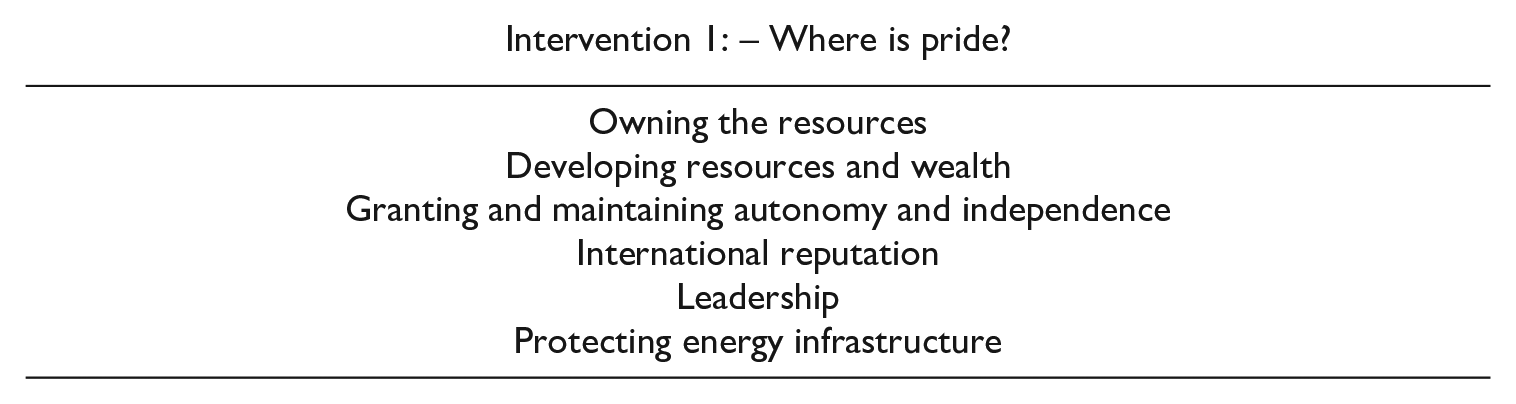
In the first intervention, I dived into the texts and intervened diffractively. Through a reflexive effort aimed at repositioning and reinterpreting the data, I wished to capture where pride surfaces and undergoes a transformation as or in rhetoric-and-matter. I let my attention shift towards pride and be guided by the following questions: where is pride? How is it attached to energy security in Azerbaijan? For instance, I often refer to urban architecture because its symbolic and material with the energy industry are illustrative of objects having a voice that speaks of pride: I noticed that architecture and physical places elicit specific stories of pride and success.
In this phase, I was careful to avoid any separation between the elements and applied Matsuda’s (1991) ‘asking the other questions’ approach: when I acknowledge discourse, I look for matter, and vice versa.
To explain by example: Azerbaijan is the motherland of oil. Everyone in our country knows this. The world knows it. Azerbaijan, a young independent state, can work properly with foreign partners and defend its national interests.
In the above quote, I noticed three major discursive lines, pivoting around identity, competitiveness and reputation. Yet, also several tangible objects are present: physical oil resources, territory, institutional networks, energy corridors, money. They are all intraconnected and inseparable.
I repeated this exercise for all sources and ordered my records, preparing an initial map of where pride manifested.
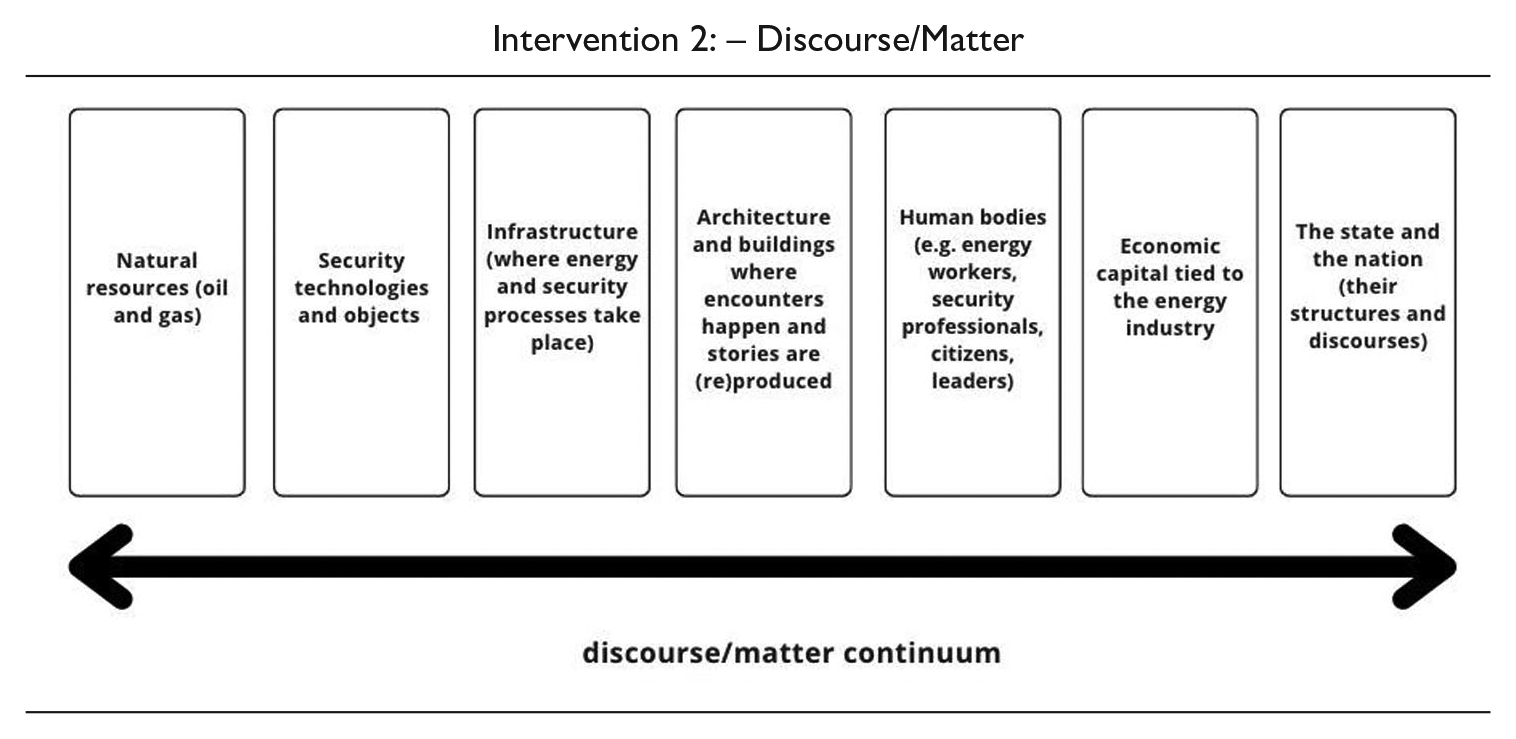
In the second intervention, I took notes about the discursive-material elements I could identify in each source. I do not claim they are the only possible forces at play, but the ones I identified. I did not insert them into specific onto-epistemological groups; instead, inspired by Feely (2020), I sketched a graph that could help me visualise them along the discourse/matter continuum. In post-coding analysis, these interventions do not aim to control the empirics but to organise it, in order ‘to understand their full explanatory power and nuances’ (Augustine, 2014: 751).
In the third intervention, I re-read the texts alongside my field notes and diary and traced the connections I could see among the elements by following the flows within, among, and in and out of discursive/material forces. I searched for the ways in which energy securitisation (re)produces pride and questioned how pride is engineered into the process, while being always mindful that power acts to ‘direct flows in ways that serve the interests of certain groups and allow them to dominate others’ (Haggerty and Ericson, 2000: 609). I tracked those elements that remained constant within the flux to fixe reality and resist change. Attention to reiteration is in line with NM views that hold that ‘power has continuity only as long as it is replicated in the next event’ (Alldred and Fox, 2017: 180).
In my fourth diffractive intervention, I read the dataset through psychological and clinical accounts of pride. This phase helped me draw parallels between pride and securitisation. Both processes construct a self-centred self, aware of and sensitive to existential challenges and more prone to assertiveness and entitlement. Learning about cognitive strategies attached to pride shed light on how securitisation operates and why.
At the heart of the nation: pride in energy, pride in Azerbaijan
In 2017, Azerbaijan’s elite gathered in the capital to celebrate the production of 2 billion tonnes of oil. No chair is left free in the 1,000-seat auditorium of the luxurious Heydar Aliyev Center, an expression of avant-garde architecture and a symbol of the rediscovered splendour of Baku. Designed by world-known architect Zaha Hadid, it rises not far from the 19th-century industrial area where oil was processed and stored for more than a century. Oil and gas revenues financed urban renewal. The large-scale ‘White City’ project transformed a degraded part of the capital – formerly known as Black Baku – into a glamorous residential area of alabastrine buildings.
Financed by oil and gas revenues, Baku experienced a process of urbanisation: wealthy neighbourhoods mushroomed, and classy buildings and shops started filling the public spaces. The city offers a glimpse of how the country’s prideful subjectivity is discursively and materially formed around opulence and sumptuosity. Pride flows in its streets and infrastructure: its extravagant and expensive architecture is ‘a glaring, electric testament to [its] profligacy and confidence’ (Leonard, 2012), a ‘white vision, outrageously total, arrogantly complete’ (Cook, 2013). Centring the analytical focus on the emotion of pride helps form a more rounded understanding of how energy securitisation happens in Azerbaijan and why. First, it provides a more detailed picture of threat construction, offering a deeper explanation of how certain objects become referent. As explained above, pride interlaces with identity and sets its boundaries: pride implies a work of selection to determine what is essential in the constitution and existence of the self as it is. Developed around what is perceived to be exceptionally important and unique about the self, it runs in parallel to securitisation: both determine what needs protection and deserves exceptional security based on a perceived necessity of existential survival. In Azerbaijan, energy securitisation is embedded in the question of identity and ontological security: oil and gas come to matter as a prideful instance of what the nation is. If energy is menaced, Azerbaijan’s survival would be in jeopardy. Aliyev (2017) remarks that ‘oil and gas play a critical role in our existence as an independent country’ as the ‘foundation of political independence’ and ‘greatest asset’. Self-branded as the ‘Land of Fire’, Azerbaijan has built a prideful sense of self around energy. Pipelines and drilling fields get securitised because they bear the deepest connection with the nation, they make Azerbaijan an oil and gas hub. This ‘making’ is not purely ideational: in the country, pipelines draw a parallel topography, drilling platforms shape its singular skyline, and oil-well derricks populate its lunar steppe. Prideful attachments to energy anchor Azerbaijan’s subjectivity to physical places, which give the collective self a tangible, corporeal dimension and remind it of whom it is. In Azerbaijan, Baku’s places and architecture secure self-perceptions and affirm a sense of self that assembles the becoming of the nation to energy matter and symbolism, sustaining the criticality assigned to oil and gas. The capital’s most iconic areas are materially and ideationally made of energy. Discourse/matter relationality creates physical and symbolic continuity that allows pride to circulate through the spaces and imaginaries of energy. A major architectural complex –the Flame Towers – consisting of three gigantic skyscrapers overlooking the Old City, was built to pay homage to oil and gas, as a sign of reverence and worship. At night, the buildings project LED lights representing walls of fire. Energy materiality, symbolic power and economic agency feeds a prideful imaginary that recurs in all the texts analysed and the stories heard during my staying: albeit a small young republic, Azerbaijan prides itself of becoming uniquely strong and successful and achieving an important international role. This narrative centres on the autonomy and prosperity that Azerbaijan gained by becoming an energy supplier to Western states. Oil and gas mobility places Azerbaijan at the centre of global networks, physically bridging the West and the East.
Pride also enriches our understanding of the mechanisms behind threat construction and management. Psychology studies explain that pride generates a responsibility for a valued outcome and encourages specific behaviours to protect self-worth and integrity, including adaptive defensive measures to counter potential menaces against the self (e.g. Tangney et al., 2007). Adaptation implies construing reality according to one’s expectations: when self-worth is threatened, individuals may distort the truth and mould it in ways that favour self-affirmation (Sherman and Cohen, 2006). Securitisation as a political process of threat construction mirrors this modus operandi: it can be interpreted as an adaptive defensive strategy enacted by and for pride to protect self-worth against a threat that could imperil the self. Studies explain that adaptive cognitive strategies may operate by rendering a situation less or more threatening (Sherman and Cohen, 2006). Because securitisation functions by establishing security hierarchies, certain threats are prioritised while others downgraded. In the case of Azerbaijan, energy security centres on the risk of terrorist attacks against facilities and belittles environmental concerns, such as land degradation, water pollution and unsustainable energy system. While there is little evidence of energy terrorism, reckless industrial contamination is extensively documented. Spotted with oil ponds, residual barrels and sewage, the country has 30 percent of its coast and 50 percent of its rivers polluted. Environmental damage is not only securitised but also denied through arguments that revolve around self-worth and reputation. Aliyev (2017), for example, says: When we built the Baku-Tbilisi-Ceyhan oil pipeline, a false ecological theme was raised to claim that the environment would be threatened. However, look, today we have built parks and created a paradise in the once polluted parts of Baku.
Because exaggerating a threat can serve as an avoidance mechanism too, securitisation performatively enhances pride by asserting the ability to counter and resist energy security threats. Research shows that when pride wavers in certain fields – such as poor environmental policies – success in different domains – like counterterrorism – is used to affirm self-worth and escape shame (Sherman and Cohen, 2006). As such, terrorism remains a persuasive argument in Azerbaijan’s energy securitisation: it positions Azerbaijan in international circuits, both materially and discursively. Most international initiatives and programmes of security cooperation in energy happens through the framework of counterterrorism.
Moreover, cognitive psychology teaches that self-pity and victimisation emerge as possible reactions to a feeble narcissistic self, when a lack of external recognition breaks entitled expectations and ‘poor me’ narratives make compromise impossible (Edwards, 2015). Azerbaijan has internalised a specific reading of history, whereby Armenians have illegitimately occupied part of its territory with the support and connivance of the international community. According to national security professionals, the highest threat to Azerbaijan’s energy security is Armenian terrorist attacks against oil and gas facilities. In its opening, the Maritime Security Strategy (Presidency of Azerbaijan, 2013) intertwines energy security with the war against Armenia and the sensitive question of sovereignty and territorial integrity: The main threat to the security of our country in the XXI century is the conflict in and around the Nagorno-Karabakh region of the Republic of Azerbaijan. 20% of Azerbaijan’s territory is under occupation, and most national defence resources are spent on resolving the conflict. At the same time, Azerbaijan’s economic and energy security is mainly related to ensuring maritime security and, particularly, the protection of offshore energy infrastructure. In this regard, maritime security is important for Azerbaijan.
While the war in Karabakh is a fundamental piece of Azerbaijan’s security, it is bizarre to see it becoming the prime focus of the national maritime strategy since the region is a mountainous land with no access to the sea. Most deposits and facilities lie far from the contested area or the border, and there is limited evidence of Armenians’ energy terrorism. Self-pity protects narcissistic pride by validating militarisation and power centralisation, sustaining a desire for retaliation and blaming external actors, especially the West. Not only does self-victimisation facilitates securitisation, but also reinforces the leadership.
Taking pride seriously also allows to acknowledge what drives securitised practices. Studies show that pride leads to self-idealisation and engender controlling and aggressive behaviours (Aicinena, 2011; Tangney, 1999; Tracy, 2016). Because pride is a spectrum that goes from self-appreciation to narcissism, when it becomes hubris, it gets tied to a desire for holding power. Its attraction to dominance and status (Golec De Zavala et al., 2009) is well-matched with the art of securitisation. In the case of Azerbaijan, pride expands the boundless nature of securitisation: threat management aims at making things controllable; it wants security everywhere, at all times. Adaptation strategies to defend pride against perceived threats are pervasive and totalitarian (Greenwald, 1980). In the case of energy securitisation, its growing apparatus results in an intrusive and ubiquitous assault on freedom, privacy and broader civil liberties. The emotional attachment between the nation and energy justifies the need to protect it at all costs: the physical protection of Azerbaijan’s energy objects and infrastructure becomes the protection of the whole state because in that materiality resides also the ontological foundations of the state, the nation and power. As such, securitisation is never disputed, and the loss of freedom become an accepted collateral damage. When following energy routes, I felt a constant sentiment of anxiety: adventuring around the sites generated suspicion and was discouraged. In the field, I wondered about the effects of energy materiality – its vastness, mobility, invisibility, pervasiveness and ubiquity – on security: what limits – if anything – the space of totalitarian securitisation? Approaching this question through pride made me realise how energy materiality in itself feeds collective pride by reaffirming a sense of greatness that passes through an internationalised subjectivity, able to overcome the restraints of a small territoriality.
Another aspect of pride that is relevant to understanding securitisation is its dark side. Its mix of self-idealisation and overconfidence is unlimited in its ambition to interpret the past and the present and create spaces of continuity in ways congenial to one’s desires and needs (Sherman and Cohen, 2006). Pride nurtures the idea that absolute security is achievable because of the self’s special rights and skills. In the case of Azerbaijan, appealing to the country’s grandeur serves to assert the power of the leadership and, finally, reinforce securitisation. Exceptionality is given to the ruling elite as an expression of the whole nation.
Pride in the rulers develops through a severe narcissistic component that sets the Aliyevs as the only one qualified, entitled and legitimate to hold control and stability in the country. Pride in the Aliyevs is pride in Azerbaijan, and vice versa. Political opponents are described as ‘incompetent’, ‘illiterate’, ‘uncontrollable’, and ‘villains’ (Aliyev, 2017). Under the Aliyevs, power underwent through material and ideological personalisation: democratic institutions and pluralism were progressively replaced by a centralised government defined by personal loyalties. Narcissistic pride has brought a cult of personality, which has distorted the separation between audience and securitising actors, working as a method of control to grant obedience and servility. As pride sticks to the population, affective attachment to the rulers develops into loyalty and commitment. The constant use of ‘we’ essentialises a prideful collective. The individual’s sense of belonging generates compliance, acceptance, but also securitising capacity. Public opinion looks suspiciously at ‘the chaos of democracy’ (O’Lear, 2017) and polls reveal that support for regime change and democratisation is low and decreasing (Nahmadova, 2021). Pride creates a demand regarding what security to provide, an expectation that total security is met. Within this support lies the evidence for a different conceptualisation of agency within securitisation processes, one that moves away from securitisation as a top–down approach. Rather than imposed on the audience, it points to agency as dispersed among different actors. In the assemblage and through its spaces of continuity and disruption, pride circulates between micro and macro levels; it flows from the nation to the individual, and vice versa. My intent here is not to find who is to blame, disregard the autocratic nature of Aliyev’s regime or dismiss the factors that operate on public opinion. Rather, it aims to understand the wider mechanisms that renders forms of domination such as securitisation possible, against the impulse to limit accountability to the dictatorial ruler. A look at pride can tell us more about securitisation as the maintenance of power structures through a constant work for affirming the status quo. Because pride develops towards the self as it is, prideful identities tend to be fixed rather than negotiated. Similarly, securitisation relies on existing political institutions and security structures that replicate the actual distribution of power. In Azerbaijan, energy securitisation has fortified the ruling family by expanding the state’s military and paramilitary machine, providing abundant financial resources, enlarging mandates and forgetting alternative energy security issues. In this sense, pride and securitisation are celebratory of the status quo and actively work to keep things as they are because security lies in the reiterative power of the whole system. During the 2017 celebration, a student said:
‘Our generation, the next generation, will continue this great glorious path with dignity’ (Presidency of Azerbaijan, 2017). In Azerbaijan, past greatness is located in the relatively recent and circumscribed period of post-independence, defined by Heydar Aliyev’s presidency and protracted by his successor and current ruler, his son Ilham. The future is designed around a returning past. Worshipped nationally, Heydar Aliyev’s photos, statues and portraits can be found in most Azeri towns; his face appears on billboards across the country. The BTC pipeline, Baku’s airport and numerous buildings, avenues and parks are named after him. Developments in the energy industry are thought to be Heydar Aliyev’s personal merit (Presidency of Azerbaijan, 2017). There is not, however, linearity in this conceptualisation of status quo: pride unites past, present and future as it circulates through past representations and future projections, collapsing timescales. The past is ever present: it lies in the buildings, objects and even (hi)stories that work as the future towards which the country is moving. Imaginaries of the future also progress while going backwards: modernisation in Azerbaijan means escaping from Soviet ‘backwardness’. Pride moves through matter and ideas of modernity, which are visible in the becoming of Baku: the towering verticality of European cities marks a departure from the strictly regulated urban planning of the Soviet era. Baku’s proxy outskirts with its Soviet apartment buildings have become the target of the city’s urban renaissance. Energy securitisation has helped with it: through modern and Western security technologies, securitisation becomes an act of self-affirmation, a proud declaration of being other from the Soviet colony it once had been. Clinical accounts on pride speak of ‘a split between an unconscious sense of inadequacy and conscious feelings of superiority’ (Robins et al., 2001: 231). Dissociative experiences emerge in Azerbaijan’s narratives, which depict a world reluctant to value Azerbaijan and its energy industry. Against global scepticism towards the country’s oil and gas reserves and the need for large transboundary infrastructure, Aliyev (2017) notes Azerbaijanis’ ‘professionalism and dedication’. Studies also argue that ‘pride specifically emerges when a person reaches or exceeds social standards or expectations’ (Verbeke et al., 2004). In this respect, securitisation has generated pride: interviewees recalled that until the late 1990s in the very early days of the negotiations for the BTC pipeline, security concerns drove much of the talks, as Western countries and companies were sceptical about Azerbaijan’s ability to protect its oil and gas infrastructure. To them, the Republic’s short life, regional political instability and the fresh memories of the Cold War raised serious concerns regarding the physical protection of the corridors. Azerbaijan had to be inserted into Western security circuits, first of which was NATO’s. Azerbaijan’s outdated security base was reformed to comply with Western standards: military build-ups and joint international programmes targeting energy infrastructure protection proliferated. Following the 1994 Contract of the Century, when oil and gas corridors physically connected Europe to Azerbaijan, most state security agencies enlarged their mandates to include the protection of energy facilities; others – like the Export Oil and Gas Pipeline Security Department – were established with that purpose. By proving Azerbaijan’s ability to protect international interests, national security practices have become themselves a motive for pride. High-tech digital security devices – such as long-range, round-the-clock radars, sensors, CCTV cameras and over-the-horizon surveillance devices – complemented traditional defence and off-the-grid activities, reorienting practices towards prevention and policing. Walking in Baku’s elegant streets, it is hard not to think about securitisation, not to feel like a security target. Like in other rich cities, in Baku high-tech security devices and CCTV cameras are everywhere. Knowing secret agents control critical spaces constantly reminded me of the risks connected to research in the region (Janenova, 2019) and made it hard to ignore the perils of securitisation and the insecurities it generates. Looking for pride in the physical environment in which I was, helped me balance my own fears, attesting to both the circulating power of affect and the force of objects’ voices. Tracing pride through places and buildings reveals that the work of understanding the assemblage, while never completed, is crucial to see how energy securitisation operates within vast social and material structures that extend far beyond energy security policies and embark in larger questions of subjectivity and agency.
Conclusion
This article engaged with pride as a performative political practice, an affective embodied experience, and a descriptive–analytical unit to provide more profound insights on the process of energy securitisation in Azerbaijan. The case shows that pride catalyses energy securitisation: it reinforces the existential stake behind specific referent objects; it creates confidence in the ability to address a threat; it acts upon self-doubts in ways that are congenial to the mobilisation of force and power. Against previous understanding of securitisation, an NM lens also sheds light on the material conditions under which securitised discourses develop.
Nonetheless, moving beyond anthropocentrism has severe implications on accountability and ethics, which are to be taken seriously when dealing with securitisation. ST has been particularly effective in exposing the politicised dimension of security and the ways in which it can be used opportunistically to pursue hidden agendas, legitimise power centralisation and normalise violence. Energy securitisation in Azerbaijan has prompted militarisation, consolidated patronage, suppressed energy workers’ rights, and shrank land management and ownership. Obsession with control and coercion downgrades other dimensions of energy security tied to infrastructure safety and environmental care. Pride reinforces its ties with existential questions, reaffirming the necessity of energy securitisation and limiting resistance.
Hence, if securitisation is to be understood as a negative process with detrimental implications, the emphasis on matter and non-human agency cannot become an escape for accountability. Similarly, dispersed agency cannot deny asymmetries of power and the hierarchies of accountability they form. When focusing on the important goals of overcoming dualism and abstractions, NM still needs to retain the critical spirit, normative sensitivity and political engagement that has always underpinned securitisation. Things echo and amplify securitisation, but human agency and intentionality still represent the kernel of the process: securitisation presumes the political and human ability to decide, choose among options and set intentions. Although ethical questions remain, NM scholars have provided some clarifications. Barad (2007: 218–219) emphasises that ‘the acknowledgement of non-human agency means that accountability requires much more attentiveness to existing power asymmetries’. Increasing concern over the danger of depoliticising agency and power has led several scholars to recognise the peculiarity and prominence of human responsibilities (Coole, 2013, 2014; Conty, 2018; Washick et al., 2015). Coole’s writings are especially pertinent to these ethical dilemmas: she suggests acknowledging humans’ material domination over the non-human world as a manifestation of the assemblage’s inherent heterogeneity and diversity. Besides warning against the dangers and ramifications of human interventions, especially when harmful, NM teaches important lessons that should be embedded in the analysis and critique of securitisation. Recalibrating the role of humans implies recognising that their dominant position is transitory and partial: they do not hold complete control over the systems in which they operate. This awareness can help overcome the dystopian illusions that guide securitisation and its totalitarian aspirations of control. In the everchanging boundaries of the assemblage, including its affective ties, lies the possibilities for a view of security in which power is not merely obstructive but also empowering.
Footnotes
Funding
The author(s) received no financial support for the research, authorship and/or publication of this article.
