



Abstract
Securitization theory has paid extensive attention to transnational issues, actors, and processes. Surprisingly, however, only little attention has been paid to the securitization of diaspora communities, defined as overseas citizens or co-nationals abroad. This article fills this gap by developing an analytical framework to study the securitization of diasporas, focusing on three discursive formations: diasporas as threatening actors, as objects under threat, or as security resources. Building upon the recent literature on state–diaspora engagement and drawing on an analysis of Israeli elite discourse (from 1948 to 2022), this article demonstrates how the securitization of diasporas serves as a discursive mechanism that naturalizes and legitimizes extra-territorial policies towards Jews abroad. Thus, the article complements structural and rational explanations of state–diaspora engagement by examining the intersubjective process that endows diaspora policymaking with meaning. Against the backdrop of extensive securitization scholarship that focuses on attempts to keep “foreigners” out, this article shows how securitization justifies bringing certain people in or governing their national identity abroad.
Introduction
In recent years, scholars of International Relations (IR) have paid growing attention to politics relating to diasporas—communities of co-nationals (citizens or non-citizens) residing outside their sending state, kin-state, or homeland. 1 In addition to examining the impact, dynamics, and sources of diaspora mobilization (e.g. Adamson, 2013; Brinkerhoff, 2016; Koinova, 2014, 2021; Shain, 2007), a wide body of literature analyzes why and how homeland governments (or “sending states”) design policies vis-à-vis populations that they consider “their” diasporas (e.g. Adamson and Demetriou, 2007; Burgess, 2020; Délano, 2011; Gamlen, 2019; Koinova, 2018; Varadarajan, 2010; Waterbury, 2010a).
Existing explanations of state–diaspora engagement identify various mechanisms that lead states to engage with their diasporas. For instance, scholars pinpoint normative diffusion or domestic political competition as mechanisms that account for the proliferation of overseas voting and dual citizenship (Lafleur, 2015; Turcu and Urbatsch, 2015; Vink et al., 2019; Wellman, 2021). Délano (2011) highlights a learning mechanism to explain Mexico’s activism vis-à-vis emigrants living in the United States, while Gamlen (2019) focuses on the mechanism of epistemological instruction to elucidate the global rise of diaspora institutions. These mechanisms operate within broader structural conditions—such as increasing numbers of emigrants, global economic transformations, and technological affordances (Ragazzi, 2017; Schmid, 2019; Varadarajan, 2010).
However, the existing literature does not pay sufficient attention to the discursive mechanisms that make certain diaspora policies conceivable, possible, and appropriate. Despite the understanding that narratives regarding diasporas are necessary preconditions for policy-related developments (Brand, 2010; Collyer, 2013), the literature concerning state–diaspora engagement fails to examine the intersubjective process that endows diaspora policymaking with meaning.
Drawing on the Israeli case, this article demonstrates how the securitization of the diaspora serves as a discourse that legitimizes and justifies diverse diaspora-related policies: encouraging repatriation, managing identity abroad, and facilitating diasporic support. Theoretically, the article seeks to conceptualize the securitization of the diaspora, defined here as employing a discourse that constitutes populations envisioned as “diasporic” as objects of security. Building upon the literature regarding state–diaspora relations, I provide an analytical framework for studying the securitization of diasporas, introducing three distinct discursive formations 2 that seek to constitute diasporas as security objects: (1) diasporas as threatening actors; (2) diasporas as referent objects under threat; and (3) diasporas as resources for security. Empirically, this article demonstrates how these securitization moves are selectively deployed to inform Israel’s diaspora policies primarily towards Jewish Americans. It does so through an original discourse analysis of Israeli–Jewish elite discourse between 1948 and 2022.
The Israeli–Jewish case was chosen due to its unique position within diaspora studies. The relationship between Israel and the Jewish diaspora is widely regarded as paradigmatic because of its intensity and duration. 3 Other governments and international agencies look at Israel as a model for successful diaspora engagement and learn from it (Gamlen, 2019: 63). As a potential norm entrepreneur in this area, it is less likely that the mechanisms identified by the literature—normative diffusion, learning, and epistemological instruction—apply to the Israeli case. In addition, as I discuss below, state–diaspora relations in Israel are an issue of domestic political consensus among elites rather than competition. As such, studying the Israeli case can offer new insights into the drivers of state–diaspora engagement, and these may also be applicable to other cases.
Indeed, examining Israel’s securitization of “its” diaspora advances current explanations of state–diaspora engagement. First, in contrast to materialist–instrumentalist explanations that focus on objective economic or security needs (Brinkerhoff, 2008; Gamlen, 2019: 9–10; Mylonas and Žilović, 2019; Tsourapas, 2015), my constructivist explanation highlights how security threats are constructed within a political community and how they are linked to diaspora members. Thus, by paying attention to discursive mechanisms, the article highlights the socially emergent nature of state–diaspora engagement and endogenizes the social environment within which political elites design diaspora policies. Second, existing constructivist accounts directly link diaspora policies to fixed ideas of political membership—ethnic or civic (Bauböck, 2005; Gamlen, 2019: 10–11; McIntyre and Gamlen, 2019). I introduce securitization as one discursive mechanism that ties ideas about political membership to state-related interests and specific diaspora policy outcomes.
Moreover, examining the securitization of diaspora communities contributes to securitization theory itself. As “the domestic abroad” (Varadarajan, 2010) or as “outside the state but inside the people” (Shain and Barth, 2003: 459), diasporas are uniquely positioned vis-à-vis the nation-state—they are simultaneously a part of the Self and part of the Other. Thus, incorporating diasporas into securitization theory adds additional variation to the classic securitization framework. Against the backdrop of extensive research concerning the securitization of migration, which demonstrates how states attempt to push or keep people out, the discussion below reveals how Israeli elites engage in securitization to bring or draw certain people in, both physically (encouraging repatriation or annexing territories) and ideationally (cultivating attachments beyond territorial borders). In contrast to a security discourse that produces “dangerous” Others (Aradau, 2004; Gray and Franck, 2019; Moreno-Lax, 2018), this article points to a security discourse that (also) produces objects as “friendly” Others, constituting them as security assets (cf. Leek and Morozov, 2018).
What does securitizing the diaspora mean?
The classic formulation of securitization theory refers to securitization as the discursive process via which securitizing actors attempt to convince an audience to treat something as an existential threat to a valued referent object, thus justifying the use of urgent and exceptional measures to tackle the threat. Securitizing the diaspora means employing a discourse that constitutes those populations envisioned as “diasporic” as objects of security. To understand what the securitization of the diaspora entails, we must first unpack the term “diaspora.”
Similarly to the word “security,” diaspora is also a contested concept with multiple definitions, each relying on different epistemological underpinnings. Some understand diaspora as a unique analytical category, distinct from refugees or migrants, defining it as “a transnational community whose members (or their ancestors) emigrated or were dispersed from their original homeland but remain oriented to it and preserve a group identity” (Grossman, 2019: 1267; see also Shain and Barth, 2003: 452; Sheffer, 2003: 9–10; Sökefeld, 2006: 267). Others adopt a more constructivist view, which is more in line with the epistemological assumptions of securitization theory. According to such an approach, diaspora is understood as a speech act that is employed politically to constitute a population as diasporic, (re)producing a narrative of a homogeneous albeit dispersed ethnonational community with ties to a shared homeland (Brubaker, 2005; Dufoix, 2017: 470; Ragazzi, 2017: 23). Just as security is constituted through discourses about dangers, threats, existence, and survival, “diasporas are created through discourses about transnational belonging to a political community” (Bauböck, 2010: 299).
However, a diaspora-related discourse, one that conjures up shared peoplehood linked to a homeland across territorial borders, is not necessarily limited to the utterance of the term “diaspora.” For instance, Russian discourse uses the labels Russkiy Mir (Russian World), sootechestvenniki (compatriots), or diaspory (diaspora) to refer to a broad category of people (for instance, those with cultural or legal connections with Russia) (Grigas, 2016: 57–93; Holm, 2020; Pieper, 2020). Traditionally, Armenian elites used the label spyurq/spyurk (“diaspora”) to refer primarily to those Armenians abroad who were dispersed as a result of the Genocide of 1915. More recently, however, Armenia has expanded the label to include “all Armenians living outside of Armenia” (Cavoukian, 2013). In all these cases, multiple terms are employed to envision a diasporic population and encourage them to see themselves as linked to the homeland.
The securitization of the diaspora is distinct from other related forms of securitization, such as the securitization of ethnoreligious minorities, migrants, and emigration. The securitization of ethnoreligious minorities targets those who are already inside the state territory, framing them as internal enemies (Buzan, 1993; Humphrey, 2009; Roe, 2004; Wæver et al., 1993), while the securitization of migration focuses on constructing incoming foreigners as threats to state or societal security (Bourbeau, 2011; Doty, 2007; Huysmans, 2000). The securitization of emigration targets domestic populations but criminalizes leaving the country, thus trying to keep domestic populations inside state territory (Tsourapas, 2020). In contrast, the securitization of a diaspora refers to populations that reside outside of the country yet are perceived as “inside the nation.” Thus, rather than necessarily constructing populations as threatening Others, the securitization of diasporas can refer to them as a part of the Self that needs to be protected or that contributes to state security. The following section elaborates on such dynamics.
Theorizing state-led securitization of diasporas
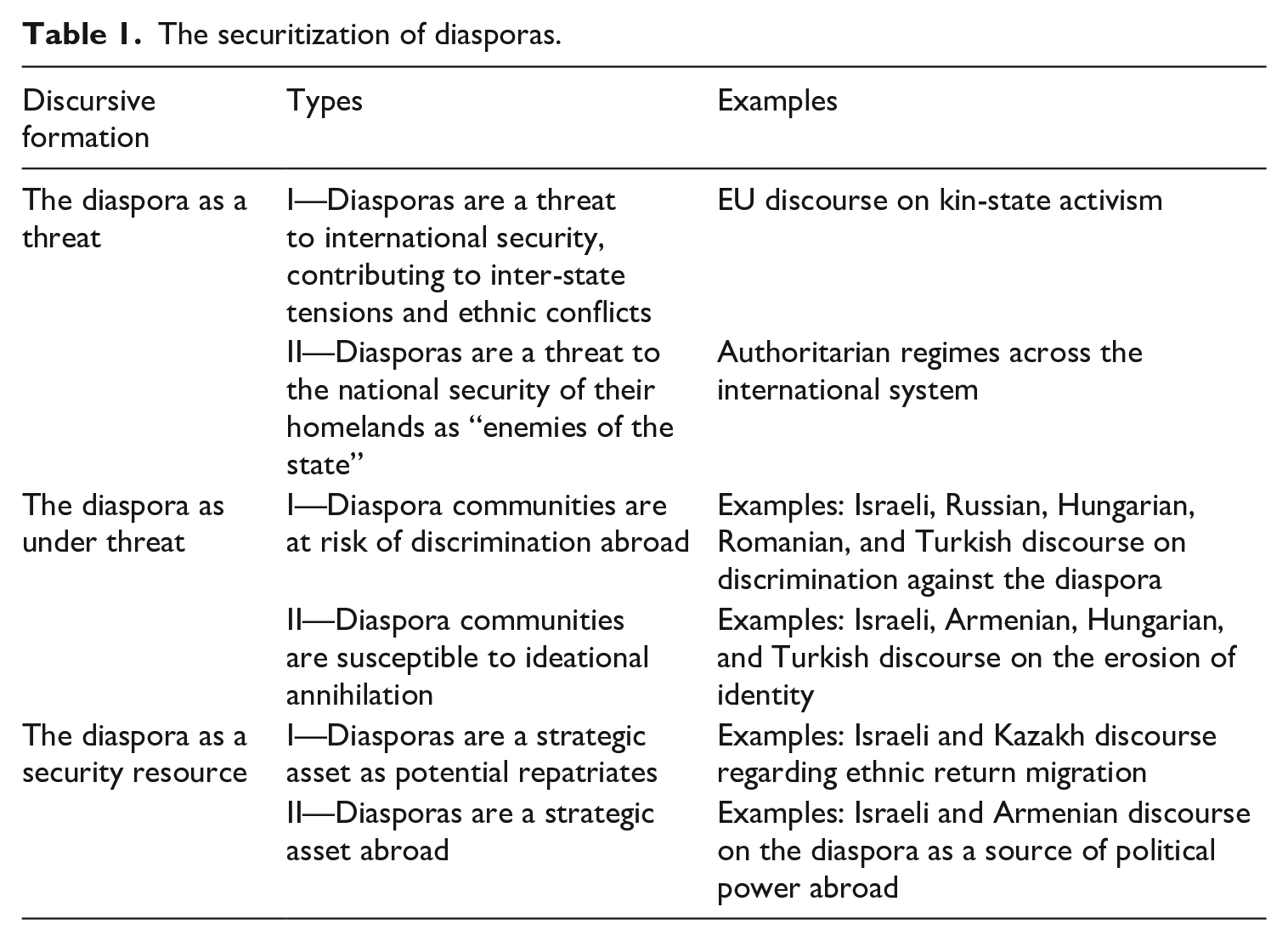
Building on the existing literature regarding state-led diaspora engagement, one can identify three different discursive formations that seek to securitize the diaspora: (1) the diaspora as a threat, (2) the diaspora as a referent object under threat, and (3) the diaspora as a security asset (see Table 1). These three discursive formations are embedded within a specific socio-historical context of modernity, in which states seek to represent themselves as the primary providers of security and bearers of institutionalized nationhood (Mandelbaum, 2016; Williams, 1998). While the extra-territorial projection of state power onto diaspora communities challenges the geopolitical imagination of territorially bounded nations (Adamson and Demetriou, 2007; Basch et al., 1994; Gamlen, 2008), it still involves a discourse of national affinity either to the homeland or to the political institutions of the state (Boccagni, 2014; Mahieu, 2015; Varadarajan, 2010). Thus, in contrast to cosmopolitan notions of global humanity and transnational citizenship (Bauböck, 2005), state-led securitization of diasporas advance a communitarian vision, targeting co-kins and co-nationals (Koinova and Tsourapas, 2018).
The securitization of diasporas.
Diaspora as a threat
One discursive formation constitutes diasporas as actors, highlighting specific threatening or destabilizing activities. Two types of discourse exist within this discursive formation, depending on the referent object that is under threat: a diaspora can be discussed as a threat to international security or as a threat to the security of the homeland. I now discuss each of these two types.
The first type regards diaspora communities as a potential threat to international security and stability; this is mainly promoted by international or regional organizations operating in the post-Soviet space. In contrast to several scholarly works demonstrating that kin-state activism triggers conflict only under certain conditions (see review in Waterbury, 2020), such discourse assumes an almost-automatic association between “long-distance nationalism,” radicalization, and conflict (Anderson, 1998). In the context of irredentism or kin-state activism, some policy documents highlight the existence of neighboring diasporas as a problem that can increase “the propensity to cause inter-state tension or to ignite international armed conflict” (OHCHR, n.d.: 2; cf. OSCE/HCNM, 2008: 1). Such securitization discourse is sometimes reinforced by pundits and experts who study the topic. For instance, an oft-cited policy paper published by the World Bank describes diasporas as “a ready market” for insurgency due to their “romanticised attachments to their group of origin” (Collier, 2000: 15). Similarly, Huntington warns of “civilizational rallying,” while others highlight the danger of sentimental cross-border “kith and kin” as drivers of conflict (Byman et al., 2001; Heraclides, 1990; Holsti, 1996: 125–127; Huntington, 1993: 35–39). 4 These works unproblematically characterize diasporic nationalism as emotional, irrational, and ancient, in contrast to the universality, rationality, and progressive character of modern statehood.
The second type, which securitizes diaspora communities as “enemies,” “traitors,” or “threats” to their homeland, has been studied within authoritarian contexts. Recent research regarding transnational repression indicates how authoritarian states securitize diasporic opposition voices, engaging in extra-territorial practices, such as surveillance, monitoring, threatening, punishing, and suspension of rights and freedoms (Cooley and Heathershaw, 2017; Glasius, 2018; Moss, 2016). 5 Tsourapas (2020) theorizes such securitization dynamics, focusing on the illiberal paradox—balancing a regime’s stability with economic developmental goals expected to be achieved via cross-border mobility. In more democratic settings, wherein freedom of expression and political dissent are more acceptable, we might expect to find fewer efforts to engage in such harsh tactics in favor of “softer” tactics such as public diplomacy or attempts to demobilize critical voices.
Diaspora as under threat
A second discursive formation designates the diaspora as a referent object that is under threat and requires “saving.” Similarly to a humanitarian discourse that justifies military intervention to prevent human suffering abroad (Barnett, 2011; Gray and Franck, 2019; Watson, 2011), states can frame “their” diasporas as being at risk. Within this discursive formation, two types of discourse are common: diasporas as victims of discrimination abroad or diasporas as susceptible to cultural annihilation.
The first type of discourse highlights societal or statist mistreatment of kin communities abroad. The Russian government justifies military operations in Georgia, Crimea, or Ukraine with the claim that Russian compatriots there are under threat (Gorst and Peel, 2008; Holm, 2020; Hopf, 2016; Liebich, 2019; Pieper, 2020). In other instances in the post-Soviet sphere, such discourse does not necessarily include direct violations of sovereignty by the kin-state. In the Romanian case, parliament members often warn against the discrimination and persecution of Romanians abroad, and the violation of their human rights, but resort to diplomatic and regional means to address these issues (Gherghina et al., 2022).
The second type of discourse refers to the threat that diaspora communities will be “lost” due to assimilation or cultural dilution. Here, the diasporic condition itself is framed as a threat to (essentialized) identity elements such as culture, religion, language, or a sense of belonging to the nation. For instance, Waterbury (2010a) demonstrates how the political interests of Hungarian elites during Hungary’s transition from communist control led them to adopt a discourse emphasizing demographic and cultural threats to Hungarian identity in nearby territories. Scholars also point to a similar discourse in Turkey, one that frames the diaspora as threatened by assimilation or cultural dilution. Specifically, on several occasions politicians of the Welfare Party (RP) and the Justice and Development Party (AKP) have highlighted the threat that Turkish children and families residing in Europe will be “Christianized.” Indeed, Turkey has sent Imams to mosques in Europe to produce a loyal Turkish diaspora and promote the “ideal Turkish family” (Maritato, 2021; Mügge, 2010; Østergaard-Nielsen, 2003: 107–111). In one of his more famous speeches to audiences of Turks living abroad, Erdoğan compared assimilation with a “crime against humanity” (Süddeutsche Zeitung, 2010).
By securitizing the diaspora as under threat—either in material or cultural terms—governments make a claim concerning state–diaspora affinity and hierarchy. On one hand, the diaspora is constituted as part of the Self, warranting the state’s concern. On the other hand, the diaspora is framed as weak and helpless, in need of the kin-state’s care and leadership. This mix of affinity and hierarchy justifies the projection of state power onto the diaspora to intervene, protect, and supposedly benefit those diasporic populations. This can be achieved via territorial intervention (e.g. Russia), regional arrangements (e.g. Romania), or biopolitical means, such as financing language programs, homeland tourism, religious institutions, or other social clubs (e.g. Hungary and Turkey).
Diaspora as a security resource
A third discursive formation depicts diasporic populations as a security resource, an invaluable asset for the homeland’s national interest. Different understandings of the “national interest” shape elite discourse regarding the type of benefit that a state can expect to derive from the diaspora. Some studies suggest that countries in the so-called Global South might be more interested in tapping their diasporas for economic purposes or domestic electoral purposes in contexts of weak authority (Burgess, 2020; Schmid, 2019; Tsourapas, 2015; Varadarajan, 2010). In addition, Koinova (2018) reveals how the socio-spatial positionality of the diaspora (where the diaspora is located and what kind of power it is perceived to derive from its location) shapes elite perceptions in the sending state vis-à-vis expected benefits.
In terms of security discourse, governments can frame the diaspora as a strategic-security asset. Rather than constituting the diaspora as a dangerous or a victimized Other, this type of discourse portrays the diaspora as a friendly Other that is party to securing the nation-state (cf. Berenskoetter, 2007). Two types of discourse appear within this discursive formation: one perceives the diaspora as potential repatriates and the other views them as residents living abroad. As potential repatriates, the diaspora is often considered as a demographic resource either due to falling birthrates or as part of state-building attempts by newly established states. Students of Kazakhstan’s diaspora policy suggest that Kazakhs living abroad were considered a strategic asset for increasing the number of ethnic Kazakhs following the collapse of the Soviet Union (Bonnenfant, 2012; Waterbury, 2010b: 145–146; Zeveleva, 2014). Similarly, the Greek government encouraged the repatriation of Greeks from the former USSR, an act partly embedded in a security discourse that considered this diaspora group an ethnic demographic asset (Mylonas and Žilović, 2019). As residents abroad, the diaspora is also framed as a diplomatic asset that can constitute a political lobby. For instance, Armenian elites have incorporated the diaspora as a strategic resource abroad to ensure the “survival” of Armenia as well as help tackle existential threats to Artsakh (Republic of Armenia, 2007a, 2020a). In a similar fashion, the Greek government favored maintaining a Greek community in Albania as a security asset abroad (Mylonas and Žilović, 2019).
At first glance, this discursive formation seems to be at odds with certain elements of the original formulation of securitization theory. In particular, a discourse claiming that the diaspora serves as a security resource does not identify a threat, invoke a sense of exceptionalism, or call for extraordinary measures. Indeed, classic securitization theory often separates the “normal” realm of politics from the “exceptional” realm of security. However, scholars have challenged that exact element of the securitization framework on several fronts (Bigo, 2002; Kirk, 2020; McDonald, 2008; Williams, 2003). More specifically, critics note that the distinction between politics and security—the normal and the exceptional—sanitizes security, freeing it of politics. The language of security, as critical security scholars suggest, should not be confined to exceptionalism. Rather, the language of security seeks to raise the importance of an issue and grant it priority; it endeavors to define group identities and make ethical claims between objects (McDonald, 2021: 16–34).
The third discursive formation—the diaspora as a security resource—is better situated within this broader understanding of security. First, such discourse seeks to raise political awareness regarding the issue of diaspora populations and “intensify” political discussions concerning it (Williams, 2011: 217–218). Second, using the language of security to describe how the diaspora helps the homeland does not seek to present the issue as “urgent” but rather reaffirms the commitment of a dispersed nation to the existence of the state. Third, the language of security is employed to mobilize loyalties and trigger emotional attachments among those who reside in the homeland vis-à-vis the diaspora. It seeks to highlight the importance and value of the diaspora to the security of the homeland. Of course, while this discourse emphasizes similarity and unity between the homeland and the diaspora, it nevertheless implies the existence of a foreign and threatening Other against which the entire nation (inside and outside the state) is mobilized.
In the following, I systematically examine how these various discursive formations operate in the Israeli case, suggesting some possible explanations for the contradictions and variations in these discourses. Before doing so, however, some methodological notes are in order.
Methodological notes
To study the securitization of the diaspora in the Israeli context, I employed an original discourse analysis of elite Israeli (Jewish) discourse between 1948 and 2022. The emphasis that securitization theory places on speech acts makes discourse analysis a logical method of analysis, albeit not the only one (Balzacq, 2010b: 39–43). Understood here as systems of signification through which individuals make sense of and assign meaning to the social world, discourse both reflects and is a product of social reality. In other words, discourse is a lens through which we can understand society’s “common sense” as well as an active participant in creating social identities, positions, and knowledge (Fairclough, 1993; Hopf, 2002; Milliken, 1999; Van Dijk, 1997). The practice of discourse analysis within a state/society involves several analytical steps that are theoretically informed and methodologically achievable—the level of analysis (e.g. popular discourse or elite discourse), the temporal scope, and the corpus of texts (Hansen, 2006).
The focus on security discourse concerning state–diaspora engagement directs us to limit the analysis to the discourse of political elites, specifically, Israeli–Jewish political elites. Focusing on elite discourse is not without its drawbacks. It privileges text over nonverbal social aspects and the securitizing actor over the audience (Balzacq, 2005; Guillaume, 2018; Hansen, 2000; McDonald, 2008). It also means that the analysis excludes other political elites—Jewish elites outside Israel or Arab elites within Israel. Elite discourse analysis likewise reflects political assumptions associated with hegemonic national narratives. In the Israeli case, this means that Palestinians abroad (with or without Israeli citizenship or permanent residency status) are not conceived as diasporic in Israeli discourse because they are not a part of the imagined national community. That said, three main factors guided my methodological decision to limit the analysis to elite discourse. First, I am interested in securitizing moves rather than their success; thus, elite discourse is useful in capturing agenda-setting attempts (cf. Salter and Piché, 2011). Second, within securitization theory, elite discourse is considered as a central arena for discussions regarding security, dangers, and threats (Al and Byrd, 2018; Messina, 2014). Third, elite discourse is also considered as a central locus for narrating hegemonic narratives of national identity (Van Dijk, 1993).
To capture elite security discourse relating to the diaspora, I limited text selection to all Israeli parliament protocols from 1948 to 2022, including assembly sessions as well as minutes of parliamentary committees (retrievable online via the Israeli parliament (Knesset) website). Unlike government documents, parliamentary discourse represents a broader spectrum of elite political discourse and provides more accurate representations of different political camps. Parliaments are also typical arenas for discussions about national membership, belonging, and identity (Van Dijk, 1997). In addition to parliamentary protocols, I included the speeches of Israeli Prime Ministers relating to diaspora issues as well as the annual reports and documents circulated at the Herzliya Conference, a major annual conference dedicated to Israel’s national security. The Herzliya Conference is regularly attended by prominent political and security figures who engage in discussions concerning multiple aspects of Israel’s national security. It is recognized in Israel and internationally as a major national security platform (Burke, 2007: 136; Toft, 2012).
This large corpus of texts was reduced by including only texts that refer to the Jewish or Israeli diaspora. The first step in so doing was to map the associated Hebrew terminology, which varies across time. During Israel’s early decades, politicians commonly used the derogatory term galut (exile) to represent the Jewish diaspora as passive, weak, and not sovereign (Almog, 2000; Don-Yehiya, 1992; Sternhell, 1998). Later on, the more neutral term tfutsot (dispersions) gained traction. Such a term represents Israel as the center and other Jewish communities as peripheral. I adopted an inclusive approach, selecting a broad spectrum of terms that refer to the Israeli or Jewish diaspora, including the following Hebrew words: golah (exile), galut (exile), tfutsah (diaspora), tfutsot (diasporas), ha’am hayehudi (the Jewish people), yahadut hao’lam (world Jewry), yahadut artzot (Jewry of countries), yehudei artzot (The Jews of country), aliyah (immigration), yeridah (emigration), and yordim (emigrants) and their abbreviations (with the definite article and other prefixes).
In the tradition of qualitative and interpretive discourse analysis (Hopf, 2002), this large pool of documents was manually screened to identify securitization statements and thematically categorize them according to the three discursive formations described above (diaspora as threatening actors, diaspora as under threat, and diaspora as a security resource). To avoid an overly loose interpretation of security, I adopted a relatively strict threshold and included only statements referring to existence, destruction, annihilation, survival, security, threats, dangers, and enemies. In addition, and following the theoretical discussion above, I included all references to the diaspora as a “strategic asset” (Neches a’strategi); indeed, in Israeli discourse, the term “strategic asset” and its derivatives are primarily used to describe areas or issues of high-security. Commonly, this term refers to areas of territorial importance (near Israel’s borders) as well as the relationship with the United States. The full textual results can be found in the supplementary file.
Focusing on securitization moves means that I do not limit securitization to the enactment of emergency or exceptional measures but rather include the discursive articulation of an “existential threat.” The Copenhagen School acknowledges such a possibility by asserting that “we do not push the demand so high as to say that an emergency measure has to be adopted, only that the existential threat has to be argued” (Buzan et al., 1998: 25). 6 Indeed, post-Copenhagen scholarship regarding securitization demonstrates how securitization is not necessarily tied to emergency and exceptional measures (Balzacq, 2010a; Floyd, 2016; Léonard, 2010: 237–38; Neal, 2006).
The securitization of the diaspora—the Israeli case
The Jewish diasporic experience (or at least a certain representation of it) is part and parcel of the Israeli narrative that constitutes Israel as a Jewish nation-state (Gal et al., 2010; Habib, 2004; Sheffer, 2003). The Israeli (Zionist) narrative considers Israel a solution to security threats that Jews in the diaspora face. Furthermore, the Israeli–Jewish diasporic narrative is embroiled in a protracted conflict that involves another diasporic narrative—that of the Palestinians. Taken together, we see how issues of identity and security are embedded in Israel’s relations with the diaspora. In the following, I illustrate how Israeli securitizes the diaspora: which discursive formations appear within Israeli discourse, how they appear, and how they serve to inform various extra-territorial projections of sovereign power.
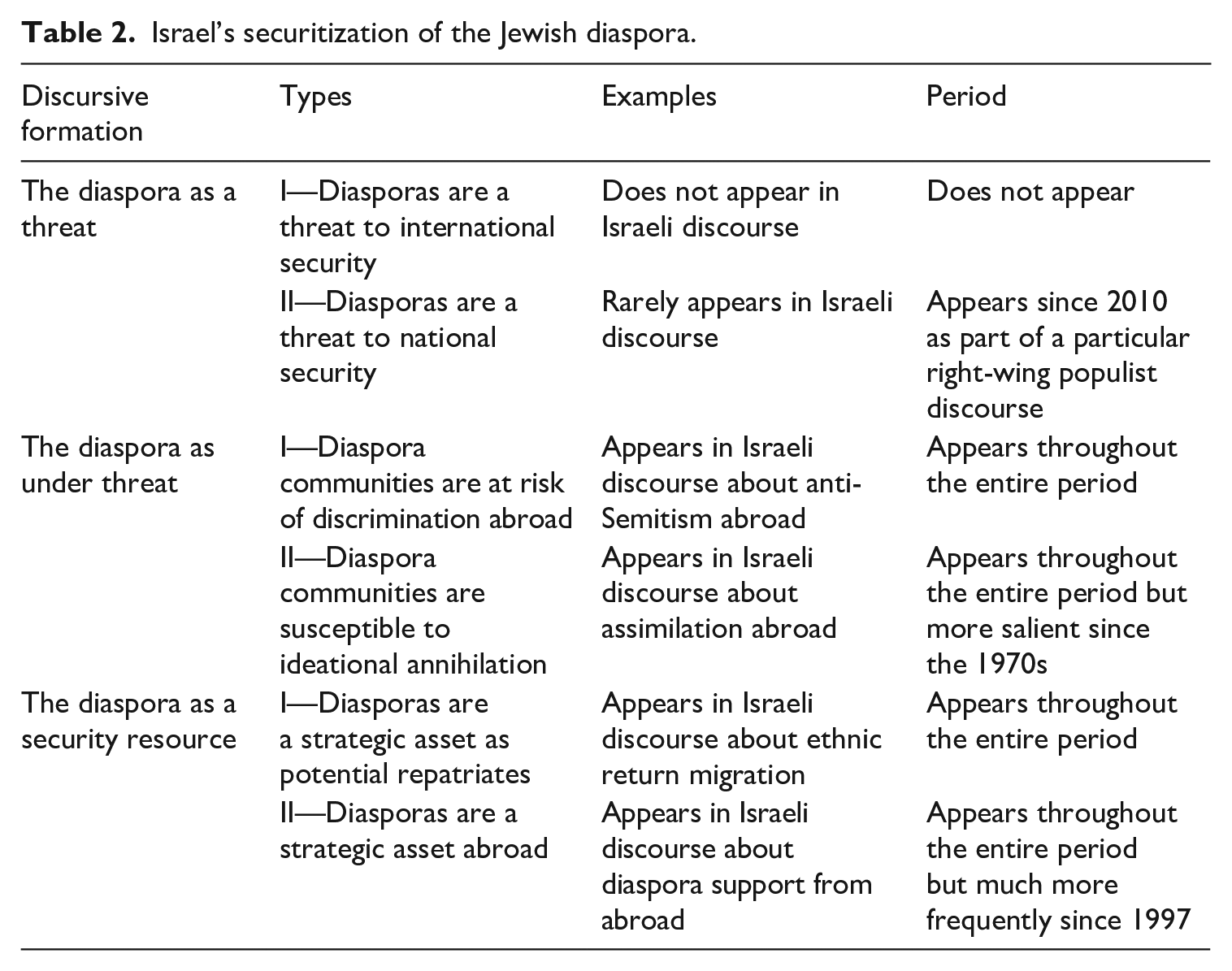
The empirical findings reveal some general tendencies within the Israeli securitization of the diaspora. First, Israeli security discourse is directed almost exclusively at Jewish communities abroad rather than Israeli emigrants. Indeed, the latter are primarily discussed in economic terms (skills, knowledge, and finance) (Cohen, 2007, 2009). Second, the three discursive formations are not distributed evenly in the Israeli discourse; significantly, Israeli discourse rarely frames the diaspora as a threat. Only recently, as part of a broader turn to right-wing populism, have Israeli right-wing elites begun to criticize some Jewish voices abroad as a threat to Israel. Furthermore, while Israeli discourse about the existential dangers of assimilation abroad appears throughout early Zionist writings, the Israeli parliament has discussed this issue more intensively since the 1970s. Table 2 summarizes the main findings.
Israel’s securitization of the Jewish diaspora.
The diaspora as a threat
The least frequent discursive formation in Israeli elite discourse situates the Jewish diaspora as a threat to Israel (see the supplementary file, section III.a). However, within Israeli discourse, at times Jewish non-Zionist (or anti-Zionist) organizations become objects of concern that warrant surveillance, monitoring, or censoring. During the 1950s, Israel monitored the activities and statements of the American Council for Judaism (ACJ), which saw Judaism as a religious community rather than an ethnonational one, thus rejecting the Zionist project (Halperin, 1961). While there is no discursive evidence that the Israeli parliament considered the ACJ an existential threat to Israel, some early archival records mention the potential dangers associated with the organization. The ACJ was seen as providing a veneer to anti-Semitic actors and Arab countries (MFA, 1952: 92), and the organization was labeled as a radical, extreme, and anti-Israeli factor against which Israel must “fight” (MFA, 1959: 103, 144–145).
Since 2010, right-wing parliamentarians have increasingly referred to leftist Jewish diaspora groups as traitors or enemies of the state. As part of the broader rise of right-wing populist discourse in Israel, one that excludes Arabs and the Jewish left from “the real people” (Levi and Agmon, 2021: 293), Israeli right-wing elites securitize Jewish and Israeli left-wing organizations and actors. For example, the New Israel Fund, established by American and Israeli Jews, has been described as an antinational and traitorous organization. In some discussions, the Jewish–American organization J-Street is labeled as an anti-Israeli organization that is backed by the Palestinians, in contrast to pro-Israeli organizations, such as AIPAC or Hillel, the Jewish campus organization. Such discourse informs Israeli legal efforts to block the transnational influence of these organizations. Israel decided to limit the activities of organizations—some of which are Jewish—that support the BDS (Boycott, Divestment, and Sanctions) movement. Furthermore, Israel sometimes detains or refuses entry to Jewish individuals who are perceived as critical of Israeli policies (Ravid, 2017; Tibon, 2018; TOI, 2018a, 2018b). While left-wing politicians portray these critical voices as warning signs for a rift between Israel and liberal American Jewry, right-wing politicians sometimes label such diaspora opposition as a threat.
The diaspora as under threat
The second frequent discursive formation in Israel refers to the diaspora as under threat and in need of the state’s protection. Israel’s founding narrative was molded vis-à-vis interaction with the diasporic condition as a significant Other. In addition to European non-Jewish society and the local Arab population, Zionism considered the diasporic condition the root problem of modern Jewish life. According to this narrative, Jewish life is not viable outside the framework of a sovereign nation-state due to anti-Semitic physical threats and modern assimilationist forces that lead to cultural annihilation (Eisenstadt, 1992: 145; Sternhell, 1998: 47–51). In this respect, Israeli elite discourse echoes the Zionist master-narrative.
One type of discourse focuses on the diaspora as victims (or potential victims) of anti-Semitism. Israeli parliament discourse portrays anti-Semitism as a routine, ancient, and perennial phenomenon that has various expressions and articulations across time and space, and it is discussed in security-like terminologies, such as combat, war, fight, threat, and danger (see the supplementary file, section I.a). Israeli authorities track, monitor, and identify anti-Semitic incidents and undercurrents abroad, emphasizing the physical threats faced by Jews abroad as well as the threat to the public practice of Jewish life. Another type of discourse securitizes the diaspora as susceptible to assimilation and demographic decline, framed as existential threats to the future of the Jewish people and sometimes described in annihilationist terms as a “silent Holocaust.” According to Israeli elites, democratic-liberal host countries, such as the United States, where Jews integrate successfully into society, facilitate such a process (see the supplementary file, section I.b). 7
On one hand, there is an inherent contradiction between these two types of discourse. The one that focuses on anti-Semitism considers the diasporic condition physically insecure, while the discourse regarding assimilation suggests the opposite—security and prosperity abroad threaten Jewish identity and might lead to cultural annihilation. One report prepared for a major national security conference stated that: “It is precisely the realization of the aspirations of Jews to be equal citizens in the countries in which they live that presents the greatest danger to the continued well-being of the Jewish people” (Herzliya Conference, 2002: 42). On the other hand, such an inherent contradiction naturalizes Israel as the only solution to these threats. Both types of discourse emphasize the need for a Jewish sovereign nation-state that can serve as a haven for those Jews who choose to migrate, protect Jews worldwide, and provide a place where Jews can live full Jewish lives. Put differently, by securitizing diaspora communities as existing under threat, Israel “writes” itself as their kin-state and projects an image of strength vis-à-vis the untenable diasporic condition.
Both types of discourse inform diverse policies that seek to influence the life decisions of Jewish individuals abroad—residence, marriage, and birth. First, Israel encourages and facilitates Aliyah (literally, ascent), referring to Jewish immigration to Israel, and considers this a solution to the double threats of anti-Semitism and assimilation. The 2002 balance sheet of national strength and security notes that: Aliyah is the most important thing, and it is considered a vital need like water from the tap. The more we increase and facilitate aliyah, the more we affect the overall national strength of the Jewish people. Every young Jewish adult who makes aliyah basically purchases for them and the State of Israel an insurance policy regarding their own Jewish future and that of their children, and they solve the assimilation problem and the need to strengthen their Jewish identity. (Herzliya Conference, 2002: 43)
Second, Israel operates transnationally and implements identity-building projects, family planning programs, and Jewish dating opportunities. Israel funds events and tours to encourage young Jews (Israeli and non-Israeli) to socialize and date (Abramson, 2017; Kashti, 2015; Maltz, 2018; Sokol, 2014; Yalon, 2018). One of the flagship identity-building programs, Birthright Israel, is often dubbed “Birthrate Israel,” hinting at its goal: encouraging Jewish marriage (Kelner, 2010: 146). The following quote, referring to Jewish assimilation in the United States, captures this logic: We will not succeed in educating and Jewifying and triggering a sense of belonging among everyone, not everyone can participate in the Taglit [Birthright] project and not everyone will find a Jewish bride or husband. (Knesset, 2013: 4–5)
As mentioned above, the two discursive types are not evenly distributed throughout the analyzed period. The parliamentary discourse regarding the “existential threat” of assimilation has increased since the 1970s, and even more so since the 1990s. Four reasons appear to explain this phenomenon. First, internal processes in Israel following the 1967 war intensified religious-Zionist identity and bolstered Israeli domestic voices regarding problems of Jewish demography and identity in Israel and abroad (Dror, 2003; Liebman and Don-Yiḥya, 1983: 200–204). Second, Israeli elites expressed concern about the declining appeal of the Zionist idea among Jewish youth abroad. The founding of Jewish American organizations critical of the Israeli occupation was interpreted in Israel as ideational confusion. In the eyes of Israeli parliament members, these young Jewish adults are misinformed about Israeli and Jewish history, have little connection to memories of anti-Semitism or the Holocaust, or are captivated by superficial material values (Knesset, 1982a, 1982b). Third, the release of Soviet Jews following the collapse of the Soviet Union meant that there are no longer any Jewish communities “in distress” that could immigrate to Israel. Thus, the discourse about Jewish demography replaced an earlier discourse of saving Jews through immigration. Fourth, the issue of Jewish demography was also a major concern within the Jewish American establishment following the publication of the 1990 National Jewish Population Survey. The survey, reporting a figure of 52 percent intermarriage rates between the years 1985 and 1990, was interpreted as confirming the devastating consequences of Jewish integration in America: high rates of intermarriage, processes of assimilation, a decline in the place of religion among young adults, and a lack of knowledge about Judaism (Heilman, 1995; Wertheimer, 1995: 65). Israeli parliament members with ties to the American Jewish establishment reported these results in the Israeli arena (Knesset, 1992: 4, 1993, 1994: 9).
The diaspora as a security resource
The biopolitical concern regarding birthrate and demography in Israel (Yuval-Davis, 1997) also infuses a discursive formation that interjects the diaspora into the security realm as a security asset or resource: one type of discourse situates the diaspora as a potential reservoir of Jewish immigration and military personnel (see the supplementary file, section II.a). Another type views the diaspora as a strategic asset that sustains the special US–Israel relationship and amplifies Israel’s soft power (see the supplementary file, section II.b).
The Israeli security concern that the Palestinian population will outnumber the Jewish one has influenced diverse policy spheres, such as natal policies, citizenship provision, population transfers, and statistical practices (Abulof, 2014; Newman, 1998; Toft, 2012; Yuval-Davis, 1989). Encouraging Jewish immigration from abroad is often discussed within such a context. As early as the pre-state period, the Zionist national movement prioritized attaining a Jewish majority within Mandatory Palestine to guarantee that the Arab population would not outnumber the Jewish one (Rosenberg-Friedman, 2015). Throughout the years, but especially since the 1967 war, encouraging Jewish immigration has been discussed as an “existential” necessity, alongside discouraging Jewish emigration and denying the possible return of the large Palestinian diaspora—all of which are justified by the need to maintain a Jewish majority within a specific territory. Thus, Israeli elite discourse positions the Jewish diaspora as a security resource to support the demographic balance (and as potential soldiers for the military).
8
The following quote from a report presented at the Herzliya Conference illustrates such discourse. I quote it at length because of its pertinence to the argument: Due to immigration from the former Soviet Union, Israel succeeded in preserving the traditional demographic balance between its Jewish and non-Jewish sectors at a ratio of 80:20. This balance is seen as a critical factor for ensuring the status of Israel as a Jewish, liberal, democratic, and Western state . . . New immigrants constitute a very substantial proportion of the soldiers and, in recent years, of the officers serving in the IDF, and are overrepresented in combat and technical units. Thus, the extent of their contribution to the maintenance of the country’s security is hard to overestimate. On the other hand, mass aliyah from the USSR and post-Soviet satellite states substantially decreased the hopes of the Arab leaders to defeat Israel, or to damage it as a Jewish state. (Khanin, 2010: 9)
The second type of discourse focuses on the diaspora as a security asset abroad. In general, the contributions that American Jewish communities make to facilitating US security aid, financial aid, or guaranteeing diplomatic support are rarely discussed publicly. Among the reasons for this is the concern that emphasizing Jewish activism on behalf of Israel might expose American Jews to accusations of dual loyalty or cause American Jewish communities to perceive Israel as “exploiting” them. Furthermore, it might place Israel in a weaker light—as a state that depends on the assistance of its diaspora. However, I find some discursive evidence that situates the Jewish diaspora as a security asset while residing abroad. First, security experts and analysts refer to the Jewish diaspora as a “vital” or “strategic” asset to Israel, providing Israel with “strategic depth” (Dror, 2011: 14; Freilich, 2018: 262). This theme is also repeated in prominent security forums—namely, the Institute for National Security Studies and the Herzliya Conference—which repeatedly highlight the importance of American Jewry for Israel’s national security either as direct contributors or as proxies to the American administration and public opinion (Alterman, 2016; Orion and Eilam, 2018). Moments of crisis in the relationship between Israel and American Jewish communities are defined as a “strategic threat” (Herzliya Conference, 2018: 24).
The discourse regarding the diaspora as a strategic asset for Israel has intensified since the early 2000s, as can be seen in the supplementary file. One of the primary reasons for such an increase is the involvement of new non-state actors interested in improving the relationship between Israel and Jewish and Israeli communities abroad. Organizations such as the Israeli American Council (IAC), the Reut Group, and the Ruderman Family Foundation often frame the diaspora as a “strategic asset” (Greenwood, 2019; Klein, 2019; Milstein, 2017: 9; Reut Group, 2013, 2017, n.d.; Ruderman, 2014, 2015, 2019). Those politicians who take part in the activities of these organizations adopt the terminology of “strategic asset.” The use of this terminology seeks to shape the way the Jewish diaspora is viewed, foster recognition regarding the importance of the diaspora, and mobilize support for policies that favor the diaspora.
Conclusion
Existing explanations of state–diaspora engagement focus on the motivations that lead states to develop certain diaspora policies (Burgess, 2020; Gamlen et al., 2019; Mylonas and Žilović, 2019; Tsourapas, 2020; Waterbury, 2010a) or the structural conditions that shape state–diaspora policies—technological changes, increasing numbers of emigrants abroad, interstate relations, and global conditions of neoliberalism (Délano, 2011; Ragazzi, 2017; Schmid, 2019; Varadarajan, 2010). This article offered an additional explanation, examining the securitization of the diaspora as a discursive mechanism that can explain state–diaspora engagement. Via a systematic analysis of Israeli elite discourse, the article explored how a discourse that securitizes the Jewish diaspora naturalizes and justifies extra-territorial policies of repatriation, identity-building projects, and protective interventions abroad.
Overall, the article demonstrates that Israel’s diaspora engagement is legitimized by a securitization mechanism that makes certain policies self-evidently necessary. In contrast to several other cases, such as India, Mexico, or Ecuador (Schmid, 2019), economic development and electoral competition do not appear to serve as strong incentives for Israel’s diaspora policies. In fact, Israeli elites across the political (Jewish) spectrum agree with a framing that sees the diaspora as a security issue. The discursive analysis above also offers some preliminary suggestions regarding variations in Israeli discursive formations. For instance, the discourse that securitizes the diaspora as a demographic resource has declined with the decreasing migratory potential; it has been replaced with a discourse that emphasizes the diaspora as a strategic asset abroad. Furthermore, the rise of a discourse that refers to Jewish assimilation and intermarriage as an “existential threat” has become more salient following changes that occurred in Israeli society and in the diasporic context between the 1970s and 1990s.
In addition to expanding the literature regarding state–diaspora relations, the article also broadens securitization theory itself. First, rather than examining “policing at a distance” in a way that differentiates between outside-foreigners and inside-citizens, this article highlights the multiple layers involved in categorizing “insiders” and “outsiders.” For instance, a discursive formation that situates diasporas as threatening actors continues to envision dissident diasporas as part of the “people” but frames them as not (or less) patriotic compared with loyal co-nationals. Second, the analysis above brings to the fore the complexity of national narratives. While existing securitization research mainly focuses on the construction of dangers, threats, and enemies, this article showed how security discourses can constitute diasporas as allies or friends who support the state’s security needs. Thus, rather than examining attempts to exclude people from territorial and national membership, the securitization of a diaspora involves attempts to include certain people within the nation and possibly the territory.
A discourse that connects security with diaspora communities is not necessarily unique to the Israeli context. Turkey, for instance, justifies its involvement in religious practices in Europe using a discourse regarding the protection of Turkish migrants from assimilationist pressures and anti-regime religious movements (Mügge, 2010; Østergaard-Nielsen, 2003). In the words of the head of the Presidency for Turks Abroad and Related Communities (YTB), Kemal Yurtnaç, Turkey does not want “Hasan to become Hans, or Hans to become Hasan” (YeniVatan, 2012). Similarly, Armenia’s National Security documents view the large Armenian diaspora as an object to be protected (from assimilation and loss of lingual and cultural identity) as well as a resource for the Republic’s security (Republic of Armenia, 2007b, 2020b). The Armenian Ministry of Diaspora designed programs to counter the assimilation of the diaspora because it was considered “a threat to the Armenia-Diaspora partnership and the national security of the Republic of Armenia” (Republic of Armenia, 2009). A recent policy document regarding Hungarian communities abroad, which calls for “special attention” to “the danger of assimilation” and lists “mixed marriages” and a lack of Hungarian education abroad as causes for concern, echoes similar concerns (Hungary, 2013). In all these cases, security discourse serves as a mechanism to legitimize the allocation of resources for enhancing state–diaspora relations. A cursory examination of these various cases suggests that the securitization of the diaspora might be related to ethnoreligious understandings of national membership as well as to countries with strong political diasporic centers that can compete over national representation. Further research should examine in more detail the conditions under which diasporas are securitized in different ways.
Incorporating diasporas into securitization theory opens up multiple avenues for further research on securitization, not confined to states. Those who understand diasporas as an analytical category can analyze them as securitizing actors involved in constructing an issue as a security threat together with or separate from their homeland governments. Diasporas can also be studied as actors who securitize another diasporic community in a different place. For instance, the American Jewish diaspora was involved in securitizing the condition of the Russian Jewish diaspora during the 1970s and 1980s (Hägel and Peretz, 2005). Diasporas can also be studied as an audience for securitization moves. Political entrepreneurs can frame issues as security threats in an attempt to mobilize the diaspora. For instance, Israel’s attempts to securitize Iran’s nuclear program included key speeches at AIPAC annual conferences that attempted to persuade the audience regarding the issue (Lupovici, 2016; Olmert, 2007; Sobelman, 2018). Simply put, incorporating diasporas into securitization theory not only introduces additional actors or audiences into securitization research but also rescales “societal security” onto the transnational level.
Supplemental Material
sj-docx-1-ejt-10.1177_13540661221151036 – Supplemental material for Securitizing the nation beyond the state: diasporas as threats, victims, and assets
Supplemental material, sj-docx-1-ejt-10.1177_13540661221151036 for Securitizing the nation beyond the state: diasporas as threats, victims, and assets by Yehonatan Abramson in European Journal of International Relations
Footnotes
Acknowledgements
The author thanks the four reviewers and the editorial team for their valuable feedback on the article. Earlier versions of this article benefited greatly from comments and conversations with Kavi Joseph Abraham, Fiona B. Adamson, Bentley B. Allan, Barry Buzan, Daniel H. Deudney, Orit Gazit, Lene Hansen, Anne J. Kantel, Margaret E. Keck, Tristan Klingelhöfer, Daniel J. Levine, Naama Lutz, Renée Marlin-Bennett, Elizabeth Mendenhall, Simon Frankel Pratt, Galia Press-Barnathan, and Tarek Tutunji. Gratitude is also owed to Tsuf Oiknine and Jason Silverman for valuable research assistance.
Declaration of conflicting interests
The author(s) declared no potential conflicts of interest with respect to the research, authorship, and/or publication of this article.
Funding
The author(s) disclosed receipt of the following financial support for the research, authorship, and/or publication of this article: This work was supported by the Israel Science Foundation (Grant No. 479/20).

Supplemental material
Supplemental material for this article is available online.
Notes
Author biography
References
Supplementary Material
Please find the following supplemental material available below.
For Open Access articles published under a Creative Commons License, all supplemental material carries the same license as the article it is associated with.
For non-Open Access articles published, all supplemental material carries a non-exclusive license, and permission requests for re-use of supplemental material or any part of supplemental material shall be sent directly to the copyright owner as specified in the copyright notice associated with the article.
