




Abstract
Historical states, be they sprawling empires or nominal vassal states, can make lasting impressions on the territories they once governed. We argue that more historical states located within the borders of modern states increase the chance of civil conflict because they (1) created networks useful for insurgency, (2) were symbols of past sovereignty, (3) generated modern ethnic groups that activated dynamics of ethnic inclusion and exclusion, and (4) resisted western colonialism. Using new global data on historical statehood, we find a robust positive association between more historical states inside a modern state and the rate of civil conflict onset between 1946 and 2019. This relationship is not driven by common explanations of state formation that also drive conflict such as the number of ethnic groups, population density, colonialism, levels of historical warfare, or other region-specific factors. We also find that historical states are more likely to be conflict inducing when they are located far from the capital and in poorer countries. Our study points to unexplored channels linking past statehood to modern-day conflict that are independent of ethno-nationalist conflict and open possibilities for a new research agenda linking past statehood to modern-day conflict outcomes.
Keywords
Introduction
Hundreds of independent states existed in the 19th century that no longer appear on political maps, many extinguished by colonialism. Some countries encompass many of these historical states while others contain few. Studies reach differing conclusions on whether these historical states are a source of conflict or stability in the modern world. Some find that prior statehood (often labeled pre-colonial) facilitates peaceable solutions to latent ethnic conflict (Depetris-Chauvin, 2016; Wig, 2016), while others find that they can leave legacies of ethnic tension and war (Alesina et al., 2003; Besley and Reynal-Querol, 2014; Englebert, 2000; Paine, 2019).
We focus on the national-level effects of variations in the number of historical states that modern states encompass. We label these states “Historical State Entities” (HSEs) throughout the paper. We argue that states with more HSEs within their modern borders experience more internal conflict onsets because HSEs left behind social networks and symbols of sovereignty that were useful for collective action, provided the raw material for ethnic claims making in the post–Second World War period and resisted colonialism before independence and state consolidation after. We test this theory with new measures of the number of HSEs that existed in modern-day states from 1816 to 1939, finding that more HSEs are positively correlated with civil conflict onsets between 1946 and 2019, an association that is not explained or mediated by more politically relevant ethnic groups or excluded ethnic groups in the modern period. This suggests that historical states are linked to conflict independently of their impact on or through modern ethnic power relations that are the focus of most research on the modern legacies of historical states (Paine, 2019; Wig, 2016). Moving “beyond ethnicity” to understand how political topologies from the past shape conflict may lead to new insights (Blaydes and Chaney, 2013; Herbst, 2014; Mazzuca, 2021). We suggest further research on the symbolic legacies and mobilization infrastructures left behind by HSEs as a useful way forwards (Ahram, 2019).
Contribution
This study makes three contributions to the existing literature on the legacies of historical states and internal armed conflict. First, many studies assume that prior statehood impacts conflict through relations between modern ethnic groups and the state (Englebert et al., 2002; Paine, 2019; Wig, 2016), or measure prior statehood with proxies of ethnic centralization. While incorporating these important insights, we advance the field by highlighting mechanisms through which historical states can influence conflict independent of ethnicity and by drawing on a global dataset of independent states rather than ethnic groups. The pre-colonial political landscape was certainly populated by ethnic groups (Murdock, 1967), but it was also populated multi-ethnic empires. A focus on ethnic groups cannot tell us about the legacies of the Sokoto Caliphate, for example, which was a multi-ethnic empire overlapping with dozens of ethnic groups in the oft utilized “Murdoch Map.” Moreover, states often made modern ethnic groups. There is, for example, little evidence of an “Acehnese” ethnic identity before the 20th century (Aspinall, 2009). This “ethnic group” is a product of the Acehnese Sultanate, which survived up to the beginning of the 20th century as an independent state before it was colonized by the Dutch and incorporated into Indonesia (see also Wimmer, 2018).
Even if we grant the assumption that states and ethnic groups are coterminous, it breaks down outside of Africa and is, therefore, a poor conceptual foundation upon which to estimate the global impacts of historical statehood. States in South Asia and Southeast Asia were not strongly ethnic states. Studies of historical legacies outside of Africa focus on empires and states (Acemoglu et al., 2011; Grosjean, 2011), violent events (Grosfeld et al., 2013), economic systems and change (Banerjee and Iyer, 2005; Nunn and Qian, 2011) or regional potentates (Mazzuca, 2021), not ethnic groups. The Mughal and Maratha empires ruled ethnic groups, but neither was an “ethnic” state, nor was the Ottoman empire (Gordon, 1993; Ramusack, 2004; Richards, 1995). Continuing from the assumption that we can study historical statehood by studying ethnic groups, therefore narrows the scope for comparative analysis.
Second, existing studies of historical statehood are based on incomplete datasets or regionally limited samples (Besley and Reynal-Querol, 2014; Depetris-Chauvin, 2016; Dincecco et al., 2019; Michalopoulos and Papaioannou, 2016; Nunn, 2008). Most studies in International Relations use registers of states with in-built European biases that exclude states in Africa, the Middle East, and Asia (Gleditsch and Ward, 1999; Sarkees and Wayman, 2010). There were hundreds of states in these regions in the 19th century, but they are elided because datasets often pin statehood to recognition by one or multiple European powers, usually England and France. For some non-Western states, Europeans were simply not the most relevant international actors. The French were a small, distant, coastal trading enclave in the eyes of the massive Sokoto Caliphate in West Africa in 1816. The Oyo Empire and Borno Emirate were more important regional powers. Moreover, Europeans did not recognize some states for strategic reasons, especially if they intended to conquer them (Teorell, 2017). The political map of the globe, according to these datasets, is blank for swathes of Africa, Asia, and the Pacific. We use a global dataset of prior-statehood that is more comprehensive than existing registers and does not select on matches with prior or modern ethnicity (Butcher and Griffiths, 2020), allowing us to test—rather than assume—links between historical states, ethnic groups, and modern conflict in addition to mechanisms that do not strongly emphasize ethnicity.
Finally, we contribute to the literature on “artificial states” (Alesina et al., 2011; Clapham, 1996; Englebert, 2000; Herbst, 2014) by developing a measure of state artifice that is more consistent with existing conceptualizations. “Artificial states” are states that overlap poorly with the pre-existing topology of statehood (Alesina et al., 2011; Herbst, 2014). Our measure of the number of HSEs that existed on the territory of a modern state between 1816 and 1939 more directly captures the overlap between modern borders and past state structures than existing measures that rely upon the straightness of modern borders (Alesina et al., 2011) or the variance in pre-colonial ethnic centralization (Englebert et al., 2002).
Theory
Historical state entities
Our main argument is that countries with more HSEs within its borders experience more internal armed conflict onsets than countries with fewer HSEs. HSEs are states that existed in the past that may or may not exist in the modern international system. For convenience and consistency with our measurement strategy below, “modern” is the period after the Second World War and “historical” is the period before 1939 and the Second World War, which was followed by the United Nations, decolonization, and the modern state system as we know it today.
Our definition of statehood comes from the International Systems Dataset (ISD), which adopts a “thin” definition (Butcher and Griffiths, 2020). States are political entities with a population of at least 10,000, autonomy over a specific territory, and sovereignty that is either uncontested or acknowledged by the relevant international actors. ISD states have a baseline level of administrative structure, population, and independence with the capacity to transmit institutions and symbols into modern states, or form the basis for ethnic groups. Thicker definitions of “modern,” “territorial,” or “national” statehood that require standing armies, permanent bureaucracies, or centralized decision making over the gamete of sovereign functions would exclude many historical states in places such as Africa and Southeast Asia (Spruyt, 1998) and a few current states. The ISD criteria permit a variety of independent states from decentralized, “composite” states (Nexon, 2009) such as the Oyo empire in 19th-Century West Africa (Law, 1977), to the more centralized Bugandan state. States can be, therefore, modern, historical, or both. France is a historical state and a modern state. Oyo is a historical state but not a modern state. Nigeria is a modern state but not a historical state. Figure 1 shows the location of former capitals/centers of historical states around modern Nigeria, which contains 19 historical states over the 1816–1939 period. For comparison, Ghana has one (Ashanti) and Benin has two (Dahomey and the Ketu kingdom).
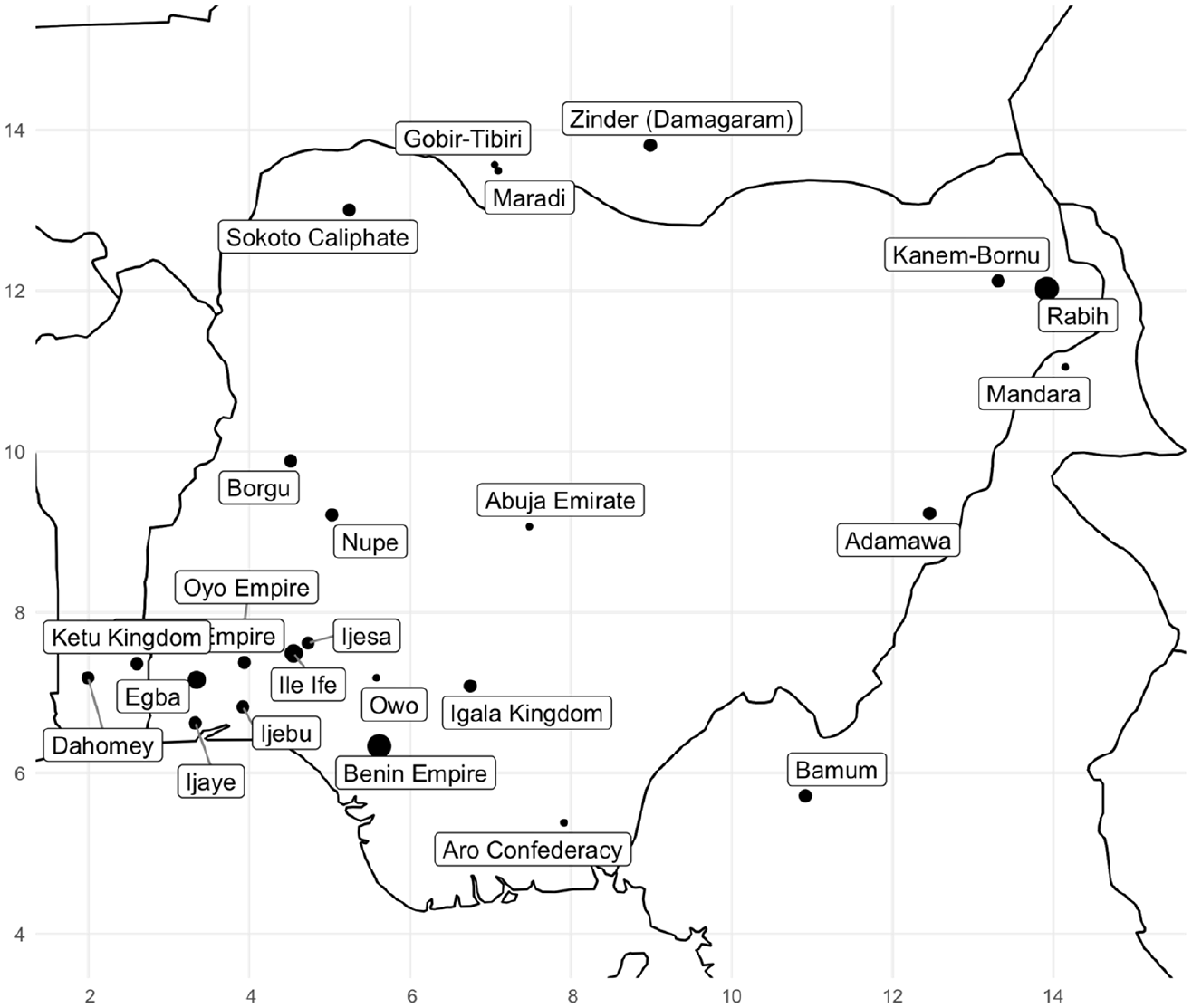
Historical states in Nigeria and Surrounds, 1816–1939.
Why would more HSEs in the territory of modern states lead to more internal armed conflict? We propose four mechanisms drawn from the existing literature on pre-colonial statehood and conflict: (1) HSEs left behind mobilization networks useful for insurgency, (2) they left behind symbols of independent statehood that conflict entrepreneurs can mobilize around, (3) they created the foundations for ethnic claim making in the post-Second World War period, and (4) they altered colonial trajectories and created unfavorable conditions for democracy and state consolidation at independence. We discuss each of these mechanisms in turn.
Networks of rebellion
Many historical states leave behind formal and informal (Wig, 2016) social networks that lower the costs of insurgent collective action (Staniland, 2014; Wood, 2000 17). For example, the Buganda Kingdom was a state entity for over 500 years before becoming a formal institution in modern Uganda through the British system of indirect rule (Tuck and Rowe, 2005). Buganda launched a brief and unsuccessful armed rebellion in 1966 after a power-sharing agreement with the Obote regime broke down (Tuck and Rowe, 2005). In Ethiopia, the Derge regime tried to arrest the semi-independent Sultan of Aussa (Awsa) in June 1975 (Shehim, 1985). However, the Sultan was able to escape and launched an armed rebellion from Somalia (Afar Liberation Front—ALF, Shehim, 1985). While the Sultanate was unable to win independence, the institution continues to exist within the current Ethiopian state (Hanfare, 2011).
These are examples of HSEs surviving into the modern period as formal institutions. Informal networks can also survive and underpin insurgency. Aceh, for example, ruled parts of the northern tip of Sumatra in modern-day Indonesia from the 16th to 19th centuries. Aceh sponsored Islamic learning and became a central node in a broad network of Islamic scholars (ulama) in Indonesia and Malaysia. These ulama fought against Dutch colonialism, even after the formal Achenese state had been destroyed. Tengku Cik di Tiro, for example, fought in these wars and later became a symbol for Acehnese mobilization against the Indonesian state. Ulama networks survived defeat by the Dutch and colonization into independent Indonesia—especially through organizations such as the Persatuan Ulamam Seluruh Aceh (PUSA; the All-Aceh Association of Ulama; Aspinall, 2009: 28)—and formed the core of the Darul Islam rebellion of the late 1940s and early 1950s. The leader of the Free Aceh Movement (GAM, formed in the 1970s), Hasan di Tiro, was the great grandson of Tengku Cik di Tiro—the lauded hero of independent Acehnese resistance to the Dutch. Tiro recruited directly from these old Darul Islam networks when launching the GAM rebellion—networks that have their roots in the pre-colonial Acehnese state (Aspinall, 2009: 61–62).
Generalizing from these specific examples, historical states can leave behind formal and informal networks that enable rebellion in the modern period. The more historical states, the more of these legacies are left behind and—ceteris paribus—the more potential foundations of rebellion there are in the often competitive and unstable environment of post-colonial politics.
Symbols of sovereignty
Historical states leave memories and collective symbols of sovereignty and independence. These narratives of lost nationhood or stolen “homelands” can be powerful focal points for mobilization into armed conflict in an international system founded on the principal of national sovereignty (Ahram, 2019; Shelef, 2016). The more prevalent these narratives are, the more common armed conflict should be.
There are several examples of armed groups using former states and empires in this manner. The Macina Liberation Front in Mali refers to a short-lived Islamic Empire in Northern Mali that lasted for only 44 years (between 1818 and 1862; Brown, 1968). The Movement for Oneness and Jihad in West Africa (MUJWA) “seeks to revive the ‘jihad’ of Alhaji Umar Tell,” leader of the 19th-Century Tokolor empire, and the Vanguards for the Protection of Muslims in Black Africa (Ansaru) claims to “revive the ‘jihad’ of Usman Dan Fodio,” leader of the Sokoto Caliphate, also a 19th-Century West African state (Zenn, 2015). Non-Islamist examples include the Cyranecia Liberation Army in Libya and the various Afrikaaner resistance groups that aimed for a re-establishment of the Boer Republics in South Africa.
There are multiple examples of interplay between the networks and symbols of sovereignty mechanisms. For example, The leader of the GAM justified rebellion with recourse to Aceh’s history as a sovereign state (Aspinall, 2009). While in Poland, the memory of an independent Polish state helped preserve elite networks of Polish noblemen and provided a model for their proto-nationalist independence movement (Wimmer, 2018).
More historical states may therefore generate higher levels of conflict by creating symbolic resources that dissidents can rally around and mold into narratives of lost nationhood. These symbols—other things being equal—may make it easier to initiate armed conflict against the state.
Ethnic power relations
HSEs might also drive conflict by creating more “politically relevant” ethnic groups in modern states. Existing studies tend to assume that ethnic groups pre-date and build states (Paine, 2019; Wig, 2016), but state-building often drives changes in ethnic identity (Anderson, 2006; Chandra, 2006; Wimmer, 2018). After the First and Second World Wars, the increasing legitimacy of appeals to self-determination by “national” or “people groups” rather than appeals to effective sovereignty (Clapham, 1996; Jackson, 1991), created incentives for collective groups to pitch political claims in ethnic or communal terms. These ethnic claims, however, were in some cases the product of prior-state building efforts that began before the existence of the ethnic group.
The “Acehnese,” for example, are an ethnic group in the “Ethnic Power Relations” data from 1950 (Vogt et al., 2015) and the war between the Indonesian state and the GAM is coded as an ethnic conflict (Vogt et al., 2015). 1 Aceh was a feudal-like state that portrayed itself as a pan-Islamic center of learning before it was an ethnic group, however (Aspinall, 2009: 20). The elite were mostly Malay and Arab, not people with deep Indigenous roots. Aspinall (2009) states that “most surviving sources tell us there was no such [Acehnese] consciousness before the twentieth century” (pp. 46–47) Rather, “Acehnese” as an ethnic identity was invented by local elites to maneuver within Indonesian laws that permitted “cultural” expressions and conflict entrepreneurs looking for foundations in international law to justify the independence of Aceh.
State-making also facilitated the expansion of ethnic groups, which influenced modern day ethnic demographics. The Lunda were a small ethnic group in modern day Democratic Republic of Congo (DRC) before the expansion of the Lunda empire, which saw Lunda settlers spread across the DRC (especially in Katanga), Angola and Zaire. Modern-day “Lunda” settlement patterns are therefore a product of prior, successful, state-building. The Punjabi state of Khalistan in modern day India and Pakistan (1799–1846) is another example of how statehood and elite (religious) networks fused to generate ethnic tensions in the modern period, in this case, between Sikhs and the Federal Indian Government during the 1970s and 1980s (Grewal, 1998). Even multi-ethnic empires in the pre-colonial period can create politically relevant ethnic groups in the post-colonial period. The Sokoto caliphate was a large, Fulbe-based, but ethnically diverse Islamic empire that conquered much of Northern Nigeria and Niger in the 1800s (Law, 1977). The political relevance of “Hausa-Fulani and Muslim Middle Belt” in the Ethnic Power Relations (EPR) is likely caused by the Sokoto caliphate, which (1) unified the Hausa and the Fulani (two different ethnic groups) under the same political administration and (2) was the foundation for the North-South division in Nigeria because northern Nigeria was ruled indirectly through the Sokoto caliphate while the south was ruled more directly (Paine, 2019). The Sokoto caliphate was so influential in the early politics of independent Nigeria because it transcended the ethnic Hausa–Fulani divide and unified the fragmented Hausa polities under a single (albeit decentralized) Islamic administration. These religious divisions are relevant alongside ethnic divisions in Nigeria and the Islamic-North–Christian-South division was sharpened by the jihads of the 1800s and the establishment of the Sokoto Caliphate (Reynolds, 1997).
The main upshot is that HSEs can shape post-colonial ethnic relations by creating, unifying, and expanding ethnic groups into conglomerates that became politically relevant in an international system that privileged national claims (i.e. people-group claims) over claims based purely in prior state rule. Countries with more historical states may be at a higher risk of conflict because those countries have a higher number of claims making ethnic groups in the post-colonial period. To the extent that more ethnic groups or ethnic groups with a history of statehood create bargaining problems and highly competitive political environments characterized by ethnic exclusion and favoritism (Cederman et al., 2013; Paine, 2019; Roessler, 2016), this should also increase the number of armed conflicts. We do not attempt to untie the knot of ethnicity and statehood here, but existing research establishes a link from historical states to modern-day civil conflict that plausibly runs through a higher number of claims making ethnic groups that are themselves the product of state-building efforts.
Colonialism, democracy, and weak statehood
Historical states often resisted European colonialism and where they were colonized, were ruled indirectly rather than directly (Englebert, 2000; Gerring et al., 2011; Hariri, 2012). Areas with stronger Indigenous statehood were also more successful at resisting European cultural and religious influences, especially Protestant missionaries (Woodberry, 2012). Although the connection is debated, direct colonial rule and the influence of Protestant missionaries may have created some foundations for democratic rule in the post-colonial period (Hariri, 2012; Nikolova and Polansky, 2021; Woodberry, 2012) and democracies are less likely to experience civil conflicts than semi-democracies or autocracies (Hegre and Sambanis, 2006).
In addition, indirect rule preserved some of the power and influence of historical states through the colonial period, placing them in a stronger position to place demands on colonial regimes during the decolonization process and the leaders of newly independent states. Where there were many HSEs, this can create a “strong society, weak state” dynamic where the central government struggled to rule parts of its territory where HSEs survived, creating areas of weak state control which, as Fearon and Laitin (2003) and Lewis (2017) argue, can facilitate insurgency by reducing the likelihood of state detection and defeat in the initial stages. Herbst (2014) argues, for example, that colonial regimes in Africa concentrated their rule in coastal capital cities, leaving existing institutions largely intact in the hinterland. At independence, African leaders inherited weak states with little “infrastructure” of rule outside of the capital, faced strong challengers and high costs to expand the state. This dynamic was replicated in South Asia and Southeast Asia (Migdal, 1988) and Mazzuca (2021) observes a similar dynamic whereby conditions at the moment of state formation—especially strong regional powers—help explain state weakness in South and Central America. Recent research suggests that expanding state presence can drive the onset of new internal armed conflicts (Ying, 2021), and as modern states move into areas previously ruled by HSEs, armed conflicts can become more likely. Higher numbers of HSEs may therefore generate more armed conflict in post-colonial period by altering the trajectory of colonial rule and creating conditions where weak, non-democratic states emerged after independence that faced strong internal challengers.
Figure 2 outlines the main mechanisms that link HSEs to conflict: (1) Networks of Rebellion; (2) Symbols of Sovereignty; (3) Ethnic Power Relations; and (4) Colonialism, Democracy, and Weak Statehood. Additional cases exhibiting links between HSEs and modern conflicts can be found in the Supplemental Appendix.

Causal diagram.
Hypothesis 1 outlines the observable implications of our arguments.
H1. More historical states in the territory of a modern state increases the number of internal armed conflicts.
Conditional effects
Our argument is general and probabilistic, applying to the post-Second World War period. It should not be taken to mean that all HSEs are conflict inducing or that all conflicts involve HSEs. Studies show that in some instances, historical states can be advantageous to state-building by providing prefabricated governance structures that the center can draw upon to deliver public goods and peace (Ziblatt, 2008). Historical states can be assets for state-building when the expanding center and the historical states have high “infrastructural capacity,” meaning a high capacity for taxation, providing public order, and delivering public goods. In these circumstances, bargaining occurs between strong and credible actors capable of delivering on agreements (Wig, 2016; Ziblatt, 2008). These circumstances do not characterize the state-building challenges of most states in the post-Second World War period, especially post-colonial states. First, centers often inherited weak and geographically limited infrastructural capacity at independence (Herbst, 2014; Migdal, 1988). Second, most historical states in our sample were relatively weak and decentralized, especially in Africa, Southeast Asia, and South Asia (Herbst, 2014; Scott, 2009). We also suspect that some of the paradigmatic examples of peaceful state-HSE integration are also situations with a few HSEs, as characterizes modern day Ghana, or Benin. The typical conditions under which modern and historical states combine for effective state-building, therefore, do not characterize the situation of most states in the post-Second World War and we, therefore, expect a general negative effect of more HSEs on peace as they provided the resources for collective action in a situation where effective bargaining is difficult.
We do, however, make two conditional arguments based on the discussion earlier. First, we expect that HSEs are less dangerous when they are located closer to the modern capital. The process of state consolidation often causes conflict between the center and peripheral regions (Ying, 2021). As the costs of governance increase with distance from the center in many modern, especially post-colonial, states (Herbst, 2014), HSEs located closer to the modern-day capital should be easier for the center to incorporate peacefully. These may also be HSEs with pre-existing connections to the center through trade and transport infrastructure. Historical states located close to the capital also sometimes inherit the state (such as in Egypt, Thailand, Sweden, or China), entailing a smooth transition between the historical and modern state. In contrast, HSEs located far from the capital are more likely to be disconnected from the center and far more costly to incorporate, either through force or negotiation.
Second, modern states with more economic resources may be able to avoid conflict by providing economic transfers to regions with HSEs, or alternatively, modern states with higher levels of development may contain HSEs with a higher pre-existing level of development, or interconnectedness, making them easier to incorporate. Italy, for example, may have been able to avoid conflict in the post-Second World War period, despite multiple HSEs, due its higher capacity to incorporate former states. Sardinia and Sicily (both HSEs), for example, have had active secessionist movements, but these never escalated to high levels of armed conflict (Griffiths, 2016). Germany’s federal institutions are (in general) the product of effective negotiation between a developed center (Prussia) and numerous, relatively developed regional kingdoms (Ziblatt, 2008). More developed artificial states should therefore have a larger carrying capacity for historical states and be better able to solve bargaining problems peacefully.
These conditional arguments imply the following two hypotheses:
H2. The number of historical states in the territory of a modern state has a stronger positive impact on internal armed conflicts when those states are located further from the modern capital.
H3. The number of historical states in the territory of a modern state has a stronger positive effect on the probability of civil war in less-developed states.
Research design
Dependent variables
The unit of analysis is a country, observed over the 1946–2019 period. Our dependent variable is the conflict onset rate over the 1946–2019 period, sourced from the UCDP/PRIO Armed Conflict Dataset (Pettersson and Oberg, 2020). A new onset is recorded when a state experiences a new internal or internationalized internal civil conflict after a period of 2 or more years of no conflict.
The dependent variable is divided by the number of active state years to adjust for exposure time. Onsets represent attempts at armed rebellion successful enough to cross the UCDP death-threshold of 25 battle-related deaths in a year (Lewis, 2017; Tollefsen et al., 2012). Our mechanisms describe conditions conducive to the launching of rebellion rather than the number of rebel groups (Fjelde and De Soysa, 2009), conflict duration (Cunningham, 2006), or termination (Walter, 2004) that are explained by additional processes such as splintering, bargaining failures across multiple rebel groups, and peacekeeping. 2 The main results reported below are robust to several variations on the dependent variable, including using the logged number of onsets, the rate of logged onsets, and the raw count of onsets using both negative binomial models for over-dispersed count data and OLS regressions.
Independent variables
The independent variable is a count of the number of HSEs that existed between 1816 and 1939 in the territory of a modern state (i.e. a state that existed between 1946 and 2019). These data are sourced from version 2 of the ISD. Butcher and Griffiths (2020) require that polities have more than 10,000 people, autonomy over a specific territory, and uncontested or recognized external sovereignty in order to qualify as a state. These criteria are more inclusive than the COW State System Membership List (Sarkees and Wayman, 2010) but more restrictive than the Murdock (1967) map that also includes stateless ethnic groups.
To code the “destination” state of HSEs, we used the latitude and longitude coordinates in the ISD for approximate locations of HSE capital cities. We overlay these capitals on modern borders and count how many capitals fall into those borders. HSEs often ended up in multiple territories—parts of the Sokoto empire, for example, are in modern-day Nigeria, Niger, and Cameroon—and we coded up to 10 additional destination states based on locations specified in the World Statesmen database of traditional states (https://www.worldstatesmen.org) and our own searches of secondary sources. Historical states in the ISD do not necessarily overlap in time. Some historical states can disappear, while others can come into being during the sample period, within a given territory. Because this measure does not vary across time, we use cross-sectional analyses to avoid artificially inflating the number of observations. Figure 3 shows how many historical states (i.e. states that existed at some point between 1816 and 1939) are recorded within the boundaries of modern states. We also run models below counting only the number of historical state capitals falling within the borders of a modern state, with very similar results.
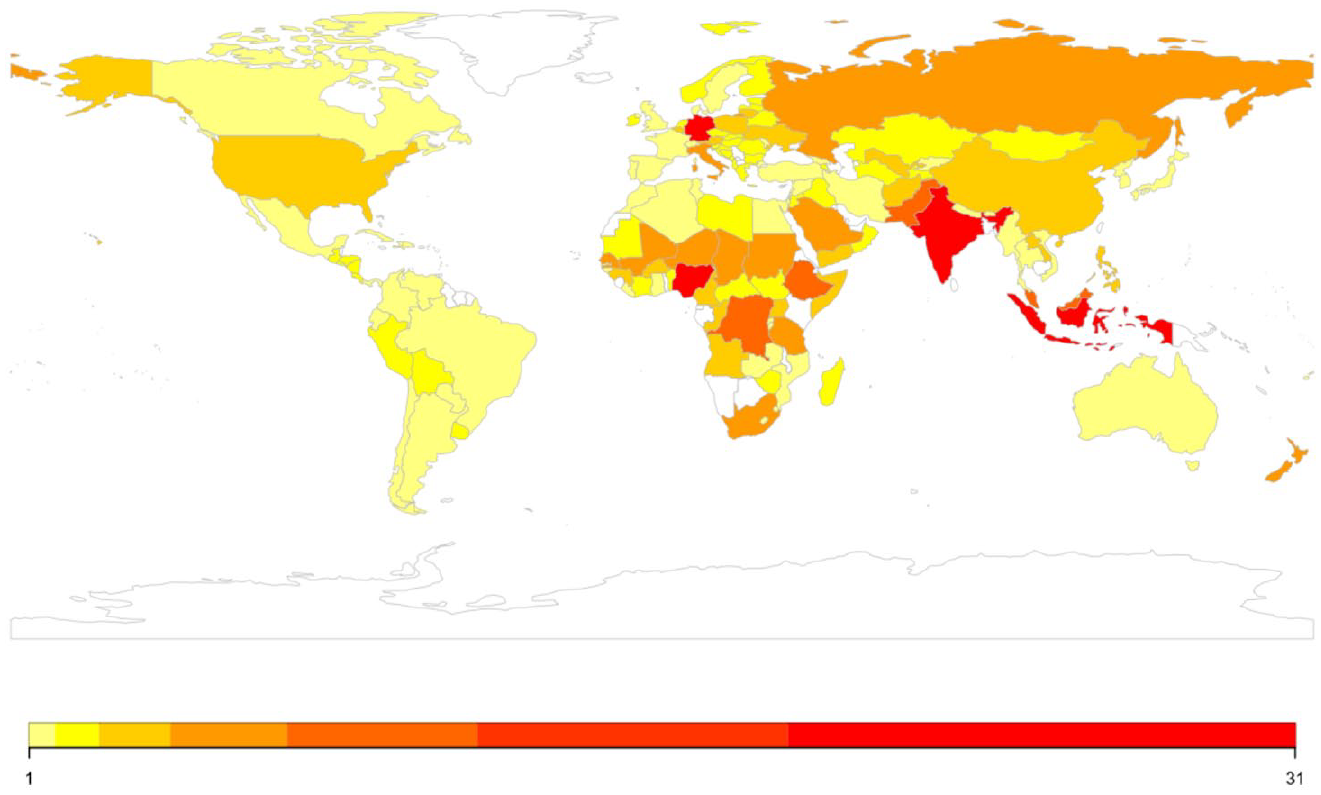
Number of historical state entities per country.
The ISD has several advantages. The first is global coverage. Existing studies have primarily analyzed Africa, or Sub-Saharan Africa, while there were dense state systems in South Asia, Southeast and East Asia, and South America that are excluded by these analyses. Even within studies of pre-colonial Africa, many state entities are not included. For example, Besley and Reynal-Querol (2014) use data for 19 historical kingdoms in Africa over the 1400–1700 period to assess the impact of historical conflict, while our sample includes 109 states on the African continent that were independent at some point over the 1816–1939 period.
Second, the ISD includes states without selecting on ethnicity. States that were ethnically based are included (such as Buganda) along with multi-ethnic empires such as the Sokoto Caliphate and states that were not ethnic such as the Rajput states of India, which were based more upon a shared warrior “class” than ethnicity (Ramusack, 2004: 12). This provides a more accurate picture of statehood in the 19th century, even within Africa. For example, Paine’s (2019) recent study of pre-colonial ethnic-states and post-colonial conflict identifies just one state in Ethiopia, while the ISD identifies 11, some of which were highly centralized, such as the Shoa and Jimma kingdoms (Lewis, 2001). Thus, what Paine (2019) identifies as a country with one ethnic state that is otherwise “stateless,” is, according to a different dataset, a country with multiple historical states. By avoiding the assumption that states are ethnic states we also avoid projecting modern ethnic identities back onto pre-colonial polities that were not ethnically based or only marginally so.
The main drawbacks are that the ISD start in 1816 and only geocode capital cities or state centers. The year 1816 is an arbitrary starting point, marking the Congress of Vienna and the aftermath of the Napoleonic wars, that attributes some states with no HSEs because they were colonized before 1816 (e.g. Bangladesh) and elides historical states that existed in the 1700s and earlier, some of which may have powerful legacies (especially in Europe, India, and Myanmar). However, the 1816–1939 period is also critical and arguably more important than earlier periods of historical statehood for understanding modern conflict dynamics because these states existed on the eve of the international system freezing into its current territorial divisions through colonialism, followed by the explosive rise of norms emphasizing self-determination and fixed territorial sovereignty (Ahram, 2019; Branch, 2013; Paine, 2019). Some states, such as France, Sweden, Thailand, or China, entered this international system having already incorporated historical states through processes of vassalage, warfare, territorial expansion and centralization by the end of the 19th century. Other states fared very differently. Nigeria, for example, did not exist as a state before 1960 and the territory of modern-day Nigeria is host to numerous historical states that existed between 1816 and colonialism, many of which survived through colonialism (and because of colonialism) and indirect forms of rule. These were all potential challengers to the post-colonial Nigerian state. Mazzuca (2021) shows that conditions at the moment of state formation can have lasting impacts on the trajectory of state consolidation. If we were to go further back in time, we would surely find more states, 3 but measuring independent states that existed between 1816 and 1939 captures the main historical states that presented the greatest potential conflict risk in the modern period. 4
Controls
Our identification strategy rests upon conditioning on observable factors (Morgan and Winship, 2015), making the question of what causes higher or lower numbers of historical states in the territory of a modern state critical. Before discussing control variables, the number of historical states is likely exogenous to some factors that may cause armed conflict. State formation is not random (Bates, 2008; Osafo-Kwaako and Robinson, 2013; Tilly, 1990), but the number of states encompassed by modern boundaries depends upon the boundary-drawing process. Competition between European powers generated colonial boundaries that were quasi-random in relation to local conditions (Branch, 2013; Clapham, 1996; McCauley and Posner 2015). McCauley and Posner (2015) suggest that up to 80 percent of the borders in Africa follow “meridians, parallels or other rectilinear or curved lines” (p. 3). The “Scramble for Africa” is infamous for paying little attention to local conditions when demarcating colonial spheres, which eventually became the foundations of modern state boundaries (Michalopoulos and Papaioannou, 2020: 81–85). Moreover, some of the risks associated with assuming quasi-random border allocation highlighted by McCauley and Posner (2015)—especially cluster randomization and open treatments—do not apply in our case because we are not studying individuals and HSEs cannot move after 1939. Therefore, our independent variable is partially assigned by a process that is likely to be independent of factors that cause modern conflict. At the very least, our results are not likely to be explained by reverse-causality concerns in some samples, especially the African sample.
Nonetheless, borders are not exogenous in an experimental sense. Even in Africa some borders were drawn in relation to historical states—the Sokoto caliphate and the northern Nigerian borders are an oft-cited example (McCauley and Posner, 2015)—and borders in Southeast Asia, South Asia, Europe, and Central Asia may have been drawn more in response to local conditions given the longer colonial experience in these areas or due to longer term processes of war and absorption. Moreover, the number of historical states will also be a function of how conducive the conditions within modern borders were to state-building, no matter how random the assignment of borders. Our main models include a parsimonious set of controls, and we show results with an extended set of controls.
Population density is closely related to state-building (Herbst, 2014) and the “great reversal” entails that countries with favorable conditions for state-building had lower levels of economic growth in the modern period (Acemoglu et al., 2001), making them more vulnerable to armed conflict (Fearon, 2003). We control for estimated population density in 1500 from Dincecco et al. (2019). 5 Larger countries have more space for previous state entities and may be more difficult for states to govern. A control for land area in 1,000s km2 was included. Countries that were colonized by Europeans may also contain more historical states compared to uncolonized countries because Europeans often drew borders without respect to historical states as opposed to more Indigenous processes of state building, absorption, and separation that may leave fewer historical states behind (Tilly, 1990). The link between European colonialism and civil conflicts is less clear, however (Hegre et al., 2001). A control for whether the state was a former European colony from the Correlates of War Colonial Contiguity data was included (Correlates of War Project, 2016). A control for historical conflict from Dincecco et al. (2019) was included, as conflict can drive statebuilding (although this is contested, Osafo-Kwaako and Robinson, 2013) and may be related to armed conflict through other channels such as lower trust (Besley and Reynal-Querol, 2014) or lower levels of development (Englebert et al., 2002). Additional tests exploring historical conflict as an alternative explanation can be found in the Supplemental Appendix and suggest that historical conflict does not confound the main results. The timing of the neolithic revolution has been found to drive statebuilding and conflict (Paine, 2019) and we control for this with the log of years since the neolithic revolution. We also control for the log absolute latitude and for slave exports as slavery may have inhibited or promoted state-building while undermining trust that may have led to conflict (Nunn, 2008).
The average number of politically relevant ethnic groups in the EPR data (Vogt et al., 2015) over the 1945–2017 period was included. This is a post treatment control biasing against the main hypothesis. Some ethnic groups may have pre-dated states and caused conflict through other channels than state-building, while some ethnic groups were created by states and may be a modern phenomenon. By controlling for both, we remove the causal effects of more EPR ethnic groups on conflict that are independent of historical statehood and the effects that run though prior statehood, biasing our estimates down. This is a conservative approach but reduces the risk that our results reflect a simple “more ethnic groups = more states = more conflict” story, and that our measure of historical statehood is simply picking up the measurement error in estimates of ethnic diversity, where it is also difficult to disentangle the relationship between ethnicity and statehood. We also include the ethnic fractionalization index, which measures the extent to which ethnic demographics are dispersed across many groups or concentrated in a single group. By including both measures of ethnic diversity, we can be more confident that our results do not reflect only pre-existing ethnic conditions. Finally, all models include region fixed effects for Sub-Saharan Africa, the Middle East and North Africa, Eastern Europe and Central Asia, Latin America and the Caribbean, Western Europe and North America, and Asia and the Pacific. These controls parse out any region-specific factors that drive state-building and conflict.
These controls are the baseline controls included in all the main models. We also ran models with additional controls for geographic factors, specifically the country’s suitability for agriculture, the extent of rugged terrain, and whether it was an island or landlocked. Again, these controls come from Dincecco et al. (2019).
Modeling strategy
We follow Besley and Reynal-Querol (2014) and use Ordinary Least Squares (OLS) regressions. The first two models use the civil conflict onset rate over the 1946–2019 period as the dependent variable with the main and geography controls. Models with the dependent variable disaggregated into conflicts over government, conflicts over territory, and then the onset rate in the 1946–1988, 1989–2000, and 2001–2019 periods are then shown. Results in regional and theoretically relevant subsamples follow. We then re-test our hypothesis against the following four similar, but conceptually distinct, independent variables: (1) the number of ethnic groups with centralized states, from Wig (2016); (2) the number of ethnic groups with pre-colonial states (PCS) and “stateless” ethnic groups in PCS states from Paine (2019); (3) state antiquity from Bockstette and Putterman (2012); and (4) the fractal index from Alesina et al. (2011). The last section unpacks the mechanisms using mediation analysis and explores conditional effects, discussed in more detail below.
Mediated and conditional effects
The main models aim to identify the general association between more historical state entities and the number of conflict onsets. We also use mediation analysis to explore the channels through which historical statehood might affect conflict (Imai et al., 2011). The mediation models use the baseline control variables. Testing the networks and symbolism argument is difficult because the legacies of past states take many forms—ethnic networks, religious networks, states in federal systems, symbolic cultural or political roles—and there are no cross-national measures of these concepts (outside of ethnicity) that we are aware of. However, we can test the ethnicity and weak statehood and colonialism mechanisms with cross-national data on ethnic groups, indicators of state development, and patterns of colonial experience.
To test the colonialism argument we use colonial duration, like Hariri (2012) and the estimated percentage of people evangelized by Protestants in 1923 from Woodberry (2012). Colonial duration and “conversionary protestants” have been shown to positively impact civil society and democracy in the post-Second World War period.
To test the ethnicity mechanism, we use the average number of politically relevant EPR groups across the 1945–2017 period and the average number of politically excluded EPR groups over the same period as mediators. Data come from the EPR project (Vogt et al., 2015). These mediators capture ethnic groups that pre-dated states and ethnic groups that were created by states (such as Aceh). We cannot separate these two channels, but the mediation analyses provide an indicator of whether any HSE-conflict link is primarily explained by the creation or survival of modern-day ethnic groups.
Finally, to test the state-weakness argument, we use log gross domestic product (GDP) per capita in 2000 from Acemoglu et al. (2001) and relative tax capacity (Hendrix, 2010) as mediators. A statistically significant mediated impact would suggest that HSEs resulted in weak state capacity and higher levels of armed conflict, but it could reflect the impact of earlier conflicts on GDP per capita. The estimate is therefore biased toward finding a mediated relationship. No significant association, however, would constitute stronger evidence against this as a causal channel.
Hypotheses 2 and 3 imply conditional effects. To test H2 (HSEs have a stronger effect when located far from the capital), we create a variable capturing the average distance between the first modern capital and the capitals/centers of HSEs and interact this variable with the number of HSEs. To test H3 (HSEs have a stronger effect in less-developed states), we interact the number of HSEs with the first non-missing observation of GDP per capita after 1946 from the Madison Project to assess whether HSEs are primarily associated with conflict in states that lack the economic capabilities or preexisting state capacity to absorb them.
Results
General associations between HSEs and armed conflict
Figures 4 and 5 show bivariate associations between HSE prevalence and modern conflict onset rates. Countries with more HSEs are associated with higher armed conflict onset rates. From Figure 5, a state with no HSEs (e.g. Malawi) experienced conflict onsets in 2.5 percent of state years, which doubles to 5.1 percent for one HSE, before dropping to 2.5 percent for states with two HSEs. 6 Onset rates then steadily climb until states with more than 10 HSEs expect onsets in 19 percent of country years. The increase is more pronounced for territorial conflicts.
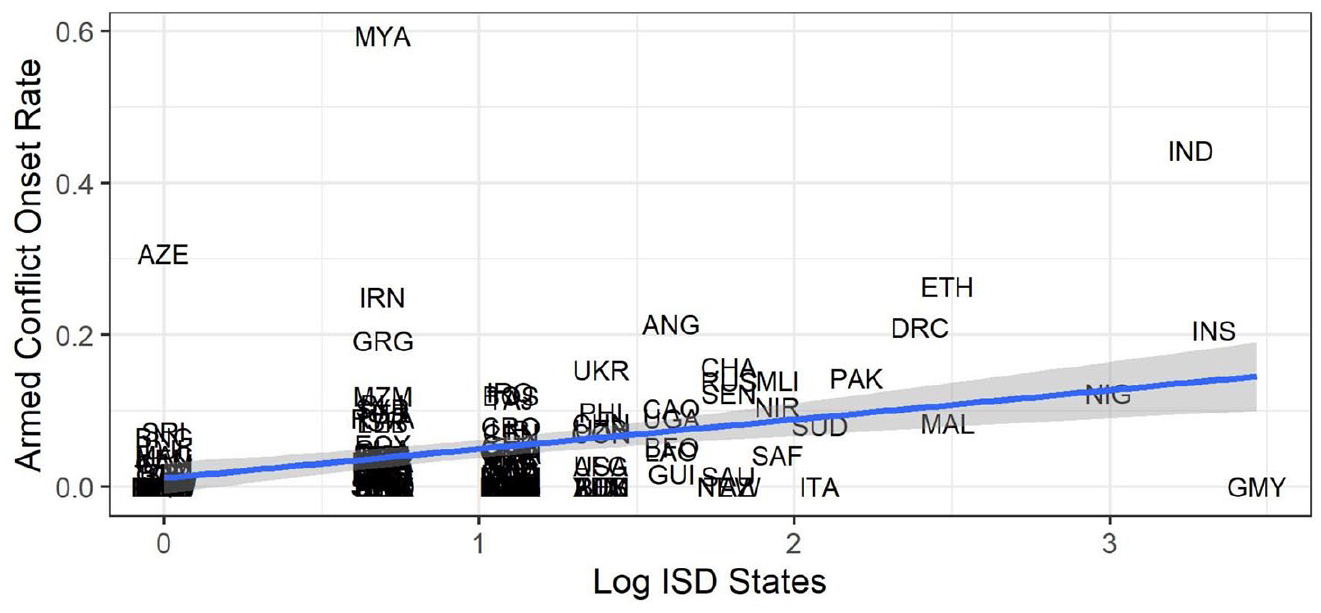
HSEs and armed conflict, bivariate association.
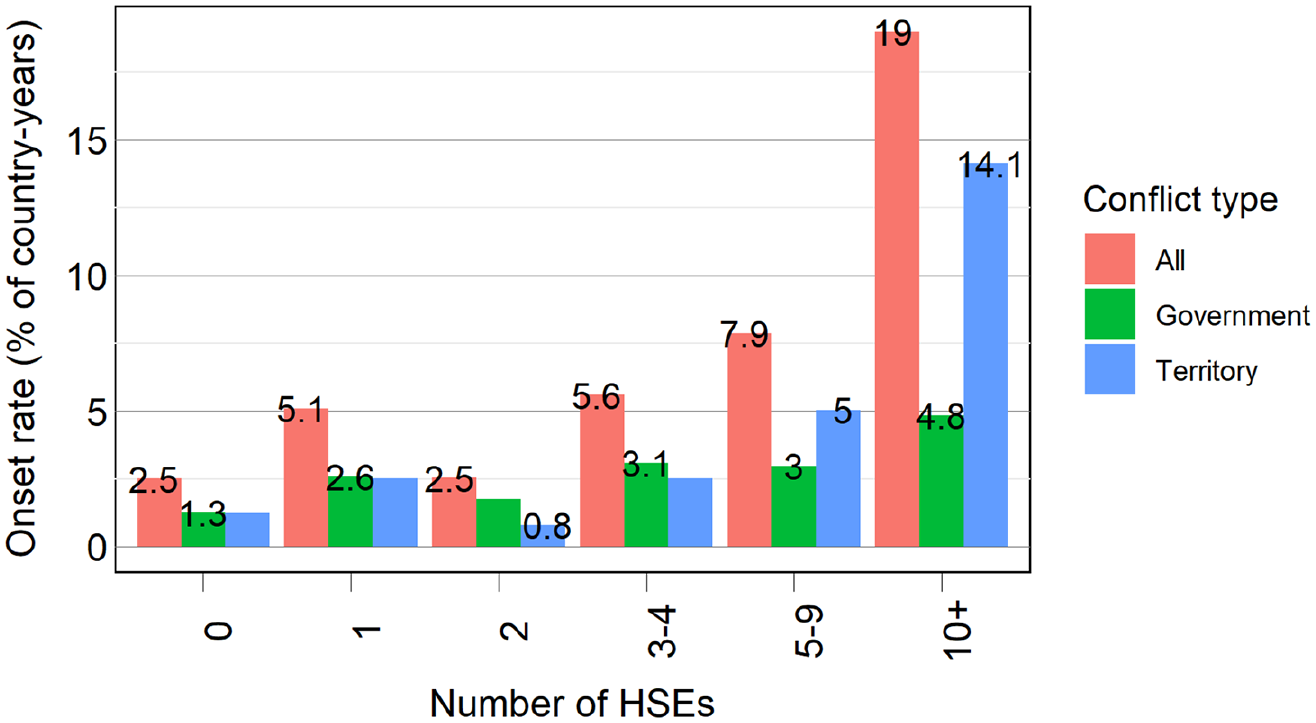
Onset rates across HSEs and conflict types.
Figure 6 shows results using the main dependent variable (internal armed conflict onsets) and our main robustness tests. The regression tables can be found in the Supplemental Appendix. There is a consistent positive impact of HSEs on the number of internal armed conflict onsets. The association is significant across both batteries of controls and is therefore likely to be independent of important alternative explanations: that HSEs are symptomatic of many ethnic groups in the modern period or that these are countries with an underlying propensity to state-building and conflict. We ran a sensitivity analysis using the sensemakr package in R, which can be found in the Supplemental Appendix. A confounder that would render the main results insignificant would have to explain about 8 percent of the variance in the number of ISD states and the conflict onset rate. For comparison, not even confounders explaining three times the variance as the average number of EPR groups or the measure of historical conflict would render the results insignificant at the 0.05 level. Other things being equal, moving from the number of HSEs in Tunisia (1) to the number in Nigeria (19) is associated with an onset rate that is 0.08 points higher, or about one additional armed conflict onset every 12 years. Although the model is not specifically set up to estimate the impact of ethnic group identities on conflict, we would need to add more than 10 politically relevant ethnic groups to generate the same impact on conflict onset (on average there were six politically relevant EPR groups in Nigeria over the 1946–2017 period and 0 in Tunisia). Thus, the main association is of a similar magnitude to the association with politically relevant ethnicity.
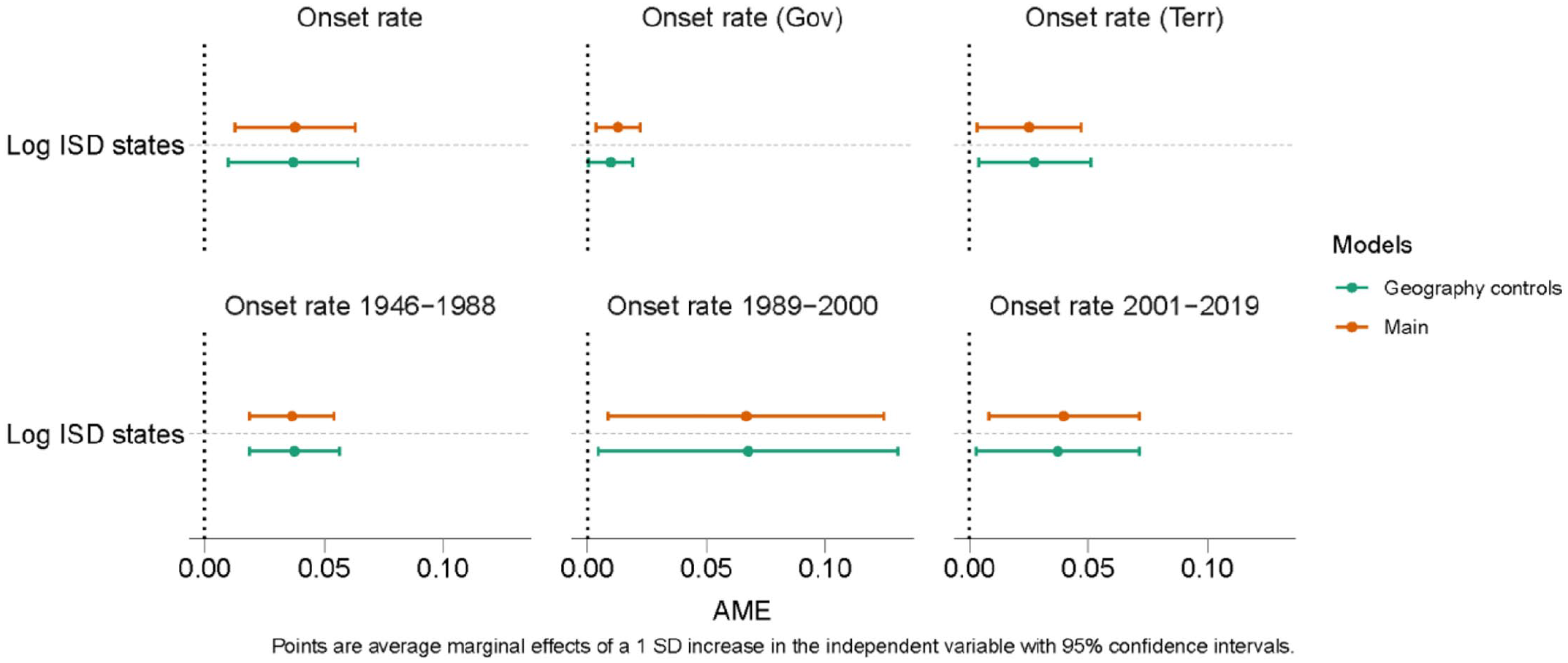
HSEs and armed conflict, main results.
The positive association between HSEs and armed conflict applies to conflicts over territory and to a lesser (although still statistically significant) extent, armed conflicts over government. The results are also fairly stable over time periods. Using the baseline model, more HSEs increase the number of expected conflicts during the 1946–1988 period, the 1989–2000 period, and the 2001–2019 period. In general, these results indicate a resilient association across conflict issues and time periods.
Figure 7 shows the main models across regional and other relevant subsamples. HSEs are associated with more conflict onsets across important subsamples where our theory should apply: former colonies, outside the West (i.e. states not in Western Europe or North America, also including Australia and New Zealand), when we drop countries coded with no HSEs coded, and in Sub-Saharan Africa. The coefficients are positive but not significant at the 0.05 level in Latin America, Middle East and Northern Africa (MENA), and Asia (the latter result may reflect the lower number of states identified in Myanmar and India). More HSEs have a generally negative impact across Eastern Europe and Central Asia. Wealth and state capacity may have enabled these countries to offset any conflict inducing impacts of HSEs, which we explore in the conditional effects.
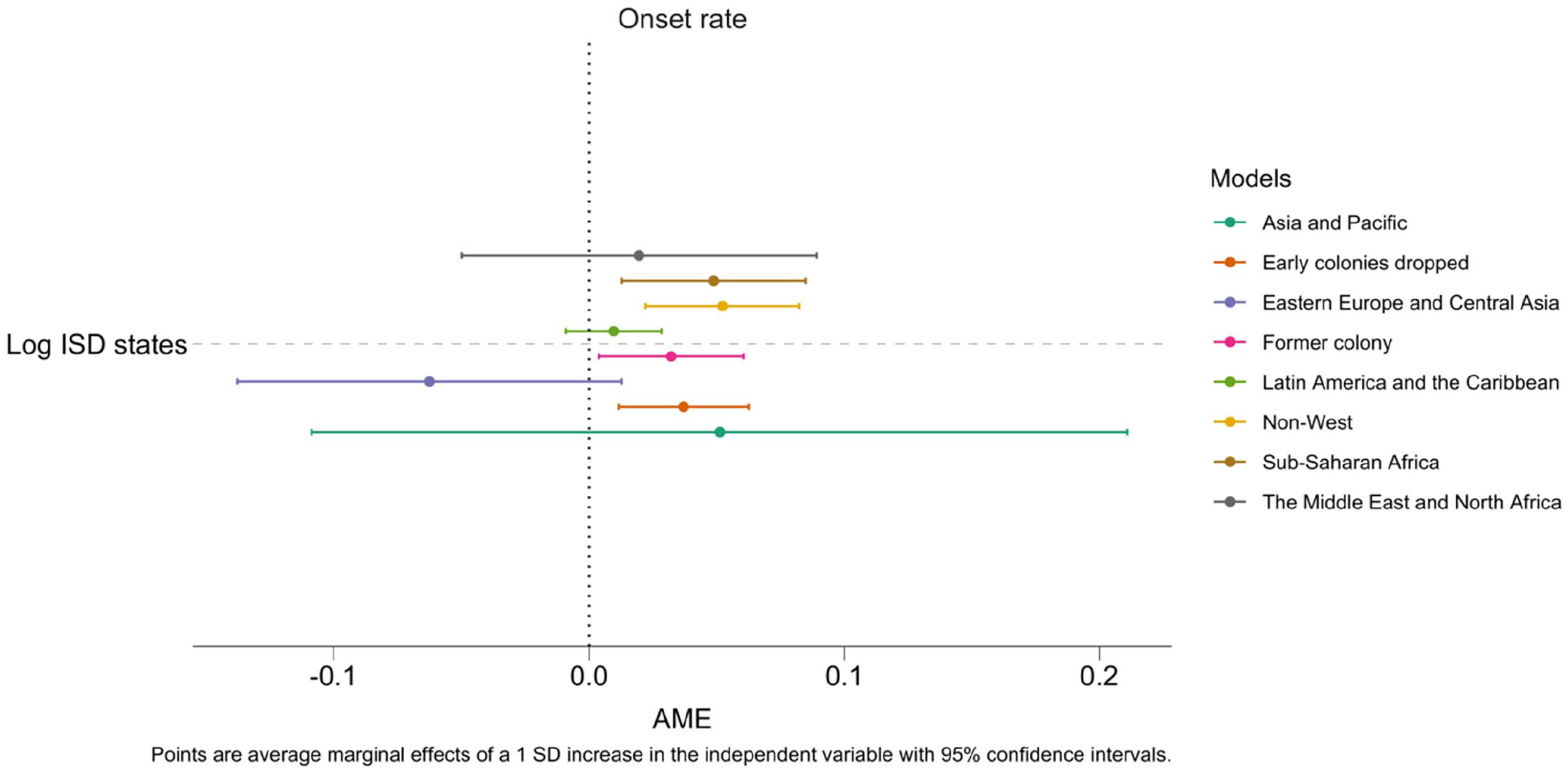
HSEs and armed conflict, regional subsamples.
The results for the sub-Saharan African sub-sample are striking (regression tables in the Supplemental Appendix). We do not find a statistically significant relationship between the average number of politically relevant ethnic groups and the number of armed conflict onsets, while we do for the number of HSEs. This suggests that HSEs have important, unexplored, connections to armed conflict even in regions where ethnic politics and tensions are thought to play an influential role (Cederman et al., 2010). This is also not simply a function of using the average number of politically relevant EPR groups. The results are almost identical if we use the average number of excluded EPR groups.
Alternative arguments
Our mechanisms link the number of HSEs in the territory of a modern state to more armed conflict onsets. Similar arguments have been made in existing studies that emphasize conceptually different aspects of historical or pre-colonial statehood. In this section, we adapt these arguments and test them as alternative explanations for the HSE-conflict link. First, Paine (2019) argues that stateless ethnic groups in a state with an ethnic group that had a pre-colonial state (SLPCS groups) rebel more frequently because of bargaining problems and exclusionary practices by the dominant pre-colonial state ethnic (PCS) group. Adapting this argument to a cross-sectional framework, Paine’s (2019) work suggests that the more SLPCS groups that exist in a modern state, the more armed conflict onsets we should observe (states with no ethnic groups that had a pre-colonial state (i.e. PCS groups) also have no SLPCS groups). As he notes, the PCS–SLPCS dynamic raises the likelihood of conflict for all groups in a state. To measure SLPCS groups we used a count of the number of ethnic groups in Paine’s study that were at one point a SLPCS group. This gives an estimate of the total number of “high-risk” ethnic groups in the state over the 1946–2013 period (the period of his study). We also include the number of PCS groups. These tests are restricted to sub-Saharan Africa.
Second, Wig (2016) argues that ethnic groups with centralized pre-colonial states can make credible commitments with the state and avoid armed conflict. This argument is not easily adaptable to a cross-sectional framework as Wig’s (2016) study is dyadic while many centralized pre-colonial states might introduce additional bargaining problems that drive up the risk of conflict for all groups, even if dyadic bargaining is easier (Cunningham, 2006; Walter, 2009). We use the number of ethnic groups that were centralized (a jurisdictional hierarchy score over 2) as a proportion of all ethnic groups to re-test this argument. An ethnic demography dominated by centralized groups (i.e. Ghana) should be more conducive to peace than one dominated by decentralized groups.
Third, Alesina et al. (2011) emphasize that artificial borders grouped together hostile pre-colonial groups and split others apart, which has led to low growth and armed conflict. To test whether our results reflect Alesina et al.’s (2011) fractal index—which measures how “squiggly” borders are—we run a model including the variable from their study.
Finally, Putterman (2008), Hariri (2012), and Bockstette and Putterman (2012) point to “early statehood” or state antiquity as an explanation for growth and internal peace. Countries with a longer history of continuous statehood developed more capable state structures that were able to generate economic growth and deter armed conflict. While there are overlaps between state antiquity and our measure of HSEs, our mechanisms highlight the distribution of states around or before colonization (similar to Paine, 2019), while the state antiquity data reach further back in time. We run a model including the mean state antiquity score from 1 AD to 1800 to test whether the results for HSEs reflect a simpler underlying relationship between early state history and conflict. Figure 8 shows the results of models including these alternative explanations, retaining the baseline controls (regional Fixed Effects (FEs) are dropped where the sample is Africa only).
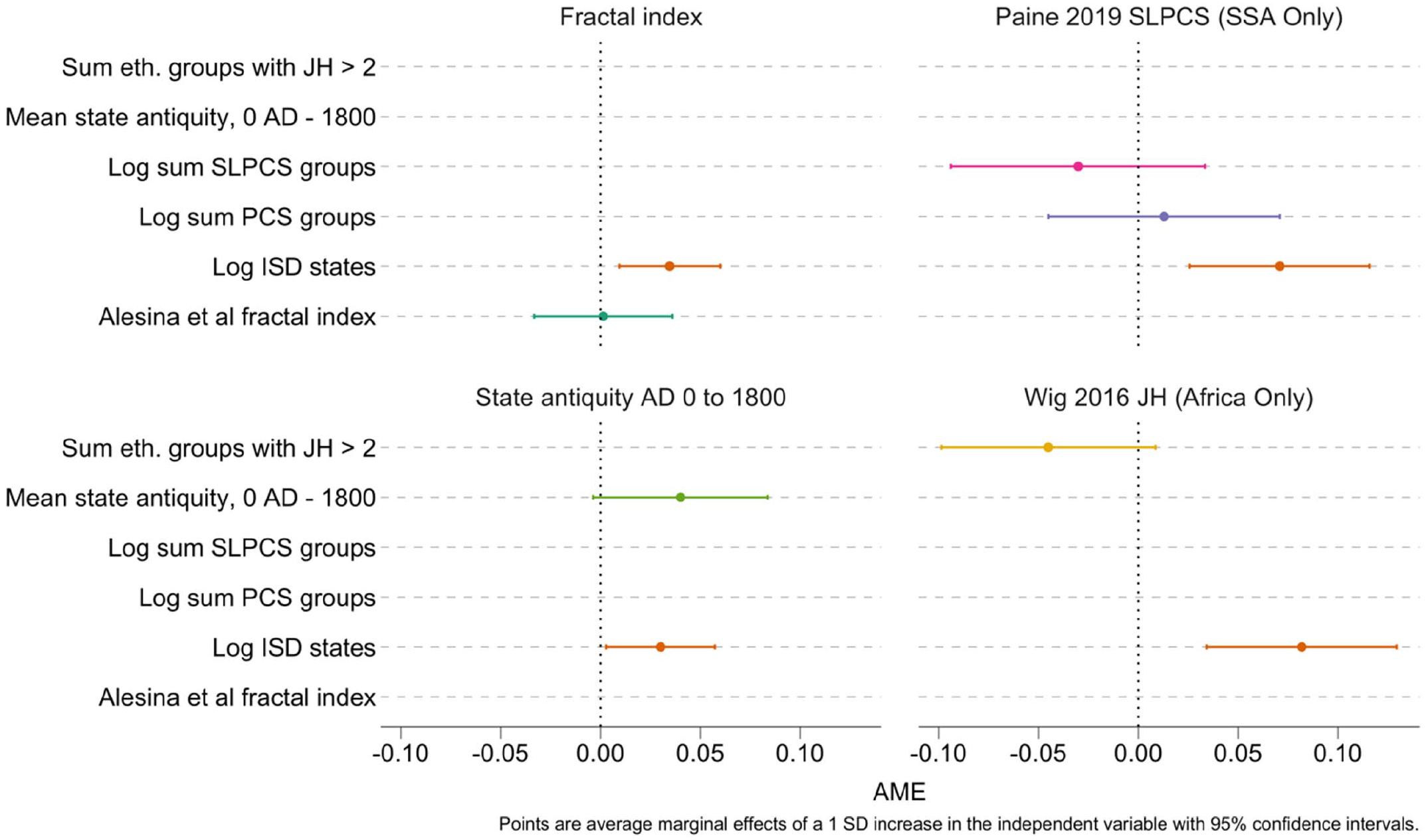
HSEs and armed conflict, alternative explanations.
Figure 8 shows that our main results are not simply a reflection of the fractal index or the state-antiquity index. The coefficients on the fractal and state-antiquity indexes have the wrong sign or are insignificant. These models also suggest that the HSE-conflict link is not solely driven by strong, peaceful, modern states (such as Sweden) with a long history of continuous state presence that might, for other reasons, have survived into the modern world. There is a negative but statistically insignificant relationship between a more centralized distribution of ethnic groups and armed conflict levels (which is not necessarily inconsistent with Wig’s (2016) dyadic argument), while HSEs remain positive and significant at the 0.05 level. More SLPCS groups are associated with fewer armed conflict onsets, but these coefficients are not significant at conventional levels while the HSE measure remains significant. Overall, these models suggest that the main results are not driven by previously identified and measured mechanisms linking pre-colonial statehood to conflict.
Mediation analysis
Figure 9 shows the results of mediation models exploring whether the HSE-conflict link can be explained by the ethnicity, weak statehood, or colonialism channels, or whether it is more plausibly the result of a direct effect that we suspect is the product of mobilization networks and symbolism. Full regression tables can be found in the Supplemental Appendix.
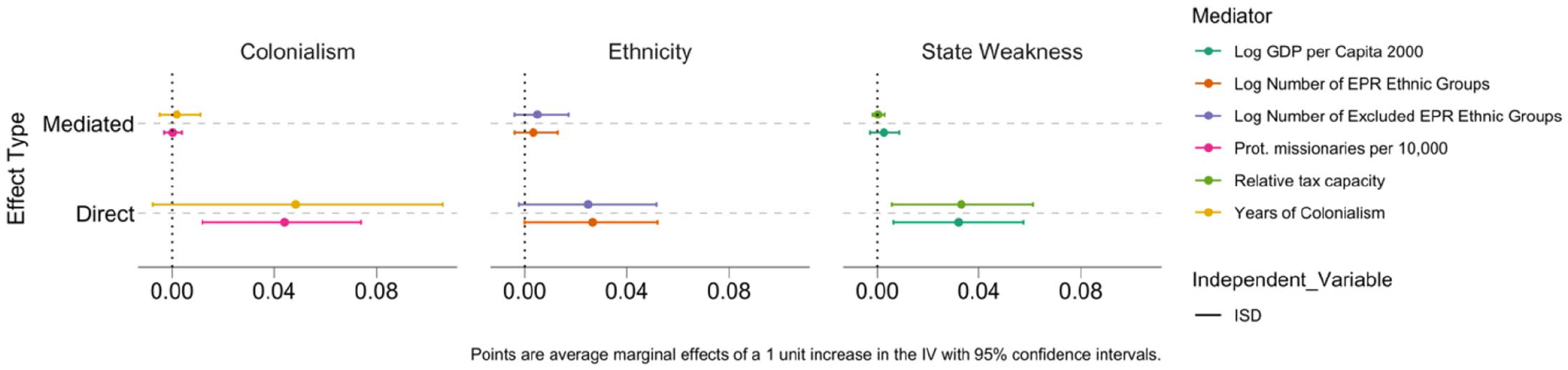
Mediation analysis, main results.
There is a little evidence that variations in colonial experiences or weak statehood transmit the relationship between HSEs and conflict. The Average Causal Mediated Effect (ACME) for log GDP per capita in 2000 and relative tax capacity are small and insignificant. The mean estimate is that close to 0 percent of the association can be attributed to lower GDP levels and only 2 percent for relative tax capacity. Both GDP and relative tax capacity have significant direct and negative associations with armed conflict. The results for colonial exposure are similar. While more HSEs are negatively associated with Conversionary Protestants (CPs), the mediated association is insignificant. There is no evidence that longer periods of colonialism mediate the association between HSEs and armed conflict.
There is also little evidence for the transmission of conflict through politically relevant ethnic groups, and there is a large direct effect that is not explained by the ethnic channel in all specifications. More HSEs are positively associated with a higher per-year average of politically relevant EPR groups, but this is not statistically significant in any models. Regardless of the way we operationalize the number of politically relevant ethnic groups across the 1946–2017 period, there are no significant associations with more HSEs. The largest estimate is that about 10.6 percent of the association between HSEs and armed conflict runs through more EPR ethnic groups, but this mediated effect is not statistically significant.
We also tested for an effect mediated by the average number of excluded ethnic groups over the 1946–2017 period and the average size of the ethnically excluded population but found little evidence a mediated effect. The number of EPR groups, the number of excluded EPR groups, and the average size of ethnically excluded populations all have strong direct effects on armed conflict levels in line with existing literature (Buhaug et al., 2014; Cederman et al., 2010, 2013), but there is little evidence that these effects are mediated though more HSEs. Our results suggest that HSEs and EPR groups are related to conflict through distinct paths, where far less is understood about the HSE-conflict link. This direct association may be evidence of the network and symbolism mechanisms at work. Finally, the mediation models act as additional robustness tests. In all the second-stage equations that estimate the impact of our treatment (HSEs) and mediators on armed conflict onsets, the coefficient for HSEs remains positive and significant at the 0.01 level. The HSE-conflict link is probably not also explained away by excluded EPR ethnic groups, modern levels of development or differential exposure to European colonialism.
Conditional effects
Figures 10 and 11 show the results of models testing whether the impact of more HSEs is mediated by the distance of those historical states from the capital, or the baseline level of development that was inherited by the state in the modern period.
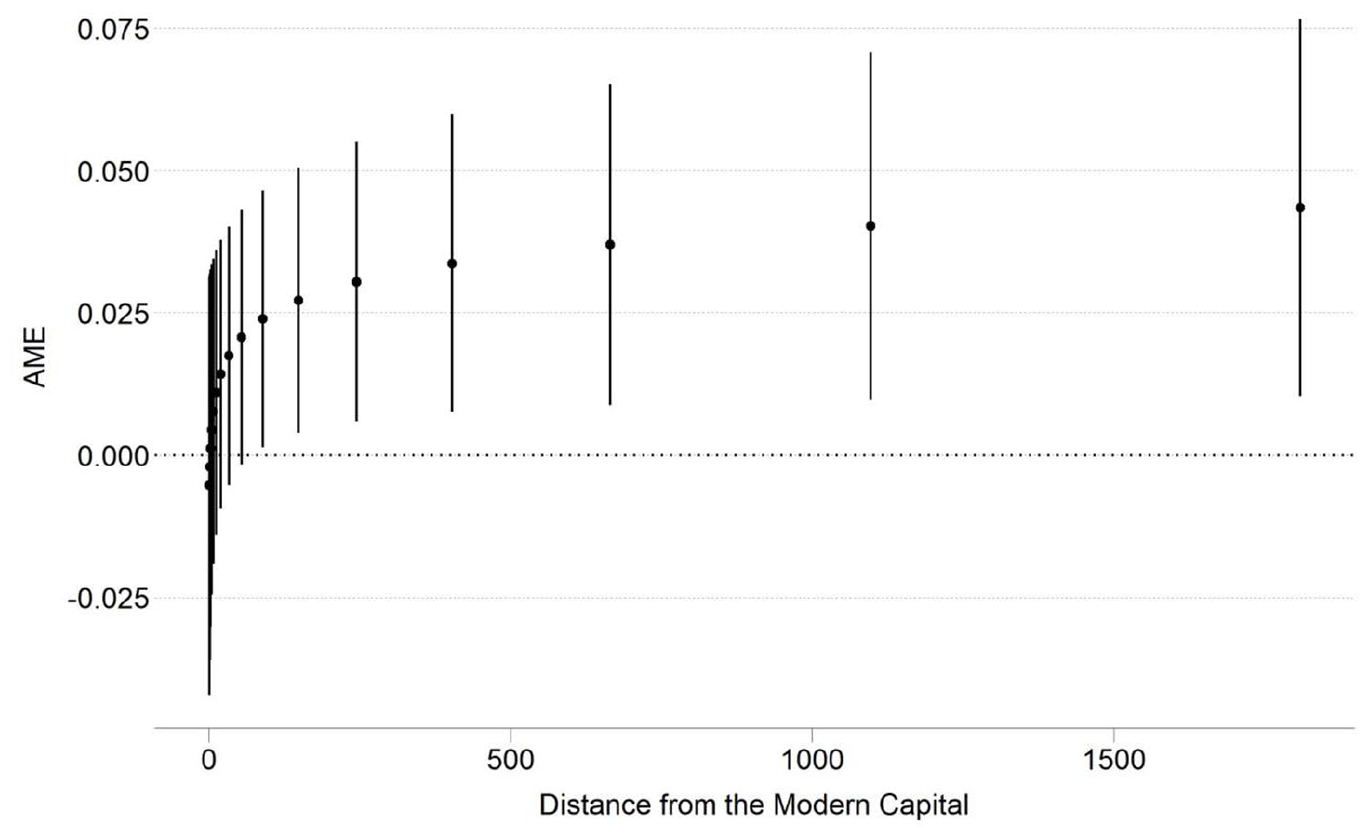
HSEs and conflict by mean distance from modern capital.
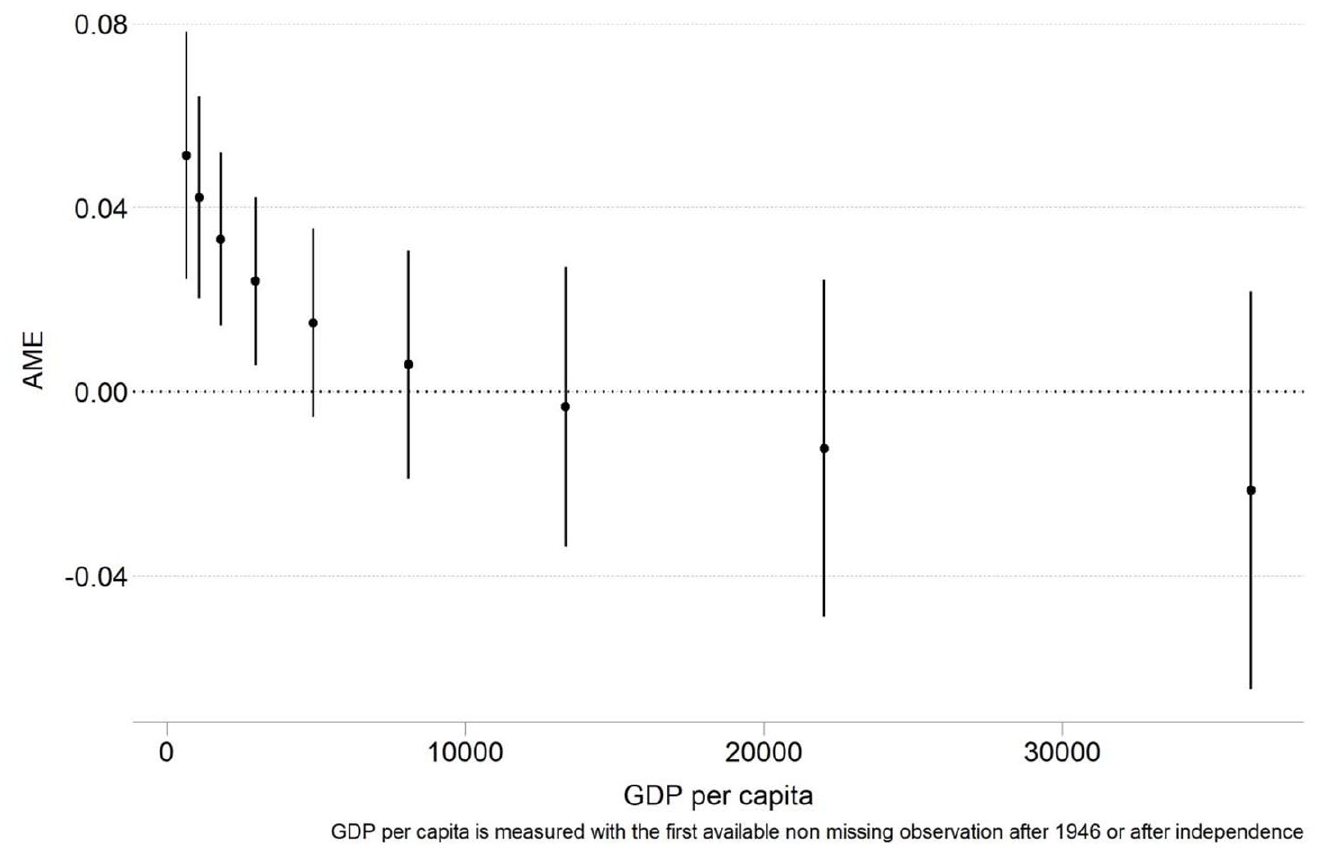
HSEs and conflict by GDP per capita.
The results suggest that HSEs have stronger impacts on armed conflict onsets when HSEs are—on average—located further from the modern capital. When HSEs are located close to the capital (including situations where the modern state inherits a historical state, such as Thailand), they do not significantly increase conflict risk. As more HSEs are located further from the capital, however, the expected onset rate for the 1946–2019 period increases.
However, HSEs are associated with more conflict onsets when the modern state is poorer in terms of GDP per capita. HSEs do not appear to have a statistically significant impact on conflict onsets at higher levels of GDP per capita, which helps explain why Italy and Germany have no recorded conflict onsets but were home to a large number of independent states between 1816 and 1939.
Overall, these results suggest that while more HSEs may not have led to conflict by making states poorer (as indicated by the mediation models), HSEs likely presented modern states with significant state building challenges where they were located in the periphery and governance is expensive, and where states had fewer economic resources or state capacity to effectively integrate older states. This is also consistent with the effect of HSEs being most pronounced in the 1946–1988 period, when many fledgling states were emerging from colonization with limited capacities.
Conclusion
Studies of historical statehood and conflict have focused on ethnic groups’ differing experiences of statehood. On the surface, our results may appear to contradict existing studies that link pre-colonial statehood to domestic peace in the post-colonial era (Depetris-Chauvin, 2016; Wig, 2016). However, it may be the case that pre-colonial statehood facilitates governance by enabling newly formed states to make credible commitments with ethnic groups (Wig, 2016) or by leaving behind institutional structures that can lower the costs of governance and provide order (Depetris-Chauvin, 2016). However, capacity for mobilization and governance, independent of the state, can be a double-edged sword. Our study suggests that pre-existing governance and mobilization structures that inhere in historical states can be turned against the state when the number of HSEs states that the regime must bargain with increases. This could be because the likelihood of bargaining failures, miscalculation, and war also increase (Cunningham, 2006; Fearon, 1995; Walter, 2009). For example, in a modern state such as Ghana or Benin, where the Asante kingdom and the Dahomey kingdom broadly overlapped with modern borders, the state can leverage these pre-colonial structures to facilitate peaceful rule. Nigeria is also host to historical states, but the larger number of states may have compounded bargaining problems to such an extent that any advantages provided by pre-colonial statehood break down.
A more important contribution of our study, however, is to identify links between historical states and modern levels of armed conflict that are not easily attributable the mechanisms that run through ethnic power relations in the post-colonial world. We suspect that the independent effect of HSEs on civil conflict comes from the mobilization infrastructures and symbols of independent statehood that historical states leave behind which can be used by conflict entrepreneurs to mobilize. Networks of rebellion need not be ethnic networks (Staniland, 2014) and HSEs can create networks of religious followers or elite networks that survive the colonial experience and exist in the modern state system. Rebel groups mobilize from a diverse array of social bases; only half of the rebel groups in the Foundations of Rebel Groups Emergence (FORGE) data have links to ethnic groups (Braithwaite and Cunningham, 2020), while another 20 percent have roots in religious groups and this is a growing proportion (Svensson, 2019). Others emerge from political parties, student groups, military defectors, and political movements, among others. Alternatively, in situations of material deprivation or grievance, historical states can provide powerful touchstones of past sovereignty upon which to construct narratives that magnify unjust oppression and create a legal basis for demands for independence (Ahram, 2019; Shelef, 2016). We do not mean to imply that ethnicity is not important, it clearly was important to historical state-building (Herbst, 2014) and modern conflict (Cederman et al., 2013), but our paper suggests that the historical states can impact conflict levels independent of their ability to make, or be made by, ethnic groups.
Of course, the direct association we observe here may still reflect omitted variable bias or another mechanism that we have not identified in this study. The conclusions that we draw are suggestive, but we argue push the research frontier forwards by identifying a puzzling direct effect, and specifying mechanisms that are likely to explain it, that can from the basis for a future research agenda.
Supplemental Material
sj-pdf-2-ejt-10.1177_13540661221106911 – Supplemental material for Beyond ethnicity: historical states and modern conflict
Supplemental material, sj-pdf-2-ejt-10.1177_13540661221106911 for Beyond ethnicity: historical states and modern conflict by Marius Wishman and Charles Butcher in European Journal of International Relations
Supplemental Material
sj-zip-1-ejt-10.1177_13540661221106911 – Supplemental material for Beyond ethnicity: historical states and modern conflict
Supplemental material, sj-zip-1-ejt-10.1177_13540661221106911 for Beyond ethnicity: historical states and modern conflict by Marius Wishman and Charles Butcher in European Journal of International Relations
Footnotes
Acknowledgements
The authors kindly thank two anonymous reviewers for excellent comments and constructive suggestions throughout the review process. They also thank Ryan Griffiths, Jan Teorell, Kristian Gleditsch, Babak RezaeeDaryakenari, and members of the Violence Instability and Peace research group at NTNU for helpful feedback and discussions. Thanks also to members of the STANCE research project for similarly helpful comments and discussions.
Funding
The author(s) received no financial support for the research, authorship, and/or publication of this article.

Supplemental material
Supplemental material for this article is available online.
Notes
Author biographies
References
Supplementary Material
Please find the following supplemental material available below.
For Open Access articles published under a Creative Commons License, all supplemental material carries the same license as the article it is associated with.
For non-Open Access articles published, all supplemental material carries a non-exclusive license, and permission requests for re-use of supplemental material or any part of supplemental material shall be sent directly to the copyright owner as specified in the copyright notice associated with the article.
