



Abstract
Recent research suggests that UN peacekeeping operations (PKOs) reduce conventional violence. However, rebel groups have been increasingly using a combination of conventional and non-conventional violence, for example, terrorism. Little is known about whether and under which conditions PKOs shape rebels’ incentives to resort to more terrorism. At the same time, existing research on the use of terrorism in civil wars primarily focuses on domestic factors, thus overlooking the impact of external shocks such as the deployment of PKOs. We argue that PKOs can have critical unintended consequences inducing tactical adaptation in rebel violence as they alter the government-rebels balance of power. Particularly, rebel groups that are militarily strong prior to the UN arrival are incentivized to escalate terrorist violence to overcome the physical barrier imposed by PKO forces and improve their bargaining position vis-à-vis the government. Weaker groups, which in the absence of PKOs are more likely to use terrorism, have not only limited capacity but also fewer incentives to escalate terrorism when PKOs deploy. Leveraging new disaggregated data on rebel terrorist attacks during civil wars, we provide the first global actor-level analysis of the relationship between PKO deployments and changes in rebels’ tactical preferences for terrorist violence. We find that, conditional on initial government-rebels power relations, PKOs can make terrorism the weapon of the strong. Our study sheds light on the unintended effects of peacekeeping, the causes of terrorism, and offers important policy implications for several current PKOs deployed in the midst of violence.
Introduction
With the last generation of United Nations (UN) peacekeeping operations (PKOs) being frequently deployed to active conflicts (Fjelde et al., 2019; Hultman et al., 2019), Blue Helmets have been facing new operational challenges. Chief among these is rebel groups’ use of terrorism as a tactic, a phenomenon which has recently grown in frequency and magnitude (Findley and Young 2012; Stanton 2013; 2019; Fortna 2015; Thomas 2014; Polo and Gleditsch 2016; Asal et al. 2019; Polo and González 2020). In relation to this challenge, the High-Level Independent Panel on Peace Operations (United Nations, 2015) 1 recommended that ‘UN troops should not undertake military counter-terrorism operations’ (p. x). The UN deputy Secretary-General Jan Eliasson, however, offered a different opinion to the Security Council in 2016, stressing that ‘terrorism and violent extremism are a reality in many contemporary conflicts, a reality which has to be dealt with’. 2 These statements reflect a timely and intense debate within the UN about whether (and how) PKOs should directly deal with the threat of terrorism.
Studies of terrorism and peacekeeping have independently highlighted two important empirical patterns. First, terrorist tactics are used frequently by rebel groups. Findley and Young (2012: 290) estimate that between 56 and 63 percent of terrorist attacks are civil war related. And yet, most explanations of rebels’ use of terrorism in civil war are domestic-focused and rarely examine how external actors may tip the balance of power and alter incentives for violence (e.g. Polo and Gleditsch, 2016; Stanton, 2013). Second, sizable deployments of peacekeepers reduce violence in civil wars (Di Salvatore, 2018; Hultman et al., 2014; Ruggeri et al., 2013). These two empirical patterns are brought together in Figure 1, which shows that the use of terrorism in civil wars has become more frequent since the 1990s, with the number of UN troops deployed to civil wars also increasing over the same period. These trends do not provide a causal relationship between PKOs and terrorism but show that peacekeeping missions deployed to active conflict are increasingly likely to face extremist violence. This article aims to shed more light on why rebel groups resort to terrorism during civil wars by focusing on how external interventions may disrupt the balance of power in civil wars. More specifically, we ask how PKOs influence rebel terrorism and under what conditions PKOs could lead to an escalation of terrorism by changing rebels’ tactical preferences. Based on previous research, we would expect that the presence and size of a UN mission can deter terrorist violence because PKOs’ monitoring, reassurance, deterrence and enforcement (Bove et al., 2020) make resort to any violence less feasible.
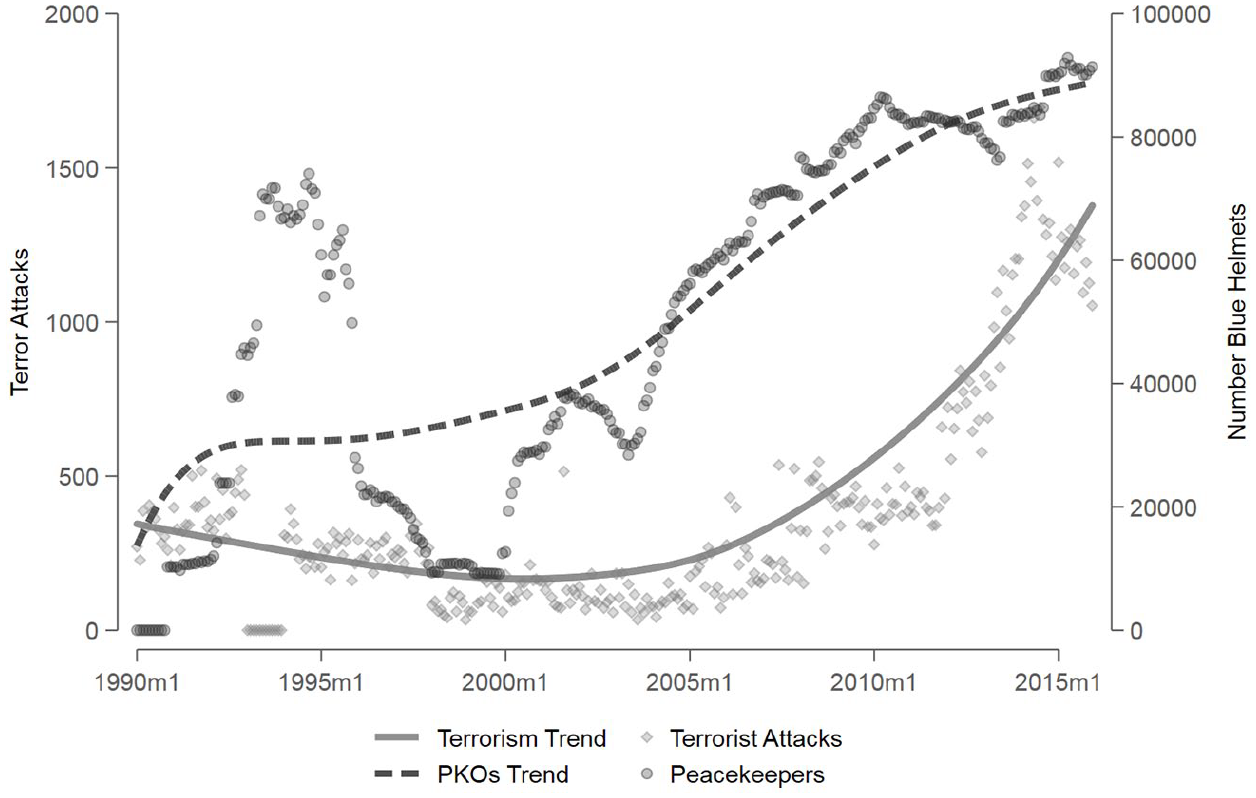
Terrorist attacks and UN deployment in civil wars.
However, we depart from existing studies that focus on aggregate levels of violence and unpack the actor-specific heterogeneity of this relationship. We contend that PKOs could trigger unintended consequences depending on the military and bargaining power between rebel groups and governments before the PKO deployment. That is because, as Fjelde et al. (2016) put it, peacekeepers ‘become a third party in the violent bargaining process’ (p. 613). Such PKO deployment not only imposes tactical constraints on belligerents’ capabilities; it also affects belligerents’ expectations about the conflict outcome and the associated payoffs. As expectations change, rebels will adapt their violence repertoires (i.e. tactical choices) in response to the PKO deployment. 3 However, not all rebel groups are equally able and willing to tactically adapt. We argue that a substantial presence of peacekeepers is associated with an increase in rebels’ reliance on terrorist violence if, prior to the PKO deployment, rebel groups had significant bargaining power relative to the government. This is because PKOs impose high operational costs on groups that are militarily stronger, and were expecting to either win the conflict on the battlefield or obtain favourable conditions at the negotiating table. By monitoring and reassuring belligerents and deterring violence, PKOs freeze the conflict and decrease the likelihood of a decisive outcome, which strong rebels expected to be in their favour. As PKOs often have the consent of the government, a PKO deployment mostly constrains the military advantage of strong rebel groups and reduces their perceived bargaining power. Weaker rebels, however, are more likely to improve their bargaining position after the arrival of PKOs, and in fact tend to cooperate with the mission (Ruggeri et al., 2013). Therefore, strong rebels will adjust to these changes by increasing their reliance on non-conventional violence, that is, terrorist attacks. The escalation of terrorism is therefore an unintended consequence of PKO deployments and rebels’ adaptation to it. Indeed, such adaptation should not be uniform across all rebel groups. The increased use of terrorism is likely to result from strong rebels’ tactical adaptation to a shrinking of their violence repertoire to pressure the government and avoid bargaining losses. A corollary of this argument would be that attacks should be targeted mostly against the government (and peacekeepers) rather than the civilian population.
We evaluate our argument using a large-N dataset that includes 103 conflicts and 197 rebel-government dyads – with the dyad-month as unit of analysis – from 1989 to 2011. Focusing on rebel-government dyads, our approach allows for an actor-level analysis of the effect of PKOs on rebel terrorism and a direct test of the mechanism of tactical adaptation, which cannot be examined in cross-national or even subnational settings that do not disaggregate actors’ use of violence (Hansen et al., 2020). Our results show that, overall, the number of UN Blue Helmets, rather than the mere presence of a UN PKO, diminishes the risk of terrorism and the level of terrorism by rebels. However, PKOs’ terrorism-curbing effect is heterogeneous and conditional on rebel-government military power relations. When rebels are weaker, large UN missions are associated with a decreasing level of terrorist attacks, whereas when rebels are stronger the presence of more peacekeepers positively correlates with the number of terror attacks by rebels. Moreover, consistent with the implication of our argument, when disaggregating terrorist attacks by targets we find that the increase in terrorism is mainly driven by attacks against government and official targets rather than attacks against private citizens. Rebels’ escalation of terrorist tactics thus reflects a strategy to impose greater costs on the government and to regain bargaining power. We also provide additional tests that document an increased targeting of UN Blue Helmets, in line with our theory. Our results are robust to controlling for missions with extremely high levels of terrorism (i.e. UNAMA in Afghanistan and UNAMI in Iraq), dyad fixed-effect, and conflict fixed-effect models. We also use matching to mitigate non-random assignment of the PKOs. We use coarsened exact matching (CEM) and selected pre-deployment variables to avoid post-treatment bias and reduce covariates’ imbalance between treated and untreated dyads. This approach provides more credible estimates of the potential effect of PKOs on terrorist violence by reducing model dependence and issues of reverse causality.
By bringing together strands of research on terrorism in civil wars and peacekeeping, this article makes two key contributions. First, our study contributes to research on the causes of domestic terrorism by examining the overlooked role of external interventions in shaping local actors’ tactical choices. Our theory incorporates changes in strategic environments and bargaining power among belligerents to understand how PKOs, by altering pre-existing equilibria, can modify rebels’ tactical preferences. Hence, our contribution shows that PKOs can have unintended consequences on rebels’ choice of tactics and targets not only post-conflict (Bara, 2020) but also during conflict and not only against the peacekeepers (Fjelde et al., 2016); more importantly, these choices result in an escalation of terrorist violence. Second, we extend existing studies of peacekeeping effectiveness in civil war, which mainly focus on battle-deaths, violence against civilians and against Blue Helmets. In doing so, we develop an argument that does not only focus on how PKOs constrain capabilities, as extant research does, but also on how they shape expectations about conflict outcomes. The result is an increase in terrorist violence, particularly against the government. The latter findings suggest that the escalation patterns we detect are not the mere result of targeting different actors (from battlefield to civilians), but of a strategic escalation aimed at weakening the government.
As a corollary, our findings highlight that the one-size-fits-all solution ‘more peacekeepers, more peace’, may backfire under circumstances we identify. Some rebel groups are spurred to adapt to interventions and broaden their violence repertoire by embracing more terrorist tactics during civil wars. This finding has broader policy implications not only for host countries but also for the peace process and the functioning of the mission itself. The use of terrorism by belligerents can be problematic as terrorism encourages military intervention in politics (Bove et al., 2020), hence threatening delicate post-conflict transitions. Furthermore, extremist violence reduces troop contributions from countries whose leaders are more sensitive to risks for their national contingents (Duursma and Gledhill, 2019).
Previous research on terrorism in civil war and peacekeeping
The question of why some groups in civil war resort to terrorism tactics while others do not, has attracted considerable scholarly attention in recent years (Findley and Young, 2012; Fortna, 2015; Polo and Gleditsch, 2016; Smith and Zeigler, 2017; Stanton, 2013; Thomas, 2014). Terrorism is the premeditated use or threat to use violence by subnational groups to obtain a political or social objective through the intimidation of a large audience beyond the immediate victims (Enders and Sandler, 2011).
Terrorism differs from other forms of civil war violence in that the immediate physical victims of terrorist attacks are usually less important than the wider audience whose behaviour rebels try to influence, and which is usually represented by the government (Fortna, 2015; Stanton, 2013). Coercion through indirect targeting differentiates terrorism from direct violence against civilians aimed at controlling a given population (Stanton, 2013) and from other forms of civilian victimization motivated by political or ethnic cleansing (Fjelde and Hultman, 2014). Moreover, terrorism differs from conventional civil war violence in that it is carried out against non-military targets, namely, targets that are not directly engaged in war-fighting activities. These include soft civilian targets (e.g. private citizens and civilian businesses), infrastructure, 4 as well as some official and government targets, such as police stations, police recruits and academies, politicians, public officials, civilian government personnel, government buildings, embassies and diplomatic personnel (Kydd and Walter, 2002; Polo, 2020). For example, the Taliban carried out several terrorist attacks against police recruits and police academies to discourage cooperation with the Afghan government. Indeed, as Kydd and Walter (2006) point out, ‘terrorists who wish to bring down a government must somehow convince the government’s defenders that continued backing of the government will be costly’ (p. 66). One way to accomplish this is to target ‘the government’s most visible agents and supporters, such as mayors, police, prosecutors and pro-regime citizens’. This allows terrorists to demonstrate their ability to hurt their opponent and that the government is too weak to protect future victims.
Existing studies explain rebel groups’ choice of terrorism mainly from a rationalist perspective (Kydd and Walter, 2002; Lake, 2002). They highlight how specific power distributions, characteristics and behaviour of government opponents, and opportunities to spread fear create incentives for rebel groups to turn to terrorism to coerce the government into making concessions (e.g. De la Calle and Sánchez-Cuenca, 2015; Fortna, 2015; Hultman, 2007; Polo and Gleditsch, 2016; Stanton, 2013; Thomas, 2014). One prominent explanation of rebel terrorism focuses on rebel groups’ military capabilities relative to the government. Building on insights from the bargaining model of war (Fearon 1995), scholars have shown that terrorism benefits weak rebels in several ways. It allows them to impose greater costs on the government relative to relying exclusively on resource-demanding conventional attacks, and to limit the costs they need to bear as the covert nature of terrorism allows rebels to evade government counteroffensives (Bueno de Mesquita, 2013; Crenshaw, 1981; Polo and Gleditsch, 2016; Stanton, 2013).
At the same time, however, most existing studies tend to see incentives for terrorism during civil wars as domestically determined, that is, generated by local factors and interactions between the main belligerents. 5 The role of international actors and external shocks in influencing armed groups’ choice of terrorism remains comparatively understudied. Yet, these external actors and shocks can substantially alter the domestic bargaining framework, including rebel-government power relations, with major implications for how rebels adapt tactically to these changes.
One prominent external factor that has been neglected in the study of rebels’ use of terrorism is third-party military interventions that alter the balance of power among belligerents. Some studies have shown that foreign occupation and unilateral military interventions trigger more transnational terrorism against the intervening country (Braithwaite, 2015; Piazza and Choi, 2018) or suicide attacks within the occupied country (Collard-Wexler et al., 2014). These studies are concerned with the backlash to foreign occupation, rather than how the latter may change belligerents’ preferences for specific violent tactics. In contrast, UN PKOs are not occupation interventions, and more importantly, they are multilateral actions based on host-state consent.
As the most prominent form of third-party intervention, PKOs impact the very factors that make rebels more willing to resort to terrorism in civil wars, as identified by the literature. First, PKOs make conventional tactics and direct confrontation not only inefficient but also unfeasible, especially when deployments are sizable (Di Salvatore, 2018). Second, the presence of PKOs may make governments more sensitive to losses and less willing to react by escalating violence to avoid legitimacy backlashes, which would increase chances of concessions. Research suggests that UN PKOs reduce battlefield violence as well as direct attacks on civilians (Fortna, 2008; Hultman et al., 2014). This literature, however, is surprisingly silent on the effects of PKOs on rebel terrorism, even though terrorist tactics are frequent during civil wars. One important exception is Hansen et al.’s work (2020) which examines the relationship between peacekeepers’ presence and subnational terrorism in 12 African countries, finding increased risk in the short term but reduced risk in the long run. While this study is an important benchmark, it does not explicitly examine which actors are more likely to increasingly rely on terrorism and why.
To examine peacekeeping effectiveness, focusing on terrorism by rebel groups is both important and necessary because PKOs are not tasked with addressing violence from other non-state actors not directly engaged in the civil conflict (Bara, 2020). Furthermore, research designs that disaggregate violence geographically rather than by actor simply do not allow testing an actor-centred theory. Our aim is to test a theory of tactical adaptation of actors, rather than geographic changes in the use of these tactics. Thus, this article attempts to get closer to the mechanism behind the escalation of terrorism by rebel groups resulting from UN deployments, while also analysing a larger sample of cases not limited to Africa.
Research on the effectiveness of peacekeeping overall agrees that missions reduce violence (Di Salvatore and Ruggeri, 2017) but surprisingly assumes a symmetric effect of PKOs on both government and rebels’ use violence. 6 However, literature on civil wars has demonstrated that rebel groups are adaptive strategic agents who often diversify tactics in response to changing environments (Polo and Gleditsch, 2016). Therefore, not only are rebels and governments affected in different ways by the presence of peacekeepers (Fjelde et al., 2019; Ruggeri et al., 2013), but even among rebels we are likely to observe heterogeneous responses and adaptation strategies. PKOs may reduce certain forms of conventional rebel violence while inadvertently pushing rebel groups to expand their violence repertoire to alternative tactics, such as terrorism, which allow groups to evade the obstacle represented by the presence of peacekeepers. Hence, PKOs may exacerbate incentives for the escalation of terrorist tactics by those groups who do not want to give up their chances of winning the war or extracting concessions from the government. Hereafter, we develop a theory explaining under what conditions peacekeeping inadvertently creates incentives for rebel escalation of terrorist tactics during civil wars.
Theoretical framework and empirical expectations
UN PKOs reduce battlefield violence by increasing the cost of fighting through several mechanisms, most prominently monitoring, reassurance, deterrence and enforcement (Fortna, 2008; Hultman et al., 2014; Ruggeri et al., 2013). While the first two mechanisms (monitoring and reassurance) mostly affect information and uncertainty about belligerents’ actions and preferences, the latter (deterrence and enforcement) affect the costs of specific actions.
UN missions with large military contingents are better equipped for gathering information through monitoring and better able to reassure vulnerable actors. These activities are relevant because they ensure governments and insurgents remain committed to peace agreements. Moreover, peacekeepers with activities and mandates focusing on deterrence and enforcement can act as credible guarantors of combatants’ compliance by increasing the cost of opportunistic behaviours. But peacekeepers do not just make violence militarily costlier, they make it politically costlier as well (Fjelde et al., 2019). If PKOs make resorting to violence less appealing for rebels, we would expect this to be true for both battlefield and terrorist violence. Terrorism may become more feasible if rebels want to overcome the military cost peacekeepers bring about. However, we argue that rebels will perpetrate terrorist attacks only if they still find violence appealing and have the capacity to carry out the attacks. As we discuss in the next section, this effect, combining incentives and opportunities, is conditional on the pre-deployment, domestic power relations between rebels and the government, and how these are affected by the deployment of a UN mission.
Changes in strategic environment and bargaining power: when PKOs escalate terrorism
While we expect UN PKOs to affect rebels’ choice of terrorism in civil wars (as others have also shown, see Hansen et al., 2020), we reiterate the need to consider which factors enable rebels’ adaptation. PKOs are not deployed in a vacuum; their effect on belligerents’ behaviour is influenced by pre-existing local conditions and by the specific responses of the warring parties to changes brought about by the PKO (Di Salvatore, 2018). Against this background, we develop a theory of rebel groups’ heterogeneous responses to PKOs and show how this induces some rebels to escalate terrorist violence.
To understand these dynamics, it is necessary to consider the strategic environment in which rebel groups operate and how this is affected by the arrival of PKOs. We suggest that the strategic environment can be influenced by both internal and external factors. Internally, elements that are pertinent to the domestic domain such as the power relations between actors (Cunningham et al., 2009; Eck and Hultman, 2007) and the existence of structural resources (Weinstein, 2006) can constraint or facilitate certain violent tactics. The strategic environment can also be shaped endogenously by conflict dynamics due to losses on the battlefield and changes in territorial control (that are crucial for power relations), violence against civilians (Wood, 2014) as well as rebel attacks against peacekeepers (Fjelde et al., 2016). Externally, international factors such as external support also influence domestic interactions and the technologies of rebellion rebels choose to adopt (Kalyvas and Balcells, 2010; Regan, 2002; Wood et al., 2012).
We conceptualize PKO deployments as an external shock that shapes rebels’ strategic environment. Existing studies argue that peacekeeping operations deployed in the midst of conflict can make violence costlier relative to other forms of resolution. However, the deployment of a UN mission does not only affect the costs of fighting (or cooperating), but also the time horizon of the conflict. Not only UN missions shorten the perceived time horizon of the conflict for belligerents (Fjelde et al., 2016: 613), they also shape belligerents’ expectations of their future power relations as the end of the conflict approaches. This is because, as we argue, peacekeepers’ deployments signal a strong commitment by the international community for a negotiated solution. Hence, PKOs change actors’ expectations about the likely duration and outcome of the conflict, especially for rebel groups who, unlike governments, are not required to consent to a PKO. In practice, by effectively separating combatants, PKOs can make a conflict ripe for non-violent resolution, facilitate negotiations and reduce the duration of the conflict (Kathman and Benson, 2019). These effects are often implicitly assumed to be beneficial for all warring actors. While this is likely to be true for governments, whose consent is required for PKO deployments in active conflicts, it is not necessarily true for rebels. For governments, expectations of how a PKO will influence the conflict trajectory are already factored in when a government consents to the mission. In contrast, rebels’ consent is not required for missions’ authorization. Hence, rebels are under greater pressure to adapt their tactics after deployment compared to governments.
As elaborated also by Salverda (2013), the power relations between rebel and government forces at the time of deployment play a crucial role in shaping rebel responses to PKOs. In particular, we argue that the strength of the rebels relative to the government explains whether rebel groups stand to benefit or lose from the arrival of peacekeepers. For peacekeepers to represent a credible threat for potential peace spoilers and non-compliers, the international community and contributing countries must signal their willingness to incur costs when protecting weak parties (Ruggeri et al., 2013). As weak actors are the most vulnerable to exploitation by the stronger side, the deployment of PKOs may be ‘seen as a source of protection and as a way to help overcome the commitment problem’ (Salverda 2013: 210). Hence, the arrival of peacekeepers is expected to affect the tactics of non-state actors but this effect is heterogeneous across rebel groups.
To understand this heterogeneous effect, let us first consider how power relations affect rebel incentives for terrorism in the absence of PKOs. In the absence of deployments, research has shown that terrorism is usually a ‘weapon of the weak’ (Crenshaw, 1981: 387). Conventional attacks against government military forces require significant resources and are therefore inefficient for rebel groups with low-military capabilities. Instead, the low resource-costs of terrorism make the latter a much more cost-effective tactic to impose costs on the government and its supporters (Bueno de Mesquita, 2013). Furthermore, conflicts with weak rebels are often characterized by greater information problems due to rebels’ avoidance of direct confrontations with government forces. Terrorism can help overcome this uncertainty, and improve rebels’ bargaining position, by allowing rebels to signal their goals, resolve, and capacity to hurt the opponent. In contrast, strong rebels face opposite incentives. By virtue of their high military capabilities, these groups can fully exploit conventional attacks to coerce the government and generally refrain from terrorism, which is unnecessary for them and could potentially tarnish their legitimacy as rivals to the state (Fortna, 2015; Polo and Gleditsch, 2016).
The deployment of PKOs fundamentally alters this scenario and changes weak and strong rebels’ incentives for terrorism. In the presence of large power asymmetries, PKOs are more likely to benefit weak rebels vis- à-vis the government by protecting them from exploitation (Salverda, 2013). As we argued earlier, in the absence of deployments, relatively weak groups resort to terrorism more frequently to impose costs on the government through indirect confrontation. But when PKOs are deployed, these rebel groups can either continue using terrorism or abandon terrorism to attempt the non-violent option of negotiations, which becomes more likely and attractive under PKOs’ oversight. They are unlikely to escalate the conflict because the mission’s presence now further shrinks their opportunity for conventional violence and increases its cost. Thus, we argue that, in the presence of a UN PKO, less militarily powerful rebel groups have incentives to reduce the use of terrorism to signal to the government and to the international community their trustworthiness and credibility as negotiating partners. In contrast, rebel groups that have greater military capacity that approximates government power, have higher expectations of military victory. Hence, they will perceive the arrival of peacekeepers as hampering their opportunities for military action and undermining their prospect of success (Ruggeri et al., 2013). In response, relatively stronger rebels will adapt to the PKO by broadening their tactical repertoire and escalating the use of terrorism. This strategy allows rebel groups to continue imposing costs on the government and maintain their bargaining position, while using tactics that are more difficult to prevent and sanction for PKOs than conventional battlefield violence. It also follows, as we conjecture, that terrorist attacks by strong rebels will mostly be directed against official and government targets rather than soft civilian targets. Again, though, we stress that our theory and analysis focus on a logic of escalation and broadening of violence tactics rather than perfect substitution or ‘displacement’ between conventional and non-conventional tactics.
To summarize, the effect of UN deployments on rebel tactics is heterogeneous and conditional on the power relations between domestic actors before the mission’s deployment. While UN missions can lead rebels towards moderation and de-escalation, as existing studies would suggest, changes in conflict outcome’s expectations induced by PKOs can push relatively stronger rebel groups to escalate the level of violence by increasing reliance on terrorist tactics. We refrain from labelling this strategy as ‘spoiling’ because the literature on spoilers fails to identify spoilers’ ex-ante (Stedman, 1997) and, more importantly, because we focus on how some actors have ex-ante motivation and opportunity to adopt terrorism to influence, rather than spoil, conflict outcomes. Thus, contrary to previous work highlighting how minorities will try to spoil the peace once an agreement is negotiated (Kydd and Walter, 2002), we argue that strong rebel groups will aim to regain their bargaining power once conditions on the ground have changed. Some of these groups might be aiming at military victory or other outcomes, but the specific desired outcome is irrelevant to this tactical adaptation. The arrival of a PKO decreases the bargaining power of relatively stronger groups and these groups will attempt to regain such power, unlike weaker rebel groups who likely find themselves in a better bargaining position after the UN deployment (Ruggeri et al., 2013). Therefore, terrorism is not necessarily a weapon of the weak; it is so, on average, but peacekeeping can turn terrorism into a weapon of the strong.
Based on the above discussion, our empirical expectation is that the effect of PKOs on rebel terrorism is conditional on the power relations between rebels and government:
H1. Larger PKO deployments will increase use of terrorism by rebel groups that are stronger than the government.
Data and research design
We test our hypothesis using a sample of active rebel–government dyad months (our unit of analysis) covering 103 domestic conflicts from 1989 to 2011. 7 In total, we have 197 dyads over time. Data on active conflicts between insurgent and government forces come from the Uppsala Conflict Data Program Georeferenced Events Dataset (UCDP GED; Sundberg and Melander, 2013). 8 We link insurgent groups from this dataset to terrorist organizations in the Global Terrorism Database (GTD, LaFree and Dugan, 2007) to identify whether rebel organizations engage in terrorist attacks in each conflict-month. To match organizations, and avoid overcounting terrorist attacks, we follow a similar procedure as Polo and Gleditsch (2016). Specifically, we code as a match only organizations that appear in both datasets with the same or reasonably similar names. 9 We apply a conventional definition of terrorism based on the fulfilment of all three criteria outlined by the GTD. 10 A terrorist attack is the intentional use of force to coerce, intimidate or convey a message to larger audiences than the immediate victims; it has a political, economic, religious or social goal; and it takes place outside legitimate warfare activities. This definition captures the targeting of non-combatants while it excludes attacks against military targets, which we regard as instances of guerrilla warfare. Indeed, to ensure consistency between our theoretical and empirical definition of terrorism we have dropped all terrorist attack against military targets, even if they take place against infrastructure or non-combatant personnel. In contrast, conventional battle events reported in the UCDP GED typically include rebel attacks on government troops and soldiers. A comparison of monthly levels of rebel terrorist attacks and battle events in our dataset reveals a very low average correlation, around 0.1. This confirms that the two types of violence are conceptually and empirically distinct. In the Supplemental Appendix (Figures FA1 to FA4), we provide an extended discussion of these comparisons and present disaggregated patterns of terrorist attacks and battle events for a sample of rebel groups. These, too, demonstrate major empirical differences in the two types of violence. Furthermore, as highlighted by Stanton (2013), most terrorist violence involves the use of means that make it distinct from conventional violence. Terrorist violence more often uses bombs or weapons with ‘substantial firepower’ instead of, for example, artillery (Stanton, 2013: 1014). 11 This suggests additional available criteria that credibly distinguish terrorist violence from other violence (e.g. conventional attacks against civilians) in civil wars. Indeed, the low correlation between all the terrorism-related variables we code from the GTD and battle events from the UCDP GED is observed also with respect to other forms of civil war violence, such as events of one-sided violence against civilians.
We use the following two dependent variables to gauge diverse facets of terrorism tactics used by rebels: (1) a dummy variable indicating whether in a given month a rebel group carried out any terrorist attack and (2) a count of rebels’ terrorist attacks in a month. We also disaggregate the number of attacks in attacks against soft civilian and against government targets, since not all terrorist attacks target unarmed civilians. Ultimately, if our argument is correct and strong groups attempt to keep violence high to avoid losing bargaining power relative to the state, we would expect rebels to use terrorism mainly against government targets. Attacks against the government are defined as those involving hard targets, government officials and infrastructure, and police. 12 Examples include attacks on a government building; government member, former members, including members of political parties in official capacities, their convoys or events sponsored by political parties; attacks on judges, public attorneys (e.g. prosecutors), courts and court systems, politicians, royalty, head of state, government employees; members of the police force or police installations; jails or prison facilities and staff. 13
In Table 1, we report the descriptive statistics of our two dependent variables. On average, 49 percent of our observations had a terror attack. On average, each dyad reports more than two attacks in a month, further corroborating the notion that terrorism is relatively common in active civil wars.
Descriptive statistics dependent variables (unit of analysis = month-dyad).

In Figure 2, we show the incidence of terrorism by group type. More specifically, the bar plot shows that for all weak rebel groups, 34 percent of group-month observations recorded at least one terrorist attack; the percentage is much lower for strong groups, where only 8 percent of group-month observations recorded the use of terrorism.
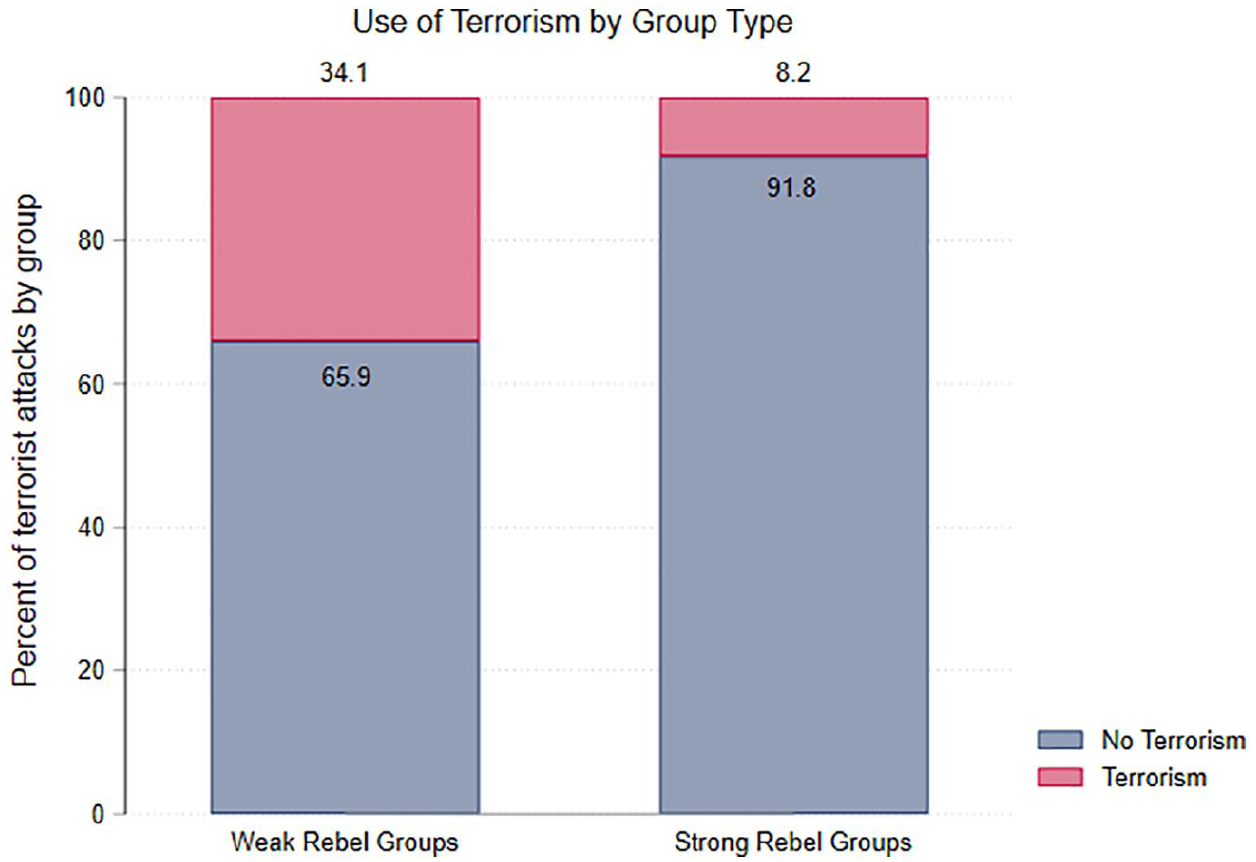
Use of terrorist attacks for weak and strong rebel groups.
Furthermore, from the data we see that, out of 197 rebel groups in our sample, 98 experienced peacekeeping at least once, but only 30 of them became first-time adopters of terrorism after the arrival of peacekeepers. The vast majority of rebel groups had already used terrorism at least once before the arrival of peacekeepers, hence there is little support for the substitution argument according to which rebels switch from conventional warfare to terrorism after UN arrives. Conversely, in most cases, groups escalate violence and use terrorism more often than they did prior to PKO deployment, consistent with our expectations.
We use a logit estimator for the occurrence of terrorist attacks and negative binomial regressions for the number of attacks in a month (Long and Freese, 2006). As our main explanatory variables for peacekeeping, we use the simple presence of a UN mission in a dyad-month (dummy) and the log-transformed size of the UN military deployment. 14 The second main explanatory variable measures the balance of power between the government and the rebel group in the dyad. It is built from the ratio of troops from the two sides, using time-varying, annual data on rebel and government troops from Wood (2010), Polo and Gleditsch (2016) and the UCDP Conflict Encyclopedia. The variable is then transformed into a dummy taking the value of 1 for strong groups, that is, when the power ratio is above 1.
Following Polo and Gleditsch (2016), who investigated under what conditions rebels are more prone to use terrorist tactics, we control for country-level characteristics such as the level of democracy (Marshall and Jaggers, 2002), population size and gross domestic product per capita (GDP PC, Gleditsch, 2002) given that these factors are consistently fund by previous works as predictors of terrorist tactics by the rebels. In terms of conflict features – to avoid that our findings are led by diverse conflict dynamics – we control for the number of conflict actors involved in the civil war, the level of violence against civilians (one-sided violence, OSV) and battlefield clashes (Cunningham et al., 2009) and whether rebels receive external support. 15 All covariates are lagged to the previous month and all models include standard errors clustered by conflict. The specification, in order to account for temporal autocorrelation, also includes a cubic polynomial of time periods since the last terrorist attack was perpetrated (Carter and Signorino, 2010).
A common challenge in peacekeeping research is that missions are not deployed randomly. Not only some features of the conflict may affect the probability of deployment, but terrorism itself may be a reason for the UN to send troops. In other words, we need to consider issues of selection bias and reverse causality between deployment of peacekeepers and levels of conflict in host countries. To provide a correction to this, we use CEM to prune our sample and reduce the imbalance of covariates across dyads (Iacus et al., 2011). Matching is based on pre-deployment levels to avoid post-treatment bias, hence reducing concerns over reverse causality. We match observations on pre-deployment levels of violence (one-sided and battlefield) and levels of terrorism, population size and GDP per capita. Countries in our sample vary significantly on these specific features, reporting an imbalance measure (L1) of 0.7. After CEM, the imbalance in the sample drops to an L1 of 0.3. Also, and we are able to match 99 rebel groups from the original sample. In Supplemental Appendix (A8a and A8b), we present models using CEM weights from an alternative set of covariates, including conflict duration (Supplemental Appendix 8b) that are not related to previous levels of violence but do exhibit some degree of imbalance in our sample, and this does not affect our estimates significantly. This means that, when we use the pruned sample, we can compare conflicts with and without UN PKOs but with similar history of terrorism and violence. Therefore, we mitigate the risk of reverse causality and non-random assignment associated with the observable covariates that were responsible for high imbalance. Finally, the models we show in the main analysis do not include fixed effects, but the Supplemental Appendix shows consistent results when we include either conflict fixed-effect (A3) or, more importantly, dyad fixed-effect without and with CEM weights (A10 and A11, respectively). The latter imposes more restrictions on our model but more accurately captures within-group tactical changes over time.
Discussion of statistical results
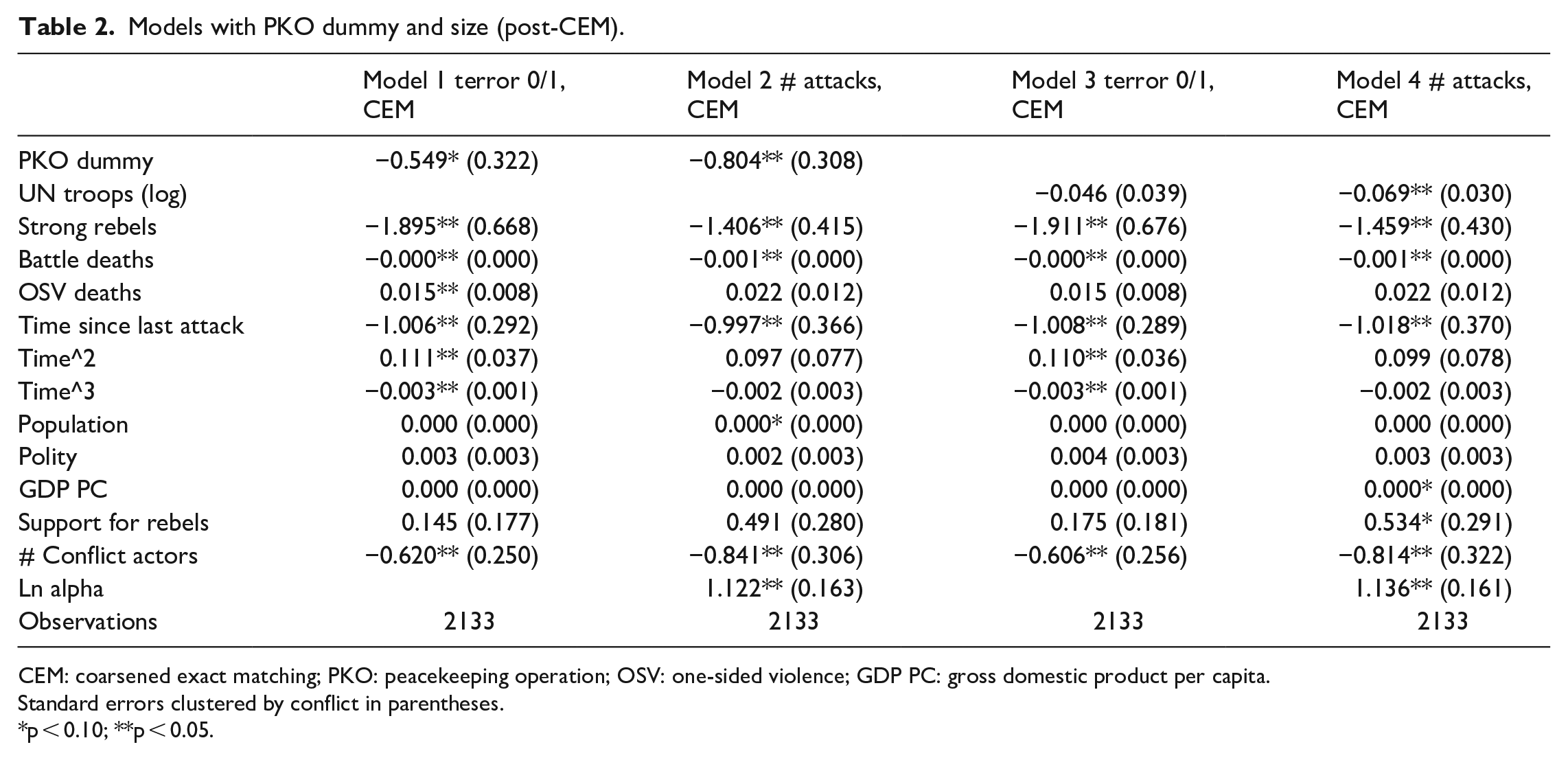
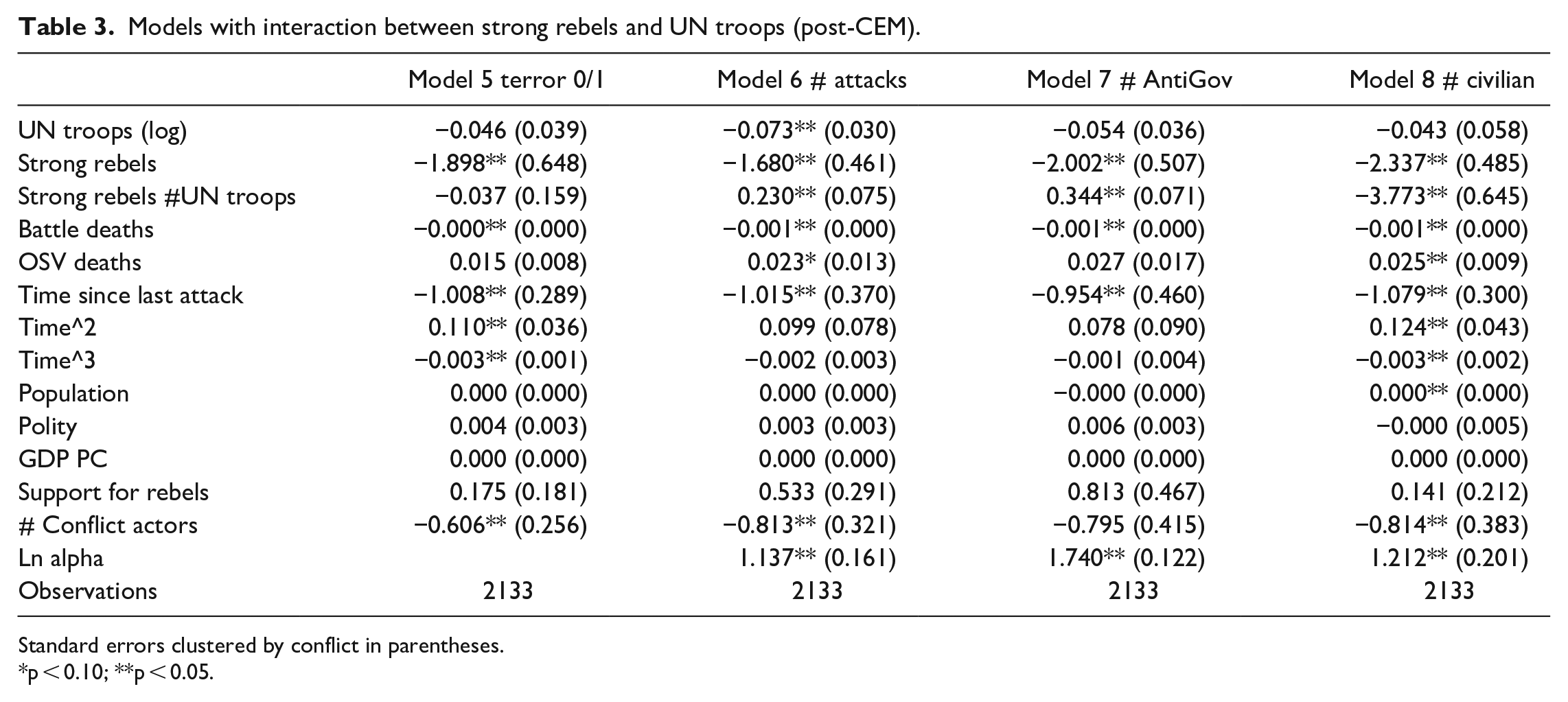
Table 2 provides the baseline models post-matching to evaluate the average effect of peacekeeping on terrorism within dyad-months. We use terrorism onset and number of attacks as main dependent variables. In Models 1 and 2, peacekeeping is measured by a dummy variable while we logged mission size in Models 3 and 4. In our analysis, we exclude outliers, namely groups that score higher than 3 on the balance of power variables. Recall that this is a ratio of rebel-government troops. In Table 3, we then interact balance of power with UN troops to test our main hypothesis that strong groups adjust to peacekeeping differently from weak ones. In the Supplemental Appendix (A1), we report the same models on the full sample (without matching) for comparison.
Models with PKO dummy and size (post-CEM).
CEM: coarsened exact matching; PKO: peacekeeping operation; OSV: one-sided violence; GDP PC: gross domestic product per capita.
Standard errors clustered by conflict in parentheses.
p < 0.10; **p < 0.05.
Models with interaction between strong rebels and UN troops (post-CEM).
Standard errors clustered by conflict in parentheses.
p < 0.10; **p < 0.05.
In Models 1 and 2 in Table 2, PKO presence seems to curb terrorism and its incidence. Large UN contingents also have a negative impact on terrorism, although mostly on the number of attacks (Model 4). The coefficient plot in Figure 3 shows a comparison of the effects of PKO presence and PKO size; this figure also allows to compare estimates before and after matching is performed. In the first group (left panel), we used the dummy for peacekeepers’ presence (as in Models 1 and 2), while in the second figure (right panel), we used the logged number of peacekeepers in a country (as in Models 3 and 4). Once differences in pre-deployment factors are accounted for, mere presence of peacekeepers results in lower odds of terrorism and number of attacks. Furthermore, more UN troops manage to curb the number of attacks, but not necessarily the likelihood of terrorism onset. This provides support to the intuition that, on average, peacekeeping missions can contain terrorism in host countries. Notice that strong groups consistently use terrorism less often than weak groups, as shown in Table 2. It is also noteworthy that battlefield violence has a negative effect on terrorism, thus pointing towards the possibility that some groups may use more terrorism when they cannot confront the government militarily due to the presence of UN troops. Violence against civilians, however, has no clear association with levels of terrorism.
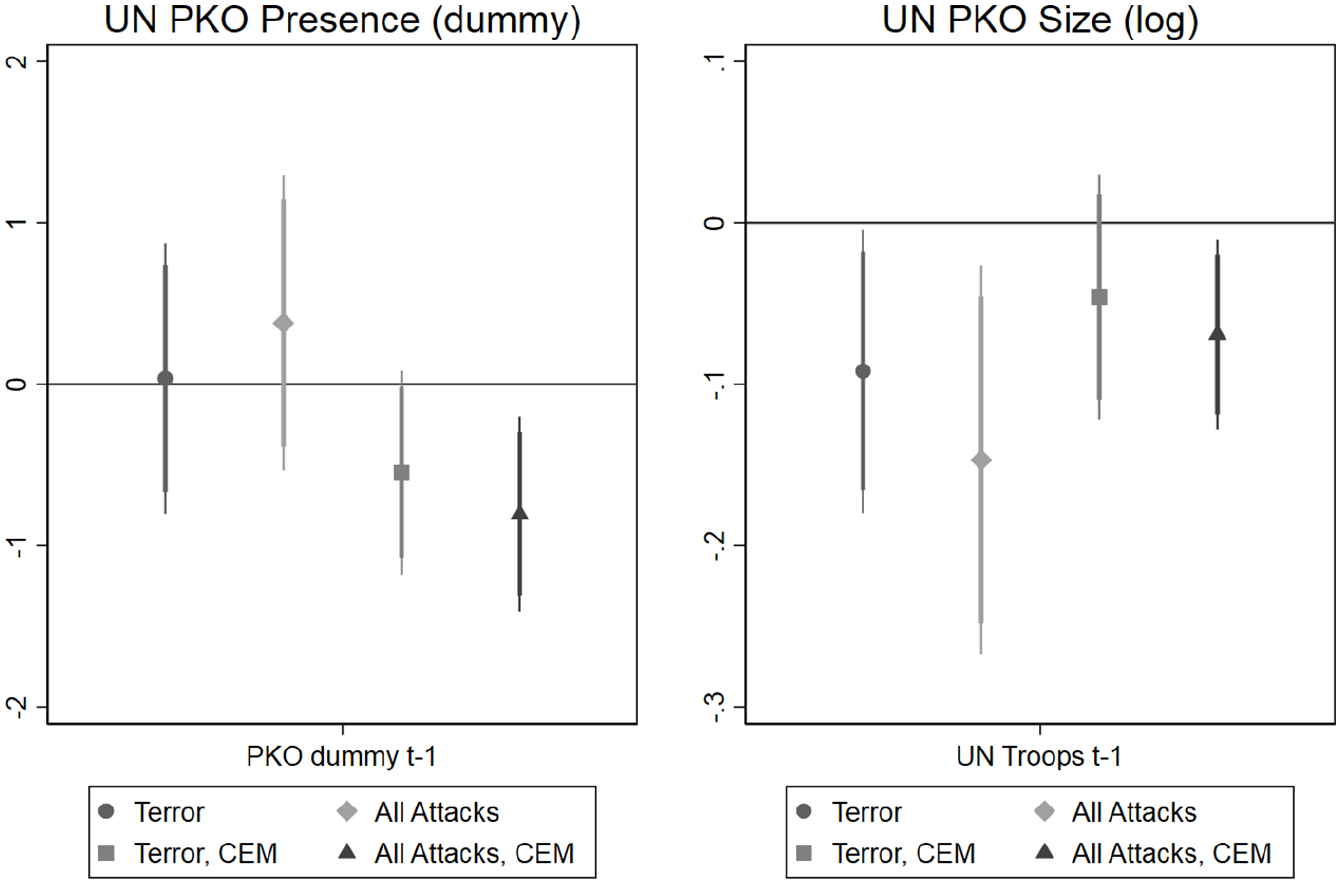
Effect of PK as dummy and as number of troops. 90 percent (thick lines) and 95 percent (thin lines) confidence intervals reported.
Hence, there seems to be some support for the idea that terrorism is the weapon of the weak. However, we have hypothesized that peacekeeping may create heterogeneous incentives for the use of terrorism among rebel groups depending on belligerents’ power relations. Given the more consistent results on the impact of size in Table 2 before and after matching, we focus on the conditional effect of peacekeeping missions’ size only, thus excluding models where PKOs are measured dichotomously. Models in Table 3 investigate this hypothesis by interacting UN military deployment with the dummy for strong rebel groups. We also disaggregate attacks by type, distinguishing government targets (Model 7) and civilian targets (Model 8). The coefficient for strong rebel groups retains its negative sign and strong statistical significance, confirming that in the absence of PKOs, rebel groups with a military advantage use less terrorist tactics. UN troops also have a negative coefficient, but it is only significant in relation to the overall number of terrorist attacks in a dyad-month. This indicates that the impact of the mission on the probability of terrorist attacks is independent of rebels’ strength on average (Model 5), but it is conditional on power balance if we distinguish attacks by targets (Models 7–8). Indeed, all models indicate a conditional impact of peacekeepers on the number of attacks as shown by a statistically significant interaction term.
Except for the likelihood of attacks, it seems that stronger rebel groups use terrorist violence more frequently when large UN missions are present. This provides support for our argument that the effect of PKOs is unlikely to be homogeneous and to equally affect all rebel groups. Groups adapt differently to PKOs, and stronger ones may escalate their use of terrorist attacks.
It is also noteworthy that they increasingly target the government, which in our theoretical framerwork is consistent with the attempt to reduce government’s advantage due to the international military presence. Terrorist attacks against civilians do not increase; 16 on the contrary, civilians are less likely to be targeted by terrorism under PKOs protection. This is consistent with the findings in the peacekeeping literature according to which PKOs do protect civilians from conventional violence, and apparently from terrorist violence as well. Indeed, our theoretical account hinges on the insight that rebels will use terrorism in the attempt to regain an advantage over government, rather than getting concessions by targeting civilians. In other words, the effectiveness of PKOs in protecting civilians from any form violence is not in contradiction with the finding that rebels will target government’s actors with terrorism. This is, in fact, in line with the expectation that terrorism will be used to rebalance the rebels-governments power relations. In Figure 4, we plot the predicted terrorist attacks conditional on the size of the UN mission and the balance of power between rebels and the government. 17 These are based on estimations in Table 3. We plot predictions of the count of attacks in two scenarios, one with weak rebels (black circles) and one where rebels are stronger than the government (hollow black circles).
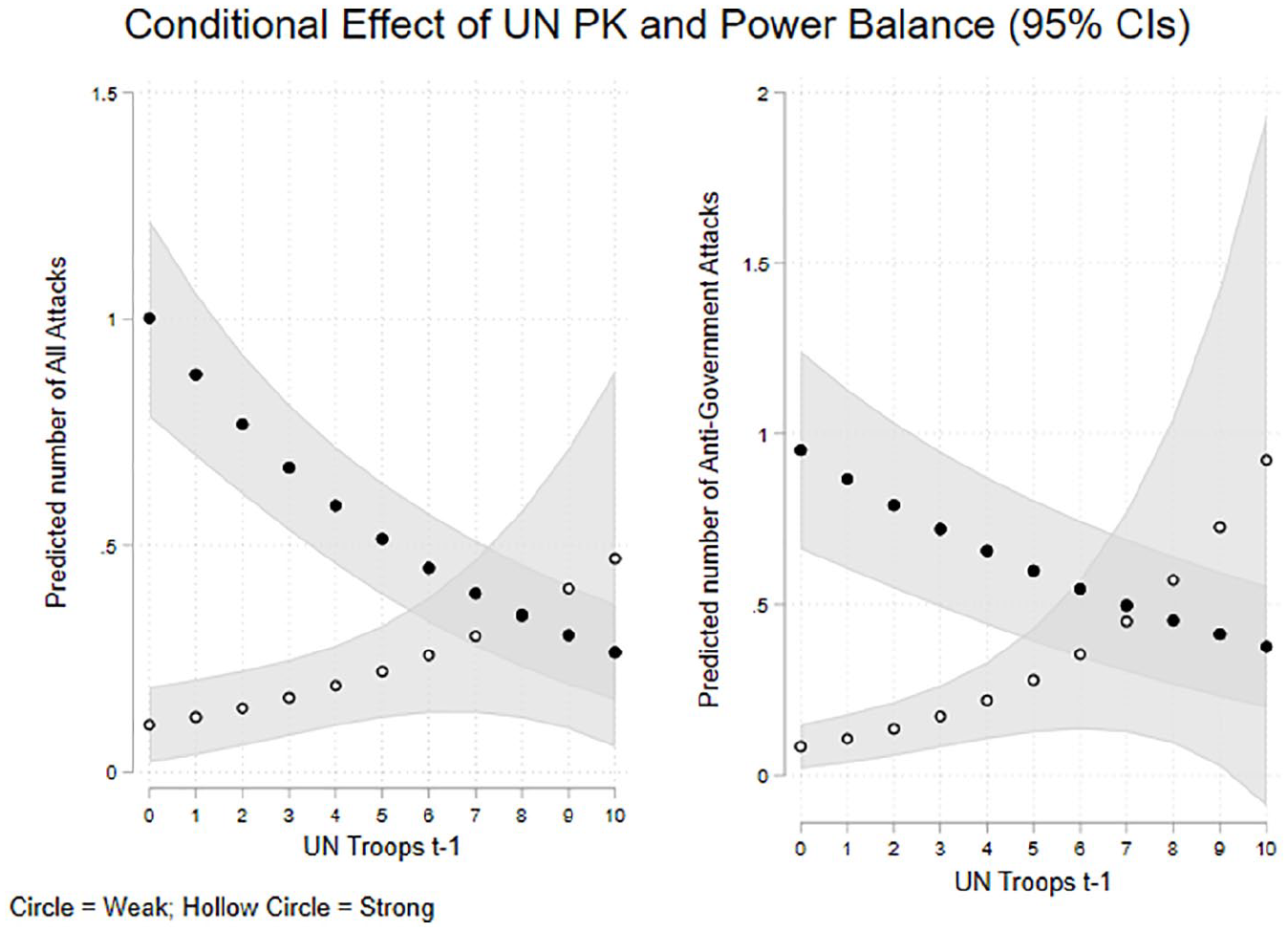
Predicted number of monthly terrorist attacks (total and against government). 95% confidence intervals (shaded areas) reported.
Figure 4 shows that weak groups are more likely to use terrorism when no troops are deployed but less so as the number of UN troops rises. Conversely, strong groups resort to terrorist violence less in the absence of peacekeeping missions, but their willingness to use terrorist tactics seems to rise sharply as UN troops join the conflict. The left panel in Figure 4 shows that the level of terrorism used by strong groups is comparable to weak groups in the presence of very large deployments. But when attacks are disaggregated, we see that the level of anti-government terrorism continues to grow for strong groups and becomes significantly larger than the number of attacks perpetrated by weaker groups (Figure 4, right panel). Hence, sizable deployments may result in several anti-government terrorist attacks that are significantly higher than the predicted number of attacks from weak groups when no peacekeepers are deployed. While in other cases, as mentioned, we see a convergence in the use of terrorism between weak and strong groups, this finding suggests potentially harmful unintended effects of PKOs according to which very large deployments will increase substantially the level of terrorism in host countries. This is likely to come at the expense of the national government.
An important corollary of our argument is that strong groups will be more likely to target the government and the peacekeepers in order to regain their bargaining power. Previous research showed how the relative power relations of local rebels affected patterns of violence against peacekeepers (Salverda, 2013). In the Supplemental Appendix (A7), we show that it is indeed the case that strong rebel groups are significantly more likely to attack peacekeepers than weak groups. Unfortunately, the temporal and spatial coverage of the Peacemakers at Risk dataset (Lindberg Bromley, 2018) results in many missing observations, which is why we do not delve further into this argument. However, we stress that this is additional evidence in favour of our expectation that, depending on their strength relative to incumbents, rebel groups will adapt and react differently to UN PKOs deployment by varying their repertoires of violence. These findings are in line with recent work that has highlighted how the obstruction of peacekeeping is used strategically to mantain an operational space to victimize civilians (Duursma, 2019). Finally, in the Supplemental Appendix, we perform additional robustness checks on our models; our results are robust to the inclusion of a control for groups with higher levels of centralization (A5), a 12-month moving-average measure of terrorist attacks (A9), both dyad-fixed effects (A.10 and A.11) and conflict-fixed effects (A3), the inclusion of dummies for the UN interventions in Iraq (UNAMI) and Afghanistan (UNAMA) (A4) and jack-knifed standard errors by conflict cluster (A6).
Conclusion
Does the deployment of UN peacekeepers affect rebels’ use of terrorist tactics? And, if so, under what conditions could UN PKOs incentivize rebels’ reliance on terrorism instead of deterring it? The HIPPO report echoes anecdotal evidence to suggest that ‘UN peacekeeping missions, due to their composition and character, are not suited to engage in military counter-terrorism operations’ (United Nations, 2015: 31). As a matter of fact, the ‘Indian-led mission in Sierra Leone [. . .] fell victim to terrorist attacks due to insufficient training and the credibility problem of the force commander and troops’ (Solomon, 2007). In Mali, where extremist violence prevails, the UN solution has involved two separated but coordinated missions, namely one dealing with conflict resolution and terrorism (MINUSMA) and the French counterterrorism operation (Barkhane). They operate with an explicit division of labour: MINUSMA’s mandate is to support and extend the central authority’s control in areas where rebels use terrorist tactics and it is ‘the first multidimensional peacekeeping operation to be deployed in parallel with on-going counterterrorism operations, the French Opération Serval and Opération Sabre, later transitioned into the current Opération Barkhane’ (Karlsrud, 2017). However, ‘in practice, the distinction falters in the face of the difficulties and the local forms of instrumentalization involved in distinguishing terrorists from legitimate combatants (or insurgents)’ (Charbonneau, 2017). These cases are worrisome. Terrorist tactics in civil wars are frequent and follow a rising trend. As Stanton (2019) suggests, we still have to analytically and theoretically disentangle the use of terrorism by insurgents. As an avenue of research, she suggests that two literatures that usually do not talk to each other, namely terrorism and civil war, be further developed together. In this article, we have taken this challenge a step further and brought together three literatures that rarely interact, adding the lessons learned from the peacekeeping literature (Fjelde et al., 2016; Ruggeri et al., 2017; Salverda, 2013).
Sizable PKO deployments could limit the use of terrorist tactics by rebels through mechanisms that reduce uncertainty among belligerents and impose additional costs on actors pursuing violent strategies. However, we have argued that in addition to imposing military costs peacekeeping also changes belligerents’ expectations about the likely outcome of the conflict. Rebel groups respond to this change in the strategic environment asymmetrically, depending on their pre-existing military power relations with the government. When rebels are militarily weaker than the government, PKOs will mostly impose costs on the incumbent forces and, therefore, a military stalemate between the two parties may provide a ripe moment for non-violent interactions. As a result, the conflict will experience lower levels of terrorism perpetrated by the rebel group. On the contrary, when a rebel group is relatively stronger than the government militarily, a sizable presence of peacekeepers could trigger unintended dynamics. Rebels who believed they had better odds for establishing a military victory before the PKO deployment react to the additional military costs of pursuing that goal imposed by the peacekeepers’ presence by broadening their tactical repertoire and escalating terrorist violence. Terrorism then becomes an attractive choice in order to reach a victory or improve rebels’ bargaining position with the government. Hence, PKOs effect on the risk of terrorist violence during a civil conflict is conditional on the pre-deployment power relations between belligerents. We show that terrorism is not only the weapon of the weak, but it may become the weapon of those that were stronger.
Our empirical results provide robust support for this theoretical argument. PKOs curbing effect on terrorism depends on the rebel-government balance of power. When rebels are weaker, large UN missions are associated with a decreasing level of terrorism, whereas when rebels are stronger more peacekeepers can increase the level of terrorist attacks, especially against official targets. In this scenario, although strong groups as a whole may seem to behave like spoilers, they actually aim to regain their previous bargaining power. In other words, the PKO deployment leads to a strategic, unitary choice of strong rebel organizations to adopt a logic of escalation. 18 Specific ex-ante group characteristics can inform expectations about which rebels are more likely to engage in terrorist escalations and how they will more often attack government targets rather than civilians in an attempt to restore their bargaining advantage.
Extant research finds that large deployments of peacekeepers reduce conflict both at the national and local level. However, these works have focused mostly on a subset of violent tactics that rebels can adopt. While we do not assess whether rebels substitute one form of violence with another, we do find that they rely more on terrorism than they used to do before the UN arrival if they have the capacity and the incentives to do so. Hence, we have shown that terrorism can become an unintended by-product of UN PKO presence. These findings have critical policy implications. When the UN is planning a deployment of peacekeepers, the parameters to factor in are not only where and how much to deploy, but also what is the strategic environment peacekeepers will enter and alter. We do not advocate that UN PKOs should not deploy in cases where rebels are relatively stronger, but stress that the UN should be aware that even enforcement mandates could not suffice to pacify a country if rebels have the willingness (and the capability) to adopt terrorist tactics.
Supplemental Material
sj-docx-1-ejt-10.1177_13540661211072714 – Supplemental material for Do UN peace operations lead to more terrorism? Repertoires of rebel violence and third-party interventions
Supplemental material, sj-docx-1-ejt-10.1177_13540661211072714 for Do UN peace operations lead to more terrorism? Repertoires of rebel violence and third-party interventions by Jessica Di Salvatore, Sara M. T. Polo and Andrea Ruggeri in European Journal of International Relations
Supplemental Material
sj-docx-2-ejt-10.1177_13540661211072714 – Supplemental material for Do UN peace operations lead to more terrorism? Repertoires of rebel violence and third-party interventions
Supplemental material, sj-docx-2-ejt-10.1177_13540661211072714 for Do UN peace operations lead to more terrorism? Repertoires of rebel violence and third-party interventions by Jessica Di Salvatore, Sara M. T. Polo and Andrea Ruggeri in European Journal of International Relations
Footnotes
Acknowledgements
The authors thank the EJIR editors Lee Seymour and Geoffrey Underhill for their comments and the suggestions of two anonymous reviewers. Previous versions of this article were presented at the European Network of Peace Scientists (2018), International Studies Association (2018), European Political Science Association (2018), Italian Political Science Association (2018), Department of Peace and Conflict Research (University of Uppsala), Department of Government (University Essex), the Folke Bernadotte Academy 2018 Peace Operations Workshop and the Hertie School International Security Colloquium. They also acknowledge comments and suggestions from several colleagues: Ludovico Alcorta, Victor Asal, Kyle Beardsley, Alex Bellamy, Vincenzo Bove, Livio Di Lonardo, Han Dorussen, Mario Ferrero, Lise Howard, Sabrina Karim, Sabine Otto, Alyssa Prorok, Jessica Stanton, Reed Wood.
Funding
The author(s) received no financial support for the research, authorship and/or publication of this article.

Supplemental material
Supplemental material for this article is available online.
Notes
Author biographies
References
Supplementary Material
Please find the following supplemental material available below.
For Open Access articles published under a Creative Commons License, all supplemental material carries the same license as the article it is associated with.
For non-Open Access articles published, all supplemental material carries a non-exclusive license, and permission requests for re-use of supplemental material or any part of supplemental material shall be sent directly to the copyright owner as specified in the copyright notice associated with the article.
