




Abstract
This article conceptualises the variety of approaches taken by International Relations (IR) scholars around the world to dominant forms of knowledge production in IR. In doing so, it advances Global IR debates along two axes: on practices and on spatiality. We argue that binary conceptions are unhelpful and that engagement with knowledge production practices is best captured by a landscape of complexity, requiring a deeper interrogation of positionality, globality and context. Using 26 qualitative interviews with IR academics at institutions in East Asia, South Asia, the Middle East, Eurasia and Africa, we construct a typology comprising seven modes of engagement that capture the conflicted relationships to dominant forms and practices of knowledge production in IR. The typology is intended to highlight the variation, complexity and contextual particularities in global IR knowledge production practices and to enable an interrogation of spatial hierarchies that unsettle conventional geopolitical West/non-West fault-lines.
Introduction
In the British public sphere, the debate over whether and how to address colonial legacies in university research and teaching has become increasingly polarised in recent years. On one side are those endeavouring to decolonise their pedagogies – that is, to decentre Western-centric narratives, theories and epistemologies in syllabi; to dismantle racialised hierarchies in classroom spaces; and to transform the purpose of knowledge from one that upholds existing power structures to one that liberates and emancipates marginalised peoples (Bhambra et al., 2018; Cupples and Grosvoguel, 2019). 1 On the other side are those who believe that such an endeavour is a form of identity politics or ‘woke culture’, and should be abandoned, leaving existing (White, Western-centric) structures of knowledge in place (see Riley, 2021). Often this exchange is assumed to occur between established, Western, primarily male scholars and critically oriented, emerging scholars, often with backgrounds outside the discipline’s centres of power. At the same time, the decision to transform one’s pedagogy in order to challenge Western-centrism is presented as an objective choice, freely available to all regardless of their positionality within the academic system.
This article demonstrates that, in the case of International Relations (IR) knowledge production at the global level, polarised conceptions of scholars either upholding Western hegemony or decolonising the discipline are too simplistic and do not capture the actual dynamics along which knowledge production occurs. Indeed, such binary thinking is characteristic of the hierarchical ordering processes of colonialism itself (Schwiy, 2007). Instead, engagement with knowledge production practices is best captured by a landscape of complexity, requiring a deeper interrogation of positionality, globality and context. Multiple forms of engagement exist between knowledge-producing ‘cores’, in which material resources and symbolic power are concentrated, and ‘peripheries’, with comparatively lower levels of access and markers of excellence. These engagements exhibit varying levels of dependency on or emancipation from dominant epistemological practices, reflecting actors’ positionality within an increasingly multipolar academic field exhibiting differentiated incentive structures and relationships to state power. ‘Core’ and ‘periphery’ are also relational and highly situated concepts that do not always map onto a ‘Western’ core and ‘non-Western’ periphery. Knowledge-producing cores increasingly exist beyond the West, and core–periphery engagement in the non-West may occur without reference to Western networks or practices.
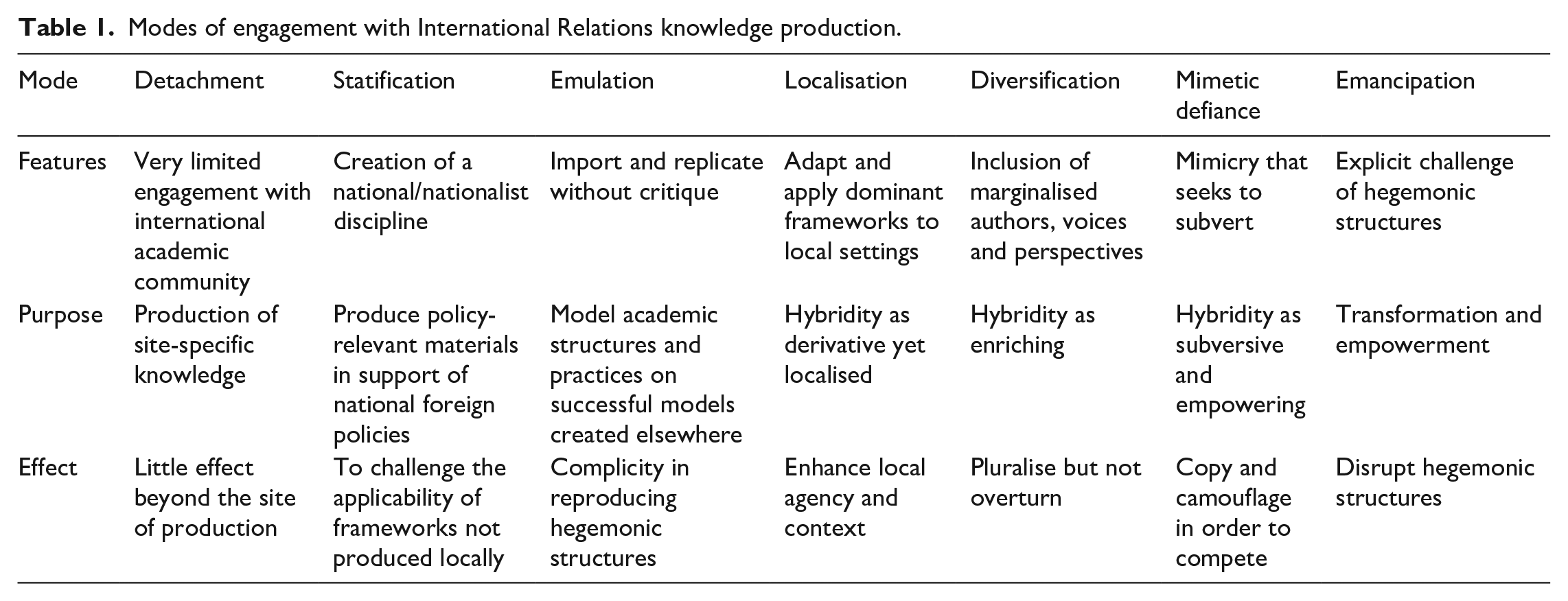
In order to interpret this complexity, we present a typology of seven sets of practices, which are adopted by scholars as they engage with dominant knowledge production practices in IR. We term these sets of practices ‘modes of engagement’ (see Table 1). They are: detachment, whereby negligible engagement occurs; statification, whereby local theoretical concepts and frameworks are co-opted into (ethno-)nationalist narratives and governmental foreign policy agendas; emulation, which reproduces the practices of dominant actors; localisation, whereby dominant theories and frameworks are adapted to fit local contexts; diversification, which advances pluralism through a variety of different views and approaches; mimetic defiance, whereby dominant frameworks are subverted in order to challenge hegemony; and emancipation, which seeks to liberate knowledge production from structures of domination. These modes were theorised synergistically via a deductive reading of the literature alongside an inductive analysis of 26 semi-structured interviews that we conducted with IR academics based in universities in East Asia, South Asia, the Middle East, Eurasia and Africa. Our study offers qualitative reflections on the discipline across five regions and 13 countries, a sample not previously undertaken in a single article-length publication.
Modes of engagement with International Relations knowledge production.
We situate our research alongside the Global IR agenda. We understand Global IR as a disciplinary ‘turn’ that gives greater visibility to various critical theories, including decolonial and postcolonial theories, and the sociology of knowledge, with the goal of broadening IR’s traditional Western-centric horizons and creating fuller representations of the ‘global’. Global IR begins with the recognition that the discipline currently ‘does not reflect the voices, experiences, knowledge claims, and contributions of the vast majority of the societies and states in the world, and often marginalises those outside the core countries of the West’ (Acharya, 2014: 647). It seeks to address this by provincialising Western narratives of world politics (Nayak and Selbin, 2010; Vasilaki, 2012) and by promoting scholarship that takes as its starting point empirical problems and/or conceptual frameworks rooted in the Global South (Ling, 2013; Sheikh, 2016; Taylor, 2012).
Our typology advances debates on knowledge production in Global IR along two axes: first, the level of practices and, second, the level of spatiality. On the first, we reveal that epistemic practices are enacted in ways that go far beyond the binary decolonisation versus sustaining Western hegemony dichotomy so prevalent in contemporary political discourse. On the contrary, there exists numerous sets of practices towards dominant IR knowledge production, which we have theorised into seven heuristic modes. We demonstrate that these practices are generated through contextual particularities across different academic settings and contribute to the growing literature in this field (Alejandro, 2019; Bilgin, 2008; Gelardi, 2020; Kaczmarska, 2020; Tickner and Blaney, 2012; Turton and Freire, 2016). Our typology constitutes a new framework for distinguishing the different relationships to dominant knowledges adopted by scholars, elements of which have hitherto only been implicitly or partially articulated in the literature.
Second, on the level of spatiality, we demonstrate that dislodging the concepts of ‘core’ and ‘periphery’ from their geographical associations with the ‘West’ and ‘non-West’ reveals other sites of epistemological domination in IR. Thus, multiple asymmetrical relationships may be analysed within and between the West and non-West. This is particularly important as geopolitical shifts are transferring both material and ideational power away from Europe and North America and towards Asia and Latin America (Stuenkel, 2016). Acknowledging that relationships of domination also occur within the non-West enables a deeper understanding of the landscape of IR knowledge production and allows us to interrogate instances of epistemological domination wherever they occur. While the binary thinking underpinning the conceptualisation of the West as ‘core’ and non-West as ‘periphery’ in IR has been roundly critiqued (Eun, 2018; Grovogui, 2006; Hutchings, 2011; Katzenstein, 2018), few attempts have been made to present alternative frameworks (exceptions include Hamati-Ataya, 2012; Murray, 2020). Our framework therefore illuminates multiple knowledge production hierarchies that are not tied to conventional geopolitical West/non-West fault-lines.
The article proceeds in three sections. The first situates our contribution within the strand of Global IR literature that problematizes binary conceptions of IR knowledge production practices. It summarises our typology’s contribution to current debates, namely by specifying complexity both in the practices of scholars in IR knowledge production and in the way in which these practices are mapped globally. The second section addresses methodology and positionality, describing the objectives and processes surrounding our data collection and analysis. The final section presents the seven modes that comprise our typology and considers why scholars may adopt one approach over another. It suggests that it is primarily, but not exclusively, the incentive structure most readily available to actors that influences their relationship to globalising discourses and practices.
Complexity in IR knowledge production practices
Ever since Stanley Hoffmann’s 1977 claim that IR is an ‘American Social Science’, debates have continued over the American or Western-dominated nature of the discipline (Hoffmann, 1977; Smith, 2000; Wæver, 1998). Numerous studies have revealed Western/US hegemony and insularity across a range of academic practices, from theory-building (Tickner, 2013) and publishing practices (Hendrix and Vreede, 2019; Maliniak et al., 2018) to syllabi and pedagogical practices (Andrews, 2020; Colgan, 2016; Kang and Lin, 2019; Mantz, 2019; Powel, 2020). These findings are largely mirrored in the sentiments of IR academics towards their discipline (Maliniak et al., 2014).
While Global IR has made important contributions towards shifting this landscape, it is not a new critique of the discipline. It shares points of convergence with critical theories and the sociology of knowledge, which have long sought to highlight IR’s parochialism, insularity and ethnocentrism. 2 Global IR has nevertheless elevated these insights and accorded them greater visibility in mainstream IR. It has become an effective discursive tool to critique the (re)production of Western-centric knowledge, creating greater consciousness about Western privilege, historical specificity and non-Western agency (Lake, 2016; Sabaratnam, 2017). It has also facilitated the growth of non-Western-centric theorising, such as the Chinese school(s) of IR (Qin, 2018; Zhang, 2012), accelerating the diversification of the discipline. Overall, Global IR has enabled greater interrogation of context and complexity in IR knowledge production, beyond conventional conceptions of a dominant West and subordinate non-West. Two key contributions stand out.
First, scholarship has made significant advances in challenging pervasive assumptions that the core dominates and determines the extent of interaction with the periphery, and that practices of IR knowledge production in the (non-Western) periphery either adopt or challenge those of the (Western) core (Tickner, 2013; Wemheuer-Vogelaar et al., 2016). Certainly, Western dominance remains widespread, relying on implicit and mostly unquestioned knowledge (doxa) that presumes the superiority of Western degree programmes, journals, research methods, conceptual frameworks and even individual scholars. In parts of the Global South, there remains a persistent cognitive and historical stickiness that ‘access to the “international” is foremost linked to the ability to import knowledge and know-how from (mainly) Western countries’ (Basaran and Olsson, 2018: 116). Nevertheless, important research shows that practices of peripheral engagement with the core are not limited to either challenging or reinforcing hegemony (Alejandro, 2019; Chen, 2011; Hobson, 2007; Hutchings, 2011): there is a long history of interaction and cross-pollination between scholars in the ‘West’ and ‘non-West’ (Bilgin, 2008; Hutchings, 2011), and the ‘non-Western periphery’ may operate less in relation to a ‘Western core’ and more in response to local conditions (Tickner and Blaney, 2012: 5).
Second, extensive scholarship has demonstrated that the ‘West’ and ‘non-West’ are not homogeneous entities. Countries in the non-West may have different experiences to the West, but also different experiences among themselves (Katzenstein, 2018). As Bilgin (2012: 28) states, they are ‘differently different’. A more critical reading of globality thus recognises stratification within and between cores and peripheries (Cheng and Brettle, 2019; Cox and Nossal, 2009; Kristensen, 2015). Furthermore, as universities in the non-West climb international rankings, bringing with them alternative epistemological and pedagogical practices, academic perceptions of what constitutes the ‘core’ are also shifting (Owen, 2020). With the emergence of a multipolar world in which numerous sites of domination exist, it is anachronistic to assume that ‘the West’ remains the only centre of knowledge production in IR.
These two sets of contributions constitute important work to problematise binary thinking on knowledge production in IR, both in terms of the practices of engagement with dominant knowledge and the stratification of these practices across different geopolitical settings. At the same time, the former has not been fully defined and elaborated in the existing literature; and the latter has focused more on debunking ‘Western core’ and ‘non-Western periphery’ categorisations than on investigating non-Western cores and peripheries. These gaps invite a more systematic framework to capture complexity across both domains.
Several scholars have explored elements of this increasingly globalised epistemological landscape. For instance, Hamati-Ataya (2012: 629) conceptualises both ‘a “core” whose identity is formed by the convergence of geopolitical, social, institutional and intellectual characteristics’ and ‘different “peripheries” that are located differently with respect to this core’. Bilgin (2012: 28) calls for a focus on scholars’ agency, which ‘cannot be considered in isolation from the academic context in which scholars operate and the international political context that shapes (and is in turn shaped by) them’. Murray (2020: 436) argues for a post-imperial, rather than a post-Western, IR, proposing that, ‘instead of promoting ethnification, globalising the discipline could suggest a move towards different categories, which emphasise the different ways human groups intersect’.
We extend these discussions on complexity and context by presenting a framework that distinguishes seven modes of engagement with IR knowledge production practices, which are not tied to pre-existing geopolitical spatialities. Our analysis shows, first, that core–periphery engagement encompasses a complex variety of interactions and entanglements, ranging from detachment to emancipation, and, second, ‘core’ and ‘periphery’ are highly situated concepts whose meanings depend on one’s positionality. Our framework seeks to capture this contextual relationship between dominant and subordinate producers of knowledge while also broadening knowledge production hierarchies beyond the conventional West/non-West divide.
Methodology
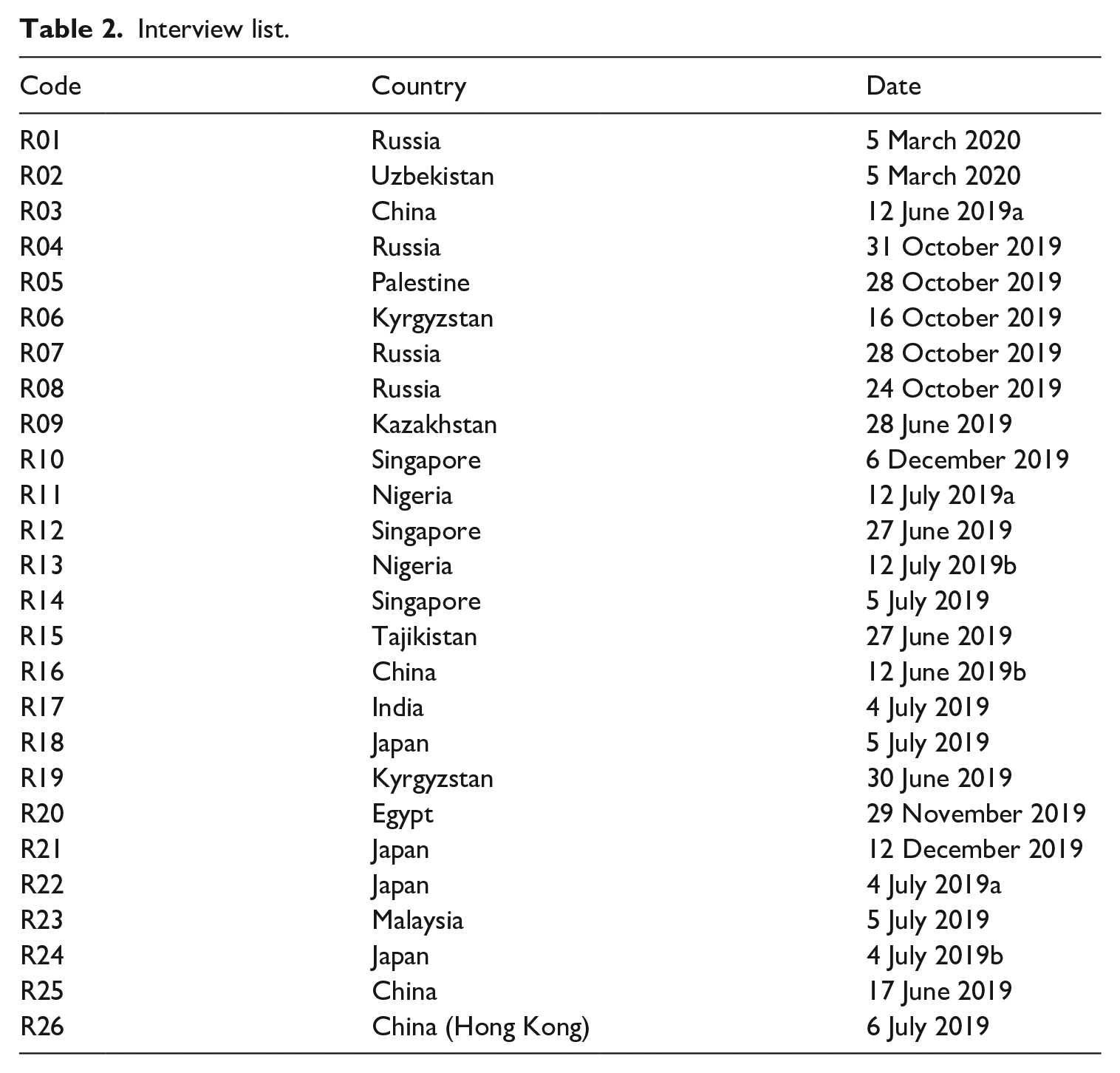
We constructed our typology via an extensive review of the existing literatures on Global IR, decoloniality, postcolonialism and the sociology of IR, and an inductive analysis of interviews conducted with 26 IR scholars based in a wide variety of countries beyond the West.
The decision to interview scholars based in different ‘non-Western’ sites was driven by two main objectives. The first was to respond to calls within Global IR for greater empirical studies on non-Western contexts. While fully cognisant of the complex issues surrounding scholarly identity and authenticity (Gelardi, 2020), we sought to prioritise range in geographical locale in order to demonstrate the variety of practices employed by scholars based in the non-West towards dominant forms of knowledge. The second objective was to demonstrate range across different institutional settings. This allowed us to examine the ways in which scholars relate not only to the West but also to other geopolitical ‘cores’, including China, Russia, and Singapore. In order to obtain as wide a variety of experiences as possible, we interviewed scholars working in universities representing various levels of local, national, regional and global significance. Respondents were selected according to two basic criteria: (1) they must be based in a university in a locale commonly perceived as the ‘non-West’, and (2) they must either be teaching or have taught foundational courses in IR. This enabled us to gather their reflections on the material and ideational constraints and incentives faced in scholarly praxis across a wide range of academic sites.
Our primary method of acquiring respondents was to contact relevant academics prior to or during international conferences. Having located potential interviewees in conference programmes, we approached them by e-mail. We also approached several scholars in person after listening to their conference presentations and surmising that our research might resonate with them. In four cases, respondents recommended acquaintances in different countries whom they thought would find our research interesting – these four interviews were subsequently conducted via Skype.
In semi-structured interviews conducted primarily in English, we invited respondents to reflect on the ways in which they encounter dominance in IR, how they assemble and deliver their curricula, and their perceptions of IR in their scholarly community. 3 Interviews typically lasted between 30 and 90 minutes, which were audio recorded, and then transcribed and coded using NVivo software. The codes, which eventually became the seven modes presented below, were established through a close reading of the literature alongside the interview transcripts, alternating abductively between the two types of sources.
Our sample inevitably has both limitations and strengths. First, the sample may over-represent critically oriented scholars as the majority of respondents were either sympathetic to or already working within Global IR and/or decolonial agendas. Yet we contend that it is precisely this reflexivity in the interview data that allowed for the unpacking of various practices and spatial hierarchies, resulting in a more nuanced, rather than explicitly biased, study. Second, although numerous respondents described their practices and positionality in relation to national and international knowledge-producing ‘cores’, the typology was theorised after collecting the interview data and hence was not discussed with respondents during the interview itself. The typology therefore risks generalising or misrepresenting scholars’ self-perceptions within global academic structures. On this point, we wish to emphasise that like all typologies, the modes are not mutually exclusive and are intended as ideal types: they inevitably involve a degree of abstraction and hence only approximate the approaches we encountered. Third, we acknowledge that our sample’s geographical reach is partial, without any South American respondents and only two each from Africa and the Middle East. Nevertheless, the lived academic experiences of 26 IR scholars based across five regions and 13 countries provide unique insights into differentiated contexts and situated IR knowledge production practices. Our approach towards theory-building also sought to mitigate this geographical gap through close readings of existing research alongside our interview transcripts, using the latter primarily to illustrate and evidence our theoretical assertions.
We would like to make a final note on our positionality within the global academic field, as part of an explicit commitment to a reflexive epistemology (Bourdieu, 1991: 25; Hamati-Ataya, 2014: 47–48). Our academic training and employment at universities located in the West have granted us social and material forms of capital and privilege, which we utilised to conduct this research. Although we faced some material constraints in having to merge our fieldwork with conference travel rather than conduct a more independent study, we could nevertheless afford to travel to the conferences where we conducted interviews and were able to write up the materials according to the standard conventions of the discipline in the West. We also acknowledge that our identities as scholars based at a university in the West may have influenced the ways in which our respondents narrated their experiences to us, although the exact nature of this influence is more challenging to uncover. The analysis below therefore only represents one (privileged, yet sympathetic) perspective on the modes discussed.
A typology of modes of engagement with IR knowledge production
In what follows, we delineate our seven modes, which capture greater complexity in knowledge production practices beyond simple binaries of sustaining or challenging (Western) hegemony. Before the modes are presented in full, we reflect on the factors that influence a scholar’s approach. We suggest that this is mostly due to their position within the academic field, understood in a Bourdieusian sense (Bourdieu, 1991; Pouliot and Mérand, 2013), and the opportunities and constraints it affords them. Underlying our conceptualisation is a recognition that Academia is not an abstract space, but a series of institutions – universities, journals, academic conferences – shaped by the coloniality of knowledge where the how we know, and what we know is always contested by different narratives, confronted with material circumstances, personal relationships, and the emotional involvement of subjects. (Fonseca, 2019: 53)
Thus, a relationship to dominant practices is never an objective or free choice, but always a response to the individual’s structural position within the broader academic field, which is policed by privileged actors seeking to maintain the scholarly status quo against those with lower levels of social capital who might challenge it. A Bourdieusian lens on scholarly practices (Jackson, 2008) enables a recognition of the ways in which the production of knowledge is influenced by the wider social, economic and political environment, as well as the internal dynamics of the academic community.
From this perspective, each set of practices opens doors to certain resources, social capital and career opportunities, and closes others. Detachment, for instance, may be the only option for academics in an environment devoid of resources necessary for internationalisation. As one Russia-based respondent noted, ‘Most of the regional universities in Russia do not have access [to online Western databases and libraries] and that’s why they have to rely either on textbooks or Russian-language academic journals’. 4 Similarly, emulation might be attractive for those seeking to obtain recognition in a field skewed against them. Scholars working in a university modelled on the Anglo-American tradition may also find themselves constrained by such practices. Even statification may be imposed upon scholars, especially in polities where research in the Social Sciences faces government control. In the words of one Uzbekistan-based scholar, ‘Until recently it was so easy to become a political scientist and to defend a dissertation. Just make 50 times the quotation of President Karimov and you are a political scientist, a recognised political scientist!’ 5 The academic field therefore underpins the material and discursive terrain upon which various modes of engagement are enacted.
Detachment
Detachment refers to the least globally networked type of academic activity: scholars in a detached relationship do not tend to engage with knowledge produced beyond their immediate epistemic community; they attend local, not global, conferences and academic events, and they work in universities with very low levels of international linkages. It occurs when scholars have limited infrastructural access to wider scholarly activities, due both to endogenous incentive structures and to exogenous gatekeeping practices, and are consequently isolated from epistemic activities occurring elsewhere (Sokolov and Titaev, 2013: 250).
Our respondents were not themselves in a detached relationship to wider IR communities, given that all interviews but one were conducted in English and most were conducted at international conferences. However, several respondents reported that their colleagues were detached from the international sphere of the discipline. One Shanghai-based scholar lamented, For Chinese scholars, money is not a problem because currently the Chinese government is offering a lot of research projects, so many scholars can pay the travel cost from their research budget. The problem is that some Chinese scholars don’t think it is important to integrate themselves into the world community.
6
This resonates with Tickner and Blaney’s (2012: 5) observation that IR scholarly communities outside the core may in many ways be relatively independent and operate more or less as a result of local conditions and needs, largely related to the foreign policies of their respective states more than relations with the core.
Turton and Freire (2016: 546) have argued that detachment is an explicit form of resistance to dominant knowledge, which consists of ‘a strategy to “go one’s own way,” therefore avoiding engagement and a relationship of subservience with the perceived “colossus”’. However, our interview respondents referred to detachment as a largely subconscious orientation. One respondent explained, Previously you didn’t have the option to publish in Russian or publish in English. You just published in Russian, got your life, got your kids, get them to school, and die, maybe 70 or 75 years old. Nice. A good life. Decent one. You’ve got a good status, even though you produce basically crap but you go to the conference and you see the people who do the same crap and you can speak the same language. You do sociology of education, but you’re not aware that there’s Bourdieu, or French sociology, German sociology, Swedish, American, UK, or anything like that. You just live your life.
7
In the International Development literature, the kind of knowledge produced by scholars in a detached relationship is often termed ‘indigenous knowledge’, that is, ‘the local knowledge that is unique to a given culture or society’ (Warren et al., 1995: xv). In the view of one respondent, scholarly work produced by academics in a detached relationship consists of ‘indigenous experiences explained in their own vocabulary’. 8 Often juxtaposed with ‘Western’ knowledge, seen to hold universal applicability, indigenous knowledge is considered relevant only for the community in which it was produced; indeed, it is this binary that postcolonial and decolonial scholars have sought to challenge (Maldonado-Torres et al., 2018; Mignolo, 2002).
We do not wish to suggest that detached knowledge is by definition inferior to knowledge connected to practices and debates occurring elsewhere. Nor do we wish to imply that detached knowledge is necessarily ‘peripheral’ (see Tickner, 2013). The detachment vis-à-vis the Western scholarly community, enacted by the Chinese and Russian scholars alluded to in the citations above, could indicate that for many scholars in the non-West, Western science is not the ‘core’, but in fact the ‘periphery’. In Communist countries, scientific Marxism was the guiding philosophy of knowledge and academic disciplines with political relevance were either carefully monitored or banned entirely until the late 1970s to early 1980s. In China, the development of higher education was strongly influenced by Soviet educational practices – and therefore hardly ‘detached’ from international influence (Hayhoe, 1995: 74–75). Indeed, as Amsler (2007: 9) reminds us, ‘Soviet science perceived itself as being the center of world science’. ‘Core’ and ‘periphery’ are thus highly situated concepts, and detachment from Western IR communities does not constitute evidence of detachment from all IR communities.
Statification
In contrast to detachment, which is largely an unconscious stance, statification refers to the explicit project of creating a national – or even nationalist – discipline. It is based on the idea that the Eurocentric ontological and epistemological origins of IR theory cannot adequately interpret or conceptualise processes occurring beyond that sphere (Shani, 2008; Tsygankov and Tsygankov, 2010). Consequently, statification occurs when domestic theorising becomes linked with, or even co-opted into, government nation-building narratives and foreign policy agendas. While the processes of theorising that underpin statification have been critiqued for their ethnocentric foundations (Acharya, 2014; Chen, 2011; Hurrell, 2016; Vasilaki, 2012) and inability to account for the cross-pollination of knowledge practices over time (Bilgin, 2008), it remains a salient approach to knowledge production in some of the regions we interviewed. As one Palestine-based scholar affirmed, There is this competition between mimicry and copying the West, and nativism – and I challenge that term because that term is very European, white – but we also have this nativist approach of ‘We want our own knowledge’. And that’s really strong in social science.
9
Our interviews indicated that building a national tradition of IR involves such strategies as developing a revisionist national history and establishing alternative, government-linked professional associations. Several scholars reported the creation of new historical mythologies that aim to enhance nationalist narratives in the public spheres of China, Russia and Central Asian countries.
10
One Kyrgyzstan-based scholar explained, in Turkmenistan, Uzbekistan and Tajikistan and to some extent in Kyrgyzstan – although Kyrgyzstan is a bit more critically aware – the decolonisation that is going on there is the construction of false alternative history. In Turkmenistan, they say that out of the whole world, the first Noah was Turkmen. Right? That’s where things start and you go, ‘Woah, wait!’.
11
Similarly, a scholar in Uzbekistan described how some political theorists in the country refer to the despotic rule of Tamerlane during the Middle Ages as proof that the country ‘is not ready for democracy’. 12 One Russia-based academic spoke of a ‘Russia First’ perspective on IR, bound up in strong normative language appealing to a medieval past and the cultural uniqueness of Russian civilisation in world politics. 13
New scholarly organisations have been created to bolster nationalist agendas. One Russia-based scholar described how, in 2012, an alternative professional political science association ‘Rossiiskoye Obshchestvo Politologov’ (Russian Society of Political Scientists) was created, after the original political science association (Rossiiskaya Assotsiatsiya Politicheskoi Nauki (Russian Association of Political Science)) received a grant from the MacArthur Foundation and subsequently faced calls to be labelled a ‘foreign agent’.
14
Conceived during rising anti-Western sentiment in Russia, the endeavours of this new association can be described as an attempt to create a specifically ‘Russian political science’: according to our respondent, the new association was involved in the ideological development of Russia’s ruling party, United Russia, in preparation for the 2021 parliamentary elections. The respondent ended discussion of this organisation by cautioning on the potential slippage between statification and decolonisation: Don’t go too far along the path of decolonisation. Because science is science. I believe that its core is international. It’s about the way we are getting knowledge and this knowledge needs to be objective, it needs to be based on procedures which are elaborated internationally so when you come to this with some ideological, nationalist in this case, agenda, it destroys everything.
15
However, the production of IR knowledge is closely linked to the foreign policy agendas of many states, which predisposes it towards a conservative or nationalist agenda. This is hardly surprising, since IR knowledge production and the academic field are embedded in national priorities and shaped by national policies. This has a fundamental impact on how knowledge is created and what types of knowledge(s) are prioritised (Grenier and Hagmann, 2016). Numerous respondents confirmed that the main task of IR in their country was to produce policy-relevant materials, rather than to engage in theory development. One Moscow-based scholar said, ‘IR in Russia is really practice-led . . . a lot of the incentives to publish, a lot of the money, the research money that comes into universities on IR is often about contracts, policy orientated contracts’. 16 Thus, it does not require a great leap from rejecting Western-led international norms and institutions at the policy level to rejecting Western theories and concepts at the epistemological level. This suggests that as Western influence in the international system declines, we may also see a rise in the statification of IR knowledge production.
Emulation
Emulation refers to the adoption of teaching, research and management practices of a core. Given the existence of multiple knowledge production cores, this could take the form of emulating Western norms and practices or, if one is situated in post-Soviet Central Asia, for instance, Russian norms and practices. It shares similarities with the notion of ‘mimicking’ (Collins, 2013) in the norm diffusion literature and ‘formal mimicry’ (Ling, 2004) in the postcolonial literature, both of which involve a subordinate actor simply copying the actions of a dominant actor. Turton and Freire (2016: 547) use the term ‘assimilation’ to refer to the ‘full-scale embodiment of the hegemonic discourse’s standards, trends or rather the “way of doing IR” and these then tend to be applied to local” or “new” case studies’. We prefer to use the term emulation in our research as it better captures the idea of locally rearticulating practices observed elsewhere, while ‘assimilation’ suggests a process of absorption into global structures; yet this absorption is not a given, even if one painstakingly emulates dominant discourses and practices.
Emulation may be driven by internalised coloniality and assumptions that what is foreign or ‘Western’ is ‘better’. It begins with ‘the belief that everything that happens in the immediate environment of the individual’s life is less important and valuable than what is happening elsewhere’ (Sokolov and Titaev, 2013: 250). Emulation thus occurs when actors believe that the dominant ensemble of norms and practices is superior. Recounting their experiences as invited Western academics seeking to introduce more indigenous Caribbean approaches to Caribbean students, Lavia and Sikes (2010: 90) were faced with the question, ‘Why are you teaching us all of this Caribbean stuff, do you want to keep us in the Caribbean?’ This orientation is evidenced in the response of a Kazakhstan-based scholar: Because everything that came from Moscow or Russia was regarded as superior – it comes from abroad. So we still have this idea that if something is imported from abroad it is going to be better than something that is locally produced. And that has its seal on almost everything – on the curriculum, on everyday practices.
17
Much of this relates to Western hegemony in publications, to what has been constructed as ‘good’ and ‘valid’ scholarship, and the perceived canons in the literature. Consequently, replicating Western teaching practices and reproducing the Western canon in IR teaching, even in non-Western contexts, are considered key to successful pedagogy. In a collective study of how IR is taught in five Southeast Asian countries (Indonesia, Malaysia, Singapore, Thailand, Vietnam), researchers found that introductory modules largely drew on Western texts and theories, rather than any distinctively Southeast Asian IR traditions, and were modelled after course content taught in Western universities (Chong and Hamilton-Hart, 2009).
Our interviews suggested that epistemic practices associated with the Western university currently remain the most widely emulated. In the words of one China-based scholar, ‘Western IR theories can help the students understand how the world works [and] how international relations work’.
18
Another Singapore-based scholar reflected, however weak the state of the field is now using predominantly Western derived approaches . . . I don’t want to junk it until something comes along that I think does a better job of explaining the same stuff . . . non-Western IR theoretical approaches are useful now as a supplement and as a corrective. But I haven’t seen anything that would indicate to me that the traditional canon needs to be thrown in the garbage.
19
There are also internal and external pressures to emulate dominant academic praxis for strategic purposes, with the goal of ‘becoming international’ and achieving upward social mobility (Basaran and Olsson, 2018: 113). Internal pressures include university managements’ imperative to perform well in global rankings. As has been discussed elsewhere (Jöns and Hoyler, 2013), these ranking systems have a homogenising effect on university practices, which leads to a sense of frustration among critically oriented scholars. According to one Singapore-based scholar, to go up the league tables, [management thinks that] we have to do everything that the best Western schools offer, which is I think extremely short-sighted. We are not distinguishing ourselves sufficiently . . . but what to do . . . I have to earn my bread and butter.
20
External pressures include the requirement to attract funding from international bodies and to publish research in journals with international reach. On the first, a Nigeria-based scholar explained, one of the constraints that Africans have is dependence on foreign funding. If you have an idea and you want to popularise it by means of a conference, you are not likely to get support from within. And if the idea does not resonate with foreign funders, the idea is going to die.
21
On the second, a Kazakhstan-based scholar highlighted ‘the difficulty of publishing in recognised journals because your work is on a particular region. There is increasing pressure to make your research generally applicable and if you’re working on Central Asia in Central Asia, that’s quite difficult’. 22
Localisation
Localisation is a process whereby dominant norms and practices are adapted to local contexts. There are important distinctions between emulation and localisation. The former replicates and buys into dominant structures, thereby reinforcing existing power relations. Localisation, in contrast, imports dominant paradigms but translates these to local settings. Localisation is prominent in the norm diffusion literature, foremost defined by Acharya (2004: 245) as ‘the active construction (through discourse, framing, grafting, and cultural selection) of foreign ideas by local actors, which results in the former developing significant congruence with local beliefs and practices’. This mode questions the universal relevance and applicability of dominant frameworks to local contexts. It challenges linear socialisation models and gives greater attention to local actors, not as passive recipients and unquestioning consumers of dominant knowledge, but as having greater agency to select, adjust and modify such knowledge in line with local traditions and contexts (Acharya, 2004).
With a greater focus on local agency, localisation can be conceptualised as a form of hybridity or bricolage, blending dominant paradigms with local particularities. This hybridity problematises dualism and rigid binaries, highlighting instead in-betweenness (Pieterse, 2001: 220, 238). Thus, localisation does not uncritically conform or acquiesce to dominant paradigms, but rather seeks to inject a local flavour and mould these paradigms into local contexts. As a scholar remarked of Singapore’s epistemic community, you realise that we are, you know, a case of a smorgasbord, or if you prefer a local term, rojak [Malay term for mixture] . . . this is what I mean by people in the hybrid category, having to find a frequency to link the dominant Western schools with what else they’re trying to bring out from the ground.
23
This form of hybridity nevertheless retains residual dependency on dominant frameworks. It does not fully escape power asymmetries and hegemonic practices, and is still subjected to a hierarchical mode of knowledge production and dissemination (Pieterse, 2001). Localisation therefore remains top-down, with less transformation sought at the level of dominance (Zimmermann et al., 2017). It is critical but does not travel as far in criticality as the modes discussed below.
Localisation emerged most prominently in our interviews in the form of teaching practices. Students in and from the Global South often have difficulties relating to predominately Western-authored textbooks ‘due to a poor connect between their textual content and ground realities’ (Behera, 2016: 155). Where available, local textbooks are used so that students can relate to explanations and examples. 24 In most cases, however, many interviewees adapted Western syllabi and made them relevant to local audiences by drawing on empirical case studies from the non-West. 25 As one Singapore-based scholar remarked, ‘‘the short answer is that theories come from the West in my syllabus and the empirical applications are largely Asia focused’. 26 Another scholar based in Russia stated how he mined the online content of courses at foreign universities for the most up-to-date materials and perspectives before ‘adapting, re-working, reusing and recycling the content’ for his domestic students. This was necessary because ‘the topical structure is most of the time not relevant to what we have in Russia, or references were not accessible. So . . . first you borrow, you see what works and what doesn’t, you adapt’. 27
Diversification
Diversification is concerned with making IR more inclusive. It seeks to introduce greater plurality beyond a Western-dominated field, making it more authentically grounded in global history and perspectives (Acharya, 2014: 649–650). As Lake (2016: 1116) articulates, the ‘different intuitions carried by now-under-represented scholars will expose previously hidden assumptions, provoke new insights, provide inspiration for new theories, and likely produce new hypotheses that help identify new empirical regularities’.
Proponents of diversification argue that deeper engagement with marginalised histories, experiences and knowledge pluralises the field and enriches the theoretical depth of existing dominant frameworks by specifying its scope conditions (Eun, 2018: 446). Diversification therefore seeks to demonstrate that other accounts may also provide legitimate constructions of world politics and that different traditions of IR can coexist alongside one another (Behera, 2010). Hybridity, in this regard, works both ways: dominant paradigms can be adapted to suit local contexts, but local accounts can also contribute to new and existing paradigms. Diversification goes further in criticality, highlighting the politics of inclusion and exclusion within IR, but it does not seek to directly compete with or overhaul existing hierarchical structures. The emphasis has been to pluralise rather than displace dominant theories, methods and canons (Acharya, 2014: 650). In other words, diversification does not decolonise the discipline.
This mode was prominent in our interviews, with many respondents emphasising the need to inject more diverse narratives and scholarship into the discipline. 28 Academic gatekeeping in publishing was considered a key issue, with interviewees stressing the need for top journals to diversify both their editorial boards and published content. More diverse, high-quality publications would assist academics in diversifying their reading lists, enabling them to respond to growing student consciousness regarding diversification. 29 Respondents reflected that students are increasingly questioning the universal applicability of Western frameworks. 30 One scholar noted, ‘lately, the students would ask me in class, what about the African perspective? So they are beginning to make such demands now’. 31 Another remarked that ‘at first, they liked reading the translated texts from the West. But now they are starting to demand more Chinese authors’. 32 Students were receptive when convenors localised theoretical applicability, introduced local empirical examples and diversified the syllabus. 33 This highlights the ways in which module convenors are key gatekeepers of knowledge transmission and curriculum design, as well as how the ‘hidden curriculum’ operates within the formal curriculum (De Matos-Ala, 2017; Killick, 2016).
At the institutional level, respondents highlighted university initiatives to facilitate greater inclusivity and diversity in academic hiring practices, institutional bodies and student recruitment. 34 Conversations about diversifying the discipline are already underway in departments offering Global Studies programmes or branding themselves as gateways to understanding Asian perspectives on world politics. 35 These respondents were quick to point out, however, that their institution was the exception rather than the norm in the country where they were based. 36 They also acknowledged that discussions remained focused on plurality and did not reach explicit interrogations and transformations of power structures. 37 In this respect, IR lags behind other disciplines in the humanities and social sciences, where greater progress towards decolonisation has been made. 38 As one Japan-based academic remarked, ‘the importance of Asia is often emphasised but it’s in the context of diversifying Eurocentric views, rather than changing power relations’. 39
This diversification mode nevertheless poses several challenges. As highlighted earlier, it could result in unproblematic reifications of pervasive ‘West/non-West’ binaries. This raises important questions about who and what counts as authentic ‘non-Western’ knowledge (Biswas and Deylami, 2017; Vieira, 2019) and potentially reduces IR knowledge to a form of identity politics (Acharya and Buzan, 2010: 14; Capan, 2017: 8; Narain, 2017: 20). As one respondent highlighted, ‘one doesn’t want to go down the reductive route of saying what you study should be conditioned by who you are because then only Indian people should be qualified to speak on India . . . you get into those problems’. 40 Metrics on the number of Western and non-Western authors in reading lists can also only tell us so much as they do not reveal the content of that scholarship as well as how they are taught and applied to world politics (Hagmann and Biersteker, 2014: 298). Furthermore, diversity for the sake of it can result in tokenism, where under-represented scholars are invited to participate in institutional events and committees in order to portray an image of diversity. Such box-ticking exercises place additional demands on these scholars at an institutional level, with implications for their professional development, and often make these scholars feel undervalued and demeaned (Katada and Grey, 2008: 467). While sympathetic to the Global IR agenda, some respondents cautioned that boundaries must be drawn because it is easy to go down the ‘rabbit hole of diversity’. 41
There are also important material constraints inhibiting the diversification of teaching practices. Probation and tenure processes, bound up in the neoliberalisation of universities, have significant impact on curriculum design and delivery (Ettinger, 2020; Odysseos and Pal, 2018). As Knight (2019: 223) writes, ‘including marginalized voices and topics might seem like a risky proposition for a non-tenured professor who is rightfully concerned about teaching evaluations’. Scholars seeking to diversify the curriculum must often invest substantial time in remodelling the syllabus while simultaneously balancing high teaching loads.
42
Language, translation and access to resources were also highlighted as inhibiting the advancement of a diversifying agenda.
43
As a China-based academic remarked, we don’t include texts by other non-Western authors, mainly because of the problems of accessibility, as most of them are not translated into Chinese. The problem of translation isn’t just a problem for IR in China – it’s a problem for the world! For example, you can’t read the latest works coming out of China.
44
A Palestine-based scholar offered a similar sentiment: The most recent scholarship is mainly in English, maybe French, but by the time they get translated into Arabic, it takes at least ten years or more, so the literature is a bit old. All this critical work in International Relations that you see in Britain, that you see even in the US, it is not present, it hardly appears in Palestine or anywhere in the Arab region.
45
Importantly, diversification is also enacted in relation to non-Western cores. The idea of a ‘Western core’ and ‘non-Western periphery’ was explicitly dislodged by some respondents, highlighting the importance of situated core–periphery dynamics. These respondents stated that diversifying processes were in fact reversed in the courses that they teach. With students exposed to state-led patriotic education resulting in nationalistic, anti-Western or anti-US cognitive framings, respondents felt the need to broaden student perspectives by engaging with Western scholarship. One Japan-based academic remarked of her Chinese postgraduate students: ‘I’m having difficulty trying to diversify their ideas because oftentimes their views and opinions . . . [are from a] Chinese perspective’.
46
Course readings and discussions are therefore about ‘letting them explore what’s been discussed outside of Asia . . . deliberately choosing a lot from American and European writers’.
47
This was also prominently highlighted by a Kyrgyzstan-based scholar in the context of the Russian core: It is necessary to present that [Western] perspective here in Central Asia, certainly in my classrooms, because of one particular problem that I keep encountering in my class, and that’s Russian colonialism here. My students are convinced that Putin is someone who is going to save the world . . . It’s extremely difficult to talk with them and even to get them to reflect on themselves and the way they look at things . . . I get them to read Western resources because that’s a way for me to teach them how to try to get an objective side . . . The presentation of America is of someone who is going to come and take stuff away and deceive everyone. So the class is very careful about balancing against this . . . I want to give them the historical and philosophical background, be honest about the Western influences so they are critical about it as well, but not have them rejected because it’s Western, not play into that kind of identity politics that is already, for me, a bit rampant here.
48
Mimetic defiance
While mimetic defiance can also be conceptualised as a form of hybridity, it embodies a more pervasive level of resistance. Although it copies and imitates, resemblances are only partial and never reach full replication (Perazzone, 2019: 166; Turton and Freire, 2016: 542). Practices of mimetic defiance are based instead on a deeper underlying intention to subvert and reappropriate dominant frameworks. Indeed, ‘mimicry is at once resemblance and menace’ (Bhabha, 1984: 127). It transpires as a representation of difference that camouflages and masquerades – as ‘a difference that is almost the same, but not quite’ – while seeking to recant, disavow and reclaim (Bhabha, 1984: 126, emphasis in original). This is aptly captured by Ling’s (2004: 117) notion of substantive mimicry whereby ‘the other is competing against, not just imitating, the hegemonic self’. In this context, mimicry represents a more explicit and fundamental challenge to dominant structures: ‘A moment of political destabilisation rather than fawning flattery, mimicry subverts the hegemonic contention that the coloniser is always separate from and superior to the colonised. Mimicry’s artifice shocks the coloniser into accepting a possible parity with the colonised’ (Ling, 2004: 117).
Mimetic defiance is therefore more transformative and emancipatory-seeking, opening up greater critical space for scholars to reappropriate dominant scholarly practices for their own ends. One reading of the Chinese School of IR, built and developed on an American foundation, is that it not only seeks recognition from the American core but also aims to reduce US dominance in the field (Kristensen, 2016: 148–149). However, since mimetic defiance is less visible and therefore more challenging to detect, this appeared less frequently in our interviews. There was nevertheless one key avenue in which it was present: mimicking the teaching of the ‘mainstream’ canon for the purpose of critique. As one Japan-based scholar remarked, ‘We usually tell students to go through all those canons in order to criticise them. Without understanding them, you can’t criticise them’. 49 Nevertheless, the sequencing by which students are exposed to ‘mainstream’ and subsequently ‘critical’ or local approaches can be problematic. Having to study the mainstream canons or theories, only to deconstruct and unlearn them later, is often confusing and unproductive for students. One respondent remarked that if students could have access to both the ‘canon’ and ‘alternatives’ in the first place, ‘we can talk directly more about some different ways to practice [and] conceive of global politics’. 50
Emancipation
Emancipation is strongest in its criticality as it seeks fundamentally to disrupt, dismantle and transform the status quo and hegemonic power structures. This mode recognises that the production and dissemination of knowledge are practices through which power structures can be upheld or transformed (Bhambra, 2014; Freire, 2007 (1970); Shihade, 2017). In this context, much of this discourse has focused on how colonial epistemologies and structures are universalised through formal and hidden curricula, hiring practices, Western-oriented grant-giving foundations, global ranking tables and English language journals valorising particular methodologies, subject matters and writing styles. Not only does this homogenisation of what counts as knowledge devalue and disregard knowledge produced outside of these boundaries, it also impoverishes academia itself.
While there are some overlaps between the diversification and emancipation modes, there are also significant analytical distinctions. The latter highlights the necessity to move beyond critiques of Eurocentrism. Although efforts to introduce pluralism in the discipline are important, they are insufficient particularly ‘if the understanding of what constitutes knowledge and how it should be presented and consumed remains embedded within the binaries and dualities that reproduces the colonial matrix of power’ (Capan, 2017: 7). Thus, ‘simply grafting other stuff on to Western canons is not going to solve the problem’. 51 More importantly, such measures often fail to recognise that colonising practices extend well beyond the West. As a Malaysia-based scholar remarked, ‘I don’t necessarily see, for instance, non-Western authors as being always the decolonised. They could be colonising as well’. 52
An emancipatory approach therefore interrogates and transforms the broader structures of power and coloniality that uphold academic domination (Anderl and Witt, 2020; Kamola, 2020; Maldonado-Torres et al., 2018; Mignolo, 2009; Santos, 2014; Shilliam, 2011). This is fundamentally an epistemological project, exercising reflexivity about how we know what we know, and why. It involves a far more critical interrogation of the institutionalised structures of inclusion and exclusion, and develops strategies to transform them that are grounded in the specificities of the environments in which they arose (Tuck and Yang, 2012). Indeed, ‘exclusion is not (always) a conscious act as much as an implicit, customary and learned practice’ (Phull et al., 2019: 386). In this regard, emancipation entails the transformation of, and liberation from, entangled structures of oppression (Mantz, 2019: 1365). It involves a multiplicity of political projects that relate to each other when acknowledging the centrality of race and racism in the articulation of global power relations (that includes the academy), the continuities of the imperial/colonial legacies (subjectively and materially) and its capacity to re-articulate through multiple layers of Global North/Global South relations. (Fonseca, 2019: 59)
Such investigations include problematising the assumption of Western ascendency as natural and given, and focusing on the broader relations between non-state actors (Powel, 2020). Several respondents highlighted that mainstream IR’s focus on the Westphalian state was often less applicable in non-Western contexts and that emancipation should work to move beyond the ‘black box of the state’ and unpack broader knowledge claims and practices.
53
As Capan (2017: 5) writes, ‘coloniality has permeated not only knowledge production but conceptualisations of what constitutes knowledge and “legitimate” practices for producing it’. Hence, the proclivity towards empirical studies is not as highly valued as works that engage in theory-building, with the former harder to publish in top international journals (Hamati-Ataya, 2012: 641; Tickner, 2013: 631; Wemheuer-Vogelaar et al., 2016). Respondents lamented this theoretical–empirical divide in IR, highlighting that strong traditions of empirical and historical work can themselves be emancipatory because they challenge the mainstream assumption of what ‘good’ research should look like. Criticisms of the lack of IR theorising in the non-West can therefore be countered with arguments that the significance awarded to theorising is not universal and that some scholars may be less theoretically conscious or simply less interested in theory-oriented research.
54
Some Russian academics eschew the kind of writing found in mainstream Western journals, which they view as sacrificing richness and complexity for the purpose of generalisability.
55
A Japan-based respondent shared similar views: There is a general tendency in Asia that values [a] historical approach. . . the way you describe is itself art. So I feel like that might give a completely different context to what we’re talking about, because it’s really grounded in [the] empirical . . . I’m often struck by the fact that there is less theoretical tendency in Asia, so that might give us a little more push toward important empirical matters and that itself can be decolonising.
56
As with the diversification mode, respondents raised several material and institutional constraints in adopting an emancipatory set of practices, including having to appeal to the mainstream across research and teaching practices. One Nigeria-based respondent remarked, ‘I’m not saying that there is no objectivity in the evaluation of manuscripts, but if it radically challenges dominant mainstream knowledge in the field, the article is not likely to be considered, especially when it comes from an African’.
57
Those wanting to pursue more critical research faced similar constraints with grant funding, especially when review committees often comprise mainstream academics.
58
On teaching, a Singapore-based academic reflected, they think that I’m too experimental, or I may be teaching a course that’s too out there, that no sizable amount of students would want to enrol in it . . . [and] it’s not cost effective . . . but you see, if you don’t try, you don’t know what demand there is out there . . . And this gets to me sometimes, that I cannot teach what I’m passionately researching about.
59
There were also myriad concerns as to where an emancipatory path would lead, with some fearing a shift towards the kinds of statification outlined above. In dismantling dominant power structures, it is thus crucial to avoid ethnocentrism. As one Kyrgyzstan-based academic stated, ‘we need to keep in mind whether we are decolonising IR or recolonising it from a different perspective’. 60
Conclusion
This article has presented a typology of IR knowledge production practices as a corrective to two persistent binaries in current political discourse: first, the notion that scholars either uphold or dismantle Western-centric knowledges and, second, the idea that the ‘West’ constitutes a dominant ‘core’ while the non-West constitutes a subordinate ‘periphery’ in the global knowledge production landscape. Our typology has sought to correct this thinking by theorising and providing evidence for seven sets of practices enacted by scholars towards dominant producers of knowledge in IR that may or may not be located in the ‘West’. We have argued that IR’s epistemic practices are best captured by a landscape of complexity and situatedness, requiring greater recognition of positionality, globality and context.
In particular, the typology captures complexity in knowledge production at the two levels of practice and spatiality. On the first, scholars do not simply accept or reject hierarchies in knowledge production. As we have shown, there are at least five other practices that they may adopt. Thus, our typology provides a more complex answer to the ‘sustaining versus decolonising Western-centrism’ dichotomy set out at the beginning of this article. Instead, a broad structure of incentives and constraints shapes a scholar’s approach. A focus on the academic field, particularly on the crucial role that materiality plays in determining scholars’ positionality and practices, is therefore necessary to bring about a more emancipatory global academia.
On the second, the typology has sought to unsettle conventional knowledge production hierarchies by highlighting that ‘core’ and ‘periphery’ are highly situated concepts that do not always map onto a ‘Western’ core and ‘non-Western’ periphery. Cores and peripheries are relational and thus require a more complex and critical reading of globality. In some contexts, they may interact with one another without reference to the West. In other contexts, diversification and emancipation from non-Western cores can mean engaging with Western scholarship and perspectives. The typology therefore allows us to move beyond binary conceptions and instead capture the intricacies of core–periphery knowledge production dynamics.
We conclude with three suggestions for how the typology contributes to a growing research agenda on positionality, globality and context in IR knowledge production. First, the typology allows us to move beyond polarising discourses that often occur without fully understanding either the range of knowledge production practices or the structural factors that influence the adoption of a particular set of practices. By highlighting the embedded structural context, we gain a better appreciation of the limits and possibilities of a scholar’s capacity to transform dominant epistemic practices. The typology thus offers the conceptual tools to further investigate the interplay of agential and structural factors by inviting greater reflexivity of the privileges and constraints afforded to us by our position within the global academic field.
Second, the typology extends existing scholarship on hierarchies by building concrete conversations about the multiple layers of hierarchy in IR knowledge production across different geopolitical spaces. By provincialising Western epistemic dominance, we can appreciate how scholars navigate competing epistemic orders across and within national, regional and global levels. The typology thus seeks to inspire more research examining such spatial hierarchies and interaction.
Finally, the typology constitutes a reminder that all knowledge is produced contextually and relationally – including the typology itself – and that any representation of the global is always partial, situated and open to change. Indeed, it is this recognition that will enable the construction of a more ethical and equitable global scholarly space.
Footnotes
Appendix 1
Interview list.
| Code | Country | Date |
|---|---|---|
| R01 | Russia | 5 March 2020 |
| R02 | Uzbekistan | 5 March 2020 |
| R03 | China | 12 June 2019a |
| R04 | Russia | 31 October 2019 |
| R05 | Palestine | 28 October 2019 |
| R06 | Kyrgyzstan | 16 October 2019 |
| R07 | Russia | 28 October 2019 |
| R08 | Russia | 24 October 2019 |
| R09 | Kazakhstan | 28 June 2019 |
| R10 | Singapore | 6 December 2019 |
| R11 | Nigeria | 12 July 2019a |
| R12 | Singapore | 27 June 2019 |
| R13 | Nigeria | 12 July 2019b |
| R14 | Singapore | 5 July 2019 |
| R15 | Tajikistan | 27 June 2019 |
| R16 | China | 12 June 2019b |
| R17 | India | 4 July 2019 |
| R18 | Japan | 5 July 2019 |
| R19 | Kyrgyzstan | 30 June 2019 |
| R20 | Egypt | 29 November 2019 |
| R21 | Japan | 12 December 2019 |
| R22 | Japan | 4 July 2019a |
| R23 | Malaysia | 5 July 2019 |
| R24 | Japan | 4 July 2019b |
| R25 | China | 17 June 2019 |
| R26 | China (Hong Kong) | 6 July 2019 |
Acknowledgements
The authors are grateful to our interviewees for their participation in the project and to Sabiha Allouche, Stephane Baele, Gregorio Bettiza, Irene Fernandez-Molina and John Heathershaw for valuable comments on an earlier draft. We would also like to thank the EJIR editors and anonymous reviewers for their insightful feedback. Due to ethical concerns, the research data supporting this publication are not publicly available.
Funding
The author(s) received no financial support for the research, authorship and/or publication of this article.
