




Abstract
Pundits, development practitioners, and scholars worry that rising populism and international disengagement in developed countries have negative consequences on foreign aid. However, how populism and foreign aid go together is not well understood. This paper provides the first systematic examination of this relationship. We adopt the popular ideational definition of populism, unpack populism into its core “thin” elements, and examine them within a delegation model of aid policy—a prominent framework in the aid literature. In so doing, we identify specific domestic political processes through which the core components of populism may affect aid spending. We argue that increases in one component of populism—anti-elitism—and in nativist sentiments, an associated concept, in a donor country lead to a reduction in aid spending through a public opinion channel. We supply both micro- and macro-evidence for our arguments by fielding surveys in the United States and United Kingdom as well as by analyzing aid spending by a large number of OECD donors. Our findings show that nativism and anti-elitism, rather than populism per se, influence not only individual attitudes toward aid but also actual aid policy and generate important insights into how to address populist challenges to foreign aid. Beyond these, our study contributes to the broader International Relations literature by demonstrating one useful analytical approach to studying populism, nativism, and foreign policy.
Keywords
Introduction
Populist attitudes have surged after financial and refugee crises. It is feared that populism brings with it more restrictive refugee policies, more isolationism, and similar inward-looking policies. Copious work in political science and public policy not only attests to this concern but bolsters it. 1 Rising populism and international disengagement in affluent countries may have particularly grave consequences for people in countries that are dependent on external funding. Populists’ emphasis on narrow self-interest over international cooperation might suggest that less development assistance would be directed toward helping the poor in developing countries, a concern repeatedly voiced by development practitioners and scholars. 2
Yet, despite these anticipated consequences, the theoretical and empirical foundations for a populism–aid relationship are thin. The invoked link between populism and aid is often based on simple correlations or collections of politicians’ quotes. 3 Similarly, concerns purported to arise from populism often do not directly address populism, and instead focus on related but distinct ideas, such as nationalism, xenophobia, and isolationism. The goal of this study is to contribute to the literature on foreign aid by theorizing and thereby clarifying a specific process through which populism affects aid policy. Importantly, armed with a theory directing our inquiry, we can provide insights into how to respond to the populist challenge to foreign aid effectively.
Our natural starting point is a delegation model of aid policy—a prominent theoretical approach in the aid literature (Martens et al. 2002; Milner 2006)—that centers on the relationship between voters and governments within (democratic) donor countries. Within this domestic politics framework, we focus on one specific causal pathway linking voters to aid policy: voters’ willingness to delegate policy implementation to their government. Following the recently emerged consensus, we conceive of populism as an ideology that is a collection of multiple distinct ideas, the most important of which for our study are anti-elitism and one variant of what constitutes “the people,” namely nativism (Mudde and Rovira Kaltwasser 2018). We examine how each of populism’s constituent and associated ideas shape voters’ willingness to delegate in our model, thereby influencing the government’s decision on aid spending.
This analytical approach generates several novel hypotheses linking core elements of populism to public support for aid spending as well as about the relationship between those elements and actual aid spending. We hypothesize that anti-elitism makes people want to delegate less and therefore become less supportive of aid while other core elements are not directly related to aid support. Further, nativism implies less appreciation of aid for development purposes, entailing less support. As a consequence, in democratic donors where the government’s survival depends on mass support, we would expect that greater prevalence of anti-elitism and nativism in the general population leads to a reduction in government spending on foreign aid.
As our arguments span two different levels of analysis, we conduct the demanding step to execute empirical tests at both levels. We test the individual-level hypotheses by analyzing novel survey data, and the donor-level hypotheses by extending the usual model of aid spending with novel covariates capturing the national attitudes of anti-elitism and nativism. If supportive evidence emerges across two different research designs, statistical estimators, and unrelated data sets, we should have greater confidence in the usefulness of our theoretical framework. First, our original surveys fielded in the United States and United Kingdom in 2018 and 2019 provide broad support for our individual-level hypotheses, including those that anti-elitism and nativism make people oppose aid spending. Since our analysis is not experimental, we not only select and control for a rich set of potential confounders but also provide a slew of robustness checks that examine nonlinearities (through quantile regression; see Koenker and Hallock (2001)) and stability from more complex forms of confounding (through double selection; Belloni et al. (2014)), both of which substantiate our results.
Second, we use data on OECD donors’ aid spending between 1990 and 2015 to examine the macro-implications of our arguments. We introduce as proxy for country-level mass nativist sentiments the immigration conservatism by O’Grady et al. (2020), which is a latent public mood estimate based on a large number of mass survey responses across countries and years. The operationalization of anti-elitism is more difficult as no comparable latent estimates exist. We turn to the admittedly crude proxy of the number of anti-government protests collected by Banks and Wilson (2018). While acknowledging the roughness of one of our measures, our statistical analysis offers suggestive evidence that immigration nativism and anti-government demonstrations lead to reductions in foreign aid outlays soon thereafter.
Our results span several different estimators, levels of analysis, and data sets, suggesting that the theory, which is the sole connection between these pieces, is a useful explanatory locus for a nexus between aid and populism. Our arguments suggest several more insights and policy recommendations. Populism as a whole may be a misguided target by international development activists and practitioners; rather, its particular components of anti-elitism and nativism should receive attention when designing strategies to manage populist challenges to foreign aid. Most noteworthy, our theory tells us that dislike for aid stemming from anti-elitism may require different approaches than aid rejection from nativism. We will return to this point at length in the conclusion.
This wide-ranging scope allows our work to contribute to at least two strands in the foreign aid literature, one assessing the determinants of aid spending (Fuchs et al. 2014; Tingley 2010) and the other on the determinants of foreign aid attitudes (Milner and Tingley 2013b; Nair 2018). Newer research has gone beyond the traditional left–right ideology and explored how different beliefs and values determine foreign aid attitudes (Baker 2015; Bayram 2016; Bayram and Holmes 2020; Prather 2020). Anti-elitism and nativism deserve to join this surging research agenda. In doing so, our study also gives support to the utility of applying a delegation framework—a perspective that studies have adopted to explain aid attitudes and policy (Martens et al. 2002; Milner 2006; Milner and Tingley 2013a).
Beyond these, our study lends a new perspective to the growing literature on populism and foreign policy generally (Chryssogelos 2017; Verbeek and Zaslove 2019). Most existing work contrasts policies pursued by populist governments with those not run by populists; in contrast, we emphasize mass public attitudes and how changes therein impel governments—populist or not—to adjust policies. Perhaps, anti-elitist and nativist sentiments have already effected policy changes such that later incumbent populist governments find little reasons to further adjust (aid) policy. 4 This might explain why some prominent populist governments seem to be actually cutting little of foreign aid once they attain power.
In the next section, we theorize by first advancing a delegation model linking the mass public attitudes to aid policy. We then introduce our conception of populism into this model and derive testable hypotheses. In subsequent sections, we test the hypotheses on original survey data in the United States and the United Kingdom, and cross-national data on aid spending. We conclude by discussing promising directions for future research, limitations of our theoretical approach, and implications for how the field of international development may deal with rising populism.
Populism and foreign aid spending
We begin by introducing our general model of aid policy, which focuses on the delegation problem that arises when voters give authority to the government within a donor country. There are two advantages to building on this delegation model. First, the delegation problems have been studied and the framework has been successfully applied to explain different aspects of aid policy. 5 Second, this framework naturally fits the concept of populism, which we will clarify below. Using this framework, we first derive a general expectation about when and how aid spending responds to mass preferences. We then discuss our conceptualization of populism and link populism, or rather facets of it, to this general result and derive specific hypotheses about aid preferences and spending.
A delegation model of foreign aid
We assume that the primary driver of a donor government’s policy choices is the desire to stay in power. In democracies, political survival requires support from a large segment of the population. Motivated by incentives to get reelected, the (democratic) donor government is wary of changes in mass preferences and opinions. When mass preferences shift, the donor government responds by changing policy in a direction consistent with change in mass opinion. 6
Citizens in the donor country view foreign aid as serving different purposes. Many care about the moral consequences of aid policy, suggesting greater support for giving aid to recipients that are economically poorer and that demonstrate greater respect for human rights (Allendoerfer 2017). Others have more instrumental views on foreign aid and are appreciative of the material benefits that aid brings (Heinrich et al. 2018; Kobayashi et al. 2021), such as easier access to natural resources and greater counter-terrorism cooperation. Whatever purpose foreign aid serves, expectations about the returns to giving aid determine the support, regardless of whether these are moral or material.
Of course, citizens do not generate such returns from aid themselves; rather, they pay taxes and delegate authority to elected politicians and bureaucrats (“the government”) to formulate and implement decisions on how taxpayers’ money will be spent. However, citizens cannot directly observe what giving aid produces. This contrasts with much domestic spending, for which people can (noisily) examine the outcomes, such as the quality of roads, health care, or national defense (Heinrich 2013). This information asymmetry creates a delegation problem. If the government prefers to use aid to pursue goals that diverge from voters’ preferences, such as parochial projects (e.g. motivated by religious or ideological beliefs) and bureaucratic comfort (e.g. nicer hotels while traveling abroad), it could exploit this information asymmetry.
Two features of foreign aid amplify this delegation problem. First, unlike many other domestic policies, foreign aid involves particularly long chains of delegation and more actors (Martens et al. 2002), including (different levels of) recipient government, and international and civil society non-governmental organizations. Second, the intended beneficiaries of aid are people in recipient countries such that the public cannot examine whether funds are spent properly. As the usual policy feedback loop is broken in foreign aid (Winters 2010), people who care about moral benefits from aid have little way of knowing whether their aid is actually helping the intended targets. Similarly, it is difficult for the public to link foreign aid to specific policies or material benefits. Given the long chain of delegation and the broken feedback loop, delegation problems should be particularly serious in foreign aid (Martens et al. 2002; Milner 2006; Winters 2010).
Therefore, people would not rely on the information provided by the government 7 and would be less willing to delegate authority to it unless they believe their preferences are shared by the government. Anticipating people’s thinking, the government needs to find ways to stay in power when citizens’ willingness to delegate declines. 8 One way to do so is to reduce aid spending, one of the most visible aspects of aid policy. 9
This delegation model produces several general theoretical results, but we focus on one simple result about the divergence between the government’s and voters’ preferences, which is useful for our purpose of studying the populism–aid nexus. 10 Suppose that the preferences of the government and citizens move further away from each other. Because citizens know that policy outcomes are hard to observe and the government can exploit the information asymmetry, they would be less willing to delegate authority to the government. Knowing this, the government prudently responds by reducing aid spending.
There are two ways to interpret this result. First, from citizens’ perspective (i.e. holding citizens’ preferences fixed), as the government’s preferences are perceived to move further from theirs, their willingness to delegate decreases and thus the government’s aid spending also decreases. Second, if citizens’ preferences move away from the (perceived) fixed government’s preferences, then a decline in citizens’ appreciation for the returns from aid reduces their willingness to delegate. That is, if the importance of the returns from aid-giving declines, support for aid spending and subsequently actual spending should go down as well. Below, we will analyze a populism–aid nexus by linking populism-related ideas to these two interpretations of the general result.
How populism shapes aid attitudes and spending
Having developed our delegation model of aid policy, we now define our notion of populism and relate it to our result about when aid policy changes occur within this framework. Because the key mechanism underlying our general result is citizens’ support for aid, our subsequent discussion relates populism to citizens’ aid support and then to aid spending. Our study relies on a particular conception of populism, namely one that rests on a dichotomization of “the pure people” versus a “corrupt elite” (Hawkins et al. 2018; Mudde and Rovira Kaltwasser 2018). Of course, as there are other conceptions of populism as well, 11 we do not wish to imply that the one we are working with is the only or best one. 12 Rather, our discussion below shows that it intersects neatly with the delegation framework that has proven useful in understanding foreign aid. We hope that future work examines aid attitudes and spending under the lens of other populism frameworks as well, a point to which we will return in the conclusion.
Our conceptualization of populism follows Mudde’s, which emphasizes that populism is an “ideology that considers society to be ultimately separated into two homogeneous and antagonistic groups, ‘the pure people’ versus ‘the corrupt elite,’ and which argues that politics should be an expression of the volonté générale (general will) of the people” (Mudde 2004: 543). Recent conceptual work stresses that populism is not a full ideology, such as liberalism and conservatism, in that it does not offer a well-defined world view. Instead, populism is a “thin-centered” ideology that focuses on the relationship between the common people and elites (Mudde 2004; Stanley 2008).
Accordingly, other beliefs that are often associated with populism—such as anti-immigration attitudes, favoring smaller governments, and nationalism—are not core features of populist attitudes. Another associated belief is nativism, an ideology that holds that “states should be inhabited exclusively by members of the native group and that nonnative elements (person and ideas) are fundamentally threatening to the homogenous nation-state” (Mudde 2007: 19). By demarcating who belongs to “the people,” nativism and populism can be combined to produce a thick political ideology. Given this particularly close relationship between nativism and populism, we will also discuss the role of nativism along with populism.
The aforementioned definition of populism (without nativism) suggests that it consists of three thin political ideas (Hawkins 2009). The first is anti-elitism, which views elites as corrupt, dishonest, and self-serving and thus not representing the interest of the people. The second is a belief that the right to power and sovereignty in a country should belong to the people. The third is the idea that the people, not the elites, are homogenous and virtuous (Schulz et al. 2017). All of these are necessary for a complete picture of populist ideology. Obviously, these ideas are related but do not necessarily need to go together. Indeed, in our own data, realizations of these traits are weakly correlated (see Section III.2 in the appendix).
This conceptual approach is useful for understanding how populism relates to attitudes toward foreign aid. The first core idea of populism—anti-elitism—entails that elites do not represent the people’s interests and therefore their preferences diverge from the people’s. In our delegation model of foreign aid, the (perceived) deviation of governments’ preferences from voters’ plays a vital role in voters’ willingness to delegate aid policy to the government (see the first interpretation of the general theoretical result). To provide support for aid spending, citizens must believe that their government’s interests are sufficiently close to theirs so that the government implements aid policy that produces moral and materialistic returns that they care about. When citizens believe the government’s preferences deviate far from theirs, they would be less supportive of aid. In turn, the reelection-seeking government would respond to a rise in general anti-elitism by reducing aid spending.
The second component of populism is the belief in the homogeneity and virtuousness of the people. This captures a person’s idea about the nature of their fellow people and therefore potentially the person’s belief about who deserves benefits from the government spending, including foreign aid. As this belief concerns voters’ preferences, rather than elites’, there is potentially a room for a link between this belief and aid attitudes (see the second interpretation of the general theoretical result). However, the belief in itself lacks a definition of who the people are, which contributes to making populism a thin ideology (Mudde 2004). In some variants of populism, the people are typically understood to be those sharing the same nationality, race, culture, and so on. In other versions, the people can go beyond national borders and be understood as the Global South and the world’s poorest. As a thin ideology, populism per se neither includes nor excludes foreigners or the poor in other countries. As a result, depending on the individual’s understanding of who belongs to the people, predictions about how beliefs in homogeneity/virtuousness of “the people” influence aid attitudes would vary drastically. Thus, we argue that holding beliefs in the homogeneity and virtuousness of the people alone does not relate to aid attitudes in the context of our delegation model.
However, populism often becomes thick when it incorporates nativism into its apparatus, identifying who belongs to these homogenous and virtuous people. Nativism defines the people to include natives of the country and treats others as a force causing harm to natives. We argue that nativists would see foreigners as undeserving of their country’s foreign aid and thus have little (moral) appreciation for benefits of foreign aid. As their preferences move away from the government’s, we expect nativists to disapprove of aid spending in general. Consequently, when nativist sentiments increase, we expect that the donor government to spend less on foreign aid.
Finally, a belief in popular sovereignty is about who should have the power in a country. Those with beliefs in popular sovereignty think that the ordinary people should control government policies. In our framework of aid policy, the key consideration is the distance between elites’ and the people’s preferences over aid. As this does not concern the question of who should govern society per se, the anticipated relationship between aid attitudes and preferences for popular sovereignty is directionally unclear.
Expectations
We arrive at two sets of testable hypotheses, cutting across levels of analysis. The first concerns individual support for foreign aid. Anti-elitist and nativist sentiments should be negatively associated with individual support for aid. In contrast, we expect no particular association between popular sovereignty and people homogeneity on one side and aid attitudes on the other. The second set of hypotheses are about levels of aid spending by donor governments. As anti-elitist and nativist moods increase in a donor country, its aid spending level should decline.
In what follows, we will test both the hypotheses at the level of individuals and donors. While our individual-level analysis evaluates the micro-foundations underlying our model, our donor-level analysis examines whether aid policy reflects changes in citizens’ preferences in a way consistent with the model. 13
Analysis of aid attitudes
We first test the hypotheses about aid attitudes using data from original surveys fielded in two different contexts. Below, we explain in detail all survey questions and how we process and analyze them.
Survey instruments
We designed and fielded surveys in two major donor countries, the United States and United Kingdom. We posted our US survey on Amazon’s MechanicalTurk (MTurk) platform in July 2018, yielding a total of 2035 US residents. The UK survey was launched on Prolific in September 2019, drawing 1003 UK residents. Our surveys consist of three sets of questions: questions on attitudes toward development aid, questions on different aspects of populism and nativism, and background questions to measure control variables. For the sake of brevity, we describe the survey instruments used in the United States while referring readers to Section II in the appendix for the discussion of the UK survey.
To measure attitudes toward aid spending, we rely on a battery of questions. There has been a long-standing critique in the literature on aid attitudes that different questions tap into different aspects of foreign aid (Hudson and vanHeerde Hudson 2012). Rather than restricting our attention to one, we use five questions to tap into more basic, underlying ideas regarding aid (see Table A.1 in the appendix). Four of these questions have been routinely asked before (general opposition/ support; spending too much/ little; responsibility to give aid; and importance of giving aid); we added a novel fifth that gives the option of potentially eliminating aid entirely, helping us capture the extreme attitudes often encountered in the context of populism. We summarize each person’s aid attitudes with a Bayesian (confirmatory) factor estimate (Quinn 2004), which handles the ordinal nature of the Likert scale responses while accounting for the uncertainty of the estimation. The factor loadings are sign-restricted so that positive values are indicative of higher support for foreign aid. Some questions load more than others, but only moderately so (Figure A.1 in the appendix). 14
Scholars also treat populism and its three constituent components as latent concepts, which we again estimate through factor scores obtained from a battery of questions that we obtain from Schulz et al. (2017) and Akkerman et al. (2014). Importantly, their set of survey questions maps exactly on the theoretical dimensions of populism that we discuss above and used in our theory. Crucially, these questions have been extensively validated across countries. Relying on a well-established set of questions to measure the populism components means that our own research interests will not influence the design of the factors. These are the first 11 items (AE, HV, and PS) in Table 1. Each provides a normative statement, and respondents are asked to what extent they agree or disagree with it on a Likert scale from 1 (“strongly disagree”) to 5 (“strongly agree”).
Populism and nativism questions.
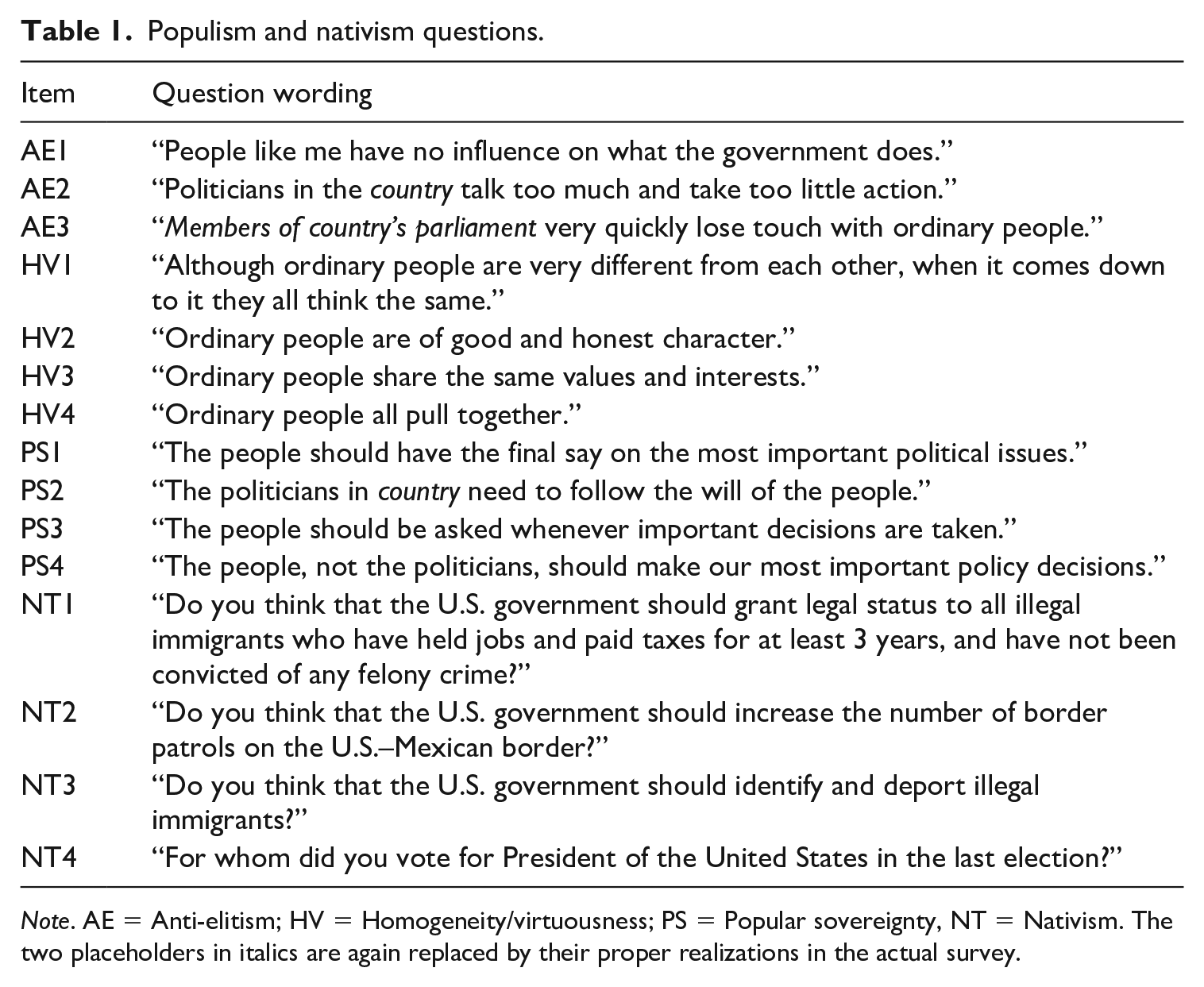
Note. AE = Anti-elitism; HV = Homogeneity/virtuousness; PS = Popular sovereignty, NT = Nativism. The two placeholders in italics are again replaced by their proper realizations in the actual survey.
For the general populism measure, we use all 11 items (excluding the nativism items). Our anti-elitism measure uses AE1–AE3, the homogeneity variable HV1–HV4, and the popular sovereignty PS1–PS4. To obtain the four factor scores, we follow the same procedure as above (Figure A.1 in the appendix). 15
Following previous studies, 16 we measure nativist attitudes based on questions about immigration and immigrants. These are NT1–NT3 in Table 1, which we took from the Cooperative Congressional Election Survey (Vavreck and Rivers 2008); these have Yes/No answer options. Additionally, we ask who the person voted for in the 2016 Presidential election (NT4), recoding the answer into a dummy whether the person voted for Donald Trump. We again turn these questions into a factor with loadings shown in the appendix (Figure A.1). 17
Not surprisingly, the general populism factor is positively correlated with all three measures of its components, but particularly strongly with popular sovereignty (see Figure A.2). Overall, the three components correlate weakly. It is worth noting that the populism-related measures and nativism are only weakly correlated (less than 0.25), supporting the idea that these concepts are distinct (Oliver and Rahn 2016).
We also include a set of questions to account for confounding issues (i.e. “attitudes-on-attitudes” problem). This is pertinent because many individual attributes are determinants of aid attitudes and of populist attitudes as we show in the appendix (Table A.3). For example, less-educated individuals with right-leaning ideology who experience financial struggles tend to oppose foreign aid (Paxton and Knack 2012), while the same people tend to support populism and vote for populist parties (Elchardus and Spruyt 2016; Hawkins et al. 2012; Inglehart and Norris 2016). Failure to account for these individual characteristics would invite known and serious bias.
To lessen such issues, we carefully surveyed the literatures on populism and aid opinions to select a set of determinants of aid sentiments that have also been shown to predict populism (Table A.3). These variables include the respondent’s age, gender, education, household income level and recent changes to it, political ideology, religiosity, and perceptions of the future economy. For details about measuring and transforming these variables, see the Appendix (Table A.4). Of course, the use of these variables does not guarantee unbiased estimates of causal effects. However, the richness and comprehensiveness of existing studies on aid and populism make it unlikely that something major is missed. In two robustness checks, we take further steps toward reducing confounding by using additional controls and employing a machine learning technique that targets complex, interactive confounding patterns.
Statistical analysis
We use linear models to analyze how aid attitudes change with populist-related and nativist attitudes. We use two model specifications, one that only includes the general populism measure and another that has the three populism components and nativism.
Turning to our data, it is well-known that MTurk and Prolific samples are not representative of the US and UK populations (Berinsky et al. 2012), respectively. While survey analyses using MTurk data generally replicate the sign of effects from nationally representative samples (Coppock 2019; Mullinix et al. 2015), we also would like to make magnitudes of associations comparable to population-level magnitudes. We achieve this by applying weights obtained from entropy balancing (Hainmueller 2012), making the moments of several demographic variables match those of nationally representative surveys.18,19
Main results
Results are summarized in Table 2. We start by showing how the general populism variable relates to aid attitudes after controlling for a rich set of potential confounders. In both the US and UK cases, Specification 1 shows that general populism is systematically associated with reduced support for aid spending. Since our outcome and explanatory variables of interest are all normalized to have a standard deviation of one, we can interpret and compare coefficients in a straightforward manner. The mean estimate for the coefficient on general populism based on the US sample is relatively small with a one standard deviation increase in populism is associated with a 4% [1, 10] of a standard deviation decrease in aid support. In contrast, the estimate based on the UK sample is larger with the same change leading to a 21% [11, 31] standard deviation reduction in aid support. These results are generally consistent with the claim that populism is related to aid attitudes. However, as we argued earlier, populism is a multidimensional concept, and a more engaging and productive understanding of the populism–aid connection requires unpacking populism into its constituent ideas.
Attitudes regression estimates.
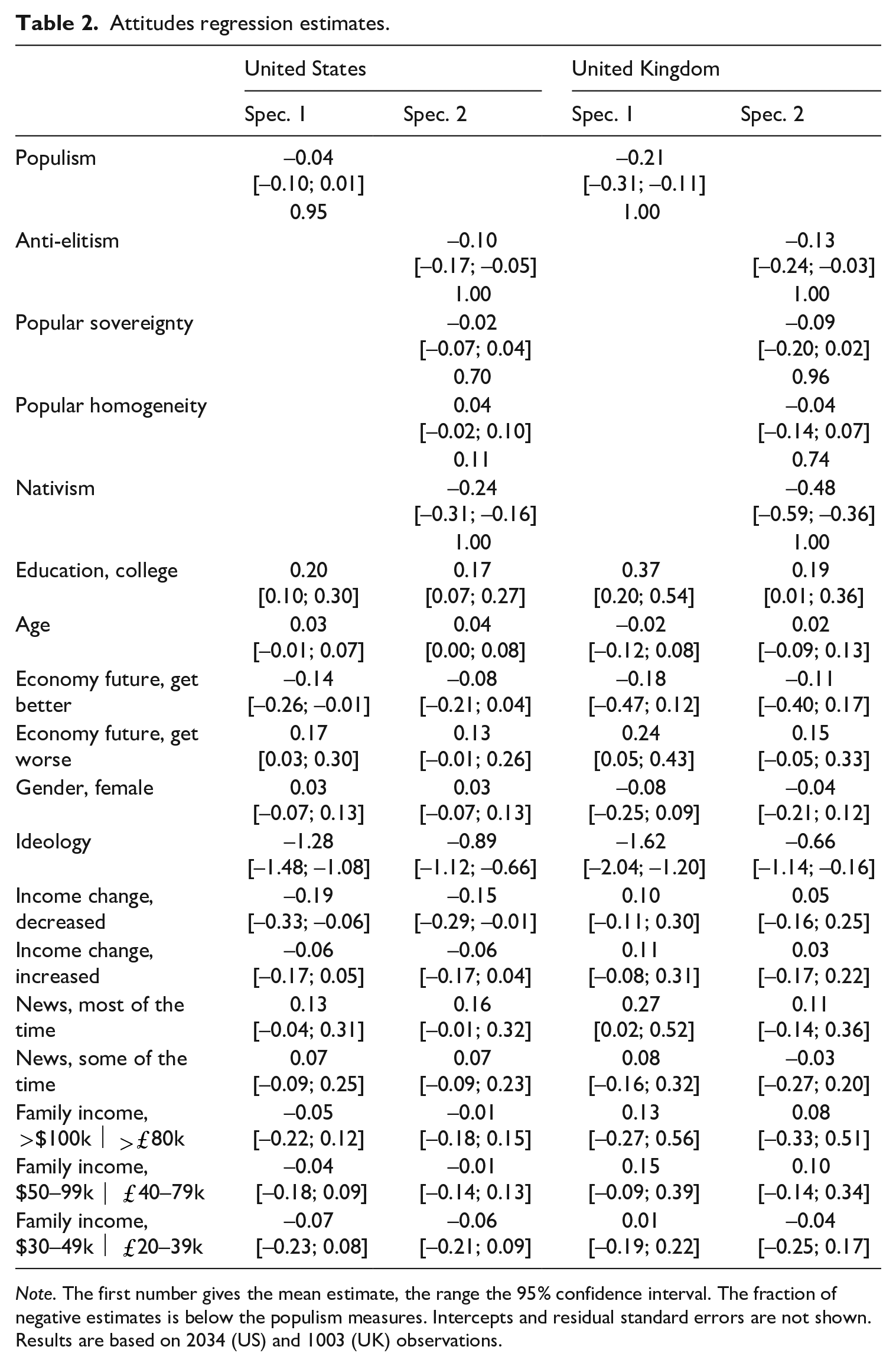
Note. The first number gives the mean estimate, the range the 95% confidence interval. The fraction of negative estimates is below the populism measures. Intercepts and residual standard errors are not shown. Results are based on 2034 (US) and 1003 (UK) observations.
Disaggregating populism in Specification 2, we find that the populism estimates consist of strong and consistent negative estimates of anti-elitism and weaker, noisier estimates for popular homogeneity and sovereignty. Across samples, nativism is strongly and consistently associated with reduced aid support. A standard deviation increase in anti-elitism is associated with 10% [5, 17] (US) and 13% [3, 24] (UK) standard deviation decreases in aid support, and such change in nativism entails a reduction in aid support by 24% [16, 31] (US) and 48% [36, 59] (UK) of a standard deviation.
Homogeneity and sovereignty are not consistently statistically significant from zero. One caveat is that the UK results shows that the popular sovereignty measure is somewhat systematically associated with reduced support for aid spending. However, this pattern is not evident in the US sample. However, we also find the estimates for anti-elitism and nativism to be consistently among the strongest two associations among all four variables of interest, as we show in Section VII in the appendix. 20
Robustness checks
Our identification strategy relies on selecting observables known to be confounders, based on our review of rich bodies of literature. To further bolster our results, we conduct three sets of robustness checks. First, we add a further set of controls to the model specification, namely measures for party preferences and whether religion is an important part of one’s life. Party preferences are included to more fully capture respondents’ political leanings, while the existing literature (weakly) suggests religiosity to be a potential confounder. Reanalyzing everything, the results are essentially unchanged as we show in Section VI in the appendix.
Second, the extent to which we can interpret the aforementioned results as casual depends on how well the control variables perform at removing confoundedness. We cannot be certain whether our additive linear functional forms adequately address confounding. Thus, we also implement an approach from machine learning called “double selection” (Belloni et al. 2014), which helps us select more relevant controls from possible (pairwise) interactions between these controls, adjusting for confounding in a richer manner while guarding against the dangers of overfitting. Our results hold as demonstrated in Section VIII in the Appendix, where we also discuss the procedure in more detail.
Third, our results show how the conditional mean of aid attitudes moves with populism-related sentiments. However, the entire distribution of aid attitudes may change in many other ways that are not revealed by simple linear models. In particular, a focus on the conditional mean can mask effects at the extremes, i.e. the most vehement attitudes. We employ quantile regression models to examine how the distribution of aid attitudes changes with populism (Koenker and Hallock 2001). Results in Section IX demonstrate that our central findings regarding anti-elitism and nativism are not driven by effects on extreme realizations. That is, the effects of anti-elitism and nativism are similarly negative and strong at low and high percentiles the distributions of aid support.
Analysis of foreign aid spending
So far, we have demonstrated that there is empirical support for the public opinion hypotheses from our theory. This provides micro-level evidence for our key arguments regarding actual aid spending by governments. Our predictions are that an increase in the mass public anti-elitist and nativist moods in a donor country is associated with a reduction in aid spending. It merits emphasizing that we expect these reactions regardless of whether the government is run by populists.
Research design
Our dependent variable is a country’s total aid commitments taken from the OECD, which we scale to a per-capita basis and transform via the logarithm. We opt to scale by the population because the GDP, the other prominent scaling factor, might itself be affected by determinants of populist sentiments (like a financial crisis or a surge of immigrants). 21 Aid commitments are firm obligations made by donors in a given year, which have to go through the national budget process. Thus, we do not expect an immediate, large effect on the commitments from changes to national sentiments. Accordingly, we prepare two outcome variables. The first variable is aid per-capita measured 1 year after all covariates are realized while the second is a 2-year lead of aid per-capita. The overall temporal domain is the period between 1990 and 2013, with aid realizations taking place between 1991 and 2014/2015.
Our tests require aggregate measures of both anti-elitist and nativist moods in donor countries over time. For nativist sentiments, we make use of a recently compiled dataset by O’Grady et al. (2020), who estimate mass preferences on immigration and on immigrants’ policy across European countries based on multiple cross-national surveys. They rely on a measurement model to combine results across different waves of surveys, providing a dynamic latent measure of immigration conservatism, scaled such that positive values express more anti-immigrant sentiments. The measure draws on constituent survey questions regarding whether employers should prefer citizens over immigrants, whether the respondent believes that immigrants are taking jobs away from citizens, and whether the government should not allow people from poorer countries to immigrate. This measure provides an excellent operationalization of our theoretical concept.
Ideally, we would also have a survey-based measure of countries’ aggregate level of anti-elitist sentiments, but unfortunately applicable survey items have only been included in some very recent surveys. The (crude) measure of anti-elitism at the country level that we propose is the number of protests against the government. The source data (Banks and Wilson 2018) uses a definition that proxies reasonably well the concept of interest to us: “[a]ny peaceful public gathering of at least 100 people for the primary purpose of displaying or voicing their opposition to government policies or authority, excluding demonstrations of a distinctly anti-foreign nature” (emphasis added). What makes this variable crude for our purposes is that partisan differences with the government may also lead to such anti-government protests. 22 Unfortunately, we are unaware of a better measure, and will proceed while acknowledging the shortcoming of one of our two aggregate tests. 23 In our sample, the count of anti-government protests is mostly low integers, but a few realizations are large. We account for this by using the square-rooted count of anti-government protests, a functional form specification which we relax in the robustness checks.
Following existing studies on aid generosity, we also include a set of control variables that might give rise to populism, nativism, and foreign aid generosity. These variables are current aid per-capita (i.e. a lagged dependent variable), GDP per-capita, economic growth, the extent to which the country is embedded with the rest of the world (economic, political, interpersonal), unemployment rate, government debt, women in parliament, inflation, government revenue, and government ideology. The globalization indices are taken from the KOF database (Gygli et al. 2018), ideology variables from the 2017 Database of Political Institutions (Beck et al. 2001), and other variables from the Quality of Government dataset (Teorell et al. 2011). We account for heterogeneity over time and across countries by including modeled year-specific and country-specific intercepts (random effects). Last, since rising populist sentiments may lead to populist governments (eventually) and, by our theory, give rise to revised aid policies, it would induce post-treatment bias if we controlled for nativism and anti-elitism leanings in the government. Thus, we refrain from doing so (King and Zeng 2006).
The spatial coverage of the immigration conservatism data by O’Grady et al. (2020) is limited to 15 European countries in the OECD, which were donors throughout our temporal domain. Crucially, this unfortunately excludes major donors outside of Europe, and in particular the United States. 24 Coverage on the other variables is almost complete, with missingness of less than seven percent. While multiple imputation has become the de facto gold standard for dealing with issues of missing data (Lall 2016), we are uneasy imputing the entire time-series of immigration conservatism for the missing countries. Therefore, we will show results using the multiple imputed data relying on the entire data set and subsetting the data to those countries with coverage by O’Grady et al. (2020). 25
Main results
Table 3 presents the results of linear regressions with random effects by donor and year. There is support for our theoretical expectations. Consider the coefficient estimates from our analysis of the full sample (the first and second columns). Those negative estimates mean that an increase in immigration conservatism as well as the number of anti-government protests in a donor country are systematically associated with a reduction in aid commitment per-capita. The entire 95% confidence interval is negative. These results remain unchanged when we restrict our sample to 15 European donors (i.e. small sample, columns three and four) and when we consider aid 2 years ahead.
Aid allocation estimates; random effects.
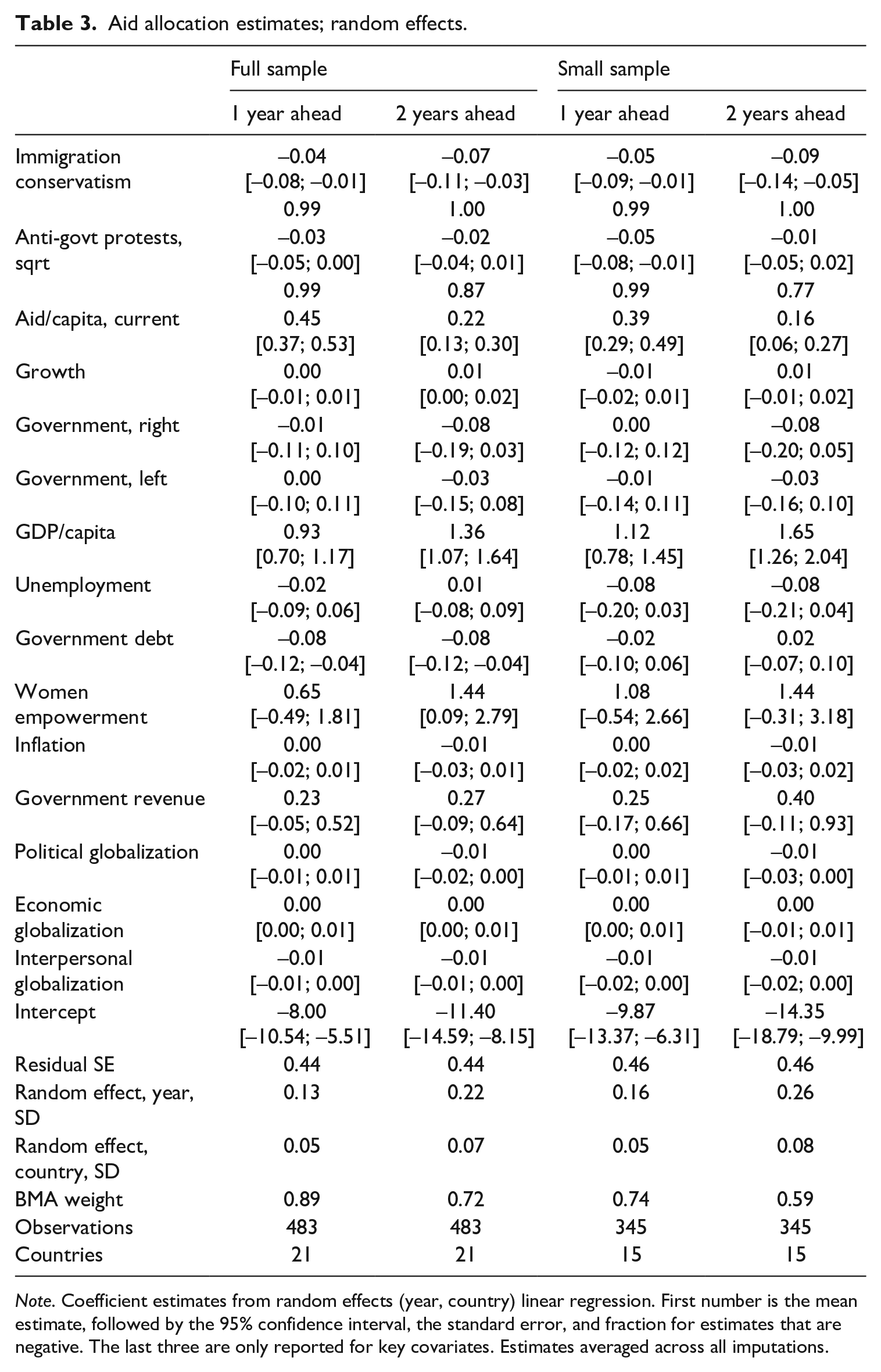
Note. Coefficient estimates from random effects (year, country) linear regression. First number is the mean estimate, followed by the 95% confidence interval, the standard error, and fraction for estimates that are negative. The last three are only reported for key covariates. Estimates averaged across all imputations.
These relationships are also substantively strong. According to the model with the 1-year lead aid variable (column 1), increasing immigration conservatism from its mean to a standard deviation above, aid-per-capita decreases by 4% [1, 8] a year later. The first anti-government protest leads to a decrease of 3% [0, 5] in aid; 10 protests compared to none reduce aid by 10% [0, 16]. The magnitudes are generally larger when using the limited sample with only European donors, and of different magnitudes when looking out by 2 years. The anti-government protest estimates noisier when examining 2 years out in the smaller sample, but overall direction remains consistent.
Together with the micro-evidence from our two surveys, these macro-findings at the donor-level offer evidence in support of the causal mechanism underlying our theoretical model. That said, the number of anti-government protests is a blunt measure of societal-level anti-elitism. But the results on the effect of anti-government protests can at least be taken as suggestive that aid spending responds to opinion changes at the mass level, the pattern implied by the model.
Robustness checks
Before concluding, we report the results of our robustness checks. First, many researchers scale foreign aid outlays by the donor’s size of the economy. The (logarithm of) aid per-capita and aid/GDP correlate very highly, and, therefore results from models using this alternative measure are nearly identical (Section X). Second, if aid outlays are sticky, including the contemporaneous level of aid per-capita in our model might not suffice. In another specification, we also include the aid per-capita realized 1 year prior to observing the immigration conservatism and the anti-government protests. The results remain largely unchanged (Section XI). Third, instead of random effects, we use a fixed-effects estimator, foregoing modeling the intercepts via a common distribution. The results are again very similar (Section XII).
Fourth, the anti-government protest variable is transformed by its square root, which might be driving its effect in preceding models. We devise eight alternative functional forms for this count variables (linear, making the variable ordinal several different ways). Since we have no a priori reason to prefer any of them, we average over the estimates from these alternative models in a principled way using Bayesian Model Averaging (BMA) (Hoeting et al. 1999; Montgomery and Nyhan 2010). Averaging over all models shows that our findings are robust. Details for the BMA analyses are in Section XIII.
Conclusion
Although pundits and scholars often draw a close connection between populism and foreign aid, theoretical and evidentiary bases for this link are thin. Our goal has been to theorize and supply evidence for a specific mechanism through which populism affects aid policy. To this end, we have adopted a popular framework of aid policy, the delegation model, and analyzed how key component ideas of populism relate to foreign aid through a public opinion channel.
Our theoretical model and survey data demonstrate that anti-elitist and nativist attitudes are systematically associated with negative attitudes toward aid. In contrast and as predicted, popular sovereignty and homogeneity are not. Our analysis on aid spending presents suggestive evidence that changes in anti-elitist and solid evidence that nativist moods in a donor country have the expected influence on the level of aid spending, regardless of whether the government is run by populists. 26 Together, our study demonstrates one specific process through which populism and its related ideas, like nativism, can influence aid spending. It is through changes in mass preferences that anti-elitism and nativism can affect donor countries’ aid spending.
While our theoretical approach has clarified where populism and foreign aid do and do not speak to each other, we want to reiterate that we conceptualize populism in one specific way. We do not wish to suggest that populism or some of its key elements (beliefs in popular sovereignty or homogeneity/virtuousness of the people) cannot relate to aid attitudes or policy. Inevitably, our study leaves open other processes by which populism may affect aid attitudes or policy. The debate about how to best conceptualize populism is far from settled with the most recent critiques of the minimal definition of populism by Mudde and associated measurement approaches (Olivas Osuna 2020; Wuttke et al. 2020). Further, other scholars have defined populism in a number of ways—most notably, as a communication style (Jagers and Walgrave 2007) and a political strategy (Weyland 2001). Our hope is that this study inspires researchers to engage with these newer insights and different conceptualizations of populism and contribute to the literature on foreign aid and foreign policy. 27
We also note other limitations of our study. First, while we have taken a step to check the generalizability of our findings by fielding the survey in two substantively important cases of the United States and United Kingdom where the claim linking populism with foreign aid are prominent, the public’s attitudes may differ in other donor countries. Although we note little a priori theoretical reason to expect different patterns in other donor countries, it is assuring that our survey results hold across two cases and that our results manifest themselves cross-nationally among all OECD donors’ aid outlays. 28 Nonetheless, we think future research should attempt to test our hypotheses outside the United States and United Kingdom to gain new insight.
Second, our delegation model makes most sense in the context of democratic donor countries, which is why our cross-national analysis of aid spending focused on OECD donors. Therefore, we wish not to claim that our findings apply to a wider group of donors, including “emerging” or “new” donors especially when they are not democracies (such as China, Saudi Arabia). We invite scholars to investigate whether our arguments and findings concerning aid spending apply to donors outside the traditional donor pool.
The final important limitation lies in the extent to which we can make claims about causality. Even though we have controlled for a rich set of predictors of populism and aid attitudes that we extracted from an examination of the existing literatures and employed a robust inference procedure (i.e. double selection), we note that other aspects might be confounding our results as well. We hope our findings motivate future research to design experiments. One possibility would be to prime anti-elitist and nativist thinking in respondents and then ask questions about foreign aid. Another might be to target respondents with high anti-elitist and nativist sentiments and conduct an experiment in which treatments are designed to mitigate specific concerns (e.g. elites handling money). Such experiments would have additional benefits of allowing researchers to probe and vary other aspects of the causal mechanism, such as the identity of elites and beneficiaries.
With these caveats stated, we assess the relevance and importance of our findings to debates in the broader IR scholarship and policy. First, IR researchers routinely suggest that rising populism presents a particularly acute concern for international cooperation (Boucher and Thies 2019; Carnegie and Carson 2019; Copelovitch and Pevehouse 2019; Pevehouse 2020). However, populism’s multidimensional and thin nature complicates and obscures the inferences about the link between populism and foreign policy. We demonstrate one useful analytical approach to understanding this likely complex relationship. This study is the first systematic analysis to apply arguably the most successful approach to populism, unpack it into its multiple elements, and investigate how they influence both individual foreign policy attitudes and foreign policy decision-making. Importantly, our delegation approach is general in that it could be applied to policy domains outside foreign aid. In doing so, this study also makes an important contribution to the general IR scholarship and a growing literature on populism and foreign policy (Chryssogelos 2017; Liang 2007).
Second, we draw out the implications of our study for what could be done to preserve support for foreign aid and what else needs to be studied. At the most basic level, our results demonstrate that populist disdain for aid is rooted in two reasons that are different from the many that the existing work has identified to cause dislike for aid. 29 On the one hand, anti-elitists reject foreign aid because their preferences do not coincide with the elites’ and not (necessarily) because they lack compassion for the poorest of the world. On the other hand, nativists oppose aid because of their exclusionary views toward foreigners, which might be a lack of compassion or sense of responsibility. 30 Even if elites were nativists to a considerable extent, nativist people would not want to see funds transferred to foreigners.
Each mechanism leads to different suggestions for how to respond to populist challenges to foreign aid effectively. Anti-elitists’ ire may be ameliorated by improving transparency and accountability in aid, minimizing the aid agency’s overhead costs, and avoiding corrupt governments as recipients. These changes may assuage anti-elitists because they help monitoring suspect agents, imply less bureaucratic largesse, and cut out particularly distrusted elites (on the recipient side), respectively. Of course, none of these are new ideas in themselves. However, aid agencies’ movements toward these recognized best practices have been slow (Easterly and Williamson 2011), and these ideas’ potential for mitigating populist critiques have not been realized to our knowledge.
One could also change the appearance of the development community. Often, celebrity activists feature in public portrayals of development efforts, who may particularly shape the views of an inattentive public (Baum 2002). However, celebrities are elites themselves and thus might fuel anti-elitist sentiment. 31 Instead, perhaps more popular involvement in foreign aid and public outreach may prove effective at mitigating anti-elitist ire.
These approaches should do little to curb nativist challenges to aid, which we think are more difficult to address. After all, nativists judge the recipients of aid to be unworthy beneficiaries, a belief that rattles the moral foundation of the pursuit of development aid. One approach might be to reframe aid as a policy tool that merely incidentally benefits foreigners, but ultimately succeeds in keeping transnational externalities away. For example, Bermeo and Leblang (2015) and Bermeo (2017) argue that governments use aid outlays to foster foreign countries’ development such that outflows of refugees and migrants or the spread of diseases is lower. One could argue that despite foreigners benefitting from aid, nativists may still appreciate a policy that tackles issues pertinent to them. Perhaps, such reframing may quell nativists’ dislike for foreign aid. Recent experiments by Heinrich and Kobayashi (2020), Heinrich et al. (2018), Kobayashi et al. (2021), and Kohno et al. (2020) show that highlighting tangible selfish benefits from aid generally makes aid more popular. However, we note that such reframing is unlikely to succeed unless nativists believe that aid is effective at addressing those underlying drivers of migrations (e.g. poverty, conflict, climate change). We believe that these ideas are ripe for future research.
Footnotes
Acknowledgements
We thank Kris Dunn, Brad Epperly, Jason Eichorst, Jocelyn Evans, Kaisa Hinkkainen, Eleonora Mattiaci, Laura Seelkopf, and participants at workshops at the Ludwig-Maximilians-Universität München, the Hochschule für angewandtes Management, and the 2019 Development Studies Association Conference for feedback and help. Devin Caughey provided us with his and coauthors’ estimates on immigration conservatism.
Funding
The author(s) received no financial support for the research, authorship, and/or publication of this article.

Supplemental material
Supplemental material for this article is available online.
Notes
Author biographies
References
Supplementary Material
Please find the following supplemental material available below.
For Open Access articles published under a Creative Commons License, all supplemental material carries the same license as the article it is associated with.
For non-Open Access articles published, all supplemental material carries a non-exclusive license, and permission requests for re-use of supplemental material or any part of supplemental material shall be sent directly to the copyright owner as specified in the copyright notice associated with the article.
