




Abstract
The Antarctic Treaty System (ATS), created in 1959 to govern the southern continent, is often lauded as an illustration of science’s potential to inspire peaceful and rational International Relations. This article critically examines this optimistic view of science’s role in international politics by focusing on how science as a global hierarchical structure operated as a gatekeeper to an exclusive Antarctic club. I argue that in the early 20th century, the conduct of science in Antarctica was entwined with global and imperial hierarchies. As what Mattern and Zarakol call a broad hierarchy, science worked both as a civilized marker of international status as well as a social performance that legitimated actors’ imperial interests in Antarctica. The 1959 ATS relied on science as an existing broad hierarchy to enable competing states to achieve a functional bargain and ‘freeze’ sovereignty claims, whilst at the same time institutionalizing and reinforcing the legitimacy of science in maintaining international inequalities. In making this argument, I stress the role of formal international institutions in bridging our analysis of broad and functional hierarchies while also highlighting the importance of scientific hierarchies in constituting the current international order.
Keywords
The Antarctic Treaty System (ATS) has governed International Relations in the southern continent for six decades and, in political discussions, is often celebrated as a model of international cooperation through scientific research. As British representative at the 1959 creation of the ATS, Brian Roberts, maintains, ‘in the forty years or more during which I’ve been associated with Antarctic affairs, I have seen some degree of international order evolve out of chaos; harmony has replaced discord. . .’ (quoted in Scott, 2011). At its 50th anniversary, US Secretary of State Hillary Clinton praised the Treaty as ‘a blueprint for the kind of international cooperation’ needed to address 21st century challenges and ‘an example of smart power at its best’. She describes Antarctica as a place where ‘science is the universal language’ that brings people from different nations together for a common purpose (Clinton, 2009). Indeed, the steady record of scientific collaboration in the harsh beauty of Antarctica has drawn much attention to science’s role in forging interstate cooperation – and its potential to create global partnerships over pressing challenges from pandemics to climate change. Some have even praised the ATS as a triumph of apolitical science in the service of peace with Fogg’s volume on Antarctic science concluding that the ATS ‘seems to have given hope of a movement towards more rationality and more peaceful solutions to international problems’ (1992: 406).
Curiously, the ATS has been an understudied moment of international cooperation in International Relations (IR) scholarship. When it is mentioned, the ATS is often listed in passing as an example of an effective international regime (Koremenos et al., 2001; Young, 1989, 1996). Scholars such as Young (1989: 64) do note the exclusionary nature of the Antarctic club, but there is limited exploration into what the use of science as an exclusionary device means for the international order that the Treaty helps to constitute. To examine the implications of science as a formal hierarchy embedded in the fabric of the ATS, this article critically interrogates pervasive visions of Antarctic science as an impartial catalyst for international cooperation, and in particular, situates the ATS in growing IR scholarship on international hierarchies (Mattern and Zarakol, 2016). Through a detailed analysis of the ATS, particularly Article IX of the treaty, which stipulates that all parties who join the Treaty must conduct ‘substantial scientific research activity’ in Antarctica, I demonstrate how science operated and continues to operate as a gatekeeper to an exclusive Antarctica club. In doing so, I draw on scholarship in geography that has advanced the critical analysis of cooperation in Antarctica as an uneven global governance framework that legitimized pre-Treaty land grabs and institutionalized early 20th-century imperial structures (e.g. Dodds, 2006; Scott, 2011; Glasberg, 2012; Howkins, 2017). I also use primary archival research that showcases how these unequal structures were embedded into the diplomatic bargains that legitimated and enabled the creation of the ATS.
By highlighting science as a hierarchical tool of exclusion in Antarctica, I make two larger interventions into our understanding of the evolution of the current international order. First, I contend that science constitutes an understudied source of hierarchy in international politics – both as a broad hierarchy that manifests itself in deep structural inequalities and as a narrow hierarchy or functional bargain that brings actors together in international agreements. In particular, science is an epistemic argument that links a certain type of knowledge production about a space with legitimate political authority over that space. In doing so, it produces a hierarchical relationship between actors that do science and the peoples and spaces that are the objects of scientific study. Here science is not an innocent tool, but a particular type of engagement with the natural world that confers legitimacy on some stakeholders over others. Second, I highlight the role that formal international institutions such as the ATS play in bridging the analytical gap between scientific hierarchy as deep-seated global inequalities and the functional bargains struck to resolve specific problems of international order. In particular, I stress how broad hierarchies create the political possibilities that enable functional bargains, and how in turn, functional bargains reinforce and legitimate existing broad hierarchies.
This article proceeds as follows. The first section explores existing IR literature on international hierarchies and how examining science as hierarchy contributes to our understanding of international order. The second section details the broad structural inequalities that framed the conduct of science in Antarctica prior to the ATS. Here, I highlight the conduct of science both as a marker of international status and as an imperial performance of territorial conquest. Following from that, I investigate how science as broad hierarchy shaped negotiations at the 1958–1959 Washington Conference that created the ATS, and how science as a geopolitical gatekeeper helped legitimate functional bargains at the conference. Finally, I examine how the ATS as a formal authority relationship reinforces broad hierarchies of science which continue to structure International Relations in Antarctica today.
Science, hierarchy, and international order
In Theory of International Politics (1979), Waltz famously juxtaposes anarchy, the absence of an overarching authority and hence ‘sameness’ between a system’s units, and hierarchy, the presence of a legitimate authority that allows for the differentiation of units. Since then, the anarchy assumption has anchored IR theory by bifurcating the anarchical international system and hierarchical domestic orders. Despite its disciplinary dominance, scholars have challenged Waltz’s anarchy assumption from the Liberal perspective (Lake, 2007; Milner, 1991) and through Constructivist and critical lenses (Onuf and Klink, 1989; Wallerstein, 1984). In recent years, a growing body of IR scholarship has worked to re-centre hierarchy as the discipline’s analytical point of departure and confront the anarchy-hierarchy distinction in a variety of ways (e.g. Mattern and Zarakol, 2016; Sjoberg, 2017; MacDonald, 2018; Kang, 2020). These scholars have theorized hierarchies as thin functional bargains between actors to achieve desirable goals, as well as deeply embedded structures of international power (Zarakol, 2017: 5–7).
Within the literature, Mattern and Zarakol (2016: 624) identify two conceptions of hierarchies, which they define as intersubjective orders of vertical relationships between actors: the narrow and broad conceptions. For them, the narrow conception of hierarchy stems from legitimate authority and is a ‘particular kind of organizing principle reflecting an intrinsically legitimate political order’, while the broad conception understands hierarchy as deep structures of inequality that stratifies actors (2016: 629–633). Hence, the narrow conception emphasizes the creation of hierarchical orders by agents that use the logic of trade-offs or functional bargains to incentivize cooperation between actors (Bukovansky et al., 2012; Lake, 2007). Here, Lake’s (2007: 54) work provides one of the clearest examples of the narrow conception within IR scholarship and stresses this notion of a trade-off between a ‘social order’ and a ‘loss of freedom’.
Broader conceptions operate through the logics of positionality and productivity that underscore the importance of social position and practices in structuring hierarchy (Mattern and Zarakol, 2016: 646). In this conception, global hierarchies such as those based on gender or race produce both agents and the political contexts in which they act (Zarakol, 2017: 7). Further, broad conceptions of hierarchy can operate within Waltz’s anarchy assumption. Unequal ideational and material structures can exist within anarchy as it does in domestic orders, and these structures shape actors’ behaviors irrespective of whether there is an overarching authority in place. Hence, for proponents of broad hierarchies, it is the implications of the lack of legitimate overarching authority that is undertheorized in Waltz’s original model (Sjoberg, 2017). In contrast, proponents of narrow hierarchies such as MacDonald (2018: 128) argue that hierarchy should be conceptualized ‘not as simply the presence of inequality or stratification’ as the broad conception suggests but dependent on ‘an authority relationship’. This authority relationship or formal vertical stratification more directly challenges Waltzian anarchy (see McConaughey et al., 2018) while often upholding the domestic-international distinction by emphasizing the different types of authority relationships that are possible at the domestic and international levels.
My argument is different in that it stresses the ways in which Mattern and Zarakol’s narrow and broad conceptions of hierarchy not only co-exist but reinforce one another. At first glance, the creation of the ATS seems like a prime example of the narrow conception of hierarchy. However, while the narrow conception emphasizes the role of agents in creating hierarchical orders to resolve an international problem – as the 12 states at the Washington Conference did in 1958–1959 – it misses the bigger question of why certain scientific practices and actors’ aspirations to scientific status were considered authoritative in the first place. In other words, analysing the ATS as solely a narrow hierarchy that uses science as a functional tool to legitimate its authority relationships treats the authority of science as a given and undertheorizes the role of scientific status and practice in global politics.
Conversely, while scholarship in history and critical geography has meticulously detailed the role science plays in constituting and reinforcing inequalities in Antarctica (most notably, Dodds, 2002; Roberts, 2011; Howkins, 2017), it is limited in showing how science as a broad structural inequality became institutionalized through international agreements to acquire legitimacy that outlasts the early 20th-century imperial world order that constituted it. Hence, while other broad hierarchies such as racial hierarchies have largely lost their legitimacy as formal ordering principles, a global hierarchy based on science constituted by the same imperial processes continues as a legitimate international ordering principle. An analysis that combines narrow and broad hierarchies can show both how International Organizations (IOs) as authority relationships at once relies on broad hierarchies and also institutionalizes those hierarchies, giving them legitimacy even as global geopolitical forces and social structures change. Further, by transforming broad hierarchies of science into authority relationships, IOs help obfuscate the link between science as hierarchy and the imperial processes that constituted that hierarchy.
There are methodological implications in combining broad and narrow conceptions of hierarchies. For scholars interested in broad hierarchies that constitute international society, the object of study is the society itself – what Inayatullah and Blaney (2018) describe as an indivisible social whole that cannot be analytically reduced down to its individual units. In contrast, narrow conceptions of hierarchy might focus on one authority relationship or functional bargain – a particular treaty or IO – among a universe of cases. Lawson (2006; 2012) suggests that historical sociologists work to bridge precisely this gap by examining the relationship between large-scale social processes and their context-specific manifestation in empirical specificity. To do so, Lawson turns to Sartori (1970) who writes that we should start at mid-level abstractions to work up and down the ladder of abstraction in order to ‘combine explanatory purchase with a high level of empirical content’ (Lawson, 2006: 405). Inspired by Lawson and Sartori, my investigation starts with the mid-level abstraction of science as hierarchy and works up and down the ladder of abstraction to investigate its empirical specificity in Antarctica as well as the embeddedness of science in wider social forces and global transformations that have shaped the broad hierarchies of modern international order. In this sense, my theorizing of hierarchies follows what Pouliot (2014: 237) calls ‘practice tracing’ whereby thick description illuminates context-specific social processes in Antarctica ‘but with an eye to producing analytically general insights’. The next section begins with science as hierarchy as an analytical starting point to examine how the two logics behind broad hierarchies came together in the creation of the ATS.
Science as hierarchy: status, practice, and organizations
To explain how and why a hierarchy based on science took root in Antarctica, I examine how the idea and practice of science were embedded in broad global hierarchies in the late 19th and early 20th centuries. Science as broad hierarchy operated in two interrelated ways that map onto Mattern and Zarkol’s logics of positionality and productivity. First, science operated as a status hierarchy based on the logic of positionality that ‘appear as extant features of the world political environment in which actors simply find themselves’ (Mattern and Zarakol, 2016: 638). Status hierarchies socialize actors into certain roles based on differentiated rank, and actors’ interests are constituted by their perceived position within a given social structure (Renshon, 2017; Wohlforth, de Carvalho and Leira, 2018). In the 19th and early 20th centuries, science became entangled with notions of civilization that shaped status positions in a globalizing European international society (Buzan and Lawson, 2015; Dunne and Reus-Smit, 2017).
Status hierarchies have long informed European international society, particularly in establishing a tier of Great Powers among European states in the 18th and 19th centuries, but its effects can also be seen in the behaviour of smaller states (De Carvalho and Neumann, 2014; Holsti, 1991). In the 19th century, the Standards of Civilization – formal benchmarks that separated modern and civilized states given full rights and recognition under international law from ‘barbaric’ polities denied such recognition (Bowden, 2009; Towns, 2009) – created a global status hierarchy based on civilizational identity. Here, claims to be more ‘scientific’ and hence ‘advanced’ informed civilizational standards for legitimate domestic institutions and relations between states (Branch, 2014; Scott, 1998). Allan’s work (2018) demonstrates how notions of scientific progress shaped collective understandings of state purpose from the balance of power in the 18th century to colonial development and economic growth in the 19th and 20th centuries. These evolving ideas of legitimate state purpose informed which actors were considered modern and civilized states and how aspiring powers might demonstrate that status.
Through European imperialism and its attendant global transformations in the 19th century, European civilizational standards became international status markers, and self-identity as advanced scientific states helped actors demonstrate and reinforce their status (Gong, 1984; Suzuki, 2005). Daggett’s (2019: 2) work on fossil fuels and thermodynamics demonstrates how the European understanding of scientific progress became global, allowing the ability to harness energy through the science of thermodynamics to become a global ‘unit of equivalence through which we can compare human civilizations’. Even as civilizational standards faded as formal legal benchmarks, the ideational legacy of these standards continue to inform our current understanding of ‘backwards’ and hence illegitimate states from the ‘failed states’ discourse to the war on terror (Anghie, 2004; Bowden, 2014; Gruffydd Jones, 2013). Similarly, the notion of scientific progress embedded in these civilizational standards continues to shape our understanding of successful and modern actors in international politics.
Second, while the logic of positionality offers insights into why actors used the conduct of science to showcase their status aspirations in international politics, it is limited in showing us how, once adopted, the performance of science helped produce new types of legitimate actors and global political spaces. Here, an understanding of Mattern and Zarakol’s (2016: 641) logic of productivity helps us explore the ways in which science as hierarchy ‘produces both the actors and the spaces of world politics’ through ‘bodily activity and discursive regimes’. In this way, the performance of science in Antarctica might be understood as a Butlerian social performance through ‘the stylized repetition of acts through time’ (Butler, 1990: 145) based on relatively stable meanings that guide actors. Seen in this light, science has a ‘practical, or performative, ontology’ (Mattern and Zarakol, 2016: 641) that elevates the actors who conduct science as politically authoritative and transforms spaces of scientific contestation such as Antarctica into a particular type of exclusive political space.
Conducting science as a constituting practice that creates new identities, relations, and spaces has long been studied by historians of science, particularly in research showing how science was implicated in European imperialism. Adas’s influential work (1989) investigates how scientific and technological achievements were used to measure societal development and compare between societies, informing Europeans’ sense of their own superiority. By opening up new geographies for scientists to explore, imperialism enabled developments in science, but scientific achievements also helped legitimate imperialism as valuable for advancing human knowledge. For example, imperial expansion enabled botanists to categorize, collect, and cultivate exotic foliage that at once advanced the science of botany, beautified Europe’s great houses and botanical gardens, and fueled the colonial economy (Brockway, 1979; Schiebinger and Swan, 2005). But also, as Drayton contends (2000), the production of meticulously curated and scientifically progressive British gardens also helped legitimate British imperialism as performed in the service of human improvement and a symbolic return to the garden of Eden. The diversity of plants and animals available to the imperial scientist enabled Charles Darwin’s work, which in turn, contributed to ideas of racial progress that helped legitimate imperial practices (Browne, 1996). Similar dynamics informed the development of other sciences including astronomy, cartography, medicine, and even physics (Seth, 2009: 374), while untamed colonial spaces were often framed as natural laboratories for both the natural and social sciences (Tilley, 2001). Hence, the conduct of science not only reflected existing status relationships between states, but in elevating a certain form of knowledge production as civilizationally superior, it also helped produce new political actors, spaces, and modes of competition.
Together, the logics of positionality and productivity account for how science as hierarchy shaped not only inter-imperial competition in Antarctica, but preserved vestiges of imperial hierarchies even as geopolitical forces shifted in the mid-20th century. IR scholars have investigated large-scale scientific projects as part of general prestige contests through conspicuous consumption (Gilady, 2017) or part of positional games within context-specific social fields of great power competition (Musgrave and Nexon, 2018). While the following empirical analysis shows that science did confer prestige and could be understood as symbolic capital within great power competition, I contribute to existing literature by examining why actors pursued science over other expensive projects and why science remained prestigious even as other symbolic capital of 19th-century inter-imperial competition – such as ‘the possession of colonies and the performance of imperial management’ (Musgrave and Nexon, 2018: 597) – lost their legitimacy. Indeed, the independent effect of science as hierarchy can be seen in the way it bridges late 19th-century imperial competition with mid-20th-century cooperation.
In particular, scientific hierarchy as a legitimating status marker for inter-imperial competition rested on its underlying epistemic claim to produce certain types of ‘authoritative’ knowledge about subject peoples and spaces that translates directly into legitimate political authority over those peoples and spaces. While this argument was widespread in justifications for imperial administration (e.g. Davis, 2007; Gilmartin, 2015), Antarctica’s sparse landscape brought this epistemic claim into clear focus – the more science conducted, the more legitimate one’s claims to political authority. This claim continued to have political purchase even as formal imperialism ended. Science’s ability to outlast other forms of late 19th- and early 20th-century symbolic capital suggests that first, the legitimacy of science’s moral claim to produce global ‘truths’ for the benefit of all humankind ran deeper than a general show of prestige-seeking behavior within inter-imperial competition. Second, I suggest that in helping legitimatize the ATS as a narrow hierarchy, science helped transform the field of 19th-century inter-imperial competition into a 20th-century one of international cooperation and global governance. Here, science as hierarchy underscores both change and continuities between these fields.
The ATS was not the only instance where science informed the creation of a narrow international hierarchy. Early IOs such as the 1856 Danube Commission and the 1865 International Telegraph Union drew on the promise of scientific and technical expertise to legitimate their creation (Murphy and Yates, 2009; Ravndal, 2020; Yao, 2019) 1 . Some early proponents of the League of Nations and the UN saw scientific thinking as capable of forging more progressive and peaceful interstate relations. For example, J. A. Hobson advocated for ‘scientific statecraft’ to help advance ‘world-civilisation’, and Julian Huxley, the first Director-General of UNESCO, argued for ‘scientific humanism’ to unite diverse societies (Mazower, 2009: 95).
In this article, I focus on the ATS as a particularly clear example of how the logics of positionality and productivity behind science as a broad hierarchy enabled the functional bargains that gave rise to an international agreement. We can observe similar dynamics in the creation of a number of functional IOs that contribute to multi-level global governance, from the 1947 International Organization for Standardization to the 1957 International Atomic Energy Agency to the 1967 Outer Space Treaty. An in-depth understanding of the creation of the ATS is a first step to considering how science as hierarchy not only shaped the creation of particular functional IOs but operates up and down the ladder of abstraction to bridge the analytical gap between science as part of longstanding global inequalities – shaped by European imperialism and transformation of a European order into an international one – and its particular expression in formal IOs. As the remainder of this article will illustrate, science as a normative marker and a legitimating imperial practice has shaped international politics in Antarctica since the late 19th century, and it was the strength of this hierarchy that created a common understanding among actors and enabled the ATS as a functional bargain to take place. At the same time, the ATS as a functional bargain also legitimized broad hierarchies of science, allowing the material and ideational legacies of colonialism to continue to structure international order.
Antarctica as an imperial space: science as legitimate conquest
At the turn of the 20th century, Antarctica remained one of the last frontiers of human exploration and conquest. Imperialism in Antarctica differed from imperialism elsewhere in two major respects – first, not only did Antarctica not have an established native human population, but second, due to the harsh climatic conditions, a permanent and self-sustaining human settlement was all but impossible. Hence, Antarctica was uninhabited and uninhabitable. This presented a conundrum for the leading imperial powers of the early 20th century who looked to Antarctica for glory and conquest. If the international legal standard for conquest established at the 1885 Berlin Conference was the principle of effective occupation (Beck, 1986; Howkins, 2017), how could the imperial powers make legitimate political claims over a territory that was all but impossible to effectively occupy?
In this section, I draw on scholarship from history and critical geography to highlight that rather than effective occupation, imperialism in Antarctica drew from a different set of ideas and practices that relied on science as a legitimating mechanism to claim political authority over new territories. Here, science operated according to the logic of positionality, embedded in global hierarchies based on civilizational status, as well as the logic of productivity as it constituted legitimate actors and practices in the quest to ‘own’ this last frontier. In doing so, this section demonstrates how science as a broad hierarchy allowed Antarctic actors to give a morally sanitized inflection to territorial conquest and transform imperialism into what Howkins (2017: 34) describes as ‘the glory of empire without the messy reality of ruling a colonized people’. Hence, competition in Antarctica reveals wider global logics about how imperial practices and hierarchies were enfolded into the conduct of science and scientific status, and how the moral clarity that accompanied scientific exploration allowed imperial logics to remain legitimate even as the geopolitical context shifted.
Science as civilizational status: the scientific scramble for Antarctica
While seal and whale hunting had framed economic competition off the shores of Antarctica since the 18th century, it was the 1895 International Geographical Congress in London that marked an increased interest in inland Antarctica as a space for geopolitical competition (Dodds, 2012). The Congress called on explorers from around the world to undertake scientific expeditions to Antarctica as the last unexplored frontier on earth. This and the subsequent 1899 International Geographical Congress launched competing expeditions in the name of scientific progress, spurring colonial rivalries and the creation of national sectors that would harden into formal territorial claims by seven countries – Great Britain, New Zealand, France, Australia, Norway, Chile, and Argentina. The following uses the British and Japanese examples to highlight the logics of positionality behind actors’ decision to send scientific expeditions to Antarctica. Proponents relied on science as a marker of civilization advancement to ennoble their enterprise. However, while the pursuit of science as a quest for international status maps onto existing civilization hierarchies, it also highlights how the moral clarity of science conducted in the pursuit of knowledge supersedes traditional (and violent) inter-imperial competition.
At an 1893 Royal Geographical Society discussion on the merits of a British Antarctic expedition, the president of the Royal Scottish Geographical Society, the Duke of Argyll noted: I always feel a little shame that civilised man. . . should in this nineteenth century of the Christian era, not yet have explored the whole of this little area; it seems a reproach upon the enterprise, civilization, and condition of knowledge of the human race. (quoted in Baughman, 1994: 54)
Here, Argyll links scientific exploration to civilization and argues that the lack of exploration in Antarctica was a smear on civilized international society. If exploration signifies civilizational progress, then who else should spearhead exploration than the most advanced nation? In his remarks at the same 1893 meeting, oceanographer and biologist John Murray asked, ‘Is the last great piece of maritime exploration on the surface of our earth to be undertaken by Britons, or is it to be left to those who may be destined to succeed or supplant us on the oceans?’ (quoted in Baughman, 2008: 11–12). Murray’s provocation relies on British national pride in its status as a great power in international society to argue for scientific exploration that would demonstrate and reinforce that position.
Halfway around the world, Japanese explorer Shirase Nobu echoed Murray when he stood before the Japanese Imperial Diet in 1910 to seek approval for an expedition to the South Pole. He argued that ‘the powers of the world ridicule the Empire of Japan, saying we Japanese are barbarians who are strong and brave in warfare, but timid and cowardly when it comes to the realm of science’ (quoted in Stevenson, 2011: 160). Here, Shirase places success in science on par with success in warfare as a marker of international greatness, and at the same time, equates Japan’s failure in scientific exploration with its national shame as a ‘barbarian’ rather than civilized nation. In the late 19th century, Japan’s effort to join the European-led international society as a great power reconstituted its interests and shaped its behavior to emulate Western standards (Suzuki, 2005). As Shirase argues before the Diet, to be included in the club of civilized nations, Japan had to demonstrate its scientific credentials and ‘raise our Japanese Imperial flag at the South Pole’ (quoted in Stevenson, 2011: 160). Britain and Japan were not alone in drawing on the link between scientific superiority and international status – Belgian, Swedish, Norwegian, German, and French expeditions in this ‘heroic’ age of Antarctic exploration all drew on larger international hierarchies that elevated science as a marker of civilization.
As the heroic age gave way to settled imperial claims, the rhetoric shifted from the use of science to legitimate exploration and conquest to its use to legitimate imperial administration, particularly for the British in the Falklands as they defended their claims against South American rivals. British use of science to legitimate colonial administration follows what Davis (2007: xiii) calls a ‘colonial declensionist environmental narrative’ that legitimates colonial authority by linking indigenous rule to environmental degradation. 2 To make this argument, the British relied on science as an international status marker that elevated rational and civilized British administration as morally and practically superior to the careless rule of local authorities.
In 1925, Colonial Secretary Leo Amery compared British efforts in Antarctica to the opening of Africa in the late 19th century as Britain took on the ‘duty of developing and safeguarding the vast natural resources of that ocean region’ (quoted in Roberts, 2011: 31). Here, the important resource of interest was whales, 3 and as geographers Howkins’ (2017) and Roberts’ (2011) detailed works argue, the British justified their sovereignty claims in the Falkland Island Dependencies based on a narrative of environmental preservation and sustainability. In doing so, British authorities framed their motives as ‘a purely unselfish one’ and ‘for the benefit of mankind as a whole’ (quoted in Howkins, 2017: 45). In contrast, the British declared in documents submitted to the International Court of Justice in May 1955 that Argentina’s claim to the Falklands were less authoritative because Argentina ‘took no measures (as a prudent sovereign would have done, or sought to do)’ to regulate the depletion of whale stocks (quoted in Howkins, 2017: 133). Hence, Britain’s superior capacity for scientific management would safeguard the whales as important imperial subjects – and this superiority justified British sovereignty over the Falklands.
Science as a performance: constituting Antarctica as a hierarchical political space
In addition to shedding light on the rhetorical use of science as an international civilizational status, examining scientific hierarchy also reveals the logics of productivity behind the conduct of scientific expeditions and how their performances produced Antarctica as a particular type of exclusive imperial space. Scientists and explorers made imperial claims on Antarctic territory by combining repeated scientific activities with acts of national claim-making as they planted flags, constructed maps, and named Antarctica’s features – what Seed (1995) calls ‘ceremonies of possession’. In doing so, these performances imbued the scientific conquest of Antarctica with a ‘heroic’ and ‘noble’ quality, legitimated scientific expeditions as agents of national conquest, and naturalized the icy wilderness as part of larger imperial imaginaries.
During the heroic age, explorers’ scientific activities from recording observations and collecting geological samples to their contributions to cartography, zoology, and oceanography all served to legitimate conquest. In the context of a Belgian scientific boom and the continuation of its late 19th-century quest for imperial and national prestige (Decleir and De Broyer, 2001), Adrien de Gerlache was one of the first to heed the 1895 call for exploration. His voyage was the first of many stories of miscalculation and survival in the Antarctic winter, but his contribution to the science of continental shift helped legitimate his expedition and transformed a misstep into a heroic story of endurance (Howkins, 2017: 36). Following de Gerlache, a Swedish expedition led by Uppsala professor Otto Nordenskjöld, a Scottish National Expeditions headed by William Speirs Bruce, and two expeditions led by the director of the French Laboratory of Maritime Research Jean-Baptiste Charcot all relied on scientific credentials and practices to legitimate their nations’ claims to Antarctica. Similar narratives frame Robert Falcon Scott’s expedition which famously prioritized scientific discovery over winning his contest with rival Norwegian Roald Amundsen and even at the expense of survival. In subsequent accounts, such as Larson’s An Empire on Ice (2011), Scott is lionized for his commitment to science above personal glory. As Glasberg (2012: xx) contends, envisioning Scott as a hero ‘reclaims the tarnished term of empire by rerouting it through science’.
As they explored, scientists also performed ceremonies of possession for the international media. Flag planting was standard practice. Amundsen’s journal described his strong emotions in planting the Norwegian flag and claiming the polar plateau for King Haakon VII of Norway – a moment of national pride merely six years since independence (Irving, 2011: 185–186). 4 Naming and mapping were also standard practices and attest to the relationship between science, cartography, and conquest: Jules Dumont d’Urville named the French claim after his wife Adèle; the German Gauss expedition named Kaiser Wilhelm II land; the Norwegian Norvegia expedition named Queen Maud Land and King Haakon VII Sea; and the joint British, Australia, and New Zealand (BANZARE) expeditions named Princess Elizabeth Land. Other performances more creatively linked scientific exploration and national aspirations. In one iconic photo (Figure 1), Bruce captures one of his men playing bagpipes to an emperor penguin (Hince et al., 2015: 75). In another, French photographer Paul Pleneau and glaciologist Ernest Gourdon celebrate Bastille Day in 1904 with a bottle of champagne. These performances solidified the relationship between scientific discovery and imperial conquest and helped legitimated exclusive national claims to Antarctica.
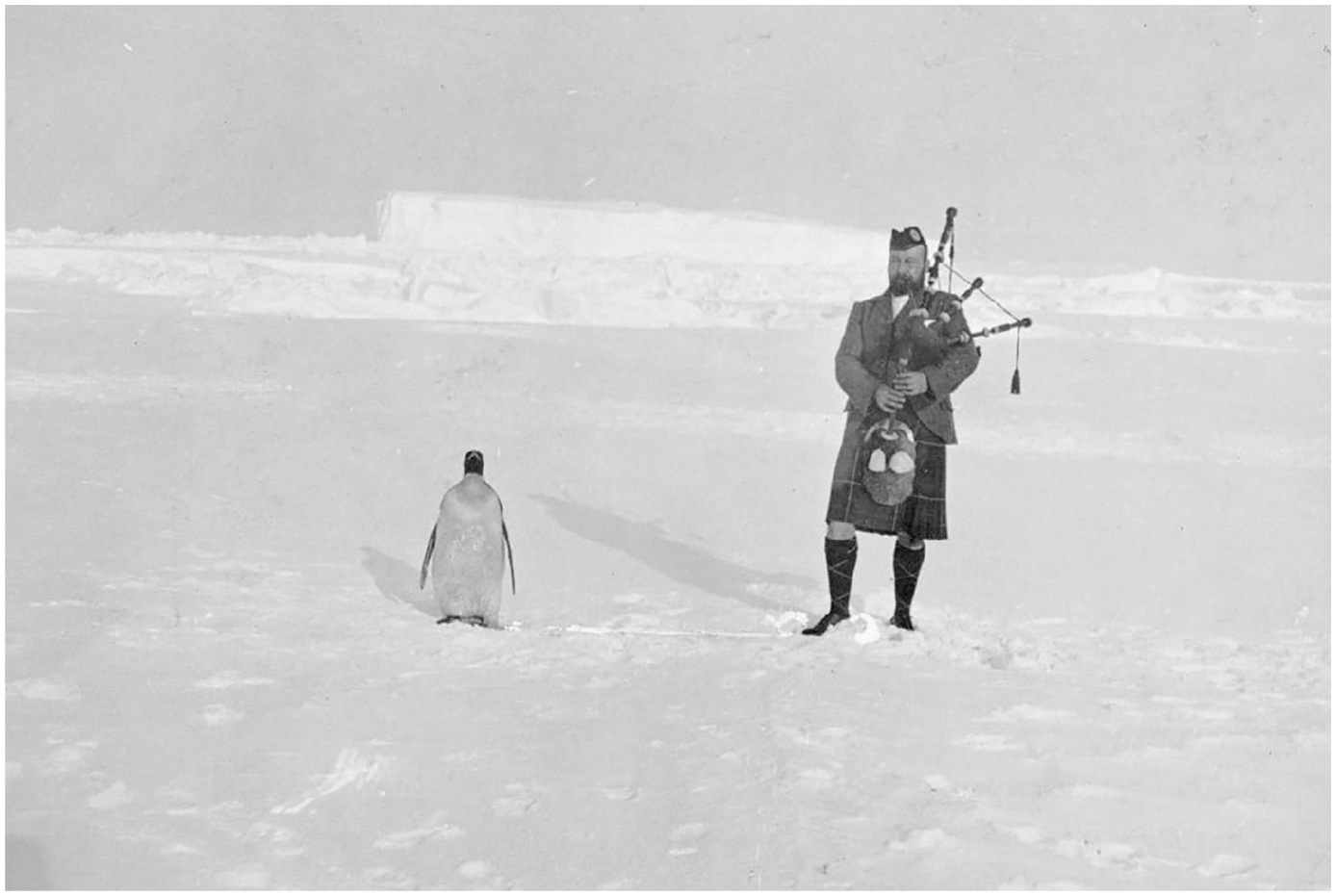
1903 Photo of Scottish Bagpiper Gilbert Kerr and An Emperor Penguin. (Wikimedia Commons: https://commons.wikimedia.org/wiki/File:Scotiapiper.jpg).
In the interwar period, scientific performances became more formalized and targeted to legitimate not only conquest but imperial administration, particularly for the British in the Falklands Dependency. In 1923, Britain created the Discovery Investigations Committee to generate the scientific knowledge necessarily to manage and profit from the region’s natural resources including whales, penguins, seals, and valuable minerals (Roberts, 2011: 32–33). However, it was not just the knowledge produced that reinforced British claims on the region. The Committee’s physical footprints in the form of research stations and repeated sailings created a tangible presence that reiterated and legitimated British territorial claims. Early British-Argentinian clashes over sovereignty of the Falklands involved conflicts over the manning of meteorological stations and the right to authorize expeditions, and during World War II, the British even launched Operation Tabarin, a secret operation to occupy scientific station in the Falklands (Dudeney and Walton, 2011: 344–345; 350).
Hence, in the interwar period, British scientific activities constituted performances that reinforced the legitimacy of their territorial claims over Latin American rivals. As I will detail in the next section, these performances would be key to the institutionalization of hierarchy in the ATS through Article IX.
The Cold War and a new Antarctic balance of power
After World War II, Antarctic competition adjusted to the new international balance of power, but the US–Soviet rivalry in Antarctica only consolidated the positional and productive logics behind scientific hierarchy. By the 1950s, ‘substantial scientific activity’ was widely accepted as the legitimate method for showing political interests in Antarctica, and while neither the US nor Soviet Union made official territorial claims, 5 their increased scientific activities worried existing claimants. Both used the conduct of science to reinforce their international status as superpowers and as a performance to legitimate themselves as ‘Antarctic powers’ with valid political interests in the southern continent.
Soviet claims to Antarctica rested on Imperial Russian Naval Officer Fabian von Bellingshausen’s 1820 expedition when he and his second-in-command allegedly became the first people to set eyes on Antarctica. Hence, the USSR framed its 1946 return to Antarctic waters as a restoration of its rightful place in Antarctic politics as well as a restoration of imperial Russia’s great power international status. In 1949, the All-Soviet Geographic Society adopted a resolution declaring that due to its ‘historic’ rights over Antarctica, ‘[n]o solution to the problem of a regime for the Antarctic without the participation of the Soviet Union can have legal force’ 6 (quoted in Boczek, 1984: 837). The USSR rooted its claims in science and argued in a 1950 memorandum to claimant countries that Russia’s historic contributions to the science of navigation afforded the Soviets a place at the table (Beck, 1986: 40; Gan, 2011). Soviet propaganda even maintained that Marxist science was better than capitalist science as it ‘was best placed to conquer nature’ (Howkins, 2017: 103). US involvement in Antarctica drew on the Monroe Doctrine and notions of the frontier and was calculated to reinforce America’s ascendant superpower status while countering Soviet influence. In the 1950s, US leadership argued that taking a central role in the 1957–1958 International Geophysical Year activities in Antarctica would allow it to further assert its rights and interests through the conduct of science for the benefit of mankind (Needell, 2000). The US even asserted its prerogative to build a research station – the Scott-Amundsen station – in the most prestigious location at the geographic South Pole.
US and Soviet scientific performances in Antarctica played to their respective national strengths. The US relied on airpower and overwhelming force to shock and awe the icy continent. In the 1930s, US pilots Robert Byrd and Lincoln Ellsworth flew extensively over Antarctica surveying, mapping, and naming previously unknown sections of the continent – a swath of unclaimed West Antarctica was named ‘Marie Byrd Land’ after Byrd’s wife (Howkins, 2017: 100–101). In 1945–1947, the US launched the largest expedition ever to Antarctica. Operation Highjump boasted at least 13 ships, nine aircraft, and 4,700 men (Howkins, 2017: 102; Klotz, 1990: 23–24). There was so much activity in the Ross Dependency that many feared the US had a more legitimate claim than New Zealand over the area (Dodds, 2002: 79). On the other hand, the Soviets drew on their experience in the Arctic to establish an authoritative scientific presence in Antarctica (Boczek, 1984; Gan, 2011). In 1956, the Soviets began construction of two research bases in Australia’s claim, creating alarm among Commonwealth states (Boczek, 1984: 838; Dodds, 2002: 82). While the US used overwhelming airpower, Soviet expeditions featured imposing trains of modified S-80 caterpillar tractors that dominated Antarctica overland (Arshenevskiy, 1961). These performances legitimated Soviet interests and secured their participation in the 1957–1958 International Geophysical Year and subsequent Washington Conference.
For the Soviets, as for other actors in Antarctica, conducting science in Antarctica was both a hierarchical marker of national and civilizational superiority, as well as a performance to reiterate the legitimacy of their claims. The next section shows how diplomats at the Washington Conference used science as a legitimate method of exclusion to negotiate a practical bargain to maintain international cooperation in the midst of the Cold War.
Institutionalizing scientific hierarchy: the 1959 Antarctic Treaty System
The 1959 ATS is often seen as a triumph of international cooperation – a shift from the dangers of inter-imperial and Cold War competition to a collaborative framework based on science (Young 1996; Koremenos et al., 2001). To be clear, the ATS did commit the Cold War powers to ‘the interest of mankind’ by ensuring Antarctica ‘shall continue forever to be used for peaceful purposes’ (Preamble). This was achieved through Article I’s bar on ‘the carrying out of military maneuvers, as well as the testing of any type of weapons’ and Article V’s prohibition on the disposal of nuclear waste in Antarctica. Perhaps most ingeniously, Article IV froze all existing sovereignty claims whereby contracting states did not renounce their claims, but instead confirmed that ‘no acts or activities taking place while the present Treaty is in force shall constitute a basis for asserting, supporting, or denying a claim to territorial sovereignty in Antarctica’. To achieve this laudable solution, diplomats drew on science as a broad hierarchy as outlined above. Science created a common understanding among diplomats that structured the authority relationship between actors and enabled functional bargains to take place at the Washington Conference. In doing so, diplomats institutionalized formal scientific hierarchy as a gatekeeper to the exclusive club of Antarctic actors.
The diplomats representing 12 countries that met at Washington DC in 1958–1959 had to address a thorny problem of international order. 7 To succeed in demilitarizing and forging international cooperation in Antarctica, the new governance framework had to balance two difficult political equilibria – first, to maintain the competing claims of longstanding Antarctic states without causing conflict, and second, to integrate the two Cold War superpowers into Antarctic politics without upsetting the existing balance. To do so, diplomats took steps to ensure that existing hierarchies were translated into formal ones by making the Treaty exclusive and exclusionary. Preliminary discussion made it clear that the main diplomatic players did not want the treaty to be associated with the sovereign equality of the UN system. In a January 1958 memorandum, the UK stated its agreement with the US that ‘we now hope that we shall be able to avoid any reference to, and consequently any discussion in, the General Assembly’ (FO 371/131905). This sentiment was supported by France (FO 371/131906, 28 February 1958) as well as other claimants (FO 371/131906, 18 February 1958). In another January 1958 briefing paper, Britain and Australia expressed their rejection of any framework that placed Antarctica under a UN trusteeship since they ‘resent the carping criticism of the Afro-Asian bloc and other anti-colonial powers who, having little interest in the matter, would seek to characterize the activities of the western powers in the Antarctic as imperialism’ (quoted in Dodds, 2002: 86). These exclusionary moves highlight how the bargains struck at the conference hinged on the authority of hierarchies based on science that allowed diplomats to achieve cooperation in the midst of the Cold War.
Insiders and outsiders at the Washington Conference
The leading states at the Washington Conference wished to keep the meeting as exclusive as possible. In the late 1940s, the US had proposed to internationalize Antarctica in the form of a UN trusteeship that would provide ‘scientific administration’ over the continent (Howkins, 2017: 104). However, such a solution would require existing claimants to relinquish their territorial claims over Antarctica, and hence the proposal received strong rebuffs from all Antarctic states except New Zealand (Dodds, 2002: 80–81). A subsequent US-UK proposal for a condominium that pooled sovereignty between claimants fared no better. In 1956, India, as a leader of the non-aligned movement, proposed the discussion of Antarctica in the 11th United Nations General Assembly meeting. Rather than continue inter-imperial competition over Antarctica in the form of colonial land disputes compounded by Cold War tensions, India wished to establish a more inclusive solution. Antarctica, India contended, is of concern to the entire world as the possibility of nuclear testing and its effect on climatic conditions would impact all life on earth (Howkins, 2008: 39).
As much as Antarctic states competed with each other, particularly Chile, Argentina, and Britain who claimed the same Antarctic sector, they joined forces to defeat the Indian proposal. Cleverly, the British did not oppose India’s proposal directly, 8 but instigated Chile and Argentina to oppose India – as third-world countries themselves, Britain’s South American rivals would have more legitimacy in publicly opposing the Indian proposal. But Britain, Argentina, and Chile were not the only ones – France and Norway also opposed with Norway working to form a Scandinavian block against India’s proposal to discuss Antarctica in the General Assembly (Howkins, 2008: 39). In addition, Britain worked to de-legitimize India on scientific grounds. Britain dismissed Indian concern about the climatic effects of nuclear testing in Antarctica as ‘scientific rubbish,’ implying that India’s lack of scientific presence in Antarctica detracted from the validity of its fears. If India was truly concerned about Antarctica, they can send scientists instead of making trouble (Howkins, 2008: 39). Here, political gatekeeping operated through scientific expertise as India’s limited scientific activities in Antarctica diminished the legitimacy of its efforts to create an equal rather than hierarchical governance system. 9
Hierarchies were central to the success of the Washington Conference itself. Before the conference even began, secret quadripartite talks took place between the US, UK, New Zealand, and Australia to ensure the four states agreed on basic principles before opening the discussion up to other claimants (e.g. FO 371/131905, 28 January 1958). 10 In issuing invitations for the conference, US Ambassador Paul Daniels limited invitation to countries with ‘direct scientific interest in Antarctica’, and hence, included the USSR, South Africa, Belgium, and Japan. Other states with political interests in Antarctica including Italy, Uruguay, Germany, Spain, Sweden, and India were not invited despite petitions from some and Soviet support for the inclusions of India (FO 371/131911, 8 July 1958 and 14 July 1958). 11 Too many participants would threaten any chance of reaching consensus, which would already be difficult given existing suspicions between parties. For the British, the question of Indian participation was particularly delicate due to its membership in the Commonwealth. However, by building hierarchies based on science into the Conference’s deliberative processes, diplomats increased their chance of forging a viable cooperative agreement. But in doing so, they also institutionalized the deep-seated inequalities that governed imperial Antarctic competition since the heroic age and enshrined these inequalities in international law.
Institutionalizing science as a standard of participation
The use of science as a gatekeeper to an exclusive club of Antarctic countries is clearly articulated in the ATS under the question of accession. Article IX states that to become party to the treaty, a state must ‘demonstrate its interest in Antarctica by conducting substantial scientific research activity there, such as the establishment of a science station or the dispatch of a scientific expedition’. Here, the treaty formalizes existing structural inequalities that framed the conduct of Antarctic science.
During the conference, the question of accession to the ATS was an awkward and tricky one. Originally, the British had envisioned a two-tiered organization for the new treaty that would include an inner ring of claimants plus the US and USSR while providing ‘for the association of outsiders in an advisory and consultative capacity only’. But since the US already invited Belgium, Japan, and South Africa due to their scientific contributions during the International Geophysical Year, it was diplomatically impossible to restrict participation in this way (FO 371/131911, 23 July 1958). As discussions continued, the need for an accession clause became eminently clear. Not only did the lack of an accession clause open the Treaty up to criticisms that it was discriminatory, but accession was necessary to freeze existing sovereignty claims under Article IV. As the French pointed out, any agreement to freeze claims would be useless without an accession clause. Otherwise, as British diplomat David Muirhead explained, ‘there is nothing to prevent a country hitherto uninterested in, say, the French zone of Antarctica from engaging in activities there and, after a certain period, claiming to have established rights on the ground of the scale and extent of their activities’ (FO 371/131911, 18 July 1958). After all, the international regime would not have collective sovereignty over Antarctica and hence cannot stop other actors from operating on the continent. In other words, as the current claimants have based their sovereignty claims on the conduct of science, what is to stop any other actor from coming in and performing science until they surpassed the original claimants? Would the newcomer not have more legitimate sovereignty claims on Antarctic territory? Hence, in order to protect their rights, the original claimants needed any new actors that wished to conduct science in Antarctica to sign on to the Treaty and therefore recognize the frozen rights of previous claimants.
Furthermore, the addition of ‘substantial scientific research’ allowed diplomats to open the door to participation but not too widely. It was the Australians that suggested the stipulation that those who wished to participate must ‘undertake substantial scientific research in Antarctica’. This phrase was designed to prevent the USSR from simply inviting representatives from its satellite countries onto its scientific expeditions, have those satellites accede to the ATS, and augment the number of Soviet-friendly votes in the governing body (FO 371/131911, 11 July 1958 and 15 July 1958). As British Ambassador Lord Hood confirmed in a report back to the Foreign Office, ‘Soviet puppets and other undesirables should be excluded by applying the criterion’ (FO 371/131905, 14 January 1958).
Therefore, the institutionalization of scientific hierarchy in the ATS solved several dilemmas. First, the accession clause allowed the treaty to seem more inclusive without throwing open the floodgates to potential troublemakers, especially Soviet satellites, who might upset established political balances. The use of ‘substantial scientific research’ as a gatekeeping device allowed the ATS to gain legitimacy as a more open framework while achieving the practical objective of keeping the riffraff out. Here, science continued to operate as a marker of international status – and performing scientific activities signaled the achievement of that status. Of course, it was Western, wealthy industrialized nations that conducted the most science, and through the ATS, scientific research became a formal benchmark to ascertain an actor’s legitimate interest in a functional area of global governance. Second, the accession clause also resolved the sovereignty issue so that all states who hoped to conduct science in Antarctica would come under the ATS and respect the rights of previous claimants. This allowed the ATS to maintain the status quo and institutionalize Antarctic science, with all its imperial implications, as a standard of political participation. In the decades following, states would use Antarctic science to demonstrate their rising power status and their growing prominence in matters of international order. As Chilean General Cañas noted in his memoirs: ‘in Antarctica the weapon is science; there is a war for dominion and the weapon is science’ (quoted in Howkins, 2017: 142).
Achieving scientific hierarchy: India, China, and science as international status
By adopting the performance of ‘substantial’ scientific activities as a standard of legitimate political participation in Antarctica, the 1959 ATS reinforced and institutionalized science as a broad hierarchy that had structured imperial competition since the late 19th century. Doing so transformed ongoing logics of productivity and positionality into a formal hierarchical arrangement underpinned by an accepted and authoritative political agreement. Science as a formal gatekeeper to Antarctica, however, did not mean that other actors could not join. As the following brief examples of India and China illustrate, actors who wished to demonstrate their rising power status through science were able to change their position within the ATS from excluded nations to participants. Indeed, it was precisely their success in achieving participation in the ATS by boasting of their advanced scientific status and showcasing their scientific knowledge-gathering that reinforced science as a broad hierarchy and upholds scientific achievements as a marker of international prestige and legitimacy into the 21st century.
As noted above, India was a major opponent of the exclusionary nature of the Washington Conference and the ATS and pushed to discuss Antarctic cooperation in the UN General Assembly where all states could participate. Antarctic states also blocked Indian efforts in the 1970s to include Antarctica in the UN Convention on the Laws of the Seas (UNCLOS) as ‘common heritage of mankind’ (Dey, 1991: 88). After losing the fight to widen participation, India changed strategy. Instead of resisting the ATS, 12 it took the necessary steps to join what Prime Minister Indira Gandhi enthusiastically described as a ‘select band of countries’ that conducted ‘advanced work’ in Antarctica (quoted in Dey, 1991: 88). While Indian scientists had participated in Australian and Soviet expeditions, Gandhi established the Department of Ocean Development and launched India’s first independent expedition in 1981. Chartering a Norwegian icebreaker, the 21-man team spent 10 days conducting scientific activities in the Norwegian Sector. A second expedition followed the subsequent year, a third the year after, and the Indian government pledged more than $10 million for further expeditions and research stations (Beck, 1983; Dodds, 1997: 146–147). This intense scientific program aimed to show India’s ambitions not only to join the Antarctic club but also its ambitions to join the upper echelons of international society. In 1983, India joined the ATS as a consultative member and transformed from a vocal opponent of the treaty to a supporter and member of the Antarctic club.
India’s conversion from opponent to enthusiastic member of the Antarctic hierarchy reinforces the functional bargain struck in 1959. However, India’s actions also echoed the productive and positional logics of earlier claimants to political authority in Antarctica. Like the Great Powers before it, India’s scientific performances aimed to rewrite Antarctic geography and imbue the frozen continent with national qualities. Ahead of its first independent expedition, India noted a major aim was to undertake meteorological studies of conditions that might affect the monsoons in the Indian Ocean. India followed its first success by establishing its first permanent but unmanned Antarctic weather station Dakshin Gangotri in 1983 (Beck, 1983). Naming the station ‘Southern Ganges’ held particular symbolic importance as it refers to the mystical source of the Ganges River and reinforces India’s ‘natural’ links to Antarctica through the Indian Ocean (Dodds, 1997: 136; 144). In addition to these performances, India’s rhetoric drew on the link between scientific prowess and international status. Indira Gandhi told the Indian lower house that the success of its independent expedition was ‘one more proof. . . that Indian scientists and technologists have the capability to undertake the most hazardous and complex tasks’ (quoted in Beck, 1983). Here, India’s scientific accomplishments were translated into proof of India’s national greatness and prestige.
Similarly, China’s inclusion into the Antarctic hierarchy demonstrates how another rising power used science to reinforce its ascendant position in the international order. China’s interest in Antarctica began on shaky footing as the PRC withdrew from the 1957–1958 International Geophysical Year because of confrontation over Taiwan’s participation. But in the late 1970s, after re-establishing diplomatic ties with the US, Chinese interest in Antarctica intensified (Liu, 2019: 121). In 1983, China declared its intention to join the ATS by stating it was ‘ready to make concerted efforts with other contracting states to bring about a speedy development of scientific investigations in Antarctica’ (Lee, 1990: 581). The following year, China launched its first independent expedition that established the Great Wall Station on King George Island in the British claim. These scientific activities and future plans allowed China to become a Consultative Party to the ATS by 1985 (Lee, 1990: 580–582).
In achieving membership, China’s actions also followed the productive and positional logics modeled by its imperial predecessors. Its scientific performances aimed to reimagine China as a natural part of the Antarctic landscape starting with its scientific stations. The first station built in 1985 was named the Great Wall and was followed by another station in 1989 named after Sun Yat-Sen, the founding father of modern China. Its third and fourth stations (2009 and 2014) are named after Chinese mountains of cultural and mythical importance. In 2005, a Chinese team successfully explored Dome A, the last geologically important and unexplored space left on Antarctica, and gave culturally significant names to features such as Turtle Mountain, Snake Mountain, and Western Lake (Brady, 2010: 767). These performances recast the Antarctic landscape with Chinese characteristics. Furthermore, China’s rhetoric celebrating its successes connected China’s scientific superiority to its increasingly dominant position in international society. A party publication boasted that China’s Antarctic success proved its ability to overcome obstacles for the sake of modernization (Lee, 1990: 582). Media coverage of Antarctic expeditions extolled the virtues of Chinese ‘science heroes’ (Harrington, 2017: 46). However, China also uses Antarctic science as a way to emphasize the peaceful nature of its rise. Before launching its own expedition, China sent more than 35 scientists to join other national expeditions and welcomed advice and training from a number of states including Japan, the USSR, the US, Chile, Argentina, and New Zealand (Lee, 1990: 580). When China inaugurated its Great Wall Station, it invited Taiwanese scientists to take part in research as part of the United Front strategy (Lee, 1990: 582). For China, science as diplomacy continues into the 21st century. A 2009 study noted that 50% of publications by Chinese polar scholars are co-authored with non-Chinese collaborators (Harrington, 2017: 44).
Both India’s and China’s inclusion into the Antarctic club show the institutionalization of science as a gatekeeper to legitimate political participation in the cooperative governance of Antarctica. Not only do these practices uphold science as a standard of political participation for rising powers, but they also reinforce a certain understanding of legitimate authority over territory – in the absence of effective occupation, legitimate authority over the Antarctic territory continues to be demonstrated through declarations of scientific aspirations and scientific performances. This places science at the center of the relationship between political authority and nature in Antarctica.
Conclusion
The 1959 Antarctic Treaty System is often lauded as a triumph of international cooperation in the midst of the Cold War, and throughout this article, I have maintained that the treaty was a functional bargain between existing actors to establish a hierarchical governance system in Antarctica. By writing hierarchy into the agreement and using science as a gatekeeper for participation, actors at the 1959 Washington Conference established a delicate peace among longstanding geopolitical competitors – both among the seven territorial claimants and the two Cold War superpowers. However, I argue that the ATS’ successes cannot be fully understood outside the context of broad international hierarchies based on science and scientific superiority that had developed in the 19th century and legitimated political competition in Antarctica since the beginning of the 20th century. These broad hierarchies reveal how productive and positional logics, as conceptualized by Mattern and Zarakol (2016), worked together to reinforce global imperial hierarchies and rewrite Antarctic geopolitics based on that hierarchical order.
Analyzing the institutionalization of broad hierarchies into a functional bargain in 1959 highlights two central contributions to the study of international hierarchies. First, the ATS shows how the creation of international institutions translates broad structural hierarchies into functional solutions – hence, the ATS as an ordering solution depended on broad global hierarchies based on scientific superiority that already structured international politics. Indeed, it is these broad hierarchies that legitimized and enabled the functional bargains to take place at diplomatic moments of institutional creation such as the Washington Conference. Acknowledging the connection between broad and narrow hierarchies is important in that functional bargains may not hold if the broad hierarchies that underpin them lose their legitimacy. Thus far, China’s actions in Antarctica have followed established rules based on the conduct of science. However, China’s hopes to establish an Antarctic Specially Managed Area (ASMA) around one of its research stations has worried other Antarctic actors that China is trying to make stronger authority claims over Antarctic territory (Liu, 2019). While China’s rationale behind the ASMA is anchored in the discourse of scientific authority, Western actors fear it is simply a first step towards challenging the established international order. More in-depth research into post-formative contestation would reveal how actors use functional bargains such as the ATS to reinforce, reinterpret, and even challenge and overturn broader global hierarchies. The Madrid Protocol of the ATS is scheduled for possible review in 2048, and whether the existing functional bargains remain in place will depend much on the alignment between broad and narrow hierarchies that inform Antarctic politics.
Second, analyzing how the 1959 ATS formalized broad hierarchies into a practical international solution highlights the importance of science as a political instrument that structures international order. As Chile’s General Ramón Cañas Montalvo said of the diplomatic negotiations over the ATS, ‘beneath the appearance of a scientific meeting a political process is in march’ (quoted in Howkins, 2017: 148). In Antarctica, doing science was both a marker of international civilizational status and a performance that reinforces that status. To understand the ATS framework only as a neutral collaboration between scientists working for the benefit of humankind would be to ignore the deeply political implications of Antarctic science as a legitimating mechanism for global order. Acknowledging science as a marker of international hierarchy and gatekeeper to Antarctic politics has implications for other ‘functional’ international institutions based on science from global environmental governance to global health. Further research into these institutions has the potential to illuminate the variety of ways in which science constitutes international hierarchy.
Finally, structural hierarchies also inevitably invite resistance. First India in the 1950s, and then Malaysia in the 1980s, led resistance against the ATS as an exclusive and exclusionary framework. When Antarctica was finally discussed at the UN General Assembly, Zambia denounced the Treaty’s ‘institutional arrangement [that] favors the rich and technologically advanced countries’, and Malaysia warned that the overlap between the interests of the Treaty’s parties and all of humanity is not certain or guaranteed (quoted in Howkins, 2017: 183). Others have challenged the broad hierarchies that constitute Antarctica in our geographical imagination. Published in 1982, Ursula Le Guin’s short story Sur reimagines the first explorers to reach the South Pole as nine women from Peru, Chile, and Argentina. Through speculative fiction, Le Guin questions the Eurocentric and masculinist narratives surrounding Antarctic exploration that continue to have implications for Antarctic science and politics today. Further exploration into the role of science in structuring hierarchies can help us understand the contours of continuing resistance against both broad and narrow hierarchies.
Footnotes
Acknowledgements
I would like to thank attendees at Durham University’s International Politics Research Group June 2019 workshop and participants at the LSE’s IR502 workshop in November 2019 (particularly Peter Wilson and Tristen Naylor) for their comments and encouragement. I am also grateful to those who engaged with my presentations at the 2019 ISA and EISA panels where I developed the core arguments for this article. Finally, I would also like to thank the Editors and the two anonymous reviewers who provided invaluable feedback and strengthened the article’s core contribution.
Funding
The author received no financial support for the research, authorship, and/or publication of this article.

