



Abstract
The evolution of migration policymaking across the Global South is of growing interest to International Relations. Yet, the impact of colonial and imperial legacies on states’ migration management regimes outside Europe and North America remains under-theorised. How does postcolonial state formation shape policies of cross-border mobility management in the Global South? By bringing James F. Hollifield’s framework of the contemporary ‘migration state’ in conversation with critical scholarship on postcolonialism, we identify the existence of a ‘postcolonial paradox,’ namely two sets of tensions faced by newly independent states of the Global South: first, the need to construct a modern sovereign nation-state with a well-defined national identity contrasts with weak institutional capacity to do so; second, territorial realities of sovereignty conflict with the imperatives of nation-building seeking to establish exclusive citizenship norms towards populations residing both inside and outside the boundaries of the postcolonial state. We argue that the use of cross-border mobility control policies to reconcile such tensions transforms the ‘postcolonial state’ into the ‘postcolonial migration state,’ which shows distinct continuities with pre-independence practices. In fact, postcolonial migration states reproduce colonial-era tropes via the surveillance and control of segmented migration streams that redistribute labour for the global economy. We demonstrate this via a comparative study of post-independence migration management in India and Egypt, which also aims to merge a problematic regional divide between scholarship on the Middle East and South Asia. We urge further critical interventions on the international politics of migration that prioritise interregional perspectives from the broader Global South.
Introduction
As academic and policy debates on the International Relations of migration continue to be dominated by discussions of the impact of migrants and refugees on wealthy states across Europe and North America, it is easy to neglect that the majority of global cross-border mobility does not involve liberal democracies of the Global North. In fact, from 2010 to 2019, eight of the ten major bilateral migration corridors worldwide were located in states of the Global South (United Nations, 2019: 12). A close analysis of contemporary labour and forced migration flows demonstrates that they overwhelmingly occur in countries that emerged from imperial and colonial rule – from the Middle East to sub-Saharan Africa (Fargues, 2013; Quirk and Vigneswaran, 2015) and from Latin America to Asia (FitzGerald and Cook-Martín, 2014; Vezzoli and Flahaux, 2017; Zamindar, 2007). However, the manner through which colonial and imperial legacies affected the emergence of states’ migration management regimes outside Europe and North America continues to be under-theorised (Adamson and Tsourapas, 2019; Chung et al., 2018). In particular, the relationship between institutional capacity, de-territorialised identities and the use of migration for processes of nation-building does not typically feature in International Relations debates on postcolonial states’ migration management. Yet, as we identify here, these factors are essential to understanding the International Relations of cross-border mobility in the Global South.
To tackle this gap, we seek to redress the absence of postcolonial nation-building within the growing literature on the global politics of migration. We utilise Hollifield’s (2004) work on the ‘migration state’, given its centrality to debates in the International Relations literature on cross-border mobility (Adamson, 2006; Martin, 2014; Ruhs, 2013). Although this framework has been instrumental in ‘bringing the state back in’ to migration theory (Hollifield, 2012), its analysis centres on post-World War II Western experiences. All modern states are migration states to some extent, but all states are not postcolonial states – the latter have historical experience as colonies, protectorates, trusts or leases of imperial powers that later underwent decolonisation processes to achieve independence. We add a missing temporal and spatial dimension in order to examine how these states face a postcolonial paradox: first, the aspiration to create a modern state with a clear national identity was constrained by weak institutional capacity; second, securing exclusive territorial sovereignty contrasted with establishing citizenship norms towards co-ethnic populations residing inside and outside the boundaries of the postcolonial state.
In historicising and geographically extending Hollifield’s framework, we identify the emergence of a specific type of state – the postcolonial migration state, which has sought to address this twin set of tensions. Although the creation of the postcolonial state is typically situated around the moment of independence from foreign rule, we demonstrate that the postcolonial migration state only emerges once states begin relying on migration control policies to resolve colonial-era tensions of citizenship, nation-building and territorial sovereignty. Central to this process is the simultaneous control of cross-border mobility, made possible with stronger institutional capacity, and the development of multiple migration streams that prioritise specific groups of citizens at the expense of others. In this sense, attempts to address past tensions result in the reproduction of colonial and imperial tropes. Ultimately, we argue that postcolonial migration states across the Global South feature distinct continuities with the policies developed by erstwhile colonial and imperial powers.
The article proceeds as follows. Initially, we examine the literature on the international politics of migration and identify a gap in terms of an appropriate framework of cross-border mobility management that addresses the particularities of postcolonial contexts. We introduce Hollifield’s concept of the ‘migration state’ and assess its utility in terms of undertaking historical comparative research across the non-West. We bring existing applications of the framework in conversation with critical social science scholarship on postcolonialism in order to establish a space for analysing an additional type of migration state – the postcolonial migration state. After detailing its characteristics, we examine how the concept sheds valuable light on the politics of migration in two key crucial case studies, post-independence India and Egypt. We draw on South Asian and Middle Eastern cases in order to identify distinct commonalities among postcolonial states that highlight the interplay between nation-building and migration management practices across the Global South. As post-independence India and Egypt sought to address distinct tensions in their nation-building processes, they ultimately reproduced colonial-era tropes: the development of institutional capacity over time allowed these states to engage in stronger control over mobility in order to ensure a clear national identity. At the same time, both states adopted tiered migration practices that overwhelmingly favour wealthier, higher-skilled citizens abroad. This is followed by a discussion of how the two postcolonial migration states employed colonial-like practices to control labour distribution via segmented emigration. We conclude by highlighting the need for further critical interventions to the literature on the international politics of migration that prioritise interregional perspectives from the broader Global South.
Cross-border mobility in the Global South and the migration state
In contrast to other social science disciplines, political science has historically overlooked the impact of colonial or imperial legacies upon the management of migration across the Global South. The study of cross-border mobility itself has been a relatively novel area of interest for International Relations scholars, as migration has traditionally not been considered part of ‘high’ politics. 1 Even as migration entered the International Relations lexicon, the emphasis has traditionally been on immigration into, and across, Western Europe and North America (Natter, 2018; Tsourapas, 2017). However, a sizable body of work sheds light on varied processes of transnationalism (Mandaville, 2001), out-of-country voting (Burgess, 2018), as well as state-diaspora relations in the non-West (for an overview, see Koinova and Tsourapas, 2018). Scholars of international migration have produced insightful works on both emigration as well as immigration politics across the Global South (Sadiq, 2009; Thiollet, 2019), while others have conceptualised South–South migration via work on regional migration governance (Geddes et al., 2019). A growing literature also focuses on conflict and forced migration within the Global South, paying particular attention to both governmental policies, international organisations and non-state actors (cf. Fiddian-Qasmiyeh et al., 2014). Yet, even as the relevant literature shifts its focus towards the politics of cross-border mobility in the Global South, little effort has been made to identify the specificities of state migration management across postcolonial contexts. In fact, existing work tends to adopt the largely ahistorical and universalist perspectives of mainstream International Relations, in which the aftereffects of colonial and imperial rule remain irrelevant to practices of migration governance.
As a result, an important social sciences research agenda centres on governments’ efforts at controlling mobility across putative state borders primarily with reference to the West (for a discussion, see de Haas et al., 2019: 225–247; cf. Mongia, 2018). As Sayad (1999) argued, ‘to think of migration is to think of the state’. By approaching postcolonial mobility through the prism of European states’ experiences and expectations, this line of work highlights an important – albeit skewed and incomplete – aspect of postcolonial migration. Invariably, it also identifies degrees of ‘state weakness’ across the Global South by framing the postcolonial in terms of ‘absences’ or ‘failures’ (Chakrabarty, 2000). In response, a number of critical scholars working on the politics of postcolonial mobility aim to decentre Eurocentric understandings of migration politics by consciously shifting away from the state as a unit of analysis (Isin, 2012). Moving beyond reductionist accounts criticised for ‘seeing like a state’ (Bigo, 2002; Scott, 1998), researchers have argued for a set of alternative concepts that might have more purchase in postcolonial contexts – from ‘urban sovereignties’ (Landau and Monson, 2008) to feminist geopolitics’ introduction of ‘alternative units of analysis’ (Hyndman, 2019). Similarly, others problematise the interaction of geography, economics, and law – for instance, Andersson’s ‘illegality industry’ (2014), or Mountz’s ‘long tunnel thesis’ (2010). Yet, the shift away from statist approaches in postcolonial migration management should not result in the marginalisation of the state itself (Mitchell, 1991). The authority of the state remains central to migration-driven processes across the Global South, including the rise of diaspora institutions (Gamlen, 2019) and the management of forced migration (Betts, 2013; Brand, 1988). Maintaining an analytic focus on the state enables a more nuanced understanding of how global mobility has been ‘a key ingredient in the constitution of state authority in the first place’ (Quirk and Vigneswaran, 2015: 2; cf. Adamson and Tsourapas, 2019).
In this article, we aim to reconcile postcolonial accounts of cross-border mobility with state-led migration management accounts by building and expanding on Hollifield’s concept of the ‘migration state’ (2004). Within migration studies, Hollifield sought to shift the field beyond market-driven theorisation by drawing on West European and North American experiences in order to underline the centrality of cross-border mobility within state logic and state formation. Migration states weigh the complex costs and benefits of immigration policy in order to assess its impact on sovereignty, market relations, and rights politics (Hollifield, 2012). In this sense, Hollifield’s framework is an ‘ideal type’ that has been influential within the literature on the politics of migration by identifying the dilemmas facing contemporary liberal states as they attempt to balance multiple and conflicting policy needs of markets and rights. Beyond re-centring the state as a key factor in migration theory, Hollifield also contributed to the unpacking of the multiple logics, contradictions and tensions in migration policymaking (Klotz, 2012).
Despite its importance, the concept’s applicability beyond the Global North is not clear-cut, with scholars highlighting its generalisability as well as its limitations: Frowd’s (2020: 342) analysis of sub-Saharan African mobility demonstrates the importance of Hollifield’s concept in identifying ‘migration management as a strategic function of the state’, while suggesting the transit migration state as a more accurate representation of the securitisation of mobility in Niger. Adamson and Tsourapas (2019: 853) identify a number of biases in Hollifield’s framework, and argue for a typology of nationalising, developmental and neoliberal migration states in order to ‘allow for a more comprehensive understanding of trajectories of state migration management policies outside the Global North’. Finally, Chung et al.’s (2018: 3) extension of Hollifield’s framework to East Asia similarly underlines the utility of Hollifield’s conceptualisation in making the state central to ‘any theory that seeks to explain the multiple logics of immigration policy’. Yet, in order to geographically extend the concept to Japan, Korea and Taiwan, they argue for the need to discuss developmental migration states, where migrants’ access to rights and settlement correlates with their utility towards national developmental goals. Overall, existing geographical extensions of Hollifield’s frame of analysis across the Global South underline a number of limitations with regard to its conceptualisation of the management of both cross-border mobility (Adamson and Tsourapas, 2019; Frowd, 2020) as well as citizenship (Chung et al., 2018).
In our application of the migration state concept to postcolonial contexts, we utilise both inductive and deductive inference (Achen, 2002), in order to move beyond the veneration of pure deduction within positivist International Relations in the Waltzian tradition (Blagden, 2016). We incorporate induction at the beginning of the theorisation process (Wagner, 2007: 2–8), by drawing from a variety of literatures on nation-building, citizenship and diasporas in order to identify the processes that transform the postcolonial state into a postcolonial migration state. We proceed to deductively assess our findings via a two-case study analysis. A long discussion exists on the potential pitfalls of the case-study method (Collier and Mahoney, 1996), yet a significant body of political science work highlights how ‘in the early stages of a research programme, selection on the dependent variable can serve the heuristic purpose of identifying the potential causal paths and variables leading to the dependent variable of interest’ (George and Bennett, 2005: 23). For the ‘postcolonial migration state’ to function as a type, we identify the following scope conditions: (i) an experience of colonial institutions meant to monitor and control populations as colonial subjects with a racially determined secondary status; (ii) an engagement in a struggle for independence as a subjugated population; and (iii) the development of new or proto-political institutions (or, a reworking of pre-existing institutions) as a product of decolonisation in order to serve the needs of independent citizens configured as equals by new constitutions.
We employ the cases of two major migration states that emerge from British colonialism in South Asia and the Middle East. Post-independence India and Egypt, chosen via the most similar method (Seawright and Gerring, 2008), satisfy the scope conditions set above and are able to shed further light on the evolution of migration management in postcolonial contexts. A paired comparison of most-similar ‘crucial cases’ (Eckstein, 1975) enables strong internal validity leading to generalisations for further testing across a number of cases to increase external validity (Tarrow, 2010). We draw on a range of primary and secondary reports on the two countries’ migration management in both Arabic and English, as well as data collected from international organisations and media sources. We use migration patterns from these paired units (India and Egypt) with paired destination sites (the Gulf Cooperation Council as well as European and North American states) to expand the number of testable observations. This case selection strategy is also driven by the fact that, despite long historical linkages between the Middle East and North Africa on the one hand, and South Asia on the other hand, interregional comparative work remains scant. With this article, we aim to address the problematic regional fragmentation that characterises much of the scholarship on the politics of migration in the Global South.
From the postcolonial state to the postcolonial migration state
When abstract models of migration management uncritically impute strategies to states, this often flattens deeply contextual, historical narratives. In an effort to reclaim the robust complexity of migration management in non-traditional case studies, we extend Hollifield’s framework across time and space in order to shed light on a variety of state migration management regimes in the aftermath of colonial and imperial rule. In this section, we identify the existence of a postcolonial paradox marked by two sets of tensions relevant to migration: first, postcolonial states seek to develop firm control over mobility amid social fragmentation yet lack the institutional capacity to do so; second, they develop postcolonial citizenship practices in order to amend colonial and/or imperial injustices that contrast with the aim of exclusive territorial sovereignty.
Hollifield’s framework argues that contemporary migration states face a number of dilemmas and tensions in policymaking; in the liberal democratic context of the Global North, this translates into a ‘liberal paradox’ between keeping their economies open to immigration and managing the political risks that it would entail. What kind of dilemmas would we expect in migration states emerging from colonial or imperial collapse? Critical International Relations scholars identify key constraints in the incorporation of non-Western states into the international system, as colonial and imperial practices continue to affect newly independent states’ policymaking beyond the formal end of foreign rule. For Zarakol (2010), these ‘stigmatised’ states emerged in tiered international environments that situated them on the ‘inferior’ side of the ‘established-outsider’ dichotomy. In their efforts to ‘catch up’ with their European and North American counterparts, postcolonial states have been characterised by their hybridity, a result of colonialism and subsequent cultural collisions (cf. Bhabha, 2012). In effect, these states ‘regard themselves caught between traditions that have not yet gone and a modernity that has not yet arrived’ (Canclini, 1995: xi), while their national identity continues to be shaped by the aftereffects of the colonial encounter (Massad, 2001).
A focus on migration management practices elucidates how postcolonial policy path dependence is well established: Bashford’s (2014: 47) analysis of the Asia-Pacific region highlights how ‘immigration restriction was not just part of the history of settler colonialism [but] also constituted the territorial nationalisms of postcolonial nation-states’. Similarly, immigration restrictions against Asians in the United States evolved into the institutional foundations of border enforcement globally (McKeown, 2008). Likewise, Mongia (2018: 21) argues that ‘a colonial dimension is inherent in the modern state globally’. Frilund’s (2018: 4) study of Tibet emphasises that a postcolonial ‘approach to migration’ reveals ‘exploitative elements within migration’ that link it to ‘minority questions and global privilege’. In the Arab world, the exploitative Kafala (‘sponsorship’) system evolved out of British colonial practices (Al-Shehabi, 2019; Lori, 2019). Vezzoli and Flahaux (2017) focus on the relationship between travel visa requirements and ‘post-colonial ties’ to show how colonial relations continue to shape (and limit) travel opportunities. Broadly, the linkages between metropole and colony appear to persist across numerous post-independence migration management contexts (Betts, 1998).
More precisely, the postcolonial paradox is defined by two sets of tensions in states’ post-independence migration management practices. First, the need to establish a modern sovereign nation-state defined by a clear national identity is constrained by weak institutional capacity to achieve it. Second, the establishment of citizenship norms that aim to address colonial and/or imperial injustices, oftentimes by being accommodative to co-ethnics outside the nation-state, contrasts with establishing sovereign territorial borders themselves. In terms of the first set of tensions, cross-border population mobility has long been intertwined with processes of nation-building (Mylonas, 2013a). Zolberg (1983: 30) argued that ‘massive refugee flows are most predominantly a concomitant of the secular transformation of the world of empires . . . into a world of national states’. Such ‘nationalizing migration states’ employ migration policy as a means of forcibly constituting national populations in an attempt to create ethno-religious homogeneity (Adamson amd Tsourapas, 2019; cf. Rae, 2002; Vigneswaran, 2013). Attempts to ‘unmix’ populations has been a feature of newly independent states emerging from colonial or imperial contexts (Mamdani, 1996). 2
The tension over the need to move towards the construction of a modern sovereign nation-state with a well-defined national identity contrasted with the weak institutional capacity to achieve this in the post-independence years. Not surprisingly, the decolonised world relied on ‘the conditioning of mobility to suit preferred state formations and national socio-political character’ (Dickinson, 2018: 261), albeit lacking adequate state strength to do so (Rist, 1997). ‘Very few new states are “nations” outside the West’ (Jackson, 1993), and arduous processes of nation-building resulted in ad hoc regulatory frameworks that coincided with chaos, violence and institutional borrowing from colonial or imperial practices. Nation-building in post-independent Algeria, for example, involved improvised policymaking and a violent exodus of Algerian-born citizens of French and European origin – the Pieds-Noirs – while thousands that did not make it were killed by lynch mobs (McDougall, 2017). The expulsion of Asian populations from Kenya and Uganda in the late 1960s and early 1970s, respectively, relied upon colonial practices with regard to introducing exclusionary rights against these minority groups.
In terms of the second set of tensions, migration management requires a re-examination of the evolution of citizenship norms in the Global South as they are shaped by identity discourses (Brubaker, 1992). Postcolonial migration states are unique given that ideas of nationhood had become the cultural repository of resistance to the colonial state (Chatterjee, 1991). In these newly independent states, a gradual ‘postcolonial citizenship’ emerged in response to the protracted process of decolonisation (Sadiq, 2017). While postcolonial citizenship was seen as a way of grappling with colonial and imperial injustices, particularly with regard to co-ethnics residing beyond the nation-state (Fanon, 1963; Torpey, 2003), it remained tied to statist, territorial terms as the international state system enforced new distinct territorial boundaries following independence (Herbst, 2000). Sovereignty and territoriality dampened newly independent states’ postcolonial visions of citizenship norms (cf. Chakrabarty, 2000; Poe, 2003). Kwame Nkrumah’s efforts towards a radical pan-African citizenship, for instance, was ultimately compromised by the political priorities of national sovereignty (van den Boogaard, 2017). At the same time, postcolonial citizenship led to political fragmentation over the division of welfare across domestic social groups in newly independent states of the Global South (Sadiq, 2017). Even in countries that did not experience Western colonialism, as in East Asia, citizenship is instrumentally tied to an individual’s value for the state’s national developmental mission (Chung et al., 2018).
We find that postcolonial migration states cluster along two functions in their efforts to address these two sets of tensions linked to the postcolonial paradox. 3 First, they develop institutional capacity that enables firm control over mobility and the manipulation of citizenship norms as ways of establishing a clear national identity. A number of African states continue in exclusionary nation-building strategies across the continent, oftentimes mirroring colonial practices (Mamdani, 1996; Whitaker, 2005). Second, postcolonial migration states adopt tiered migration practices that overwhelmingly favour some population groups over others, particularly wealthier, higher-skilled citizens (Tsourapas, 2019). Such functions of control and preference hold true both for postcolonial sending states that fall on the labour ‘supply side’ as well as for a minority of states, including members of the Gulf Cooperation Council (GCC) and Singapore, who are on the ‘demand side’ as primarily (but not exclusively) labour-importing states. Mylonas’ (2013b) work on South Korean emigration, for instance, identifies distinct hierarchies in the state’s treatment of communities abroad, not unlike many Global South states’ instrumentalist outreach to specific diaspora groups (cf. Gamlen, 2019). This is mirrored in tiers within racialised immigration contexts across the Global South – again reminiscent of colonial tropes – where ‘expatriates,’ or citizens of Western nation-states, are privileged over others (Fechter and Walsh, 2010). The following section clarifies this analysis further by tracing the evolution of the postcolonial state into the postcolonial migration state across South Asia and the Middle East.
The origins of the postcolonial migration state in India and Egypt
Post-independence nation-building and institutional capacity
In both India and Egypt, the origins of the postcolonial migration state lie in the end of British rule and the onset of decolonisation. As migration policies and citizenship norms became implicated in nation-building strategies across the two countries, they came into contrast with two aspects of decolonisation: lack of implementation capacity and the exigencies of territorial sovereignty. In India, British withdrawal from South Asia was marked by expedient ethnicised territorial divisions and resultant population transfers. The 1947 Partition created the independent states of India and Pakistan from a once-contiguous British colony. A double boundary line within British India – one dividing the province of Punjab to the west, another dividing the region of Bengal to the east – was determined in roughly 5 weeks. As Mishra (2007) notes, Cyril Radcliffe, chair of the boundary commission, divided on paper entire villages, communities, rivers, and forests that he did not visit. These new international borders were published 2 days after independence was declared in Pakistan and India on 14 and 15 August 1947, respectively. This resulted in a chaotic and massive population transfer, ‘comparable only to the nearly contemporaneous displacements produced by the Second World War in Europe’ (Zamindar, 2007: 6). Bharadwaj et al. (2008: 40) use population census data from 1931 and 1951 (four years after partition) to estimate that 14.5 million people migrated into India, Pakistan and Bangladesh (then East Pakistan), with a total outflow from India, Pakistan and Bangladesh for the same period being 17.9 million, with 3.4 million people unaccounted for, or ‘missing’.
The mass migration and expulsions of people across the subcontinent strained pre-existing imperial or barely present new state institutions. Emergency permit systems such as the Indian ‘Influx from Pakistan (Control) Ordinance’ and its Pakistani equivalent the ‘Pakistan (Control of Entry) Ordinance 1948’ were introduced on both sides of the border. They sought to control and prevent caravans of refugees from leaving their homes or, later, returning to reclaim property left behind (Chatterji, 2012: 1063; Zamindar, 2007: 82). These migration control mechanisms were enacted in response to rapidly challenging refugee flows and acts of inter-religious communal violence. There was no cohesive migration management system to oversee the population transfer since the permits ‘proved impossible to administer’ and ‘impossible to enforce’ (Chatterji, 2012: 1064). The gap between legal rules, regulations and local practice resulted in corruption, abuse and national-level uncertainty on who counted as Indian. Weak institutional capacity at the moment of independence compounded a crisis of national identity, a tension confronted by postcolonial states across the Global South. While independence was achieved in 1947, the criteria for determining citizenship status among a new territorially defined population was only put in place in 1955 with the Indian Citizenship Act. Years after independence partition refugees lived in a legal ‘zone of liminality’ (Roy, 2010: 34) with new refugees continuing to cross the western and eastern borders long after the constitutional deadline of July 1948. The five year gap between the ratification of the Indian constitution in 1950 and the Citizenship Act in 1955 led to legal and bureaucratic confusion on who could become an Indian citizen.
Prior to independence, migration management in India occurred under the imperatives of the British Empire. While the British abolished the slave trade in 1807 and passed the Slave Abolition Act in 1833, the development of ‘coolie’ labour sourced from the Indian subcontinent supported British plantation and industrial interests. The passage of the Indian Emigration Act of 1922 placed strict controls and regulations on agents and transport companies, but by 1922 there were already roughly 2.7 million Indians who were resident outside of India in British territories or dominions (Table 1) (Shirras, 1931: 592). 4 The largest numbers of Indians outside India were located in Ceylon (Sri Lanka), Malaya (Malaysia), Mauritius, South Africa and the West Indies. According to Mongia (2018), segmented colonial migration management operated along two contrasting logics: one of facilitation and another of constraint. The migration of ‘coolie’ labour was ‘facilitated’ through the state-controlled indenture regime even as the migration of non-indentured Indians was ‘constrained’ by targeted bureaucratic procedures (such as passport requirements) that limited entry to white settler colonies such as Canada and South Africa. A massive colonial bureaucracy governed all aspects of migration control within the British empire, generating a complex legal system informed by international contract law and principles of ‘free’ movement. 5
Estimates of Indian residents abroad from 1921.

Source: Shirras (1931: 592).
Once the decolonisation process began, it was marked by institutional borrowing from colonial policy amid tensions over weak state capacity. At independence, the Indian state-in-progress had to reinvent the institutional purpose and form of its institutions by redefining the legal relationship and responsibilities between multi-ethnic populations – as individuals and ethnic groups – and the secular government and its democratic institutions (Sadiq, 2017). Consequently, two colonial era laws that predate independence still govern the entry, stay and exit of foreigners in India. The Indian Foreigners Act of 1946 empowered a British monopoly over movement within India. In the post-independence era, the act largely targets cross-border illegal immigration. The Passport (Entry into India) Act of 1920 was introduced just as the international passport regime developed after World War I. It now provides the Indian state with wide power to detain and arrest anyone who enters Indian territory fraudulently. Colonial-era laws that governed migration within British India were re-applied towards international migration control, setting in motion a process of institutional path dependence that led to the emergence of the Indian postcolonial migration state.
While Egypt was never a formal British colony, it underwent a long process of occupation from the 1882 Anglo-Egyptian War to the 1952 Free Officers Revolution, which ended the long entrenchment of British rule in the Egyptian state. Even then, British troops formally withdrew from Egyptian soil only in 1956, by which time rising Egyptian nationalism was embodied in the charismatic figure of Gamal Abdel Nasser (Gordon, 1992), who remained in power until his death in 1970. During this era, Egypt underwent an ambitious process of nation-building that coincided with independence from foreign rule for the first time in its modern history (Baker, 1978). Nasserite discourse also sought to place Egypt at the forefront of anti-colonial struggles across the Third World: ‘we cannot look stupidly at a map of the world,’ Nasser argued, ‘not realizing our place therein and the role determined to us by that place’. In fact, as he wrote, Egyptian national identity falls within three concentric ‘circles’ – the Arab, the African and the Islamic (Nasser, 1955). Although Egypt does not appear to share the ethnic divisions that marked India’s post-independent experience, the two states share a similar interplay between nation-building and migration management during decolonisation.
The management of mobility in Egypt was employed as a key strategy towards solidifying the country’s post-independence national identity. Throughout much of the 1950s, the state introduced a range of discriminatory policies against population groups that were not meant to be part of Egypt’s post-independence national identity, primarily the country’s Jewish and foreign-born populations, against whom the Nasserite regime employed a range of formal and informal measures (Beinin, 2005). These included arbitrary police detention, the sequestration of businesses and property, and formal expulsion from the country, applied in an ad hoc manner across different communities, particularly in the major urban centres of Cairo and Alexandria – all reminiscent of British-era population control measures (Mitchell, 1988). These policies accentuated the exodus of the Greek community of Egypt, numbering more than 25,000, as well as the departure of over 60,000 Italians (Dalachanis, 2017). Over 27,000 Jews were also forced out of Egypt between 1956 and 1963, as a number of international organisations – including the United Nations High Commissioner for Refugees (UNHCR), the United Hebrew Immigrant Aid Society Services (UHS), and the International Committee of the Red Cross – sought to prevent a humanitarian disaster in chaotic scenes at the country’s borders (Table 2). The port of Alexandria and the Cairo airfield were crammed while, ‘in the bedlam of this situation, thousands of people left with little more than the clothes on their back’ (Laskier, 1992).
Assisted emigration of Egyptian Jewish refugees

Source: AJDC, UHS Research and Statistics Department (1964).
But the process of national identity consolidation was also aided by the state’s lack of institutional capacity in terms of ethnic homogenisation: in November 1956, the Egyptian Nationality Law of 1950 was amended via a new decree proclaiming that ‘only individuals resident on Egyptian territory before 1 January 1900 . . . are Egyptians’. This created a major loophole, ‘as there was simply no officially valid documentation in existence there that could attest to the residence of persons in Egypt at that remote point in time’ (Laskier, 1992). Thus, the state was able to deny citizenship or to annul citizenship certificates retrospectively; Egyptian citizens of Jewish or foreign descent were rendered stateless overnight. Authorities were also able to stir up anti-Western and anti-Jewish nationalism across the social body, in effect transforming these once-thriving communities from ‘a national asset into a fifth column’ (Beinin, 2005). As Gordon (1992: 52) recounts: ‘Jews, Syrians, Greeks, Italians, and Armenians left in droves for Europe, Israel and the Americas: usually voluntary but sometimes under duress and always with tight restrictions imposed on what they could take with them’.
The extent to which weak state capacity contrasted with Nasserite elites’ wish to use migration management in their nation-building strategies is evident in state responses to political dissenters. The confusion and weak state capacity of these early post-independence years were exploited by a range of regime dissidents, who were able to seek shelter abroad. Members of the Egyptian Communist movement, for instance, were able to take advantage of this transitory period in order to flee abroad (Botman, 1988). Many Egyptians also managed to escape, despite formal restrictions, in order to avoid mandatory military conscription (Tsourapas, 2019). But it was members of the Egyptian Muslim Brotherhood, or al-Ikhwan, that most benefited from weak administrative capacity: hundreds of Muslim Brothers fled to Saudi Arabia, Kuwait, Bahrain or elsewhere (Kandil, 2015). Many of those who defied travel restrictions and fled Egypt were retroactively punished by the regime: they were accused of ‘treason to the [Egyptian] nation’, stripped of their nationality, and forbidden from returning to Egypt (Mitchell, 1969: 141)
Beyond ad hoc measures implemented under conditions of weak state capacity, the Egyptian state also engaged in institutional borrowing in its management of cross-border migration. In addition to measures of population control outlined above that incorporated British imperial practices, a second instance refers to Egypt’s response to the post-World War II decline of British power throughout the Middle East, which created a gap in terms of providing educational staff to the Arab world (Balfour-Paul, 1991). For decades, British professionals were dispatched across parts of North Africa and the Middle East by the Foreign and Commonwealth Office, effectively an instrument of imperial soft power dependent on staffing and managing the region’s educational structures. The era of decolonisation granted Nasser’s Egypt an opportunity to step into this role: successive Egyptian governments recruited, trained, and dispatched thousands of Egyptian professionals – particularly teachers – across Africa, to Latin America and, most importantly, throughout the Arab world (Tables 3 and 4). Once abroad, many Egyptians disseminated the Free Officers’ rhetoric on anticolonialism and anti-Zionism, while promoting nationalist sentiments – effectively serving as one of Egypt’s most potent instruments of soft power. As a result, Egyptian high-skilled emigration throughout the 1950s and 1960s enjoyed a key role in shaping political processes across the Global South, including the decolonisation of Africa and the Middle East, the North Yemen Civil War, as well as the Arab–Israeli conflict (Tsourapas, 2019).
Total number of Egyptian teachers in Arab and other countries (1953–1964).

Source: Arab Republic of Egypt, Ministry of Education.
Egyptian teachers seconded to Arab states by destination (1953–1962).

Source: Arab Republic of Egypt, Ministry of Education.
The limits of postcolonial citizenship
After independence, many new and fragile states buckled under military regimes. This began with Egypt in 1952, Pakistan in 1958, Burma in 1962 and Indonesia in 1965 among others. The rise of military rule was accompanied by the harsh treatment of ethnic minorities and political dissenters. Clearly, the ideals of citizenship were tested by the politics of postcolonial governance. In democratic India, the presence of co-ethnic refugee flows from Bangladesh and Sri Lanka complicated principles of exclusive territorial sovereignty and led to the narrowing of citizenship criteria. In Egypt, this involved a targeted engagement with populations that resided outside the country’s borders, as per the Nasserite three-circle theory, and included identity discourses of pan-Arabism, pan-Africanism and pan-Islamism.
The breakup of Bangladesh from Pakistan in 1971 made immigration into India a key identity and security issue. Estimates at the time note that 10 million refugees fled into neighbouring India and overwhelmingly to the region of West Bengal. UNHCR estimated the daily influx to be 100,000 refugees for the month of May in 1971, with a total refugee population closer to four million. Many of the displaced were co-ethnic Hindus who were settled by the Indian government in refugee camps along the porous India–Bangladesh border, currently the fifth largest international border in the world. By 1 December 1971, official UNHCR data show that roughly 9.8 million Bangladeshi refugees were settled in 825 camps across seven Indian states (Table 5). The majority of refugee camps were located in the Indian state of West Bengal, which housed approximately 7.2 million refugees from the conflict. The refugee flow upended local demographics. By May of 1971, it was estimated that in the state of Tripura alone roughly 900,000 refugees arrived, overburdening an indigenous population of 1.5 million (UNHCR, 2000: 64) and by December the figure had risen to roughly 1.3 million (Table 5).
Bangladeshi refugees in India as on 1 December 1971.

Source: United Nations High Commissioner for Refugees (2000: 65).
Not all refugees returned and like many refugee crises, the scale of the flow and stock were believed to be vastly undercounted. According to some estimates 9.27 million refugees returned, with 1.5 million remaining in India (Kapoor et al., 2000). However, a 1974 planning commission report by the Indian state of West Bengal indicates that in 1971, there were still nearly six million displaced persons in the state of West Bengal alone. 6 A decade later, in 1981, the Rehabilitation and Resettlement Committee Report estimated the figure to be closer to eight million. 7
No longer classified as refugees after the conflict, the flow of ‘survival migrants’ (Betts, 2013) threw out of balance local demography and citizenship in Northeast India, especially in the state of Assam. The indigenous Assamese community felt overwhelmed by the presence of Bengali immigrants. In 1979, the All Assam Students Union (AASU) demanded the identification and deportation of all ‘illegal’ immigrants in the state. Their agitation, the Assam Movement, led to ethnic conflict that culminated in the Nellie massacre of 1983, when entire villages of mostly Bengali Muslims were attacked resulting in over 1500 deaths (Hazarika, 2000: 45–46; Kimura, 2003: 225–239). Many who were victim to the violence claimed that they were, in fact, citizens of India and not illegal immigrants, since their ancestors relocated to the area during pre-partition (British) India. In an effort to resolve the conflict, Prime Minister Rajiv Gandhi signed the Assam Accord in 1985. The accord amended the Citizenship Act of 1955 by adding a clause specifying that only those who came prior to the formation of Bangladesh in 1971 were eligible for Indian citizenship and all those who came after were subject to deportation. This set into motion a precedent that narrowed Indian citizenship criteria away from the early constitutional preference for jus soli (birth right citizenship) to the political preference for jus sanguinis (blood based) principles (Jayal, 2016; Sadiq, 2017).
Tensions over postcolonial regional migrations continue to impact the character of Indian citizenship norms. More recently, the Citizenship Amendment Act (CAA), passed in 2019, and a proposed legislation for a National Registry of Citizens (NRC) would enable the Indian government to strip citizenship status from those deemed ‘illegal’ even as it extends citizenship on the basis of religion, to those outside its territorial sovereignty. According to Jayal (2019), one ‘carves out paths to statelessness for groups that are disfavoured [while the other] creates paths to citizenship for preferred groups’. The discriminatory impact of these legislations lay in their sequential linkage: if Hindus, Sikhs, Buddhists, Jains, Parsis, or Christians, are determined ‘illegal’ by the NRC, they can invoke preferential religious refugee status to qualify for Indian citizenship through the CAA (which excludes Muslims). The consolidation of the state’s discretionary power in determining citizenship acquisition and loss is revealing – unlike before religious identity has become a determinative factor in the legal reconstruction of Indian citizenship norms. The contradictory desire to assert religious preference anew while also upholding territorial sovereignty was most evident in the exclusion of persecuted migrants from Sri Lanka in the 2019 CAA. This exclusion was ironic given that linguistic, cultural and religious ties between Tamil-speaking populations in India and Sri Lanka predate national independence. Many Indian Tamil laborers were forcibly relocated to Sri Lanka as indentured laborers by British colonial authorities (Table 1). Subsequent refugee flows into India from Sri Lanka’s protracted civil war occurred in four phases (Graph 1). The Indian Ministry of Home estimates that since the start of the Sri Lankan civil war in 1983, there have been over 300,000 official Sri Lankan refugees entering India (Government of India, 2013: 183). Currently, there are over 60,000 Sri Lankan refugees staying in 108 refugee camps (mostly in Tamil Nadu) with an additional 37,000 who live outside refugee camps (Government of India, 2017: 294).
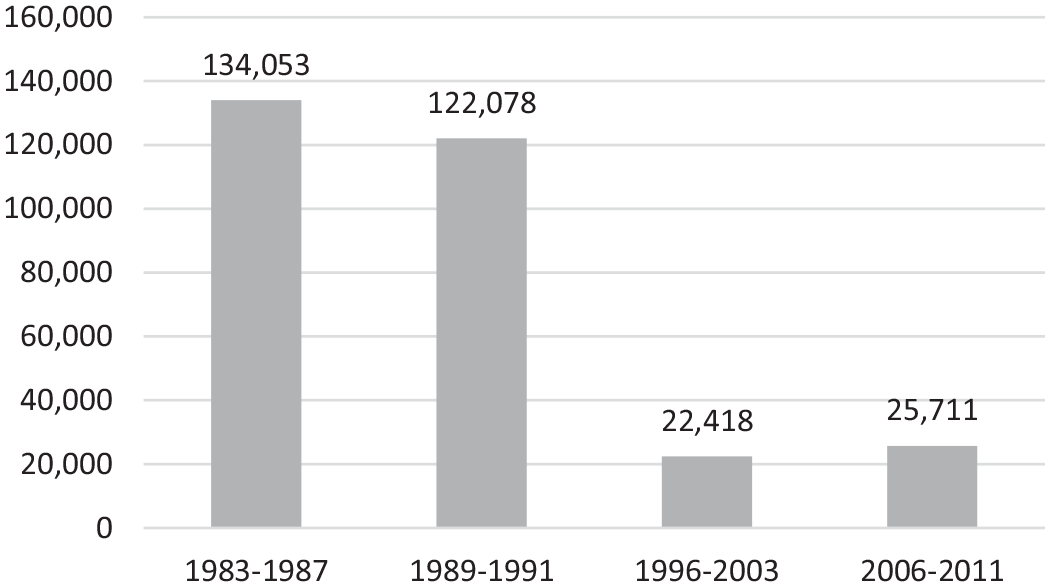
Phases of Sri Lankan refugees in India.
As South Asia was splintering along ethnic and religious fault lines, the Middle East experienced a consolidation of postcolonial Arab identity. Nasser’s political thinking involved establishing Egypt as an important component of the Arab, African, and Muslim nation. Egyptian elites negotiated a 1958 agreement with Syria to merge the two states into the United Arab Republic (UAR), a major effort towards pan-Arabism that sought to redress colonial-era legacies in the Middle East (Jankowski, 2002). As a result, the two states’ bureaucratic apparatuses were combined, while novel identity markers were created: a new UAR flag was designed and the new 1958 Nationality Law established common citizenship among Egyptian and Syrian citizens. The UAR was envisioned to be the first step towards the creation of an Arab nation-state: ‘something had to be done so that the Arab nation and the Arab homeland might be saved from the imperialist invasion’, Nasser would declare; ‘the Arab nation had to unite again in order to win’ (Podeh, 1999: 120). Yet, this experiment in redressing postcolonial citizenship tensions fell into administrative problems early on (Tsourapas 2019). It was also met with hostility from other Arab states, particularly Jordan and the oil-rich monarchies of the Persian Gulf, as Nasser and the UAR were perceived as security threats to their own political and territorial sovereignty. The union between Egypt and Syria collapsed three years later, although Egypt continued to be known officially as UAR until 1971.
Beyond the UAR, Nasserite Egypt developed a range of policies in support of Palestinian refugees that fled violence during the 1948 and 1956 Arab–Israeli Wars and sought shelter in Egypt (Table 6). Arab states typically rejected granting formal citizenship to Palestinian refugees in order to retain pressure on Israel; yet, Palestinian refugees in Egypt were awarded the same employment rights as Egyptians, while public services such as education and healthcare were also made freely available (El-Abed, 2009). Decree 66 of 1962 also ‘permitted to appoint Arab Palestinians to positions of state employment’ across the UAR, while scholarships and loans for Palestinian university students contributed to open ‘lanes of upward mobility that would otherwise have remained blocked’ (Brand, 1988: 53). Travel papers (watha’iq al-safar) for Palestinian refugees across the UAR were also issued from 1960 onwards (Brand, 1988: 51). Ultimately, however, Egyptian extension of rights to non-Egyptian Arabs suffered a setback once the Palestine Liberation Organization – founded with Nasser’s support in 1964 – developed its independent agenda in support of Palestinian statehood. Egyptian rapprochement with Israel in the 1970s would put a permanent halt to its pro-Palestinian policymaking.
Number of Palestinians in Egypt classified (by Governorate) according to their assistance category, as of 1966.

Source: Al-Lajnah al-‘Ulya li-Shu’un al-Muhajirin al-Filastiniyyin, p. 49.
Similarly, Egyptian efforts to engage in pan-African and pan-Islamic identity politics were unsuccessful. Egypt put forth a range of favourable policies towards newly independent sub-Saharan African states, including scholarships for African students to attend Egyptian universities, as well as extensive bilateral exchanges of professionals and experts. A range of high-skilled Egyptians would be dispatched to work across sub-Saharan Africa throughout the 1950s and 1960s. At the same time, the Nasserite regime toyed with ideas of Islamic unity as another way of uniting a disparate group of post-independent majority-Muslim states in the Middle East, Africa and Asia. However, these efforts were not carried through: Egypt’s African outreach quickly became embroiled in a bilateral competition with Israel, which was carrying on a similar project, and lost credibility. At the same time, pan-Islamic politics came to contrast with the Egyptian state’s desire to restrict the power of al-Ikhwan as well as conservative oil-producing states, notably Saudi Arabia. Ultimately, the radical dimension of Nasserite ideas that traversed state boundaries would become compromised by the political priorities of national sovereignty.
The emergence of the postcolonial migration state in India and Egypt
The previous section demonstrated the inherent constraints in attempts at nation-building within post-independence India and Egypt, paying particular attention to the two sets of tensions we associate with the postcolonial paradox: weak institutional capacity and the limits of postcolonial citizenship. In this section, we demonstrate how citizenship criteria and regulations emerge as an important migration management tool for the development of emigration control policies. Over time and in response to global labour demands, India and Egypt developed dual emigration corridors consisting of high-skilled labour emigrating to states in advanced democracies and another of low or semi-skilled labour emigrating to the GCC. India’s transition to a postcolonial migration state begins in the mid-1970s when its two emigration corridors developed. These dual emigration corridors parallel two distinct emigrant groups: first, ‘non-resident Indians’ (NRIs) who are Indian citizens and passport holders but live or work outside of India, and second, ‘overseas Indian citizens’ (OCIs) who have acquired the citizenship of their host state and have forfeited Indian passports. The NRI designation of citizens abroad was introduced for tax purposes in 1961 with minimal privileges, while non-citizen OCI designates are actively courted with visa-free travel and property rights among other benefits.
Indian emigration is governed by the Indian Emigration Act of 1983, which updated the pre-independence 1922 Emigration Act. Indian migration to the Gulf peaked around 1981, but a second oil shock saw a sharp decline between 1982 and 1986 (Amjad, 1989: 4). Unsurprisingly, there was a gap between the migratory flow (beginning in the mid 1970s) and the institutional updating of the Emigration Act in 1983. The new provisions established an inter-agency bureaucratic structure that linked the Ministry of External Affairs to the Ministry of Labour. Low-skilled labour headed for the Gulf region, unlike their high-skilled counterparts, now required special ‘emigration clearances’ in the form of a passport stamp. Such migration control policies target low skilled labour both before departure (in India) and on arrival in labour-reliant autocratic host states. These bureaucratic and surveillance mechanisms served two purposes. First, they streamlined the emigration process for Indian laborers to help meet overseas labour demands and, second, they formalised the recruitment process to better monitor Indian labour abroad. In practice, the 1983 Emigration Act relied on a colonial regulative framework that distinguished between emigrant ‘classes’ – those that required emigration clearances and those that did not. 8
Migration management is one way to expand overall developmental state capacity. Accordingly, in 2015, the Ministry of Overseas Indian Affairs (MOIA) unveiled an online database initiative called ‘e-Migrate’. The programme created an online application and registration system to digitally streamline and monitor the process for emigration clearance. Indian emigrants in the GCC are a key asset in bilateral relations. Applying a new surveillance technology through the e-Migrate initiative, India sought to assert its authority over its emigration flows while expanding Indian security interests beyond territorial borders. However, states dependent on Indian emigration pushed back. The UAE ambassador to India called parts of the initial e-Migrate programme a breach of ‘sovereignty’ resulting in a diplomatic spat. 9 The ambassador argued that the initial programme’s mandate for site inspections of company property by Indian Embassy and Consulate officials fell outside of its jurisdiction. Reports of abuse, unsafe working conditions and unscrupulous middlemen continue to put pressure on the Indian state to protect its emigrants’ rights. 10 By 2017, the UAE maintained the highest number of Indian emigrant stock (3,310,419) followed by Saudi Arabia (2,266,216), Kuwait (1,157,072), Oman (1,201,995), Qatar (658,488) and Bahrain (310,591) (Graph 2).
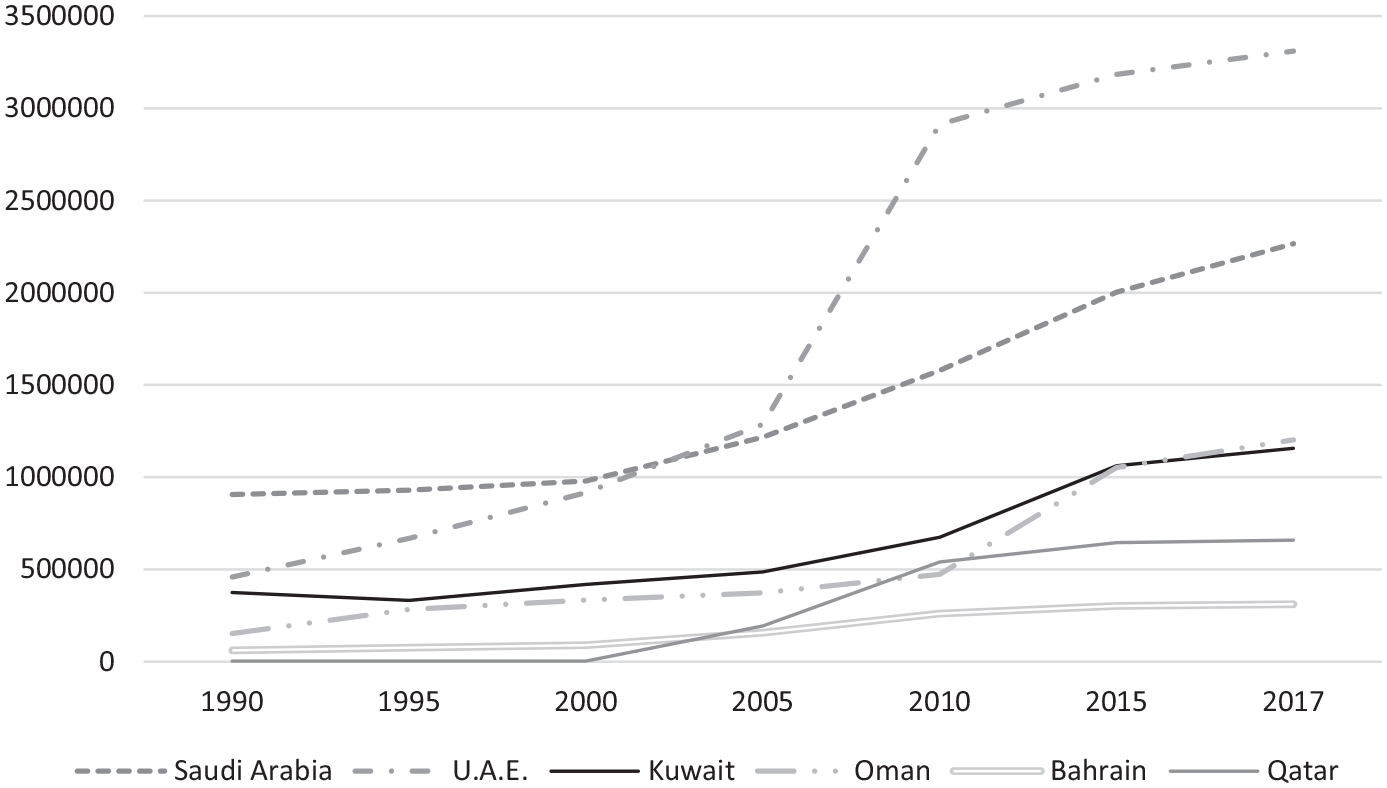
Indian emigration stock in GCC, 1990–2017.
A second emigration corridor from India is to western advanced democracies, consisting of highly educated and skilled emigrants (Graph 3). Indian policy engagement with this group is designed to elicit remittances and investments from those settled abroad (Kapur, 2010). In return, this group has demanded dual citizenship in order to maintain ties with their country of birth. As a tool of emigration management and in an effort to appease the Indian diaspora in advanced democracies, the Indian government introduced a multitier diaspora identification programme – the Person of Indian Origin (PIO) card in 2002 and the Overseas Citizen of India (OCI) card in 2005. These programmes address two concerns: first, they enhance Indian state capacity through the regulation and surveillance of emigrants and, second, they provide a formal and preferential recognition to select members of the diaspora in western democracies.
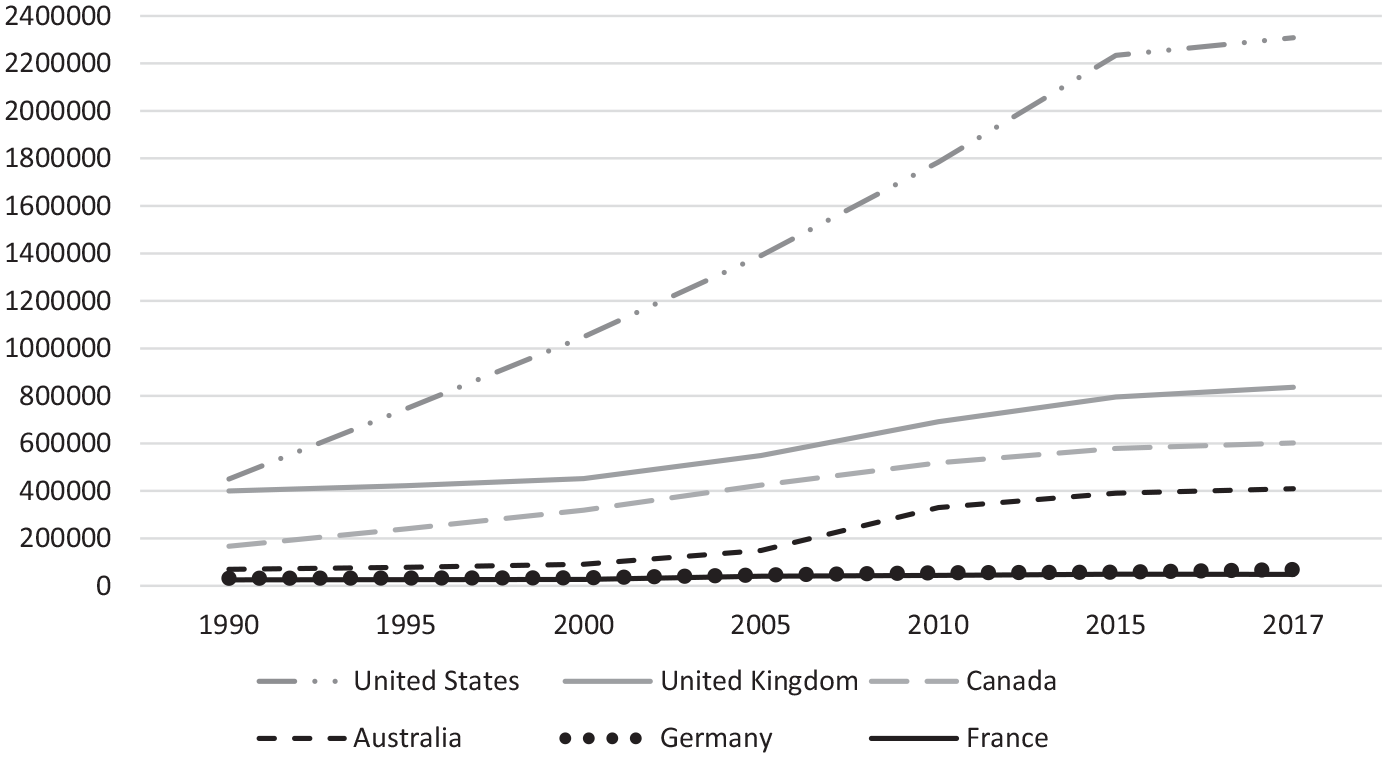
Indian emigration stock in select advanced democracies, 1990–2017.
While the segmented character of Indian emigration flows shaped the form and function of these diaspora programmes, it is the anxieties of Indian partition amid decolonisation that continue to resonate and define these diasporic policies. For example, the PIO card explicitly denied eligibility to those who at any time held passports from Bangladesh, Pakistan, and Sri Lanka. In 2015, the PIO programme merged with the OCI programme, and there were an estimated 1.7 million PIO card-holders that had converted to OCI status (Naujoks, 2017: 94). The OCI card was introduced as a more rigorous diaspora identification regime with heightened surveillance capabilities as well as a ‘de-facto’ dual citizenship programme. Continuing the legacy of colonial partition, the OCI card explicitly excludes those of Indian origin who were at any time former citizens of Bangladesh and Pakistan, their children, grandchildren, and great-grandchildren – a jus sanguinis principle that extends the exclusion across several generations. 11 Initially, the 2003 OCI programme was drafted for a select group of eight western states (Naujoks, 2015: 25). 12 The multitiered diaspora programme excluded the descendants of Indian indentured laborers who were brought in by the British Crown to countries such as Fiji, South Africa, and Trinidad (Table 1). This exclusion emphasised the role of ‘class’ and ‘country of residence’ in determining overseas Indian citizenship (Roy, 2008: 239), while also serving as a migration control policy. Thus, a hierarchy of diasporic engagement has emerged through the privileging of ‘elite’ emigrants in North America and Western Europe, while simultaneously overlooking those located within the Global South. Despite Indian government claims of one common diaspora spread across the world, ethnic, class, and political divisions fragment it – the antecedents of which can be traced to colonial policy.
Egyptian diaspora policymaking emerged with Law 111/1983, still valid today, which formalised variation between different tiers of emigration: a ‘permanent’ emigrant is one who ‘stays abroad permanently by obtaining the nationality of a foreign country and/or a permanent residence permit; stays abroad for a period of at least ten years; or obtains an immigration permit from one of the countries of destination’. A ‘temporary’ emigrant, on the other hand, is ‘someone (not a student or seconded worker) who works abroad for twelve consecutive months’. However, in practice, this differentiation has been based upon country of destination: Egyptians living in Arab countries are invariably considered temporary emigrants, even when they have lived there for decades. All those emigrating to the West, on the other hand, are considered permanent emigrants, even if they just arrived in their host countries. This mirrors historical practices of Egyptian temporary mobility across the Arab world spanning back centuries. Gradually, Egypt developed a multitier diaspora policy to accommodate and prioritise the needs and wishes of permanent migrant populations abroad.
Interestingly, a postcolonial approach to Egyptian diaspora politics allows for a more nuanced understanding of the state’s desire to engage closely with those migrating to the West. These policies build on an existing framework that, from the 1970s on, has put forth several initiatives to engage with and leverage the Egyptian diaspora residing in the West, which the state estimates to number approximately 3.23 million in 2016, with the majority located in the United States (Graph 4). Egyptian policymakers view permanent migrants as well-off, educated and successful; as a result, they have developed instruments within the Ministry of Foreign Affairs and other agencies to harness their potential, promote return migration and reverse the phenomenon of brain drain. This includes providing government-paid trips to Egypt, as well as targeted outreach to diaspora members via embassies and consulates, particularly in Western Europe and North America. In the pre-2011 era, a large number of select Egyptian diaspora members would frequently be invited back to Cairo and Alexandria, where they would be entertained by the President and the First Lady under both previous administrations of Presidents Sadat and Mubarak. ‘Permanent’ migrants enjoyed heightened attention of the executive and state agencies abroad: those studying in Europe and North America would receive financial support from the Egyptian President on an ad hoc basis – a grant of $50,000, or ~$212,000 today, was given to the Union of Egyptian students in North America, for instance, with assurances that any problems were to be dealt with immediately, regardless of cost.
In sharp contrast, the Egyptian state was less active in cementing the relationship between ‘temporary’ Egyptian emigrants to the Arab world and their homeland (Lesch, 1986). Almost twice as many Egyptians work across the Arab world as those in Western states – approximately 6.236 million according to 2016 estimates, with the vast majority of them residing in Saudi Arabia (Graph 5). The state’s initial involvement in regulating the outflow of Egyptian labour towards the Arab world, by coordinating requests from Arab and, to a lesser extent, African host states, gradually diminished over time: by the 1990s, a number of unregulated makatib al-tawzīf (non-governmental recruitment agencies) had emerged to court Arab employers who had travelled to Egypt to secure contracts for Egyptian workers. The agencies then sold these contracts at exorbitant prices to Egyptians. A work permit for Saudi Arabia is priced at more than 20,000 EGP (~$2600), while a permit for Kuwait goes for over 30,000 EGP (~$4000). A multitude of bilateral and multilateral treaties signed with Arab states that aimed to regulate the outflow of Egyptian labour were never observed, and the stipulated migration quotas never enforced. The Kafala process as well as the nature of autocratic host governments restrict these communities’ mobility across most Arab states. More importantly the Egyptian state, much like India, would often fail to respond to human rights abuses of its migrant population across the Arab world. This was particularly evident during massive expulsions of Egyptian workers in Libya by the Gaddafi regime in the 1970s and 1980s and the endemic labour violations of Indian workers in GCC states.
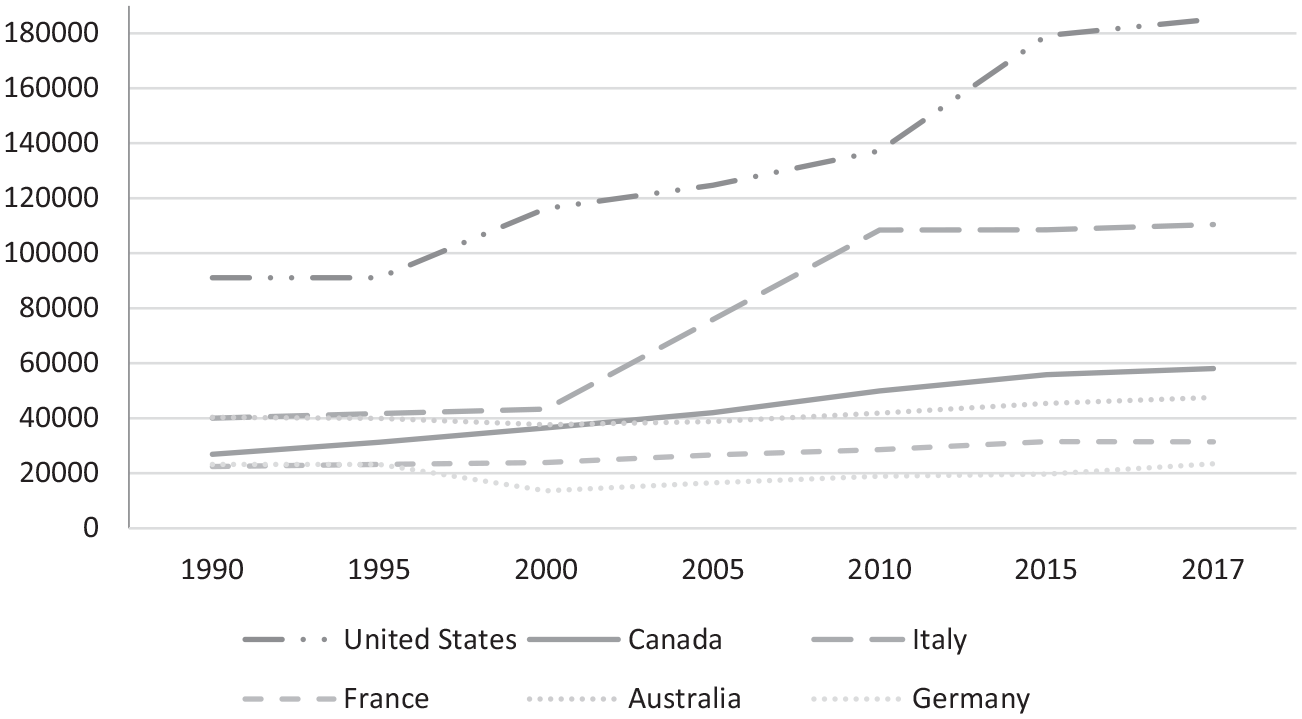
Egyptian emigration stock in select advanced democracies, 1990–2017.
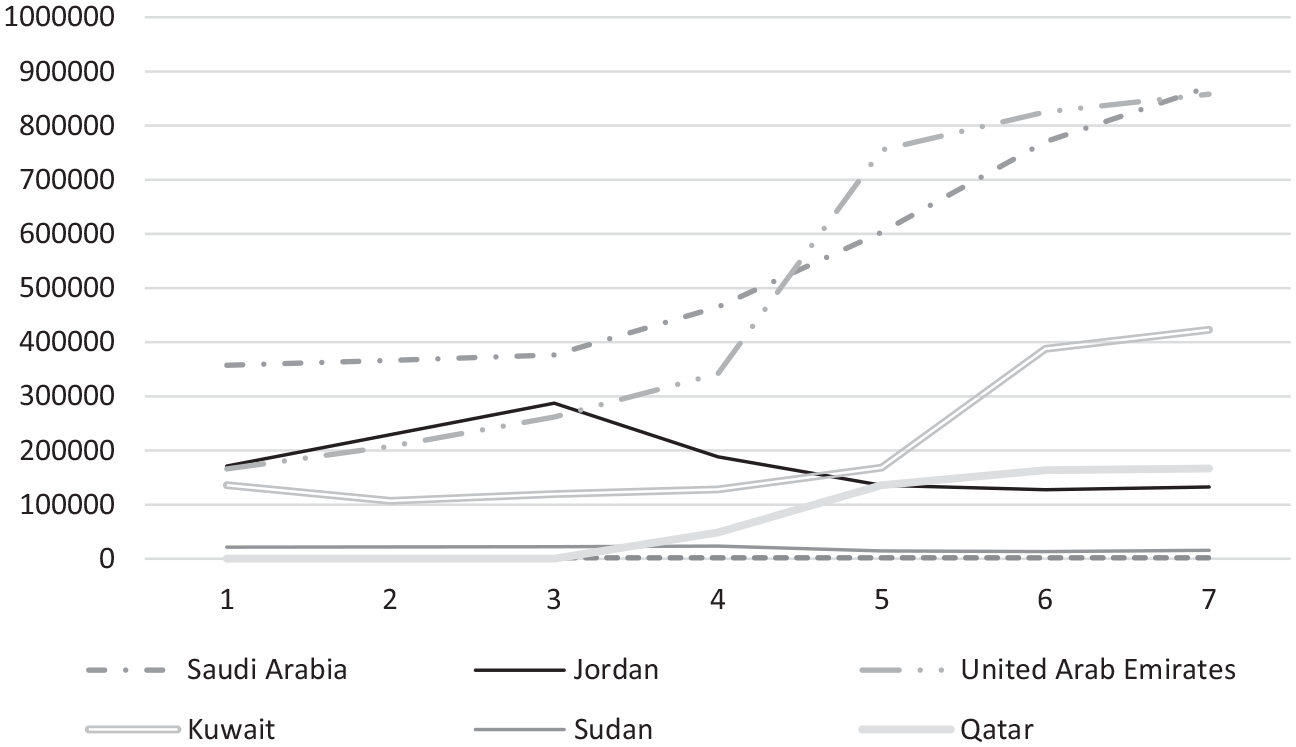
Egyptian emigration stock in Arab countries, 1990–2017.
The segmentation of Egypt’s migration streams highlights the tensions that are inherent in the creation of a postcolonial state’s diasporas, which are necessarily tiered: the relationship between Egyptian emigration policymaking and its diaspora communities places current formations within global economic networks that are reminiscent of colonial-era practices. The declared impermanence of Egyptian migrants across oil-producing Arab states enable Egypt to engage in redistributing labour for the global economy – in this case, by sending low-skilled, temporary migrants to work in exploitative conditions. These communities, under the vigilant eye of autocratic host-state regimes, are subject to surveillance and control. In sharp contrast, the care and attention shown to ‘permanent’ migrants highlights the desire to seemingly accommodate co-ethnics outside the nation-state all while tilting migration policies to favour particular groups.
The elitism and distinct class biases that mark India and Egypt’s multitier diaspora policymaking signal the degree to which colonial-era practices have seeped into and become ascendant in these postcolonial migration states, as socio-economic status continues to shape mobility. In fact, Indian and Egyptian diaspora members residing in the West are entitled to an assortment of exclusive privileges. The tiering of migration policies shows an increasing willingness and capacity to regulate segmented migration streams in ways that connect colonial patterns to contemporary postcolonial migration management.
Conclusion
Although the study of migration in postcolonial contexts has produced a thriving scholarship across the social sciences, it has yet to occupy a central part of mainstream work in International Relations. In this article, we brought Hollifield’s concept of the migration state into existing critical debates on the management of cross-border mobility in the Global South. By historicising Hollifield’s framework, we identify two inherent tensions – a postcolonial paradox – that characterises the interaction of migration, state-building and national identity across much of the decolonised world. First, aspirations to create a modern nation-state conflicted with weak institutional capacity leading to ad hoc policymaking, violence and the re-purposing of colonial institutions. Second, a strategic use of citizenship norms attempted to address the historical injustices of foreign rule but contrasted with the territorial realities of state sovereignty. The transformation from a postcolonial state to a postcolonial migration state is contingent on the use of migration control policies to both reconcile and reproduce colonial era tensions of citizenship and nation-building, as well as to respond to the complex character of migration flows that impact it. A focus on the centrality of migration control for state-building processes moves beyond a review of migration policies to reveal the genesis, form and function of contemporary migration governance in the Global South.
This article demonstrates the added value of an International Relations perspective via the re-centring of the state as the unit of analysis in the study of postcolonial migration management. This highlights the tensions between cross-border mobility, national identity projects and the institutional limitations of post-independence state-building across the non-West. State migration management in the postcolonial world is both a reaction to, and a reproduction of, Western ideals of modernity that is particular to the experience of colonial and imperial rule. In the context of India and Egypt, the postcolonial migration state relied upon both the control of cross-border mobility, which was made possible with stronger institutional capacity, as well as the development of multiple migration streams that prioritise specific groups of citizens at the expense of others. Ultimately, the postcolonial migration state’s attempt to address past tensions results in the reproduction of colonial and imperial tropes.
The development of a distinct postcolonial migration state type is able to shed analytical light on broader debates in the Global North. For one, the increasingly common language of nativeness, indigeneity, or autochthony across the West closely parallels postcolonial nationalism and demonstrates how national identities remain vested in conception of the ‘local’ (cf. Geschiere, 2009). Looking beyond dominant Western perspectives of diasporas as homogenous populations that are defined on a singular primordial connection to the homeland, the postcolonial migration state recognises the multiplicity of tensions that result in the emergence of multitier emigrant policies that prioritise some citizens abroad (frequently those resident in the West) at the expense of others (Tsourapas, 2019; cf. Turner and Kleist, 2013). Similarly, across postcolonial countries of destination – such as Singapore or the GCC states – the development of segmented migration streams likewise prioritises specific populations, namely Western ‘expatriates’ and high skilled professionals over temporary ‘labourers’ from the Global South.
The article paves the way for novel future work within International Relations on the politics of migration control in postcolonial contexts. Beyond single or paired case studies, further research is needed to show variance in features and expectations among a larger universe of postcolonial states. Notably, how do postcolonial migration states regulate mobility in times of crisis, say amid a global pandemic? How do different manifestations of colonialism impact the practices adopted and developed? The unique nature of the current crisis imparts states with greater control over mobility. As such, it is revealing the skewed character of policymaking favouring certain groups and areas while targeting others as sources of contagion in regions that feature some of world’s most important, yet heretofore overlooked, migration flows.
Footnotes
Acknowledgements
The authors would like to thank the EJIR editorial team as well as the four anonymous reviewers for their significant contribution in improving the quality of this manuscript. Earlier drafts of the manuscript were presented at the 115th and 116th Annual Meetings of the American Political Science Association, where co-panelists and attendees offered significant feedback. We are particularly grateful to James F. Hollifield, Hélène Thiollet, Fiona B. Adamson, Audie Klotz, Jen Dickinson, Daniel Naujoks, and Eiko Thielemann for their engagement with our ideas.
Funding
The author(s) received no financial support for the research, authorship, and/or publication of this article.
