




Abstract
When and how do regional parties influence foreign policy in federal democracies with multiparty coalition governments? The existing literature has focused on situations of foreign policy disagreements between subnational parties and the central government in multinational states. By contrast, we argue that under varying conditions, central governments either decide to accommodate the preferences of small regional parties when designing foreign policies, or co-opt these regional parties to push their own foreign policy agenda. Some scholars looked at the role of decentralization and federal power arrangements in providing more control to political sub-units over the external affairs of a state. Other studies showed that certain coalition-building configurations facilitated the inclusion of the concerns of small parties in the foreign policy debate. Bridging these two literatures, we argue that both structural and agential conditions behind regional and national coalition building processes—visible in federal settings—affect foreign policy-making in different ways, and not necessarily toward disagreement and obstruction. To illustrate these hypothesized mechanisms, we look at two case studies in the Indian context: the role of regional parties in the debate over the US–India nuclear deal of 2008 and the role of regional parties in shaping India’s Sri Lanka policy from 2009 to 2014.
Introduction
Foreign policy-making has increasingly been a contested political space due to the blurring of the boundaries between domestic and foreign policies. Some foreign policy decisions, such as signing trade deals, disproportionately affect particular regions or provinces (Keating, 1999). For instance, rural regions have concerns about exposing their agricultural sectors to international competition. Even in the context of decisions of military interventions, some regions and provinces are varyingly affected, for instance, in the context of disproportionate humane and financial contributions to the war effort (Trubowitz, 1998). In spite of the recognition of regionalized and localized preferences in foreign and security policy issues, notably in the liberalism research program (Kaarbo, 2015; Moravcsik, 1997), we still do not know much about how regional constituencies and their representatives influence the national government’s foreign policy decisions. Notably, we still do not know when, in which ways, and to what extent regional parties—which compete mainly in regional legislatures—become involved in the national foreign policy-making process.
This is an important question to address, as foreign policy-making has long been assumed to be strongly centralized in order to ensure a cohesive and effective response to international issues, especially in the domains of international security. In addition, policy-makers and scholars have also long presumed that there had been a permissive consensus to the process through which foreign policy was made (Holsti, 2004). The implication has therefore been that a small elite has exclusive control over foreign policy to efficiently protect the national interest (Lobell et al., 2016). This leads to another vexed question within the field of international relations: is there an objective and consensual national interest? This question is even more relevant in contexts of multinational or multicultural societies where the political contestation between national and regional parties over identity or identities has moved on to foreign policy debates and decisions (Hill, 2013). Accordingly, over the past decades, Foreign Policy Analysis (FPA) scholarship has increasingly argued and demonstrated that foreign policy is contested between domestic political actors, especially in democratic settings (Cantir and Kaarbo, 2016; Kaarbo, 2015). This literature has notably emphasized the role of partisanship, political parties and parliaments in shaping foreign policy (Joly and Dandoy, 2016; Mello and Peters, 2018; Rathbun, 2004; Raunio and Wagner, 2020; Verbeek and Zaslove, 2015; Wagner, 2018, 2020; Wagner et al., 2016).
In parallel, another strand of scholarship, building on the concept of paradiplomacy or sub-state diplomacy, has observed how sub-state actors are increasingly involved in international politics (Aguirre, 1999; Aldecoa and Keating, 1999; Cantir, 2015, 2020; Curtis, 2011). Paradiplomacy is a phenomenon through which subnational actors—such as regional governments, but also large cities—bypass central governments and promote their own regional interests directly on the international arena. Their counterparts may be other cities and regions as well as states. The emergence of paradiplomacy is usually explained by the direct and indirect consequences of foreign policy decisions for subnational actors.
While not denying the importance of paradiplomacy, our focus is on regional political parties, that is, parties that do not bypass the national government by developing their autonomous foreign activities but—on the contrary—influence national foreign policy decisions of the central government in direct and indirect ways. Through a closer study of these neglected actors, this article aims to contribute to international relations theory in several ways. First, while there are sparse accounts of how different regional or subnational actors have influenced specific foreign policy decisions (Blatter et al., 2008; Bradley and Côté, 2019; Criekemans, 2010; MacMillan, 2008; Paquin, 2013; Wong, 2018), these have mainly focused on how some institutional settings have given more leeway for actors to conduct a certain level of autonomous foreign activity. By contrast, this article aims to provide a more systematic understanding of when and how regional parties become involved in the national foreign policy of federal democracies. Building on insights from FPA and studies of regional and coalition politics, we argue that the combination of the degree of interest of regional parties in specific foreign policy issues and the prevailing institutional-coalitional configuration in place (i.e. whether the central government is engaged in coalitional power-sharing arrangements with regional parties at the national and regional levels) determines the timing, nature, and extent to which regional parties shape foreign policy outcomes. This analytic framework therefore also indirectly contributes to the scholarship on how regional preferences influence the definition of the national interest.
Second, we analyze and compare the effects of this hypothesized argument by examining two historical case studies of foreign policy-making in one federal and multiparty democracy, India. We believe that illustrating these factors through an examination of two Indian cases contributes to scholarship for two reasons. First, despite being the world’s most populous democracy and sharing many of the institutional features of parliamentary democracies, India has generally been neglected by studies of the foreign policy of coalition governments, which have for the most part focused on coalition governance in Western Europe (Alden and Brummer, 2019; Blarel and Van Willigen, 2017). Since coalition governments have become a prevalent feature of Indian politics since the late 1980s, India offers a plethora of illustrative cases to understand the role of coalition politics and specifically the influence of regional parties in these coalitions on foreign policy processes and decisions. India’s diverse coalition governance experiences can thereby help us evaluate some of the existing scholarly explanations as well as to derive new theoretical and empirical findings.
Furthermore, looking at Indian cases advances FPA and international relations scholarship in conceptual and theoretical terms, contributing to further overcoming the field’s still strong US and Western European bias (Acharya, 2014; Brummer and Hudson, 2015). The two cases of Indian foreign policy debate were previously mentioned in the literature as cases in which regional parties played an influential role (Asthana and Jacob, 2019). Here, we go several steps further by analyzing when and how these regional parties became involved. Moreover, our article aims to theorize on regional parties’ involvement by hypothesizing four possible outcomes that reflect different combinations of regional party preference and coalitional configuration. Doing so, we aim to offer a theory that can be applied beyond the Indian context, that is, in other democracies with federal systems and coalition governance.
The remainder of this article is organized in four sections. First, we identify and evaluate the relevance of the existing scholarships to account for the nature and extent of influence of political parties in general and regional parties in particular in foreign policy decisions. Second, we suggest a new argument that the combination of regional party preferences and multilevel coalitional arrangements leads regional parties to influence foreign policy decisions. In the third part of this article, we probe the validity of this argument in two historical cases to see how regional political interests shaped two sets of Indian foreign policy decisions. Finally, the article concludes with some discussion of the findings and the future directions for this research program.
Regions and foreign policy-making: the state of knowledge
While International Relations scholarship increasingly recognizes that domestic constituencies within a country seek to influence their country’s position in international politics, it has yet to specifically develop an adequate understanding of when and how regional political parties shape foreign policy decisions made by central governments. 1 Some studies show that varying domestic institutional conditions—including whether countries have presidential or parliamentary systems, autonomous or constrained executives, and open or closed institutions—enable or constrain the influence of parties on foreign policies (Beasley and Kaarbo, 2014; Hagan et al., 2001; Kaarbo, 2012, 2017). Within this scholarship, the literature on the role of multiparty coalition governments in foreign policy-making is of particular interest. For long, there was a tendency within this literature to study coalition government and foreign policy-making in comparison to foreign policy-making by single party governments. By now, the focus of the scholarship has broadened and moved away from emphasizing the constraining effects of coalition governments on foreign policy-making. In the early literature, coalition government was primarily seen as something that restrains foreign policy decision-making. Arguments from institutionalist theory (the role of veto players) or social psychology (group-level bargaining dynamics) learned that the wide occurrence of compromises, decision postponement, and non-decisions in coalition governments showed that foreign policy-making in coalition governments is more constrained (Beasley and Kaarbo, 2014; Hagan, 1993; Tsebelis, 1999).
More attention has recently been given to factors that might explain variation in foreign policy outcomes between different coalition governments (Beasley and Kaarbo, 2014; Clare, 2010; Greene, 2019; Kaarbo and Beasley, 2008; Oktay, 2017; Oppermann and Brummer, 2014). This has led to rich empirical insights as well as to the formulation of hypotheses and causal mechanisms for the observed effects of coalition government on foreign policy outcomes. Kaarbo (2012) and Beasley and Kaarbo (2014) found for instance that coalition governments tend to have “more extreme” foreign policies as compared to single party governments. Factors like the number of parties in the coalition and the type of coalition (minority or majority) (Kaarbo and Beasley, 2008), but also its ideological composition (Oktay and Beasley, 2017) and the influence of institutionalized ideas (Ozkececi-Taner, 2005) can influence the foreign policy-making process.
Some scholars demonstrated that coalition-building configurations facilitate the inclusion of concerns of small parties in foreign policy decisions (Beasley and Kaarbo, 2014; Coticchia and Davidson, 2016; Greene, 2019; Verbeek and Zarlove, 2015). Kaarbo and Beasley (2014) identified various causal mechanisms to account for the type of influence of small parties in coalition cabinets’ foreign policy behavior. One explanation of interest in the context of this article—“political hijacking”—emphasizes the role of junior parties in coalitions that can threaten to withdraw their support (and possibly to defect from the coalition) to shape foreign policy decisions. This blackmailing tactic allegedly gives disproportionate leverage to smaller parties and should lead to extreme foreign policy behaviors.
An important limitation of this literature, however, is that the empirical cases from which theories are derived and then tested are predominantly Western coalition governments (Kaarbo, 2012). European cases are especially well represented in this scholarship, reflecting the large occurrence of coalition government in Europe. As a result, the focus of these parties (and the input of small parties’ ideas) lies on party competition along the traditional left–right ideological spectrum, overlooking the role of regionalized preferences and regional parties (Blarel and Van Willigen, 2017; Clare, 2010). The role of coalition building and management on foreign policy outcomes in the context of federal and multinational polities like India has therefore mainly been overlooked.
Consequently, while we know more about some domestic drivers of foreign policy-making, and the role of small parties in coalitional configurations, we know less about the conditions under which regional parties can push for local interests in the foreign policy-making process. Some insights can be gained from a body of scholarship that has studied the influence of political decentralization of political power and federal arrangements on foreign policy-making. Emerging in the 1990s, this scholarship questioned the traditional centralized and unitary conception of the nation state’s foreign policy. Structural changes in the international system such as globalization have led to renewed debates over the nature of who defines the national interest of a country and more particularly of the growing influence of subnational actors on International Relations. Within this scholarship, some have studied and compared the increasing role of political sub-units within various federal systems over the external affairs of a state. According to the emerging literature on paradiplomacy, some regions, states, provinces, and cities have managed to develop their own external relations when constitutional arrangements accommodate some power-sharing possibilities and/or remain ambiguous over the distribution of competences over foreign policy among federal as ambiguous (Aldecoa and Keating, 1999; Kincaid, 2003; Lecours, 2002; Michelmann, 2009).
One major insight coming from this literature is the identification of small spatially concentrated constituencies, which can hold informed and committed preferences—often expressed through the intermediary of regional parties or regional legislatures—over specific foreign policy issues (Plagemann and Destradi, 2015). However, these studies mainly look at under which explicit institutional conditions these subnational authorities can directly develop their own transnational networks, both bilaterally and multilaterally, with other similar political or cultural sub-units in other states (Cantir 2020; Royles, 2017). In most cases, these transnational opportunities for sub-state actors emerge in areas such as education, healthcare, climate change, waste management, culture, and transportation (Emanuel, 2020; Tavares, 2016). The focus is therefore more on separation of power among layers of governance and less on situations under which local preferences directly conflict with national foreign policy positions and how debates between the central government and regional parties are institutionally mediated through coalitional arrangements.
Regional parties and national foreign policy-making
To address some of the limitations mentioned above, this article offers to examine in what ways and to what extent regional parties influence foreign policy decisions. We define influence on national foreign policy decisions—our dependent variable—as the type of intra-state influence on national foreign policy-making a regional party can have in the context of a particular foreign policy debate. We adopt Ziegfeld’s (2016: 24) definition of a regional party as “a party whose electoral support is geographically concentrated within a small part of a country.” This definition includes parties that compete in both regional and national parliamentary elections, as long as the votes are geographically concentrated these parties count as regional parties. 2 We operationalize regional party influence on national foreign policy as a variable that can take the following values:
Coordination: there is a policy convergence between the central government and the regional party preference on a foreign policy decision (Borzel, 2002).
Compromise: there is no policy convergence but the central government makes partial concessions to the regional party. In practice, the central government selectively adopts some of the expressed policy preferences of the regional party on a particular foreign policy issue.
Quid pro quo: the central government pushes for its own preference on a foreign policy decision but makes other concessions to a regional party that are not directly related to the foreign policy decision (Gerring and Thacker, 2008), such as policy cooperation on other issues or promises of electoral support at the regional level.
Absent dialogue: the central government ignores the preference of the regional party and pushes for its own preference on a foreign policy decision.
We look at two explanatory factors to determine how the interest and influence of regional parties vary on foreign policy decisions: regional preferences and multilevel coalitional arrangements. We first define regional preferences as small, but spatially concentrated constituencies that have held informed and committed preferences (through the intermediary of regional parties) over time and over specific foreign policy issues (Jaganathan, 2019; Plagemann and Destradi, 2015; Sharam et al., 2020). Variation in regional preferences can be observed through the geographical distribution of economic and/or cultural interests relative to foreign policy issues. For instance, two regional parties in India (DMK and AIADMK) have held consistent and enduring preferences over India’s relationship with Sri Lanka, notably over transnational ethnic solidarity with the Tamil minority. Similarly, the process of economic liberalization initiated in the early 1990s has gradually given lead to an increase in economic interest of Indian states in national foreign economic policy (Basu, 2016; Jenkins, 2003). Since Indian states have now carried out direct paradiplomatic trade ties with external entities, they have developed specialized economic interests and stakes in particular regions of the world (Asthana and Jacob, 2019). Regional parties have adapted by integrating these preferences in their own political programs.
However, we also argue that strongly expressed and enduring preferences by regional parties are not a sufficient condition to see a central government-regional party bargaining game over foreign policy decisions. Strong foreign policy preferences and opposition from regional parties only lead to a reaction from the central government if these disagreements are likely to bring political and especially electoral costs. Recently, Narang and Staniland (2018) argued that the shifting electoral salience of foreign policy issues and the clarity of responsibility for policy outcomes combined in various ways generate different accountability environments in which Indian politicians operate. Building on this, we also argue that small, but regionally concentrated, parties can pressure the national leadership and thereby influence foreign policy through multilevel coalitional arrangements.
Multilevel coalitional arrangement is our second explanatory factor. Here, we build on the scholarship on the effects of India’s experience with coalitions on its domestic policies. While the Indian case is often cited as evidence to support the claim that coalition politics have a decisive impact on foreign policy decisions, 3 there has been no systematic inquiry of the effects of India’s transition to a coalition style of governance on its external policies. 4 However, many have investigated the increasing influence of regional parties within large national coalitions, and the politics of coalition-making and -sustaining (Adeney and Saez, 2005; Chakrabarty, 2005; Kailash, 2014; Manikandan and Wyatt, 2019; Nooruddin, 2010; Ruparelia, 2015; Sridharan, 2005, 2012, 2014; Ziegfield, 2012, 2016).
One important finding has been that regional parties have gradually become supporting actors within the fragile coalition governments that were formed at the national level (Sridharan, 2014; Ziegfield, 2012). The two largest national parties, the Indian National Congress (INC), and since 1998 the Bharatiya Janata Party (BJP), have had to build large coalitions that included many smaller regional parties. To some degree, national parties have had to agree on more or less structured common political programs (before or after national elections) with potential coalitional partners, to divide ministry portfolios and political responsibility in order to mobilize enough parliamentary support to make decisions.
Unlike other parliamentary democracies like the Netherlands and Israel in which the electoral rules are based on the principle of proportional representation, sharing authority over foreign policy-making between multiple political parties has not been an initial feature of the Indian political system. Through its first-past-the-post-system, India has mostly been a centralized political system with one single party ruling. For the first four decades after independence, one single party (the INC) controlled a majority of parliamentary seats. In fact, India’s foreign policy decision-making structure has long been considered as a restricted decision unit to the Prime minister, Prime Minister’s Office, and the Ministry of External Affairs (Bandyopadhyaya, 1970). Furthermore, the INC that had been in power for most of the pre-1989 period developed its own conception of India’s foreign policy role and orientation (Narang and Staniland, 2012). However, from 1989 to 2014, India diverged from other first-past-the-post systems like the United Kingdom, which have been mostly dominated by single party majority governments by entering a long period of coalition governance. 5
The rare studies assessing the role of coalition politics on Indian foreign policy-making have insisted upon the institutional and political constraints of coalitions, which supposedly have led to foreign policy conservatism (Mazumdar, 2011; Sridharan, 2003). These scholars have often invoked the virulent anti-incumbency tendencies, higher electoral volatility, or the parochial and local interests of regional parties as negatively affecting types of foreign policy choices Indian decision-makers could make. This emphasis on foreign policy inertia is more closely linked to the existing scholarship discussed in the previous section on the moderating effect of coalition politics on foreign policy outputs (Kaarbo, 2012: 9).
In this article, we suggest concentrating on how the particular combination of federalism and coalition politics helps explain how regional parties, which usually run and control many seats in regional legislatures, but are minor players in national parliaments, can influence foreign policy decisions made by governing coalitions at the center in a federal polity like India. We suggest looking at the multilevel coalition bargaining between a national party heading the central government and regional parties in both the national parliament and the state assemblies (Chhibber and Murali, 2006). What needs to be observed is not so much the relatively small number of national parliamentary seats of the regional party allied with a national party within a coalition, but also its vote and seat shares in its state legislature of origin.
The particular institutional features of the Indian political system create the phenomenon of mutual electoral interdependencies or “locked-in supporters” (Sridharan, 2012). These mutual electoral interdependencies, which are visible in federal and multiparty governing settings, create specific structural constraints and opportunities for national and regional parties to shape the policy agenda of a governing coalition at the center. In order to maximize electoral prospects at the national level and to build large and stable coalitions, national parties have therefore to take into account the inputs from their regional party partners, even if these parties only have a small number of seats in the national assembly (Sridharan, 2012), thereby making it necessary for national parties to take into account the concerns of a wider number of electoral partners. As national parties build coalitions or electoral alliances with regional parties both within the national and regional parliaments, the national parties are bound by agreements that might give a disproportionate amount of leverage to regional parties to shape national policies, including foreign policies. Reciprocally, some regional parties might also depend on support from the national parties in their regional parliamentary elections, and are also constrained in their capacity to pressure the agenda of the national government, even if they had the seats in the national parliament to be a pivotal player. These informal interlocking coalitional bargaining games have generally not been captured by approaches on decentralization and power sharing over the external affairs between the center and the states (Aldecoa and Keating, 1999; Michelmann, 2009).
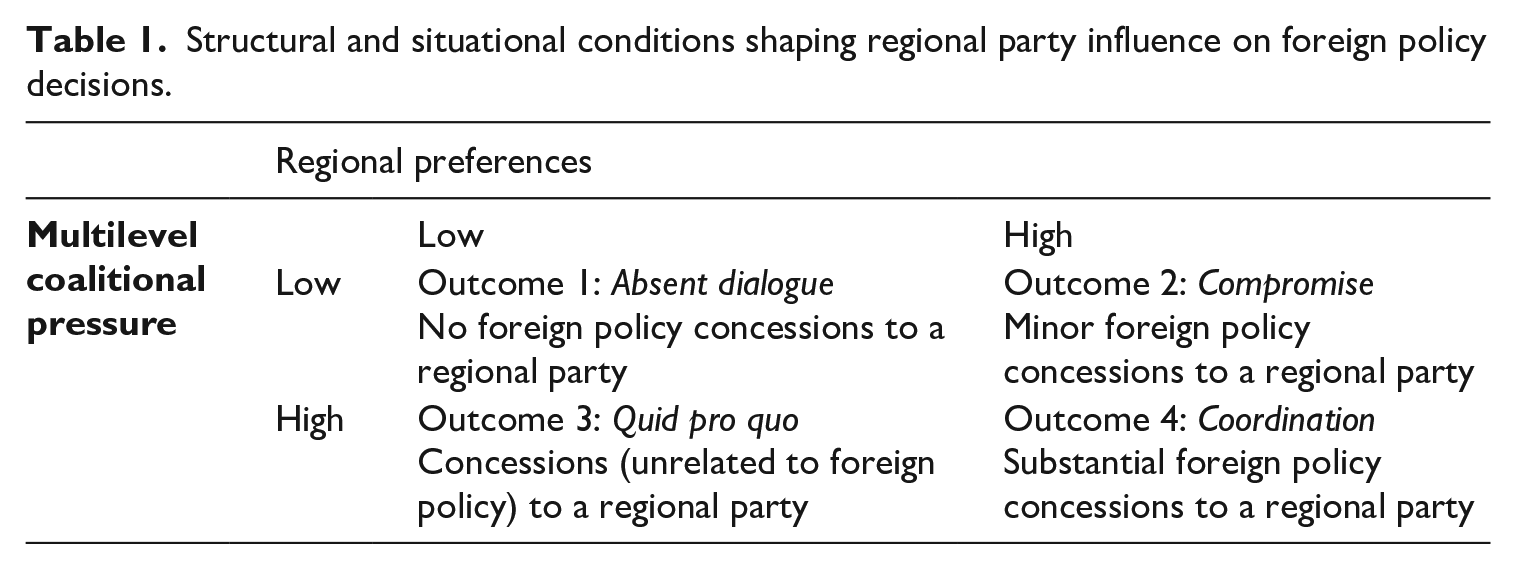
We thereby hypothesize four possible outcomes that reflect different combinations of regional preference and coalitional configuration.
(1) First, the absence of strong regional preferences and of a multilevel coalitional arrangement leads to the absence of regional party input and thereby of pressure on the central government to make substantial foreign policy concessions to the regional party.
(2) Second, there is no multilevel coalitional arrangement but a strong regional preference. In this context, the perspective of future elections and future coalitional bargaining encourages the central government to be open to minor foreign policy concessions to placate strong regional party preferences.
(3) Third, a multilevel coalitional arrangement induces the national government to accommodate a regional party, but the absence of a strong regional party preference opens the possibility of logrolling (Oktay, 2018; Snyder, 1991), a coalition bargaining situation where a regional party trades its vote on a foreign policy issue in exchange for other benefits (concessions unrelated to the foreign policy issue).
(4) Fourth, both a multilevel coalitional arrangement and a strong regional preference push the national government to make foreign policy concessions to accommodate regional party concerns.
These hypothesized outcomes are summarized in Table 1.
Structural and situational conditions shaping regional party influence on foreign policy decisions.
This project aims to look at two Indian foreign policy decisions (over time and across regions) for the purpose of clarifying the hypothesized causal mechanisms. Because of the difficulties to access information inside the “black box” of the informal intra-coalitional decision-making processes, we use the comparative method (Beasley et al., 2013). The project concentrates on two Indian foreign policy decisions that vary in terms of regional party preference and coalitional set-up. The two cases are therefore selected on the independent variables. In each case, we use process-tracing to unpack the precise causal mechanisms linking the foreign policy preferences of regional parties and intra-coalitional bargaining to specific foreign policy outcomes (George and Bennett, 2004: 67–72). This in-depth analysis addresses feedback loops between variables, which is appropriate to trace the relationships between the explanatory factors—regional party preference and coalitional configuration—and the outcome—influence on national foreign policy (Bennett and Checkel, 2014: 29–30).
Coalition politics and foreign policy: the Indian puzzle
Our two case studies concern two instances of Indian foreign policy-making. At first sight, foreign policy in India is heavily centralized (Asthana and Jacob, 2019). The constitution envisaged and made space for a federal structure with a unitary bias. The distribution of legislative powers between the Union and the states was envisaged in the Indian Constitution (article 246) and emphasized that the Union government is competent to legislate in foreign affairs; diplomatic, consular, and trade representation; participation in international conferences; entering into treaties and agreements with foreign countries and implementation of treaties, agreements, and conventions with foreign countries; and foreign jurisdiction and trade and commerce with foreign countries.
In spite of this apparent clear-cut division of competences, India’s central government has encountered from 1989 to 2014 indirect and direct resistance from regional parties when trying to push foreign policies. Yet, there has been no systematic attempt to evaluate the influence of regional parties on India’s external policies through coalition building. There is a scholarly consensus that there had been a “fragmentation” of India’s party system from 1989 to 2014 (Chakraborty, 2005; Sridharan, 2012, 2014). After the almost uninterrupted rule at the Center and in most states by India’s INC party, there have been six consecutive hung parliaments from 1989 to 1996, and then the emergence from 1996 to 2014 of very large coalitions of 9–12 parties. Consequently, as smaller and regional parties have gained more seats in parliament since 1989, there has been an assumption that Indian foreign policy has also become more democratic and politicized (Narang and Staniland, 2018). New actors might disagree over the best course of action for their country and/or have varying interpretations of India’s national interest. However, the literature has usually concentrated on ideological debates between the two national parties, the INC and the BJP, and has thereby not systematically integrated the foreign policy preferences of regional parties (Friedrichs, 2019; Narang and Staniland, 2012; Plagemann and Destradi, 2019; Sagar, 2014). A small number of studies have merely concentrated on the obstructive power of regional parties in border-states on India’s policy toward neighboring countries like Bangladesh and Sri Lanka (Sridharan, 2003; Staniland and Narang, 2015: 208). But how have eventual disagreements been bargained and resolved?
Interestingly, the beginning of the coalition era in Indian politics correlates with what some have defined as a revolution in India’s foreign policy orientation. In the early 1990s, a series of foreign policy decisions constituted important departures from India’s traditional policies. In spite of a growing literature on India’s post-Cold War foreign policy, there has yet to be any evaluation of how coalition politics could have shaped these radical foreign policy decisions (Blarel, 2016). Structural changes in international politics do not always lead to automatic reactions as various actors and parties in a coalition perceive international opportunities and constraints differently and therefore suggest varying policy options (Rathbun, 2004).
In this section, we look at two different cases selected based on variation of the values of our independent variables: regional preference and coalitional set-up. The first case study looks at India’s stance over the civil conflict in a neighboring state (India’s United Nations Human Right Council (UNHRC) vote on Sri Lanka in 2012 and 2013), where there has historically been a strong support from regional parties in Tamil Nadu to the ethnic Tamil minority in Sri Lanka (strong regional party preference). During this time period and the two votes from India at the UNHRC, there was also some variation in the INC-led multilevel coalitional structure and thereby pressure on the central government. The second case study focuses on the issue of alignment with one major power (the nuclear agreement negotiations with the United States in 2008), which has mainly been a national issue with low regional party preferences, but the negotiations had been happening at a period when the INC was constrained by a multilevel coalition structure. The case of the nuclear deal with the United States therefore involves a potential public good for India (energy security), while the other case focuses on the appropriate distribution of private goods or with salience for a specific regionally concentrated constituency (as for example the ethnic solidarity that immediately affects regional preferences).
Case 1: the role of Tamil parties in shaping India’s Sri Lanka policy from 2009 to 2014
The two major regional parties competing for the control of the regional assembly in the Indian state of Tamil Nadu, the Dravida Munnetra Kazhagam (DMK) and the All India Anna Dravida Munnetra Kazhagam (AIADMK), have historically been also competing to pose as the most ardent champion of the welfare of the neighboring Indian-origin Tamil population in Sri Lanka (Jones, 2012). This foreign policy issue of ethnic solidarity has been salient for successive regional elections since the 1970s. This issue has also influenced coalition-building discussions between national and Tamil Nadu parties since 1989. For decades, the single-party majority of the INC insulated the foreign policy-making process from the concerns and pressures of the regional Tamil parties, but Indian central governments have had to increasingly take into account regional preferences when shaping India’s Sri Lanka policy due to varying coalitional configurations after 1989. The need for political support of Tamil parties in national coalitions or the concern over large-scale political protests in Tamil Nadu have led the Indian governments to opt for a more interventionist policy in Sri Lankan affairs.
Regional party preferences and pressures are decisive in this particular case as these are in direct conflict with India’s national and geopolitical interests, and notably concerns about Chinese influence in Sri Lanka (Destradi, 2012). Since 2009, China’s growing trade, investments, and aid have been used as important instruments of strategic influence on Sri Lanka’s domestic and foreign policies (Lim and Mukherjee, 2019). The combination of geopolitical and regional political constraints therefore led the Manmohan Singh INC-led United Progressive Alliance (UPA) coalition government at the height of the Sri Lanka civil war (2006–2009) to publicly signal concerns about human rights violations, but of not to engage into any direct efforts to thwart the Sri Lankan military operations. This was meant to placate the concerns of the DMK, which was a member of the ruling UPA coalition with 16 seats in the national parliament (Jha, 2012). However, in early May 2009, the Chief Minister of Tamil Nadu and leader of the DMK, Muthuvel Karunanidhi, pushed the recently reelected INC-led UPA-II coalition government to demand a ceasefire in Sri Lanka. Karunanidhi notably threatened to review his party’s support for the coalition if the Indian government did not adopt a more pro-Tamil position. There were further criticisms against India’s decision to vote against the motion in the United Nations Human Right Council (UNHRC) later in the month of May, which demanded an investigation into war crimes purportedly committed by the Sri Lankan government during its military offensive against the Liberation Tigers of Tamil Eelam (LTTE).
To intensify pressure over the INC, Karunanidhi encouraged all Tamil MPs to resign from their posts. His daughter, Muthuvel Karunanidhi Kanimozhi, and a series of DMK MPs offered their resignations. As a response, Prime Minister Singh tried to assuage concerns by summoning the Sri Lankan High Commissioner to express India’s concerns. In addition to this, Basil Rajapaksa, brother and senior advisor to the Sri Lankan president, traveled to New Delhi to give assurances about the safe treatment of the Tamil minority, notably by authorizing the delivery of Indian supplies. However, the Indian government did not explicitly condemn the Sri Lankan government’s military operations against the LTTE, and therefore did not align with the DMK’s stated foreign policy preference, which was to demand a ceasefire.
A dissatisfied Karunanidhi undertook a fast to support an immediate ceasefire. This obliged the Indian government to ask for the suspension of hostilities and to encourage a political resolution to Sri Lanka’s ethnic problem. However, the coalitional configuration and electoral timeline actually favored the national government and the national party’s agenda in 2009. While the UPA-II coalition had just been reelected thanks to the support of the DMK, the DMK-led government in Tamil Nadu was supported by the INC and needed electoral support in the elections in the state of Tamil Nadu in 2011. As a result, despite a clear foreign policy preference on this issue, the DMK could not compel the central government to reverse its support to Sri Lanka (Destradi, 2012).
The situation shifted in 2012. First, the DMK had lost the elections in the regional legislature in 2011. Second, the United States brought to vote a resolution again at the UNHCR in 2012, encouraging Sri Lanka to conduct an independent and credible investigation into alleged war crimes and tens of thousands of civilian deaths in the final stages of the Sri Lankan offensives to quell the LTTE insurgency (Cumming-Bruce, 2012). This time, however, the coalitional configuration was in favor of the DMK as it did not need to court the INC for electoral support in regional elections and could leverage its parliamentary support at the national level. The DMK therefore directly threatened to withdraw its support to withdraw from the central government if it did not vote against Sri Lanka (NDTV, 2012). As a result, the central Indian government chose to break with its traditional practice of not voting for country-specific motions, especially with regard to interference in domestic politics (Narrain, 2017). Nevertheless, given China’s growing economic and political influence in Sri Lanka, the central government also qualified its support by suggesting that the Sri Lankan government had to give its prior approval to international inspections.
A following UNHCR resolution in 2013 created further problems for the central government. The United States sponsored a stronger resolution and the DMK demanded this time that India amend the resolution to explicitly condemn Colombo of genocide and war crimes. The DMK was pressured to act by its local rival at the regional level, the AIDMK, which had passed a resolution in the regional legislature requesting the Indian government to break ties with the Sri Lankan government. No agreement was reached within the national coalition over an appropriate response on the part of the Indian government, but a series of central government ministers condemned Sri Lanka’s treatment of the Tamil population and India voted for the resolution. These rhetorical accusations, which again were mainly compromise concessions, failed to satisfy DMK, which chose to follow up on its threats and withdrew from the UPA coalition in March 2013 without, however, destabilizing the coalition. The DMK effectively maintained its external parliamentary support to the national coalition (Sivani, 2013). The coalitional configuration, therefore, pressured the Indian government to make partial concessions such as the vote at the UNHCR and the decision of Prime Minister Singh to skip the Commonwealth Heads of Government Meeting organized in 2013 in Colombo as a sign of protest. However, the central government still did not align with the DMK’s preference of explicit condemning the Sri Lankan government.
However, by 2014, conscious that relations with the Rajapaksa government were deteriorating and encouraging China’s push for more influence in Colombo (Destradi, 2012), the central government decided to again modify its voting policy. This was made possible by a shift in the coalitional configuration: the DMK had effectively withdrawn its support from the coalition and the INC was looking for other coalitional allies (Asthana and Jacob, 2019). Freed from the pressures of any electoral agreement with the DMK, the central government was less concerned about pro-Tamil demands and tried to mend ties with the Sri Lankan government. India therefore abstained from voting against Sri Lanka in the UNHRC vote in 2014. The vote change was immediately welcomed by the Sri Lanka government, which announced the release of detained Indian fishermen (Asthana and Jacob, 2019).
What are the lessons we can highlight from India’s shifting stand when it comes to its votes on the Sri Lanka issue at the UNHCR? This first case study seems to confirm the expectations of outcome 2 (Compromise, see Table 1). In this case, there were strong and long-term regional preferences, reflected by an electoral and populist competition between the two main Tamil parties to champion the Tamil cause in Sri Lanka. In 2009, the Indian government was initially in a coalitional configuration, which pressured it to make partial concessions in its policy toward Sri Lanka. While the UPA-II coalition needed the support of the DMK in the national parliament to stay in power, it benefited initially from the “mutual electoral interdependencies” mechanism, which prevented the DMK from threatening a withdrawal from the national coalitions, as it was itself facing regional elections in 2011 and thereby needed the INC’s electoral support locally.
However, as the UPA-II coalition grew weaker at the national level by losing the support of other regional small parties, the INC did attempt to integrate DMK preferences and voted to condemn Sri Lanka in 2011 and 2012 at the UNHCR. In this context, regional interests seemed to have partly trumped geopolitical concerns as the central government’s main preference was to limit China’s increasing political influence in Sri Lanka. Contrasting with the expectation that strategic competition with China would lead to a quieter diplomacy with Sri Lanka, or even with the narrative that constant criticism from the Tamil Nadu regional parties would pressure the central government to systematically condemn Sri Lanka, the shifting coalitional configurations between 2009 and 2014 tells us a more nuanced and complete account of India’s fluctuating position at the UNHRC.
Case 2: the role of regional parties in the signing of the US–India nuclear deal of 2008
The nuclear deal signed with the United States in 2008 is another important case to analyze as it is the first instance of a substantial foreign policy disagreement leading to the dissolution and reformation of a governing coalition. Until then, junior coalition members had mostly threatened to withdraw their support on the basis of differences on domestic policies. The nuclear debate of 2006–2008 was also the example of an important departure from traditional Indian positions on nuclear policies and relations with the United States, which happened in spite of the institutional and social psychological constraints of coalition politics.
Historically, India had been averse to any clear alignment with US policies due to the perception of losing its strategic autonomy (Kapur and Ganguly, 2007). The emergence of an INC-led UPA coalition in 2004 with the external parliamentary support from the Left Front (a grouping of left-leaning national parties) further created constraints for any substantial policy change. While in opposition (from 1998 to 2004), the INC and the Left parties were concerned about preserving India’s strategic autonomy as India grew closer to the United States (Mohan, 2006). Nevertheless, the INC was encouraged by the opportunity provided by the presence of an accommodative administration in Washington under George W Bush. As a result, the UPA coalition resumed the nuclear negotiations that had been initiated under the previous BJP-led government (Mohan, 2006).
On 18 July 2005, Bush and Singh announced in Washington an Indo–US nuclear deal, which was to be the most wide-ranging partnership in the history of their bilateral relations, covering the economy, energy security, democracy promotion, defense cooperation, advanced technology, and space cooperation. The agreement was also part of a larger set of initiatives between the United States and India involving space, dual-use advanced technology, advanced military equipment, and missile defense, but the most decisive aspect of the agreement was Bush’s commitment to “work with friends and allies to adjust international regimes to enable full civil nuclear energy cooperation and trade with India” (Ministry of External Affairs, 2005).
In effect, according to the agreement, the United States explicitly recognized and cast itself as prepared to legitimize India’s nuclear weapons program even though it was still a Non Proliferation Treaty (NPT) state. In the statement, the United States declared itself ready to change domestic laws and policies and to work with international partners to equally reform the existing international regulations to allow sale to India of nuclear material and reactors for civilian purposes. The US administration freed the relationship from an historical disagreement over India’s nuclear status since India’s nuclear test of 1974 and the resulting US Nuclear Nonproliferation Act of 1978, which limited any possibilities for nuclear cooperation for India (Perkovich, 2002).
At the time, some members of the UPA’s coalition expressed concerns that the deal could compromise India’s valued strategic autonomy. The UPA’s external supporters in parliament were alarmed that a rapprochement with the United States would compromise India’s relations with Iran (Baruah, 2006). During the negotiations to sign the nuclear deal, India effectively voted in September 2005 and February 2006 in support of two US-led resolutions at the International Atomic Energy Agency (IAEA), which condemned Iran’s nuclear program. The Indian vote was considered by the Left parties as a concession by the central government to US pressure (Varadarajan, 2009). As a result, the Left Front claimed that the Indian government had conceded too much to obtain the nuclear deal with the United States.
These divisions in the broader UPA coalition led to a debate in the parliament over the approval of the nuclear deal. According to the Indian constitution, the Indian government is not required to ask for parliamentary approval to enter into international agreements or to sign treaties. However, the survival of the INC government coalition was contingent on the support of allies outside the governing coalition, notably the Left Front. In order to limit and to mediate any possible disputes, the INC had negotiated with the Left Front a common minimum program before the 2004 elections. The Left Front parties were disappointed with the INC’s limited consultation with them over the foreign policy-making process leading to the nuclear deal negotiations (The Hindu, 2005a). While the attempt to push for its own foreign policy preference, to break India out of its nuclear and technological embargo, seemed logical from an institutional standpoint, as any nuclear deal required no parliamentary approval, the multiparty coalitional configuration meant that small parties had greater leverage over the foreign policy agenda.
As a result, the parties within the Left Front publicized their opposition to the deal. The Communist Party of India (Marxist) (CPI(M)) judged that the debate was not about a nuclear deal but about a “wider strategic alliance” with the United States (The Hindu, 2006b) It therefore argued that the deal would compromise India’s strategic autonomy (Chatterjee, 2007; Karat, 2006). The general secretary of the other Communist Party of India (CPI), Prakash Karat, used similar rhetoric when he said that the deal would “affect the sovereignty of the country’s strategic relations, defense and economy” (Raj and Mankotia, 2007).
In spite of reassurances from the central government that India’s “autonomy of decision-making” would be preserved during the negotiations with the United States and the IAEA, the communist parties of the Left Front used their intra-coalitional bargaining leverage and threatened to withdraw their support to the coalition and trigger early elections (Ridge, 2008). The CPI finally withdrew its support in July 2008 and a no-confidence vote was scheduled in Parliament. This led to the introduction into the foreign policy debate of regional parties, which were traditionally not engaged in foreign policy debates but of which the support became pivotal at the moment of the confidence vote in Parliament. Their bargaining power rose as their share of vote grew, outstripping the usual leverage commanded by national parties in deciding the foreign policy agenda.
After the withdrawal of the Left Front’s support for the governing coalition in July 2008, the INC needed 43 votes to win the confidence vote, and struck deals with specific regional parties. These parties used this opportunity structure to push for their own local policy initiatives in exchange for their support. One prominent example is the Telangana Rashtra Samithi (TRS)’s demand for the creation of a separate federal state of Telangana (out of the bigger state of Andhra Pradesh) in exchange for its vote for the nuclear deal (Asian Age, 2008). The Samajwadi Party (SP), which mostly competed in the state of Uttar Pradesh, negotiated a seat-sharing agreement with the INC for the next regional and national parliamentary elections. The SP’s position was interesting because it was originally opposed to the deal as it considered it as a “total surrender before a foreign power” (Jha, 2008). The SP abruptly changed its position during the negotiations and rationalized its changing stance by quoting the former Indian president and one of the architects of India’s missile program, Dr Abdul Kalam, who supported the deal and had argued that the deal would help India be “self-sufficient on the energy front” (Hindustan Times, 2008). The nuclear deal was ultimately approved by the Indian parliament, but only after long intra- and extra-coalitional negotiations and following a no-confidence vote that the central government barely survived (275 in favor, 256 against) (Lakshmi and Wax, 2008).
What are the lessons of this debate? The debate over the nuclear agreement with the U.S. seems to conform to the expectations of outcome 3 (Quid pro quo, Table 1). First, coalition-building and rebuilding have helped ensure that new regional parties became involved in the foreign policy decision-making process. One finding is that previously uninvolved or excluded regional parties like the SP were courted to become allies in favor of certain foreign policy decisions.
Second, the revised coalitional arrangement creating a new coalition with the SP’s parliamentary support (to replace the Left Front) induced the central government to make concessions the SP but the absence of strong preferences vis-a-vis the nuclear agreement opened the possibility of logrolling and to offer electoral support for the upcoming state assembly level elections (2019) in exchange for parliamentary support (Sasikumar and Verniers, 2013). While the bargain between the INC and the SP was dissociated from the actual content of the nuclear deal, this made this regional party an enduring stakeholder in the new policy decision and direction.
Third, there was no decisive hijacking or veto power from the external supporters of the UPA coalition. The communist parties of the Left Front were unable to constrain the government from signing the nuclear deal even though they withdrew their support, which was initially critical for the INC to sustain its parliamentary majority. In the Indian context, the coalition formateur’s role appeared key as it negotiated the entry and/or external support of new actors to prevent the fall of the central government. As a result, coalitions are fluid entities and ensure some degree of stability in India’s policy-making. It is possible for national parties to negotiate and renegotiate with various smaller regional parties on an ad-hoc basis if these parties have no strong or historical preferences vis-a-vis the foreign policy issue.
Conclusions
In this article, we argued that the final foreign policy decision in the Indian federal and multiparty settings depends under certain conditions on the coalitional arrangement (mainly the existence or not of interdependence of regional and national coalition building processes) and the existence of strong regional party preferences (usually expressed through regional parties’ platforms or within debates in regional legislatures). These findings both break with accepted wisdom on center-region dialogue on foreign policy debates and reinforce emerging new research directions.
One first main finding is that political parties, both central and regional, play an important role in the design of foreign policies, in both direct and indirect ways. Depending on institutional and situational conditions, there are varying opportunity structures for skillful regional party leadership to exploit the weak spots of the governing central government to push their own foreign policy preferences or to get other policy and/or electoral concessions from the central government. However, we also demonstrated in both case studies that central governments and national parties can also, under specific institutional and regional situations, mobilize wider coalitions, including small regional parties that had not traditionally been involved in foreign policy debates, to support their own foreign policy agendas, including radical foreign policy change as in the US nuclear deal case. This finding reinforces the argument promoted by Kaarbo (2017) that multiparty decision-making dynamics can actually encourage important policy changes.
Second, building on the case study on the nuclear debate, we demonstrate that the central government can garner approval at the central and regional levels for their own foreign policy preferences by engaging quid pro quo (or logrolling) and offering policy and electoral support to regional parties in return for their vote on a foreign policy decision. The central government in New Delhi offered electoral support to the SP in the coming regional elections in Uttar Pradesh to secure the support of the SP in the run-up to the much controversial nuclear deal vote in 2008. This case also proved to be a scenario with more than one regional coalition partner (SP, TRS, among others). More studies will need to further tease out and test how the chances of a central government pushing its own foreign policy preferences can be actually increased by the existence of large pool of potential regional party partners with limited foreign policy interest, as one would expect as a result of political fragmentation. In this particular case and institutional configuration, the inherent weaknesses of the central government compelled it to proactively seek outside support and rebuild its coalition in exchange for policy and electoral payoffs. This also adds on to the literature on coalition foreign policy, which has argued that logrolling happens both within and beyond governing coalitions (Oktay, 2018; Oppermann et al., 2016).
Relatedly, a broader theoretical implication is that these quid pro quo arrangements not only facilitate radical foreign policy change, but bring in new political parties, including regional parties, into the policy-making process in issue areas where the central government had traditionally supreme constitutional authority. This has important implications for how the International Relations literature defines and measures the national interest. At first glance, it would seem that Indian foreign policy and the definition of national priorities have become more democratic and politicized (Narang and Staniland, 2018), but the extent to which some foreign policy issues are politicized and integrate local/regional preferences is not clear given that co-opted regional parties do not always bring new ideas to the foreign policy debate. In the context of the US nuclear debate case, the foreign policy issue was used as a bargaining tool by the national and regional parties to achieve their own respective political objectives.
This also confirms the assumption that the central government maintains an institutional advantage within a multilevel governance system, which gives it the opportunity of exploiting information asymmetries to promote its own foreign policy agenda and definition of the national interest (Blatter et al., 2008). However, this asymmetrical relationship could evolve as regional parties and subnational governments get more involved in regional and global affairs, seeking notably foreign direct investment and trade ties, or further institutionalize their transnational links with diasporas. For instance, the first case study shows a direct confrontation between India’s geopolitical priority of limiting Chinese influence in Sri Lanka and Tamil parties’ advocacy for supporting the Tamil minority, which led to a shifting foreign policy. As international issues affect regions differently, one would expect the definition of the national interest to become more complex and contested than traditional International Relations theories would have us believe. This further highlights the need to monitor the highlighted intra-state channels through which the definition of the national interest is increasingly negotiated.
Through this article, we mainly concentrated on two illustrative case studies to probe and tease out the causal mechanisms that we argue are at play through the interaction of regional salience of foreign policy issues and multilevel coalitional pressure. At present, the two cases seem to conform two of the expected outcomes: Compromise (first case study) and Quid pro quo (second case study). In further studies, we hope, first, to apply the causal mechanisms to other cases. In order to do so, two scope conditions need to be taken into account or relaxed depending on the research objectives. First, we concentrate on a federal or confederal political system in which foreign policy is officially centralized, but in which at the same time regional political parties are playing a relevant role shaping national foreign policies through informal intra-state institutional channels. The second scope condition is that a case should involve multiparty governance. Paradoxically, this also means that as of 2014, India is not a potential case study anymore, because since then then India is again being ruled de facto by a single party central government. However, concrete examples of cases that are in accordance with the two scope conditions and therefore could be studied are numerous: Australia, Austria, Belgium, Canada, Germany, Spain, and Switzerland (Borzel, 2002; Côté, 2019; Leonardy, 2007; Reuchamps, 2015), and one can also expect informal multigovernance and multilevel coalitional configurations to be increasingly visible in other settings such as the European Union (Blatter et al., 2008).
Second, future research could look at whether and how other combinations of our variables of interest can lead to the other outcomes predicted in Table 1. Rather than leading automatically to disagreement and deadlock, this article demonstrates that, under certain conditions, the multilevel coalitional structure enables agenda setting in foreign policy-making and can ensure that regional parties become direct stakeholders of foreign policy decisions. Future studies should look at other foreign policy issues where regional parties have varying preferences such as trade, investment, culture, infrastructure, security, and national security to further unpack the complex causal processes of center-region bargaining. In addition, it would be worthwhile to further test and refine these mechanisms in other Indian cases and in other in federal and multiparty polities.
Footnotes
Funding
The author(s) received no financial support for the research, authorship, and/or publication of this article.
