




Abstract
Many international organizations (IOs) are currently under pressure and the demise of the liberal international order is the talk of town. We theorize that institutional characteristics help to explain why some IOs survive external pressures where others fail. We test this argument through a survival analysis of 150 IOs (1815–2014). We find that the only significant variable explaining the death of IOs is the size of the secretariat: IOs with large bureaucracies are good at coping with external pressures. In addition, IOs with diverging preferences among members and those that are less institutionalized are more likely to be replaced with successor organizations. We find that institutional flexibility included in the treaties does not have an effect on survival. This is surprising because the purpose of flexibility clauses is precisely to deal with external shocks. Finally, we also find that systemic and domestic factors do not explain IO failure. In conclusion, we should not write off the liberal international order all too quickly: large IOs with significant bureaucratic resources are here to stay.
Introduction
The arrival of the post-liberal international order is the talk of town (e.g. Allison, 2018; Colgan and Keohane, 2017; Ferguson et al., 2017; Glaser, 2019; Mearsheimer, 2019). And while it remains to be seen how deep the crisis of liberal internationalism actually runs (Eilstrup-Sangiovanni and Hofmann, 2020; Ikenberry, 2018), many international institutions are in a survival mode. The Trump administration is causing havoc across global governance; states are leaving the European Union (EU), United Nations Educational, Scientific and Cultural Organization (UNESCO), and the International Criminal Court; and the emerging powers are setting up their own institutions. The ultimate way for states to show that international institutions have outlived their purpose is to disband them. This is not a new phenomenon: no less than 39% of the international organizations (IOs) (218 out of 561) created since 1815 have ceased to exist (Eilstrup-Sangiovanni, 2020; see also Pevehouse et al., 2020).
This article therefore asks why some IOs survive where others fail, thereby contributing to the emerging literature on the decline and death of IOs (von Borzyskowski and Vabulas, 2019; Eilstrup-Sangiovanni, 2020, 2021; Gray, 2018; Shanks et al., 1996; Strange, 1998). The article differentiates between death, replacement, and integration as three distinct types of failure and theorizes that institutional design is critical to understand whether IOs can survive external pressures. Two features of institutional design are potentially relevant for survival. First, IOs with built-in flexibility should be better at adjusting to a changing environment (Koremenos et al., 2001). Second, more institutionalized IOs should be more difficult to replace (Jupille et al., 2013; Wallander, 2000), while IOs with larger bureaucracies should be better at resisting external pressures (Chorev, 2012).
To test this institutional argument, this article makes use of survival analysis of a random stratified sample of 150 IOs (1815–2014) drawn from the Correlates of War Intergovernmental Organizations (COW IGO) dataset v3.0 (Pevehouse et al., 2020). For each of these IOs, we coded indicators on institutional design, thereby providing new data on institutional flexibility and the bureaucratic size of IOs. Furthermore, we recoded the dependent variable, better distinguishing between three distinct instances of what can be called “IO failure”: death, replacement, and integration. We contrast our institutional theory with alternative explanations for IO death, which put an emphasis on external developments such as wars between member states, power asymmetries, economic crises, and domestic member state politics.
The findings are surprising. Contrary to much of the realist approaches, which currently also predominate the debate on the demise of the liberal international order, the most important variable explaining death of IOs is the size of the secretariat staff. In contrast, diverging preferences among member states and low institutionalization can explain the replacement of IOs (a structural change). 1 Apart from the effect of diverging preferences on replacement, none of the other external factors are significant for either death or replacement. If we are to understand global governance in the post-liberal order, we should thus pay much more attention to bureaucratic and institutional theory rather than systemic international relations approaches, which put the cause of death outside IOs themselves. And we should not write off the liberal international order all too quickly: large IOs with significant bureaucratic resources, which are the cornerstone of liberal order, are here to stay.
While we find strong support for secretariat staff size, we do not find support for our hypothesis on institutional flexibility. This is equally surprising, as leading sociologist Aldrich (1999: 194) notes “an organization that cannot change in fundamental ways will constantly be at risk, if its environment is evolving and it cannot keep pace.” It is furthermore surprising because flexibility clauses, such as withdrawal procedures, amendment clauses, and contract precision, are often painstakingly negotiated and included in treaties precisely to deal with external shocks and uncertainty (Koremenos, 2016; Pelc, 2016; Rosendorff and Milner, 2001). It also raises questions about the durability of more flexible institutional designs, such as networked or informal governance (e.g. Goldstein et al., 2000; Slaughter, 2004; Westerwinter et al., 2020).
This article differs notably from other articles on the death of IOs that have recently been published (Eilstrup-Sangiovanni, 2020, 2021; Gray, 2018; see also Shanks et al., 1996). First, our article explicitly tests theory-informed hypotheses on institutional design. While our findings correspond to Gray, she focuses on vitality where we look at failure. Shanks et al. and Eilstrup-Sangiovanni (2020) are more inductive, whereas Eilstrup-Sangiovanni (2021) uses case studies, and neither address institutional explanations at great length. Eilstrup-Sangiovanni (2021), for instance, focuses on systemic shocks. Second, this article uses newly available data from COW IGO v3.0, includes time-varying predictors, and our own original data on flexibility and size. Eilstrup-Sangiovanni (2020) does not provide annual data. Gray focuses only on international economic organizations (since 1950) and the data of Shanks et al. stop at 1992. Third, we provide a more focused conceptualization of IO death and separate it clearly from other forms of structural changes such as IO replacement and integration. These differences are important: not only do we find that institutional features matter much more than external pressures, we also highlight that the death of large IOs is actually rare compared to the headline findings of Gray and Eilstrup-Sangiovanni that IOs regularly die. That large IOs are more resilient is good news for the liberal international order.
The article starts by identifying external factors that put pressure on IOs before suggesting hypotheses on institutional flexibility, institutionalization, and bureaucratic size to explain how IOs cope differently with these external pressures. The article continues with research design, operationalization, and measurement of key variables, and statistical models before moving to the findings. The discussion section focuses on the key findings and how this affects our understanding of IOs and the debate on the post-liberal order.
Institutional theory: why flexible and larger IOs live longer
This article argues that the institutional design of IOs affects their longevity. The starting point is that IOs are constantly under external pressure: wars break out, economic crises occur, problems on the international agenda change, and domestic forces in IO member states may oppose cooperation. Yet such pressures are unlikely to affect all IOs in exactly the same way. After all, international institutions “are organized in radically different ways” (Koremenos et al., 2001: 761). Some IOs may cope with external pressures, where others may fail. Based on institutional theory, we hypothesize that (1) IOs with built-in flexibility are less likely to fail as they can adapt to a changing environment; (2a) institutionalized IOs are less likely to be replaced or integrated as member states face higher replacement costs; and (2b) IOs with larger secretariats are less likely to die as staff can be active agents for survival.
Most IOs continuously face a number of external pressures (Eilstrup-Sangiovanni, 2021). Realists, for instance, conceptualize IOs as vehicles for member states to pursue their respective interests (Mearsheimer, 1994: 13–14; Walt, 1987). Once relations between states become less cooperative, IOs will likely suffer. Realists also expect that changes in the distribution of capabilities will likely have repercussions for IOs (Eilstrup-Sangiovanni, 2021; Gilpin, 1981; Mearsheimer, 2019: 44–48). Liberal institutionalists focus instead on whether IOs solve problems effectively (Keohane, 1984; Moravcsik, 1993). Problems, however, change over time, which puts external pressure on IOs. Other external pressures involve competition between IOs within a given policy field (Abbott et al., 2016) or changing domestic politics in IO member states. Public administration scholars, for example, suggest that political turnover, societal pressures, problem pressures, and austerity negatively affect public organizations (e.g. Adam et al., 2007). Lewis (2002: abstract) notes that “[w]hen an agency’s opponents gain power, the hazards of agency mortality increase.” Nationalist parties in government might be problematic for IOs since they often contest cooperation and pursue protectionist policies (Copelovitch and Pevehouse, 2019; Foa and Mounck, 2016). Finally, scholars argue that democracies are posited to build more lasting institutions (Mansfield et al., 2000; Martin, 2000; Pevehouse, 2005), so changes in the type of domestic political systems may also affect IOs.
While by no means exhaustive, most IOs over the course of their life cycle will face considerable external pressures. Importantly, such external pressures affect different IOs in different ways (see particularly Eilstrup-Sangiovanni, 2021). Young IOs are likely problem-relevant, but may fail to take off (“infant mortality”; Davies, 2011; Eilstrup-Sangiovanni, 2020, 2021; Kuipers et al., 2018). Older IOs are likely less vulnerable to the political flavor of the day but may also be less problem-relevant. The rationale of task-specific IOs (with a narrow scope) will be questioned if they fail to achieve their goals, whereas general-purpose IOs (with a broad scope) may simply shift policy priorities (Eilstrup-Sangiovanni, 2020; Hooghe et al., 2019). And some external pressures, such as a war in the Caucasus or a trade dispute in South America, will affect regional IOs more than international IOs (Eilstrup-Sangiovanni, 2020, 2021).
External pressures thus potentially provide important explanations for failures of IOs, but this article goes further. It argues that institutions “matter” to explain why some IOs are more able than others, due to their institutional characteristics, to cope with external pressures. Institutional theories are often subject to critiques of endogeneity and this is no different when it comes to the failure of IOs. There is a good argument that IOs are strong precisely when major powers invest in them and that they are therefore more likely to survive. In this article, we do not pick sides in this debate. We merely seek to establish, theoretically and empirically, that there is a significant relationship between institutional characteristics and the failure of IOs.
Faced with external pressures, there are essentially two ways for IOs to respond (Heinkelmann-Wild and Jankauskas, 2020; Hirschmann, 2020). They can accommodate the external pressures and try to adjust to a changing international environment, or they can resist (or ignore) external pressures. The ability of IOs to adjust or resist is contingent on their internal institutions. After all, not all IOs will be capable of providing an appropriate response. This article therefore hypothesizes that more flexible IOs, more institutionalized IOs, and IOs with larger bureaucracies will live longer, because their institutional characteristics allow them to cope with external pressures.
Built-in flexibility is an important institutional design aspect that allows IOs to “confront unanticipated circumstances or shocks, or face new demands from domestic coalitions or clusters of states” (Koremenos et al., 2001: 773; see also Koremenos, 2001, 2016; Marcoux, 2009; Thompson, 2010; van Witteloostuijn et al., 2018). This is directly linked to longevity. As Koremenos (2016: 99) writes: “agreements designed to accommodate uncertainty are less likely to be reneged upon than are those not designed that way. Thus, institutional design [. . .] might affect the robustness of cooperation.” There are two forms of institutional flexibility within IOs: the adaptive, interpretive, and transformative flexibility included in treaties (Koremenos, 2001, 2016; Marcoux, 2009; Thompson, 2010) and flexibility related to decision-making and the production of output (Hooghe et al., 2019). Beyond the formal flexibility clauses, IOs may develop informal practices that allow them flexibility in case of uncertainty, but the emphasis here is on formal rules.
Adaptive flexibility clauses allow states to commit to a contract in spite of potential future uncertainty through the inclusion of escape and withdrawal clauses. Rosendorff and Milner (2001) argue that the inclusion of safeguard clauses in trade agreements helps to make cooperation more durable. Interpretive flexibility refers to the degree of precision of the treaty mandate and its rules and procedures (Goldstein et al., 2000; Hooghe et al., 2019). IOs with mandates that are less strictly defined can venture into new policy areas or adapt initial missions to new circumstances. IOs with ambiguity in the interpretation of rules and obligations should be better able to adapt, because member states get some leeway on required behavior. IO treaties may also allow for transformative flexibility, which refers to the degree that both the mandate and procedures of an IO can be changed (Koremenos, 2001, 2016). IOs that have the built-in potential for renegotiation (e.g., sunset clauses or amendment procedures) should be more likely to adapt to changing environments.
While many scholars have focused on flexibility in IO treaties and other international agreements to deal with uncertainty, another key explanation for survival concerns flexibility in decision-making procedures. If IOs can continue to produce output in spite of a changing international environment and diverging member state preferences, they remain relevant for their membership (Gutner and Thompson, 2010; Tallberg et al., 2016). Important is the degree to which member states have pooled their sovereignty through majority voting (Hooghe et al., 2019). If IOs instead decide by consensus, they are more likely to face veto players and gridlock (Hale et al., 2013; Pierson, 2004: 43; Tsebelis, 2002).
The ability of IOs to deal with external pressures should therefore increase with institutional flexibility in their treaties and decision-making procedures. If IOs have formal flexibility, member states do not necessarily have to terminate an IO in case of external pressure. Through built-in flexibility, IOs may change their mandates and adopt different outputs. Flexibility also permits substantial transformation of IOs. Flexibility therefore reduces changes of failure: not only are more flexible IOs less likely to die, they are also less likely to be replaced, or integrated into other IOs.
H1 More flexible IOs are less likely to fail (die, replaced, integrated), because they have the ability to adapt to a changing external environment.
Apart from adaptation, institutions also have permanence beyond the political events of the day. The ability of IOs to resist external pressures (or ignore them) is conditional on their competences and resources. For many IOs, member states have made a considerable investment in establishing them. Indeed, institutional creation is particularly costly due to bounded rationality resulting in high transaction costs. Jupille et al. (2013) argue that states, even when unhappy with certain IOs, rarely create new ones and prefer to “stick with the institutional ‘devil they know’ as long as the status quo produces results above some minimum threshold” (p. 7). Keohane (1984: 102) notes in this regard that “[t]he high costs of regime-building help existing regimes to persist.”
This logic of uncertainty and replacement costs seems particularly significant with respect to highly institutionalized IOs. Where member states have set up elaborate institutions with some degree of independent authority, they will be less likely to abandon the IO. The complexity of the United Kingdom leaving the EU is exponentially more challenging than Burundi quitting the International Criminal Court. Two decades before the Brexit referendum, Pierson (1996) noted that “[w]hile the governments of ‘sovereign’ member-states remain free to tear up [the EU] treaties and walk away at any time, the constantly increasing costs of exit in the densely integrated European polity have rendered this option virtually unthinkable” (p. 47). In addition to problems of uncertainty and indeed the unintended consequences of such drastic actions, Wallander (2000) has argued that large IOs may also possess significant institutional assets. Coupled with the flexibility of North Atlantic Treaty Organization (NATO) to adjust, she explains NATO persistence in part as a result of these capabilities.
This theoretical logic focuses particularly on the cost of replacement and is not equally applicable to all three failure events. Clearly the cost of replacement will become a critical consideration for member states if they are planning to indeed replace the existing IO with a new IO (e.g., the Organisation of African Unity with the African Union). Similarly, we would expect a less institutionalized IO to be integrated into a more institutionalized IO rather than the other way around. The logic of institutionalization and replacement costs seems less applicable when member states are not planning to replace the existing IO (e.g. Warsaw Treaty Organization). In such case, the investment member states have made in negotiating an institutionalized IO are essentially sunk costs, which are costs already incurred that cannot be recovered. Thus, we should not necessarily expect that institutionalization affects the prospects of death, as the costs invested in an IO have considerably less value if member states want to dissolve the IO and not replace it.
H2a More institutionalized IOs are less likely to be replaced or integrated, because member states face higher replacement costs to create new organizations.
Going one step further than the cost of replacement by the member states, IOs may also have agency of their own (Barnett and Finnemore, 2004; Hawkins et al., 2006). This allows IOs and particularly their secretariats to resist and fend off external pressures. As Kaufman (1976: 9) writes about domestic agencies: “They are not helpless, passive pawns in the game of politics as it affects their lives; they are active, energetic, persistent participants. The motives . . . to preserve the organisations to which they belong are very strong.”
The size of IO bureaucracies and their administrative capacity is particularly important to explain IO agency and chances of survival. There is significant variation in the functions and capacities of secretariats (Rittberger et al., 2019). The majority of IOs have only relatively small secretariats, which perform tasks such as preparing meetings, providing translation and legal advice, and taking care of external communication. IOs with larger secretariats also accumulate policy expertise (Barnett and Finnemore, 2004). To support the formulation and implementation of policy, member states have delegated significant competences and resources to several IO secretariats, including the European Commission, International Monetary Fund (IMF) Staff, and NATO International Staff. This not only potentially results in informational asymmetries that are difficult for member states to counter (Dijkstra, 2015), but also in independent policy preferences and a “corporate identity” on the side of the secretariat.
The logic of bureaucratic agency and survival potentially goes along two lines. First, secretariat officials may work hard to find compromises among member states (Beach, 2004), when faced with external pressures, to ensure the continued relevance of their IOs. Gray (2018), for instance, argues that high-quality staff increases IO vitality. Second, secretariat staff may exploit their positions for private gain. Chorev (2012) argues that the World Health Organization (WHO) “strategically adapted” to external pressures by playing member states out against each other. IOs with larger bureaucracies should have more capacities to react effectively to changing external circumstances and prevent member states from dismantling the IO. Strange (1998) goes even further pointing out that the international elites working in secretariats have too much to lose from IO death and will fight for their generous pension plans. The ability of IOs to resist (and ignore) external pressure is thus likely to correspond with their bureaucratic size.
The logic of bureaucratic agency seems particularly applicable when it comes to death. It is less clear what the interests of secretariat staff are with regard to replacement or integration. Secretariat staff are normally closely involved in the setting up of replacement IOs (Johnson, 2014). They may actually benefit from replacement (in case of expansion) or they may be agnostic as long as they do not lose their jobs. Furthermore, while secretariat staff might cherish their autonomy, integration might equally yield career opportunities in the larger IO. Our final H2b therefore only concerns the failure event of death.
H2b IOs with larger bureaucracies are less likely to die, because secretariat staff can be an
active agent to ensure the survival of the IO
This section has proposed three hypotheses on how the institutional characteristics help to explain whether IOs can adapt (H1) and/or resist (H2a; H2b) in light of external pressures. We have stayed clear of whether IO institutions are simply a function of the politics between member states or whether IOs also take a life of their own (e.g. Mearsheimer, 1994; Barnett and Finnemore, 2004). Indeed, even for H2b, we note that the casual logic may be one of secretariat staff preventing negotiation failure among the member states by reducing transaction costs. In this article, we limit ourselves to establishing a relationship between institutional characteristics and IO failure, and the exact causal logic requires further research.
Research design
To test our hypotheses, we analyze the effects of flexibility, institutionalization, and bureaucratic size on IO failure using a sample of 150 IOs (1815–2014), while controlling for alternative explanations. To discern determinants of IO failure, we employ Cox (1972) proportional hazard models that estimate the effect of predictor variables on the hazard of a failure event. We will first discuss the dependent variable to define how we differentiate between death, replacement, and integration of IOs. We continue with the independent variables for flexibility, institutionalization, and bureaucratic size as well as alternative explanations and control variables. We conclude with details on the dataset construction and model specifications.
Dependent variable: conceptualizing and measuring IO failure
We consider IO failure to include three distinct categories: death, replacement, and integration. The death of an IO is at its core a binary concept (dead or alive) that defines when an IO ceases to exist. We understand an IO in line with the conceptualization by Pevehouse et al. (2020) as an institution that (1) has at least three member states, (2) holds a plenary session at least every 10 years, and (3) has a secretariat and corresponding address. Consequently, any IO that is officially disbanded or no longer fulfills any one of those three criteria is considered dead. Once IO membership drops below the three-member mark, IOs do not meet for longer than 10 years, or the secretariat is dissolved, we consider the IO to be dead.
However, just coding all IOs that no longer fulfill these criteria as “dead” is too limiting, as many IOs do develop some form of an “afterlife.” The Organization for European Economic Cooperation (OEEC), for instance, was reformed in 1961 to become the Organisation for Economic Co-operation and Development (OECD). While the work of the OEEC thus officially ended in 1961, it would be wrong to call the organization “dead” since operations in a newly founded organization continued from the same Parisian headquarters with largely similar membership (plus United States) and an adapted mandate. Likewise, the Schengen Agreement was originally set up as a separate institution from the European Economic Communities, but was integrated into the EU in 1999. It is not dead but does no longer represent a separate IO according to the definition given above.
We therefore use the concept of “IO failure,” which covers the three distinct instances of death, replacement, and integration. While failure is the methodological term employed in survival analysis to denote the moment when the failure event occurs (Cox, 1972; Cox and Oakes, 1984) and an IO leaves the dataset, it also corresponds to what we are empirically witnessing. IOs such as OEEC and Schengen “failed” in their original conception, as their original treaties did not allow them to effectively move forward. The same can be said about the replacement of the General Agreement on Tariffs and Trade (GATT) by the World Trade Organization (WTO); the institutional forum of the GATT was no longer fit for post-Cold War trade. These IOs thus all “failed,” but their failure events are distinct from IO death, as they developed further in a new institutional setting.
To define the three instances of IO failure: IO replacement occurs when the operations of an IO are transferred to a newly founded institution with a similar mandate, membership, and/or headquarter location. Accordingly, the OEEC transformation to OECD can be considered as replacement. IO integration, on the other hand, occurs when the operations of an IO are transferred to an already existing institution and becomes a sub-institution within the other IO: the Schengen Agreement was integrated into the already existing EU. IO death occurs when IOs no longer fulfill the three criteria above and are also not replaced or integrated into other IOs.
Our data on the dependent variables are based on COW IGO v3.0 (Pevehouse et al., 2020). We work with a random stratified sample of 150 out of all 534 IOs that is representative of policy fields and regional distribution (for a list of included IOs, see Table C, Online Appendix). To draw the sample, we coded all 534 IOs from the COW dataset according to their main policy activity (general purpose, economic, financial, political, security, social, environment, commodities, research and technology, judicial) as well as their main regional affiliation (Africa, Americas, Asia-Pacific, Europe, Global). We then drew a proportional sample from each combination of categories and supplemented the resulting sample with the politically most prominent IO from each category if they were not yet included in the sample (UN, IMF, EU, NATO, GEF, ICC). We added these prominent IOs to avoid that influential cases (Zürn, 2018 identifies 34 IOs with considerable authority, which is only 6.4% of the entire population) would be excluded from the random sample (Seawright and Gerring, 2008: 295–296 on why a nonstratified random sample is not possible in such case).
Based on our stricter differentiation between death, replacement, and integration, we have recoded the dependent variable and made 19 changes within the sample (see codebook in supplementary material for details). Out of the 150 IOs, 89 were still alive at the end of the observation period in 2014, while 36 of them had died (e.g., African Timber Organization and the Rhineland Commission), 9 had been integrated (e.g., East Caribbean Common Market and the International Bureau of Education) and 16 replaced (e.g., Francophone Agency and the GATT) (see Figure 1 and Table C in Online Appendix).
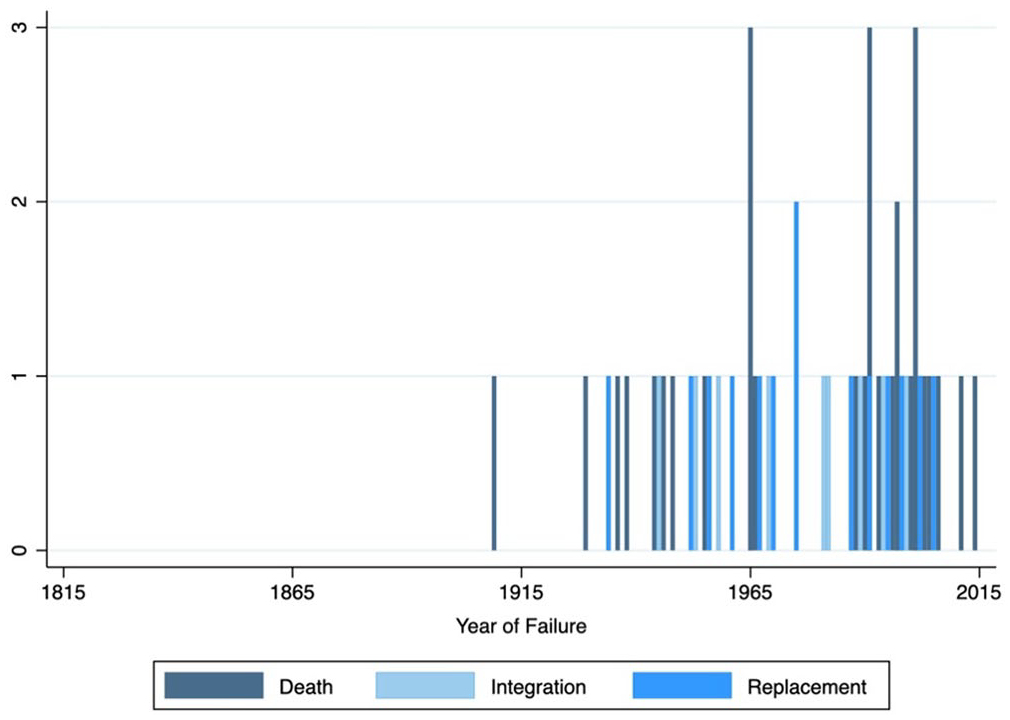
IO Failures by Type, 1815–2014.
Institutional explanations: flexibility, institutionalization, and bureaucratic size
We understand flexibility as a formal institutional design feature that allows IOs to change institutional, procedural, or substantive aspects as a reaction to external challenges. First, we include three variables that measure to what extent founding treaties provide for adaptive (escape and withdrawal clauses), interpretive (incomplete contracts), and transformative (sunset or renegotiation clauses, amendment procedures) capacity of IOs. To code these three variables, we looked at the founding treaties of IOs to see if they included provisions on withdrawals and reservations (withdrawal), the precision of their mandate (precision), and amendment procedures or sunset clauses (amendments) (see Koremenos, 2016; Pelc, 2016). A treaty is coded as precise if it clearly specifies cooperation in a specific policy area and includes policy measures to achieve this goal. Withdrawal, sunset, and amendment clauses are coded as dichotomous and receive a 0 if there are either no provisions or any of the issues are expressly barred by the treaty.
Second, we measure flexibility in decision-making in terms of the possibility for majority voting within an IO (majority voting). We code the IO as 0 if decisions by the main IO body have to be consensual, and 1 if they allow for simple, weighted, or qualified decision-making. We also build a composite aggregate that distinguishes between low (0–2) and high (3–4) flexibility IOs. For institutional flexibility, we code IOs at moment of foundation as expressed in treaties. Extensive treaty revisions such as those that we know from the EU are the exception, and most IOs do not undergo much substantive treaty change, especially with regard to the flexibility provisions we are coding. 2 Even in the EU, treaty changes did not affect the flexibility provisions or the precision of the mandate.
We understand institutionalization in terms of the investment states have made to set up the IO. Member states make a more costly investment if they equip IOs with complex institutions and strong competences, such as enforcement power and dispute resolution. Negotiating treaties, such as the ones of the EU or WTO, takes a lot of time and often requires domestic ratification. The degree of institutionalization reflects these transaction costs and therefore the investment that states have made. We use the measurement suggested by Karreth and Tir (2013), who build on Boehmer et al. (2004), to differentiate between low, medium, and highly institutionalized IOs (institutionalization). Highly institutionalized IOs, for instance, “contain mechanisms for mediation, arbitration and adjudication, and/or other means to coerce state decisions” (Boehmer et al., 2004: 18). However, we change the coding to a dichotomous measure to differentiate between low and medium-high structured IOs for two reasons. First, we expect that medium and highly institutionalized IOs should be equally less likely to be replaced compared to low-institutionalized IOs since both medium and highly structured IOs have a substantially institutionalized bureaucracy compared to low-structured IOs (Karreth and Tir, 2013: 101). Second, both medium and highly structured IOs have the same likelihood of survival, suggesting that there is little substantive difference between both categories (see Online Appendix, Figure A1).
We measure bureaucratic size in terms of the number of bureaucratic staff (staff). We use the data available for the last year the IO is in the dataset of the Yearbook of International Organizations, complemented by IO websites. However, exact numbers of staff size are not available particularly for older and dead IOs and those from the Global South, also because the Yearbook relies on self-reported data (exact staff numbers are only available for 100/150 IOs, with most missing values for IOs that experience failure events). We therefore decided to use a categorical measurement of IO bureaucratic size. We code IOs as large if they have more than 50 permanent staff members and small if they have less. 3 The cutoff point is chosen both on theoretical and empirical grounds. Theoretically, it makes sense to distinguish between IOs with small secretariats that only provide basic support functions, such as conference management, translation, legal expertise, and public relations, and IOs with larger secretariats that also have policy divisions, which contribute to the formulation and implementation of actual output. This decision is validated empirically, with staff size in our sample varying between 0 (ARCAL and ICRI) and 43,000 (EU) members, with most IOs hovering around a median of 50 staff members. Importantly, bureaucratic staff size does not necessarily correlate with the number of member states or purpose of the IO: the Regional International Organization for Plant and Animal Health (RIOPAH) was founded by only eight Latin American states but has a staff size of 300. The Wassenaar Arrangement in contrast has 42 member states but only 13 staff members. Where exact numbers are not available, we rely on descriptions of IO activities given in secondary literature such as the International Governmental Organizations: Constitutional Documents series by Peaslee and in older versions of the Yearbook. When there were no indicators in the literature that a given IO had a sizable bureaucracy to rely on, we coded the IO as small. Where no information was available at all, we coded staff as missing.
To validate the constant measurement of staff, we have checked the development of secretariat staff size across older versions of the Yearbook (all decades since 1950s). Importantly, we found a significant increase in secretariat staff over time, but mostly in the IOs that were already large (>50 staff) at foundation. As such, most IOs remain large or small over time and do not change categories (see Online Appendix, Table B). Only two IOs in our sample (Benelux Community and Central American Institute for Public Administration) exhibit a decrease in bureaucratic staff, which could be evidence that they slowly declined over time. Six IOs change categories toward large bureaucracies. Yet, only two of those exhibit a substantial increase in staff numbers far beyond the 50 staff threshold (Eastern Caribbean Development Bank, GATT). Moreover, some IOs had a brief startup phase during which they had a small secretariat but rather quickly developed afterward. In conclusion, the very large majority of IOs either have a small or a large secretariat (as defined by the 50 staff threshold) and this remains stable over their life cycle.
Alternative explanations and control variables
We control for exogenous factors that create pressures for IOs. Realists posit that IOs suffer when relations between their member states deteriorate or change. We include a variable (war) measuring if interstate militarized disputes occurred between member dyads in a given year (Maoz et al., 2019). We also control for a change in the distribution of capabilities among IO members (capabilities) to capture potential negative influences of declining hegemonic power on IO survival. We calculate the distribution of capabilities based on the COW dataset on National Material Capabilities composite index of national capability (CINC) (Singer, 1988), which measures the combined power of a state based on six indicators of military expenditure and personal, military personnel, energy consumption, iron and steel production, urban population, and total population.
Second, sociological accounts argue that potential pressures may arise from competition between IOs within a policy field. To capture this effect, we measure the overall number of IOs across policy domains (political-security, economic, social-environmental, technical-legal, general purpose) and main regional affiliations (Africa, Americas, Asia-Pacific, Europe, Global) and include the logged value to control for negative population density effects on survival (competing IOs) with the expectation that higher numbers of IOs within a field (a more crowded field) increase the risk of failure.
Third, we control for pressures on IO survival stemming from domestic politics. In line with research on domestic agencies (Adam et al., 2007), we expect that declining GDP of member states (austerity) will put pressure on all sorts of public spending, including IOs, potentially resulting in failure. We thus include the annual change in the logged total GDP of all IO members divided by the number of IO member states. GDP is taken from the updated Maddison dataset (Bolt et al., 2018). Furthermore, we control for the average democracy level of member states (democracy). We include the average Polity IV scores (Marshall et al., 2018) of all IO member states with the expectation that higher levels of democracy among IO member states should decrease the likelihood of failure.
In addition to these alternative explanations, we also include three further control variables. First, diverging preferences of member states could lead to cooperation problems and IO failure. We use the measure suggested by Bailey et al. (2017), which is based on ideal points of annual voting behavior in the United Nations General Assembly (UNGA). Preference heterogeneity (preferences) captures the standard deviation between the ideal points of all member states of an IO per year with the expectation that higher values (i.e., more diverging preferences) increase the likelihood of failure.
Second, IOs with a broader mandate should also be more flexible compared to task-specific IOs. Task-specific IOs might be more likely to outlive their purpose if the nature of the cooperation problem changes, while general-purpose IOs usually have a broader mandate that can be better adapted to changing needs and realities. Furthermore, task-specific IOs cannot rely on the stabilizing force of community that underpins general-purpose IOs (Eilstrup-Sangiovanni, 2020, 2021; Hooghe et al., 2019). We differentiate between task-specific and general-purpose IOs (purpose) based on the measurement suggested in Hooghe et al. (2019). Finally, the number of member states might be related to the investment states make in establishing an IO, since negotiations become more complex and costly with higher numbers (Eilstrup-Sangiovanni, 2020, 2021). We thus include the logged total number of IO member states per year (IO Members) to account for this potential effect.
Model specifications
To discern the determinants of IO failure, we estimate Cox (1972) proportional hazard models with robust-clustered standard errors on the IO level to account for interdependence between observations. We estimate two models to analyze the effect on death and replacement separately. Since we only have a very low number of integration events in the dataset, we cannot accurately estimate this type of failure event and do not find any robust statistical results. The unit of analysis is IO-year, since we want to estimate the effects of IO characteristics including aggregated membership data on survival.
An IO enters the risk set at foundation, and exits with the year of either death, integration, or replacement. IOs that were still alive in 2014 are right-censored, since we do not yet know if they will survive or fail in the future. Likewise, replaced, or integrated IOs are right-censored when estimating death (and vice versa for replacements as dependent variable). These IOs exit the risk set at the moment of their replacement or integration because they seize independent existence but should not be counted toward failure as death.
Cox models are well suited to estimate effects independently of the type of measurement of included variables (Cleves et al., 2016: 179–192). It is thus unproblematic that most of the institutional variables tested in our models are dichotomous and remain constant over time, while we use continuous forms of measurement and annual data for some of the control variables. However, it is important to check two underlying assumptions of Cox proportional hazard models. First, continuous variables are assumed to have a linear effect on the baseline hazard but can also have more complex (e.g. quadratic) effects. To check if the all our continuously measured variables can be included without additional changes, we test multivariable fractional polynomial models (Sauerbrei and Royston, 1999). The models confirm that for all continuous variables, inclusion without additional powers with linear effects produce the best model fit.
Second, Cox models rely on the proportional-hazard assumption to ensure nonbiased estimates. The proportionality assumption essentially denotes that the effects of covariates on the hazard of failure remain constant over time. This often does not hold in social science research since the effect of a predictor variable might change over time due for instance to learning or maturation effects (Box-Steffensmeier et al., 2003). We thus checked if the proportionality assumption holds for all variables included in the models. While our data globally conform to the proportionality assumption, it is violated for the variables majority voting and purpose for both death and replacement as failure events (see Online Appendix, Figures B1–B4). To deal with the violation, we follow Box-Steffensmeier et al. (2003) and include interactions between the natural logarithm of time with both predictor variables to model time dependency.
Results
The following section presents the results from the Cox proportional hazard models. Assessing the baseline hazard of experiencing death or replacement using the Kaplan–Meier estimator, many IOs seem to depict a relatively long life cycle and are most volatile to experience death or replacement in the first years of survival (See Figure 2). Median survival time of all IOs in our sample is at about 65 years, with the hazard of failure stabilizing somewhat at around 40 years. Before that time of maturation, IOs do face a significantly higher likelihood of dying, with many IOs being volatile to failure in the first 20–30 years of existence. This corresponds to earlier findings that different forms of governance, including IOs, suffer from “infant mortality”: that the risk of failure for IOs is particularly high in the first years (Davies, 2011: 732; see also Eilstrup-Sangiovanni, 2020; Lewis, 2002). When comparing the baseline hazard, it seems that IOs are at a higher risk of death in the first 50 years but then seem to stabilize (see Figure 3). IOs seem to face a slightly lower risk of replacement in the same 50-year timeframe, but then again face risk of being replaced at the median survival time of 80 years.
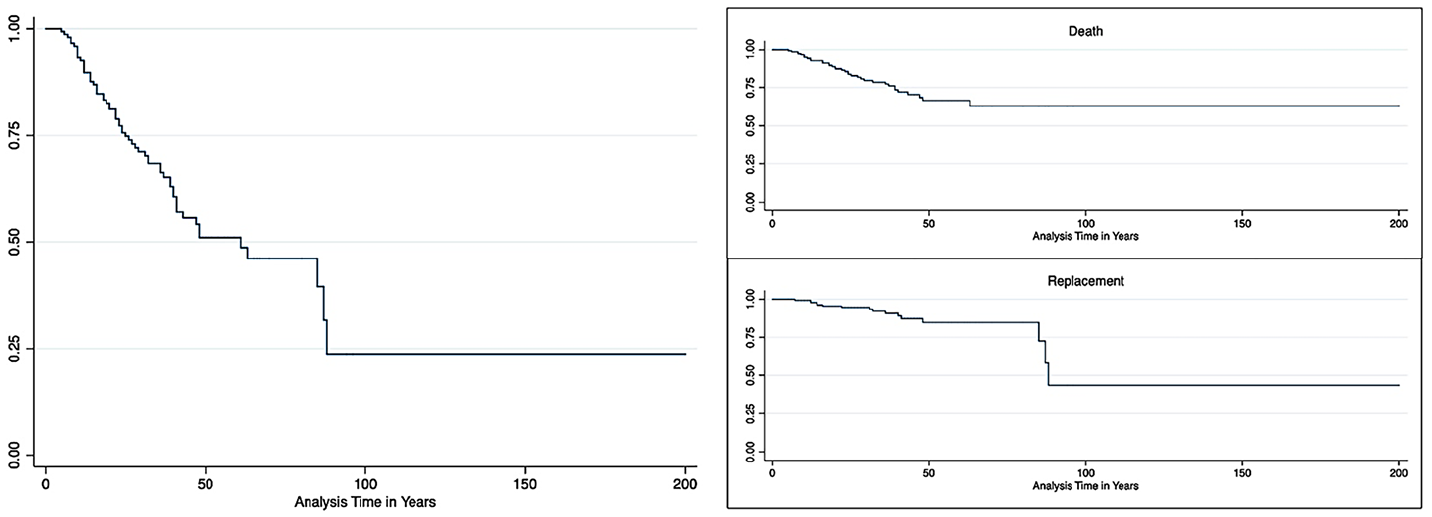
Kaplan–Meier estimates of overall survival time in the sample (left), and separate for death and replacement (right).
Cox proportional hazards model
Tables 2 and 3 summarize results of the Cox proportional hazards model for IO death and IO replacement. Columns 1 to 4 show results for flexibility variables, bureaucratic size, and institutionalization in separate estimations, columns 5 to 7 are fully saturated models. Model 5 covers the full range of time since foundation of the first IO in 1815, while models 6 and 7 are restricted to 1945–2014. We restrict the estimation to the post-1945 period because we have no values for the variable preference heterogeneity before 1945, since it is based on voting similarity in the United Nations General Assembly (UNGA). We use an alternative measure of preference heterogeneity based on regions represented in the IO to estimate model 5.
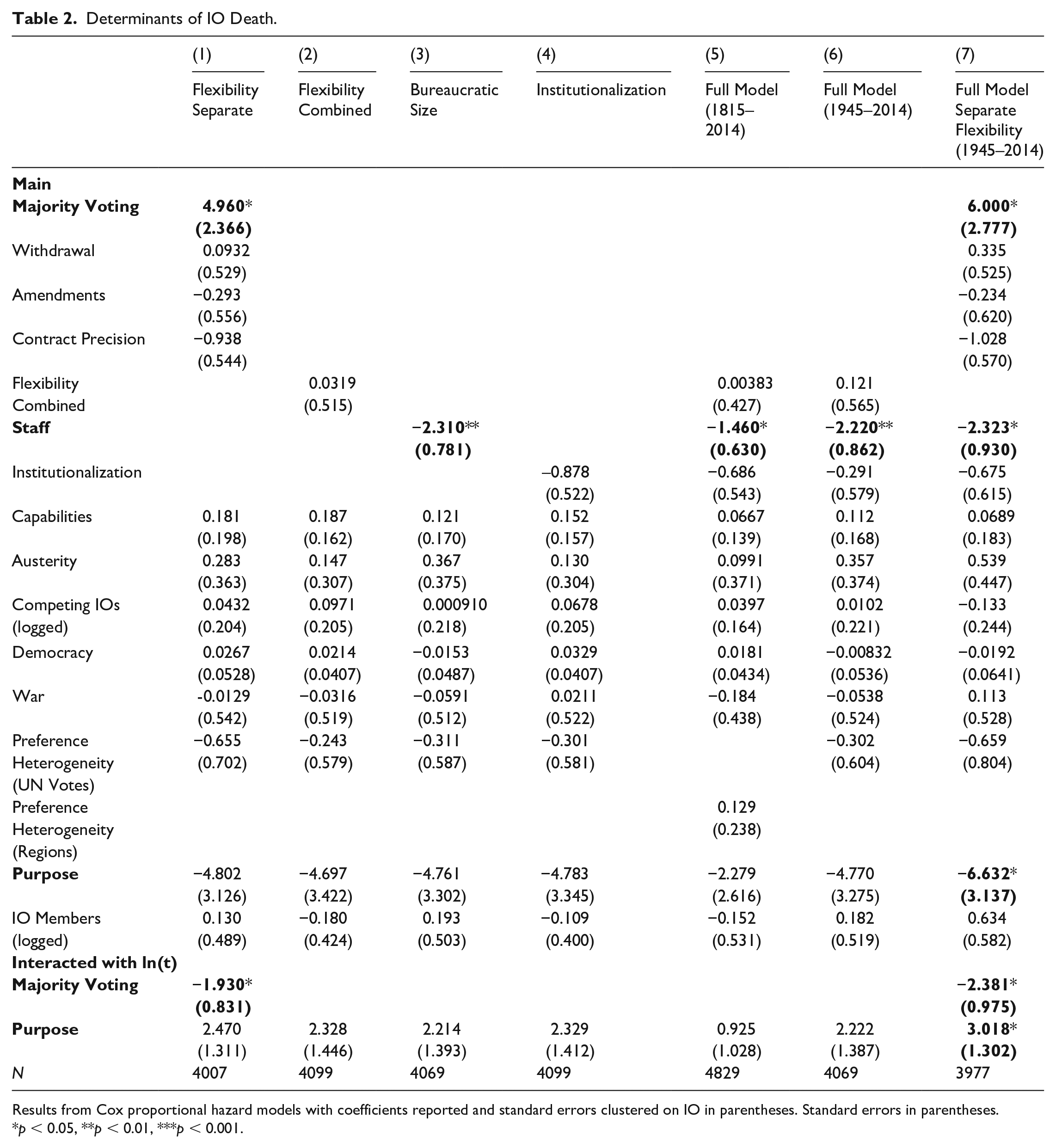
Predictor Variables of IO Failure.
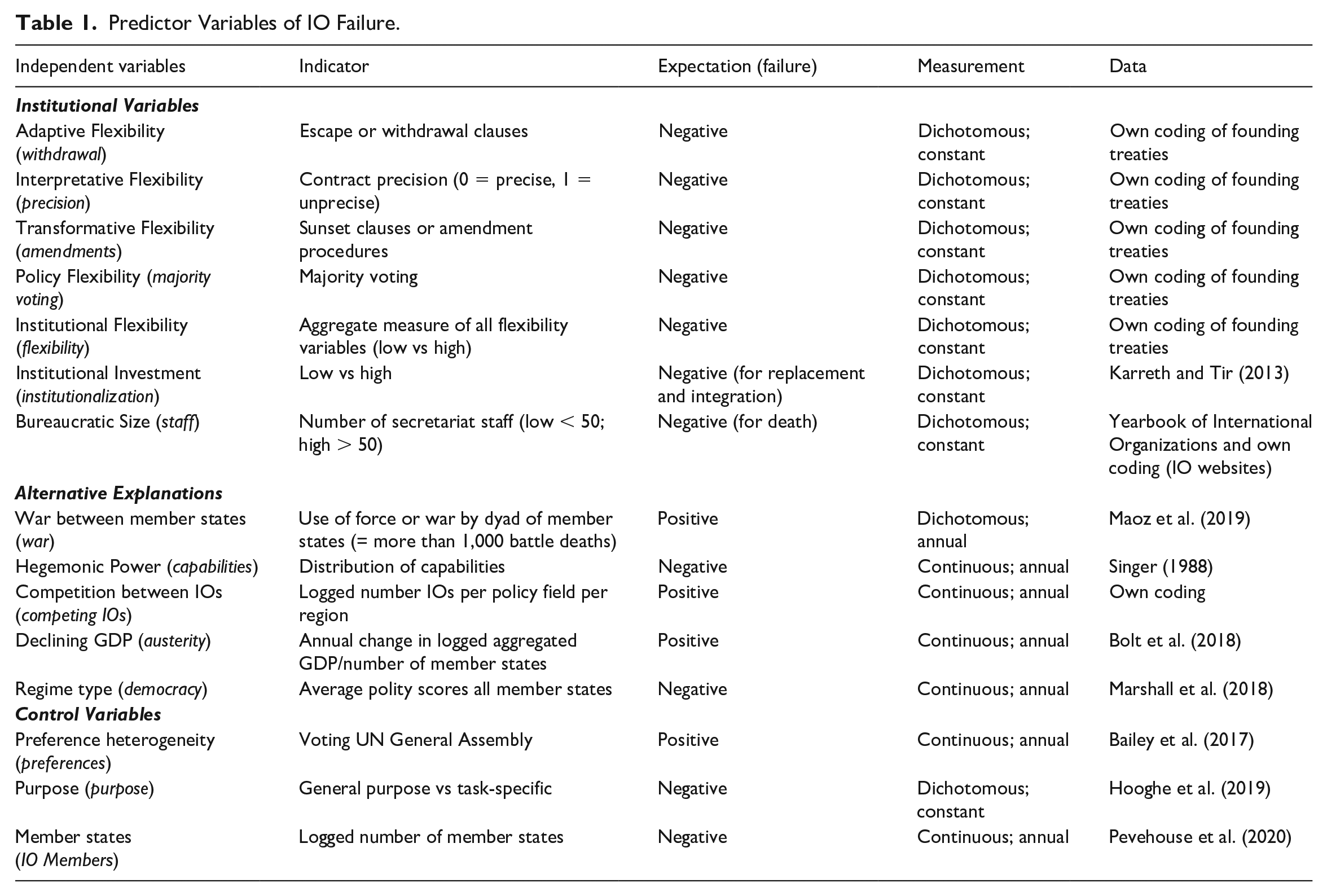
Determinants of IO Death.
Results from Cox proportional hazard models with coefficients reported and standard errors clustered on IO in parentheses. Standard errors in parentheses. *p < 0.05, **p < 0.01, ***p < 0.001.
Determinants of IO Replacement.
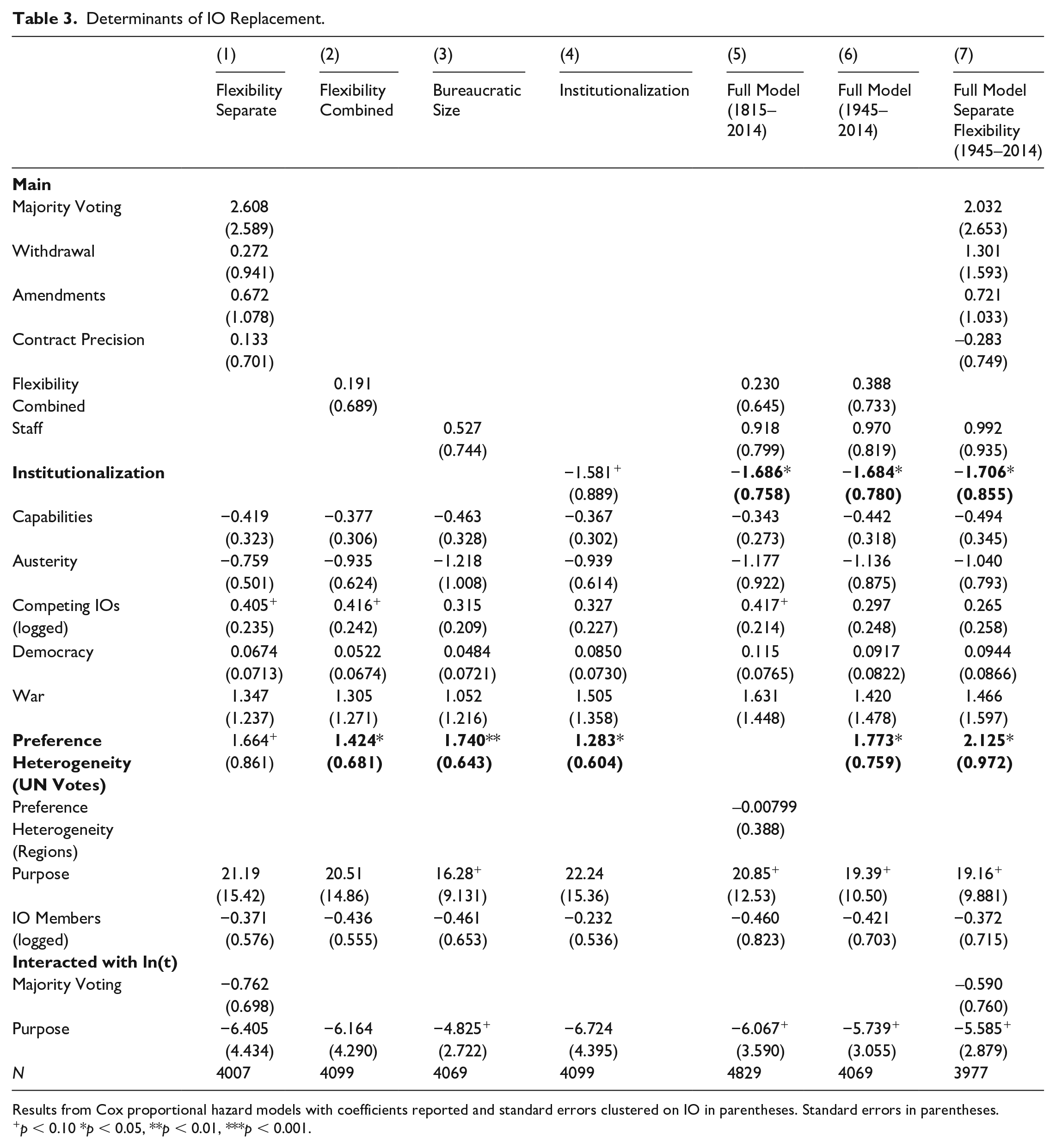
Results from Cox proportional hazard models with coefficients reported and standard errors clustered on IO in parentheses. Standard errors in parentheses. +p < 0.10 *p < 0.05, **p < 0.01, ***p < 0.001.
Table 2 provides support particularly for the importance of secretariat staff size to explain death (H2b), while institutional flexibility measures (H1) as well as external pressures are not significant. Accordingly, IOs with a large staff size have significantly decreased hazards of death over time. Figure 4 plots the survival function of the death model over time by level of staff size. The graph emphasizes the different survival probability that IOs with large secretariats face compared to those with a small staff. While IOs with small bureaucracies are highly prone to failure in the first 50 years of existence, IOs with large bureaucracies are much less affected by failure during the same time frame and remain much more stable afterward. Thus, we can accept hypothesis H2b: IOs with large bureaucracies are more likely to survive with regard to death.
In contrast, the level of institutionalization seems to be the driving force behind explaining IO replacements (H2a) (see Table 3). Those IOs with medium and high levels of institutionalization are much less likely to face replacement than low-institutionalized IOs. Thus, once member states have made higher investments into an IO, they seem to be more likely to refrain from replacing the IO. When inspecting the predicted survival curve (see Figure 5), we can corroborate this finding and confirm H2a with regard to replacement: more institutionalized IOs are less likely to be replaced.
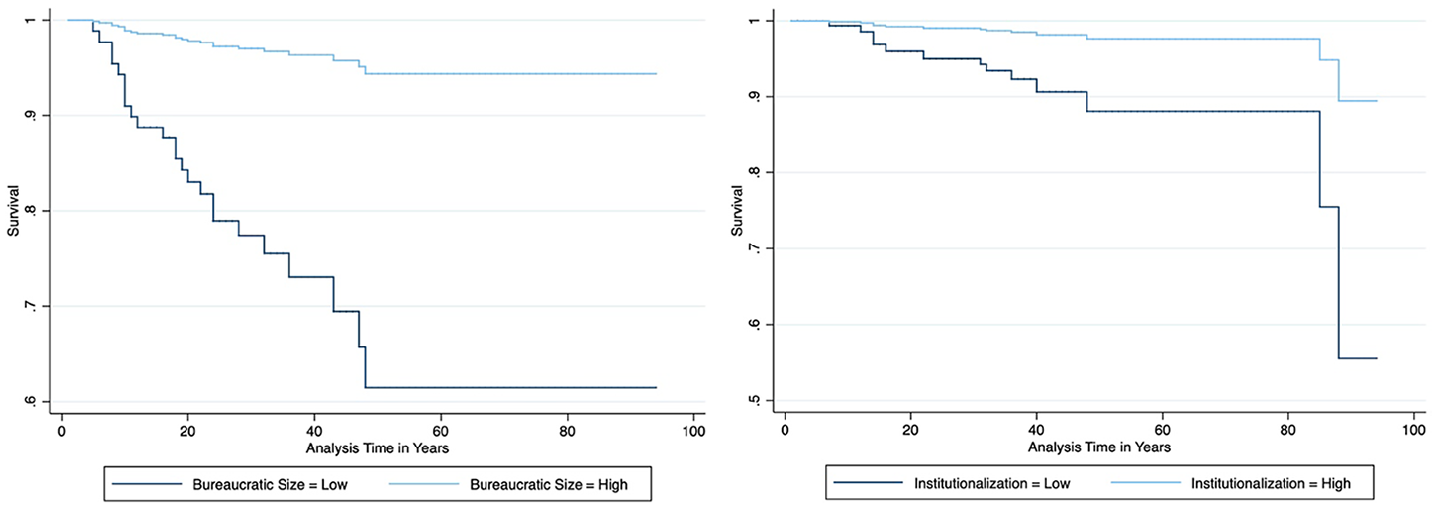
Cox proportional hazards survival functions by level of bureaucratic size (left) and level of institutionalization (right).
Finally, diverging preferences among IO member states also seem to make replacements more likely. Where preferences become more heterogenous, potentially resulting in gridlock, states might decide to reset cooperation under a new umbrella. While the alternative conceptualization of preference heterogeneity based on the number of regions represented in the IO is not significant, the effect of institutionalization does not change (Table 3: Column 5).
Contrary to our hypothesis, inbuilt institutional flexibility does not seem to be able to explain any type of IO failure. Although flexibility has been extensively theorized in the literature to be related to higher survival, none of the institutional flexibility variables achieve significance in the models, either as a composite index (Tables 2 and 3: Column 2) or if included separately (Tables 2 and 3: Column 1). However, one exception is majority voting: when interacted with time, it decreases the probability of death compared to consensual forms of decision-making as expected (Table 1). However, the effect on the hazard of survival does not stay constant over time. While IOs with majority decision-making have a very high hazard of experiencing death during the first years after foundation, the effect rapidly decreases after roughly 10 years, after which IOs with majority voting are increasingly more likely to survive compared to those with consensual decision-making (see Figure 6). Out of a total of 60 IOs with majority decision-making procedures in the sample, 12 have died, but all after a relatively short time period averaging at 15 years. This means that after a turbulent initial few years, IOs with majority voting are less likely to experience death compared to IOs with consensual voting procedures. This strong decrease also explains why the main effect of majority voting (which estimates the mean effect over the whole time period) is positive, but when interacted with time, it is negative. The effect might be explicable due to voting coalitions stabilizing after an initial phase, which would increase the possibility to form majorities and thus to avert gridlock. With the exception of the described effect of majority voting on death, we have to reject H1: more flexible IOs do not seem to be more likely to survive.
Alternative explanations of survival relating to realist, sociological, and domestic approaches do not achieve significance and cannot adequately explain IO failure in general. Hegemonic powers do not necessarily stabilize cooperation, IOs seem to be able to withstand warring member states, democratic states do not seem to be more likely to build more lasting institutions due to their ability to make more credible commitments, and austerity does not necessarily result in international consequences. Also, none of the variables achieve significance if included in a separate model without the institutional explanations (see Online Appendix, Table A). One exception is the purpose of IOs with task-specific IOs being more likely to die compared to general-purpose IOs. The risk of death constantly increases over time, making task-specific IOs more vulnerable to death with every year that passes after foundation (see Figure 7), potentially because they cannot adapt well to changing problem, may have fulfilled their mandates, or do not rely on the stabilizing force of community.
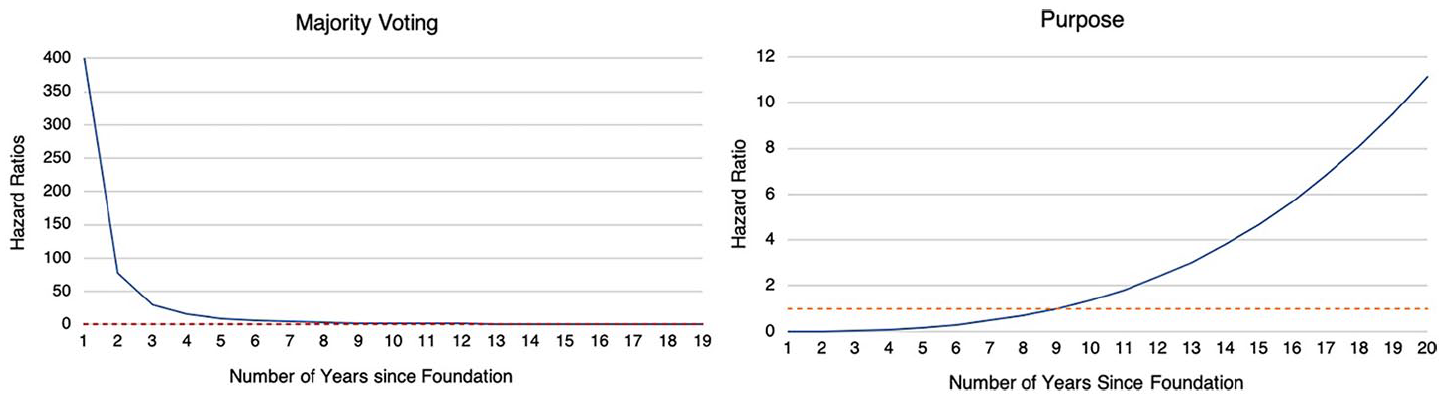
Hazard ratio of majority voting and purpose associated with IO death over time.
Discussion
Our most important finding is that IOs with a large secretariat (>50 staff members) are much less likely to die. This finding fits with Strange (1998) on elites, Gray (2018) on the vitality of IOs, and the broader research agenda on IO agency (Barnett and Finnemore, 2004). At the same time, secretariats are still often considered secondary to international politics. Particularly realists keep on describing IOs as nothing more than the sum of the member states. While the size of the secretariat can be an indicator of member states investment, our article provides strong evidence that institutions can withstand external pressure and that large IOs with more bureaucratic resources are likely here to stay.
There are several logics behind how larger IO bureaucracies prevent death. They are not always applicable to all large IOs, but neither are they mutually exclusive. It is worth discussing them with brief empirical examples based on secondary case study literature. First, member states might hesitate to dissolve an IO with a significant bureaucracy. Although NATO’s mandate was essentially fulfilled after the end of the Cold War, NATO persisted, also because key member states were not willing to abandon such an extensive institution given an uncertain future (Wallander, 2000). Second, secretariat staff may lower transaction costs and thereby improve cooperation between member states. The complexity of international negotiations often results in a situation where gains are left on the table. Beach (2004) shows, in this respect, how EU secretariat officials have been instrumental in concluding successive treaty negotiations. If secretariat officials help member states find compromise when faced with difficult external pressures, this can explain survival.
Third, large bureaucracies might be better able to help adapt an IO to changing environments and move beyond gridlock by seizing opportunities for change during crisis moments. While the IMF was largely regarded as an institution that had outlived its usefulness before the financial crisis of 2008 (Reinhart and Trebesch, 2016), IMF staff were key in reinventing the IO as manager of global capital flows and loan giver for wealthy economies (Young, 2017). Similarly, global health governance has been marred by increased fragmentation between multiple actors (Brown and Held, 2017), which has often hampered an effective response by the WHO. However, the WHO secretariat emerged as the key player during the 2002 severe acute respiratory syndrome (SARS) crisis and has since formally institutionalized its emergency powers (Kreuder-Sonnen, 2019: 197).
Finally, large bureaucracies might be better able to resist member state challenges. When the United States announced that it would stop funding the United Nations Relief and Works Agency for Palestine Refugees (UNRWA) in 2018, the agency essentially faced the potential end of its engagement in the Middle East. However, the agency was able remain functional by starting a campaign to lobby other member states to increase their funding pledges (Al-Jazeera, 2019). Similarly, Eckhard et al. (2019) show how the UNESCO bureaucracy was at the forefront of addressing the budget crisis after the United States stopped contributing in 2011. In resisting external challenges, secretariat staff are rarely alone. Larger secretariats can strategically collude with member states (Dijkstra, 2017) or use intermediaries such as NGOs and public–private partnerships (Abbott et al., 2015) to push for their governance goals and ensure continued operations.
There are thus different reasons why IOs with larger bureaucracies are less likely to die. Indeed, in our sample, only four large IOs have died: the League of Nations, the Rhineland Commission, the Council for Mutual Economic Aid (COMECON), and the Intergovernmental Bureau for Informatics (IBI). While these IOs are exceptions to our hypothesis 2b, they show in fact the actual resilience of institutions. The Rhineland Commission, the League, and COMECON only died after massive exogenous shocks, respectively the rearmament of Germany in the interbellum, the Second World War, and the end of the Cold War. It thus really requires a lot of external pressure before large IOs are put at risk. Indeed, these three major events only resulted in the death of these three IOs in our sample. The other ones lived on. While Eilstrup-Sangiovanni (2021) does find these systemic shocks relevant for IO death, we show that this is really restricted to smaller IOs without secretariat resources. The IBI is an odd one out. It was dissolved as a result of a rapidly changing policy area and competition from UNESCO (Pohle, 2013).
Beyond support for hypothesis 2b, this article notably makes a contribution in showing that relations between member states are important predictors for institutional change in the form of replacements, as preference heterogeneity is significant. As also conceptualized above, death and replacement do indeed seem to be very different failure events. Contrary to death, replacements could potentially signify that a crisis between members might also lead to potential growth for IOs. It is therefore not surprising that different variables explain replacements in line with hypothesis 2a. Where preferences diverge, member states might in fact be required to renegotiate treaties to account for previous failures and restart cooperation under a new institutional heading. For instance, when the GATT was no longer able to sufficiently regulate trade liberalization between member states in a number of controversial policy areas, it was renegotiated and replaced by the WTO with an expanded and adapted mandate.
Based on our findings, institutionalist work on flexibility needs revision. Contrary to established wisdom, we find that inbuilt institutional flexibility included in the treaties of IOs has no effect on survival with the exception of a short-lived effect of majority voting. This is surprising because flexibility clauses are included precisely to deal with uncertainty and external shocks. It is also surprising as we use the same operationalization as other scholars who do find significance for flexibility mechanisms in other international institutions such as trade agreements (e.g. Koremenos, 2016; Pelc, 2016). While flexibility may be important for (bilateral) treaties, on which most of the literature focuses, IOs as organizational entities are apparently something different. On a closer look, we also find relatively little variation in institutional flexibility, particularly with regard to withdrawal and amendment clauses. Many treaties of IOs follow the same template, particularly after the Vienna Convention of 1969. Only around 25% of IOs do not explicitly include the possibility to amend treaties or do not regulate withdrawal procedures. This might signify that IOs, compared to other international institutions, are established with a more long-term and less flexible commitment from member states.
Our findings, including on flexibility provisions, are of course limited to formal intergovernmental organizations. While there are good reasons for studying formal rules and institutions (e.g. Hooghe et al., 2019: 30–32), flexibility increasingly also comes through informal governance both within and outside IOs (e.g. Abbott and Faude, 2020; Stone, 2011; Vabulas and Snidal, 2013, 2020; Westerwinter et al., 2020). In this sense, our conceptualization of flexibility is limited. At the same time, if formal flexibility clauses have no effect on longevity, this also raises questions about all these new forms of governance. Strikingly, Vabulas and Snidal (2020) find, in this respect, that informal intergovernmental organizations are “remarkably durable,” which also implies that the flexibility in international governance needs further thought.
Conclusion
Given growing nationalist tendencies especially in many established democracies, IR theorists have heralded the end of the liberal international order. Mearsheimer (2019) even contends that it “was destined to fail from the start, as it contained the seeds of its own destruction” (p. 7). However, external pressure facing international cooperation is anything but a new phenomenon: IOs previously had to face two world wars, several extensive financial crises, power shifts to rising powers in the Global South, and normative challenges from nationalist, authoritarian, and communist regimes (e.g. Eilstrup-Sangiovanni, 2021). Given these various external pressures that we have historically witnessed, we argue that not all IOs are similarly affected and that institutional design is critical in understanding how well different IOs will be able to cope.
We hypothesized that two dimensions of IO institutional design—institutional flexibility as well as institutionalization and bureaucratic size—are particularly relevant to explain survival. While more flexible IOs should be better able to facilitate adaptation to a changing international environment, more institutionalized IOs should be less likely to face replacement or integration because of high replacement costs for member states, and IOs with larger secretariats should be better at fending off external pressures. To test these hypotheses, we compiled data on institutional flexibility, institutionalization, and bureaucratic size for 150 IOs for the timespan 1815–2014. We also recoded failure events in the COW IGO dataset v3.0 (Pevehouse et al., 2020) to separate more clearly between failure due to death, replacement, or integration.
We show that IOs with a large staff size are better able to avert death. In contrast, IOs that are less institutionalized and face diverging preferences are more likely to be replaced, potentially to restart institutional cooperation to account for previous failings. However, we do not find support that flexibility provisions such as amendment or withdrawal clauses and mandate precision can explain IO failure. Although these provisions are often included into treaties to facilitate longevity, they are not the key for survival. Finally, systemic international relations and domestic explanations also do not carry much weight. IOs do not seem to suffer fatally if member states are faced by austerity and might attempt to cut IO budgets. IOs also do not profit from a more homogenously democratic membership that should be better able to credibly commit to cooperation in the long term.
These findings highlight that we should think about decline and death of IOs in more nuanced ways.
Understanding IO failures presents valuable conclusions for the literature on institutional change over time, as well as the current debates about the inability of IOs to effectively adapt to fundamental changes in international politics. While the blowback for IOs from populist election victories in the United States and Europe is still under way, this article offers a more optimistic view on the future of the liberal international order. Large and highly institutionalized IOs such as the UN, the EU, NATO, or the WTO will be difficult to disband with secretariat staff fighting hard for their adaptation and survival. The mere survival of IOs obviously does not tell us much about their quality and effectiveness in solving the world’s problems, yet it is also worth to be optimistic in this respect. Many large IOs are bastions of multilateralism. They are based on transparency and reciprocity (Ruggie, 1992), make policy informed by expertise, and generally promote liberal values such as democratization. Further research should analyze what the likely survival of large IOs exactly implies for the liberal international order, with a focus on the substance of IO output.
Supplemental Material
Online_Appendix – Supplemental material for Institutional design for a post-liberal order: why some international organizations live longer than others
Supplemental material, Online_Appendix for Institutional design for a post-liberal order: why some international organizations live longer than others by Maria Josepha Debre and Hylke Dijkstra in European Journal of International Relations
Research Data
EIJR_Replicationdata – Research Data for Institutional design for a post-liberal order: why some international organizations live longer than others
Research Data, EIJR_Replicationdata for Institutional design for a post-liberal order: why some international organizations live longer than others by Maria Josepha Debre and Hylke Dijkstra in European Journal of International Relations
Research Data
EJIR_Do-File – Research Data for Institutional design for a post-liberal order: why some international organizations live longer than others
Research Data, EJIR_Do-File for Institutional design for a post-liberal order: why some international organizations live longer than others by Maria Josepha Debre and Hylke Dijkstra in European Journal of International Relations
Footnotes
Acknowledgements
The authors are thankful for the constructive comments of two anonymous peer reviewers and the editorial team at EJIR. They are also grateful for valuable comments on previous versions of this article by Tobias Lenz, Mette Eilstrup-Sangiovanni, Thomas Dörfler, Yoram Haftel, Thomas Sommerer, Marie Labussière and participants of the ERC Workshop “Decline and Death of International Organisations” in Brussels (2020), the European Consortium for Political Research General Conference (2019), and the ISA Venture Research Workshop “International Organization Dissolution” in Zurich (2019).
Funding
The author(s) disclosed receipt of the following financial support for the research, authorship, and/or publication of this article: This article is part of a project that has received funding from the European Research Council (ERC) under the European Union’s Horizon 2020 research and innovation program (grant agreement No 802568).

Supplemental material
Supplemental material for this article is available online.
Notes
Author Biographies
References
Supplementary Material
Please find the following supplemental material available below.
For Open Access articles published under a Creative Commons License, all supplemental material carries the same license as the article it is associated with.
For non-Open Access articles published, all supplemental material carries a non-exclusive license, and permission requests for re-use of supplemental material or any part of supplemental material shall be sent directly to the copyright owner as specified in the copyright notice associated with the article.
