




Abstract
This article stands at the intersection between the relational turn in International Relations (IR) and the quantum turn in the social sciences (and more recently in IR as well). The relational turn draws much-needed attention to the centrality of relations in global politics, yet its imprecise conceptualization of whole-part relations casts shadow over its relational ontological foundation. The quantum turn, meanwhile, challenges the observed–observer dichotomy as well as the classical views about causality, determinacy, and measurement. Yet, despite their common stance against the Newtonian ontology, the relational and quantum turns have largely neglected each other at least in the IR context. This article aims to bridge this gap by introducing a quantum holographic approach to relationality. Drawing on theoretical physicist David Bohm’s work on quantum theory and his key concepts about wholeness and the implicate order, the article argues that the world is being holographically (trans)formed: its parts are not only parts of the whole, but also enfold the whole, like in a hologram. This quantum holographic ontology contributes to both a clearer differentiation between internal/implicate relations and external/explicate relations and a renewed emphasis on wholeness and whole-part duality. In doing so, it not only provides new conceptual tools to rethink IR as holographic relations which involve the dynamic processes and mechanisms of enfoldment and unfoldment, but also has important policy and ethical implications for the conduct of “foreign” relations and for transforming the way we think about identity, survival, relationship, and responsibility.
Keywords
You are not a drop in the ocean, you are the entire ocean in a drop.
Introduction
Despite its name, International Relations (IR) has long been predicated on a Newtonian substantialist ontology of things, rather than an ontology of relations, which are “the important missing dimension in most theories of IR” (Wight, 2006: 296). In recent years, IR’s “deep Newtonian slumber” (Ruggie, 1998: 194) has been disturbed by a “relational turn” (Bousquet and Curtis, 2011; Jackson and Nexon, 1999; Kavalski, 2018; McClurg and Young, 2011; Neumann, 2013; Nexon, 2010; Nordin et al., 2019; Nordin and Smith, 2018; Qin, 2018; Shih, 2016; Trownsell et al., 2019). Challenging two versions of Newtonian substantialism: atomism (individualism) and structuralism (structuralist-substantialism) (Zanotti, 2017; see also Wendt, 1999: 26), the gist of this turn is that the fundamental reality is not independent things, but relations. Focusing on “a relation between entities” (Jackson and Nexon, 2019: 584–585, emphases in original), the relational scholarship also departs from the agent-structure and level-of-analysis debates.
Yet, despite this significant and welcome development, IR’s relational turn suffers several drawbacks. First, it lacks a clear conception of relations/relationality beyond often tautological definitions. Second, insisting on the temporal priority of relations over entities, much of the literature sidesteps an implicit “chicken-egg” dilemma between entities and relations. Further and more importantly, the relational turn has not yet seriously engaged with another important development in the social sciences in general and IR in particular, namely, the “quantum turn” (Keeley, 2007; Wendt, 2015), or according to Der Derian and Wendt (2020), a permanent quantum revolution. This neglect is both surprising and lamentable. Both turns share an anti-Newtonian stand, and as a “momentous shift in metaphysical outlook” (Seager, 2018: 5), quantum mechanics espouses a doctrine of relational holism “in an all pervasive way” (Teller, 1986: 71), which would make quantum theory a valuable source in IR’s relational quest. To be fair, at least in the IR context the neglect seems mutual. With few exceptions and some general references to relational ontology (e.g. Wendt, 2015; Fierke, 2017; Zanotti, 2017), the burgeoning quantum turn literature in IR has not focused extensively on relations either. Wendt’s pioneering work on quantum theory, for example, is driven primarily by the need to “reconcile consciousness and meaning with the material world” (Wendt, 2006: 218), though he acknowledges that quantum mechanics’ holistic and relational contribution is “a thematic that needs to be developed down the road” (Wendt, 2015: 35).
Therefore, the gap between these two turns in IR calls for an explicit quantum relational perspective. This is what this article sets out to do, by offering, more specifically, a quantum holographic approach. The basic notion of holography is that an “object” is “part of the whole while it simultaneously contains the whole” (Van Daele, 2018: 651, emphases added). 1 In quantum theory, the holographic principle promises a solution to the well-known tensions between atomic-level quantum physics and Albert Einstein’s planet-level theory of gravity by suggesting that the universe is a holographic projection: what appears on the surface (event horizon) of a black hole is encoded information about what is inside, “just as a two-dimensional hologram encodes a three-dimensional image” (Merali, 2013: 517).
So far still largely alien to this field (few exceptions include Pan, 2018; Wendt, 2015), quantum holography adds value to IR in several important ways. First, as a specific form of relationality, quantum holography helps mitigate the existing definitional vagueness about relations. Second, instead of asserting relations’ priority over entities, quantum holography accentuates the ontological duality of relations and things. Avoiding the ontological chicken-egg dilemma over which comes first, the duality proposition suggests that relations do not exist either before or after things; rather, relations are from the outset implicated or embodied in things. Relations-in-things are implicate relations that can be better understood through quantum mechanics, whereas things-in-relations (and relations-between-things) represent more classical understandings of relations as something external, compositional, and derivative. Third, quantum holography provides a deeper and more sophisticated understanding of relations, including whole-part relations and internal relations, which have not been adequately theorized in IR. Furthermore, its differentiation between explicate and implicate relations enables us to incorporate mainstream IR’s Newtonian ontology as a limiting case in a broader quantum relational ontology, rather than simply brush it aside.
In delving into some thorny ontological issues, this article will likely raise more questions than answers. Given the substantialist bias in our everyday language, which is better at describing things than relations, 2 articulating “a clear expression of a world view contrary to the one implied in the primary structure of a language” (Bohm, 1980: 59) will be difficult. For these reasons, this enterprise can only be a small first step toward shifting the entrenched Newtonian ontology of things. Keeping these caveats in mind, the article will unfold in four parts. Firstly, beginning with a brief survey of IR’s relationalism literature and its conceptual weaknesses, it makes a case for adding a quantum holographic twist to the relational turn. The second section then discusses the ideas of quantum holography from a “realist” approach (namely, treating holographic relationality as a true state of reality) as opposed to a geo-cultural or analogical approach. Drawing primarily from the work of renowned theoretical physicist David Bohm, it introduces and discusses a series of his important concepts about holographic relationality, notably wholeness, the implicate order, the explicate order, enfoldment, unfoldment, and holomovement. Thirdly, I explore the implications of a quantum holographic ontology for IR. Due to its largely conceptual and metaphysical focus, the article will not apply quantum holography to an in-depth empirical study; instead, it illustrates the point by examining some general but nonetheless pressing issues in IR, such as the importance of wholeness in IR, the holographic nature of the state, and the implications for understanding and dealing with difference and conflict. In the concluding section, the article sums up its key arguments and briefly considers some ethical implications of quantum holographic relationalism and future research directions.
The relational turn in IR: a case for quantum holography
The relational turn postulates that “relationality,” as opposed to substance and essence, is the fundamental reality of the world. Beyond this general consensus, the relational scholarship is not homogenous. As well as marked by various geo-cultural focuses and different emphases on position versus process (Fierke, 2017; Jackson and Nexon, 2019; Nordin et al., 2019; Qin, 2018; Reddekop, 2014; Shih, 2016; Trownsell et al., 2019), this literature comes with diverse disciplinary and methodological flavors such as relational sociology (Jackson and Nexon, 1999; Pratt, 2017), practice theory (Jackson and Nexon, 2019; McCourt, 2016), critical realism (Patomäki, 2002), social network analysis (Hafner-Burton et al., 2009; McClurg and Young, 2011; Zhang, 2015), systems theory (Albert et al., 2010), complexity theory (Bousquet and Curtis, 2011; Nexon, 2010), and assemblage thinking (Acuto and Curtis, 2014).
Inspired by this Special Issue’s focus on creating more interdisciplinary openings for IR, this article engages with this multidisciplinary literature from yet another disciplinary perspective, namely, quantum holography. Introducing this perspective is justified not only because of its apparent disciplinary novelty, but also because of its promise of addressing some conceptual (and by implication, ontological) weaknesses in the existing relational literature. To begin with, if it seems inexplicable why IR does not yet have a well-established ontology of relations, it is also curious that thus far the relational turn still lacks a clear definition of what relations and relationality mean (Qin, 2018: 110). Relational scholars often describe relations as “interactions,” “connections,” “relatedness,” “ties,” “links,” “networks,” “interdependence,” and “entanglement.” Such seemingly commonsensical usage, however, is ultimately tautological and does not take us very far.
Also, the term relation (or entanglement) is sometimes defined by negation, or by what it is not. For example: To be entangled is not simply to be intertwined with another, as in the joining of separate entities, but to lack an independent, self-contained existence. Existence is not an individual affair. Individual do not preexist their interactions. . .. (Barad, 2007: ix, emphases added).
While definition often “begins in negation” (Norton, 1988: 3), negation is no substitute for definition per se. By focusing on what relationality is not, it says little about what it positively is. Worse still, by repeatedly mentioning substantialist things as its (albeit negative) reference points, it may unwittingly reinforce the Newtonian ontology it seeks to challenge. For example, assemblage thinking, actor-network theory (ANT), and even complexity theory assume assemblage components to be “initially disparate elements” (Cudworth and Hobden, 2013: 432–433; Donnelly, 2019; Müller and Schurr, 2016: 217), thus implying a dichotomy of zones of substance and zones of relations (Jackson and Nexon, 1999: 292; Zhang, 2015: 5). In this context, some relational approaches (e.g. network analysis) treat relationality mostly as a useful analytical (as opposed to ontological) category (Donnelly, 2019: 919), merely to “complement[s] existing structural approaches. . . that focus on actor attributes and static equilibria” (Hafner-Burton et al., 2009: 560).
Another issue is a common assertion of relations’ temporal priority over individual units or structures (e.g. relations as “prior to either individual agents or aggregate structures,” Nexon, 2010: 100; “relations before states,” Jackson and Nexon, 1999). While this stance may serve as a useful antidote to the longstanding ontological bias toward things over relations, appeal to relations’ chronological precedence may lead to an ontological dilemma akin to the chicken-egg problem. That is, when relations are defined as “social ties, communication, exchange, and practice” “between” actors (Nexon, 2010: 101), it implies that actors already predate relations. To my knowledge, the relational literature has not yet come up with a satisfactory solution to this conundrum.
These conceptual problems in the relational turn not only limit the analytical utility of this otherwise promising theoretical turn but also potentially weaken its ontological robustness. In this context, I argue that it is now necessary to put the relational turn in dialogue with the quantum turn in general and its holographic perspective in particular. Quantum holography argues that actors are not just nodes or relata tied together by exogenous relations and networks. Rather, they are relations as well as relata and actors. By envisioning parts (or actors) as always already comprising the whole (and the whole’s various parts and their relations), quantum holography treats relations as the very condition for the being of “things” or “actors,” thus ontologically dissolving the stubborn things/relations binary that has dogged some existing relational analysis. Different from the classical conceptualization of relations as mechanistic mixture, assemblage, or hybridity between parts, quantum holography underscores the relational enfolding of wholes into their constituent parts/actors. Such whole-part duality reminds us of the quantum effect of interference pattern or superposition, with the wave-particle duality of light in quantum mechanics being its best example (Barad, 2007: 85, 265, 269). 3
As illustrated in Figure 1, the Newtonian ontology sees individual entities as the basic units and their relations merely as an external function/effect of their subsequent interaction. In comparison, the existing relational literature affords a more prominent role for relations and networks. Nevertheless, relations often continue to be conceptualized as something external to or between solid actors and entities. 4 Quantum holography, by contrast, sees relations as part and parcel of what entities are and may become. That is, relations are already implicated in entities (hence implicate or internal relations) even as entities are also externally linked by (explicate) relations. As shown in the illustration about holographic relationality, inside an entity exist traces of its large whole and its overall relations, just as inside a seed exist memories and traces of “interactions within the web of life” (Shiva, 2014: 438). Thus understood, an entity is always already relational and its relations are inherent and holographic. It cannot be disentangled or disembedded from the whole or other “entities” in the whole, even if it may appear to stand “alone.”
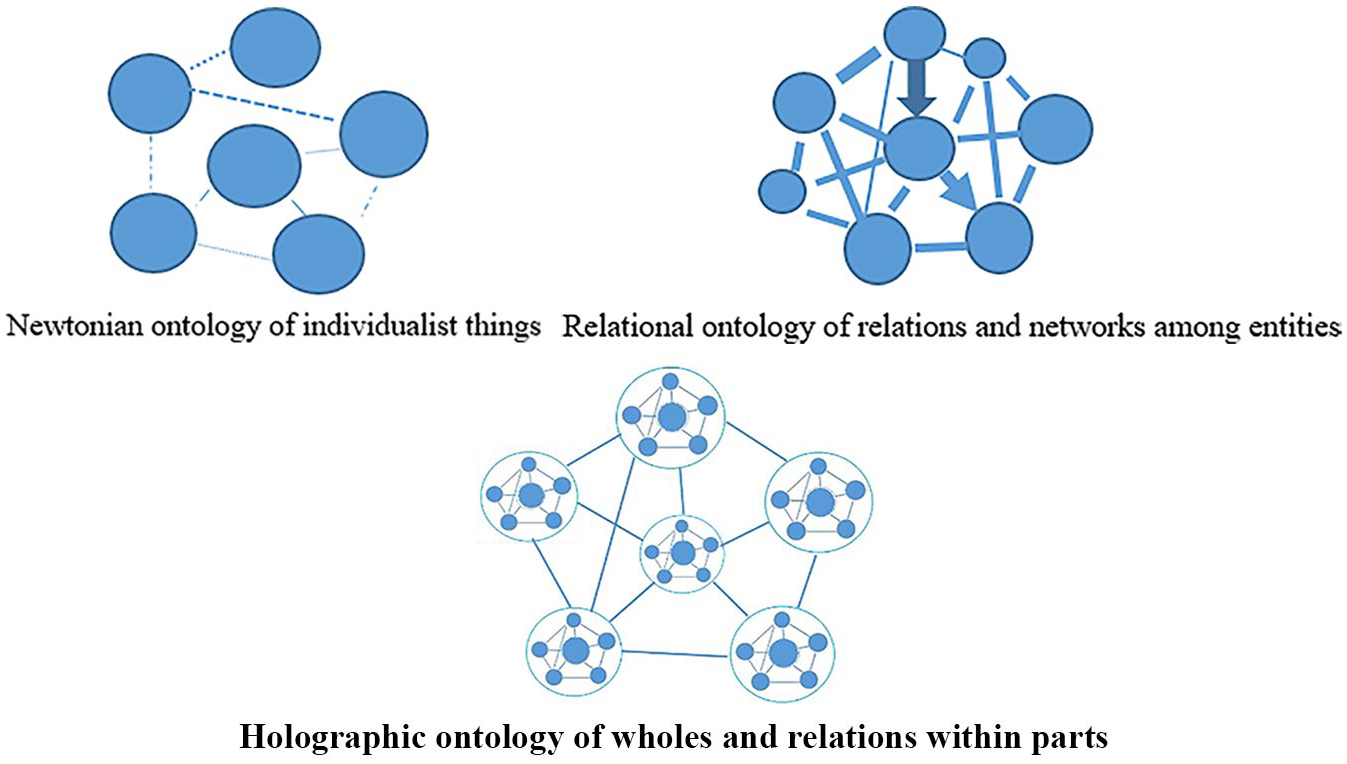
Visualizing three different ontologies. 5
Quantum holography as a post-Newtonian relational ontology
Quantum holography: a “realist” approach
As outlined above, quantum holography speaks directly to one of the basic tensions in metaphysics, namely, the relationship between the parts and the whole (Capra and Luisi, 2014: 4). In this sense, it is a particular form of holism. Conventional holism (especially what anthropologists refer to as totalitarian holism) holds that the whole has emergent properties and is greater than the sum of its parts (Pettit, 1998; Willerslev and Pedersen, 2010). 6 The implication is that as components of the whole, parts are fundamentally local and non-holistic (Seevinck, 2004). Quantum entanglement challenges this supervenience approach to holism, arguing that parts or related things within a whole, by virtue of their entanglement, necessarily possess relational, non-local properties rather than intrinsic properties of their own (Esfeld, 2004; Teller, 1986). That is, parts are more than just “parts” in the conventional sense of the word. Parts not only exist in the wholes, but each part also “contains” its wholes. Just like a hologram, wholes are present in their parts, and each part is a smaller (though not identical) version of its wholes. Indeed, the very being of parts is embodied in and ontologically defined by their holographic relations with their wholes. In this sense, understanding parts necessitates understanding the whole of which they are part (Zinkin, 1987: 8).
Thus, quantum relationalism is a more thoroughgoing form of holism. It emphasizes the fundamental non-separability of whole-part and non-locality of parts and rejects their apparent particularism (Barad, 2007: 333). More than simply related to each other at arm’s length (in terms of external relations, namely conventionally observable external links such as family ties, social networks, trade agreements, and alliances [see, for example, Sazak, 2020, in this Issue]), parts in quantum holography are inherently entangled and mutually implicated, even in the absence of formal or explicate connections. At this juncture, it is worth making a brief detour to the philosophical debate on internal and external relations in the early 20th century (see Moore, 1919). While the monist, idealist claim that all relations are internal implies holism and interconnectedness, it also gestures toward a kind of causal essentialism by suggesting that relations are internal (or intrinsic) to their bearers insofar as without those relations their relevant properties (be they natural, social, or logical) would not exist or descriptions of those properties would not be true (Schaffer, 2010). This static, essentialist conception of internal relations is different from internal relations of a holographic nature. A quick example might help explain the difference. If I use a pencil to write numbers 1, 2, 4 on a piece of paper, there exist different layers of relationship between these numbers. For a start, the fact that 2 happens to be below 4 can be seen as an external relationship as this “random” relationship does not affect the mathematical property of 4 qua 4 (or 2 qua 2 for that matter). On the other hand, 4 = 2 × 2 (or 2 = 4 ÷ 2) represents an internal relationship between the numbers 2 and 4. So in this sense, 1, 2, 4 are all internally and logically linked in some way. But holographic internal relations go deeper still. From a holographic perspective, the internal relations of these handwritten numbers refer to the fact that they are all written on more or less the same piece of paper by more or less the same person using more or less the same pencil. These constitute their internal relations with their wholes (person, paper, and pencil as well as other “things” that further make up these relational entities). Those holographic relations, while seemingly trivial and unremarkable, are constitutive of the relational being of those numbers. Thus, although on surface 1, 2, and 4 appear to be discrete and different numbers, such “internal relations” make them inherently entangled in an implicate way that is often unseen and underappreciated. 7
Here, the important question is whether the world indeed exists holographically. One can explore such knowledge by turning to different cultural or geo-linguistic traditions for relevant insights, as many have done in the “Global IR” and relational turn genres (Acharya, 2011; Ling and Chen, 2018; Nordin et al., 2019; Qin, 2018). Indeed, the idea of holographicity (if not necessarily the concept per se) can be found in many spiritual traditions and cosmological thoughts (Di Biase, 2009: 215; Pan, 2018: 346). But as already noted, this article tries to address the question by looking at quantum mechanics and particularly holography theory.
8
This of course begs the next question of whether quantum knowledge about atomic and subatomic levels of reality can be extrapolated to larger-scale reality (Wendt, 2010: 282). Although there is a debate on this complex issue, the short answer is yes: it has long been recognized that Newtonian classical physics is a limiting case of quantum mechanics (Born, 1927), meaning that quantum mechanics is more fundamental and more encompassing in its scope: quantum mechanics is not a theory that applies only to small objects; rather, quantum mechanics is thought to be the correct theory of nature that applies at all scales. As far as we know, the universe is not broken up into two separate domains (i.e., the microscopic and the macroscopic) identified with different length scales with different sets of physical laws for each. (Barad, 2007: 85)
Sharing the same conviction, Wendt has sought to unify physical and social ontology through quantum physics. In doing so, he chooses a “realist” approach which believes “quantum theory is telling us something about reality,” as opposed to an “instrumentalist” approach that is “agnostic about reality” (Wendt, 2015: 71–72). Wendt’s (2015: 3) strong “realist” approach is controversial. For some critics, an analogical approach would have been safer and more appropriate (Arfi, 2018; Donald, 2018; Kessler, 2018; Michel, 2018). Such criticisms have merits, especially given that physicists have not agreed on an authoritative or “realist” way to interpret quantum theory (Wendt, 2015: 70). For others, the differences in scale and time between the micro- and macro-worlds call into question the application of quantum theory to the classical domain with which social scientists are mostly concerned (Waldner, 2017).
Despite these objections, there are still good reasons to favor a “realist” approach over an instrumentalist or analogical one, particularly in relation to quantum holography and its relevance to IR. The first reason is straightforward: classical physics is not realistic enough, a shortcoming which quantum theory can remedy (Barad, 2007: 31; Wendt, 2010: 282). Second, the “scale” and “decoherence” problem raised by Waldner (2017) relates primarily to the quantum effect of the uncertainty principle and its epistemological implications for knowledge and measurement. Quantum holography, on the other hand, is arguably less susceptible to the “scale-up” problem. In fact, the larger the scale of an object of study (e.g. IR) is, the more obvious it is in a holographic state. Of course, there is a possibility that international relations are not really holographic in nature, which would render the “realist” approach problematic; but then the burden of proof lies equally with skeptics as to why they are not holographic. Finally, opting for an instrumentalist or analogical thought experiment can present problems of its own. It would not be taken seriously if the world is not holographic; or it could be suboptimal in comparison with the “realist” approach if the world is a hologram. 9 So on balance, a “realist” approach is a “risk” worth taking here. 10
Wholeness and the implicate order: Bohm’s quantum holographic ontology
Recent years have witnessed a growing interest among social scientists and IR scholars in quantum theory (Becker, 1991; Der Derian and Wendt, 2020; Elbe and Buckland-Merrett, 2019; Haven and Khrennikov, 2013; Montgomery, 2016; O’Brien, 2016; Overman, 1996; Tesař, 2015; Zanotti, 2017). 11 Much of the debate, however, has been on the implications of non-locality, uncertainty/indeterminacy, consciousness, entanglement, and the measurement problem for social sciences, whereas the quantum effect of holography has received far less attention. Wendt is a notable exception here. 12 He argues that individuals are holographically entangled (through language) in the state which is a hologram (Wendt, 2015: 271), and that world politics as we know it is “local realizations of broader structures of social potentiality” (Wendt, 2010: 293). These holographic insights, as he rightly notes, have “far reaching implications for how we should understand international politics” (Wendt, 2010: 290). However, concerned primarily with consciousness, the mind-body problem and a unified social and physical ontology (Wendt, 2015: 29), Wendt’s book does not extensively explore holographic relationality.
Picking up where Wendt has left off, I now draw on David Bohm’s relevant work, particularly his book Wholeness and the Implicate Order (1980). Described as one of the most original theoretical physicists in the 20th century, Bohm made important contributions to quantum theory and neuropsychology, among other fields (Peat, 1997). But it is his mathematical and physical theory of implicate and explicate order that is most relevant here. In this theory, which is largely overlooked in Wendt’s otherwise thought-provoking treatment of holography, 13 Bohm developed a number of important concepts, such as wholeness, implicate order, explicate order, enfoldment, unfoldment, and holomovement.
Contrary to the individualist and atomistic starting point in the Newtonian ontology, Bohm argues that both relativity and quantum theories take “unbroken wholeness of the universe” as the “actual state of affairs” (1980: xvii). This state of affairs is the implicate order, where “everything is enfolded into everything” (1980: 225). The Latin root of the word “implicate” means “to enfold” or “to fold inward” (1980: 225). While Bohm made no specific mention of bootstrap theory, this quantum field theory describes the subatomic particles of hadrons, of which a proton is the most famous example, in remarkably similar terms: “every particle consists of all other particles” (Capra, 1999: 295). If “each particle helps to generate other particles, which in turn generate it,” then it makes no sense to suggest that these particles are either elementary or independent (Capra, 1999: 296). Following the rules of quantum theory and relativity theory, the hadron bootstrap is hard to be visualized, as the phenomenon that “a single particle can contain all other particles and at the same time be part of each of them” is “inconceivable in ordinary space and time” (Capra, 1999: 297).
The apparent inconceivability of such holographic entanglement is to be expected as it occurs in the implicate order, which belongs to a “higher-dimension” reality of the unbroken whole (Bohm, 1980: 239). The unbroken whole is constantly enfolded into lower, commonly perceived three- or two-dimensional reality, which is displayed, or unfolded, as the “explicate order,” something we can normally observe and measure as apparently separate and locally realized objects (recall the earlier example about numbers written on a “two-dimensional” piece of paper). 14 Indeed, attention, observation, and measurement play an important part in the process of unfoldment by helping make a superposition (or holographic entanglement) collapse into explicate relations of classical mixtures and interactions (Barad, 2007: 280; see also Wendt, 2015: 217). Bohm (1980: 226) describes “the totality of movement of enfoldment and unfoldment” as holomovement, a dynamic and immeasurable process which carries the implicate order of holographic relationality. As “the primary reality” (Zinkin, 1987: 6), holomovement takes place in the movement of the electromagnetic field and the fields of the electronic, protonic, sound waves, and so forth, and “these fields obey quantum-mechanical laws” (Bohm, 1980: 225).
Bohm invokes the analogy of hologram to explain how the implicate order resembles a hologram where “each part contains information about the whole object” (Bohm, 1980: 224, emphasis in original). A hologram is produced by a photographic technique called holography. Under this technique, coherent light emitted from a laser passes through a beam-splitter (this can be a half-silvered mirror). Part of the light (or the “reference beam”) that passes through the splitter goes (either directly or via a mirror) onto a photographic plate. Another part of the original laser beam, also known as the “object beam,” reaches and illuminates an object and then hits the plate to interfere with the “reference beam.” When again illuminated by a third laser light (“reconstruction beam”), the interference pattern (superposition) on the photographic plate can reveal a three-dimensional image of the original object. Importantly, even when only a small area of the plate is illuminated, we can still see the whole object, albeit with fuzzier detail (Bohm, 1980: 183–184; Wendt, 2015: 228; Zinkin, 1987: 3). This holographic characteristic differs from that of conventional through-the-lens photography. What is captured by a lens is the explicate, “mechanistic order” of apparently discrete and relatively stable elements (Bohm, 1980: 226). What a hologram reveals, by contrast, is the implicate order of holographic relations. Bohm is quick to add that the hologram analogy can only illustrate a static order, while in the actual order, “Not only is everything changing, but all is flux. That is to say, what is is the process of becoming itself” (Bohm, 1980: 61, emphases in original).
To illustrate the constant holomovement of enfolding and unfolding, Bohm turns to an ink-in-fluid analogy (1980: 234). Consider a device made up of a transparent container full of a very viscous fluid, and a mechanical rotator that can stir the fluid very slowly and very thoroughly. When an insoluble droplet of ink is put in the fluid which is then stirred by the rotator, the ink droplet will be transformed into a thread which then spreads to the whole fluid. This process can be seen as the enfolding of both the ink droplet and the fluid in every part of the container, which resembles an implicate order of each part containing the whole. When the stirring direction is reversed, the droplet of the ink reappears, a process similar to what Bohm calls unfoldment (1980: 188–189).
Bohm (1980: 232) argues that “enfoldment and unfoldment in the implicate order” reveals a new model to understand the electron. Instead of the “current mechanistic notion of a particle that exists at each moment only in a small region of space,” the new model sees the electron as “a total set of enfolded ensembles.” The ensembles are generally non-local in space. While one of them may be unfolded and become localized at a certain moment, the next moment it may enfold and be replaced by another one. Bohm describes the apparent continuity of existence of a seemingly singular particle through the analogy of a rapidly spinning bicycle wheel, which appears to be a single solid disc (just as the enfolded ensembles of the particle appear to be a separate solid particle). As he explains: What is is always a totality of ensembles, all present together, in an orderly series of stages of enfoldment and unfoldment, which intermingle and inter-penetrate each other in principle throughout the whole of space. (Bohm, 1980: 233)
According to Bohm (1980: 234), in the quantum domain this new model makes more sense than the classical notion of an interacting set of particles, and what we see as a “particle” is “only an abstraction of a much greater totality of structure.” Instead of representing the stable essence of an objective reality, the abstraction is contingent on sense perception of the observer and his/her measurement, both of which are created and limited by space, time, and the information enfolded within that limited space-time. The info-spatio-temporal specificity and limitation of the observer and his/her sense perception makes the otherwise superpositional world appear to unfold in particular orders and forms. This is perfectly in accordance with the quantum quality of indeterminacy of an electron whose superpositional states may collapse into either a particle or a wave (or something in between) depending on the context and the way it is observed or measured (Bohm, 1980: 234). Bohm (1980: 234) argues that by providing “a much more coherent account of the quantum properties of matter than does the traditional mechanistic order,” the implicate order (and the holographic relationality it represents) should be regarded as “fundamental.” Through the concepts of implicate and explicate orders as well as the constant process of enfoldment and unfoldment, quantum holographic relationalism allows for the indeterminate duality or superposition of whole-part, relations and things, as well as the fundamental quantum entanglement between matter (“observed”) and mind (“observer”).
In many ways, Karen Barad’s (2007) study of quantum physics and other fields arrives at similar conclusions. She stresses the ontologically and epistemologically inseparable entanglements between matter and meaning, the material and the discursive, and ontology, epistemology, and ethics. She refers to those entanglements as phenomena, which are “ontologically primitive relations—relations without preexisting relata” (Barad, 2007: 333). Those phenomena are best embodied in the physical phenomenon of diffraction (interference pattern), which is precisely what is involved in the production of a hologram. Furthermore, her idea that specific agential intra-actions determine the “boundaries and properties of the ‘components’ of phenomena” resonates with Bohm’s notion of unfoldment (Barad, 2007: 333). Yet, despite these fascinating parallels, Barad’s quantum-inspired relational ontology says very little about the holographic concept (her book mentions “holography” only once as in “ultrasound holography”). For this reason as well as due to space limitations, this article cannot engage in a fuller account of Barad’s profound contribution other than by saying that her insight, particularly into the entanglement between matter and meaning, offers another important quantum take on relationality.
Beyond the subatomic field, the holographic phenomenon of whole-part duality is evident in fractal geometry. With “each small part of the object replicating the structure of the whole” (Addison, 1997: 2; Otto and Bubandt, 2010: 98), such a “self-similarity” or “self-scaling” fractal-holographic phenomenon can be found throughout nature, such as in the shapes and contours of plants, trees, snowflakes, maintains, rivers, coastlines, clouds, and lightning (Chapman, 2015: 87–88). In neuroscience, reports of the first optical holograms prompted neuroscientist Karl Pribram to argue that the brain functions effectively as a hologram, for memories are stored across the whole brain rather than in specific parts (Bohm, 1980: 251; Pylkkanen, 2007: 127). Contrary to the conventional belief that engrams of memory are located somewhere in the physical brain, Pribram proposed a holonomic brain/mind theory which argues that the cognitive sensory processes of memory, sight, hearing, and consciousness all operate holographically (Joye, 2016: 121). For example, experiment shows that even as 98% of a cat’s optic nerves were severed, the cat could still perform complex visual tasks, meaning that the cat’s eyes are structured like a hologram (Katz, 2015: 28). All these examples suggest that holography exists in reality.
International Relations as holographic relations
According to the holographic worldview, the universe is “an undivided and unbroken whole” which is enfolded into parts. Thus, the division within as well as between society and nature is “a crude abstraction and approximation” (Bohm, 1980: 158, emphasis in original; see also Barad, 2007: 24–25). In his book Wholeness and the Implicate Order, Bohm expressed a pressing concern with the tendency to divide and subdivide the world into essentially different units or groupings: When man thinks of himself in this way, he will inevitably tend to defend the needs of his own ‘Ego’ against those of the others; or, if he identifies with a group of people of the same kind, he will defend this group in a similar way. He cannot seriously think of mankind as the basic reality, whose claims come first. Even if he does try to consider the needs of mankind he tends to regard humanity as separate from nature, and so on. (Bohm, 1980: xii–xiii)
IR scholars are no stranger to the tendency described by Bohm. The world, apparently organized into sovereign states, appears to be as fragmented as ever, further compounded today by the rise of nationalism, populism, and identity politics, as well as by the so-called return to geopolitics or even the Cold War. All these fragmentations and conflicts in IR seem to conform with the Newtonian ontology of things.
However, what is revealed in this orthodox ontology is merely the explicate order of IR, whose implicate order and implicate relations have yet to be adequately understood and theorized. Bohm’s insights into holographic relationality lay an important foundation for such theorizing in IR. As will be illustrated below, the Bohmian holographic theory can give IR, among other things, a stronger ontological commitment to whole and wholeness, a more holographic relational conception of parts such as states, and a novel account of differences as contingent and spatio-temporally situated unfoldments of holographic parts.
Wholeness and the study of IR
The concept of wholeness is central to Bohm’s ontological interpretation of quantum theory (Bohm, 1980; Bohm and Hiley, 1993; Zinkin, 1987: 6). Despite a growing effort to include a wider array of issues and factors, IR still has a rather “weak sense of a social whole” (Albert and Buzan, 2013: 121). Even as IR scholars focus on “macro-level” factors such as international political systems, international structures, international societies, world systems, and global networks, these systemic factors are at best particular structural abstractions of world politics, such as anarchy, the distribution of capabilities, and international norms and rules. While these systemic or structural features are part and parcel of the whole, ontologically they are often seen as either mere external and causal determinants of state behavior, or ultimately reducible to parts (e.g. states, material resources, or ideas), 15 rather than as the whole in the holographic sense of the word.
By whole we mean the entirety of space, time, and the information, relations, structures, processes, movements, and parts/agents contained within that all-encompassing space-time. In the IR context, the whole goes well beyond states and the totality of their interactions. It embodies the whole social and ecological systems as well as their explicate and implicate relations both between and embedded within their constituent “parts.” Such “parts” may include regions, states, societies, cultures, religions, peoples, economies, markets, goods, histories, ideas, emotions, materials, creatures, and natural phenomena. Of course, what exactly makes up the whole for IR cannot be exhaustively tallied a priori, because by definition such a task is impossible in any given space-time. But the point is that wholeness should be given a higher ontological priority in IR. Just as trees do not grow as assemblages of previously separate branches, leaves, and roots, the world does not start off with merely fragmented parts and preexisting sovereign states which then come together to form a global system; it is the other way round: the whole permeates through the parts and forms the essential relational conditions under which parts emerge and exist. This approach makes it imperative for IR to look for relations in much broader contexts which otherwise have been invisible, understudied, or artificially carved up by mainstream IR.
To advocate for wholeness does not mean always privileging “macro-level” issues at the global level. In any case, whole-part or macro-micro issues are always already entangled and co-emergent (Wendt, 2015: 257). Micro parts and issues, precisely because they are microscopic, may be particularly prone to be diffusely spread and enfolded into various parts of the whole. As a result, micro parts simultaneously develop an emergent, holographic property of the whole. The fact that the tiny coronavirus can be quickly enfolded into almost every corner of the whole world and turn global life upside down illustrates the part-whole entanglement, and we dismiss its holographically holistic nature and impact at our own peril. To further illustrate, often traditionally considered outside the purview of IR, micro issues or events such as music (Gienow-Hecht, 2015), sports (e.g. ping-pong diplomacy), the Chernobyl disaster (e.g. the collapse of the Soviet Union, van der Veen, 2013), a flight school in Florida (e.g. 9/11), US subprime mortgage crisis, Fukushima, Wikileaks, melting polar ice caps, a Tunisian street vendor (e.g. the Arab Spring and the Syria conflict) and now even COVID-19 may be all in various ways “localized” holographic instantiations of the wholes. As such, they can and do play an important part in both reflecting and shaping the whole, especially in the form of some unexpected events and surprising turns, such as the end of the Cold War, 9/11, the global financial crisis, the rise of Donald Trump, and the current global pandemic. True, some of those “micropolitical” issues have begun to attract IR’s attention (Kertzer, 2017; Solomon and Steele, 2017), but overall the discipline lacks an explicit and holographic ontological and conceptual foundation for a more systematic engagement with the duality of whole-part.
Of course, we cannot deal with “the whole of reality all at once” (Bohm, 1980: 2; see also Wendt, 1999: 14). Often it is necessary to take things “apart” and analyze them as if they were separable units. But it is important to always remember the “as if” caveat, lest we reify them as something objectively autonomous. It is also worth remembering that ontologically international relations are always a holographic part of bigger wholes, not closed or autonomous systems or units in and of themselves. In this context, a quantum holographic perspective becomes imperative especially in the face, for example, of the increasingly apparent human-nature holographic entanglement as evidenced by mounting “glocal” environmental crises and their implications for economic development, international conflict, and planetary survival. Contrary to the prevailing IR approaches that continue to subordinate environmental issues to a state-centric framework and a “national economic” imperative (Saurin, 1996), a quantum holographic approach has the potential to bridge the ontological and conceptual division between the parts and the wholes.
Enfoldment and the implicate order: the holographic nature of the state
Best understood as specific and contingent instantiations of the whole, parts always take on the dual quality of whole-part. In the IR context, the whole-part duality is particularly pertinent to re-ontologizing and re-theorizing the state. From a quantum holographic standpoint, the nation-state is always in a contingent holographic bound state with the whole(s) whose dynamic relational characteristics it both enfolds and contributes to. Here A. L. Kroeber’s (1948: 66) description of the US as a holographic entity is instructive: We do not think of our American civilization as something that is particularly discordant or ill-assembled. Yet we speak an Anglo-Saxon form of a Germanic language that contains more original Latin than English words. Our religion is Palestinian, with its specific formulations into denominations made chiefly in Rome, Germany, England, Scotland, and Holland. Our Bible is translated partly from Hebrew, partly from Greek. We drink coffee first grown in Ethiopia and adopted in Arabia, tea discovered in China, beer first brewed in ancient Mesopotamia or Egypt, hard liquor invented in mediaeval Europe. Our bread, beef, and other meats are from plants and animals first domesticated in Asia; our potatoes, corn, tomatoes, and beans were first used by the American Indians; likewise tobacco. . .. It is needless to extend the catalogue. We no longer feel these things of foreign origin as being foreign; they have become an integral part of our culture.
This, he went on to say, is not because the US is somehow exceptionally “polyglot,” but because “such a condition,” which is in effect a holographic bound state, “is typical of all cultures.”
A holographic conception of the state means at least two things for IR. First, it opens up the black box of the state, not in a downward reductionist and mechanistic way, but in a holistic, relational sense. Starting with the whole, quantum holography offers a stronger and more dynamic ontology about the being/becoming of the state. Some political economists have argued that “national systems could not be considered on their own” and that the “domestic and international levels of analysis” cannot be “separated off from one another” (Underhill, 2000: 805–806). Similarly, a historical materialist perspective posits that the relations between states and the economy are an internal relation in which “each part is constituted in its relation to the other” (Robinson, 2001: 163). And Adler-Nissen (2015: 286) argues that “states are not born into this world as fully developed states that then ‘exist’; states are made in continuous relations with other states and non-state actors.” These relational insights may now be better synthesized under the rubric of quantum holography. The “continuous relations,” for instance, can be best understood as processes and mechanisms of enfoldment.
The concept of enfoldment is key to unlocking the black box of the state. Though rarely employed as an IR concept, enfoldment as a phenomenon is nothing new to IR. The familiar concepts of globalization, worlding, socialization, norm diffusion, mimicry, and emulation all reveal some aspects of the enfolding dynamics in state formation and transformation in relation to the whole. 16 The enfolding process of state-making can involve “anything” in the whole, such as land, people, information, ideas, goods, capital, technology, culture, history, climate, other states, and corporate actors or some combination of the above. At the same time, these “things” are themselves enfolded parts of their respective wholes, which together help form and transform the state in ongoing dynamic, complex and inherent relations and processes. As well as a spatially (and non-locally) holographic phenomenon, the enfolding process also takes place both within time and of time, making a part (such as the state) always related to its temporal whole: the past (see, for example, Nisancioglu, 2020, in this Issue), the present, and the future (see Bradley, 2007). In short, to paraphrase Charles Tilly, enfoldment makes the state.
The mechanisms of enfoldment have various forms, scopes, densities, and combinations. They include transportation infrastructure, communication tools and technology (e.g. the Internet), media networks, diplomatic ties, protocols and institutions (e.g. embassies, state visits, summits, negotiations, aid, and bilateral and multilateral treaties, agreements, and organizations), war and conflict, markets (e.g. supply chains and production networks, trade, and investment), people-to-people channels (e.g. migration and tourism), transnational activism, education, commemoration (via museums, ceremonies, etc.), natural events (e.g. tsunamis), and so forth. These overtly relational mechanisms and practices (e.g., diplomacy, see Standfield, 2020, in this Issue), one must add, do not exist independently of enfoldment but are themselves products or symptoms of it.
The nature of the enfolding process and mechanism can be violent or predatory, as in the cases of war and territorial conquest, or manipulative, as in the example of educated citizens in a state (Wendt, 2010: 300). It may also be relatively orderly and peaceful, as in the forms of trade and regulated immigration. In IR, enfoldment happens frequently by design or by “agential cut” (Barad, 2017). For example, states may select their alliance partners, decide to join a trading bloc, or choose to internalize certain international norms. But enfoldment can also occur as a by-product of some unorganized, decentralized, passive, or involuntary processes, as exemplified by the pervasive effect of climate change on states, the influx of “outside” influence, or the spread of transmittable diseases. As such, enfoldment is not necessarily always desirable or positive.
Enfoldment might look no different to “interdependence” between different entities in the conventional sense, but “interdependence” presupposes fundamental independence for parts in an otherwise complex and competitive system. In quantum holography, being a part means being an already holographically enfolded relational phenomenon. In this sense, enfoldment includes but is more than “interdependence,” which may be just one enfolding mechanism. The former implies a level of wholeness that is absent from the latter. Such a holographic rethinking of wholes and parts in IR permits us to problematize and go beyond the level-of-analysis and agent-structure debates, whereas network analysis, for example, continues to grapple with the level-of-analysis problem (see Hafner-Burton et al., 2009: 586). From a holographic perspective, what are traditionally considered “domestic” actors and variables are never purely domestic; they are holographic parts whose connections and “origins” often transcend state boundaries and whose understanding entails both examining their holographic relationalities and tracing their enfoldment processes. Consequently, we “require a knowledge of the whole in order to understand the parts” (Barrow, quoted in King, 1994: 60), albeit not in the sense of essential causal explanation, but in a constitutive sense. Such understanding in turn requires interdisciplinary tools and methods, because what is enfolded from the whole by definition cannot be adequately tackled from any single method or discipline. The holographic nature of the world thus provides a stronger ontological basis for the epistemological commitment to interdisciplinary approaches, theories, concepts, and methods in IR.
Second, a holographic conception of the state allows us to rethink what survival—arguably the most fundamental interest—means for the state, and how the state should conduct its “foreign” policy to achieve that goal. While mainstream IR understands state survival in terms of absolute autonomy, self-help, self-interest, or power maximization, quantum holography defines survival as the scope and ability to sustainably enfold larger wholes (and their parts) without destroying them in the process. The classical concept of survival is premised on the Hobbesian state of nature, while quantum survival is informed by holographic connectivity. Just as human beings cannot survive without continuously enfolding food, water, and air into their bodies, the state as we know it may not exist or function properly without similar enfolding processes. Seen this way, the collapse of the Soviet Union was not due to a lack of self-help on the Soviet part so much as due to its limited ability to connect to the whole or to enfold it (thanks in part to Western containment; Wallander, 2003). In contrast, what can best account for China’s recent rise is its enfoldment of the wider whole through mechanisms and processes such as its opening up and reform, global economic integration (Pan, 2009), and entry into international institutions (e.g. the United Nations and the World Trade Organization). This has often been described as China’s “going global,” which is true, but at the same time it is also an enfolding phenomenon in which the globe is absorbed into China, thus making its rise a contingent process of “holographic transition” (Pan, 2018).
The holographic theory of the state (and its survival and state transformation) sees the state’s “foreign” relations as fundamentally internal relations, essential to its very being. If holographic entanglement has made, say, what the US is today, such entanglement cannot be taken for granted, let alone be jettisoned. Rather, it needs to be continuously nurtured through a different approach to “foreign” relations. Indeed, there is nothing foreign about “foreign” relations and “foreign” policy. “Foreign” policy can best serve the fundamentally relational national interest by being open, reflective, sustainable, and conciliatory, none of which is traditionally associated with the conduct of foreign policy, much less Trumpian foreign policy.
Unfoldment and the explicate order: making sense of difference, conflict, and peace
While the implicate order and enfoldment are central to Bohm’s theory, he also acknowledges the coexistence of an explicate order brought about in the process of unfoldment. Out of the implicate order produced through enfoldment, unfoldment brings about an explicate order where parts, despite their holographic entanglements with the whole and other parts, are rendered specific, separate, and different, just as plants, while all enfolding energy, water, and nutrients from the whole in similar ways, nevertheless grow or unfold into different species with different habits. This explains why the enfolding of the whole into each part does not necessarily make parts “like-units” (Wendt, 2015: 271–272). Each part has different relationships with space and time, and those spatio-temporal relationships together constitute their different (and ever-changing) positionalities in the whole. Positionality is not a distinctive mark of essence or the absence of relationality, but a specific expression of it. With varying and contingent positionalities, the parts both enfold the whole and unfold themselves in different ways. This should caution against crude holistic generalization: after all, two leaves, even from the “same” branch, are not exactly alike. For example, although Japan and Germany both are linked to the American imperium (akin to the same whole for the two countries), they also reside in and enfold different sub-wholes or regional institutional orders, Asia and Europe respectively. It is in this context that their “distinctive” economic, political, and cultural characteristics can be better understood (Katzenstein, 2005).
Enfoldment makes the world an interconnected (or, more precisely, intra-connected) whole or one, while unfoldment renders the world diverse, heterogeneous, and many. Rather than contradicting each other, these twin processes are always intertwined, and constantly co-occurring as “holomovement.” Through such continuous processes, the state is at once a more or less holographically enfolded whole and a more or less “unique” part. Such whole-part duality casts a new light on international relations. Take Israeli–Palestinian relations for example. Juval Portugali, from a human geography vantage point, subjects this relationship to a holographic interpretation. He argues that while these societies have been seen as essentially separate from each other, their separation is a symptom of unfoldment which produces merely an explicate appearance of an otherwise deeply implicated relationship. That is, “the two societies contain each other in their ideologies, politics, spatial, social and economic structure; in fact, in almost every possible sphere and to such an extent that neither party is yet prepared to admit” (quoted in Newman and Portugali, 1987: 325). Even in this seemingly archetypical relationship of self/other, the two entities are mutually implicated, just like two holographic parts in the same whole.
To be sure, dichotomous understandings of self/other offer certainty and clarity, whereas complicated entanglement seems to pose a threat to that clarity. It is therefore tempting for populist leaders to try to limit holographic enfoldment. This can be exemplified by Trump’s border-control, travel ban, and trade policies in his attempts to insulate or decouple the US from the “outside” world. But such policies are deeply problematic. At one level, if the US can manage to insulate itself, it will cease to be the US as we know it. At another level, there is nowhere outside of the whole into which the US can retreat in the first instance. While ostensibly operating outside of the international system and its normative structure, Trump’s America, being a powerful part of the world, will nevertheless help shape the whole, albeit in a more “protectionist” and “populist” direction. The new whole is likely to be embraced by and enfolded into other parts or actors, thus creating a tit-for-tat scenario that resembles the fractal-holographic phenomenon of self-similarity. Through such mutually-reinforcing enfolding and unfolding processes, more explicate relations of division and rivalry may become the order of the day. Such classical international relations scenarios, best described by realism and seemingly corresponding with the Newtonian ontology, is not a contradiction to, but a limiting case of, quantum holography.
While international relations are, for better or worse, holographically connected and constituted, our consciousness of their holographic nature remains limited. However, to the extent that we are able to imagine nations as shared communities, there is no reason to believe that a holographic world community cannot be consciously formed. Such efforts will not be easy (Wendt, 2018: 189), but they have been, at least partially, practiced through cosmopolitanism and tianxia (天下, “all under heaven” or “the whole world”). The traditional Chinese world order, for example, was organized as internal hierarchical relations, “like Chinese society itself,” rather than as international or foreign relations in the modern sense of the term (Fairbank, 1968: 2). Underpinning this order was a relational consciousness or “expressive rationality” of an ethical communion in which “the Chinese and foreigners are all of the same body [hua yi yi ti 华夷一体]”; Zhang, 2015: 102). This seems to be a case of holographic thinking. Zhang’s study of “foreign” relations of the Ming dynasty shows that when such a consciousness was intersubjectively shared (or commonly enfolded) by both the Chinese emperors and rulers of their vassal states, it was likely to produce appropriate practices (such as “imperial grace (en恩) and humaneness (ren仁) on the part of China, and subordinate loyalty (zhong忠) and integrity (cheng诚) on the part of secondary actors”; Zhang, 2015: 41). Such practices, especially when institutionalized, in turn helped promote more peaceful relations between China and its neighbors. Of course, this is not to suggest that such an order would eliminate conflict, much less to advocate for the resurrection of the Confucian ethical order or tianxia per se. The broader point, rather, is that reimagining relations of wholes and parts in a holographic fashion carries profound practical implications for diplomacy, institution-building, and peace.
Conclusion
This article situates itself between the relational turn in IR and the quantum turn in the social sciences (and lately in IR as well). Between the two turns, there has been a mutual neglect at the expense of a better defined and more operationalizable relational approach to IR. To address the gap, this article has outlined a quantum holographic ontology, which stipulates that parts are more than just parts in the conventional sense of the word, but are specifically enfolded wholes. Drawing on Bohm’s insights into wholeness and the implicate order, the article has introduced a set of new conceptual tools to IR in general and to the relational debate in particular, such as whole-part duality, enfoldment, unfoldment, implicate order, and explicate order. These tools help us rethink IR and many dominant IR concepts in some ontologically innovative ways, including the need to take wholeness in IR more seriously, a new emphasis on the holographic nature of the state, and the promises of this approach for explaining and mitigating difference and conflict in IR theory and practice.
By way of conclusion, the article now briefly considers two ethical implications of quantum holography for IR. First, the holographic being/becoming for “parts” is immensely empowering, because it reveals that the parts, or previously assumed individual “selves,” are never alone in a frightening state of nature; rather, they are inescapably linked to and sustained by the whole/world: indeed, their holographicity means that they are the whole/world, merely on smaller scales. This should transform the way we think about our identity, interest, and security in a fundamentally relational and positive way, because in a holographically related world, there can be no inherent “Others” or “external” threats out there unless we consciously or subconsciously divide the world in binary terms and act accordingly.
Second, holographic being/becoming entails holographic responsibility, which is an ethical commitment to the notion and practice of responsibility for all. By all we mean the whole and its various “parts,” including the smallest “components,” such as corals and insects. To the extent that they all ultimately share the same whole, all parts, large or small, are real or potential enfoldments of the whole. Their well-being, as an indicator of the well-being of the whole, matters to the whole and to each of its parts. Thus, responsibility for all means “care for all and do no harm.” In a holographically connected world, harm to “others” (even the smallest “others”) means inevitably harm to the whole, including the “self,” who necessarily enfolds the whole: here the example of the microplastics problem comes to mind. Cosmopolitanism has long held the idea that “harm to individuals [is] a moral problem for the world as a whole” (Linklater, 2002: 320), and quantum holography can enrich the relational ontology of cosmopolitanism and at the same time help it move beyond its narrow humanist focus.
Due to both the specific focus of this article and limited space, I have not been able to address many relevant questions associated with quantum holography, such as how to measure holographicity, the relationship between enfoldment and unfoldment in the IR context, the issue of agency for parts and whole, the role of information and discourse in enfoldment and unfoldment, and the questions of power and inequality in holographic relations. But what I can say here is that such questions, along with their empirical relevance to IR, point to some exciting future research possibilities.
Footnotes
Acknowledgements
I would like to thank Geoffrey Underhill, David Kang, Baogang He, Anne McNevin, three anonymous reviewers, the EJIR Editors, and the participants of the EJIR 25th Anniversary Special Issue workshop (Toronto, March 2019) for their constructive comments on earlier versions of this article. Thanks also go to Mark Beeson and Dirk Nabers for stimulating conversations. I owe a great debt to the late L.H.M. Ling for her pioneering work and encouragement. Some of the article’s ideas have also benefited from feedback received at the 13th Beijing Forum (2016) and the University of Macau (2017). The usual disclaimers apply.
Funding
The author received financial support for the research, authorship, and/or publication of this article: The author received Research Dissemination Grant (Grant ID: 482131509) from the Alfred Deakin Institute for Citizenship and Globalisation at Deakin University to present an earlier version of this article at the EJIR 25th Anniversary Special Issue workshop in Toronto, Canada, in March 2019.
