




Abstract
Authoritarian regimes are frequent targets of international pressure in the form of economic sanctions or threats thereof. Existing research shows that foreign interventions can carry several unintended consequences for politics and the economy in the targeted countries. One of the side effects of such interventions is boosting support for incumbent autocrats. Public demonstrations in support of embattled leaders are one aspect of this dynamic. This article investigates the link between foreign pressure and domestic mobilization in favor of ruling autocrats. It is argued that pressure simultaneously increases regime supporters’ willingness to participate in rallies and the regime’s demand to display and even overstate regime support. Foreign pressure facilitates mobilization as autocrats can fuel nationalist sentiments and frame foreign interventions as an attack on the nation as a whole. At the same time, rallies are a strategic tool to reduce political opportunities for the opposition and to signal resolve to the international community. Empirically, I conduct the first quantitative analysis that evidences the existence of a relationship between international pressure and mobilization in support of incumbent autocrats. Using monthly data on rally events in all authoritarian regimes between 2003 and 2015, I find that sanctions but also threats significantly increase pro-government mobilization. In addition, I show evidence for a moderating role of media freedom in the targeted state, highlighting the importance of how international events are portrayed in national news.
Introduction
Authoritarian leaders do everything they can in order to stay in power. For this purpose, they rig elections, crack down on dissidents, restrict civil liberties, or violate human rights. In some cases of blatant wrongdoing, Western countries and international organizations react with condemnation and sanctions. For instance, the European Union (EU) imposed sanctions on Venezuela for human rights violations and a decline in democratic institutions in 2017. Sanctions are a highly popular diplomatic tool among Western actors. The United States alone has more than 30 active sanction programs in place, and the United Nations Security Council has established 30 sanctions regimes since 1966. 1
The track record of economic sanctions in terms of success is mixed at best. There is an ongoing debate about the determinants of sanction effectiveness (e.g. Von Soest and Wahman, 2015; Bapat et al., 2013), as well as the normative implications of the adverse side effects of sanctions (Peksen, 2019). One of the potential unintended consequences of putting pressure on a country is increased public support for incumbent leaders during times of international conflict. In many cases, citizens in authoritarian regimes take to the street to support the incumbent government in response to foreign interventions. Former Zimbabwean president Robert Mugabe, for instance, organized a massive campaign in which he condemned Western sanctions back in 2011. Nicolás Maduro in Venezuela repeatedly spearheaded rallies against U.S. interference with Venezuelan politics. Similar events and campaigns took place in Cuba and Iran, where leaders used interventions by Western countries as focal points to mobilize their supporters and spark nationalist sentiments. Except for some recent scholarship on the role of nationalist protests in autocracies (Weiss, 2014) and the consequences of sanctions for anti-government protests (Allen, 2008; Grauvogel et al., 2017), little is known about the link between international pressure and domestic mobilization.
This article argues that foreign pressure—understood as diplomatic means short of the use of force—facilitates the mobilization of regime supporters and bystanders while, at the same time, raising the regime’s demand to display public support. International pressure provides autocrats with powerful mobilization frames that motivate rally participation. In line with the rally-around-the-flag approach (Galtung, 1967), autocrats can exploit nationalist sentiments and portray regime support as a civic duty to defend the nation against a foreign enemy. These framing effects should be moderated by media freedom in the target country. The more autocrats control public discourse, the easier it is to make their narrative resonate with the wider public. On the demand side, foreign pressure, together with international attention, sometimes opens windows of opportunities for the opposition to challenge the incumbent government. Pro-government rallies can help the regime to counter these challenges and avoid the costs of direct repression as it hogs international spotlight. In addition, they signal resolve and domestic support for the policy that caused international conflict (Weiss, 2014). Whereas nationalist frames facilitate the mobilization of regime supporters, the regime might coerce others to participate in an attempt to overstate support in public.
To evaluate this argument empirically, I provide the first cross-country quantitative study of the relationship between international pressure in the form of diplomatic threats and economic sanctions and pro-government mobilization in non-democracies. The analysis combines monthly protest event data from the Mass Mobilization in Autocracies Database (Weidmann and Rød, 2019) and recently collected sanction data (Weber and Schneider, 2020) as well as machine-coded threat data (Althaus et al., 2019) for all authoritarian regimes between 2003 and 2015. The results from multivariate regression analyses support the argument that foreign threats and sanctions significantly increase the likelihood of rallies. Moreover, I find partial evidence for an interaction effect between international pressure and government censorship efforts in the target country. Regimes that strongly censor the media are more likely to see pro-government mobilization during ongoing sanction episodes. This finding highlights the importance of national news coverage of international conflicts.
This study contributes to the existing literature in at least three ways. First, it builds a framework to understand the link between international pressure and mobilization in favor of authoritarian leaders combining insights from work in international relations and contentious politics. It emphasizes the role of media censorship in understanding how international conflicts are perceived in non-democratic countries. Second, it demonstrates robust evidence for an empirical relationship between international pressure and domestic mobilization complementing existing work on the effect of foreign pressure on collective action against the government (Allen, 2008; Grauvogel et al., 2017). Third, it shows that international factors affect pro-government mobilization, expanding the existing work that focused exclusively on domestic political developments when explaining its occurrence (Hellmeier and Weidmann, 2020).
Previous work
Authoritarian leaders do not give up power easily. When their rule is threatened, they respond with repression and coercion, from curtailing civil liberties to the direct use of violence (Davenport, 1995). In many cases, Western powers condemn human rights violations (naming and shaming) and in some, they go one step further and use sanctions understood as the “(. . .) withdrawal of customary trade or financial relations” (Hufbauer et al., 2007: 3) to put additional pressure on the country and incentivize policy change. For instance, coup d’états and rigged elections are typical events that entail economic sanctions (von Soest and Wahman, 2015). Whether or not international pressure and sanctions—a foreign policy tool in between direct use of military coercion—work is a matter of scholarly debate. Following the “sanctions boom” (Haass, 1997: 75) in the 1990s, the debate has moved from a discussion about the general effectiveness of sanctions (Baldwin, 1985; Elliott, 1998; Pape, 1997; Tsebelis, 1990) to a more nuanced analysis of the institutional and economic factors that affect the success of sanctions (Adrian et al., 2007; Allen, 2005; Blanchard and Ripsman, 1999; Dashti-Gibson et al., 1997; Jeong and Peksen, 2019; Morgan and Schwebach, 1997; Smith, 1995).
Previous work shows that foreign interventions affect politics and the economy in targeted countries. There is a long list of “side effects” with devastating consequences for ordinary citizens. Among other things, sanctions are related to a deterioration of press freedom (Peksen, 2010), lower levels of respect for human rights in general (Peksen, 2009) and women’s rights in particular (Drury and Peksen, 2014), the escalation of violence in ongoing conflicts (Hultman and Peksen, 2017), and currency crises (Peksen and Son, 2015). It almost comes as a surprise that sanctions do not magnify the severity of genocides (Krain, 2017).
The effects of international pressure heavily depend on political institutions in the targeted country. One empirical regularity that appears in various studies is the apparent ineffectiveness of sanctions against autocracies (Licht, 2017; Marinov, 2005). Some attribute this finding to a simple lack of (electoral) accountability (Lektzian and Souva, 2007). Autocrats have no incentives to respond to grievances inflicted on the broader population as their power rests on support from the elite and repression. Others argue that autocrats react to sanctions by allocating resources to their supporters and increasing repression (Escribà-Folch, 2012; Wood, 2008). 2 In the case of Iraq, for example, Saddam Hussein’s government was able to solidify its power because it became the key player to administer the supply of sanction-restricted goods (Peksen and Drury, 2009).
In addition to shaping autocrats’ policy discretion, international pressure also affects citizens’ attitudes about the government. There are ongoing debates about whether international pressure leads to more opposition or support for incumbent leaders. On the one hand, there is evidence that pressure increases resistance. Sanctions, or at least threats of sanctions, are associated with more anti-government protest (Allen, 2008; Grauvogel et al., 2017). And sanctioned incumbents fare worse at the polls as citizens express their dissatisfaction with the adverse economic consequences of sanctions (Park, 2019).
On the other hand, proponents of the so-called rally-around-the-flag effect argue that public support for political leaders increases in countries that are subject to foreign pressure. 3 By fueling ingroup–outgroup conflicts and perceptions, political leaders can legitimize their rule, justify repression against opposition groups, and distract the public from economic grievances (Sobek, 2007). Leaders who engage in international conflict also face less criticism by the opposition and media outlets (Baum, 2002). In his seminal contribution, Galtung (1967: 395) describes how “(. . .) sanctions themselves may give the leaders pretexts to demonstrate their ability to share the plight of the people.” As Cortright et al. (2000: 20) put it, “[r]ather than causing political disintegration, sanctions may inflame nationalist sentiments and generate greater autarky in the targeted country.” Remarkably, rally effect plays a role in theoretical work with very different postulates such as public choice (Kaempfer et al., 2004), social constructivism (Jaeger, 2016), or critical theory (Jones, 2015). On the empirical side, Hale (2018) finds an increase in support for Vladimir Putin after the annexation of Crimea using survey data from Russia, whereas Frye (2019) finds no effect on government support after EU sanctions against Russia.
Reliable and comparable measures of tacit government support are not available for autocratic countries, particularly closed regimes such as North Korea and Cuba. In such countries, mass mobilization plays an important role. Foreign interventions are often used as a rallying point to display regime support. Examples include the rallies to protest the UN sanctions against Eritrea (Hirt, 2014), the state-organized mass protests during the anti-sanctions campaign in Zimbabwe (Eriksson, 2011), and demonstrations against U.S. interference in Iran and Venezuela. According to Weiss (2014), nationalist mobilization is an important diplomatic tool in international negotiations as it helps autocrats to make credible policy commitments. However, beyond anecdotal evidence, little is known about the origins of mobilization in favor of autocratic governments in light of international pressure. Previous studies on pro-government mobilization emphasize their strategic importance in response to political challenges (Hellmeier and Weidmann, 2020) such as elections (Smyth et al., 2013) and regional protest movements (Koesel and Bunce, 2013). While the state often incentivizes participation, intrinsic motivation and emotional investment are widespread (Smyth et al., 2015). Existing work in this area says little about the international drivers of pro-government mobilization.
This article contributes to existing scholarship in three ways. First, based on social movement theories, it provides a theoretical link between international pressure and collective action in the form of domestic pro-government mobilization. The main argument is that foreign interventions against authoritarian states increase citizens’ willingness to join pro-government rallies but also the regime’s demand for mass support. Thus, public support following international pressure is partly an expression of government support and partly the result of top-down strategic mobilization. Second, it tests the long-held supposition that international pressure, particularly from Western states targeting autocratic governments, backfires by facilitating mobilization in favor of incumbent autocrats. The article shows that mobilization during ongoing sanctions is more likely in countries that censor the media as evidence for this claim. Third, it complements existing research on the domestic drivers of pro-government mobilization by emphasizing the relevance of international determinants.
Foreign pressure and mobilization
We know that international pressure—understood as threats to cut diplomatic ties as well as the actual imposition of sanctions—affects political mobilization in targeted countries. As Grauvogel et al. (2017) show, signals of international disapproval with the incumbent government enhance the prospects of domestic dissent. Sanctions legitimize opposition activity and serve as an echo chamber for dissident voices in the international community (Wood, 2008). Economic hardship induced by sanctions can also deprive wider parts of the population of basic needs and breed political action (Allen, 2008).
On the opposing side, there are many examples of people joining mass demonstrations and showing public support for the incumbent government. As I argue, rallies are the result of two distinct but related processes. First, foreign pressure facilitates mobilization as autocrats can spur nationalist sentiments and portray themselves as defenders of the nation. This nationalist framing triggers emotions with broad appeal to citizens—mostly to those who already support the regime—and increases their willingness to participate in rallies. Second, autocrats increasingly need street support to signal strength and unity vis-à-vis opposition movements and the international community. Therefore, they will maximize participant numbers and try to mobilize even those who are critical of the regime.
Mass rallies require organization and logistic support. Incumbent regimes play a crucial role in the process of organizing collective action (Hellmeier and Weidmann, 2020). In order to motivate citizens to attend rallies, they can increase state propaganda, reward participants, or even make attendance compulsory (Skidmore and Wilson, 2013: 40). As a result, not all participants genuinely support the regime. However, the mobilization of large crowds through coercion alone is challenging because forced participation reveals the illegitimacy of the regime’s rule and defeats the purpose of signaling regime support. Rallies are the result of both an increase in citizens’ willingness to join and the regime’s strategic incentives to mobilize its supporters.
Propaganda and framing
Foreign pressure reduces the costs for autocrats to mobilize their supporters through its propaganda effects. The work on collective action frames (Benford and Snow, 2000; Noakes and Johnston, 2005) provides a framework to understand the social-psychological processes that facilitate mobilization in this context. Frames consist of cognitive elements, for example, attributions of causality or normative beliefs. They are subject to “conscious strategic efforts by groups of people to fashion shared understandings of the world and of themselves that legitimate and motivate collective action” (McAdam et al., 1996: 6). If a foreign power threatens or sanctions a country, its leaders are given the opportunity to present themselves as defenders of the nation and tie their regime to the survival of the nation as a whole. Participating in pro-government rallies becomes a civic duty for “good patriots.” As a result of successful framing efforts, citizens in the targeted country will perceive international pressure as an attack on the nation and blame the sender for the economic and humanitarian costs produced by the dispute.
According to framing theory, several conditions are necessary for collective action frames to resonate: (1) autocrats must offer a new interpretation of the events, (2) present a solution and, most importantly, (3) give reasons to participate in collective action (Snow and Benford, 1988). Leaders of targeted countries often downplay their shared responsibility for the outbreak of international disputes and portray the events as an attack on national sovereignty. They then claim that they are the only ones capable of protecting the nation against foreign aggression. In her work on Cuba, Schreiber (1973) writes: “The regime has made U.S. economic coercion a rallying point for the people as it attempts to bolster spirits and increase productivity. Standing up to the ‘North American giant’ helps make Castro look like a hero” (Schreiber, 1973: 404).
Anecdotal evidence from Venezuela illustrates these framing processes in a stylized fashion. In 2015, former U.S. President Barack Obama signed an executive order that renewed targeted measures against seven high-ranking Venezuelan government officials. Current president Nicolás Maduro described this act as a threat to national security and as “gringo imperialism” (diagnostic framing). After that, Maduro asked the parliament to grant him extraordinary legislative powers under the enabling law (“ley habilitante”) under the pretext of fending off the supposed threat (prognostic framing). Finally, Maduro led a large government-backed rally during which he condemned the sanctions (action mobilization framing). 4
The reasons for the effectiveness of such nationalist frames are straightforward. First, the nation-state is a simple concept that forms the foundation for many modern societies. These frames clearly define in-group and out-group and whitewash other existing social conflicts. As a consequence, opposition groups have difficulties countering the government’s national sovereignty frames. When criticizing the regime, the opposition runs the danger of being accused of treason and unpatriotic behavior. Second, the history of nation-building is a building block of a society’s cultural heritage. Many authoritarian countries of today have a colonial past or look back at a long struggle for independence. These historical processes make national sovereignty a highly salient issue for the majority of citizens. The aggressive foreign policy of the Cold War powers gives further justice to the fear of foreign intervention.
The role of the mass media
The mass media plays a crucial role in shaping public perceptions of international conflicts. Research on the rally-around-the-flag effect in the United States shows that citizens’ evaluation of an international dispute heavily depends on media reporting (Groeling and Baum, 2008). Controlling the flow of information is crucial for authoritarian regimes to amplify their appeals to nationalist sentiments and to prevent the diffusion of diverging interpretations of ongoing events. Episodes of international conflict are characterized by conflicting claims about whom to blame for conflict initiation. While the opposition will hold the incumbent government accountable, the latter will blame foreign interventionism. Therefore, in line with the described framing effects, the degree of press freedom in the target country should moderate the impact of foreign pressure on the magnitude of pro-government mobilization. Authoritarian regimes that fully control the media landscape have an advantage in disseminating their collective action frames. More press freedom results in higher exposure to alternative perspectives on the causes and consequences of international conflict and should lead to smaller rally effects.
While such nationalist framings are appealing to some citizens, it is important to emphasize that not all participants at pro-government rallies genuinely support the regime. The work by Kuran (1989) shows that even regime opponents might decide to support the incumbent leader in public due to the fear of repression. Given that autocrats have limited information about true regime support and low turnout would display weakness, they will maximize participant numbers by pressuring citizens into attendance. Thus, despite the power of nationalist mobilization frames, strategic considerations on behalf of the government are crucial to understanding the occurrence of pro-government mobilization (Hellmeier and Weidmann, 2020). For instance, images of large crowds in the news can be used by the regime to legitimize its policies.
Political opportunities for the opposition
One of the reasons for increased government demand for public support is that foreign threats and economic sanctions can create political opportunities for regime opponents. 5 The display of international disapproval with a country’s political decisions—be it the military coup in Guinea-Bissau in 2003, the enrichment of Uranium in Iran, or the violation of human rights in Myanmar in the mid-1990s—legitimizes and encourages political activism against the incumbent government. As shown by Tolstrup et al. (2019), (dis)approval by major international powers affects the degree to which targeted regimes use repression in response to domestic challenges. Opposition movements will try to capitalize on the government’s phase of weakness and increase their mobilization efforts. States that threaten or impose sanctions (sender states) count on the mobilization of opposition groups to put pressure on the targeted regime.
Moreover, international conflict puts the target country in the spotlight of international media attention. Press coverage raises the regime’s costs of repressing domestic dissent and, in turn, reduces activists’ costs to protest. Violent repression could intensify international pressure and force the sender country to impose more drastic measures. Assuming that dissidents stage protests strategically when their perceived chances of success are high, new sanctions, but also threats, for example, to cut diplomatic relations or financial aid, should stimulate collective action against the regime. In any case, threats serve as a strong signal (Giumelli, 2011) that demonstrates the sender country’s willingness to impose more coercive measures if the target is not willing to cooperate. As an example, the fact that Venezuelan self-declared interim president Juan Guaidó was able to move in and out of the country without being arrested seems unthinkable without the enormous international attention. Pro-government rallies can thus serve to counter opposition mobilization and signal regime strength without the deployment of state repression.
International bargaining
At the international level, rallies demonstrate that the targeted country is unfazed by foreign threats and that parts of civil society reject international intervention. Democratic sender states might be especially receptive to this signal since they have to ensure domestic support to enact and uphold interventionist foreign policies. Support for these measures might drop if citizens in the sender state believe that the imposed foreign policy measures do not enjoy legitimacy among the target state’s population. This dynamic is important when we consider the possibility that sanctions are often used to please domestic audiences in the sender state (Whang, 2011).
Rallies may also help the regime to avoid concessions in international negotiations. Following Weiss (2014) and her seminal work on nationalist protest in China, rallies are used to show that the regime cannot change the policy at stake given strong public support. The case of Iran’s nuclear ambitions is illustrative in this regard. On the one hand, the Iranian leadership uses foreign interventions to stifle nationalist sentiments. On the other hand, it exploits rallies in support of the program to demonstrate to international actors that the populace does not accept concessions (Herzog, 2006).
In sum, I argue that two coinciding factors explain the link between foreign pressure and pro-government mobilization. Foreign pressure facilitates mobilization by providing autocratic leaders with powerful collective action frames that exploit in-group out-group dynamics. If media framing matters, target countries that censor the media should be more likely to experience pro-government rallies in response to foreign pressure. At the same time, international pressure creates incentives for authoritarian regimes to organize street support to signal regime strength to the domestic opposition and improve their position in international negotiations. As a result, not all rally participants genuinely support the regime. However, forcing large numbers of citizens to participate behind the scenes is challenging as well if the regime wants to signal support. The following section describes the data and methods used to test these claims empirically.
Data and methods
To conduct a systematic study on the relationship between international pressure and domestic mobilization, this study combines event data on pro-government rallies, foreign threats, and sanction data.
Dependent variable
Data on pro-government mobilization in a large sample of authoritarian regimes comes from the Mass Mobilization in Autocracies Database (MMAD) (Hellmeier et al., 2019; Weidmann and Rød, 2019). Based on news reports by Associated Press (AP), Agence France Presse (AFP) and BBC Monitoring, the database records all occurrences of pro-regime rally events (and anti-regime protest) in authoritarian regimes as defined by Geddes et al. (2014) between 2003 and 2015. 6 The MMAD includes activities that occur in public, involve at least 25 people, and explicitly support (or oppose) the incumbent government (Weidmann and Rød, 2019: 51). Events exclusively directed at foreign powers such as anti-sanction protests without support for the incumbent government are not included. In total, MMAD records 2140 individual pro-government rally events. Using this data, I created an unbalanced panel data set including 74 countries and a total of 8861 observations at the country-month level. 7 The main dependent variable in the analysis is a binary indicator for the occurrence of pro-government rallies. In about 9% of observations, one or more rally was observed. In an attempt to disentangle pro- and anti-government mobilization that co-occur frequently, I also use the absolute number of events and rally participants as the dependent variable in some of the models.
Independent variables
I use two types of data to measure international pressure: human-coded data on sanction threats and sanction impositions, and machine-coded data on foreign threats. Data on sanction episodes against authoritarian regimes comes from a recent effort within the scope of the European Sanctions (EUSANCT) project (Weber and Schneider, 2020) that updates and expands existing sanctions data such as the Threat and Imposition of Sanctions (TIES) data set by Morgan et al. (2014). The data set defines sanctions as measures “(. . .) of economic coercion through which senders try to force a target to change a behavior that they deem unacceptable” (Weber and Schneider, 2020: 4, emphasis in original). The data set contains information on start and end dates of sanctions imposed by the European Union (EU), the United States, and the United Nations. Using this data, we can identify those country-months in which (1) a new sanction was imposed and (2) a sanction regime is active. According to the data, 65 new sanctions were imposed against authoritarian countries between 2003 and 2015 and sanctions were ongoing in 2724 country-months. The variable sanction onset identifies the month in which a new sanction was imposed as well as the following month. 8 Ongoing sanction indicates the presence of an active sanction in any given country-month. 9 The distribution of both variables across countries and over time together with a list of countries included in the analysis is shown in the Appendix (Figures A.1 and A.2). In addition to that, the variable sanction threat identifies monthly observations in which a sanction was threatened. This data is also taken from the EUSANCT sanction data. 10
For a more comprehensive measurement of foreign threats, I use machine-coded event data by Althaus et al. (2019). The Historical Phoenix Event Data identifies threats made toward a particular country. It builds on the British Broadcasting Corporation’s (BBC) Summary of World Broadcasts and uses the PETRARCH-2 event data coder to automatically identify political threats and the main actors involved. The data contains a variety of different threats from the reduction of foreign aid, the imposition of economic sanctions to the use of military force. 11 The variable foreign threat is a binary indicator capturing the occurrence of one or more threats toward a particular country. 12 The distribution of this variable across countries and over time is shown in the Appendix (Figure A.3).
Finally, I use data from the Varieties of Democracy (V-Dem) project (Coppedge et al., 2019a) to assess whether media freedom has a moderating effect on pro-government mobilization. The indicator for government censorship efforts (v2mecenefm) measures the degree to which “the government directly or indirectly attempt to censor the print or broadcast media” (Coppedge et al., 2019b: 185). Country experts were primed to think about direct and indirect forms of censorship and disregard nonpolitical issues such as pornography and estimated the prevalence of censorship efforts on a scale from rare to routine. Measures from the previous year are used in the analysis to avoid post-treatment bias, as sanctions lead to lower levels of media freedom (Peksen, 2010).
Control variables
To account for potential confounding, I include a series of control variables. The first set of control variables considers political stability and domestic conflict in the target country. Most importantly, large-scale protest against the government and repressive state responses could coincide with mobilization in favor of the government and interventions by foreign powers. Ignoring these polarization dynamics would lead us to overestimate the effect of international pressure. Therefore, I include the number of protest events against the government from the MMAD in the previous month and respect for human rights (Fariss, 2014) in the previous year as control variables. Another concern is potential overreporting of pro-government rallies in Western media. When a country is sanctioned, it is in the international spotlight and political events attract more media coverage. 13 While there is no way to fully eliminate concerns of overreporting, I add a variable that captures high media attention by summing the number of media reports in MMAD for all pro- and anti-government protest events in the previous month. 14 For example, this variable indicates that in Russia in March 2014, there were 104 reports about 59 protest events following the military intervention in Ukraine.
I also control for the occurrence of certain trigger events that are associated with the imposition of sanctions such as coup attempts, successful coup d’états (Powell and Thyne, 2011), or elections (Hyde and Marinov, 2011). I compute the temporal distances between each country-month and the most recent coup and election and create a binary indicator that flags the 6 months after these events. I also use a dummy variable for the occurrence of intra-state violent conflict based on the UCDP Georeferenced Event Dataset (GED) (Sundberg and Melander, 2013). 15 Again, the idea here is to control for developments that could be the cause of foreign interference and mobilization in favor of the government at the same time. Finally, I consider the level of democracy and political opportunity structures for protest in the target country by including yearly information on each country’s clean election index (v2xel_frefair) from V-Dem (Coppedge et al., 2019a). 16
Apart from domestic conflict measures, I add several economic indicators such as overall gross domestic product (GDP) per capita and population size (Bold et al., 2018). Economically powerful countries could be more or less vulnerable to sanctions and experience lower levels of protest mobilization. The degree to which a country is integrated into the world economy and its cultural ties to other countries could also affect sanction imposition as well as the dynamics of domestic mobilization. Therefore, I include measurements of financial, political, and trade globalization from Gygli et al. (2019). 17 In addition, I add data on natural resources (Ross and Mahdavi, 2015), which affect the degree to which authoritarian countries can respond to grievances by the populace but also their “attractiveness” as a target of international interventions. Time polynomials take temporal dependence in the occurrence of pro-government rallies into account (Carter and Signorino, 2010). Given that previous work has found an effect of sanctions on GDP growth (Neuenkirch and Neumeier, 2015), repression (Wood, 2008), and press freedom (Peksen, 2010), I lag these and other variables by one time unit. Table A.1 in the Appendix displays the summary statistics for the variables used in the subsequent statistical analysis.
Methods and results
As a starting point for the empirical analysis, Figure 1 provides descriptive evidence for the bivariate relationship between different types of foreign pressure and pro-government mobilization. The bar plots display the percentage of observations (country-months) for which we observe at least one pro-government rally in different subsets of the data. For instance, in 23% of all months in which a given autocratic country is threatened, we see at least one pro-government rally. This is only the case for 4% of observations without a foreign threat. A similar pattern can be observed for months with a new sanction imposition (32% versus 9%) and ongoing sanctions (19% versus 4%). International pressure is consistently associated with higher levels of pro-government mobilization.
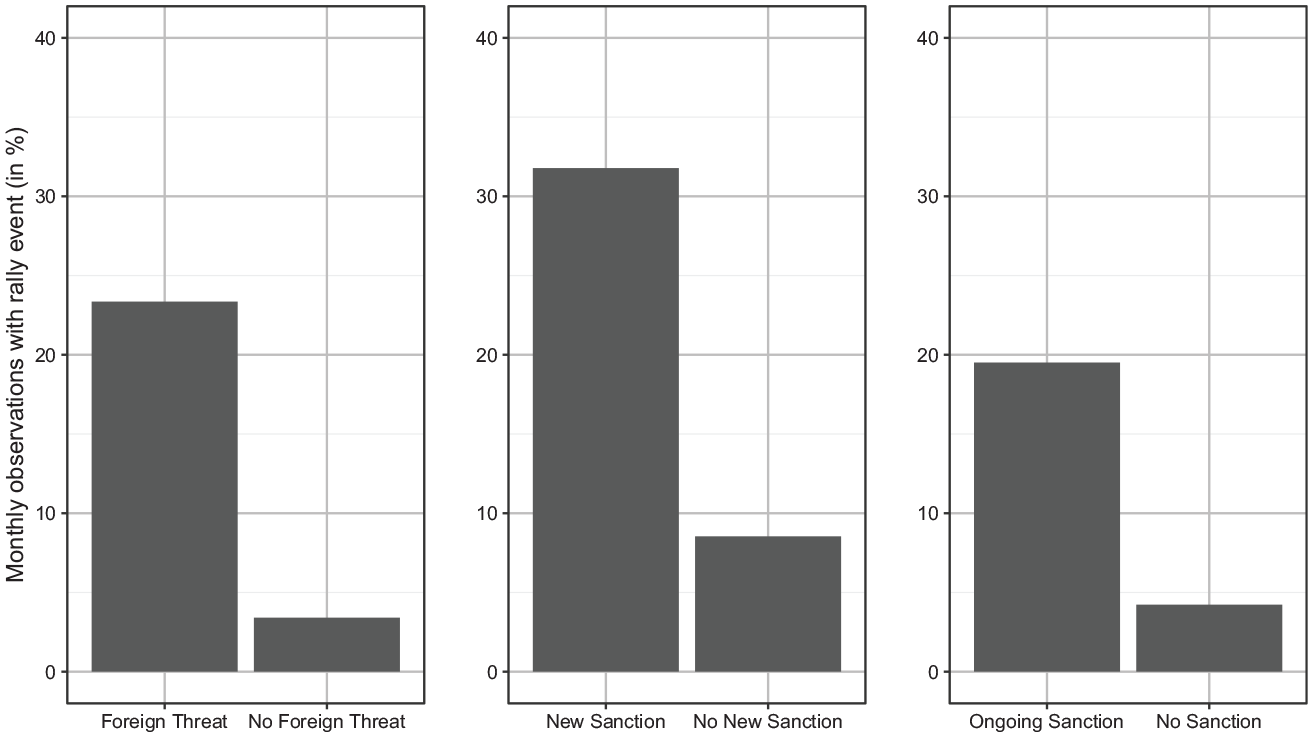
Percentage of observations with at least one pro-government rally; the comparison is made between observations with a foreign threat (n = 1156), a new sanction imposition (n = 129) and an ongoing sanction period (n = 2783), and observations without these events (total n = 8925).
When we look at the temporal relationship between sanction events and pro-government rallies, a similar trend emerges. Figure 2 plots the occurrence of rallies as a function of temporal distance to sanction onset using local polynomial regression fitting. It shows that rallies are more likely to take place around the imposition of a sanction. The increase in mobilization starts around two months before a sanction was imposed and reaches its peak shortly after the imposition. This trend could reflect that sanctions are usually preceded by a debate about its content and the senders’ negotiations about the precise implementation.
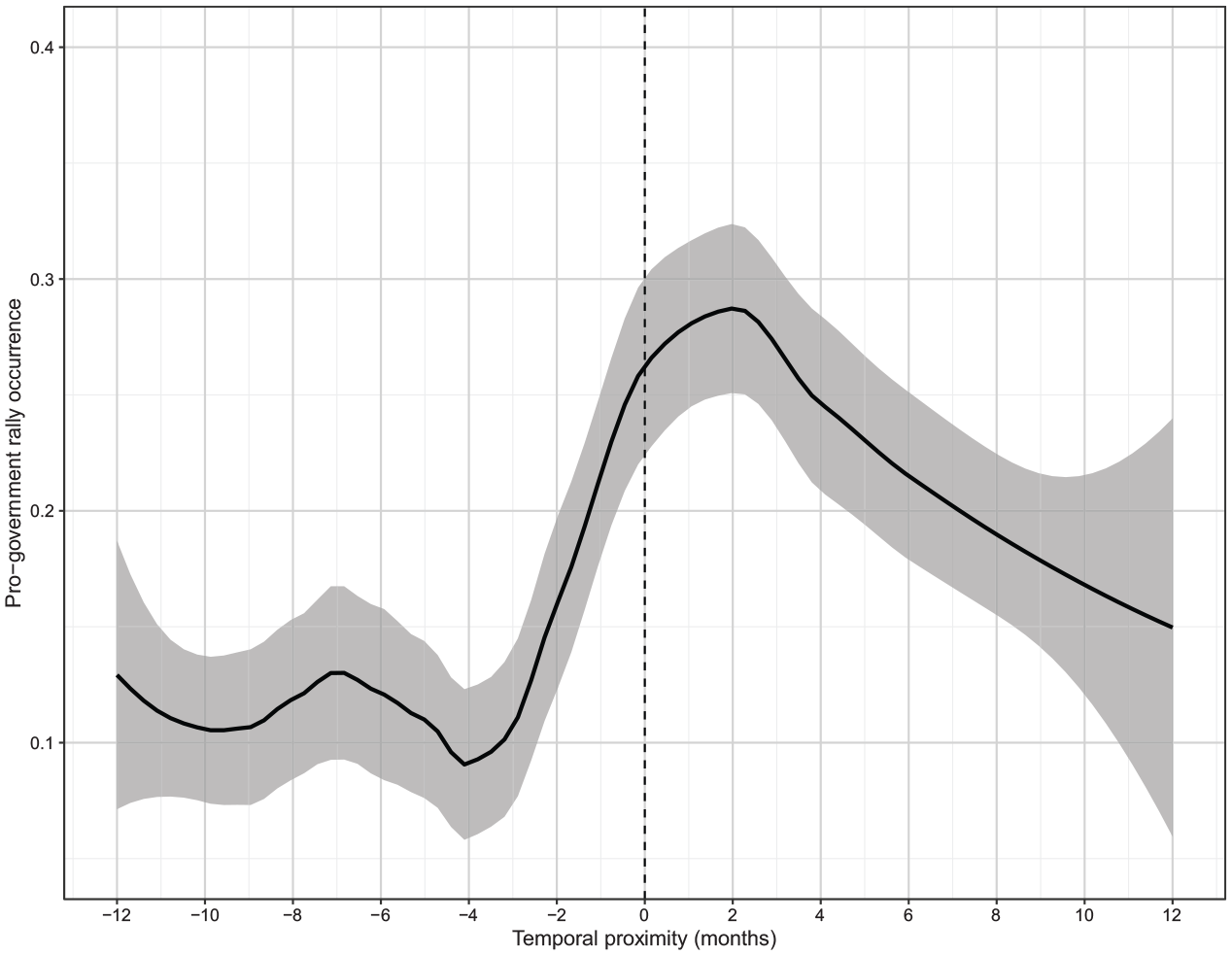
Smoothed relationship between the probability of rally occurrence and temporal distance to sanction onset. Includes observations one year before and after the imposition of a new sanction (n = 1558). Shadings represent confidence intervals.
However, these comparisons offer only a first glance at the relationships of interest as they are based on nonrandom subsets of the data and ignore potential confounders. It could be, for example, that sanctions are imposed in the aftermath of fraudulent elections with large-scale mobilization by both regime supporters and opponents. In this case, the observed differences cannot be attributed to foreign pressure. In order to analyze the effect of international pressure on pro-government mobilization more systematically, I conduct multivariate regression analyses.
I rely on random intercept models for most of the analysis for two reasons. First, observations are not independent within countries and over time. For instance, there could be unobserved country-specific factors such as history or political culture that bias the results. Second, sanction regimes change at a low frequency, meaning that some countries are sanctioned during the entire observation period (e.g. Cuba or China) while others are never sanctioned. 18 In order to deal with the former challenge, many studies employ a fixed effects approach, often in the form of dummy variables for each country in the sample. However, this approach prevents the estimation of rarely changing variables (Beck, 2001: 285) such as ongoing sanctions. Therefore, I use random or varying intercept models (Gelman and Hill, 2006) that leverage variation within and between units. The random intercepts take into account potential country-specific and time-specific differences. A visual representation of the country-specific intercepts is provided in Figure A.4 in the Appendix and shows higher baseline levels of mobilization in countries such as Cuba, Venezuela, Haiti, and North Korea. 19
Table 1 summarizes the main results from fitting regression models with random intercepts for each country and each month (Bates et al., 2015). In the first four models, the occurrence of at least one pro-government rally in a given month is the dependent variable. Model 1 includes only the main variables of interest without controls. The results show a positive relationship between the different measurements of international pressure and pro-government rallies. Foreign threats, new as well as ongoing sanctions, are associated with a statistically significant higher probability of rally occurrence. The second model includes the full set of control variables taking into account anti-government protest, media attention, repression, quality of elections, and political stability in the target country. The positive coefficients for media attention to previous protests are in line with our expectations. The coefficient size of the more dynamic foreign pressure variables (foreign threat and sanction onset) becomes smaller due to the inclusion of the control variables. Still, all measures of foreign pressure are statistically significant. Next, the set of economic controls is added in Model 3. The main effects of interest remain unchanged. Model 4 includes the sanction threats taken from the EUSANCT sanction data instead of the foreign threat events variable. The result is in line with the previous models. Sanction threats are positively and significantly associated with rallies. The predicted probabilities for the main variables of interest are shown in Figure A.5 in the Appendix.
Main results: Relationship between foreign pressure and pro-government rallies. Mixed-effects logistic regression models with random intercepts for countries and months.
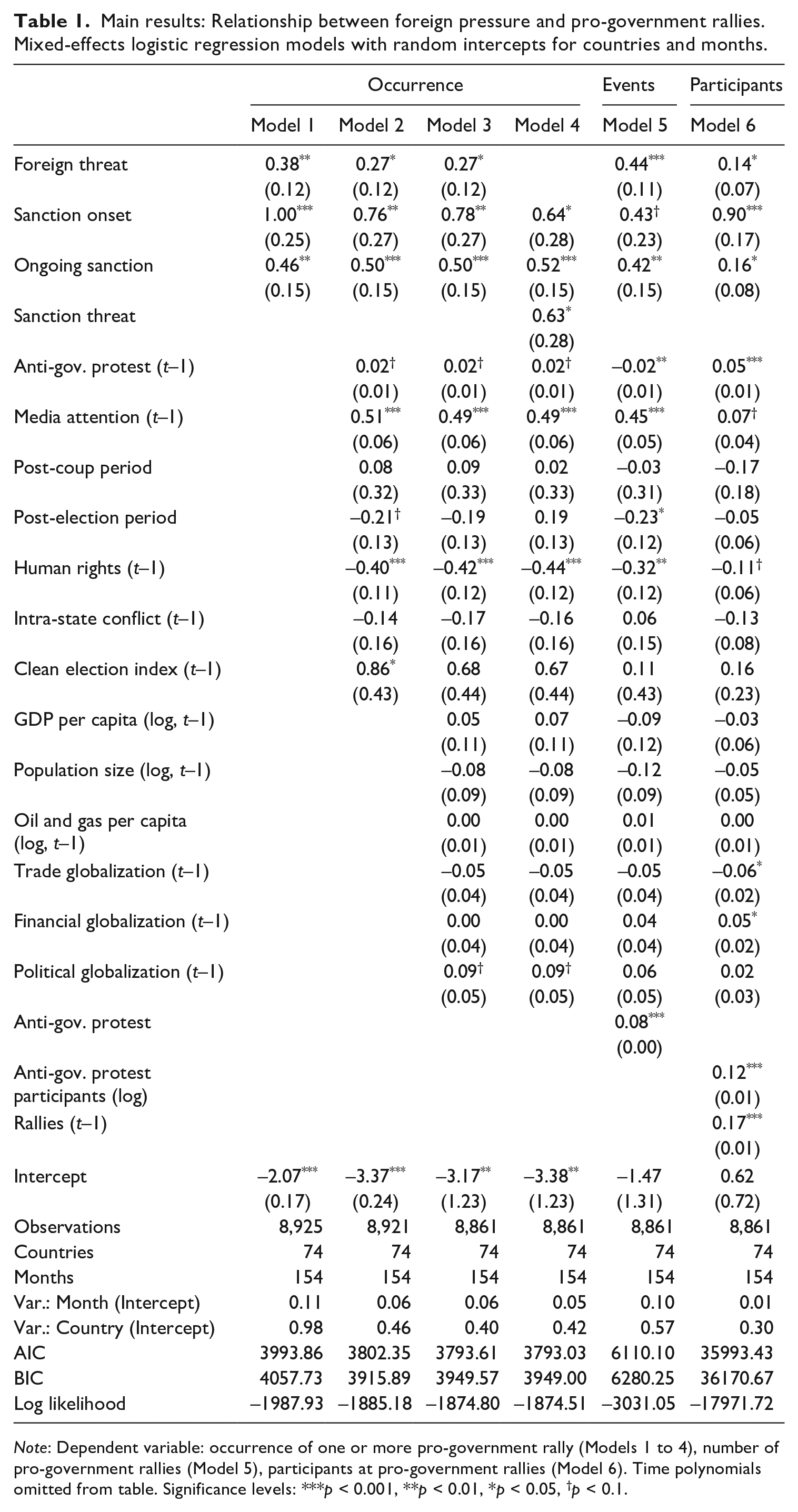
Note: Dependent variable: occurrence of one or more pro-government rally (Models 1 to 4), number of pro-government rallies (Model 5), participants at pro-government rallies (Model 6). Time polynomials omitted from table. Significance levels: ***p < 0.001, **p < 0.01, *p < 0.05, †p < 0.1.
In many cases, pro-government mobilization is a response to mobilization against the regime, and vice versa. The last two models of Table 1 are an attempt to disentangle mobilization on both sides. Model 5 is a negative binomial model with the number of pro-government rallies as the dependent variable and the number of anti-government protests in the same month as a control variable. In Model 6, the (logged) number of participants at pro-government rallies is the dependent variable controlling for the number of opposition activists protesting in the same month. If mobilization in favor of the regime was fully explained by opposition mobilization, the main effects should disappear. However, the positive relationship between international pressure and pro-government mobilization holds. Looking at participant numbers instead of event counts is also one way to mitigate concerns of media bias. In times of high media interest, many smaller events make the news distorting event counts but not necessarily overall participant numbers (Biggs, 2018).
This first series of models confirm the expectations laid out in the theoretical part of the study: international pressure is associated with more pro-government mobilization. Next, I assess the moderating effect of media censorship (Table 2), that is, the framing mechanism. In Models 7 to 9, I add interaction terms for foreign threats, sanction onset, and ongoing sanctions with state censorship efforts. All interaction terms display the expected positive relationship: threatened or sanctioned countries that control the media landscape intensify the collective action dimension of rally effects. However, only the interaction term for ongoing sanctions is statistically significant. Given the difficulties of interpreting interaction effects from the regression coefficients alone (Brambor et al., 2006), a visual presentation of the changes of the conditional coefficients is provided in Figure 3. 20 The distribution of the moderating variable, displayed on the x-axis of each plot, covers the whole spectrum of the censorship variable (common support). As authoritarian regimes frequently censor the media, there are only a few observations with low censorship scores (i.e. free media). Figure 3 confirms the results from the regression models. All interaction terms show the same tendency; the coefficients of the foreign threats variables are higher in countries with strong censorship efforts. At low levels of media censorship, international pressure does not have a statistically significant effect on mobilization. However, only the interaction between ongoing sanctions and censorship shows statistically significant differences across different levels of censorship.
Interaction effects: foreign pressure variables are interacted with government censorship data from V-Dem. Logistic regression models with random intercepts for countries and months.
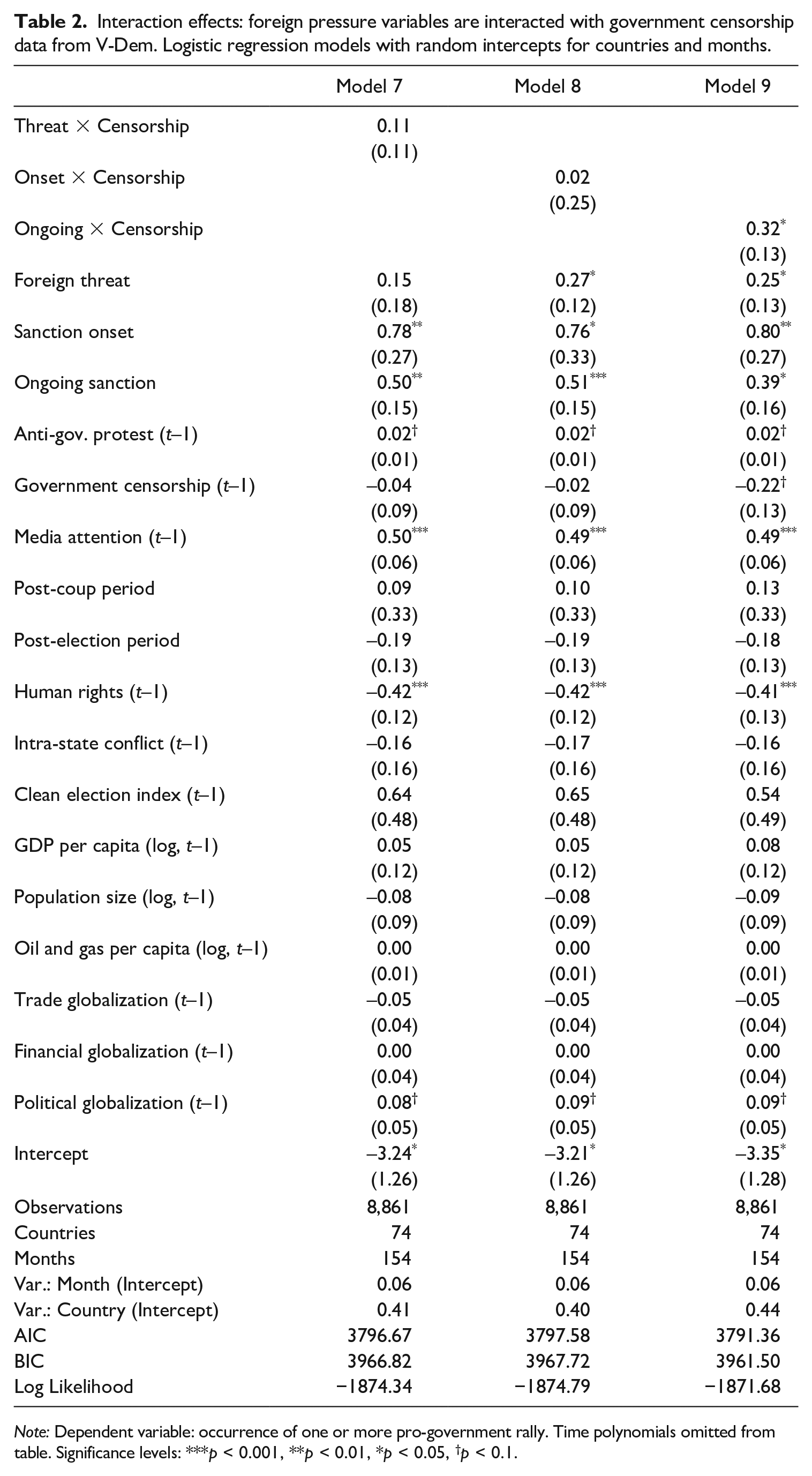
Note: Dependent variable: occurrence of one or more pro-government rally. Time polynomials omitted from table. Significance levels: ***p < 0.001, **p < 0.01, *p < 0.05, †p < 0.1.
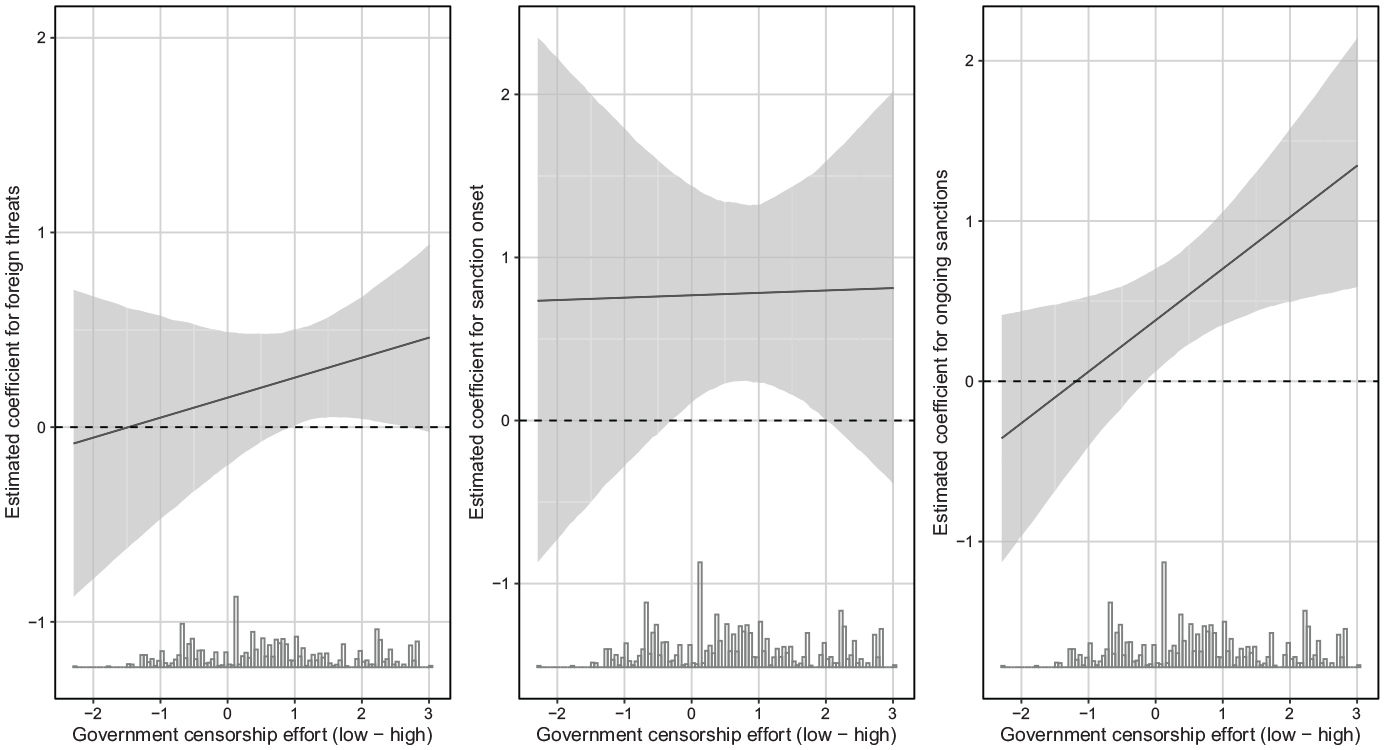
Conditional coefficients from interactions: estimated coefficients are calculated from Models 7–9. Bars above x-axis represent the distribution of government censorship. Shading indicates 95% (adjusted) confidence intervals.
The interactions shown in Figure 3 could be the result of the correlation between media censorship and state repression. In other words, repressive states are more capable of mobilizing their supporters and censorship is merely a correlate of repression. 21 To address these concerns, I run several additional analyses. First, I include the interaction between the foreign pressure measurements and respect for human rights as a measure for overall state repression in Models 7–9 and see if the effects change (see Figure A.6 in the Appendix). While uncertainty around the estimates increases, the fundamental interpretation of the results does not. Second, I run the same models including the interactions between international pressure and two measures of state repression: respect for human rights (Fariss, 2014) and V-Dem’s physical integrity index (see Figures A.7 and A.8 in the Appendix). The idea here is to check if more repressive regimes are indeed more likely to see pro-government rallies when under pressure. The results, however, do not support such assertions. Third, I run additional multicollinearity checks on the main models. The variance inflation factors (VIF) for each variable in the main models are displayed in Table A.3 in the Appendix and do not indicate critical correlations between the predictors. Finally, to avoid the common pitfalls associated with interaction effects as described by Hainmueller et al. (2019), I also compute the binning and kernel estimator for Model 9 (cf. Figure A.9 in the Appendix).
Additional robustness checks
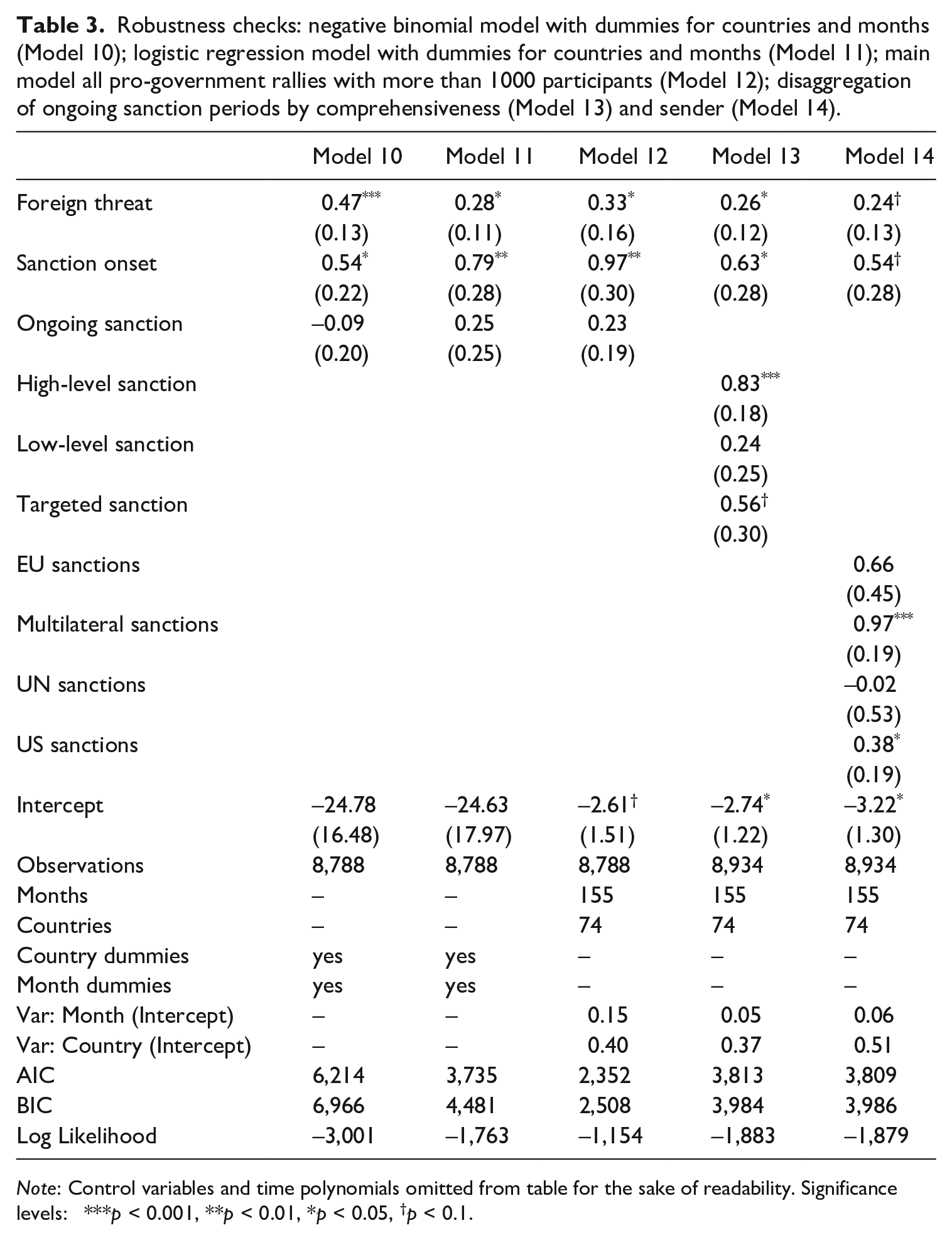
To increase the confidence in the overall results, I conduct a series of additional tests summarized in Tables 3 and 4. First, I assess the robustness of the main results (Model 3) with different model specifications. Model 10 is a negative binomial model with raw counts of monthly rallies as the dependent variable, including country and year dummies. Model 11 is a logistic regression with country and year dummies instead of random intercepts. These models, commonly described as fixed effects models, confirm the main results for the threat and onset variables but do not show a significant effect for ongoing sanctions, which could be due to the slowly changing nature of the variable.
Robustness checks: negative binomial model with dummies for countries and months (Model 10); logistic regression model with dummies for countries and months (Model 11); main model all pro-government rallies with more than 1000 participants (Model 12); disaggregation of ongoing sanction periods by comprehensiveness (Model 13) and sender (Model 14).
Note: Control variables and time polynomials omitted from table for the sake of readability. Significance levels: ***p < 0.001, **p < 0.01, *p < 0.05, †p < 0.1.
Additional robustness check: Heckman-style selection model.
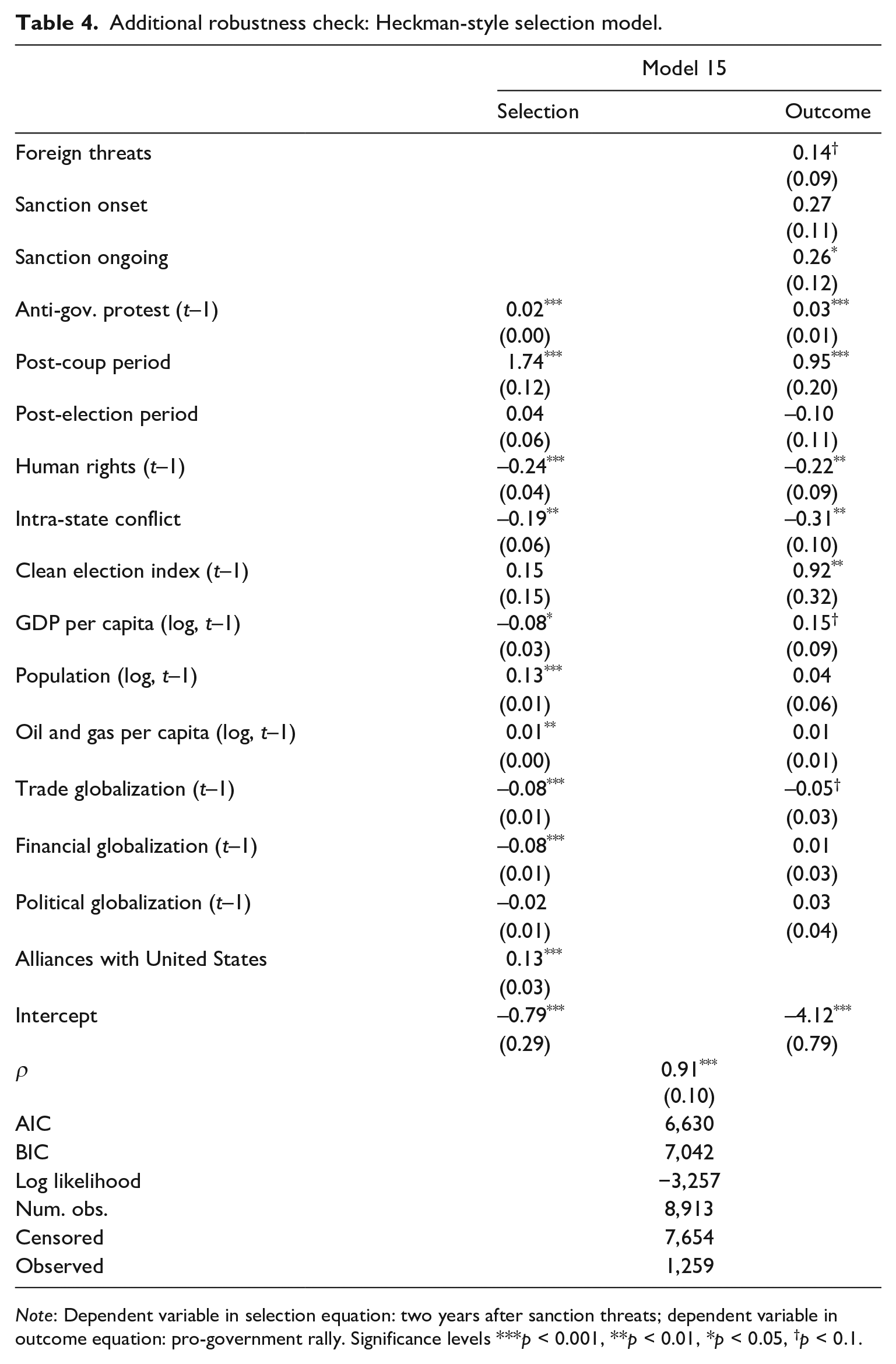
Note: Dependent variable in selection equation: two years after sanction threats; dependent variable in outcome equation: pro-government rally. Significance levels ***p < 0.001, **p < 0.01, *p < 0.05, †p < 0.1.
For Model 12, I rely on a subsample of pro-government rallies. MMAD includes all protest events with participant numbers as low as 25 participants. Autocrats are able to mobilize such small groups of people easily, which is why we want to make sure that the results are not driven by very small events. The sample in Model 12 includes only rallies with more than 1000 participants resulting in a total of 808 instead of 2140 rally events. The results for foreign threat and sanction onset are very similar to the main results; the coefficient for ongoing sanctions is not statistically significant in this model.
Finally, I disaggregate ongoing sanction episodes by sanction comprehensiveness and sender type to investigate if particular features of the imposed measures shape the effect of international pressure on mobilization. In Model 13, I distinguish between targeted (asset freezes, travel bans), low-level (import/export restrictions, termination of foreign aid, suspension of economic agreements, diplomatic sanctions), and high-level sanctions (economic embargoes, blockades, major financial sanctions). The coefficient for high-level sanctions is larger compared to low-level and targeted sanctions. It might be that low-level sanctions are not damaging enough to pose a threat to autocrats. In Model 14, I distinguish multilateral sanctions from unilateral measures by the United States and the EU. Multilateral sanctions show the strongest relationship with pro-government mobilization. 22
Another challenge are potential selection effects in the sense that the countries threatened by international actors are the ones with higher levels of protest mobilization in general. To account for this selection dynamic, I run a Heckman-style selection model (Toomet and Henningsen, 2008), the results of which are presented in Table 4. In the first stage of the model, all country-months in the data set are included. The second stage of the model is limited to observations with a sanction threat as recorded in the EUSANCT data set and the following two years (1259 observations). This subsample contains those observations that are more likely to be sanctioned as a first threat was already made. Within this sample, we can then assess the effect of foreign threats and the presence of sanctions. This approach provides a more balanced comparison between countries that are eventually sanctioned and those that are not. The number of alliances with the United States based on data from the Alliance Treaty Obligations and Provisions (ATOP) project (Leeds et al., 2002) is included in the selection stage but not in the second stage. Ties to the United States could affect the likelihood of being threatened with a sanction but should be unrelated to domestic mobilization. In other words, the United States might be more or less inclined to act against their allies, but alliances per se should not affect domestic mobilization. The coefficients for the outcome equation are comparable to the main results from Table 1 with a positive and significant effect for the different measurements of foreign pressure.
As additional robustness checks, I analyze how the main results in Model 3 change if I include the number of anti-regime protests in the same month (Model A1, Table A.2 in the Appendix) and exclude the variable from the model (Model A2). In the former case, we should see smaller effect sizes for the main variables of interest, as the non-lagged protest variable now captures variation in pro-government mobilization that is due to increased opposition mobilization. In the latter case, we should see larger coefficients. 23 Given that an analysis of influential cases based on Cook’s Distances (Nieuwenhuis et al., 2012) reveals that Cuba, Iran, Venezuela, and Egypt are particularly influential cases in the random intercept models (see Figure A.10 in the Appendix), I run a model without these countries (Model A4). The effect estimates do not change substantially. 24
In sum, the empirical results provide strong evidence for the importance of international factors for pro-government mobilization in authoritarian regimes. Foreign threats, recently imposed sanctions but also ongoing sanction episodes are consistently associated with higher levels of pro-government mobilization. This finding is robust to the inclusion of different control variables and modeling choices. There is also some indication that the effect of ongoing sanctions is moderated by media freedom in the targeted country. In regimes that strongly censor the media, there is an increased likelihood of observing pro-government mobilization during ongoing sanction episodes.
Some caveats are worth mentioning. First, data on pro-government protest is only available for the period from 2003 to 2015. Additional data is required to test whether the findings hold for other historical power configurations in the international system, for instance, the immediate post-Cold War period. It might well be that the distribution of international power affects the perils of international pressure for the survival of authoritarian regimes and the effectiveness of pro-government mobilization. Second, reporting bias could be a concern regarding the effect of newsworthy events such as the imposition of new sanctions. The imposition of sanctions in a particular country attracts media attention, which could partly explain the increase of reported events. However, media attention is short-lived (Hellmeier et al., 2018) and should not bias the effect of ongoing sanctions on pro-regime mobilization. While in the absence of ground truth on mobilization, the direction and size of media bias remains unknown, the inclusion of the number of news reports on protests takes into account peaks of international attention. It is also encouraging to see that the results hold when using monthly participant numbers as the dependent variable (Model 6). Overreporting distorts event counts more than participant numbers (Biggs, 2018).
Finally, it is important to reiterate that the protest event data does not contain information about the degree of state involvement in the organization of rallies and protester’s true motivations for rally participation. As Petrone (2016: 187) nicely puts it, mobilization is the “(. . .) ever-changing relationship between the agents of a dictatorial state seeking to propel its people to action on the state’s behalf, and the people who might potentially be voluntary self-propelled into action.” Following the theoretical argument presented in this article, international pressure increases both citizens’ willingness to participate and autocrats’ demand for street support. However, it is not possible to quantify the relative strength of supply and demand factors. We should not interpret rally participation by each individual as an expression of sincere regime support. And yet mobilization could not fulfill its signaling function if all participants had to be coerced into participation.
Conclusion
This study set out to shed light on the relationship between international pressure and domestic mobilization in authoritarian regimes. I argued that interventions by foreign powers spark mobilization in favor of incumbent autocrats. Three theoretical mechanisms explain increased mobilization. First, foreign interventions facilitate mobilization as they provide attacked leaders with powerful collective action frames. Such framing effects should be stronger in autocracies with tight control over media outlets. Second, international pressure creates incentives for the regime to mobilize street support in order to reduce opportunities for the opposition. Third, autocrats use rallies to signal resolve in international negotiations. In a nutshell, foreign pressure increases citizens’ willingness to participate in rallies, but it also increases autocrats’ demand for public support.
The empirical analysis provides support for these arguments. Different forms of international pressure (threats and sanctions) are consistently associated with higher levels of pro-government mobilization. In line with the described framing effects, I find partial evidence for an interaction effect between ongoing sanctions and domestic media freedom. Authoritarian regimes with high levels of media censorship are more likely to experience pro-government mobilization during sanction episodes. The results are robust to alternative model specifications and hold when controlling for a variety of potential confounders such as state repression. This study is the first to show empirically that foreign pressure increases mobilization in favor of autocrats and emphasizes the relevance of international factors in explaining domestic mobilization in favor of autocratic leaders.
The study has implications for our understanding of the political effects of foreign pressure on authoritarian countries. It supports criticism of the “naive theory” theory of sanctions (Galtung, 1967). External pressure and punishment do not automatically lead to political disintegration in the targeted country. On the contrary, as this study has shown, such activities can result in more public demonstrations of support for the incumbent government. Whether or not rally participants support the incumbent government in private remains unknown. It is safe to say that some only participate out of fear of being punished. However, large participant numbers and the emotions at such rallies point toward the importance of nationalist framings in the mobilization process. In addition, this study emphasizes the relevance of how the mass media portrays foreign interventions in the target country. Sender countries should, therefore, not only focus on reducing the economic consequences of sanctions for the wider population, for example, by making them more targeted. They should also reflect on how their actions make their way into public discourse in the target country. Finally, this study highlights threats can trigger pro-government mobilization before actual measures were imposed. Future research should systematically address the effect of rallies on the persistence of authoritarian regimes in general. Pro-government mobilization could lead to more stability but also more polarization in the streets.
Supplemental Material
supplemental_material – Supplemental material for How foreign pressure affects mass mobilization in favor of authoritarian regimes
Supplemental material, supplemental_material for How foreign pressure affects mass mobilization in favor of authoritarian regimes by Sebastian Hellmeier in European Journal of International Relations
Footnotes
Acknowledgements
I thank Joseph Wright, Nils Weidmann, Gerald Schneider, Christian von Soest, Alexander De Juan, Clara Neupert-Wentz, Jessica Strong, Johannes Vüllers, Philipp Lutscher, Simon Richter, and Joscha Abels for helpful comments on earlier versions. I also thank the whole V-Dem Institute, all participants at the Brown Bag Meetings (Konstanz) as well as all members of the Communication, Networks and Contention research group and the Graduate School of Decision Sciences at the University of Konstanz. I am very grateful to Gerald Schneider and Patrick Weber for early access to their sanction data. Additionally, I would like to thank the reviewers and editors for their constructive feedback.
Funding
The author(s) disclosed receipt of the following financial support for the research, authorship, and/or publication of this article: This research was supported by Vetenskapsradet (grant number 2018-016114, PI: Anna Lührmann), the European Research Council (Grant 724191, PI: Staffan I. Lindberg) as well as the German Research Foundation (DFG Research Grant 402127652, PI: Nils Weidmann).

Supplemental material
Supplemental material for this article including the Appendix and replication data is available online.
Notes
Author biography
References
Supplementary Material
Please find the following supplemental material available below.
For Open Access articles published under a Creative Commons License, all supplemental material carries the same license as the article it is associated with.
For non-Open Access articles published, all supplemental material carries a non-exclusive license, and permission requests for re-use of supplemental material or any part of supplemental material shall be sent directly to the copyright owner as specified in the copyright notice associated with the article.
