




Abstract
This article addresses the question of how we should understand the normative grounds of legitimacy in global governance institutions, given the social and organizational pluralism of the contemporary global political order. We argue that established normative accounts of legitimacy, underpinning both internationalist and cosmopolitan institutional models, are incompatible with real-world global social and organizational pluralism, insofar as they are articulated within the parameters of a ‘statist’ world order imaginary: this sees legitimacy as grounded in rational forms of political agency, exercised within ‘closed’ communities constituted by settled common interests and identities. To advance beyond these statist ideational constraints, we elaborate an alternative ‘pluralist’ world order imaginary: this sees legitimacy as partially grounded in creative forms of political agency, exercised in the constitution and ongoing transformation of a plurality of ‘open’ communities, with diverse and fluid interests and identities. Drawing on a case study analysis of political controversies surrounding the global governance of business and human rights, we argue that the pluralist imaginary illuminates how normative legitimacy in world politics can be strengthened by opening institutional mandates to contestation by multiple distinct collectives, even though doing so is incompatible with achieving a fully rationalized global institutional scheme.
Introduction
The most fundamental normative demand within any political order is articulation of the standards and grounds of legitimacy, in terms of which governing institutions can be judged worthy of support. Legitimacy is a key institutional virtue insofar as it helps to align institutions’ operations with their justifying purposes and motivate support for valuable governing functions (Buchanan and Keohane, 2006; Macdonald, 2016; Reus-Smit, 2007). As such, political demands for legitimacy are routinely raised against myriad institutions beyond states – including powerful transnational actors and networks (Macdonald and Macdonald, 2017), international law (Tasioulas, 2010) and international organizations (Keohane, 2011). But at present, these political demands are not accompanied by any systematic theory of legitimacy applicable to such diverse institutions.
Modern normative theories of legitimacy have been developed primarily for states (Macdonald, 2018). Correspondingly, most influential visions of legitimacy in world politics have been internationalist or cosmopolitan – centred on institutionalized inter-state relations (Clark, 2005; Miller, 2007) – or the development of state-like world government institutions (Cabrera, 2010, 2018). But as we approach the third decade of the 21st century, political realities of organizational and social pluralism 1 in world politics – the dynamics of which have been described variously in terms of institutional ‘ecology’ (Abbott et al., 2016), ‘complexity’ (Weiss and Wilkinson, 2014), ‘fragmentation’ (Biermann et al., 2009) and ‘postmodernism’ (Scholte, 2014) – have brought traditional visions of legitimacy into crisis. Liberal and democratic models of domestic state legitimacy have been eroded by the globalized dispersal of state power (Held, 1995; Tallberg et al., 2018; Zürn, 2018), while oppositional anti-globalism has undermined the legitimacy of international and cosmopolitan institutional projects (Habermas, 2012; Reus-Smit, 2007). To help overcome these challenges, there is pressing need for a new articulation of the normative grounds and standards for legitimacy within a pluralist global order.
The magnitude of this intellectual task is daunting. It makes sense to begin, as many have done, with the theoretical materials already to hand within established democratic, liberal and realist traditions. Some have sought to move beyond internationalist or cosmopolitan democratic ideals by reconstructing established conceptual and institutional models of deliberation (Bohman, 2007; Dryzek, 2006; Kuyper, 2014), representation (Macdonald, 2008) or broader egalitarian social empowerment (Scholte, 2014). Others have adapted liberal models of accountability (Grant and Keohane, 2005) or public justification (Gaus, 2016), or developed realist and associated republican insights linking global legitimacy to institutional mechanisms for combating arbitrary power (Buckinx et al., 2015; Deudney, 2007). For the most part, these theoretical reconstructions have focused on assessing institutional standards of legitimacy – that is, prescribed institutional characteristics (often formulated as procedural ‘inputs’ or substantive ‘outputs’) that serve as political criteria of support-worthiness. They have taken for granted, as normative grounds for legitimacy assessments, some fixed political values developed historically in and for states. With some notable exceptions (Buchanan and Keohane, 2006; Buchanan, 2014; Erman, 2015; Macdonald and Macdonald, 2017), little work has probed systematically how understandings of the underlying normative grounds for assessing legitimacy standards may themselves need revision for a pluralist world order. It is at this deeper level of theoretical analysis that our contribution here is situated.
In what follows, we work within the conceptual and methodological parameters of a ‘collective agency’ understanding of normative legitimacy – which grounds legitimacy in some value of collective ‘self-determination’ or collective ‘intelligence’ 2 – to articulate a new theoretical account of legitimacy for a pluralist global era. We argue that many established understandings of legitimacy’s normative grounds are discordant with global pluralism, insofar as they are articulated in terms of a ‘statist’ world order imaginary. 3 This sees legitimacy as grounded in rational forms of collective agency, exercised within ‘closed’ communities constituted by settled common interests and identities. Instead, we elaborate an alternative ‘pluralist’ world order imaginary, which articulates a normative vision of legitimate global institutions more concordant with empirical facts about social and organizational pluralism. This views legitimacy as partially grounded in creative forms of collective agency (Dewey, 1917; Joas, 1996), exercised in the constitution and ongoing transformation of a plurality of ‘open’ communities, with diverse and fluid interests and identities. The idea of creative agency invoked here captures those distinctive faculties of intelligence driving adaptation, innovation and flexible adjustment to social difference. By highlighting its political value, we argue that the ‘pluralist’ imaginary illuminates how legitimacy can be strengthened by opening institutional mandates to creative contestation by multiple distinct collectives, even when doing so is incompatible with achieving a fully rationalized global institutional scheme. In doing so, we build on and extend a fragmented ‘pluralist’ tradition of normative political thought (Bevir, 2012; Laborde, 2000; Levy, 2014; Stears, 2002), which we take to offer rich and under-utilized intellectual resources for theorizing global political legitimacy.
We develop this argument in three steps. First, we explain with more precision the concept of global legitimacy our analysis aims to address and the specific normative and methodological commitments associated with our ‘collective agency’ conception. Next, we sketch the key theoretical elements of our proposed ‘pluralist’ world order imaginary and contrast it with the ‘statist’ imaginaries that have dominated normative analyses of global political legitimacy to date. Finally, we analyse a case study of political controversies surrounding the global governance of business and human rights, to help show the distinctive utility of the pluralist imaginary in understanding the normative grounds of legitimacy in contemporary global politics.
Legitimacy and the normative grounds of world order
So far, we have characterized legitimacy as a normative standard of political support-worthiness for governing institutions; but since the concept of legitimacy is contested across a range of literatures, a more precise formulation is warranted. The concept of legitimacy as ‘support-worthiness’ denotes an institutional virtue of political acceptability – to real political agents in some concrete operational context. 4 To call an institution legitimate is to say not only that it can motivate the political support required for its operation, but moreover that it is worthy of this support. Put differently, a legitimate institution can motivate support for the right reasons; this is what makes ours a normative rather than an empirical (sociological) conception. Here ‘support’ may involve, for example, compliance with institutional rules or directives, non-interference or provision of resources. Conceptualizing legitimacy as support-worthiness – rather than the orthodox ‘right to rule’ (Buchanan and Keohane, 2006) – thus makes better sense of legitimacy claims about global institutions exercising power through instruments beyond authoritative rule-making, such as economic distribution, infrastructure building or institutional orchestration (Hurrell and Macdonald, 2012).
Within these conceptual parameters, normative questions about legitimacy in global institutions can be directed at two levels. First, what institutional standards of legitimacy should be adopted for global institutions: whether ‘input’ standards such as legality, accountability or representation; ‘output’ standards such as peace, ecological viability or egalitarian economic distribution; or ‘complex’ (Buchanan and Keohane, 2006) hybrid standards? Second, what are the normative grounds of institutional legitimacy standards – that is, the justifying reasons warranting support for an institution when particular standards of legitimacy are met? 5 This latter question is fundamental, since any substantive conception of legitimacy as support-worthiness requires specifying what kind of reasons count in favour of support; it is by appeal to these reasons that justifications for institutional standards can be systematically constructed.
Modern (realist, liberal and democratic) traditions of political thought have mostly converged around two kinds of answers to this question. First, legitimacy standards are grounded in special procedural (Rawls, 1996), substantive (Erman, 2015) or non-ideal (Valentini, 2012) moral principles, posited as more fundamental than the value of particular institutional standards themselves. For example, it is commonly claimed that liberal and democratic standards generate legitimacy by helping institutions satisfy moral demands for individual autonomy (Valentini, 2012) or political equality (Christiano, 2008); similarly, consequentialist moral principles are invoked as grounds for ‘output’ legitimacy standards (Keohane, 2011; Scharpf, 1999). Such ‘moralist’ (Williams, 2005) accounts appeal to normative reasons articulated by moral philosophers; but in many global institutional contexts, philosophers’ moral principles are rejected by many political agents whose support is at issue – due to repudiation of cosmopolitan morality (Walzer, 1980) or the view that the scope of liberal and democratic moral principles is limited to domestic (Miller, 2010; Rawls, 2001) or otherwise circumscribed (Maffettone and Ulas, 2019) institutional spheres. In such contexts, the required link cannot be sustained between moral principles and legitimacy’s demand for standards acceptable to real political agents.
A second answer appeals not to philosophers’ moral principles, but rather to some intrinsic political value of empowering collective political agency, understood as a quality of the processes through which collectives steer the operation of their own governing institutions. Legitimate institutions are support-worthy, on this view, as a corollary of the respect due to the real political agency of individuals, collectivized through institutional collaboration with others in pursuit of some ‘common interests’. 6 Standards of legitimacy thus track an institution’s support-worthiness insofar as they index its collective empowerment functions (Macdonald, 2016, 2018, 2019).
This collective agency account has been influential within democratic theory – described as collective ‘autonomy’ or ‘self-determination’ (Miller, 1995), and interpreted as egalitarian political decision-making through democratic social choice – whether via formal aggregative or deliberative procedures (Knight and Johnson, 1994) or informal deliberation within democratic ‘civil society’ (Habermas, 1996; Warren, 2001). But not all collective agency accounts require the egalitarian collective decision-making procedures characteristic of democracy. ‘Communitarians’ instead value culturally structured self-determination of national ‘peoples’, exercised through the vehicle of sovereign statehood (Miller, 1995; Walzer, 1980), while realists or contractarian liberals value the agency exercised towards solving narrower collective action problems – such as achieving physical security (Williams, 2005) or institutional ‘meta-coordination’ (Buchanan and Keohane, 2006). Taken together, collective agency accounts have been influential in grounding external state legitimacy within international society (Clark, 2005; Rawls, 2001) and accounting for systematic political differentiation of national and international legitimacy standards. As such, they capture many normative reasons that ‘make sense’ (Williams, 2005: 11) to real political agents and can supply acceptable criteria of institutional support-worthiness. On this basis, we adopt the collective agency frame for our following analysis of the normative grounds of legitimacy standards.
This collective agency conception is ambiguous, however, about the character of the ‘collectives’ whose self-determination is to be valued. Real-world political understandings of collectivity have emerged through a messy fusion of thin theoretical conceptions of ‘demos’ or ‘public’, with thick historical practices of sovereignty, nationality and civic association; as such, they have eluded precise definitions. This ambiguity is widely acknowledged as a source of unresolved ‘boundary’ or ‘origin’ problems for democratic and liberal accounts of legitimacy, and a topic of ongoing theoretical controversy (Macdonald, 2003; Näsström, 2007). Greater clarity on this matter is required to sustain a new collective agency conception of global legitimacy; moreover, collectivity must be conceptualized on terms that can accommodate pluralist as well as statist formulations, to leave space for the substantive normative argument developed below.
Here we propose a ‘problem-based’ understanding of political collectivity – versions of which are loosely shared by some realists (Williams, 2005), pragmatists (Dewey, 1946) and liberal contractarians (Buchanan and Keohane, 2006). 7 On this view, legitimacy standards are grounded in normative reasons that can motivate collaborative institutional responses to the political problems jointly experienced within some group. Correspondingly, political ‘collectives’ are problem-solving communities, defined by mutual recognition of problems requiring collaborative responses (though not necessarily agreement on what would count as acceptable solutions). A galvanizing political problem could in principle have a social-ontologically ‘holistic’ character – for instance subsuming all people everywhere in some modern ‘circumstances of politics’ (Waldron, 2016); but problems may instead – as Dewey (1938) famously argued – be pluralistic and fluid, generating a dynamic plurality of problem-solving collectives which Dewey (1946) called ‘publics’. Such pluralistic collectives may overlap and intersect in geographical and institutional ‘social space’ and thus be located social-ontologically in shared ‘situations’ rather than territories, cultures or organizations (Boltanski and Thevenot, 2006). This accommodates the possibility (invoked in our subsequent argument for a pluralist imaginary) that some general problem of legitimacy may be recognized across a global population, yielding a ‘thin’ collective agency understanding of legitimacy’s normative grounds, while ‘thicker’ understandings simultaneously apply within localized situational contexts. 8
This situational understanding of political collectivity invites a refined formulation of the value of empowering collective agency, as tied to the value of problem-solving intelligence – where ‘intelligence’ denotes faculties of judgment useful to agents in understanding and remedying their experienced problems (Dewey, 1938). 9 The empowerment of intelligent collective agency thus generates legitimacy insofar as it institutionally harnesses the faculties of judgment best equipped to remedy the collective problems to which institutions respond. It follows that both the dimensions of intelligence to be empowered as an instrument of legitimization (such as the rational and creative dimensions we discuss below) and the terms on which individuals are included in its collective exercise and empowerment (for instance how egalitarian the terms of inclusion and participation) may vary with the character of problems shared by institutionally collaborating political actors in different situational contexts. 10
Given this scope for situational variation, a clear methodology is required to identify which forms of agency and collectivity can ground legitimacy within the specific institutional practices of contemporary global governance. To this end, we recognize that political values take shape through reflection on experiences of political practice (Dewey, 1927, 1939) and accordingly propose that normative conceptions of valuable collective agency can best be articulated through critical interpretation of constitutive ideas within global legitimization practices (Taylor, 1985). We borrow from Charles Taylor the concept of a social ‘imaginary’ – ‘the ensemble of imaginings that enable our practices by making sense of them’ (Taylor, 2004: 165) – to describe the ideational elements of practice that are our object of interpretation. But while Taylor’s social imaginary frames his interpretation of the broad social practice of ‘Western modernity’ (Taylor, 2004: 1), we refer instead to world order imaginaries to frame our interpretations of global legitimization practices. These aim to articulate how some normative legitimacy standards may be seen as intelligible, attainable and acceptable, in virtue of some understanding of what real political agents and situations are like within contemporary world politics. The ‘statist’ and ‘pluralist’ world order imaginaries we elaborate below can thus be understood as alternative normative visions of legitimate global institutional configurations emergent or partially realized within existing political practices.
Collective agency and global legitimacy: from ‘statism’ to ‘pluralism’
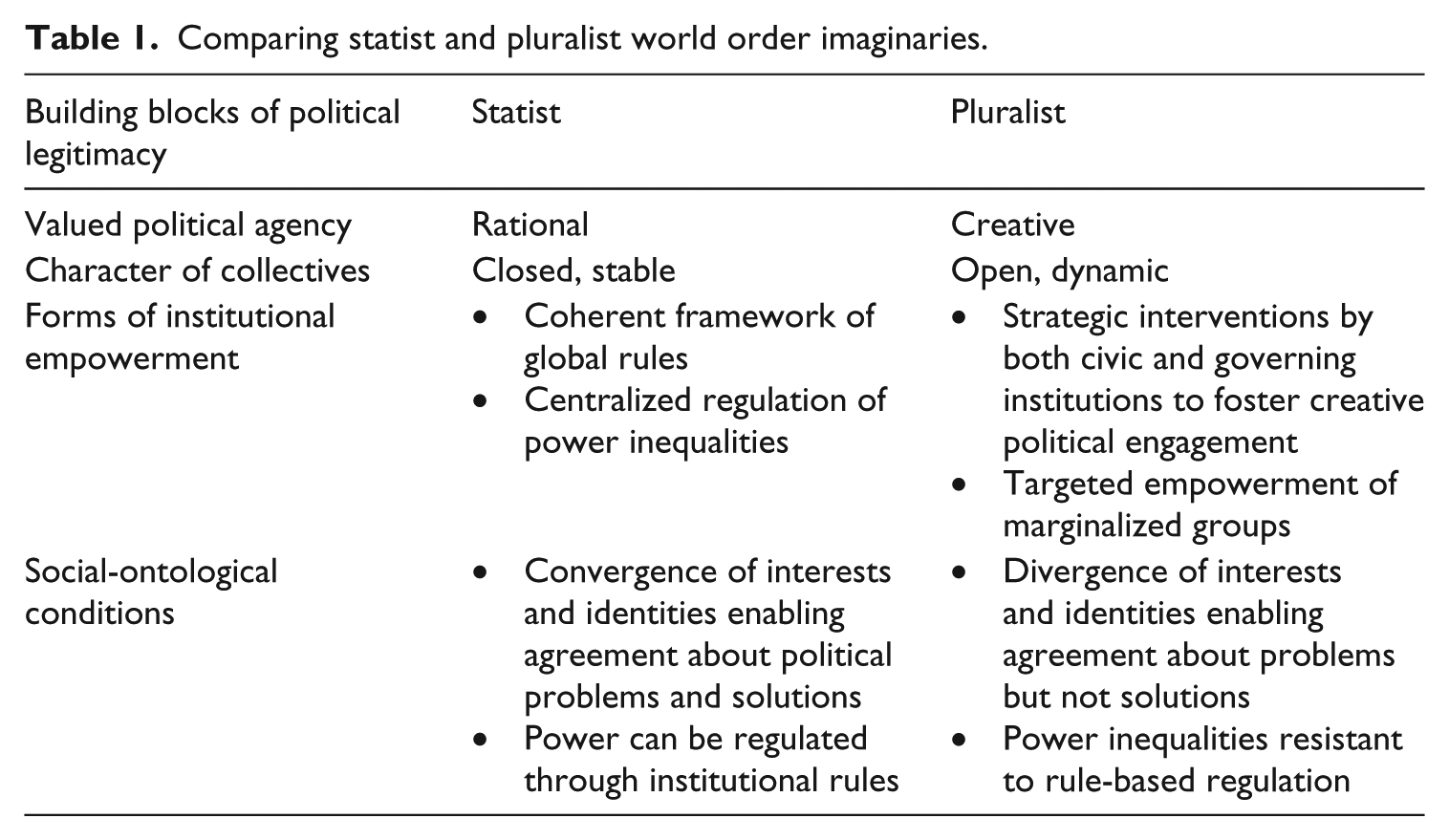
While our primary objective is to advance a ‘pluralist’ vision of the grounds of legitimacy within contemporary global governance practice, its significance and appeal can be most clearly illuminated through contrast with the more familiar ‘statist’ imaginary, which underpins established internationalist and cosmopolitan models of legitimate global order. Each embodies a vision of global legitimacy based on a substantive normative interpretation of ‘empowered collective agency’, which can be broken down into three key dimensions: an account of the forms of political agency that have value as sources of respect-worthy political judgment; an account of the forms of political community or collectivity through which this agency can be collectively expressed; and an account of the forms of institutionalized empowerment required to support the expression of this collective agency through governance institutions. In what follows we contrast ‘statist’ and ‘pluralist’ imaginaries within each of these three dimensions and further consider what empirical characteristics of agency, collectivity and power are presupposed by – or prerequisites for realizing – each. A schematic summary of this analysis is presented in Table 1.
Comparing statist and pluralist world order imaginaries.
Rational agency and legitimacy in the ‘statist’ world order imaginary
The character of world order and its legitimate institutions has been deeply contested during the last century, as divergent cultural and ideological value-systems have clashed in both theory and practice. But the dominant normative visions have been either internationalist (Clark, 2005) or cosmopolitan (Cabrera, 2018) – both sharing roots in post-enlightenment liberal and republican political theories centred on the state. Internationalist and cosmopolitan visions of world order encompass a diversity of institutional models – differing in particular on the question of whether legitimate authority should be vested primarily in separate ‘sovereign’ states linked through a shared framework of international law and human rights (Miller, 2007) or dispersed across a supranational authority structure characterized as some form of ‘world state’ (Cabrera, 2010), ‘world government’ (Deudney, 2007; Weiss, 2009) or more loosely ‘constitutionalized’ global governance framework (Wiener et al., 2012).
Notwithstanding the significant structural and functional differences among these institutional visions, they share in common a more abstract set of underlying ideas about the normative grounds of legitimacy in global institutions. These normative ideas do not take the form of institutional ideals or prescriptions (though as we shall see, they do have institutional corollaries insofar as some institutional structures and capabilities will be more conducive than others to achieving legitimacy thus understood). Rather, they take the form of a shared normative vision of the kinds of collective agency that should be valued in global political life and empowered through institutions as a basis for their legitimacy. In recognition of the fact that these ideas are adapted from the legitimizing logics of domestic state-based political orders, we refer to them here as elements of a ‘statist’ world order imaginary.
The first element we identify with this broad statist vision is the normative view that rational dimensions of real political agency have some special intrinsic value, such that their empowerment can ground institutional legitimacy. The general idea that normativity is derived from an account of good agency – and moreover that good agency is rational in character – is central to enlightenment liberal moral theories, such as Kant’s (Korsgaard, 1996). This idea in turn underpins rationalist liberal and democratic understandings of the grounds of political legitimacy. Conceptions of ‘rational’ agency in political life are varied (Elster, 1979), but liberal and democratic variants draw mostly on three: instrumental – involving the strategic pursuit of individual agent interests; moral – involving impartial pursuit of multiple individual agent interests; and communicative – involving the transformation of individual agent interests, through dialogue, to better harmonize with those of others (Habermas, 1996).
Taking these ideals of political agency as a starting point, rationalist liberal and democratic theories then explain how individual rationalities can be collectivized in support of a common standard of legitimacy for shared institutions, through some combination of an instrumentally rational social contract; individual preference aggregation; morally rational ‘public justification’; and communicatively rational democratic deliberation. Ideal-typical rationalities can be combined in deliberative political practice in complex ways (Mansbridge et al., 2010) and can also accommodate recognition of the value of some non-rational inputs – such as emotion (Marcus, 2010), rhetoric (Dryzek, 2010) and creative problem-solving intelligence (Landemore and Elster, 2012) – within deliberative processes. But deliberative practices incorporating non-rational inputs will nonetheless operate as ‘rationalist’ sources of legitimacy if their outputs depend on a decision procedure or substantive ‘test’ (for bringing deliberation to an end through decisive judgment) that relies on some (instrumentally, morally or communicatively) rational criterion.
These conceptions of collective rational agency have direct and significant implications for the social-ontological conceptions of political ‘community’ or ‘collectivity’ entailed in the statist imaginary – that is, the kinds of political ‘boundaries’ within which rationalist contracts, preference aggregation, public justification or democratic deliberation should be pursued (Macdonald, 2003; Näsström, 2007). Specifically, collective expressions of rational agency can only be achieved among individuals who stably share in common some settled interests or identities, since these generate the common ‘reasons’ for action to which rationalist models of agency appeal. The sense in which this is true differs across theoretical interpretations of collective rationality. Instrumentally rational social contracts and preference aggregations both require some prior degree of stable convergence among individual interests (or preference sets) within the relevant collective (Dryzek and List, 2003; Gauthier, 1986), while morally or communicatively rational agreements, achieved through public justification or democratic deliberation, instead require stably shared moral or political identities to serve as common grounds for resolving conflicts among interests (Bohman, 1999; Rawls, 1996). Such collectives can be described as ‘closed’, to denote the closure of political contestation around some basic set of common interests or identities, and thus the sharing in common of rational criteria for decisive political judgments. It is often (though not always) assumed that closure of this kind further requires, as an empirical precondition, some closure of territory and population – as assumed in both Rawls’s ideal-theoretic conception of ‘closed’ liberal-democratic states within an internationalist order (Rawls, 1996, 2001) and parallel cosmopolitan ideals of political community with all-inclusive global scope (Caney, 2006).
In addition to these ideas about valuable political agency and community, the statist imaginary further incorporates a vision of the particular institutional instruments through which collective political agency can be empowered as a basis for legitimacy. Notwithstanding the diversity of institutional models within internationalist and cosmopolitan traditions, these ‘statist’ visions share in common the view that political empowerment of collective agency can best be achieved through the development of a rationally coherent framework of rules consistent with the common interests and identities of some closed political community – whether comprised of individuals, as on the cosmopolitan model, or state-based communities, as in internationalism. Aligning all global institutional rules with a common set of underlying interests and identities requires the cohesive integration of institutional rules that articulate global common interests and identities, in the form of procedural rules for structuring social choice or substantive rules prescribing normative standards, such as human rights protections; define particular institutions’ governance functions – including states, international organizations and non-state institutional actors – through codified institutional mandates and allocations of third-party responsibilities for compliance and material support; and finally, structure accountability systems to help guard against misuses of institutional powers, and thus preserve institutions’ functional integrity.
Finally, to help assess the range of real governance practices that may be able to achieve legitimacy on the terms of the statist imaginary, it is important to consider the empirical presuppositions of this vision. While the empirical prerequisites for particular elements and variants of the statist vision may vary, all share at least two very basic (and related) ones. The first is the assumption that substantive global common interests and identities exist and can be articulated in the clear and stable terms necessary to constitute a ‘closed’ global political community and to facilitate the operation of a coherent framework of institutional rules supporting empowered collective agency. The second is that power relationships within the global political community can be controlled through institutional rules – at least to a sufficient degree that institutional mandates can reflect global common interests and identities, without unacceptable distortion by the power of dominant interests. The importance of this second assumption is sometimes discussed in theoretical analyses of the rules required for ‘stability’ in legitimate liberal institutions (Rawls, 1996) – underpinned by an assumption that stability can be brought about simply by selecting and enforcing the right set of institutional rules.
To the extent that both of these assumptions hold, the coherent framework of rules envisaged by the statist imaginary can serve as a bulwark against domination and a vehicle for the empowerment of cosmopolitan collective agency. But to the extent that they do not, there is a risk that it will serve instead as an ideological legitimizing mask for institutional rules that serve the interests of powerful institutional founders – entrenching institutional obstacles to more inclusive expressions of collective political agency. The appeal of the statist imaginary as an interpretive frame for understanding the grounds of normative legitimacy within contemporary global governance practice must therefore be assessed with these empirical features of practice in the foreground.
Creative agency and legitimacy in the ‘pluralist’ world order imaginary
While the statist world order imaginary has clear intellectual ancestry in liberal and democratic traditions of political thought, the alternative ‘pluralist’ imaginary that we advance here has a more diffuse intellectual heritage. At its core is a pluralist conception of the collective agencies whose empowerment can ground the normative legitimacy of global governance institutions. These pluralist ideas have developed historically in fragmentary ways across diverse intellectual traditions and political practices. As such, they lack strongly cohesive conceptual frameworks or institutional programmes, of the kinds associated with statist visions.
The theoretical language of ‘pluralism’ that we employ here has its origins in a range of critical intellectual reactions against the ‘statism’ of late 19th- and early 20th-century political theories (Bevir, 2012; Laborde, 2000; Runciman and David, 1997; Stears, 2002). The ‘pluralist’ label was taken initially from pragmatist William James’s (1909) Pluralistic Universe (Runciman and David, 1997: 84), and later adopted by a diversity of statist critics – including British guild socialists (Stears, 2002), French and other European anarchists and anarcho-syndicalists (Laborde, 2000; Rocker, 1989; Russell, 1954), and liberals (Levy, 2014). The label denoted opposition to aspects of the ‘monist’ ideals of institutional authority and political community associated with statist visions of political order. Deeper intellectual roots of pluralist theories have been traced widely to elements within older republican constitutional traditions (Levy, 2014) and ‘medieval’ or ‘organicist’ Germanic theories of group personality (Runciman and David, 1997: 34–63), in addition to liberal and democratic accounts of civic association as instruments of freedom (Levy, 2014) and political participation (Hirst, 1994).
The popularity of pluralist political ideas in the early decades of the 20th century had mostly dissipated by the 1930s, due to a mix of resurgent statism brought by economic and security crises and failure of pluralist theorists to articulate any adequately compelling institutional programme (Runciman and David, 1997: 195–222). Since then, pluralist ideas have retained influence in domestic-level political theory – both in empirical accounts of the pluralist structure of power within liberal-democratic states (Gunnell, 1996) and in some defences of ‘agonistic’ (Mouffe, 1999) and ‘associational’ (Cohen and Rogers, 1992; Warren, 2001) pluralism within democratic practice. But insofar as these more circumscribed pluralisms endorse forms of associational empowerment that are ultimately subordinated to the overarching hierarchical authority of a state and its all-encompassing political community or ‘public’ (Walzer, 1984), they are not at a basic level inconsistent with rationalist legitimizing logics (Dryzek and Niemeyer, 2006). As such, they have been largely domesticated within the dominant statist imaginary.
At the level of global political theory, however, pluralist ideas have taken on a more independent life over this period. Pluralist and liberal internationalist theories evolved together through the early decades of the 20th century, sharing complex and ambivalent conceptual relationships (Schmidt, 2002; Sylvest, 2007). While unified by belief in the possibility of realizing peaceful world order in the absence of a monistic world state, pluralists departed from internationalists in emphasizing the central role of transnational associations within global political order, thus downplaying the significance of inter-state boundaries and institutions (Fox, 1975; Sylvest, 2007). Over subsequent decades, this pluralist focus on the complex associational dynamics of global political life has expanded not only into rich empirical analyses of the ‘neomedievalist’ (Friedrichs, 2001) or ‘neopluralist’ (Cerny, 2010) characteristics of contemporary world order, but also into some explicitly normative defences of ‘pluralist’ international law (Krisch, 2011), transnational authority (Macdonald and Macdonald, 2017; Krisch, 2017; Zurn, 2018) and global democracy (Bohman, 2007; Hirst, 2013; Macdonald, 2008, 2018).
Articulations of pluralist normative visions of global order have been even more fragmentary and diffuse than at the domestic level. There are no historical theoretical formulations of global pluralism that could be simply dusted off and put to work as a template for legitimizing contemporary global institutions. Rather, what is required is more re-constructive theory-building: drawing out elements of the pluralist intellectual heritage that are salient to the specific problems of grounding global legitimacy, and where necessary incorporating original elements that depart from commitments of earlier pluralist writers. To this end, we propose here one substantive interpretation of the pluralist vision of world order that reflects ideas about collective agency and legitimacy expressed within some organizationally and socially pluralistic contemporary global governance practices. The ‘pluralist’ vision we advance here contrasts directly with statism insofar as it allows for many diverse empowered collectives to contribute directly to the legitimacy of global governance institutions, without subordination within the rationalized hierarchies of a unified structure of public rules. But without reliance on statist logics of legitimization, more must be said about what substantive pluralist conceptions of valuable agency, collectivity, and institutional empowerment can provide alternative normative grounds of global legitimacy standards. We therefore consider in what follows how the pluralist vision of world order departs from statism in each of these three dimensions.
First, our proposed pluralist vision departs from the statist imaginary in its conception of the valuable faculties of intelligent agency that can ground normative legitimacy – according greater recognition to the value of creative faculties, which extend beyond standard conceptions of rationality. Within the modern philosophical literatures that anchor rationalist ideals of agency, creativity was commonly characterized in mystical or spiritual terms – as a product of divine inspiration, rather than ordinary human intelligence (Sternberg and Lubart, 1999). But from the late 19th century onwards – under the influence of romantic-era ideals of creative individualism (Becker, 1995) – many pluralist political thinkers departed notably from this tradition, developing new analyses of the psychological and epistemic characteristics of creative agency as a central feature of human (and political) intelligence. The pragmatist psychology of William James was influential in this development, with his vivid depictions of creative intellectual processes as ‘seething caldron[s] of ideas’ distinct from the ‘treadmill routine’ of linear rationalist thinking (James, 1880: 456). The political value of such creative agency became a recurrent, albeit under-developed, theme of much subsequent pluralist writing – with scattered analyses highlighting: its constitutive role in complex problem-solving (Dewey, 1933, 1939) and productive innovation (Hayek, 1960); the intrinsic value to individuals of creative work and experimentation, as constituents of freedom and wellbeing (Chomsky and Otero, 2004; James, 1890; Laborde, 2000; Laski, 2014; Russell, 1954); and the central role of creativity in the production and transformation of shared cultural meanings and political identities (Merriam, 1939).
With the declining influence of pluralism in normative political thought from the 1920s, these embryonic accounts of creative political agency became rapidly eclipsed by ascendant rationalist liberal and democratic theories of agency and legitimacy. Some limited recognition has since been accorded in empirical literatures to the role of creativity operating at the limits of rationalist political agency – within forms of political ‘entrepreneurship’ (Finnemore and Sikkink, 1998; Sheingate, 2003) or ‘bricolage’ (Carstensen, 2011) that strategically utilize ambiguous ideas, institutional rules or policy goals. But beyond recognition of the epistemic virtues of creative pragmatic inquiry associated with experimentalist democratic theories (Dorf and Sabel, 1998; Macdonald and Macdonald, 2017; Sabel and Zeitlin, 2008), relatively little attention to creative dimensions of agency has been sustained within recent normative literatures. Our proposal is that the richer range of old pluralist insights about the political value of creative agency should be restored within normative theories of global legitimacy and redeveloped as a complement to the rationalist dimensions of intelligence emphasized within the statist imaginary.
Such a contemporary re-imagining of global political pluralism can be articulated with the benefit of the vast inter-disciplinary literature on creativity that has developed over the last century – extending out from philosophy and political science across fields of psychology, education, organizational studies and beyond (Kaufman and Sternberg, 2010). Drawing on insights from this inter-disciplinary research, we can specify that creativity involves the production of value that is novel (D’Agostino, 1984; Sawyer, 2011), through an integration of three socially embedded intellectual processes: generating new ideas, artefacts or practices, recognizable as novel within some socially recognized domain or discipline; assessing their worth, and selecting those with value; and assimilating these into some wider social field in which their value can be recognized and deployed (Csikszentmihalyi, 2014; Gardner, 2011). These processes draw on competencies that include, but extend beyond, the cognitive and communicative skills typically associated with rationalist ideals of intelligent agency (Kaufman and Baer, 2006; Sternberg, 1985). In particular, they depend further on harnessing individual attributes such as attentional engagement and energization, divergent and flexible thinking, and comfort with complexity, risk and ambiguity (Amabile, 1983; Guilford, 1950).
Creativity provides a valuable complement to rationality in constituting intelligent political agency in the following sense: while rational faculties operate in support of some settled agent interests or identities, creative faculties are those through which the content of political interests and identities are themselves produced and transformed, through adaptation, improvisation, experimentation, invention and flexible mutual adjustment to social difference (Dalton, 2004; Joas, 1996). Creativity can thus enhance intelligent problem-solving within complex and dynamic political environments in both material and social dimensions: first, by helping dynamically adapt understandings of political interests to changing material environments and available technological and infrastructural tools; and second, by supporting flexible adjustment of political identities (and the values and commitments implicit in them) to accommodate differences in experiences and perspectives characteristic of diverse and dynamic social environments.
Understanding intelligent political agency as incorporating creative as well as rational competencies has significant implications for how it can be expressed collectively. Whereas collective rational agency requires some substantial social ‘closure’ of political contestation around the definition of common interests or identities, a political commitment to empowering creative political agency implies a contrasting ‘openness’ in the definitions of common interests or identities that unify members of political communities, and in corresponding political boundaries. The conception of ‘open’ political communities we invoke here is closely related to those endorsed by some liberals with strong pluralist leanings as the basis for state legitimacy (Gaus, 2016; Popper, 2013; Thrasher and Vallier, 2018), insofar as they share a commitment to opening a wide range of institutional rules to ongoing contestation driven by experimentalist political agency. But whereas statist liberals remain committed to preserving the incontestability of some set of ‘constitutional’ rules backed by normative ‘limiting principles’ of a more familiar (morally) rationalist variety (Thrasher and Valliers, 2018), our pluralist conception of openness goes further in extending the requirement of contestability even to the most fundamental rules within the political order. 11
As such, political solidarity within ‘open’ communities will typically derive not from shared commitments to fully articulated institutional goals or values (of the kind codified in constitutional rules), but rather from mutual recognition of some shared political problem and shared commitment to remedying it. Crucially, this need not entail agreement on what would count as an acceptable solution to the problem, but only agreement that all stand to benefit from common efforts to work in search of possible solutions – even if only on an exploratory and temporary basis. Motivations for such open-ended collaborative engagement may be varied – including ‘agonistic’ embrace of contestation and struggle (Mouffe, 1999) or alternatively pursuit of the strategic advantages, mutual understandings or new ideas that could result – even if (as will often be the case) the collaboration fails to produce a single solution acceptable to all or to retain the ongoing engagement of a stable group of participants.
In addition to these ideas about the character of valuable collective political agency, the pluralist imaginary further incorporates a vision of the institutional instruments through which collective agency can be empowered as a basis for legitimacy. Existing political literatures have established the importance of liberal political freedoms and open intellectual culture to fostering creative experimentalist inquiry within public policy processes (Dorf and Sabel, 1998) and wider political communities (Dewey, 1927, 1988). Creativity research in organizational science and psychology fields extends these insights through analysis of instruments for empowering broader dimensions of creative agency involved in technological innovation and cultural production across a variety of institutional settings. Key institutional variables supportive of creativity include support for social diversity within, and changing membership of, the relevant collectives; secure material resources for members (of kinds salient to the creative activity in question); and limits on the exercise of institutional control through strong coercive pressure or material incentives (Amabile, 1983, 1998; Paulus and Nijstad, 2003).
Translating these insights to the context of global governance institutions, we can identify some broad institutional prescriptions for empowering collective creative agency as a basis for pluralist legitimacy. Most fundamentally, empowering the collective expression of creative political agency requires opening institutions’ recognized constituencies, by creating mechanisms through which emergent collectives can mobilize politically and claim a stake in the functional operation of particular institutions. This further requires opening institutions’ functional mandates to ongoing contestation and change, in order to facilitate substantive responsiveness to shifting constituencies. This constitutes a significant move away from a mandate model that ties institutional legitimacy to the functional purposes defined by institutional founders. In the absence of an overarching ‘state’ or unified framework of authoritative rules, a pluralist order also requires targeted material empowerment of marginalized populations, to ensure that individuals and groups have sufficient capability to engage in creative collective activism against a societal background of material inequality and asymmetrical power. This may be achievable through greater diffusion of political responsibility for material empowerment activities across a plurality of organizational and societal agencies, acting within overlapping spheres of influence. 12
Finally, we can highlight two key empirical characteristics that a governance practice must be assumed to embody in order to be compatible with the social-ontological presuppositions of pluralist legitimacy. First, it must be assumed that the contents of global common interests and identities – and the boundaries of political communities associated with these – are matters of ongoing contestation and change, such that legitimization can foster their creative production alongside their rational promotion. Associated with this, second, is the assumption that power relationships in global politics are persistently unequal, and will persistently evade the control of institutional rules. This entails that every real framework of rules can be assumed to reflect (to some degree) the interests of dominant political collectives and further to be vulnerable to challenge as background social distributions of power shift across time and changing circumstances. To the extent that these assumptions hold, the empowerment of ‘open’ political constituencies and mandates through targeted interventions has the potential to facilitate more inclusive expressions of creative collective agency in complex processes of collaborative problem-solving. Conversely, should these assumptions not hold, a pluralist order may risk eroding rationalized support for common interests and identities, by undermining the authority and stability of internationalist and cosmopolitan institutional rules.
Towards pluralist legitimacy: the case of business and human rights governance
To help explore the implications of these world order imaginaries for global governance practice, we now consider a case study of governance practices aimed at protecting human rights affected by transnational business activity. This governance field encompasses a multiplicity of governing organizations and institutions, including international and domestic legal instruments, quasi-judicial institutions and a range of voluntary and multi-stakeholder regulatory institutions (Ruggie, 2007, 2014). Pluralist institutional practices in this case closely resemble those that empirical governance scholars have documented in other global governance issue domains – perhaps most strikingly in the field of global environmental governance (Oberthür and Stokke, 2011). This case thus illustrates patterns of social and organizational pluralism characteristic of contemporary global governance more generally, rendering the analysis of legitimacy presented here highly salient elsewhere within the global order.
We first examine statist institution-building practices oriented towards the cohesive integration of global rules as a means of empowering rational collective agency. Our analysis highlights some important ways in which these institution-building efforts have been weakened by deviations from key social-ontological assumptions of the statist imaginary. We then examine nascent pluralist practices oriented towards empowering creative collective agency, highlighting the productive potential of such practices to accommodate dynamism, diversity and pervasive power imbalances within the prevailing global order.
The statist imaginary and its limits
In accordance with a statist approach to empowering collective agency, many political efforts to strengthen the human rights governance of transnational business activity have sought to strengthen legitimacy by building a coherent framework of shared global human rights rules. Such efforts aspire to institutionalize the empowerment of stable political collectives, which can be variously conceptualized in rationalist terms as demoi engaged in democratic decision-making or groups of individuals constituted as liberal publics. For example, a vocal coalition of government and civil society actors has advocated for the creation of an internationally legally binding treaty to regulate the human rights impacts of transnational business, leading in 2014 to the UN Human Rights Council establishing a working group to develop options for a treaty (Human Rights Council, 2014). Arguments for pursuing global collective action through an international treaty mechanism, instead of through looser coordination with reference to the previously ratified UN Guiding Principles on Business and Human Rights (Human Rights Council, 2011), have been explicitly supported by claims about the value of a centralized global mechanism for regulating business and human rights, ‘rooted in a common normative understanding of fundamental rights’ (Bilchitz, 2014, p.2).
Others have sought to promote the development of coherent global institutional rules through more incremental approaches to institution-building. One widespread governance strategy in this field has involved the creation of ‘multi-stakeholder’ institutions, such as the Forest Stewardship Council, Fair Labor Association and a range of single commodity Roundtables – enabling regulatory standards to be negotiated between business and civil society participants within a framework of agreed procedural rules for structuring public deliberation and social choice (Meidinger, 2007; Utting, 2002). Such forums have in turn often attempted to create overarching coordinating institutions, through which the coherence of institutional rules can be extended beyond the boundaries of individual forums. For example, the umbrella organization ISEAL develops Codes of Good Practice that seek to facilitate coordination and benchmarking across multiple independent ‘sustainability standards systems’. Moreover, many private and multi-stakeholder governance schemes seek to support increased global coherence of institutional rules through ‘horizontal’ cross-referencing of national and international laws, explicitly clarifying which rules should prevail in the case of a conflict (Eberlain et al., 2014).
Even though such efforts to build greater overarching coherence of institutional rules remain incomplete, it is often argued that interaction between such initiatives can support incremental strengthening of global institutional coherence – at least to the extent that supportive social and political conditions can be sustained (Green, 2013; Utting, 2005). In the business and human rights governance field, the past United Nations Special Representative of the Secretary General on transnational business and human rights, John Ruggie, has argued that ‘any “grand strategy” needs to strengthen and build out from the existing states and the states system to regulate and adjudicate harmful actions by corporations’ (Ruggie, 2007: 838). Such coordinating efforts can make significant contributions to supporting the coherence of global institutional rules governing human rights impacts of transnational business activity – in some cases also clarifying hierarchical orderings of rules.
Nonetheless, statist efforts to empower collective agency through promoting more cohesive integration of global rules are persistently undermined by certain empirical features of social practices in this governance field, as global regulatory institutions emerge and evolve through processes of social and political struggle between different interest- and identity-based collectives, in the presence of significant imbalances of power.
First, statist efforts to promote the cohesive integration of global rules are weakened by facts about social diversity and the corresponding absence of common interests and identities of a kind that could underpin the exercise of rational collective agency on a cosmopolitan scale. Global governance institutions in the business and human rights field must often traverse deep social and cultural difference (Mouffe, 1999) and pervasive conflict among community, NGO, business and government actors with divergent identities and interests. Even amongst communities and NGOs who identify themselves as taking the ‘same side’ in regulatory conflicts with businesses, efforts to act collectively are frequently undermined by significant tensions between groups promoting liberal human rights norms and those mobilized around distinctive understandings of indigenous or tribal rights, or radical counter-hegemonic struggle (Tsing, 2011). While some remain optimistic about the possibilities for rational deliberation and coordinated collective action across deep cognitive and normative difference (Dallmayr, 1996; Taylor and Gutmann, 1994), high levels of social and cultural diversity substantially constrain the degree to which a coherent framework of global rules can be legitimized in terms of shared cosmopolitan interests and identities. Rationalist efforts to traverse cognitive and normative difference are further challenged by the fluidity of constitutive boundaries of relevant problem-based collectives, as shifting political and economic drivers of investment and production generate dynamic interactions with affected populations, through which associated interests and identities are incrementally transformed, interpreted and politically mobilized.
A statist vision of global political legitimacy also confronts a second challenge, as significant structural power imbalances through which regulatory governance institutions are constituted impede efforts to exercise institutional authority free from domination by particular social groups. A core assumption underlying a statist imaginary is that power relationships within the global political community can be controlled through institutional rules, as a basis for creating governance institutions capable of supporting common interests and identities. Yet empirical studies of transnational business regulation have consistently demonstrated how institutional mandates and capacities of global governance institutions are shaped by the preferences and capacities of programme founders and the powerful social collectives they represent – both during processes of institutional formation and ongoing processes of path-dependent institutional evolution (Auld, 2014; Miller-Dawkins et al., 2016).
Exploring the pluralist imaginary
Having highlighted some key challenges faced by the statist imaginary under the social-ontological conditions of contemporary global governance, we next explore pluralist efforts to directly accommodate such conditions through practices of collective creative agency and its empowerment.
In the transnational business regulation field, communicative processes of creative generation and evaluation oriented towards developing solutions to shared problems have been richly theorized through both deliberative and experimentalist theoretical lenses – both of which draw on fundamentally rationalist understandings of collective agency. Such analyses have stressed the potential for convergence on shared institutional solutions to shared problems, through either deliberative multi-stakeholder processes that generate convergent identities and interests (Rasche, 2010; Ruggie, 2002) or evolutionary and experimental processes involving observation, adaptation and learning (Overdevest and Zeitlin, 2014). As explained above, such accounts sometimes recognize the value of creative agency, but are nonetheless grounded in rationalist assumptions insofar as outputs of collective creative processes are still assessed against some decision procedure or substantive test that relies on shared rational criteria.
The pluralist account of creative collective agency builds on these established analyses of creative agency, but departs from more rationalist accounts insofar as it does not assume that collective engagement should necessarily aspire towards convergence of interests and identities and associated ‘rational’ agreement about desirable solutions to shared problems. Instead, it highlights possible ways in which the process of engagement can stimulate new institutional capabilities, relationships or understandings that would not have been possible in its absence – even where disagreement about appropriate solutions persists.
Such dynamics are clearly evident in the transnational business regulation field, where different groups sharing a broad commitment to strengthening human rights regulation of transnational business have persistently disagreed both about interpretations of the shared problem and evaluations of potential institutional responses, giving rise to multiple parallel or rival institutions addressing the underlying problem. Despite persistent institutional divergence, such interactions can be productive insofar as they enable participants to build on experiences, relationships or capacities acquired as a result of their mutual engagement with a shared problem. For example, intense conflict over whether Fairtrade certification in certain commodities should remain restricted to smallholder cooperatives led in late 2011 to Fairtrade USA splitting off from the global organization Fairtrade International – the former declaring this division to represent ‘a period of great change and innovation’ through which the global Fair Trade movement could expand its reach and impact through experimenting with new approaches (Rice, 2012). The potential for such conflictual dynamics to support productive outcomes depends importantly on the capacities of collective agents to respond creatively to misunderstanding and disagreement by adapting or re-framing familiar cognitive models, normative assumptions or repertoires of action and by fostering greater tolerance for ambiguity and conflict. Where such collective creative capacities can be effectively established, they can help accommodate persistent difference and disagreement without such difference destabilizing a commitment to keep working together to tackle shared problems.
A focus on empowering creative collective agency within a pluralist order in turn entails reliance on distinctive institutional strategies – currently nascent within existing practices – through which creative collective agency can be practically empowered. We focus here on two distinctive features of a pluralist approach to empowering the exercise of creative collective agency – both of which aim to provide strategic, targeted responses to the legitimacy challenges arising under the social-ontological conditions of a pluralist order.
First, as explained above, a pluralist framework understands creative collective agency as exercised through the ongoing transformation of a dynamic and diverse plurality of ‘open’ communities. Accordingly, it highlights the need for responsiveness of shared governing institutions to persistent dynamism and contestation surrounding boundaries of problem-based collectives. Amongst institutions governing the human rights impacts of transnational business, some nascent shifts can be observed towards increased recognition of multiple categories of membership, association, affiliation or observer status (as in multi-stakeholder regulatory initiatives such as the Roundtable on Sustainable Palm Oil). A number of institutions have also created formal channels to enable indirectly affected stakeholders to participate in deliberative processes or voice their grievances – at least minimally enabling emergent collectives to mobilize politically and claim a stake in the operation of an existing institution (Macdonald and Macdonald, 2017). Accommodation of dynamic collectives could be further enhanced by developing institutional instruments that provide more systematic means of facilitating ongoing contestability, revision and review regarding stakeholder entry and exit.
Fluidity in the constitution of pluralist collectives is further reflected in pervasive contestation surrounding the functional mandates and associated capacities of shared governance institutions. There are many examples in the business and human rights field in which institutional processes established for one purpose are creatively appropriated to serve a competing set of interests and identities. For example, global institutional protections established as instruments for protecting indigenous or environmental rights have sometimes been appropriated by groups with longer histories of mobilizing in relation to redistributive land reform – enabling them to harness global institutional functions that were established for one regulatory purpose to support goals of a distinct, albeit partially overlapping, nature (Rothman and Oliver, 1999). The legitimacy of such strategies of institutional appropriation is often challenged by established groups who assert formally circumscribed mandates as a way of closing down dissent (Diprose et al., 2019). A pluralist lens offers a theoretical basis for defending such strategies, by highlighting their potential to support legitimacy by facilitating substantive responsiveness not only to shifting boundaries but also to shifting purposes of fluid political constituencies.
Second, a pluralist approach to institutional empowerment seeks to foster creative collective agency through targeted empowerment of marginalized social groups such as workers, farmers or indigenous communities – thereby helping to support the capacity of such groups to engage in creative collective activism against a societal background of material inequality and asymmetrical power. In some circumstances, the creative agency of marginalized groups can be supported through the targeted mobilization of institutional authority and resources, such as support for the participation of marginalized groups within deliberative processes of multi-stakeholder business regulation (Dingwerth, 2008) or for outreach and capacity-building designed to facilitate access of disempowered workers or communities to grievance or accountability mechanisms established by global institutions (Macdonald and Macdonald, 2017). Support for the organizational capacities of marginalized groups can further enhance their capacity to generate and disseminate their own creative ideas about desirable institutional responses to shared problems. Targeted structural interventions can also play an important role in countering background social conditions that impede the creative agency of structurally marginalized groups, such as via support for greater livelihood security and freedom from coercive pressures – well-recognized conditions that help foster the capacity and motivation of social groups to engage in creative collective processes (Fung et al., 2003).
Because a pluralist imaginary views social power as widely distributed beyond governing institutions, it regards responsibility for fostering pluralist strategies of empowerment as lying not only with governing institutions, but also with members of wider collectives – institutionally organized through various economic and civil society channels. Moreover, because such strategies depend for their efficacy on ‘the constellations of social forces that maneuver in and around’ the relevant institutions in a given context (Fung et al., 2003, p.259), such strategies are envisaged as strategic or ad hoc rather than structured through rules – thus enabling them to respond to contingent and dynamic judgments about contextual opportunities and constraints.
The challenges of implementing such pluralist strategies of institutional empowerment should not be underestimated. Such strategies demand well-developed capacities amongst collective agents to strategically interpret and creatively respond to changing circumstances and pervasive difference. Such capacities are difficult to acquire, and are themselves unevenly distributed, creating significant challenges for ongoing struggles against the ‘dark side’ of creative political agency (Cropley et al., 2010), as dominant social groups seek persistently to appropriate collective institutions for their own purposes. A pluralist imaginary neither celebrates nor denies these challenges, but rather views them as deeply embedded features of a pluralist global order to which our imaginaries of collective political agency and its legitimate expression can productively be adapted.
Conclusions
In this article we have advanced a pluralist vision of legitimacy within global institutions, which presents a distinctive account of the normative grounds of legitimacy within socially and organizationally pluralistic global institutional practices. This account stands in contrast to the orthodox statist imaginary, extrapolated from normative models of legitimacy developed for state-based political orders. At its centre is the recognition that normative legitimacy can be grounded not only in the empowerment of rational forms of collective political agency, but further in the empowerment of creative agency – constituted and transformed via a plurality of ‘open’ global communities. Drawing on a critical interpretation of real-world global political practices associated with the contemporary global governance of business and human rights, we have further illustrated how the pluralist imaginary illuminates pathways towards strengthening the legitimacy of global governance institutions, by opening institutional mandates to contestation by multiple distinct communities.
The appeal of the pluralist imaginary as a basis for understanding the grounds of legitimacy in contemporary world politics depends not only on the normative appeal of the value it places on creative dimensions of political agency, but also on the empirical plausibility of its social-ontological assumptions about the character of real-world collective agency. To the extent that common global interests or identities exist, and established governance institutions can be trusted rationally to empower them, then pluralist approaches to legitimization could risk eroding these rational cosmopolitan sources of institutional legitimacy. But the pluralist vision of legitimacy will be appealing to the extent that we remain sceptical about the empirical prospects for such cosmopolitan normative convergence and embrace a range of contrary ‘realist’ assumptions: that power is ineradicable; that disagreement is pervasive in social life, and resistant to rational resolution; that power always looks for new ways to dominate; and accordingly that the weak must always look for new opportunities to resist – outside as well as within the strictures of established institutional rules.
Our analysis here has not defended any firm conclusions about the relative normative appeal or empirical realizability of statist and pluralist imaginaries. Nonetheless, our exploratory sketch of the pluralist vision has endorsed an understanding of legitimacy that is pluralistic in a broader sense: viewing imaginaries not as competing blueprints, but rather as contrasting lenses, which provide complementary insights into potentially productive pathways towards legitimacy within a pluralist global order. While we have not said enough here to settle all the challenging questions the paper has probed, we hope to have made the case that the pluralist imaginary warrants further examination as a promising framework for understanding legitimacy that is both normatively appealing and practically accessible within the pluralistic conditions of contemporary global governance practices.
Footnotes
Acknowledgements
We would like to thank Luis Cabrera, whose intellectual engagement on debates about the idea of a world state prompted us to write this article. We also gratefully acknowledge colleagues on the Australian Research Council grant (LP10100426) for their collaborative work on the global governance of business and human rights—elements of which we draw on in this paper.
Funding
The author(s) disclosed receipt of the following financial support for the research, authorship, and/or publication of this article: The authors acknowledge research funding from the Australian Research Council, grant number LP10100426.
