




Abstract
Why do some rebel groups forcibly recruit children while others largely refrain from using this strategy? We argue that it depends, in part, on their ability to profit from natural resources. Rebel groups that earn funding from natural resources have less incentive to restrain abusive behavior such as the forced recruitment of children and more incentive to tolerate and even promote this recruitment strategy. To test our expectations, we collected new data on the level of forcible recruitment of children by rebel groups. This is distinct from the broader use of child soldiers, a significant portion of whom volunteer to join armed groups. We combined the information on forced recruitment with a recent data set on rebel groups’ exploitation of natural resources. Our analyses show that rebel groups that profit from natural resources are significantly more likely to forcibly recruit children than groups that do not exploit natural resources. Looking at specific characteristics, rebels that extract lootable resources are more likely to engage in the forced recruitment of children than groups that profit only from non-lootable resources or from no natural resources at all. The findings have important implications for our understanding of the relationship between rebels’ revenue streams and their engagement in human rights violations.
Introduction
To sustain their operations, armed groups must have a steady supply of recruits to fill their fighting ranks and to replace those lost to injury, death, or desertion (Richards, 2014). Most rebel groups rely initially on volunteers but resort to some form of forced recruitment 1 when they can no longer attract enough voluntary recruits (Eck, 2014). This strategy is particularly prevalent among rebel groups that recruit children (Beber and Blattman, 2013; Gates, 2017; Gates and Reich, 2010). Yet, the extent of forcible recruitment of children differs across rebel groups and conflicts, and evolves over the course of a conflict. Children have been forcibly abducted on a large scale by rebels operating in Myanmar, Sierra Leone, and Colombia (Coalition to Stop the Use of Child Soldiers, 2008), for example, while groups in Niger and Georgia have largely refrained from using this recruitment strategy. Even within a single country, Burundi’s National Council for the Defense of Democracy (CNDD) forcibly recruited children, while the Front de Libération Nationale (FROLINA) used this strategy to a lesser extent.
Conflict scholars have focused primarily on the strategies used by rebels to enlist new recruits on a voluntary basis, thereby neglecting coercive recruitment (Gates, 2002; Weinstein, 2007). 2 Studies that focus on why individuals revolt tend to assume some level of free will, thus downplaying the possibility of coercion (Eck, 2014; Herbst, 2000). Meanwhile, scholars working on the topic of child soldiering recognize that many children are forced to join rebel groups, but they are primarily focused on explaining why children join rebellions voluntarily (Machel, 1996; Singer, 2006; Wessells, 2006) and why rebel organizations demand children (Beber and Blattman, 2013; Blattman and Annan, 2008; Haer and Böhmelt, 2016a).
Focusing specifically on the coercive dimension of child soldiering, we posit that rebel groups that profit from natural resources are more likely to forcibly recruit children. These groups have less incentive to restrain abusive behavior such as the forced recruitment of children and more incentive to use this strategy to maximize benefits for adult members. Further, we expect different types of resources to impact forced recruitment patterns. In particular, lootable resources that are relatively easy to access and extract should increase rebels’ demand for low-cost, unskilled laborers; children can often fill this role. In our empirical analysis, we show that rebel groups that profit from natural resources are significantly more likely to forcibly recruit children than groups that do not exploit natural resources. In addition, rebels that exploit lootable resources are more likely to use coercive practices to recruit child soldiers than groups that exploit only non-lootable resources or no resources at all.
Understanding how natural resource exploitation influences rebels’ decision to forcibly recruit children is important for several reasons. It contributes to ongoing debates about the determinants of the recruitment strategies of armed groups. The forcible recruitment of children has received surprisingly little scholarly attention, despite ample literature on the use of child soldiers more broadly. In addition, this research can help policymakers improve efforts aimed at preventing forcible child recruitment and protecting children during conflict (Eck, 2014; Kubota, 2013). If resource-rich rebel groups are more likely to forcibly recruit children, policymakers may want to focus first on those groups. Identifying the potential mechanisms contributing to coercive recruitment practices also provides an opportunity to address other human rights abuses. Studies have identified a correlation between forced recruitment and abuses such as sexual violence during conflict, for example (Cohen, 2013; Eck, 2014).
This article proceeds in several parts. After reviewing existing research, we present our theoretical argument about the influence of natural resource exploitation on rebel recruitment practices toward children. In the research design, we introduce a new measure to capture the degree of rebel groups’ forcible recruitment of children and combine this information with a recent data set on rebel exploitation of natural resources. The results of our analyses, presented in the next section, support the central argument that rebel groups profiting from natural resources are more likely to engage in the forcible recruitment of children. We conclude with a brief discussion of policy implications and directions for future research.
The supply and demand for children
Scholars generally distinguish between the supply and demand sides of labor to illuminate the “market” for child soldiers. 3 On the supply side, scholars argue that certain factors make children readily accessible to, and more likely to join, rebel groups. They point to factors such as poverty, lack of education, and lack of political opportunities (Brett and Specht, 2004; Dallaire, 2011; Honwana, 2006; Singer, 2006). 4 Children often voluntarily join rebellions when employment prospects are low or basic necessities such as food are scarce (Cohn and Goodwin-Gill, 1994; Wessells, 2006). Scholars seeking to explain variation in child soldier usage generally consider the supply of children to be fairly consistent across conflict zones. 5 Thus, supply-side arguments are unable to fully account for variation in child soldier usage across non-state armed groups operating in similar areas (Andvig and Gates, 2010). To explain such variation, recent studies focus more on the demand side of the equation (Beber and Blattman, 2013; Haer and Böhmelt, 2016a; Lasley and Thyne, 2015).
Demand-side explanations focus instead on the costs and benefits of utilizing child soldiers (Lasley and Thyne, 2015). Scholars have explored the motivations of recruiters and the conditions under which armed groups are likely to recruit children over adults (Andvig and Gates, 2010; Brett and Specht, 2004; Gates, 2017; Haer and Böhmelt, 2016a; Tynes, 2011). They suggest that using children for rebellion is cost-effective for several reasons: children are easier to retain, take more risks, and are less likely to desert (Andvig, 2006; Beber and Blattman, 2013; Blattman and Annan, 2008; Gates, 2011, 2017; Shepler, 2004; Singer, 2006). Recruiting children reduces operational costs as they are cheaper to feed and clothe. Moreover, children are often satisfied with a disproportionate share of resources and can easily be prevented from sharing them. By limiting the number of members eligible for revenue-sharing, leaders maintain more resources for themselves and for the armed struggle (Beber and Blattman, 2013; Gates, 2011). Lastly, children are comparatively easier for rebels to capture because they are generally less mobile than adults and are often concentrated in poorly policed locations such as refugee camps and schools (Achvarina and Reich, 2006; Andvig, 2006: 20; Andvig and Gates, 2010: 90; Gates, 2017; Gates and Reich, 2010).
Although past literature has identified motivations for children to join rebellions and for rebels to recruit children, it has given only limited attention to an important related issue: the exact nature of such recruitment, and particularly the use of voluntary versus forcible strategies (Eck, 2014). Most organizations working on the issue of children in armed conflict have emphasized forced recruitment, often portraying children as victims of abduction, press-ganging, or quota mechanisms used by rebels to fill their ranks. Due to this narrative, which is attractive in its simplicity, much of the early literature on child soldiering implicitly assumed that most children were forcibly recruited (Haer, 2019). However, overreliance on this explanation overlooks the importance of children’s agency in the decision to join armed groups (Hart, 2006). At times, conflict represents an opportunity for children to obtain necessities denied to them in civilian life (Wessells, 2006). Indeed, adolescents and adults are often motivated to fight by the same factors (Read, 2002). Singer (2006: 61) estimates that “roughly two of every three child soldiers have some sort of initiative in their own recruitment,” suggesting that only a third of child soldiers are forced into participation. This assertion is supported by surveys conducted in East Asia (UNICEF, 2002) and Africa (ILO, 2003). 6 Regardless, the strength of the forced recruitment narrative has impeded progress in academic research seeking to explain variation in recruitment methods among rebel groups.
To the extent that the distinction between the voluntary and forced recruitment of children is addressed in the literature, one prevalent assumption is that coercive recruitment is a “cheap alternative” to voluntary recruitment, and thus “rebel groups will choose to employ violent coercion if given the opportunity” (Eck, 2014: 372). However, the presumption that rebels will forcibly recruit children whenever they have a chance to do so is problematic. Most obviously, it belies the fact that some rebel groups forcibly recruit large numbers of children and others do not, even though most conflict zones include a steady supply of children. The observed variation among rebel groups in the forcible recruitment of children suggests that there are differing incentives for rebel leaders to restrain this abusive activity among their forces, tolerate it, or even strategically promote it at times (Wood and Cohen, 2015).
Natural resources and the forcible recruitment of children
Building on this line of argument and drawing on literature about natural resources and conflict, we argue that one important factor influencing rebels’ incentives to forcibly recruit children is the exploitation of natural resources. More specifically, we posit that rebel groups that profit from natural resources are more likely to forcibly recruit children than groups that do not have such funding. Resource-rich rebel groups have several motivations for engaging in this behavior.
First, rebel groups that earn funding from natural resources have less incentive than groups without such funding to restrain their use of coercive tactics such as the forced recruitment of children. As Wood (2010: 602) argues, perhaps “the most relevant characteristic of a strategic conflict environment is the real or perceived relationship between civilians and armed political actors.” Civilian loyalties can impact the survival of rebel groups and the outcomes of the conflicts in which they engage (Kalyvas, 2004, 2006; Scott et al., 1970; Wood, 2010). Civilian support is not only crucial when it comes to providing food, shelter, and other supplies; it also can take the form of civilians refraining from collaborating with the government by reporting rebel presence and movements (Eck, 2014; Kalyvas, 2006).
While most rebel groups are likely to seek a minimal level of cooperation from the local population, some are more dependent than others on civilian support to sustain their operations, and this influences their behavior. Groups that lack steady funding tend to rely more on locals to contribute money and supplies to their rebellions. Such groups thus have strong incentives to refrain from abusing civilians in order to maintain this support (Weinstein, 2007). In contrast, groups that successfully profit from natural resources are less dependent on civilian populations. As a result, they tend to be less accountable to local communities and suffer fewer costs for abusing civilians (Beber and Blattman, 2013; Richards, 2014; Weinstein, 2005, 2007; Wood, 2014). Consistent with this line of reasoning, existing research shows that rebel groups that profit from natural resources are more likely to victimize civilians through targeted killings, sexual violence, and other abuses (Cohen, 2013; Walsh et al., 2018; Weinstein, 2007; Whitaker et al., 2019; Wood and Kathman, 2015).
Like these other forms of victimization, the forced recruitment of children risks alienating the local population. Resource-poor rebels are less likely to take such a risk for fear of losing the civilian support necessary to sustain their operations. Groups that have a steady stream of funding from natural resources, on the other hand, have less incentive to limit the forced recruitment of children. Of course, resource-rich rebel groups who forcibly recruit children still assume a strategic risk in doing so, but these groups are more confident that they can continue to fund their rebellion through natural resources. In short, having access to natural resource revenues decreases the constraints on rebels using more violent recruitment strategies in their pursuit of children.
Second, rebel groups that exploit natural resources are likely to attract a higher proportion of “opportunistic” recruits who are motivated by a desire for personal benefit rather than a genuine commitment to the broader cause of the group, to the extent that such a cause exists (Weinstein, 2007). In seeking to maximize their own personal benefits, these opportunistic recruits may be especially reluctant to share group assets with other members. In this context, the forced recruitment of children becomes an attractive way to expand the manpower and capabilities of the rebel unit without having to divide up assets more equitably. As emphasized in extant literature, children are particularly desirable recruits given their obedience and loyalty. Moreover, they do not appear to hurt the military capabilities of a rebel organization and may actually increase its relative fighting capacity (Beber and Blattman, 2013; Haer and Böhmelt, 2016a). More important for our argument is the fact that children are often satisfied with a disproportionate share of resources and can easily be prevented from sharing them (Beber and Blattman, 2013; Gates, 2011). 7 From the perspective of an adult commander of a rebel unit, then, it would seem logical to forcibly recruit children who can assist the unit’s mission without demanding an adult share of the unit’s assets. Thus, this recruitment strategy is a way for adult members of a resource-rich rebel group to maximize their pecuniary benefits without reducing the group’s capabilities.
Third, rebels that profit from natural resources generally want to sustain and even increase resource revenues (Buhaug et al., 2009) but may need additional labor to do so. Rebel leaders may therefore promote coercive recruitment strategies in order to obtain labor that can be used to extract more resources. Given that children are cheaper than adults, they are an easy, and often preferred, target (e.g. Achvarina and Reich, 2006; Beber and Blattman, 2013; Gates, 2011). Importantly, however, this incentive to forcibly recruit children is likely to be limited to situations in which the natural resource being exploited does not require much skill or equipment to extract — that is, resources that children can actually help to produce or acquire.
Past research highlights the “lootable” nature of resources such as alluvial diamonds, drugs, and timber (Lujala et al., 2005; Ross, 2006; Snyder, 2006). These resources can typically be extracted or harvested by unskilled labor with minimal capital investment. Non-lootable resources, on the other hand, generally require expertise to acquire and skill or equipment to extract. The distinction between alluvial and kimberlite diamonds is useful to illustrate this point. While alluvial diamonds can be gathered by unskilled miners from the earth’s surface, kimberlite diamonds are below the surface and require massive equipment and skilled operators to extract (Gilmore et al., 2005). Lootable resources are therefore an especially attractive funding source for rebel organizations because they are “high value goods with low economic barriers to entry” (Snyder, 2006: 946). Drawing on this logic, empirical studies have linked lootable resources to conflict onset, severity, and duration (Lujala, 2009, 2010; Lujala et al., 2005; Ross, 2006).
Children can help in this exploitation of lootable resources since it does not require technical skills or the use of heavy equipment. Moreover, children may possess physical advantages over adults when it comes to acquiring some lootable resources. They are generally smaller and nimbler than adults, making it easier for them to fit into tight spaces such as mines or climb trees to fell timber. Furthermore, the extraction of lootable resources can be dangerous and uncomfortable, leading adult recruits to avoid such tasks and increasing demand for children, who can be manipulated into performing undesirable jobs.
For non-lootable resources that require expertise or the use of heavy equipment, children offer no real advantage and might be a liability. In addition, the extraction of non-lootable resources is often more laborious and time-consuming, and may require the cooperation of civilian experts, increasing pressure on rebel groups to ensure that civilians refrain from collaborating with government forces. Consequently, rebels who profit from non-lootable resources should be less likely to engage in behaviors that compromise their relationship with civilians, while rebels who profit from lootable resources face fewer restraints on their behavior. They can employ coercive recruitment strategies with little concern that doing so will affect their funding stream and, with it, the viability of their rebellion. Thus, rebel groups that profit from lootable resources should be more likely to forcibly recruit children than groups that profit only from non-lootable resources or from no natural resources at all.
In summary, rebel groups that earn funding from natural resources face fewer incentives to restrain abusive activity such as the forced recruitment of children because they are less dependent on the civilian population. These groups are also more likely to attract adult members who seek to maximize their own benefits of participation and see forcibly recruiting children as a means to do so. Rebels that exploit lootable resources in particular have an added incentive to forcibly recruit children, not only because they demand a smaller share of profits, but also because they increase the pool of low-cost unskilled labor necessary to extract more resources. Together, these lines of argument lead to the following hypotheses: Hypothesis 1: Rebel groups that profit from natural resources are more likely to engage in the forced recruitment of children than groups that do not profit from natural resources. Hypothesis 2: Rebel groups that profit from lootable resources are more likely to engage in the forced recruitment of children than groups that exploit only non-lootable resources or do not profit from natural resources at all.
Existing case studies provide preliminary evidence for the hypothesized relationship between natural resources and the coercive recruitment of children by rebel groups. Richards (2014) finds that Mai-Mai militias in the Democratic Republic of Congo (DRC) increasingly engaged in the forcible recruitment of children after acquiring access to natural resources and greater assistance from the government. Following our logic, these funding streams presumably reduced the militias’ dependence on civilian support, undermining any incentives to restrain abusive behavior. Along similar lines, the Lord’s Resistance Army (LRA) in northern Uganda forcibly recruited many children, especially after solidifying its economic security (Faulkner, 2016). In contrast, Uganda’s earlier National Resistance Army (NRA) lacked economic resources at its formation and largely refrained from coercing children (Weinstein, 2005).
In their analysis of a random sample of sub-Saharan African rebellions, Beber and Blattman (2013: 99–100) find “suggestive albeit not conclusive support” that natural resource access increases the probability of forced child soldiering. They propose that the characteristics of resources themselves, specifically their “lootability,” may influence rebel recruitment strategies. Case studies suggest that rebels who profit from lootable resources often forcibly recruit children, in part, to extract more resources. The National Union for the Total Independence of Angola (UNITA) coercively recruited large numbers of children to work as laborers in diamond mines (UNICEF, 2009). The LRA abducted children in the DRC, South Sudan, and the Central African Republic to work as soldiers and as laborers to extract diamonds and gold (Huynh et al., 2015). In Sierra Leone and the DRC, where rebel exploitation of natural resources has been prominent, children have been found working in mines and trafficking lootable resources (Denov, 2010; Rosen, 2005; UNICEF, 2009). Thus, there is ample anecdotal evidence to suggest that natural resources broadly, and lootable resources specifically, are associated with a greater likelihood of forcibly recruiting children, though these hypotheses have yet to be tested on a larger scale.
Before turning to our empirical analyses, however, it is important to consider two alternative lines of argument. If a rebel group earns funding from natural resources, why not just use those revenues to offer economic incentives to recruits and avoid coercive tactics? This is a logical question, but forced recruitment is not simply a function of economic incentives; it is a dynamic process that reflects changing circumstances during the conflict itself (Eck, 2014; Gates, 2017). For example, rebels may need to replenish their forces quickly. When a rebel group has experienced battlefield losses, people may not want to join a losing cause, and many civilians may have fled, decreasing the availability of new recruits. Such situations may necessitate a less voluntary approach toward recruitment, even for resource-rich groups (Gates, 2017). In fact, as Eck (2014: 375) notes, rebel groups that exploit natural resources generally have little to no base of popular support, making them more “apt to employ coercion.” This distinction suggests that the impact of natural resource funding on forced recruitment may differ from other sources of external support (e.g. foreign governments or diaspora networks) because of differences in the underlying relationship between rebels and civilians, a key aspect of our line of argument.
Another alternative argument speculates that the forced recruitment of children leads to the exploitation of natural resources and not the other way around. Specifically, rebels may forcibly recruit children in an effort to gain access to natural resources and to ensure efficiency in their extraction (Faulkner et al., forthcoming). Indeed, there is evidence that the use of children increases the fighting capacity of rebel groups (Haer and Böhmelt, 2016a), which could allow them to take over valuable resource sites. While we cannot rule this out entirely, we suggest that the relationship is primarily in the direction of natural resource exploitation increasing the likelihood of rebels forcibly recruiting children. For starters, most rebel groups initially employ voluntary recruitment strategies and resort to forced recruitment only later when they are “desperate” (Eck, 2014: 374; Gates, 2017). By then, groups have generally already established their funding streams, which may include the exploitation of natural resources. Indeed, in the case studies of DRC and Uganda mentioned earlier, rebels started forcibly recruiting children only after they secured their sources of finance (Faulkner, 2016; Richards, 2014), while others without external funding avoided forcibly recruiting children (Weinstein, 2005).
Perhaps more fundamentally, the argument that the forced recruitment of children leads to natural resource revenues assumes that rebel groups operate in areas with natural resources that can be exploited. In reality, however, many rebellions emerge in geographic areas that do not contain natural resources to exploit. In fact, one important motivator for rebellion can be a region’s economic marginalization, which may be due, in part, to a lack of natural resources. Prominent examples include Boko Haram in north-eastern Nigeria, the Sudan Liberation Movement in Darfur, the Oromo Liberation Front in south-eastern Ethiopia, and the Moro Islamic Liberation Front in the southern Philippines. In the absence of natural resources, rebels often earn funding through criminal activities. Indeed, recent research shows that crime is a more common source of finance for rebel groups around the world than natural resource exploitation (Walsh et al., 2018). 8 Given this logic and the existing anecdotal evidence, we suggest that rebel groups are likely to first secure access to natural resources when available. Then, confident that they can sustain their rebellion without relying on civilian support, these rebels are more likely to begin forcibly recruiting children, both to augment manpower without having to share as many assets and, when relevant, to extract additional lootable resources. Having laid out our theory and considered alternative arguments, we turn now to the empirical analysis.
Research design
To systematically test our hypotheses, we first need information on the scale of forced child soldiering by rebel groups. Collecting information on child soldiers is difficult, especially in cases when children are coerced. Consequently, there is no data set available that records information on the level of forced recruitment of children by rebel groups. An important exception is Beber and Blattman (2013), who collected information on the level of forced recruitment for 40 randomly chosen sub-Saharan African rebel groups active between 1980 and 2004. Although their group-level analysis is a useful departure from traditional cross-national analyses, it is limited by the number of observations, temporal coverage, and focus on Africa.
Taking this into account, we decided to extend the existing Child Soldier Data Set (CSDS) by Haer and Böhmelt (2016a, 2016b, 2017). The CSDS captures the use of child soldiers by rebel groups in conflict periods as identified by the Non-State Actors in Armed Conflict Dataset (NSA) (Cunningham et al., 2009, 2013). 9 The NSA data set is an expansion of the Uppsala Conflict Data Program (UCDP) Dyadic Dataset (Gleditsch et al., 2002) and offers specific details of rebel groups’ characteristics. The unit of analysis is a conflict dyad-period (i.e. a government is connected to one rebel group in a particular conflict period). When any change occurs in the dyad’s parameters, a new observation is generated. In order to combine the expanded CSDS with other data sets necessary to test our main hypotheses, we transformed its structure into one with conflict dyad-year as the unit of analysis from 1990 to 2011.
Dependent variable: Forced recruitment
As the CSDS data set (Haer and Böhmelt, 2016a, 2016b, 2017) does not include the mode of child soldier recruitment, we undertook the task of coding information on the practice and degree of rebels’ forced recruitment of children. We relied on independent reports from various sources including Child Soldiers International (formerly the Coalition to Stop the Use of Child Soldiers), Human Rights Watch, Amnesty International, the US Department of State, the International Labour Organization, and various academic sources and independent news outlets in different languages (Dutch, English, French, German, and Spanish).
We coded a new variable, Forced recruitment (ordinal), indicating the level of forced recruitment by a rebel group on a three-point scale, with 0 meaning no evidence that the group was involved in forcible recruitment of children, 1 meaning that fewer than 20% of all children involved in the rebel group were forcibly recruited, and 2 meaning that more than 20% of all children involved in the group were forcibly recruited. This cut-off point of 20% is based on the threshold used by Beber and Blattman (2013). 10 Groups that use child soldiers but do not recruit them forcibly, such as the Party for Freedom and Life in Kurdistan (PJAK) or the All Tripura Tribal Force (ATTF), receive a value of 0. This is an important distinction as a 0 on our forced recruitment scale is not the same as the absence of child soldiers within the organization. 11
A few points are worth noting. First, this measure of forcible recruitment captures several forms of coercive recruitment practices: abduction, raids on schools, and “one family, one person” policies that obligate each family to provide a son or daughter for the “cause,” as practiced in many Asian countries (Becker, 2010: 110). Second, we coded these variables in a conservative way. If there were several reliable accounts, we used the lower level of forcible recruitment mentioned so as to not overestimate the degree of the practice. Third, in coding this new variable, a number of challenges arose, not least of which was identifying temporal variation in rebels’ forcible recruitment of children. Based on available sources, it is nearly impossible to code annual changes in the level of forced recruitment of children by rebel groups. However, we were able to identify instances in which rebel groups’ level of forcible recruitment changed across conflict periods and account for this in the data. Notably, rebel groups that were active across multiple conflict dyad-periods and adopted this recruitment strategy in an early period rarely abandoned or decreased the practice in later conflict periods, according to our data. 12 Fourth, although we made significant efforts to ensure the accuracy of the data, there are potential sources of bias. Some organizations might have incentives to over-report the number of child soldiers who were violently recruited into rebel groups in an effort to increase attention to their mission (Haer and Böhmelt, 2017). Further, in certain instances, rebels (and governments) may hide their activities to avoid negative consequences and stigmatization by the international community. Therefore, one cannot assume that groups coded as not using forcible recruitment (coded with a value of 0) have never used this tactic. For example, we coded several rebel groups in Somalia as not recruiting children forcibly although the practice is reportedly very common in the country (Human Rights Watch, 2012). Notwithstanding, if we did not find any reports clearly stating that a specific rebel group engaged in the practice, it received the value of 0. 13
There are a few differences between our coding of the forced recruitment of children and that of Beber and Blattman (2013). 14 In some cases, we established that a particular group forcibly recruited children while Beber and Blattman (2013) did not (this was the case for some rebel groups operating in Côte d’Ivoire). In two other instances, we found evidence that a rebel group recruited a high percentage of children, whereas Beber and Blattman (2013) categorized these groups as coercively recruiting only a few children. These few differences likely stem from the fact that our data set covers a more recent period of time. For example, Al-Shabaab adopted more coercive recruitment tactics post-2004 as a result of military success by Somalia’s transitional federal government in pushing the group from Mogadishu (Abbink, 2012).
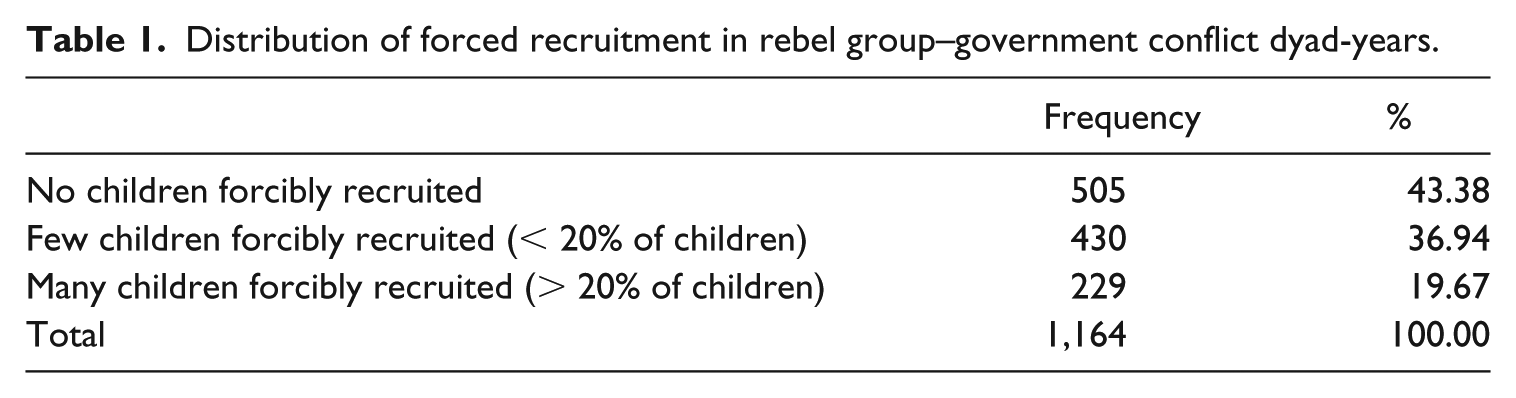
Table 1 provides the distribution of the level of forced recruitment of children by rebel groups. In total, 1164 rebel–government dyad-years are captured, with 505 (43%) seeing no forcible recruitment of children by rebels. In 430 observations (37%), the rebel group forcibly recruited fewer than 20% of the children in its ranks. In 229 cases (20%), the rebel group forcibly recruited more than 20% of the children active in its rebellion. The Naxalites in West India and Liberians United for Reconciliation and Democracy (LURD) are prominent examples of groups that forcibly recruited children on a large scale. In Figure 1, we provide a histogram displaying the distribution of rebels’ forced recruitment of children across the world’s regions. The figure shows some important “hot spots.” Of the 444 rebel–government dyad-year observations in Africa, 29% involved a high level of forcible recruitment of children. The Asian continent also saw high levels, with 21% of the total dyad-years characterized by a large portion of children forcibly recruited.
Distribution of forced recruitment in rebel group–government conflict dyad-years.
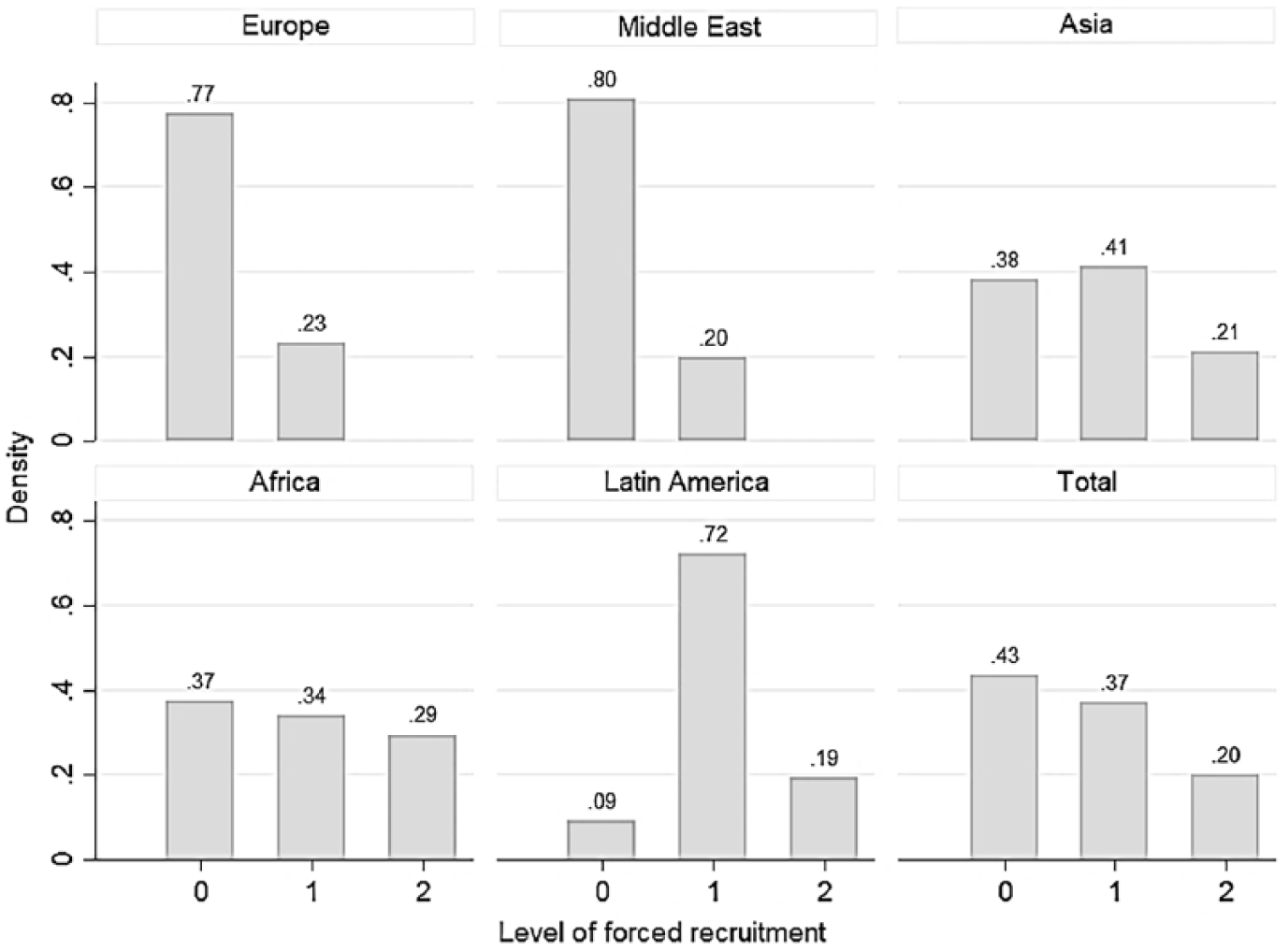
Distribution of forcible recruitment of children by rebel groups across regions.
Independent variables: Natural resource exploitation and “lootability”
To assess the influence of natural resource exploitation on rebel groups’ forced recruitment of children, we use variables from the Rebel Contraband Dataset (RCD) (Walsh et al., 2018). This data set codes yearly information on rebels’ exploitation of more than 20 natural resources from 1990 to 2012. For our purposes, this data set has several advantages over existing data on natural resources and conflict (Fearon, 2004; Gilmore et al., 2005; Lujala et al., 2007; Lujala, 2010; Rustad and Binningsbø, 2012). Most importantly, instead of assuming that groups operating in resource-rich areas have access to those resources, the RCD provides specific information about whether a rebel group actually exploited natural resources in a given year. This is important because rebel groups sometimes operate in resource-rich areas without actually profiting from those resources, as seen with some armed groups in eastern Congo (Seay, 2014).
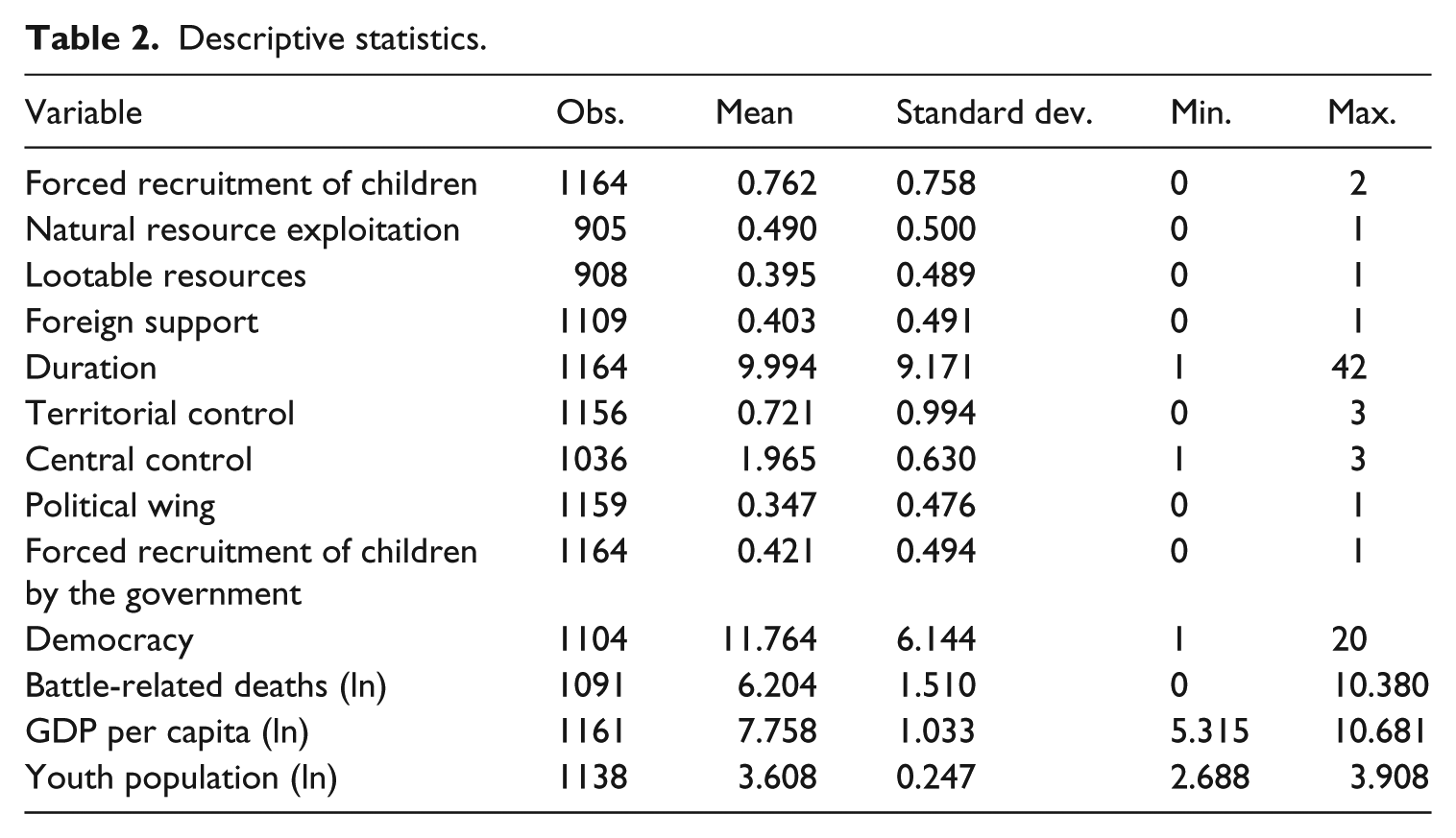
To test our first hypothesis, we use a dichotomous measure from the RCD of Natural resource exploitation, which takes a value of 1 for any year in which a rebel group profited from the exploitation of any natural resource, and 0 if it did not. As shown in the descriptive statistics in Table 2, rebel groups profited from natural resource exploitation in just 49% of the dyad-years in our data set, demonstrating that rebels often find ways to support their operations other than through natural resource revenues.
Descriptive statistics.
We also use the RCD to test our second hypothesis on the role of lootable resources. We construct a dichotomous variable, Lootable resources, that takes a value of 1 for any year in which the rebel group profited from the exploitation of lootable natural resources, and 0 if it did not. 15 In our analyses, both independent variables are lagged by one year, meaning that we estimate the effect of rebel exploitation of natural resources broadly and lootable resources specifically in one year on the forced recruitment of children by rebels in the following year. We do this in an effort to mitigate potential issues of endogeneity. 16
Control variables
We include several controls that have been shown to influence the (forcible) recruitment of children or a rebel group’s endowments (e.g. Beber and Blattman, 2013; Jo, 2015; Tynes and Early, 2015). These controls are especially vital for the empirical models given the risk of selection on observables. Most of the control variables speak directly to the supply/demand arguments of child soldiering common in the literature. 17
First, in line with Beber and Blattman (2013), we consider the possibility that foreign support may allow rebel groups to operate with impunity. Such support offers greater capabilities and, like natural resource exploitation, might reduce reliance on the civilian population (Weinstein, 2007). To control for this, we use the NSA’s measure of a rebel organization’s receipt of Foreign support (coded as 1) or lack thereof (coded as 0) (Cunningham et al., 2009, 2013).
Second, we control for the number of years that a rebel group has been active (Duration). The longer a group is active, the more likely it is to become desperate for victory, increasing the likelihood of forcibly recruiting children. This variable also comes from the NSA data set (Cunningham et al., 2009, 2013) and accounts for other temporal dependencies. 18
Third, some scholars have suggested that when rebel groups endure significant battle losses, they will forcibly recruit children in an attempt to replenish their numbers (Haer and Böhmelt, 2017; Singer, 2006). To control for this desperation effect, our models include a measure of the natural logarithm of Battle-related deaths from the UCDP Battle-Related Deaths Dataset (Gleditsch et al., 2002). This includes all deaths due to battle-related events between warring parties in a given year.
Fourth, one implicit assumption in the literature on rebel group behavior is that when leaders of rebel groups are unable to control their members, organizations become more likely to commit human rights abuses (Weinstein, 2005). Indirectly, this reasoning implies that leadership strength might influence the level of forcible recruitment of children. To control for this factor, we include an indicator of Central control from the NSA data set (Cunningham et al., 2009, 2013). This ordinal variable captures the strength of control exhibited by a group’s leadership and ranges from a low level of control (coded as 1) to a high level of control (coded as 3).
Fifth, scholars have argued that the extent to which a rebel group is “legitimacy-seeking” may influence its propensity to be violent toward civilians (Jo, 2015; Lasley and Thyne, 2015). If a rebel group wants to be recognized internationally, it should be less likely to perpetrate serious human right abuses. One variable often used as an indicator of “legitimacy-seeking” is whether a rebel group has a Political wing. To control for its possible influence on the forced recruitment of children, we use the NSA measure, which records the presence (coded as 1) or absence (coded as 0) of a political wing within the rebel group (Cunningham et al., 2009, 2013).
Sixth, we include a variable indicating whether a rebel group effectively controls territory. Also from the NSA data set, this measure ranges from no territorial control (coded as 0) to a high level of control (coded as 3) (Cunningham et al., 2009, 2013). Having Territorial control may provide rebels access to a variety of valuable material and human resources. It can facilitate training complexes, headquarters, and so on, and may make it easier to recruit adolescent fighters (Kubota, 2013). This factor can be seen as both a supply and demand variable.
Seventh, rebels’ decision to coercively recruit children might be influenced by the actions of the government against which it is fighting, and particularly whether government forces also engage in the forced recruitment of children (Tynes and Early, 2015). To control for the effect of the Forcible recruitment of children by the government, we coded whether a government (i.e. the national army, police, or paramilitary organizations connected to the government) forcibly recruited children (coded as 1) or not (coded as 0) in a given year. In coding this variable, we employed a similar coding procedure as was used to capture our main dependent variable. 19
Finally, our models include standard supply-side variables that are frequently used in analyses of child soldiers and of armed conflict more broadly. These include the level of democracy in the state, although the expected influence on forced child recruitment is unclear (Lasley and Thyne, 2015). As a measure of Democracy, we use polity2 from the Polity IV data set (Marshall and Jaggers, 2004). This variable ranges from −10 (full autocracy) to +10 (full democracy). For the analyses, we have transformed it to a 0 to 20 scale. 20 We also include Gleditsch’s (2002) measure of the natural logarithm of a state’s gross domestic product per capita (GDP per capita) to account for the fact that children might be more likely to join armed groups in poorer countries (Tynes, 2011; Tynes and Early, 2015). Additionally, we incorporate a measure to account for the general supply of children within a country. To do so, we use the natural logarithm of the Youth population indicator provided by the World Bank. 21 As Dallaire (2011) argues, overpopulation makes children “cheap” recruits. The descriptive statistics are displayed in Table 2. 22
Analyses
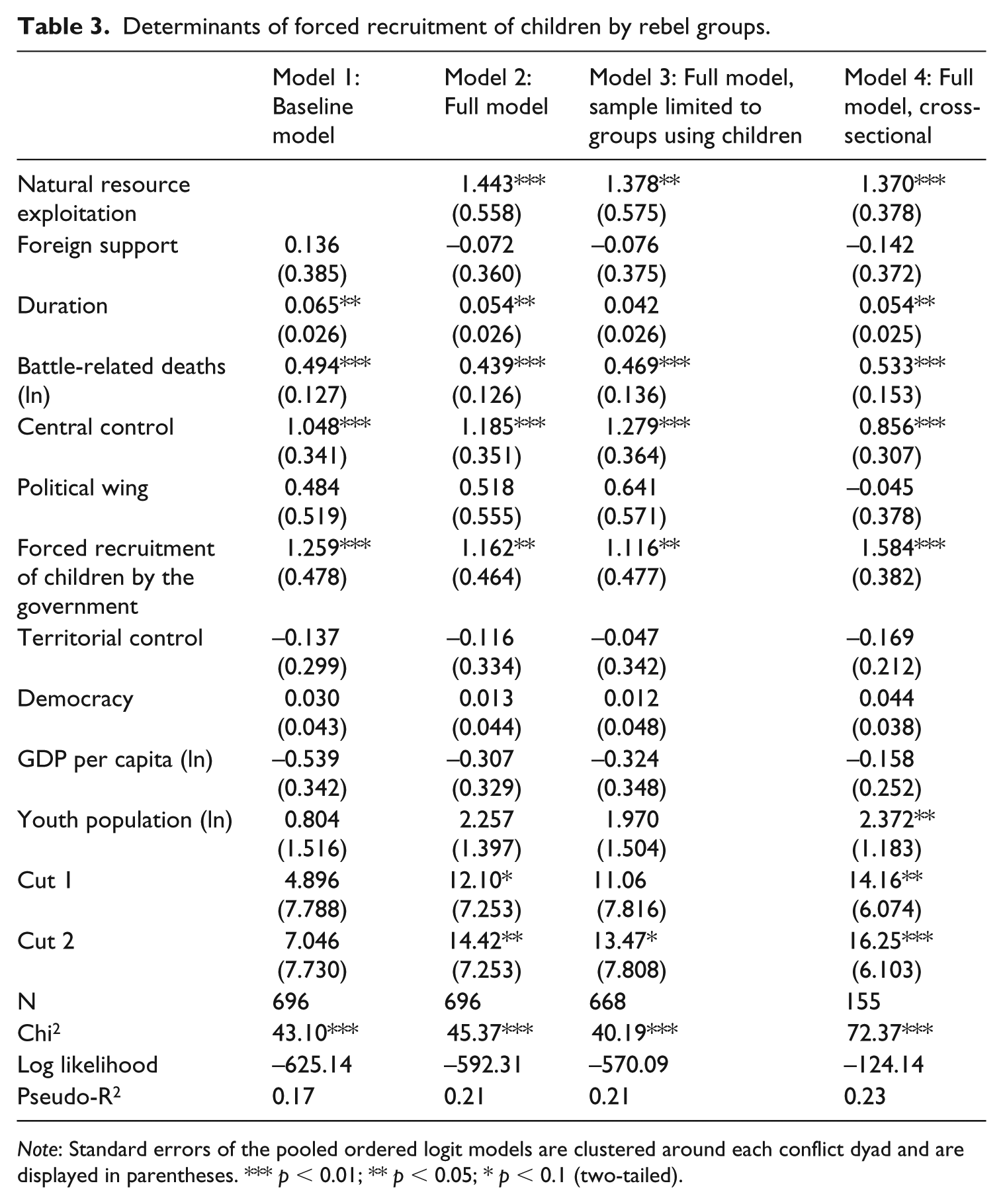
Given the ordinal nature of our dependent variable, we employ ordered logistic regression analysis with standard errors clustered by rebel–government dyads to account for the lack of independence among annual observations. Table 3 presents the results of four models. Model 1 is a baseline model that includes control variables related to the supply and demand sides of forced recruitment of children by rebel groups. Using the same dyad-year observations as the baseline, 23 Model 2 then adds the variable for rebel natural resource exploitation to assess its influence on forced recruitment. Model 3 includes the same variables but limits the sample only to rebel groups that use child soldiers, thus allowing us to focus specifically on the recruitment strategy. Model 4 also includes the same variables but adopts a cross-sectional approach in which the unit of analysis is the conflict dyad-period in which a rebel group is active.
Determinants of forced recruitment of children by rebel groups.
Note: Standard errors of the pooled ordered logit models are clustered around each conflict dyad and are displayed in parentheses. *** p < 0.01; ** p < 0.05; * p < 0.1 (two-tailed).
Regardless of model specification, rebel natural resource exploitation has a positive and statistically significant relationship with the forced recruitment of children. In other words, rebel groups that profit from natural resources are significantly more likely than groups that do not profit from natural resources to forcibly recruit children. This lends support to our first hypothesis. Moving through model specifications, Model 1 examines the effect of the supply- and demand-side control variables. It shows statistically significant effects of duration, battle-related deaths, central control, and the forced recruitment of children by the government on the likelihood of forcible recruitment of children by rebel groups. Consistent with our expectations, the longer an armed group is active and the more intense the conflict in terms of battle-related deaths, the more likely the rebel group is to forcibly recruit children. Additionally, the forced recruitment of children by governments is associated with significantly more forced child recruitment by rebels, mirroring the results of Tynes and Early (2015). Model 1 also shows that rebel groups with a strong central command structure are more likely to forcibly recruit children. This runs counter to previous work and is an indication that the forcible recruitment of children might be a conscious strategy of the rebel group’s leadership. Other demand factors, such as foreign support, having a political wing, and territorial control, are not statistically significant. Furthermore, consistent with recent literature showing that supply-side variables do little to explain variation across rebel groups in the use of child soldiers, none of the variables solely related to the supply side (democracy, GDP per capita, and youth population) reach traditional levels of statistical significance.
Building on the baseline, Model 2 adds our primary independent variable of interest: rebel natural resource exploitation. The results show a positive and highly significant relationship between natural resource exploitation and the level of forced recruitment of children by rebels, even as the effects of the control variables remain consistent. Moreover, the log likelihood and pseudo-R2 values suggest that the introduction of the natural resource variable in Model 2 increases its explanatory power substantially over the baseline model (Model 1). Figure 2 graphs the substantive effects, that is, the first difference estimates, based on this full model. These estimates depict the change in the predicted probability of observing the forced recruitment of children (in contrast to not observing any forced recruitment, i.e. the dichotomous version of our dependent variable) as each explanatory variable increases from its minimum value to its maximum value, holding all the remaining explanatory variables constant at their median (King et al., 2000). The figure shows that the probability of forced child recruitment increases by 41 percentage points when a group profits from natural resources as compared to groups that do not profit from such resources.
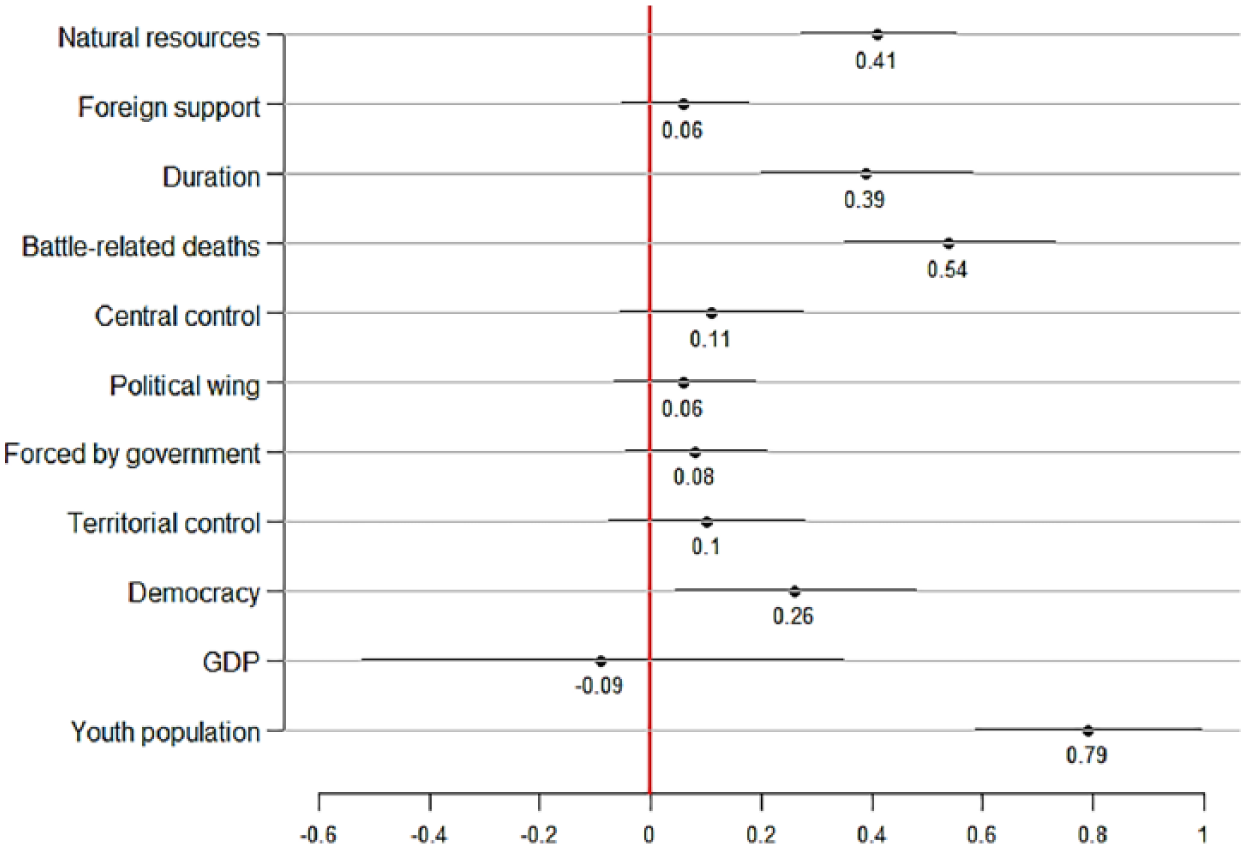
Substantive impact on the (dichotomous) forced recruitment of children.
It is important to note that in Models 1 and 2, our comparison category (i.e. a value of “0” on the dependent variable) is “no forced recruitment.” Practically, this can mean two things: a rebel group may have recruited children but did so solely on a voluntary basis or the group did not recruit any children. To focus specifically on the question of forced as opposed to voluntary recruitment, Model 3 limits the sample to rebel groups that use child soldiers regardless of their recruitment strategy. The results are largely consistent with previous models. Most importantly, among rebel groups that use child soldiers, those that exploit natural resources are significantly more likely to have forcibly recruited these children than groups that do not profit from natural resources. This suggests that natural resource exploitation has a particular relationship with the forced recruitment of children, as explored in our theoretical discussion, beyond any relationship with the use of child soldiers in general.
Our first three models employed the conflict dyad-year as the unit of analysis, allowing us to lag our independent variables and account for year-to-year variation in their values. However, our dependent variable changes only across conflict periods due to the difficulty of coding annual changes. To account for this, we also calculated a cross-sectional model using the rebel group–government conflict dyad-period as the unit of analysis. Model 4 shows these results, which are robust to previous model specifications. Most importantly, rebel natural resource exploitation exhibits a positive and statistically significant relationship with the forcible recruitment of children. 24
An interesting result in Models 2 through 4 is that the coefficient for foreign support is negative, suggesting that rebel groups that receive foreign support are less likely to forcibly recruit children, though the finding is not statistically significant. 25 If we consider foreign support as another source of funding for rebels that reduces dependence on civilians, similar to natural resources, we may expect a positive coefficient. However, there are at least two key differences between these sources of funding. First, rebel groups that receive foreign support are often under pressure from their donors to behave in certain ways (Salehyan et al., 2014). In some cases, this may include pressure to avoid human rights violations that could attract unfavorable attention, including the forced recruitment of children. Foreign support may function more like civilian support under such circumstances. Second, while foreign support is not dependent on specific forms of recruitment, children can actually play a role in the exploitation of lootable resources, as discussed earlier.
To explore in more detail the relationship between natural resources and the forced recruitment of children by rebels, we test the distinction between lootable and non-lootable resources, as articulated in our second hypothesis. We present these results in Table 4, along with the first-difference estimates using the binary version of our dependent variable in Figure 3. Model 5 shows that exploiting lootable resources in particular has a positive and statistically significant relationship with the forced recruitment of children. In other words, rebels that profit from lootable resources are more likely to forcibly recruit children than groups that do not profit from lootable resources. The first-difference point estimate suggests that exploiting lootable resources increases the probability that a group will engage in the forcible recruitment of children by 27 percentage points.
The influence of “lootability” on the forcible recruitment of children.
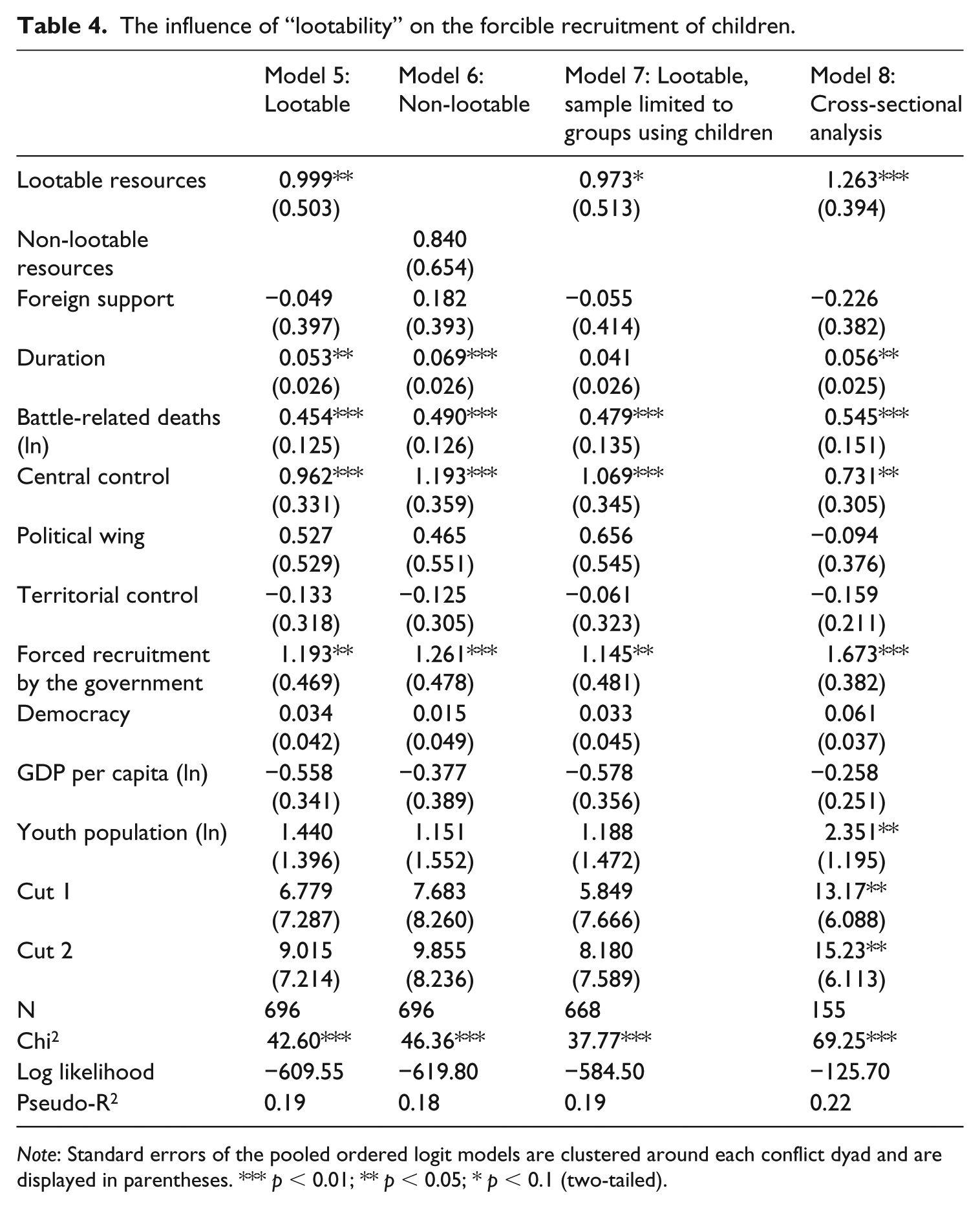
Note: Standard errors of the pooled ordered logit models are clustered around each conflict dyad and are displayed in parentheses. *** p < 0.01; ** p < 0.05; * p < 0.1 (two-tailed).
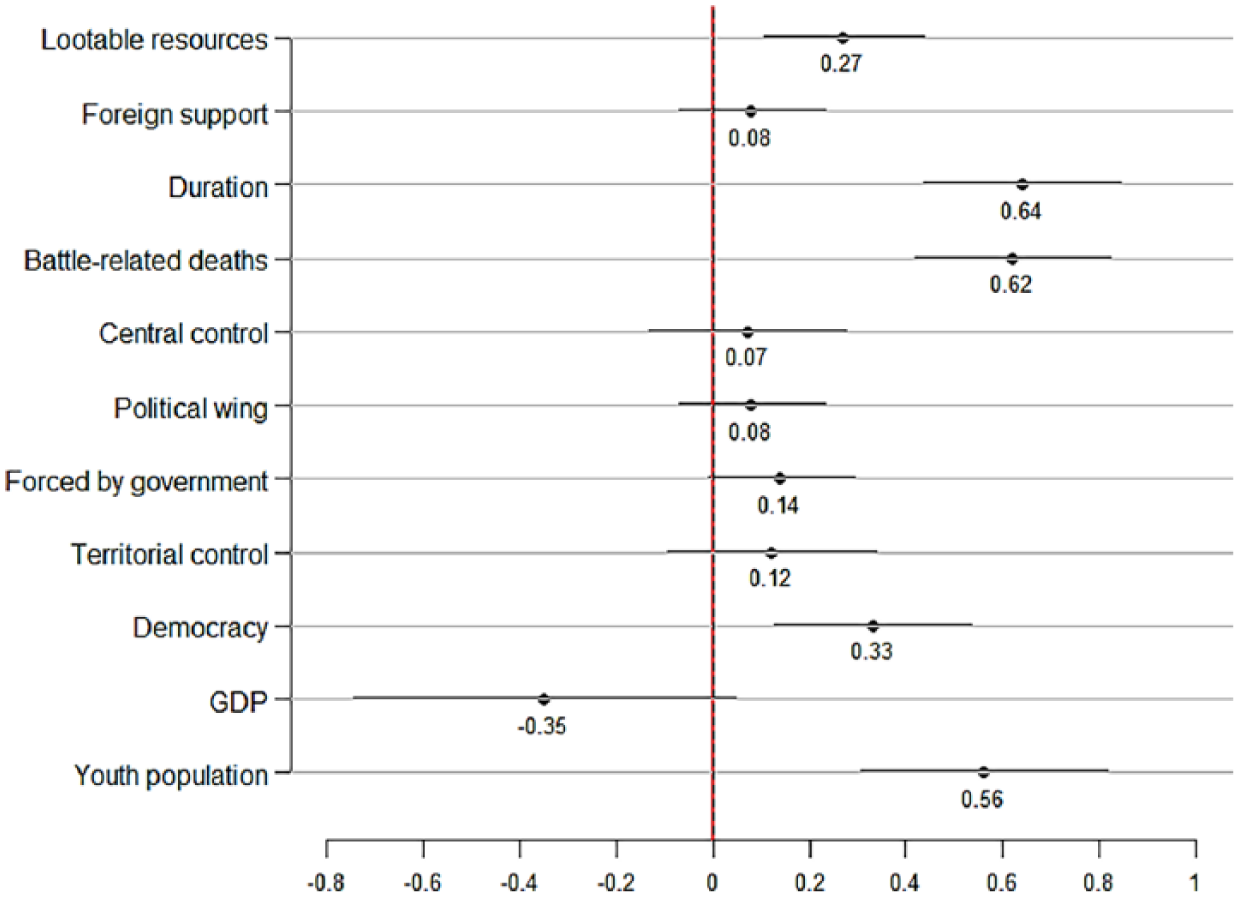
Substantive impact on the (dichotomous) forced recruitment of children.
Model 6 tests the influence of rebel exploitation of only non-lootable resources (such as oil and kimberlite diamonds) on the likelihood of forced child soldiering. Although the coefficient for non-lootable resources is positive, it is not significant, which is consistent with our hypothesis. Rebel groups that profit from lootable resources are more likely to forcibly recruit children, while groups that only profit from non-lootable resources are not statistically more likely to engage in such behavior. As previously suggested, one explanation could be that to successfully exploit non-lootable resources, rebels must rely on more cooperation from the local population, making collaborative relationships more beneficial and incentivizing the restraint of abusive behaviors. Extracting non-lootable resources also requires more skill than child laborers typically can provide, so there is no increase in demand as there may be for extracting lootable resources. The control variables behave in a similar fashion to previous models.
Model 7 shows the effect of lootable resource exploitation on the forcible recruitment of children across the subsample of rebel groups in which child soldiers are present, once again allowing us to focus specifically on the strategy of forced recruitment. The positive and significant coefficient for lootable natural resources suggests that even among groups using child soldiers, those that profit from lootable natural resources are more likely to have used some degree of coercion when recruiting these children. Lootable resource exploitation is thus associated with a higher likelihood of the forced recruitment of children even when limiting the analysis to rebel groups that are already inclined to use children.
Model 8 reports the cross-sectional results for the relationship between lootable resource exploitation and the forcible recruitment of children by rebel groups. As with the last model in Table 3, the unit of analysis is the conflict dyad-period in which the rebel group is active. Once again, lootable resource exploitation is associated with an increased likelihood of rebels forcibly recruiting children to be used as soldiers.
Overall, these analyses highlight an important but often overlooked influence on rebels’ coercive recruitment of child soldiers: the exploitation of natural resources. Our findings are robust across a series of model specifications 26 and demonstrate a strong association between natural resource exploitation and the likelihood that a group will engage in the forced recruitment of children. Lootable resources in particular are associated with a higher propensity for rebel groups to forcibly recruit children. These findings suggest the need for additional research on how natural resource characteristics and exploitation strategies influence forced recruitment and conflict dynamics more broadly.
Conclusion
Existing studies on child recruitment in armed conflicts have been primarily concerned with the conditions influencing their voluntary participation or on the characteristics of children that make them desirable to rebel groups. In focusing on these factors, the literature has largely ignored the fact that children are often forced to join these groups. While many studies have alluded to the regularity of forcible recruitment practices (Beber and Blattman, 2013; Eck, 2014; Gates, 2017), existing literature does not explore why certain rebel groups choose to forcibly recruit children on a large scale while others generally refrain from this recruitment strategy.
Using newly compiled data on rebels’ forcible recruitment of children, this article offers a first attempt to systematically examine this variation. Specifically, we explore the influence of one hypothesized determinant of recruitment strategy: a rebel group’s exploitation of natural resources. We argue that rebel groups profiting from natural resources are more likely to forcibly recruit children because they are less dependent on civilians and thus face fewer incentives to restrain abusive behavior. Moreover, these groups may attract a larger portion of adults who want to maximize the personal benefits of participation by forcibly recruiting “low-cost” children. Our analyses confirm our primary hypothesis. Additionally, the specific characteristics of a resource matter for the degree of forced child recruitment. We show that rebel groups engaged in the exploitation of lootable resources are significantly more likely to adopt forcible recruitment tactics as compared to groups that exploit only non-lootable resources or no resources at all.
This article sheds light on the relationship between rebels’ exploitation of natural resources and forcible recruitment tactics, but further research is needed to overcome some of our limitations. Our main argument linking the resource base of a rebel group to the level of forcible recruitment is not child-specific per se. We argue that children are more likely to be forcibly recruited than adults, but one can also apply elements of our argument to the adult population. A lack of data on the forced recruitment of adults impedes such an investigation. As such, we test one specific theoretical constellation. In addition, Weinstein (2005, 2007) has argued that the initial endowments of a rebel group help to determine its recruitment strategy. Our current measure of resource exploitation accounts only for resources exploited once a group has become embroiled in conflict. As discussed earlier, one important limitation of the data is that our dependent variable is unable to fully account for annual temporal variation in the forced recruitment of children by rebel groups or to identify exactly when this recruitment strategy first begins, making it difficult to determine a direct causal effect between natural resources and the level of forced recruitment. Future research should focus on investigating this relationship over time, including by conducting in-depth qualitative analyses of individual rebel groups. 27 Finally, future research should examine the consequences of rebels’ forced recruitment of children. Armed groups that forcibly recruit children on a large scale may behave differently on the battlefield than groups that refrain from doing so. Coercion could provide a poor organizational base for rebellion in the short run, for example, possibly affecting battlefield performance.
Concerning policy implications, our work highlights the importance of identifying rebel revenue streams in an effort to better predict the types of groups that will engage in abusive and coercive behavior. We have shown that resource-rich rebels are significantly more likely to forcibly recruit children at high levels, raising concerns about the second- and third-order effects not only on the conflict itself, but also on children who have experienced this life-altering event. Among other possible responses, the international community can seek to make it more challenging for rebels to profit from the commodities they exploit, particularly those for which they need children. While certain commodities (i.e. those that are illegal) are more difficult to police than branded manufactured goods, markets can usually identify the origins in the process of determining the quality (Collier, 2000). Efforts such as the Kimberley Process, although imperfect, have helped inhibit the flow of conflict diamonds and curtail rebels’ demands for laborers, including children. Of course, the international community will never be able to halt the illicit economy in its entirety, but opportunities exist to force illicit activities to the fringe of markets. Rebels might then be compelled to sell their products at deep discounts or not at all, thereby rendering the forcible recruitment of children a less lucrative endeavor (Collier, 2000).
Supplemental Material
EJT850622_supp_mat – Supplemental material for Rebel funding and child soldiers: Exploring the relationship between natural resources and forcible recruitment
Supplemental material, EJT850622_supp_mat for Rebel funding and child soldiers: Exploring the relationship between natural resources and forcible recruitment by Roos Haer, Christopher Michael Faulkner and Beth Elise Whitaker in European Journal of International Relations
Footnotes
Acknowledgements
We thank Fredrika Moberg, Lars Janssen, and all the participants of the Jan Tinbergen Conference 2017, the AK-Methoden workshop 2017, the workshop on New Perspectives on the Micro-Dynamics of Political Violence 2017, the Amsterdam Conflict Club 2018 meeting, and the annual International Studies Association 2018 meeting for their insightful comments. Additionally, we would like to thank the reviewers for their suggestions. We are especially grateful to Scott Gates and Clifton Morgan for their help and support.
Funding
The author(s) disclosed receipt of the following financial support for the research, authorship, and/or publication of this article: This material is based in part on work supported by the US Army Research Office through the Minerva Initiative under grant number W911NF-13-0332. The views expresed in this article are the authors’ and should not be attributed to the US Institute of Peace, which does not advocate specific policy.
Supplemental material
Supplemental material for this article is available online.
Notes

Author biographies
References
Supplementary Material
Please find the following supplemental material available below.
For Open Access articles published under a Creative Commons License, all supplemental material carries the same license as the article it is associated with.
For non-Open Access articles published, all supplemental material carries a non-exclusive license, and permission requests for re-use of supplemental material or any part of supplemental material shall be sent directly to the copyright owner as specified in the copyright notice associated with the article.
