




Abstract
Since the failures of the United Nations of the early 1990s, the protection of civilians has evolved as a new norm for United Nations peacekeeping operations. However, a 2014 United Nations report found that while peacekeeping mandates often include the use of force to protect civilians, this has routinely been avoided by member states. What can account for this gap between the apparently solid normative foundations of the protection of civilians and the wide variation in implementation? This article approaches the question by highlighting normative ambiguity as a fundamental feature of international norms. Thereby, we consider implementation as a political, dynamic process where the diverging understandings that member states hold with regard to the protection of civilians norm manifest and emerge. We visualize this process in combining a critical-constructivist approach to norms with practice theories. Focusing on the practices of member states’ military advisers at the United Nations headquarters in New York, and their positions on how the protection of civilians should be implemented on the ground, we draw attention to their agency in norm implementation at an international site. Military advisers provide links between national ministries and contingents in the field, while also competing for being recognized as competent performers of appropriate implementation practices. Drawing on an interpretivist analysis of data generated through an online survey, a half-day workshop and interviews with selected delegations, the article adds to the understanding of norms in international relations while also providing empirical insights into peacekeeping effectiveness.
Keywords
Introduction
In principle, the protection of civilians (PoC) plays an increasing role in United Nations (UN) peacekeeping. As a direct result of the failures of Rwanda and Bosnia-Herzegovina, the mandates of 90% of UN peacekeeping operations now include PoC, including the use of force to protect civilians ‘under imminent threat of physical violence’ (Security Council, 1999: 14). PoC has become a norm, defined as an intersubjective standard of appropriate behaviour (based on Finnemore, 1996: 22–23; Klotz, 1995: 451; Zimmermann, 2016: 98) of peacekeeping. It stands alongside peacekeeping’s ‘traditional’ norms and may even supersede them: the 2015 High-Level Independent Panel on Peacekeeping Operations (HIPPO) explicitly noted that impartiality, consent of the parties and the limited use of force ‘should never be an excuse for failure to protect civilians’ (United Nations, 2015b: 12).
Since 1999, when the UN mission in Sierra Leone (UNAMSIL) became the first to include PoC in its mandate, the norm has been well institutionalized across doctrinal and operational peacekeeping documents (Hultman, 2013; United Nations, 2017). This institutionalization contrasts with PoC’s implementation record, especially regarding the use of force. In 2014, a report by the UN Office of Internal Oversight Services found that ‘the use of force … appears to have been routinely avoided as an option by peacekeeping operations’ to protect civilians (General Assembly, 2014: 1). This is despite the UN continuously giving guidance on how the norm could be operationalized and implemented to enhance the effectiveness of peacekeeping in reaching stated objectives and to remove confusion and conflicting understandings (United Nations, 2015a, 2017). How can we make sense of the gap between the apparently solid normative foundations of PoC and the wide variation in implementation?
Many constructivist approaches to norms are interested in implementation primarily in relation to monitoring compliance. Implementation, according to this view, follows a top-down approach, and authors identify sources of constraint, such as domestic veto players or a lack of capacity (Jacobsen and Brown Weiss, 2000; Risse et al., 2013). A simple explanation for the wide variation in implementing the PoC norm could be that national contingents lack capacity: reports have repeatedly concluded that troops on the ground have not been given sufficient pre-deployment training to understand how they should act in different scenarios (Blyth and Cammaert, 2016; Holt and Taylor, 2009; United Nations, 2015b). Contingents are also frequently deployed lacking even basic equipment or the ability to take a proactive posture and to conduct flexible and decentralized missions in their areas of operation (e.g. Dos Santos Cruz et al., 2017). While these perspectives shed some light on PoC implementation on the ground, they do not account for dynamics at different levels of implementation (e.g. at the intermediary dimension in New York). They also work with limiting assumptions about supposedly stable normative content in portraying implementation as a top-down process.
Norm contestation scholars have criticized such sequential models by pointing to diverging understandings of norms, subsuming these under the theme of contestation (Dixon, 2017; Jose, 2017; Wiener, 2014). Open contestation, typically conceptualized in contentious terms (Wiener, 2009: 176; 2017: 123), may therefore lead to gaps in implementation. However, what if actors concerned with implementing a particular norm hold and follow different understandings of what this norm means without contesting either the norm or its relevance? In speaking to this question, we make three contributions to norm research and practice theories in International Relations (IR), as well as an empirical contribution to the peacekeeping literature.
First, most international norms, even if they are institutionalized in UN Security Council (UNSC) resolutions or other soft and hard law, are inherently ambiguous. This is often the premise for having achieved compromise. States can then continue to hold different understandings of what particular norms mean without contesting them. While critical norm research starts from this premise of norm ambiguity (Hansen, 2015: 196–197; Krook and True, 2012: 104; Sandholtz, 2008: 101; Van Kersbergen and Verbeek, 2007: 221; Wiener, 2004: 198), it does not integrate it fully into analysing norms. The logic of contestation implicitly accepts that there is a kernel of shared normative meaning that can be contested (see Niemann and Schillinger, 2016: 30). If normative meaning is ambiguous in the first place, different understandings of norms are built into the norm and therefore remain present. This reasoning corresponds to arguments made by critical law scholars, highlighting the indeterminate nature of international law (Brunnée and Toope, 2013; Koskenniemi, 2011). We should therefore expect a constant diversity of normative meaning and consider how to ‘theorize with th[is] unfixity’ (Epstein, 2013: 501) rather than assuming a stable normative structure that makes it straightforward to evaluate the behaviour of others.
Second, we argue that different understandings of norms are likely to manifest themselves and emerge in differing implementation practices. Here, states are faced with a multitude of contextual specificity (Sandholtz, 2008), combining their understanding(s) of the norm, how these should be applied in particular circumstances and the experience of conflictual norm-scapes (see also Karlsrud, 2016). Not only is normative meaning ambiguous, but there are also often conflicting norms that states could follow that come with diverging understandings of appropriateness. We show that particular understandings of the PoC norm for some states come into conflict with understandings related to the traditional norms of impartiality, consent of the parties and the limited use of force. Implementation practices are thus key to understanding normative meaning(s). Constructivist scholarship has long highlighted the productive nature of practices (Guzzini, 2000; Onuf, 1982; Reus-Smit, 1997). These insights have also found their way into norm research (Wiener, 2004). However, such conceptualizations remain (empirically) under-specified (see Wendt, 1994). With the practice turn, a diverse theoretical programme has evolved that enables a closer conceptual integration of practices into studying normative meaning (see Bueger and Gadinger, 2015). Further, while practice theories initially associated practices primarily with reproduction (Sundaram, 2017: 140), recent contributions highlight their analytical potential for examining dynamics of change (Bode, 2018b; Bode and Huelss, 2018; Hopf, 2017).
Practices are patterned actions in social context (Leander, 2008: 18) that allow us to study concrete empirical phenomena such as actors’ diverging understandings regarding the substance of particular norms. Considering differentiated implementation through practices therefore renders this process analytically approachable and visible. This type of analysis recasts the process of implementation as a site where normative content emerges through practices rather than considering it as technical or apolitical (see Sullivan, 2017). This supports critical scholarship on norms in IR (Krook and True, 2012; Sandholtz, 2008) as we see normative content manifesting and emerging through implementation practices, rather than considering norms (like PoC) as already ‘fixed’ or shared once they have been adopted and institutionalized in UNSC resolutions or other official UN documents.
Third, in examining how different understandings of the PoC norm emerge in implementation practices, we focus on a particular group and site where such understandings are voiced: military advisers to the permanent delegations of the UN in New York. Theories on norm localization make important arguments about how norms are differentially instantiated (Acharya, 2004, 2009; Zimmermann, 2016), but they focus on national implementation rather than on the state-based understandings of international norms in the international setting of peacekeeping that we are interested in. Localization therefore highlights the agency of local/regional actors in the Global South in implementation processes, but it still refers to these actors as ‘norm-takers’ (Acharya, 2004: 240). This implies that they have limited immediate agency in processes of norm-making at the international level. Such agency considerations change if we assume that ambiguity has already been built into international norms, such as PoC, at the international level, including by actors of the Global South.
The implementation of the PoC norm is a multifaceted process covering diverse levels, such as national ministries, national representatives to the UN in New York and national contingents at the field level. We focus on one link in this process by considering the role that military advisers play in between national ministries and the field. Military advisers not only provide advice and analysis to the UNSC and conduct most of the negotiations in developing the doctrine for UN peacekeeping, but are also involved in the planning, budgeting, implementation and evaluation of operations. Although these actors are commonly expected to execute decisions made by national ministries of defence and foreign affairs, in reality, those ministries are thinly staffed for substantive issues like PoC. That often provides New York-based diplomats, including military advisers, with considerable room for manoeuvre, especially in filtering information and deciding the content and form of reports to their capitals (Faizullaev, 2014; Karlsrud, 2013; Schia, 2017). They are pivotal agents of norm implementation, thereby reintroducing meaningful instances of agency into implementing norms from the international level onwards (see Bucher, 2014).
Finally, the article makes a substantial empirical contribution to the literature on UN peacekeeping, and especially questions of effectiveness (see Autesserre, 2010; Bove and Ruggeri, 2016; Druckman and Diehl, 2013; Fortna, 2007; Howard, 2008; Hultman et al., 2013; Karim, 2017). We collected data on troop contributors’ attitudes towards PoC, as seen by military advisers, through an online survey (during September 2015), a workshop (during November 2015) and expert interviews (during June 2016). Such information can provide indications of the extent to which understandings of PoC are diverse or shared among major contributors, offering a solid foundation for debate on how PoC mandates will be put into practice in the future.
The remainder of the article is organized as follows: first, we describe the deliberative normative development of the PoC norm and its disconnects in implementation. Second, we expand our theoretical contribution by conceptualizing norm implementation via practice theories and examining the role of military advisers. Here, we also reflect briefly on our methodology, while including a longer discussion in Appendix I. Third, we demonstrate how the institutionalized form of the PoC norm remains ambiguous, therefore allowing for diverging normative understandings to coexist in implementation practices and the role of military advisers therein. In the final section, we sum up and draw conclusions.
The PoC norm in peacekeeping doctrine and its disconnects
Originally designed to create buffer zones between conflict parties in inter-state conflicts once a ceasefire was in place, since the 1990s UN peacekeeping has been involved in more complex intra-state conflicts. These new settings have brought peacekeepers into closer contact with civilian populations and, with ceasefires rarely in place or secure, have created protection expectations. The responses of peacekeeping to this new environment have been varied, as shown by the UN Assistance Mission in Rwanda. Most contingents were withdrawn following a UNSC decision to reduce mission size in the midst of the Rwandan genocide. However, the UN Force Commander with Ghanaian contingents of about 400 troops stayed behind (Kimenyi and D’Amour Mbonyinshuti, 2015). Using means such as negotiation and a safeguarding shelter in a football stadium, the Ghanaian contingents were able to protect thousands of civilians in a very difficult situation. The doctrinal failures of the 1990s triggered a rethinking of UN peacekeeping, which has, since UNAMSIL in 1999, increasingly included PoC among the mandated tasks. Of the 14 peacekeeping missions deployed in 2018, five have PoC as their main objective, while another five were charged with protecting civilians among other tasks. Indeed, most peacekeeping operations mandated since UNAMSIL have included PoC mandates. Given this fact, as well as numerous UNSC resolutions on PoC, indicating a growing normative foundation (Breakey, 2014; Hultman, 2013), we may safely say that PoC has become firmly embedded as a peacekeeping norm.
Yet, the increasing complexity and variation across different missions has contributed to differing understandings as to how PoC should be implemented on the ground. In 2009, a study found that ‘the UN Secretariat, troop- and police-contributing countries, host states, humanitarian actors, human rights professionals, and the missions themselves continue to struggle over what it means for a peacekeeping operation to protect civilians, in definition and practice’ (Holt and Taylor, 2009: 4). The study cited several factors contributing to this disconnect between UNSC mandates and practice: the UNSC and other peacekeeping decision-makers lack awareness of the nature and circumstances of the threats to civilians; interpretations differ among Secretariat officials at headquarters and in the field as to what the UNSC intended to do with certain mandates; and there have been gaps between policy guidance, planning and preparedness (Holt and Taylor, 2009).
The study also noted how work on bridging this disconnect ought to lead to the ‘provision of the requisite political support and resources by the Member States’ (Holt and Taylor, 2009: 5), and raised the issue of political will to engage in robust operations. However, this did not include in-depth examination of the different understandings among troop contributors as to the PoC norm and where to draw the limits to this activity in connection with other core peacekeeping norms. This is what we investigate in this article by conceptualizing how military advisers understand and reflect on the implementation of the PoC norm.
Concurrent with the rise of the PoC norm, there has been increasing criticism of missions being deployed to situations where there is no peace to keep (United Nations, 2000). The HIPPO report described a tendency to deploy UN peacekeeping to ‘conflict management’ settings — ‘violent settings without the enabling frameworks that have previously driven success’ — and advised that the UNSC should ‘define “success” more realistically in such settings’ (United Nations, 2015b: x, 28). A short-term definition of success could focus on protecting civilians and/or delivering humanitarian aid (Hultman, 2013; Kathman and Wood, 2016), rather than longer-term priorities, such as strengthening inclusive and participatory state institutions, for example, through security sector reform. Short-term definitions of peacekeeping success therefore lead to a stronger link between effectiveness and the readiness to use force in peacekeeping: ‘[c]ontingents must deploy with the necessary equipment and training and a clear understanding of the mission rules of engagement’ (United Nations, 2015b: 30). However, such multidimensional ‘conflict management’ missions are generally given lower chances of achieving longer-term success, for example, as defined in terms of comprehensive mandate implementation and long-term stability (e.g. Brosig and Sempijja, 2017; Druckman and Diehl, 2013; Howard, 2008). 1
Understanding where major troop and police contributors stand regarding ‘protecting civilians under the imminent threat of physical violence’ (Security Council, 1999) gained importance with a 2014 report on the implementation of PoC mandates (General Assembly, 2014). The report noted the inconsistent application of the use of force as a last resort to protect civilians, citing reasons such as ‘lack of willingness on the part of troop-contributing countries to put troops in danger’ (General Assembly, 2014: 14). Moreover, as Blyth and Cammaert (2016: 309) note, ‘there is a continuing lack of knowledge at all levels of command regarding the mission mandate and the rights and obligations to use force to protect civilians’.
Is there a general lack of willingness among troop contributors to use force, as a last resort but a critical option, to protect civilians? Do troop contributors show different degrees of willingness as regards using force? To answer these questions, we must access how states understand their role in implementing the PoC norm. Research so far has not been able to shed much light here. Although the International Peace Institute, for example, has published country profiles for several key troop-contributing countries (TCCs), these provide little information on where these stand on PoC and the use of force (e.g. Aubyn and Aning, 2013: 6). We hold that we can understand these apparent disconnects by considering the implementation practices surrounding the PoC norm by military advisers and what these mean for normative content.
The implementation of norms: A practice-based approach
Research on international norms has become a firm part of IR, associated with the second and third waves of constructivism. Authors in the second wave considered how norms emerge, the parameters of their promotion and acceptance, their often long periods of socialization, and their internalization (Finnemore, 1996; Keck and Sikkink, 1998; Risse et al., 1999). In contrast, authors in the third wave were interested in contestation, arguing that even though states signed up to the same documents enshrining particular norms, these were ‘contested by default’ (Wiener, 2009: 179). A growing number of studies explored contestation and, as a result, examined the processes of norm emergence and diffusion in more disrupted terms (Dixon, 2017; Krook and True, 2012).
Neither group of theorists has considered norm implementation as a differentiated process that continuously accounts for the diversity of normative content as a result of inherently ambiguous international norms. While second-wave constructivists recognized ambiguity, it was cast as something that should and could be avoided. Studies saw increasing the precision of normative meaning as conducive to ‘proper’ norm implementation by safeguarding against loopholes and a diversity of meaning (Chayes and Chayes, 1993: 198; Finnemore and Sikkink, 1998: 907; Legro, 1997). In contrast, contestation scholars have typically started from the assumption of ambiguous norms (Krook and True, 2012; Van Kersbergen and Verbeek, 2007; Wiener, 2004).
Yet, none of these studies has integrated ambiguity as a constant and wide-reaching characteristic of all normative content. Wiener’s (2017: 113) theory of contestation, on the one hand, highlighted norm ambiguity in pointing to ‘enacted normative meanings-in-use’. On the other hand, in differentiating between three types of norms — fundamental norms, organizing principles and standards/regulations — Wiener (2017: 119) assumed that standards/regulations are less contested because these are ‘most clearly defined’ and ‘most detailed’. This arguably replicates second-wave assumptions about the possibility of increasing precision. The logic of contestation implies that a basic, shared understanding of a norm exists that can be contested in the first place: ‘contestation involves the range of social practices which discursively express disapproval of norms’ (Wiener, 2017: 112). However, what is this substance that can be contested, originally, if it is ‘contested by default’ (Wiener, 2009: 179)?
Recognizing the ambiguity of norms as constant and continuous finds echoes in critical legal scholarship dealing with the indeterminacy of international law. While much of the IR literature continues to treat international law as fixed and independently authoritative (Brunnée and Toope, 2013: 125), scholars here consider it as ‘an expression of politics’ that involves choice rather than simply ‘applying a pre-existing principle’ (Koskenniemi, 2011: v).
If we accept that norms are always ambiguous, each norm contains multiple meanings (Hansen, 2015: 194). Moreover, as ambiguity and different meanings are part of what a norm is, when actors revert to these different understandings in their implementation practices and anchor their understanding of the norm by referencing other norms (such as impartiality) within a conflictual norm-scape, they are not contesting it. By contrast, the contestation literature is infused with a vocabulary of rejection and struggle; it sees ‘normative meaning in crisis’ (Wiener, 2017: 123). However, we argue that ambiguous norms in a conflictual norm-scape cannot ever be ‘settled’ in content when their very design and presence allows for coexisting meanings (see Sandholtz, 2008).
While different meanings are thus always already there as a potential at the point of decision-making, we can see this when actors revert to them in their implementation practices. Norm localization argues that norms are differentially instantiated, but it focuses on national implementation rather than examining diverging understandings of international norms in international settings like UN peacekeeping. Changing the site is important because it challenges conceptions of who makes norms. Localization often comes with a critical, postcolonial element (Steele, 2017: 133), but in focusing on the regional/local levels only, it continues to cast actors outside the West as ‘norm-takers’ (Acharya, 2004: 240). Zimmermann (2016: 106), for example, accounts for the modification of international norms, but only through processes of translation at the local level. Yet, in areas such as UN peacekeeping, the practical contribution to norm-making by actors outside the West is strong due to their substantial and growing involvement in the practical implementation of norms at international sites. While African countries only contributed about 27% of the total amount of troops at the beginning of the 2000s, this number has today increased to 49% globally and 58% on the African continent (United Nations, 2018). 2 Their share is even higher in individual operations: African troops make up 70% of the UN stabilization mission in Mali (MINUSMA) (United Nations, 2018). Generally speaking, the shift towards stronger African participation is also reflected in stronger willingness to use force, although not as a uniform tendency (Karlsrud, 2018). These regional differences in implementation practices will therefore be important for the normative meaning(s) of PoC.
As discussed, because norms are inherently ambiguous, their meanings will manifest or emerge in implementation practices. Here, combining the theoretical insights from constructivist norms research and practice theories is helpful. Constructivist research has long addressed the significance of practices in constituting social life (Guzzini, 2000: 155), and practices have also featured in norm research (Wiener, 2004: 199). However, practices as a concept have remained under-specified (e.g. Onuf, 1982; Reus-Smit, 1997).
With the practice turn, studying practices has emerged as a dynamic theoretical agenda in IR. Practices result from how patterned actions are perceived and constructed in a social space and thereby ‘create meanings, objects and power relations’ (Leander, 2008: 18). Practice theories have produced innovative accounts of decision-making (Adler-Nissen and Pouliot, 2014; Bode, 2018b; Ralph and Gifkins, 2017), as well as of the substantial make-up of international relations (Adler and Pouliot, 2011; Bode and Huelss, 2018; Pouliot, 2016). Bueger and Gadinger (2015) differentiate between two major groups of practice theories: critical practice theories interested in repetition/reproduction; and pragmatic practice theories interested in fluctuation/contingency. Studying practices may therefore be useful for examining how constructions are made, reified or changed by visualizing the processes sustaining and therefore constituting international relations at the micro-level (Bode, 2018a: 105).
Recognizing normative understandings enshrined in international doctrines as ambiguous rather than solid, we can access how states understand particular norms in considering how they implement and reflect on norms, such as PoC, through practices. The ambiguous foundations of the PoC norm therefore help us to make sense of the wide variation in implementation. This captures a different approach to understanding what normative content is and where it comes from, thereby aligning itself with critical norm research without buying into the underlying logic of contestation. Rather than seeing normative content as enshrined in international documents and doctrines, we consider what happens ‘after decision-making’ (Huelss, 2017).
Despite this pluralist approach to normative meaning, states and their military advisers find themselves in (both materially and ideationally) hierarchically structured social spaces that have to be accounted for in analysing the implementation of the PoC norm. In other words, normative content is shaped in implementation but not all implementation practices are equally important. Practice scholarship has furthered this understanding of power that permeates diplomatic negotiations by highlighting the importance of perceived competence (Adler-Nissen and Pouliot, 2014; Ralph and Gifkins, 2017), competing authority claims (Sending et al., 2015) and background knowledge (Pouliot, 2008, 2016), and showcasing the overall dynamics of micro-level decisions (Bode, 2018b; Wiseman, 2015). First, in material terms, it is important to acknowledge the positions of actors in the peacekeeping architecture. When it comes to assessing the implementation practices of states around the PoC norm, only 73 out of 193 member states actually have designated military advisers. Further, those states contributing significant numbers of military personnel on the ground and/or contributing financially will likely carry particular weight. In this context, military advisers of the 20 most important TCCs, as well as those of the permanent five members of the UNSC (P-5), have prominent positions (see Table 1). These concerns served to limit the range of states that we examined most closely.
Top-20 TCCs and the P-5 (August 2015).
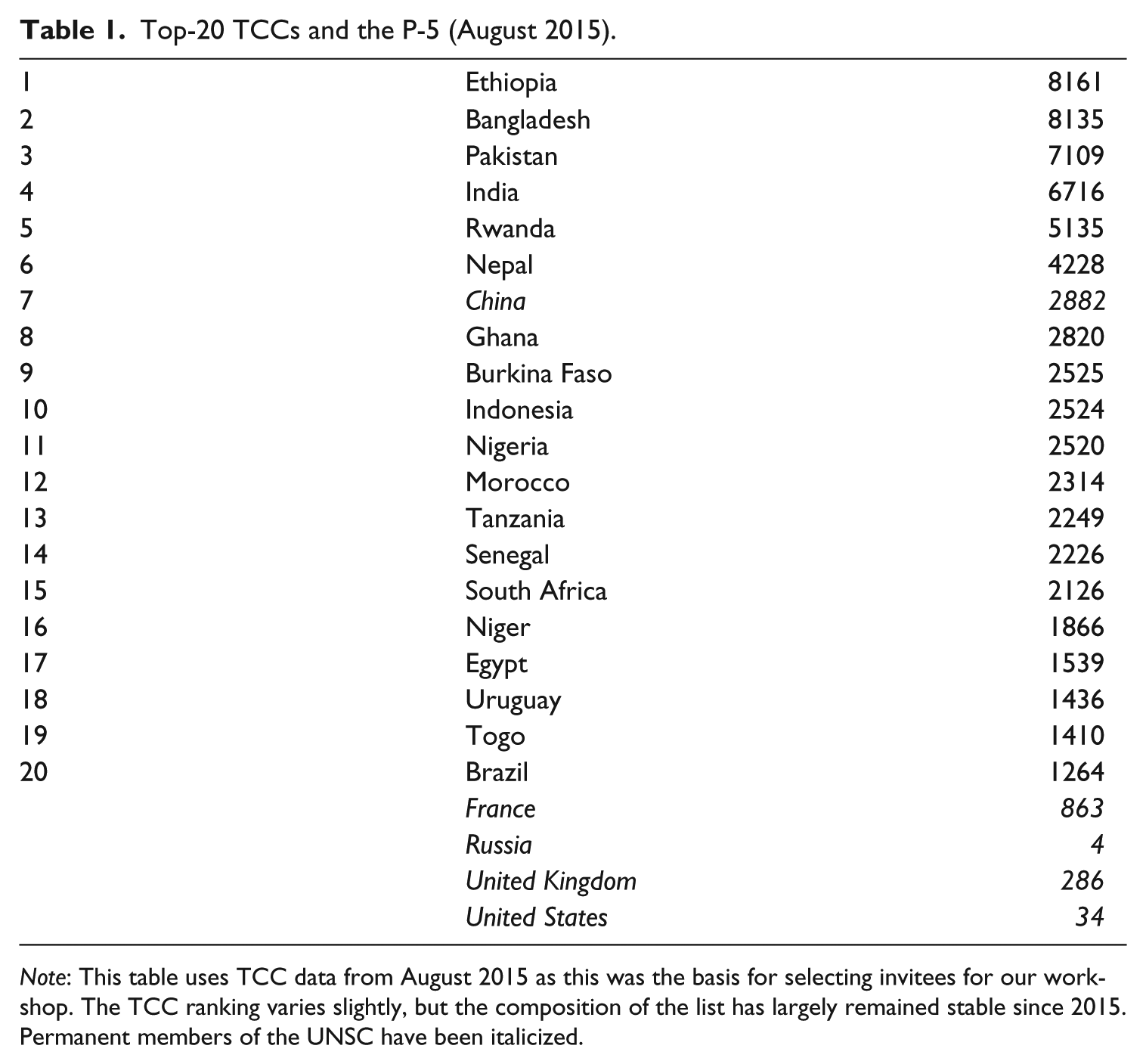
Note: This table uses TCC data from August 2015 as this was the basis for selecting invitees for our workshop. The TCC ranking varies slightly, but the composition of the list has largely remained stable since 2015. Permanent members of the UNSC have been italicized.
Second, practices can be performed more or less competently (Guzzini, 2005), that is, vested with more or less intersubjectively recognizable meaning (Bode, 2018b: 299; Lahire, 2011: 66–7). In their study of the negotiations leading up to the 2011 intervention in Libya, Adler-Nissen and Pouliot (2014) focused on the bureaucratic processes of establishing recognized competence and how these were turned into practice by skilled actors. Military advisers can draw on a general military background and also frequently have specific field experience as sector/battalion commanders of military contingents in UN peace operations, as well as national and, for instance, North Atlantic Treaty Organization (NATO) military operations. They will refer to their experience in discussions to give weight, credibility and legitimacy to their implementation practices. Their competence becomes evident in their ability to represent their states’ practices as legitimate in and of themselves, and as useful contributions to the evolving debate on the PoC norm in New York, even when they involve non-action. Military advisers find themselves in a ‘contest over doing’ (Gross Stein, 2011: 88) that defines their competence. This also includes appealing to in-group knowledge in judging PoC implementation practices as competently performed.
Thus, the background knowledge and therefore potential competence of such military advisers as diplomats and practitioners is essentially plural. Background knowledge should be seen as fluid and multidimensional in nature — rendering its competent enactment in practices dependent on whether military advisers are able to make timely use of the ‘right’ kind of knowledge. This contrasts with Bourdieusian practice theories that tend to work with a pre-reflective conceptualization of tacit or background knowledge (Pouliot, 2008), captured by the ‘inarticulate feeling for the game’ often underlined by sports metaphors (Pouliot, 2016: 73). This intuitive understanding of practices as reflexive and their performance as ‘unthinking’ is based on a uniform incorporation of background knowledge and the so-called practical sense (Bourdieu, 1980: 101; 1987: 81), ‘that is the product of a lasting subjection to conditions similar to the ones in which they are placed’ (Bigo, 2011). However, the sports metaphor, which has been so popular in Bourdieusian practice theories, draws exclusive attention to a type of social situation that demands reflexive reaction rather than choice over the diversity of social situations. In the course of many social situations, actors work reflectively and with longer time frames, often explicitly drawing upon the experience of different parts of a varied professional career (Bode, 2015; Karlsrud, 2016). We therefore argue that practices cannot only be reflexive, but can also be produced by reflective processes (see Gadinger, 2016). Military advisers may draw intuitively or deliberately on varied parts of their background knowledge in implementing PoC across a series of situation-dependent choices (Lahire, 2011: 149).
Further, in theory, the Permanent Delegations receive marching orders from their capitals. However, oftentimes, the units in the national ministries of defence and foreign affairs (themselves in competition) are thinly staffed for substantive issues such as PoC, giving great latitude of action to the Permanent Delegations (especially to the military advisers, where these exist) because of the relative absence of competing competence claims inside the diplomatic system of states. As an example, one of the military advisers that we engaged with was seconded by the Ministry of Defence but worked together with colleagues from the Ministry of Foreign Affairs and had to consult with both these groups when establishing a position in negotiations, for example, on new official guidelines for UN peacekeeping. The process of implementing norms such as PoC therefore directs our analytical attention to a different group of actors in IR. The role of military advisers can also take the form of acting as information filters: they summarize information from discussions in New York, thereby creating their specific version of events. Such a framing of information will involve types of emphasis, as well as omissions. 3 Military advisers also have direct communications with contingents deployed as part of UN peacekeeping missions in the field in order to represent their views and to contribute to, for example, discussions with UN peacekeeping headquarters’ staff on PoC implementation.
In sum, we argue that norms are ambiguous and therefore open to plural interpretations, which emerge within a conflictual norm-scape. We therefore propose to examine normative meaning through implementation practices. These arguments can help to account for disconnects between supposedly solid institutionalized versions of the PoC norm and peacekeeping practices. We study the dynamic implementation of the PoC norm at an international site by focusing on military advisers. Military advisers can reflectively and reflexively recur to diverse background knowledge when performing practices. They compete for being recognized as competent performers of implementation practices, attempting to set the framework for implementation policies to appear appropriate. This shifts our focus to how practices provide insights into the content of international norms, such as the use of force to protect civilians, and responds to gaps in the constructivist literature on norms. In making these analytical observations, our objective is not to build a formal model of norm dynamics. Rather, our arguments engage in ‘low-level theorizing’ and produce an explorative account of how the PoC norm is implemented that leaves space for the ‘messiness of practice’ (Bueger, 2017: 128).
We collected primary empirical material to access states’ implementation practices of the use of force to protect civilians in three ways (for a detailed account, see Appendix I). First, we conducted a mixed-structure online survey, which contained multiple-choice and open questions in four thematic areas (during September 2015). The survey received 30 responses, compared to 73 delegations to the UN in New York who have identified military advisers. Response rates per question differed and we indicate the individual rates. Although responses were anonymous, the survey included regional identification: the European region had the strongest representation, followed by the Asia-Pacific group, while African member states were under-represented. To complement the limitations of the survey in terms of regional spread and the number of respondents, and to diversify our account, we gained additional information through a half-day military adviser workshop attended by advisers from all five regional groups (during November 2015) and three follow-up interviews (during June 2016). All information was gathered under Chatham House Rules. Therefore, we do not identify individual states in quotes. This three-pronged research strategy allowed us to cover the three core constituencies relevant to implementing the PoC norm in military terms: African, Asian and Western states (see also Figure 3). It also demonstrates a diversified methodological toolbox for practice-based analysis, which often relies heavily on elite interviews and/or focus groups. We follow an interpretive lens in using these methods (see Schwartz-Shea and Yanow, 2012).
The PoC norm between principles and practice: Analysis
We first outline a basic understanding of the PoC norm in UN peacekeeping, especially in relation to the use of force, highlighting ambiguity therein. Next, we demonstrate how this ambiguity leaves room for diverging understandings of the norm that manifest themselves in the implementation practices expressed by and debated among military advisers. This will show the extent to which diverging implementation speaks to the meaning of the norm and the role of military advisers in this process.
The PoC norm in peacekeeping: A basic understanding
To illustrate a basic understanding of the PoC norm, we briefly examine the language agreed upon in UNSC resolutions and key UN documents. The UNSC first used the phrase ‘to afford protection to civilians under imminent threat of physical violence’ in Resolution 1270, mandating UNAMSIL (Security Council, 1999). The phrase is restrictive as it does not authorize the general use of force to protect civilians, only its use in situations when civilians are about to be harmed (Holt and Taylor, 2009). That phrase, or slight variations, has since been used by the UNSC to mandate 11 peacekeeping operations. 4
Through several reform initiatives over the past 15 years, the UN has continuously developed its thinking on how PoC should be implemented by the various actors involved in peacekeeping, seeking to limit uncertainty and the scope for interpretation by risk-averse states (United Nations, 2000, 2015a, 2015b, 2015d). The 2015 PoC guidelines provide a summary of a three-tiered approach to PoC implementation: tier I — protection through dialogue and engagement; tier II — provision of physical protection; and tier III — establishment of a protective environment (United Nations, 2015a).
These efforts speak to the expectations of second-wave constructivists, noting that problems with implementation gaps can be addressed by specifying normative content further and further. However, as we will see in the next section, ambiguity remains. Even the standard phrase ‘to afford protection to civilians under imminent threat of physical violence’ leaves open the means by which civilians should be protected. Although it strongly suggests the use of force, it does not specify whether such force should be offensive or defensive. This is an indicator of potentially different meanings that may emerge in implementation practices.
The PoC norm and the use of force: A practical understanding
Military advisers display widely differing understandings of the role that the use of force plays and should play in implementing the PoC norm. We find differences in how military advisers defined the key phrase ‘protecting civilians from the imminent threat of physical violence’ and whether PoC implementation should require the offensive or defensive use of force. This highlights the continued presence of normative ambiguity throughout the implementation process. The following section uses survey questions for structuring purposes but maps and analyses information on implementation practices gained through all three methods.
Question 1: What is meant by ‘protecting civilians from the imminent threat of physical violence’?
Although responses to this question indicated a basic, shared understanding, only four responses included explicit references to the use of force, such as ‘being prepared to use force, including lethal force’ (see Table 2). Given that this phrase deals explicitly with protection from physical violence, this indicates a considerable divergence of envisioned implementation practices on the use of force and also the avoidance thereof. Table 2 groups the open answers provided to this question into four categories depending on what they concentrate on: (1) define contours of protection; (2) focus on what counts as an imminent threat; (3) refer to the use of force; and (4) critical of the definition. Most responses of military advisers attempted to ‘define the contours for the protection of civilians’ (7) rather than explicitly mentioning the use of force. The four responses we labelled as ‘focus on what counts as an imminent threat’ also attempt to clarify the phrase. This focus on applied definitions in practice indicates the considerable impact of implementation when it comes to what constitutes the PoC norm. One answer was critical of the phrase, noting its inadequacy for explaining implementation. Interestingly, this answer mentioned the lack of intelligence, an issue particularly prominent in responses to question 3.
Q1: What is meant by ‘protecting civilians from the imminent threat of physical violence’?
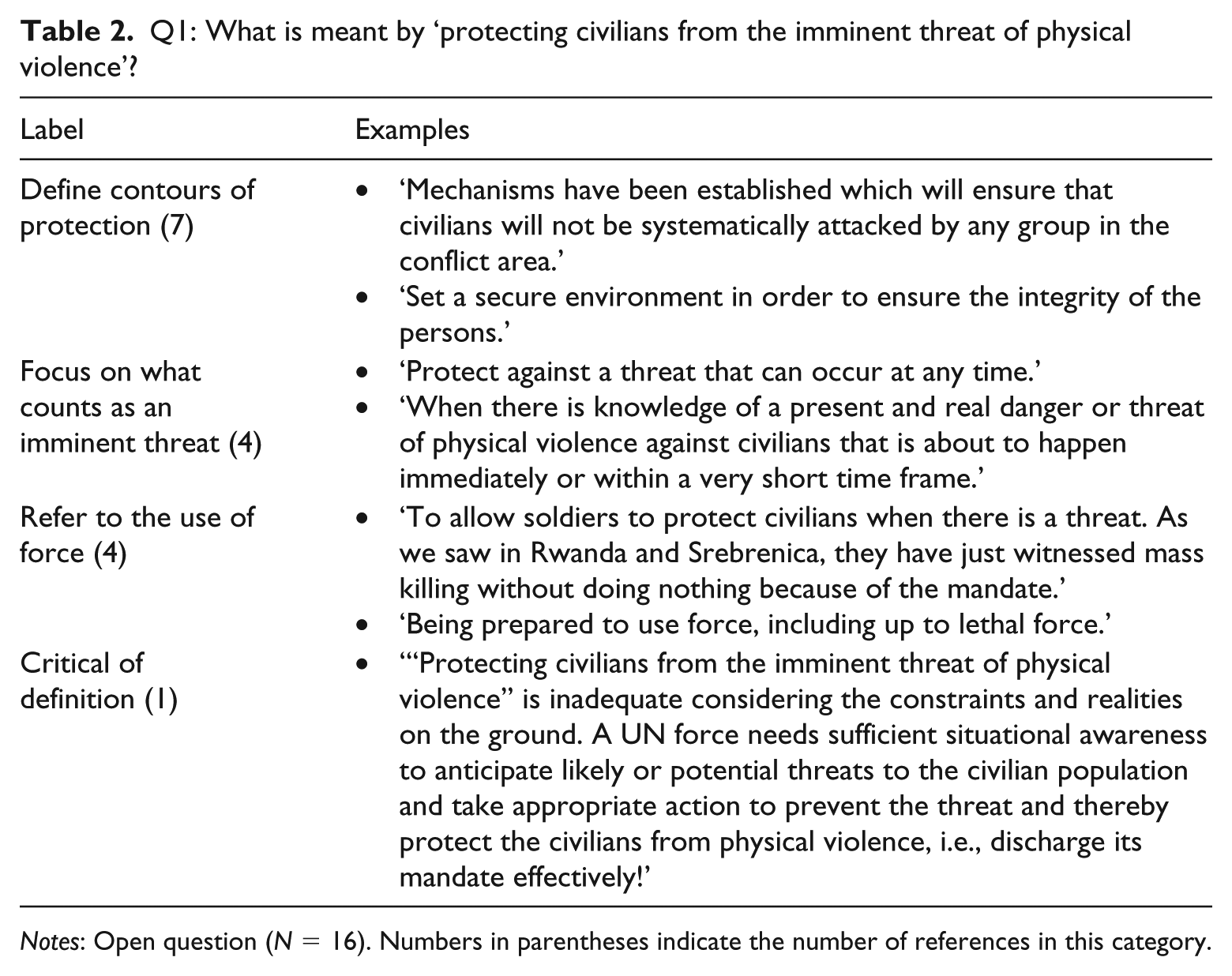
Notes: Open question (N = 16). Numbers in parentheses indicate the number of references in this category.
Overall, these answers point to numerous diverging interpretations and implementation practices regarding the key phrase defining the PoC norm in a peacekeeping setting. This underlines that even a phrase that is at face value clear contains normative ambiguity.
Question 2: In what way is the use of force as a last resort an important option for peacekeeping aimed at PoC?
Responses of military advisers indicate a division of opinion on what counts as appropriate implementation practices on the use of force. There is a basic split between those who emphasize the strict last-resort nature of using force to protect civilians in case-by-case assessments, and those who see implementing the use of force as a last resort as an obligation of peacekeepers upon which the legitimacy of the entire operation hinges (see Table 3). This division points to diverging practices for implementers of the ambiguous PoC norm.
Q2: In what way is the use of force as a last resort an important option for peacekeeping aimed at PoC?
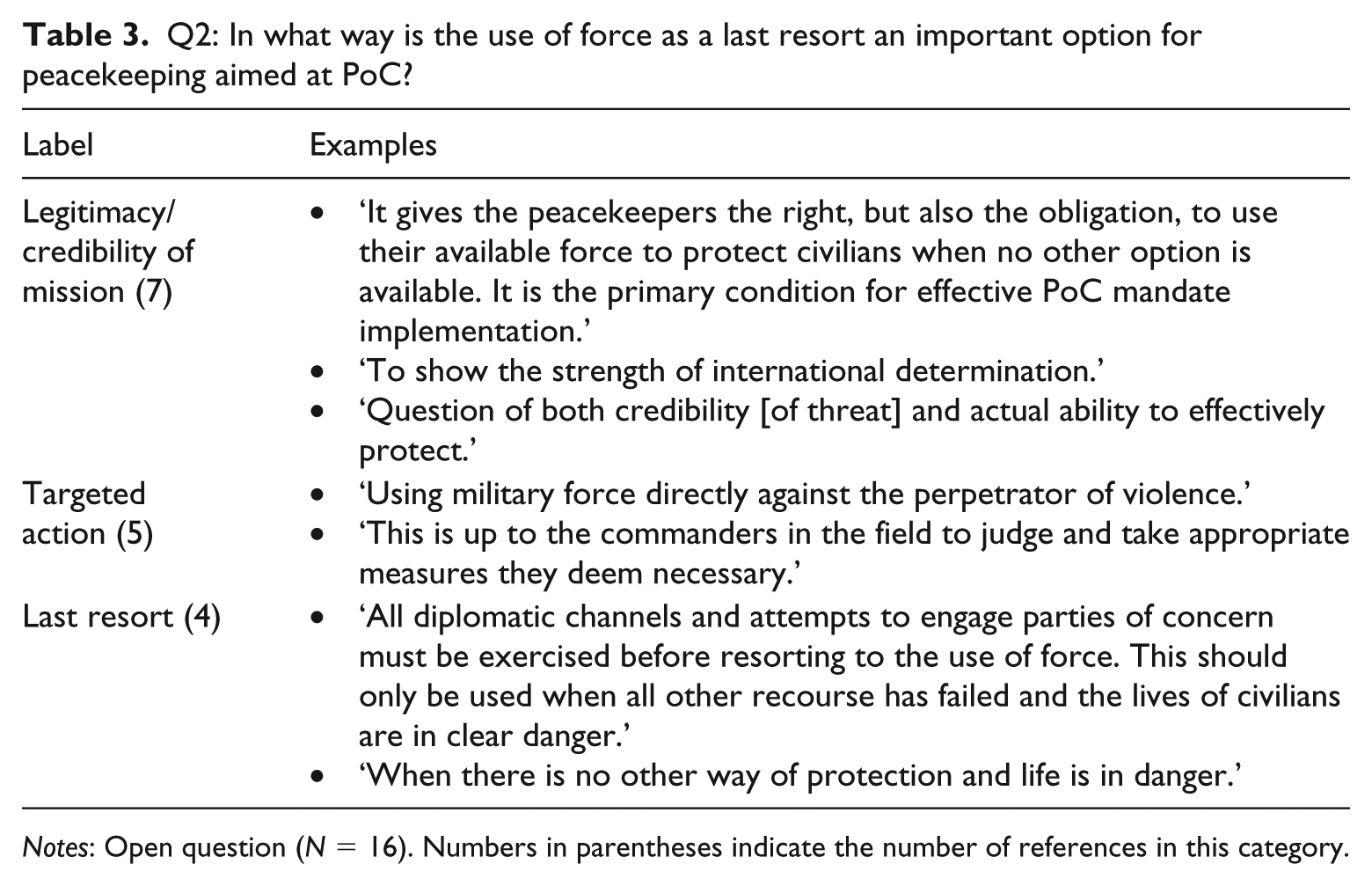
Notes: Open question (N = 16). Numbers in parentheses indicate the number of references in this category.
Discussions at the workshop echoed this uneasy division between implementation practices considered as ‘appropriate’ when it comes to the use of force. Whereas some military advisers argued that the use of force is dependent on an operational case-by-case decision, highlighting selectivity when applying force, another military adviser saw a particular use-of-force-oriented interpretation of the PoC norm as determining successful implementation: ‘peacekeeping is essentially for the protection of civilians’, adding that ‘you have failed your mission if you don’t protect civilians. You have failed humanity’.
Question 3: Do you have examples of situations where it is difficult to decide whether force should be applied?
The question presented military advisers with 12 different reasons for why it could be difficult to decide whether to apply force in implementing PoC. The top three general answers given were ‘lack of intelligence’ (14 out of 17), ‘armed groups embedded in population’ (13 out of 17) and ‘fighting occurred between several armed groups’ (10 out of 17) (see Figure 1).
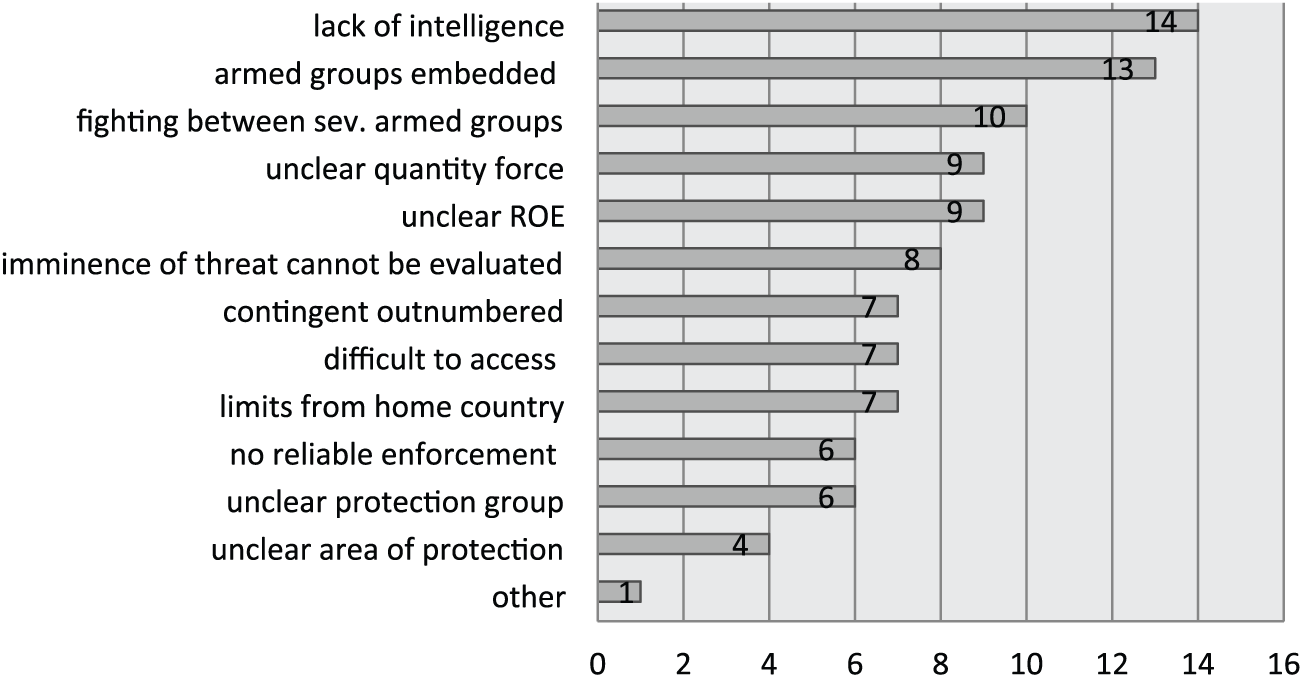
Question 3: Do you have examples of situations where it is difficult to decide whether force should be applied?
Equipping UN peacekeeping operations with modern intelligence capability for force protection and mandate implementation has long been controversial on the grounds of the sovereignty concerns of host and neighbouring states. It was thus surprising to see that ‘lack of intelligence capabilities’ was the top answer to this question, signalling significant convergence on the need to equip the UN with such capabilities. Several other categories could also concern this perceived lack of intelligence capacity: ‘unclear which civilians should be protected’ (6 out of 17); ‘fighting occurred between several armed groups’ (10 out of 17); ‘armed groups were embedded among the population’ (13 out of 17); and ‘imminence of threat to civilians cannot be evaluated’ (8 out of 17). Intelligence is important ‘to be there in good time’, as one interviewee stated, while also cautioning that the right resources must be available to react on the basis of additional information. However, since the lack of intelligence has long been the Achilles heel and familiar deficit of UN peacekeeping (Dorn, 2011; Karlsrud and Rosén, 2013; United Nations, 2000, 2015c), mentioning it might also be a convenient excuse for inaction.
Further interesting results indicating diverging implementation practices relate to rules of engagement (RoE): ‘unclear rules of engagement’ (9 out of 17); ‘unclear about how much force should be used’ (9 out of 17); and ‘limits on the use of force from home country’ (7 out of 17). In discussions about the use of force, unclear RoE have historically been the most frequent explanation used when refraining from the use of force. As a result, the UN has put considerable emphasis on the need to make the RoE explicit and clear. The Secretary-General repatriated commanders and units from the UN/African Union (AU) mission in Darfur (UNAMID) in March 2016 and the UN Mission in South Sudan (UNMISS) Force Commander in November 2016, who did not perform according to expectations (United Nations, 2016a, 2016b). Both the HIPPO report and its follow-up threatened that entire contingents could be sent home in the future: ‘Consistent underperformers must be warned officially and repatriated if they fail to improve’ (United Nations, 2015b: 57; see also United Nations, 2015c: 5). However, the fact that most troops must relate not only to the RoE received from the UN, but also to national RoEs, which might be more restrictive, has frequently been acknowledged as challenging: ‘The ability of field commanders to ensure performance is severely hampered, however, by the use of caveats and national controls’ (United Nations, 2015b: 57).
To control for possible changes in these national guidelines and caveats from UN RoE, and following up on the recommendations of the HIPPO report, the Secretary-General advised: Additional caveats beyond those explicitly agreed by the Secretariat cannot be accepted after deployment. I have instructed all missions to communicate to Headquarters any incidents of refusal to follow orders given by the Force Commander or the Police Commissioner, whether on grounds of new national caveats or others. The Secretariat will immediately inform the concerned Member State and, on a regular basis, the Security Council and, where no remedial action is forthcoming, will repatriate the unit concerned. (United Nations, 2015c: 21)
Analytically, these UN efforts follow a belief that the ambiguity of the PoC norm can be reduced. However, our findings on the implementation practices of military advisers point to consistent ambiguity, coming out as a cat-and-mouse game. TCCs want to keep their space for manoeuvre as regards interpreting the RoE in order to minimize risks and maximize freedom of action when it comes to implementing the PoC norm in the field; the UN is constantly seeking to make the RoE as precise as possible to limit the possibilities of differing interpretations and resulting inaction. States do not want to be called out as behaving inappropriately, so they have been cooperating in developing the RoE at UN headquarters, eager to be seen as proactive and constructive partners. When we shared our survey results with Department of Peacekeeping Operations (DPKO) staff, they were surprised to hear that the RoE were still deemed unclear — they thought that these problems had been ‘sufficiently resolved’ (see United Nations, 2015d).
At the workshop, one of the military advisers declared that ‘RoE will always be unclear’ — there is no national legal framework on UN RoE, and there will always be varying national definitions on what counts as self-defence. The same representative challenged the threat that units would be repatriated, saying that while it may be possible to have an upfront agreement on caveats at the time when contingents are deployed, they ‘will still be subject to change when the environment deteriorates’. Other military advisers stressed the need to constantly adjust and translate the RoE to realities on the ground.
Eagerness to contribute to further deliberative, normative development is positive, but while emphasizing the need to contextualize the RoE to the implementation situation on the ground may be seen as constructive, it could also be seen as a way of continually moving the ‘agreed-upon’ goalposts in order to ensure enough ambiguity to warrant inaction. Situations where civilians need protection will always have a sui generis element; in the end, action/inaction will hinge on the interpretation and calculation of challenges, risks and means on the ground, undertaken by the individual force and/or contingent commander. Taken together, this also underlines the continuous ambiguity inherent in central operationalisations of the PoC norm.
The offensive and defensive use of force to protect civilians in peacekeeping missions (Q5 and Q6)
Two survey questions differentiated between the offensive and defensive use of force to protect civilians in peacekeeping. Again, the responses of military advisers pointed to greatly diverging understandings manifesting in different implementation practices. Twelve out of 19 respondents indicated that their country differentiates between offensive and defensive steps, while seven respondents said that they did not (Q5). Question 6 allowed a more detailed look at the stances of military advisers: ‘In what way does the potential of using force affect your country’s decision to participate in peacekeeping operations?’ As Figure 2 shows, many military advisers saw the use of force as a ‘last resort but an integral option’ (7 out of 18), whereas others agreed on its centrality but were also ‘sensitive towards risks’ (3 out of 18).
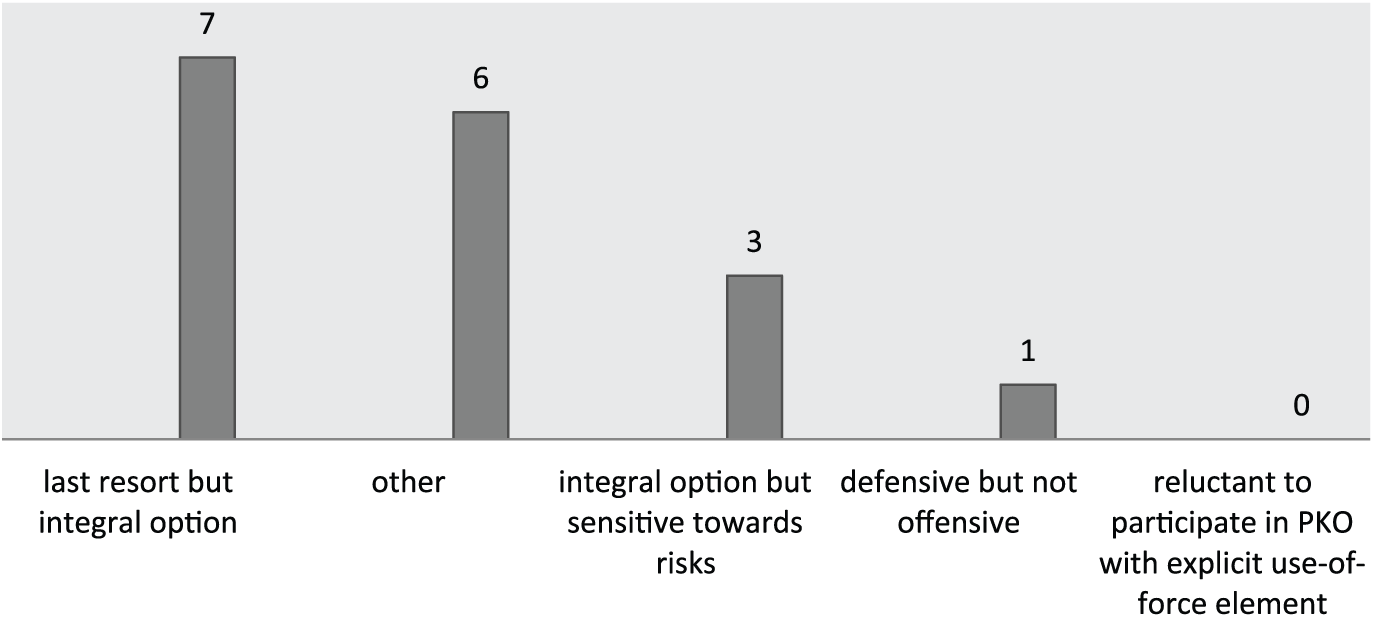
Q6: In what way does the potential of using force affect your country’s decision to participate in peacekeeping operations?
Only one respondent indicated that they would engage solely in defensive rather than offensive force when participating in peacekeeping. Moreover, none of the military advisers said that their country was reluctant to participate in peacekeeping operations that included an explicit use-of-force element. This was underlined at the workshop by one military adviser, who noted: ‘I don’t see any country having any issue with protecting civilians in danger’. However, responses in the ‘other’ category (6 out of 18) tell a different story. Again, military advisers were split between those indicating that their country supported a ‘robust posture’ and those who said that their country decided on a case-by-case basis and would ‘contribute in a niche capability of our strength’ — a stance far more reluctant and cautious.
This split also came up in the workshop. The choice between offensive and defensive steps and how these should be defined led to a heated discussion between two military advisers. It is here that we can most clearly see the military advisers’ positioning in a conflictual norm-scape manifesting in diverging assessments of what are appropriate implementation practices. One military adviser advocated a strictly defensive understanding of the use of force and the importance of using force solely on the tactical level. In his statement, he included two assessments: ‘we don’t believe in offensive operations, but we believe in the use of force to protect civilians’; and ‘offensive operations are part of the problem’. This practice hints at other defining norms of peacekeeping, in particular, impartiality and consent/sovereignty concerns. At the workshop, this provoked an emotionally charged response from another military adviser, with images of past failures of peacekeeping because force was not used, underscoring that peacekeepers need the ‘right’ mindset not only to protect civilians, but also to protect themselves: ‘You can’t go into peacekeeping saying “I am not ready to fight”. Then don’t do it. Don’t provide contingents.… Every peacekeeping operation must be well equipped and psyched to protect themselves and civilians’.
Several military advisers echoed and supported these sentiments, while others kept silent or tried to shift the discussion to another topic, stressing how peacekeeping has too often been used as a ‘band-aid’, merely satisfying the need to ‘be doing something’. This division also came out in interviews, with some highlighting the primacy of the political process (‘we don’t go there for permanence’; ‘peacekeeping should be short, for a specific purpose’) and others noting that national caveats should be clear before deployment (‘Don’t bring caveats when you are deployed. Once you deploy, we expect you to have done your homework’). These statements point to diverging views on what constitutes effectiveness in peacekeeping, as well as the presence of a conflictual norm-scape.
Group dynamics and debating appropriate implementation practices: The Kigali Principles
In addition to demonstrating diverging implementation practices and thereby highlighting how the PoC norm gets filled with substantive content through practices, the workshop provided insights into the military advisers as a community (see also Krieger et al., 2015). Through this, military advisers not only negotiate intersubjective assessments, but also ascertain competing competence claims when it comes to appropriate implementation practices with regard to the PoC norm. We illustrate the latter dynamics through considering the Kigali Principles, a member-state initiative led by African states ostensibly designed to improve the implementation of the PoC norm by having TCCs declare their readiness to use force, resonating with a shorter-term definition of peacekeeping effectiveness.
First, on an intersubjective level, we noted appeals to a shared understanding of the community as a whole, for example, through their military identity and a shared sense of being ‘operators’. Two military advisers commented on the survey results as follows, drawing many nods of approval from the room: ‘for the military, it’s very straightforward’ and ‘military advisers tend to provide pragmatic answers, issues are seen as more clear-cut’. Similar responses emerged from our interviews, with one respondent noting that there is agreement in technical discussions among military advisers but ‘then we have to go to the capital’. On the one hand, military advisers tend to see themselves and their way of approaching PoC as distinct from that of the political dimension; on the other hand, as our findings show, there is far more ambiguity than coherence among the implementation practices favoured by military advisers than indicated in these statements of shared identity. Still, it is inherently appealing to refer to a ‘shared’ military standard of practice that makes it possible to link diverging practices and ensuing veritable challenges to the choices made by political actors. Further, military advisers evinced differing conceptualizations of their roles: while some saw their role as ‘operators’ almost totally defined by strategic choices made at the political level, others acknowledged that ‘operators’ necessarily engage in operational translation, for example, of the RoE. This indicates split awareness or acknowledgement of the relationship between norm-making and norm implementation.
Second, the discussion among military advisers about the Kigali Principles aptly underlines competing claims, based on their diverse backgrounds, for what count as appropriate and competent implementation practices of the PoC norm. Initiated at a high-level conference in May 2015, the Kigali Principles have been endorsed by 44 states as of December 2017, 5 including 11 of the top-20 TCCs and three of the P-5 (France, the UK and the US). Some interviewees mentioned that their states endorsed the Kigali Principles because ‘we saw this as an opportunity’ or ‘we joined the process because of conviction’; others did not perceive the Kigali Principles as an ‘inclusive process’ because they had been drafted at a ministerial-level conference with only nine states involved. While it remains unclear whether only this limited number of states had been invited, some TCCs objected to this way of organizing, that is, being presented with a text rather than having a say in drafting it. Agreeing on language is, after all, a recurrent and touchy issue at the UN.
Disagreement about what kind of language is appropriate and how to understand PoC is linked with ‘the different strategic experiences at the field level in highly diverse peacekeeping operations’ that military advisers bring with them. One interviewee noted that part of the wording of principle no. 3 — ‘taking direct military action against armed actors with clear hostile intent to harm civilians’ (Government of Rwanda, 2015: 4) — is problematic as it does not acknowledge the limitations of the UN system: ‘the role of the UN is not like that of a country, it does not have the hold on resources’. In the words of another military adviser: ‘The Kigali Principles are now facing the language problem. This is very sensitive for some countries [pause]. I can’t believe it’s an excuse’. Military advisers thus justify stances in opposition to and in support of the Kigali Principles as examples for competent behaviour. They also underline disputes about which and whose implementation practices are appropriate as some interviewees objected to perceived Rwandan or even African ownership of this process: ‘This is UN peacekeeping after all, not AU peacekeeping, so the UN should own it’. Interestingly, one interviewee opined that PoC ‘is personal for Africa. If we own it as Africans, it will be good for the rest of the world’. The Kigali Principles therefore illustrate how the overall condition of normative ambiguity opens room for disputes and also for, in this case, African efforts to promote particular implementation practices at the more robust end of the spectrum as appropriate (see also Dembinski, 2017). The latter observation highlights the relevance of considering actors of the Global South as norm-makers at international sites.
In sum, our findings show that the UN’s continued efforts to provide clarity on what PoC should mean proved futile due to inherent norm ambiguity resulting in diverging implementation practices, as well as the positioning of military advisers in a conflictual norm-scape. In distinguishing between the offensive and defensive use of force to protect civilians, or in identifying practical, operational challenges to implementing PoC, military advisers therefore refer to diverging interpretations of the PoC norm and how it is positioned in conflict with the particular understandings of other core peacekeeping norms, such as impartiality and consent of the parties.
Figure 3 offers a region-based overview of how the three core constituencies currently chiefly responsible for implementing the military dimension of the PoC norm (African, Asian and Western states) are placed in an ambiguous, conflictual norm-scape with regard to peacekeeping. 6 It shows both important overlaps between (and within) these groups in terms of the normative meanings that they associate with core peacekeeping norms, and vast differences, therefore providing a summary of the diversity of implementation practices among military advisers. Our analysis shows that the implementation process of ambiguous norms such as PoC is messy. Therefore, we can group normative meanings, as Figure 3 does, rather than neatly map practices to norms.
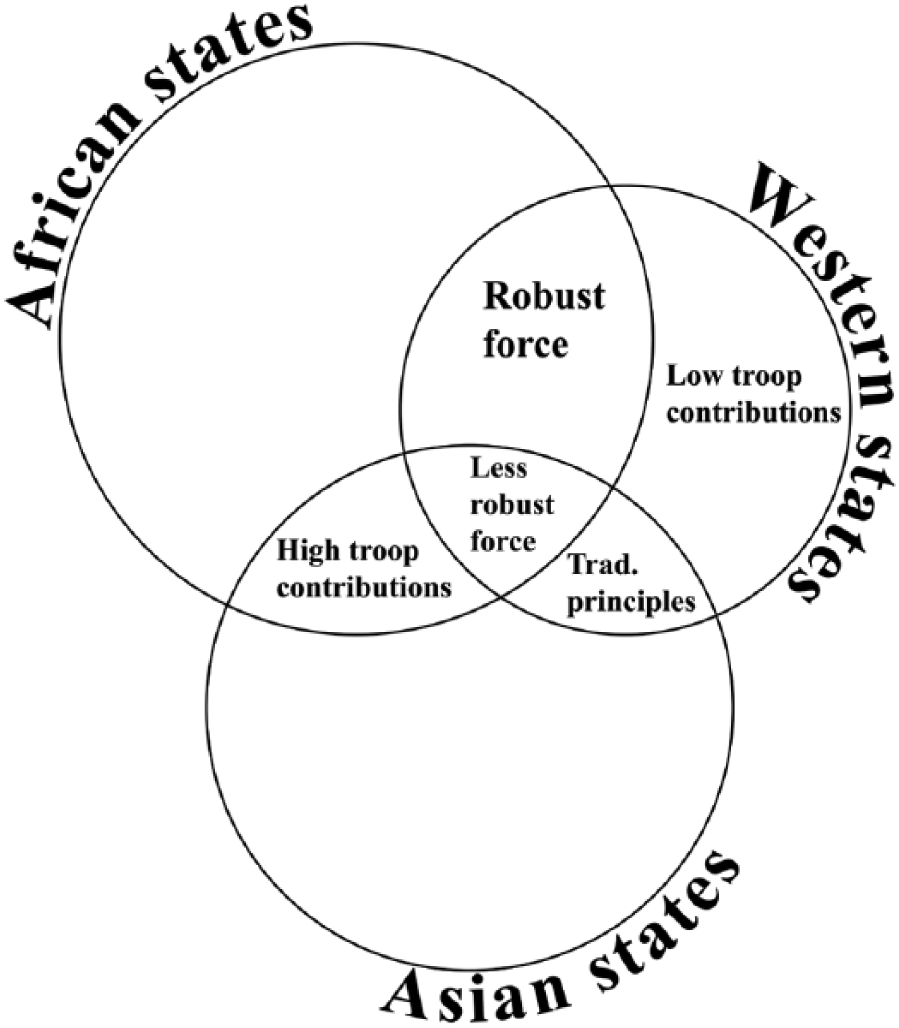
TCCs in a conflictual norm-scape.
Conclusion
We have shown how the ambiguous content of norms manifests and emerges in their implementation through practices, using the military dimensions of the PoC norm in peacekeeping as an example. Fully integrating ambiguity into theorizing norms and focusing on implementation at international sites draws attention to different actors. Our focus has been military advisers as important links implementing core norms in peacekeeping policy in between national ministries and contingents in the field. We have used a survey, a workshop and follow-up interviews to show how military advisers put forward diverging understandings of the PoC norm based on their field experience, and operate in a conflictual norm-scape. Mapping these understandings and their associated implementation practices can help explain why use-of-force practices, although an integral component of PoC in peacekeeping, diverge consistently among states. Ambiguity in peacekeeping norms fulfils essential functions for actors. For states, we find that it allows flexibility to judge how much risk their troops should be exposed to in any given situation and the ability to determine this on a case-by-case basis. For the UN, ambiguity enables plausible explanations for why action is taken in one instance but not replicated in the next, and for all parties to save face and continue their cooperation without damaging political relations.
We considered military advisers as performers and carriers of implementation practices in discussions on PoC at UN headquarters in New York. Combining critical-constructivist norms research with practice theories sheds new conceptual light on the process of norm implementation at international sites, including by actors of the Global South that have not typically been at the centre of analytical efforts. Military advisers are a particularly interesting group to study as these practitioners-cum-diplomats bring both reflexive experience and reflective knowledge to the table, and aim to influence the evolving understanding of a norm through its diverging implementation. In discussing their states’ practices, military advisers make different appeals to competence in order to frame how they understand implementation practices and even inaction, surrounding the PoC norm in ways that still reflect favourably on the contingent and state, and provide input in supposedly ‘refining’ the norm to increase the short-term effectiveness of UN peacekeeping. On the basis of this finding, we contend that practical knowledge need not be ‘unthinking’: it is produced by reflective processes and shows careful calculation of the ways in which practices are presented.
Our analysis has informed the theory-oriented debate on critical norms research in IR by continuously integrating normative ambiguity and conceptually refining the productive powers of practices in studying normative content via practice theories. This highlights the role of implementation practices and their subsequent interpretation as practices of representation at the diplomatic level. Likewise, our study points towards interesting new dimensions of research on norms in IR by exploring how implementation dynamics shape what norms ‘are’ in practices. We argue that norms can never be ‘settled’ in content when their very design, as well as contextual specificity on the ground and flexible positionality in a conflictual norm-scape, allows for coexisting meanings.
Our observations also point to further areas of research, such as the extent to which military advisers form an epistemic community with a meaningful horizontal network of connections. 7 The dynamic processes that we identified in relation to the PoC norm could also provide innovative angles of analysis for the implementation trajectories of international norms at international sites from environmental protection to non-proliferation.
Supplemental Material
EJT_796540__Appendix_I_Methodology – Supplemental material for Implementation in practice: The use of force to protect civilians in United Nations peacekeeping
Supplemental material, EJT_796540__Appendix_I_Methodology for Implementation in practice: The use of force to protect civilians in United Nations peacekeeping by Ingvild Bode and John Karlsrud in European Journal of International Relations
Footnotes
Acknowledgements
We wish to thank all military advisers for making time in their busy schedules to complete our survey, attend our workshop and be interviewed. A special thank you to Richard Gowan for chairing the workshop and to Security Council Report for allowing us to use their meeting room. Further, we are grateful for valuable feedback that the article received at the 2016 International Studies Association (ISA) Convention in Atlanta, the 2016 Annual Meeting of the Academic Council on the UN System (ACUNS) in New York, the 2016 protection workshop organized by the German Association of the UN (DGVN), and Kent’s School of Politics and International Relations research seminar. Finally, our thanks go to the editors of EJIR and two anonymous reviewers for their constructive engagement and thoughtful suggestions.
Funding
This research was supported by the Japan Society for the Promotion of Science (JSPS), the Training for Peace programme at the Norwegian Institute of International Affairs (NUPI) and the School of Politics and International Relations, University of Kent.
Notes

Author biographies
References
Supplementary Material
Please find the following supplemental material available below.
For Open Access articles published under a Creative Commons License, all supplemental material carries the same license as the article it is associated with.
For non-Open Access articles published, all supplemental material carries a non-exclusive license, and permission requests for re-use of supplemental material or any part of supplemental material shall be sent directly to the copyright owner as specified in the copyright notice associated with the article.
