




Abstract
The United Nations Security Council passed its first resolution on children in armed conflict in 1999, making it one of the oldest examples of Security Council engagement with a thematic mandate and leading to the creation of a dedicated working group in 2005. Existing theoretical accounts of the Security Council cannot account for the developing substance of the children and armed conflict agenda as they are macro-oriented and focus exclusively on states. I argue that Security Council decision-making on thematic mandates is a productive process whose outcomes are created by and through practices of actors across the three United Nations: member states (the first United Nations), United Nations officials (the second United Nations) and non-governmental organizations (the third United Nations). In presenting a practice-based, micro-oriented analysis of the children and armed conflict agenda, the article aims to deliver on the empirical promise of practice theories in International Relations. I make two contributions to practice-based understandings: first, I argue that actors across the three United Nations engage in reflective practices of a strategic or tactical nature to manage, arrange or create space in Security Council decision-making. Portraying practices as reflective rather than as only based on tacit knowledge highlights how actors may creatively adapt their practices to social situations. Second, I argue that particular individuals from the three United Nations are more likely to become recognized as competent performers of practices because of their personality, understood as plural socialization experiences. This adds varied individual agency to practice theories that, despite their micro-level interests, have focused on how agency is relationally constituted.
Keywords
Introduction
In August 2016, a United Nations (UN) report documented the grave impact of conflicts on children: in Syria, children have been maimed and killed due to the indiscriminate use of force in civilian areas; they have been subject to arbitrary detention and torture; children have been used in combat and support roles; and schools have been attacked and used for military purposes (Security Council, 2016: 24–26). This description characterizes the vulnerabilities that children face in situations of conflict, a topic that has concerned the UN Security Council (UNSC) regularly for the past 19 years and, in 2005, led to the creation of a subsidiary body, the Working Group on Children and Armed Conflict (WG).
The institutionalization of the human rights-focused children and armed conflict (CAAC) agenda cannot be fully accounted for in existing theoretical accounts of the UNSC. Here, research has either considered states as rational cost–benefit calculators (Beardsley and Schmidt, 2012; Prantl, 2005; Yang, 2013) or examined how states, interested in sustaining the UNSC’s legitimacy, may use normative arguments strategically to bolster their negotiating positions (Hurd, 2005, 2007). These arguments can, for example, explain why member states that could be at the receiving end of UNSC interventions related to CAAC are resistant to it. Likewise, it may be helpful for member states to associate themselves with normative agendas such as CAAC in a strategic sense. Yet, these accounts cannot show how the substance of the CAAC agenda’s resolutions emerged, or present an in-depth empirical perspective that goes beyond the macro-level. Further, they neglect the roles of actors apart from states.
I argue that to understand what shaped the UNSC’s engagement with children and armed conflict requires a dynamic analysis of interactions between the ‘three United Nations’ (Weiss et al., 2009) 1 : member states (first UN), UN officials (second UN) and non-governmental organization (NGO) representatives (part of the third UN). The UN is a ‘social environment’ (Johnston, 2001), characterized by ‘significant interaction’ between the three UNs that is changing the boundaries of global governance (Sending et al., 2015: 5; Wiseman, 2015: 12). While this has been acknowledged for the overall organization, I draw attention to how it has reached the UNSC, specifically through thematic mandates since the late 1990s (Popovski and Fraser, 2014).
To integrate the role of the three UNs substantively, I present a practice-based, micro-oriented analysis of the CAAC agenda at the UNSC. Practices are patterned actions in social context (Leander, 2008: 18) that can, as sensitizing concepts, 2 allow us to study concrete empirical phenomena such as the UNSC decision-making process among different actors and different ‘ways of doing things’. In this, the article aims to deliver on the empirical analytical promise of practice theories in International Relations (IR) (see Gadinger, 2016: 199), where debate often remains on an abstract theoretical level. In studying practices with a micro-orientation and tracing the agency of actors involved, the processes sustaining and therefore constituting UNSC dynamics, as well as conflicts and power structures, become visible. By advancing substantial and empirically grounded accounts of varied agency, practice theories can therefore provide ways of improving the constructivist study of change — a perennial problem of constructivist IR (Flockhart, 2016).
To accomplish this, I make two contributions to conceptual discussions on practice theories: I distinguish between reflective strategic and tactical practices (De Certeau, 1984), and consider the role of individual agency. First, tactical and strategic practices acknowledge that actors can adapt creatively to situations, contrasting with the purely pre-reflective understanding prevalent in Bourdieuan practice theories. I associate practices of actors across the three UNs with their ‘space’ in UNSC decision-making, which they manage, arrange or create. Second, particular individuals from the three UNs are more or less likely to be recognized as competent performers of their practices in an intersubjective sense because of their personalities (Bode, 2015: 18). Individuals are more likely to communicate appropriately with relevant actors across the three UNs if they bring the ‘right’ mixture of socialization experiences enabling them to instantiate situationally ‘fitting’ parts of their past selves.
The remainder of the article is organized as follows: first, I develop my two conceptual additions to practice theories in more detail. I also reflect on the methodology and limits of this interpretive study. Then, I map the CAAC agenda from June 1998 to December 2014. Working with information gained through 21 in-depth interviews and supplementary published material, I analyse how decision-making on CAAC was shaped through the practices of actors across the three UNs. Finally, I offer a critical conclusion.
Practices in UNSC decision-making
Acknowledging potentially influential practices across the three UNs does not mean that actors find themselves on equal ground. Instead, they have different positions in the hierarchical setting of UNSC decision-making that allow them to perform particular practices.
Studying practices has gained ground in IR; although many studies are inspired by Pierre Bourdieu, practice theories are epistemologically and ontologically diverse (e.g. Adler and Pouliot, 2011a, 2011b; Adler-Nissen and Pouliot, 2014; Bueger and Gadinger, 2014; Frost and Lechner, 2016; Neumann, 2002; Pouliot, 2008; Schindler and Wille, 2015; Sending, 2015). Practice theories have presented innovative accounts of UNSC decision-making, but also only consider state input in UNSC outcomes (Adler-Nissen and Pouliot, 2014; Ralph and Gifkins, 2016). As conceptual sites, practices are equally based on the characteristics of actors and the constraints/opportunities inherent to social structures (Bode, 2015: 18). They result from how patterned actions are perceived and constructed in a social space and thereby ‘create meanings, objects and power relations’ (Leander, 2008: 18). Therefore, practices are valuable sites for studying the interplay of the three UNs in UNSC decision-making and zooming in on individuals.
I make two additions to Bourdieuan practice theories through working with De Certeau’s (1984) understanding of practices as reflective and Lahire’s (2003, 2011) plural functioning of personality. In this, I draw attention to De Certeau as a core practice theorist whose work has only received limited attention in IR, despite an early contribution by Neumann (2002). In their synthesis of practice theories, Bueger and Gadinger (2015: 456) differentiate between critical (often Bourdieuan) and pragmatic practice theories based on the former’s emphasis on repetition/reproduction and the latter’s focus on fluctuation/contingency. Indeed, Bourdieu’s work focused on explaining how social inequalities are reproduced and power structures maintain their stability (e.g. Bourdieu, 1979, 1989). However, scholars in the Bourdieuan tradition have criticized and rethought his key concepts (Colliot-Thélène et al., 2005; Lahire, 2003, 2008), thereby adapting them to understand both reproductive and transformative aspects of practices. This critique is rarely considered in conventional versions of Bourdieuan practice theory in IR.
Thinking about the practices of actors across the three UNs as potentially transformative starts with differentiating between two kinds of reflective practices: strategies and tactics (De Certeau, 1984: xix). These can be associated with occupying different backgrounds and therefore spaces in the UNSC’s positional hierarchy, defined by both formal and informal processes (Schia, 2013: 142–145). Yet, lower status within a positional hierarchy does not equal inaction, ‘the dominated’ are not passive (De Certeau, 1984: xi–xii).
Strategic and tactical practices are reflective, thereby highlighting that the actors performing them can adapt their conduct creatively to situations. They imply ‘a logic of the operation of actions relative to types of situations’ (De Certeau, 1984: 21). Bourdieuan practice theories in IR typically build on understanding competent practices as pre-reflective, based on tacit or background knowledge (Pouliot, 2008: 260), and produced by an ‘inarticulate feel for the game’ (Pouliot, 2016: 73; see also Bigo, 2011: 228; Bueger and Gadinger, 2015: 453; Kuus, 2015: 369). This pre-reflective characterization derives from the ‘unconscious’ functioning of the habitus, the embodiment of a social background, history and culture that is the creator of practices for Bourdieu (1980: 101). Yet, this ‘feel for the game’ metaphor privileges a particular type of social situation, in which actors have to act on the spur of the moment with no time to consider, above other types of social situations that allow and even require the reflective engagement of actors within a longer time frame (Lahire, 2011: 149). This reflectiveness is explicitly captured in differentiating between tactical and strategic practices.
Strategic and tactical practices also come with an understanding of a hierarchically structured social space within which they are performed. Actors who have an ascertained place within an established order perform strategic practices, arranging and controlling spaces in order to capitalize on their advantages (De Certeau, 1984: xix–xx). In contrast, actors outside an established order and without a proper place resort to tactical practices, aimed at creating space for themselves (De Certeau, 1984: xviii–xix). They engage in ‘clever tricks’ that depend on time (De Certeau, 1984: xix, 26, 34–39). Tactical practices need to be well timed to succeed, thereby drawing attention to the historical-normative context that may be more or less conducive to certain types of practices, as well as actors’ ability to read contexts. As De Certeau (1984: 30) summarizes: ‘Strategies are able to produce, tabulate, and impose these spaces … whereas tactics can only use, manipulate, and divert’. To illustrate this with an everyday example, business employers use various strategic practices to regulate and rationalize the workplace, while employees engage in tactical practices by diverting work time to activities not designed to garner profit (De Certeau, 1984: 25).
I use this differentiation to conceptualize what kinds of practices actors in the three UNs perform (See Table 1).
The three UNs and their practices.
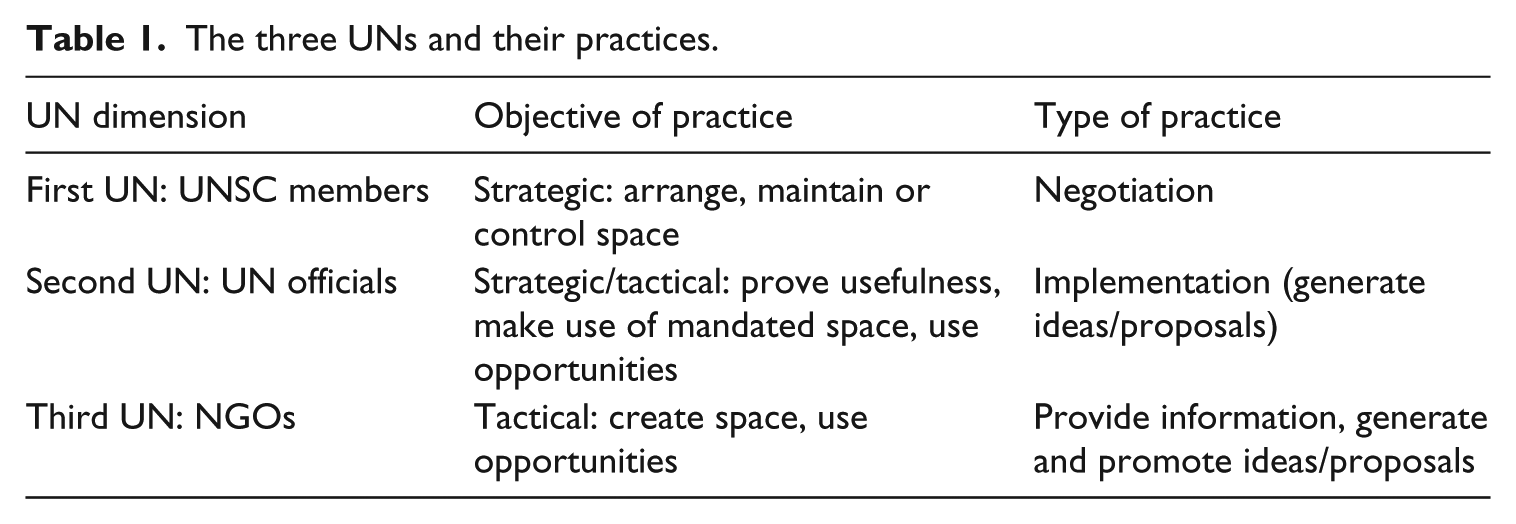
While these are ideal types, ‘the two ways of acting can be distinguished according to whether they bet on place or on time’ (De Certeau, 1984: 39): strategic practices assume a demarcated place that serves as a base for action, tactical practices are defined by the absence of this place and therefore work through manipulating time.
Both permanent and elected UNSC members can rely on their place within an established order. They engage in strategic practices, aimed at arranging and managing/controlling the space attributed to them to their greatest benefit. A characteristic type of practice that member states engage in is negotiation, associated with making the most of their privileged places. The space that elected members can occupy in the UNSC is, in particular, connected to how and if agreements can be reached. Permanent members (the P-5) have a guaranteed and powerful role to play in decision-making because of the UNSC’s institutional design (see Mahbubani, 2004: 259). Yet, even for the P-5, being able to make deals and produce outcomes still has positive effects in terms of controlling space (see Tardy and Zaum, 2016).
Third UN actors who do not have established places within the UNSC engage in tactical practices, designed to create space by turning well-timed manipulations of events into opportunities for influence. Tactical practices are associated with providing information, and generating and promoting policy proposals, thereby producing input into how a thematic mandate should be dealt with (Mertus, 2005: 7). These are ‘typical’ practices that NGOs perform in other issue areas (Ahmed and Potter, 2006) applied to the UNSC. NGOs are able to engage in these tactical practices because their background is different to that of the first UN, producing an asset that they can instantiate through their practices: particularly ‘on the ground’, they do ‘what governments cannot or will not do’ (Simmons, 1998: 87) and can use this information for gaining access (Keck and Sikkink, 1998). In engaging in these tactical practices, NGOs can therefore find ways of using the exclusionary institutional set-up of the UNSC (De Certeau, 1984: 30). At the same time, their tactical practices are fragile as they depend on affirmation by first UN actors: ‘a tactic insinuates itself into the other’s place, without being able to keep it at a distance’ (De Certeau, 1984: xix).
The practices of second UN actors are a mixture of strategic and tactical because they occupy an established but limited place in UNSC decision-making. UN officials are typically given vague, gradually expanding mandates on the basis of which they can engage in strategic practices, arranging and managing their mandated space. However, as this space depends on the approval/renewal of member states, they cannot fully rely on their standing and may also use timely opportunities. The practices of implementation that UN officials engage in combine their mandated place in the institutional setting with tactically using that place. UN officials often perform a conduit role between first and third UN actors (Wiseman and Basu, 2013: 334). They may therefore also contribute to generating ideas, especially in the early stages of their mandates when their practices are more tactical than strategic. As their mandate solidifies, their practices should become more strategic and less tactical.
Differentiating between strategic and tactical practices helps to capture the dynamic interplay between the three UNs as actors have decision-making space to gain (and to lose) from collaborating. Both UN officials and NGOs depend on collaboration with member states to maintain space but can also gain space by collaborating with each other. Actors within these groups are not homogeneous: there may be internal rivalries regarding the ‘right’ practices to select and with whom to engage. There is a sense of limited available space within UNSC decision-making while the precise arrangement of that space is the outcome of constant ordering and contestation.
This can be underlined by considering the ambivalent space-arranging strategies of member states with regard to NGOs: ‘many governments … persistently labour to limit the formal access and participation of nongovernmental human rights organisations and to challenge the legitimacy of their findings’ (Gaer, 1995: 389). Allowing NGOs space in the UNSC threatens the privileges of this exclusive club (Willetts, 2000: 199–200). Member states may highlight differences in positional standing to preclude opportunities from opening for the third UN and to maintain their own established space.
By contrast, other member states deliberately associate with NGOs, trying to use NGO information to put them into a better place as committed or competent negotiators (Paul, 2004: 379). The 1992 invention of Arria-formula meetings, which allow NGOs to brief the UNSC informally, was thus tied to Venezuelan Ambassador Arria’s frustration with the available information on Bosnia-Herzegovina (Bosco, 2009: 180), highlighting the strategic nature of this practice.
Numerous Arria-formula meetings since 1992 underline this argument (Sievers and Daws, 2014: 79–91; 2016): from 1992 to 2016, 86 out of 207 meetings included NGO invitees, while 83 out of 130 meetings since 2000 have included NGO speakers. This demonstrates an increasing importance of NGOs for UNSC members.
However, tactical and strategic practices can be performed more or less competently. This is where individuals come in: how actors in the three UNs can perform their practices also depends on the personalities of the individuals involved, which I conceptualize from a sociological perspective. Personality incorporates an individual’s varied socialization experiences across social and professional settings (Lahire, 2011: 11–62; see also Goffman, 1959). How individuals perform practices hinges on whether the social situations that they encounter find equivalents in their past social interactions and experiences (Lahire, 2003: 342–343). The more familiar they are with the dynamics and potential interaction patterns of a social situation due to having found themselves in similar situations or interacting with similar partners in the past, the more likely it is that their practices are going to be perceived as competent, that is, intersubjectively recognized as being authentic and convincing (Lahire, 2011: 66–67).
Integrating a reflective and plural understanding of individual socialization backgrounds is my second addition to Bourdieuan practice theories in IR. Despite their interest in ‘the innovativeness of reflexive agents’ (Bueger and Gadinger, 2015: 453), and ‘competence’ (Sending et al., 2015: 18), practice theories often bypass whether and how it matters which individuals, in the true sense of the word, perform practices. Pouliot (2016: 56), for example, concentrates on the relational side of competence: ‘practices are social possessions and their skilful performance has to be recognized by a community of reference’. This also manifests in a relational understanding of agency as emerging in practice (Bueger, 2015: 5). By contrast, practice theories based on Boltanski concentrate on ‘the critical capacity of ordinary actors’ (Gadinger, 2016: 188), while others draw on symbolic interactionist Goffman to highlight actors’ creative adaptiveness (Adler-Nissen, 2014; Zarakol, 2011). Yet, these studies do not accommodate the individual level, focusing instead on collective actors. However, the differential recognition of a competent practice also depends on the particular qualities of the performing individual, which can be instantiated reflectively.
Analytical difficulties in capturing individual difference in Bourdieuan practice theories stem from considering individual socialization and background knowledge as homogeneous (Bourdieu, 1979: 191). A conventional reading of Bourdieu therefore considers ‘unthinking’ individuals to actualize practices produced on the basis of their limited habitual background knowledge in the same way across contexts. Following Lahire, I argue that it is precisely their varied socialization and their context- or situation-based ability to ‘activate’ different parts of their socialization that can make individuals competent performers of practices. Although socialization is varied, individuals still have a finite set of experiences, which may be more or less fitting in the social situations they encounter.
Moreover, as individuals have to be able to communicate adequately across different UN dimensions in order to be recognized as competent performers, switching between them can be a challenge as these dimensions work with different standards of appropriateness. Further, individuals who have spent longer periods of socialization in, for example, the first UN than in the third UN may therefore find themselves particularly knowledgeable when it comes to interacting with first UN actors but less adept in terms of communicating in ways that third UN actors consider appropriate. Analysing their varied social backgrounds therefore allows for a flexible understanding of why some individuals situated in the three UNs are more likely to be recognized as competent performers of practices than others.
I use these arguments to analyse UNSC decision-making on CAAC from June 1998 to December 2014. As the most institutionalized thematic mandate, the CAAC agenda offers varied material for analysing the interplay among the three UNs. Due to space constraints, this account is limited to decision-making and policy outcomes, with no comments on effectiveness. In order to provide a detailed, micro-oriented mapping of practices over time, my analysis builds on semi-structured interviews. The UNSC only publishes proceedings of its formal meetings, excluding those conducted under the Arria-formula. The meetings of the UNSC mechanism dedicated to CAAC, the WG, are also closed to the public. 3
I conducted 21 interviews across the three UN dimensions (November 2013–June 2014) with representatives of six different member states, 4 UN officials and members of the NGO community. 5 Given the sensitive nature of the UNSC, the article does not identify individual/country names or organizational attributes. Moreover, I summarize some information gained through interviews in narrative form rather than as direct quotes. Relying on anonymous interviews is essential for this study as there is little published material allowing me to access practices. This substantial requirement for particular types of empirical material is a limiting challenge for practice theories, especially when considering historical developments. Moreover, interviews always provide particular readings of situations. In addition to interviews, I have systematically analysed all publications by Security Council Report until 2014 that specifically cover the CAAC agenda. 6 These are available since 2005 and offer additional information on dynamics among member states.
My analysis is interpretive in nature. I do not aim to establish generalizable causal links, but, instead, in following the actors and their practices, present a particular reading of and explore the micro-dynamics at play in UNSC decision-making on CAAC. The following section provides a brief overview of the CAAC agenda at the UNSC, which is then analysed in detail.
The development of the CAAC agenda 7
CAAC entered the UNSC’s agenda in 1998 after gaining traction in the General Assembly (GA) with the presentation of the 1996 Machel report (General Assembly, 1996). This resulted in the GA mandate for the Special Representative of the Secretary-General (SRSG) for Children and Armed Conflict in 1997 (General Assembly, 1997), 8 designed to lead the international community’s response. The CAAC agenda developed in three phases, as summarized in Table 2: first, agenda-setting and awareness-raising (1998–2004); second, institutionalization (2005–2011); and third, consolidation (2012–2014).
UNSC resolutions/presidential statements on CAAC (1998–2014).
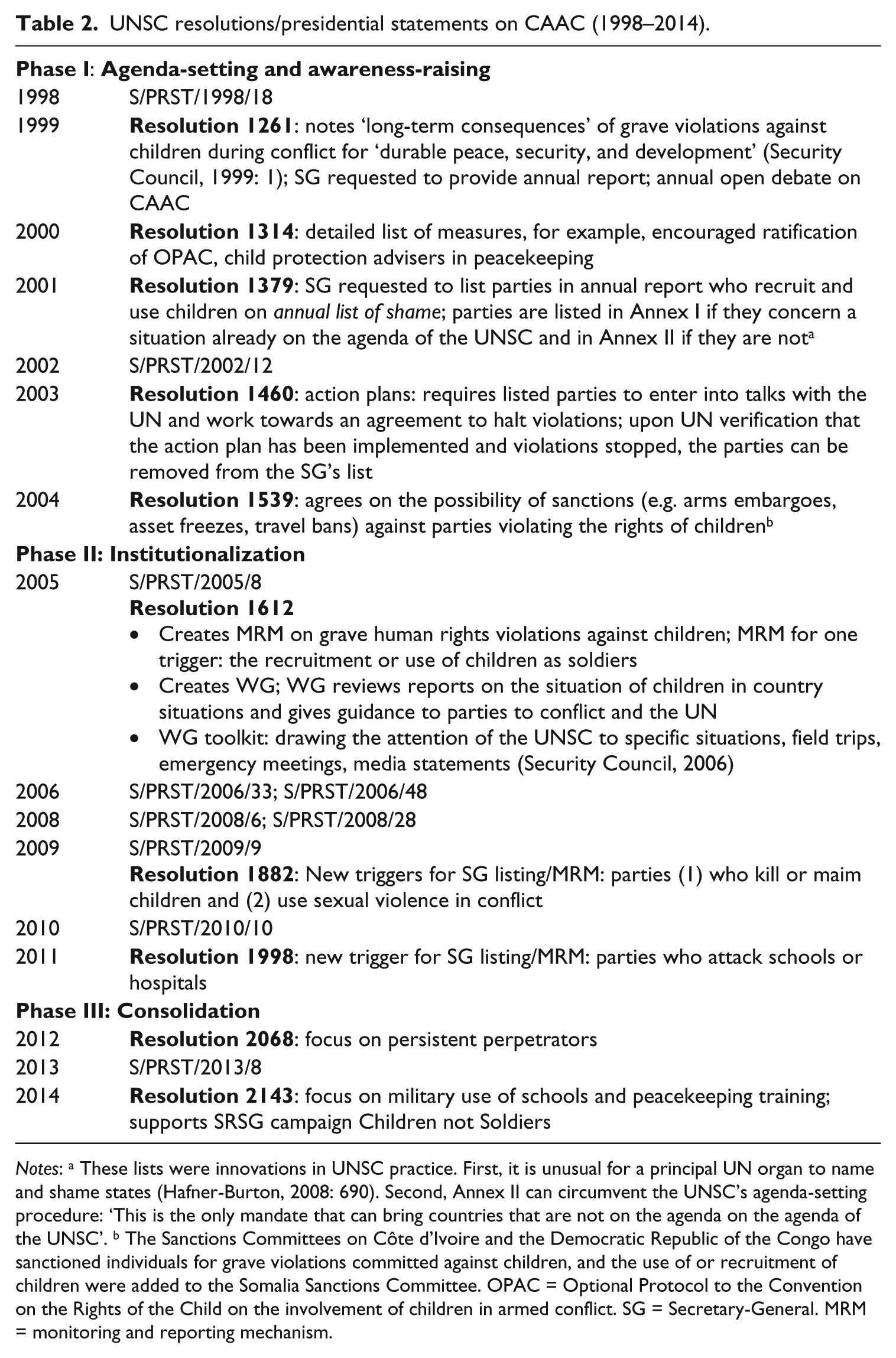
Notes: a These lists were innovations in UNSC practice. First, it is unusual for a principal UN organ to name and shame states (Hafner-Burton, 2008: 690). Second, Annex II can circumvent the UNSC’s agenda-setting procedure: ‘This is the only mandate that can bring countries that are not on the agenda on the agenda of the UNSC’. b The Sanctions Committees on Côte d’Ivoire and the Democratic Republic of the Congo have sanctioned individuals for grave violations committed against children, and the use of or recruitment of children were added to the Somalia Sanctions Committee. OPAC = Optional Protocol to the Convention on the Rights of the Child on the involvement of children in armed conflict. SG = Secretary-General. MRM = monitoring and reporting mechanism.
The CAAC agenda moved quickly through the phase of agenda-setting to institutionalization, but, since mid-2011, is marked by some contestation, illustrated by the first-ever abstentions on a CAAC resolution (2068). Overall, with a broad protection and monitoring framework in place, it has now reached a plateau.
Targeting space in UNSC decision-making
In analysing the tactical and strategic practices of actors across the three UNs, turning points of the CAAC agenda are associated with how practices have been performed by individuals, five of which I focus on: Olara Otunnu (first SRSG), Jo Becker (representative of Human Rights Watch), Jean-Marc de la Sablière (French Permanent Representative (PR) to the UN), Radhika Coomaraswamy (second SRSG) and Roméo Dallaire (founder of the Roméo Dallaire Child Soldier Initiative (CSI)). I selected these individuals as they were/are at the representative forefront of developing the CAAC agenda and based on information provided by interviewees. While I focus on these individuals, one should be cognizant of the fact that they all worked as part of teams.
Although many of the practices analysed in the following sections occurred simultaneously, I cover them separately in order to clarify the analytical understanding.
Providing information and generating ideas: Tactical practices from NGOs and UN officials
Ideas driving the CAAC agenda originated in how third and second UN actors performed tactical practices (see Security Council Report, 2008: 13). Their engagement precedes UNSC discussions, dating back to the Machel report (General Assembly, 1996) as the central idea-generating document. Second and third UN actors who were involved in the report lobbied member states to implement its recommendations. These included many United Nations Children’s Fund (UNICEF) officials, whose staff had the ‘recognized’ field-proven expertise on ensuring the protection of children. In this phase, UNICEF actors engaged in a hybrid of tactical and strategic practices: they strategically worked from their established position as the UN system’s child protection agency while also seeking to establish themselves as agenda-setters for children’s rights in armed conflict at the UNSC.
One of the Machel report’s recommendations, the creation of an SRSG mandate on CAAC, was realized with the appointment of Olara Otunnu in 1998. Otunnu is credited with performing particular competent tactical practices. First, he expanded cooperation between the SRSG office and the UNSC. Second, he generated some agenda-defining ideas: the ‘era of application’ that pushed for institutionalizing UNSC involvement (Otunnu, 2003); action plans negotiated between the SRSG and government/non-state armed groups on steps to be removed from the annexed lists; and the appointment of child protection advisers in all new UN peacekeeping operations, starting with the 1999 UN mission in Sierra Leone.
Otunnu was well known in UN circles of the late 1990s, having already traversed first and third UN backgrounds: he was Uganda’s PR to the UN from 1980 to 1985, a period during which Uganda was an elected UNSC member (1981–1982). Here, he played a crucial role in the 1981 Secretary-General (SG) appointment process when serving as UNSC president, earning him the reputation of being a skilful negotiator (Otunnu, 1990). From 1990 until he became SRSG in 1998, he was President of the International Peace Academy (IPA), a key UN think tank.
Based on these plural socialization experiences, Otunnu comes across as well suited to communicating effectively with first and third UN actors. However, his third UN socialization at IPA is different to that offered by the human rights NGOs associated with pushing the CAAC agenda. Moreover, the SRSG position was Otunnu’s first UN Secretariat job, indicating that he might not have been adept in the intricacies of the second UN’s role. Otunnu was most familiar with interpreting and handling social situations dealing with member states, and UNSC members appreciated his work: ‘Kofi Annan chose the right person as his special representative. Thanks to Olara Otunnu a “take off” has been possible’. Yet, he was not fully in line with the expectations/aspirations of the NGO human rights community. Here, some interviewees noted that Otunnu could have made far better use of the ‘dynamic early years’ of the CAAC agenda. This illustrates that switching between what are perceived as appropriate ways of communicating to different UN dimensions is not easy or automatic, even with a varied socialization.
Three particular ideas that shape the CAAC agenda were tied to the tactical practices performed by a group of second and third UN actors in this period (1999–2005): the six grave violations (UNICEF), the monitoring and reporting mechanism (MRM) (NGOs, UNICEF), and the UNSC WG (NGOs, de la Sablière, Otunnu).
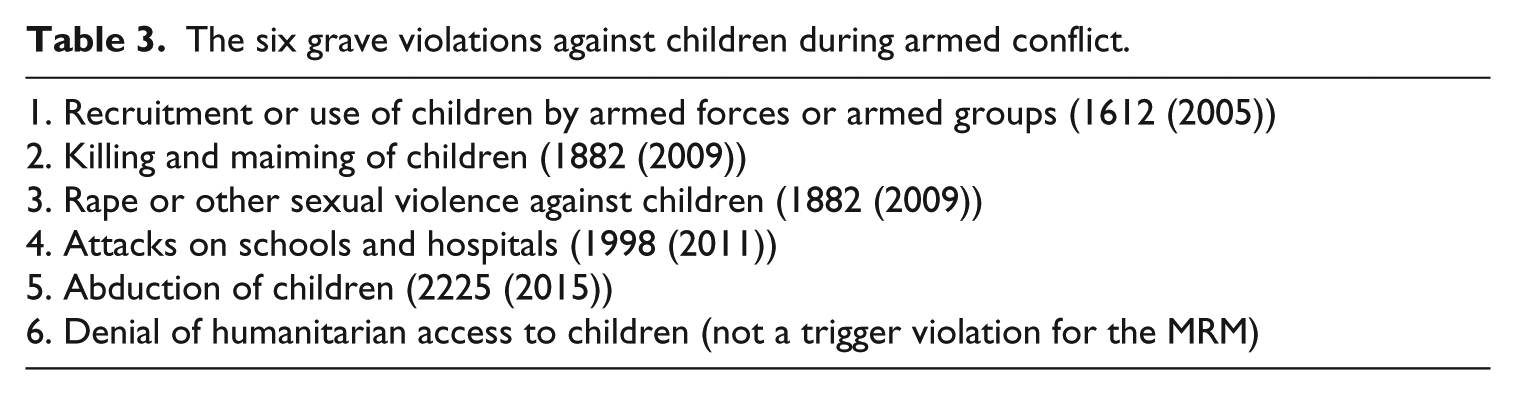
First, the six grave violations of children’s rights in conflict (see Table 3) that define the UNSC’s approach to CAAC come out of the Machel report, appearing in 1261 in a ‘copy and paste’ fashion after elected UNSC members had approached UNICEF staff for drafting advice. 9 These violations were later added as triggers to the MRM, which can then be connected to suggestions contained in NGO policy briefs.
The six grave violations against children during armed conflict.
This agenda-setting period of CAAC has to be seen within its historical-normative context, associated with the increasing prominence of global human rights. From the 1990s onwards, the UNSC gradually accepted a human rights component on its agenda and began to question ‘absolute’ understandings of sovereignty (Genser and Ugarte, 2014; Heupel, 2011). The two ad hoc tribunals for the Former Yugoslavia and Rwanda established by the UNSC illustrate this development. Further, the creation of the International Criminal Court (ICC) includes a referral role for the UNSC, underlining rising accountability for fundamental violations of human rights (Genser and Ugarte, 2014: 4). In terms of timing, this created an advantageous environment for human rights NGOs to perform their tactical practices.
NGOs liaising with UNSC members on CAAC could revisit connections forged in two parallel campaigns: first, on the jurisdiction of the ICC in 1998; and, second, on the Optional Protocol to the Convention on the Rights of the Child on the involvement of children in armed conflict (OPAC) in 2000. Both campaigns were successful: the ICC statute included conscripting children under the age of 15 as a war crime and convicted Thomas Lubanga of this offence in 2012. The OPAC raised the age limit for conscription to 18. Its negotiation and ratification process contributed to spreading a norm on the prohibition of child soldiering that also influenced UNSC decision-making. While some governments had defended the use of child soldiers during OPAC’s negotiations (General Assembly, 2000), this disappeared with OPAC reaching 156 state signatories in 2014, making it the most widely ratified universal human rights instrument. Another outcome of NGO lobbying was the Watchlist on Children and Armed Conflict (Watchlist, created in 2001), a network composed of NGOs with its own steering committee. 10 Watchlist was modelled after the International Coalition to Ban Landmines, which had played a crucial role in bringing about the Ottawa Treaty in 1997.
As tactical practices depend much on how timely opportunities are seized, all of this contributed to an overall favourable context for third UN involvement on CAAC. Having established a network of ‘friendly’ member states when promoting the OPAC, NGOs such as Human Rights Watch (HRW) increased their advocacy at the UNSC. Insiders identified Jo Becker of HRW as a key person in generating new ideas for UNSC involvement, in particular, the MRM. Although SRSG Otunnu started reporting to the UNSC in 2000, his annual reports lacked structured information, ‘details were not substantiated enough’. A central MRM, involving second and third UN actors with reporting responsibilities, intended to change this and was pushed for by Watchlist. In addition to country-specific reports, the MRM also produced a global horizontal note summarizing key developments, allowing UNICEF and NGO actors to brief the UNSC on a regular basis:
Every time we have a plenary meeting of the Working Group, they [NGOs] presented a fact sheet of the situation in the world. … I felt that it is very important to have because it’s a source of information, because some of them are really in the field. They can bring information that you don’t get from some other sources.
For actors from the third UN, the MRM therefore meant gaining space in UNSC decision-making because it provided an access channel for NGO information (see Security Council Report, 2008: 13). This pathway is still controlled by UN officials, as Becker describes:
One of the great frustrations for Human Rights Watch is that we have monitored violations for years in India but UN actors in India will not verify our information. … As a consequence, the parties responsible don’t get put on the SG’s list. (Quoted in Columbia SIPA, 2012: 36:10).
Although the relationship between second and third UN actors is often cooperative, this points to their different positions in UNSC decision-making: the second UN occupies a formal space that can be strategically arranged. This also maps out through how closely the SRSG’s office and NGOs cooperate over time, with variation emerging across SRSGs. Interviewees remarked that the second SRSG, Coomaraswamy, held regular briefings with NGOs, while this was not a priority for the third SRSG. SRSGs can therefore perform their conduit function depending on how they conceptualize their strategic practices, which has consequences for NGO space in UNSC decision-making.
Becker’s role still provides a useful illustration of the comparative advantage that NGOs can have through their tactical practices. She was the founding chairperson of the International Coalition to Stop the Use of Child Soldiers, which led the campaign for the OPAC. Becker therefore started working on children’s rights in the mid-1990s and continues to be an active voice. Her communication style is remarkable for bringing a strong advocacy element, highlighting the importance of speaking out that is testament to her human rights socialization, but also retaining connections to the ‘friendly’ member states that she needs to push the CAAC agenda, as ‘tested’ during her leading the OPAC campaign (see Columbia SIPA, 2012). These experiences have allowed her to act on the basis of long-term personal and institutional memories and to receive recognition: ‘Becker has been the only one who has been around for the last decades’.
The WG on CAAC is the third key idea promoted by second and third UN actors in this period. With the MRM, a documentation of worldwide violations was in place but there was no UNSC mechanism to process information. When creating a thematic sanctions committee proved unfeasible, Otunnu, together with French PR la Sablière, with whom he worked closely throughout his tenure, came up with the WG as an alternative (see next section).
After Resolution 1612 (2005), which enhanced the mandate and therefore the positions of key second UN actors, their practices focused on implementation and consolidating their space. This included operationalizing UNSC policy outcomes:
We had the framework in the SRSG’s report, but that doesn’t go into a lot of operational detail. We had to figure out how we would define the violations so that it is common across the board. What kind of data will we collect, is it going to be qualitative or some sort of quantitative data? What’s the minimum data set? How do we collect information ethically from the survivors?
UNICEF officials therefore drafted operational-technical field manuals for the MRM (UNICEF, 2014). With UN officials occupied with implementation, ideas included in resolutions after 1612 are connected exclusively to NGOs.
The CAAC agenda has entered a third phase after 2012, characterized by some backlash (see subsequent section). This not only applies to CAAC, but is part of a changed context: ‘Nowadays, the UNSC is less open to human rights issues than it was 10 years ago’. Since 2012, some parts of the third UN have therefore adapted their tactical practices, connected to a sense of timing: ‘As an advocate, you have to be able to read the landscape. You are not going to push for your most progressive advocacy ideal when the landscape is already terrible’.
With a range of instruments in place, the CAAC agenda has arguably been stalled because UNSC members do not make full use of them. This situation can create rifts between ‘friendly’ elected UNSC members and NGOs: some members characterized NGO demands as ‘too unrealistic’ while also expressing frustrations about being on the receiving end of NGO criticism. One interviewee noted that NGOs have no sense of ‘how it works’ in negotiations:
The NGOs, they have a long agenda, they want results. Sometimes, listen, I can support what you are saying, but what you are saying will not fly, taking into account the positions that exist in the context of the Security Council.
These claims of superior competence with respect to navigating the ‘diplomatic turf’ (Krieger et al., 2015: 274) illustrate how member state representatives may use their positional dominance to arrange space.
Third UN actors appealed to their own space in decision-making, as well as their sense of timing:
We have heard: ‘Oh, you shouldn’t talk about this now, it’s dangerous for the agenda’. There are only so many times you can use this as an excuse for bringing up something or not bringing up something. … We all understand what’s happened, we’ve been there, we have adapted accordingly. But it cannot be eternally used as an excuse to choose a certain direction over another.
These frictions underline that the space NGOs created in UNSC decision-making through tactically using opportunities is fragile as they remain outside the established space: ‘There is still a two-tier system where we [NGOs] feel we are a little bit second class’ (Becker, quoted in Columbia SIPA, 2012: 34:40). Pushing NGOs out is therefore easier in the UNSC than in organs where NGOs have formalized consultative roles, such as the Human Rights Council (HRC).
Yet, other NGOs, such as the CSI, continue to be recognized as competent performers of tactical practices and illustrate how it matters who performs them: its founder, Lt General Roméo Dallaire, devises the NGO’s perspective. Inspired by his experiences as force commander of the UN assistance mission in Rwanda, Dallaire gradually started to speak about encounters with child soldiers during the Rwandan genocide (Dallaire, 2010: 5–7). He highlighted the security dimension of child soldiering as a weapon of war, that is, the tactical advantages that commanders see in using children as combatants and the dilemmas that adult peacekeepers/military face when they encounter them. His particular socialization experiences make Dallaire well suited to performing these tactical practices as he has both a military background and ‘is a humanitarian at heart’.
Dallaire has written about how his plural socialization as a general and a humanitarian enabled him to communicate in different, fitting, ways across key audiences. Moreover, it also makes him appear authentic and therefore establish trust with both humanitarian and military leaders. His military background, in particular, made him a useful communication partner for the leaders of armed groups and child soldiers themselves: ‘My rank gave me access to their world view in a way that was not offered to either the aid workers or the UN troops’ (Dallaire, 2010: 9). In performing his tactical practices:
Dallaire was able to bridge a gap, he was able to bring together people at a table that speak different languages and use different lexicons. He talks about how they can have strategic complementarity. It’s not so much that you’re collaborating but that you are understanding the strategic point of you working together.
Despite these socialization advantages, there are also challenges in communicating adequately with actors coming with different expectations of appropriate behaviour (Dallaire, 2010: 213, 219, 232), making adapting practices a reflective learning process. CSI’s training practices have been confirmed by Resolution 2143 (2014) as relevant for peacekeeping operations and are being implemented by peacekeepers on the ground (Security Council, 2014c).
Negotiation practices of UNSC member states
Although the substantial ideas moving the CAAC agenda originated in the third and second UNs, they only became part of UNSC resolutions through the strategic negotiating practices of member states. At first, elected members such as Canada and Namibia advocated for greater UNSC involvement and called Arria-formula meetings on the topic (Sievers and Daws, 2014: 82). These are examples of elected members attempting to leave a legacy by strategically managing space in UNSC decision-making. While elected members played crucial roles throughout, CAAC received its greatest member state push under French leadership from 2002 onwards (see Security Council Report, 2007a). France is known for an activist foreign policy in the UNSC (Bosco, 2009: 251–2; Mahbubani, 2004: 258). Sustaining this is a space-managing strategy to demonstrate its contribution and to legitimize its privileged position as a P-5 (Tardy and Zaum, 2016: 121).
A main reason for France’s CAAC negotiation practices was the engagement of France’s PR Jean Marc de la Sablière and his team (see Security Council Report, 2007b). La Sablière personally negotiated Resolution 1612 for a year, engaging in bilateral communication and balancing member state interests: ‘La Sablière was the political mastermind behind 1612. He knew when to say stop and when to push and had a good sense of what was possible in the Council’. He, for example, brought elected member Benin on board ‘to demonstrate West-African involvement’, and 1612 was unanimously passed during Benin’s presidency. Due to the scope of this resolution and its creation of the WG, this unanimous passing presented a greater challenge than prior CAAC resolutions and can therefore indicate recognition of La Sablière as a competent performer (see Security Council Report, 2008: 14–15).
A career diplomat, La Sablière had been appointed as PR in 2002 (until 2007) and was known as a seasoned negotiator by 2005, having led UNSC opposition against the US push towards authorizing force in Iraq (De la Sablière, 2013). La Sablière was motivated to take on the mandate after encounters with child soldiers during a UNSC field visit to the Democratic Republic of the Congo (DRC) (De la Sablière, 2013: 298). He had been the human rights expert responsible for the GA’s Third Committee as a young diplomat working at the French mission. Interviewees across the three UNs remarked that it is ‘rare for an ambassador to show this level of personal commitment’ and how this helped to move the issue along. As stated in a Security Council Report (2008: 15) publication: ‘France’s commitment to this issue from the level of foreign minister down, has impressed Council members, who say that without France’s leadership it would be a very different picture’.
After negotiating Resolution 1612, La Sablière also made France the chair of the WG. This was an unusual move for a P-5, who generally do not chair UNSC subsidiary bodies (Luck, 2006: 17; Sievers and Daws, 2014: 556–7). La Sablière chaired all WG meetings, although negotiations in subsidiary bodies typically run at an expert level (first or second secretaries). This involvement was characterized as a ‘French stamp’ on the CAAC agenda and also included sending a French Junior Professional Officer to work at the SRSG’s office.
The early phase of the WG was characterized by a ‘progressive atmosphere’: the team around La Sablière were still around and, as insiders remarked, other UNSC members were attracted by the novelty of the mechanism and committed to making it work. Interviewees also noted that the focus on children privileged content over politics: ‘This has been a consensual topic. Children are important. There is no voting on children. This applies both to the GA and to the UNSC, you don’t vote in children, everything is decided upon by consensus’. 11
La Sablière’s role can also be underlined by his work after retirement: ‘He has continued to work on this issue; he has continued to make himself available on this issue. He reaches out to civil society actors’. In 2012, he produced a report about remaining areas of engagement at the request of then SRSG Coomaraswamy. As the CAAC agenda had entered a stage of contestation, La Sablière was brought in because Coomaraswamy felt that member states would listen to him.
In 2009, the WG chair was taken over by elected members, starting with Mexico, followed by Germany and Luxemburg. In different styles, these elected members pursued space-arranging strategies by working in close collaboration with relevant NGOs and the SRSG’s office. Mexico’s style is referred to as particularly ‘inclusive’ (Security Council Report, 2010: 22), both in its interaction with UNSC members and with the second and third UNs: ‘I would see them at meetings, they had this NGO policy brief and the whole thing was coloured through with marker and highlighter’. The first transition of chairperson was considered important among interviewees as the agenda lost its P-5 champion (see Security Council Report, 2006). Some interviewees noted how the French delegation ‘dumped’ the CAAC agenda on the Mexican delegation with a hearty ‘bonne chance’, underlining how closely France’s engagement was tied to La Sablière and his team.
During Mexico’s chair, the UNSC added a new trigger to the MRM and took the WG on its first field visit to Nepal, which interviewees characterized as important for demonstrating the full applicability of the toolkit. Mexico also started training incoming elected WG members and invited Watchlist to conduct these sessions. This practice has been continued by later WG chairs, allowing for enduring working relationships between NGOs and member states. One interviewee noted how NGOs provided the institutional memory: ‘They have been very, very influential in convincing other members of the council, those that were hesitating, did not have time to apprehend all the history and the background of this, the new members arriving in the council’.
In 2011, Germany took over as chair with the goal of shortening the time it would take the WG to decide upon conclusions on country situations. This ‘time-pressure strategy’ was perceived as a ‘constructive tool’ for half a year, at which point the chair ran into difficulties related to what was happening in the UNSC (see Security Council Report, 2012: 30). In terms of space-managing strategies, events and discussion in the UNSC impact on the atmosphere and associated possibilities in the WG. From mid-2011 to 2012, there were three issues that made consultations in the WG difficult to manage.
First, three of the country reports discussed at the WG (Afghanistan, Myanmar and Sudan) were blocked due to political divisions in the UNSC. Only when the UNSC itself had reached a decision could work continue on WG conclusions. Second, in April 2011, Germany abstained from voting on Resolution 1973, mandating a no-fly zone over Libya to protect civilians and authorizing the use of force for its enforcement. Germany’s abstention created tension with the P-3 (United Kingdom, United States, France) (Gowan, 2013) and damaged its status as a ‘competent’ elected UNSC member (Adler-Nissen and Pouliot, 2014). Tension caused by later vetoes on Syria also had an adverse effect.
A third factor impeding German chairing was UNSC composition. The role of the chair is to manage discussion and debate in the WG from a neutral, if interested, vantage point. From 2012, the ‘annus horribilis for the CAAC agenda’, the WG was composed of several critics, some disinterested/silent members and almost no supportive states. State and non-state parties of three elected members — Pakistan, India and Colombia — were either mentioned or listed in the SRSG’s 2012 report (General Assembly and Security Council, 2012: 26, 27–28, 51). Moreover, the P-3 were inactive at the time, with two delegations involved in expert turnovers. As a result, the German chair was often the only delegation to speak for substantive points, thereby losing its ability to properly chair WG meetings. These conditions, combined with an attitude perceived by some members as pushing too hard, led to the first UNSC abstentions to a resolution on CAAC (2068). 12
The strategic practices of other first UN actors are crucial for understanding these abstentions. Elected members critical of the CAAC agenda, such as Azerbaijan and India, also engaged in strategic negotiation practices, designed to put themselves in prominent UNSC positions during their membership through also aligning with some of the P-5. Several interviewees noted that China and Russia might not have abstained from Resolution 2068 had the elected members not gone first.
These elected members also pursued strategic practices with respect to the SRSG mandate, which they sought to delimit in its scope (see next section). Although this was not successful, it had an impact on both the next SRSG, Zerrougui, in 2012 and the negotiation style of the subsequent WG chair, Luxemburg. For the first year of chairing, the Luxemburg delegation focused on improving working relationships: if Luxemburg felt that progress was slow, its experts would negotiate bilaterally to solve difficulties before bringing the issue to the WG again. This approach, combined with an emphasis on transparency, was applied to negotiating PRST 2013/8 and Resolution 2143. Luxemburg benefited from a change in UNSC composition that brought in more cooperative partners on the CAAC agenda in 2014. Its strategic practices proved successful as Resolution 2143 (2014) was again adopted unanimously. The focus of 2143 was technical, especially through the inclusion of capacity building (Security Council Report, 2014b). Its accompanying open debate at the UNSC included 72 speakers, the highest number of speakers on CAAC to date (Security Council, 2014b): ‘almost none of the speakers sounded negative, compared to at least 25 negative comments out of your previous around 50 speakers’.
Luxemburg’s PR, Sylvie Lucas, moreover, became known for addressing the concerns of children: ‘Luxemburg, systematically, in all its speeches, in consultations, mentioned children. Sometimes, it triggers a little bit smiles, because we know that in every speech, we are going to have a little section on children’. Lucas has focused on introducing child-specific language into country-specific resolutions and thereby to mainstream the CAAC agenda into UNSC practice. Figure 1 underlines the effects of this development: since 2012, around 75% of relevant country-specific UNSC resolutions include references to CAAC. 13
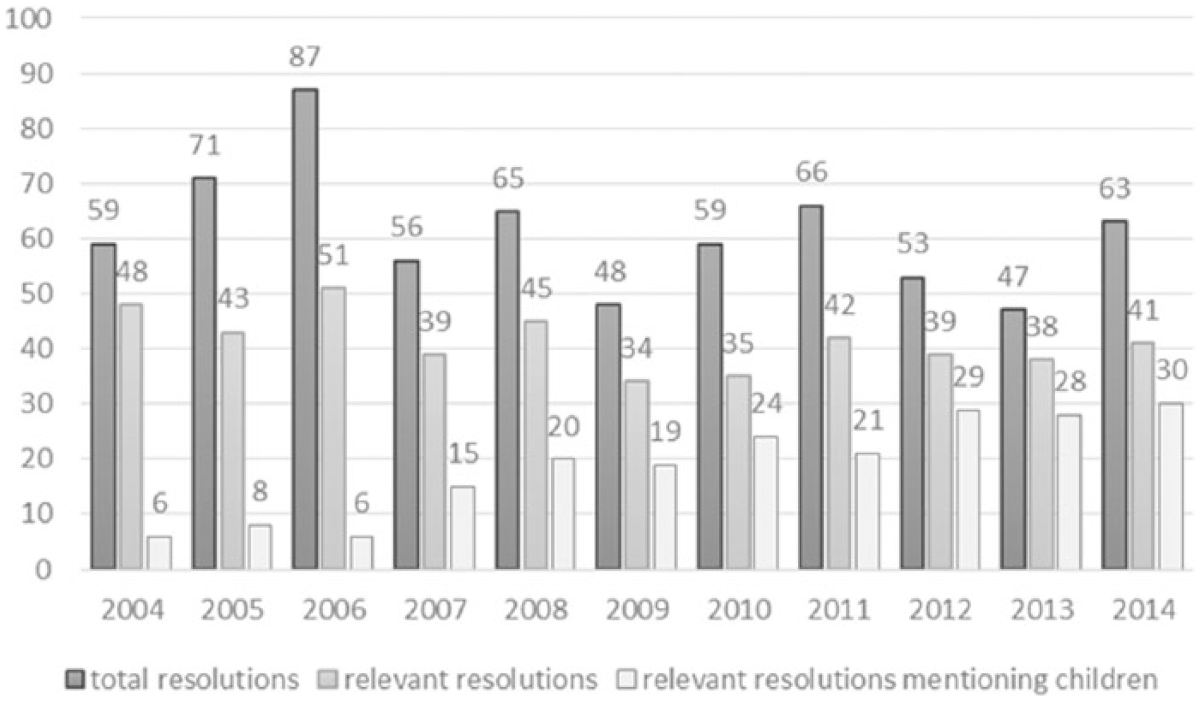
References to CAAC in country-specific UNSC resolutions, 2004–2014.
Notwithstanding the personal dedication of Luxemburg’s delegation, given that this is the country’s first-ever UNSC membership, Luxemburg’s negotiation strategies aimed at space-claiming in its favour. In contrast to previous WG chairs, who had other issues to push, Luxemburg developed a strong sense of ownership over the CAAC agenda, making it ‘their’ issue during their UNSC term.
Strategic and tactical implementation practices in the second UN
As a result of the tactical practices performed by a coalition of the SRSG, UNICEF officials and members of the NGO community, the SRSG mandate integrated more and more functions. Financially, the SRSG office had started off small with no travel budget, but it became part of the regular UN budget after Resolution 1612 (2005) was adopted, which changed the opportunities associated with the mandate drastically. In analytical terms, this gradually moved UN officials in the SRSG’s office away from pursuing tactical towards also engaging in strategic practices as they now disposed of a ‘greater’ established space.
The second SRSG, Radhika Coomaraswamy, was appointed in April 2006 and took up her office shortly after the adoption of Resolution 1612. Many of her practices were strategic, designed at least partly to make comprehensive use of her mandated space: Coomaraswamy emphasized field visits and interpreted her mandate widely, for example, by commenting on violations of children’s rights across various situations rather than only those under discussion at the UNSC, stressing that her mandate not only served the UNSC, but also the GA and the HRC. By asking other UN agencies and actors to pay more attention to the CAAC agenda, Coomaraswamy ‘engaged in efforts towards mainstreaming children’s rights in armed conflict’.
Interviewees characterized her approach to field visits as a particularly useful tool because ‘she was very effective in getting things done. She would go on a field trip and basically sit there until the Action Plan was signed. She had a way of persuading them just by being there’ (see also Security Council Report, 2010: 5).
Actors across the three UNs characterized Coomaraswamy as a dedicated human rights activist. This can be traced to her plural set of socialization experiences: she is a trained human rights lawyer and experienced human rights campaigner, having worked in these fields in her native Sri Lanka and as UN Special Rapporteur on Violence Against Women. In line with this, her strategic practices in office also speak of a willingness for confrontation: ‘She made the moral voice of the office heard, growing it out and increasing the comfort level and cultural acceptance of the CAAC mechanisms, such as the MRM’.
At the same time, Coomaraswamy reflected on the balancing act between confrontation and cooperation with member states characteristic of becoming recognized as a successful performer of practices (Bode, 2014: 281). Coomaraswamy’s reaction at a discussion event underlines this balancing: speaking after an NGO representative highly critical of the UNSC’s performance, she defended the then WG chair: ‘I do want to say that Germany really fights our battles in the Council. … Even though it’s not always successful. I think that’s important to know also’ (Columbia SIPA, 2012: 49:00).
The appropriateness of Coomaraswamy’s strategic practices was still contested by some UNSC member states, especially in 2011/2012: UNSC members insisted that she should clarify the specifics of her mandate and stick to a narrow interpretation. Pakistan, India and Colombia, in particular, criticized the report-writing and action plan-related practices of the SRSG as overstepping her mandate (see Security Council Report, 2014a: 45–46). These member states wanted to limit the SRSG mandate permanently through a campaign around mainstreaming special mandate holders when the SRSG mandate was up for renewal in the GA Third Committee: ‘a well-organized and orchestrated attack on the SRSG mandate’. As another insider noted: ‘It was really difficult to extend the mandate at the GA and to maintain it as it was, without getting any damaging language in, on sovereignty etc. It [her style] had direct repercussions on the SRSG mandate’. The SRSG mandate remained unchanged but comments by first UN negotiators underline these fault lines while also acknowledging her contributions: ‘Radhika Coomaraswamy had been an outstanding SRSG. She managed to have the whole UN system working together and many plans of action adopted. Her engagement created some tension with a few delegations, but she was right in staying firm’.
SRSG Leila Zerrougui (since late 2012) was appointed in the middle of these negative campaigns. Her practices can be read as a reaction to this situation and appear to have been aimed at consolidating her mandate through becoming recognized as a competent performer of strategic practices rather than attempting to find timely opportunities. As one interviewee noted: ‘Zerrougui is more conscious of needing to keep more people happy’. Her limited number of briefings at the UNSC on country situations speaks of a less ‘activist’ interpretation of her mandate.
During Zerrougui’s term, the SRSG’s office has published papers on the scope of the mandate and she has engaged in results-oriented initiatives. This is well illustrated with the campaign Children not Soldiers (2014), which focuses on getting the remaining eight governmental forces off the SG report’s list of persistent perpetrators. Given that two-thirds of the persistent violators are non-state armed groups, the campaign can be read as a strategic practice, 14 an effort to be recognized as a competent performer, especially vis-a-vis critical members of the UNSC. At its launch, all listed governmental groups spoke in favour of the campaign, signalling that ‘those countries the SRSG is working with are not questioning the legitimacy of the mandate’.
Conclusion
UNSC debates on thematic mandates dealing with humanitarian and human rights issues have increased since the late 1990s. Taking the CAAC agenda as case study, this article examined how its substantive development involved inputs from actors across the three UNs: member states, UN officials and NGOs. Using a practice-based and micro-oriented approach, the article explored the dynamics sustaining UNSC decision-making.
Addressing overlooked aspects of practice theories in IR, I proposed two conceptual innovations: differentiating between tactical and strategic practices, and individual agency. These innovations also speak to the constructivist challenge of conceptualizing processes of change.
First, I considered how actors across the three UN dimensions reflectively perform tactical or strategic practices, reacting in a creative and timely manner to social situations. This helped to account for how NGOs, UN officials and permanent and elected member states have moved or halted the CAAC agenda through managing, arranging and creating space in UNSC decision-making. Second, working with a plural understanding of personality, the particular space created by individuals performing practices, such as Dallaire, can be associated with adequate socialization experiences enabling them to be recognized as competent performers of practices. Yet, their varied social backgrounds are finite: Otunnu’s case underlined that actors across the three UNs come to different evaluations on what is appropriate behaviour for an SRSG, thereby leading to diverging opinions on some individuals’ performance and ‘competence’.
The empirical analysis highlighted the conceptual value of practice-based approaches with a micro-orientation: they can provide detailed accounts of change by tracing the actors’ steps and actions, and their varied agency therein. In this, they expose dynamics, conflicts and power structures that are typically hidden in ‘macro’ accounts of UNSC decision-making — and international relations more generally.
Timing proved to be a particularly influential factor in studying UNSC dynamics in two ways, both of which lend themselves to practice-based studies. First, it is important to identify how the historical-normative context, the political climate and broader patterns of UNSC behaviour and composition, as well as the individuals involved at a given time, shape the limits of practical possibility. While UN officials and NGOs were able to create spaces in UNSC decision-making through their well-timed performance of tactical practices, these are fragile and contested. This corresponds exactly to De Certeau’s (1984: 37) conceptualization of a tactical practice: ‘It takes advantage of “opportunities” and depends on them, being without any base where it could stockpile its winnings … What it wins, it cannot keep’. It also applies to interesting competitive dynamics between the second and third UNs as the comparison of interaction patterns between SRSGs and NGOs over time demonstrated.
Second, the right timing is vital in order to be recognized as a competent performer of practices in specific situations. This ‘feel for the game’ or ‘practical sense’ (Bourdieu, 1980) features prominently in reflexive practice theories and also appears in Lahire’s (2011: 32) reflective notion of a ‘sense of situations’. In following particular actors, the micro-oriented perspective presented in this article can enable scholars to capture these dynamics, as well as the contestation therein. This illustrates the added value of practice theories in capturing complex decision-making processes.
Empirically, the CAAC agenda illustrates a reoccurring phenomenon at the UNSC: after adopting Resolution 1612, ‘it was surprised to have agreed to it’ (Columbia SIPA, 2012: 57:00). In creating momentum, actors across the three UNs may make member states go further than they had perhaps intended if the timing is right. Albeit continuously contested, thematic mandates, as well as the greater relevance of humanitarian and human rights issues in country-specific resolutions, have therefore arguably made the UNSC a more dynamic space with access points for both second and third UN actors.
Footnotes
Acknowledgements
This article has benefited from the thorough critical readings of Vesselin Popovski, Trine Flockhart, John Karlsrud and Hendrik Huelss. I am further grateful for valuable feedback that the article received at the 2014 Annual Meeting of the Academic Council on the UN System (ACUNS) in Istanbul. I wish to thank all the diplomats, UN officials and NGO representatives who generously made time in their busy schedules for the interviews that are the backbone of this research. Finally, my thanks to the editors of EJIR and two anonymous reviewers for their constructive engagement and thoughtful suggestions.
Funding
This research was supported by the Japan Society for the Promotion of Science (JSPS).