




Abstract
This study investigates the tribological behavior of Al5083 alloy reinforced with AlCoCrFeNiSi high-entropy alloy (HEA) particles using friction stir processing (FSP). Wear characteristics were analyzed using pin-on-disc experiments across varying HEA volume percentages, disc speeds, and test durations, revealing significant improvements in wear resistance with increasing HEA content. Machine learning techniques, including artificial neural networks (ANN) and long short-term memory (LSTM) networks, were employed to predict specific wear rate (SWR) and coefficient of friction (COF) with high accuracy. The ensemble model combining ANN and LSTM architectures achieved R-squared values of 0.9653 for SWR and 0.9718 for COF, with a root mean square error (RMSE) of 0.024 and 0.017 for SWR and COF respectively, indicating robust predictive capabilities. Cross-validation further validated the model's effectiveness, achieving an average prediction error of 2.13% for SWR and 1.89% for COF. Response surface methodology (RSM) optimization refined process parameter relationships, identifying conditions that minimize SWR to 3.57 × 10⁻⁶ mm³/Nm and COF to 0.237. Scanning electron microscopy (SEM) analysis of worn surfaces confirmed the effectiveness of HEA reinforcement in mitigating wear mechanisms, enhancing the material's durability by 45% compared to the unreinforced alloy. This comprehensive approach advances the understanding of HEA-reinforced composites. It provides practical insights for optimizing material performance in industrial applications, contributing to developing high-performance materials tailored for durability and wear resistance.
This is a visual representation of the abstract.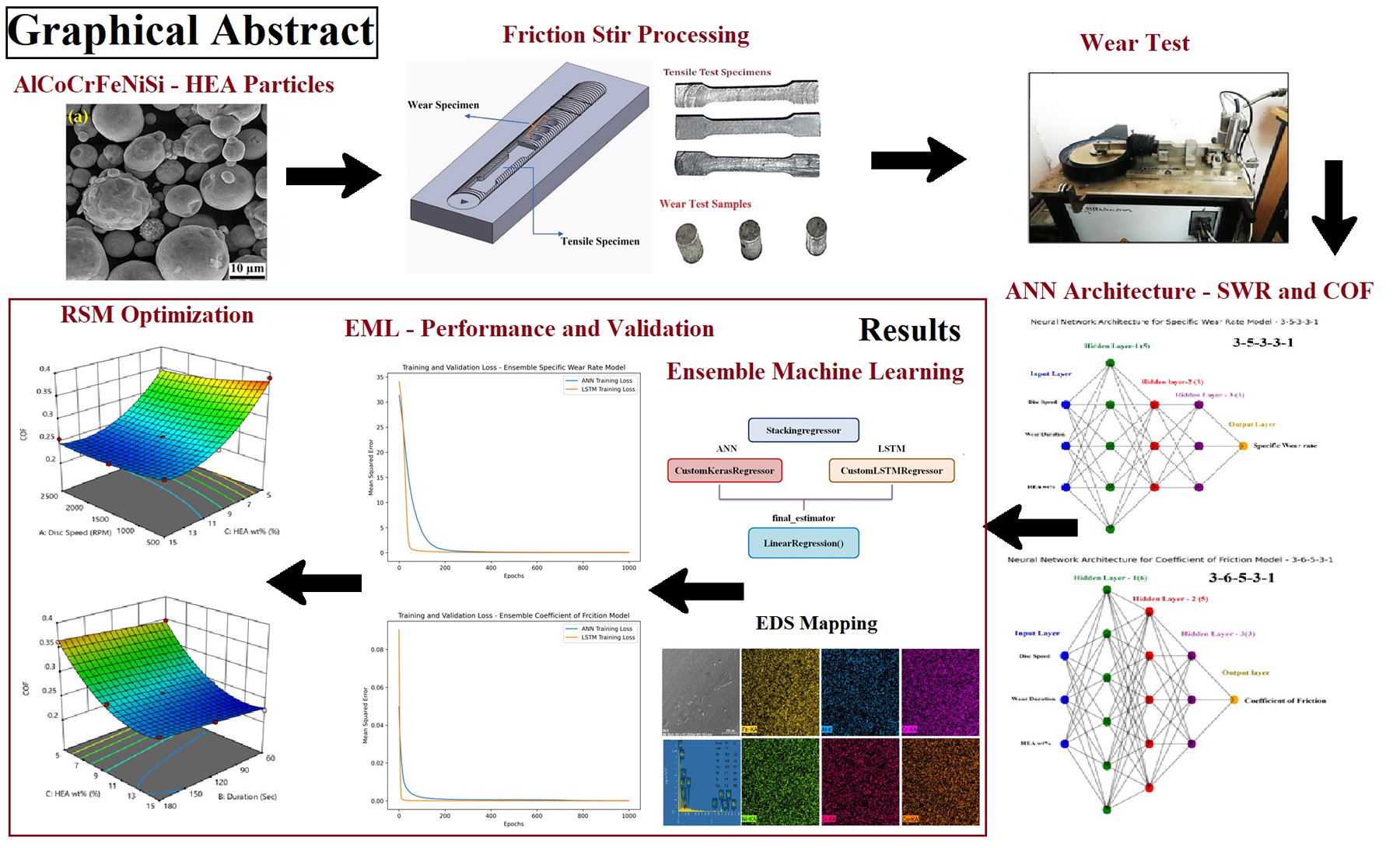
Keywords
Get full access to this article
View all access options for this article.
References
Supplementary Material
Please find the following supplemental material available below.
For Open Access articles published under a Creative Commons License, all supplemental material carries the same license as the article it is associated with.
For non-Open Access articles published, all supplemental material carries a non-exclusive license, and permission requests for re-use of supplemental material or any part of supplemental material shall be sent directly to the copyright owner as specified in the copyright notice associated with the article.
