



Abstract
Fluid film bearings operated with smart lubricants have been successfully used to enhance the lubricating performance. This article proposes a computational model to analyze the influence of magnetorheological lubricant on the performance of an annular recessed hybrid thrust bearing system. The governing modified Reynolds equation for circular thrust pad orifice compensated bearing is solved by finite element method. Further, for simulating the flow behavior of magnetorheological lubricant, a constitutive relation for the Bingham model Dave equation, has been used. The numerical results reveal that using magnetorheological lubricant improves the loading carrying capacity and damping coefficient of both annular and circular recess hybrid thrust bearings. Additionally, bearing lubricated with magnetorheological lubricant requires a lesser quantity of flow and hence less pumping power.
Keywords
Introduction
The hydrostatic thrust pad bearings are commonly used in numerous applications due to their excellent characteristics as they are able to support heavy loads, provide high accuracy, and have high fluid film stiffness. Recently, hydrostatic thrust bearings have been studied extensively. Fesanghary and Khonsari 1 developed the sequential quadratic programming for determining the optimum shape of hydrodynamic film to obtain maximum load-carrying capacity for a sectorial-shaped thrust bearing. Hamrock et al. 2 studied the hydrostatic thrust bearing used in heavy-duty industrial machinery applications such as hydroelectric power plants, machine tools, radar antennas, dynamometers, measuring devices, telescopes, and positioning tables.
The studies reported by Osman et al., 3 Sawano et al., 4 and Chen et al. 5 deal with the effect of compensating elements and recessed bearing configurations on the behavior of hydrostatic thrust bearing. Osman et al. 3 carried out the investigation of hydrostatic annular recessed thrust bearing considering dynamic loading conditions. They found that bearing performance parameters are dependent on squeeze number, bearing number, bearing radii ratios and tilt parameter. A study by Sawano et al. 4 deals with thrust pad bearings compensated with a variable inherent restrictor. It was reported that the values of stiffness coefficient and fluid film reaction get improved by reducing the oil flow rate. Orifice restrictors are the most widely used compensating devices for hydrostatic bearings because of their small size and ease of manufacturing.5–8 Chen et al. 9 examined the effect of compensating devices on the stability of hybrid bearings. They reported a better stability for the bearing compensated with an orifice restrictor in comparison to the capillary compensated bearing. The behavior of circular and multi-recess hydrostatic thrust bearings using capillary restrictor as a compensating element was investigated experimentally by Osman et al. 10 They concluded that the hydrostatic multi-recessed thrust pad bearing can withstand a higher value of external load than the circular recess hydrostatic thrust pad bearing. A study by Gohara et al. 11 carried out the theoretical and experimental investigation of water-lubricated hydrostatic circular thrust bearing compensated with a membrane restrictor. They found that using a membrane restrictor greatly improves the bearing fluid film stiffness.
The proper selection of bearing configuration is very critical for the optimal output of hydrostatic thrust bearing. Shen et al. 12 considered the effect of recess shapes on the behavior of the thrust pad hydrostatic bearing system. They revealed that annular recessed bearings provide a larger value of loading capacity corresponding to circular bearings. Sharma et al. 13 examined the hydrostatic thrust bearing performance with various pocket geometric configurations i.e. annular, rectangular, circular and triangular recess shapes. They revealed that an appropriate selection of the geometric shape of the recess is necessary for better performance of hydrostatic thrust bearing. Chow 14 also studied the annular recessed hydrostatic thrust bearings, and it was reported that this type of bearing configuration gives improved stability and life. Yadav and Sharma 15 analyzed the performance of tilted hydrostatic thrust pad bearing. They observed that tilt angle significantly influences the bearing performance.
Proper lubrication of tribo-pairs is essential for the smooth and effective operation of all machines. The lubricant may be responsible for the tribological failure of machine elements and currently, smart lubricants are finding increasing use for improving the lubricating performance of tribo systems. The rheological behavior of smart lubricants can be adjusted in real-time. The choice of lubricant for specific engineering applications is very important and is based on working conditions i.e., the material of the mating surface, load, speed, and temperature range. The rheological behavior of smart lubricants such as magnetorheological (MR), electro-rheological (ER), and electrically conducted lubricants (ECLs) can be effectively adjusted by changing the magnitude of externally applied electric and magnetic fields. MR lubricant was first invented by Winslow and Rabinow in the 1940s. 16 The MR lubricant-based devices such as clutches, dampers, bearings, brakes, etc. have been successfully used during the last few decades.17–22 MR lubricant-operated devices have attracted a lot of attention in the transportation sector. Koo et al. 23 and Goncalves et al. 24 reported that MR dampers have an extremely fast response time. Wang and Gordaninejad 25 reported that the amplitude and orientation of the applied magnetic field influence the shear rate and viscosity of the MR lubricant.
According to Carlson, 26 there are two important factors required for the proper use of MR lubricant, one is the induced yield strength by applying the magnetic field and the other is the resistance to the settling of suspended particles due to gravitational effect. They also found that the shear rates may exceed 105 s−1 and the MR lubricant model can operate more than 105 cycles. Lampaert and Ostayen 27 carried out an experimental, closed-form and numerical study to investigate the behavior of MR lubricant in the hydrostatic thrust bearing. They reported that the analytical solution is the coarsest, but it has the benefit of being very quick to measure the characteristics, whereas the numerical model is more accurate, but it has computational difficulty. In recent times, several researchers have studied the influence of MR lubricant on the hydrodynamic/hybrid circular journal bearing systems performance.28–31 Urreta et al. 28 considered the effect of MR lubricant on the behavior of hybrid circular journal bearing for high-precision machine tools applications. They found that the hydrodynamic effect gets significantly improved by using MR lubricant. Bompos and Nikolakopoulos 29 analytically and experimentally examined the hydrodynamic circular journal bearing performance operated with MR lubricant. They revealed that the dynamic characteristic of bearing is enhanced by MR lubricant. Rao and Sekhar 30 incorporated the finite element method (FEM) technique to investigate the behavior of MR lubricant behavior on hydrodynamic circular journal bearing. It was reported that MR lubricated bearing provides an improved value of bearing stability. The studies conducted on the behavior of MR lubricant clearly indicate that the lubricating performance of tribo-pairs gets improved.
Innovation in the present work
The use of MR lubricant in hydrostatic/hybrid circular thrust bearings can be efficiently harnessed to improve the lubricating performance of tribo-pairs. The available published studies amply reveal that the lubrication of annular thrust bearing with MR lubricant has not been researched previously. Further, the few available studies dealing with the use of MR lubricants in circular pad thrust bearings reported are mainly experimental in nature and are limited to evaluation of fluid film pressure and load-carrying capacity for circular recessed thrust pad bearing without comprehensively studying the bearing performance. Therefore, from the design point of view, a modelling and simulation study is desirable to facilitate the design process. In the present work, the authors propose to numerically investigate the static and dynamic behavior of an annular recess thrust pad bearing lubricated with MR lubricant. A comparative performance analysis between the annular as well as circular recess thrust pad bearing configurations has also been carried out to make a better use of recess shape. In recent times, the need for the development of high-performing machines necessitates the reduction of friction between bodies in relative motion. Thus, in the present paper, the combined influence of surface texturing along with MR lubrication has also been studied on the bearing performance parameters so as to study the interactive effect of MR lubrication and surface texturing. The author(s) believes that this study would be useful to the designers to make a better use of bearing configurations, that is, circular/annular, Newtonian/MR lubricant, textured/non-textured surfaces, spherical micro-dimples/cylindrical micro-dimples.
Governing equations
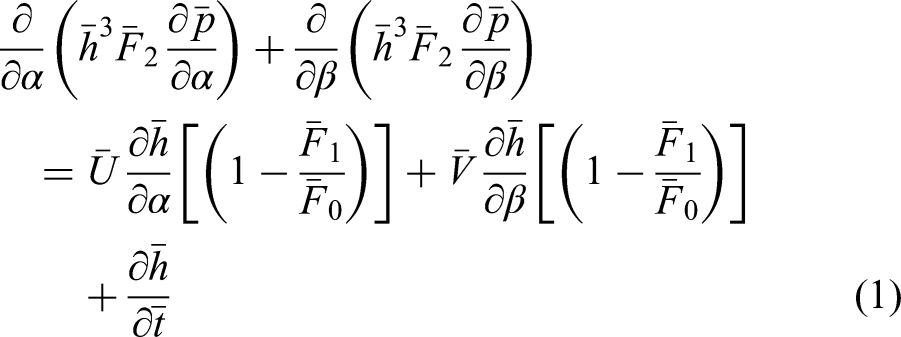
Figure 1 shows a schematic of a hybrid thrust bearing compensated using an orifice restrictor, consisting of different recess configurations, that is, annular and circular recess. The modified Reynolds equation for a hydrostatic thrust bearing governing the non-Newtonian lubricant flow in bearing clearance gap in the dimensionless form may be given as follows32–34:

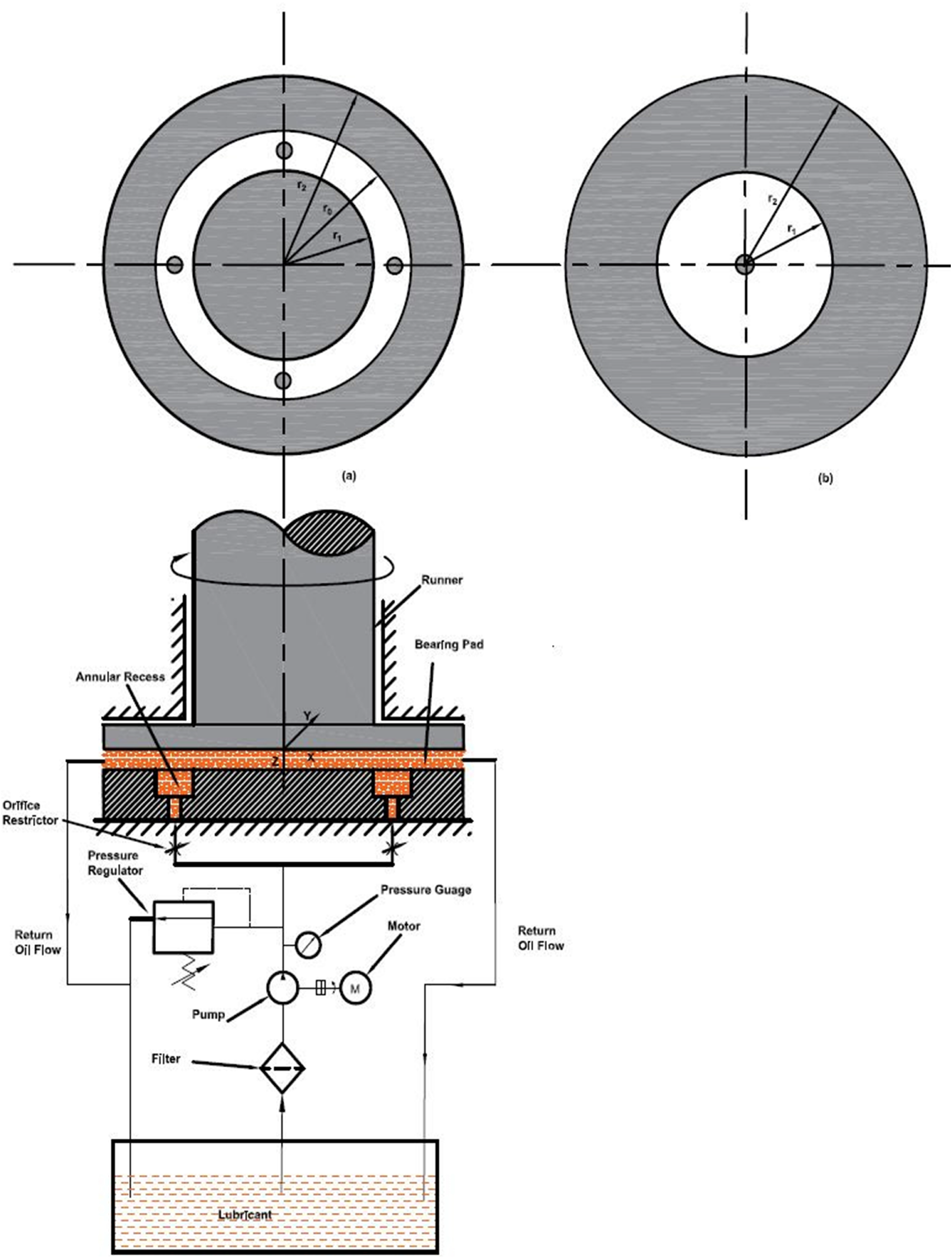
Schematic diagram of a circular thrust pad hybrid bearing: (a) annular recessed bearing and (b) circular recessed bearing.
Lubricant film thickness equation
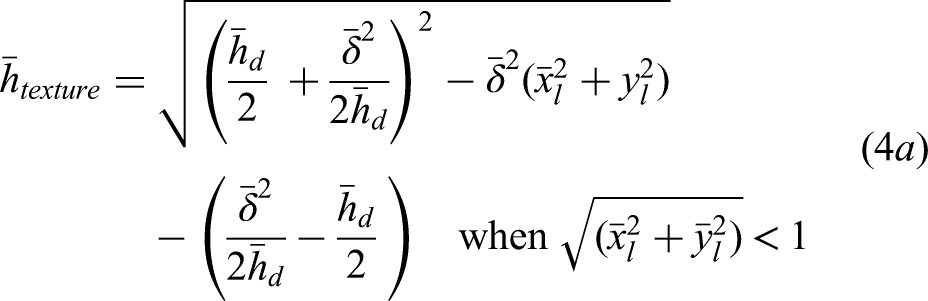
The fluid film thickness expression in the clearance gap between micro-textured thrust pad and runner surface for the parallel operation is defined as32,35:


The fluid film thickness for the spherical dimple is defined as follows:


Constitutive equation for MR lubricant
The expression for the MR lubricant viscosity is expressed using a continuous Bingham plastic model as given below36,37:

The MR lubricant yield shear stress is calculated by using the Dave equation.
38
The Dave equation is the most realistic and accurate way to describe the behavior of MR lubricant The MR lubricant yield shear stress is given as follows:

Here
Using the following non-dimensional parameters, the non-dimensional MR fluid viscosity may be defined as follows:

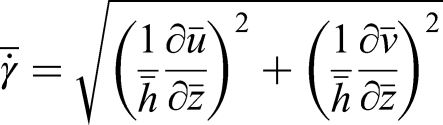
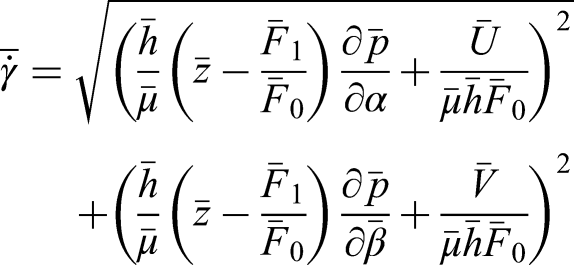
The type of MR lubricant used in this study (MRF122EG) is a commercial lubricant.39–41 The chosen MR lubricant consists of magnetic particles suspended in a hydrocarbon carrier fluid. The rheology of this lubricant changes quickly and reversibly due to the application of an external magnetic field. The MRF122EG lubricant is non-abrasive and has an excellent temperature tolerance, hard-settling resistance characteristics and higher dynamic yield strength. 37
Finite element modeling
The performance characteristics of hybrid thrust bearing using MR lubricant are computed by solving the modified Reynolds equation. The modified Reynolds equation of hydrostatic thrust bearing is solved using FEM. A four-node quadrilateral isoparametric element is used for discretizing the lubricant field domain of hydrostatics thrust pad bearing. A Lagrange polynomial function is used to interpolate the value of unknown fluid film pressure as given below
35
:

The equation of the elemental system for hybrid thrust pad bearing is given as follows:




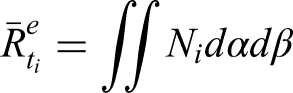
By incorporating Galerkin’s orthogonal condition, the equation of the global system of equation is obtained as follows13,33:

Restrictor flow equations
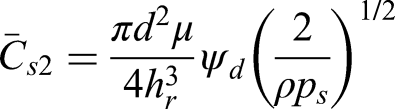
The lubricant flow through an orifice compensator (

The restrictor design parameter
Boundary conditions
The boundary conditions used for obtaining a solution for a hybrid thrust pad bearing system are given as below45,46:
All nodes situated at the recess boundary have the same fluid film pressure value. The fluid film pressure value is zero for all the nodes located at the bearing external boundary. The input lubricant flow rate via an orifice restrictor is the same as bearing input flow.
Performance characteristics
The performance characteristics parameters for MR lubricated hybrid thrust pad bearing using orifice restrictor are obtained by the expressions as given below.
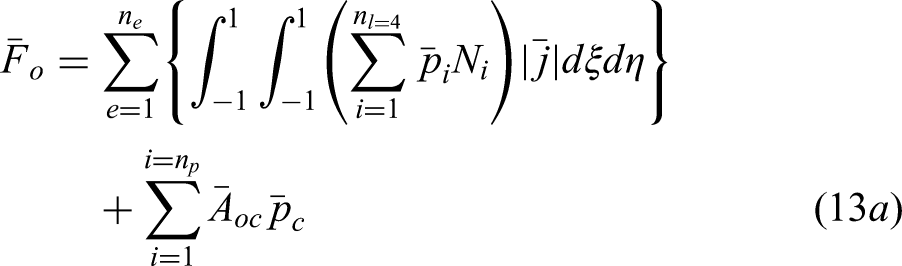
Fluid film reaction
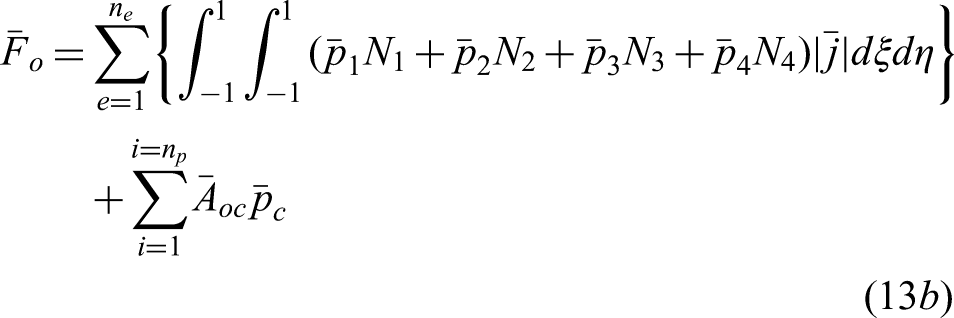
The fluid film reaction of the hydrostatic thrust bearing can be calculated by summing up the contributions from the land area and pocket area. The fluid film reaction is given as follows13,21:

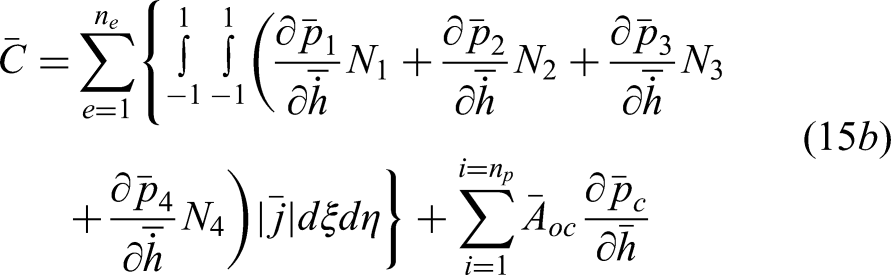
Stiffness (
) and damping coefficient (
)
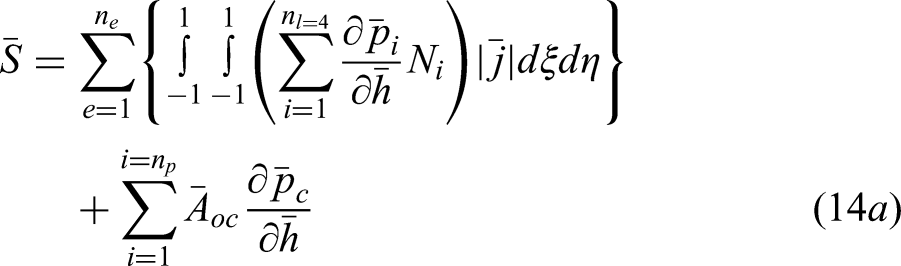
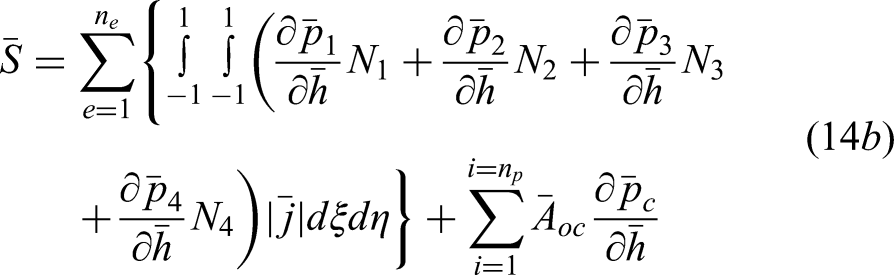
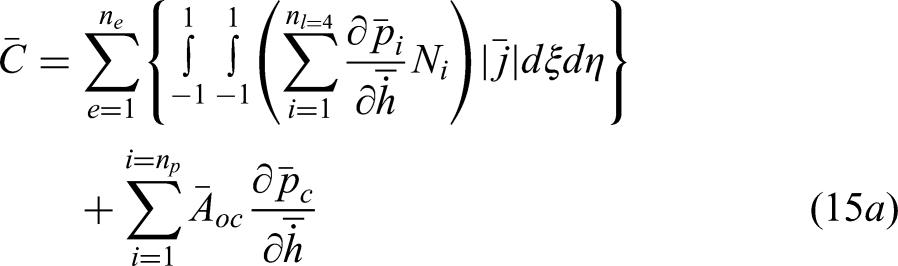
For the hydrostatic thrust bearing system, the stiffness and damping capabilities are computed for dynamic loading conditions


Frictional power loss (
)
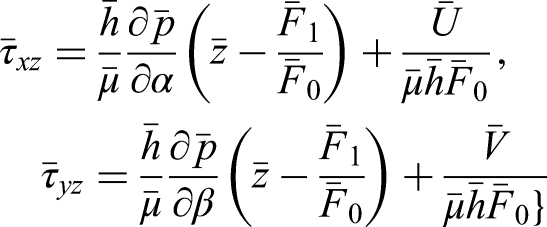
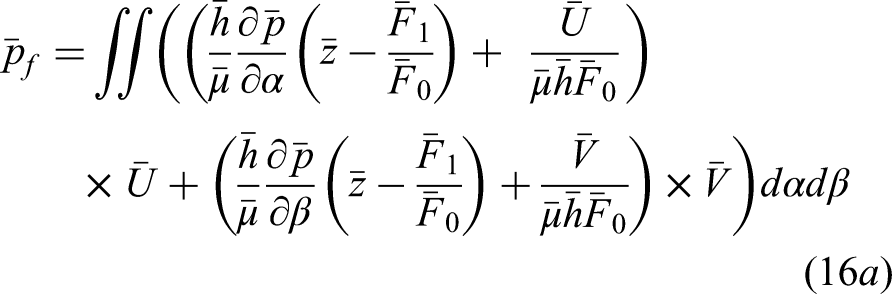
The frictional power loss in hybrid thrust pad bearing is expressed as follows
32
:


Numerical solution procedure
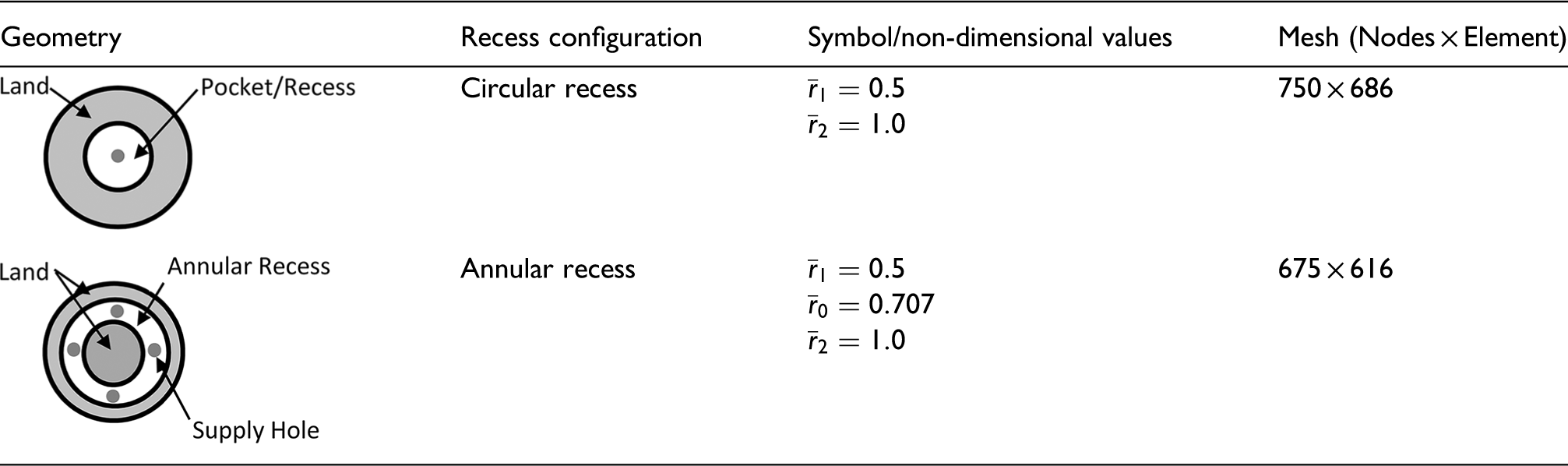
Figure 2 shows a numerical solution scheme for MR lubricated hybrid thrust pad bearing. A MATLAB source code is developed to numerically simulate the effect of MR lubricant on the behavior of hybrid thrust pad bearing. The bearing pad surface is discretized with four-noded quadrilaterals isoparametric using ANSYS software. The use of an orifice restrictor in hybrid thrust bearing makes the system equation non-linear. Therefore, Newton–Raphson method is employed for handling the non-linearity that arises in the system. The generally used operating and geometrical parameters of the fluid film bearing are taken from the available published literature32,33,35,38,39,47,48 as shown in Table 1. Prior to numerical simulation, a mesh sensitivity analysis is carried out to choose the optimal meshing size as presented in Figure 3, Table 2 depicts the geometric parameters and mesh details for the annular and circular recess bearing configurations. The aforementioned meshing size and converging criteria as given below is used for obtaining the nodal pressure vector in order to numerically simulate the results

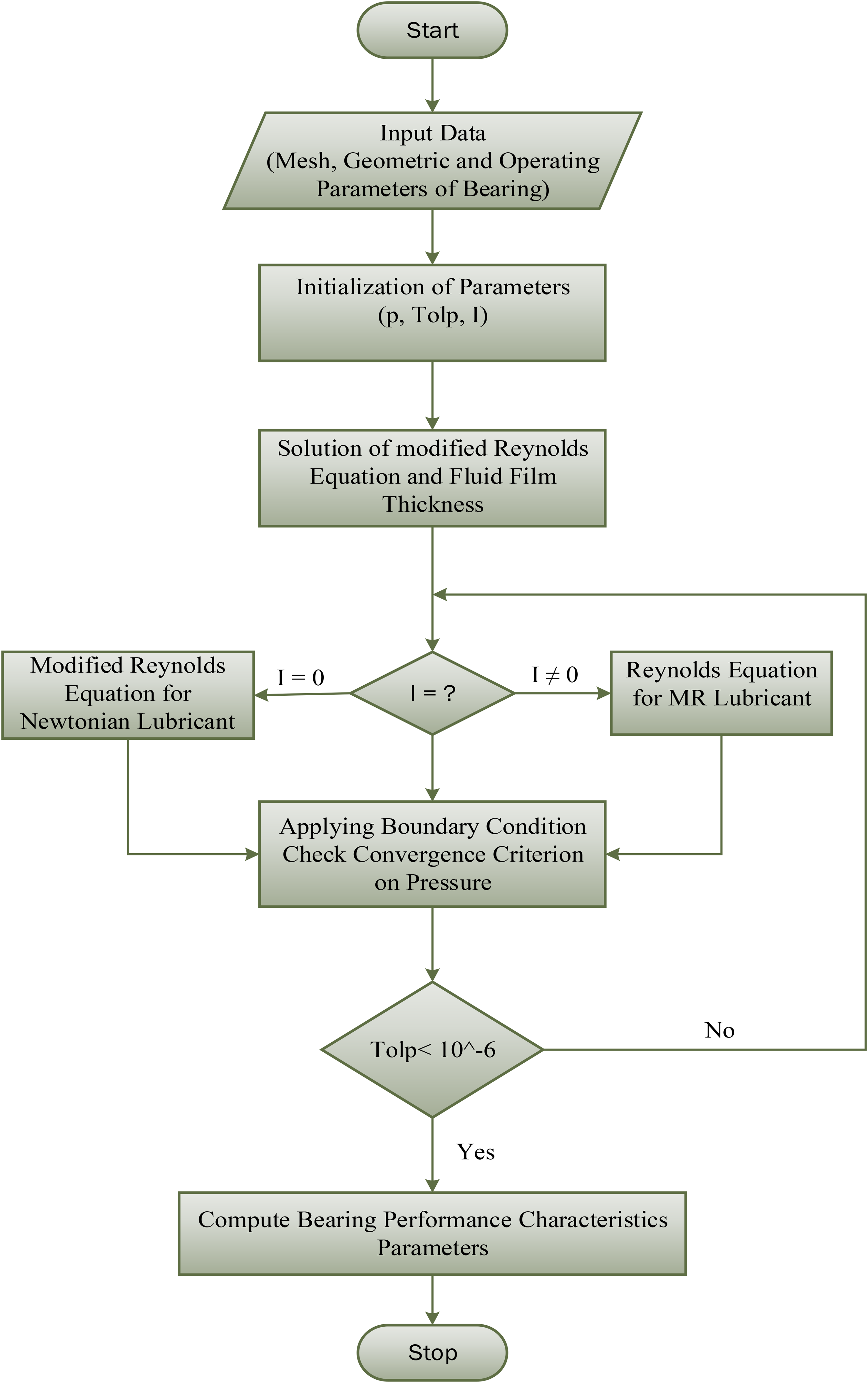
Numerical solution scheme.
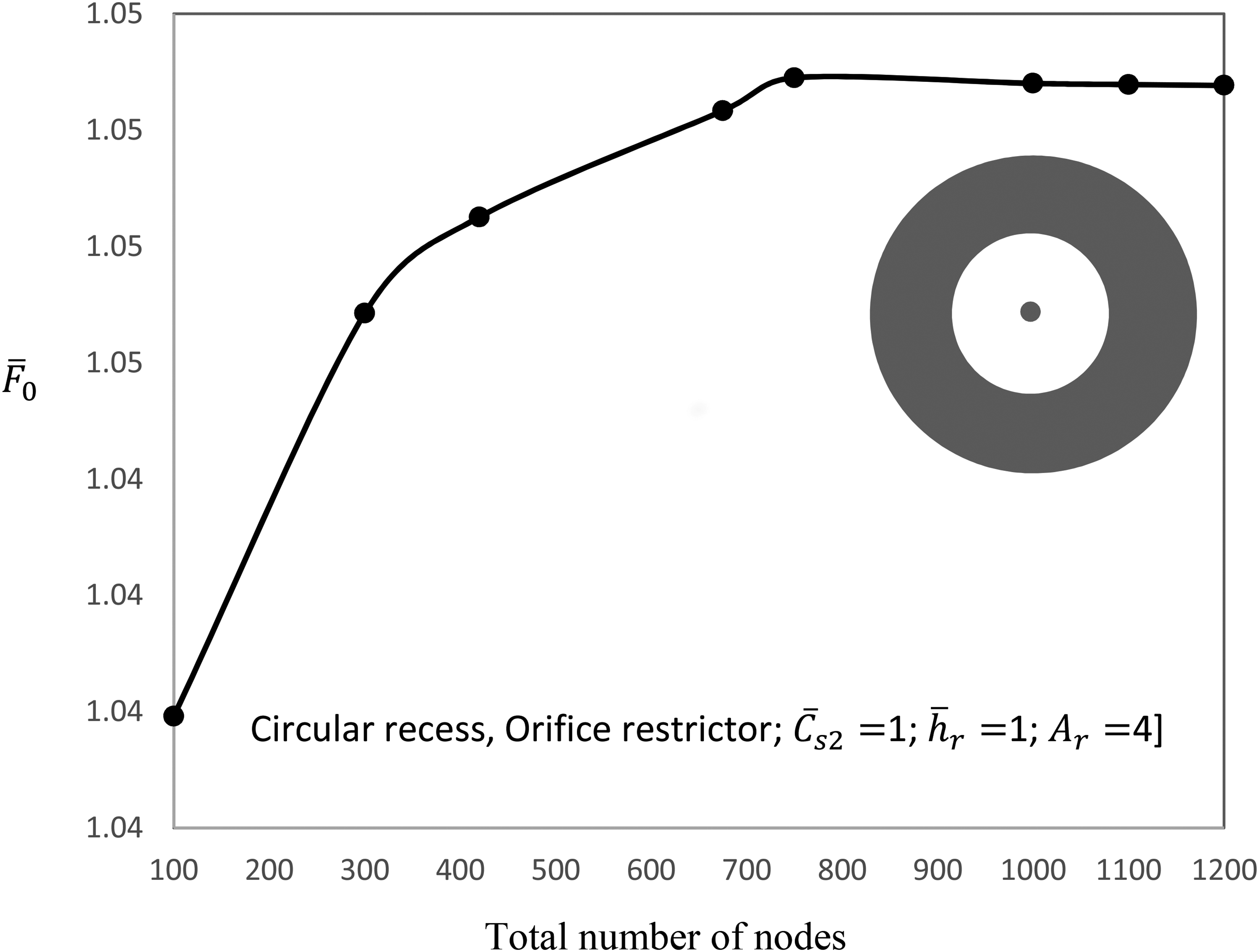
Mesh sensitivity test.
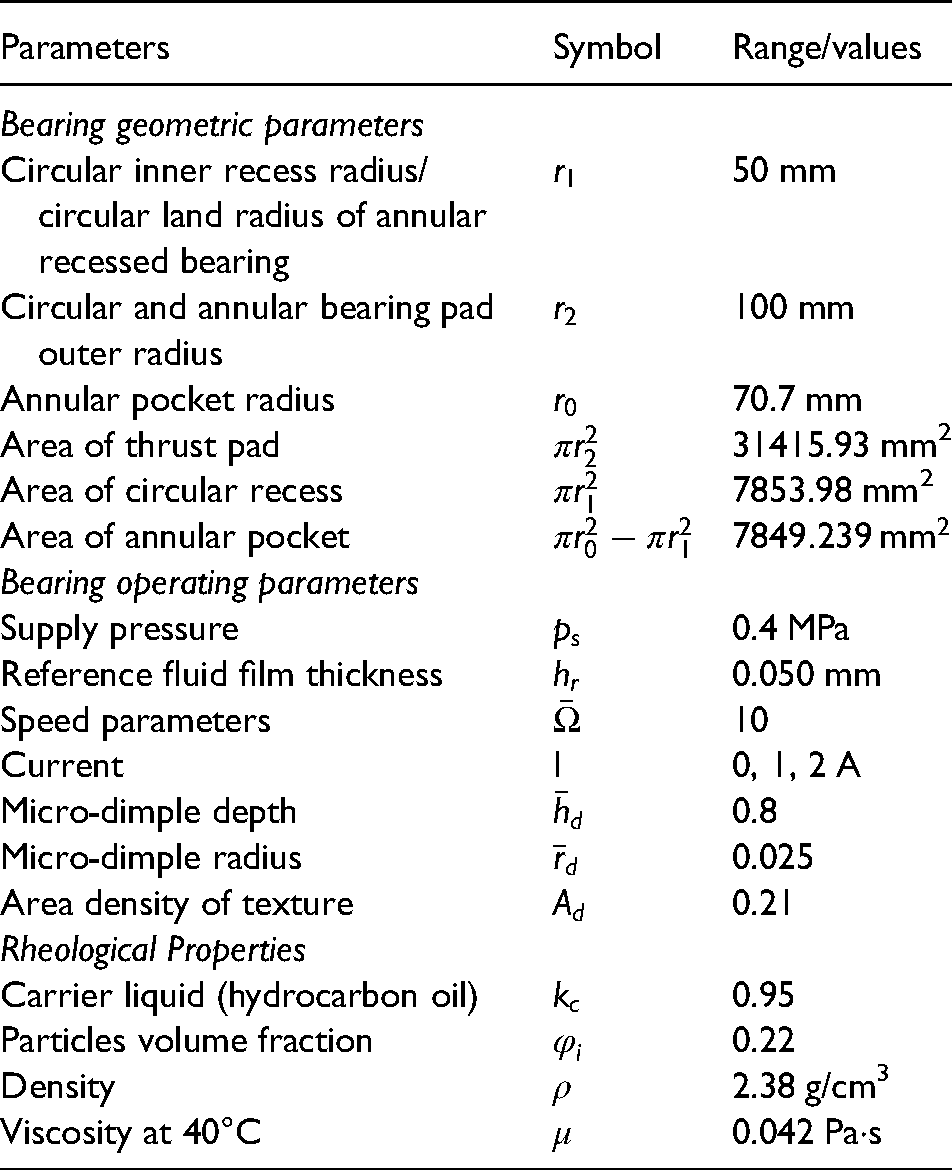
Geometric details of recessed hybrid/hydrostatic thrust pad bearing configuration.
Validation of a numerical model
The present developed model is validated stage-wise with the previously published experimental studies10,27
Experimental Validation of Hydrostatic Thrust Pad Bearing – In the first stage, experimental validation is performed for hydrostatic thrust bearing using Newtonian lubricant. The validation of the present model is performed with the published experimental results of Osman et al. using identical operating and geometric parameters. Figure 4(a) illustrates the variation in the fluid film pressure along the radial direction between the results of reference and present study and a maximum difference of 5.88% is seen. Validation of MR Lubricant Operated Hydrostatic Thrust Bearing With Experimental Study – In the second stage, hydrostatic thrust bearing lubricated using MR lubricant is verified with the experimental results of Lampaert and Ostayen.
27
The present model is modified for the hydrostatic thrust bearing lubricating with MR lubricant considering the similar operational and geometrical parameters as listed in the reference study. Figure 4(b) shows represents the variation in the value of
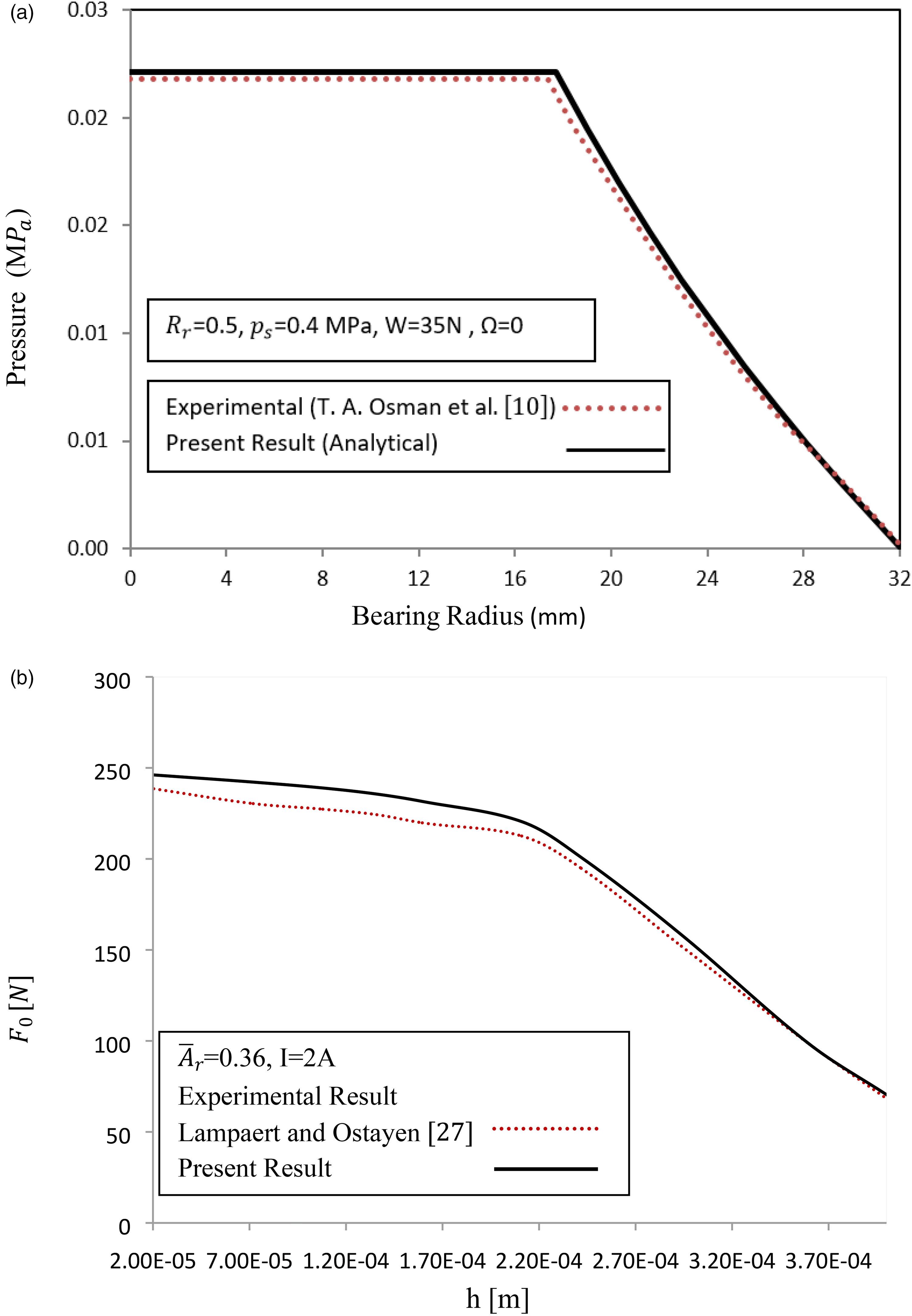
(a) Fluid film pressure profile along the radial direction in hydrostatics circular thrust pad bearing and (b) load-carrying capacity of the circular hydrostatic thrust pad bearing versus fluid film thickness.
Result and discussion
This section deals with numerically simulated results obtained from the MATLAB software to study the influence of MR lubricant on the behavior of hybrid annular and circular recess thrust pad bearings. For the purpose of comparative study, both the recess configurations, that is, annular and circular recess have been chosen so as to have the identical ratio of bearing area to pocket area, that is,
Influence on pocket pressure (
)
The distribution of pocket pressure (

(a) Pocket pressure
This behavior occurs because the value of pressure gradients gets altered with a change in the recessed bearing configuration, that is, annular and circular recessed bearings. The bearing using MR lubricant gives larger values of
Influence on fluid film reaction (
)
The variation in the value of fluid film reaction (
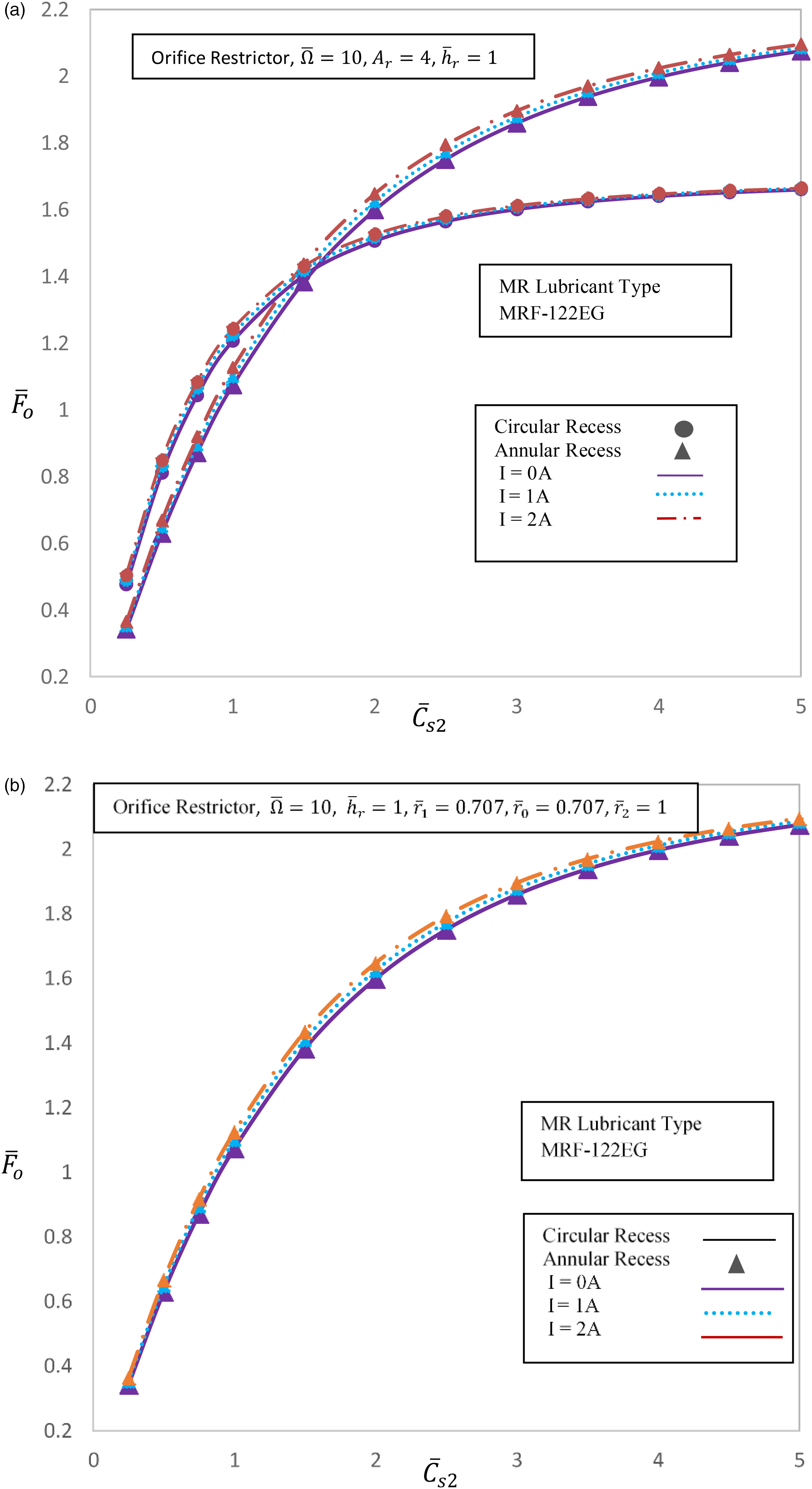
(a) Fluid film reaction
Influence on the fluid flow rate (
)
Figure 7(a) shows the variation in the value of lubricant flow rate
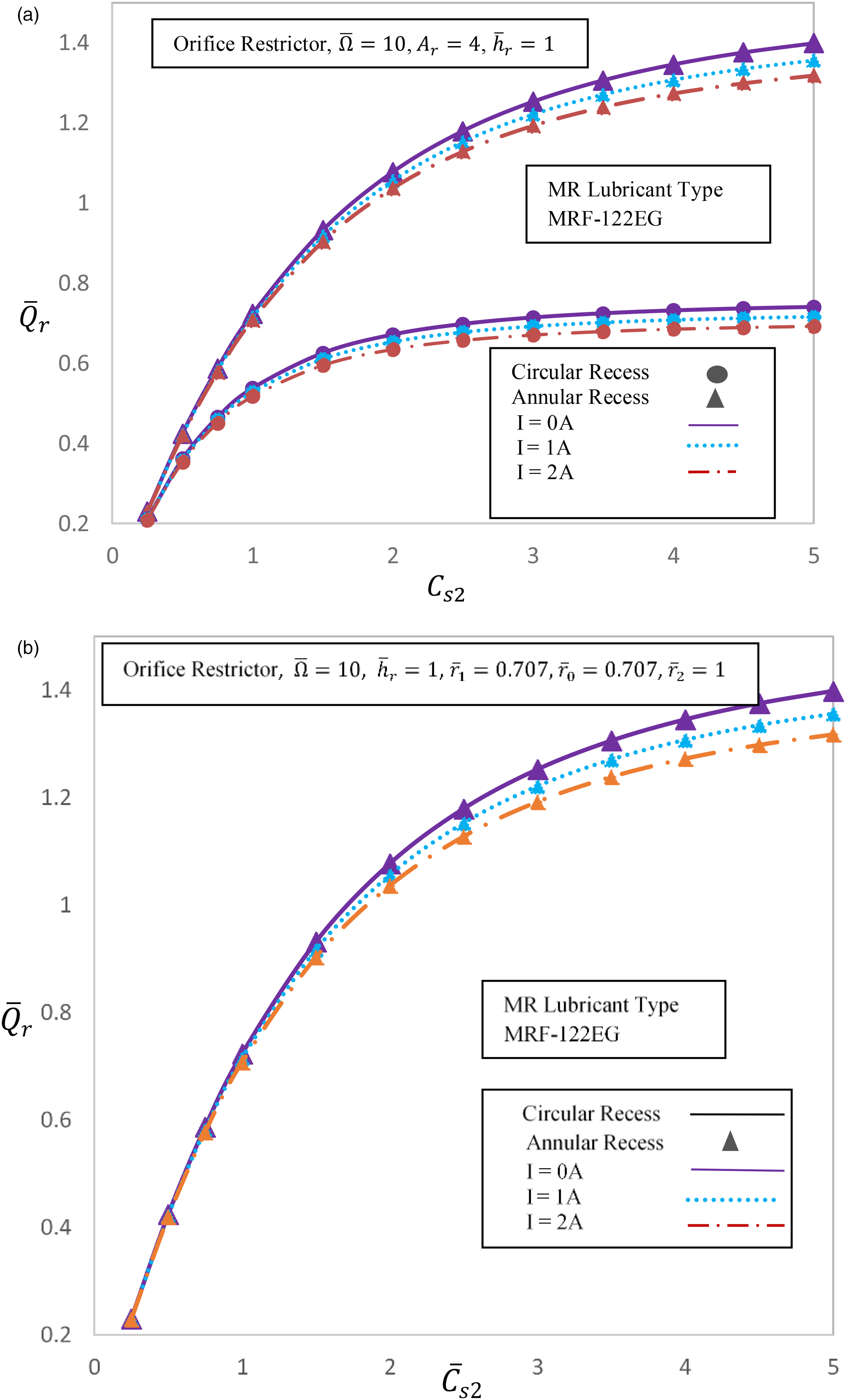
(a) Lubricant flow rate
Influence on fluid film stiffness coefficient (
)
Figure 8(a) illustrates the variation of fluid film stiffness coefficient with respect to restrictor design parameter (
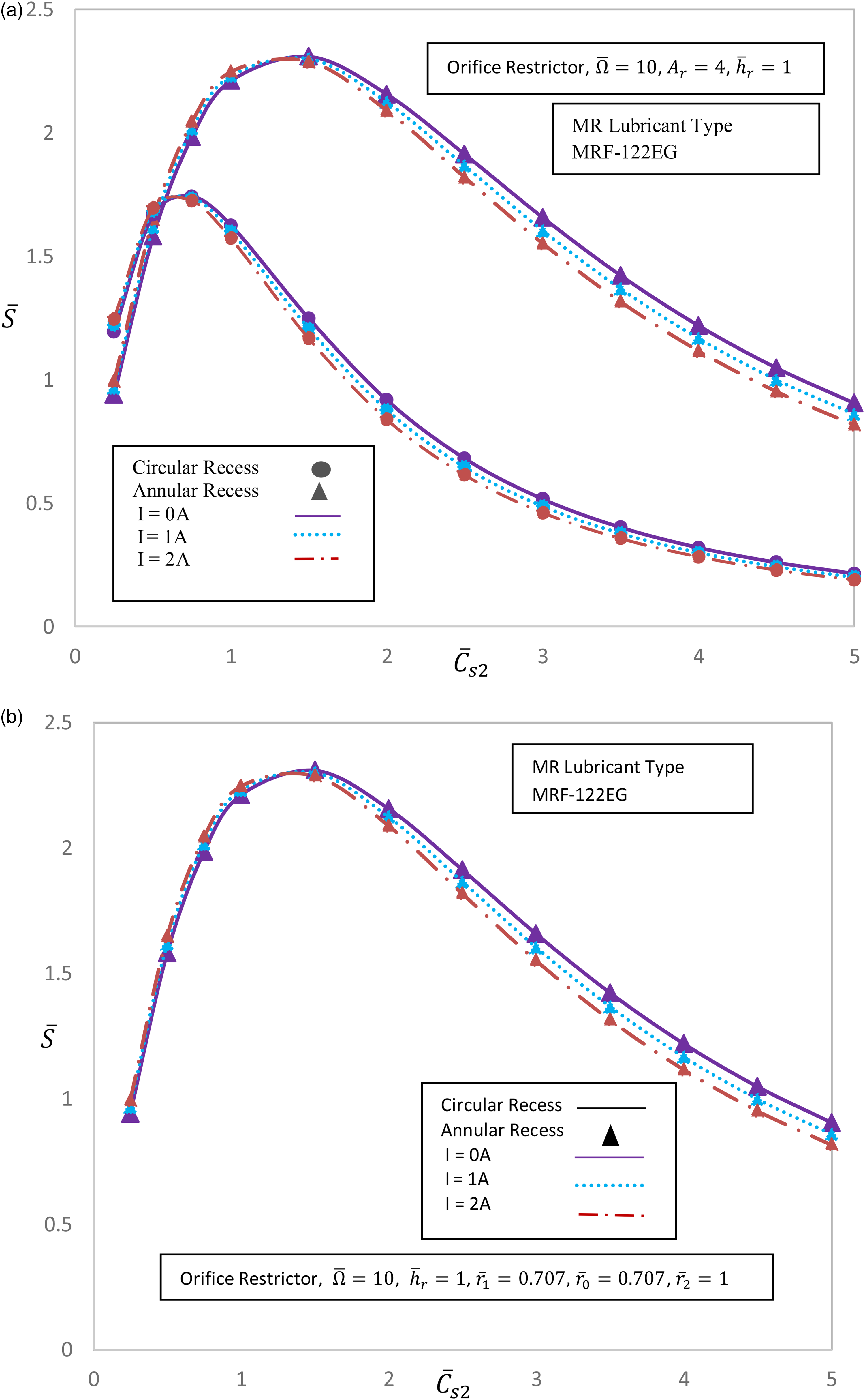
(a) Stiffness coefficient
Influence on fluid film damping coefficient (
)
For the annular and circular recessed hybrid circular thrust pad bearings, the variation in the value of
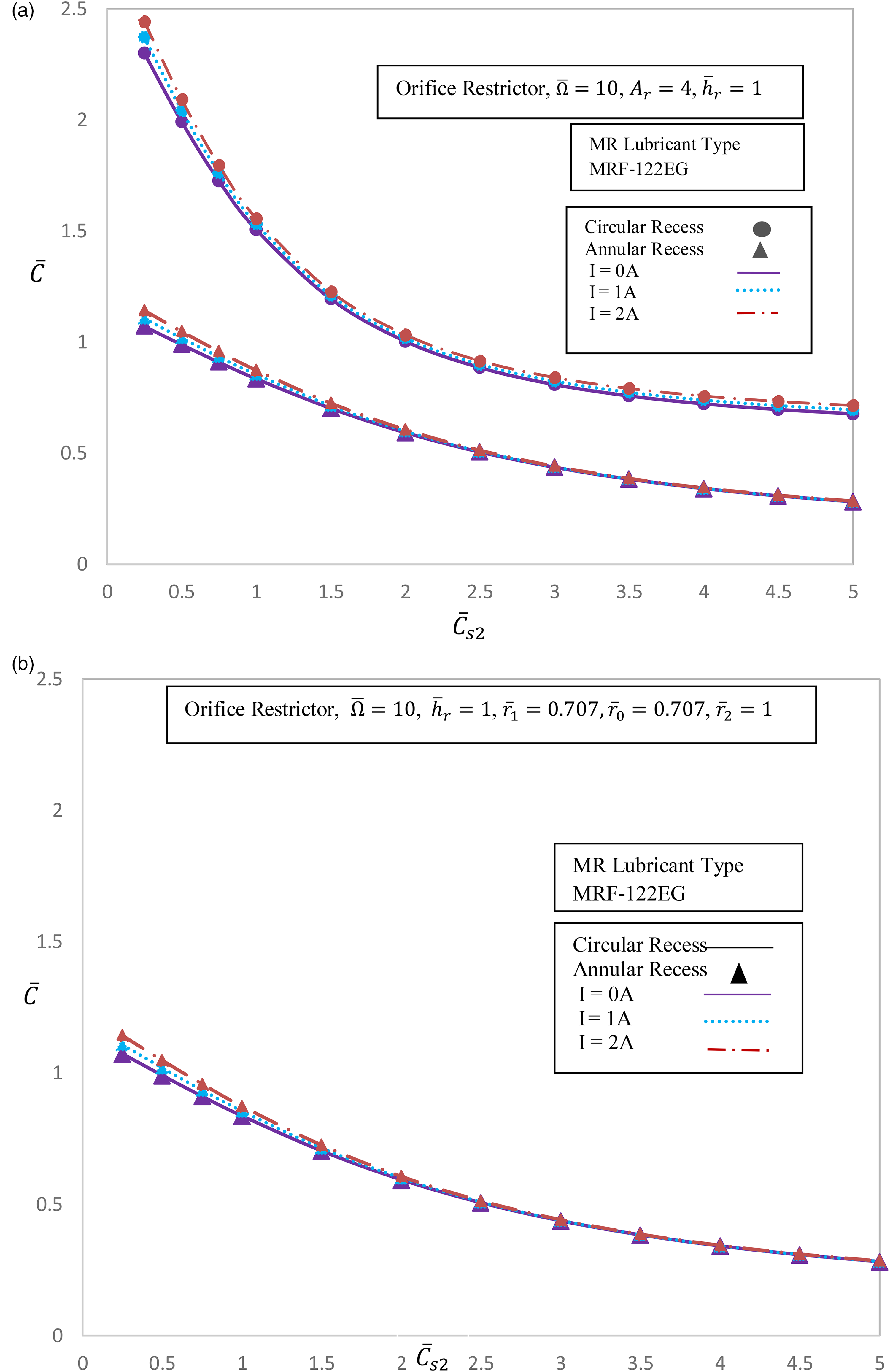
(a) Damping coefficient
Influence of surface texture on the bearing performance parameters
The use of textured surfaces in tribo-pairs is a very active topic nowadays. The micro-features/micro-dimples are produced on the bearing surfaces to improve the performance of tribo components. In the present work, the author(s) also considers the combined influence of MR lubricant behavior on the performance of micro-dimpled circular and annular recess hydrostatic thrust bearing configurations.
The micro-dimples are introduced on the surface of the hybrid thrust pad bearing and are considered to be symmetrically located as shown in Figure 10(a). Therefore, 1/32th domain of the bearing is analyzed to save the computational time and memory as shown in Figure 10(b). In the present work, the spherical and cylindrical geometric shapes of micro-textures (as shown in Figure 10(c)) have been considered to study the effect of surface texturing and MR lubricant behavior. For the conciseness and brevity of the paper, the influence of surface texturing on the bearing performance parameters is shown in a tabular form only in Table 3. From Table 3, it may be noticed that the pocket pressure gets reduced by introducing the textured surface for both circular and annular recess hybrid thrust pad bearings. Further, the reduction in the value of load carrying capacity is obtained by introducing the texture surfaces. The quantum of reduction in the values of pocket pressure and load carrying capacity is seen to be more for cylindrical shape texturing as compared to spherical shape texturing for both circular and annular recess hybrid thrust pad bearings. However, the bearing lubricated with MR lubricant enhances the load-carrying capacity due to an increase in the viscosity of the lubricant. The requirement of lubricant flow is increased due to surface texturing. Such behavior occurs due to the fact that micro-dimples themselves act as micro-bearings. The cylindrical shape texturing requires a more lubricant flow rate in comparison to spherical-shaped micro-dimples. The value of frictional power loss is seen to be reduced by the provision of micro-dimples on the bearing surface. This behavior occurs due to a reduction in the land area by introducing surface texturing. The decrement in the value of frictional power loss is larger for the case of cylindrical shape texturing for both circular and annular recess hybrid thrust pad bearing configurations as compared to spherical shape texturing. The fluid film stiffness of the bearing system is decreased by introducing the textured surfaces. The fluid film stiffness of the bearing system is a function of pressure gradients in fluid film or the load-carrying capacity (as shown in equation (14a)). Therefore, similar trends for the value of stiffness are obtained by introducing the textured surfaces as in the case of load-carrying capacity. The MR lubrication enhances the fluid film stiffness of the bearing system. The damping coefficient of the bearing system depends on the available land area. The provision of the micro-dimples on the bearing surface reduces the land area, which results in a decrease value of the bearing damping coefficient. Similar behavior has been observed in earlier published studies.32,35,49 The value of fluid film stiffness and damping coefficient is larger for spherical shape texturing in comparison to cylindrical shape texturing for both circular and annular recess hybrid thrust pad bearings. However, the bearing operated with MR lubricant may partially compensate for the reduction in the value of the bearing damping coefficient.
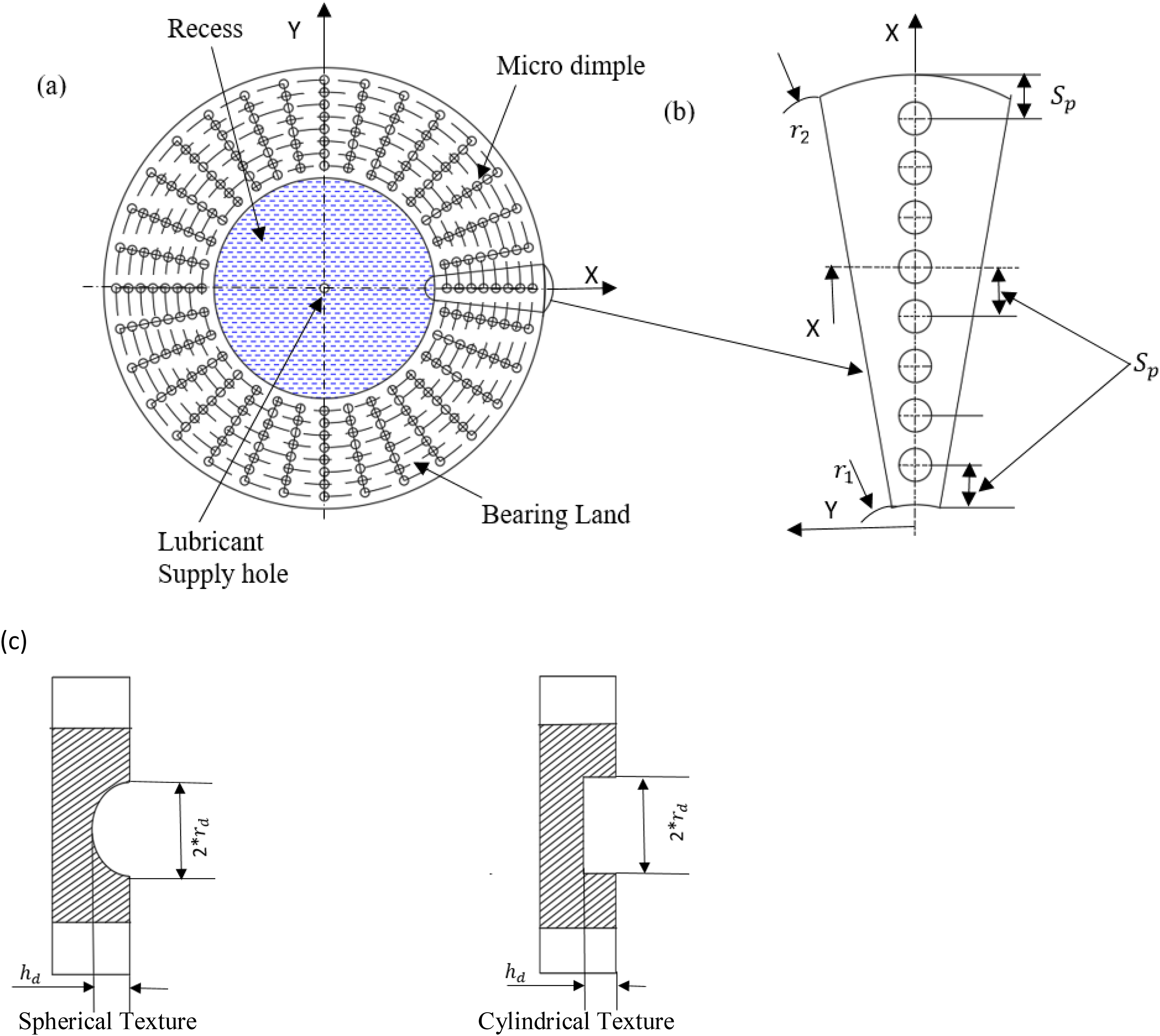
(a) Configuration of textured thrust pad, (b) 1/32th model of thrust pad, and (c) geometric shapes of texture surface.
Influence of surface texture on the bearing performance parameters.
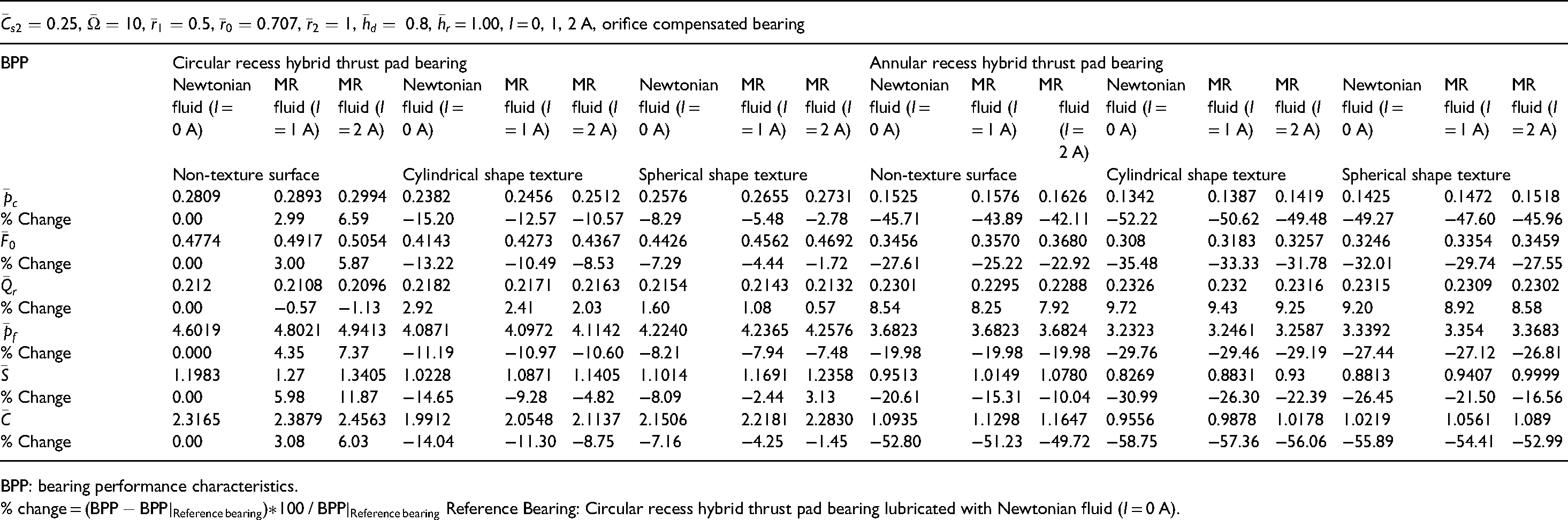
BPP: bearing performance characteristics.
% change =
Dimensional values
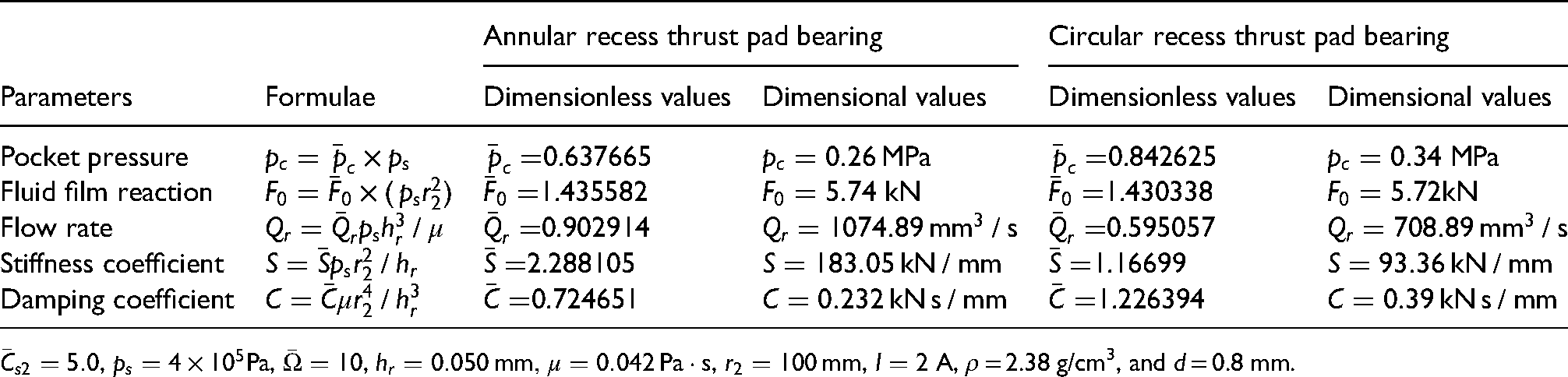
In the present study, the numerically simulated results have been presented in dimensionless form. Using the dimensionless parameters as given in the Notation section, the results can be converted into the dimensional form, so as to have a better physical insight into the behavior of influence of MR lubricant on the performance of annular and circular recessed hybrid thrust pad bearing, the dimensional and non-dimensional values of bearing performance characteristics are indicated in Table 4, at
Conversion of non-dimensional values into dimensional values.
Conclusions
The present work investigates the combined influence of MR lubricant, recess configuration (i.e. annular/circular), and restrictor design parameter ( From the viewpoint of getting an adequate value of fluid film reaction ( From the viewpoint of pumping power, the circular recessed bearing is better as it requires a lesser amount of lubricant and hence less pumping power. It is also observed that MR lubricated in both annular and circular recessed bearing reduces the lubricant flow requirement further. In order to obtain the maximum value of fluid film stiffness The circular recessed thrust bearing configuration is preferable to use from the viewpoint of damping capabilities as this configuration provides a larger value of fluid film damping coefficient A designer may obtain better performance of a circular thrust pad hydrostatic bearing system by having a proper selection of bearing configuration (annular recessed/circular recessed) along with the proper value of restrictor design parameter ( The bearings lubricated with MR lubricant do not show much improvement in the bearing performance characteristics, however, a designer can make suitable use of MR lubricant as per the design constraints.
Footnotes
Declaration of Conflicting Interests
The authors declared no potential conflicts of interest with respect to the research, authorship, and/or publication of this article.
Funding
The authors received no financial support for the research, authorship and/or publication of this article.
