



Abstract
The lubrication of hydrodynamic journal bearings using shear thinning fluids is investigated analytically by comparing three different constitutive models. Whilst journal bearings have been in use for a long time, they are still fundamental components of the most advanced mechanical systems, and will remain so for a long time to come. In particular, the modified Reynolds equations for the power-law (Ostwald-de Waele), the Carreau and the Cross models were derived based on the perturbation method. The three models were used to calculate the pressure distribution and the load carrying capacity, and their results were compared and discussed. It is shown that at high shear rates (i.e., high shaft speeds) the Carreau and Cross models, which better describe the rheology of shear-thinning fluids, yield higher magnitudes of the pressure than the power-law model, while at low shear rates the three models are in better agreement.
Introduction
Journal bearings have been used for hundreds of years, since early engineering applications in mills and printing presses. 1 Nowadays journal bearings are still used in many advanced applications such as turbomachinery, aircraft engines, machine tools and automotive applications. 2 The shaft supporting system is very important for the performance of industrial rotary machines. Hydrodynamic bearings are able to carry the load under severe conditions, providing stabilizing support for the rotating shaft when subjected to unexpected dynamic forces. In addition, slider bearings have a very long service life. 3 The operating conditions of journal bearings are often extreme; for instance, in cars journal bearings operate under the varying load conditions of the crankshaft and the high temperature of the engine for thousands of miles. While all applications require maximum durability and efficiency, in critical applications such as power plants the journal bearings of steam turbines must have 100 percent reliability. 4
Currently, hydrodynamic bearings are exposed to severe operational conditions such as heavy load and high speeds, leading to increasing temperatures of the lubricating film as a result of viscous friction. It is well known that the rise in lubricant temperature leads to decreased viscosity, thus it is necessary to improve the lubricant viscosity index by adding high-molecular weight polymers to prevent viscosity change with temperature. These additives make the lubricant behave as non-Newtonian shear-thinning fluids.
5
Similarly, non-Newtonian behavior is also observed in lubricants laden with dirt particles and debris.
6
The original Reynolds equation, which describes the pressure distribution in the lubricating film, assumes the lubricant is a Newtonian fluid, therefore it cannot be used when the lubricant exhibits non-Newtonian characteristics.
4
Whilst the equation could be coupled with one of the shear-thinning constitutive models updating at each step the viscosity distribution in the journal bearing gap, this approach is computationally expensive and, depending on the fluid constitutive equation, convergence may be very slow or even show stability issues. Consequently, it is preferable to derive a modified Reynolds equation for non-Newtonian lubricants. Non-Newtonian lubricants are represented by a variety of constitutive models, some of which consist of purely empirical relationships obtained by data fitting, while others are derived from some theoretical basis.
7
The simplest type of non-Newtonian flow behaviour occurs when the viscosity coefficient is a monomial function of the shear velocity gradient (power law, or Ostwald-De Waele model):



In this paper, the derivation of modified Reynolds equation obtained for the simple power law model is revisited and extended for the Carreau-Yasuda and the Cross models. Then, the modified Reynolds equation for the three models is solved to obtain the pressure distribution and the load carrying capacity for a model journal bearing.
Problem formulation
In this section the derivation of modified Reynolds equation for power law fluids is reviewed, then the derivation is extended for Carreau and Cross models. The journal bearing layout is shown in Figure 1, where y is the axis along the film thickness, z is the coordinate across the film, r is the journal bearings bore radius, and (
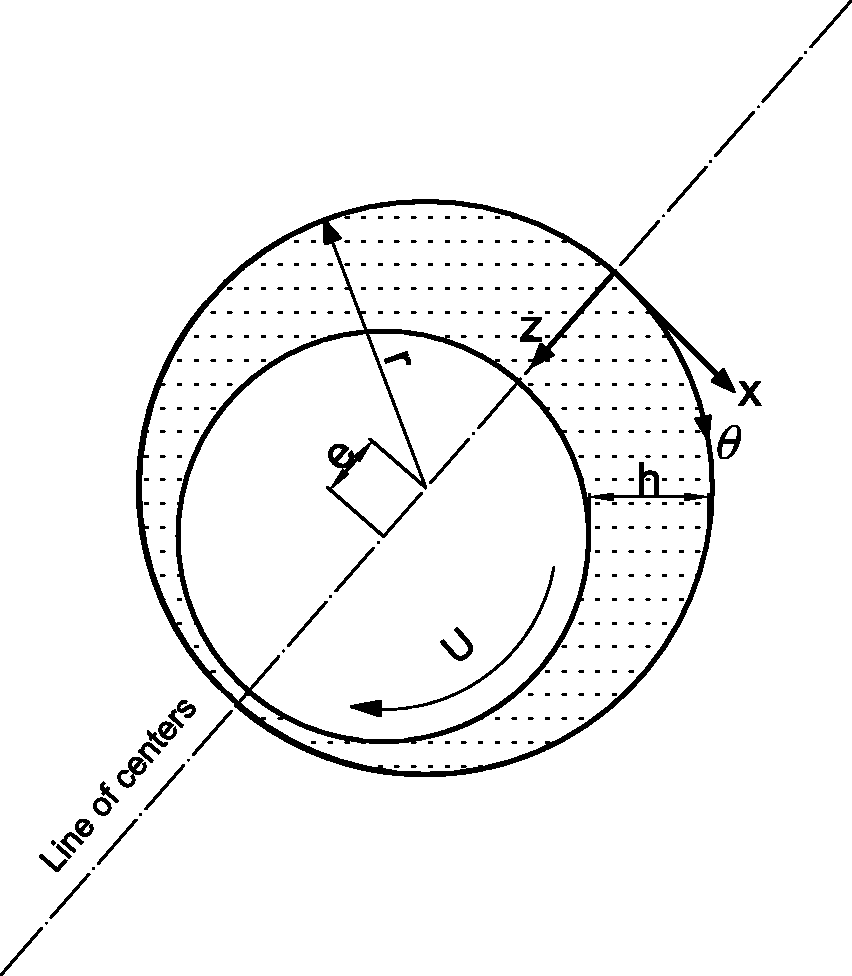
Journal bearing layout.
The velocities in the x and y directions are u and v respectively. The local film thickness, h, is a function of the angle, θ, and it can be found from
15
:

Modified Reynolds equation for power law fluids
Dien and Elrod
16
derived a modified Reynolds equation for lubrication with non-Newtonian power law fluids in journal bearings by using regular perturbation method to express the velocity field and pressure. They used a simplified momentum equation, which is applicable for laminar flow neglecting the inertial force of the fluid. In the lubrication theory the velocity derivative components are responsible for all the shear deformation of the fluid, so that the linear momentum conservation equations can be written as:




In Newtonian lubricants, velocities and their derivatives change linearly with pressure gradient, while in non-Newtonian lubricants it assumed that the strain rate is generated by surface velocity. Thus this approximation is more accurate for Couette-dominated non-Newtonian fluids. The pressure gradient is expressed as follows:



By substituting equations (10) and (11) into equation (8) the second invariant can be rewritten as:





Integrating the zero-order equations resuls into:



As



To find the first order-velocities, the viscosity equation (13) and the velocities equations (10) and (11) up to the first-order replaced into equations (5) and (6):


Replacing equations (21) and (22) into equations (23) and (24) results into:
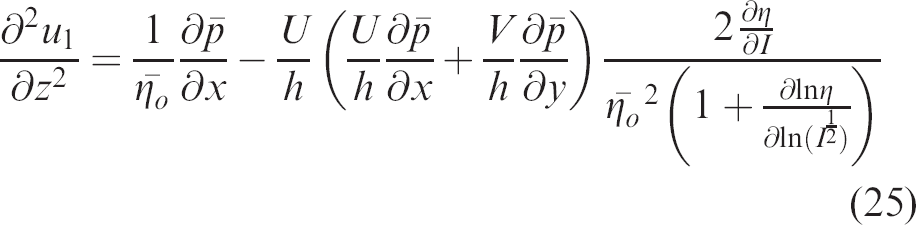
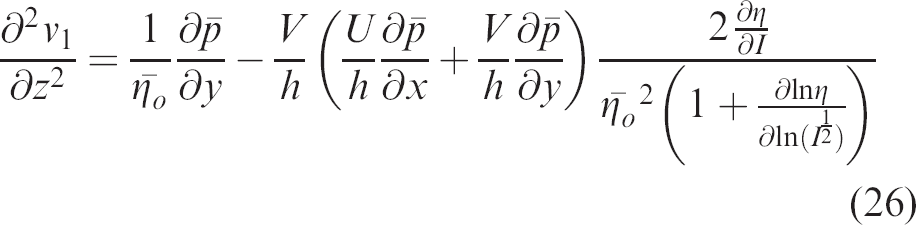
Integrating equations (25) and (26) twice and applying the boundary conditions, the first-order velocities are found as follows:

and

The velocities u and v are found by substituting zero-order velocities equations (21) and (22), and first-order velocities equations (27) and (28) into equations (10) and (11). To find the mass flux,


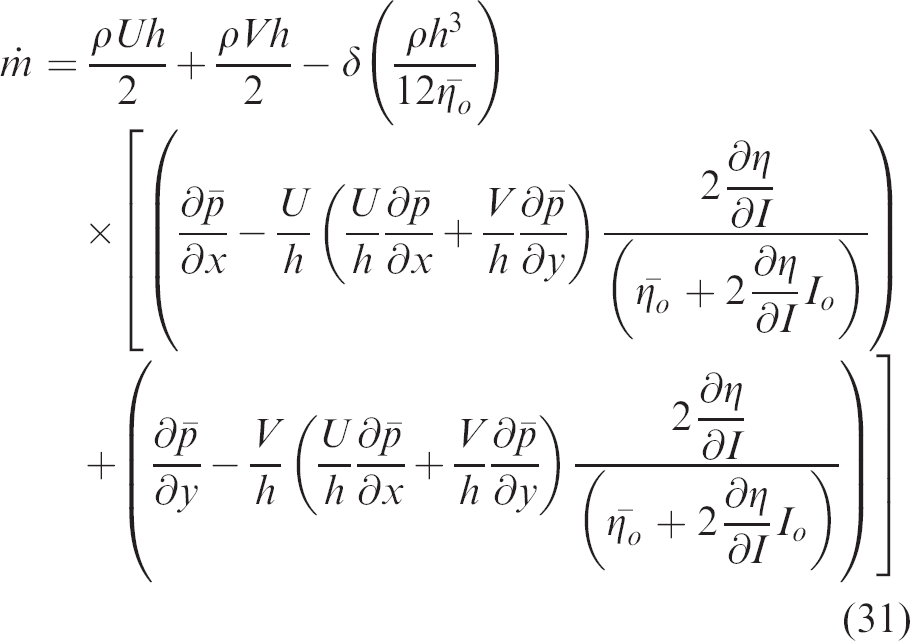
By using the following vector expressions:

and

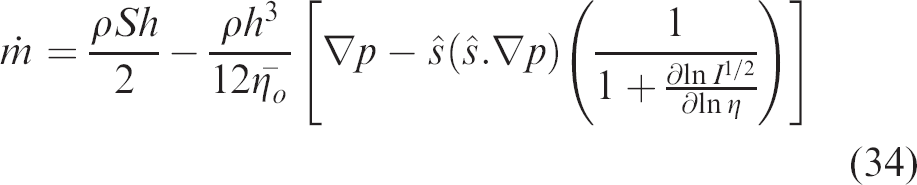
The term
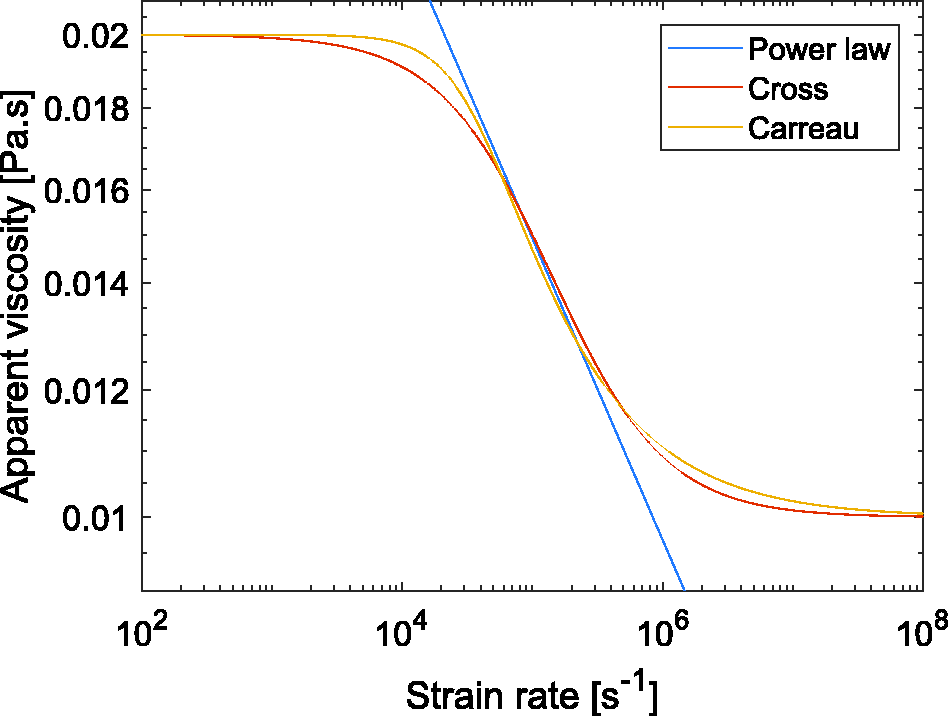
Log(η) vs. log (
For power-law fluids, this term can be easily calculated as:

Replacing equation (35) into equation (34), the mass flux in x-direction is found as:


By equating the total mass flux (in the x and in the y direction) to zero, the modified Reynolds equation for lubrication of journal bearings with power law fluids is obtained:
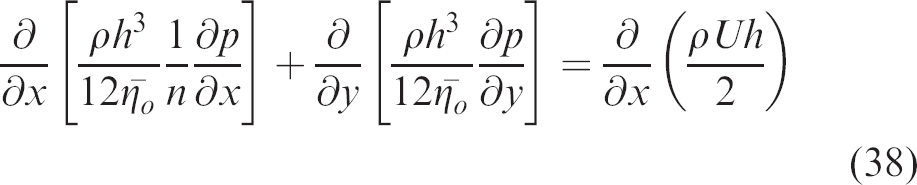
The

Substituting equation (39) into equation (38) assuming constant density, and replacing

Modified Reynolds equation for Carreau and Cross models
For the Carreau and the Cross models, a modification in equation (34) is done by using the identities (

By equating the total mass flux (in the x and the y direction) to zero:

From equation (41), one obtains in the x direction:


Substituting equations (43) and (44) into equation (42), and replacing (



For the Carreau model (equation (3)), viscosity can be expressed as:

Since

Then, for the Carreau model

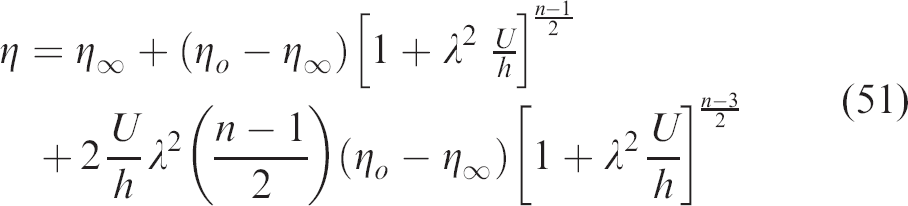
By substituting equations (50) and (51) into equation (45), the modified Reynolds equation for the Carreau model can be obtained. Finally, for the Cross model the viscosity in equation (2) can be expressed as:

Then,

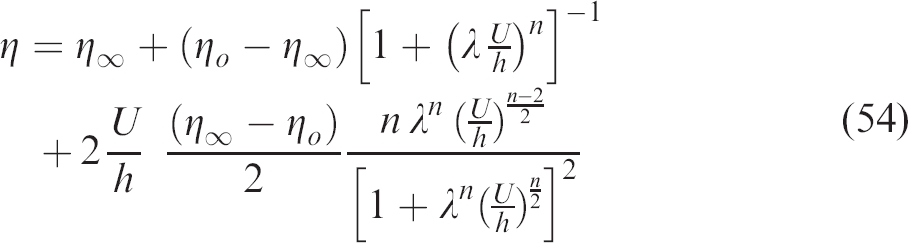
The modified Reynolds equation for the Cross model is obtained by substituting equations (53) and (54) into equation (45).
Results and discussion
The full modified Reynolds equation was solved numerically using the finite difference method (FDM), where the differential terms in the Reynolds equation were replaced by linear approximations of the function values at grid nodes on the bearing surface. The Reynolds boundary conditions for cavitation were used to obtain the equation solution, which states that
15
:

The pressure is positive in the region (
Radius = 0.050 m
Radial Clearance = 30 µm
Length = 0.100 m
The calculation was carried out using the SAE 10W50 oil properties. This oil behaves as a shear-thinning non-Newtonian fluid, and it can be modelled with any of the three constitutive equations considered in the present work using the parameters listed in Table 1, which were obtained by curve fitting. 18
10W50 oil parameters for non-Newtonian models.
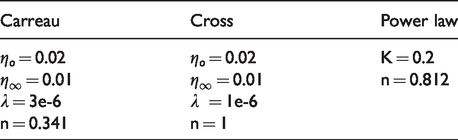
Using these parameters, the modified Reynolds equations (40) and (45) were solved numerically with a MATLAB code to obtain the pressure distribution and the load carrying capacity. The calculation was repeated several times for different shaft speeds and shaft eccentricity ratios.
The maximum pressure in the journal bearing is shown in Figure 3. This plot shows that at low speeds the maximum pressures generated in the journal bearing are almost identical for the three models considered. However, increasing the speed and the eccentricity ratio the Carreau and the Cross models yield higher pressures with respect to the power law model. For instance, the pressure distribution in the journal bearing for
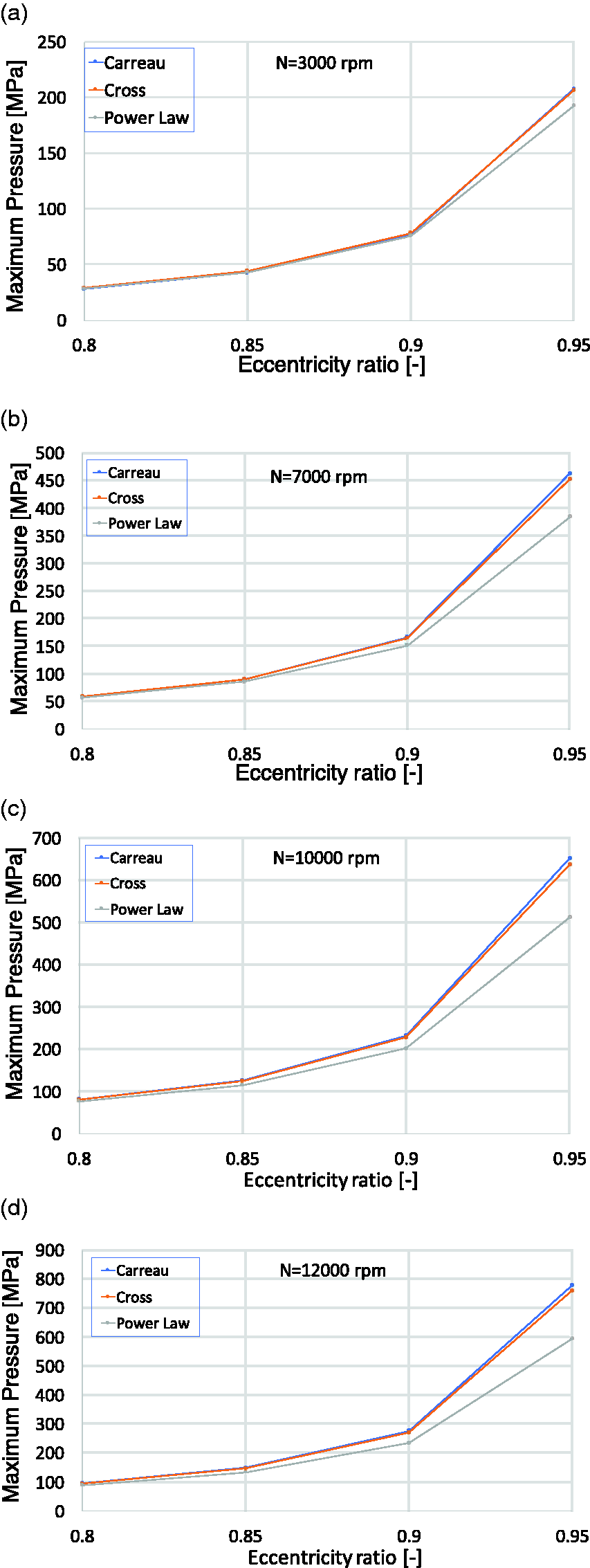
Maximum generated pressures for journal bearing modelled by power law, Carreau and Cross models for different shaft speeds (N) and eccentric ratios: (a) N = 3000 r/min (b) N = 7000 r/min (c) N = 10,000 r/min (d) N = 12,000 r/min.
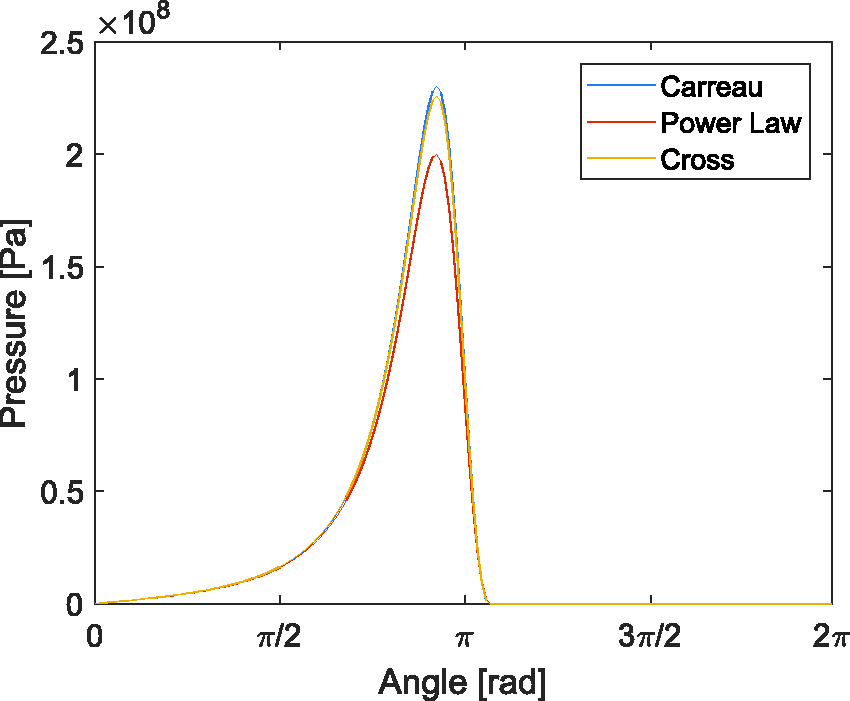
Pressure distribution in journal bearing with (ϵ = 0.9, speed =10,000 r/min and L/D = 1).
Since the load carrying capacity for journal bearings is the integration of the generated pressure over the bearing surface area, then its values follows similar trends to those shown in Figure 3. Consequently, the load carrying capacity of the journal bearing is also underestimated by the power law model at high shear rates, as shown in Figure 5.
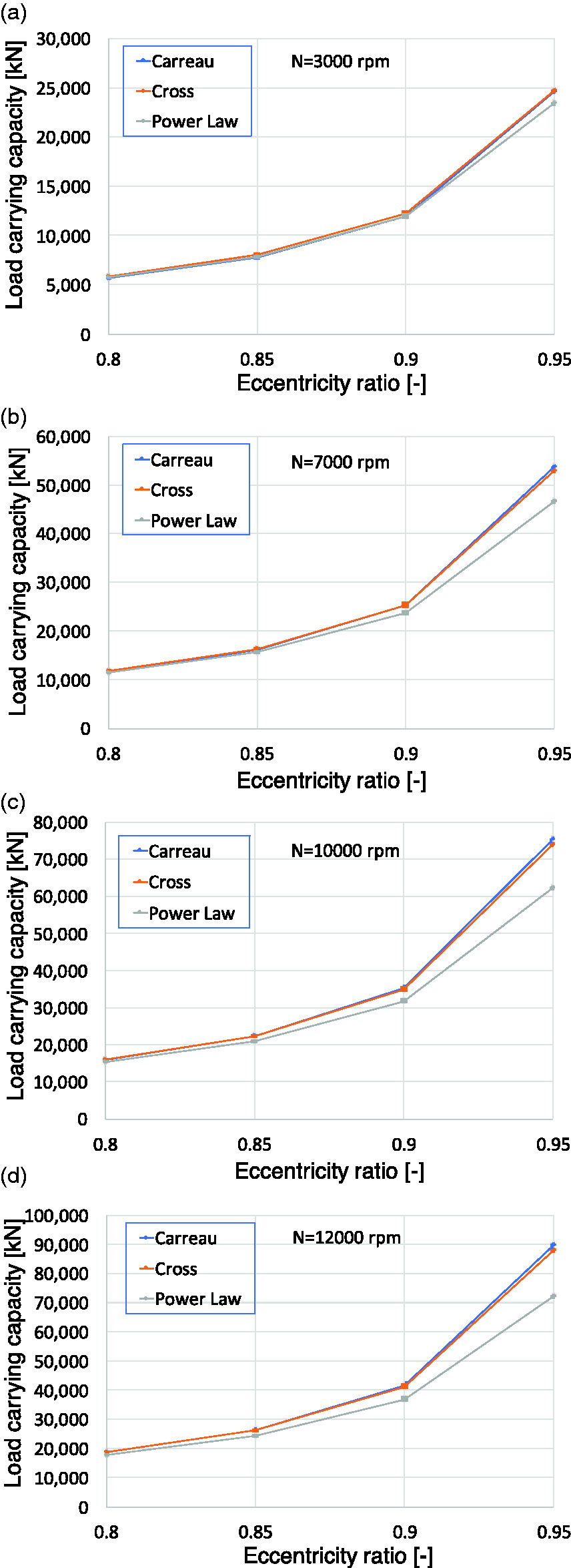
Load carrying capacity for journal bearing modelled by power law, Carreau and Cross models for different shaft speeds (N) and eccentric ratios: (a) N = 3000 r/min (b) N = 7000 r/min (c) N = 10,000 r/min (d) N = 12,000 r/min.
Conclusions
The modified Reynolds equation accounting for the non-Newtonian shear-thinning flow behaviour was studied for three well-known constitutive models: the power law (Ostwald-de Waele), the Carreau-Yasuda, and the Cross model, using the perturbation method. The resulting modified Reynolds equations were solved numerically using the finite difference method.
Results showed that non-Newtonian shear-thinning lubricants cannot be modelled accurately by the power law model at high shaft speeds (i.e. high shear rates), where this model underestimates the pressure distribution and the load carrying capacity, whereas the Cross and Carreau-Yasuda models yield more realistic results. At low shaft speeds (i.e. low shear rates) all the three models are in good agreement.
Footnotes
Declaration of Conflicting Interests
The author(s) declared no potential conflicts of interest with respect to the research, authorship, and/or publication of this article.
Funding
The author(s) received no financial support for the research, authorship, and/or publication of this article.
