




Abstract
Parasitic frictional losses in internal combustion engines of race vehicles adversely affect their performance. A significant proportion of these losses occur within the piston-cylinder system. This paper presents a study of the compatibility of cylinder bore surface materials with typical lubricant base constituent stock (poly alpha olefin and polyolester) as well as a fully formulated lubricant. Nanoscale boundary friction is measured using lateral force microscopy. The effect of material properties, nanoscale roughness and lubricant species upon underlying mechanisms of generated friction is presented. Advanced cylinder materials and coatings and lubricant molecular species used for high performance engines are investigated, and an integrated approach not hitherto reported in literature.
Introduction
For motorsport applications, where engine operating conditions are often reasonably predictable, and, in some cases, entirely controllable, focus can be placed upon the enhanced performance through reduced friction of in-cylinder components. Reduction of gradual wear is a secondary concern as competition engines are often rebuilt based on a mileage or a measured unit time interval, which in some instances can be less than 200 miles or 10 h running under race conditions. During such operations, frequent inspection of any indicators of wear can be made and some remedial actions undertaken.
To highlight the importance of reducing friction in the piston-cylinder subsystem, it is necessary to consider the magnitude of the accrued losses. A typical spark ignition engine has an inefficiency, which may be as high as 60–70%. Of the underlying losses, a large proportion is thermal, but as much as 33% can be attributed to engine friction. Almost half of these losses can be attributed to the frictional losses related to the piston assembly, 7–8% of which occurs at the interface between piston compression rings and the cylinder liner.
With the development of lightweight and durable aluminium alloys, the cast-iron cylinder blocks (with no requirement for liners or inserts) have been largely replaced. However, these new lightweight castings require either spray coatings or pressed-in inserts to prevent excessive cylinder bore wear and friction. As a result, designers have turned their attention to an array of selected spray coatings, electro-plates or liners which replicate or outperform cast-iron tribologically.
Engine and component level testing1–4 has been shown to be an excellent methodology to benchmark alternative lubricant-surface combinations. In recent years, the development of nanoscale experimental techniques, such as surface force apparatus techniques and atomic force microscopy (AFM), has led to an improved fundamental understanding of asperity level interactions and confined fluid behaviour. The fluid-cell AFM has become an important tool for the investigation of the growth and frictional properties of surfaces, self-assembled monolayers and tribofilms.5–12 Pidduck and Smith 5 and Leighton et al. 9 showed that AFM can be used to investigate generated tribofilms, generated through the use of tribometry. A range of lubricant formulations containing ZDDP were investigated on EN31 hardened steel surface. 5 Miklozic and Spikes 6 conducted tests for various lubricant formulations, including the dispersants; MoDTC and ZDDP with both tribometers and AFM. Tests are conducted on a single steel-type substrate (i.e. AISI 52100), demonstrating the variation in surface film formation and frictional properties of the two additives under investigation. The same approach was reported by Leighton et al. 9 for a base oil and formulated lubricants with different viscosity modifiers. Also, Bhushan et al. 7 investigated the friction and wear resistance of ionic lubricants for MEMS devices. Again, they showed that varying the lubricants' composition altered the performance with a single material type (in that case, silicon). Campen et al. 8 investigated the formation of various fatty acids using lateral force microscopy (LFM) on mica surfaces. The study demonstrated fluid-cell AFM to be a suitable method for investigating and elucidating the tribological behaviour of surfaces and boundary films. These investigations have significantly advanced the understanding of thin confined fluid-film lubrication behaviour. Styles et al. 11 used LFM to determine the boundary shear characteristics of various cylinder liner surface types under dry conditions, whilst Bewsher et al. 12 used pieces of real cylinder liners subjected to long-term dynamometric testing together with sample lubricants in fluid-cell LFM. Most investigations have predominantly focused on varying the lubricant additives, whilst using the same surface specimen.
This paper investigates asperity-level interactions and lubricant-surface synergies using fluid-cell LFM. Five sample surfaces with different coatings, commonly used for automotive cylinder liners, particularly for high performance engines, are investigated in the presence of poly alpha olefin (PAO), polyolester (POE) and a mixture of both with a fully formulated lubricant.
Materials and method of measurement
Predicted Tip contact pressures.
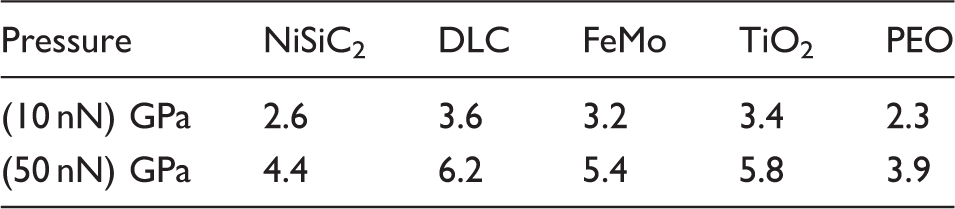
Before each measurement, a blind calibration procedure is used10,11 with a TGF 11 monocrystalline silicon grating. Friction was measured using the trace-minus-retrace method, where

Friction is then obtained as

Asperity level frictional performance of a combination of five surface types with four formulated lubricants, which are used for automotive cylinder bore surfaces, is studied here. For this purpose, an AFM in LFM is used.
Surface coatings.
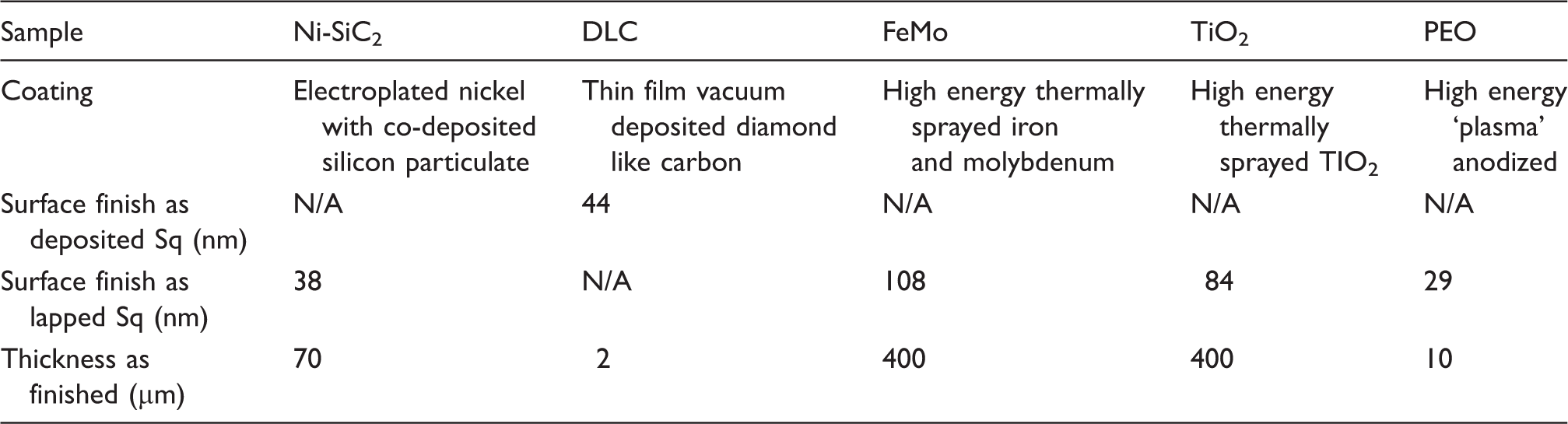
Substrate materials.

Any variations in surface topography of various samples are minimised as far as possible. The DLC-coated sample is used as the topographic baseline (datum), whilst the other surfaces were lapped using a 9 μm polycrystalline diamond polishing paste to attain a comparable surface finish to the DLC sample. The microscale roughness parameters are listed in Tables 2 and 5. The measurements were made using an Alicona focus variation microscope using a 100 × magnification objective.
Lubricants.

AFM surface roughness measurements.
The AFM tip radius was measured using a TGT1 silicon wafer with a calibrated surface geometry. The tip was scanned over 20 peaks, with the deconvolution of the measured data, yielding the tip radius.
Initially, the frictional performance of each surface was investigated without the presence of a lubricant (nominally dry LFM). Each sample surface was subsequently divided into four equal sections along its length, with each partitioned area tested in the presence of PAO, PEO, PAO/POE and the fully formulated lubricant, respectively (fluid-cell LFM). This partitioning is carried out in order to prevent any cross-contamination at the various lubricant-sample interfaces. The sample surfaces were thoroughly cleaned prior to each test with petroleum ether (40–60). The calibration procedure is carried out for all wet conditions for topography and friction in all the four sections of all the specimens. Each test (lubricant-surface combination) is repeated three times at different locations within the apportioned regions. A fluid cell is used to keep any lubricant meniscus action away from the vicinity of the tip-sample contact, thus mitigating any potential capillary adhesion, affecting the measurements.
Contact mechanics
The conjunction of the AFM tip-to-a sample surface is subjected to mixed regime of lubrication under suitable conditions.
14
Therefore, the generated friction is expected to be due to the combined result of direct interfacial interaction of contacting surfaces (boundary friction) and friction of a thin fluid film (viscous friction). In ultra-thin film conjunction of LFM, the boundary friction is caused by the shear strength of the interface between the surfaces 



And the equivalent (composite) modulus of elasticity of the elastic half-space becomes

The composite elastic modulus, 

Combining equations (5), (8) and (9), the fraction of the real contact area can be determined as

Isolating the surface roughness and material property parameters in equation (10), it can be observed that the real contact area fraction between the AFM tip and the surface is a function of surface elastic modulus, the standard deviation of summit heights and average radius of curvature as

Homola et al.
23
showed that the interfacial shear strength of the contact in the absence of a lubricant can be approximated by the cobblestone model as


The surface-specific equilibrium atomic spacing parameter,
Results and discussion
Friction is obtained using LFM on the five sample surfaces commonly used for automotive cylinder bores, particularly for high performance applications and in the presence of four lubricant types; two of which are constituent components of the lubricant base stock (i.e. PAO and POE), another is a mixture of the two (i.e. PAO and POE), and, finally, a fully formulated lubricant: 0W40 (FF).
Figure 1 shows the measured friction for each lubricant in combination with the various sample surfaces.
Variation of friction with normal load for different surface coatings in the presence of (a) PAO, (b) POE, (c) PAO and POE mix and (d) fully formulated oil.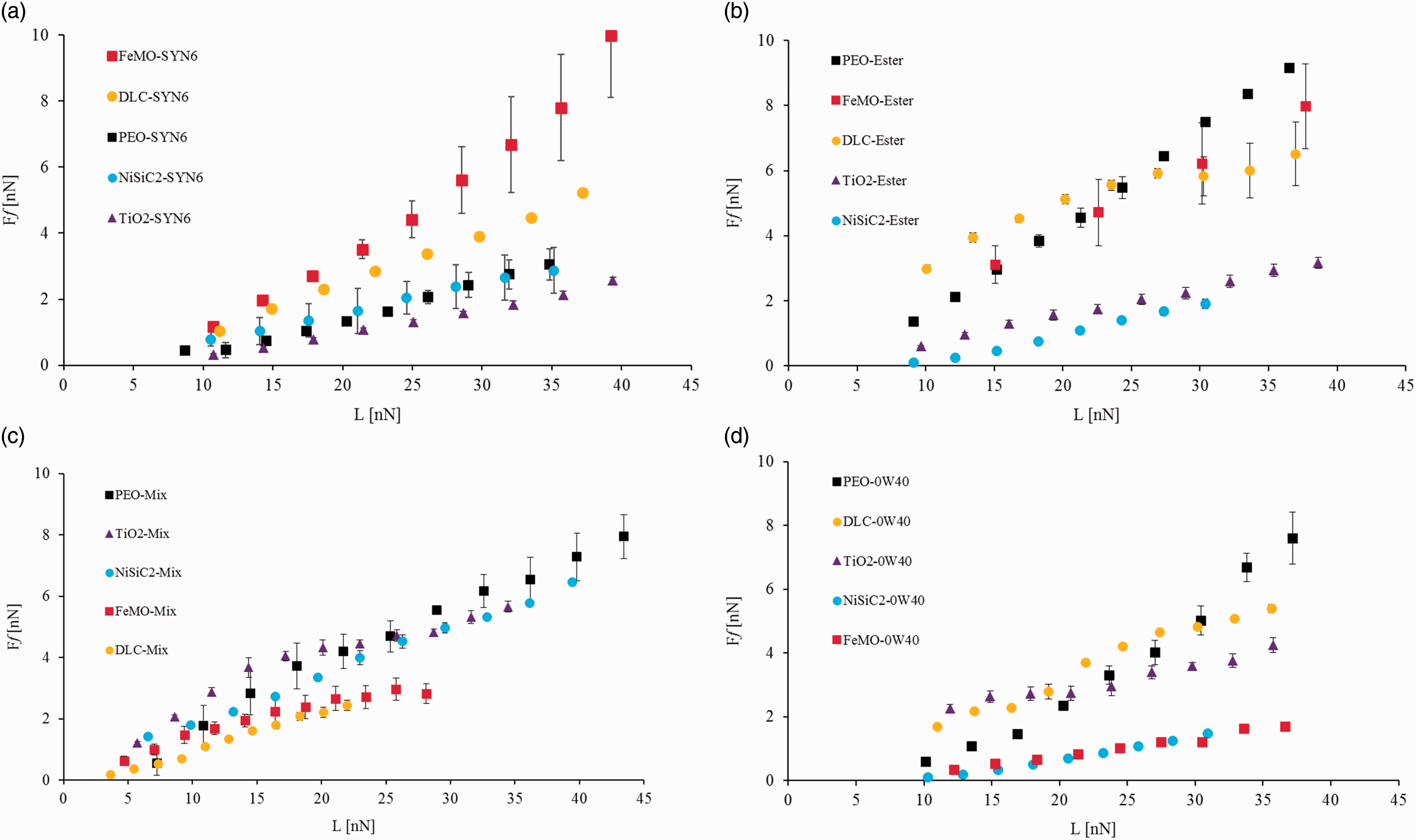
Figure 1(a) is for the case of the POA fluid. The results show the influence of surface type upon frictional behaviour when wetted with the PAO. This finding is repeated in the case of all lubricant variants. In all cases, there is a near linear relationship between the load and the measured interfacial friction. The slope is analogous to the coefficient of friction by definition. Therefore, a higher slope constitutes greater friction. It is shown that TIO2 coating, when paired with PAO, produces the lowest coefficient of friction.
Figure 1(b) displays the interfacial friction of sample surfaces wetted by the POE fluid. Again, as with the surfaces wetted with the PAO oil (Figure 1(a)), there is a clear distinction in frictional behaviour of the tested surfaces. The interfacial friction for the FeMo, TiO2 and DLC surfaces does not appear to be directly proportional to the applied load (as is the case in Figure 1(a)). Such a result suggests slip at the lubricant-surface boundaries as also shown by Fillot et al. 24 The same deviation from linearity is also noted in the presence of a mixture of the PAO and POE fluids for the FeMO, DLC, TiO2 and PEO samples (Figure 1(c)). The relative frictional performance of the sample surfaces shows that neither constituent fluid mixtures (PAO or POE) dominate the characteristic responses in Figure 1(a) or (b). There appears to be some synergistic or antagonistic interactions, which are commonplace with such lubricant species.
Figure 1(d) shows the interfacial frictional behaviour when each surface is wetted with a fully formulated commercial lubricant. As it would be expected, the two most common piston liner materials/coatings for high performance applications; FeMO and NiSiC2 show the lowest coefficient of friction. Fully formulated lubricants, containing surface-active species, such as friction modifiers, allow NiSiC2 and ferro molybdenum oxide to attain lower coefficients of friction. From similar experiments in literature, employing similar contact types and conditions (Gosvami et al. 25 ) at elevated temperatures and higher shear, a large number of sliding cycles are required in order to generate a tribofilm. Due to the relatively low temperature in the current tests and a limited number of sliding cycles, there is a low chance of tribofilm formation of any significant thickness.
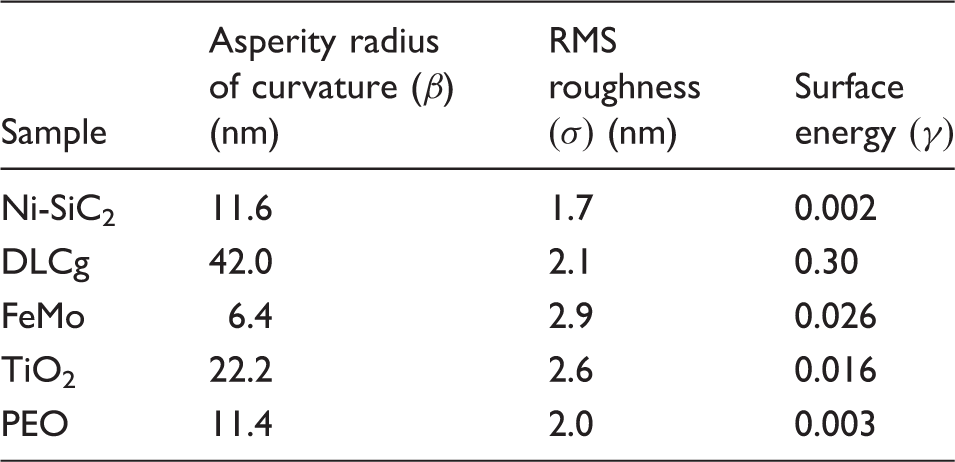
A comparison of the measured coefficients of friction thus far with independently (separately) measured surface parameters is shown in Figure 2. The surface parameter selected is provided in equation (13) and is referred to as the boundary friction propensity parameter. The trend in the coefficient of friction variation with this parameter gives an indication of the influence of intervening a lubricant layer upon the mechanics of contact of all the sample surfaces. The surface roughness parameters required for this analysis are measured using AFM (Table 4) and post-processed to remove any long wavelength surface forms. The results for the surface energy, asperity radius of curvature and RMS roughness are listed in Table 5.
Friction coefficient versus propensity of boundary friction parameter for surfaces lubricated with (a) PAO, (b) POE, (c) PAO/POE mixture and (d) fully formulated oil compared with corresponding dry surface performance.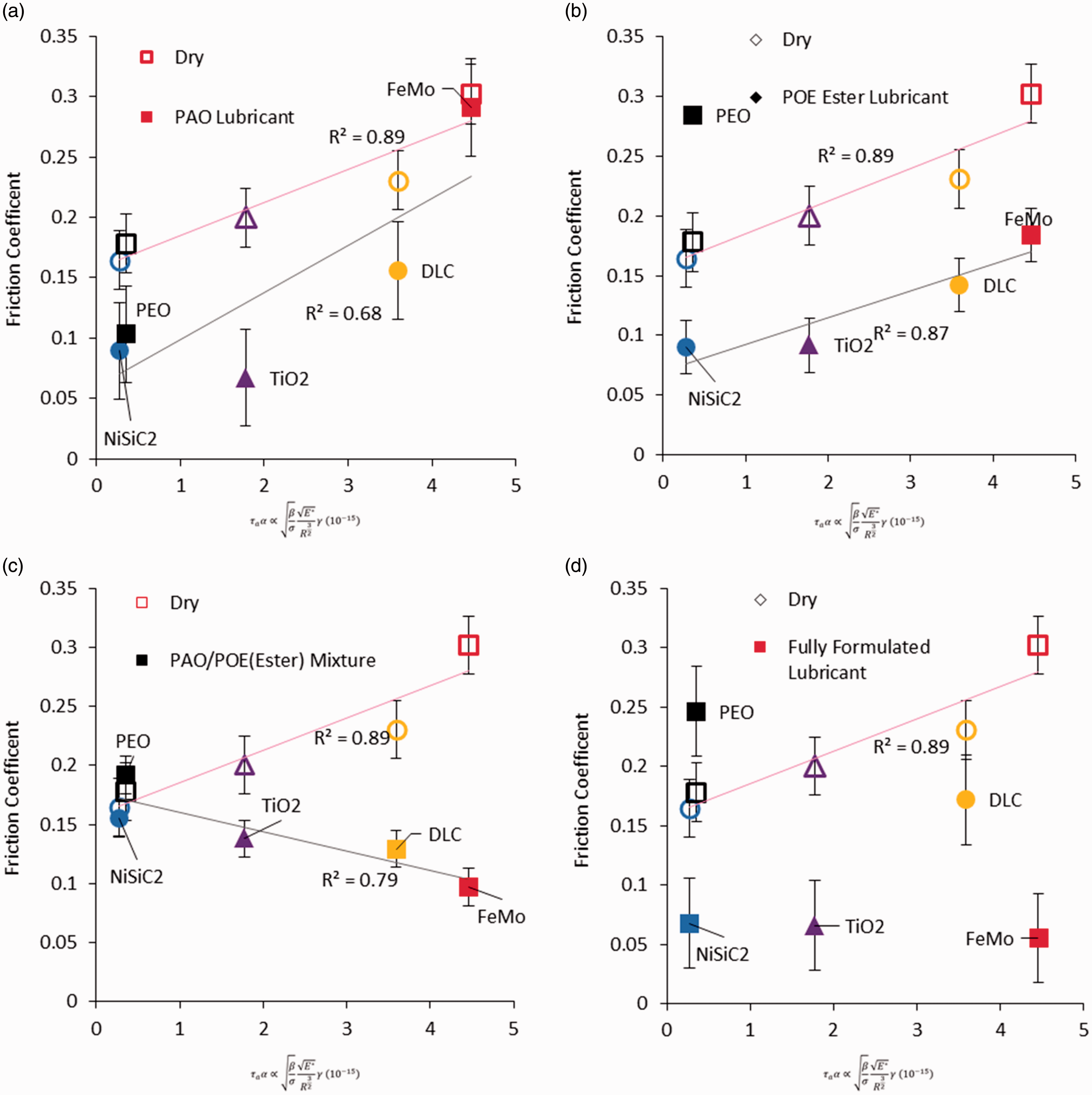
The data presented in Table 5 are those measured at a length scale limited by the machines used to measure them. The length scales over which the measurements are taken are close to, but not completely appropriate, for the theory described in the analytical section. For this reason, only the relative performance of the surface types is investigated rather than attempting to quantify individual frictional components. This is appropriate if one assumes that the surface parameters in Table 5 would have the same value relative to one another at the length scale appropriate for the analytical model. In addition, it should be noted that the RMS roughness σ is used to replace the summit height standard deviation
Figure 2(a) shows that the surfaces with a larger value of boundary friction propensity parameter (see equation (13)) demonstrate a minor reduction in the coefficient of friction through the introduction of PAO. This means that PAO, when used in isolation as a lubricant, neither reduces the coefficient of friction by effectively separating the surfaces (i.e. reducing α) or by lowering the shear strength of the adsorbed film on the surface (i.e. reducing
In Figure 2(b), the introduction of the POE reduces the coefficient of friction by a similar amount for all the surfaces except for the case of PEO. The reason for a consistent drop in the coefficient of friction for all surface variants is due to a change in the value of
Figure 2(c) shows the effect of introducing a mixture of PAO and POE (ester) to the AFM tip-sample conjunction. The results show that the coefficient of friction is significantly reduced for contacts with a high propensity to boundary friction parameter. This indicates that the specified mixed fluid decreases the incidence of boundary friction through either reducing
The results for the fully formulated lubricant, shown in Figure 2(d), do not indicate any particular trend with respect to the boundary friction parameter. A similar low coefficient of friction is achieved for each sample surfaces which contains a transition metal (i.e. NiSiC2, FeMo and TiO2). There is evidence in literature that commonly used inorganic friction modifiers form low friction tribofilms on surfaces containing transition metals.28–30
Conclusion
This paper shows the interfacial response depends upon both the fluid in confinement and the properties of the confining surface materials. At the level of asperities, the influence of nanoscale roughness, surface modulus of elasticity and real contact area can be used to determine the dominant frictional behaviour for esters, PAO and a mixture of the two. The ester (POE) is shown to increase the separation of the surfaces (increased load carrying capacity). Consequently, the coefficient of friction is reduced due to a decreased level of boundary interactions. The PAO is shown to reduce the viscous shear in the contact. The fully formulated oil is largely independent of the topographical and material mechanical parameters, with improved frictional performance for all the surfaces containing transition metals (i.e. NiSiC2, FeMo and TiO2).
The study has shown that lubricant composition can be tailored to meet the requirement of friction reduction for a chosen cylinder bore/liner material for a variety of engine applications. However, it has also been shown that due to the plethora of synergistic or antagonistic interactions between the lubricant species and the surfaces, the simplest of lubricant-surface combinations require detailed combined integrated measurements and contact mechanics analysis.
Footnotes
Acknowledgements
The authors would like to express their gratitude to Capricorn Automotive and the Engineering and Physical Sciences Research Council (EPSRC) under the DTP scheme for the financial support extended to this research.
Declaration of Conflicting Interests
The author(s) declared no potential conflicts of interest with respect to the research, authorship, and/or publication of this article.
Funding
The author(s) received no financial support for the research, authorship, and/or publication of this article.
ORCID iDs
Nicholas Morris https://orcid.org/0000-0001-9463-647X Ramin Rahmani 