




Abstract
Many feminist organization and management scholars align with feminist activists, offering their research as a form of intervention. Thus, research engagement with/as organizational practice may be influenced by feminist epistemologies that emphasize situated and embodied becoming. Assuming that knowledge cannot exist independently of action, the present study explores the potentials of polyphonic feminist organizing as a mode of “knowing-as-action.” More specifically, we work with collective memories of organizing Feminist Futures Copenhagen (FFC), an activist hackathon in which we were all involved. Using polyphony to identify dynamics of in- and exclusion in our own organizing practices, we find three tensions that simultaneously pull centripetally toward unison and push centrifugally toward difference: resistance/recognition, solidarity/difference, and research/practice. Reflecting on their various articulations across our memories, we examine these tensions and explore their productive potential under the labels of “Emergent subject positions,” “Giving and taking space,” and “Staying with the process.” Thus, we, as feminist organizers, and researchers, configure our “knowing-as-action” of FFC polyphonically. Methodologically, we show how creating and remembering moments of embodied feminism may facilitate the integration of research and activism around polyphonic tensions. By sharing our experiences with feminist organizing, we create an opportunity to reflect upon the role of activism within feminist management and organization studies. We suggest that methods of polyphonic feminist organizing offer productive means to navigate and articulate ongoing tensions between research and practice.
Introduction
The heat and humidity are overwhelming this Friday morning on the longest day of the year. As we settle in the shade of Sine’s garden, sweaty from biking or walking from the train station, expectation is in the air. We’re about to embark on an academic endeavor together. The anticipation is tangible, the sort of exciting vibe of ‘everything is possible’ that sometimes arises at the start of a new project. Some of us have known each other for years, others have only recently met. We are getting to know each other as a group, as a feminist collective, and feelings of excitement are mixed with hesitancy. We want to get it right, to create a space where we can all express ourselves and contribute with our different experiences. Our common starting point is that we all participated, in different capacities, in the organization of the Feminist Futures Copenhagen hackathon. We are meeting today, two months after the conclusion of the hackathon, to explore what we might learn about feminist organizing from our experiences of the event. As we reflect upon our experiences, we are concerned with how we can write about them without imposing our own understandings on the hackathon: how can we give voice to the many voices of the event?
Just as the introductory vignette marks the beginning of our common writing process, what follows marks its provisional end: the result of our collective engagement with memories of organizing/participating in Feminist Futures Copenhagen (FFC). FFC is a platform for organizing hackathons that builds on feminist values and invites participants to engage in collaborative processes of imagining, designing, and developing possibilities for personal and collective learning and change. The first FFC hackathon took place in April 2023, and we were drawn to the project for its aim of creating a space of and for diversity, getting involved as either organizers, academic sponsors, mentors, or participants. Hackathons are generally understood as time-bound collaborative events, often solution-oriented and reliant on technology to provide the solution. They are stereotypically masculine coded, catering to a “gamer culture” of competitive, “pumped” performances of skills and endurance (Brooke, 2022). FFC, on the contrary, alters the hackathon format by designing for the inclusion of marginalized voices and incorporating long-term systemic thinking and community-led perspectives. As such, FFC counters the dominance of “white, straight, able-bodied, cisgender males, masculinist assumptions about technical competence, universalizing discourse, and solutionism” (Costanza-Chock, 2020: 164), inherent to traditional hackathons and tech-culture, more broadly. Instead, FFC invites participants to engage in an open-ended process of thinking differently about problems and imagining alternative solutions.
By creating a space for reflection, FFC invites exploration of how feminists, as the writer collective Gibson-Graham (1993) so forcefully put it, can “have their revolution now.” Thus, the FFC carves out a space adjacent to the everyday—an opening from which to imagine societal transformations rooted in mundane practices. As we reflect upon our involvement in this space, we are concerned with the relationship between feminist organizing and feminist organizational scholarship; what brings the two together and what demarcates them from each other? Addressing these questions, we begin from the recognition that knowing subjects are never detached from what they know, to the contrary, knowledge is situated within practice (Haraway, 1988). If, ontologically, no external vantage point exists from which to study empirical practice, then, epistemologically, knowledge must be generated “from the ground”; anchored in one’s particular position within the studied practice. Research is “knowing-as-action” (Beavan, 2021), and feminist organizational scholarship, in its many different guises and iterations, “. . . is about enacting theory in practice and developing theory through practice” (Fotaki and Pullen, 2024: 600).
Building on this premise, feminist organization scholars have developed the interrelations of doing and knowing feminist organizing along different lines; for instance, suggesting that feminist organizations prefigure societal change (Izlar, 2019), showing ways in which affective intensities can build solidarity and enable resistance for feminist activists and academics (Ashcraft, 2017; Vachhani and Pullen, 2019), and exploring how feminist scholars can, themselves, practice their scholarship as an alternative to the continued dominance of masculine academic and societal norms (Benschop and van den Brink, 2023; van den Brink and Benschop, 2012). As “. . . feminism provides opportunities for distinctive practices of knowledge production that challenge the patriarchal social formations” of academia as well as society at large (Bell et al., 2019: 4), feminist organizational scholarship becomes able to develop and practice academic activism (Rhodes et al., 2018). We seek to contribute to this agenda by turning to the methodological challenges of reflexively identifying and discussing the performative effects of feminist organizing (Dorion, 2024) and of feminist organization research (Mauthner, 2023).
As such, we posit that intersections between research and practice are at the core of feminist activist scholarship, noting that the tensions, which arise at these intersections, remain less well-documented (Bleijenbergh, 2023). With the present study, we return to the concept of polyphonic organization (Hazen, 1993) to explore its methodological potential for articulating “knowing-as-action” that is sensitive to the tensions of participants’ different positions of articulation and listens for the dissonances between their different voices (Kinser, 2003). Exploring the polyphonic organizing of FFC through a process of collective memory work, we are concerned with identifying and mitigating the risks of privileging our voices as researchers above those of organizers and our voices as organizers above those of participants.
Beginning from the identification of tensions between doing and knowing feminist organizing, as articulated in our memories of taking part in FFC, we do not aim to resolve these tensions but seek to explore their productivity. Our aim is to foster organizational polyphony while acknowledging that our methods of feminist organization (research) inevitably (re-)produce their own regularities and normativities (Guschke, 2023). This process inherently shapes which voices are included in the organization and which are heard by us as both organizers and researchers. Rather than seeking to reconcile different organizational voices, this article explores the productive tensions between feminist organizing and feminist organization studies. Grounded in our different positionalities within and experiences of the FFC hackathon, we explore how these tensions are manifested in our collective memory work.
We suggest that the method of collective memory work is attuned to our purpose, as it helps us articulate polyphonies of the FFC hackathon, bringing our different voices into productive tension. Collective memory work enables participants to reflect on lived experiences through remembering, writing, sharing, and analyzing collaboratively (Davies et al., 2005). Central to the method is the idea that memories play a crucial role in “processes of selving” (Davies and Gannon, 2006: 7); when working with memories collectively, “selving” becomes an at once singular and plural experience, highlighting the unique experiences of the individual in relation to the common understandings of the group. Collective memories, then, are understood as coming to life in between the holder of the memory, the written and spoken words of the memory, and the listener (Davies and Gannon, 2012). Memories do not reside in one person but are entanglements of matter and meaning, where the self-as-entity (subject) only emerges in relation to other agencies. Beginning from these principles, collective memory work is a reflexive method that troubles the distinctions between knower and known, challenging what is seen as knowledge (Gannon and Gonick, 2019). Adopting this method, we build on previous work with collective memories within management and organization studies (Basner et al., 2018; Dahlman et al., 2020; Davies et al., 2005), aiming to explore and produce polyphony in feminist organization (research).
In sum, we understand polyphony as a perspective from which to reflect upon the knowing-as-action of feminist organizing and feminist organization studies. In what follows, we introduce the empirical context of the FFC hackathon before presenting our review of the extant literature. We then offer a methodological account of collective memory work as an academic practice that explains and supports organizational polyphony. In working analytically with our collective memories, we identify three recurrent tensions: resistance/recognition, solidarity/difference, and research/practice. We detail these tensions and consider their possible productivity under the headings of “Emergent subject positions,” “Giving and taking space,” and “Staying with the process.” Lastly, we discuss our contributions to the knowing-as-action of feminist organization (studies), suggesting how polyphonous methods may support the productive articulation of persistent tensions between research and activism.
Hacking feminist futures
FFC is a platform for organizing hackathons that operates on the belief in and advocacy for economic, political, and social equality of all people. The organization of the hackathon in Copenhagen was inspired by Feminist Futures Helsinki and Our Feminist Futures, which organized hackathons that both took place in 2021 in Finland and the US, respectively. The first iteration of the FFC hackathon was held in 2023, on the 12th–28th of April. It was organized as a hybrid event, combining physical and digital participation. The event hosted 40 participants, was supported by 20 partner organizations, included 11 mentors, and was organized by a core team consisting of 17 people, most of whom worked on the project as volunteers (Bjerke, 2023). Throughout the hackathon process, the participants, with mixed but mostly academic backgrounds, worked in 12 teams to collectively imagine intersectional feminist futures within 4 thematic tracks: (1) Bodies of Care, (2) Commoning the Archive, (3) Digital Utopias, and (4) Solidarity Economies. Each track was co-developed with an activist organization that created a thematic brief from which the teams could draw inspiration.
Throughout its organization, the FFC hackathon was framed as an explorative, experimental, and open-ended process, welcoming anyone regardless of their relationship with the themes and without requiring any prior experience of either the topic of feminist futures or the format of hackathons. The process centered participants’ self-organized collaborative work, supported by mentoring sessions (at which people with academic or professional specialist knowledge in each thematic area were available to the teams), a panel discussion, sharing sessions, social gatherings, and a concluding showcase event.
The FFC hackathon builds on critiques of traditional hackathons raised by feminist Human-Computer Interaction (HCI) scholars. These scholars propose ways of designing more inclusive hackathons that prioritize social justice outcomes for marginalized groups over corporate profit (Costanza-Chock, 2020; D’Ignazio et al., 2020). Additionally, FFC draws on data feminism, emphasizing the renegotiation of binaries and hierarchies while elevating emotion and embodiment, and the design justice movement, which centers lived experiences and fosters a community-focused approach (D’Ignazio and Klein, 2020).
Throughout the organizing process, efforts were made to enhance the accessibility of the event by considering the needs of people with caring responsibilities, full-time work, chronic illnesses, and other traits that might affect their ability to participate fully in an intense 48–72-hour event (the typical length of a classic hackathon). Accordingly, the FFC hackathon was spread over two and a half weeks, participation was flexible/hybrid, offline venues were chosen with accessibility in mind, and sign language interpretation was available. To promote active engagement with and shaping of the process, participants were not asked to present specific outputs at the end of the hackathon. Instead, the teams were invited to decide for themselves how they would like to express their learnings and visions for the future(s).
Having introduced the organization of the FFC hackathon, we now turn to a review of the extant literature that discusses relationships between feminist organizing and feminist organization studies, ending with the (re-)introduction of polyphonic organizing as a promising approach to feminist doing and knowing. On this basis, we present our method of collective memory work as a key methodological contribution to exploring the tensions of research and activism.
Polyphonic feminist organizing: Finding productive tensions
Feminist perspectives have informed organization studies for decades (Calás and Smircich, 1989, 2006; Harding et al., 2013; Meriläinen et al., 2023), and their importance to the field has recently been reinforced with urgent calls for feminist responses to current organizational and societal challenges (Bell et al., 2019; Benschop, 2021; Fotaki and Pullen, 2024). Benschop and Lewis (2024) posit this feminist revival against the backdrop of a backlash to previous progress and as a response to postfeminist individualization and neoliberal responsibilization (see also Butler, 2024; Butler and Athanasiou, 2013). Against these tenets, feminist organization studies commit to fostering collective solidarity while remaining attentive to the intersectional differences that shape feminist movements: “we need to consider what form of collectivity can both address the issue of diverse origins, experiences and biographies as highlighted by Black feminist critiques, and challenge the individualized feminism of postfeminism” (Benschop and Lewis, 2024: 11). In other words, feminist answers to issues of “organizing solidarity in difference” are as urgently needed as ever (Fleischmann et al., 2022).
Just as the tensions of collectivity and difference invite further research, there are productive tensions in entanglements of feminist organizational scholarship and feminist activist organizing—in the in between of academia and activism (Rhodes et al., 2018; Weatherall, 2022). According to Rhodes et al. (2018), “to be an activist refers to the ways that academic work, and academics themselves, can politically intervene into the non-academic world ‘out there’ with a view to changing it” (p. 142). As such, much feminist research is inherently activist, as it calls out persistent sexist organizational norms and gendered barriers to social justice (Gilmore et al., 2024; Guschke et al., 2024), including those norms and barriers that continue to marginalize feminist research in organization studies (Bell et al., 2020). However, research that studies feminist activist organizations and practices has a less clear-cut activist role (Hearn, 2000; Martin, 1990), and feminist researchers that seek to engage in activist practices encounter barriers and challenges (Mendez and Wolf, 2001). Thus, how feminist organization scholars can and should combine research and activism is not immediately clear, nor is it completely unproblematic.
What is at stake, here, is feminist organizers’ and feminist organization scholars’ ability to understand their (our) own privileges and decenter their (our) own knowledge production (Ackerly and True, 2010; Dorion, 2024). Thus, each encounter between feminist organizing practices and feminist organizational theory raises the question of how to “put feminist theory to work”; how to engage with the activist “organizational everyday” that we wish to understand and promote but also risk essentializing in the process (Coleman and Rippin, 2000; Klostermann, 2020). In raising this point, we do not mean to imply that feminist organization scholars have not found ways of reckoning with their own positionality; rather, we suggest that feminist organization scholars who aspire to (also) be organizational activists may benefit from reflexively configure their knowing-as-action (Beavan, 2021), actively showing how they (we) know what they (we) do and do what they (we) know.
In considering how we know what we do and do what we know, we are inspired by approaches to polyphonic feminist organizing that celebrate the diversity of feminist organization, seeking ways of making tensions between research and practice productive for understanding and enacting spaces of solidarity and difference as well as resistance and recognition (Ghorashi, 2014; Letiche, 2010). In particular, we follow Kinser (2003) who offers polyphony as an opportunity to cultivate feminism as “messy and vibrant,” thereby sharpening our ability to listen to the many different “articulations of feminism” that make up feminist organizations (p. 110). Polyphony supports an understanding of feminism as a multivocal and open-ended project that opposes “erasure of difference [which] has racist, classist, heterosexist, and other implications” (Kinser, 2003: 110). Feminism is not a singular approach, and it should not strive for singularity. Rather, feminism derives its organizational and societal legitimacy as an intellectual and activist effort from its ability to support intersectional difference, within feminist organizations and in society at large (Just and Muhr, 2019). By centering polyphony, we embrace difference as integral to feminist solidarity, recognizing that feminist organizations cannot operate on principles of exclusion, but must, instead, harness oppositions, frictions, and/or tensions for their ongoing doing and knowing. Or, as Kinser (2003) puts it: If we are to embody a commitment to global multi-voiced feminism then [. . .] we must actively examine strategies for coping with the friction emerging from our own voices, Others’ voices, the authors’ voices, from the voices of the women [and differently gendered subjects] represented in the research, and from the interactions among them all. (p. 112)
While insisting on the necessity of making this effort, we also recognize its difficulty, suggesting that the potential of feminist organizing lies exactly in activists’ and researchers’ ability to “stay with the trouble,” as Haraway (2016) so felicitously puts it. Through reflexive practices, activists/researchers can examine their own methods, becoming aware of and pushing at the boundaries of intelligibility they inevitably encounter (Guschke, 2023; see also Butler, 2004). As an organizing principle and a methodological approach, polyphony enables us to uphold productive tensions between difference and unity (Fleischmann et al., 2022; Wickström et al., 2021).
Beyond the tensions of difference and inclusion, the concept of polyphony spans feminism’s critical and reparative efforts (Christensen, 2021; see also Sedgwick, 1997). It highlights the productive interplay between identifying existing problems and proposing alternatives. This tension is inherent to Gibson-Graham’s (1993) recognition of the transformative power of everyday practices, valuing each little step and every small change, whilst not losing sight of what remains to be done. Here, a tension of resistance and recognition is also invoked, suggesting that change comes “from within” individuals, organizations, and societies when norms are repeated with a difference (Allen, 1998). Thus, the recognizability of speaking positions arises from the normative demand for repetition (Butler, 2002). But the fragility of norms, their need for repetition, also enables individuals to express norms differently, building new positions from which to speak. It is the process of repeating differently that makes the difference—not the specific outcomes.
Kinser (2003) argues that the process of making room for other voices while exploring how one’s own voice can “fit back into the polyphony” is “the core of our struggles toward polyphonic feminism” (p. 111). She specifies these struggles in terms of Bakhtinian polyphony with its simultaneously centripetal and centrifugal forces that enable us (as individuals and groups) to maintain relationships with others without becoming one. Thus, Kinser’s polyphony might offer the kind of collectivity without erasure that feminist organization scholars have recently called for (Benschop and Lewis, 2024; Fleischmann et al., 2022).
To substantiate this claim, we join feminist management and organization scholars who experiment with research methods and modes of writing that challenge “the mold” of research—disturbing, stretching, and/or breaking the template that (re-)produces the authority of the singular voice speaking from nowhere (Haraway, 1988). In direct opposition to the objectivist and universalizing norms of research, feminist organization studies include different voices with articulated positionalities throughout the process of knowledge production (Abdellatif et al., 2021; Ahonen et al., 2020; Phillips et al., 2014). With this article, we seek to contribute to ongoing methodological developments of feminist knowing-as-action that recognize tensions between research and activism and explore their potential productivity. Further, and more specifically, we join ambitions to do and write feminist organization studies differently (Clavijo and Mandalaki, 2024; Grey and Sinclair, 2006; Kaasila-Pakanen and Mandalaki, 2023; Lehman and Tienari, 2024). Combining these two ambitions, we turn to collective memory work as a methodology that invites us to embrace feminist polyphony at every stage of the research process.
Collective memory work: Polyphony as academic practice
Constituting ourselves as a temporary research collective, we aim to “. . . critically question the nature of knowledge production and problematize how traditional methodologies often fail to centralize the experiences of women and others who have been marginalized in societies” (Katila et al., 2023: 1). Existing studies present many inspirational examples of collective research methods, for example, the use of poetry to foster multivocal expressions of embodiment and affect (van Amsterdam et al., 2023) or collective autoethnography as a method for generating and analyzing data and writing collectively (Martel et al., 2022; Pławski et al., 2019). As we seek to bring our different experiences together without detracting from their difference, collective memory work offers a particularly strong starting point for listening to and writing through polyphonic organizing.
Collective memory work was developed as a means of writing collaborative biographies in the context of the feminist movement in 1980s Germany, where Haug (1987) introduced it as a method for exploring how gendered bodies are socially constructed in academia. This empirical focus has recurred in the general use of collective memories (e.g. Brooks et al., 2020; Gannon et al., 2015; Kern et al., 2014) and in its more specific applications within organization and management studies (e.g. Basner et al., 2018; Dahlman et al., 2020; Davies et al., 2005). In this study, we extend the use of collective memories, working with memories of our involvement with feminist organizing in the attempt to become reflexively aware of our knowing-as-action.
Doing collective memory work
Memories are conventionally thought of as individual recollections of past experiences that each person can store, retrieve, and retell. However, memories are not just possessed or managed individually; instead, they are socially constituted, and memory work is the collective (re-)telling of historical events that makes these events matter in different ways. Beginning from this social understanding of memories, collective memory work explores “the entanglements of matter and meaning through which we are co-implicated in the generation and evolution of knowing and being” (Davies and Gannon, 2012: 362).
Consequently, collective memory work recognizes that knowledge production is a polyphonic activity and posits that knowledge emerges from the frictions between one voice and the other, from the tensions that arise between individual and collective experiences. On the one hand, memories are individual accounts brought to life by the narrator. On the other hand, the collective account is not interested in the narrator’s “autobiographical life” (Davies and Gannon, 2012). While earlier iterations of the method explored unidirectional effects of oppression by discourse on individuals (see Haug, 1987), more recent versions position the subject as emergent in each moment, where the moment is understood as concurrently discursive, material, and relational (Davies and Gannon, 2009; Wyatt et al., 2011). Thus, memory work is a process of exploring entangled encounters in which we are continuously made and making ourselves in relation to others.
Memory work “insists that it [the remembering subject] is emergent in relation to other agencies and that its conditions of possibility are necessarily its entanglement with those other agencies” (Davies and Gannon, 2012: 362). Accordingly, in our work with collective memory, we shift from individual experiences and representations of “actual” events toward exploring how matter and meaning relate to each other in the making of our memories. Thus, we adopt polyphonic means of knowing and doing feminist organizing, the practicalities of which will be developed in the following section.
Generating collective memories of FFC
Our memory work started in June 2023 when we met to elicit and discuss memories of having participated in the FFC hackathon (as recounted in the opening quote). While we had already agreed on the method of collective memory and shared a common understanding that our experiences of the hackathon were the topic of concern, we needed a more focused prompt around which we could develop our memories. To ensure that the collaboration would be based on our multiple voices, we each individually wrote down themes that we were interested in exploring on post-it notes. Then everyone presented their themes, and we collectively grouped the post-its that touched upon the same themes. Through this preparatory exercise, we found that three themes recurred: safe space/inclusive space, embodying feminist spaces, and feminist contradictions. Finding that the theme of embodying feminist spaces could, potentially, encompass memories that would touch upon the other themes as well, we formulated our prompt around this theme: Describe a moment of embodied feminism at/during FFC. Then we sat down individually to produce a memory in writing. In the writing process, we paid special attention to describing the memory as directly as possible (e.g. avoiding jargon or academic language) and refraining from clichés, seeking to create favorable conditions for the memory to speak for itself (Davies and Gannon, 2012).
When the memories were written, we collectively engaged with each text. The holder of the memory read it out loud, and the listeners asked questions to clarify, unfold, or direct attention to especially intriguing parts (Gannon and Gonick, 2019). The listeners also shared their own reflections on the memories and some shared further memories that the reading had sparked. The holder of the memory then re-wrote the memory based on the collaborative engagement, seeking to enhance elements that resonated with the listeners (Davies and Gannon, 2012). Through this process, we collaboratively produced six individually embodied memories of different situations that took place during the FFC hackathon. These memories speak from different positionalities within FFC, articulating some of its many voices, and they function as the empirical foundation for our polyphonous analysis of feminist organizing.
The memories and their relation to FFC
We hold different positions within the ecosystem that co-created the FFC hackathon. Mia and Henriette were part of the core organizing team, Nanna and Sara took on mentoring roles, Sine helped secure funding for the hackathon as a sponsor partner, and Linea was a participant and observer in the hackathon (see Figure 1). As such, our different memories come from different positionalities—within FFC and beyond.
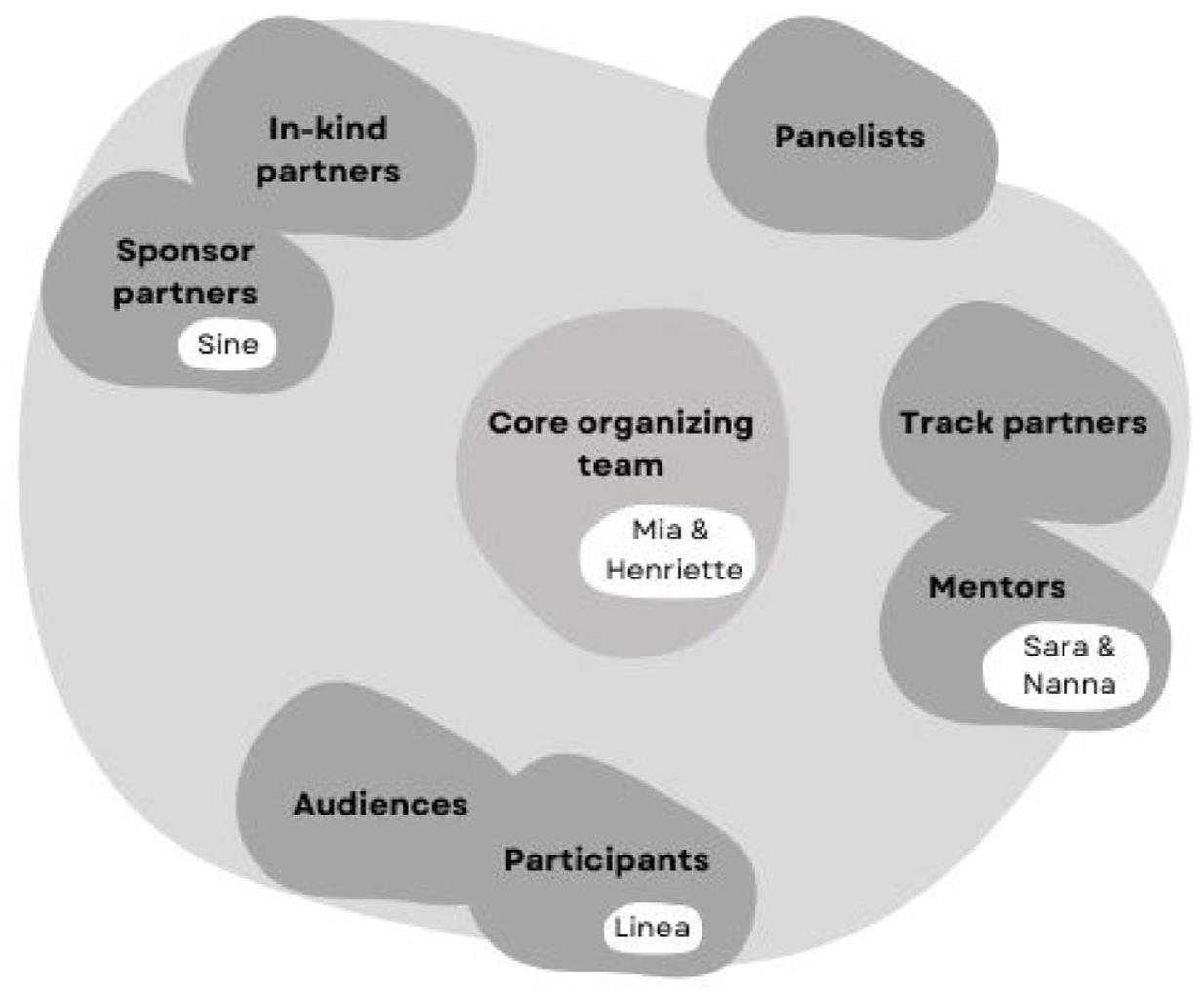
The eco-system of FFC and the authors’ positions within it (inspired by Bjerke, 2023).
Despite our different positions, we were all part of the same larger process, and our memories are located within it, some referring to the same and some to different instances within the broader event of the hackathon (see Figure 2 for an overview).
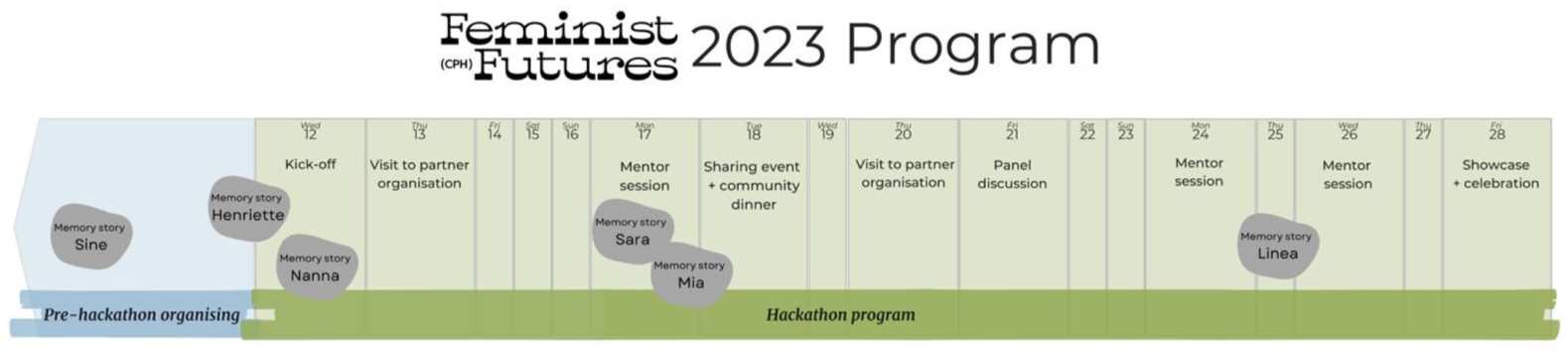
Timeline of FFC with the six memories plotted in.
This overlap enabled us to delve deeper into the commonalities and differences between our memories and to explore the entanglements of matter and meaning within them.
Analytical strategy: Listening for productive tensions
Having produced our embodied memories, the next step was to analyze their polyphony. The first round of analysis took the form of a workshop where we individually shared passages in the memories that were especially glowing for us (MacLure, 2013); that is, passages that affectively captured our interests. We used a whiteboard to visualize the data, jotting down key words (potential empirical codes) and using drawings to develop their meanings (see Figure 3).
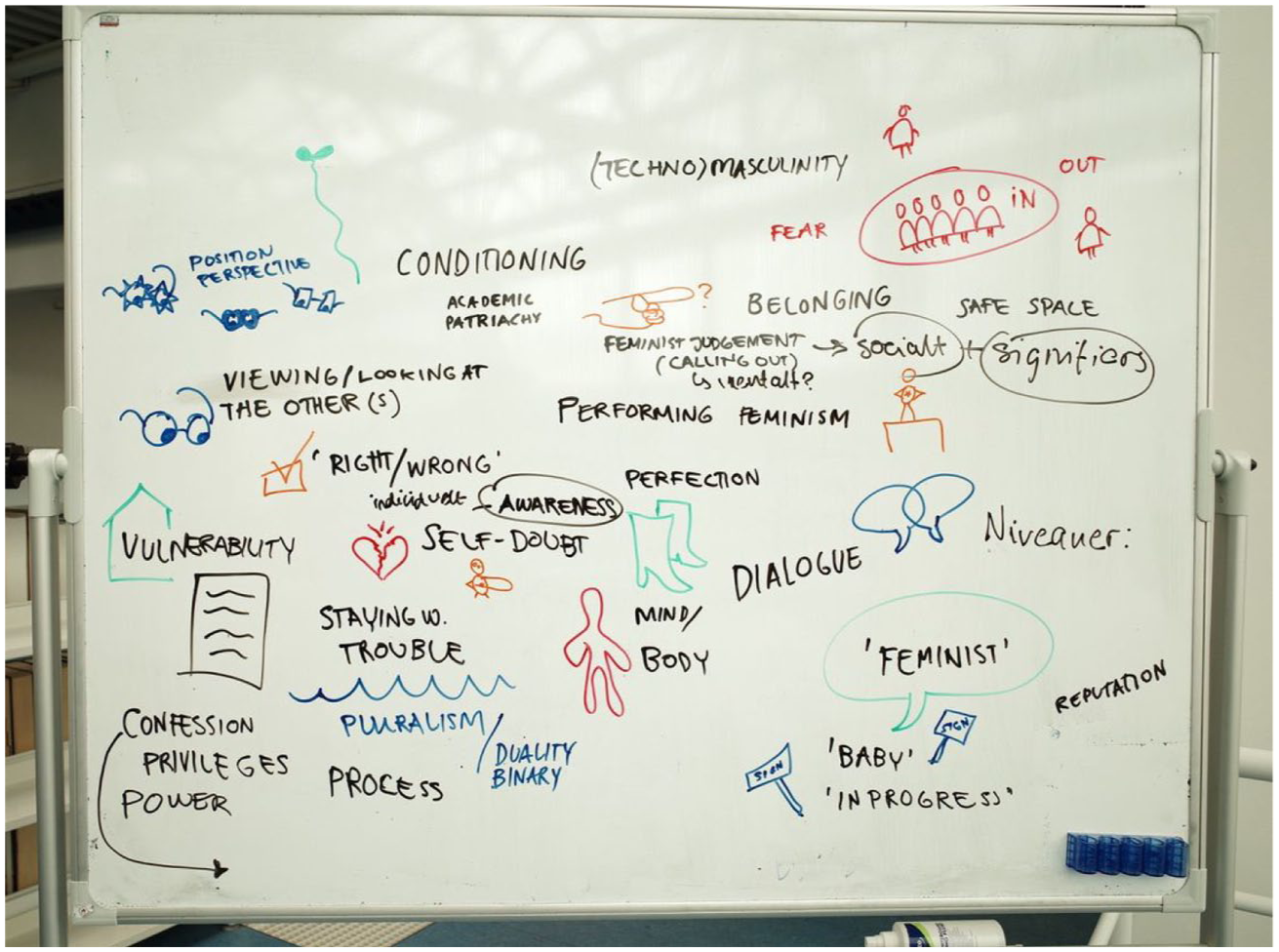
First round of coding.
Next, we explored links between the initial codes and different memories, identifying the parts of memories that elicited the codes and sharing memories of other experiences from the hackathon that spoke to the codes in various ways. In particular, we looked for tensions within and between the emergent empirical codes that might prove productive for reflexively reconnecting with the emerging polyphony (Kinser, 2003: 111) by recognizing and interrogating the inherent limitations of our own positionalities (Christensen et al., 2025).
Through the discussion, we arrived at six initial empirically grounded themes: Self-doubt and awareness; Feminist signifiers; Looking at the other; Promoting process; In-group/out-group; Affective intensities. We then turned to a second round of analysis in which we considered the initial themes through our reading of literature on polyphonic feminist organizing. In this second round of analysis, we moved back and forth between the data and theory, using our different readings of both as means of exploring productive tensions. In this process, we reflected upon the need for social recognition as it persists in the context of seeking to alter societal norms, the challenges of organizing for difference whilst offering the necessary recognition and support, and the ambition of researching these processes in ways that are loyal to them, creating supportive knowing-as-action as organizers and researchers whilst not naively ignoring the privileges of our positions. Gradually, we were able to specify these reflections as revolving around resistance/recognition, solidarity/difference, and research/practice.
Thus, the analysis emerged as an entanglement of our methods, theory, and data, which led to a focus on our own normative positions within the organization of the FFC hackathon. In this process, we noticed how many of our memories circle around a desire “to get it right” (as is already expressed in the introductory quote), which shapes and, to some extent, inhibits our organizational and scholarly practices. Taking our cue from a helpful comment offered by one of the reviewers, we recognize how our concern with getting feminism “right” risks (re)instating normativities—even as we seek to trouble them. This risk, as it shines through in the analysis, is indicative of our own boundaries of intelligibility, suggesting where further troubling (and, hence, other voices) might be particularly needed. Throughout, we attempt to highlight the productivity of the identified tensions, but we inevitably come up against our own limitations—ironically, the more certain we become that we have got it “right,” the more certainly are we “wrong.”
Tackling this paradox directly, the first theme deals with the issue of who and what can be recognized as feminist within our understanding of the organization of the FFC hackathon. Seeking to relate our hopes of being “good feminists” productively to our fears of being “bad feminists,” we explore this tension in terms of “Emergent subject positions.” Thus, the first theme addresses the issue of whether and how to embody feminism without foreclosing alternative feminist embodiments, productively interrogating relationships between recognition and resistance (who are “we” and what are “we” against?).
The second theme unpacks our reflections on what it means to organize for polyphony, centering the issue of whether and how solidarity can be centrifugal, promoting difference rather than delimiting it. Again, we take our cue from articulations of our concerns and insecurities, as the collective memories express tensions around our roles as organizers and facilitators: how can we invite participants to articulate their own positions and to listen to those of others? We explore the potential productivity of this tension in terms of “Giving and taking space.”
The last theme develops tensions around process- and impact-oriented understandings of our roles as activists and researchers. These tensions arise from our positions as organizers who have certain ambitions in relation to the participants (i.e. hoping that they will be able to present something at the showcase event that marks the end of the hackathon while not wanting to delimit what they present) and from our positions as researchers who have certain ambitions in relation to the organization (i.e. hoping that we will be able to learn something from this study while not wanting to predetermine what that “something” might be). We seek to show how this tension may become productive in so far as we succeed in “Staying with the process.”
Productive tensions of polyphonic feminist organizing
Working with our collective memories of participating in the FFC hackathon, the analysis explores the three productive tensions that we identified within and across our writings and conversations.
Emergent subject positions
In our meetings with the organizing team, we spent a lot of time discussing how the money we raised would be best spent. Working through several iterations of our budget, from ambitious to MVB (minimal viable budget), we continuously had to make prioritizations and compromises. Most importantly, we constantly had to ask ourselves: What is the most feminist choice we can make here? Who do we want to give money to? What embodied experiences and values do they bring to the table? And what does it mean for us to platform them in a context backed by big institutions such as universities, unions, and private companies? (Henriette)
What is the most feminist decision we can make? This was a question that kept popping up in discussions within the FFC organizing team. Knowing that every decision they made could have consequences for who was included, for example “hiring sign language interpreters for our public panel discussion, even though no deaf folks had signed up” (Henriette), put a lot of pressure on the organizing team to make the “most feminist” choices. This wording hints at expectations of being able to make fully informed decisions and being aware of all the consequences of our decisions, which go against our conscious positions but may be pervasive in practice—it indicates a knowledge of what the “most feminist” would be, which acts as an unarticulated yet powerful constraint.
The ongoing effort to make “the right” decisions through a transparent and democratic process led to decision-fatigue in the organizing team: [It] left me unable to live up to the level of care for my co-organizers that I was otherwise aspiring to. The partners and participants became the focus, and our own needs sometimes took a backseat. (Line)
A feeling of failing to live up to one’s own aspirations of reaching a certain (unspecified) “level” of both inclusion, equality, and care indicates a tension inherent to feminist organizing—one that may, as we will explore below, become productive, but which also comes with its own limitations. Significantly, the ideal of the “most feminist” choice sends everyone scrambling to achieve something that is both unknown and impossible, suggesting a normativity that is at once hidden and powerful (or powerful because hidden).
The tensions became visible at the organizational, inter-personal, and individual levels of organizing: I think in a way I always felt like I was too loud in most spaces. As a kid in a small town, in the countryside, it was always so quiet there. Feeling like a too loud-mouthed girl, and later woman, at work, at university, in the classroom. Throughout planning the Feminist Futures hackathon, I was so hyper focused on creating a welcoming, productive space for everyone else. For the partners, for the mentors, for the participants. A space where people didn’t feel out of place, but welcome in every way. Not feeling like they had to be ‘right’. (Mia)
The articulated feeling of being too loud and taking up too much space by claiming a space for herself motivates Mia to make space for others to feel included, as we will detail below. Here, we will highlight how this memory of organizing the hackathon expresses a hyper-attentiveness to the experience of others, similar to what Line describes in the opening quote of this section. The two memories, then, articulate a tension between self-imposed expectations of facilitating inclusive spaces without imposing expectations on others. Paradoxically, as we insist others do not have to “be right,” we mount expectations on ourselves to “do right.” Our ability to create inclusive spaces might even determine whether we are “good feminists”: I remember feeling excited but also afraid of falling through. Being a ‘bad feminist’ – whatever that means. Afraid of not being able to create the spaces we wanted to create in the organizing team. (Mia)
This simultaneous excitement about the hackathon and fear of failing recurs in our memories. Nanna, one of the mentors, describes how she experienced the kick-off event as disappointing, as the softness and slowness clashed with her expectation that feminist activism would be loud and in-your-face. Reflecting on this feeling of disappointment, Nanna describes her expectations as “wrong”: “And it annoyed me because it meant I had had the wrong expectations. I thought I should have known better. Been a better feminist without masculine expectations and needs.” In a similar vein, Sine, an academic sponsor of the hackathon, describes how she is seeking financial support for the hackathon and is met with skepticism and resistance. She finds herself thinking she should have been more direct in her articulation of a feminist position: And I always become hesitant when making statements that I feel are political/contentious, which is actually what annoys me, as I think I should be standing up for my politics/beliefs rather than use different words or shy away from these conversations. (Sine)
In concert, the memories reveal how we are evaluating our own voices—our expectations and actions—and indicate our normative positioning of “good feminists.” Rather than identifying what a good feminist is, our memories reflect feelings of failure, of having not been recognizable enough or not recognized others as much as we would like, but also of not having resisted enough, of not having presented a good enough alternative.
Some memories recount tactics for navigating the tensions between our expectations and feelings of failing to live up to them. Nanna handled the issue of fitting in with feminism quite literally, as expressed in this reflection on how she was dressed for the kick-off event: I felt cool in my new plateau boots. I looked at the participants in the room with cool haircuts, makeup, tattoos, and unique clothes on. Those boots made me fit in. And saved me from looking like a totally vanilla, hetero, cis woman. How does one look like a good/real feminist? (Nanna)
Edgy clothing, tattoos, and “cool haircuts” are, in this memory, cast as indicators of what “real feminists” look like. In the memory, fitting in means bodily signaling something different from her usual more modest appearance, which indicates the categories “hetero,” “cis,” and “woman.” Knowing that feminism should embrace difference, the boots come to function as a tactic to avoid—or to be “saved from”—the uncomfortableness of signaling one normative position and, concomitantly, to become aligned with another.
Reflecting on what makes us feel included and/or recognized, Mia connects her current tactics to past experiences: For many years, entering into feminist spaces and feminist organizing I called myself a baby feminist, putting into words the fundamental feeling of not being quite right, not having read quite enough, not going to enough demos, being the first generation in my family to go to university, and not having Judith Butler-reading parents to rely on to teach me how to embody these spaces with ease. I say the word ‘baby feminist’ with humor and as a way to let others know ‘hey, you don’t have to perform around me. I don’t know what I’m doing either’. (Mia)
By positioning her-self as a “baby feminist,” Mia is creating space for experiences (her own and others’) that do not necessarily conform to (implicit) feminist norms and can create space for new feminist subjectivities. Thus, “baby feminist” is used to dismantle our own and others’ insecurities, as a caring way of facilitating an inclusive space for emergent subject positions to become able to express themselves.
Conceptually speaking, we identify as intersectional feminists who aspire to acknowledge and foster difference within our organizations. We do not consciously judge people by their looks (whether “edgy” or “modest”), and our explicit aim is to relate “bookish”/academic knowing to embodied/activist doing (dismantling hierarchies between them). Nevertheless, we find ourselves harboring assumptions of what it means to be “right” along with expectations of own adequate performance of “rightness,” even as we actively seek to avoid imposing such normativities on others. Our memories of feminist organizing tell stories of our desire to fit in and belong in these spaces, revealing a tension between judgment and acceptance (Kinser, 2003). We are troubled by tensions of judgment (do I fit in?) and acceptance (you belong!).
While it is emotionally demanding to stay in this state of doubt, it protects us from leaning back and assuming that we are done with our feminist development. Acknowledging our own emergent subject positions along with those of other, we find that tensions around recognition and resistance can become productive for reflexively developing our feminist positions and creating spaces where others can do the same. As Kinser (2003) argues, “judgement and acceptance are the stuff out of which vibrant and messy feminism is made” (p. 112). Linea, a participant in the hackathon, articulates a sense of thriving in the messiness of the tensions: “I know I will never be a perfect activist or feminist because these simply don’t exist. I also know, however, that my continuous judgment of myself continues to haunt me.” Thus, we suggest, positioning ourselves—and others—as emergent, as coming to be, and coming to terms with ourselves, in and through our very relations with others, may enable participants in feminist organizing to constantly negotiate these relationships. In turn, such negotiations may make tensions around un/realized expectations of resistance and recognition productive for the maintenance of open and dynamic spaces that invite difference and avoid closing in on themselves.
Giving and taking space
Line instructed us to close our eyes and imagine we were in a feminist utopian future. I imagined Sine and Sara, who sat beside me around the table, that we were sitting there in 10, 20, 30 years, as happy, free, light feminists surrounded by green plants. I smiled and was wondering what everyone else imagined. It was cool and brave to start with such an exercise, I thought. I felt a little silly thinking if anyone would be watching me with my eyes closed. It felt vulnerable to sit like that. It gave me a sense of collectiveness that we were all activating our imaginations. (Nanna)
Feelings of unity are crucial for enabling organizing toward a common goal. In this memory, an exercise at the kick-off event sought to tune in the wide array of people that had joined the FFC hackathon to a common frequency. While not speaking with one voice (cf. Rand, 2014), the participants in the hackathon became united in a shared individual practice of imagining feminist utopias that allowed every participant to activate their own imagination. It filled Nanna with a feeling of community as she imagined the participants to be collectively engaged through their individual imagination of what it might mean to work toward feminist futures.
Tensions between polyphony and unity emerged throughout the social interactions of the hackathon. Mia recounts how she experienced the room of the first mentoring session, sitting around a big table with three teams of participants and their mentors: I remember sensing that everyone was being hesitant. Not just the usual shyness at the beginning of a process but an extra level of quiet. I felt like everyone was waiting for others to set the room – lurking to see what the vibe was going to be like before giving their hand away. Perhaps from the all too well-known experience of how much it can cost to show yourself, your politics, in some spaces. I had a hard time actually focusing on the things people were saying – hyper focused on their body language, the vibe of the room, it was my job to set. (Mia)
Polyphony was an articulated goal of the hackathon—being a feminist event that aspired to facilitate imagination and co-creation of diverse feminist futures. Still, the participants, as they are positioned in this memory, seemed hesitant of speaking up. The hesitancy indicates a shared insecurity and, perhaps, a realization that the one who starts talking will set the tone for the session, thereby exerting a form of power that both closes room for some voices and invites others in.
While thinking that polyphony must be a shared practice of the group, Mia feels a certain responsibility as an organizer to ensure a space that can accommodate diversity. As the session started and the groups began presenting their ideas, Mia’s palpable stress of ensuring polyphony began to wear off: “I remember thinking ‘okay they got this from here. This is a group who can make this room a productive and safe space. These are my people’. Whatever that means. It’s about belonging, isn’t it?” This memory shows the relief of recognition, as members of the group begin speaking together in different voices, creating the polyphonous space Mia was worried would not emerge.
Sara’s memory, of attending the same session as a mentor to the groups, speaks to a similar feeling of connection to the people in the group, but it also reveals that (self)doubts may arise after attempts at facilitating polyphony: Ending the session an hour later, I feel really happy, inspired, and enthusiastic. It was so great to have a dialogue with a group of people I never met before, but still felt so much connection to. On the metro home, I start thinking again. I cannot completely remember what I said or did in the feedback session. I have a creeping feeling of having done something wrong. I am worried that I did not listen enough. That I did not leave space for the participants. That I talked over Nanna. That I was not perceptive enough. That I hijacked the situation and talked about my research rather than the participants’ projects. I was just high on excitement and wanted to say all the things that bubbled in my head, inspired by the participants’ presentations. How can a feminist space make me feel so good and at the same time make me doubt myself? (Sara)
While recounting a feeling of connection and unity with the participants during the mentoring session, the memory also raises concerns that polyphony has not been fully realized. These feelings indicate an attention to how other participants have perceived the session in general and Sara’s behaviors in particular. Moving from feelings of joy and excitement, Sara begins to critically dissect her own behavior in the session. She wonders if the other participants have experienced the session to be as inspiring as she did or if she silenced voices or took up too much space and time.
Like Sara, Mia struggles with a tension between excitement and self-doubt. In her memory, this is cast as a tension between feelings of belonging in this feminist group, which make her “hyped up,” leading her to feel like a “bad feminist” (as discussed above). In this memory the outsider (the bad feminist) is someone who takes up (too much) space and does not let others talk: I feel caught in a tension of being inspired, and hyped up, wanting to talk for hours, contributing and listening forever to these people who speak my language – but also that all too familiar feeling of being too loud, feeling like a white cis-straight lady taking up too much space. (Mia)
Both Sara and Mia had designated tasks in the mentoring session, Sara as a mentor and Mia as an organizer. As such, attention to prevailing power hierarchies may explain the enhanced concern with how one’s own behavior is perceived by others. Thus, striving for polyphonic feminist space can leave us with feelings of inadequacy, suggesting that we are not doing enough and that we always could do better to make space for others.
Feeling this insecurity, Mia sought to channel her nervousness, to move from her head to her body: So, I started to knit. Something soft with my body. I think it was a green mohair cardigan. We were working with ‘soft technology’ in this track – trying to rethink the techno-masculinity of much modern tech and tech-spaces. That’s why I brought the knitting in the first place, I remember – as a way to set a different room, a soft room, to break up our rigid ideas of what a ‘meeting’ is and how one embodies meetings in a professional way. To show with my hands that here we can do things in cozy, relaxed, spacious ways. But maybe I brought the knitting for myself as well. As a way to place my nervous energy into the strands of yarn, to still my mind and go into the body. As a way to stay with the trouble and stay with the body. (Mia)
While the act of knitting in this memory is meant to signal to the participants that the session is a different space—a relaxed and cozy space as opposed to the more corporate and techno-masculine spaces of traditional hackathons—it also mitigates sensations of nervousness or stress caused by the pressure to establish a polyphonic space.
Whereas Nanna’s memory of the mindfulness exercise during the kick-off event shows a way of collectively engaging individual imagination, Sara’s and Mia’s memories point toward the complexities that arise when seeking to collectively engage different voices. In the mentoring session, individual imaginings and ideas were voiced and became objects of discussion. The tensions between trying to establish a sense of belonging to the group by sharing ideas and responsibilities and at the same time grappling with the self-doubt that arises in these encounters are, at times, hard to sit with.
In addition, Sara and Mia struggled to navigate their roles as mentor and organizer, respectively, and the power that comes with those positions—to not be too controlling but still taking up the responsibility of facilitating and supporting the groups’ processes. Here, then, we encounter tensions of belonging to a diverse group and longing for (even more) diversity, of taking up a space while holding it open—and giving it over to others to take up as they please. Difficult as navigating these tensions is, they may become productive for feminist organizing practices that do not stabilize a normative space but continuously open room for other voices to become included and heard.
Staying with the process
The first group starts presenting. They are in an early stage of the process and have worked with individual mood boards to brainstorm an idea for the common project. The four group members have completely different ideas, and my first thought is that it is incoherent and scattered. How will the group ever land in a common project and be able to finalize something within the limited time frame for the hackathon? I instantly start analyzing and evaluating the individual presentations to find a common ground that I could provide as feedback to the participants. A common ground to push the process forward. This implies deeming some of the ideas as more feasible than others and starting to think along the lines of good ideas and bad ideas. As I realize this, I stop my brain from imposing the logics of academia on this setting. This process of imagining new feminist futures is not about achievements and performances, we are here for the process. Not for the result. (Sara)
The hackathon invited participants to embark on journeys of thinking, doing, and feeling differently in order to imagine and actualize different feminist futures. In addition, participants were invited to redirect focus from a specific goal toward the process of imaging and reimagining. Being a mentor in one of the tracks, Sara experienced a tension between keeping the process open and a pull toward “finalizing” an outcome for the groups, which she ascribes to her academic training that has conditioned her to create “smooth processes” for “achievement and performance.” Her memory not only sheds light on tensions between organizers and participants, but also between organizers and researchers. How can we resist the temptation to provide “right” answers? As the memory shows, a first step might consist of, simply, raising awareness of the pull toward hierarchies of knowledge, which may, in turn, raise our ability to stay with the trouble of an open-ended process.
In another memory, Sine describes a meeting with a potential sponsor, which leads her to (re-)value vulnerability: I don’t know what power feels like for this other person, but from the outside she always seems so sure, so confident. And she gets so much done. Maybe that’s what we all look like to others? Maybe it would be helpful if we opened up about our anxieties and insecurities? Could that be an anticipatory move towards feminist futures? I do not know, but what I learned from the encounter is that I am going to continue to search for ways of speaking up for feminism that create spaces between consensus and conflict. (Sine)
Becoming mutually vulnerable may, as this memory implies, counteract assumptions that everyone else is acting with ease and it may help dismantle the norm that acting with ease is desirable. As already indicated, many of our memories describe feelings of not doing feminism “the right way”: if we talked more about these feelings of doubt and insecurity, we might find collectivity in these shared experiences.
The process of writing this article became an opportunity for us to share anxieties and insecurities about our experiences of the FFC hackathon, but also of the writing process itself. Remembering, writing, and discussing gave us opportunity to embrace the uncertainties of doing and knowing feminist organizing. As described in Mia’s memory: “. . . perhaps it was that through the astonishing vulnerability of everyone else in the process, I found that we are all in some ways baby feminists—always in a process of learning and growing into it.” Thus, acknowledging that we are all “baby feminists” ties in with the ambition of “staying with the process,” emergent subject positions connect in and through ongoing processes: I had a strong feeling that the initiative had to be spotless, which I’ve realized is a bit of a paradox in this context. Everyone in the organizing team worked with and from an understanding that our participants would all be feminists-in-progress (as all feminists are) – yet we were not always as generous towards ourselves. As cliché as it sounds, I do believe that feminism is a verb not a destination or a permanent state. Feminism, as per its definition, is always changing and evolving, so where does this pressure come from to perform it to perfection? (Line)
Recalling how members of the organizing team had a hard time allowing themselves to make mistakes and learn from them, this memory returns to the discrepancy between our expectations toward others and toward ourselves. Even as we seek to organize an open-ended process in which there is no “right” answer, we have difficulty shedding our desire to “fix” feminist organizing. Becoming aware of this pattern, we may begin to know and do feminism as an interminable work-in-progress, pointing toward collective and individual future practices—of sharing vulnerabilities and anxieties and of accepting and forgiving our own imperfections. Thus, the tensions we experience may become productive when we invite participants (including ourselves) to enact their own knowing-as-action.
Still, trouble prevails, as expressed in a memory of playing a board game that was being developed by one of the other groups. Here, Linea reflects upon the difficulties of creating polyphonic conversations: As I am looking back and re-experiencing this evening, I am reminded of an idea I heard at a conference this spring about feminist judgment and its detrimental effects on the development and enactment of feminism as a movement. I, ‘we’, want to create a conversation. Especially in my case, I want to depart from misogynistic rhetoric of hard facts based on predetermined ideas of what makes science, and knowledge, legitimate. I want to sit with the uncomfortable, both feelings and experiences, but, as this evening has shown, perhaps I have underestimated how difficult this is. (Linea)
As Linea points out, judgment can be detrimental to the polyphonic feminist space, as it risks silencing voices and conversations. However, as Kinser (2003) argues “pluralism, multiplicity, polyphony . . . suggest a willingness to hear and consider. They do not imply our ipso facto acceptance of what we hear and consider; hence, judgement and acceptance are necessary and dialectical” (p. 114). Linea’s memory is an individual articulation of our collectively experienced need to find ways of productively negotiating the tensions of judging and acceptance, our commonly felt need to keep conversations open and ongoing instead of closing them down.
Linea suggests that moving away from traditional sources of knowledge, such as science, may be a way forward. Sara points to a similar notion, as she discusses her discomfort with imposing academic expertise on the participants’ projects: . . . how can I mentor these groups to stay in the openness of the task and still progress in such a way that it becomes meaningful for them? I become aware that it is a hard balance to strike between engaging my academic knowledge in the discussion without imposing my knowledge as an expertise, which will risk foreclosing the possibilities of other knowledges. (Sara)
Activating (academic) knowledge without silencing other knowledges represents another productive tension in our collective memories. Establishing positions of (academic) expertise might foreclose the articulation of bodily or affective knowledge, thus silencing certain voices and experiences (often marginalized ones). Still, researchers can bring their reflexive understandings to feminist projects, as we sought to do throughout the organizing of the FFC hackathon—and activist organizers can bring their experiences to academia, as we are seeking to do here.
What we have learned from listening to each other’s memories is that attention to mutual vulnerabilities, openness to each other’s experiences, and acceptance of our own imperfections are all central to the knowing-as-action of feminist polyphonic organizing. We have also learned that the enactment of feminist polyphony is a necessarily incomplete and ongoing project that requires us to constantly reflect on our positionality and responsibility—on how we can both give and take space in meaningful ways to create spaces of solidarity and difference, recognition, and resistance. Our memories trace the affective labor of navigating polyphony, illustrating our continuous worries about maintaining its conditions of possibility. In reflecting upon our collective memories, the overriding feeling is one of concern rather than care; in seeking to create and hold space for polyphony, we often become more aware of the limitations of our endeavor than of the polyphonic organizing we enacted. However, we also feel hopeful, as we hear traces of the hackathon’s polyphony in our memories of it—and of our differently positioned voices in the collective retelling. When we are able to listen to the in-between of our different voices, when we focus on the relations between them rather than the different positions they represent, the tensions of polyphony become productive; they do not disappear, but we become able to sit with them, use them, and even relish in the frictions that arise from collective articulations of difference.
Concluding discussion
The aim of FFC is to facilitate feminist futures by organizing hackathons that support participants’ imagination of such futures and inspire them to know and do polyphonous feminism, listening to feminist voices, and finding their own voice within it. Thus, the project seeks to create a sanctuary for rehearsing the enactment of Gibson-Graham’s (1993) everyday feminist revolutions by facilitating a process of creating a collective present for imagining different futures. The aim of this article is to learn from our organizing process by remembering it collectively. Given the empirical and methodological focus on creating and remembering moments of organizing for polyphonic feminism, our conceptual starting point revolves around the tensions of such polyphony. Thus, we situate the voices of individual participants in relation to the chorus of feminist collectives, considering how we might organize for and with polyphony through principles of intersectional difference (Grosser and McCarthy, 2019; Muñoz-Puig, 2023). Attending to such open-ended organizing privileges process over outcome (Izlar, 2019), and situates knowledge production within organizational practices, recognizing positionality as a condition of possibility for feminist knowing-as-action (Plotnikof et al., 2022; Vachhani and Pullen, 2019). Pivotally, polyphony, as a feminist practice of knowing and doing organizing, involves inclusion of the one voice and the many voices in ways that neither lead to centripetal unity nor centrifugal dispersion (Just and Muhr, 2019; Kinser, 2003; Rand, 2014).
Revisiting Kinser’s (2003) concept of polyphony, we contribute to current discussions within feminist organization studies that consider how we could and should combine research and activism. This approach enables us to understand relationships between feminist organizing and feminist organization studies through the tensions that shape them. These tensions can become productive when we embrace their “vibrant messiness,” engage with the frictions that arise between different voices, and accept their inherent dissonance instead of seeking harmony. On this basis, we offer a methodological consideration of how to study those tensions in ways that involve activists as researchers and researchers as activists by centering experiential and affective knowledges as articulated in our collective memories. And we provide a practical illustration of this methodology, as we use it to reflect upon our experiences of (organizing for) polyphony in the FFC hackathon.
Beginning with our practices as organizers and researchers of the FFC hackathon, we have identified three productive tensions, which are surely particular to our empirical context and our collective memories of it but might point to constitutive tensions within other forms of feminist organizing as well. We have labeled these “Emergent subject positions,” “Giving and taking space,” and “Staying with the process.” The first tension revolves around individual expectations and organizational normativities, detailing how we negotiate our desire to do “more”—to resist societal norms more radically and more thoroughly recognize the subjectivities of participants—in relation to a desire to do “less”—to diminish our own influence and create open space for the participants’ experiences and ambitions. By recognizing that we are all in the process of becoming feminists, we may apply the tensions of our emergent subject positions productively. Recognizing our individual insecurities and vulnerabilities, we become able to organize for collective resistance (see Butler, 2016).
“Giving and taking space” centers tensions between making space for others and caring for the self as a matter of recognizing one’s privileges as well as one’s needs. In the context of the FFC hackathon, we had certain powers to shape participants’ experiences, which also meant we were responsible for them. As such, we could not not take up that space and could not help but give the organization a certain shape, but we also had the chance to give space in and through the way in which we took it—whether by bodily practices (knitting) or articulations (of vulnerability). No organization is shapeless or limitless, but every organization can strive to become more open to solidarity in difference (Fleischmann et al., 2022). Thus, we have come to understand organizing for polyphony as a process of listening to the differences of voices within and listening for the silences of voices that have yet to be included.
Just as subjects are always becoming, polyphonous organizing is never complete, as our third theme highlights. Reminding ourselves to “stay with the process,” we configure our knowing-as-action in and through the tensions of research and practice. Throughout our collective memory work, we have thought through and with the process, even as we recognize our different positions within it—and accept their limitations. Such open-ended reflexivity, we suggest, is the main contribution of polyphonic organizing; the approach urges us to never stop listening to and for different voices, even as the frictions that arise may be jarring and uncomfortable. Also, the approach pushes us to listen for the tensions that arise at the very intersections of different voices, privileging polyphonous relationality above individual positionality. Still, polyphonous organizing teaches us that there are always limits to what we can hear, limits to our reflexivity and, hence, to our knowing and doing of polyphony. In our case, these limits show themselves in (re-)productions of norms and demarcations of positions that we explicitly disavow but cannot help but bring with us into our activist practices and research processes. Our collective memories reveal these limitations, and they can, we hope, serve as starting points for moving beyond them.
As such, the method of collective memory work enables us to attend to our positions within the process of polyphonic organizing, inviting reflections on our experiences that are “. . . willing to risk exposing weaknesses to and being vulnerable with one another” (Hawkins et al., 2016: 175). This approach to collaborative research is designed to create tension and to enable activists-researchers to experience tensions productively. This is not to say that the research process becomes therapeutic; rather, it gears research toward practice, and it enables researchers to reflect upon their own practices. As research methods, polyphony, generally, and collective memory work, more specifically, contribute to feminist organization studies’ turn to alternative forms of knowing and/as writing (Abdellatif et al., 2021; Ahonen et al., 2020). Feminist organization scholars have exposed how norms of academic writing discipline bodies and/or thought (Kaasila-Pakanen and Mandalaki, 2023: Pullen, 2018), reproducing dominant subject positions by privileging a “masculinized rationality” of detached and abstract objectivity (Cunliffe, 2022; see also Haraway, 1988). Beginning from alternative principles of bodily involvement, these scholars have explored collective and creative processes, positing academic writing as the active production of shared knowledge rather than a passive report on what has been “found” (Clavijo and Mandalaki, 2024; Lehman and Tienari, 2024). The variation of collective memory work that we have employed here offers feminist organizing and feminist organizational research heightened attention to individual and collective voices, enhancing our ability to speak with and listen to both—and attuning us to their relationalities. As such, we supplement existing experiments with collective memory work in organization and management studied (Basner et al., 2018; Dahlman et al., 2020; Davies et al., 2005), suggesting that collective memories are useful starting points for exploring tensions of polyphonic organizing.
Our approach to polyphonic feminist organizing, as practiced and studied here, contributes to the turn to feminist research as activist organizational practice (Bell et al., 2019; Benschop, 2021; Fotaki and Pullen, 2024). It does so by attuning researchers to their positions within processes of organizing and orienting researchers-activists toward open-ended processes. Beginning from Beavan’s (2021) assertion that research is knowing-as-action, we have explored what thinking and doing this configuration through polyphony may add to ongoing conversations. Most notably, polyphonic feminist organizing destabilizes and pluralizes practices of feminist knowing and acting; there is not one knowing feminist subject, not one feminist future to enact. To the contrary, feminism contains multitudes; it must, as Walt Whitman does in “Song of myself,” accept that it contradicts itself. Establishing polyphony as the organizing principle of knowing-as-action does not just attune us to different feminist voices but suggests that we organize for difference. The potential of and for feminist organizing emerges in the productive tensions between its multitudes.
Producing tensions is neither entirely pleasant nor will making those tensions productive ever be easy. Rather, attending to tensions risks exposing differences within feminist organizations in manners that may end up tearing those organizations apart (Dorion, 2024). However, feelings of pleasant ease suggest complacency or, indeed, occupation of dominant positions that set normative boundaries around feminist subjectivities. If we (our temporary research collective and the broader community of feminist organization scholars) ever became convinced that we were “good feminists,” we might, in fact, have become “bad” ones. If we ever felt like we fully belonged, we should start worrying about who we have excluded from our community. And if we were ever to think that the goal had been reached, we would surely have become part of the problem.
Footnotes
Funding
The authors disclosed receipt of the following financial support for the research, authorship, and/or publication of this article: This research was supported by The Velux Foundation and The Villum Foundation with grant number 27102/39017.
