




Abstract
Using insights from Bourdieu’s theories of social space, this paper explores how neurodivergent workers negotiate disclosure in an organisational field that is centred around neuro-normativity. The paper draws on interview data from neurodivergent people in the UK workplace, exploring the relationship between the disclosure process and Bourdieu’s theories of capital. In addition, Walter Benjamin’s essay on storytelling is used as a methodological framework to explore how storytelling around disclosure can enable the acquisition of capital. The analysis emphasises the ways in which the telling and retelling of disclosure ‘stories’ create perceptions that allow for recognition of value and a related increase in the cultural capital of neurodivergent employees.
Introduction
This paper explores how neurodivergent workers navigate the disclosure process. It illustrates how disclosure can disrupt neuro-normative assumptions through its potential to increase capital for neurodivergent workers. I apply a Bourdieusian approach to the relationship between capital and neurodivergence, illustrating the interaction between Bourdieu’s concepts of cultural and symbolic capital and hexis, thus building on literature exploring difference and social context drawing from Bourdieu’s theories, for example Jammaers et al. (2021); Berezin (2014) and Edwards and Imrie (2003). The empirical focus is on neurodivergent employees in the UK, exploring how stories emerge as a result of disclosure, how they are re-told and how this can affect capital. Exploring the relationship of capital to bodies which have invisible differences, which I argue is currently under-researched, the paper therefore applies Bourdieu’s theories to the normative assumptions applied to non-(neuro)normative subjects in organisational life.
In addition, concepts from Benjamin’s (2015 [1968]) ‘The Storyteller’ are used to develop a complementary methodological framework, addressing how stories emerge in relation to disclosure. Drawing on the interrelation between these two frameworks, the paper explores the ways in which the process of storytelling arising from disclosure can increase capital for neurodivergent employees. The paper therefore adopts a social constructivist approach, concerned with the interweaving of people, organisations and society; epistemologically it draws from Bourdieu’s relational sociology to explore the relationship between stories and disclosure. Theoretically, it extends understanding of the relationship between forms of capital, bodily hexis (Bourdieu, 1977) and marginalised employees.
Neurodivergence is an umbrella term used to describe the range of differences in individual brain function and associated behavioural traits, including autistic spectrum disorder, Attention Deficit Hyperactivity Disorder (ADHD), dyslexia, dyspraxia and Tourette syndrome. In the UK, it is estimated that around one in seven people or 15% are neurodivergent (wisecampaign.org.uk, WISE, 2023). Traditional assumptions about who can or cannot contribute to organisational life that is typically centred around neuro-normativity, or the standard way of thinking, functioning and behaving are being challenged (Bruyère and Colella, 2022). In this paper, neurodivergence is the preferred term used to describe individuals who diverge from neuro-normativity, whereas neurodiversity in used to describe the range of different mental or cognitive functions, including neuro-normativity, that is represented within human populations. Within the neurodiversity movement which emerged during the 1990s, its associated conditions are conceptualised using the social model of disability. Under this model, disability is seen as resulting from a poor fit between the physical, cognitive or emotional characteristics of a given individual and the structures and characteristics of their social context. An individual is therefore disabled not by their impairment, but by the failure of their environment to accommodate them (Den Houting, 2019). Neurodivergent employees in the UK who have a formal diagnosis are protected under the Equality Act of 2010, whereby workers with a mental or physical disability are entitled to adjustments to their working lives. Neurodivergence is not recognised as a separate or specific category, however, and not all neurodivergent people consider themselves to be disabled; for those who do, their disabilities are often invisible.
A common challenge that neurodivergent people encounter in the workforce is deciding whether, when and how to disclose their difference and any associated condition(s). Whilst disclosure may mitigate for some of the challenges faced and provide necessary accommodations, it also risks exposing individuals to potential discrimination (Romualdez et al., 2021). Once the decision has been made to disclose, questions arise about around the act of disclosure as well as organisational norms (Toth et al., 2022). Possibilities also exist for disclosure to be disruptive, altering work relationships (Gibson, 2018). Disclosure can be defined as the initial conversation to line managers or HR, as well as to the ensuing conversations when individuals disclose to colleagues. For the participants in this study, disclosure often involves providing details about their diagnosis and conditions, as well as asking for what they needed and are entitled to. These autobiographical stories are not limited to the initial disclosure conversation, but they are also repeated amongst colleagues. Walter Benjamin describes storytelling as ‘the ability to exchange experience which is passed on from mouth to mouth’ (Benjamin, 2015 [1968]: 84), which is a feature of the ways in which a disclosure is experienced in the accounts of the participants in this paper.
Fears around loss of cultural capital due to perceptions of disability (Jammaers and Zanoni, 2021) feature within their narratives and are drawn upon here to illustrate how struggles over capital influence their workplace experiences. Bourdieu’s theoretical ideas combined with a methodological focus on storytelling are therefore deployed as an original perspective for studying the ways in which capital can be both perceived as lost as a result of neurodivergence, but can be accrued through disclosure. Exploring the ways in which narrative has many meanings and different potential usage in relation to disability rights, Engel and Munger (2007: 85) point out that: We are equally impressed with the fact that narrative is essentially a fabrication. By this we do not mean that the stories we present are necessarily untrue but that they are put together, or spun out, by the narrators in particular ways as they draw on remembered experiences, perceptions, and feeling.
Building on this in relation to the ways in which stories around neurodivergence emerge from disclosure, the paper connects disclosure accounts not only to neurodivergence but also to broader discussions around disability in the workplace, and to Bourdieu’s theories of capital. It therefore aims to contribute to the literature on disability and inclusion; for example Mauksch and Dey (2024: 639) who discuss the different ‘doings’ of disability produced by social enterprises, to the critical interrogation of inclusion in organisations (Adamson et al., 2021) and to literature on storytelling in organisations, for example Chapple et al. (2022) who demonstrate the audience’s role in shaping storytelling (in an entrepreneurial context).
Benjamin (2015 [1968]) explores the social, cultural and historical contexts of storytelling. His focus is on the decline of traditional oral storytelling due to mass media and the relaying of information rather than the communal shared experience of stories that that connect the listener and the storyteller. Whilst this somewhat elegiac argument does not seem to be relevant, from an initial reading, to the exchange of information in a modern workplace (precisely the milieu that Benjamin describes as emphasising anecdotes rather than the collective wisdom that storytelling once represented), I have nevertheless drawn from this essay to guide the methodological approach. This is particularly for its use in data analysis, as it helped illuminate how stories around disclosure are ‘spun and woven’ (Benjamin, 2015 [1968]: 91) as they are repeated, and how the evolving stories have the potential to transform the capital of neurodivergent employees. This is more fully explored in the methodology section below.
Bridging a gap in explorations of bodies with invisible difference and forms of capital in the workplace and adding to research on narrative and capital, the overall research questions that the paper addresses are: Firstly, what is the relationship between disclosure, storytelling and capital? Secondly, how might disclosure affect the perceived cultural capital associated with neurodivergent employees in the workplace?
The paper is structured as follows. I begin with a theoretical framework, with a review of the literature concerned with neurodivergence and organisational disclosure, leading to an exploration of Bourdieu’s theorisation of the social world. I then review the literature concerned with storytelling within organisations. I introduce the methodological approach used to explore the participant stories, drawing on Benjamin’s conceptualisation of storytelling and how its use for data analysis arose, before presenting the field work and findings. The data shows the ways in which the telling of disclosure stories allows for an evolution of capital within the field. I end the paper by discussing its contributions, providing directions for future research and conferring implications for organisational inclusion.
Neurodivergence and disclosure
Workers with invisible disabilities or challenges face unique challenges (Santuzzi et al., 2014), and dilemmas that differentiate them from visible disabilities (Norstedt, 2019). Fears around ‘displaying failings’ contribute to why many neurodivergent employees do not disclose their status at work, even though this prevents access to support and legal protection (Johnson and Joshi, 2016). Even when employees do disclose, uncomfortable memories may arise, since these individuals may have had numerous negative experiences during their education and employment history (Bewley and George, 2016). Workplace isolation is shown to be a recurring problem among employees with a disability (Klinksiek et al., 2023). Exploring how their participants navigate a context in which normative values are tantamount, Stenger and Roulet (2018: 258) ask how the risky ‘shall I, shan’t I’ decision is affected by the social context of individuals; in a similar way, Brownlow et al. (2018) explore the risks associated with disclosure and situate this within emotional labour in the workplace. Disclosure can therefore be seen as a continually shifting social process within organisations, Barnard-Brak et al. (2010: 421) found that students in their study frequently ‘downplayed’ disability, attempting to pass as non-disabled or avoided disclosure altogether. From this, the connection between disclosure and perceptions of negative capital can be seen, although the specific context of neurodivergence disclosure has not been researched, nor the relationship between potentially increased capital and disclosure. This study is an attempt to bridge that gap.
Capital in the organisational ‘field’ and the hexis
Bourdieu’s conceptualisations of social space are underpinned by his theories of field, capital and habitus (Bourdieu and Wacquant, 1992). Fields are networks of social relations, within which struggles take place over contested capital. Acting like market-places or games pitches, fields are occupied by the dominant and dominated (Bourdieu and Wacquant, 1992: 98). Fields are a social space in which individuals interact within the particular rules of the game that regulate the ways they behave (Bourdieu, 1991). It is the demonstration of practical logic in the field (known as habitus) that ultimately affects individuals’ ability to play the game in ways that allow them to accrue various forms of capital.
This negotiation, or struggle, emerges via the acquisition of capital, and an individual’s ability to play the ‘game’ is dependent on their possession of capital. Bourdieu presents capital in three forms – economic, social and cultural. Economic capital is, unsurprisingly, related to financial assets. Social capital is dependent on social networks and the mutual obligations of capital that arise from one’s connections (Townley, 2014). Cultural capital can be institutionalised, that is, arising from education, qualifications, knowledge and value (Bourdieu, 1991); embodied, for example bodily comportment, language skills, looking a particular way (Everett, 2002) or objectified capital, for example books and pictures. Everett (2002) points out that objectified capital can only release profits if the embodied capital is already present, illustrating the importance that Bourdieu places on embodied cultural capital and its relationship to social competence within the field. Bourdieu (1977) also tells that cultural capital can only be acquired through an interdependent relationship between field, habitus and capital, which is conceptualised by him as ‘hexis’; bodily hexis refers to the manner and style in which actors carry themselves – the ways in which the field, habitus and culture combine. Hexis is therefore a cluster of social meaning and values (Pettinger, 2005).
Symbolic capital, Bourdieu’s fourth form of capital, is the accumulated prestige or honour derived from the accumulation of any capital, and is therefore significant in distinguishing an individual in their field. Symbolic capital becomes a specific form of capital when it is grasped through categories of perception that recognize its specific logic (Bourdieu and Wacquant, 1992: 119 [emphasis in original]). Recognition is therefore crucial to allow the perception of accrued capital within the field; symbolic capital acts as an enabler to achieve cultural or economic capital once it is recognised and valued, and prestige is gained as a result of that value.
Edwards and Imrie (2003: 253) discuss the relevance of Bourdieu’s sociology for corporeal identities in social settings, specifically for disabled bodies: Thus, for Bourdieu, social location and inequalities are understood, in part, in relation to bodily dispositions (i.e. to comportment, ways of talking, eating, sitting, touching, etc.) and to bodies as bearers of value.
This focus on bodily hexis has also been addressed by disability scholars: Berezin (2014) applies Bourdieu’s theory of capital as a lens through which to better understand the role and impact of disabilities in school and society, arguing that capital does not merely comprise cultural knowledge and social relationships, but also the ability to perform one’s knowledge and desires through behaviour that is valued in the field. Jammaers et al. (2021) show how valued forms of capital are unequally distributed in an organisational field that privileges able-bodies workers over disabled ones. Applying a Bourdieusian lens to discover what sets apart disabled entrepreneurs who build their business around disability and those who do not, Jammaers and Williams (2023) remind us that the physical and socially situated body in Bourdieu’s framework is important to the ways in which capital is produced and accumulated. Bourdieu and Wacquant (1992) also describes language as a form of bodily hexis through which the relation to the social world reveals itself (p. 149). He describes how every linguistic exchange ‘contains the potentiality of an act of power, and all the more so when it involves agents who occupy asymmetric positions in the distribution of the relevant capital’ (Bourdieu and Wacquant, 1992: 145, original italics). Thus, the ways in which difference is disclosed involves potential repercussions in relation to capital, as well as the sharing of personal information.
Exploring how a Bourdieusian sociological framework interacts with life history data involving written or spoken forms of self-representation, Barrett (2015) argues that his conceptual framework offers a range of potentially productive avenues for future research. Arguing that Bourdieu’s focus on the relational interweaving of people, organisations and society can lead to greater understandings of how organisations, workplaces and practices of work and management are shaped, Ernst and Jensen Schleiter (2021) see narratives as an essential part of the establishment of position (or capital) within the field. This relationship between narrative and a Bourdieusian lens is further explored below, as I turn to reviewing the literature on stories and narratives within organisations.
Stories in organisations and in organisation studies
Forming part of the vast body of literature over recent decades on storytelling and narratives in organisations, as well as on organisational storytelling, there have been enquiries within OS into the relationship between stories based on personal narratives and marginalised workers, focusing on identity (Jammaers and Zanoni, 2021), age and gender (Tomlinson and Colgan, 2014), disability as a discursive category (Mik-Meyer, 2016) and storytelling and ‘difference’ in relation to non-normativity (Moore et al., 2022; Riach and Tyler, 2024; Van Laer et al., 2022, inter alia). Storytelling can therefore offer the potential to address personal complexity. When personal histories are critically explored, we are reminded of the interlinking of both the individual and social context (Brown et al., 2009). Stories therefore capture both individual perspectives, as well as context and the connections between them. Tassinari et al. (2017) and Jørgensen (2022) explore the capacity of storytelling to open up space and to change the practices in organisations. Illustrating that personal stories are accounts of individuals, Bruner (1991) argues that they are also about the societies they live in and situations they experience.
Whilst disclosure is not usually conceptualised as a story, rather a transfer of information, van Hulst and Ybema (2020) draw from Smith (1981) and Gabriel (2000) to define storytelling as an instance in which someone tells someone else about events that have taken place or are taking place in a particular time and space, triggering emotions and explanations; stories, then, are normally not used to depict ordinary events and routines, but those things that deviate from the ordinary (van Hulst and Ybema, 2020: 368). Gabriel (2000) conceptualises stories as personal and emotional, often subversive accounts, whilst narratives represent the underlying themes and perspectives that arise from stories. Whilst accepting that there is often a degree of interchangeability between the two terms, in this paper I draw from Gabriel (2000), and use story when explaining accounts which include characters and specific, often emotional events.
Drawing from the above, and from Bourdieu’s (1991) claim that stories narrate the structures of the social world, each experience of disclosure can be seen as a pivotal storytelling moment. Sandberg and Fleetwood (2017) argue that including a narrative dimension to Bourdieu’s conceptual framework reflects the importance of stories and how events are verbalised and discussed. In their study, the inclusion of a narrative dimension allows for a better understanding of the role of symbolic capital: ‘Stories transmit social structures. They are learned, incorporated and become instinctive as the way things are’ (Sandberg and Fleetwood, 2017: 378). Lueg (2022) brings together narrative theory and Bourdieusian field theory within the frame of organisation studies, arguing that the narrative notion can help trace how struggles in and between organisations are carried out and how they impact organisational practices. Takacs (2020) explores narrative capital, aligning it to cultural capital, and consisting of a person’s experiences capable of being turned into interesting stories, and their skill at constructing and deploying these stories to signal social status.
From the above, we can see that Bourdieu’s logic of practice has been applied to non-normative bodies. The relationship between personal narratives and capital has also been studied. I argue, however, that there is a lack of research exploring the relationship of capital to bodies which have invisible differences. The ways in which stories can arise from the disclosure of neurodivergence, and how this is related to the potential accrual of capital, therefore merit attention.
Research design
This inductive study was conducted from an interpretive perspective in an attempt to produce a rich account of the experience of disclosure. The data forms part of a wider (and ongoing) longitudinal empirical study exploring how neurodivergent people experience work. The research was designed round semi-structured qualitative interviews, to allow participants to talk freely about their experiences. Initial participants were drawn from the staff (themselves neurodivergent) of a recruitment consultancy specialising in assisting neurodivergent applicants, and to which I had been granted access via a personal contact. Once ethical approval had been awarded by my institution, permission was granted for me to email staff members, introducing the study and myself. A consent form and participation information sheet were provided on the day and discussed with the participants. These interviews took place within the London offices. I then added to the original data set by the inclusion of other participants who were recommended to me, and these interviews took place in coffee shops close to the participants’ workplaces, or via zoom. The coffee shop location was chosen by each of the respondents, rather than by me; private space was available within offices, but each of these participants preferred to be away from the office, despite the noise and sensory overload present in these locations which might have been considered to be problematic for some neurodivergent people. All chose familiar territory where they knew they would be comfortable. There was no difference in the richness of data elicited from face to face or zoom interviews. To date, 17 participants have been interviewed at least twice, with 8 participants being interviewed 3 times (due to the longitudinal nature of the wider study on neurodivergence and work; all participants will be continue to be interviewed during several stages). Seven women have been interviewed, and ten men. All are based within the UK and hold professional positions.
Methods of data collection
The data consisted of 42 audio-recorded semi-structured interviews conducted between late 2019 and summer 2023. These conversations lasted somewhere between 45 minutes and 2 hours. The interviews were structured using open-ended substantive questions, covering career and employment history, the experience of neurodivergence and the experience of work in relation to this, specifically asking questions about disclosure. Initial thematic data analysis took place as soon as the interviews were transcribed and was an ongoing process throughout the data collection stage. Anonymity was assured to all participants.
During the interviews, I strove to make my language as direct as possible, appreciating that metaphorical language may cause difficulties for some neurodivergent people. Whilst I did not identify as neurodivergent during the data collection phase, 1 I do have a cognitive disability following a traumatic injury which caused a hiatus in the research. During the interviews that were part of the later data collection phase I was aware of being affected by listening about difficulty concentrating and anxiety around semantic disorder which is similar to anomic aphasia, a type of word retrieval failure, which I experience alongside difficulty with prolonged concentration. This was helpful in that I was able, for example, to enjoy rich conversations, sharing which coping mechanisms I found useful, but also unhelpful in that I found it hard not to reflect on my own experiences and I had to be careful not to assume responses. Experiences of are of course diverse and not all participants described episodes with which I was familiar. I did ensure that all participants were fully informed that they could ask for breaks at any time, or complete the interviews in two stages if they preferred. I was also reflective on my own role as interviewer (through keeping a research diary) and reflexive during the interviews as I strove to take my own conditions ‘out’ of the conversations, whilst responding with empathy to all stories.
As I listened, I recorded (and subsequently analysed) the ways in which participants recounted their disclosure stories, and the ways in which their personal stories had been retold. This focus on stories led me to Benjamin’s essay on the death of the story in modern life and I explain below how this approach was pivotal to the analysis of the data.
Methodological foundation: Walter Benjamin and the death of the story
In his 1936 essay ‘The Storyteller’, Benjamin locates storytelling as embedded in human history as both a communal and intimate enterprise. He describes the ‘ability to exchange experiences’ (Benjamin, 2015 [1968]: 83) as something inalienable to humanity, yet which has been losing its value and dying as an art since the early years of the 20th century. Stories, instead of being told and retold, spun and re-woven in communal settings, are now presented as mere information and consumed passively: ‘Now almost nothing that happens benefits storytelling; almost everything benefits information’ (Benjamin, 2015 [1968]: 89). Stories, however, were never simply entertainment to while away pre-modern existence. Their role was to communicate experience and transmit traditions and memories across generations. Stories both preserve and concentrate their strength, beyond the time in which they are first told, and in this way are capable of ‘arousing astonishment and thoughtfulness’ (Benjamin, 2015 [1968]: 90), even whilst difference emerges out of every iteration, because, again unlike information, stories are not static but transformational.
The discomfort for organisational researchers is the attempt at applying Benjamin’s concepts to the information that is disclosed and discussed within the workplace, since he argues that the ‘communicability of experience is decreasing’ (Benjamin, 2015 [1968]: 86) because ‘no event any longer comes to us without being shot through with explanation’ (Benjamin, 2015 [1968]: 89). We do not have the option to interpret things at our leisure, but instead the psychological connections are forced upon us, pinpointed in a particular context and time, with no community of listeners able to be relax and absorb the story and thus re-tell them, because the explanation and interpretation is already provided for us and the stories are no longer retained; ‘there is no more weaving and spinning to go on while they are being listened to’ (Benjamin, 2015 [1968]: 91). The modern workplace therefore seems an unlikely setting for providing the deep relaxation that according to Benjamin allows stories to ferment. Yet, he did locate stories within the workplace. Storytelling in his account is part of the milieu of work, with workrooms as the location where ‘it sinks the thing into the life of the storyteller’ (Benjamin, 2015 [1968]: 91). What Benjamin conjures is the constant flow of narrative experience; admittedly quite separate from, and indeed crushed by, the stream of information that we today associate with a busy workplace. In addition to this, not all narratives are stories; Gabriel (1998: 3) tells us that ‘in particular, factual or descriptive accounts of events which aspire at objectivity rather than emotional effect must not be treated as stories’. We know, however, from the explorations of how storytelling is used to transmit social structures (Gabriel, 1998), that narratives about the self are told and retold within organisational settings. Gabriel identifies that Benjamin shifts the meaning of stories away from stories about characters towards stories about the self and personal experience. Maddox (2021: 93) reading through a critical disability lens, argues that Benjamin saw a radical disruptiveness in ‘non-normative and not-quite-human corporeality’ since she posits that the body that has been disabled by the world in which it inhabits haunts the edges of several of Benjamin’s works. The mute-deaf interlocuters of The Storyteller, for example are unable to speak of their experiences; in this way, Benjamin draws attention to the fragility and vulnerability of non-normative subjects, but also their disruptive capability; here, stories are transformational not only in their content, but by the presence of their narrators. In this way, whilst placing stories where Benjamin writes that they no longer occur, the disruptive and germinative power of storytelling became a point of analysis for the data that I was gathering.
Data analysis
After reading and re-reading the transcriptions many times and listening back to the interviews, the data was broken into analysable sections. These sections contained key themes which emerged in an inductive manner. I derived coded categories through the integration of theory and empirical data. For example, in the first phase I identified categories related to cultural capital, bodily hexis, the ‘recognition’ of neurodivergence and the ways in which capital was perceived to have increased. During the second phase, I added codes for disclosure (and the ways in which disclosure was then re-narrated by colleagues). Disclosure was conceptualised during the analysis as both event and process; an initial exchange of information, usually to a line manager, but also the ensuing conversations which involved revealing information to colleagues. I began to be particularly interested in how disclosure was narrated as a story; a story code was added when participants described disclosure as a process with its origins in the past, and was told and then retold by others within organisational settings, with transformative results.
It was at this point during the analysis that Benjamin’s (2015 [1968]) work on storytelling began to occur and recur in my thoughts, and I began to trace the patterns of the stories that emerged during and re-formed following disclosure. The narratives that I was listening to were deeply personal, as most contained stories of diagnosis and the perceived lack of – or anxieties around – workplace capital due to neurodivergence. Sometimes these conversations contained fragments of stories; for example one participant told me about diagnosis when I asked about disclosure, mentioning that disclosure had been difficult due to unhappy memories of diagnosis, and then returned to provide ‘snippets’ of disclosure conversations whilst discussing his experience of neurodivergence in the workplace. I conceptualised these fragments as stories, however, not only because of the ways in which the various fragments combined to present events that were imbued with explanations and emotions when shared with me, but also due to the ways in which participants told me that multiple listeners often re-told the accounts, transforming disclosure information from a piece of news to ongoing stories about people, their challenges and their capabilities. The accounts continued to be repeated by and discussed with others and this process was again narrated back to me. I began to draw on Benjamin’s work as a methodological framework to highlight the narrative temporality of disclosure, and as a tool for identifying how disclosure could be understood as a story which has germinative power. Hence, I did not start the process with the intention of bringing together the works of Bourdieu and Benjamin in relation to this study; Benjamin’s storytelling essay instead emerged as a methodological ‘prompt’ to help me understand how Bourdieu’s theorisation of social life emerged during disclosure. It became evident (when I reread the transcripts multiple times) that those participants who described disclosure were also describing the acquisition of capital, so this became another code, as did the disruptive and germinative power of stories in relation to the ways in which neuro-normative assumptions were challenged as a result of disclosure stories. Finally, I addressed each research question and re-coded, aligning narratives with particular questions, until the evolving framework was saturated with empirical data.
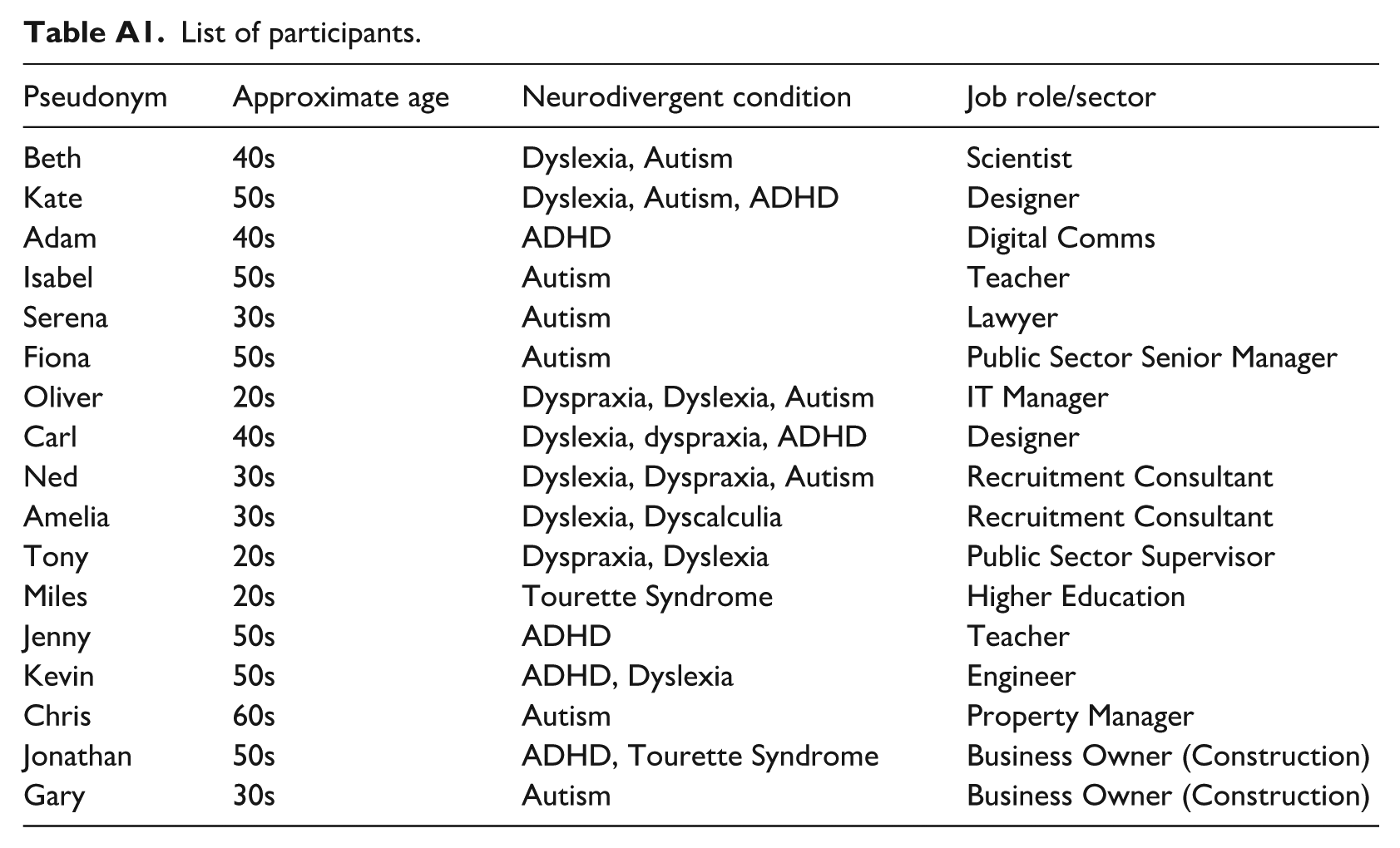
A full list of participants is provided in Appendix Table A1.
Findings and analysis
The findings are presented here in three stages; firstly, many of the participants discussed how their neurodivergence affected them – common phrases including ‘not fitting in’, ‘not understanding the rules’ and ‘hard to find my way around’ – and as a result they experienced a lack of cultural capital in relation to the workplace norms of behaviour. Secondly, the ways in which the participants’ stories were initially told, and then retold by listeners, is described, so illustrating the ways in which stories can change the perceptions around neurodivergence. Lastly, the effects on that participants’ symbolic capital as a result of storytelling around disclosure is described and analysed.
Neurodivergence, the hexis and cultural capital
The first theme to emerge from the findings was the way in which the participants spoke about their struggles to belong in the organisational environment. These examples emerged from a single question: ‘Have you disclosed in your workplace?’ Whilst there were yes and no responses, all of the participants discussed how they had felt in their environment, and how that influenced their decision. In this way, stories started to emerge, with the ‘first chapter’ narrated involving personal history, emotional reactions in the present, and worries about the potential pitfalls of disclosure. As Beth explains: The department I was in was full of young graduates. It was very sociable, lots of drinks after work and so on. We were all in our first jobs and everyone was expected to be very career oriented, but also very confident and sociable. I couldn’t sort of understand the rules, of how people just got into groups.
From her account, we see how Beth’s field is neuro-normative, that is, composed of a set of assumptions, norms and practices that function as the correct and accepted ways of behaving. Beth views her field as a competitive market place, which as Bourdieu and Wacquant (1992) tells us are occupied by the dominant and the dominated. In describing her inability to inculcate a ‘feel for the game’, her habitus does not align with the field. She demonstrates her valuation of what confers cultural capital here – being a graduate and having sociability, self-confidence and the ability to network.
Beth decided not to disclose in that work environment: It was just that feeling of not fitting in, not somehow being on the same wavelength as everyone else. It just felt like something very personal that wasn’t anyone else’s business.
For Beth it was her lack of cultural capital, her feelings of having behaviours that did not fit in with her environment, that became a barrier to disclosure.
Jonathan and Gary, who are business partners, did not disclose, either to one another or to their other partners. As Jonathan puts it ‘why would I want to try and stand out? It was all about trying to fit in. I didn’t want to be thought of as different’. Gary says that there were other environments where he wishes that he had disclosed, in retrospect, because it would have opened up support, but in his current role, he doesn’t see the need as he feels he can ‘shoulder’ his neurodivergence and he does not think that his conditions affect how he is perceived. Tony and Carl, who work in different industries and are at different career stages, have also not disclosed. Neither has felt the need as yet and both discussed how their diagnoses were interesting and ‘explained a lot’ as Tony said, but did not affect their work or the ways in which they felt assimilated and accommodated in their respective workplaces. As Carl said: I absolutely would, if I felt it was something that had a negative impact on my work life. As it is at the moment, it’s just something that I find interesting about myself and it doesn’t seem to have an impact on anyone else.
In other words, for these participants, cultural capital was not lacking – as long as they were able to keep masking their conditions and regulate their environments.
Miles discusses his embodied lack of capital in his current work environment: It is so tiring (the tic control) and it is physically taxing as well as mentally. It is all very physical, for me. I’ve had to really work hard there to suppress my tics, which I can do for a limited time, by displacing the urge to tic into other actions. Explaining why he has not disclosed, he says: I’d rather have an unnamed elephant in the room than a named elephant – I think the latter would be more conspicuous.
Disclosure is too high-risk, even when, in Miles’s case, his embodied hexis is affected by his neurodivergence. By not disclosing, however, he can continue to mask, despite the fatigue that this involves, as he is more comfortable with his condition not being named.
Ned references the external social environment in his account of why disclosure can be seen as high-risk: Ideally you’d be open, willing to talk about your experience when you go for a job, or when you’ve got a job. But the reality is, we’re so often on the defensive. So that translates into why people don’t disclose. We have these terrible memories of how we were misunderstood and we assume it’s going to be the same thing. And to be frank often it is.
Ned’s and Miles’s focus on the vulnerabilities associated with a neurodivergent identity illustrates how the ways in which capital is acquired can be the product of early experience (Everett, 2002), and that anxiety becomes inculcated into neurodivergent individuals who have had negative experiences in their employment history (Bewley and George, 2016).
Adam describes his embodied lack of cultural capital: I will get really agitated sometimes and need downtime, but I get worried about being seen to be always up and down – and then some joker will say something about me having a weak bladder! – and I will get embarrassed. So often I’ll just sit there silently although that makes me anxious. Being really focused and able to concentrate and multi-task is what is expected where I work.
Bourdieu (1977) tells us that domination often takes the form of bodily emotion, and that the hexis refers to the manner and style in which actors carry themselves. Adam reminds us that there is often a particular standard of moving or interacting within the organisational space (Klinksiek et al., 2023: 3). His hexis makes him at odds with this (he describes his agitation as physically noticeable, literally ‘standing out’ and leading to targeted jokes) and he becomes emotionally uncomfortable and anxious and lacks the cultural capital that is valued in his field.
Kate describes her field as ‘creative, small-team focused, very open and chatty’. Yet as an autistic woman, her habitus results in her feeling ‘out of place’ in this very social environment: I don’t always respond in the ways that other people do. I need lots of ‘alone’ time whereas everyone else seems much more comfortable being sociable all the time. I can also be abrupt and people don’t always expect that in a woman.
We see here how her field draws on the external social environment in order to develop its own taken-for-granted understanding about the world, and Kate lacks the cultural capital to be included.
Fiona articulates (and summarises) how trying to fit in with the dominant work culture is challenging and means she cannot have a ‘feel for the game’: It’s like there’s a code running just underneath the surface. I can’t grasp it, I can’t see it, but I know it’s there. Everyone else can grasp it.
In this way, Fiona is drawing attention not only to her perceived differences, but also the lack of recognition that her neurodivergence excludes her from.
In the findings illustrated below, the participants show how disclosure stories are related to the cultural capital that they perceive themselves to be lacking in their fields.
Disclosure stories as a category of perception
For those participants who did disclose, it became apparent during the interviews that disclosure was not conceptualised as a single event. Whilst the initial act of disclosing (to a line manager or HR) was not necessarily described in detail, the subsequent conversations (since most shared their disclosure with immediate colleagues) did initiate conversations where more private information was shared, or they became a talking point. In this way, the stories ‘grew’ as the participants related the reactions, both in the ways they recounted their experiences during the interviews, and the ways in which they all mentioned the subsequent re-telling in the workplace. For example, Kate describes the telling and retelling of her story: I talked a lot to my boss about my diagnosis and why I wanted him to know. A lot of things came out, how I’d felt in the past, that sort of thing. I was surprised though by the way in which he reacted. He just kept saying ‘Autistic? Surely not’. It made me feel odd and a bit stupid, like I was making it up. (Interviewer: Did he explain why he said that?) Because I’m a woman! He actually said that. I told him that women can be autistic too. He said ‘oh yes I know’, but he honestly only ever saw men – in his mind I mean.
Kate raises issues around neurodivergence and intersectionality, which are beyond the scope of this paper, but she illustrates how stereotypical assumptions arising from the external social environment re-surface in the field. Her story continues as she describes what happened when she disclosed to her immediate colleagues, again provoking surprise: I kept being told ‘Are you sure?’ I think because again I don’t fit their image of a socially awkward man who sits behind a screen all day. I’m creative and expressive. It’s just that I don’t always express myself in typical ways. But it makes them interested, and I talk and explain things about me. It starts conversations.
Here her story moves on from the initial uncomfortable disclosure conversation, to an ‘opening up’ of conversations about who she is, and the response of her colleagues changed from disbelief to acceptance and recognition.
Fiona found her initial disclosure conversation to be positive and helpful. She went on to disclose to colleagues, and finds that when she does, she ignites discussions around autism: My boss was so understanding, and interested, and wanted to make sure I felt supported. I continued to tell the people I work with, and I still do. People are really interested and want to find out more. But then so often, they will go on to tell me about autism! It’s infuriating. You know – ‘oh my brother finds this helps’, as if I know nothing about it! But then I’ll hear them telling other people things like ‘you should talk to her about it’ . . . Although I can’t control what people say about me, it’s good that the subject is discussed. It sort of normalises autism. It enables everyone to talk about what they know or have experienced in their lives, with family members and so on.
In a similar way, when Kevin disclosed, which was only following a very recent diagnosis, he found that there was a great deal of interest: I guess ADHD is verry ‘current’, isn’t it. So people have wanted to talk about it a lot. I don’t mind, I find it interesting too.
Chris describes himself as ‘nearing the end of my professional life’ but like Kevin, has had a recent diagnosis: I suppose I didn’t really need to disclose, as I’ll be retiring soon. But I did it to help other people, really, to speak up . . . It hasn’t been a big deal at all, but people are interested.
From the above, we can see how the stories emerge from an initial sharing of information. The disclosure opens up a retelling of stories within the workplace, what Benjamin calls ‘weaving and spinning’ (Benjamin, 2015 [1968]: 91) and which allows for stories to provoke ‘astonishment and thoughtfulness’ (Benjamin, 2015 [1968]: 90). It is more than information that is being discussed; it is personal history and emotional responses that are being relayed, and this sharing allows others to exchange their own understanding and their own experiences of neurodivergence in their social networks. Storytelling around disclosure is therefore acting as a category of perception that recognises the ‘logic’ (Bourdieu and Wacquant, 1992: 119) of neurodivergence and disclosure, in other words it is accepted and valued.
Disclosure and capital
In this final section, several participants referred to the ways in which their initial disclosure, and the subsequent retelling of their stories – both to and by others – can provide them with capital; symbolic capital which evolves into cultural capital, as Adam described: I did disclose in the end, because I thought it should be something that was on record. I felt comfortable to then tell colleagues as well. So I feel the same in many ways, in that I still don’t feel like I always fit in, but on the other hand, people know there’s a reason for it and they all make it clear they want to support me and that I have things to offer the team. So I kind of have my place now.
In Adam’s account, disclosure is an important part of a shifting component of wider social processes. What Stenger and Roulet (2018) describe as the ‘shall I, shan’t I’ gamble of disclosure has paid off for him, because his neurodivergence is recognised which increases his capital.
Jenny initially disclosed to her line manager, and it was very much a statement of information. As she gradually started to tell her colleagues about her neurodivergence, however, People wanted to know more and more. Not in a nosey way, they were just really interested. It means I’ve had some conversations with people I’d never spoken to before, and it’s opened up a lot of opportunities.
In this way, Jenny was able to augment her social capital, by extending her network due to her neurodivergence and her cultural capital, in that she becomes ‘known’ for something.
Isabel also found disclosure to change her situation in unexpected and embodied ways: My headteacher was so interested, and listened to everything I had to say. But the main thing is that everyone is interested. In fact more than interested. I would say it’s changed the way we think of ourselves. We’re a school who not only support autistic students, but now everyone knows we have a staff member who is open about their own diagnosis and challenges. All of this has made me more confident. I feel as though I have something that enables me to make a difference, and be a voice, and my colleagues have noticed that. Our headteacher told me that she had seen my confidence grow. I feel taller, somehow! More confident in my body now.
Isabel’s story has allowed for an increase in capital, specifically symbolic capital allied to cultural capital. This is illustrated by the change in her own bodily confidence, again reminding us that cultural capital can be embodied and presents itself through the hexis (Berezin, 2014). Gabriel (1998) identifies that Benjamin shifts the meaning of stories towards narratives about the self and personal experience and is not static, but transformational, in that she can gain capital as a neurodiversity champion. Ned also explains how a long conversation with his boss where he disclosed his autism affected his capital: I wanted to make it clear that I had things to offer, so it was quite a long conversation, in the end. A bit of an autobiography! In that conversation I was seen as someone who could be creative, not just someone who was a bit abrupt, or who couldn’t work well with other people. It did change things for me. I felt that I had presented my competitive edge, and it was respected, and it changed how I fitted in, and how I saw myself as part of the wider team. It definitely changed the way that people saw me too, and the way they interacted with me, because I was seen as having a value.
Ned, like Isabel, unleashes the ‘germinative power’ (Benjamin, 2015 [1968], a: 90) of their story. Bourdieu (1991) tells us that it is subjective narratives about the most personal difficulties that illustrate the contradictions of social structures, and Ned’s disclosure story articulates the contradiction between being different but being able to use this difference to increase his capital and an accumulation of prestige.
Oliver hadn’t initially planned to disclose, feeling that he was ‘managing’ and not wishing to draw attention to himself. An office move, however, caused him some problems, and having finally explained his neurodivergence to colleagues, he was urged to formally disclose: Where I was sitting, I was much closer to the door. And I found myself getting very easily distracted. If I get distracted, it makes me anxious. I lose concentration quickly and I’m aware that I forget things and make mistakes. And then I start worrying that I haven’t finished something, or have made a mistake somewhere Eventually I mentioned how I was getting so anxious to my immediate colleagues. They kept telling me to talk to our manager, and in the end I did. She’s asked me to join a neurodivergent group at work. It’s informal but we do also have the chance to suggest things to management if something comes up. It’s great, I feel valued, and as if my neurodivergence adds something. And my desk has moved now.
From Oliver’s story about his path to disclosure, we see the capacity of storytelling to provide opportunities to change the practices in organisations (Jørgensen, 2022; Tassinari et al., 2017). Disclosure for Oliver not only allows him to change his everyday experience within the office by moving place, but also by becoming part of a network for neurodivergent employees, which makes him feel as if his symbolic capital has increased and, like Ned, has accumulated prestige because of this.
Kate also found that repeated disclosure narratives helped increase her capital, even though her initial conversation with her boss had made her uncomfortable: I do tell people, and people will now openly discuss autism with me and want to hear about my history and my experiences as a woman with autism. The more I say it, and the more other people tell each other about me, I feel kind of, sort of, extra creative. Like I’ve got some sort of power that they discuss. I think of myself as a goddess now!
The retellings of her story following from the initial disclosure provides her with cultural capital. Serena recount a similar augmentation of capital as a champion for neurodivergence: Disclosing has sparked a lot of conversations and people ask me a lot about autism in particular. I am more used to the fact that this is me. I didn’t have to tell everyone, but it gradually became a talking point after I’d told one or two people. People say, ‘oh now I understand you!’ It’s opened things up and I’m coming to terms with being a bit of a poster girl for people like me. Autism has always been such a white male space.
Amelia aligns her confidence to the increased capital that it brings: I feel confident about exposing my own issues because I understand the ‘spikiness’ of it. Although there are some things that I can’t do, there are these amazing things that I can do, and I think talking about it and other people discussing it with me has helped me to see that more clearly, like ‘oh look there you go with your entrepreneurial thinking, or your intuition, or your problem solving, or imagination’, and I feel good about that. It makes me feel so much more valued. Disclosing helps that because in my experience you get an opportunity to be listened to and you get a chance to have your skills appreciated.
Both Serena and Amelia find that the conversations that open up around their neurodivergent stories are instrumental in creating cultural capital for them. Amelia is able to draw on positive coverage of neurodivergent, that is, a ‘spiky’ profile, meaning that neurodivergent people tend to perform very highly in some areas and lower in others rather than a consistent average. Serena’s is becoming known for her difference, and, she feels, recognised and understood, and she connects this to her other identities, for example, as an Asian woman in the workplace.
Whilst the locus all of the stories was disclosure, the participants returned to past memories and moments of discomfort, but they also described change and potential as a result of disclosing, particularly relating to an increase in capital. Disclosure was more than a factual exchange of information, but instead opened up opportunities for many of the participants to gain capital, specifically cultural capital, by being valued as experts or advisors in neurodivergence, even if this role hadn’t initially been sought. Those participants described how they had been actively encouraged to describe their experiences and their histories. Of course, not every neurodivergent person wants to be a champion or spokesperson for their difference; however for many participants, disclosure did provide a way of gaining capital through interest generated by their stories. These stories are not static, but are transformational (Benjamin, 2015 [1968]: 90). The ways in which the stories were listened to was pivotal; Ned describes relating what turned into an autobiography, Amelia got the opportunity to talk about her skills and Kate discusses the ‘power’ that she thinks her colleagues see in her as they listen to her story.
Discussion and conclusion
Bourdieu’s theories of capital have been used as a lens through which to better understand the experiences of neurodivergent employees and their social relations. Using a Bourdieusian lens, in conjunction with a methodological prompt based on Benjamin’s treatment of storytelling, has allowed for an analysis of the ways in which disclosure stories can offer transformative potential in relation to capital. Whilst Benjamin saw modern working life as a antithetical to storytelling, instead I build on his conceptualisation of stories to show how disclosure, whilst generally considered to be merely the sharing of information, can lead to the sharing and re-telling of personal details and histories, with transformational changes to capital as a result. Hence, the analyses of both Bourdieu and Benjamin’s theories in relation to the practices underlying social structures are foregrounded in this study. The autobiographical accounts that are disclosed, and go on to be repeated in organisations, are here presented as stories. Disclosure can be merely a brief confidential exchange of relevant information, yet for most participants, stories about their lives and their experience of neurodivergence emerged as their conditions and diagnosis were discussed with colleagues, and their stories go on to be told and retold in communal settings; for example, Jenny’s account shows how her disclosure moved from a straightforward exchange of information to a personal story as a result of people’s interest and questions. The exchange of information does not necessarily create a story, however the ways in which disclosure sparked discussion and interest, involving personal detail and the re-telling of events (e.g. in the accounts of Fiona, Kate, Isobel, Serena and Amelia) were analysed by me as stories, drawing from Gabriel’s (2000) definition of stories being about particular characters, settings and events. Benjamin’s (2015 [1968]) The Storyteller, therefore emerged for me as I was analysing the data, particularly his account of how stories are ‘spun and woven’ (Benjamin, 2015 [1968]: 91) as they go on to be re-told and have germinative power; complementing and adding to Bourdieu’s theories of social life.
The paper makes the following contributions. Firstly, I make a theoretical contribution by extending Bourdieu’s sociology to neurodivergent employees and showing how neurodivergence becomes a recognised value that can increase cultural capital through disclosure stories. Whilst scholars have used Bourdieu’s sociological theories to explore disabilities and social context (e.g. Berezin, 2014; Edwards and Imrie, 2003; Jammaers et al., 2021) the paper extends this literature by applying a Bourdieusian approach to the relationship between capital and neurodivergence.
Bourdieu’s (1977) concept of ‘hexis’ emerges from the findings as a way of understanding how individuals are embodied prior to and post disclosure. The participant accounts illustrate the ways in which disclosure adds nuance to the symbolic and thus cultural capital of neurodivergent employees. Theoretically, therefore, the paper extends understanding of the relationship between forms of capital and how they can evolve through a focus on marginalised employees. The data shows that the capital that some neurodivergent employees believed they lacked – particularly embodied cultural capital and its relationship to social competence within the field – increases once neurodivergence is openly known and discussed. For some of the participants, disclosure also increased their social capital as the re-telling open up networking opportunities. Disclosure can therefore act as a category of perception that recognises the ‘logic’ (Bourdieu and Wacquant, 1992: 119) and the symbolic value of neurodivergence. I draw attention to the embodied hexis (Bourdieu, 1977) of misalignment and discomfort for employees who lack cultural capital, but I argue that those employees can alter their hexis through disclosure, allowing for an accumulation of prestige as a result of recognition. Neurodivergence is therefore analysed as offering the potential for a different form of cultural capital, once it is recognised. Neuro-normativity is presented in the findings as an organising principle; employees are expected to conform to neuro-normative behaviours and comportment. Whilst disclosure therefore has associated risks and challenges, many of the participant accounts foreground how cultural capital can increase as a result, because of the transformative powers of storytelling.
Secondly, I make an empirical contribution through a focus on neurodivergent employees, disclosure narratives and the ways in which they narrate how their disclosure is re-told and becomes a workplace story. In this way, I add to the current debates around workplace isolation which is shown to be a recurring problem among employees with a disability (Klinksiek, et al., 2023). Neurodivergence by definition contains a myriad conditions and cognitive differences and therefore cannot necessarily be conflated; however, anxiety around disclosure, fears over a lack of cultural capital and the ways in which disclosure involved repeated storytelling were common to all participants who disclosed.
Lastly, I make a methodological contribution by using Benjamin‘s conceptualisation of storytelling to guide the analysis of the data. It is through Benjamin’s evocative descriptions of the ways in which stories are told and retold that disclosure is analysed as a story and storytelling can be shown to still be thriving within an organisational context, and has transformative potential. Benjamin’s attention to the fragility, vulnerability and disruptive capability of non-normative subjects has been used to better understand how the flow of narrative experience can augment capital. In this way, the study contributes to debates around inclusion and disability, extending the ways in which stories have many meanings and different potential usage in relation to disability rights (Engel and Munger, 2007), and can disrupt neuro-normative assumptions, with a particular focus on people with invisible disabilities. Disclosure is not always a story and neither are all of the subsequent conversations that ensue. The paper shows, however, that for those participants who did disclose, the initial disclosure was conceptualised as a deeply personal account, which was then picked up and re-told to others, as well as being re-told to me as part of the research process. Hence, I argue that disclosure and the resultant storytelling can be a significant mediator between neurodivergence and workplace outcomes. Many neurodivergent people are not only reluctant to disclose, but are reluctant to take on a role as a (neuro) diversity champion, which needs to be taken into account, however in this paper the opportunity to ‘normalise’ neurodivergence, as Fiona puts it, is one example of how fears over a lack of cultural capital can be assuaged. Additional nuance is therefore afforded to cultural capital, particularly through the ways in which the hexis of neurodivergent people evolves.
There are several limitations to the paper. The participants in the research study had formal diagnoses and are professionals who articulate their stories with clarity. Many were also comfortable disclosing to colleagues, as well as to management, despite the confidential nature of disclosure. Further research could explore the experiences of people at different points of the neurodivergence spectrum, disclosure at different temporal points, and any differences between industries with regard to acceptance of neurodivergence. An intersectional approach to the work experiences of neurodivergent people would be also be fruitful. Research that draws on the perspectives of those listening to disclosure stories – including academic researchers, HR professionals, line managers and colleagues – would offer a more holistic understanding of the experiences of neurodivergent people, as would research exploring instances where disclosure is problematic and/or worsens the outcome for neurodivergent employees.
In conclusion, I suggest that a focus on storytelling in relation to disclosure, recognising the tensions between neurodivergence and capital on the one hand, and the opportunities for increasing cultural capital through storytelling on the other, provides opportunities to reflect more broadly on how organisations might acknowledge the experience of marginalised workers, and the vulnerability as well as the potential symbolic gains inherent in the disclosure process.
Footnotes
Appendix A
List of participants.
| Pseudonym | Approximate age | Neurodivergent condition | Job role/sector |
|---|---|---|---|
| Beth | 40s | Dyslexia, Autism | Scientist |
| Kate | 50s | Dyslexia, Autism, ADHD | Designer |
| Adam | 40s | ADHD | Digital Comms |
| Isabel | 50s | Autism | Teacher |
| Serena | 30s | Autism | Lawyer |
| Fiona | 50s | Autism | Public Sector Senior Manager |
| Oliver | 20s | Dyspraxia, Dyslexia, Autism | IT Manager |
| Carl | 40s | Dyslexia, dyspraxia, ADHD | Designer |
| Ned | 30s | Dyslexia, Dyspraxia, Autism | Recruitment Consultant |
| Amelia | 30s | Dyslexia, Dyscalculia | Recruitment Consultant |
| Tony | 20s | Dyspraxia, Dyslexia | Public Sector Supervisor |
| Miles | 20s | Tourette Syndrome | Higher Education |
| Jenny | 50s | ADHD | Teacher |
| Kevin | 50s | ADHD, Dyslexia | Engineer |
| Chris | 60s | Autism | Property Manager |
| Jonathan | 50s | ADHD, Tourette Syndrome | Business Owner (Construction) |
| Gary | 30s | Autism | Business Owner (Construction) |
Funding
The author received no financial support for the research, authorship, and/or publication of this article.
