



Abstract
Amid the ongoing contestation of expertise fueled by populist rhetoric, this paper argues that contemporary discourse on expertise is part of a long-standing discursive struggle shaped by two distinct forms of articulation: populist and hegemonic. While populist articulations are grounded in antagonism toward expertise, hegemonic articulations—traditionally associated with experts—seek to construct a consensual discourse around it. Drawing on critical discourse studies, the paper first outlines theoretically these logics before turning to an empirical examination of “street-level” discursive practices through which business experts articulate their expertise today. What emerges are three distinct discursive practices that rely on micro-insertions, small-scale incorporations of discursive elements, as a recurring means of articulating expertise in relation to ecological and social concerns and, more unexpectedly, of introducing elements of antagonism into otherwise hegemonic discourse. Building on this theoretical framework and empirical analysis, the study advances two key contributions. First, it foregrounds populist rhetoric surrounding expertise by recontextualizing it, through a critical discursive lens, within a broader hegemonic struggle, thus contributing to literature on the entanglements between populism and elitism through the lens of expertise. Second, it offers a micro-level analysis of how contemporary business experts engage in articulatory practices. These micro-discursive activities deepen our understanding of “hegemony-in-practice” by identifying micro-insertion as a privileged discursive mode and revealing how business actors subtly mobilize antagonisms within expert discourse. This points to a latent ambivalence among business experts, who both inhabit and question hegemonic articulations of expertise.
Introduction
One of the most salient features of populist rhetoric seems to be the rejection of experts and expertise. There would be a specific “populist hostility to ‘experts’” (Kerr et al., 2024: 25) that can appeal to people’s sentiments and “common sense” over expertise (Hameleers, 2020; Macagno, 2022). Expertise, as a traditional source of business power and institutional safeguard, would be challenged by populists and technocratic experts relegated to the sidelines (Blake et al., 2024; Culpepper, 2021). In essence, populism would be an “anti-expert, and evidence-free way” (Hameleers, 2020: 146).
In light of the current contestation of expertise, driven in part by such rhetoric, I argue in this paper that the “expertise crisis,” associated to a wider questioning of experts’ authority fueled by socio-political and environmental issues (Eyal, 2019; Nichols, 2017; Reed and Reed, 2023; Wright, 2019) can be reinterpreted as part of a longstanding discursive “war of position” over expertise (Egan, 2013; Femia, 1987; Gramsci, 1985). Populist rhetoric can thus be understood as an articulation that reflects broader hegemonic struggles, expressed through ongoing discursive rearticulations of expertise in a sustained process in which both pro- and anti-expertise discourses seek to occupy and define a discursive territory (Fairclough, 2003, 2005; Fairclough and Thomas, 2004; Laclau and Mouffe, 2014).
Building on this argument rooted in critical discourse studies, this paper has two objectives. First, it seeks to theoretically reinscribe populist rhetoric within the broader discursive contestation surrounding expertise, with a focus on the logics that shape this struggle. I specifically conceptualize expertise as the result of articulatory practices that manifest in two distinct forms: populist and hegemonic. While populist articulations construct oppositions and are typically employed to challenge expert authority, hegemonic articulations aim to establish the consensual dominance of a particular discursive structure and are traditionally associated with business experts (Aroles et al., 2023; da Costa and Silva Saraiva, 2012; Ferns and Amaeshi, 2021; Kenny and Scriver, 2012; Levy and Egan, 2003; Nyberg and Wright, 2024; Räisänen and Linde, 2004). The second objective is to build on this theoretical foundation that supports empirical investigation, and the current moment of crisis, to offer a micro-analysis of contemporary articulatory practices, presumed to be hegemonic, through which business experts shape their own discourse of expertise today (Sunnercrantz, 2024). I focus on the case of consultants as they are emblematic of those business experts that lack a stable basis for expertise compared to more established professions and compensate for this lack with skillful communicative performances to “manage impressions” in front of the criticisms they face (Clark, 1995, Heimstädt et al., 2024: 41; Sturdy, 2009).
My empirical findings highlight micro-insertions as a recurring discursive practice. These small-scale incorporations of discursive elements allow business experts to articulate their expertise in relation to ecological and social concerns while also, more unexpectedly, introducing subtle forms of antagonism into an otherwise hegemonic discourse. Specifically, my analysis identifies three distinct articulatory practices: Organic-Consensual Micro-Insertion, Resilient-Consensual Micro-Insertion, and Unarticulated Populist Micro-Insertions. The first practice illustrates a subtle discursive move in which elements of corporate social responsibility (CSR) are inserted into a dominant discourse articulated around the business expertise of consultants. This reinforces the hegemony of business expertise by blending it with social and ecological concerns, thereby discursively bridging business with society. The second practice involves a discursive strategy that incorporates minor social and ecological critiques into the dominant discourse while preserving overall consensus. These insertions allow the discourse to appear responsive and adaptable, helping to maintain its stability. Finally, and quite distinctively, the third practice introduces populist-like micro-insertions that introduce latent antagonisms into an otherwise consensual discourse, subtly destabilizing it from within.
Building on my theoretical framework and empirical findings, I make the following contributions. First, by reinscribing populist rhetoric within a broader hegemonic struggle, I offer a critical-theoretical perspective that highlights two competing discourses of direction in relation to expertise: one grounded in antagonistic articulations, the other oriented toward the maintenance of hegemonic formations. This framing positions populism not as external to hegemonic discourse but as interwoven with it, part of a parallel articulation-building process through which expertise is discursively constructed. Given that populist discourse often frames experts as embodiments of the elite (Giorgi and Eslen-Ziya, 2022), and that the categories of elite and expert are increasingly entangled (Sunnercrantz, 2024), I therefore contribute to existing literature on the relationship between populism and elitism by showing how populist logics can be subtly micro-inserted into elite discursive practices themselves (Bloom and Sancino, 2019).
Second, by delineating a range of “on the spot” discursive practices employed by business experts, this study contributes to the exploration of “hegemony-in-practice” (Aroles et al., 2023; da Costa and Silva Saraiva, 2012; Ferns and Amaeshi, 2021; Kenny and Scriver, 2012; Levy and Egan, 2003; Nyberg and Wright, 2024; Räisänen and Linde, 2004). It enriches our empirical understanding of how expertise is actively constructed and negotiated through everyday articulatory practices. Moving beneath the surface of consensus, I examine how micro-insertions function to sustain and adapt hegemonic discourse around business expertise. While CSR-related themes play a role in shaping the micro-organization of expert discourse, I also identify instances where business experts incorporate populist or potentially anti-expertise elements. These findings extend existing models of discursive hegemony by showing how hegemonic actors may incorporate antagonistic elements into their rhetorical repertoire. In doing so, the study raises questions about a possible ambivalence, whether conscious or not, among business experts who simultaneously inhabit and challenge hegemonic articulations of expertise. This ambivalence subtly destabilizes consensus from within and prompts reflection on the evolving role and positioning of business experts.
In what follows, I begin by briefly reviewing the roots of the anti-expertise stance associated with populism and some entanglements between business and populism. Based on this review and drawing on critical discourse theory, I then reinscribe these themes into a broader and more neutral theorization of the discursive logics of expertise. I specifically distinguish between two logics of articulation, populist and hegemonic, which can be used to analyze the ongoing struggle over expertise. Given the formal character of this theoretical framework, I then examine how these logics operate in practice by presenting my fieldwork, focused on business experts. Finally, I unpack my findings and discuss their implications.
Theoretical background
The antagonistic roots of populist rhetorical opposition on experts and expertise
Appeals to anti-elitism seem to be a characteristic of populism (Mueller, 2019; Wodak, 2024). Populism is based on the idea that power needs to be exercised directly by the people, “unmediated and unencumbered by social elites” (Sharon, 2019: 2). Populist discourse often frames experts as an “expression of the elite” (Giorgi and Eslen-Ziya, 2022), making the categories of elites and experts intertwined and constituted through differentiation from the popular (Sunnercrantz, 2024). Anti-elitism associated with populism can be substituted for anti-expertise (Sunnercrantz and Yildirim, 2022). With their expertise and knowledge, experts would have the power “to ‘debunk’ the masquerade of populist politics and restore faith to liberal democracy” (Sunnercrantz and Yildirim, 2022: 43). The populist rhetoric, then, antagonizes experts as elites devoted to the current regime, as part of broader anti-establishment sentiment, or marginalizes technocratic experts (Blake et al., 2024; Sunnercrantz, 2024).
Anti-intellectualism also underlies populist rhetoric about experts and expertise. Populism provides a background where experts are challenged, as representatives of the elites, insiders and victims of populist anti-intellectual stance (Eslen-Ziya, 2022; Wodak, 2024). Populist leaders are fueled by “anti-intellectualism” referring to a “generalized suspicion and mistrust of intellectuals and experts” (Merkley, 2020: 2; Mudde and Kaltwasser, 2017: 64). Under populism, “the expert” may be identified through “a type of rhetoric that asserts logocentric technical arguments on a relatively specific domain of knowledge” (Sunnercrantz and Yildirim, 2022: 60). Populism typically focuses on the people’s feelings and experiences whilst undermining empirical evidence and expert analyses (Hameleers, 2020: 146). In sum, the “Populism’s Manichean discourse bypasses elitist knowledge and expert opinion and stresses conflict, emotionalization and people centrism.” (Hameleers, 2020: 148).
Populism is often contrasted with technocracy. Technocracy is based on the superiority of expertise and a scientific approach to the social world (Bertsou and Caramani, 2022). It can be understood as the exercise of power by technical elites, with expertise as one of their sources of legitimacy: they are “those who know best” how to guide society (Bertsou and Caramani, 2022: 7). “The expert” is perceived as a neutral knowledge mediator, consulted by politicians, and associated with bureaucratic systems, technocracy, and depoliticization (Sunnercrantz, 2024: 552). To sum up, populism is still largely regarded as “the convenient name under which is dissimulated the exacerbated contradiction between popular legitimacy and expert legitimacy (. . .)” (Rancière, 2005: 88).
Business experts in populist times
Expertise has long been a key source of business power. As such, the populist rejection of expertise, rooted in anti-elitism, anti-intellectualism, and anti-technocracy, undermines one of the most valuable resources business representatives bring to the negotiating table and populism is increasingly perceived as both a corporate risk and a strategic challenge (Blake et al., 2024; Culpepper, 2021; Feldmann and Morgan, 2022).
Feldmann and Morgan (2022) argue that populism undermines the power of business in three ways (pp. 14–15). First, it promotes “noisy politics,” bringing issues out into the public domain when business prefers “quiet politics,” behind the scenes, based on their expertise, knowledge, and networks. Second, populists seek to replace the processes of network governance which dominate policy making by decision-making “emanating from the leader’s ability to articulate the will of the people, preferably without the use of expertise.” Third, whilst some populist policies reflect the interests of business, others are designed to counteract globalization of the economy and represent a challenge to dominant business models.
This raises questions about how business experts respond to the populist stance in ways that frame their expertise. Interestingly, at the firm level, Blake, Markus, and Martinez-Suarez analyze the “populist syndrome” and specify how firms should adapt their non-market strategies to manage these risks. As a response to populism, firms can use political ties and corporate social responsibility to moderate risks. These particular configurations of political ties and CSR activities are mainly aimed at the populist leadership, bureaucrats, political opposition, and societal stakeholders, seeking to minimize threats to business under populism (Blake et al., 2024). In a related but distinct register, Barros and Wanderley (2020) explore how business actors may not only react to populism but also actively shape it. Departing from Weffort’s (1980) conceptualization of populism, based on a permanent process of consensus-building among asymmetric forces, the authors discuss the role of business people in supporting and even taking control of the populist political agenda. Their research on Brazilian businessmen movements demonstrates, first, that a populist macro “political” discourse can be framed with the support of businessmen and professionals, as populists can “advance a pro-business agenda presented as a solution to problems faced by the ordinary citizen.” (Barros and Wanderley, 2020: 400). Second, the authors also show that business people organized their movement around think tanks under a different populist discourse to fit their interests and spread their own messages in the mass media (Barros and Wanderley, 2020: 398). This reaffirms that business elites “aim to develop cultural and political frames to guide debates in society” (Barros and Wanderley, 2020: 396).
Just another struggle for hegemony?
Business experts’ practices are not only reactive or overtly political. A significant body of research has examined how these actors engage in proactive forms of discourse aimed at maintaining their authority. This literature, often framed through the lens of hegemony, explores how business expertise is both reproduced and naturalized through everyday as well as longer-term discursive practices (Aroles et al., 2023; da Costa and Silva Saraiva, 2012; Ferns and Amaeshi, 2019; Kenny and Scriver, 2012; Levy and Egan, 2003; Nyberg and Wright, 2024; Räisänen and Linde, 2004). Research has outlined various forms of hegemonic practice through which businesses use language not only to respond to critique but also, more broadly, to embed the world of business and management within a hegemonic performative discourse (Aroles et al., 2023; Nyberg and Wright, 2024).
Levy and Egan (2003) famously illustrated how the oil and automobile industries used “hegemonic discursive strategies” to deny climate change while emphasizing a “win-win” position aligned with the dominant market ideology. Räisänen and Linde (2004) demonstrated how experts strategically “re-engineer” textual discursive practices to impose a hegemonic framing of the new work order in multi-project organizations, rendering managerial control as a form of consensual and seemingly natural praxis. More recently, Ferns and Amaeshi, drawing on Laclau and Mouffe’s discourse theory, illustrate how BP defended its core business of producing and selling fossil fuel products by enacting three sequential hegemonization strategies: adopting new signifiers; building “win-win” relationships; and adapting nodal points. This process-based perspective considers how organizational actors produce hegemony in the long run as a bottom-up process, focusing on the accumulative arrangement of signifying chains. Discursive (hegemonic) construction is an ephemeral process, that, far from being impermeable to critique, enables organizations to both incorporate and evade various types of stakeholder critique, which reproduces business-as-usual (Ferns and Amaeshi, 2021).
An important conclusion emerges from this review. The prominence of both proactive populist discourse and the reactive responses by business experts tends to draw attention. Yet, populist rhetoric can itself be seen as an intensified reaction to a hegemonic discourse, part of a broader, ongoing discursive struggle over expertise. In other words, behind the rise of populist rhetoric lies a question about the hegemony of experts and the enduring “war of position” over the relevance of business expertise today. In the following section, I offer theoretical insights into the sustained discursive struggle surrounding expertise.
Theorizing the logics of expertise discourses: A critical perspective
To reinscribe contemporary debates within a broader perspective, I now introduce my discursive approach. This approach calls for a shift in analytical focus, from evaluating the validity of expertise claims to analyzing the underlying logics of articulatory practices (Venizelos and Trimithiotis, 2024). This perspective is grounded in the constructivist tradition on expertise, which sees expert discourse as a form of indirect, soft social control and challenges the idea that expertise is objective, neutral, or detached from power relations (Heimstädt et al., 2024: 32). At the same time, and partly in response to the conceptual ambiguity surrounding populism, it also seeks to adopt a more neutral view. It recognizes that populist claims can hold democratic value and aims to move beyond the moral charge often associated with the term.
The theorization in this paper is grounded in critical discourse theory, particularly Ernesto Laclau and Chantal Mouffe’s work on populism and their social theory of hegemony (Laclau, 2005a, 2005b; Laclau and Mouffe, 2014). These frameworks have been widely adopted in critical management studies, where scholars have used social theory of hegemony to explore the discursive logics underpinning both populist and hegemonic strategies (Contu et al., 2013; Fougère and Barthold, 2020; Hensmans and van Bommel, 2020; Levy and Egan, 2003; Nyberg et al., 2018; Spicer and Sewell, 2010; van Bommel and Spicer, 2011).
In Laclau and Mouffe’s discursive-practical perspective, the social is a discursive battlefield where every object is constituted as an object of discourse. Central to the their discourse-theoretical lens is that discourses are the result of the establishment of links between disparate discursive elements—the practice of articulation—to build favored discursive points leading to the production of a dominant discourse, an inherently political process requiring two components—antagonism and hegemony (De Cleen and Stavrakakis, 2017). The practice of articulation consists in the construction of “nodal points,” that is, favored discursive points that partially fix the meaning of “floating” discursive elements leading to the production of a dominant discourse embodied in practices (see Figure 1). An “equivalential chain” or “chain of equivalence” is a discourse that manages to regulate the differences between elements and to dominate the social arena or a field of discursivity, by partially fixing the meaning of the elements around a nodal point. This fixation is partial and proceeds from the openness of the social, which prevents the space of the discourse from being completely sutured. Defined as such, the practice of articulation leads to the production of several discourses embodied in practices. I now turn to two distinct forms of articulation: populist and hegemonic.
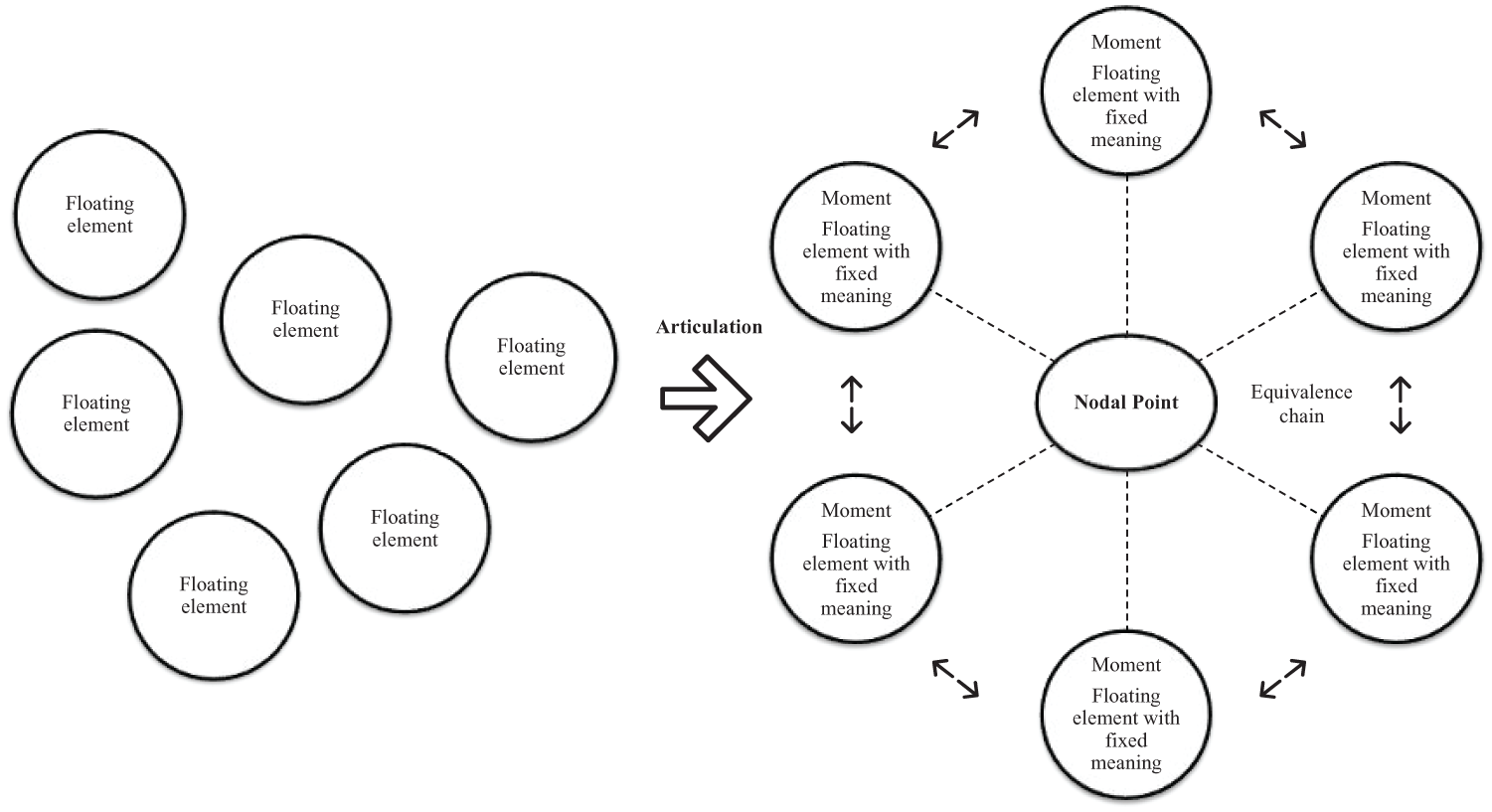
The process of articulation.
Populist articulations
The MOS literature identifies “articulation” as a key category for understanding Laclau’s theory of populism (De Cleen et al., 2018; Misoczky, 2020; Yu and Wright, 2025), that moves away from traditional understanding of populism, referring to specific event or political movements (Fougère and Barthold, 2020; Giorgi and Eslen-Ziya, 2022; Hensmans and van Bommel, 2020; Yu and Wright, 2025). By “populism” Laclau does not mean “a type of movement – identifiable with either a special social base or a particular ideological orientation – but a political logic.” (Laclau, 2005a: 117). This “political logic” is a movement which succeeds in creating a unity from a diversity of demands, in and around organizations. Specifically, the meaning of populism is “not to be found in any political or ideological content entering into the description of the practices of any particular group but in a particular mode of articulation of whatever social, political or ideological contents” (Laclau, 2005b: 3). As underlined by De Cleen, Glynos and Mondon, the focus shifts from the “content” of populism (the demands formulated by populist actors, their ideology) to how it is articulated (De Cleen et al., 2018). This approach implies that, to understand the diversity of populist practices, we need to look at how populism is articulated with a diverse range of other elements (De Cleen et al., 2018).
An antagonistic logic lies at the core of populist articulations. Previous work frames populism as a discursive means of legitimizing the expression of antagonisms (Hensmans and van Bommel, 2020). According to Laclau and Mouffe, any attempt to fix meaning and establish a hegemonic social or political order is inevitably partial, as complete closure is unattainable (Laclau and Mouffe, 2014). Such attempts are always accompanied by struggle, antagonism, and the drawing of discursive frontiers. Antagonism, in this context, reinforces a sense of moral superiority of one community over others. Agonistic populism, in particular, mobilizes these antagonisms to forge chains of equivalence that delineate a political frontier, constructing an “us” of “the people” in opposition to a “them” identified with a dominant hegemonic bloc (Hensmans and van Bommel, 2020; van Bommel and Spicer, 2011).
Hegemonic articulations
“Hegemony as discourse” is one of the most widespread uses of hegemony in organization studies. Most of these studies draw on critical discourse analysis, with a particular focus on the role of discourse in shaping power relations, often grounded in the theoretical framework of Laclau and Mouffe (e.g. Islam et al., 2022; Josefsson and Blomberg, 2020; van Bommel and Spicer, 2011). Laclau and Mouffe’s Hegemony and Socialist Strategy builds on The Gramscian Watershed (Laclau and Mouffe, 2014: 65–71) to provide a key contribution to the social theory of hegemony (Contu and Willmott, 2006; Lok and Willmott, 2014; Zueva and Fairbrass, 2021). With them, hegemony becomes a discursive practice intimately linked to articulations.
A consensual logic lies at the core of these hegemonic articulations. For Gramsci, often regarded as the foundational thinker on hegemony (Bates, 1975; Daldal, 2014; Fontana, 2006), hegemony refers primarily to a power structure in which individual consent is orchestrated. It is conceived as an organic synthesis of various elements grounded in an ideology capable of generating adherence (Gramsci, 1985: 161). Hegemonic practices do not rely on overt coercion; rather, they operate subtly and persistently, “lulling” individuals into perceiving these practices as natural and legitimate, while simultaneously reinforcing discursive and material structures that privilege one group over others especially in the decisive nucleus of economic activity (Gramsci, 1985; Hatch and Cunliffe, 2013).
Hegemony is an “opinion-moulding activity” (Morton, 2007: 113) and discourse is seen as central in building consensus, the processes of “naturalization,” and the construction of “common sense.” The ability of dominant groups to maintain hegemony over others is tied to their ability to influence the scope and flow of discourse (Fernando and Prasad, 2019). Hegemony encompasses the ability to fix a particular meaning temporarily, while excluding alternative meanings in a dialectic of inclusion and exclusion (Dey et al., 2016). For example, in Laclau and Mouffe’s perspective, “empty signifiers” are discursive elements that, while lacking a fixed meaning, can be strategically employed to unify disparate demands, obscure social antagonisms, and help establish a particular discourse as hegemonic (Islam et al., 2022; Kenny and Scriver, 2012; Zueva and Fairbrass, 2021).
Having completed my first objective, which was to theoretically reinscribe populist rhetoric within the broader discursive contestation surrounding expertise while uncovering on the logics that structure this struggle, I now turn to the empirical dimension of my study. I draw on this theoretical background to analyze how these discursive logics take shape in practice. Specifically, I offer a micro-level analysis of contemporary articulatory practices, presumed to be hegemonic, through which business experts construct and negotiate their discourse of expertise.
Uncovering discursive logics in business experts’ practices: Research context, data collection and analysis
The case of consultants: Navigating unsettled foundations of business expertise
My empirical study focuses on consultants. On the one hand, consultants can be perceived as technical experts, focused on diagnosis and problem-solving, able to heal the organizations in which they provide their services (functionalist approach, e.g. Schein, 1978). On the other hand, consultants are sometimes portrayed as charlatans and management consulting as a largely symbolic activity (critical approach). The criticisms are numerous: consultants are seen as zealous and unethical rationalizers, neo-imperialist ideologues or a waste of resources to legitimize existing ideas and plans (Sturdy, 2009). Consultants are also seen as promoters of new management fads (Abrahamson, 1991, 1996; Sturdy, 2009; Fache and Zerbib, 2020). They have been portrayed as “gurus” (Canato and Giangreco, 2011; Clark and Salaman, 1996, 1998; Wright and Kitay, 2004) involved in a process of commodification of knowledge (Heusinkveld and Benders, 2005). The profession has had an influence in the field of ideas and this has been widely explored (Kipping and Clark, 2012; O’Mahoney and Sturdy, 2016). Consulting is often seen as a sector that disseminates ideas and even produces ways of thinking (Van den Bosch et al., 2005). Research also observed consultants’ ability to leverage their expertise in their appropriation of “new” subjects. For example, Brès and Gond (2014) use the corporate social responsibility (CSR) consulting market in Quebec to show how the hand of management consultants is “visible” in the process of creating “virtue markets,” in the context of the CSR revival. The consensus leans toward the view that consultants are emblematic of experts who “lack a stable basis for expertise compared to more established professions” and may “compensate for their lack of a basis for expertise with skillful communicative performances in order to enact themselves as experts” (Heimstädt et al., 2024: 41). This makes them a particularly relevant subject of observation, given my discursive approach and its focus on practices.
Research setting and background
To observe the discursive practices—presumed to be hegemonic—through which business experts shape their expertise, it was necessary to identify a setting where such practices are actively deployed. As consultants are key players in the (discursive) popularization of business-related ideas and fashions in the spaces between organizational practices and management and education (Wright, 2019: 152), I conducted my research in a business school in France, hereafter referred to as “FrenchBS.” Internationally-recognized in rankings, FrenchBS is best-known for its most prestigious program—the Master in Management, within which my fieldwork took place. Graduates’ employment prospects are closely linked to consulting (approximatively one third of the students enter the sector after graduation). FrenchBS graduates from the Master in Management program are targeted by the most prestigious consulting firms. This setting offered a site where the reproduction of business expertise is actively secured.
The academic and media context deserves a quick note. I offer a behind-the-scenes view of the performative spectacle of expertise (Preda, 2023), examined within one of its strongholds but also against the backdrop of growing contestation.
The relationship is organic between business schools and consulting firms, and it is common to refer to a “blurring of boundaries” between them (Engwall, 2012). Consulting is also one of the most highly sought-after careers among business school graduates (Armbrüster, 2006; Binder et al., 2016; Gebreiter, 2019; Kipping and Armbrüster, 1999) and the business school a strategic environment for consultants to reproduce their expertise. Business schools play a key role in the development of management consultants’ education (Alvesson and Robertson, 2006) by offering a growing number of study programs, and consultants may be involved in designing these programs (Engwall and Kipping, 2006; Schmidt and Richter, 2006; Thompson, 2018). Yet, academia is also an environment where the influence of consultants is contested (Wright, 2019: 153). For example, consulting firms have recently been seen as using COVID-19 as “a pretext to transform universities and business school education” (Fleming, 2022).
The French media context between 2020 and 2022, the period during which this study was conducted, is also worth noting. In March 2022, French senators published a report denouncing the “tentacular” influence of consultancy firms on the state, particularly in the design and implementation of public policies. This report reignited long-standing debates, which had resurfaced during the COVID-19 crisis, about the role of consultants in public management and society. COVID-19 served as a catalyst for renewed criticism of the close ties between the state and consulting firms. Throughout the pandemic, a range of concerns was raised by the media, elected officials, researchers, and the general public regarding the use of consultants in crisis management and, more broadly, their social legitimacy and mandate.
Data collection
The overall aim of this study was to identify consultants’ discursive practices and analyze them through a critical discourse lens. My objective was to gain insight into how consultants imply or construct their status as experts, and to examine the emergent patterns in their discourse within the context described. The goal was to provide an in-depth understanding of the discursive strategies used in this setting.
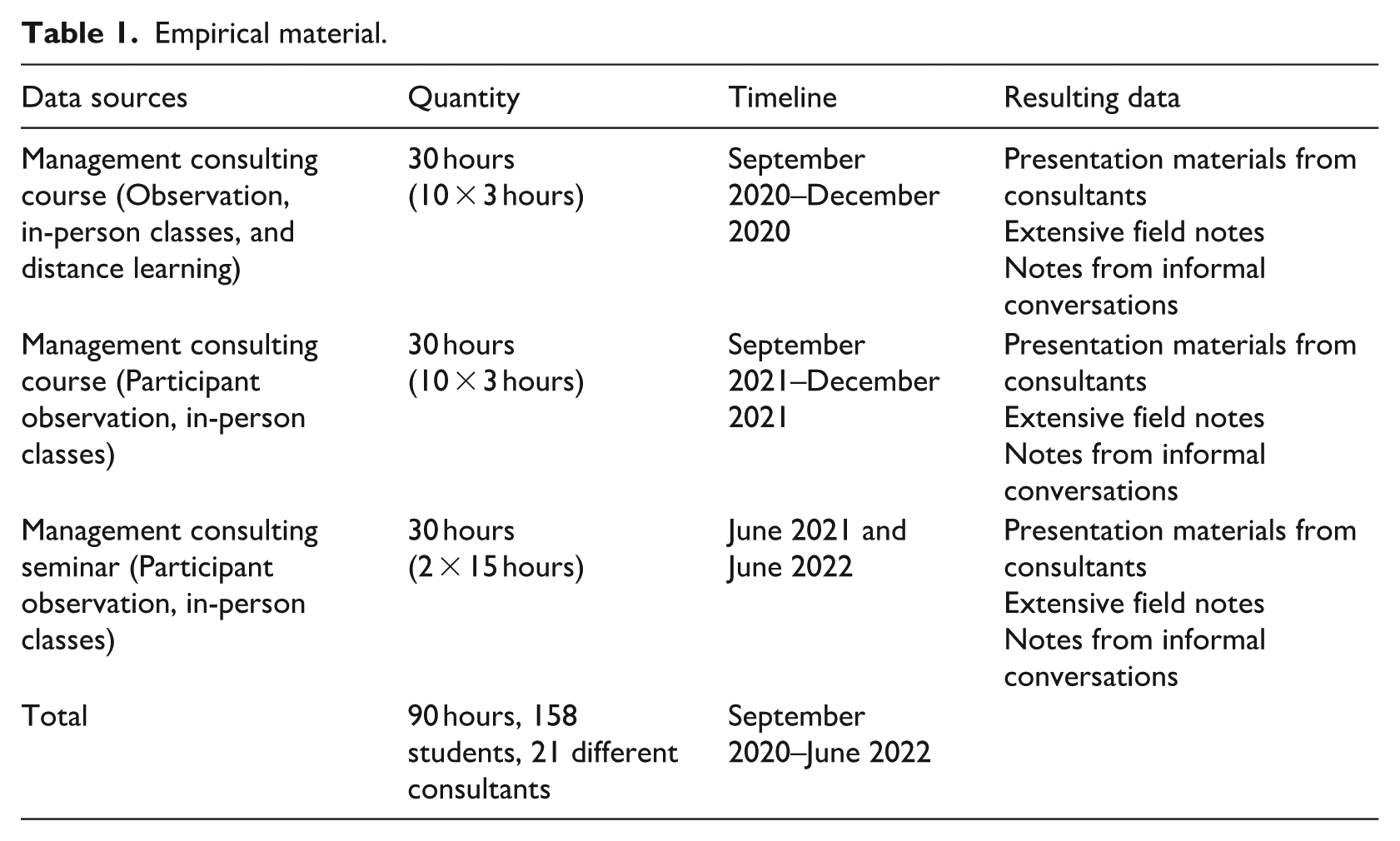
The data analyzed in this study are taken from my observation of consultants’ talks given in an elective program in management and organization consulting at FrenchBS. The classes observed were part of 3-hour modules taught once a week, or on two full seminar days. Adopting an observer perspective, I started to gather data in September 2020. Teaching staff, consultants, and students were always informed of my research activity at the beginning of the program. I therefore had complete access to the classes (direct observation, syllabus, materials, etc.), and combined archival data with observations. My data set is mainly composed of the following:
−
−
Following the principle of saturation, I ended my observations in June 2022. In total, the data represents 90 hours of talks given by 21 consultants, involving more than a hundred students (see Table 1). I have ensured that the firms and consultants involved remain entirely anonymous, and that the confidentiality of information and documents has been maintained. All data used in this study has been duly anonymized.
Empirical material.
Data analysis
My analysis was grounded in an analytical approach focused on practices and mechanisms (Zilber and Meyer, 2022). More specifically, my unit of analysis is related to micro discursive processes which reflect consultants’ practices to shape discourses.
The first stage of the analysis took place during data collection. I observed consultants, noting their speech, the questions exchanged, and key interactions. My initial focus was on gaining interpretive insight and developing an understanding of the consultants’ discourse in context. At this stage, the first substantive elements began to emerge, which were then collected, noted, and segmented for further analysis. The diffusion of ideas by consultants to tackle social and environmental issues (Wright, 2019: 153) became apparent. Far from confining their aspirations to the provision of consulting services, consultants embraced other issues. The analysis of this discourse revealed a strong emphasis on “ecological” and “social” questions, co-existing with the “business-as-usual” discourses on expertise.
I then focused on how the discourses were delivered. This involved exposing tacit and explicit practices in the discourse used in my setting and revealing the ways particular practices become dominant. This is where the concept of articulation became clearly relevant, particularly in relation to “micro-insertion,” understood as the small-scale insertion of discursive elements into a chain of equivalence. My initial focus was on the articulations between business and management expertise and ecological and social concerns, specifically on how consultants construct links between these different elements. I then turned to a closer examination of how various elements were inserted into equivalential chains and how these articulations were implemented in practice. The key elements of articulatory practices, as developed in the theoretical framework above, were used to structure the data (Poroli and Cooren, 2024).
This was followed by a third step, in which I engaged in a critical interpretation of how consultants performed discursive work in relation to expertise. I revisited the data, interpreting specific situations and exploring patterns, which eventually led to the identification of distinct types of articulations. This process culminated in the writing of three vignettes that illustrate the key insights of my analysis. Vignettes are a well-established method for conveying empirically grounded accounts of situated complexity. They are typically based on fieldnotes written during the events and may also draw from sources such as diaries, free writing, self-introspection, and interactive introspection (Barter and Renold, 1999; Erickson, 1985; Reedy et al., 2016; Smith, 1999). They are typically short, hypothetical narratives used to explore participants’ perceptions, beliefs, and responses to specific situations, often simulating real-world contexts. In line with my aim to shift the focus away from the validity or content of expertise claims and toward their underlying discursive logics, I used vignettes to highlight discursive processes and patterns rather than to offer detailed empirical descriptions of consultants’ claims. These vignettes are best understood as written analytical narratives, accompanied by visual representations, designed to illustrate discursive processes before evoking a sense of situated reality. The vignettes were selected for illustrative purposes (Slager et al., 2024), particularly to illuminate the unfolding of each discursive practice rather than the substance of the discourse itself, which is only briefly referenced.
Three discursive practices articulating business expertise
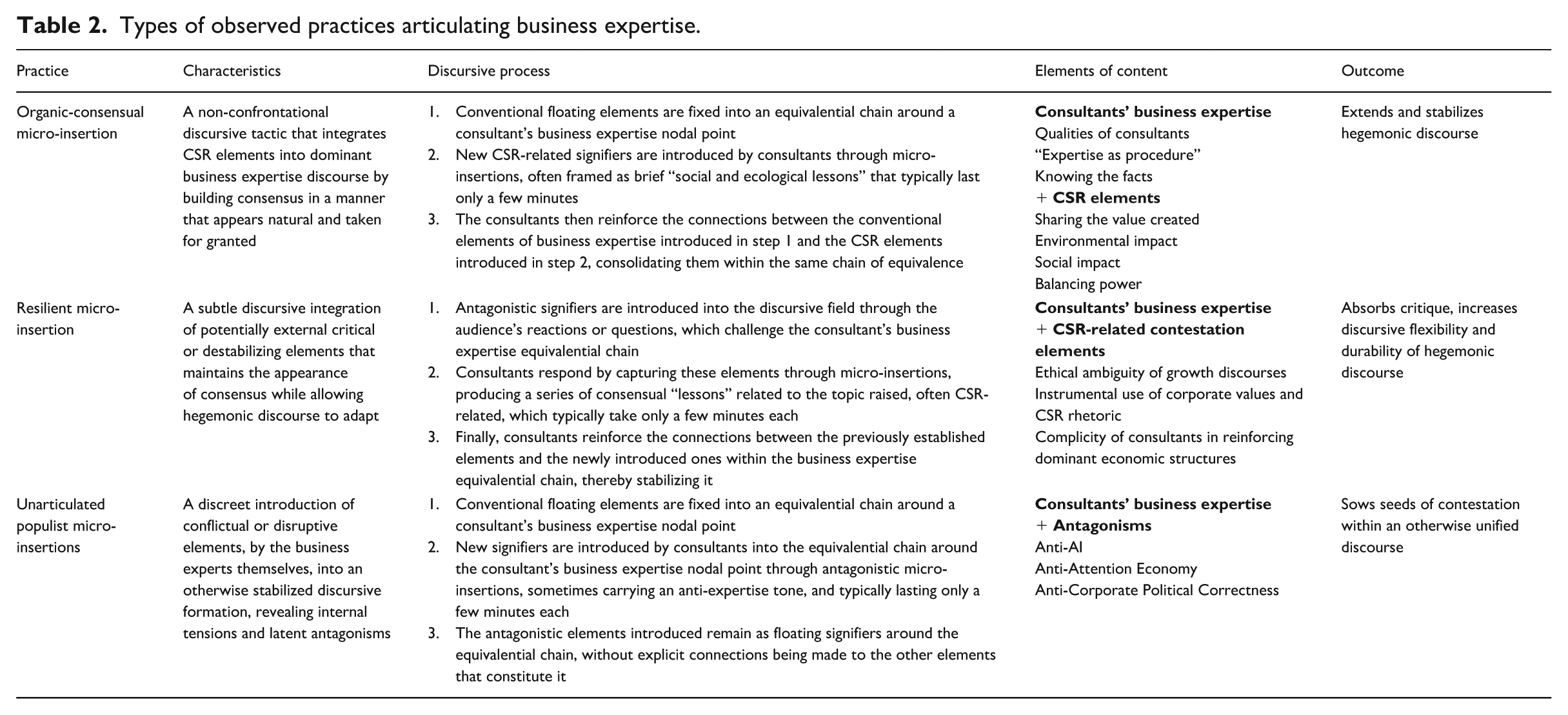
In unpacking my findings, I present three vignettes to illustrate the distinct discursive micro-level practices that emerged from the analysis: Organic-Consensual Micro-Insertion, Resilient-Consensual Micro-Insertion, and Unarticulated Populist Micro-Insertions. Each vignette is structured as follows: I begin by outlining the general characteristics of the practice, then provide a brief summary of the emerging discursive pattern, and conclude with a more detailed description of its key stages. Vignette 1 illustrates a discreet discursive move in which CSR elements are introduced through micro-insertions, understood as small-scale incorporations of discursive elements into a chain of equivalence, within a dominant discourse centered on consultants’ business expertise. Vignette 2 presents a discursive strategy that integrates minor social and ecological critiques into the dominant discourse in a way that preserves overall consensus. Finally, and quite distinctively, Vignette 3 highlights the subtle use of populist-like micro-insertions, which introduce latent antagonisms sometimes regarding expertise, into an otherwise consensual discourse without openly disrupting it. The identified practices and their main characteristics are summarized in Table 2.
Types of observed practices articulating business expertise.
Vignette 1. Organic-consensual micro-insertion
The first practice, Organic-Consensual Micro-Insertion, is a subtle and non-confrontational discursive tactic that integrates CSR elements into dominant business expertise discourse. It represents a discursive mechanism through which CSR elements, which could otherwise introduce tension with consultants’ business expertise, are incorporated into a chain of equivalence in a way that seems spontaneous. These insertions are “organic” in the sense that they simulate a common-sense extension of the prevailing discursive order and “consensual” because they rely on structures that avoid overt antagonism. By organically integrating new signifiers without disruption, these micro-insertions help expand and reinforce a hegemonic discourse around business expertise.
This practice is characterized by the following pattern (see Figure 2):
Conventional floating elements are fixed into an equivalential chain around a consultant’s business expertise nodal point.
New CSR-related signifiers are introduced by consultants through micro-insertions, often framed as brief “social and ecological lessons” that typically last only a few minutes.
The consultants then reinforce the connections between the conventional elements of business expertise introduced in step 1 and the CSR elements introduced in step 2, consolidating them within the same chain of equivalence.
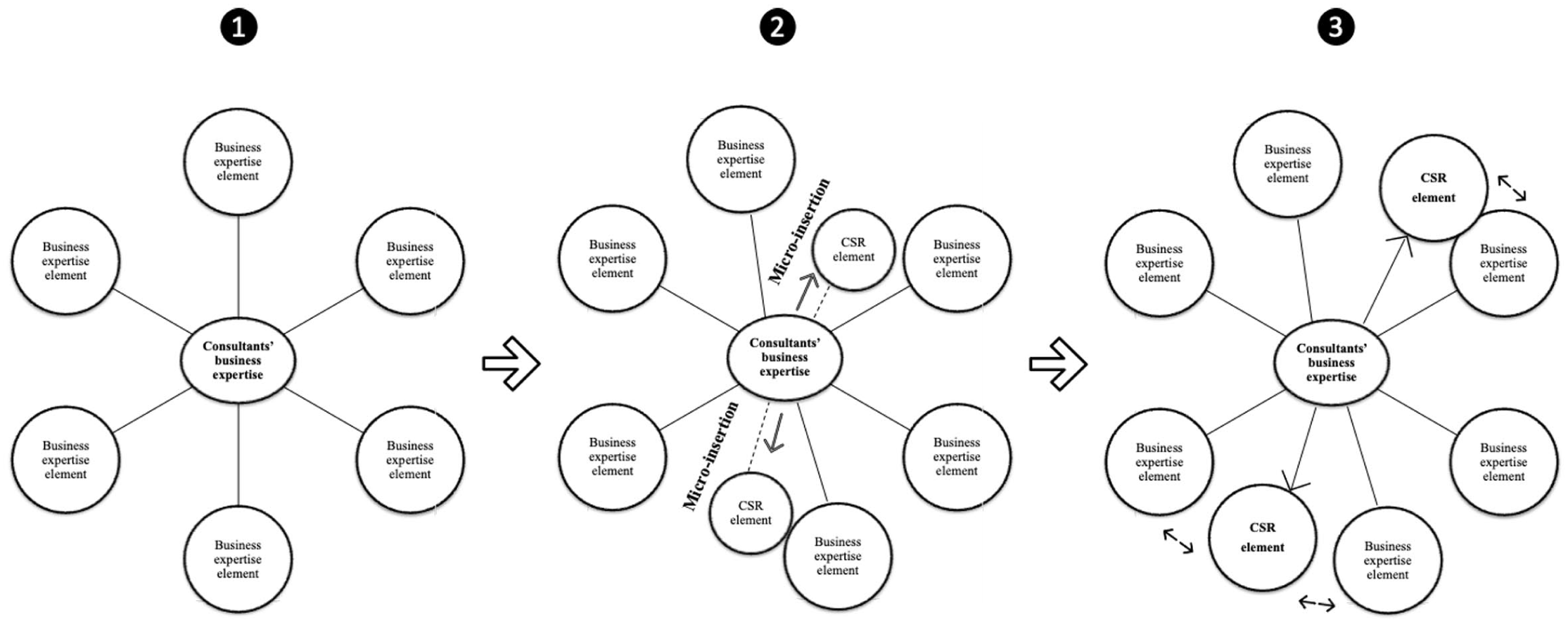
Organic-consensual micro-insertion practice.
Step 1. Conventional floating elements are fixed into an equivalential chain around a consultant’s business expertise nodal point
The first step involves the construction of a familiar discursive structure designed to generate adherence to the operating methods of consultancy firms, including their practices, recruitment processes, and the formal and informal rules that legitimize the expertise they claim to offer.
This begins with the promotion of consultants’ qualities, portraying them as analytical and creative, well-organized, results-oriented, good listeners, and highly motivated individuals with the ability to work collaboratively and build strong relationships with both colleagues and clients. Leveraging one’s experience at a prestigious consultancy is one of the arguments that crops up quite naturally: such a business experience is considered to act as an accelerator of careers, and consultants emphasize this fact.
Secondly, a conception of expertise as procedure also appears to predominate among consultants, who regularly emphasize their methodological mastery as a key marker of their business expertise. This procedural framing shifts attention away from definitive answers or content knowledge and toward the ability to apply structured approaches to complex problems. For example, as part of their training, students are required to work on several case studies specifically designed to assess their analytical and problem-solving skills. Within this context, consultants frequently stress the value of method over outcome, often stating that “the approach is more important than the answer.” Such statements reinforce the idea that expertise is how one thinks and proceeds, thereby positioning procedural competence as central to the discourse of business expertise.
Thirdly, this form of expertise involves a claim to knowing the facts. Consultants often present fictitious business cases that are based on real, albeit simplified, versions of past assignments they have carried out. These cases function as a key element in the consultant’s discourse, serving as microcosms of actual consulting work. They are designed to simulate the kinds of challenges consultants face and to test the same competencies required during real assignments. While the cases presented to students are streamlined for pedagogical purposes, the consultant typically emphasizes that the real-life situations they encounter are far more complex. Their hands-on engagement with concrete business realities is presented as evidence of superior, experience-based business knowledge, reinforcing their claim to expert authority.
This form of expertise is also made visible through the shared use of a common language. The lectures are frequently peppered with English-language business jargon, despite the course being conducted primarily in French. This use of jargon not only signals familiarity with global business norms but also functions as a marker of expertise. Interestingly, the consultants themselves often express amusement at this vocabulary and acknowledge the occasional need for translation or explanation in the French-speaking context.
Step 2. New CSR-related signifiers are introduced by consultants through micro-insertions, often framed as brief “social and ecological lessons” that typically last only a few minutes
My analysis of this practice revealed a subtle emphasis on ecological and social demands, coexisting with the dominant business-as-usual discourse. Environmental and social awareness is regularly micro-inserted into the consultants’ discourse. These micro-insertions can be grouped into several themes that can be considered as “empty signifiers” that is, discursive elements with no fixed meaning, used to unify different ideas under a shared but flexible label.
Sharing the value created requires an ethical financial strategy based on fair and transparent management practices, equitable remuneration aligned with the value generated, guarantees regarding working conditions and job security, and efforts to develop employees’ employability.
Environmental impact calls for a genuine transition in terms of eco-consumption and eco-driving within companies and among its stakeholders, including more eco-designed products, reduced greenhouse gas emissions, less packaging, relocation of activities, regionalization of the economy, and increased use of teleworking.
Social impact refers to the firm’s societal role within its core business, both internally, in relation to its employees, and externally. This includes the ability to create or maintain jobs, the development of products and services for vulnerable populations (such as those affected by precariousness, disability, or aging), and the promotion of a more balanced human-machine interaction to support more human-centered relationships.
Balancing power involves new forms of management based on the principle of more ethical governance. This includes transparency in decision-making, gender and hierarchical parity within decision-making bodies, integration of the company into its local ecosystem with the aim of strengthening its local presence, repatriation of activities considered essential or strategic for the company and society, and alignment between values and managerial practices.
Step 3. Strengthening connections between consultant’s business expertise conventional elements and new CSR-related elements
The micro-inserted themes are often linked to the consultant’s job, career, and elements of their expertise. Ecological and social concerns sometimes lead consultants to refuse certain assignments, for example, stating, “We wouldn’t work for the tobacco industry” and more broadly, to emphasize their commitment to ethical issues within the firm. One manager, for instance, highlights that “the firm has an ethics committee.” This engagement is also reflected in the consultants’ promotion of internal initiatives addressing key sustainability and green transition issues, ranging from environmentally friendly technologies to animal welfare. These discourses may translate into real-world practices; for example, one firm has replaced company cars with bicycles. This is accompanied by a more conventional discourse on diversity, framed around creating the best possible work environment in which everyone can thrive. The emphasis is placed on promoting social inclusion, gender equality, support for the LGBTQ community, and diversity both within firms and among clients and society at large.
Vignette 2. Resilient-consensual micro-insertion
The second practice is Resilient-Consensual Micro-Insertion. This refers to a discursive strategy through which elements that could be antagonistic or destabilizing to the dominant hegemonic articulation of consultants’ business expertise are incorporated in a way that preserves the appearance of consensus. These insertions are resilient in the sense that they enable the existing hegemonic articulation to absorb critique without rupture. They are consensual because they rely on signifiers that encourage agreement rather than antagonism. These micro-insertions function as tactical moments of re-articulation that preserve the chain of equivalence and stabilize business expertise hegemony through discursive elasticity. In this practice, discourse and commentary operate in a cycle of mutual reinforcement.
This practice is characterized by the following pattern (see Figure 3):
Antagonistic signifiers are introduced into the discursive field through the audience’s reactions or questions, which challenge the consultant’s business expertise equivalential chain.
Consultants respond by capturing these elements through micro-insertions, producing a series of consensual “lessons” related to the topic raised, often CSR-related, which typically take only a few minutes each.
Finally, consultants reinforce the connections between the previously established elements and the newly introduced ones within the business expertise equivalential chain, thereby stabilizing it.
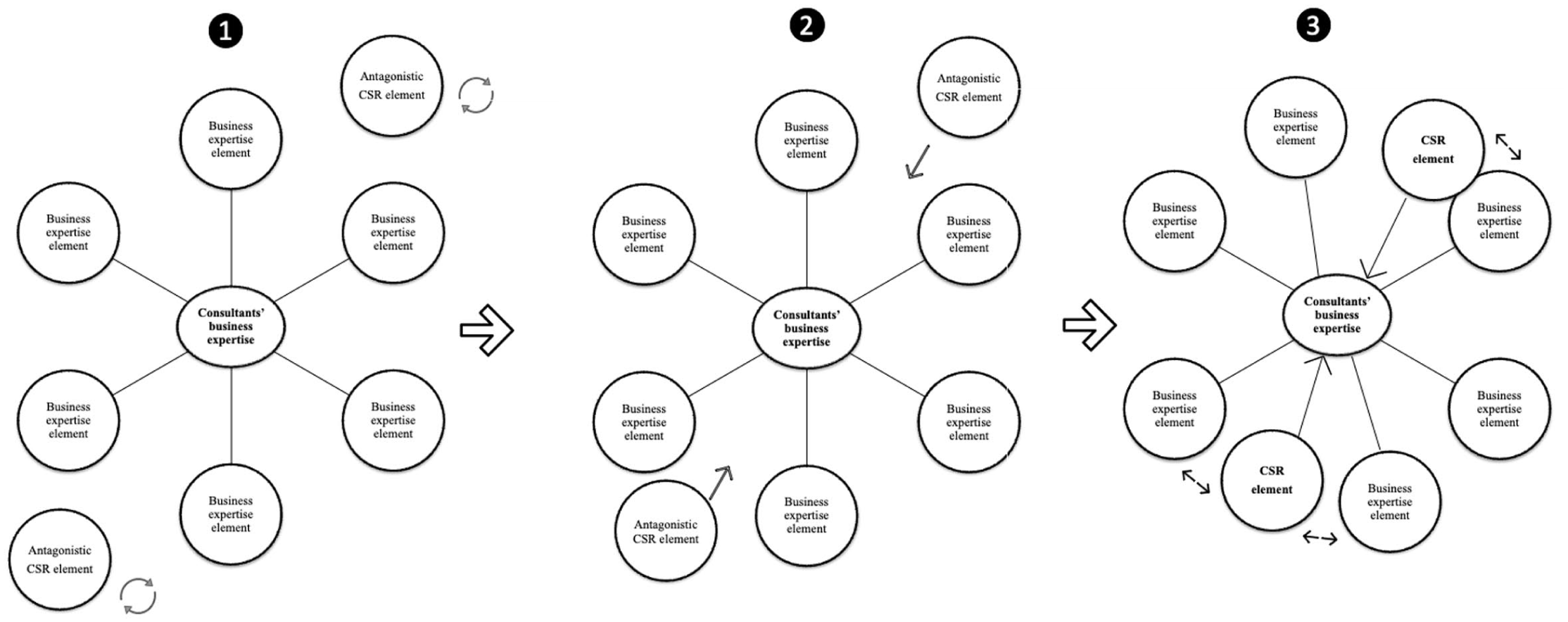
Resilient micro insertion articulatory practice.
Step 1. Antagonistic, CSR-related signifiers are introduced into the discursive field through the audience’s reactions or questions that challenge the consultant’s business expertise equivalential chain
Typically, the speaker begins with a conventional discourse on consulting and the expertise associated with it, drawing on the arguments outlined in the previous practice: the intrinsic qualities of the consultant, mastery of method, and command of the facts. This reproduction of a consensual discourse is punctuated by subtle yet consequential moments of critique. Students express skepticism, allowing consultants to acknowledge and defuse the criticisms. These interventions rarely reject the consultant’s authority outright but instead pose internal challenges to the coherence, legitimacy, or ideological underpinnings of expert discourse.
Such critiques often revolve around three recurring themes: the ethical ambiguity of growth and innovation discourses; the instrumental use of corporate values and CSR rhetoric; and the broader complicity of consultants in reinforcing dominant economic structures. In the context of this study, discursive challenges are not voiced from a radical exterior but from within a business elite. As such, they present a latent antagonism that experts must navigate carefully—prompting subtle but strategic efforts to reintegrate critique into a rearticulated consensual order.
For example, in an observed interaction between a consultant and business students, a moment of discursive tension emerges when a student challenges the coherence between the consultant’s discourse of “reinvention” and the material reality of consulting work. The student critiques the growth-oriented logic underlying the consultant’s example and frames it as emblematic of consulting’s complicity in sustaining extractive capitalist practices. This intervention momentarily introduces an antagonism between market-driven optimization and post-growth ideals. The critique operates through a populist, anti-business expertise rhetorical move, constructing an opposition between the student’s demand for systemic transformation and the consultant’s perceived role in legitimizing and sustaining the existing economic order.
Step 2. Consultants capture these elements through responsive micro-insertions, producing a series of consensual “lessons” related to the topic raised, each typically lasting only a few minutes
Consultants often operate within a discursive terrain that appears apolitical, built on the assumption that social and economic issues can be addressed through technical rationality, innovation, and value-driven leadership. When confronted with critical questions that expose contradictions, such as the tension between sustainability and growth, or between inclusivity and instrumentalization, the apparent neutrality of expert discourse is momentarily disrupted. To preserve their discursive structure, consultants frequently deploy localized rearticulations that absorb critique while reconfiguring its meaning to align with dominant logics. These insertions do not resolve the antagonism; rather, they defer it by moralizing growth, rebranding optimization as responsibility, and positioning consultants as mediators of social good.
Returning to the previous example, rather than rejecting the critique outright, the consultant acknowledges the operational challenges raised but reframes the discourse within a consensual logic. The key antagonistic signifier, “growth” is immediately rearticulated as “responsible growth” enriched with affectively charged signifiers such as “social and environmental value” and the “triple bottom line” (these can, again, be considered as “empty signifiers”). This reframing neutralizes the critique by expanding the meaning of economic growth to include progressive aspirations. In doing so, it maintains the hegemonic economic logic while incorporating the language of critique.
Step 3. Consultants strengthen the connections between business expertise elements and newly introduced ones in the equivalential chain to stabilize it
The response further mobilizes hybrid discursive elements such as “cooperative models” and “stakeholder participation” suggesting that consulting is not merely reinforcing capitalist efficiency but is instead facilitating more inclusive and sustainable forms of value creation.
An illustrative example is the notion of a desirable economy, which functions as an empty signifier introduced by a consultant to suggest that a new form of capitalism is possible, one that combines performance with the common good, and development with well-being. This ambitious and demanding transformation is framed as desirable for society. It also requires a transformation in responsibility, which is described as “ambitious and difficult” yet necessary for firms, for society and for “mankind.” This vision calls into question the very raison d’être of corporations and demands exemplary behavior from individuals, alongside a corporate contribution to the “harmonious development of society” and its long-term sustainability.
Moreover, the situation is presented as generating new skills, knowledge, and strategic areas, thereby becoming a driver of sustainable performance. The modern firm is described as entering “a new chapter in its history.” Once viewed solely as a source of progress and growth, the firm is now seen as partly responsible for today’s “social and environmental upheavals” and thus can no longer act in isolation. Its greatest challenge is framed as transforming its model to meet the realities of the current century, in other words, to “reconcile performance and the common good.” The consulting industry, in turn, is positioned as developing the skills necessary for this transformation while also “bringing meaning.”
Here, the consultant accentuates a dual move: absorbing the language of systemic critique while reasserting the legitimacy of business expertise as a facilitator of change. This maneuver culminates in a self-legitimating closure, in which consulting is positioned as a central actor in the transformation toward CSR, effectively embedding critique within an acceptable hegemonic articulation.
Vignette 3. Unarticulated populist micro-insertions
The last practice, Unarticulated Populist Micro-Insertions, refers to a discursive operation in which antagonistic elements are introduced into an otherwise hegemonic articulation around consultants’ business expertise. These micro-insertions do not overtly disrupt the dominant discourse but, as subtle reactivations of antagonism, introduce traces of ambiguity or dissent that signal their populist character. They expose the discursive field to potential rearticulation, without immediately undermining its unity or stability.
The practice is characterized by the following process (see Figure 4 for illustration):
Conventional floating elements are fixed into an equivalential chain around a consultant’s business expertise nodal point.
New signifiers are introduced by consultants into the equivalential chain around the consultant’s business expertise nodal point through antagonistic micro-insertions, sometimes carrying an anti-expertise tone, and typically lasting only a few minutes each.
The antagonistic elements introduced remain as floating signifiers around the equivalential chain, without explicit connections being made to the other elements that constitute it.
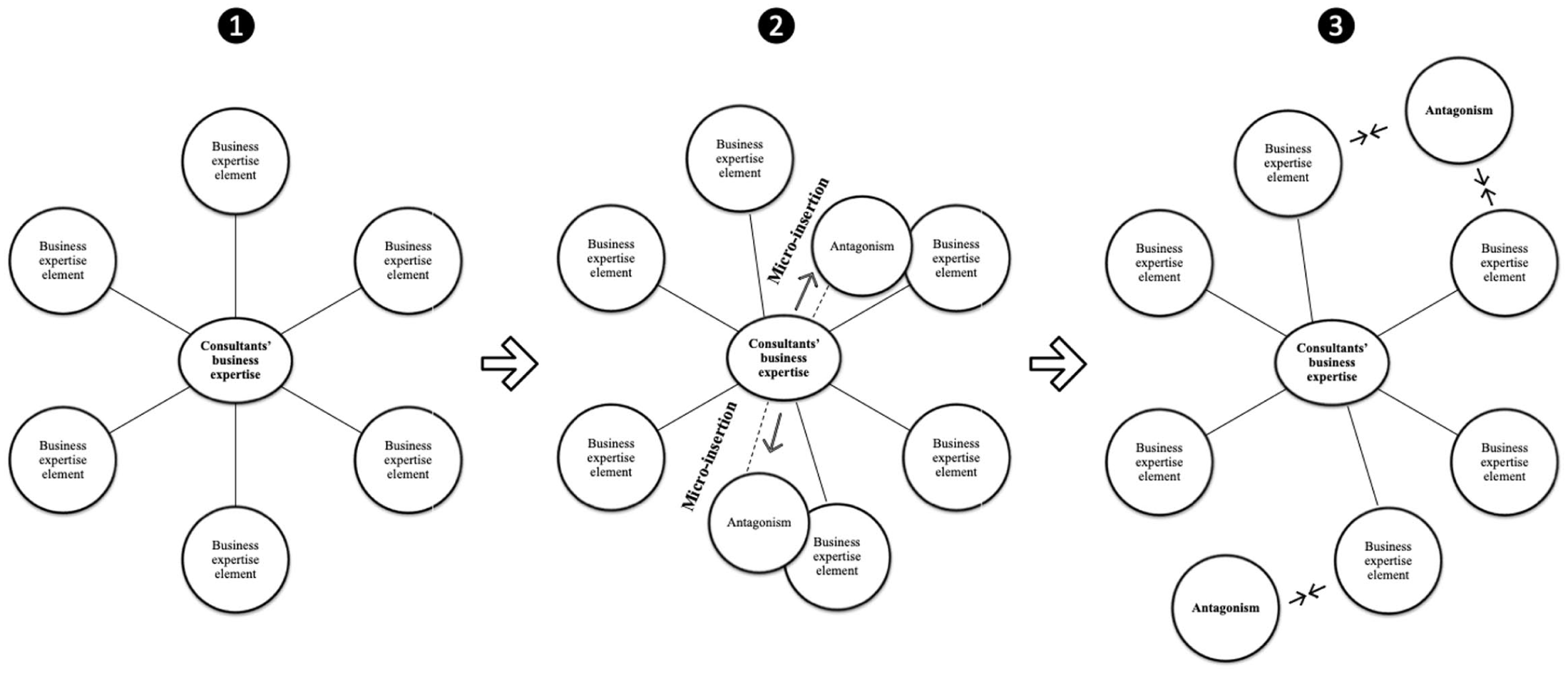
Unarticulated populist micro-insertions.
Step 1. Conventional floating elements are fixed into an equivalential chain around a consultant’s business expertise nodal point
As with the other two practices, the consultants define the main areas of expertise they associate with consulting.
Step 2. Antagonistic elements are organically introduced by consultants through “micro insertions”
This practice reveals a subtle emphasis on several antagonisms, regularly micro-inserted into consultants’ discourse and coexisting with the dominant “business-as-usual” discourses surrounding their expertise. These micro-insertions can be grouped into several themes. The first two relate to a broader anti-tech discourse, while the third carries a more overtly political tone.
Anti-AI
Consultants occasionally introduce skeptical framings of artificial intelligence, not only from a technical standpoint but also through existential and ethical concerns. AI is portrayed as a system that, in its pursuit of prediction and optimization, risks undermining core human qualities such as spontaneity, emotion, and critical thinking. This theme positions AI not merely as a technological tool but as a potential threat to human subjectivity, evoking a populist logic that contrasts an essentialized human nature with an abstract technological force.
Anti-attention economy
A second recurring theme targets the attention economy. While acknowledging the need to capture consumer attention, some consultants adopt a critical stance toward the saturation and fragmentation of the digital environment. Attention is described as being “shredded” by constant notifications, and the media landscape is referred to as an “ocean of noise.” These metaphors reframe digital engagement as cognitively exploitative, subtly positioning users as victims of systemic overstimulation. Although these critiques remain situated within a market-oriented discourse, they open space for latent antagonism toward platform capitalism and tech giants.
Anti-corporate political correctness
A third type of micro-insertion critiques the gap between corporate values and actual practice. Consultants point to the instrumentalization of values such as benevolence, diversity, or sustainability, suggesting they are often employed more for branding purposes than for genuine ethical commitment. The use of terms like “greenwashing” signals a growing distrust of corporate virtue signaling, particularly when such discourses lack operational credibility. This critique implies that business experts may speak the language of ethics without practicing it, reinforcing a subtle populist tension between political correctness and lived reality.
Step 3 Antagonistic elements are floating around the equivalential chain without connections explicitly made between other elements constituting it
This practice is marked by a lack of articulation between the antagonistic elements introduced and the broader equivalential chain structured around consultants’ business expertise. These antagonistic signifiers—critiques of AI, attention capitalism, or corporate virtue-signaling—remain discursively isolated, orbiting the nodal point without being directly linked to one another or to the dominant chain’s conventional elements. The antagonisms evoked—between “real people” and “machines,” between “common sense” and “ideological posturing,” between “authentic ethics” and “corporate branding”—all echo populist logic, yet they are left underdeveloped and unlinked. There is no formal chain of equivalence connecting AI critique to CSR skepticism, nor are these tied to a broader political project. Instead, they float within the discursive field as isolated and organic signals of discontent, antagonistic empty signifiers and unarticulated. This non-articulation prevents these elements from coalescing into a full-fledged counter-hegemonic articulation capable of challenging the coherence of the dominant discourse. These micro-insertions do not function as overt ruptures but rather as small disruptions that momentarily unsettle the internal logic of hegemonic business expertise discourse. Yet they are far from trivial: they introduce antagonistic logics into a discourse that typically works to depoliticize or technocratize complex social issues.
Discussion
Based on my study, I make two contributions. The first is to advance a critical understanding of expertise as discourse by theoretically reinscribing current populist rhetoric within a broader hegemonic debate, thereby offering a discursive perspective on recent research into the entanglements between populism and elitism, using expertise as a connecting lens. The second contribution is to empirically enrich our understanding of hegemony-in-practice and the various discursive tactics employed by business experts today. This analysis reveals how latent antagonisms are introduced through micro-insertions and points to a deeper ambivalence among business experts, who both produce and subtly contest hegemonic articulations of expertise. In this section, I elaborate on these contributions before offering some concluding reflections.
From contemporary to enduring debates: A critical discursive approach to expertise
Reinscribing populist rhetoric in the hegemonic struggle
To the best of my knowledge, no article in MOS journals has engaged with the topic of experts and expertise starting from the populist rhetoric and reinscribing it in a long-standing debate around expertise. Populism is still mostly used in political matters, often tied to political categories from radical left to far right, or from progressive to regressive (Kerr et al., 2024; Masood and Nisar, 2020), although with a growing organizational focus (Fougère and Barthold, 2020; Hensmans and van Bommel, 2020; Robinson and Bristow, 2020). Theoretically, as a deeper understanding of populism is still developing within MOS, this article takes a specific discursive standpoint. “To measure populism ‘in practice’, i.e., beyond rhetoric, (. . .)” (Blake et al., 2024: 552), I do not give up on discourse theory, but try to push it further.
I thus frame populist articulations as part of an ongoing discursive process composed of multiple antagonisms, with anti-expertise being one of them (Sunnercrantz, 2024; Sunnercrantz and Yildirim, 2022). Beginning with contemporary populist rhetoric is not a mere detour, but a way to reinscribe it within a broader hegemonic struggle around expertise. Populist rhetoric emerges as a response to consensual, pro-expertise hegemonic articulations. The study of populism is therefore inseparable from the study of a particular form of hegemony, one that is organically related to it through a patterned dynamic of responses.
Rather than offering a strict analysis of “counter-populism,” this study is best understood as a theoretical effort to grasp hegemony as both a parallel and intersecting discursive process centered on expertise, one that resonates with populist logic. Populism and hegemony can be viewed as two discourses of moral and intellectual direction: the former favors antagonistic articulations, while the latter tends toward integration and stabilization, in a dynamic interplay of competing articulatory strategies. Each is shaped in relation to the other—two sides of the same coin.
A discursive contribution to the entanglements between elitism and populism through expertise
Populist discourse frames experts as an “expression of the elite” (Giorgi and Eslen-Ziya, 2022), making the categories of elites and experts intertwined and constituted through differentiation from the popular (Sunnercrantz, 2024). Populism thus establishes a unique relational approach to expert and expertise as a result of a rhetoric that characterizes experts’ position in society. This dialectic of interpellation/identification produces a sense of collective identity by relying on an assertion of difference (De Cleen and Stavrakakis, 2017). In the populist theoretical logic of rejecting experts, consultants, the subject of my empirical study, would typically be seen as part of “the business elite” as opposed to “the people.”
Yet from my perspective, which focuses not only on discursive logics but also on practices, populism and hegemony become entangled in the ways business experts reconfigure signifiers in their discourse. Through micro-insertions, they introduce elements of antagonism, including anti-expertise critiques such as those targeting AI, the attention economy, or corporate virtue-signaling, into otherwise hegemonic articulations. At one level, such practices may seem anecdotal, functioning as an uncontrolled refrain in the day-to-day flow of discourse. At another level, however, they are significant.
They reintroduced the question of antagonism into elitist discourse on expertise, highlighting how it acknowledges, at least implicitly, the antagonistic dimension of expertise within an otherwise consensual framework. My findings illustrate the blurring of boundaries and the entanglements between populism and elitism through the discursive practices of business experts. I draw attention to the discursive battlefield shaped by these entanglements, exploring how populist elements are subtly embedded within elitist articulations of expertise. In doing so, the study contributes to ongoing discussions around concepts such as populist technocracy, elitist populism, or renewed forms of elitism and the conceptual efforts that attempt to grasp what has been described as the “populist elite paradox” (Bloom and Sancino, 2019; Mangset et al., 2019).
Business expertise from below: Studying the everyday discursive practices
Hegemony-in-practice: Uncovering micro-insertion as a discursive mode of business expertise
This study contributes to discussions of hegemony in critical organization studies by identifying separate forms of hegemonic practices (Nyberg and Wright, 2024). I specifically go beneath the surface of consensus to examine how micro-insertions sustain hegemonic discourse around business expertise. While the concept of micro-insertion has been recognized as an effective pedagogical tool in business schools, used by instructors to incorporate learning objectives such as ethics into business curricula (Slocum et al., 2014), it has not been explored as a hegemonic mechanism for tracing subtle discursive practices within expert discourse.
The practice of Organic-Consensual Micro-Insertion offers a nuanced addition to classical models of discursive hegemony. Rather than constructing overt chains of equivalence, this practice integrates signifiers into an existing hegemonic discourse in ways that appear natural and consensual. It exemplifies how hegemony can be maintained through localized insertions that preempt contestation by embedding potentially contentious elements within already accepted narratives. This micro-level operation reveals that power is exercised not only through the production of consensus but also through its organic performance. It functions as a soft form of reinforcement that sustains hegemony by diffusing tension before it becomes discursively visible. In doing so, it expands the repertoire of hegemonic practices by highlighting the techniques through which discursive stability is maintained in expert-driven contexts such as consulting.
The Resilient-Consensual Micro-Insertion exemplifies a form of discursive plasticity in which hegemonic actors absorb oppositional logics without provoking full-scale antagonism. It is “resilient” because it protects the consultant’s expertise, and “consensual” because it reconfigures critique into a moralized narrative of responsible capitalism. These moments show how business expertise maintains its hegemonic position not through direct confrontation, but by strategically incorporating and neutralizing external discursive threats. Understood as an articulatory process rooted in antagonism toward expertise, populism may serve as an incentive to stimulate discursive agility between the corporate and the social. As populist politics exploit and weaponize social grievances, firms are increasingly compelled to formulate their political and social strategies in parallel (Blake et al., 2024). The connection this study makes with the notion of discursive resilience offers a promising avenue for MOS researchers interested in analyzing how business experts respond to criticism in ways that allow them to navigate potentially more hostile environments.
In terms of content, I observed how CSR-related topics influence the micro-organization of experts’ discourse. In my findings, consultants incorporate elements with broader social meaning into the multi-faceted discursive strategies that consulting firms use to blend managerial domains of business expertise with non-managerial ideas. They explain situations to a specific audience and establish legitimacy in speaking on these particular issues (Sunnercrantz, 2017; Sunnercrantz and Yildirim, 2022). They navigate their expert role by presenting themselves as intermediaries between business and society, responding, whether consciously or not, directly or indirectly, to questions surrounding the social mandate of business expertise. This corroborate both insights from the populism-business literature focusing on Political CSR as a response of firms to mitigate populist risks talking and the visible hand of consultants in the construction of the markets for virtue (Al-Esia, et al., 2023; Brès and Gond, 2014; Zueva and Fairbrass, 2021).
How business experts mobilize antagonisms in expert discourse
Perhaps more unexpectedly, I highlight how businesses make use of antagonisms through the practice of Unarticulated Populist Micro-Insertions. This refers to subtle moments within expert discourse where populist, potentially anti-business expertise themes are introduced without being explicitly connected to the dominant hegemonic articulation. These insertions do not directly challenge the existing discourse; instead, they remain isolated and disconnected from the main chains of equivalence. In this micro-insertional mode, such antagonistic gestures remain partial, fragmented, and unarticulated into a full counter-hegemonic project. They signal potential tensions within the consensus discourse without coalescing into an alternative logic or fully articulated counter-hegemonic position. This complicates classical understandings of hegemonic formation by showing how latent antagonisms can be momentarily introduced into dominant discourses without disrupting their surface coherence. As such, this practice reveals a discursive liminal space where dissent is not suppressed but contained. Drawing on populist rhetorical logics, these gestures mobilize affect, critique, and moral contrast. In terms of content, these insertions often carry an anti-tech or anti-expertise tone, standing in contrast to the more conventional technologization discourses typically found among experts (Räisänen and Linde, 2004).
What is particularly significant in this practice is that the consultants themselves are the agents of insertion. They subtly introduce antagonistic signifiers, such as critiques of AI, the attention economy, or corporate virtue-signaling, into an otherwise consensual discourse on business expertise. These are not reactions to external critiques but self-initiated reintroductions of antagonism into their own speech acts. This can be interpreted in two complementary ways. First, as a strategic incorporation of latent dissent: by expressing sympathy with certain critiques, whether of AI, the attention economy, or CSR hypocrisy, consultants adopt a reflexive stance that may shield them from accusations of unawareness or complicity, in coherence with other uses of CSR (Blake et al., 2024; Brès and Gond, 2014; Zueva and Fairbrass, 2021). Second, these insertions may also reflect a deeper ambivalence within the subjectivity of business experts, an internal tension where the consultant both inhabits and questions the hegemonic order, navigating between the demands of expertise and a shifting political climate. These moments may serve as early signs of populist articulation, subtly destabilizing the dominant discourse from within while remaining formally embedded in it. According to the constructivist view on expertise, experts are no longer defined by who they are. My study demonstrates that they are not defined about how they speak about who they are and what they do either.
Limitations
I would like to take the opportunity to reflect on some of the limitations of this study and to address questions that may arise for readers who are less familiar with populism studies or with the paradoxes and entanglements between populism, hegemony and elitism. Throughout the writing and review process, I encountered a set of interrelated challenges concerning my overall approach, theoretical framing, and interpretation. These included the moral evaluations often associated with populism, the use of Laclau and Mouffe’s theoretical framework, and the classical issue of interpretive subjectivity.
Moral evaluation of populism
Concepts carry with them a moral evaluation that is part of their ongoing discursive construction, as is the case with populism (Barry and Elmes, 1997). Consequently, doing research on populism and hegemony as discursive activities involves engaging with and potentially transforming concepts in ways that shape individual understandings. My aim has been to adopt a neutral account of populism in my theorization, viewing it primarily as a discursive way of constructing a position against expertise. This is not a straightforward task, given the widespread and often contested use of the term “populism” in both academic and media discourse. During the writing and reviewing of this paper, I encountered my own moments of uncertainty and confusion about the concept. Ultimately, in proposing a discursive perspective, I do not intend to discredit other definitions or overlook the risks and opportunities associated with the term. If any ambiguity remains regarding my theoretical position, I take full responsibility for clarifying it.
Decontextualization
I acknowledge the traditional limitations often attributed to Laclau and Mouffe’s radical theory, such as its tendency toward decontextualization and the abstraction of the concept of “the people” in populism. This paper is clearly situated within a Western perspective on the development of expertise. At the same time, the theoretical framework itself draws on postcolonial theory, which introduces, I hope, a productive tension. By using critical theory to explore the discursive formations of business expertise, I aim to highlight both the variety of practices and the instability of the boundaries separating hegemonic and populist positions. I also recognize that the specific practices I identified, and their subtlety, may be particular to the context I studied. However, I believe that this account can serve as one example among many for identifying discursive practices in other settings.
Interpretation
As with any (critical) research endeavor, it is important to acknowledge that the researcher, as an interpretive instrument, does not claim to reveal an absolute or universal truth through their findings. In fact, I did not initially set out to develop a discursive account of populism or hegemony when entering the field. The use of vignettes in this study demonstrates how my interpretations are an interactive construction that conveys the gestures and voices of others and my interpretations are formed through the very power effects they seek to examine (Huber, 2024). While my vignettes are presented in an analytical form, they are also self-referential and non-definitive. They are “true” in the sense that they emerge from a world shaped by the exercise of power (Humphreys, 2005). This paper, by reconstructing populist and hegemonic discourses, contributes to their ongoing formation. I am fully aware of this effect and now make it explicit for the reader, should there be any doubt.
Concluding thoughts
In this paper, I proposed a theoretical and empirical exploration of contemporary logics and practices around experts and expertise. I hope it offers some (discursive) insights into the sociopolitical debate and conflict around expertise and the study of its crisis (Eyal, 2019; Heimstädt et al., 2024; Nichols, 2017; Reed and Reed, 2023). I conclude this study with some reflections on future research on expertise, followed by a final note.
Future research on expertise: Reconnecting the durable and the situated
Regarding future research on expertise, my theoretical and empirical work encourages a closer integration of constructivist and situationist perspectives. My endeavor resonates with process-based perspectives that examine how organizational actors produce hegemony over time as a bottom-up process, emphasizing the cumulative arrangement of signifying chains (Ferns and Amaeshi, 2021). By situating business experts’ practices within a broader, enduring rhetorical context and analyzing how they (re)claim expertise through micro-level discursive acts, I contribute to the intersection of constructivist and situationist perspectives on expertise through the lens of discourse theory.
Heimstädt et al. (2024) argue that both constructivist and situationist perspectives view expertise as the outcome of social action and attribution by specific audiences. The constructivist perspective assumes that such attribution is relatively durable, while the situationist perspective understands it as emerging within, and limited to, specific situations. In this paper, I examine both a durable rhetorical context for expertise and the discursive tactics business experts use to (re)claim expertise in particular situations and in front of specific audiences. Expertise, I argue, is both an enduring discourse and a situated one.
Research that limits its conception of expertise to broad populist or hegemonic articulations risks overlooking how individual experts respond in specific organizational contexts. Conversely, reducing the study of populism and hegemony to the discourse of individuals in isolated situations diminishes its structural dimension. The constructivist perspective can benefit from the situationist lens by paying closer attention to how expertise is enacted in interaction with targeted audiences in particular settings. Similarly, the situationist perspective gains from the constructivist approach, which offers a broader discursive context in which specific performances acquire meaning.
Adopting a combined constructivist and situationist perspective through discourse theory would enable a more nuanced understanding of how business expertise is not merely communicated, but actively constructed, negotiated, and reconfigured in context. Rather than treating expert authority as a stable, objective asset, this approach foregrounds its performative and contingent character, constantly (re)produced through situated discursive practices. It allows researchers to trace how meanings are stabilized, contested, or subverted within particular settings, revealing the micro-political labor involved in sustaining hegemonic authority. By analyzing how consultants navigate, absorb, or subtly resist dominant discursive logics, as seen in the case of micro-insertions, discourse theory opens analytical space to grasp these dynamics more fully. I believe researchers could continue to explore and deepen their understanding of the connection between constructivist and situationist perspectives on expertise, potentially through discourse theory but also drawing on political science, history, sociology, psychoanalysis, or philosophy.
A final note
The concept of expertise is a living discourse, continually shaped by historical context and ongoing contestation. Populist rhetoric has emerged at a particular historical moment in the West, with the potential to reshape a long-standing discursive formation that had already been evolving prior to these recent critiques. In this sense, I agree with Bakhtin’s (1978) remark that all discourse is dialogic, always formed in relation to prior statements and discursive positions.
On this final note, I want to emphasize that my endeavor does not suggest that all forms of expertise should be reduced solely to discourse, nor does it dismiss the real harm that can be inflicted on expertise in the public sphere. While expertise, as a discursive object, is inevitably subject to polemics, knowledge should remain a concrete and desirable horizon beyond the confrontational narratives that shape social and political life.
Footnotes
Acknowledgements
I wish to thank the editor, the guest editors, and the three anonymous reviewers for their generous feedback and guidance during the review process. Earlier drafts of this paper benefited from constructive discussions at the EGOS Colloquium. Special thanks are also due to Andrew Sturdy and Lucie Noury for their insightful comments on earlier versions of this article.
Funding
The author received no financial support for the research, authorship, and/or publication of this article.

Author biography
Tristan Dupas Amory is a postdoctoral researcher at HEC Montréal, Canada. He holds a Ph.D. in Management from ESCP Business School in Paris, as well as degrees from the London School of Economics and Sciences Po Paris. His research explores identity, resilience, and narratives among business elites, with a contextual focus on strategy and entrepreneurship education, learning, and practice.