




Abstract
This photo-centered essay is based on an ongoing conversation with three other artists and a continuous engagement with their work. It addresses the challenges posed by the anti-Black nature of the history of photographic language and by the exclusionary nature of the contemporary art market as a highly racialized institutional arrangement. Driven by a Black Feminist practice of love my artistic work brought me to question and to seek to unsettle the politics of portraiture, expression, hegemonies, and anti-Blackness. This essay builds on collective reflections on how photographic artistic expression can be liberated from an historically colonial and racialized medium and become a love practice that incessantly redistributes power relations within racial capitalism.
This photo-centered essay results from an ongoing interrogation of my practice as an artist using photography as a primary mode of expression and from an uninterrupted engagement with fellow artists whose work unsettles the hegemonic language of photography and seeks to destabilize it. Our photographic work seeks to challenge the issues of anti-Blackness and subalternity nested within the hegemonic nature of the photographic apparatus and language and to do that, we offer to use photography as a practice of love and community-building. With this photo-essay and reflections, I offer an artist’s take on Blackness and racial capital as they come to materialize the social formation of a racialized market wherein Black artists are injuncted to practice and produce. The interrogation of that specific racialized market I call the Art Complex, contributes to better address the deep-seated structural injustices of a highly racialized institutional arrangement. I begin by reflecting on my own practice as a portraiture artist and move on to describe the collaborative efforts artists employ to dismantle and challenge anti-Blackness in our field of production. To do so, I will include my own and my fellow artists photographs throughout the essay hoping that the work will anchor and illustrate my reflection and also contribute to unsettle the reader/viewer.
The first extensive series of portraits I made was called Real Lyric, and it would eventually become my graduate thesis project. The photographs were of my family and friends and the families of those friends and was conceptually a type of visual love poem. There were three foundational elements of that process that would become a constant in my photographic work: poetics and lyricism, a concern about politics, and photographic portraiture. To a large degree, I chose to attend art school for photography over creative writing, because I thought schooling would prepare me for the editorial and artistic industries of photography. Afterall, I figured I could always write poetry anywhere. While I eventually realized I didn’t need school for either, it was invaluable for introducing me to the politics of artist, patron, and sitter discussed in West’s (2004) book Portraiture. I wanted my work to create a shared world and wondered if the process could be a performance of love. I think this concern weighed so heavily on me because the photographic portrait demands a corporeal presence and produces a reality that seems independent from imagination. A photograph is explicit and reads as a person more often than a description of someone. That they were portraits also meant that viewers would be concerned about the preponderance of Black bodies in the work, and I wanted to protect and guide the narrative as much as possible. The nature of photographic language fixes the subject—especially the body in portraiture—in space and time, suspending it there for others to see, interpret, and judge.
Concerned with these issues of power, I’d already tried to ensure that Real Lyric used visual language that would transmit exactly what I felt. The project set out to be an engagement with those I cared about and to reflect that in the form of the photograph. While there were depictions of me in the images, I wanted to make sure the composition centered the sitter and that I appeared smaller than them. I also did not want the camera aimed down on them and wanted to avoid an unflattering image, because my depiction would determine how the sitter was seen. I became preoccupied with ways to deal with the power problems of these portraits, specifically a discourse or writing that would give direction. I eventually began to read “the love trilogy” and The Will to Change, a series of books by Black feminist theorist bell hooks (2001a, 2001b, 2002, 2004). It established a direction that would not only affect concepts at the intersection of Blackness and identities but also guided the form of my subsequent work. Afterall, I didn’t want to only reference love but aspire to make work that performed love. This remains a pivotal point of my artistic expression and is the central political barometer relevant to the success of the work.
On June 6th, 2021, the artist Deepanjan Mukhopadhyay and I delivered a presentation for Discrit, an initiative of public knowledge sharing created by Joey Molina and Chris Fernald with Atlanta Contemporary. While we were both interested in politics, art, and photography, this lecture leaned into his background in post-colonial theory and the practical side of bell hooks’ Black feminist thought and love practice. Using Gayatri’s Spivak’s seminal and controversial Can the Subaltern Speak (1988), we applied analysis of Sealy’s (2016) book Decolonizing the Camera: Photography in Racial Time to discuss the camera as a tool of oppression within the contexts of the settler-colonialism and structural anti-Black racism in America. We chose these two texts for their centering of colonialism, but also to use the way Mark Sealy evidenced the colonial application of photography and its ability to do good work at the hands of those making photographs for and with people in their communities. We also were interested in the similarities between the subaltern and B/black people. 1 This connection allowed us to provide further ideas on how the photographic artist must concede to the history of photography but must also use the camera against its historical intents to fulfill a type of expression and to achieve some semblance of speech.
Spivak borrows the term “subaltern” from Gramsci’s (1971) Letters from Prison and uses it to question whether those without any ability to be heard, to organize, and/or who are concerned with statehood could have a voice. Spivak explains in an interview with Leon De Kock that the context of the article hinges upon the suicide of Bhuvaneswari Bhaduri who prior to her death left a message through which she “spoke” and prevented any potential false interpretation of her gesture. There are two parts of Spivak’s argument that are important to the rest of this paper: the problem western intellectuals pose for subaltern prospects of speaking for themselves and the aspiration for speech itself. This overarching domination of marginalized groups results in what Spivak refers to as epistemic violence, where the extent of domination is absorbed and perpetuated through the thoughts and assumed knowledge systems of marginalized people resulting in severely suppressed speech. Again, I am principally interested in photography as expression and the art practices it drives, so from this point on in the essay, voice, partial speech, and expression are varying degrees of similar pursuits: the drive, ability, and freedom to express.
Photography, Blackness, and the Art Complex are three institutions of epistemic hegemony resulting from the imposition of knowledge systems and devaluation of knowledge and imagination with which the ability to exercise voice for racialized artists must contend and concede. Photography is part of ongoing media control by the powerful and was invented by the elite to fix subjects in space and time. The camera is the culmination of many western epistemologies like the chemistry of film development, the optics of the lens, and the small, mechanized components such as the shutter and advance lever. The complexity of the common camera is the reason it will at times be referred to as an apparatus, to highlight its instrumentalization and to reference its knowledge history.
Anti-blackness as an oppressive state is also a form of epistemic violence and can be reflected in the word black, the categorization of a people themselves. I often think of the absorption of the intent to create a place of damnation in which to pit all of a like-seeming people through the act of blackening and the power wielded in so doing. The Art Complex is largely an extension of the racial capitalist system that created the category “black.” It is a material space comprised of institutions functioning as and holding taste makers, gatekeepers, collectors, and exchanges of art and artifacts. This, hegemonic racialized institutional arrangement has also become a place for expression under duress. The Art Complex is the highly racialized world of these art market cultures, big and small. Opposing the Art Complex, the artist must rely on expression as a subversion of racial capitalism and as a modality for the performance of life. Artistic expression as a modality of “going home” (more on this concept later in the essay) is what enables artistic expression to be liberated. Finding liberated artistic voice is the result of a communal act and it is the spirit that drives this essay. In my artistic practice, I choose photography as a way to act with and against the racialized enclosure of the Art Complex and to find a liberated expression. I’m grateful for Deepanjan Mukhopadhyay, Bethelem Makonnen and Zora J Murff’s artistic and dialogic contributions in engaging such topics and agreeing to be in dialog with me in this photo-essay. To reflect on this mode of expression, I will first address the colonial racist nature of photography as artistic language and then reflect on the ideas of Blackness as a categorical racial enclosure that is also an expansive space of freedom and creation.
Photography as racialized language
Photography is the culmination of a western cultural desire realized during the industrial revolution and colonial expansions of the 19th century. In 1839, Louis Daguerre, edged out other elite class westerners for credit of photography’s invention. The requisite knowledge limited the first photographers to those who could expose for a clear picture, effectively conduct the chemical processes for clarity, and fix it for perpetuity so that it didn’t fade away in the light of day. Thusly, it became a language through which the upper class could transmit its voice. For instance, Szarkowski’s (2009) 1966 book The Photographer’s Eye helped crystallize the lingual components as detail, vantage, the thing itself (the referent), frame and time. The book provides a clear, concise, and seemingly comprehensive lexicon through which photography is understood. Less groundbreaking but no less practical, Shore (2007) surveyed The Nature of Photographs in 1998 to include the flatness of the print, its ability to articulate through sharply focusing its lens, and photography’s animation through the photographers’ ideas. This vocabulary usually makes photography seem trustworthy and factual, but it is an always loaded artifact that uses visual metaphors and idioms to echo dominant ideas. In this sense, photography is like a feedback loop, through which western thought and desires materialize, proliferate, justify, and reify themselves.
Outcries that “The apparatus is the episteme” (Spivak, 1988: 94) or “the medium is the message” (McLuhan, 1964: 5) reasonably resound today, because there is no undoing the historical complicity of photography with colonialism and racism (Buckley, 2014; Smith, 2004; Wevers, 2016). The camera began as and remains a tool by and for the powerful, continuing to rigidly frame, convincingly lie, and index its way into ubiquity. The widespread accessibility has made it deleteriously unnoticed, increasingly outgrowing its early exclusivity, but, again, the powerful wield it like no other. For instance, advertising companies and news outlets use photography to reach around the world for profit and power. This is why photography is so problematic to the artist in the way all language demands deep consideration and political awareness. Language evolves from and with a culture, and photographic language should similarly be studied through the drive of its invention and through its service to domination. Photography is an artifact of dominant culture and a continued vehicle for it. However, we, as artists, can always work to subvert or misuse the apparatus. The question that remains however pertains to the intersection of Blackness with the always already racialized language of photography: how then, can a Black artist speak and work with and against photography?
Blackness as oppression and liberating expression
If this essay is a hopeful lyric against anti-Blackness, it is because being blackened is an important concession to the performance of my art practice and general life. I realize the world looks at me through a phenotypical lens while in the same breath I understand that there are irrefutable hope affirming events constructed within Blackness. This is why Deepanjan and I considered the American Black and subaltern struggles asymmetrically similar. Our distinct histories and sustained oppressive blows converge at the aspirations to speak from beyond linguistic, physical, and psychological hegemonies. In a similar vein of struggle, how does someone from whom humanity has been withheld speak using dominant material to express something like love? Can photography create a disruption in domination that approaches liberated voice? Like Moten’s (2017) analysis of Aunt Hester’s scream and Bey’s (2017) writings on transness, the tools of expression and oppression share the same material. Blackness is an oppressive application that serves to retain Black people within systems of power while also denying access to them. Blackness sets the bottom and outermost limits of the oppressed class complex, stemming from chattel slavery and its enduring institutional derivations. American oppressive systems are inherently anti-Black, and as Frank Wilderson (2020) explains, unintelligible without them. Blackening of people has been a method, a tool, that holds strains and restrains culture and those that experience it into their lives. The culture from within Blackness fills the mold of oppression. So, to be a Black anglophone photographer writing this paper is a triple concession in tongue, in identity, and in visual artistic expression. Consequently, through an interrogation of photography as a mode of expression and a consideration of Blackness as an enclosing but also liberating category, I will endeavor now to describe how this expression takes shape in the work of artists with whom my work is in ongoing dialog.
A dialog of artists
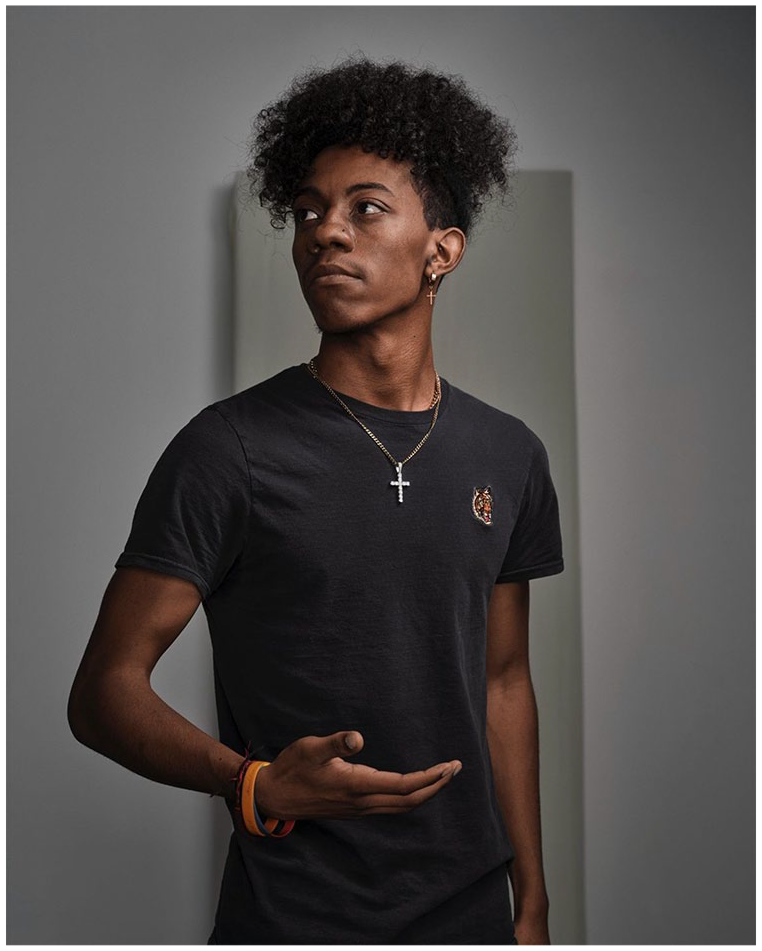
The politics of my work formed through an affective engagement with ideas and an exaltation at the thought of expressing them. Like the gathering of the artists and their work shared in this paper, I often feel a collaboration with sitters in the photographic portrait studio, those related to the experiences therein, and the need for me to express with and for us. My recent portrait work (Figure 1) and even my working definition have evolved to consider my and our experience of Blackness as a form of poetic. Put another way, my work is a performance of possibilities from a collective indetermination of something/someplace possibly Black/black. For me, the ambiguity of the images reflects these aspirations. This ambiguous defiance toward the photographic medium is also the reflection from within Betelhem Makonnen’s work and the conversation revealed in her idea of misuse of photography. Hers is a refusal of the historical and structural intentions integral to the medium and its oppressive applications.
Betelhem Makonnen
The “misuse” of photography and video in Betelhem’s practice employs a voice that does not quietly acquiesce into the language of photography; it rejects the apparatus’ yearning to fix an image. The way that photography wants to hold and finitely explicate is in direct contradiction to her trans-spatial and trans-temporal un-fixed practice of inquiry, love, and artistic resignation to unknowing as a practice. For instance, instead of attempting to pass one process off as a “real photograph,” she does away with the static and proposes dynamic selves as, multiple, and expandingly warped. Her work undermines a dominant gaze with an oppositional one. Selfing studies 07 (Figure 2; Makonnen, 2019) offers the often-fixed photorealistic self to itself on a low resolution and unfixed/bending substrate upon which the self is multiplied in depiction and various performances of looking inward, away from the viewer. The work is hung on the walls as transparent film. We experience but a few confluences of self as we, the viewer, can find ourselves reflected on the surface. The anti-Black, anti-love art world would have us be masters, but she confides that her application of the term misuse as it relates to photography is “. . . in connection with Harney and Moten (2013) and others’ approach to fugitivity. Misuse is a continuation of efforts to escape. It is escapism, a move toward freedom.”
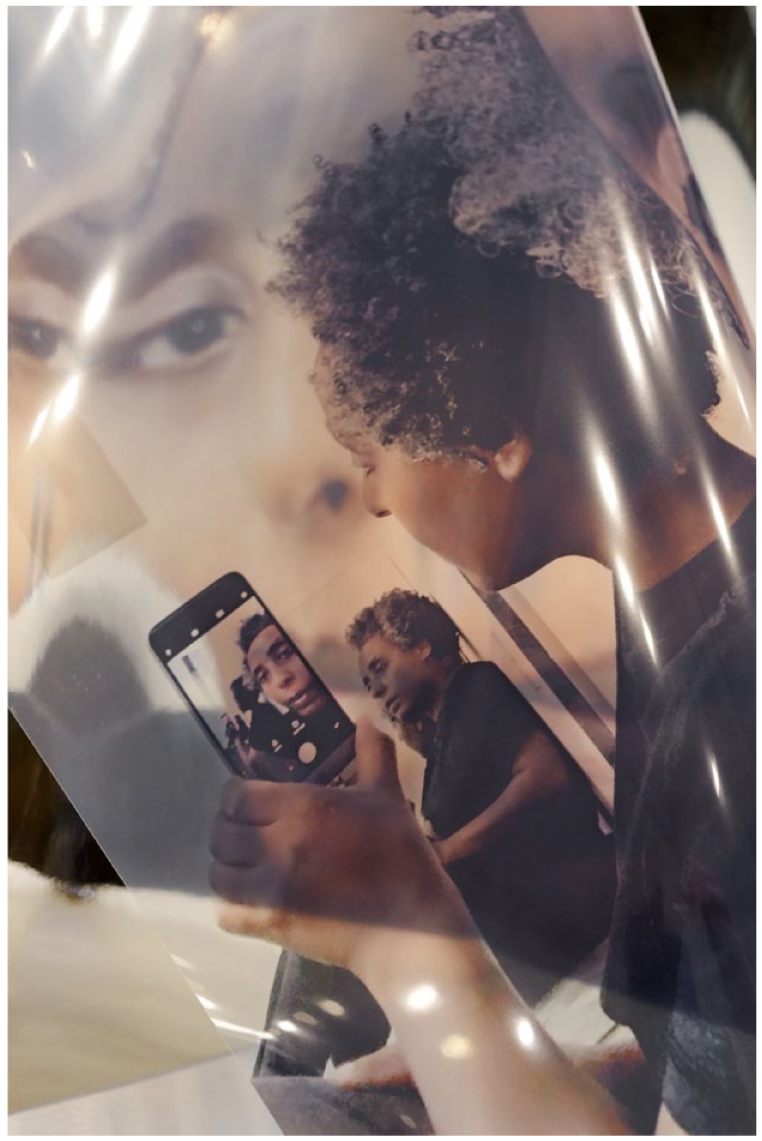
Betelhem Makonnen. (2019). (detail image) selfing studies 07 (______). [Archival print on clear film, reflective cardboard, Sintra (PVC) board, and dressmaker pins]. Artist’s personal collection] Austin, Texas, USA. © [2019] Betelhem Makonnen Image Credit: Useful Art Services.
Betelhem reveals photography’s’ perpetual for-hire status and that an artist can employ the camera to encode a message. Her work is a contradictory (mis)use of a medium intended for veracity. Her message, then, is not fixed but wavers, vibrates, and she leans into the unpredictable return from a radical transmission. As these images billow and bend in defiance of truth, they allow acerbic playfulness to become an act of subversion. Betelhem’s work is the performance of a refusal to abide by the desires and applications of forced complicity with power to create space beyond hegemony and beyond and yet within Blackness itself. If you look at more of Betelhem’s work, you will see multimedia practices addressing concepts of power and resistance. Language systems are often part of the conversation, because like photography and racialized designation, they reflect the historical aspiration of power.
Deepanjan Mukhopadhyay
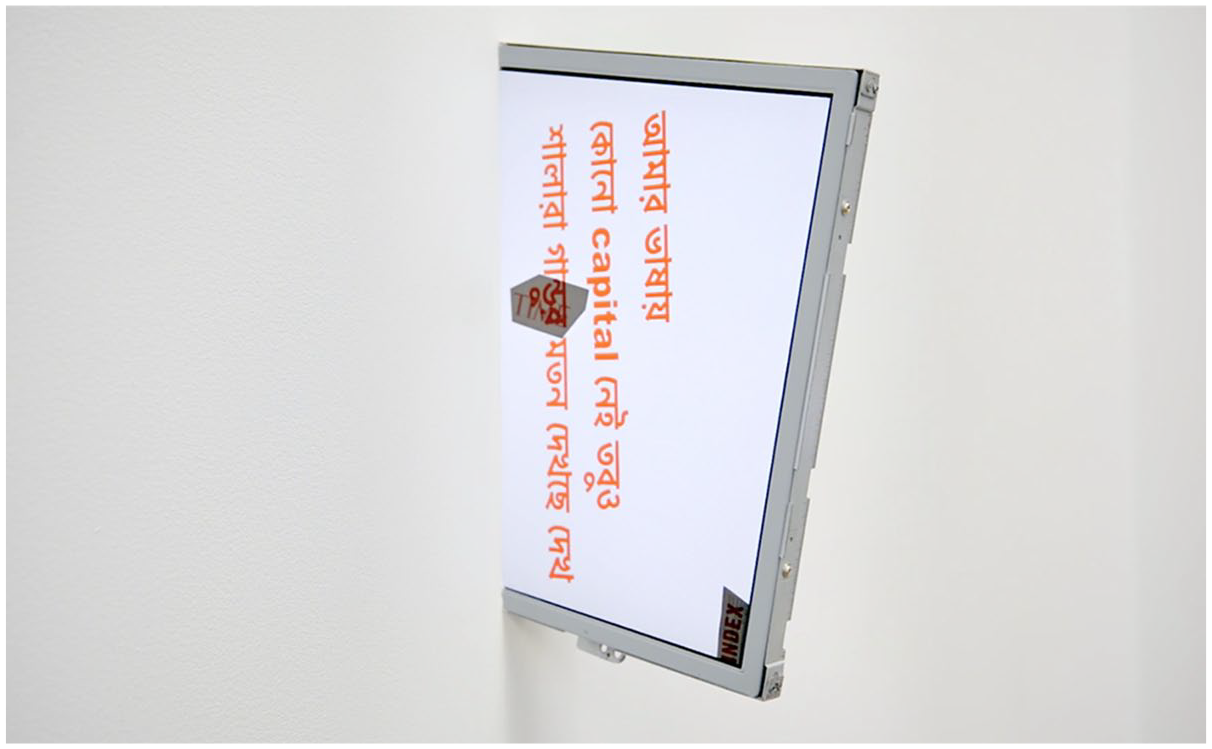
In a departure from the medium of photography, but on the topic of language, Deepanjan’s Code-switching (Mukhopadhyay, 2017); Figure 3 provides a poignant and witty example into the power of language and over language. An animated passage written in Bengali moves around an LCD screen and past visibility into the wall where the screen is halfway embedded. The animation is a metaphor of when and where code switching takes place and is necessitated, the walls of the institution while the text translation is withheld from those that don’t read Bengali. Deepanjan explained that Bengali is the fifth most spoken language in the world but is not on popular language learning applications when, ironically, most English-speaking call centers are in India. This highlights how power can undermine population and distort popularity. This use of language holds the key to his artistic expression.
Deepanjan’s practice is critical of systems of power such as language and photography. His image Trump (Mukhopadhyay, 2020), (Figure 4) from his series Appropriated Figure Ground, is like Code-switching (Figure 3) in the way that the medium, photography in this case, is implemented as critique of itself. In this case, the process of making an image belies the appearance of a singular out-of-camera photograph, a singular moment. In fact, the image is constructed the way power comes into being, as an accretion of elements. This group of artists rebel against photography but are so entangled with its metaphorical ability that they hope its misuse is fruitful. Expression is a hopeful reference to deliberately performing the act of being, dismissive of some general audience or pandering to the Art Complex. Appealing to these institutional assemblages is preached as a sound career move but they won’t help take care of “home” and makes no promise of an investment in return. But how we might deconstruct, if not dismantle these systems, through methods of reuse or encryption highlights the places and states of refusal in which we long to gather.

Zora J Murff
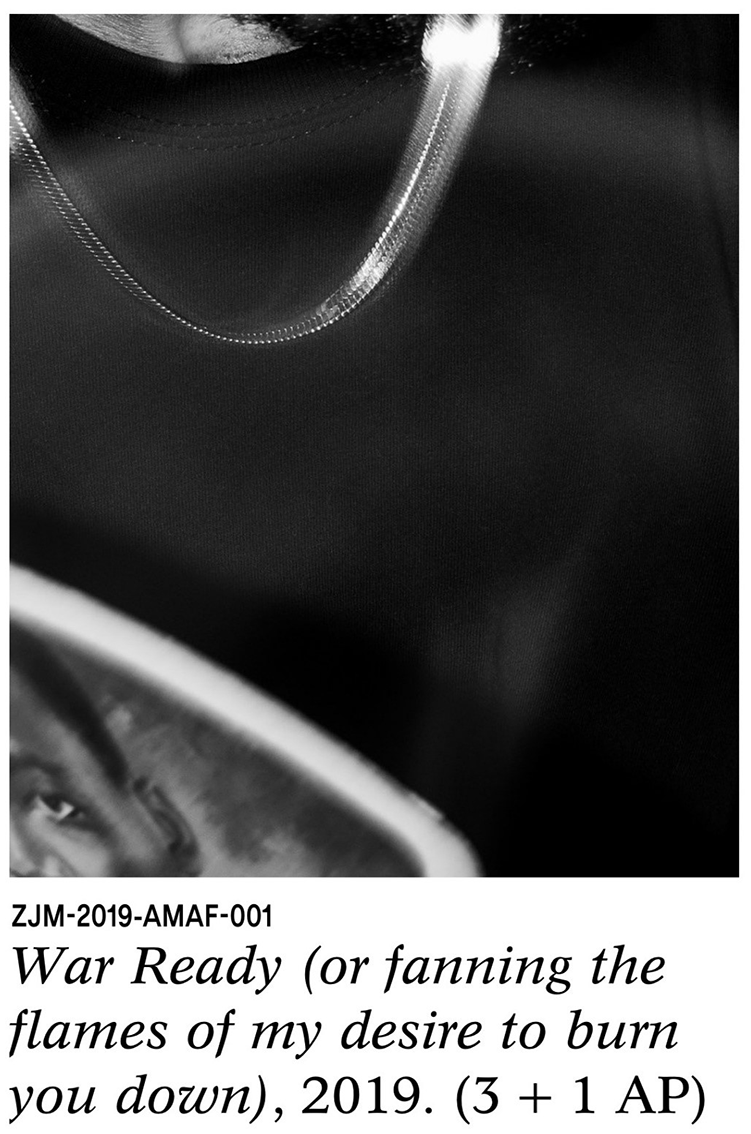
Zora J Murff’s work is more direct than playful or illusionary in its subversion. Where photography wants to render life into rigorous definition through forcing the symbolism of whiteness as the default surface upon which Blackness is thrown into relief, Zora’s work chooses a reference beyond the walls but between the lines. The apparatus always encodes, but the decoding may present an opaque surface to viewers without lingual and/or experiential access, Black words on Black pages. For instance, Zora’s photograph War Ready (or fanning the flames of my desire to burn you down) (Figure 5) is an act of provocation as much as it leans into refusal to be someone else’s being, which is to not breathe, to not be at all, to not express as humans do. In War Ready he is “. . . trying to articulate an experience without boiling it down. I was thinking of these moments that we’ve felt. War Ready is a type of truth of feeling and reflects an assertion in having no fear in articulation while knowing at the time (2018-2019) that things were/are off. . .” When the culture of understanding changes, when the tools to understand an image that might hang in a museum are located beyond the walls, the apparatus is being misused. Like the rest of us, Zora J Murff is conceding into the privilege of uncertainty. During our conversation over the work, Zora sometimes feels that digging so deeply and transmitting so directly might insight divisiveness. However, his unease has greatly subsided. He admits that he has “worked to be more comfortable to work with it {photography} as a material. Past white gaze, and just Blackness, wanting to get into the idea of having conversation in mixed company.” To suffer the hypervisibility of Blackness is to always be in mixed company, and such encryption, opacity, code switching, and misuse are tools for bending power to liberated voice.
Conclusion: “Photos Going Home” and the photographic practice of love
While I have not mentioned opacity much, if at all, in this photo-centered essay, Glissant’s (1997) Poetics of Relations assertion of the right to opacity has animated my thoughts on art making and love-building. To speak without having to translate oneself is foundational to the ability to speak. When Zora refers to mixed company, he speaks to the presence of the epistemic violence of the Art Complex. Mixed company, the Art Complex, Blackness, language, and photography are hegemonies through which we must find a way to live and express ourselves.
In that vein, Deepanjan and I collaborated on an idea that will conclude this essay in a way that a crossroad marks a destination and a new journey. Rather than pandering to the Art Complex and its injunctions, we articulated the idea that photography as a love-building mode of expression can escape the capital-driven value of the Art Complex. We called this process, Photos Going Home (PGH) (Figure 6) as an aspiration to center the concept of home as a place of community love-building rather than to focus on photography as a compromising artistic expression for a general audience. Photos Going Home is not the arrival at home but a dedication to going. It is oriented toward community-building outside of the Art Complex and its racialized institutional practices. PGH is a way to practice photography as a mode of exercising a right to opacity, encryption, encoding, and gathering. The artists on whose work this essay is built, (mis)use photography from within the racialized established hegemonies of Photography and Blackness to build on an artistic practice of love.
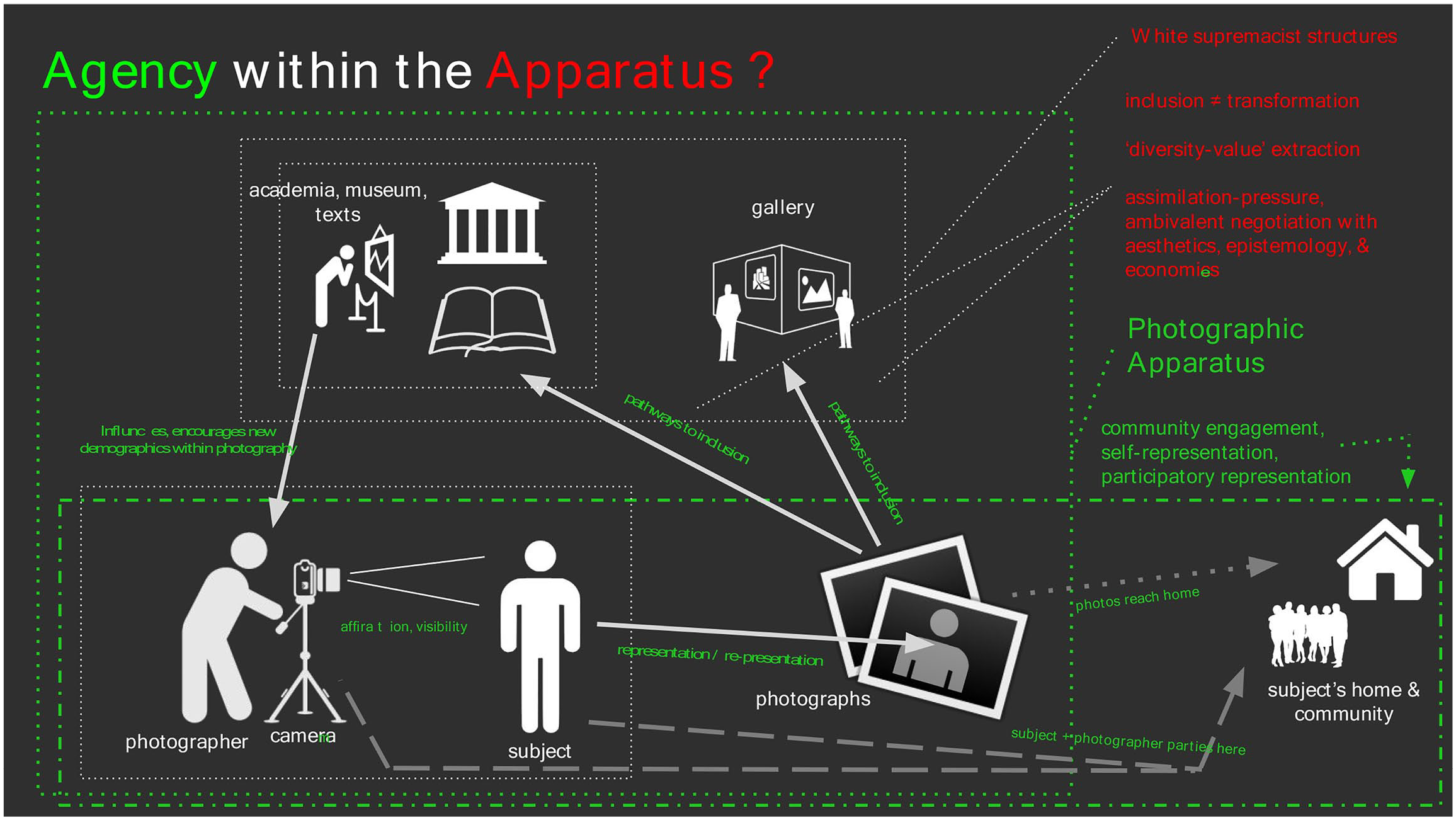
Deepanjan Mukhopadhyay. (2021). Subaltern voice in photography. [digital diagram]. © [2021] Deepanjan Mukhopadhyay.
Footnotes
Acknowledgements
Thanks to Deepanjan Mukhopadhyay, Betelhem Makonnen, and Zora J Murff for the use of their contributions through conversation and display of their artwork.
Funding
The author received no financial support for the research, authorship, and/or publication of this article.
