




Abstract
Take a deep breath. Although nothing is more natural or essential to human bodies than breathing, this simple yet vital act is the critical result of complex organizational, material, and political processes. We suggest that breathing can be thought of as a political model of organizing insofar as it shapes questions of life and death while rooting these “operationally” in immediate, urgent, collective and more-than-human intra-action. Breathing is also a social act because the self is bound up with others in a fabric of relations upon which each person depends, and so breathing can serve as a trope for regenerating and rethinking social structures, institutions and organizing blueprints. We take the act of breathing—its literal and metaphorical (im)possibility and collective organization—as the focus of a reflection on relations among humans and between other living beings, humans, and their ecological surroundings. Re-thinking the question of whose breathing we care about and whose breathing counts, we offer a political model that embraces the mutuality principle for post-humanistic and post-anthropocentric organizing and community building. We thereby hope to “inspire” and materialize new social and political realities for organizing our shared future, conceptualized as building a (scholarly) community of breathers who breathe and let breathe.
Keywords
Introduction: Holding our breath

Recent global disruptions, like repeated cadences, have foregrounded breathing in striking ways. Despite being a vital matter—a question of life and death (Berardi, 2018; Pérezts et al. 2022)—breathing is an overlooked aspect of social organization. Yet, recognizing the centrality of breath and its relational and political nature holds profound implications for governance, social movements, bio- and identity politics as well as for everyday corpo-material and affective dynamics (Górska, 2018). Refusing to take for granted the experiential and social phenomenon of breathing, we interweave its embodied and political dimensions to develop a critical inquiry beyond biological mechanisms or environmental conditions alone. Breathing offers unique insights as a relational metaphor for organizing with transformational political power, inspiring theories and practices of organizing “that do not bite, but make it easier to breathe” (Canetti, 1978: 51).
Bodily metaphors in organization studies are not new, but they have often focused on eating and digesting—a predacious conception emphasizing capitalism’s hunger for “devouring and consuming any durable thing” (Bazzicalupo and Clò, 2006: 112). Predatory imagery stresses the voracity of relentless growth, sometimes described as cannibalistic and viral, consuming our planet’s resources, our very communities and selves (Courpasson, 2019; Han, 2020; Rehn and Borgerson, 2005). Depleted air quality in megacities (Nature, 2006) systematically damages public health, and the air we breathe is too quickly becoming a commodity instead of a commons. Clean air is less and less accessible to marginalized populations, particularly in the Global South, as well as to other life forms which all depend on a variety of breathing processes that are often bound up by human activity and maybe impeded by it. Breathing is therefore as much about being able to breathe, as about letting others—including more-than-human others—breathe. Can’t we imagine our embodied relation to the world in terms other than consumption and predation on marginalized or indigenous populations, other species, and the habitat? Can the literal and metaphorical power of breathing help us think differently about the mutuality that underlies all forms of life and move beyond anthropocentric, instrumental and extractivist outlooks in its theorizing? In the words of feminist philosopher Luce Irigaray, “not only our culture does not teach us how to cultivate breathing to assure our existence. . .it does not make known to us that becoming spiritual amounts to transforming our elemental vital breath into a more subtle breath at the service of loving, of speaking and hearing, of thinking” (Irigaray and Marder, 2015: 254).
Drawing inspiration from breathing, we attempt to rethink our interactions holistically, organically and dynamically through a model of absorption and connectedness that does not rely on predation or consumption but instead on mutual exchange (what Haraway, 2016 calls “relational worlding,” p. 50) as essential to flourishing and to life itself. To breathe—and to be alive—is to take the outside in through inspiration and give back an atmosphere transformed by the passage through our bodies (Allen, 2020). As Butler (2021) notes, “this vector of breathing in and breathing out tells us something about a fundamental dependency” that is often neglected despite its irrevocability. The potential of breathing rests on an inherent relationality: manifested in the biological rhythm of breath; it is unnoticed but persistent. Puig de La Bellacasa (2017), drawing on a feminist conception of political care (Tronto, 1995, 2010; Fotaki, 2023), broadens the frame beyond the human to the scale and temporality of the ecological, calling for the inclusion of things-objects (de la Bellacasa, 2011) as well as plants and soil, as matters of care in the political. Similarly, Barad (2018: 224) argues for “a materialist, naturalist, and posthumanist elaboration—that allows matter its due as an active participant in the world’s becoming, in its ongoing interactivity.” We are thus reminded of how closely we are intertwined with both sentient and non-sentient beings (Berardi, 2018). In the inescapable entanglements of existence, “we require each other in unexpected collaborations and combinations, in hot compost piles” and consequently, “we become with each other or not at all” (Haraway, 2016: 4).
Extending this relational principle metaphorically, the rhythm of breathing runs through human decisions at both individual and collective levels in every arena of phenomenal and organized life. In this spirit, we begin by using breathing to analyze the crisis of human and more-than-human relationships that neglect relationality, as we characterize our times as times of breathlessness and carelessness. We reject the illusory and dangerous idea of self-contained, disembedded, and disembodied numbed individuals (Pérezts, 2022) in a purely instrumental and extractivist relation to others and the world. Instead, we consider mutuality at the interface between inside/outside and the processes of exchange across this (practically artificial) boundary.
Next, we examine how the renewal and regeneration potential of the phenomenal power of breathing enables new ways of organizing to emerge. In the third section, we argue that, ultimately, the organization always comes back to breathing because breathing is the most vital of relational patterns that define how living beings interact with the world. We develop a radical conception of breathing and its implications for management and organizing at a time when this seems particularly vital and urgent (Silva, 2021). This involves treating the breathing metaphor and practice as an impetus for imagining future organization guided by politically charged imperatives of relationality and caring (e.g. Allen, 2020; Butler, 2004, 2012; Fotaki, 2019; Fotaki et al., 2020), and living well Buen Vivir (Walsh, 2010). 1 In using breathing as a model for regenerating, redesigning, and rethinking social structures, institutions, and organizing blueprints, this essay enlivens the act of breathing—its literal and metaphorical (im)possibility within forms of collective organizing—as the focus of a pre-figurative and performative reflection on relations among humans and between other living beings, humans and non-sentient matter.
We then extend this contemplation to the academy in the concluding section of our essay, reflecting on how we conduct our work as organizational researchers, teachers, and administrators, which can infuse or deplete life from our scholarship (Dutton, 2003). With this work, and by attempting to write as we breathe, we hope to “inspire” and develop participatory understandings of new social and political realities for organizing our shared future, conceptualized as building a (scholarly) community of breathers who breathe and let breathe.
Breathing in times of breathlessness
Berardi (2018) describes “breathlessness” as the “general sentiment of our time.” Precisely because breathing is at the heart of our beating lives—to the point that we take it for granted—there is nothing like experiencing the “closing in” of one’s world through breathlessness (Carel et al., 2015) to remind us of our inherent vulnerability, finitude, and dependency on others. This is also why the politics behind breathlessness creates particularly unacceptable forms of violence.
If only from a human perspective, the governing of bodies (Nieuwenhuis, 2018) recognizes the importance of breathing and how controlling it can be weaponized by those holding power. Organizations and societies establish respiratory regimes that shape whose breath is allowed to be, will be protected, cherished, and grieved, and whose will not. From torture techniques 2 to police violence 3 to drowning refugees and migrants in the stormy Mediterranean or the Rio Bravo/Grande, to exhausted workers driven to suicide by overwork (Kanai, 2009) and burnout (Han, 2020) or a literal breathless life, many recent societal scandals and traumas, have been assaults on breathing as the space of life in one way or another. The earth’s population is exposed to increasing pollution, creating geographical and economic divides between breathable places and environments where waste and toxicity pile up to unbearable levels, leading to the dangers of “respiratory publics” (Garnett, 2020; Nguyen, 2020), policies and politics. Respiratory poverty is classed, racialized, ethnicized, and gendered, while the poorest and the most vulnerable face additional harm to their breathing functions caused by emergent fuel poverty (Barrett et al., 2022) and increasingly toxic working and living environments, particularly in non-Western countries.
Such assaults on the common good of breathing oppose recognition of our shared embodied vulnerability while irretrievably impacting other species and even the geology of the earth itself. Commons, by contrast, represent a comprehensive and radical approach to organizing collective action, placing it “beyond market and state” (Bollier and Helfrich, 2012). Engaging with and redefining the respiratory commons affectively enables the realization of our interconnectedness and interdependence, holding possibilities for caring futures (Mandalaki and Fotaki, 2020).
The enclosure of and extraction from such commons in the Anthropocene are marked by the planet’s increasing and rapid suffocation. At a very basic level, breathing depends on forests decimated through deforestation and wildfires and sea algae threatened by rampant pollution and warming (Gao et al., 2021). Life is not possible if our planet becomes saturated with CO2 emissions, for which our industrial development is responsible (IPCC, 2021). In the Amazon rainforest, devastating deforestation, ethnocide, and human rights violations are intertwined consequences of rampant economic extractivism. In that ecosystem, each tree operates as an aerator, breathing hundreds of liters of moist air into the atmosphere—creating “flying rivers” that carry within themselves more water than the Amazon River. 4
The vital rhythm of breathing runs across all levels of life, shaped by our decisions and organizations, even as these largely rely on the dangerous illusion of onto-epistemological unrelatedness and supposed hierarchy between humans and non-humans (Barad, 2018). This illusion ideologically justifies narcissistic conceptions of self-contained, disembedded, and disembodied individuals whose relations to others and the world are only considered in terms of resources to be extracted and consumed. And since breathing is threatened as never before in these times of breathlessness, we are reminded that it can also offer an alternative metaphor for relating and organizing at the interface between inside/outside, through the mutuality and entanglement of beings and life can be found.
The phenomenal power of breathing

Breathing is a dynamic force at the heart of mundane existence. Although nothing is more proper to specific living bodies than breathing, breathing is also a social act because the self is bound up with others in a fabric of relations upon which each depends. From our first cry for recognition and protection by caregivers in all our primal vulnerability to our dying breath when we finally expire, our breath is socially embedded. Breaths carry our voices, our laughter, and song, our anger and sorrow through cries and mourning as they resonate into speech, providing material and sensual substrate for reflection and discussion. As we channel our experience and speech into institutions, the traces of breath live on in the cadences of the written word and the smoke of formal rituals.
Even while holding pretensions to overcome bodily needs, we use metaphors of “inspiration” to describe genius, to live by the “spirit,” and our “enthusiasm” 5 signify the idea of a divine wind of life breathing its power into us. It may be no coincidence that this has symbolic and etymological dimensions. The Greek words for soul (ánemos) and spirit (psyché) denote wind and breath but also life. In languages as diverse as Hebrew (ruah), Danish (ånd), Finnish (henki), Hawaiian (hanu), or Chinese (qi) “breath” and “soul” are often almost synonymous and share a linguistic root (see also Benso, 2006).
In her study of the symbolic and mythical significations associated with the body, De Souzenelle (1991) considers the lungs as spiritual organs through their form as inverted trees (Figure 1) and through the practices surrounding breathing that we find across the world.
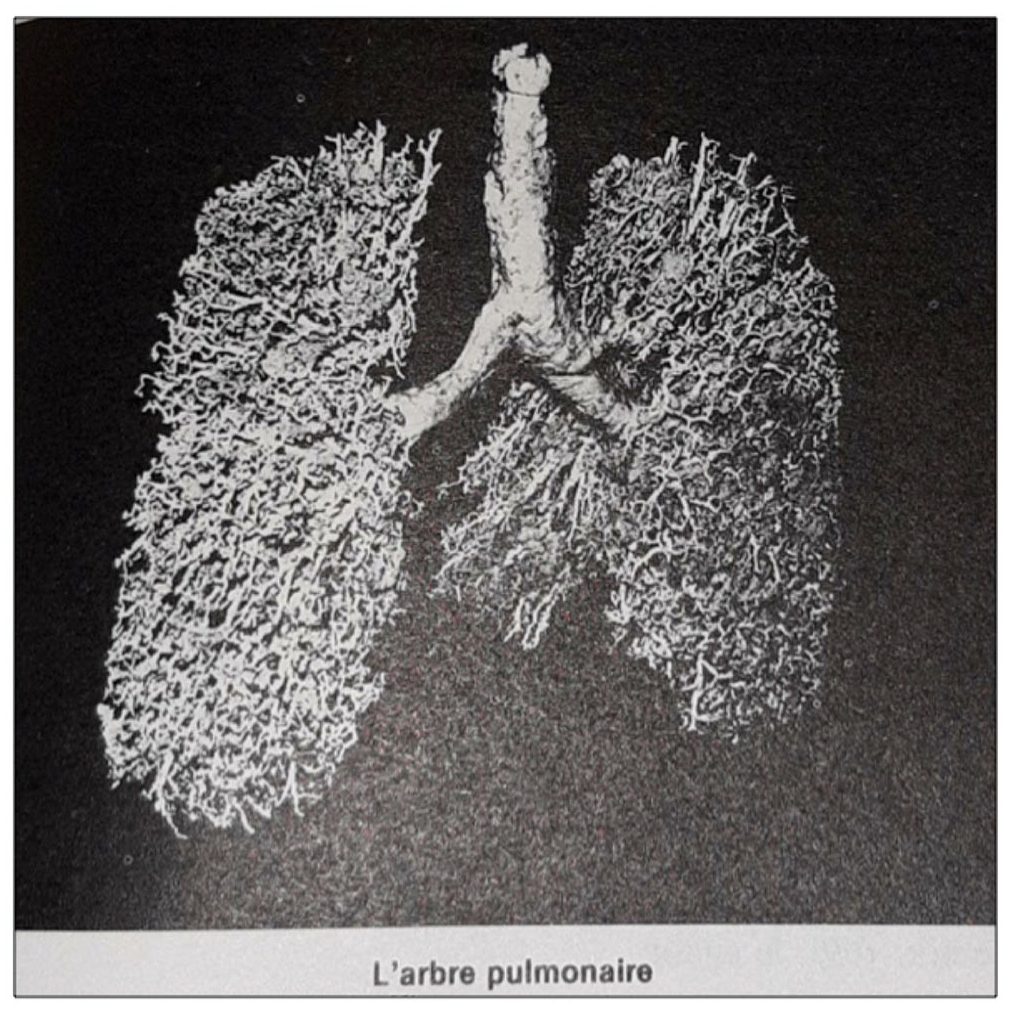
“The lung tree” Photograph by Bruneau/fotogram, in De Souzenelle (1991: 267).
For instance, she shows that in Chinese acupuncture, “breathing is a constant back and forth between the order of the world deposited at the center of each universe, of each being, and the multiplicity of its regions, structures, functions, and manifestations” (Kespi, 1982: 117, quoted in De Souzenelle, 1991: 264). She notes a parallel in Judeo-Christian tradition where the world’s creation (in the book of Genesis) is a back-and-forth movement tying together singularity and multiplicity (bara-shit-bara in Hebrew, creates-withdraws-creates). This movement of inspiration is described as breathing life into the waters, the land, and the light before resting (withdrawing, expiring), while breathing humanity into existence by blowing into Adam’s nostrils. In this tradition, as De Souzenelle (1991) notes (pp. 265–266), the divine (Hashem) הויה is etymologically related to breathing (Nashom), as the principle ו is between two breaths ה. Hence, “everything breathes.” Numerous myths and religious traditions build upon the fundamental unity between breathing and spirituality. For instance, the Egyptian God Isis, giver and destroyer of life, also breathed life into her brother Osiris in a cyclical renewal of life. Furthermore, while breathing as a metabolic process is involuntary and continuous, independent of explicit attention, many spiritual traditions insist on this connection: from mantras (such as in Hinduism), psalmodies (in Judaism), hesychastic traditions (in Christian orthodoxy), the dikr (in Muslim tradition) or more broadly in a variety of meditation, relaxation, and birthing techniques that involve deep, slow breathing efforts present in many Far Eastern philosophical and religious practices.
In sharp contrast to the spiritual foundations of breathing, today’s relentless rhythms where the market and our cities “never sleep” (or should we say, never breathe?) push people into a constant state of exhaustion and tiredness (Han, 2020) without the possibility to “withdraw” to rest, chasing after deadlines, and where living beings are perpetually gasping or out of breath.
The intersubjective, intercorporeal, and social significance of “inhabiting” rather than “having” our bodies highlighted in phenomenological tradition invites us to claim back and restore a breathable rhythm of our being. The forgetfulness of air and breath is somewhat characteristic of the whole history of modern thought (Irigaray, 1999a, 1999b). But living bodies ‘are given to us as centers of signification. They “breathe life” into the material environment, they “animate” it and thus create intricate systems of affective and expressive relations in which material things are internally bound together (Heinämaa, 2006: 149). In addition to Irigaray, albeit in a slightly different manner, Lévinas (1991) radicalizes specific attention to breathing and even considers lungs as our central ethical organ, leading to ethics of breath through pneumatology of the other (Škof, 2015).
Taking inspiration from these sources, we remind ourselves that the air we breathe and the activity of breathing, with its life-defining rhythms of pulse, taking and giving, ethically binds us to the world we inhabit and share with others. Crucially, the exchange involved in breathing contains a continuous interaction across cycles within the material world, implicating mineral and atmospheric phenomena as well as micro-organisms, plants, animals, and humans. Humans play neither privileged nor unique role in orchestrating this process, but their respiratory entanglement with a plethora of life forms is inextricably implicated in mutualistic relations (Armstrong, 2022; Škof and Holmes, 2013). Therefore, mutuality is at the core of the most fundamental questions of organizing livable societies and carries political significance. Some artists, such as Bertille Bak’s recent exhibition aptly termed Out of Breath (Abus de Souffle), understand and capture this reality by visiblizing global exchanges of breathing between North and South. These exchanges are continuous (as flows of products, people, and work) and often occur within an asymmetrical relationship of domination and subordination. 6 Indeed, “breathing together is political” (Figure 2). 7
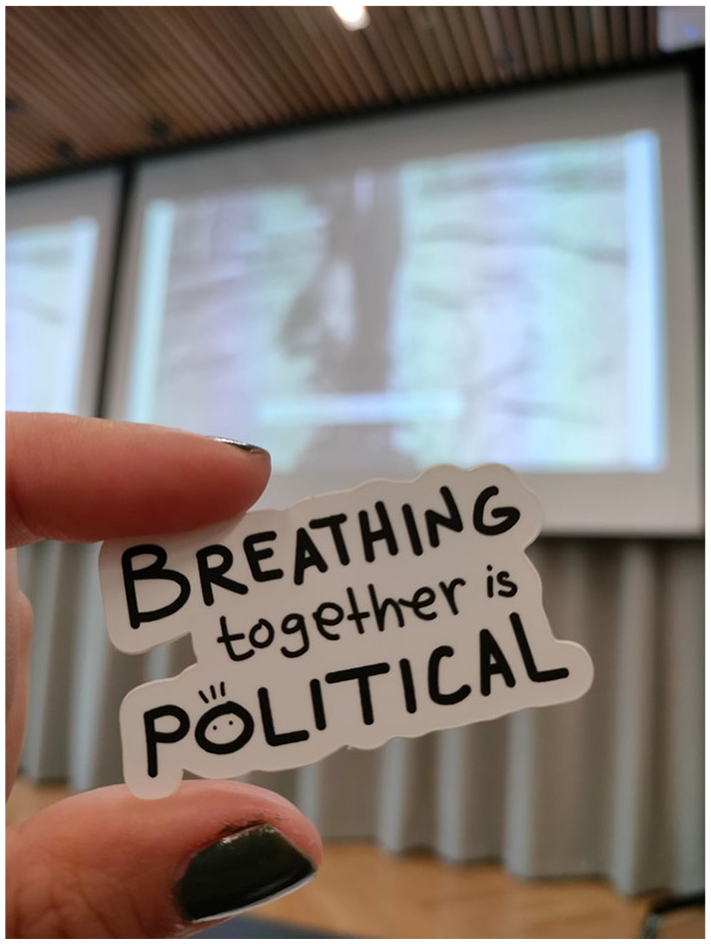
“Breathing together is political” moto printed on a sticker for a workshop (photograph courtesy of Ana Paula Lafaire).
But how can breathing help us reinhabit the world and change the dominant organizing principles? In other words, how might centering organizing around embodying breathing together pave the way toward radically different forms and modes of communities and even the larger “body” of the Earth? We suggest developing the metaphor of breathing centered around care and togetherness to conceptualize breathing as a political model of and for organizing.
Breathing as political model of organizing

Care ethics is rooted in feminist philosophy centered on relationships (see Held, 2006), but these relationships of care cannot exist outside of bodies, as explained above. Care involves material and affective dimensions, but it is also profoundly political, encompassing the mundane labor of doing and repairing webs of life that extend beyond human relations. Puig de La Bellacasa (2017) reads Tronto’s political notion of care, focusing on resource scarcity, exclusion, and global inequalities of care together with Haraway’s posthumanist feminism and Latour’s idea of “matters of concern.” Drawing on these readings, she proposes an ontology of care pertaining to all activities and entities, including neglected things (e.g. soil, plants). Such care includes others as a part of us and vice versa, as Judith Butler shows in the case of shared vulnerability, a connectedness to others that can lead us to flourish or perish. It also obliges us to care about things as part of the larger web of life we cannot afford to not care about. The ability to breathe depends on complex organizational, socio-material, and political processes, however, as these processes are compromised, breathing must be affirmed politically as a recognition of relationality and a refusal of capture and cooptation in favor of poetry as an excessive overflow that creates spaces for uncontrollable life (Berardi, 2018).
Beyond a condition of life produced by social coordination, breathing is a medium and platform for that coordination. When grafted into language, breath supports the word as a vehicle of social life while retaining a certain autonomy. As Ong (2002: 79) notes, literate, written culture impinges on the oral and spoken, but the oral retains a privileged and sacred primacy, always being the last word. He explains, “The letter kills, the spirit (breath, on which rides the spoken word) gives life” (Ong, 2002: 79). Ong observes that although religious texts are ultimately written to ease transmission, the initial inspirations are oral and embodied. This also explains the ongoing social struggle between the instability of the breathed word and its control through techniques of inscriptions and institutionalization.
Organizing is essential to human functioning—it can either vitalize or suffocate living entities, and the organizational ethics of life and death are center stage in our field (Banerjee, 2008; Pérezts et al., 2022). Consequently, understanding breathing politically implies fostering forms of organizing that allow breathing, and hence life, to flourish rather than stifling it. Organizing in such a way means embracing the primal idea of coming back again and again to beginnings (Irigaray, 1999a, 1999b) and entanglements with the world conceived as a relational whole (Barad, 2007, 2018).
Butler (2021) recently extended the metaphor for breathing into an affirmation of mutual dependency that gives life to modern conceptions of autonomy. In this conception, the self is political but non-sovereign, bound up with others in weaving a social fabric we depend on for survival. As Keltz (2016) elaborates, this non-sovereignty assures that morality and politics, separated by the affirmation of individual autonomy and a minimalist conception of the political, remain nevertheless bound up because we simply cannot live without each other. If the air we breathe, and thus the condition of life, depend on collective action, then we literally breathe for each other.
Similarly, ecophenomenology approaches social transformation through pursuing the relationalities of worldly engagement among all creatures (Brown and Toadvine, 2003). Drawing inspiration from what some indigenous knowledges and ways of life have put into practice (see Fleming and Manning, 2019), eco-feminist views steer clear of technocratic and anthropocentric conceptions of nature. Breathing, an elemental effort of a lived body that persists despite industrial transformation and modernization, reminds us of a vital reality of “the animate earth,” “the breathing biosphere” or “the more-than-human natural world” (Abram, 1996: 65). In this process, we become “air-and-breathing-bodies” 8 “attending to the politics inscribed in air, and articulating the politics implied in air’s material-discursive intra-action with human-more-than-human bodies (. . .) bodies and air cannot fall out into discrete distinguishable entities but are fused through embodied breath” Allen (2020: 87–88). This process evokes Irigaray’s feminist re-organization of life as relationally unfolding (see also Fotaki et al., 2014). As Gherardi (2023) elaborates (p. 319) “Air is co-constituted with ‘breathers’, who experience air’s elemental materiality. Thus, breath and the breathing body are collaboratively and continually made and remade, and breath is both human and becoming more-than-human, an aspect of the body but extending beyond it.” These parallel movements motivate us to incorporate feminist post-humanist metaphors such as the permacultural process of breathing proposed by Puig de La Bellacasa (2017) and Haraway (2016, 2003, 2008), ecopolitical developments on “naturecultures,” stressing their indivisibility and questioning binary categories and dichotomies (nature vs culture, human vs non-human). Equally, Barad’s (2007) conception of the performativity of matter prevents us from falling into anthropocentric ethics.
By drawing on such sources for inspiration, we begin to imagine breathing as a political model of organizing that doesn’t overlook its embodied ethical implications but represents a conscious effort that can radically change/transform a given reality (Hamington, 2004). Just like breathing, organizing can be seen as both an automatic instinct/reflex that seamlessly ensures the functioning of the individual/social body and a conscious action toward a revitalizing goal. Developing breathing-protective forms of organizing invites us to rethink how we build our relationships with the sites where we carry out our social lives to make them “breathable” places. This would mean allowing and creating conditions for others to exist and flourish in their multiplicity and “irreducible otherness” (Lévinas, 1991) within our organizations and societies.
Crucially, thinking of breathing as political organizing creates the vision for remodeling social relations, exchanges, and interactions into a community of attentive breathers. It is no longer the neoliberal individual that comprises the basic building block of organized societies but a breather, relationally bound to others through breathing itself. For example, by letting go of cognitive or biological hierarchies in favor of a system of lateral relations or kins (Haraway, 2016) between humans and other life forms, we can discover what really “speaks” to and resonates with us from a non-anthropocentric world. Organizing in a multi-species community of breathers celebrates the connected aliveness of breathing bodies to re-source us, putting us in contact as body-subjects with the ecological network underlying our being (Choy, 2020).
In such a community established through breathing, organizing would foster public sensitivity toward all living beings and cultivate the expressive space between them. Mazis (2008: 16) describes such vision as the task of boundary blurring that results in “things, people, creatures intertwining, yet not losing the wonder that each is each and yet not without the others.” Returning to the pre-figurative meaning of organizing as breathing means that we learn to recognize and affirm “our corporeal immersion in the depths of a body much larger than our own” (Abram, 2005: 174). Organizing immersion starts from learning to decelerate and take a deep breath even—or especially—when that is most difficult. De-accelerating living allows a two-way dialogue with the natural world to emerge. We must hear the “message” nature is sending us, as Inger Andersen, the head of the UN Environment Program, put it at the outset of the coronavirus outbreak in January 2020—and noteworthy is the effect the massive global lockdowns had on decreasing levels of air pollution for instance (Albayati et al., 2021).
We cannot grasp on our “own” this breathing body of nature or subject it to ultimate analysis. However, caring about oneself is political too. Living an out-of-breath life—constantly trying to catch one’s breath—including in academia—is also political. If we cannot care about ourselves, how can we care about others and the world? It means that we cannot talk about breathable organizations if we relate to ourselves in breathless ways (Pérezts, 2022).
But if we are willing to slow down and welcome it with the breathing lifeworld of our collective being, then we can establish durable forms of resonance (Rosa, 2019), allowing breathing space, and helping others live. This “brings previously considered immaterialities (lungs, dust, emotions, affects, atmospheres and breath itself) into sharp focus and redefine embodiment through intra-action (not inter-action) with implications for how environmental subjectivities and politics come into being.” (Gherardi, 2023: 319–320). Conversely, it can help replace the horror of breathlessness with the emancipatory breath of freedom and full life in and through instinctual physiological respiration in all our expressions and social activities.
Specifically, the political model of organizing we envision promotes breathing as a foundation of voice: in art as singing, and in being heard, in the capacity of voicing oneself. In other words, breathing offers a rhythm: its constancy provides security, and its rhythmic renewal maintains a sense of agency and fearlessness. Breathable organizations will be the opposite of toxic environments if the work is structured around the rhythm of purposeful breathing as the active locus of engaged action rather than austerity that either seeks to maintain respiration at its minimal level to maintain bare life or that co-opts and weaponizes breathing through wellness discourses that conceal a neo-liberal and individualistic rhetoric (Willmott, 2018). The contribution that a conception of breathers can bring to the political aspect of any community is not to be founded upon an ideology. Instead, it relies on the relational bond of exchange, of receiving the air and giving back the air charged with particles of myself, co-creating the air we all breathe and share in each breath we take. What would such a political model of organizing look like concretely? Although approximate and ambivalent, even utopian, we can point to several instructive cases.
For instance, Berardi (2018) considers Occupy Wall Street as an organization that both contested global capitalism but was ultimately unable to “stop the neoliberal devastation” (p. 8). Nevertheless, because its goal was not to seize the structures of power but to establish a hiatus within which to experience alternatives for imagining and living together, OWS had immense value as a moment of common organizing by interrupting the frenzy of business-as-usual, prefiguring new ways of governing and making us pause for a moment and catch our breath. Specifically, Berardi (2018: 10) considers OWS as an attempt at liberation from “abstract grip that is suffocating social respiration,” and as an initial step toward the “reactivation of the social body” (p. 8) as a model for building social organization in cross-cutting, non-extractive ways respecting the social commons (Mandalaki and Fotaki, 2020). Reducing inequalities through care for excluded others must drive these activities and interventions, even if they fall short of their ultimate goals. Political care concerned with the distribution of care (Tronto, 1995) inflected by “affective equality” (Lynch, 2022) can address specific problems of exclusion from and inequality of care for others. Embodied breathing, providing a foundation for political organizing, would allow us to consider all forms of human and non-human life as equivalent without eliding their differences (Fotaki, 2023).
Relatedly, and similarly ambivalent, Roux-Rosier et al.’s (2018) discussion of permaculture movements as social imaginaries provides an example of cross-species, ecological organizing founded on a concern for the liveability of all its members. The authors describe attempts of growers who have often left less “breathable” conditions in the city and have attempted to reorganize a mode of production emphasizing sustainable relations across species. This process contrasts small-scale agricultural experiments with an “anarchist-liberal” bent toward human control of sustainable circular processes with broader utopian “holistic-mythical” movements focused on cosmological visions and “eco-political” intersectional social justice movements. The degrowth movement puts social well-being and climate change ahead of economic profitability, asking us to reconsider the failings and destructiveness of the limitless growth paradigm (https://degrowth.info/). Each of these proposals, contests the violence of unsustainable modern production that remain the dominant paradigm for organizations. Still, the eco-political imaginary comes closest to an organization of breathers by inserting the “other” within relational processes, considering marginalized actors and other living beings as equivalent community members, and complementing utopian and mythical cosmo-visions with concrete applications for food production and inter-species relating, making the space of agriculture and food production a ’breathable’ condition instead of an unsustainable one.
Perhaps, quite simply, but also profoundly transformative, is how breathing thus conceived can lie at the foundation of peace and peace building. Dietrich (2012) recounts how a student from Burkina Faso faced bewilderment in his class when he mentioned that in his mother tongue, the word for “peace” is “fresh air.” Reflecting on this a few years later, “it appears to me that quite an estrangement of human beings from nature is necessary in order to be amazed by fresh air as a concept of peace” (p. 3). Breathing as a material exchange practice and a metaphor for our connectedness, stressing the importance of shared spaces and resources for making our lives livable (Butler, 2004), can provide an alternative by recognizing that all life forms are vulnerable and worthy of grieving. Therefore, the proposed political organizing founded on breathing is radically universalist as it eschews any hierarchies among humans, non-humans, or indeed, “things” that deserve less or more protection and care. Rather than getting caught in the chatter of the narcissistic mind, presence in the moment of breathing (as in meditation) supports an openness to otherness that follows the rhythms of spontaneous relating. Such rhythms are consistent with organizing to “live and breathe” and promote interactional moments from which new collectives can emerge. This evokes a normative posture of what ancient Greeks called kenosis, an “emptying” of self (e.g. by remaining silent, cf. Irigaray, 1999b) for the creation of the metaphorical “peace of mind” but also literally the space where everything “creatively and spontaneously yields to one another” (Armstrong, 2022: 103). Breathing care is ontologically different as it ascertains various forms of relationality binding us to others and our living environment as an urgent necessity. Also, such radical care is political as it considers who produces, delivers, and who benefits from what types of care.
Equally, it counteracts the persecution of those who insist on speaking up. A political manifestation of breathlessness is indeed when those who act as radical carers of the public good are silenced. 9 However, preventing breathlessness, and therefore, quite literally, working toward peace, necessitates joint action and caring approaches centered on the radical notion of care (Care Collective, 2020) rather than carelessness to create and protect breathing spaces in organizations and society. The pandemic experience beginning in 2020 revealed just how much we depend on close physical contact with the living world—and how much we suffer when this is brought to a halt. Thus, in the post-pandemic world, organizational scholarship may embark on rehabilitating and promoting modes of togetherness that see being with others and the surrounding world not only as a vector of contagion but as literally and metaphorically, a breath of fresh air, as we discuss next.
Breathing scholarship
One of the greatest breathers of the 20th century, Elias Canetti, insisted on shifting from thinking to breathing in the practice of knowing and apprehending: “it is not enough to think, one has to breathe. Dangerous are the thinkers who have not breathed enough” (Canetti, 1978: 194). So, what implications does this re-imagining bear for us as an academic community? Such a profound shift will also require new ways of writing, researching, and pursuing knowledge creation. Gilmore et al. (2019: 4) contend that “scientific writing suffocates: it constricts our breathing especially when the norms of such writing are far removed from the material experiences which shape how we live, think, feel, work, see others and so on. . ..” This is particularly true where majorities of living beings have been excluded and/or not considered in knowledge production. Such exclusions impoverish science by producing skewed images of reality and foreclosing potentialities for thinking and imagining. In Politics of Nature, Latour (2004) calls for questioning the two dominant divisions constituting the Enlightenment worldview: the norm-fact division and the human-natural division. Latour’s plea to rethink these divisions reminds us of Husserl’s (1981) lament on the crisis of European sciences on the eve of World War II, whose devastating consequences Henry (2012) later called the sinking of scientific thought into “barbarism.”
Another suffocating division is between the “hard” sciences and the humanities, and between academic sub-disciplines, where inspirational breaths of ideas are debated in isolation instead of being shared. In a unique 5-year project called Life of Breath, funded by the Wellcome Trust, an interdisciplinary group of scholars reflected on common sets of data to advance a more holistic form of knowledge merging medical (pulmonary disease), clinical (patient care), historical and cultural phenomenology (experience) of breath and breathlessness (Malpass et al., 2019). This leads to understanding how interconnected the symptomatic, symbolic, and affective dimensions of breathlessness are and how artificial and impoverishing our attempts to study each in isolation can be (see Carel et al., 2015; Škof and Berndtson, 2018).
Taking inspiration from this and joining the broad array of scholars who are fighting for less suffocating academia (see recently Petriglieri, 2020; Korica, 2022; Pérezts, 2022, among many others), our essay advances a conception of knowledge and knowledge creation that is relational to the core. Kalanithi (2016) reminds us that human knowledge is irreducible to a single individual. Instead, it stems from the relationships that bind us to the world and others, defined by a fundamental incompleteness. Finally, we must organize to protect spaces for free expression within academia and beyond so we can engage in scholarship and writing breath-fully rather than speaking under our breath (Silva, 2021). We must defend the right to speak and hear things we may disagree with in academia, or it will become a place of learning without “breathing.” This means supporting endangered scholars where censorship is apparent, truth-tellers, and whistleblowers whenever possible (Kenny and Fotaki, 2023). However, where freedom of speech is ostensibly protected, we must not veer toward “safe” or “legitimate” topics in our research and avoid those deemed “sensitive” or engage in self-censorship (Association of American University Professors [AAUP], 2021). We are also responsible for communicating scholarship on complex topics in ways that inform public understanding and debate (Association of American University Professors [AAUP], 2021; Granter et al., 2023).
Overall, our proposal seeks to speak to scholarship that is attentive to the politics of life and death (e.g. Banerjee, 2008; Punch, 2000; Pérezts et al. 2022) by rooting it within the living, breathing bodies as triggered by the social upheaval of recent times (e.g. Burgen, 2020; Fotaki, 2022). Such endeavor urges us to push for a relational conception of scholarship in form and content. For example, Brewis and Williams (2019) cross-disciplinary boundaries to write about “writing as skin,” showing that the difference between “inside” and “outside” in writing is equally false. Dripping with metaphors and insights from the myriad ways in which “skin” has been understood, their article seeks to un-write the division between skin/body and ways of writing (Gilmore et al., 2019: 8). Similarly, here we wish to end by inviting the reader to explore how a focus on breathing can reinvigorate scholarship as a poetics, a creation with a rebellious, creative, and political capacity to reimagine and enact new worlds (Islam and Greenwood, 2021; Pérezts, 2022), one breath at a time. The opening lines of our introduction constitute a small attempt to write as we breathe, where each verse can be read in one gasp of breath, following the embodied relational rhythm of our shared thoughts. Words written to be uttered and not read (or if so, read out loud). Written to be breathed, following the rhythm of breathing. Poetry as a literary form is so closely related to inspiration—a respiratory metaphor used to convey creativity—that the argument could not have evolved in our minds and bodies without poetry as a way to think and breathe through these issues in a way that allowed them to echo in us and create resonance. But poetry is not the only one, nor is it what poetics understood more broadly boils down to.
As Berardi (2018: 18) argues, to insist on breathing via the inspirational politics of poetry is not “merely Romantic patheticism,” as the hyper-conceptualism of modern industry is at the core of the suffocation problem. He approvingly cites Hölderlin’s assertion that “poets establish what remains,” arguing that poetry exists where the common creation of life replaces merit or “deservingness” out of itself. In poetry, the gift’s gratuitousness replaces the merit principle, posing a direct challenge to the neoliberal performance principle in which all rewards, or even the ability to live itself, follow performance and value metrics. This rejection of metrification (Islam, 2022) through poetry is not simply a refusal to enter politics by sabotaging this calculative game but an insistence on politics beyond calculation. For Berardi (2018), the politics of breathing is to move away from a mode of living based on control and colonization and instead to “attempt to tune into this cosmic vibration, this temporal vibration that is coming and coming and coming” (p. 17). Being able to openly ponder such questions means thinking about our own compromises, survival tactics and failures to care, including in academia. This essay is an exercise of introspection that formulates an aspirational ideal while recognizing how far away we are from realizing it.
Conclusion

The preceding reflections have been our attempt to “knock from the inside,” beginning from what is most internal and intimate to the body, the act of breathing, and moving toward the social and organizational structures that make such interiority and its relation to its others possible, and finally toward reflecting on the conditions of knowledge production in this regard. It is upon such a relational conception that intersubjectivity and community can find resources to become. At that edge between the body and the world, “on the lip of insanity,” society is made and remade in the repetitive rhythms of vain attempts to sustain itself indefinitely. But that lip of insanity is also the birthplace of the poetic word, the imagination of a new way of organizing, the breath of fresh air. If there is a way out of our institutional repetitions, it is in that excessiveness of the breath that cannot be caught, in the poetic breath, that creates new worlds (Berardi, 2018). In this essay, we relied on poetry’s life affirming power, rhythm, and flow for our collective “breathing”: as we were inspired by each other and collectively expired with relief and satisfaction upon completing it. Reflecting on breathing in and around organizations is to remember that organizing has always been and is now, crucially more than ever, a matter of life and death in the light of global disruptions (Pérezts et al., 2022). Holding our breath can signify hope and resistance by speaking out instead of simply struggling for survival in an era of breathlessness. But it is also important to remember that new inspirations come with the ability to breathe and that we must learn to live and breathe freely again. This means approaching others’ vulnerable respiration with protectiveness and care instead of succumbing to casting them out as dangerous in their overflowing and leakiness (see Shildrick, 1997). However, perhaps, this time, through the trial of periods of breathlessness, we will learn to breathe vigilantly and gratefully. We believe that the academy has the power to infuse life into scholarship, and it is our collective responsibility to harness this power to better our shared future.

Footnotes
Funding
The author(s) received no financial support for the research, authorship, and/or publication of this article.
