




Abstract
This article critically examines the perpetuation of gender regimes within postsocialist Europe by analyzing how organizational recognition is performed as part of the corporate celebration of Christmas. A critical ethnography was conducted at a male-dominated company in postsocialist Hungary. The article’s findings align with three corporate Christmas scenes: the company owner’s speech, an award ceremony for families, and an award ceremony for the best employee. This study contributes to critical organization studies by advancing an understanding of the postsocialist gender regime and those ideological forms of recognition that invisibly reproduce it through the seemingly innocent practices of Christmas celebrations. Furthermore, by providing a critical reconceptualization of workplace familism as an ideology, it is argued that it is a central and distinctive element of the gendered subtext of this particular postsocialist gender regime. Ultimately, three different and ritualized forms of pathological recognition (misrecognition, overidentification and reification) are identified, claiming to be constitutive of individual gender identity regulation and extending socioideological control beyond the boundaries of the organization.
Keywords
Introduction
Organizations often close the business year with Christmas celebrations. As a festival, Christmas can link an organization to its broader socioeconomic, cultural and historical context. Studying such celebrations can, therefore, offer a unique opportunity to gain insight into the intersecting “practices of consumption, management and organizing” and processes of individual and group identity formation (Hancock, 2016: 756). Moreover, such rituals and symbolic interactions create space for organizational recognition (Hancock, 2022), as well as managerial influence on the reproduction of meanings, social relations and identities (Rippin, 2011; Rosen, 1988), and crucially, the gendered subtext of the organization (Acker, 2012). As such, seemingly innocent organizational events, like office Christmas parties, can play an important role in reproducing or challenging unequal gender regimes in organizations (Ortlieb and Sieben, 2019).
Thus, while critical literature on identity is concerned with how broader socio-historical contexts shape self-understandings (Alvesson et al., 2008; Boussebaa and Brown, 2017; Jammaers and Zanoni, 2021; Lai et al., 2020), little attention has been paid either to how gender identity regulation is performed in such Christmas celebrations (but see Ortlieb and Sieben, 2019), or how these might provide “subtle ways in which recognition is achieved or subverted in specific workplace settings” (Islam, 2012: 47).
Building on Honneth’s (1996, 2012) theory addressing the interconnection of recognition and identity formation and on Acker’s (2006, 2012) concept of gender regimes, this article aims to critically investigate the perpetuation of gender regimes in the post-socialist context by analyzing forms of recognition performed through the organizational rituals surrounding Christmas, utilizing rich ethnographic data collected during the festive period in a male-dominated organization in Hungary.
Historically, in this region, attitudes toward gender have differed from those in Western European countries. Although gender equality was promoted during the socialist period between 1949 and 1989 (Nagy et al., 2016), after the change of regime, there was a pronounced tendency toward retraditionalization (Gradskova and Asztalos Morell, 2018) in the form of increasing societal familism and anti-gender politics. This, in turn, led to a backlash against previous state-led initiatives at bringing about gender equality. As one of the most important festivals, Christmas was also shaped by these societal changes, which provides the macro-level context for this study.
The article opens with a conspectus of the recognition and gender identity regulation literature, focusing on corporate Christmas activities. Next, the specific postsocialist context, emphasizing societal familism and retraditionalization in connection with Christmas, is considered, followed by a discussion of the adopted methodology and its critical ethnographic approach. Findings are then organized into three corporate Christmas scenes: the owner’s speech, the award ceremony for families, and the award ceremony for the best employee. The study then contributes to the critical organizational study on gender by analyzing the distinctiveness of the postsocialist gender regime, demonstrating how societal familism pervades the organization in the form of workplace familism diffused through ideological acts of recognition at its Christmas celebrations.
Recognition, gender identities, and Christmas rituals
Recognition and pathology
According to Honneth (1996), in a just and healthy society, the possibility of identity formation depends on developing certain types of practical relations-to-self, namely self-confidence, self-respect and self-esteem. The intersubjective conditions for becoming an autonomous human being and achieving full self-realization are related to different modes of recognition and their achievement. Primary relationships, such as love and friendship, provide the emotional support that is essential for basic self-confidence; having the right to participate in rational will-formation provides cognitive respect for the individual as a morally responsible person, which is essential for self-respect while recognizing the individual’s contribution to the realization of societal goals and gaining social esteem for their way of self-realization is essential for self-esteem that exists beyond the individual as “a prerequisite for solidarity.” (Honneth, 1996: 129).
In his reformulation of critical theory, Honneth (2007) redefines his critical effort as uncovering or exposing social pathologies of misrecognition that undermine or harm such relations of recognition alongside those conditions that potentially sustain them. Such misrecognition can take several forms, including marginalized or unrecognized social groups being withheld recognition, experiencing disrespect or ideological forms of recognition (Honneth, 1996, 2012; Klikauer, 2016). Such forms of misrecognition are of particular interest in understanding how identities are regulated. However, ideological forms of recognition are extremely difficult to uncover if the people involved are particularly predisposed to accept them. Honneth (2012) identifies three prerequisites for considering recognition as ideological. First, it should highlight a valuable attribute of a particular social group positively. Second, it should be credible to the group addressed. Third, it should be contrastive in that a new value or performance must be expressed, and the addressees should feel distinguished by it.
However, besides those prerequisites, ideological recognition is manifest in “an individual relation-to-self that suits the existing dominant order” (Honneth, 2012: 86) and the exercise of “the ‘regulative’ ability to engender modes of behaviour by promising the advantage of an increase in self-esteem and public affirmation” (Honneth, 2012: 90). Furthermore, in rituals such public (ideological) recognition remains merely symbolic, in so far as it is not justified through a change in legal definitions or material redistribution (Honneth, 2012). It results, therefore, in regulated identity formation.
The literature discusses further forms of pathological recognition (Honneth, 2008, 2012; Klikauer, 2016), which are widespread in the organizational realm (Hancock, 2022). As a form of negative recognition, for example, informal misrecognition refers to the “non-intentional but often unequal treatment of citizens and employees” that occurs in everyday interactions (Klikauer, 2016: 40). Moreover, Honneth (2008) has reformulated reification, a critical concept developed by Lukács (1971), as a forgetting of a form of antecedent recognition, which entails openly and empathetically “placing oneself in the perspective of a second person.” The reification of human beings results, therefore, in us losing sight of or denying this antecedent recognition (Honneth, 2008: 134); instead, relating to others as human resources and means for achieving organizational goals.
Another form is that of pathological mass-recognition, which occurs when “individual recognition is replaced with a mass-mediated form of false recognition based on symbols and signs as a medium between two entities,” usually relying on the managerial “glorification of a great corporate leader” (Klikauer, 2016: 45). Analyzing employee recognition systems, Hancock (2022) refers to this as a compelled over-identification with organizational goals and culture. In this article, we argue that such ideologically distorted forms of recognition lead to identity regulation that is difficult to uncover, especially for those individuals subjected to it.
Identity regulation and gender regimes in organizations
Literature on identity regulation views the employee as a managed identity worker and pays attention to the role of managerial elites and existing discursive regimes in the process of identity formation (Alvesson et al., 2008). As an analytical framework, it focuses on the interaction between the local organizational manifestation of control, broader societal institutions, and prevailing macro-level discourses (Alvesson et al., 2008). Exemplar studies discuss the regulative impact of Englishization in organizations (Boussebaa and Brown, 2017), the identity regulation of people with disabilities through ableist discourse (Jammaers and Zanoni, 2021), representations of struggles in the broader social context that regulate identities in a Chinese MNC (Lai et al., 2020), or the regulation of refugee employees’ identities in inclusive organizations (Ortlieb et al., 2021).
Another stream of research focuses on gender identity regulation (Chasserio et al., 2014; Essers et al., 2013; Wasserman, 2012) providing telling examples of how power asymmetries regulate gender identity through discursive and material structures (Barragan et al., 2018), arguing that gender identity regulation can be constrictive for all members of an organization (Johansson et al., 2017). Gender identity work is influenced by idealized images of masculinity and femininity for self-identification and advocating desirable behaviors in consonance with organizational or managerial goals (Alvesson and Billing, 2009). Targets of regulation include direct interventions, such as defining the idealized gendered subject, and more indirect control mechanisms, such as circumscribing appropriate morals and values (Alvesson and Willmott, 2002) that are written into the gendered subtext of an organization (Acker, 2012). Thus, masculine and heterosexual norms are institutionalized in organizational cultures through symbols and social interactions, which remain “unstated and unseen” (Pringle, 2008).
Acker (2006: 443) argues that “all organizations have inequality regimes defined as ‘loosely interrelated practices, processes, actions, and meanings’ that result in and maintain class, gender, and racial inequalities.” She highlights that gender regimes build on the image of the ideal organizational subject as it is construed as an abstract, unencumbered worker, constructed from a male body, who is expected to prioritize work over private life (Acker, 1990, 2006). Identity regulation is accompanied, therefore, by a normalizing effect whereby notions of masculine and feminine are produced and naturalized (Butler, 2004), creating uncertainty about diverging from prescribed images (Alvesson and Billing, 2009) and forcing intensive identity work from those who are exposed to it (Alvesson and Willmott, 2002).
Regarding the question of gender inequalities at work, Honneth (2012: 229) states that “such deviations are therefore taken to be pathologies that arise within the system of organization, such as a failure to recognize employee rights to equal treatment despite, say, one’s gender or sexuality.” He highlights that recognizing certain femininities and masculinities as valuable in line with gendered ideologies might also lead to identity regulation as, for example, is the case in Wasserman’s (2012) study that analyzes the workplace distinction between the front of stage as a “masculine zone,” and backstage as a “feminine zone,” a distinction that can be considered as a way of recognizing gender identities in a regulative way.
Christmas as a site for gender identity regulation
As ideological recognition is, therefore, often performed through repetitive rituals, this brings to the fore the value of studying ritual festivals such as Christmas celebrations, especially within organizational settings, as a gendered phenomenon. Certainly, existing studies have highlighted how rituals in organizations play an important role in regulating identities (Alvesson and Billing, 2009; Alvesson and Kärreman, 2007), while company celebrations also serve for employee recognition in the simple form of “saying thank you” (Hancock, 2022). Furthermore, the gendered subtext (Acker, 2012) of an organization is often written into scripts and rituals that convey stereotypical images and narratives about gender (Ely and Padavic, 2007).
Decoding the script of Christmas rituals in organizations has the potential, therefore, to offer a situated understanding of the reproduction of gender regimes as they occur (Calás et al., 2014) while providing an opportunity to unravel the role of repetitive and ideological forms of organizational recognition (Hancock, 2022), which “can create a feeling of self-worth that provides the motivational resources for forms of voluntary subordination” (Honneth, 2012: 77) resulting in identity regulation. Furthermore, celebrating Christmas at the workplace stimulates the symbolic blurring of the boundaries between work and non-work-related experiences, which requires a stronger existential self-representation from the individual while opening the door for a new way of exercising normative control and identity regulation (Fleming, 2005; Fleming and Sturdy, 2011).
Broadly speaking, organization studies has largely failed to recognize the gendered nature of workplace Christmas celebrations (but see Ortlieb and Sieben, 2019). Rather, previous studies on Christmas parties have tended to reveal how symbolic techniques are deployed to maintain the existing organizational social order without a direct focus on gender inequalities (Rippin, 2011; Rosen, 1988). Likewise, theoretical pieces on gendering Christmas have instead focused on the organization of female labor during Christmas time (Brewis and Warren, 2011; Vachhani and Pullen, 2011), detached from organizational settings. One exception, however, is Ortlieb and Sieben’s (2019) investigation of how the inclusion of women employees in social events in organizations, including Christmas, can reinforce or challenge gender inequalities at work. Despite this, however, much work remains to be done exploring this particular issue.
The socialist legacy: Re-traditionalization
Compared to post-industrial Western countries, socialist societies tended to modernize differently. Instead of steady and linear development, gender equality and secularization had already been significantly advanced by the late 80s (Nagy et al., 2016). After the regime change in 1989/90, however, the values and practices of state socialism were often strongly criticized and, as a backlash, previously suppressed “traditional values” once again became popular. In particular, this included the diffusion of conventional gender roles, religiosity, and social conservativism, defined as in certain quarters as re-traditionalization (Gradskova and Asztalos Morell, 2018; Kováts, 2018).
Societal familism
During the period of state socialism, egalitarian attitudes toward gender equality were mainly manifested in full employment and the possibility of career progression for both genders, weakening men’s traditional bread-winning role (Gradskova and Asztalos Morell, 2018). The full-time employment of women was supported by relatively cheap and widely available childcare and 3 years of state-supported maternity leave (Frey, 1997). However, family-related welfare measures were only available to women, maintaining the gendered division of labor within families during this era (Dupcsik and Tóth, 2008).
After the regime change seen across Europe in the early 90s, a large proportion of children’s day-care centers were closed, and employment dropped radically for both men and women due to the widespread introduction of a capitalist system of production (Frey, 1997). This shift in the work regime from a socialist to a more free-market and post-Fordist approach to economic and social organization, with long working hours for both genders and the growing societal pressure to perform intensive mothering (Nagy, 2020), resulted in dissatisfaction with employment and an increasing number of women prioritizing family responsibilities over work and, if affordable, leaving paid labor partly or fully (Gregor and Kováts, 2019). Today, evidence points to the fact that traditional values, championing a clear division in gender roles, remain widespread (European Commission, 2017), while for those women wishing to remain in work, their position is affected by both formal and informal discriminatory practices in the form of the “motherhood penalty” whereby women who are assumed to be the primary caregiver in a household are rarely selected for responsible positions (Glass and Fodor, 2011).
This societal trend has been labeled as re-familization, which is observable across the region (Dupcsik and Tóth, 2008; Javornik, 2014; Juhász and Pap, 2018; Saxonberg and Sirovátka, 2006) and has been reinforced by recent family mainstreaming and the promotion of anti-gender ideologies (Grzebalska and Pető, 2018). State familism has been described as a gendered practice (Leitner, 2003) in which public policy advocated that families should take on caring responsibilities in such a way as to explicitly or implicitly motivate women to leave the labor market (Javornik, 2014; Saxonberg and Sirovátka, 2006), thereby devaluing family care in relation to employment and focusing on heterosexual (married) couples (Leitner, 2003).
Familism also reflects a prevailing social ideology of family-centeredness, widespread in post-socialist societies, where family ties built on solidarity compose inextricable elements of society in contrast with Western individualism (Dupcsik and Tóth, 2008). Familist ideology advocates having as many children as possible and favors a traditional, paternalistic family model that emphasizes women’s roles as primary caregivers (Dupcsik and Tóth, 2008). Although familism is not a ubiquitous ideology and counter-narratives do exist, this discourse is continuously reinforced by public messages about Hungary being a family-friendly country, introducing state-led measures favoring above-average income families having at least three children and including in the Fundamental Law that “The mother is female, the father is male” (Primecz and Pelyhe, 2023).
Familism can be counterbalanced neither by business feminism imported by a Western-headquartered MNC (Fodor et al., 2019; Nagy et al., 2017) nor by the relatively weak and disorganized feminist movement in Hungary (Kováts, 2018). Societal familism infiltrates everyday organizational life and is known as workplace familism, albeit conceptualized as a quantitative concept, measuring the degree to which employees perceive their supervisors as paternalistic parental figures (Restubog et al., 2013; Restubog and Bordia, 2006), leaving the gendered nature of workplace familism untouched.
Christmas in post-socialist context
One way in which re-tradtionalization has been observable in Hungary has been through an increase in religious observance, which contrasts with previous attempts to secularize Christmas (Hidegh and Primecz, 2020). In most respects, in Hungary, Christmas is celebrated much as in Western European countries, except that the celebration starts on the evening of the 24th of December, and gifts are brought by Baby Jesus instead of Santa Claus. Nonetheless, its central elements are the Christmas tree, gift-giving, and family gatherings (Bálint, 1973). The historical context is, however, slightly different. During the state-socialist regime, to suppress and eliminate any religious content, Christmas was reframed in the official political discourse as “Pine Tree Feast,” and Santa Claus as “Father Winter,” who gave children gifts on December 6th.
After the regime change, as a reaction to forced secularization, the religious content of Christmas returned (Hidegh and Primecz, 2020) and religiously celebrating Christmas became a symbol of resistance to the socialist past and an expression of an anti-communist attitude. Thus, in the region, Christmas has contradictory symbolic layers. Alongside re-traditionalization and the return of religious rituals, it has been commercialized and instrumentalized (Hancock, 2023) in much the same way as in Western European countries. Femininized (Western) Christmas rituals embodying familist ideology and prescribing reproductive work for women along with the idealized image of the (Holy) family (Bella, 1992) also became widespread. The Western “Christmas imperative,” integrating familist ideology and consumerism (Bella, 1992), was, therefore, exacerbated by postsocialist retraditionalization. While gift-giving has remained part of corporate practice, carnivalesque Christmas parties (Rippin, 2011) also become popular due to the spread of Western multinational companies.
Taking stock of this knowledge, the article aims to investigate the following research questions: How are different forms of recognition enacted in Christmas rituals? How do different forms of recognition influence gender regimes through identity regulation in the postsocialist context? In the next section, we present the methodology used for answering these questions.
Methodology
This study employed a critical ethnography, which views discourse as a vehicle for power. Focusing on injustice, control and domination (Thomas, 1993), it aims to reveal ‘issues of domination and the freezing of social reality in a certain ideological and institutionalized order (Alvesson and Deetz, 2021: 37). While it attempts to fathom everyday life, it also strives to set in motion a process of self-reflection, which could serve as a basis for changing the status quo (Thomas, 1993). Field research was conducted by the first author at a Hungarian company (henceforth System Co.), which provides engineering and IT services and organizes a yearly Christmas party. The first author completed a pilot study and attended three other companies’ Christmas parties. This proved helpful in refining the research framework. She entered each company as a researcher.
Following previous studies that employ critical organizational ethnography (e.g. Fleming and Sturdy, 2011; Karreman and Alvesson, 2001; Rosen, 1988), data was collected through participant observation and semi-structured interviews, while photos, videos and relevant documents were used as complementary resources. Participant observation was crucial in making sense of Christmas rituals while observing everyday social interactions provided an important insight into “how things work” in the organization (Watson, 2011). The first author spent 2–3 days a week in the company between November 2012 and February 2013, 2 months before and after the Christmas party, and participated in the corporate Christmas party as a participant observer. Official and informal Christmas preparation activities and spontaneous interactions were the focus of attention. Viewing photos and videos of the previous years’ Christmas parties and discussing them with the organization’s members was crucial in identifying the recurring elements of this particular Christmas ritual. Being involved in small talk about the everyday issues in the company was also an important data source for understanding how gender relations were constructed. Observations were recorded in a diary, which amounted to 40 pages.
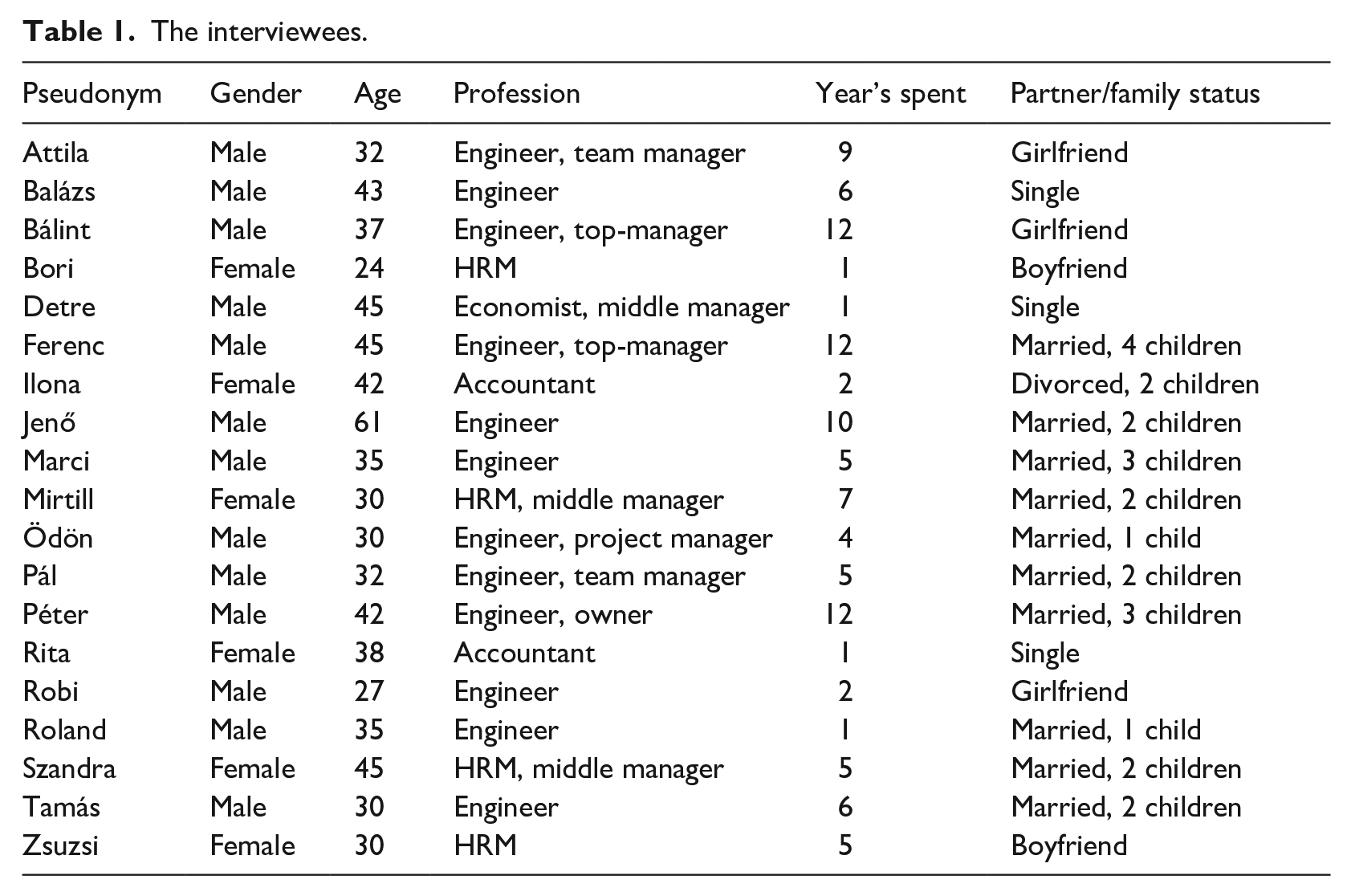
Nineteen semi-structured interviews were conducted before and after the Christmas party, following Rosen (1988). Interviewees included the key actors of the corporate Christmas (company leaders and organizers of the Christmas party). While selecting interviewees from the employees, we aimed for a sample sufficiently diverse concerning age, gender, organizational position, and years spent in the organization (see Table 1) until reaching theoretical saturation (Kvale, 2008). Interviews were between one and 2 hours long and transcribed verbatim. All respondents were ascribed pseudonyms in order to ensure confidentiality.
The interviewees.
Predefined key topics (Kvale, 2008) (organizational context and culture, previous Christmas parties, the Christmas season itself at the company, the current Christmas party and its relation to Christmas Eve) were complemented with topics arising from the researcher’s observations (the ideal employee, family-friendliness, gender relations), and with topics mentioned by interviewees.
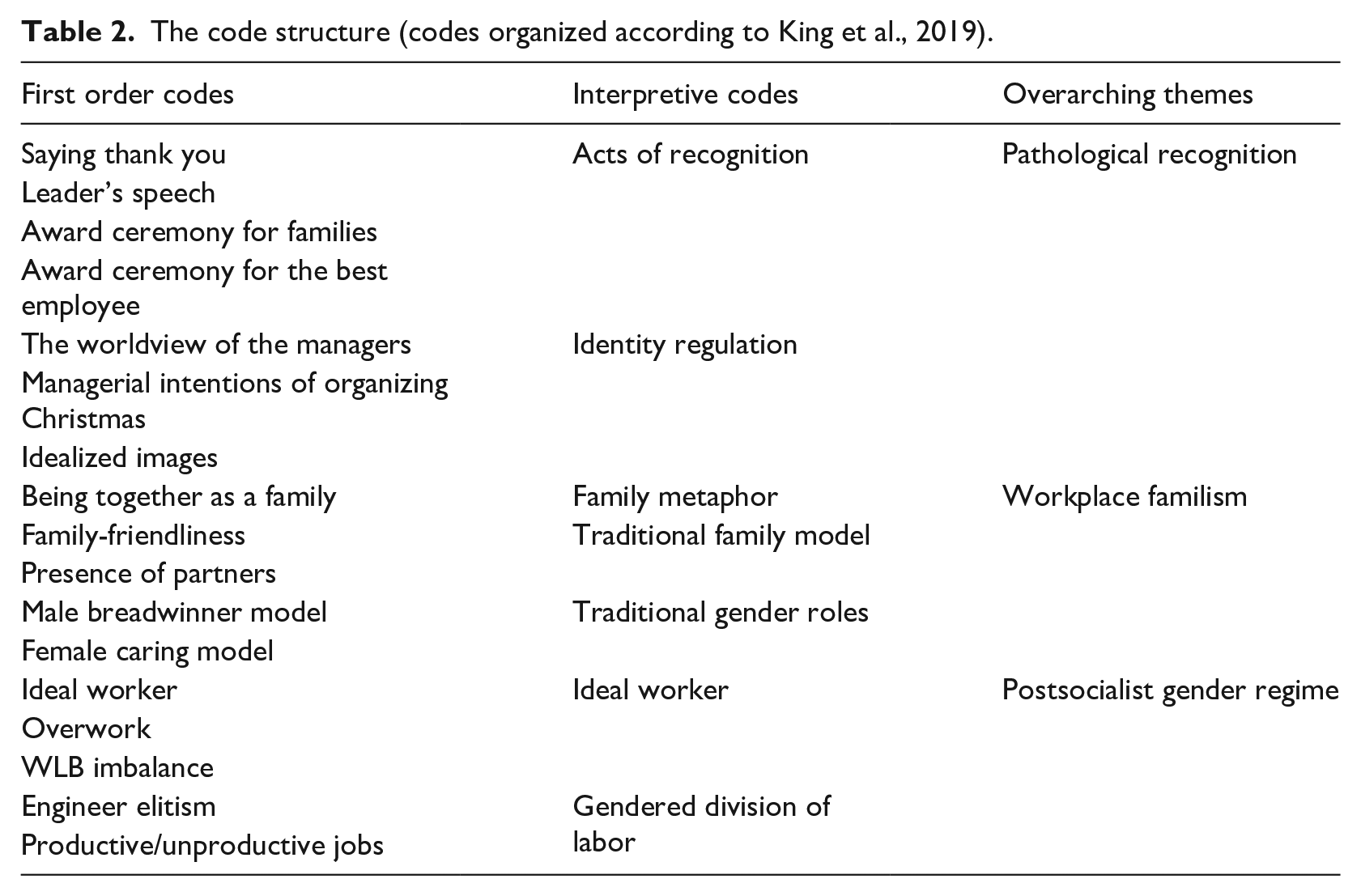
The data analysis process began with coding and thematic analyses (King et al., 2019) using Nvivo 10 (see Table 2). The first author organized interview texts and the research diary into several emerging first-order codes. The second author joined the data analysis when selected first-order codes were organized into second-order interpretive codes. Three overarching themes were identified through a back-and-forth process between the empirical material and the relevant literature: pathological recognition, workplace familism, and the postsocialist gender regime. The story of the Christmas party was reconstructed around three scenes, which were identified as particularly relevant in highlighting these important themes: (1) the leader’s speech, (2) the award ceremony for families, and (3) the award ceremony for the employee of the year, while the discussion reflects on the overarching themes.
The code structure (codes organized according to King et al., 2019).
Critical studies emphasize the importance of reflexivity to ensure validity and reliability (Alvesson and Sköldberg, 2000). Ethnographical researchers are active creators rather than passive recorders of data, so they should reflect upon their own values and ideological commitments (Thomas, 1993). In this case, both authors are women who share a constructionist view of gender and contest traditional understandings of femininity. We both have experience living in the socialist era and have observed changes in religious observance, gender expectations, family structures, childcare support, and organizational perceptions of women working in professional environments, both during and after the socialist era. We used a research diary for self-reflection and consciously searched for counterexamples in the text (Thomas, 1993), while intersubjective validation (Kvale, 2008) was achieved through our reflective dialogs.
The study’s limitation is that the subjective experiences of the employee’s partners are not considered. For this reason, we have been careful only to make analytical claims about managerial intentions and the interpretations of male and female employees. Female partners were not interviewed, but their behavior was observed at the Christmas party. Furthermore, this research has been conducted in a male-dominated company, and we might see different attitudes toward gender in different organizations. Nonetheless, it provides valid insight into how the male-dominated discourse on gender in the postsocialist region has seeped into organizational life.
The following ethical considerations were taken into account. Informed consent (Kvale, 2008) was ensured by sharing the primary research purpose (understanding the meaning of corporate Christmas) with the participants and asking for their agreement. Data were anonymized and treated confidentially, eliminating any information that might uncover the actual name of the company or respondents. While there might be a conflict between confidentiality and intersubjective validation (Kvale, 2008), the latter was supported by discussing the results with two close acquaintances of the first author, who had previously worked for the company, thereby raising validity without breaching confidentiality. Regarding potential consequences, we are unaware of any harm the study might cause unless confidentiality is breached. One possible positive outcome of the process is that these interviews might induce self-reflection among the participants.
Ritualized gender identity regulation in System Co
Founded by a Hungarian engineer, Péter, the System Group started as a small enterprise with 10 employees. During the 12 years of its existence, the company has evolved into a holding corporation with about 1000 employees, with several locations in Hungary and operations in four other countries. The research project was performed at the group’s headquarters in Budapest, where most Hungarian employees—about 350 people—work. The company’s primary business is delivering engineering and information technology services.
Organizational context: Engineer-elitism and alleged gender-neutrality
As System Co. grew, a holding company was established to include functionally divided small firms. It became apparent that engineering units produced income, while support units, including HRM and accounting, spend money. Consequently, male-dominated engineering units were labeled “productive,” whereas the female-dominated back-office was labeled “unproductive.”
Non-engineer female employees reported that the engineering profession is treated as superior to other occupations. They called this “engineer-elitism,” meaning “. . . it’s the engineer who knows everything best.” People from different professions were not treated as equal partners in the company because they did not possess the knowledge essential for the company’s existence. This is also reflected in promotion opportunities, salaries and informal relationships. Since this mainly affects women, it overlaps with gender inequalities that have been experienced. Péter was even humorously confronted with this by the HR manager: Because here, a woman is a woman, and it absolutely comes out in terms of the benefits package. [. . .] I think that it’s mostly not being a woman itself – though that’s part of it, sure – but that this is a support function, and this company is led by engineers. So here, it’s the engineer who knows everything best. (. . .) [I used to say] “we know, Péter, I’m not an engineer, and much less a man!” So, if you look at the managing directors, maybe XY [newly hired male managing director] is not an engineer, and otherwise, all of them have engineering degrees. (Szandra)
Engineer-elitism places women in a secondary position in the organization in two ways. First, it is the women who are not engineers and thus do inferior work and possess what is perceived to be inferior knowledge, which allocates a lower-status professional identity to them. Second, women undertake what is deemed unproductive work, and this functional division makes their lower status more visible. Additionally, in this company structure, women spend while men generate money, reproducing the male breadwinner model at an organizational level.
Women complained about differences in status, but they believed this was due to engineer-elitism, not gender. Interviewees emphasized equal opportunities for both genders and alleged gender neutrality. As proof of this, they refer to one woman engineer who has been promoted to lead the all-male Developer Division. However, the proportion of women engineers remains under 5%, and no other women in the productive units were in managerial positions. However, part-time job opportunities were mentioned as a further example of supporting women.
Furthermore, the company won the Best Workplace for Women Award and joined the Girls’ Day initiative, which is meant to make technical and natural sciences more popular among young women. Engineering employees echo the view that it would be great to have more women in the office, arguing that women would “domesticate” and “add color” to it. While equal opportunities are emphasized, an essentialist view of women remains present, maintaining the woman/caretaker association instead of emphasizing professionalism.
Gendering Christmas rituals at System Co
System Co. has had a Christmas event each year since it was founded. While HR is responsible for organizing the event, Péter has always been actively involved in this process. The Christmas party takes place on one of the last working days before the holiday, as close to Christmas Eve as possible, to ensure a genuine festive atmosphere. It begins around 7 PM and lasts until dawn. While this might cause difficulties for those with caring responsibilities or living out of town, they usually strive to find a solution for this one evening. Traditionally, the venue is an elegant, exclusive building in the city. The script contains the same repetitive elements each year: the top management greets the participants; there are managers’ speeches, followed by the handing out of awards and presents, dinner, music and dancing, with an interval for a prize draw, and further music and dancing. Employees can bring a plus-one who tends to be their current partner, but sometimes it is a sibling, friend, adult child or former partner. The guests number around 630 in total.
Saying thank you to the ideal worker and his ideal wife
The ritual: The speech
Péter, the owner, has given a speech every year since the company was founded. The style and critical elements of it have remained the same. The speech is intentionally focused on family, avoiding discussion of the business’ performance, for which they have a separate occasion in early January: Engineer Day.
The main message is to say thank you to the employees’ partners. In the one witnessed during the research, he started with a situational story, which was supposedly based on his own experience: “I am sure it has already happened to most of you,” he began, “that you intended to arrive home on time, but you did not manage, due to an urgent assignment. And you did not make it home on time, not even by bath time, and so you did not see your child either in the morning or in the evening.” (In Hungary, a good father is expected to arrive home from work when babies are supposed to have a bath at around 7:30 p.m.) He added: “we need to say thanks to the hinterland, to our partners, for their support, who need to be understanding when employees arrive home late from work.”
Traits and achievements recognized
In this speech, Péter spoke of a male employee, describing everyday hard work from a man’s perspective and said thank you on behalf of men to women. He pictured a family model in which the man is the breadwinner, whereas the woman ensures they have a warm home, takes care of their children and patiently waits for her husband. Therefore, the opportunity to attend the Christmas party is a kind of symbolic compensation for the partners in return for the hardship they endure, an acknowledgment of their background role and contribution to the company’s success. The “thank you” pertains to employees’ professional performance throughout the year and their partners’ “background performance” at home, providing idealized images of the ideal worker and (his) ideal wife, which correspond with traditional gender roles.
Saying thank you is a repetitive element in Péter’s yearly speech, which most respondents and Péter himself considered an indication of family-friendliness. Péter underlined that gratitude, especially at Christmas time, is essential. The Christmas party allows him to communicate directly with his employees’ partners. With this speech, he symbolically recognized the unpaid work of women who support men so that the latter can deliver a uniform performance. It is designed to provide social esteem for the achievements of women as housewives and caretakers, describing these performances as a valuable way of self-realization. In this instance, he emphasized concrete positive traits and abilities (warm, caring, patient), in contrast to a father being late, which allows women to construe a positive identity and to feel distinguished.
While not explicitly acknowledging the fact, these annual speeches normalize overwork and work-life imbalance for employees, two essential characteristics of the ideal worker. Although Péter reflects on it as something ostensibly negative, he eventually lifts it into a positive context. At Christmas, overwork is presented as a “heroic sacrifice” that not only the “soldiers of the system” but also their families make for a “sacred mission.”
Employees’ responses: Credibility, obedience, and resistance
Employees reacted to the speech’s messages in various ways. One of the team managers interpreted the speech as follows: I think it’s good if she [the partner] also sees the context of this organization, its motives, the managers, and their approach to things. This way, they too can get somewhat closer to what they had a negative experience of, from the other side what they experienced through their partner not being there, or not being there when they were needed most (. . .). What I mean is that if there’s work, work comes first. (. . .) Being, so to say, at the mercy of the company, and now they either need my husband, or they don’t, either he comes home, or he doesn’t. It makes this a bit more understandable, and it expresses the gratitude that the management invites the partner to the event. (Attila)
Here, the interviewee echoes the expected and internalized moral order for the ideal worker: “work comes first.” Although he perceives the subordinate role of female partners to this social order (’being at the mercy of the company’), he takes this for granted. The function of the Christmas party is to calm down everyday tensions about overwork and “manufacture consent” (Hermen and Chomsky (1988) from employees and partners. In other words, accepting this “thank you” from the leaders means accepting the social order that is being enforced, ensuring the obedience of both the worker and their partner.
However, despite this, there was some resistance to overwork among organizational members. For example, the previous year’s Engineer Day was raised by some interviewees who reflected negatively on Péter’s explicit statement that one could not make a living working 8 hours a day: At last year’s Engineer Day, to the dislike of many, Péter declared that we’d better forget about the 8-hour working day. (. . .) Now, declaring this, stating this officially, too, I felt this was almost a moral expectation, that you don’t think along the lines of an 8-hour day. (Jenő)
Presenting overwork as an individual financial necessity hides the company’s interest in it, and some interviewees perceived this external normative pressure and displayed some opposition to it. Employees have also lived the experiences that Péter recounted in his story, again displaying, at best, ambivalence: Me, specifically, I never arrive home before around seven each evening, and leave around six thirty, so I’m away from home for more than twelve hours. So, I don’t see them get up. All I have is that I make it home by bath time, so this isn’t okay. Well, whatever. (Roland)
As such, some interviewees appeared to doubt the real family-friendliness of the company because of its normalizing of overwork, which undermines the credibility of the recognition of the ideal worker’s additional effort.
In contrast to this, however, traditional, “background” or domestic female roles are hardly ever questioned, as the following quote illustrates: The woman needs to take a back seat, why couldn’t it be the other way round? – (. . .) in fact, a dinner like this would be strange there [at a workplace that primarily employs women], like, we welcome you dear husbands, who have supported [your wife] from the background. But (. . .) I don’t know if all women have an issue with this. My wife, for instance, is a typical example of someone who’ll never be disturbed by this because she likes it this way, that she’s in the background. [. . .] she has a degree, but I think if she’d never had to have a job, if she could spend all her time at home with the family and take care of the kids, that would be fine with her. (. . .) Whereas for a careerist woman, whose goal in life is to become the top manager of a company and be admired by two hundred people, this sentence might be quite painful, my wife would rather take it as an acknowledgement. (Pál)
At first sight, the respondent denaturalizes the woman’s domestic role, revealing power asymmetries, but he later then goes on to rationalize them. While there is an opportunity to question the gender order, he chose to naturalize it with the example of his wife, arguing that women freely choose traditional gender roles. Indeed, the sarcastic way he refers to “careerist” women devaluates that path toward self-fulfilment while validating Péter’s ideas as credible by describing caring roles as a fulfilling and autonomous way of life for women, using the example of his own wife. Highlighting the potential “painfulness” of the speech, he reveals that it denies recognition to those women who put their careers first, while it is a show of esteem for those who choose to be primary carers. However, in this instance, such recognition appears motivated far more by a desire to promote an acceptance of the prevailing gender order within the organization than to recognize such women as genuinely equal contributors to the company mission.
The ideal family: Fertility and heteronormativity awarded
The ritual: The award ceremony
Each year, managers’ speeches are followed by the awards ceremony. It was introduced by the HR manager, pointing out that Christmas at System Co. is traditionally about the family; therefore, they welcome married couples and the “System babies” who had been born in the year. They showed a picture of each couple and baby on a display and called the couples to the stage. These photos were also displayed in the corridors of the HR department. The newlyweds receive a wellness weekend for two. In contrast, those with a baby received a voucher for a baby shop, a playsuit with the company logo, and a subscription to a conservative family magazine “that Péter likes very much because he said it features excellent articles, and that was the feedback the mothers gave, too” (Zsuzsi).
The ritual elements of the award ceremony contribute to extending gendered identity regulation to the employees’ families, conveying familism as a central value. The greeting can be interpreted as a rite of incorporation (Van Gennep, 2011): the new family member (spouse, child) is introduced and accepted into the corporate community. The spouses and the babies “get hired” by HR, and their photos will be displayed in the corridors. They usually refer to the babies as “Engineer babies,” and the playsuit with the logo is designed based on the shirts they receive when they are baptized. Values important for the management are spread by circulating the “appropriate” family magazine.
Traits and achievements recognized
The managerial rationale of the award ceremony as part of the Christmas celebration is the following: (. . .) during the given year, things happened in the life of a family that were important to them. We strove to somehow pay attention, to acknowledge. (. . .) Advent is a period of preparation (. . .) dear colleagues, please do not forget at Christmas time that there is a big change, don’t just experience it like “oh well, it’s Christmas again,” but rather this is a Christmas like no other future Christmas will be, because this is a first one from a certain perspective. (Ferenc)
This quotation indicates that having a family with children is considered a positive accomplishment, one to be acknowledged, and that provides for a moment of recognition, both in the sense of re-identification and granting a certain status to it (Anderson 1996 in Honneth, 1996). It is presented as an essential contribution to society and the maintenance of the companies’ family culture. Even senior managers at the company are charged with providing a good example in this respect: I think my fellow managers, too, strive to radiate this. If you count how many kids the members of the management have between them, it’s far above the Hungarian average, so the average here is approximately above three. We’re setting an example, in a way. (Ferenc)
Senior managers are recognized, therefore, for setting an example by being successful both in terms of their career and their family, while, at the same time, heterosexual workplace romances are encouraged: “there’s nothing better than families being formed within the company” (Ferenc).
However, such recognition is interpreted in light of Péter’s view known by all that “the ideal employee has a wife, house, car and two or three children’, and thus, is satisfied, loyal and reliable, “does not make hasty moves’ and delivers uniform performance.” The ideal employee is not only financially dependent on the company because he needs to support his family and maintain their standard of living, but he also actively shares the company’s and managers” values with respect to some of the most personal aspects of their family life. This indicates how these award ceremonies are not only about recognizing having babies or marrying that reflects the values of societal familism but also about being a loyal and reliable employee who performs well.
Employees’ responses: Credibility, obedience and resistance
The recognition performed in the award ceremony was positive but also exclusionary since it implicitly denied recognition of single people, along with divorced and non-heterosexual couples, from the community. This was visible in the way the Christmas party was organized, with company employees expected to bring a heterosexual partner, an award ceremony for couples, and with the band playing wedding music. As part of the familist ideology, heteronormativity and living in a relationship pervades the day-to-day life of the organization, providing clear, prescribed images for employees’ self-identification. However, the reaction to this pressure was expressed in different ways: For me, what blew a fuse was that you must attend with a partner. No, you don’t have to, but you almost do have to. (. . .) I could have brought ten people at least, too, but I think that would’ve been a lie to myself, too, (. . .) whereas they aren’t even my immediate relative or my partner (. . .) therefore I didn’t want to go, because everyone’s bringing someone, and they’ll be chatting with them. Who’ll chat with me? No-one, I thought, I’ll be all alone there (. . .) so that awoke some fears in me. (Rita) Sure, the fact that I brought this female friend, did have a role that my colleagues won’t badger me why I’ve come alone once again. (Balázs)
As a consequence of familism, being single is viewed as inconvenient and needing to be rectified. In the case of Rita, it evoked uncertainty and fear of transgressing the norm, but at the same time, she wanted to protect her authenticity and not lie to herself. She resisted by choosing not to attend the party at all, as did many singles in the company. Others tried to adapt and brought a plus one for appearance’s sake, as with Balázs, while others took a friend, a very recent partner, an ex-spouse, a sibling or another relative.
On one occasion, as a form of resistance, the entire accounting department reportedly agreed that they would not bring anyone to the Christmas party. The following year, however, the group leader was in a relationship and brought her partner to the Christmas party, and the remaining singles did not organize themselves. Although the previous years’ action was not penalized, the normative power of organizational culture and the wish to belong to the majority undermined collective resistance. Christmas rituals are also relaying informal misrecognition for those who do not live in heterosexual relationships and employees who were excluded reported identity threats.
Crucially, those in relationships did not acknowledge the discriminative impact of company culture. Instead, from this perspective, blame was put on singles for their situation, claiming that they could find a partner, at least in the company, since workplace romances are encouraged: Just think about it, you more or less know the entire company, it’s not that big yet, if no-one has ever crossed your way at the company whom you liked, then yes, that’s an issue, who should you take [to the party], if you don’t want to be alone. (Mirtill)
Blaming singles for their situation deepens disrespect, as it degrades their way of living, withdrawing the social esteem necessary for healthy identity formation. Christmas rituals are pervaded by familism, intertwined with heteronormativity, since being compliant to the norms of familism is a necessary condition to being included in the organizational community, and deviation from this norm is penalized. To celebrate Christmas together is to celebrate the organization’s existence (Rosen, 1988); thus, being excluded from the rituals questions one’s existence as an organizational member. Ultimately, being single and an employee of the System Co. are constructed as incommensurable identities.
Celebrating the ideal workplace family
The ritual: The “best employee of the year” award
At a previous Christmas party, the HR manager and event organizer reportedly received the Best Employee of the Year Award, based on the votes of the employees, and was greeted as the “mother of all employees” by Péter when he gave her the award: So, for us, [Christmas] at home is already about the children. Here, it’s about the colleagues - I almost said our children here (laughs). (. . .) At the previous Christmas party, I was one of the employees of the year, and it’s always been me handing over the awards, and then Péter took the microphone from me, and then he said that [I was] the mother of all of us, and then for half a year, everyone just called me Mum. Sometimes, I have a slip of the tongue and say “kids.” – And by the way, symbolically speaking, who is the father at the company? – Well, everyone’s dad is Péter, in my opinion. (Zsuzsi)
Péter, the Father, is an engineer and the founder with all the responsibility and authority for the business. The Mother is an HR expert responsible for organizing corporate events, among other HR-related tasks, thus working in an unproductive business unit. By calling Zsuzsi “everyone’s Mum”, Péter reinterprets HR’s performance in terms of the ideal wife. He underlines the traditional feminine roles attributed to the HR profession, namely that HR’s task is “patting people’s heads” (Szandra), that is, taking care of corporate children.
Additionally, in this “corporate family” the division of tasks in organizing the Christmas party is highly gendered: It’s Zsuzsi’s team who, from the background, ensure that everything runs smoothly, paying attention to everything. While Norbert and the others [leaders], who make the speeches, put in a stronger, more obvious appearance, and they sometimes can even relax. Zsuzsi and the others, I don’t think so, their chances [of relaxing] are rather slim. (Tamás)
The female HR employees and secretaries are responsible for organizing the party and taking the role of hostess, but they generally stay in the background. Their male co-workers help out sometimes (e.g. when physical strength is required), yet the responsibility for the smooth flow of the entire event lies with the women. During the speeches, the HR manager stood at the stage’s side and ensured that the agenda was followed. The spotlight was on the male leaders who, as the hosts, welcomed the guests, gave out speeches and awards, and shook hands with the employees. Women ensured that the employees as “family members” felt “at home,” in the same way as it is women’s duty in the private sphere to take care of the preparations and household chores related to Christmas, to set up and transform their home for the holiday (see Vachhani and Pullen, 2011).
Traits and achievements recognized
Merging the two images of the HR professional and the mother from work and non-work spheres during the award ceremony, Péter reproduces the gendered image of the HR profession and HR professionals and women’s backstage roles in the organizational community. Caring, organizing, and managing from the background, as femininized performances, are considered as positive, contrastive and credible, and provide self-esteem for Zsuzsi, as was clear from her comment. Yet, this did not result in higher salaries for HR employees, with such praise a predominantly ideological substitute for such remuneration.
Employees’ responses: Credibility, obedience, and resistance
However, it is not just Péter who champions this culture. As we have seen, many employees echo his words, and Zsuzsi happily accepts it. These are also important actors in constructing gendered identities in a largely reductionist way, validating the positioning of Zsuzsi as a predominantly maternal subject by calling her “mummy” without any concern. Moreover, a double burden for HR “girls” was mentioned as they “work hard and organize” and for them, “it is more convenient if the husband is not there, who also has to be groomed.” (Balázs). This again highlights that family-friendliness does not apply to all employees. It is construed from a male perspective and inflected by workplace familism.
Gendered recognition and identity regulation
Merging professional and familial roles into each other in the performance of Christmas rituals provides a symbolic resource for the pursuit of workplace familism and the positioning of the supervisor as a parental figure who nurtures, guides, and directs (Restubog and Bordia, 2006). The case of Christmas in System Co. highlights that the maternal figure and parent-child relationship might complement it. Embracing the maternal-paternal-child relationship immanent to workplace familism, that is, by definition, infused with a power asymmetry and patriarchal control, makes gender identity regulation via Christmas rituals particularly potent.
Workplace familism also pertains to the company as an extended family: There [on the 24th, Christmas Eve, you have] the immediate family, whereas here [you have] your quasi-extended family, and this is absolutely common to everyone. (Attila)
Christmas rituals, therefore, reinforce the existence of an extended family in a double sense. Employee’s partners and children become members of an extended corporate family through the rituals of incorporation at the Christmas party. Moreover, by celebrating Christmas together, the company becomes part of an employee’s extended family, blurring, if not dissolving, boundaries between work and private life, requiring people to incorporate a slice of their lives and identities from outside the company. Employees and their families are exposed to direct generalized recognition that aims to provide social esteem for certain approaches to self-fulfilment. In this way, Christmas in System Co., which takes place outside of working hours, does not exercise control by tearing away the employee from their family as many other office Christmas parties do.
On the contrary, it brings the employee’s family under the temporary supervision of the company. The official managerial messages conveyed through the ceremonial acts of recognition offer idealized social identities that serve to establish the norms for a work-friendly family, cowering under a rhetoric of family-friendliness. Recognition at Christmas is addressed to “productive” engineers and their reproductive wives, so (workplace) familism is not only a gendered but also a performance-oriented, repressive organizational phenomenon.
Discussion
This study contributes to critical organizational studies by applying Honneth’s theory for unraveling “contradictions of systems of recognition that serve (. . .) to bind them to externalized priorities and duties” (Hancock, 2022: 18), with a particular focus on the gendered subtext of the organization (Acker, 1990, 2006). Analyzing gender identity regulation as performed through the ritualized acts of recognition at the office Christmas party in a postsocialist context, the study highlights the subtle way in which societal familism, as the prevailing ideology of the region, is woven into the texture of organizational reality.
Furthermore, this study links pathological forms of recognition to individual identity regulation, thereby informing critical studies of identity regulation (Alvesson and Willmott, 2002). First, we argue that recognition performed at Christmas was ideological, aiming to regulate the identities of employees and their family members. Second, we highlight that the ideology enshrouded in recognition was workplace familism, and that how it becomes constitutive to the postsocialist gender regime. Third, based on our results, we identify three pathological forms of recognition that lead to gender identity regulation and thereby perpetuate postsocialist gender regimes.
Firstly, recognition must be positive, contrastive and credible to be effective. In our analysis, we showed that in each scene, a possibility for crafting positive self-identities was offered both for employees and their family members. Regarding gendered forms of recognition, we have observed little resistance to the normative expectations enacted through Christmas rituals, and interviewees considered the “thank you” as credible. The personal tone of Péter, the exemplary behavior of the management, and its consonance with macro-level societal familism also underscore this credibility. Several ritualized acts, like the festive character of the leader’s speech and the award ceremonies, were built upon exceptionality (Hancock, 2022), that is, recognition was based on an implicit contrast with other lesser achievements.
In all cases, however, these acts of gendered recognition were not accompanied by material remuneration. They remained symbolic and, therefore, ideological in form, achieving the goal of providing motivational resources for voluntary forms of subordination in a seemingly non-oppressive manner. In this regard, this study speaks back to studies about the constraining effect of seemingly innocent practices of Christmas celebrations (Hancock and Rehn, 2011; Ortlieb and Sieben, 2019), and highlights how repetitive recognition, deeply embedded as thankfulness under the guise of a Christmas party, might interfere in individuals’ identity formation.
Second, the study reveals that workplace familism is a central and distinctive ideological element of the subtext (Acker, 2012) of the postsocialist gender regime. Symbolic recognition deployed through Christmas rituals aims that workers “accept the system of inequality” (Acker, 2006: 454), along with the symbolic construction of frontstage as a “masculine zone,” and backstage as a “feminine zone” (Wasserman, 2012) restricting women’s effectiveness to the private sphere (Bella, 1992). Celebrating Christmas also embeds the organization into the texture of society: rituals organized under the aegis of family-friendliness enable the recursive reproduction of familism both on the societal and organizational levels.
While establishing an organizational anchor for studies on societal familism (Dupcsik and Tóth, 2008), by analyzing it as a managerial ideology masquerading as family-friendliness, this study also provides a fundamental reinterpretation and reconceptualization of workplace familism, compared to its previous positivist antecedent (Restubog et al., 2013; Restubog and Bordia, 2006). Through a critical gender lens, this study shows that paternalism is an underlying value of workplace familism while highlighting its roles in gender regimes and patriarchy (Acker, 1994). It also indicates that the leader has a legitimate license to be involved in both work-related and private issues by incorporating festive rituals from the social realm into the professional sphere. Our findings extend Ackers’ theory of the ideal worker by adding a further layer to the gendered image of the postsocialist ideal worker, such as having three or more children (Dupcsik and Tóth, 2008) and heteronormativity (Pringle, 2008), while supporting workplace romances challenges Acker’s (1990) notion of the asexual workplace. In sum, workplace familism perpetuates the “backlash” against recognizing gender inequalities.
Third, the case of Christmas suggests that workplace familism as a managerial ideology leads to pathological forms of recognition, such as informal misrecognition (Klikauer, 2016), overidentification (Hancock, 2022; Klikauer, 2016), and reification (Honneth, 2008). Workplace familism enacted through ritualized acts of recognition results in informal misrecognition (Klikauer, 2016). Familist discourses and related Christmas rituals implicitly support heteronormativity and fertility, as single and LGBTQ identities are constructed as inferior compared to the idealized married man/woman and are not the target of ritualized acts of recognition, thereby resulting in symbolic exclusion. This form of misrecognition was unmasked partially by the comparatively ineffectual resistance to the celebration by the few single employees, while it remained invisible to (or ignored by) the majority of the employees.
Christmas rituals took the form of generalized mass-recognition (Klikauer, 2016), and were pervaded by familist discourses. They are intended to achieve overidentification (Hancock, 2022) with the underlying values of the postsocialist gender regime, which reaches beyond the boundaries of the organization involving non-work selves and social competencies in the company (Fleming and Sturdy, 2011), interfering with home-related identity work, and extending gender identity regulation to the employee’s private sphere. Therefore, it becomes constitutive of the lifeworld of the employees and their family members in a colonizing way. This extends Ortlieb and Sieben’s (2019) findings that both excluding and including women in social events can be disadvantageous by highlighting that involving female partners provides an opportunity to intrude into the identity work of those not employed by the company and perform pathological, informal mass-recognition (Klikauer, 2016) more effectively, constructing a gendered social order outside of work, which aligns with corporate interests.
Furthermore, workplace familism contributes to a process of identity formation that results in reification (Lukács, 1971), where the ritualized recognition that naturalizes the male breadwinner model and women’s reproductive function strengthens the economic dependence of both the male employees on the company and their female partners on their husbands, and hence, the whole family’s dependence on the company. The family’s value is acknowledged as it ensures the supply of a productive human resource for the company. Another aspect of this is that this ritualized recognition indicates an instrumentalized process of identity formation, along with the idealized images of the ideal worker and wife, where both employees and their partners might relate to themselves as calculable resources in performing paid and unpaid work for the company and maintaining a gendered division of labor both at work and at home.
Conclusion
In conclusion, this article has established that workplace familism is a central managerial ideology constituting the postsocialist gender regime through the acts of symbolic recognition enacted at the office Christmas party, resulting in gender identity regulation. It provides evidence that multiple forms of gender regimes exist. Due to the postsocialist legacy, gender equality is supported in the sense that having a full-time job for women is taken for granted and widespread; at the same time, traditionalized “backstage” identities are offered for them, emphasizing their reproductive role as a virtue. This article provides evidence for the argument that recognition as a familist ideology is crucial in reinforcing gender inequalities and freezing the postsocialist gender regime without exercising overt oppression, while it unravels the recursive relationship between societal and workplace familism diffused through acts of recognition at Christmas celebrations. Although this article presents the postsocialist case, practices of retraditionalization are also evident in Western European countries, offering lessons for those seeking to cast a critical eye over such developments.
Future research could address the identity construction of partners involved in family-friendly social events as potential sites for organizational recognition and/or managerial identity regulation. Moreover, it would be worth examining whether societal familism is embraced in female-dominated organizations. Indeed, investigating the enactment of workplace familism in different countries in the region through a critical gender lens might further enrich the academic understanding of postsocialist gender regimes, while studying workplace familism as a gendered phenomenon in different socio-economic contexts could further augment knowledge about gender regimes themselves.
Footnotes
Acknowledgements
Our sincere thanks go to András Gelei and László Radácsi for their invaluable support throughout various stages of the research project. We are also grateful to Beáta Nagy for her inspiring comments. We would also like to thank the anonymous co-editor and the two reviewers for their encouraging and constructive feedback on earlier versions of the paper.
Funding
The author(s) received no financial support for the research, authorship, and/or publication of this article.
