




Abstract
It sometimes appears that alternative organizations are doomed to perpetuate the systems they aim to transform, as efforts to avoid co-optation entail retreat from the very engagement social change requires. Scholars then face a dilemma: do we reveal these degenerative processes in existing alternative organizations and reinforce disillusionment, or avoid such critique and endorse ineffectual strategies? To address this question I draw on Erik Olin Wright’s identification of two broad strategies of social transformation adopted by alternative organizations. Symbiotic strategies are those that aim to change the existing system via incremental reform, such as trade unions’ collective bargaining. Interstitial strategies, by contrast, are those more radical approaches that seek to prefigure emancipatory alternative systems, such as mutual aid networks. The first contribution this paper proposes is a mapping of these social transformation strategies to distinct forms of degeneration, understood as inadvertent reproduction of the hegemonic system. Organizations adopting the symbiotic strategy are particularly vulnerable to the more well-studied forms of degeneration that result from partial alignment with the hegemonic system—what I call exposure degeneration. Organizations adopting the interstitial strategy are instead vulnerable to less well-studied forms of degeneration resulting from insufficient engagement with the hegemonic system—what I call insulation degeneration. Although this model may appear to place alternative organizations in a catch-22, I draw a more hopeful perspective from theories of performativity that highlight the relationship between socially transformative agency and social reproduction. Unpacking the necessary impurity of performativity leads to the paper’s second contribution: while both practitioners and scholars of alternative organizations can pursue social transformation only via impure critical performativity, awareness of this constraint can foster reflexivity regarding the agential scope that remains.
Keywords
Introduction
Alternative organizations can generally be characterized by their shared aim of bringing about a more just, emancipated society (Dahlman et al., 2022; Just et al., 2021; Parker et al., 2014), yet their limited success in changing society beyond the boundaries of the organization grounds recriminations across this broad movement (Dean, 2016; Fraser, 2019; Srnicek and Williams, 2015; Zanoni, 2020). Much theorizing around alternative organizations has traditionally focused on the risk of degeneration, which names various mechanisms by which alternative organizations tend to lose their alternative character as they develop, thereby contributing to the maintenance of the prevailing system. Through such critiques, alternative organizations have become sensitive to the risks attending engagement with mainstream organizations and systems. Indeed interest has grown in recent decades regarding prefigurative approaches to social change that precisely eschew such engagement, instead directly ‘embodying a different type of society within the old one’ (Monticelli, 2021: 107). In response, however, we are now witnessing a growing current of disillusionment with the prefigurative approach. This stream of research highlights how prefigurative movements’ intentional resistance to both organizational structure and engagement with hegemonic actors undermines the efficacy of their coordination and influence, thereby inadvertently reinforcing the very hegemony they intend to oppose (Dean, 2016; Srnicek and Williams, 2015). In this way, critical scholarship of alternative organizations paints a bleak picture: alternative organizations ultimately perpetuate the systems they aim to transform, whether by acquiescing to and channeling the system’s dictates or by failing to engage with the system at all, thereby rendering their efforts irrelevant.
Simultaneously, an important debate has been ongoing in the critical management studies (CMS) literature regarding the efficacy of our scholarship, particularly in this journal and in special issues of Human Relations, M@n@gement and Culture and Organization. This debate has coalesced around the concept of critical performativity, or ‘active and subversive intervention’ into the social reproduction of the hegemonic system, usually as performed by academics (Spicer et al., 2009: 538). Where CMS is in part defined by its anti-performative attitude toward mainstream management (Fournier and Grey, 2000), this debate centres concern that critical scholarship like the above risks extending such anti-performativity to alternative organizations in a manner that neuters attempts at social transformation and thereby paradoxically reifies the hegemonic system (Alvesson and Spicer, 2012; King, 2015; Koss Hartmann, 2014; Schaefer and Wickert, 2016; Spicer et al., 2016; Wickert and Schaefer, 2015). The question the present paper aims to answer, therefore, is how can we critical scholars study alternative organizations in an appropriately demanding and discerning manner without thereby stifling social change efforts?
To answer this question the paper unfolds as follows. Section 2 categorizes alternative organizations’ social change efforts according to two distinct strategies presented in Erik Olin Wright’s theory of social transformation. Symbiotic strategies are those reformist approaches that aim to change the rules of the existing system via incremental modifications ‘that simultaneously make the system run more smoothly and expand the space for subsequent transformations’ (Wright, 2019: 55). Examples include collective bargaining by trade unions, lobbying by social movements to change laws, and efforts by B corporations to model better business practices. Interstitial strategies, by contrast, are those more radical approaches that ‘seek to build new forms of social empowerment in the niches, spaces and margins of capitalist society, often where they do not seem to pose any immediate threat to dominant classes and elites’ (Wright, 2010: 326). Examples include mutual aid networks directly addressing unmet needs, ecovillages prefiguring a sustainable society and open-source projects that subvert ownership norms.
Section 3 explores mechanisms inhibiting these social transformation efforts. I argue that organizations adopting the symbiotic strategy are most vulnerable to commonly-cited forms of degeneration, such as mission drift and oligarchization, and that the interstitial strategy can be understood in part as a defensive response to these risks. However, I posit that this defensive response renders organizations adopting the interstitial strategy vulnerable to mirror-image forms of degeneration, such as the purity trap and organizational paralysis, which have received less systematic attention in the alternative organizations literature. The first contribution of this paper, therefore, is a mapping of the forms of degeneration faced by the symbiotic and interstitial strategies—respectively exposure degeneration and insulation degeneration—entailed by each strategy’s relationship to the hegemonic system.
While this model suggests that alternative organizations face a double bind, Section 4 proposes a more hopeful perspective drawing on Butler’s (2006) suggestion that impurity in social reproduction enables agency. I propose the term impure critical performativity to call attention to this dependence of social transformation on some degree of social reproduction. I then elaborate this concept via Callon’s (2007) exploration of the performativity of theory-both academic and folk-which further problematizes sharp distinctions between academics and practitioners as agents of critical performativity.
The remaining sections demonstrate the value of impure critical performativity as the second contribution of the paper. Section 5 uses this concept to reappraise the relationship between degeneration risks and social transformation strategies in alternative organizations, arguing that while an approach based solely on avoiding degeneration risks might recommend a middle path between the symbiotic and interstitial strategies, the concept of impure critical performativity suggests that courting these degeneration risks is in fact necessary to the pursuit of social transformation. Furthermore, whereas this account might appear to delegitimize academic critiques of alternative organizations’ social transformation approaches, Section 6 applies the same analyzis to the strategic choices made by CMS scholars regarding the adoption of a more reformist or radical approach. On this basis I advance the claim that both practitioners and scholars of alternative organizations can pursue social transformation only via impure critical performativity, and that awareness of this constraint can foster reflexivity regarding the agential scope that remains. As an illustration, Section 7 offers a reflexive account of the impure critical performativity of this paper, highlighting respects in which it contributes to the reproduction of arguably oppressive categories as a necessary element of its social transformation strategy.
Social transformation strategies in alternative organizations
The Real Utopias project, spearheaded by the late Erik Olin Wright, aims to develop a theory of social transformation that identifies mechanisms of reproduction of the hegemonic system and scope for agency in favour of change against such mechanisms (Wright, 2010, 2019). Real utopias, on this account, are realizable alternatives to the prevailing social order (Elder-Vass, 2022). Wright suggests that the range of real utopias can be understood as nested sets: desirable alternatives are all those that would be preferable to the status quo; viable alternatives comprise those desirable alternatives that would be internally stable, given our understanding of how social institutions work; and achievable alternatives are those viable alternatives that can be reached given the existing hegemonic system. On this basis, Wright defines three broad categories of approach to social transformation: ruptural, symbiotic, and interstitial. The ruptural approach, whereby an existing social order is replaced with a viable alternative outright, is usually understood to require revolutionary seizure of state power. The other two strategies, by contrast, can be pursued at the organizational level and therefore form the basis for the following analyzes.
Symbiotic social transformation is described as progressing via achievable alternatives, where the hegemonic system is incrementally modified in the direction of a more emancipatory viable alternative in a manner coherent with the interests of dominant actors within that system. Wright illustrates this category of strategies with the example of class compromise as pursued by social democratic parties and labour unions. These are arrangements that ‘solve certain real problems faced by capitalists and other elites’ (2010: 337), such as those relating to complex coordination of workers. At the same time, however, such bargains deliver certain advantages to workers, ideally laying the foundations for further emancipatory action. This strategy can be seen in various types of alternative organizations. Many social enterprises, for instance, engage in pragmatic compromise with more hegemonic clients and partners in order to ‘remain in [a given] industry, [while] seeking to change it from within’ (Dahlman et al., 2022: 1973). In the realm of cooperatives, Paranque and Willmott (2014) highlight how the ownership and governance structures of the John Lewis Partnership are sufficiently aligned with those of hegemonic actors to enable the cooperative to effectively compete against its joint-stock counterparts. Pragmatic compromise with hegemonic actors is similarly commonplace in the official politics and institutionalization practices of social movement organizations and alternative political parties (Alves and Gomes, 2018; Husted et al., 2022; Spicer and Böhm, 2007; Tarrow, 2011).
Interstitial social transformation, by contrast, works to build viable alternatives within the margins of the hegemonic system, usually in a manner that does not overtly ‘pose any immediate threat to dominant classes and elites’ (Wright, 2010: 305). Wright offers Wikipedia and similar commons-based organizations as examples of projects adopting this approach. By making use of the interstitial space of the early-2000s internet, alternatives to existing models of managing and distributing information were built according to anti-capitalist principles, without the need for direct confrontation with incumbent actors. Through the success of this ecosystem of alternatives, limits on how production and consumption can be organized were revealed as ‘simply the effect of the power of specific institutional arrangements’ (Wright, 2010: 334). The interstitial strategy thus involves, in the short-term, the creation of ‘emancipatory enclaves within capitalism that enable people to live very different kinds of lives’ (2019: 80), at least in some aspects of social life. In the longer term this strategy aims to erode the limits imposed by the hegemonic system and ultimately replace it with an emancipatory alternative. This broad strategy is prominent in literatures addressing prefiguration (Monticelli, 2021) and community economies (Gibson-Graham, 2006; Zanoni et al., 2017). We can identify the interstitial approach in social enterprises and cooperatives that adopt a ‘defensive strategy’ of establishing relatively insulated market spaces by building alliances to ‘protect cooperatives against the excesses of competition’ (Jaumier et al., 2017: 89). In social movement organizations, similarly, we can see the interstitial strategy in those that focus on more radical or direct action (Spicer and Böhm, 2007; Tarrow, 2011). Such social movements typically cultivate some degree of ‘opposition (whether instrumental or symbolic) to existing institutions and cultural values’ (Rothschild-Whitt, 1976: 79), and often aim to foster ‘autonomous social space’ with boundaries sufficiently strong to ‘shut out [. . .] the power of the forces of domination such as capital and the market’ (Arthur et al., 2008: 30).
Degeneration in strategies for social transformation
A great deal of research regarding alternative organizations has focused on mechanisms of degeneration, or the ways in which these organizations ‘are too weak to confront capitalism and so they will either adapt to its logic or fold’ (Kokkinidis, 2015: 861). In either case, the organization contributes to the maintenance of the prevailing system by failing to realize a viable alternative. The concept emerges particularly from the literature regarding cooperatives (Diamantopoulos, 2012; Storey et al., 2014), but similar phenomena are identified in other alternative organizations (Alves and Gomes, 2018; McAdam, 1982; Rothschild-Whitt, 1976; Sanders and McClellan, 2014; Spicer and Böhm, 2007; Tarrow, 2011). A variety of forms of degeneration have been identified (Cornforth et al., 1988; Jaumier and Daudigeos, 2021), but for the sake of brevity we will focus here on just two: goal and organizational degeneration.
Goal degeneration - otherwise termed mission drift (Audebrand, 2017; Cornforth et al., 1988) or goal displacement (Cheney, 1995; Rothschild-Whitt, 1976) - refers to situations in which an organization’s plural values become compromised and dominated by goals compatible with the hegemonic system. For organizations that aim at both social and economic value, such as cooperatives and social enterprises, the economic aims often ultimately diminish and undermine the social purpose (Bousalham and Vidaillet, 2018; Cornforth, 2014; Cornforth et al., 1988). Causes of such degeneration include the excessive influence of more mainstream organizations’ values and priorities (Cheney, 1995; Esper et al., 2017; Leca et al., 2014). For instance, where management discourse is too readily adopted within alternative organizations, the tension between the profit motive and the organization’s other goals is suppressed and ‘other ways of organizing that could better suit a nonprofit organization are rendered at best obscure and at worse un-discussable’ (Sanders and McClellan, 2014: 80).
Organizational degeneration is a related process, naming the tendency for the structure of the alternative organization to become more similar to its hegemonic counterparts (Cornforth et al., 1988). This phenomenon is commonly termed oligarchization (Jaumier, 2017; Michels, 1999; Osterman, 2006), as convergence with hegemonic ways of organizing usually entails increasingly concentrating power—formally or informally—in the hands of powerful actors invested in the hegemonic system. The influence of the hegemonic context is understood to be a key driver of this process, pushing even organizations with strong democratic commitments toward more hierarchical decision-making structures, given the prevailing belief that such structures are necessary for organizational efficiency and economic survival (Storey et al., 2014).
It would appear, however, that alternative organizations adopting the symbiotic strategy are more vulnerable than their interstitial counterparts to both forms of degeneration, given their active pursuit of engagement with the hegemonic system. In terms of goal degeneration, we have seen that the symbiotic strategy explicitly prescribes compromise with dominant actors (Alves and Gomes, 2018; Spicer and Böhm, 2007). Regarding organizational degeneration, similarly, the symbiotic strategy requires participation in mainstream arenas of engagement—such as markets and political races—which often demand or highly incentivize conformity in terms of organizing structure (Esper et al., 2017; Paranque and Willmott, 2014).
We can thus understand why groups championing interstitial strategies often emerge as a direct response to the degeneration, real or perceived, of organizations adopting the symbiotic approach (Tarrow, 2011; Wilson and Swann, 2021). Yet it is important to recognize that interstitial strategies face degeneration risks of their own. Though not often explicitly labelled as such in the literature, I suggest that the following dynamics should also be understood as forms of degeneration as they represent failure to effectively confront the hegemonic system and thereby contribution to its unimpeded reproduction.
While organizations adopting the interstitial strategy might effectively resist mission drift, it is precisely this resistance that renders such organizations vulnerable to a mirror-image form of goal degeneration we might term the purity trap, where a refusal to compromise results in failure to effectively pursue its goals. In alternative organizations that operate on the market, this form of degeneration typically amounts to market failure (Cornforth, 2014; Cornforth et al., 1988). Yet even in those that are able to stay in business, a refusal to accept some value compromises so as to achieve economic scale is often criticized for keeping the organization ‘separated from the economy and the wider society [. . .] leav[ing] capitalism unchallenged’ (Kokkinidis, 2015: 867). In the realm of social movement organizations, this dynamic can be seen in abstention from the messy requirements of political engagement, where vigilance against political or moral compromise is vulnerable to critique as a retreat into mere lifestyle politics (de Moor et al., 2017). Parker and Parker highlight that this purity risks ‘covertly support[ing] the status quo by not challenging it’ (2017: 1378).
Similarly, through their resistance to oligarchization, organizations pursuing the interstitial strategy find themselves vulnerable to a corresponding form of organizational degeneration we might term organizational paralysis, where a reluctance to impose rules and organizing structures limits the organization’s ability to realize social change (Shanahan, 2023). The pursuit of consensus in cooperatives and social enterprises, for instance, ‘can slow down the organization’s responses to market opportunities and affect the long-term viability of the organization’ (Kokkinidis, 2015: 863). This dynamic is also common in social movements, as demonstrated in the frustration some express at the World Social Forum’s explicit commitment not to take action or decisions as an organized body (Patomäki and Teivainen, 2004). While this aversion to organizing structure is motivated by vigilance against the risk of reproducing oppressive dynamics and degenerating into oligarchy, this reflexivity risks its own degeneration into ‘actionless deliberation’ (Reedy et al., 2016: 1563) and famously interminable meetings (Polletta, 2002).
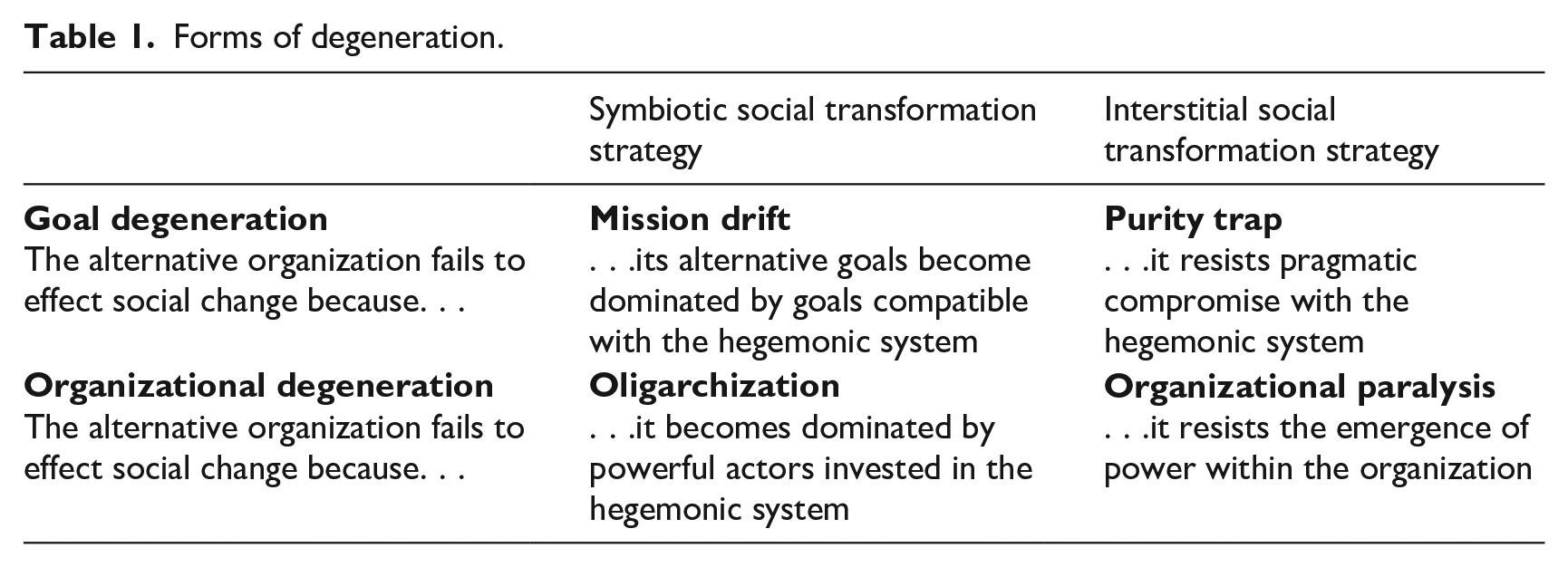
Table 1 summarizes these four forms of degeneration. While recommendations for the prevention of specific types of degeneration are not hard to find in the academic and practitioner literature, this framework highlights the bidirectionality of degeneration and thereby the risk that efforts to avoid one form will tend to foster its mirror. Indeed, I posit that this is a fair characterization of the relationship between the symbiotic and interstitial social transformation strategies. Considering the relationship between alternative organizations and the status quo in terms of Luhmannian systems theory, Cheney characterizes alternative organizations as social systems that ‘must not be so open as to lose [their] cohesiveness and distinctiveness’ in relation to external systems (1995: 173). Yet as organizations that aim to influence the external system, some degree of engagement appears necessary. Alternative organizations thus face a ‘tension between the need to integrate within a whole and the need to distance oneself from this whole’ (Malo et al., 2012: 282), that is, a tension between exposure and insulation.
Forms of degeneration.
Building on Malo et al.’s (2012) account of dialogic tensions in cooperatives, we can model alternative organizations’ social transformation strategies and attendant degeneration risks as defined by their relationship to the centripetal and centrifugal forces of the hegemonic system. This model is represented in Figure 1. The symbiotic strategy relies on greater exposure to and engagement with the hegemonic system for its social transformation efforts, and therefore organizations adopting this strategy are more vulnerable to the exposure degeneration risks of mission drift and oligarchization. On the other side, the social transformation efforts represented by the interstitial strategy depend on distance and difference from the hegemonic system, and thus organizations adopting this approach are particularly vulnerable to the insulation degeneration risks of the purity trap and organizational paralysis. A prosaic reading of this model might suggest that alternative organizations need to tread a middle ground between exposure and insulation. A more pessimistic reading might conflate symbiotic strategies and interstitial strategies with exposure and insulation degeneration respectively, such that social transformation appears impossible. In the remainder of this paper, I hope to offer a more nuanced perspective than either of these two readings, analyzing both social transformation strategies through the lens of impure critical performativity.
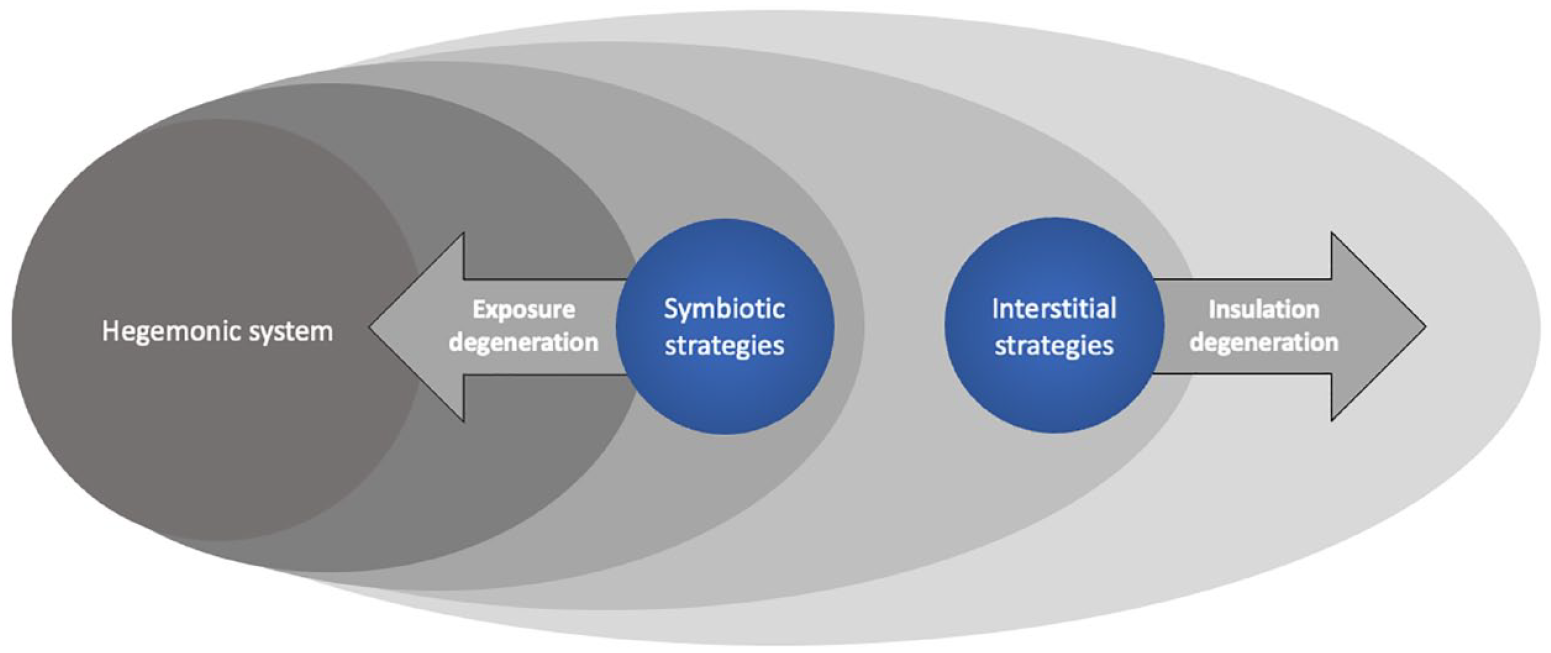
A model of the dialogic tension facing alternative organizations regarding the centripetal and centrifugal forces of the hegemonic system.
Social transformation through critical performativity
In introducing Wright’s characterization of the difference between symbiotic and interstitial social transformation in Section 2, I drew on a sharp distinction between viable and achievable alternatives in relation to the hegemonic system. This depiction risks implying that the hegemonic order is itself static and monolithic in the face of agentic attempts to foster change. Yet Wright is clear that the social context is constantly evolving in a non-deterministic manner due to ‘the cumulative unintended effects of human action’ as well as the conscious efforts of various actors ‘to transform the conditions of their own actions’ (2010: 25). He explicitly includes the formulation of coherent and convincing social alternatives and their pursuit via social transformation strategies as amongst the actions that can shape the ‘limits of what is achievable’ because the ‘social limits of possibility are not independent of beliefs about those limits’ (2010: 23). In this way Wright’s account of the relationship between emancipatory agency and its social context is highly coherent with performativity theorizing, particularly as advanced by Butler (2006, 2010) and Callon (2007, 2010).
Performativity theory explores both the process of social reproduction and the gaps within that process that open space for social change (Cabantous et al., 2016; Khasnabish and Haiven, 2015). A core implication of performativity theory, crucial to the critical assessment of alternative organizations, is that social transformation can only be realized via action that at the same time contributes to the reproduction of elements of the status quo (Butler, 2006). This is because an intended performative must connect to certain felicity conditions to be successful. For instance, an intended political action must sufficiently adhere to certain political conventions to be interpreted as such (Butler, 2010; Gond et al., 2016). This understanding of performativity thus diverges from speech act theorizing that centres the agency of the speaker, instead placing emphasis on the relationship between the act and its context.
This redistribution of performative agency is highly relevant for CMS engagement with practice as it pays appropriate attention to ‘the conditions faced by practitioners’ who are, for instance, ‘based in an organization where what might seem like normative arguments are unlikely to be accepted if isolated from instrumental concerns’ (Koss Hartmann, 2014: 619). By attending to the felicity conditions of performative agency, critical scholars can avoid overestimating what practitioners can simply choose to do. Given that our existing social system is itself unjust, and this social system today determines the felicity conditions for successful performatives, Butler argues that no emancipatory efforts can be politically pure—and indeed ‘perhaps that impurity is what produces agency’ (2006: xxviii).
At the same time, shifting focus to the relationship between performatives and their felicity conditions expands our view of the available points of strategic intervention in the process of social reproduction. As Wright indicates, the felicity conditions of a given social transformation strategy are not determinate but rather the product of social reproduction in their own right. Callon’s work regarding economic models is particularly illuminating on this point, emphasizing the coevolution of these performative theoretical statements and the conditions of their success, creating agential amalgamations he terms sociotechnical agencements (2007). On this account, the evaluation of the viability and achievability of a given social alternative is a slippery task because statements about social transformation possibilities are not strictly constative but rather always participants in such sociotechnical agencements. Callon describes this approach as exhibiting ‘the struggle between worlds that are trying to prevail’ (2007: 332) or, we might say, the struggle between diverse real utopias.
This understanding of performativity in terms of sociotechnical agencements ‘rejects the distance between the object and the discourse about it’ (Callon, 2007: 327) and thereby undermines the strict hierarchy between academics and practitioners that has been identified as implicit in many calls for critically performative scholarship (Butler et al., 2018; Spoelstra and Svensson, 2015). Considered as a full participant in various sociotechnical agencements, the critical scholar’s role cannot be to impartially evaluate whether a given strategy for social transformation coheres with an independently accurate social theory. Rather, our role can only be to participate alongside practitioners in the performative struggle to realize a desirable alternative social order, which if successful would render accurate the performed social theory (Callon, 2007, 2010).
By the same token, both Butler and Callon refute the idea that the speaker – or theoretician – is the privileged agent of performativity. Where critical performativity designates subversive reproduction of the status quo in the direction of an emancipatory alternative, therefore, we must recognize that practitioners are as much agents of critical performativity as are academics. Finally, regardless of whether and how we aim at emancipatory social transformation, our efforts can only unfold via social reproduction – that is to say, our efforts are necessarily implicated in a variety of sociotechnical agencements that at the same time impede other efforts toward social emancipation. I propose the term impure critical performativity as a means of keeping this implication in mind when assessing the performative actions of both practitioners and scholars.
Impure critical performativity in alternative organizations
We return now to the model proposed above regarding the dialogic tension facing alternative organizations aiming to modify the hegemonic system. The model suggests that symbiotic and interstitial strategies are both vulnerable to their own forms of degeneration, particularly at their extremes. This might be taken to imply that alternative organizations should pursue some form of balance between the two strategies to achieve their social transformation aims. The concept of impure critical performativity, however, contrarily indicates a more nuanced perspective whereby contributions to social transformation unfold alongside contributions to social reproduction, without the latter necessarily neutralizing the former. Furthermore, it is possible that attempts to tread a middle ground between the two strategies may in fact undermine the socially transformative potential of alternative organizations.
This conundrum appears regularly in practitioners’ reflexive accounts of their alternative organizations’ choice of strategic approach. To take one example, Dahlman et al. (2022) recount the case of SusPens, a pseudonymous fintech start-up that aims to shift the pensions market toward sustainable investments. SusPens adopts the symbiotic strategy, with their partnership model meaning that they must find ways to make their sustainable investment portfolios financially attractive to established pensions funds. The resulting compromise with hegemonic actors in the pensions market involves the inclusion of some unsustainable stocks in their investment portfolios. While acknowledging that such concessions ‘can easily (and sometimes justifiably) be written off as capitalist co-optation’ (2022: 1976), both the participants and researchers ultimately frame this compromise as an intentional social transformation strategy: ‘the organization consciously sacrifices the ‘purity’ of its alternative in order to continue pushing the financial sector in a more sustainable direction’ (2022: 1976). Viewed in terms of impure critical performativity, we might say that the inclusion of unsustainable stocks does indeed represent capitalist co-optation, or mission drift, enlisting SusPens in a sociotechnical agencement reproducing the hegemonic profit imperative. Yet this does not imply that the solution would be to mitigate such exposure degeneration. Indeed as Wright notes, social transformations arising from the symbiotic strategy ‘have a contradictory character to them, both expanding social power and strengthening aspects of the existing system’ (2010: 305). This invocation of contradiction suggests that the strategy does not incidentally produce mission drift, or reproduction of the status quo, but rather that such reproduction is a fundamental component of the strategy.
Turning to an example of the interstitial strategy, Ouahab and Maclouf (2019) analyze a French regional Community-Supported Agriculture (CSA) network as a sociotechnical agencement aiming to foster food system transformation, replacing dependence on intensive and exploitative industrial agriculture with an environmentally sound model based on solidary with farmers. This mission and strategy is reflected in the CSA charter, which is nevertheless open to member CSAs’ interpretation in practice. Facing competition from other food basket schemes, a degree of mission drift amongst member CSAs appears in the case, with some CSAs adopting modifications to make their schemes more convenient for customers, and therefore less reliable for farmers. A pursuit of balance between exposure and insulation might recommend these types of concessions, noting that a failure to render the CSA agencement sufficiently attractive to enrol customers risks degeneration through the purity trap, depriving the farmers of an imperfectly solidarity-based market. Yet Ouahab and Maclouf highlight how these compromises undermine the social transformation strategy of the CSA network – prefiguring an alternative food system – because ‘it will not perform the necessary subversive practices among members [. . .]. In other words, it will fail to perform the world it aimed to create in the first place’ (2019: 551). We thus might think of the interstitial strategy as fundamentally characterized by foregoing immediate influence on the hegemonic system in favour of cultivating ‘counter-hegemonic forms of social relationality and reproduction’ (Khasnabish and Haiven, 2015: 24), in the understanding that such work ‘develops processually, immanently, slowly and, because of its karst-like nature, may require time to produce visible changes on a large scale’ (Monticelli, 2021: 113). An important felicity condition of efforts to perform an alternative in this way, however, would be the wider community’s recognition of the alternative as divergent from the status quo. One participant’s description of CSA members behaving ‘as if they’re shopping in a regular supermarket’ (Ouahab and Maclouf, 2019: 549) is therefore rightfully presented as a warning regarding the integrity of the interstitial strategy in the CSA case.
Whereas an approach to alternative organizations based solely on avoiding their degeneration might recommend pursuit of a strategic middle ground to avoid both exposure and insulation degeneration risks, therefore, we can see the distinct value of the symbiotic and interstitial social transformation strategies individually, even where these strategies appear to be in conflict. As Wright puts it: None of these strategies is simple and unproblematic. All of them contain dilemmas; all of them contain risks and limits. None of them guarantee success. In different times and places, one or another of these modes of transformation may be the most effective, but often all of them are relevant. It often happens that activists become deeply committed to one or another of these strategic visions, seeing them as being universally valid. As a result, considerable energy is expended fighting against the rejected strategic models. A long-term political project of emancipatory transformation with any prospects for success must grapple with the messy problem of combining different elements of these strategies, even though on the ground it is often the case that they work at cross-purposes. (2010: 307)
Supplementing Wright’s account with the concept of impure critical performativity, we can see how such conflict and apparent degeneration is in fact necessary to the pursuit of social transformation, since transformation can only unfold via imperfect reproduction of the existing system. The first answer to this paper’s motivating question regarding academic engagement with alternative organizations might thus be to recommend that critical scholarship aim for inclusivity in the types of organizations with which it engages, recognizing these diverging strategies and their social transformation potential despite necessary accompanying elements of degeneration.
Impure critical performativity in critical scholarship
This appeal for inclusivity is indeed a common refrain in the critical performativity debate (Alvesson and Spicer, 2012; Parker and Parker, 2017; Schaefer and Wickert, 2016). However I believe the concept of impure critical performativity in fact implies that such inclusivity should apply also to the social transformation strategies of critical scholars and all those who pursue emancipation in part through theorizing possible alternatives (Islam, 2015; Ramirez and Islam, 2022). This section thus explores how critical scholarship is subject to a double bind analogous, but not identical, to that of alternative organizations.
I have noted that theorizing necessarily participates in various political sociotechnical agencements, and therefore as critical scholars we must understand ourselves as embedded in emancipatory performative struggle alongside practitioners, rather than as impartial observers. This is not to deny, however, the distinctive value to emancipatory social movements of theorizing possible social alternatives and their relationship to our present condition. Furthermore, the particular position of critical scholars is relevant both in terms of the relative autonomy many of us enjoy regarding how we spend our research time (Reedy and King, 2019) and the competencies we cultivate as academic subjects (Khasnabish and Haiven, 2015).
We can distinguish two broad schools of thought in the debate regarding critical performativity in CMS, designated the reformist approach and the radical approach for brevity (Koss Hartmann, 2014). The reformist approach argues for a more intentionally performative CMS (Alvesson and Spicer, 2012; King, 2015; Koss Hartmann, 2014; Schaefer and Wickert, 2016; Spicer et al., 2016; Wickert and Schaefer, 2015). 1 This approach roots itself in critiques of the CMS field’s tendency toward ‘becoming closed and limited to internal debates’ (Koss Hartmann, 2014: 620), only rarely stepping ‘out of the ivory tower to engage in situ with the dynamics they decry in order to bring about real change’ (Gray, 2023: 180). That is to say, CMS is perceived as excessively insulated from the systems it critiques, suggesting a general tendency in CMS towards a scholarly approach analogous to the interstitial strategy.
On this account, critical scholars tend to fall into a purity trap of our own, or a kind of ‘secular holiness’ where ‘all alternatives and actions are able to be critiqued, nothing is beyond reproach’ (King, 2015: 262). This propensity to critique not only the status quo but also all social transformation efforts has been theorized in terms of ‘paranoid reading’—a defensive anticipation of injustice and ethical failing (Christensen, 2021; Sedgwick, 2003). King vividly describes how the demands of purity foster paralysis, recounting his time as a manager in the voluntary and community sector while pursuing his CMS PhD: ‘I became trapped by the depth and gravity of the critique, exhausted by a seemingly endless range of dilemmas. [. . .] whatever I did seemed to reproduce the problematic practices revealed by what I had read’ (King and Learmonth, 2015: 365). Additionally, and perhaps paradoxically, the incentives fostered by CMS and related critical fields of study can mean that academics’ self-interested career aspirations are served by strictly policing the borders of critical theorizing, favouring aesthetic sophistication over practical engagement (Koss Hartmann, 2014; Spicer et al., 2016). Ultimately, these tendencies toward purity and paralysis amount to insulation degeneration to the extent that they inadvertently contribute to the reproduction of the status quo – both by inhibiting the exploration and development of impure alternatives and by ceding ground to the performative engagement of academics aligned with the hegemonic system (Koss Hartmann, 2014; Parker and Parker, 2017; Spicer et al., 2009).
In response to such degeneration, therefore, the reformist side of the debate advocates approaching critical scholarship as a way ‘to change management by making incremental incisions into particular processes’ (Spicer et al., 2009: 550). This approach can be seen as analogous to the symbiotic strategy, most clearly apparent in descriptions of how critical scholars can identify problems faced by managers in traditional corporations and advance solutions with attendant emancipatory effects (Wickert and Schaefer, 2015), including by demonstrating how the insights of critical theory can improve business functioning (Koss Hartmann, 2014). More fundamentally, however, the symbiotic strategy in academic critical performativity is characterized by its affirmative stance, identifying sociotechnical agencements in which it can participate to foster the performative success of its emancipatory theories (Callon, 2007; Leca et al., 2014). This affirmative perspective rejects paranoid reading, instead pursuing reparative reading of practitioners’ efforts, accepting the risks of betrayal and appearing foolishly naïve as the price of contributing to a ‘future [that] may be different from the present’ (Sedgwick, 2003: 146). As Christensen found in his ethnography of Roskilde Festival, such reparative reading requires ‘giving the other the benefit of the doubt,’ and ceding control of what will be performed by the sociotechnical agencement (2021: 159). In this way, the symbiotic strategy of academic critical performativity does not merely describe micro-emancipatory engagement with managers and other actors within traditional organizations, but also comprises practical engagement with ‘less than perfect’ alternative organizations (Just et al., 2021). These less-than-perfect alternatives may themselves be categorized as pursuing a symbiotic strategy, and thus imperfect due to their exposure, or an interstitial strategy, with imperfection stemming from their insulation.
The engagement of the Argentinian extensionistas’ with worker-recuperated enterprises (WREs) is an example of this symbiotic approach to academic critical performativity (Esper et al., 2017). The WREs themselves can be understood as adopting the interstitial strategy, developing and consolidating a counterhegemonic vision of economic possibilities. With the help of the politically entangled extensionistas—academics from the University of Buenos Aires—they resist attempts to incorporate the WREs into the broader sociotechnical agencement of the cooperative movement. Such incorporation might have rendered the WREs more significant in Argentina’s overall economy, and thereby bolstered their social transformation effects in the short term, but this would have come at the cost of compromising the distinct socio-economic future they prefigure. Esper et al. demonstrate how the extensionistas contributed to resisting the cooperative movement’s agencement in part by developing theorizations of WREs that emphasize their difference from cooperatives. In this way these academics clearly pick a side, producing theories intended to ‘shape social reality, rather than represent or predict it’ (Gümüsay and Reinecke, 2022: 240).
Embracing such intervention, of course, entails that academics shoulder some degree of responsibility for the reality they shape (Contu, 2020). We can consider here, for instance, the ways in which academic interventions enhancing the radicalism of an alternative organization can backfire and contribute to sociotechnical agencements hostile to the alternative organization’s interstitial strategy (King, 2015; King and Learmonth, 2015) On the other side, in translating ‘ideas from one arena (such as social movement theory) and then trying to place them in the context of another (such as the voluntary sector)’ (King, 2015: 263) utopian theory must necessarily be compromised in order to gain the uptake necessary for performative efficacy (Fleming and Banerjee, 2016). This will often involve, for instance, engaging with ‘existing organizational ontologies’ (Schaefer and Wickert, 2016: 222) that may be oppressive in their own right. That is to say, the symbiotic approach to academic critical performativity operates precisely via compromise and impurity at the level of knowledge production.
Yet such impurity raises concern regarding what we might consider exposure degeneration risks in CMS. These critiques are most prominently articulated in relation to engagement in corporate settings, where ‘critical scholars may end up compromising their academic values [. . .] due to practitioner demands and other institutional pressures’ (Butler et al., 2018: 428) and risk the ‘unwitting reproduction of existing power structures and elites’ (Just et al., 2021: 93). Even when engaged with alternative organizations, however, there is the risk that the critical perspective becomes diluted (Butler et al., 2018; King, 2015). Some academics articulate a fear that engaging too much with sociocracy consultants, for instance, holds ‘the risk of losing their critical thinking’ (King and Griffin, 2023: 12). Here we find a defene of the value of paranoid reading against demands for trust and affirmation (Christensen, 2021; Sedgwick, 2003). This account suggests that the risks of reparative reading are not merely that we will be disappointed—that our intended performatives will fail (Fleming and Banerjee, 2016)—but that our engagement effects unintended performativity (Callon, 2010; Just et al., 2021). That is to say, in adopting only an affirmative stance toward necessarily impure alternative organizations, critical scholarship lends its performative capacities to agencements reproducing these organizations’ harmful elements. To take one example, if the symbiotic approach to critical performativity requires that we avoid critiquing the sometimes racially exclusionary tactics of certain environmental movements, our engagement with such groups will in part contribute to reproducing racial hierarchies (Berglund and Schmidt, 2020).
Against such exposure degeneration risks, therefore, the radical approach emphasizes the necessity of critical theorizing that does not aim to have immediate effects on practice but rather challenge oppressive ontologies (Cabantous et al., 2016) and cultivate ‘spaces of intellectual openness and inquiry’ that explore utopian alternatives that are not achievable from within today’s hegemonic context (Fleming and Banerjee, 2016: 13). This approach can be seen as analogous to the interstitial strategy, particularly where critical scholarship is understood to be performative in changing ‘the terms of the debate’ in the longer term rather than ‘giving immediate answers’ and easy prescriptions for action in the short term (King and Learmonth, 2015: 367).
While acknowledging that the account of performativity presented in Gender Trouble (2006) suggested that performing alternatives can only begin from ‘inside’ the status quo, progressing toward achievable alternatives through imperfect reproduction, Butler (2010) has since argued that emancipatory social theorizing also requires a stream of intellectual work that attempts to begin from ‘outside’ the status quo, 2 rooted not in achievability but rather in normativity—that is, viable or merely desirable utopias (Gümüsay and Reinecke, 2022). This aligns with Wright’s suggestion that emancipatory social transformation ‘may depend in significant ways on the presence of more radical visions of possible transformations’ (2010: 8). The above critiques of the interstitial approach’s insulation from practice still stand, however, as the choice to focus on long-term expansion of our collective radical imagination contributes to the social reproduction of the hegemonic system in the meantime, given that we ‘are always already involved in the ontological reproduction of the world’ (Contu, 2020: 739). Similar to the critical performativity of alternative organizations, therefore, academic critical performativity is unavoidably impure.
The second answer to this paper’s motivating question therefore recommends inclusivity also at the level of critically performative theorizing, and indeed we do find some calls for such inclusivity in the academic critical performativity debate (Alvesson and Spicer, 2012; Wickert and Schaefer, 2015). Nevertheless, the unavoidability of impurity does not offer critical scholars carte blanche to approach our work however we like—or however best serves our own careers (Butler et al., 2018; Koss Hartmann, 2014; Reedy and King, 2019). Instead we are called to take responsibility for the social reality we participate in producing, ‘despite the fact that it is not possible to ever fully understand, predict and control the consequences of one’s co-participation, and what one is co-constituting and becoming’ (Contu, 2020: 739). While we do not have full control over the sociotechnical agencements in which we participate, there remains scope for intentionality regarding our performativity, whether as academics or practitioners. Therefore the recommendation of this paper is not merely for inclusivity in terms of the social transformation strategies pursued, but more specifically for intentionality regarding the strategy chosen, and reflexivity regarding the relationship between distinct strategies and their respective limitations.
The impure critical performativity of this paper
I noted above that the performativity perspective complicates the relationship between social theories and truth claims. This draws into question the epistemological and ontological status of the account of impure critical performativity I am here advancing. On what basis can a purely theoretical academic paper dictate that emancipatory action only be pursued in light of sufficient ‘intentionality and reflexivity’ regarding some abstract theory of social transformation strategies?
In Callonian terms, the present paper can be understood as an artefact joining the sociotechnical agencement – the Real Utopias project – developed by Wright as an intentional effort to foster emancipatory social transformation (Elder-Vass, 2022). In highlighting that ‘[d]eveloping systematic, compelling accounts of viable alternatives to existing social structures [. . .] is one component of the social process through which the social limits on achievable alternatives can themselves be changed’ (2010: 23), Wright acknowledges the intended performative status of his theoretical framework. In the same manner, my account of impure critical performativity in relation to both the practice and study of alternative organizations is offered as a potentially useful tool for the project of emancipatory social transformation. In particular, I believe that conceptualizing social transformation strategies in terms of the relationship between exposure to and insulation from the hegemonic system can contribute to the expansion of ‘the terrain of the possible’ (Khasnabish and Haiven, 2015: 25) by helping both practitioners and academics to resist critiques that would performatively limit the set of approaches with potential for emancipatory success. In this way, the idea of impure critical performativity might operate similarly to theories of economic diversity in supporting a greater variety of organizational forms by resisting convergence (Callon, 2007).
It may be fairly objected, however, that by attempting to account for all emancipatory efforts in terms of a dichotomy of symbiotic and interstitial social change strategies, this paper engages in its own performative constriction of the range of possible approaches (Morgan, 2006). This is true, and one amongst likely many respects in which the present work contributes to an agencement fostering restriction on emancipatory agency. 3 Nevertheless, I take such impurity to be the cost of this paper’s approach to critical performativity, which requires legibility and uptake by practitioners and scholars of alternative organizations. As I hope to have demonstrated in this paper, the symbiotic and interstitial strategies are not ‘invented [. . .] ex nihilo’ but reflective of approaches performed and reflexively theorized under a variety of different names by those engaged in emancipatory struggle (Islam, 2019: 101). In this way, the paper can be understood as adopting the research strategy of convocation, participating in an ongoing dialogue amongst practitioners and scholars of alternative organizations to collectively construct a set of conceptual alignments and distinctions to support intentional critical performativity (Khasnabish and Haiven, 2015). By translating the various approaches surveyed above in articulation with the dialogic tension of exposure to and insulation from the hegemonic system, a sociotechnical agencement drawing on the insights of these various actors is proposed (Callon, 2007; Esper et al., 2017; King, 2015; Leca et al., 2014).
I am motivated to contribute to this agencement by a belief that it may serve to strengthen the ‘ecological niches within and between which’ viable emancipatory alternatives to the status quo can be ‘true or at least enjoy a high degree of verisimilitude’ (Callon, 2007: 330). In particular, I propose that the account of the relationship between exposure and insulation degeneration presented here, and the pursuant coupling of impurity and agency, may be useful in helping practitioners and scholars of alternative organizations to understand and work with the contradictions of social reproduction and social transformation (Khasnabish and Haiven, 2015). This prediction will only be made true, however, through the performance of other participants in the sociotechnical agencement – performances that will themselves iteratively reconfigure the agencement in directions rightfully beyond my control (Elder-Vass, 2022; Ouahab and Maclouf, 2019).
Conclusion
Recent contributions to the critical performativity debate have suggested that this concept is too baggage-laden to be useful, and have proposed alternative labels for what we are trying to do as critical scholars engaged with alternative organizations. Butler, Delaney and Spoelstra, for instance, call for ‘a demythologization of critical performativity’ (2018: 441) that recognizes constraints on agency and emphasizes the value of non-performative critical scholarship. As presented here, the concept of impure critical performativity centres attention on the constraints faced by both practitioners and scholars in our attempts to exercise agency in favour of emancipatory social change. Indeed, it emphasizes that these constraints are the conditions of agency, and thus harnessing the agency enabled by these constraints—engaging with agencements of social reproduction—cannot be ethically impermissible. Emancipatory efforts, in scholarship as in organizing, ‘derive their value from their very imperfections’ (Dahlman, Mygind, Plessis and Husted, 2022: 1982). Furthermore, in applying the concept of impure critical performativity to scholarship specifically, this paper reiterates the value of anti-performativity by demonstrating how more radical and demanding critique is indeed a coherent strategy of social transformation in exploring the outer bounds of viable, desirable alternatives.
Nevertheless, suggestions that the term critical performativity should be retired are premature, I believe. First, the concept of performativity should be maintained in theorizing regarding alternative organizations and emancipatory social change in order to keep our attention trained on the ways in which the viability and achievability of alternatives are shaped by theorizing, both academic and folk, both critical and hegemonic. So should we maintain the concept of critical performativity to emphasize the possibility, despite the above constraints, of intentional, agential intervention in social reproduction, and therefore our responsibility to intervene in the reproduction of oppressive social systems. Finally, where the concept of critical performativity has been abused to disavow the oppressive consequences of attempted critical interventions—the ‘in-built defense mechanism’ of critical performativity (Butler et al., 2018: 441) – the concept of impure critical performativity clarifies that such disavowal is incoherent since any performative intervention will necessarily reproduce oppressive aspects of the existing social order. By doing away with the implicit idea of some possible pure critical performativity, therefore, impure critical performativity calls on us as critical scholars and practitioners to take responsibility for what we reproduce in our pursuit of utopia.
Footnotes
Acknowledgements
This paper has benefited from the generous and constructive feedback of too many colleagues to mention here, though special mention must be made of Stéphane Jaumier, Thibault Daudigeos, Ismael Al-Amoudi and Adélie Ranville, who all kindly reviewed numerous versions over the years. My deep thanks also go to the editors and anonymous reviewers at Organization for their contributions to improving this paper, particularly in pushing the reflexive turn to apply the theorization to critical scholarship itself.
Funding
The author received no financial support for the research, authorship, and/or publication of this article.
