




Abstract
This paper discusses the political economy of organizing slow and ongoing genocide against the de facto stateless community of Rohingyas. We draw on the method of organizing situated solidarity offered by Richa Nagar and the concept of political society. Basing on that, we explore the ways, methods, and contents of organizing situated solidarity during Myanmar’s political transition as a democratic state against Rohingyas’ misrecognition and their experience of slow and ongoing genocide. We argue that such organizing urges us to recognize the structural reasons for misrecognizing Rohingyas as internally displaced people (IDP) or stateless people. Thus, our analysis shows that structuring misrecognizing by the militarized state and its interventions was deeply linked to the political economy of slow and ongoing genocide. We argue that the method of organizing situated solidarity has enabled us to constitute our situated understandings and has the capacity to extend the debate by asking what role we should undertake as researchers and business academics in an increasingly militarized racial capitalism.
Keywords
“I am three years old and am effectively erased from existence. [. . .] I am already an outlaw in my own country, an outlaw in the world. I am three years old, and I don’t yet know that I am stateless.”
Introduction
The above quote is extracted from the autobiography of the first author, First, They Erased Our Name: A Rohingya Speaks, by Habiburahman (from now on, Habib). Habib’s autobiography is regarded as a first-hand account of the systematic process of organizing ongoing genocide by the Burmese Military government and the ruling-majority faction, Burmese Buddhists, against the Rohingya community. His narrative begins with how, through enacting legislation, Myanmar’s militarized state officially recognized Rohingyas as internally displaced people (IDP) and, thus, made an estimated 3.5 million Rohingyas arguably illegal migrants from Bangladesh and the world’s single largest de facto stateless community CFR, 2020. Their ongoing persecution was categorized as a “slow genocide” by Amartya Sen in a public forum at Harvard in 2014 when he stated:
“You denied peoples’ health care, [. . .] denied peoples’ nutritional opportunity, [. . .] denied peoples’ opportunity to work and earn an income to make a living and to feed themselves and their family members and denied medical care [. . .]. This is killing people.[. . .], it is a genocide, and it is a slow genocide. I think it is very important for institutionalized killing like this to be seen as genocide.”
Sen’s (2014) remark directly relates to our experience. Hence, this paper explores and discusses the political economy of organizing genocide against the Rohingya community when, in 2017, almost 750,000 Rohingyas fled to Bangladesh, which resulted in the formation of the world’s largest refugee camp in Cox’s Bazar, Bangladesh. This state-organized genocide and ethnic cleansing occurred under Myanmar’s interim democratic government (HRC, 2018).
The paper is built on Richa Nagar’s (2014, 2017) method of “organizing situated solidarity.” Nagar defines organizing situated solidarity as an approach of critical feminist engagement by underscoring that at the core of such engagement is our commitment to cultivating radical vulnerabilities. As the method, it demands that as researchers, we must grapple with how to attend to the questions that are evoked by the particular configuration of material, political, socioeconomic, cultural and institutional conditions of a particular location. By “we” she implies “those who enter into intellectual and political partnerships to explore the particular processes, events and struggles that are underway” (2017, p. 5). Becoming radically vulnerable implies being indebted to our differences—how we recognize ourselves and relate our identity and privileges, such as positionality. So, our commitment to radical vulnerability considers how we, as researchers, organize in self and critical reflexive analyses. According to Nagar, that is how our collective sensibilities evolve to constitute our shared situated understandings in collaborations, translations, and co-authorship (Nagar, 2017: 15).
Our vulnerabilities are entwined with our lived experience, knowing that we could never fully access each other’s lived experience and lived reality. At the same time, our concerns, commitments, and consciousness are inculcated in our sense of responsibility. In 2017, being located in Australia, Habib—a genocide survivor, a refugee from Myanmar, and a secretary and spokesperson of Rohingyas’ grassroots organization in Melbourne, the Australian Burmese Rohingya Organization (ABRO)—became actively engaged in events, talks and forums on solidarity against Rohingyas’ misrecognition, and on the experience of slow and ongoing genocide. The Second Author (SA) is a Bangalee, a naturalized Australian citizen and academic. She has observed Rohingyas’ plights closely over the last 40 years, following how, since 1978, Rohingyas’ sporadic exodus to Bangladesh became normalized and legitimized. Her feeling of being responsible made her feel compelled to review and translate some of the parts of Habib’s autobiography into Bangla to introduce to Bangalee readers Rohingya’s dreams, their pain, their constant fear of death, their love, their longing and desire/hope to live as human beings and above all, their aspirations for freedom. This has enabled us to build our situated solidarity. This was the beginning of our collaborative research project, in particular, our co-authoring of this paper.
We also use the concept of political society. Thus, we categorize Rohingyas’ social-political status as a political society, as opposed to their identity as IDP, based on how multiple state authorities, including the UNHCR, have been regulating and managing their lives in camps for 40 years. Their management approach demonstrates how there has been organizing of sanction, expulsion, and destruction, and the formation of camps for their living. Sanyal (2007) outlines these mechanisms in his book Rethinking Capitalist Development Primitive Accumulation, Governmentality and Postcolonial Capitalism as embodied features of postcolonial capitalism. He further argues that such features become more evident during the transition to neoliberal capitalism. Borrowing from Sanyal, we argue that such a misrecognizing strategy—categorizing Rohingyas as IDP—has legitimized Rohingyas’ expulsion as a surplus population in 2017 during Myanmar’s transition to a neoliberal market economy and democratic state. Hence, we raise a question about what has been derived from such organizing of the life of Rohingyas, precisely, by misrecognizing them either as illegal migrants from Bangladesh, IDP or the de-facto stateless people categorically.
With this question, in this paper, we explore the methods and content of organizing situated solidarity against Rohingyas’ misrecognition and their experience of slow and ongoing genocide during Myanmar’s political transition to a democratic state. Our paper shows how the outcomes for Rohingyas are corollaries of a militarized state and relational militarism. More importantly, the militarized state or the transitional democratic state could perpetuate the organizing of such slow genocide through the active participation of the majority or the dominant communities of the political society,—such as Bamars, Buddhists-Bamars and Buddhists. We argue that it further indicates a form of organizing racial capitalism under state control.
We first outline the concept of organizing situated solidarity and how it generates our understanding of the political society and its dynamics. Then, we discuss how we cultivated our radical vulnerability to organize our situated understandings. Drawing on our situated analyses, we discuss militarism and its relational interventions, the structuring of Rohingya’s misrecognizing, and the political economy of ongoing genocide against the Rohingya community. Finally, we discuss the potential of activist–academic research. We argue that such a research collaboration can broaden our understanding of postcolonial violence, which is entwined with genocidal intent and results from the working of the state and the dominant factions of the political society. However, such violence is deeply linked with the military’s interest in corporate capital. We argue that our responsibility is to advance our research to imagine the political society beyond the nation–state project in an increasingly militarized racial capitalism.
Situated solidarity, situated understandings and postcolonial violence
Nagar (2014, 2017) offers the “organizing situated solidarity” method, drawing on her studies with the Dalit women in the Sitapur District of Uttar Pradesh in India. Nagar argues that situated solidarity is a “speaking-with” approach which outlines the value of broadening our scope by showing what constitutes our shared concerns. Therefore, according to Nagar, building “situated solidarities” implies a process which requires a closer examination of what connects us, what resonates with us, and how we engage in conversations based on our lived experience, and thus, how we essentialize our shared political sensitivities to address issues relating to our power and privileges. As researchers, our accountability is demonstrated by explicitly showing how we make our claims and for whom.
In Nagar’s research, Dalit women organized their solidarity by placing recognition that entails equity at the core. This led Nagar to argue that these women’s bodies embody the reality of their history: their experience of violence organized by the state and its developmental apparatuses, neo-liberal Hindu Brahmanical capitalist patriarchy, and casteism. Nagar emphasizes that it is clearly through their bodies that we are informed how violence like hunger and starvation, hungry bodies, social humiliation, and murder are inherent in Dalit women’s social relations.
To capture the essence of such violence, violent conditions and Dalit women organizing against such violence, Nagar emphasizes that researchers need to make themselves radically vulnerable. As she says, “Radical vulnerability [..] goes hand in hand with a critical in-self-reflexivity” (2014, p. 17). This implies that researchers need to provide an account of how the notion of ’we’ is constituted as the legitimate voice in collaborative research. The process entails how, as researchers, we relate our concerns and commitments that imply our vulnerabilities and the situatedness of our vulnerabilities. We must demonstrate that our social status and identity are not collapsed into each other but indicate what relates to us and what creates our differences and deep commitment, wherein our accountability is grounded (Nagar, 2017). Correspondingly, our positionality and reflexivity must be assessed in intersecting and complementary ways to open up possibilities to recast our views on the intersection of our historical, political, social, and economic trajectories of institutional and social power and practices and the interfaces of these practices in the lived experience of those expelled and excluded materially. Indeed, Nagar refers to herself as a researcher who is actively engaged in collaborative research, though she is neither Dalit nor marginalized.
Thus, Nagar explains how researchers can ground equity in research; therefore, their research could be regarded as a way of seeking justice. Referring to Hart, she argues that critical feminist scholarship—the methods, analyses and perspectives—“must be grounded in particular configurations of material and cultural conditions and engage directly with specific local histories and trans-local connections, as well as with meanings, memories, and the making and remaking of political subjects” (Nagar, 2014: 161, from Hart, 2002: 313). Therefore, our derived situated understandings can uncover how genocidal intent is inherently structured in the social relations of the postcolonial or developmental states and their mechanisms. Nagar’s research elucidates that these Dalit women’s social status was once historically, socially, and culturally politically dismissed, and still, they are mis/non-recognized by the state and its development apparatuses. Their status resonates with what Mir and Greenwood (2021) describe regarding political society’s status—that they are burdened and burnt out by experiences of both past and present violence territorially, socially-culturally and emotionally.
Such non/misrecognizing urges us to recognize the relevance of the taxonomy of the political society and the limits of liberal political notions such as nation and citizenship status, equality and equity. These political notions are entangled with the issues of entitlements and capability for developing human potential, denoting the materialistic aspects of these political values. Building on Sen’s twin ideas of entitlements and capabilities, Sanyal examines fundamental strategies of the development-cum-poverty-management governance of the developmental states, and thus, he characterizes features of postcolonial capitalism. According to Sanyal, primarily, the state manages basic entitlements, such as employment, education, health care, housing or shelter, and food. Nevertheless, through the strategy of misrecognizing certain populations or a group of people in terms of their class, ethnicity, caste, religion, or gender, nation-state mechanisms deploy strategies like sanctions and suspensions. The misrecognition as a strategy structures a method of accumulation through structuring deprivation and disparity of basic capability requirements of specific groups of people (Sanyal, 2007). Thus, the state’s workings create “surplus” populations, who remain in camps or slums or squatters. Their living arrangements in camps or slums or squatters produce the conditions for social and ethical compliance and, at the same time, embody how postcolonial capitalism evolves through the genocidal structure of its social relations. Pointing out their organized living outside the boundary of capital or the dominant formal economy, Sanyal argues that these people or communities are not the casualties of capitalism but are allowed to be disposed of in the arising time of capital in the postcolonial states (2007).
It leads to the question of what is derived from these suspended lives and where they contribute when there has been structuring misrecognizing a specific ethnic-minority community, Rohingyas, for 40 years. Grappling with this question, we undertake this research project with situated solidarity as our method.
Organizing our situated solidarity against mis/non-recognition and experience of slow and ongoing genocide
“Our history has become both a lie and a crime in the eyes of the dictatorship. Their hatred and racism have turned us into foreigners who must be crushed. [. . .] Your memory is all you will have to keep our history alive, Habib. So listen to me carefully because your grandmother won’t be here forever” (Habiburahman and Ansel, 2019: 5).
In organizing our situated solidarity, we followed two steps: we tried to understand what connects us—our relationality—and how to structure equity in our research collaboration to constitute our situated understandings as “we.” In translating, retranslating and narrating some sections of the first author’s autobiography to each other for the Banglaee community in Bangladesh, we noticed how collective sensibilities evolved and began to take shape through our articulations. Indeed, labouring on our radical vulnerability in our collaborative research started with Habib’s autobiography. Making ourselves radically vulnerable was reflected in how we did our multiple levels of reflexive analyses collectively and individually. It has enabled us to build mutual trust by revealing how our shared political understandings are linked with our collective historical lived realities. At the same time, translating and retranslating the book enabled us to realize that violence and violent contexts cannot be discussed separately. Our situated solidarity has been built upon by making it explicit that our vulnerabilities are intrinsic.
The book begins by introducing Rohingyas and their history: “They call us ‘Kalars’. This is a derogatory term generally used by the Burmese to express disgust for dark-skinned ethnic groups with an Indian facial appearance.” Through the tales he heard from his grandmother, the author elucidates Rohingyas’ experience of organized plundering, such as the confiscation of land and property, and his grandfather’s fleeing to Bangladesh in 1967. The book outlines the political machinations of the Burmese military government and its ruling class behind the Rohingyas’ experience of 40 years of genocide. The census of 1948 by the British categorized 135 ethnic communities in Myanmar and excluded the Rohingya community from these categorizations. Therefore, the Rohingya community was recognized as an ethnic-national community of Myanmar by the citizenship law of 1948. Based on such categorization, when the Burmese military occupied political power, they used nationalistic paranoia and religion to legitimize their invasions—Pure Gold (1959), More Purity, and Purify and Whiten like the Jasmine Flower (1967-73)—in the name of preserving territorial and cultural purity and integrity. The militarized developmental–socialist state further entrenched racial politics by enacting consecutive legislations: The Emergency Act of 1974 and the Citizenship Act of 1982 on the assumption that the Rohingya entered Burma (from then on) after 1824, that is, after the First Anglo-Burmese War (1824-26). Officially, since 1978, these pieces of legislation made Rohingyas illegal immigrants from Bangladesh, that is, IDP and de facto stateless people revoked their civic and ethnic claims, displaced them, and compelled them to live in camps. During Burma’s economic transition from 1992 to 2010, militarized invasions were entangled with cultural interventions, which are more innovative. Hence, in the name of the search for an authentic nation, such interventions resulted in renaming the Arakan State as Rakhine, branding Rohingyas as Bengali invaders.
By asking, “Why are we not like the others?” the author links Rohingyas’ everyday struggles by elucidating how the strategy of sanction and suspension of entitlements has resulted in constituting Rohingyas’ expulsion as a “surplus” population. The cost of being misrecognized implies the regularity of random taxes (as the author notes, “even if a goat gives birth, we are heavily taxed” (p. 93), as well as arrests due to various restrictions, sanctions, and suspensions of movement. For Rohingyas, the reality from 1978 is that “Every day is a struggle,” and they feel they are “Fleeing, always fleeing” (p. 9). In conclusion, by illustrating the violence of August 2017, which forced his sister and his family to flee to Bangladesh, the author concludes that activism is the only way to inform the world about Rohingyas.
We tried to disentangle, examine and distinguish the consideration of political economy questions from questions relating to politics and social structures. Such categorization clarifies the politics of inventing decontextualized historical narratives. These narratives can actively produce legal-social and cultural institutional narratives and conditions to shape, reinforce and legitimize the misrecognition of Rohingyas as a stateless people.
In countering such a racist, decontextualized and institutionalized approach to history, we understand why Habib’s grandmother urges that Rohingya history be preserved in the form of public memories, meanings and their connections with local social geographies and histories. At the same time, it was driven by our radical vulnerability –that was through the in-self and collective- multiple-level reflexive analyses—we invented “us” as the “we” in writing this paper. We did so by raising the question of why historicizing is vital in relation to our given geography—the Subcontinent—by combining our political and geographical truth. It led us to reflect, argue, analyze and synthesize how our collective past evolved in interconnected ways by entangling people’s mobility and cultural exchanges between Bangla and Arakan. The Arakan dynasty patronized Bengali literature in the 12th century, which addressed themes of the inescapable implications and reality of Hinduism in our region, the rise of Islam through Sufism during the Mughal reigns, and what drove Buddhists toward East Asia. Hence, our concerns emanate from our shared historical, geographical, political and anthropological trajectories. Thus, we relate our colonial and racially politicized history with geography and our lived experience of militarism and military regimes by focusing on its strategy of invoking religion-centric nationalist paranoia. Like Burma in 1988, the military regime in Bangladesh made Islam its state religion since the Muslim community is the majority. Such strategies successfully mask the compromised political democratic approach of the developmental states that cultivates communalism and escalates ethnic divisions.
Our organizing of situated solidarity shows how “it evolves over space and time and [. . . is] deeply entwined with the land, locations, and spatial connections/disconnections” (Nagar, 2014: 85). This enables us to combine the exploration of broader affinities and linkages that are grounded in recognition and equity with identity. Such situatedness evokes an intuitive understanding in us that our collaborative research is a way of seeking justice by pointing out how mis- and non-recognizing strategies have structured political indeterminacy in terms of Rohingyas’ identity as the IDP, to disconnect them from their land and organize their deprivation of all types of capability and capacity. Our method of organizing situated solidarity demonstrates how to constitute our situated understandings as the “we,” regardless of our positioning and Rohingyas’ status as IDP, stateless or “refugees from Myanmar,” or having the status of “irregular to illegal maritime arrivals” in Australia. Our situated solidarity has been built upon by making it explicit that our vulnerabilities are intrinsic. It has enabled us to develop our mutual trust and our feeling of being accountable. Herein is embodied our felt entitlement that invokes our sense of responsibility and our feeling of being accountable, as illustrated in Figure 1.
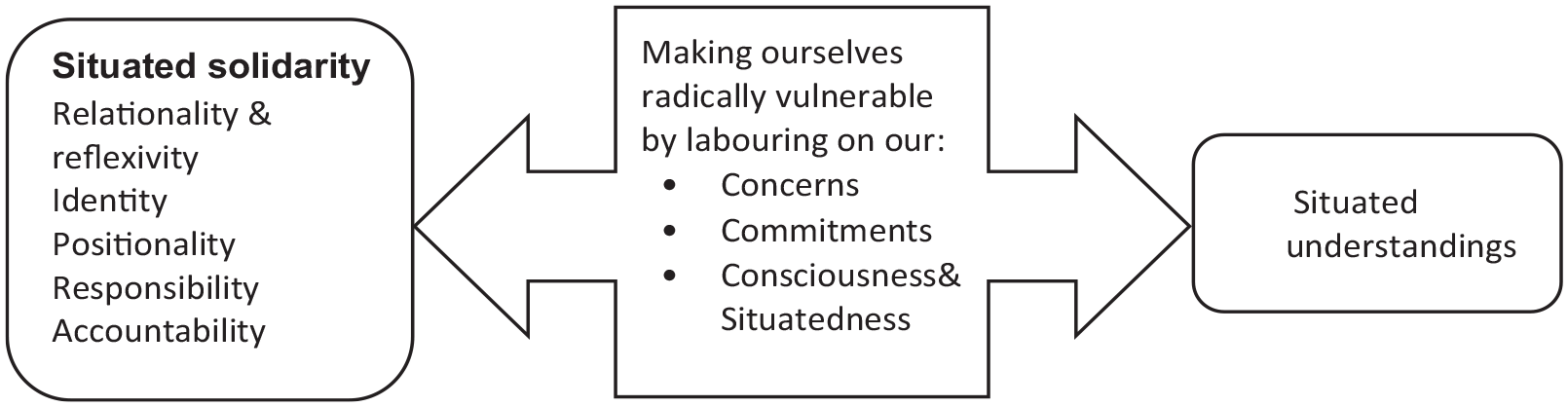
Situated solidarity and organizing situated understandings.
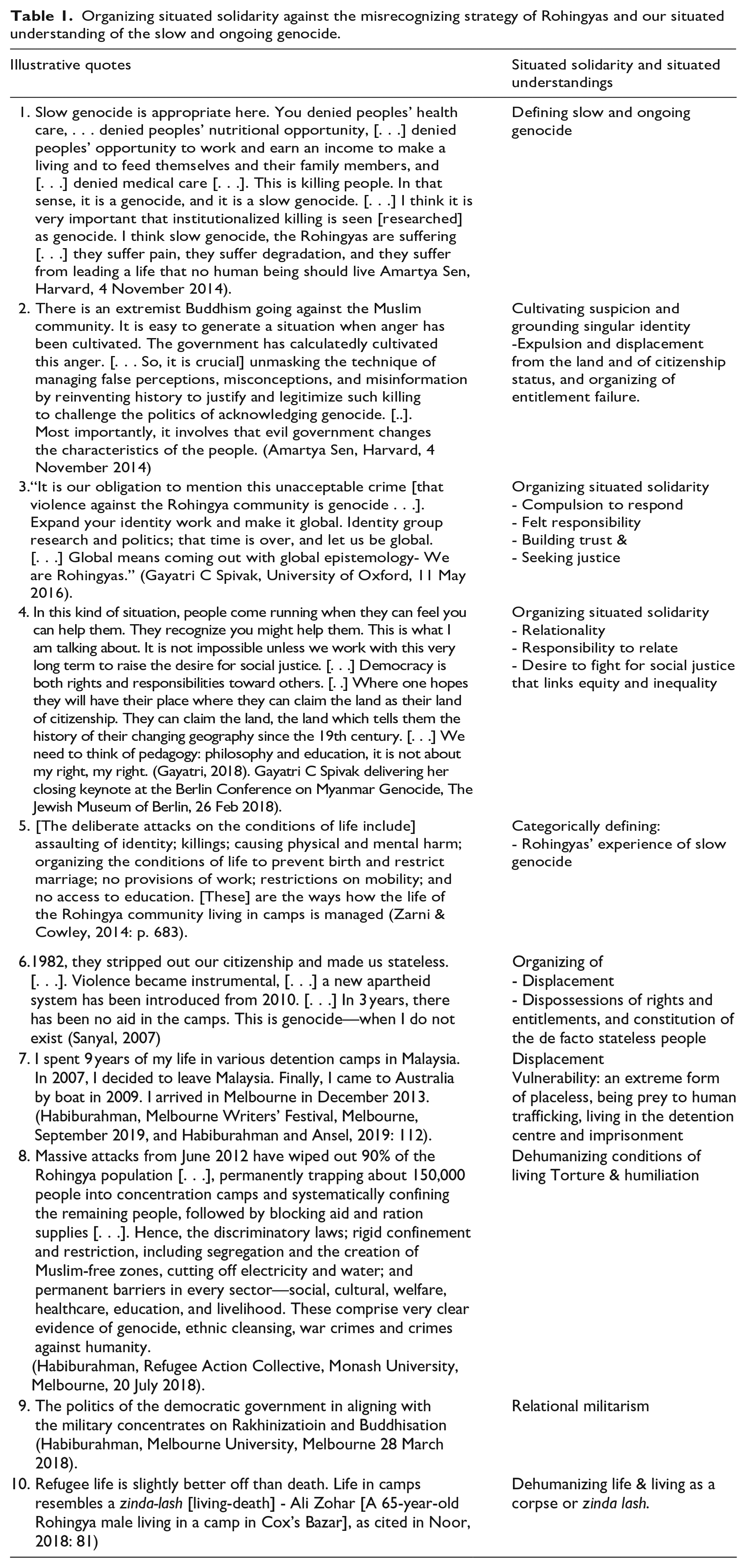
Our analyses of exploring situated solidarity followed two broader steps: relationality and reflexive engagement in exploring active participation in the ongoing related and relevant conversations and then publications regarding Rohingyas’ experience of slow and ongoing genocide during Burma’s transition to a democratic state. In our analyses, we categorize and separate political concerns regarding misrecognizing Rohingyas and relate those with the political and economic conditions. Tables 1 and 2 present our shared/situated understandings in the next section.
Organizing situated solidarity against the misrecognizing strategy of Rohingyas and our situated understanding of the slow and ongoing genocide.
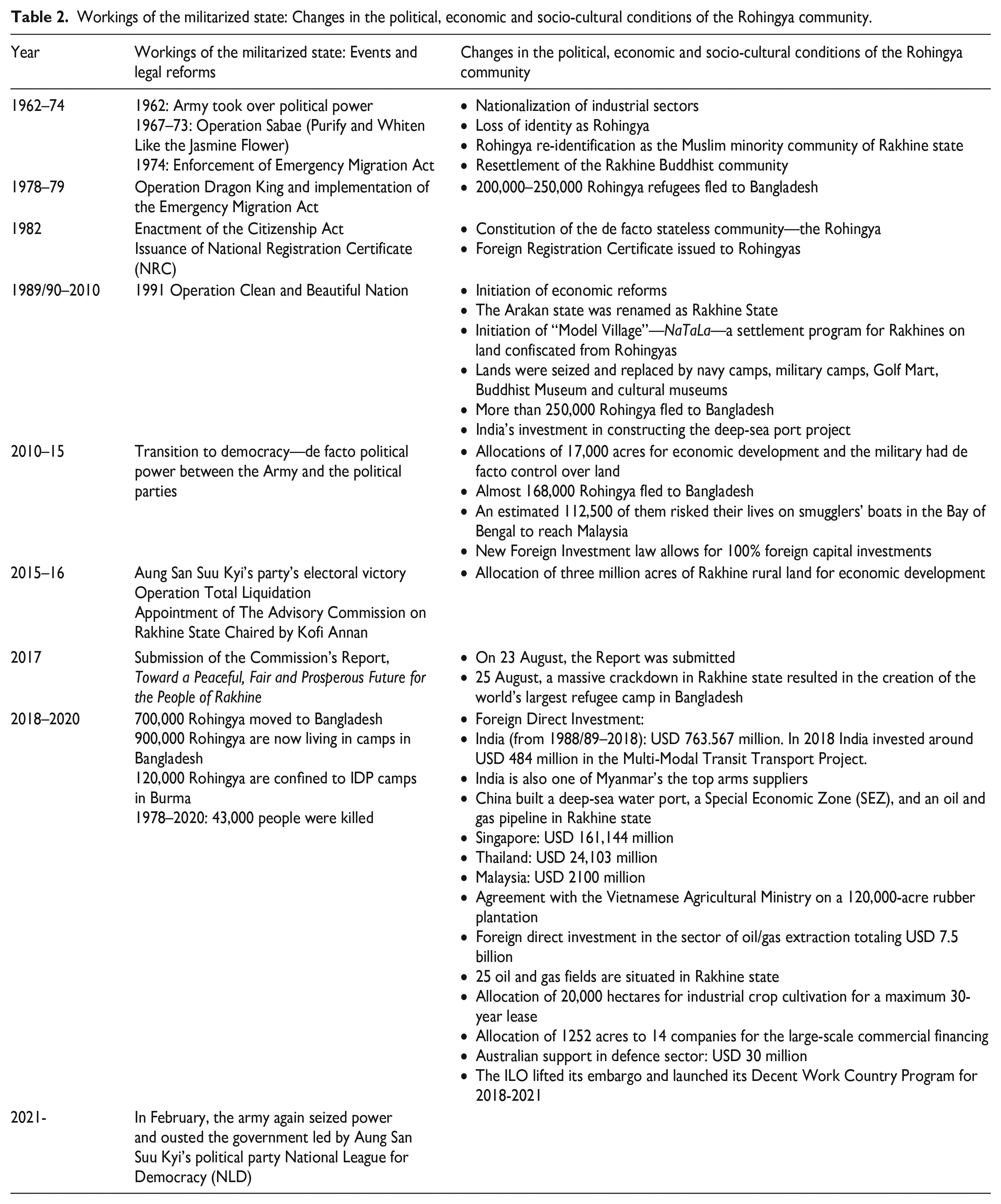
Workings of the militarized state: Changes in the political, economic and socio-cultural conditions of the Rohingya community.
Organizing situated solidarity against Rohingyas’ misrecognition, the taxonomy of the political society and the political economy of organizing slow-ongoing genocide
Refugee life is slightly better off than death. Life in camps resembles a “zinda-lash” [living-death]- Ali Johar (as cited in OHCA, 2022: 81).
In exploring organizing solidarity against the misrecognizing strategies of Rohingyas, we identify first what relates to our experience. Table 1 illustrates the approach and situatedness in solidarity by highlighting the intrinsic relevance of synthesizing our sociocultural history in structuring situated understandings. Our analyses first unpack the productive material and cultural conditions that sustain genocide in Rohingyas’ lives. Second, building on such understandings, we discuss how despotism has been entrenched by militarism in the name of securing purity and why we need the taxonomy of the political society. This explains the political economy of organizing slow and ongoing genocide.
At Harvard in 2014, Amartya Sen, in his speech on the mobilization of solidarity for the recognition of Rohingyas’ during Burma’s transition to democracy, severely criticized Burma’s political government by condemning its enacted legislations. He found it objectionable how legislation became the method of reconstruction of truth to substitute/replace actual history, instances, and views that combine the anthropological trajectory of a community (Table 1: Quotes #1, 2). Sen’s situatedness in solidarity was organized primarily against constructions of a-historicized knowledge by emphasizing how it has structured Rohingyas’ misrecognition by cultivating Rohingyas’ singular identity as Muslims.
Similarly, Spivak repeatedly urged researchers to organize situated solidarity against Rohingyas’ misrecognition and genocide globally and crimes against their humanity by questioning identity, equality, equity and our responsibility as if “We are Rohingyas” (Table 1: Quote #3, 4). Sen and Spivak’s radical vulnerability was cultivated by urging researchers to place recognition and equity at the core of their research and to constitute our situated understandings of violence like genocide. Elsewhere, Zarni, through his research since 2011, has been urging us to recognize the Rohingyas’ genocide by emphasizing his lived experience in Burma. By recognizing himself as a Bamar-Buddhist, Zarni (2011: 683) grounds his vulnerability in his research and organizes his situated solidarity against the strategy of mis/nonrecognizing Rohingyas that has been pursued by the military state.
Taking their concerns altogether, we organized our shared and situated understandings as the “we” to interrogate, clarify and inform how racial–communal ideology was solidified through the militarization of social relations, and wherein lies the essentiality of the taxonomy of political societies (Table 1: Quotes #5, 6, 8). The militarism employed colonial accounts of race, religion, and ethnicity. Subsequently, people’s political and cultural subjectivity has been shaped by setting singular identities like Bamar and Buddhists first, then Rakhine Buddhists, and finally, the image of a state that strictly follows Buddhist scripts. In contrast, suspicion has been entrenched that justifies structuring genocidal intent against the Rohingya community by cultivating a singular identity of them as illegal Muslim migrants from Bangladesh or Bengali invaders. Zarni puts these workings as the “performance legitimacy” of the army-state (p. 208), where economic interests and social legitimacy are entangled, as illustrated in Table 2.
Our analyses in Table 2 show the alliance between the ruling class—the retired army generals and Burmese, Bamars and Buddhists—by uncovering the reconfiguring of politico-economic conditions of the Arakan state. It is worth noting that military interventions became more relational during the partial deregulation and liberalization of the economy, which could produce conditions of organizing the gain of one community at the expense of another community. For example, the military initiated the Rakhinization project of the Arakan state, whereby along with the resettlement of poor Rakhine Buddhists from other states, a part of the surplus material resource such as land was employed in rehabilitating Buddhism by reconstructing Buddhist monasteries, schools and museums (Table 1: Quote #8, Habiburahman and Ansel, 2019). Arguably, expert opinions as the “objective analyses” even in 2017 argue that poor Rakhines were equally impacted by the sharp growth in land acquisition and consolidation of traditional and extractive sectors under state-sponsored capitalists (Jones, 2017; Sassen, 2017). The presented “facts” equate the Rohingyas’ experience of genocide with the state’s policy of accelerating pauperization by placing Myanmar as a socialist state within the East Asian regional geopolitical context (Jones,2017; Sassen, 2017). When it was evident that at the core of the management of the economy was managing the land, over which the military had de facto control (see Table 2). The militarized socialist state failed to organize genuine social reforms such as land reform or educational reform that explicitly linked issues of entitlements and capability of the people, irrespective of their status, according to the mandate of the socialist state structure (Zarni and Cowley, 2014). However, such “objective analysis” obfuscates genocide by misrecognizing it as communal violence/riots by claiming that such communal conflicts/violence in the Subcontinent repeatedly occurred from 1930 until the 1950s (Jones, 2017).
Obviously, the strategy of misrecognizing Rohingyas as IDP can actively produce violent conditions of slow and ongoing genocide (Table 1: Quotes #6, 8) by obfuscating the fact that there had been active participation of the dominant community and consolidation of capital under state control. Alternatively, Rohingyas incarcerated in camps, IDPs exemplify how interventions were planned to be accompanied by a prolonged, complex, evolving, and much less anomalous form of genocide upon Rohingyas by constituting absolute deprivation, which is inherently linked to an individual’s capability. Categorically, Rohingyas’ displacement and deprivation of basic human requirements and their capabilities have gradually and intermittently resulted in forms of slow death (Table 1: Quotes #6, 8).
After escaping from the 2017 massacre of Arakan, Ali Johar, a 65-year-old Rohingya, compares their life in the camps to Zinda lash. The notion implies that Rohingyas are living a life as a corpse in camps, but our question is how their lives can ultimately be explained in terms of the logic of accumulation and the market.
Relational militarism and the logic of accumulation for organizing living as Zinda lash
“The Rohingyas that have managed to escape alive remain, for the most part, stateless, illegal immigrants’ prey to human traffickers, and vulnerable to torture and arrest.”
The above quote exemplifies our realities: how we are situated in this research. So, our vulnerabilities are inherent in our exploration of organizing situated solidarity as they are entwined with our everyday lived realities. Our analyses in Table 2 and Chowdhury’s (2021) paper on camps in Cox’s Bazar show how alliance formation has evolved as a strategy of management of camps, which demonstrates that the relational approach remains at the core of such alliance formation. Unpacking this management strategy, we explicate the process of accumulation through the managing of suspended lives as Zinda lash in camps.
It is worth noting that the military’s management demonstrated the form of alliance as a governance strategy during Burma’s emergence as an “emerging economy” and its political transition by involving civil society organizations. In 2017–2018, when Burma was recognized as a state in transition to democracy, such an alliance approach ensured sustained support from the UN, ILO and INGOs, and neutral private civil society entities, such as the Commission, led by Kofi Annan [see Table 2]. We categorize such a management or governance approach as relational militarism. Relational militarism was able to collude with transnational capital and produce and legitimize violent conditions and violence like genocide in the name of fighting insurgencies and ethnic conflicts to organize a smooth transition of the market. It enabled the Burmese political government to appoint the Commission when it denied the UN Human Rights Commission access to investigate the human rights situation in Arakan state. The Commission neutralized global criticisms and perceptions, particularly regarding genocide against Rohingyas since 1978. It thus legitimized bilateral and multi-lateral investments by “graduated economies like China, India, Vietnam, and Singapore” (Advisory Commission for the State of Rakhine, 2017; Mothaer, 2019; Reporting ASEAN, 2020, see Table 2). More importantly, the Commission validated the 2017-18 Rohingya genocide.
Subsequently, since 2017, Bangladesh, as the host state, has been accommodating 156 local NGOs and 80 INGOs and providing around US$900 million in funding for 134 projects on Rohingyas’ rehabilitation (OCHA, 2022). It exemplifies, as Sanyal (2007, p. 107) says, how surplus people are disposed of “when the market logic is partially operationalized,” which evidences the management of sanction, suspension, expulsion and formation. He further argues that capital’s logic can negotiate for the dispossessed people’s space and create a condition for its production. For example, being in Australia until 2021, we had to bear the Australian government’s justifications for its trade and bilateral defence cooperation support to “Myanmar’s democratic political government” (Slee, 2018). Australia is, however, the third-largest donor state to the UNHCR for managing Rohingya refugee camps in Bangladesh.
Indeed, a balance of investment and relational strategy demarcates the pattern of managing the 2017–2018 Rohingya genocide and their suspended lives in camps. The management of camps involves multiple state authorities as the donors of involved INGOs or, precisely, transnational NGOs (operating across the regions globally and locally) and their local partners. Certainly, the local state apparatuses, such as the military, police, and government officials, are involved in managing the security. Also, various vendors and agencies are involved in setting up the camps and distribution of relief, which shows the involvement of businesses and the markets.
Chowdhury (2021) identifies such arrangements for managing camps as creating a non-cooperative space. Chowdhury’s concerns extend from the type of medicines and products being sold in bazaars close to camps to how Rohingyas “could be easier targets for drug trafficking businesses and exploitation (e.g. sex work, abduction, rape).” So, Chowdhury forcefully appeals for the creation of an effective cooperative market by emphasizing the potential of the Rohingya as workers or entrepreneurs—that is, as economic agents. Rohingyas’ able bodies are a material reality. And, for Rohingyas, violence is an everyday lived reality when misrecognition regulates their living. Therefore, they are neither allowed to imagine nor could ever be imagined by researchers as a politically empowered community. Hence, their classification as economic agents and camps as research sites now invite economic considerations.
In hindsight, we also mark our situated understandings, evidencing our contradictions. In our everyday lived realities, the possible sites of Rohingyas’ ways of living are diverse: as IDP in camps, detention centres, and prisons, and being trafficked in vessels. These multiple sites collide with the management of Rohingyas’ lives in camps and intricately link with our everyday lived reality, which we broadly categorize as the rehabilitation economy. The rehabilitation economy inhabits the functioning of three economies in camps: the surveillance economy, the criminalized survival economy, and the consumer economy. At the same time, the function of various economies illustrates the working of the accumulation logic. For example, Rohingyas living in incarceration, detention, and under sanctions in camps support a “surveillance economy’, including the recruiting of security forces wherever they are since they are located in camps. Being caught up with such incarcerated living, Rohingyas are trafficked and exploited, being a part of an illegal labor supply chain (Habiburahman and Ansel, 2019). Thus, Rohingyas contribute to criminalized or illegal/illegitimate economies. Our situated analyses offer that their suspended lives and experience of genocide cannot only be reduced to land. Rather, suspended lives expose that the Rohingyas” potential living with the abled body in camps as the Zinda lash is distinctive and demonstrates the condition of creating value without any exchange. Eventually, all economies are coalesced with the consumer economy.
Through organizing our situated understandings, we have learnt that alliance-making is the pivotal governance approach of the rehabilitation economy during the period of relational militarism or, precisely, during Burma’s transition to the market economy. It is deeply entangled with the consolidation of regional, global and local capital. Our analysis makes visible the link between primarily regional and local capital where Rohingyas’ life in camps such as Zinda lash can equally produce social compliance. This invites more questions, as Sanyal suggests, about how we could grasp such a violent form of formation and consolidation of postcolonial capitalism or the emergence of such capitalism in the region, specifically the subcontinent.
The postcolonial violence and organizing activist-academic collaboration
In this paper, we use the method of organizing situated solidarity as argued by Nagar –a way of critical feminist engagement- to unpack the political economy of organizing slow and ongoing genocide. To do so, we explore the organizing of situated solidarity against the mis- /non-recognition of Rohingyas and their experience of genocide by labouring on our commitments to vulnerability. By making ourselves radically vulnerable, that is, through critical in-self and collective reflexive analysis, we have developed trust and accountability. Following that, our situated analyses illustrate how the militarized state organizes perpetual indeterminacy in terms of Rohingyas’ status as de facto stateless by providing a critical understanding of the extent of militarization of social relations. Our analyses offer insights into the political economy of slow and ongoing genocide by highlighting the involvement of states, NGOs, business, and the market in managing camps and organizing the lives of people who recognize their lives in camps as Zinda lash.
It is worth stressing how our praxis of radical vulnerability makes us equally accountable. For example, translation/retranslation to each other [from Bangla to English], Noor’s (2022) book “September on Teknaf Road” resonates with the poem of Allen Ginsberg, “September on the Jessore Road.” Ginsberg wrote the poem in 1971 during the Liberation War of Bangladesh after visiting the camps of refugees from Bangladesh on the Jessore Road in West Bengal, India. Noor makes the connections in terms of memories and meanings that are inseparable from geographical locations and their trans-local connections and historical lived realities, which directly relate to the SA’s realities. Evidently, the misrecognizing strategy has structured genocidal intent rooted in colonial history. However, since 1978, militarized and compromised democratic-developmental states, including the UN, have been legitimizing genocide based on this strategy by organizing the politics of indeterminacy surrounding Rohingyas’ status by making them displaced and stateless people in Burma and Bangladesh rather than political subjects.
We argue that using political society as a concept to categorize Rohingyas and linking it to our method of organizing situated solidarity has enabled us to combine our lived realities wherever Rohingyas are located. Our offered analyses can shift the focus away from the tendency to offer sanitized accounts of political society by omitting particularities of its dynamics. Indeed, such distinctions are important since despotic regimes can make complex innovations in citizenship politics centering on religious belief. Hence, violence and violent conditions for ethnic minority communities have been integral to the current sectarian politics in South Asia. Our analyses distinctly expose communalism by illustrating the inherently genocidal structure of the postcolonial state and its violence. It also evidenced how racism is built into the economy’s structure and is denied in national narratives and political discourse; thus, there has been the organizing of racial capitalism (Mir and Toor, 2021). Our analyses illustrate that the military’s corporate interest has been deeply entangled with communalism. Through this strategic alliance, transnational capitalism has been evolving in this region by involving transnational NGOs, and such a strategy can produce social compliance for managing suspended lives in camps. This is not a non-cooperative space, as Chowdhury identifies. Hence, his appeals to the successful garments industry of Bangladesh in tapping the potential of Rohingyas raise a question inadvertently: What form of capitalism are we legitimizing? To unpack capitalism in the postcolonial context, we need to examine the nexus between despotic regimes and changes related to their social relations in collusion with the functioning of the dominant communities of the political society or, precisely, the far-right factions.
Also, our deployed method and use of the taxonomy of the political society make explicit the limit of the politico-economic analyses of our discipline. For example, in our discipline, accumulation is only explained by dispossession when the involvement of the market is clear (Banerjee, 2011). In explaining postcolonial political violence, the strategy is to organize homogenized understandings that cannot take us beyond categories like “markets” where postcolonial states are “democratic/ developmental states,” and the ethnic minority communities are “resource cursed” (Banerjee, 2011).
Our collaboration has made it intuitively evident how our relationality was evoked by recognizing our deeply seated experience of the militarized state and relational militarization and its nexus with corporate capital. This networking leads to the eruption of postcolonial violence based on misrecognizing along the lines of ethnic communities. Therefore, we argue to cultivate our radical vulnerability by placing recognition and equity at the core and organizing activist-academic collaborative research. Such research would enable us to raise relational and reflexive questions regarding what has already been structured by making the management of nonaccountable bodies like Zinda lash and entities like camps visible. We hope to inspire academics to engage in relational research and thus create equity in knowledge practice.
Footnotes
Acknowledgements
We are deeply indebted to Professor Gary Magee, Monash University. We especially would like to thank Editor Raza Mir, Associate Editor Suhaib Riaz, two anonymous reviewers for their valuable comments, and Andrea Bunting and Katherine Lyons for their help in the process of preparing and writing this paper
Author’s Note
Habiburahman is also affiliated with Australian Burmese Rohingya Organization (ABRO), Melbourne.
Funding
The author(s) received no financial support for the research, authorship, and/or publication of this article.
