




Abstract
Growing alarm has been expressed about populism in mainstream political parties, yet the vast majority of scholarship investigating populism has documented the role of radical right populist parties rather than that of mainstream parties. This article draws on non-essentialist understandings of populism—the idea that populism is a central aspect of democracy and not restricted to the realm of radical political parties and “populist” leaders—to examine how mainstream political leaders discursively articulate the antagonism between “the people” and the institutional order. We also examine how mainstream party leaders, who are likely to be deeply embedded in the institutional order, negotiate tensions between the institutionalized system and populist articulation. We study this in the Australian context, which is appropriate for examining populism in mainstream political parties given that far-right and far-left parties have gained much smaller shares of electoral support in Australia than elsewhere. Our findings indicate that mainstream party leaders discursively construct the idea of “the people” by homogenizing disparate social demands and claiming their right to represent the community as a whole. In doing so, these leaders must negotiate pressures from the institutionalized order in the form of clientelism and accountability. This article contributes insights on the reconciliation of contemporary populism with institutionalized settings and processes.
Introduction
In recent decades there has been renewed interest in populism and the political process, especially in the realm of migration policy (e.g., Mudde, 2013). In particular, growing alarm has been expressed about populism and mainstream political parties. Mazzoleni (2008: 57), for example, argued that mainstream political discourse is experiencing a “populist contamination” and that even in countries without significant populist parties, mainstream parties have adopted “soft populist” rhetoric. Yet the vast majority of scholarship investigating the relationship between populism and migration policy has documented the role of radical right populist parties rather than mainstream parties. This paper addresses this problem by examining the following research questions: How do mainstream political leaders discursively construct “the people” in migration policy? How are tensions between populist articulations and the institutional order managed?
Populism has traditionally been studied as a phenomenon—a thing that is or is not—rather than as a form of discourse. Hence, scholars have classified political parties into “populist” and “non-populist” parties, and leaders as “populist” and “non-populist” leaders. We draw on non-essentialist understandings of populism—the idea that populism is a form of articulation rather than a specific content and thus can be adopted by a diverse range of political actors (Moffitt, 2016; Worsley, 1969). Seminal scholars of populism have maintained that rather than represent an antithesis to democracy, politics built around the primacy of “the people”—a core definition of populism—is constitutive of the democratic process (Laclau, 1977, 1993, 2005a). A framework that emphasizes populism as form rather than content enables us to examine the discursive articulation of “the people” by mainstream political leaders and mainstream parties in the context of migration policy. Migration policy is an area that has historically invited essentialist analyses on the influence of populism on policy making. Scholarship has thus associated populism with nostalgia for the community of the past, often connecting it with restrictive immigration policies and desires for a more homogenous society (Clarke and Newman, 2017). We provide an alternative, non-essentialist, rationale for studying populism in the context of migration, in the sense that migration often provides the deliberative space for explicit articulations of “the people” and “the homeland” (Laclau, 2005a).
We study mainstream parties’ discursive construction of “the people” in the context of migration policy in Australia, a country distinguished both for its historical openness to migration and societal anxiety toward certain types of migration. As far-right and far-left parties have gained much smaller shares of electoral support in Australia than various European countries, mainstream party practices are less prone to influence from radical political parties (Robinson and Bristow, 2020). Hence, Australia is an appropriate context for our study. While previous studies have examined the impact of far-right populist parties on migration restrictions, our focus is on discursive articulations of “the people” across the political spectrum rather than on predicting the content of migration policy. We present findings from an examination of the discursive practices of Australia’s two mainstream parties—the center-left Australian Labor Party (hereafter “Labor”) and the center-right Liberal/National Coalition” (hereafter “Coalition”)—in the context of changes in temporary skilled migration (TSM) policy. Our study answers recent calls to broaden the study of populism beyond “populist” parties and leaders (Gidron and Bonikowski, 2013; Mazzoleni, 2008). We contribute to a theoretical understanding of populism as a discursive practice central to democracy and politics as well as a practical understanding of how mainstream political party leaders navigate the tensions between institutionalized systems and populist representation.
Populism as discursive politics
Although most conceptualizations of populism center around the antagonistic relationship between the people and the elite in society (Shils, 1956; Taggart, 2000), consensus on its definition has been elusive in the half century that scholars have studied it. A widespread understanding of populism has been as an ideology or political strategy. Mudde (2004: 562), perhaps the best-known theorist of populism as an ideology, defines populism as “an ideology that considers society to be ultimately separated into two homogenous and antagonistic groups, ‘the pure people’ versus ‘the corrupt elite’.” Apart from the primacy of the people over their rulers, populism’s political tenets were relatively unelaborated. Populism was seen to combine easily with other ideologies, such as communism, socialism, or nationalism (Mudde, 2004: 544). Mudde (2004: 544) thus understood populism as a “thin-centered ideology” with a core tenet focusing on “the people.”
Others have conceptualized populism as a political strategy, focused on the methods of winning power. Weyland (2001: 12), for example, understood populism to be a method by which “personalistic leaders” seek or exercise power by directly mobilizing large numbers of mainly unorganized masses without relying on established intermediary organizations. Although such understandings of populism as a distinct phenomenon have motivated studies of countless populist parties and populist leaders from Europe to Latin America, conceptualizing populism as an “entity” with accompanying cognitive assumptions, structures, and practices has revealed limitations in understanding the broad appeal of populism in recent decades. In what scholars have variously termed the “populist Zeitgeist” (Mudde, 2004) and “populist revival” (Roberts, 2007), populism has increasingly been adopted by a diverse range of political actors and parties in contemporary politics. Hence, essentialist definitions of populism that limit its purview to populist parties and leaders fall short in explaining how it continues to be adopted in new settings by actors that may, in some cases, not even be characterized as populist (Hawkins, 2010; Moffitt, 2016: 20).
Non-essentialist understandings of populism, on the other hand, where populism is conceived as a form of discourse and as a political style, enable us to explain how populism is adopted by actors and organizations of diverse forms. Ernesto Laclau, along with his co-author Chantal Mouffe, has been a seminal theorizer of populism as a discourse. Laclau (2005a) put forth the discursive construction of hegemony as key to the political process in the post-communist world. Laclau and Mouffe (1985) ideated that after the Cold War and the failure of Marxism, politics in the post-ideology era rested on the “structuration of hegemony,” and that populism would be central to this process due to the primacy of “the people” in a post-ideological world. Hence, these scholars have been interested in how “the people” have been constructed through the political process, and how this has enabled new agents of social movements to compete alongside traditional constituencies.
Laclau (2005a) maintained that the notion of “the people” is an empty signifier whose meaning must be articulated through the political process. Articulation, for Laclau (2005a: 68), depended on discourse, which he argued was broader than speech or text, and essentially relational. Populism, then, is the discursive articulation of social demands in terms of an antagonism between the powerful and the people (Laclau, 2005b: 38). The heterogeneity of grievances in complex post-industrial societies necessitates that politics discursively constructs what Laclau (2005b: 39) termed “equivalential homogeneity” by integrating particularistic social demands in the name of “the people.” In contrast to those who viewed populism as a fringe political phenomenon, Laclau (1977, 1993, 2005a) surmised it to be key to the democratic process. As Laclau (2005b: 43) famously and somewhat controversially stated, “To ask oneself if a movement is or is not populist is, actually, to start with the wrong question. The question that we should, instead, ask ourselves, is the following: to what extent is a movement populist?”
A similarly non-essentialist view of populism has been developed by scholars who have characterized populism as a political style (Canovan, 1999) and as a performance (Moffitt, 2016). Canovan (1999: 3–4), who theorized populism as a political style, stressed that the only constant in populism was what she referred to as its “legitimating framework” that pitted “the people” against the established power structure. Importantly, the content of populism would vary depending on the context in which grievances were articulated against the elite and on the prevailing ideological environment (Canovan, 1999: 4). While Moffitt (2016) retained the focus on populism as a political style, he further argued that scholars must attend to its performative aspect. In his view, this was crucial to understanding populism’s enduring and increasing appeal in the contemporary world where communications are driven by media and technology (Moffitt, 2016: 51).
We draw on this non-essentialist school in populism scholarship and define populism as a form of discourse articulating a logic of antagonism between those with power and “the people” as the underdog (Laclau, 2005a: 51). Following Laclau (2005a, 2005b), we are interested in the dynamic and ongoing construction of the divide between the institutional order and “the people.” We thus answer calls to study populism in different political and cultural contexts (Gidron and Bonikowski, 2013: 9) by investigating how mainstream party leaders discursively construct the contention between the powerful and the community as a whole. While non-essentialist scholars of populism have opened the possibility of studying its influence outside of populist parties and its use by diverse political actors (Moffitt, 2016: 3), in practice these scholars have largely maintained the focus on “populist” leaders. A key facet of the populist leader that extant literature has emphasized is that this type of political actor relies on a direct representation of “the people” to build personalized power (Canovan, 1999: 14). Importantly, populist leaders exhibit low reliance on institutionalized mediators such as political parties (Canovan, 1999: 14). To win over the masses directly, populist leaders are known to construct perceptions of crisis where existing systems are represented as threats to “the pure people” (Taggart, 2000). Hence, Moffitt (2016: 45) exposited that “this performance of crisis, breakdown or threat relates to a more general distrust of the complex machinery of modern governance and the complicated nature of policy solutions, which in contemporary settings often require consultations, reviews, reports, lengthy iterative design and implementation.”
Taking the non-essentialist perspective to populism opens the practices and behaviors of all political leaders and parties to empirical examination. Submitting to the tenet that populism as a form of articulation is constitutive of the democratic process to different extents (Laclau, 2005a, 2005b), we study mainstream political parties and their leaders’ practices in the context of migration policy, an area that has frequently supplied inspiration for essentialist understandings of populism.
Populism and migration policy
Essentialist perspectives of populism have conceptualized it as imbued with nostalgia for a relatively homogenous past and desire to defend frontiers, whether physical or political (Clarke and Newman, 2017; Foroughi et al., 2019: 144). Hence, much research in this vein has focused on studying the impact of populism and populist parties on migration policy, frequently in the context of Europe. For example, Carvalho’s (2013) study of radical right parties and immigration policies in Britain, France and Italy found that these parties have achieved influence due to mainstream parties co-opting their policies to neutralize the electoral threat of the radical right. Other studies have demonstrated that in some European democracies with radical right populist parties, center-left parties have shown a clear turn against migration (Alonso and da Fonseca, 2012). But overall, this literature has revealed mixed evidence regarding the success of populist radical right parties in influencing government migration policy. Bale (2003) argued that the rise of European radical right populist parties has been driven by center-right parties adopting populist policies, including on migration, which has helped to legitimize radical right parties’ agendas. In his study of 17 West European countries, Lutz (2019) found that anti-migrant mobilization by radical right policies parties has had a greater impact on the integration policies of governments reliant on these parties to form governing coalitions than on their migration policies. Other writers have examined the role of various factors mediating radical right populist parties’ influence on migration policy, such as radical parties’ abilities to mobilize public opinion (Howard, 2010), the issue salience of migration (Givens and Luedtke, 2005), and electoral systems that can affect the representation of smaller and less established parties (Breunig and Luedtke, 2008: 142).
Scholars have increasingly argued that the attention given to radical right populist parties is likely misplaced in understanding the impact of populism on migration policy. Mudde (2013: 1) argued that radical right parties in Europe are “neither a necessary nor a sufficient condition for the introduction of stricter immigration policies” but have affected a “‘populist contamination’ of mainstream political discourse” (Mazzoleni, 2008: 57). This is because mainstream governing parties across Europe have exhibited populist rhetoric on migration policy including in countries without significant populist parties (Mudde, 2013).
We submit that essentialist views on populism and their focus on the direct impact of populist parties on migration policy overlook the wider adoption of populist forms of articulation by other political parties and leaders as well as the broader influence that discursive constructions of “the people” can have on politics and society. Hence, this study aims to contribute to theoretical advancement in understanding how mainstream political party leaders engage in populist discourse in the context of migration policy.
Research context: Temporary skilled migration in Australia
Studies have suggested that different types of migration can spur distinct reactions in the political sphere (Joppke, 1998; Lutz, 2019). This is relevant to the Australian case, where migration is consistently one of the most salient issues among voters (Cameron and McAllister, 2019), with political leaders historically exploiting public opinion toward different forms of migration (Wright, 2014). Public support historically has been stronger for skilled migration than for family reunion and humanitarian migration (Wright, 2016). This has informed migration policies, which have prioritized skilled migration and restricted entry to family and humanitarian migrants on national interest grounds (Boucher and Davidson, 2019). The differential economic impacts of these migration types largely explain these preferences. Compared to family migrants, skilled migrants have had much better employment outcomes and have been found to make a net positive contribution to the Australian economy. This led the center-right Howard Coalition government, in office 1996–2007, to shift the focus of immigration policy from family to skilled visas (Hawthorne, 2005).
The Howard government also initiated a restrictive shift in humanitarian migration. While humanitarian migration represents a very small share of Australia’s overall annual migration intake—typically less than 1% of non-tourist visas (Department of Home Affairs, 2023)—there have been regular “moral panics” as measured by public opinion about seaborne asylum seekers. These concerns related to: process as reflected in the trope that seaborne asylum seekers have “jumped the queue” ahead of other migrant applicants; prominent images of boats carrying asylum seekers that captured significant if disproportionate media and public attention; and racism, since seaborne asylum seekers in Australia have come mainly from the Middle East and Asia. Beginning with the Howard government, Australian governments have responded by adopting strident discourses and policies to highlight increasing controls on seaborne asylum seekers (Martin, 2015).
Skilled migration historically has been uncontroversial in Australia and in other countries (Hainmueller et al., 2015), making it an unlikely area for the articulation of populist discourse. Skilled migrants have had above-average incomes and relatively low unemployment rates; skilled migration intake levels have been calibrated with labor market needs to reduce displacement effects on non-migrants (Productivity Commission, 2016); and virtually all skilled migrants have generally received, or had opportunity to gain, permanent residency, which provides them the same employment and social rights as Australian citizens (Wright and Clibborn, 2020).
This changed with the expansion of temporary skilled migration (hereafter “TSM”) following the creation of the “457 visa” in 1996. The 457 visa operated based on sponsorship from a single employer, which limited the ability of skilled migrants to change employers. This visa was originally designed exclusively for high-skilled migrants, but subsequent reforms transformed the program into one that allowed sponsorship of intermediate skilled workers. In the mid-2000s, media reports emerged of workers on 457 visas being underpaid and mistreated by their employer sponsor. This led to increased criticism of the 457 visa especially by trade unions (Campbell and Tham, 2013), and prompted policy responses from political parties.
In recent years, the issue of skilled migration has created tensions within and between the major parties. Labor has been reliant on the support of socially liberal middle class voters and migrant community groups, which favorably disposes the party toward expansive migration policies, and working-class voters who traditionally support more restrictive migration policies. A similar tension has also been evident within the Coalition’s support base, with business groups supportive of expansive skilled migration policies and socially conservative voters more skeptical (Jupp, 2007).
In recent years populist minority parties have emerged with anti-migration platforms forming a centerpiece of their electoral strategies. Of note is the radical right Pauline Hanson’s One Nation Party (ONP). ONP’s electoral support is small overall having never exceeded 9% of the primary vote at federal elections and typically much smaller than this. Its support has been concentrated among working class voters who have traditionally voted for Labor and rural and socially conservative voters who have traditionally voted for the Coalition. Support for the ONP’s migration policies among these critical segments of the major parties’ traditional voter blocs have prompted these parties to redefine their own policy positions, as seen in the case of the Howard Coalition government reducing family and humanitarian visa intakes (Wright, 2014).
The scrutiny of a hitherto relatively uncontroversial policy scheme and the manifestation of tensions among groups constituting mainstream party support bases make TSM a suitable context in which to examine how mainstream party leaders integrate disparate demands in the name of “the people” and manage the tension between the institutional order and articulations on behalf of the community.
We examine two instances of policy change following intense controversy over TSM: the first in 2013 presided over by the Gillard Labor government and the second in 2017 under the Turnbull Coalition government. Labor Prime Minister Julia Gillard (in office 2010–2013) had close links with the union movement, which she relied upon for internal support within Labor, but also had strong support from the party’s socially liberal wing. She was generally seen as a progressive leader. However, Gillard faced three different internal leadership challenges and had to deal with a combative leader of the opposition (Curtin, 2015). Coalition Prime Minister Malcolm Turnbull (in office 2015–2018) was seen as a cosmopolitan, socially progressive, and pro-business figure within the Coalition. This made him a natural supporter of an expansive skilled migration policy, but he also faced leadership turmoil during his time as prime minister (Savva, 2020).
Method
Data collection
Our primary data was archival in nature, originating from different sources that allowed for triangulation (see Appendix for cited archival references). We focused on the period between the November 2007 and May 2019 Australian federal elections for two reasons. It spanned four electoral cycles, with Labor and the Coalition each controlling government for two cycles: Labor from November 2007 to September 2013 and the Coalition from September 2013 to May 2019. Additionally, this period coincided with two major instances of policy change in 2013 and 2017, with Labor and Coalition governments each overseeing one reform juncture.
First, we collected statements made by ruling party leaders, operationalized in this study as heads of ruling parties and immigration ministers. Hence, we searched government databases for speeches by prime ministers and immigration ministers referring to migration and skilled migration. In addition, we collected media releases relating to TSM issued by government ministers responsible for migration policy from 2007 to 2019. In total, we collected 15 prime ministerial speeches (10 from Labor, 5 from the Coalition), 61 immigration minister speeches (40 from Labor, 21 from the Coalition), and 62 ministerial press releases (32 from Labor, 30 from the Coalition) during our period of observation.
Second, we assessed statements made by both parties regarding migration and skilled migration in published party platforms in preparation for general elections held during the period of our observation (2007, 2010, 2013, 2016, and 2019). This amounted to a total of 82 relevant statements (67 by Labor, 15 by the Coalition).
Third, we collected relevant media reports from major national and metropolitan daily news publications between January 2012 and December 2013, and between January 2016 and December 2018. These two periods were selected because they allowed key developments preceding and following the two TSM policy changes to be captured. We selected daily news publications with the largest readerships in Australia representing varying ideological viewpoints: The Australian and the Daily Telegraph both owned by the Rupert Murdoch controlled News Corp Australia and generally regarded as conservative, and the Australian Financial Review and the Sydney Morning Herald, both owned by Nine Entertainment (formerly Fairfax Media) and generally considered politically neutral (Boulus and Dowding, 2014). We did not include The Guardian, the only mainstream left-wing daily news publication, since its Australian arm was founded in 2013 in the middle of our period of analysis. To ensure that we captured all articles and opinion pieces relevant to TSM policy developments, “457 temporary migra*” (all words) was used as the search term. In total, we analyzed over 629 pages of media content.
Lastly, we collected reports from two independent reviews of TSM that were conducted during the study period, in 2008 and in 2014 respectively (Azarias et al., 2014; Deegan, 2008). Both reviews were commissioned by the Department of Immigration, yet they were conducted independently and led by recognized experts.
Data analysis
Our overall analytical strategy sought to understand how major political party leaders discursively constructed “the people” in the context of TSM and how ongoing tensions between the institutional order and the construction of populist discourse were managed. Our analysis proceeded in two steps. First, we drew upon the four sources of data outlined above to develop a chronological history of events before, during, and after the two policy junctures in June 2013 and April 2017. This allowed us to construct a narrative storyline of each period in question (Langley, 1999; Langley and Tsoukas, 2016). Formulating a narrative storyline allowed us to clarify any influence that preceding events and discursive constructions may have had on events that followed and to identify major actors and their roles for each period. A timeline of major events and developments is presented in Figure 1.
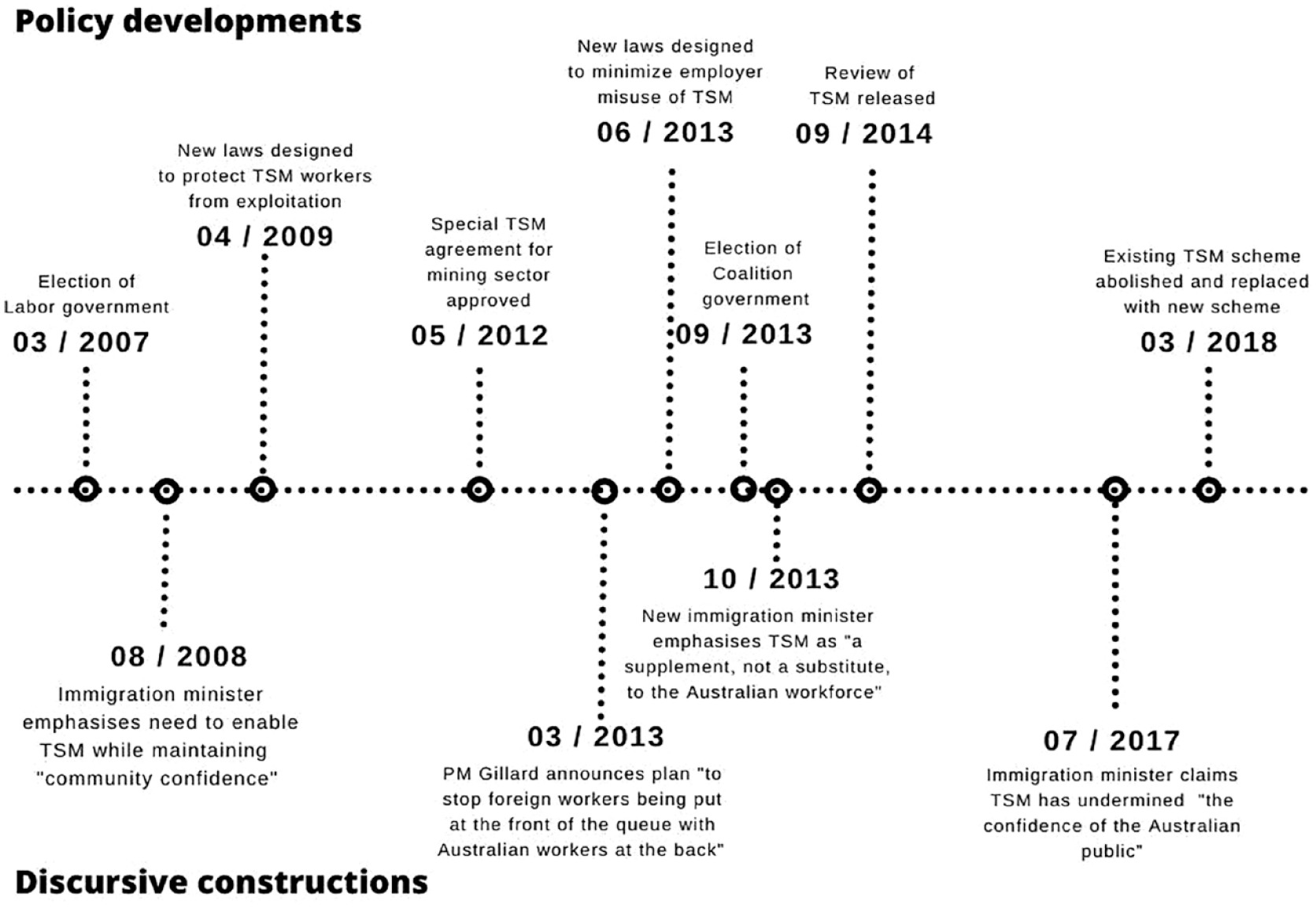
Timeline of policy developments and discursive constructions.
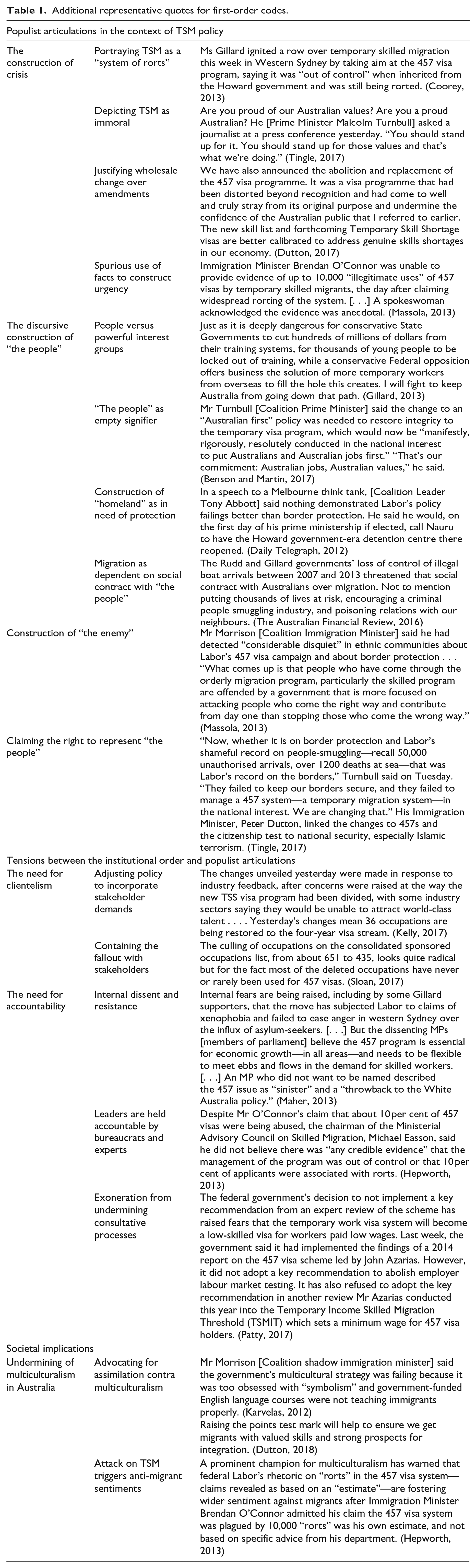
Second, we performed content analysis across our data sources to thematically analyze the forms of articulation and ways of managing tension. We operationalized populism as language (and other signifiers) that politically constructs “the people” in relation to migration policy, positioning the people in an antagonistic relationship with powerful entities (Canovan, 1999; Laclau, 2005a). Thematic analysis was conducted first within the two policy junctures separately, and second, across the policy juncture periods. As a part of the latter process, we compared discursive constructions by Labor and the Coalition to identify similarities and differences in the articulations of parties on different sides of the ideological spectrum. First-order codes were designated by reading relevant passages of data repeatedly and inductively coding for discursive constructions of “the people” and “the homeland” as well as tensions between institutionalized practices and the ideational primacy of the community as a whole. Each author coded the data separately, and subsequently met to debate any inconsistencies until agreement was achieved. We iterated between patterns in the data and the literature on populism to group first-order codes into second-order themes (Van Maanen, 1983). Subsequently, we discussed the theoretical implications of second-order themes and identified the aggregate dimensions of these themes into building blocks for theorizing major parties’ articulations of “the people” in migration policy. Representative quotes for first-order codes and the data structure are presented in Table 1.
Additional representative quotes for first-order codes.
Findings
Two policy junctures in TSM
Labor government’s restrictions on TSM
The TSM scheme grew to its largest intake under the Labor government (2007–2013) and played a role in propelling Australia’s mining boom which started in 2005. Nevertheless, in anticipation of a federal election, the Labor government in June 2013 reversed its previously supportive position toward TSM, which the immigration minister in the previous year had declared was “more efficient and more responsive to changes in the labor market than at any time in its history” (Bowen, 2012). Key to Labor’s policy turnaround was the dissatisfaction of unions in industries related to mining, who asserted that Australian workers were being sidelined by employers who preferred “compliant” migrant workers. High youth unemployment rates in mining regions, where migrants were among workers who “flew in, flew out” of the area, underscored these claims. In particular, project specific migration agreements that guaranteed labor supply to support large-scale new mining developments in relatively disadvantaged areas came under fire.
The central features of Labor government’s policy changes were re-introducing labor market testing requirements for employers to advertise locally before hiring TSM workers, increased powers to the government’s labor inspectorate to strengthen oversight of employer compliance, and various measures to improve the protection of TSM workers.
Coalition government’s restrictions on TSM
Despite endorsing Labor’s restrictions on TSM prior to the 2013 federal election, the Coalition, the victorious party in this election, sought to continue its traditional stance of favoring skilled migration over family migration and asylum seekers upon coming to power. In 2017, however, the government reversed its decades-long support of TSM, targeting the scheme as part of a suite of measures designed to reduce the overall migration intake.
Central to the 2017 restrictions, which came into effect in 2018, was to sever the pathway from TSM to permanent residency for some visa holders, shortening the list of eligible occupations, and increasing English and skills requirements. The occupations eligible for TSM were separated into two visa categories of 2- and 4-year maximum durations respectively, with only the latter category providing eligibility for permanent residency. In announcing this policy change, which was met with astonishment by businesses, the Coalition used similar language as did the Labor government in 2013 and claimed that the increased selectivity of TSM applicants in these measures would improve migrant integration into Australian society.
In the following sections, we present the results of our analysis of the discursive process in the two parties surrounding these TSM policy junctures. While we examined our data for any similarities or differences between the two major parties, we found mainly commonalities rather than differences. Hence, we combine our findings for both parties focusing on common theoretical dimensions.
Populist articulations in the context of TSM policy
The construction of crisis
Changes in TSM policy were couched in a discursive frame that portrayed the status quo as a failure and a crisis. A frequently invoked phrase was that the scheme represented “a system of rorts,” that is, misuse, typically due to decisions made by a previous government led by the opposing party. Gillard, for example, was quoted as stating, “We inherited a system here from the former government that was riddled full of rorts . . . that had people brought into Australia not to take occupations because there were genuine skills shortages, but brought into Australia because the employer thought it would be easier to have a foreign worker” (Bolt, 2013). Political leaders exaggerated the number of violations and portrayed the scheme as immoral beyond repair. TSM was depicted as responsible for “human trafficking” and “slavery” (Hannan, 2013), and local workers as “being discriminated against and missing out” (Kelly, 2013). Misleading statistics were often drawn on to propel the message. Hence, Gillard belabored the fact that the number of TSM visas increased at a higher rate than total employment growth when this was to be expected given that TSM visas by design targeted occupations in high demand (Gillard, 2013).
The contribution of TSM to total migration intake is relatively small. Since the origins of TSM in 1996 it has accounted for less than 10% of the annual intakes of all non-tourist visas (Department of Home Affairs, 2023). Constructing the TSM as integral to Australia’s failure to keep its population growth in check justified a clean break from past policy. Leaders thus advocated wholesale change rather than amendments for better enforcement of standards. This was most starkly illustrated in 2017 by the Coalition government in announcing the abolition of the 457 visa. The immigration minister at the time stated, “We are cleaning it up because Labor made a mess of this migration program when they were in government” (Kelly, 2017). He explained the need for radical policy change by referring to the “systemic, endemic and rife exploitation of foreign workers” (Baker et al., 2016).
The discursive construction of “the people.”
In 2013, Labor’s construction of “the people” included voters who felt alienated from the prosperity created during Australia’s mining boom in the preceding decade. The Labor government had approved the signing of special agreements with resource companies overseeing large-scale mining projects, facilitating the timely recruitment of large numbers of migrant workers for all contractors. Criticism of confidential deals made with wealthy mining magnets heightened. Politicians were asked, for example, “why Labor would engage in what is actually a sellout of Australian jobs in the interest of a few greedy billionaires” (Sloan, 2012). In response, leaders portrayed themselves as involved in a “fight” to defend the people’s rightful share in the windfall, which reportedly was felt by ordinary Australians as “someone else’s boom” (Kenny, 2013). Hence, Gillard’s immigration minister declared that “The Gillard government will not sit idly by while Australian citizens and permanent skilled migrants lose out to unscrupulous employers” (Benson, 2013), and that “Labor will not be influenced and lectured to by billionaires about allowing rorts to continue” (Kelly, 2013).
As Laclau (2005a) pointed out, who “the people” were in the TSM policy change served as an empty signifier whose boundaries were discursively constructed. Leaders of both parties referred to Australian workers as casualties in migration but constructed this group in various ways. While Gillard acknowledged the ethnic heterogeneity of Australian workers—“I offer absolutely no apology for putting the opportunities of Australian working people first, front and center, wherever they were born” (Gillard, 2013; emphasis ours)—at other times this group was described as being distinctive yet unvaried. Turnbull hence justified prioritizing Australian workers because they had Australian values (Benson and Martin, 2017), implying that such values could not be shared by migrant workers.
The “homeland” (Laclau, 2005a) was viewed as in need of protection from those who sought to free ride, such as employers who undermined Australian wages and benefits by bringing in foreign workers (in Labor’s formulation) and migrants who drew on the country’s welfare or did not integrate into Australian society (in the Coalition’s formulation). Turnbull thus justified restricting overall migration by depicting membership in the homeland as a “privilege” only bestowed to those with the right values: “Membership of the Australian family is a privilege and should be afforded to those who support our values, respect our laws and want to work hard by integrating and contributing to an even better Australia” (Coorey, 2017).
Political leaders frequently reminded audiences that migration to Australia was contingent on a “social contract” with the Australian people. Thus, leaders emphasized the importance of maintaining public “confidence” in migration policy, and that once confidence was eroded, the policy could not be retained. As a Labor immigration minister stated, “If the public doesn’t have confidence in the integrity of the temporary skills migration program, it will be seriously undermined and, quite frankly, there would be huge public pressure to end it” (Evans, 2008). Letting in foreign workers who would either undercut Australian wages or who failed to contribute economically was associated with betraying the people’s trust. As a Coalition immigration minister put it, “The Australian people must have confidence that our immigration system is, firstly, well designed to meet our economic objectives—immigration is first and foremost an instrument of economic policy not welfare policy” (Morrison, 2014).
Constructing “the enemy.”
In antagonism with “the people,” political leaders articulated the prevalence of powerful interest groups. For Gillard, this was unscrupulous and greedy employers who put their interests before the Australian workers. These employers were depicted as preferring foreign workers for their compliance, which resulted in undermined wages and conditions for the Australian worker. The language invoked had the effect of confounding TSM with humanitarian migration. The latter activated voter anxieties around “losing control” over borders that politicians have historically drawn on in Australia. For example, it was widely believed, even by some within Labor, that the party’s decision to restrict TSM in 2013 was influenced by public resentment toward asylum seekers whom Labor was seen to be more lenient toward than the Coalition (Coorey and Massola, 2013). This was reinforced by Gillard’s use of language to depict TSM workers as low-skilled workers taking jobs from Australians and her invocation of the need to protect Australia’s “clean beaches and precious open spaces” from overcrowding (Kelly, 2012).
Turnbull, by contrast, depicted the enemy as powerful unions with influence over the Labor Party. The Coalition, then, constructed a rhetoric that attributed the curtailing of TSM to lobbying by large unions while accusing Labor of allowing into the country “the wrong kind” of migration in the form of asylum seekers. Hence, as opposition leader, Coalition leader Tony Abbott accused Gillard of betraying the community with policy that “tolerates people coming illegally to this country and then going on welfare and is now trying to demonize people coming legally to this country, paying taxes and making a contribution from day one” (Kelly, 2013).
Claiming the right to represent “the people.”
Laclau (2005b: 39) observed that populism entailed establishing what he termed an “equivalential chain” by integrating heterogeneous and particularistic demands into a broader anti-institutional narrative representing the community as a whole. As distinctions between traditional party constituencies were blurred in this process, we find that mainstream political leaders competed in their claims to represent the “Australian people.” Frequently this led to asserting one’s own party as more genuine than the rival party in representing “the people’s” interests. As Turnbull declared in 2017, “Unlike Labor, the Turnbull government will always put Australian workers first. [Labor leader] Bill Shorten sold out Australian workers by allowing a record number of foreign workers into the country, many not filling critical skill shortages” (Turnbull, 2017). Mainstream party leaders also sought to instill in voters that their representation of “the people’s” interests was authentic rather than influenced by the ONP, whose leader attempted to take credit for providing the rationale for both major parties’ policy changes. Hence, Gillard sought to distinguish Labor’s discourse from the ONP leader’s: Ms Gillard said “that’s a matter for her” when asked about Ms Hanson, the former One Nation leader, endorsing her rhetoric about putting “Aussie workers” before “foreigners” and saying the latter should go to the back of the queue. “I believe in putting Australian jobs first. Others can use whatever label they choose for that,” she said. (Coorey and Massola, 2013)
Hence, populist articulations gathered together the widely differing demands of the Coalition, Labor, and ONP constituencies in “a precarious unity” (Howarth, 2014: 12).
Tensions between the institutional order and populist articulations
In Laclau’s formulation, institutional politics and the populist logic are continuously interacting rather than occupying distinct and separate spaces (Howarth, 2014: 15). Drawing from this tenet, we focus on two ongoing tensions between the institutional order inhabited by mainstream parties and populist articulations in TSM.
The need for clientelism
Migration policy scholars have pointed out that governments in liberal democracies are rhetorically bound to anti-immigrant sentiments expressed by voters yet enact permissive immigration policies because of their need to be responsive to clientelistic pressures (Freeman, 1995). Major political parties negotiated the tension between clientelism and populism by adjusting public policy to accommodate stakeholder demands even whilst pledging that they would prioritize Australian jobs for vulnerable Australians. After the 2017 policy change, a collection of business representatives “blasted the Turnbull government’s move to scrap the 457 visa system as populist, blunt and a knee-jerk reaction that will hurt business and the economy” (Durkin, 2017). In response to employer complaints, the Coalition moved 36 occupations from the 2-year category to the 4-year visa category eligible for permanent residency within months of announcing the two visa categories (Kelly, 2017). Similarly, the Labor government exempted the IT sector from labor market testing requirements after these requirements were made public in 2013 (Foo and Griffith, 2013).
A key indication that clientelistic interests were upheld was the relatively inconsequential nature of the policies themselves. As a case in point, neither policy change resulted in drastic reductions in the use of TSM. One expert commented that “the changes that Labor was pursuing were little more than tweaks to previous overhauls of the scheme that would have little impact on the number of visas granted under the scheme” (Colley, 2013). Similarly, commentators pointed out that many of the occupations culled from the sponsored occupations list in 2017 had in fact rarely used TSM visas (Aly, 2017; Sloan, 2017).
The need for accountability
Procedural and bureaucratic accountability rising from the institutional order also was often in tension with articulating “the people’s” will in TSM policy. Yet the construction of a crisis around the TSM scheme appeared to exonerate party leaders from pressures of accountability, such as the failure to implement the outcome of consultative processes. The Turnbull government’s disregard of recommendations from an independent inquiry the Coalition commissioned into the TSM scheme illustrated this: When Turnbull said he was responding to the Coalition government’s own 2014 expert inquiry into the 457 visa program, he failed to acknowledge its core recommendation. The inquiry led by John Azarias recommended the abolition of the current approach to labor market testing and its replacement with a new independent model. (The Sydney Morning Herald, 2017)
Leaders also undercut established stakeholder consultation procedures set up by their own party, as seen in Gillard’s immigration minister overlooking the advice of his own ministerial advisory group: While Mr. O’Connor said his decision was “informed” by his advisory council on skilled migration, The Australian understands the group was divided on key findings. The council is chaired by former ACTU [Australian Council of Trade Unions] deputy Michael Easson, who strongly praised the 457 program in The Australian two weeks ago even as he acknowledged that more “loose planks” in the policy might have to be nailed down. (Crowe and Hepworth, 2013)
Mainstream parties themselves exerted accountability pressures on their leaders and their practices. Although both party leaders faced disapproval in their populist articulations, we find that Labor experienced more resistance and dissent compared to the Coalition. Dissenting Labor MPs expressed their views to the media, referring to the TSM scheme as “essential for economic growth” and expressing concerns that the rhetoric used to explain the policy “doesn’t sound like Labor” (Maher, 2013). Reports stated that “there is deep disquiet in Labor ranks about the move, which is seen as a barely disguised counter to the party’s political problems on border protection” (Tingle and Priest, 2013). Furthermore, Labor’s reputation as the party that historically aspired to tripartite consultations (Jupp, 2007) arguably suffered when tripartite ministerial advisory council members objected to its policy change (Crowe and Hepworth, 2013).
In addition to party structures, the government bureaucracy imposed its own checks and balances, for example, on the use of facts and figures to articulate reality. Hence, when Gillard’s immigration minister exaggerated the “illegitimate uses” of the TSM visa, “Immigration Department officials distanced themselves from their minister’s claim of up to 10,000 rorts in the 457 visa program, revealing they never provided evidence of that figure to [immigration minister] Brendan O’Connor and don’t know what advice he relied on for the claim” (Massola, 2013).
Societal implications
As discursive construction and policy development are both constitutive of politics, we do not follow the essentialist perspective in inquiring into the causal impact of populist discourse on TSM policy change. Instead, we identified the broader cultural influences of a populist articulation of societal demands including the undermining of multiculturalism as a goal for Australian society and a policy tenet that the government had espoused since the 1970s (Jupp, 2007).
Despite emphasizing the temporary nature of workers entering Australia to fill a “skills gap,” policy changes were driven by intense concerns about their ability to integrate into Australian society. The government justified raising the minimum standards for English proficiency and skills requirements based on a stated assumption that doing so would provide “strong prospects for integration” (Dutton, 2018). This was despite TSM workers holding higher education and skills levels than average Australian workers. An apparent irony was that policy changes stressing integration prospects made it increasingly difficult for TSM workers to become a part of Australian society by restricting the pathway from TSM to permanent residency. As the Australian Multicultural Foundation’s executive director attested, “If you deny these people that opportunity to become citizens, then you’re creating a group of second-class—where they come to do a job but don’t feel part of society” (Crowe, 2013). Labor’s own party platform had promoted permanent over temporary migration for decades, stating, for example that, “Labor is committed to ensuring that no migrant is permanently temporary. This recognizes that many permanent migrants begin their time in Australia as temporary migrants” (Labor Party platform, 2016). Nevertheless, Labor endorsed Coalition-led changes to the TSM scheme that severed the pathway between the TSM and permanent residency.
Community representatives also expressed concern that the language used by political leaders served to stir anti-migrant sentiments that could normalize their exclusion. As the chairman of the NSW Community Relations Commission stated, the situation was “certainly creating an opportunity to legitimize anti-immigration debate. [. . .] Most certainly they are reflecting on Australia and it has the potential of creating a negative attitude towards migrants in general” (Hepworth, 2013).
Discussion
This study aimed to shed light on how mainstream party leaders discursively construct “the people” in the context of migration policy amidst tensions between populist articulations and the institutional order. Scholars have increasingly called attention to the spread of populism into mainstream democratic politics (Moffitt, 2016: 47), and indicated the need to understand how a “softened” populism is increasingly being practiced by non-populist parties (Mazzoleni, 2008: 56; Mudde, 2013: 11). Yet no study that we know of has hitherto investigated how populism is practiced by mainstream party leaders who have not been characterized as “populist” leaders. Our study demonstrates that “the people” was articulated as an empty signifier assembling disparate social grievances, from that of trade unions seeking to maintain work standards, Australian residents concerned with “border security,” and employers seeking flexibility in hiring. Political leaders constructed urgency around a TSM system that was portrayed as no longer meeting “the people’s” needs and violating a social contract with the community. As with populist leaders, mainstream party leaders created urgency by constructing a “crisis” that provided the perception that the system was broken and therefore posed a threat (Moffitt, 2016: 45; Taggart, 2000).
Our findings demonstrate that populist articulations exist in tension with institutionalized practices in mainstream parties designed to represent clientelistic interests and promote accountability. Meeting clientelistic demands was at odds with the homogenizing and generalizing discourse around “the people,” and the need for accountability challenged populist articulations of reality by insisting on congruence and consistency of words and deeds.
Our major contribution to the literature on populism is to provide an account of the use of populism by mainstream party leaders who are not themselves “populist” in the essentialist sense. As previously explained, taking a non-essentialist perspective of populism as a form of articulation of social division that gives primacy to the notion of “the people” opens scholarly inquiries into populism to all political realms, yet we lacked empirical examinations of populist articulations by mainstream party leaders. While all political leaders must negotiate the articulation of populism within the given institutional order, mainstream parties more than “populist” parties constitute the established order (Husted et al., 2022). Thus, mainstream party leaders must discursively construct “the people” while negotiating historical expectations of clientelism and accountability to bureaucrats, party members, experts, and consultative bodies. We thus contribute to a growing body of scholarship that has called for examining how contemporary populism increasingly must reconcile itself with institutionalized settings and processes (Canovan, 1999: 14; Weyland, 2001: 14).
Our findings suggest that mainstream political leaders managed the need for clientelism by separating their statements from actual practice and making policy adjustments to accommodate particularistic interests. Leaders were also forced to respond to the need for accountability by internal dissidents, consultative and expert bodies, the media, and the government bureaucracy. These findings imply that while populism may be constitutive to the democratic process (Laclau, 2005a, 2005b), an amount of risk is borne by political leaders who enact the populist logic due to ongoing conflict with the institutional order. Our research suggests that electoral pressures and intra-party leadership competitions may provide the rationale for political leaders to undertake the work required to manage the tensions. While non-essentialist perspectives of populism have emphasized the historical imperative of populism as a mode of articulating social demands, they have neglected the political agency required to undertake populist articulations. Future research could shed further light into the institutional work required to enact populist articulations and the motivations of the actors undertaking this work.
Footnotes
Declaration of conflicting interests
The author(s) declared no potential conflicts of interest with respect to the research, authorship, and/or publication of this article.
Funding
The author(s) received no financial support for the research, authorship, and/or publication of this article.
