




Abstract
Yet another hysteric! Can’t bear it anymore? Neither can we! In this text, we reclaim this highly derogatory term, “hysteric,” so often used against us, as women academic writers, to rewrite the gendered architecture of academic membership in organization studies. Performing hysterical writing interweaves affects, poems and reflections with feminist theoretical and methodological inspirations to challenge the masculine norms that marginalize affective, sentient, feminine and/or other, nonconforming, different bodies from academic texts. Specifically, drawing on Irigarayan mimesis as an activist feminist practice, we develop hysteria’s transformative, response-able potentials for writing, researching, relating and eventually knowing differently in organization studies. Our account contributes to burgeoning debates on writing differently particularly by situating the ethico-political potentials of écriture feminine for knowledge creation and resistance against epistemic oppression and violence.
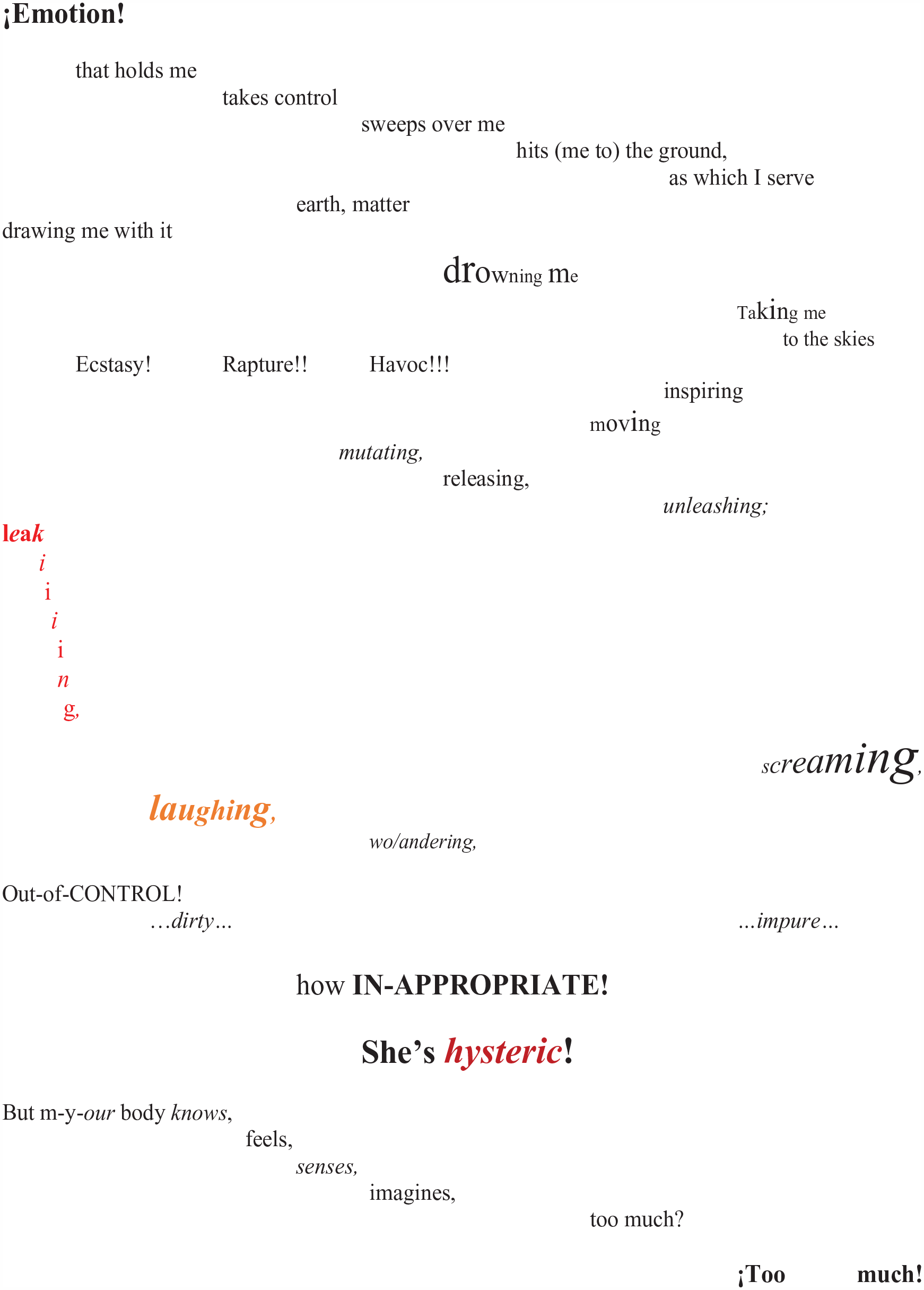
What if we began to listen to the hysterics and let them in? To academic research, fieldwork, texts, classrooms, and knowledge creation? As Cixous et al. (1976: 889) reminds us: her language does not contain, it carries; it does not hold back, it makes possible.
Alison Pullen (2018) poignantly interrogates the terms of being, becoming and belonging for women in the organization studies community. Attempts at membership in this community come with a “price,” granting women “representational” access, conditional upon either male projection or the acquisition of a metaphorical phallus (Höpfl, 2000, 2003, 2007). In this context, the feminine and more broadly the other body (especially bodies so designated by heteronormative frameworks) are seen as abnormal, vulnerable, lacking, over-emotional and, more often than not, reduced to hysterical (Silva, 2021). This often requires their surrendering to the masculine logos and suppressing their embodied potential for knowing to avoid threatening the dominant epistemic norms of being and writing (Bell et al., 2020; Dotson, 2014; Höpfl and Matilal, 2007; Mandalaki and Pérezts, 2023).
The term hysteric embodies aptly this “menacing” quality, carrying strong, gendered underpinnings, as it is historically associated with feminine corporeality and an incapacity to articulate an intelligible story of oneself (Appignanesi, 2008; Devereux, 2014; Showalter, 1993a). This historical foundation shows in the contemporary ubiquitous usage of the terms “hysteria” and “hysterical.” Transformed into global mass signifiers, these terms are strategically used in hashtags, tweets, blogs, newspaper headlines and articles to discredit everyone who calls out the systemic violence of xenophobic, misogynist, racist, neoliberal authoritarianism, right-wing populism and far right extremism (Krasny, 2020: 127). Driven by feminist curiosity, which is not limited to women but strives to restore justice for all marginalized bodies (Ahmed, 2016a; Enloe, 2004), here we seek to defy such pejorative use of the term. We do so by embracing the unique performative potentials of hysteria, as a gendered concept associated to language, and the lack of it (Devereux, 2014; Irigaray, 1985b; Showalter, 1993a), conceptualizing it as a means of resistance against epistemic oppression (Dotson, 2014).
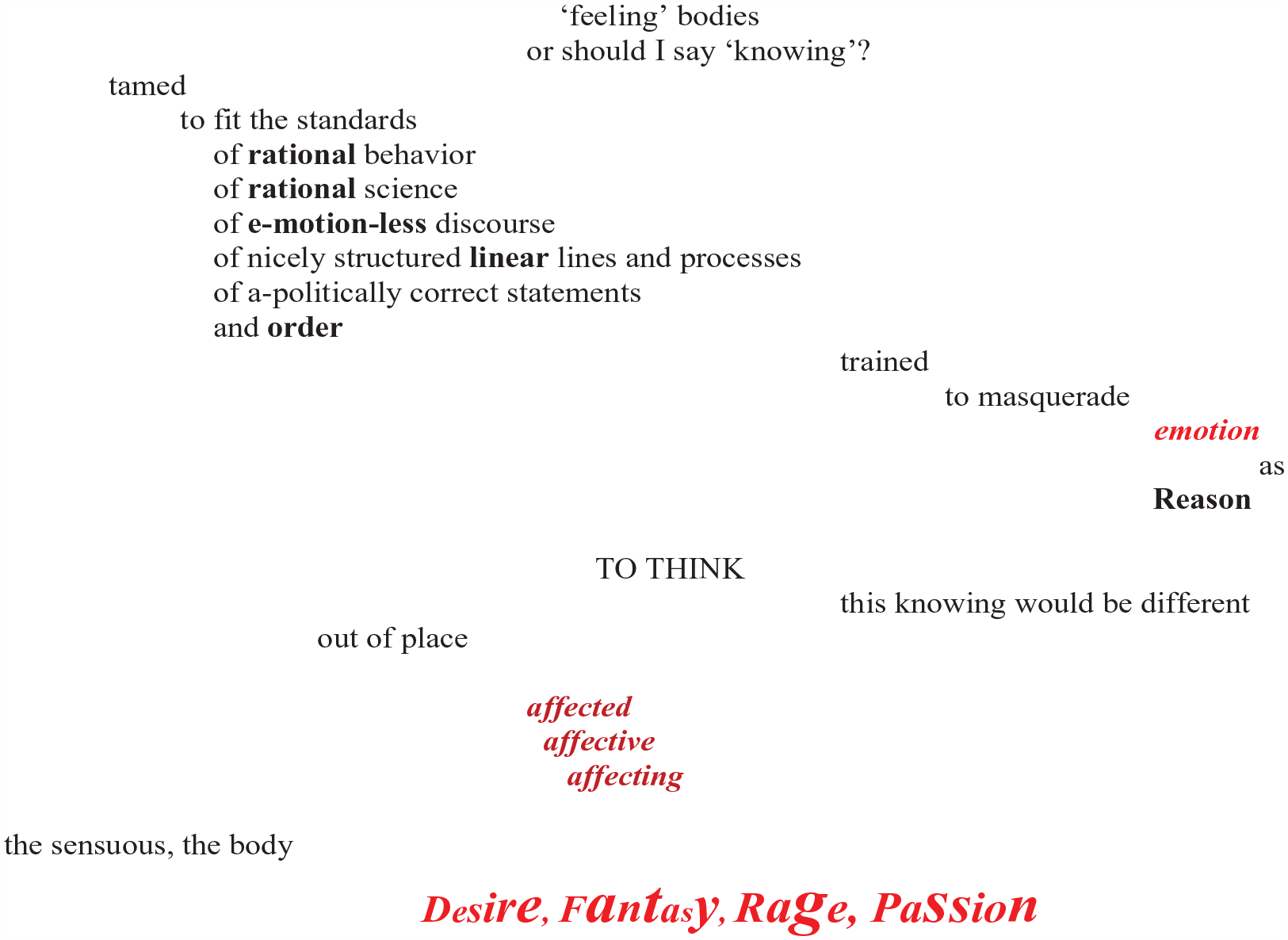
Three decades ago, Calás and Smircich (1993) invited us to play with our senses and the potential of hysterics for reimagining management and organization theory and research. Answering to this long overdue call, our text builds on a few notable exceptions (Dickson, 2015; Fotaki and Harding, 2013) and draws on feminist post-structural understandings on écriture feminine (not referring to women exclusively; Cixous et al., 1976), specifically on Irigarayan mimesis (Irigaray, 1985b), to develop hysteria’s transformative ethico-political potentials for writing, researching, relating and eventually knowing differently in organization studies (Schäfer, 2021). In this text, hysterical is used as an adjective and hysteric as a noun to refer to the embodied subject. Mimesis functions as a creative and transformative mode of reclaiming our subjectivities and forms of representation (Irigaray, 1985b). As described by Kozel (1996: 116), mimesis involves consciously stepping in and out of the sexual stereotype provided for us to critically examine and challenge it. Doing so, it seeks to: recover the place of her exploitation by discourse, without allowing herself to be simply reduced to it. It means to resubmit herself –inasmuch as she is on the side of “perceptible,” of “matter”– to “ideas,” in particular to ideas about herself, that are elaborated in/by a masculine logic, but so as to make “visible,” by an effect of playful repetition, what was supposed to remain invisible . . .. (Irigaray, 1985b: 76)
We suggest that rethinking hysteria through mimesis allows understanding, relating and responding to each other as well as writing, reflecting and knowing with and through one another differently with care. It also allows reshaping our reflexive understandings of organizational realities in their multiplicity and complexity, by connecting with the affective experiences of those who have been subjected to oppression, discrimination and/or marginalization. As a form of disruptive academic practice (see Fotaki and Harding, 2013) and language (Dickson, 2015), hysterical academic engagements highlight, as argued here, the agency of unruly academic bodies to articulate intelligible academic stories of themselves and the different subjects they study. They manifest a form of resistance against epistemic oppression and violence (Dotson, 2014; Lorde, 1984; Spivak, 1988), allowing us to learn from those embodied voices (ours and others’) that we have become accustomed to dismiss.
Our thinkingwritingfeelingresearch contributes to calls in the literature to reclaim the hysterical as a political stance in our social, research and writing engagements (Calás and Smircich, 1993; Dickson, 2015; Fotaki and Harding, 2013; Schäfer, 2021). It also adds to the burgeoning literature stream on writing differently, joining the community of organization scholars who, from this journal (Mandalaki and Pérezts, 2023; Mandalaki, 2022; Bell and Sinclair, 2014; Fotaki and Harding, 2013; Helin, 2023; Huopalainen, 2022; Pullen, 2018) and more broadly (e.g. Ahonen et al., 2020; Einola et al., 2021; Boncori, 2022; Dorion, 2021; Gilmore et al., 2019; Helin et al., 2021; Pérezts, 2022; Plotnikof and Utoft, 2022; Pullen et al., 2020; Thanem and Knights, 2019; Fotaki et al., 2014), engage with embodied and affective forms of writing to resist normative, masculine writing standards. Unfolding the response-able ethico-political potentials (Bozalek, 2020; Haraway, 2016) of hysterical writing, our text specifically extends feminist scholarly debates discussing the ethical and political dimensions of écriture feminine (Beavan, 2019; Huopalainen, 2022; Prasad, 2016; Vachhani, 2019; Mandalaki, 2021).
In what follows, we develop what a hysterical critical positioning, inspired by mimesis (Irigaray, 1985a, 1985b), might be and enable in researching and writing organizations. We start by describing the shared process that gave birth to this text, reviewing feminist texts that have inspired our research-writing journey. This motivates our proposition of/for hysterical research and writing and situates methodologically what “hysterical autoethnography” might look like. This development is informed by scattered bits and pieces of our shared embodied and poetic exchanges, performing hysteria on the page and recognizing the value of what remains unarticulated and unknown in/for the knowledge we create. We then draw on historical, medical and feminist readings of hysteria to discuss the theoretical, methodological and empirical potentials of rethinking organizational research and writing as mimetic hysterical practices. Stressing the ethico-political underpinnings of academic endeavors undertaken by response-able hysterical bodies, we open-end this text by offering implications of our proposition for pedagogy, reviewing, editing, and collegial relationality in academia.
Our text is guided by a logic other than coherence (Irigaray, 1985b: 153), a desire for closeness, relationality, proximity, cyclical arrangements, non-linearity, multiplicity of positionings, beginnings and (open) ends. The learnings and conceptualizations emerging from our process can be seen as traveling concepts (Simpson et al., 2018), grounded in reflexive and interpretive engagement with the shared and non-shared embodied experiences that inaugurated this writing (Cixous, 1993). To openly explore the emergent ideas, you are invited, dear reader, to experiment with the reading of this text. You may enter from various locations—prompted by the different headings—and move along spontaneously without reserve. Regardless of your entry point, you are welcome to t-ravel with us in and out of this maze.
Tracing our path toward hysterical writing
Feminist inspirations
This writing encounter started from a shared longing for research and writing that moves, allowing us to be in touch with others around us and within us (Mandalaki, 2021; Brewis and Williams, 2019; Pullen and Rhodes, 2008). We started exchanging experiences and texts, following up on research discussions with a group of co-authors (for another paper). Our initial, most often written, weekly conversations lasted for about 6 months and have been followed to this date by regular exchanges, via email, Zoom, and WhatsApp, where we also share photos and videos. Our broken sentences and utterings of both inadequacy and accomplishments, opened avenues for us to express our sensations, processes of caring, being cared for and about, and being valued in our exchange. These translations carried us into this meaningful relationship, inspiring us to write together.
In togetherness, we found something that multiplies when shared, making space for our bodies to fit. We found resonance with burgeoning organization studies debates questioning how the masculine normative standards shaping toxic neoliberal academic spaces and methods (Plotnikof and Utoft, 2022) displace affective, sentient, feminine and/or different other bodies from the academic text (e.g. Mandalaki and Perezts, 2022; Beavan, 2019; Helin et al., 2021; Höpfl, 2000; Pullen, 2018; Boncori, 2022; Huopalainen, 2022; Pérezts, 2022). Building on their legacy, our inquiry revisits this question, seeking to explore the potential of the ungovernable emotional and affective (hysterical) excesses that have underlined our writing encounter to contribute to this collective endeavor.
We embarked in an embodied journey of reading and writing (Cixous, 1993). T-raveling slowly and patiently across feminist literature, our bodies, as well as in-complete, “nonsensical,” vulnerable poems or texts (Helin et al., 2021; Valtonen and Pullen, 2021), allowed us to make collective sense of our embodied experiences of othering, as woman-identifying writers (Pullen, 2018). This involved unpacking pressures that start from the paradoxical position of the female subject as “lacking,” dis-abled and insufficient in comparison to the fully able male body that sets the norm (Ahmed, 2016a; Bell and Sinclair, 2014; Cixous, 2010; Höpfl and Matilal, 2007; Irigaray, 1985b; Pullen, 2018). We resonated with feminist authors problematizing how the masculine presumes the agency to speak of/for women, thereby creating a distant space of reflection and speculation where it claims to view itself, femininity and the other “objectively” (Grosz, 1989: 128; Irigaray, 1985b; Kristeva, 1984). As Grosz (1989: 126) points out, patriarchy does not prevent marginalized bodies from speaking, but when such speech does not emanate from a “universal” position, patriarchy refuses to listen.
. . . I can thus speak intelligently as a sexualized male (whether I recognize this or not) or as asexualized. Otherwise, I shall succumb to the illogicality that is proverbially attributed to women. (Irigaray, 1985b: 148–9, also quoted in Tauchert, 2002a: 1)
Dotson (2014) explains how this condition creates dominant epistemological systems, far from being democratic, symbiotically related to social and political injustices. Such systems perpetuate epistemic violence (Spivak, 1988), by maintaining credibility criteria that favor privileged groups while marginalizing others. Doing so, they undermine underprivileged bodies’ epistemic agency to offer epistemological accounts of their experiences (Dotson, 2014), (re)creating epistemically disadvantaged identities that remain “obscured from collective understanding” (Fricker, 2007: 155). In this order, dominant epistemologies view critical, feminist scholarly undertakings as threatening, dangerous knowledge to established ways of knowing, subjecting them to persistent epistemic exclusions (Bell et al., 2020).
Within this dominant paradigm, textual practices manifesting palpable, relational, “feminine” auras, like poetry, for instance, become marginalized, denigrated as “mark[ing] a heightened ‘hysterical’ mode in women’s narrative” (Tauchert, 2002b: 59). They are only tolerable when disconnected from serious theoretical writings and discourses (Grosz, 1989: 130; Höpfl, 2003; Kristeva, 1984). In Dotson’s words: “Her testimony of the experience may be rejected as nonsensical; they may designate her as a deceiver with dangerous ideas; or the conclusions she draws might invoke ridicule and laughter” (Dotson, 2014: 130, our emphasis; see also Bell et al., 2020).
Reading, pondering and feeling (with and through) these texts, recent calls to reclaim the hysterical as a critical political stance destabilizing the power dynamic, both in the academy (Fotaki and Harding, 2013) and in the academic text (Dickson, 2015), resonated deeply in us. We sensed this as a useful inroad for turning the oppressive laughter of dominant epistemic systems (Dotson, 2014) into a hysterical laughter (Cixous et al., 1976). By reconfiguring creatively the gendered, embodied and linguistic architectures associated to it, and thus different bodies’ representation to knowledge, hysteria might enable long-desired epistemological alternatives, we thought.
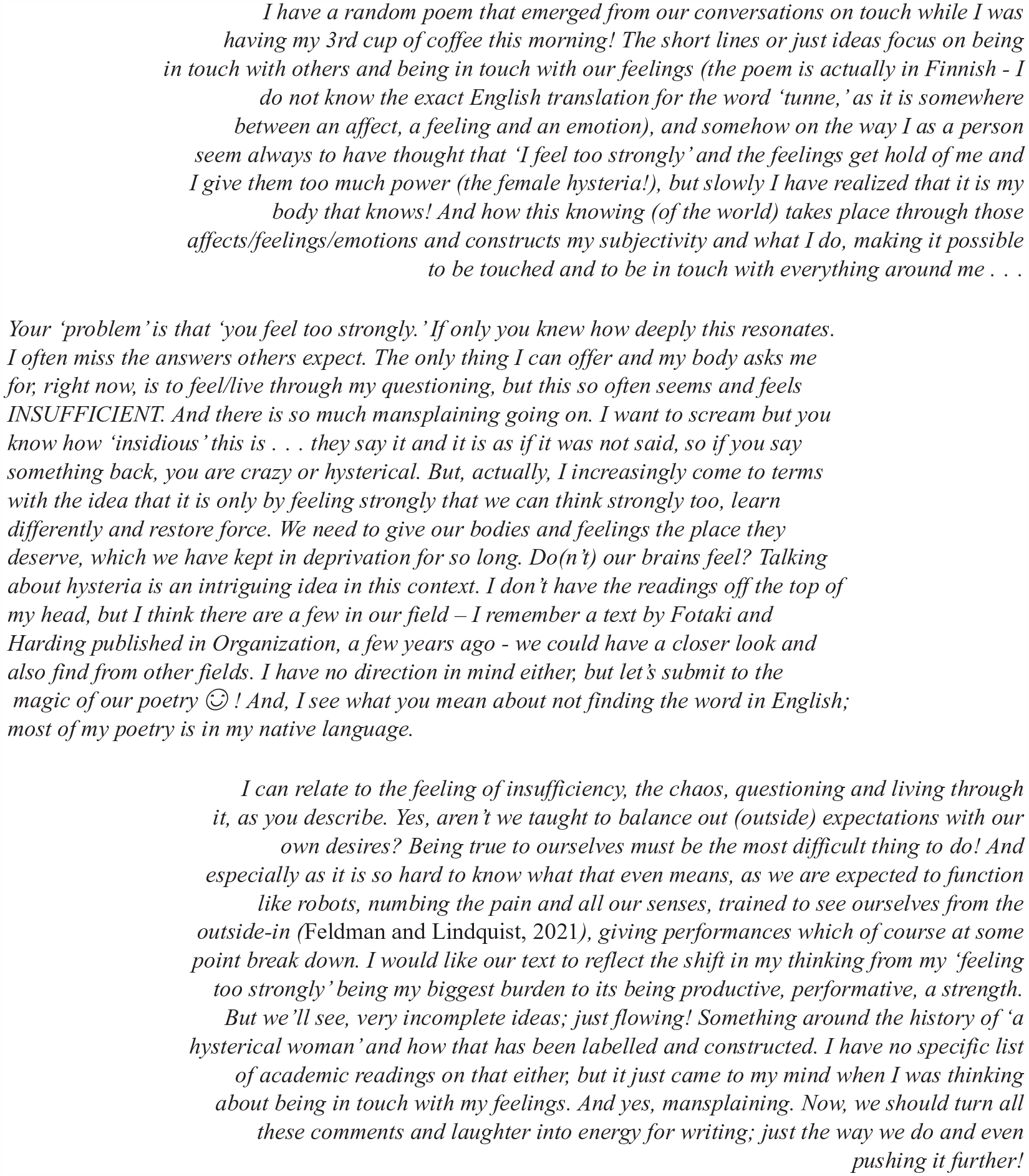
As Silva notes: “the hysterization of women is also part of every imposed power relationship . . . mak[ing] us question whether we are crazy or paranoid (Sinclair, 2019), a very perverse system indeed” (Silva, 2021: 5). All this has led us to shape our research question as: How would it be to experience academic researching and writing and all that these processes involve (i.e. thinking, relating, feeling, knowing) from within the marginalized body of a hysteric?
Experimenting with a hysterical autoethnography
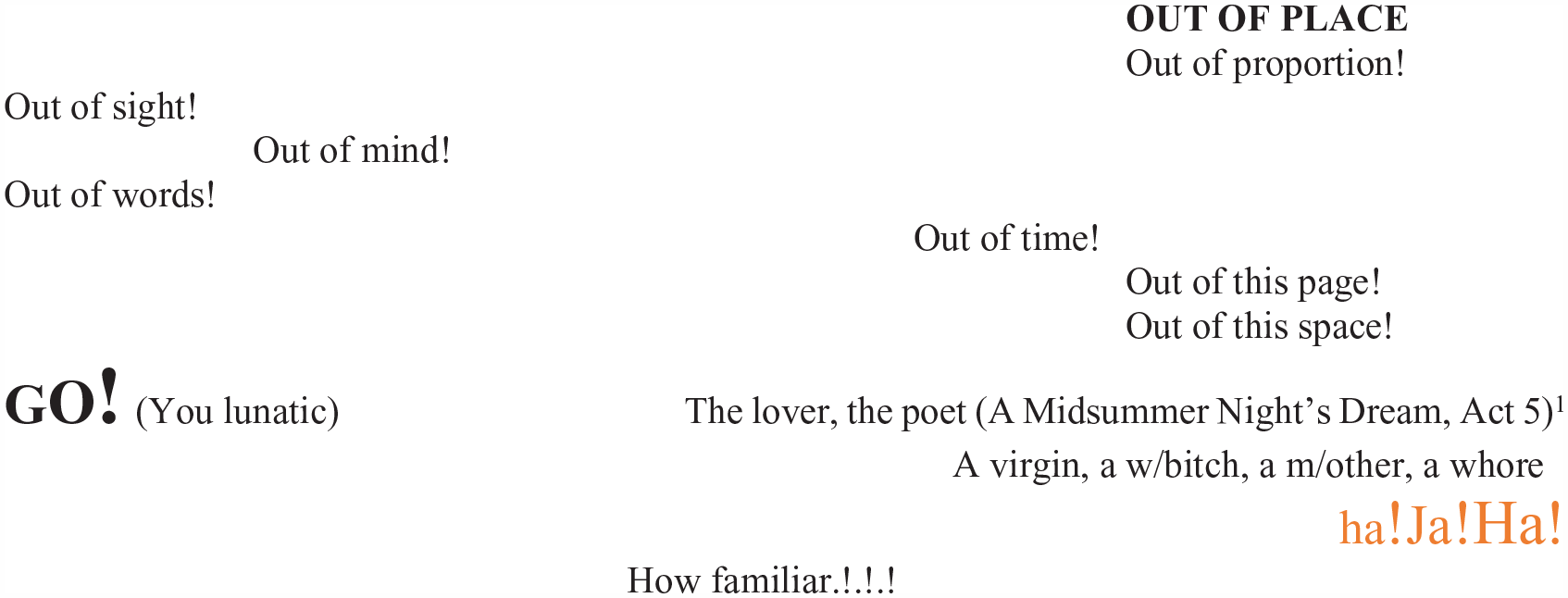
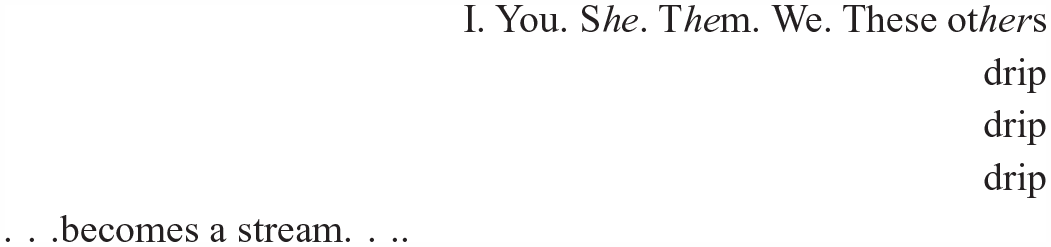
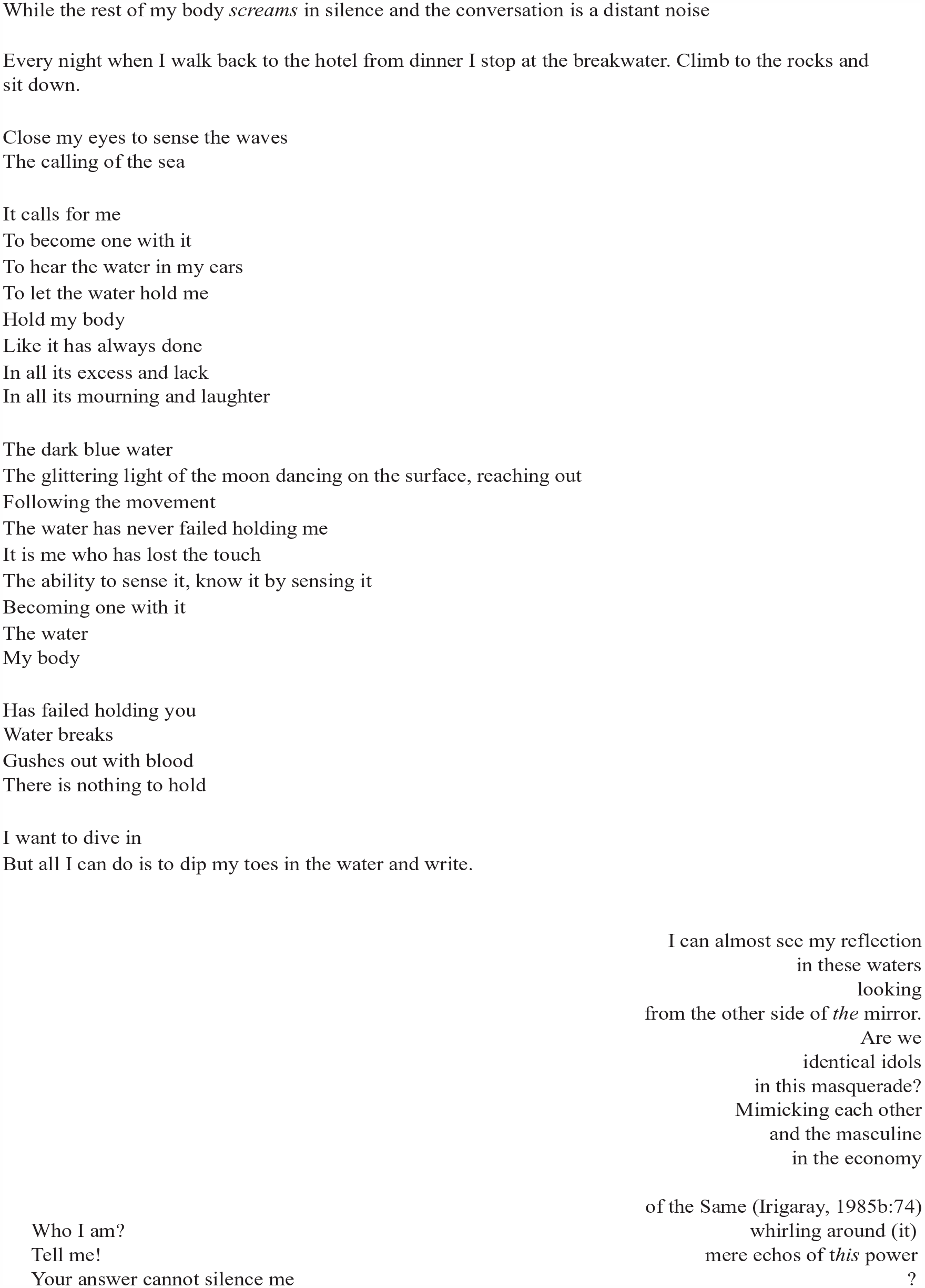
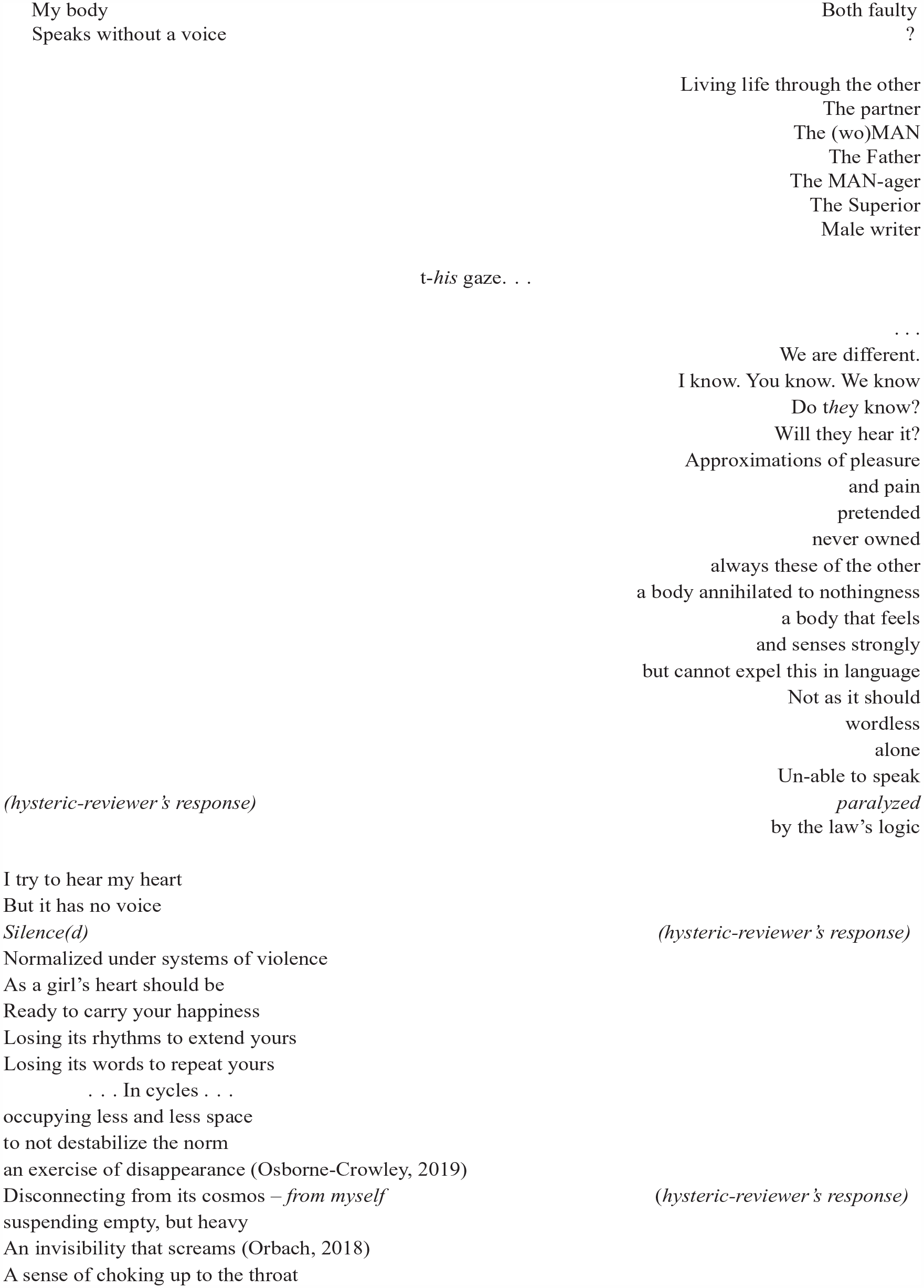
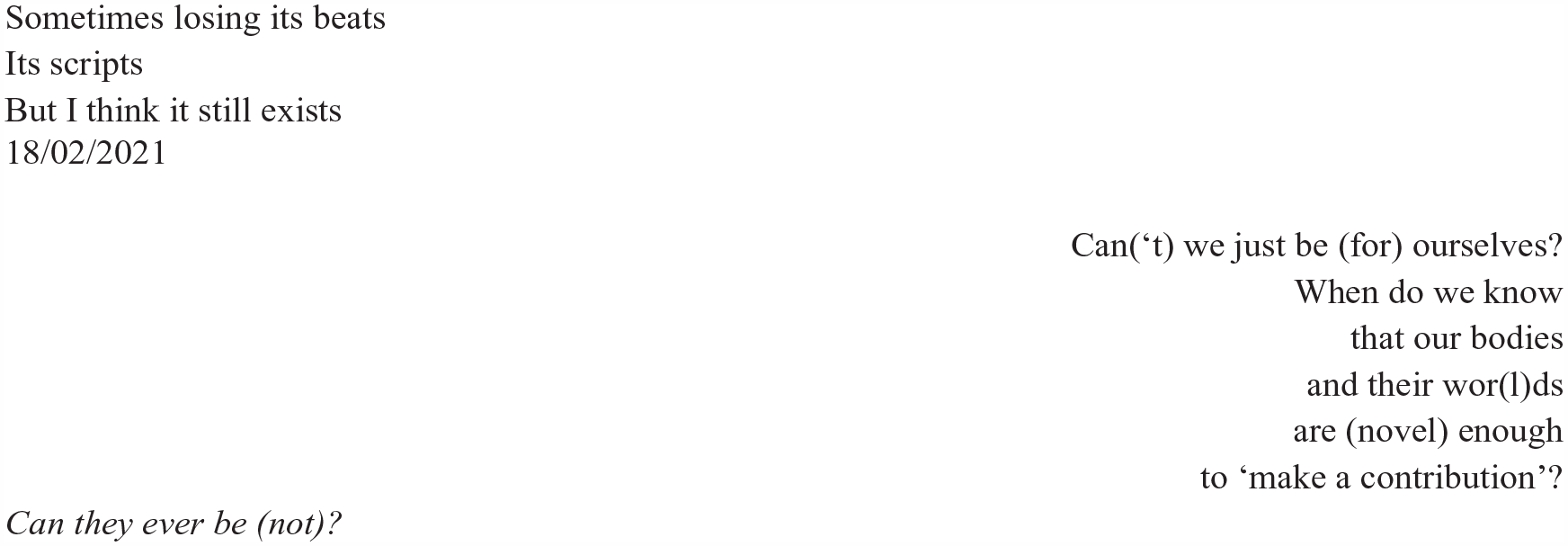
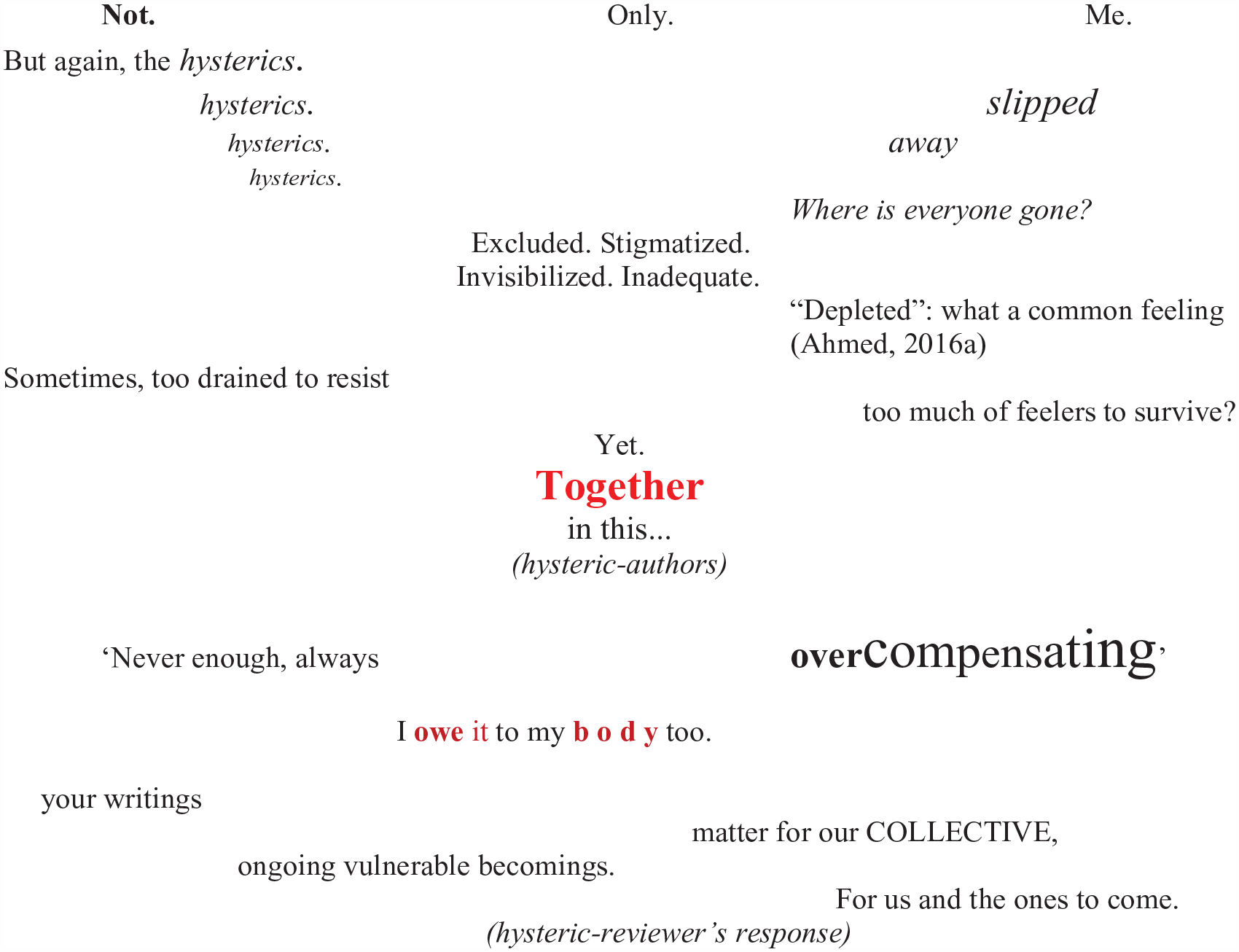
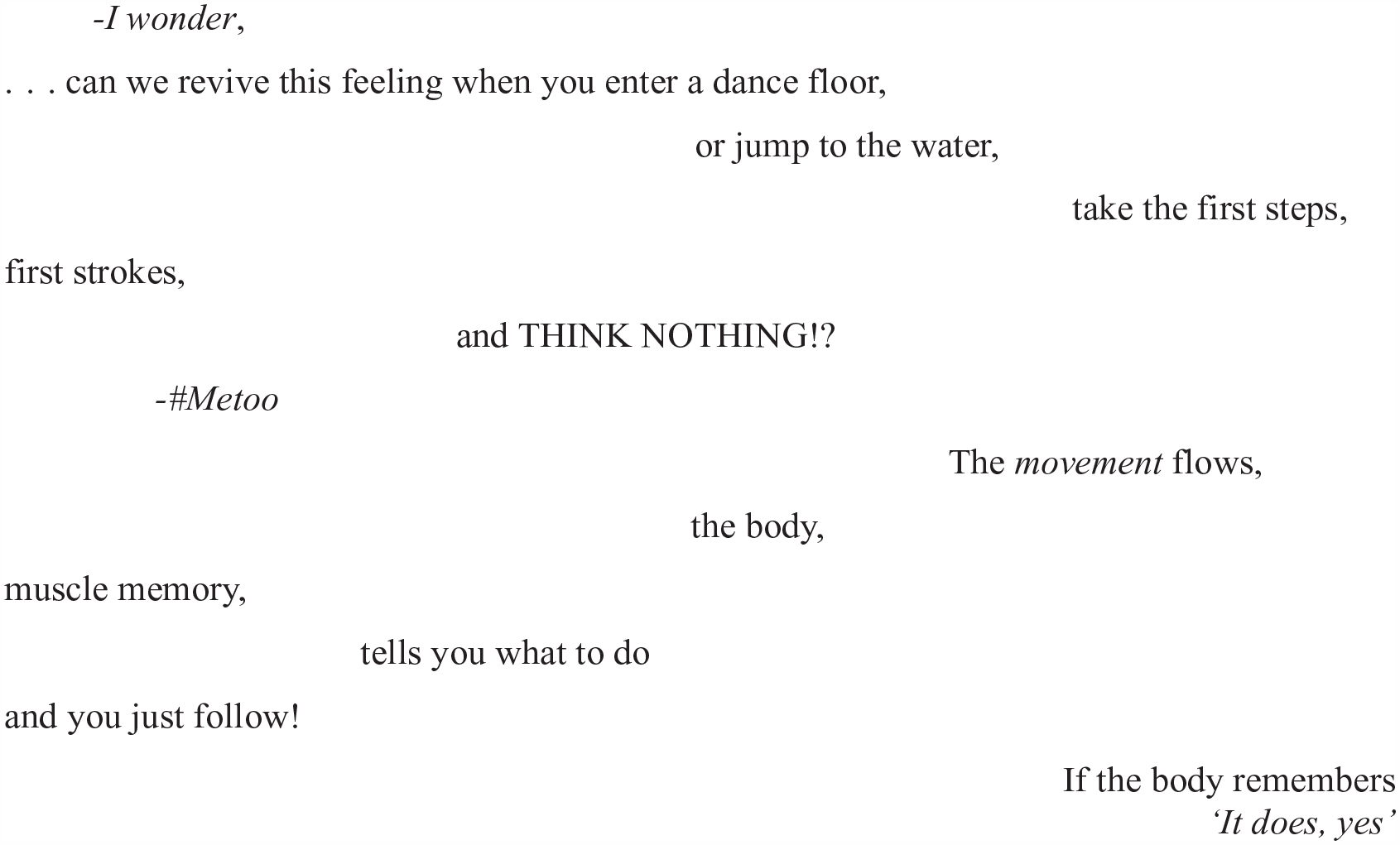
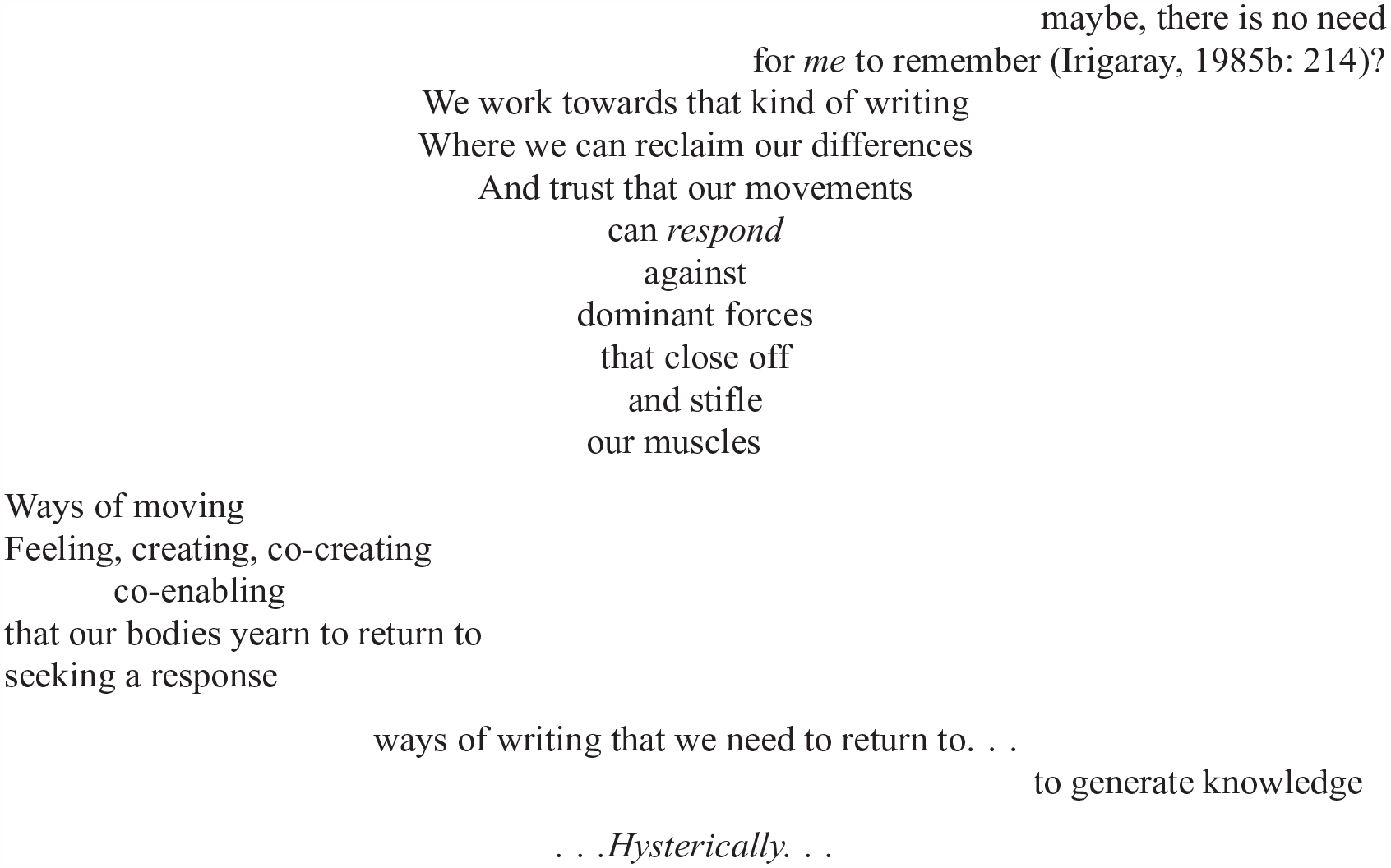
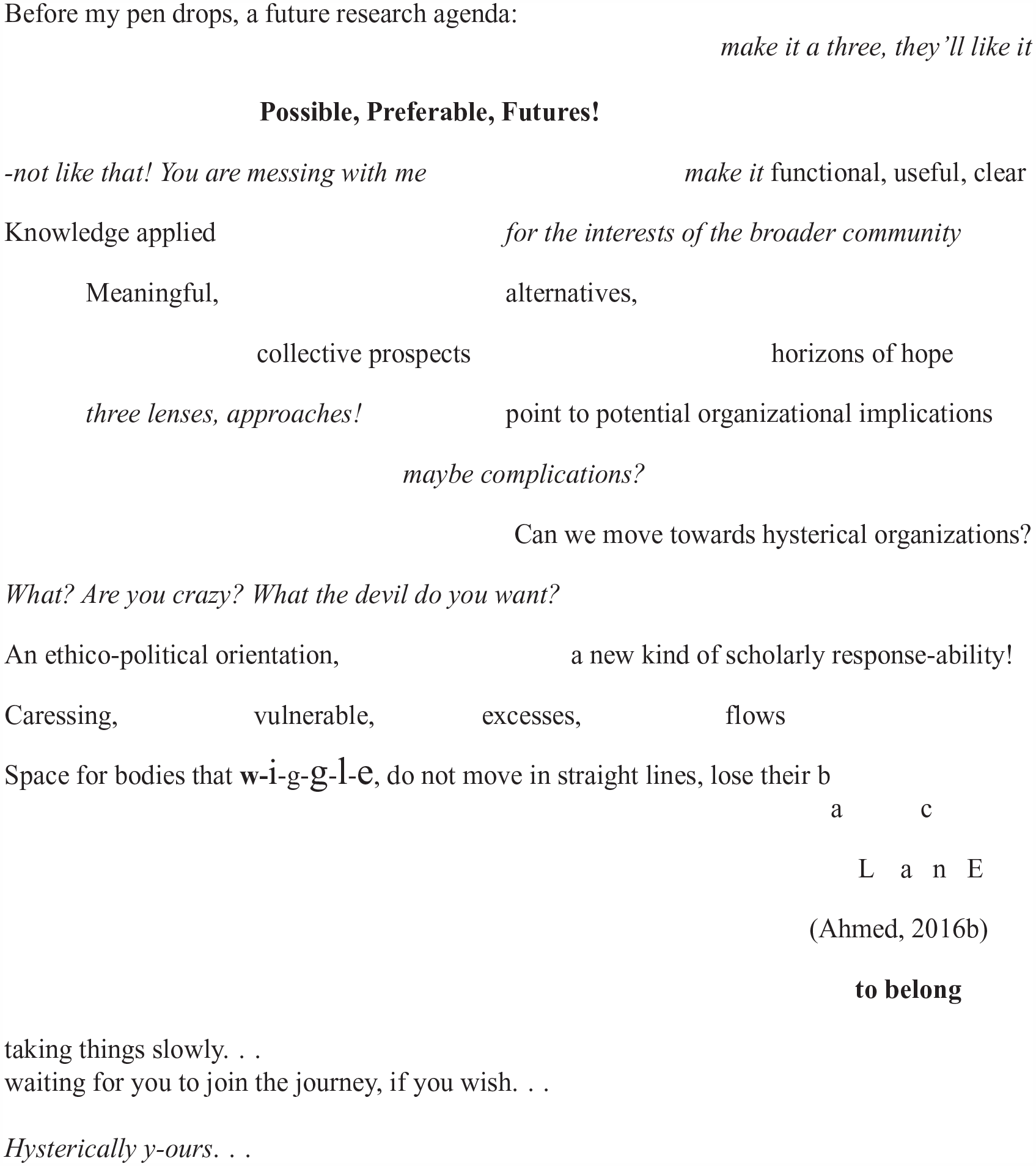
To explore our question, we give into what could be seen as a “hysterical autoethnography”—performing embodied language rooted in feminist, provocative and unsettling (for academic standards) writing (Cixous, 1993; Dickson, 2015; Pullen, 2018). Our writing follows different rhythms and adjustments, regular font or italics, using hyphens and slashes as it feels right (Kjær and van Amsterdam, 2020). Its hysterical prose interweaves embodied itches (Thanem and Knights, 2019), affects, poems and reflections, as well as theoretical and methodological inspirations, establishing collective reading, writing, thinking, relating and responding to as crucial in our methodological approach (Kaasila-Pakanen et al., 2023; Bolous Walker, 2017; Cixous, 1993; Helin et al., 2021). Poetry offered us a feminist language with which to transmit the affects that lingered on our bodies, challenging the status quo of rational academic knowledge (Lorde, 1985; van Amsterdam et al., 2023). Each of us wrote poetry, first separately, then together, we read and responded to each other’s verses, connecting affectively through the spaces that we share and those that we do not. While revising this text, we also included poetic verses generously offered by one reviewer. This was experienced as a way of enacting the relationality, collaboration and caring response-ability that informs the hysterical processes we advocate. In ‘A Room of One’s Own’, Woolf (1929) writes: poetry allows us to expel the edges of the world—anguish and laughter—to “celebrate a feeling one used to have, so that one responds easily, familiarly, without troubling to check the feeling or compare it with any other” (2019: 17–9, our emphasis). This is the conception of poetry embodied in this text; a hysterical poetry that feels pain and laughs, produced by response-able, incomparable bodies in thinking, feeling, relating and knowing (Irigaray, 1985b).
Prompted by a hysteric-reviewer (with all respect!), we also attempted to experiment with different letter sizes and colors. In this spirit, some poetic words and letters are presented in augmented size and shades of red, which relate to blood, dirt, embodied leaks, revolution, and resistance (Irigaray, 1985a; Pérezts, 2022) to create echoes of the affective excesses that ignited our writing. From an Irigarayan perspective, colors facilitate a reflection incorporating body and mind, non-binariness, multiplicity and difference, since they are rarely fixed or pure (Fielding, 2001). We are prepared that our text might be subjected to the same treatment as that of Mar Pérezts, whereby colors other than black and white (namely red) were censored by the journal’s requirements (Pérezts, 2022). This gives us one more reason to perform hysterical writing, arguing that how we write beyond what we write matters equally in/for the knowledge we create (Kaasila-Pakanen et al., 2023; Huopalainen, 2022).
Engaging with hysterical writing as a duo requires a relationship based on shared vulnerability and responsibility. This involves compromises, mutual respect and trust. Albeit the creative differences between us, our mode/s of textual expression and momentum for writing evolved organically. During the writing process, we have shared passionate discussions, intimate personal experiences, intense affects and emotions. Some of these faded away while others still linger within. In our experience, hysterical writing is far from being ideal or “easy.” It requires making space for the affective intensities and vulnerabilities exchanged between the co-authors, thus claiming vulnerability as a regenerative epistemic resource for resistance, agency and transformation (Gilson, 2014). Performing hysterical writing beyond just writing about it also involved a balancing act between our highly personal and subjective expressions and more conventional academic language that can speak to broader academic audiences. This act and the changing modes of writing are part of the mimetic tactic employed here, consciously stepping in and out of the stereotype that we challenge.
Our language-s in this text are situated (Haraway, 1988), seeking to ground our otherness as autonomous (yet interdependent) embodied subjects to nurture caring across differences (Chatzidakis et al., 2020; Einola et al., 2021). Anna-Liisa is white, a mother of two and has recently defended her PhD in a North European Institution. Emmanouela is white, single and an Associate professor in a Central European institution. What we do not share (beyond what we do) resides perhaps also in the blank spaces behind these words. In these spaces, the performance or masquerade breaks down, and the relation to our private/public bodies becomes uncontrollable and immediate. What remains unsaid and unarticulated between us, but also probably in the reviews that gently accompanied us in this process, matters equally in the hysterical autoethnographic process we navigate. Therefore, not intending to delete our subjective voices, the “we” used here positions writing as a “collective repossession of the images and representations . . . coded in language, culture, science, knowledge, and discourse and consequently internalized in the heart, mind, body, and lived experience” (Braidotti, 2011: 100).
This hysterical process brings us to terms with the impossibility of ever knowing the self and the other fully in/through the knowledge that we create. It is based on response-ably (Bozalek, 2020; Haraway, 2016) engaging with each other and hopefully with others “against the tyrannies of silence” and marginalization (Pérezts and Mandalaki, 2023; Lorde, 2017). We next develop hysterical writing as a feminist language of care, healing and dissidence. As a way of building intersubjectivity (Irigaray, 1985a) between affective bodies that “lack,” “embracing, rejoicing and reveling that lack” to experience the Other’s jouissance as different from phallic jouissance (Dickson, 2015: 140). Our conceptualization explores the performative dimensions of hysterical academic engagements, drawing on hysteria’s historical production across various epistemic disciplines (Braun, 2020b). Doing so, we develop the possibilities and response-abilities of a hysterical academic stance for transforming the terms of membership in the organization studies community. This writing flows from a position amidst the binaries: from the excluded middle (Grosz, 1989), seeking to counter gender binaries and reconcile what is traditionally seen as opposing (Huopalainen, 2022; Irigaray, 1985b).
Broken bodies
EGOS 2016. The beautiful seafront of Naples. The heat has settled, and the refreshing gentle breeze soothes my face as I walk past the buzzing bars and restaurants spilling music and chatter to the crowded street. I see street performers, couples strolling along, large family gatherings, runners, tourists taking pictures while imagining the outlines of Mt. Vesuvius visible in the far distance during the day. I can feel the rhythm and energy of the city. Although a polished version of it. I try to let it sink in, immerse myself in it. Polish myself too.
I arrive at the dinner Greet others and take a seat Give occasional signs to mark that I have listened to the conversation A quick laugh for the joke Yes, I agree My ears listen My mouth talks
Behold the mad one: On hysteria and acquiring new value for it
Reading her-stories
We traveled curiously with the concept of hysteria, reading her-stories as inscribed in the narratives of medical professionals, historians, literary critics, cultural theorists (Rousseau and Porter, 1993) and feminist authors (Appignanesi, 2008; Braun, 2020a; Bronfen, 2014; Devereux, 2014; Ender, 1995; Gilman, 1993; Micale, 1989, 1995; Orbach, 2018; Showalter, 1993a, 1993b). What stroke us, revealing to us the unique potentials of hysteria as a disruptive epistemological proposition, was the distinguishing etymological quality of the term, hystera: uterus. This connects feminine corporeality to the concept from its birth (King, 1993). A highly gendered term, hysteria has functioned throughout history to highlight how “women make meaning of their sensations against a backdrop of social messages that denigrate their bodies” (Feldman and Lindquist, 2021). For centuries, hysteria was used derogatively to denote women’s demonic madness and the incapacity to secure a subject position (Appignanesi, 2008; Rowland, 1999). Specifically, it was employed as a medical metaphor for anything seen as mysterious or unmanageable in women (Micale, 1989: 320); as evidence of “wandering” wombs, reproductive (in)capacity, (in)fertility and susceptibility to miscarriage (Devereux, 2014: 20). As Appignanesi (2008: 144) posits, hysteria’s varied and fluctuating symptoms (e.g. unstoppable loquacity, loss of voice, constant mobility, agitation when asleep and/or paralysis when awake) reflect women’s distressed response to the augmented controversial demands placed on them at the end of the 19th century. Hysteria, thus, became a voice of protest and contestation, experienced as a solution (and not a problem) for women in oppressive life situations (Orbach, 2018).
Showalter explains how, by drawing connections between hysteria, semiotics and discourse theory, feminist thinkers discuss hysteria “as a specifically feminine protolanguage, communicating through body messages that cannot be verbalized” (Showalter, 1993a: 286). She notes that Freud discussed interrupted narration as one of the main elements of hysteria, emphasizing the doctor’s “responsibility” to reorganize a hysteric’s discontinuous speech. The incapacity to provide an “ordered history of their life” (p. 318) was not simply a symptom of hysteria, but the meaning of hysteria itself. If the hysteric could remember and provide an intelligible account of their repressed thoughts, the “dis-ease” (Devereux, 2014) was considered treated (Showalter, 1993a: 318). Τhe “loss” of the hysteric’s voice was the outcome of becoming “selfless,” a masculine-inspired state of “independence” that girls were instructed to reach in becoming adults (Gilligan, 1995).
With its unique gendered, embodied and linguistic underpinnings, hysteria “holds the secret of the subject’s desire and knowledge, but also a site of remembrance and of a touch return to the primal scene” (Ender, 1995: 273). The hysteric’s discourse may, thus, reveal the “unacceptable” nature of women’s writing (both in content and format) for the masculine “scientific” order—what Devereux (2014) discusses as the structure of unpresentability (i.e. the patriarchal unconscious’s unease with affective embodiment, vulnerability, relationality, natality, mortality and sexual vitality, Braidotti, 2011: 102). It is worth noting that although hysteria has also existed in the history of male experience (Showalter, 1985, 1993a; Tasca et al., 2012; see also Dickson, 2015), men were not called “hysterics” (unless in attempts to belittle them). They suffered more “honorable” illnesses, such as melancholy, hypochondria, neurasthenia, shell shock or obsessional neurosis (Showalter, 1993a). The latter distinction, we suggest, is important, in relation to how masculine logics have traditionally dominated logos, naming and writing.
As Ahmed reminds us, acts of naming social objects (and subjects), orient us in particular ways by giving these objects or subjects certain attributes and qualities that may become “sticky” (Ahmed, 2004). Signs become sticky through their relation to other signs (pp. 91–2), their ability to evoke other words, and through binding histories of repetition. In our text, the word “hysteric” is used to problematize how the term has been employed to denigrate different positions in science; through reductionist mimetic discourse that stops the wor(l)d from moving. Inspired by the feminist post-structuralist notion of mimesis (Irigaray, 1985b), which considers hysteria’s unique associations between gendered embodiment, difference and language, our account reclaims hysteria as a performative act of resistance (Fotaki and Harding, 2013; Krasny, 2020)—as a creative solution and not a problem (Appignanesi, 2008; Orbach, 2018) to oppressive epistemic orders marginalizing different others’ voices (Dotson, 2014).
Behold the madwoman who dances by, as she vaguely recalls something. Children chase her with stones, as if she were a blackbird. Men chase her with their gaze. She brandishes a stick, pretending to chase them, and thencontinues on her way. She loses a shoe on the road and doesn’t notice. Long spider legs circulate around the nape of her neck—it’s only her hair. Her face no longer looks human, so it seems for an instant, and she bursts out laughing like a hyena. She lets shreds of sentences slip out, which, if stitched back together, would make sense to very few; but who would restitch them? (Didi-Huberman, 2003: 67)
Situating hysterical writing as a mimetic feminist practice
Hysterical language draws from Irigarayan mimesis, an activist feminist practice that makes a difference in challenging contemporary culture, by eroding stereotypical assumptions reproducing women and different bodies as mirror reflections of each other (Irigaray, 1985b; Kozel, 1996; Whitford, 1991). Irigaray’s ideas enable us to understand the intersubjective exchanges between us as exchanges which do not view one of us as the “real”—the original—and the “Other” as her copy—an imitation. By performing our bodies in writing, we engage and play with mimesis, seeking to relate meaningfully without simulation (and assimilation) (Irigaray and Burke, 1980: 78). Using the concept of new poetics or poetics of two (Irigaray, 1993), Irigaray explains that we can understand our presence through an adaption, not withdrawal, of the sensible, as a relation between two Others who remain irreducible to knowable and identical sameness. The others, in this account, co-exist to reclaim all these relational and response-able elements of (inter)subjective development. It is in these moments, we suggest, that disruptive hysterical language, as an enabler of difference, emerges (Cixous et al., 1976). This carries a seducing capacity that “can never be possessed” (Salecl, 1997: 21), making space for different unknowns to regain voice through/in embodied response-able language.
In this text, hysterical writing is not experienced as a cure for “the dis-ease of women in patriarchal culture” (Kahane, 1990: 31). We rather reclaim hysteria “to find a cure for . . . patriarchy’s dis-ease enacted in women’s bodies” (Devereux, 2014: 42). Following Irigaray and Burke (1980: 69), we seek to get out of their (the dominant) language, disengage from their concepts and go back to our bodies and scripts through a name (Ahmed, 2004)—hysteric—given to us. To be clear, we do not write as hysterics by following a certain “script” in writing, but by giving speech to that which has remained silenced, under-expressed and unspoken (Grosz, 1989: 138). This involves engaging with theory that speaks from within a gendered, stigmatized body, used historically as a (negative) mirror of/for the (positive) masculine (Irigaray, 1985a). Our narrative develops on top of, in-between/through/for/with/of/despite and over each other’s embodied voices to question taken-for-granted assumptions and often ourselves, seeking to “avoid. . .slipping into the frozen and sterile discourse of the master” (Fotaki and Harding, 2013: 153). Doing so, it challenges the “all-ing” tendencies of dominant epistemic systems (systems defining “all correct” ways of being, Dickson, 2015; Mitchell and Rose, 1983) to enable autonomous, yet intersubjective, representations (Grosz, 1995) of leaky, cyclical and volatile othered bodies. Because, if we continue to speak this sameness, (. . .) we will fail each other. Again. Words will pass through our bodies, above our heads, disappear, make us disappear. (Irigaray and Burke, 1980: 69)
Mimesis, stresses two pre-lingual bodily gestures identified by Irigaray (1985b: 134): women’s suffering and laughter. Like the cries and laughs of a medusa—enigmatic, uncodified, confusing, misleading, surprising, and powerful (Cixous et al., 1976)—such hysterical laughter circulates across bodies, words and sensations that breathe, sweat and leak. This challenges the masculine epistemic modalities of plan, intention, closure and control, creating space for truthful and embodied accounts of oneself under oppressive epistemic systems (Dotson, 2014). In their article published in Organization, Fotaki and Harding (2013) outline the benefits of hysterically laughing at masculine claims for epistemic dominance. In their words: “business schools need hysterics, because hysterics undertake the very necessary task of constantly questioning and redefining their purpose” (p. 164). We echo their critical positioning that adopting the discourse of the hysteric is “the only tenable position we can occupy as critical theorists” (p. 165) to meaningfully challenge instances of sexism and other structural inequalities reproduced in the academy. Drawing on Irigaray’s ideas, our argument emphasizes the need for hysterical mimetic laughs that perform in research and language (instead of veiling) creative differences between bodies (Cixous et al., 1976; Irigaray, 1985b). We suggest, resonating with Dickson (2015: 145), that only by reclaiming writing as a hysterical practice, can we “let the lack of signifiers become our Real (non)voices, to let the absence of signifiers signify the feminine, where the phallus cannot assimilate us.” This enables exploring the potentials of “not-all” othered bodies to experience the Other’s jouissance and desire through co-subjective development (Dickson, 2015). Such hysterical proposition further finds resonance in Braun and Krasny’s (2021) argument, which reminds us of the learnings derived from hysterics’ writing practices. The authors point to the curative and transgressive potential of hysterical wanderings when they feed into academic writing, discussing how these can enable epistemic disruptions against the current conditions of neoliberal knowledge extraction and colonization. This involves both our bodies as academic researchers and writers and the bodies of the subjects we study, proposing hysteria as a promising academic stance for performing new organizational wor(l)dings.
We wish to clarify that we are not suggesting that there currently exists an immediate and transparent relationship between female-embodiment and a specific mode of researching and writing as hysterical practices. As Tauchert reminds us, such a relationship is “necessar[ily] un-fixed, and recognizable in its un-fixedness,” much like embodiment in its “rhythmic transformations” (Cixous et al., 1976; Tauchert, 2002a: 131). Thus, the hysterical claimed here is not about being a female or the same; nor is it attached to the socially constructed, gendered category of woman. Hysteria remains silent and mimes; it is both gestural and lingual, unfinished, never fully known (Irigaray, 1985b: 137–8). Grounded in mimesis and écriture feminine (Cixous, 2010; Irigaray, 1985a, 1985b), our conceptual positioning attempts to preserve in sufferance that which does not speak—embodied differences and earliest desires (Irigaray, 1985b: 136). It goes beyond imitation and binary distinctions between male/female, man/woman, human/non-human, mind/body or nature/culture, recognizing, instead, interdependences and intra-actions that bind humans and all others into a life-sustaining web (Bozalek, 2020; Haraway, 2016; Huopalainen, 2022). Echoing Schäfer (2021), we suggest that hysterical academic practices may build a theoretical bridge to trans*formation, trans*ference and trans*gression to enable the embodiment of different, other, queer subjects into writing (p. 340).
Considering the above, we suggest that adopting the discourse of the hysteric might enable academics, regardless of gender, biology or sexual orientation (among other identifiers of difference), to embrace a caring and critical attitude toward academic writing and knowledge development (Fotaki and Harding, 2013; Thanem and Knights, 2019; Mandalaki, 2021). Hysterical practices may encompass the bodies of the researcher and the researched, joining efforts to disrupt binary heteronormativity (Dorion, 2021; Huopalainen, 2022). Such performative engagement might allow rethinking fixed associations in their broadest sense and especially in relation to rewriting the gendered (and broadly, hu-man-centric) architecture of academic membership in organization studies. We next discuss how these elements might be potentiated by the ethico-political underpinnings of response-able, hysterical academic encounters.
The ethico-political potentials of hysterical research and writing
Performing hysterical research and writing, at the intersections of situated embodied experiences and critical post-Lacanian understandings of the hysteric, involves adopting a “productive and ethical” positioning toward knowledge development (Dauphinee, 2010; Dickson, 2015: 140). This not only challenges absolute linear truths and reductionist constructions of different bodies under patriarchy. It also acknowledges that “representations” of others might only be possible (if ever) through intersubjective encounters that recognize and value differences and multiplicities between humans (Ahonen et al., 2020; Kaasila-Pakanen, 2021) and nonhumans (see Huopalainen, 2022). Such encounters will respect and accept you as other, with/in all your differences and vulnerabilities, even though, and exactly as, I cannot know you in thought or in flesh (Irigaray, 1996: 103).
Recognizing the vulnerability of the self and the other has an ethical potential rooted in inter-corporeal care (Butler, 2015). It extends a relational embrace to another, different, “lacking,” affective, marginalized body, offering them space to emerge, raise their voice and be expressed, socially and epistemically (Butler, 2015; Fotaki and Harding, 2013; Pullen and Rhodes, 2015, 2021). In the hysterical processes experienced and proposed here, this goes beyond idealized claims of empathy that often disregard the other’s positionality (Hemmings, 2012). It involves openness, relationality, attentiveness, sensitivity and careful listening, but also patience, slowness (Bolous Walker, 2017), shared responsibility, accountability and dialog (Helin, 2019; Helin et al., 2021). Being patient and slow reminds us not only of our shared responsibilities as ethical others. It also stresses the response-ability (Haraway, 2016) that we are capable of; and our ability to render each other capable of identifying and responding to our different ethical needs (Bozalek, 2020). As Helin et al. (2021: 105) write: slowness and patience “disrupt the order of things (. . .) enabl[ing] relational work based on trust and care between us, and with the community in mind,” as well as our (joint) work. Such attitude not only refers to how we might perform our individual bodies as authors, researchers and (auto)ethnographers on the page. It may also inform how we relate with others in the field and then transfer the studied embodied experiences to the academic text.
We do not propose a feminine ethics constructed as a “world apart,” disconnected politically and psychologically from normative social and ethical orders (Gilligan, 1995). The ethics guiding hysterical academic practices considers the (field/organizational) context within which ethical relationships evolve. It develops across affective, pre-reflective, non-linguistic and non-oppositional response-able interactions (Barad, 2014) between the researcher/s and the researched. Such feminist ethics also accounts for moments of affective dissent that ground a politics of/for the collective (Hemmings, 2012). It is dedicated to liberating embodied differences and uncontrollable excesses of affect, granting the freedom to be and become oneself by living a life infused with individual and collective empowerment (Pullen and Rhodes, 2021: 49). Emerging in the making-with an (hysteric) other, what Haraway (2016) would call sympoiesis, such ethical stance blurs boundaries between ontology and epistemology, assigning to the hysterical practices proposed here an ethico-political dimension. This seeks to enable a politico-ethico-onto-epistemological stance that lets in the irreducible, unknown other (Bozalek, 2020). Such stance, we suggest, might then reframe the whole world (and maybe the word) as a verb to potentiate relational processes of worlding (and maybe wording), which counter pre-existing ontological fixities (Barad, 2014).
Thus, hysterical writing can contribute to reshaping how different organizational phenomena and realities are brought into being. Their affective, relational, unfinished performativity challenges us to reconsider the ongoing interactions, power dynamics, discourses and materialities of the organizational contexts we study. They push us to recognize the effects of dominant narratives, amplify marginalized perspectives and disrupt established norms, to rather explore the emergent, productive, entanglements that shape organizational structures and practices. Hysterical writing may also ignite affective responses from the readers and the researched. It may resonate with experiences of injustice, disappointment and/or gratification, generating a sense of connection, empowerment and validation of one’s lived experience. Adopting a hysterical academic stance might thus enable spaces for solidarity and connection leading to more inclusive and participatory research.
With the above in mind, we remain sensitive to the varied impacts of and responses to hysterical writing in the academic and broader organizational communities. Although this text has been crafted for a diverse readership, its nonconventional and provocative language performances of hysterical writing may discomfort some. We are prepared for (but not less vulnerable to) all kinds of reactions, including dismissal and derision, and remain hopeful of constructive dialog as a way of broadening up perspectives and practices in the organization and management studies community. We also recognize that writing positions the subject in ways that might (even unintentionally, but often inevitably) displace and/or exclude others (Helin et al., 2021). Writing this way is an effort to enable an open space for dialog, interaction and response. A space which, in all its relationality and complexity, might lead us to reimagine academic research, writing and knowing differently, through response-able expressions of embodied care (Huopalainen, 2022; Merilainen et al., 2022).
Through (critical) performative writing that “matters” (Barad, 2007; Contu, 2018, 2020), this text stands in support of and connection with intersectional hysteria collectives and movements (see Krasny, 2020). Such collectives perform the links between hysteria, language and patriarchal misogyny, resisting creatively through activism and hysterical solidarity (Hysterical Feminisms, 2023; Krasny, 2020: 131). We thus propose the potential of hysterical practices to queer established ways of acting and relating (Ahmed, 2016a), and from there of writing and creating academic knowledge and organizational practice (Schäfer, 2021). As suggested, this is about understanding writing, researching and knowing as the collective labor of relational, response-able bodies.
Discussing
This text problematizes how different ways of thinking and writing are traditionally constructed as parasitic of male-dominated epistemologies (Cixous et al., 1976; Höpfl, 2007; Irigaray, 1985a, 1985b; Young, 1980); seen as “com[ing] second to the ‘true’ function of writing” (Tauchert, 2002b: 57). We use our writing exchanges to reclaim relationally the hysterical aspects of othered subjectivities, often dismissed as overly affective, identically faulty (Irigaray, 1985b), “imaginary, somatic → embodied” (Dickson, 2015: 143). Doing so sheds light into how “non-conforming” hysterical embodiment performed intersubjectively can interfere with academic research and writing in creative, palpable and enlivening ways (Cixous et al., 1976; Tauchert, 2002b). Performing hysterical writing as a feminist act of resistance (Ahonen et al., 2020) enables us to make contact with the world and make sense of how our bodies have been touched (or un/de-touched/detached, othered, cut and left alone) by this world (Ahmed, 2016a; Mandalaki, 2021; Kaasila-Pakanen et al., 2023).
Hysterical practice, as developed here, recognizes the significance of affective inter-becomings for the conduct of academic research and writing. For how we come to feel about the questions we write, reflect, research and theorize. As a hybrid, self-other reflexive, and response-able process, hysterical writing directs our questioning both toward the systemically imposed dominant standards of writing and toward ourselves as critical researchers. It moves us in between mimesis and silence, language and embodiment, excesses and lack of affect, masculine, feminine and bi/a-sexual discourses (Irigaray, 1985b). All of this demonstrates what it means to be in and out (of one’s body and the world) at the same time. In this way, hysteria works to destabilize the dominant canons of researching, thinking and writing, including our academic habitus to often unconsciously reproduce the very symbolic signifiers that we seek to oppose (Fotaki and Harding, 2013). It carries the ethico-political potential to bring us in touch with each other and the world, creatively challenging dominant epistemic norms (Kaasila-Pakanen et al., 2023).
Calling ourselves hysterics in this account, and adopting what this naming entails (Ahmed, 2004), is a political act by itself. We seek to unmute corporeal vibrations of our bodies, challenging constructions of embodied research and writing as deceitful, “unrealistic” or “bad art” (Tauchert, 2002b: 59); or only meaningful when they participate in the interests of the libidinal economy (Phillips et al., 2014). Writing this way allows us to access these speechless moments where we feel incapable of standing in one piece or finding the words to present academically proper accounts. Hysterical language rather “speak[s] the truth of real desire, [which] is unshakeable in its dissidence” (Dickson, 2015: 145). Reclaiming the hysterical potentials of academic research and writing allows us to reclaim the affective potentials of the bodies of the researcher and the researched. It converts our feelings of strangeness for not fitting normative orders into a revolutionary, regenerative force (Kristeva, 2004) for change (Beavan et al., 2021). Hysterical force can take us up to the skies, which isn’t up there, but between us (Irigaray and Burke, 1980: 76). We suggest that we can use this regenerative force to transform systems of power that disqualify different others by suppressing their hysterical speech (Fotaki and Harding, 2013). We might rather recognize the response-ability residing in affective, vulnerable research encounters entangled within the materialities of the organizational contexts we study (Barad, 2014; Bozalek, 2020).
Acknowledging significant works that challenge dominant norms of researching and writing (Mandalaki, 2022; Mandalaki and Perezts, 2022, 2023; Beavan, 2019; Boncori, 2022; Helin, 2023; Helin et al., 2021; Huopalainen, 2022; Merilainen et al., 2022; Pérezts, 2022; Pullen, 2018), we suggest that a refined call to action, through the destabilizing force of the hysteric, is in order. As Ahmed (2016a) reminds us, it is through repetition that feminism reclaims its power. Especially given its unique associations with gendered embodiment, difference, language and resistance, hysteria gives such repetition new life, powerfully destabilizing dominant epistemic orders. The latter is particularly true at a time when critical management studies communities, women and other “non-conforming” (by gender heteronormativity) academics speaking against social injustices and/or studying gender, queer, de- or postcolonial and other critical questions increasingly become the targets of public shaming by sexist, patriarchal, dominant ideologies (Pérezts and Mandalaki, 2023; Savigny, 2017). Further, we note how contemporary political mobilization and activist movements, such as Black Lives Matter, MeToo, The Every Day Sexism Project, Women’s March, Idle No More, LGBTQ+ Pride, and Iran’s revolutionary movement, are openly fueled by deep-seated “hysterical” attributes, such as collective frustration, anger, rage and passion (Hysterical Feminisms, 2023; Krasny, 2020). These are expressed in the streets and on online feeds to record resistance against various forms of oppression and inequality. Doing so, they show that people are no longer keeping quiet, nor are they “going gently” (Women’s March, 2023). In times of crisis, it is undomesticated excessive affects and solidarity (Vachhani and Pullen, 2019) manifested in hysterical performances that drive social change, moving us and others to act together.
At this point, it may be worth pointing out that amidst writing of the revolutionary, regenerative force of the hysteric, we believe in change made through small, perhaps mundane, micro steps; such as those experienced in this shared thinkingwritingfeelingresearch (between us the authors, the reviewers, editors, and hopefully, readers). As hysteria intrinsically functions as a mimetic embodied language connected to affective excesses, suffering and laughter, it might also be explored as a means of resistance against the dominant logocentric system (Irigaray, 1985b: 134). Hysterical cries and laughs resist the position of the objectified, marginalized, unspeakable subjectivities of the researcher and the researched. They provide the means to reclaim an agentic stance in researching, writing, thinking, relating and knowing in different terms: in y-our own terms (cf. Grosz, 2013: 204). Reflecting on embodied experiences of being hysterically in touch with the world enables us to raise feminist consciousness of the instances of normalized “violence and power concealed under the languages of civility, happiness and love” (Ahmed, 2016a: 62). It leads us to recognize our ability to fluidify commonly thought gendered boundaries and binaries (Cixous et al., 1976; Irigaray, 1985b), in life and academia (Mandalaki, 2021; Fotaki et al., 2014). Hysterical academic performances, inspired by mimesis, are about working together as men, women, and others—authors, researchers, research subjects, reviewers, and editors—to explore “the possibilities of generative difference” (Phillips et al., 2014: 326). Such practices may reposition the bodies of the researcher and the researched as reference points of how/what we write, reflect, relate, and theorize to inspire academic knowledge from relational encounters with diverse others (Kaasila-Pakanen, 2021; Meriläinen et al., 2022).
We suggest that the discontinuities and fragments of the intersubjective hysterical discourse proposed here allows for new imaginations, thoughts and spaces to emerge. Performing hysterical academic practices might offer a momentary chance to break free from the sameness attributed to various others, to recognize the gaps and silences existing in organizational structures, as well as the differences dismissed by the current state of affairs. This involves reconsidering the ethico-political conditions of dominant epistemological systems, to imagine epistemological alternatives that make space for othered bodies (Dotson, 2014). Such a turn may be necessary for reclaiming epistemically disadvantaged positions subjected to various forms of marginalization (Dorion, 2021; Savigny, 2017; Schäfer, 2021).
Reaching the end, we also wonder how and whether a hysterical academic stance could materialize in the classroom, that is in pedagogies that transcend the “neutrality” of the senseless gendered body in knowledge exchanges with students. We suggest that engaging with intersubjective, reciprocal, teaching, and learning can only take place through shared recognition and respect of each other’s embodied, affective and social differences. We have experienced the potentials of collaborative, communal learning when our pedagogical engagements are based on openness, response-ability, relational care, and recognition of each other’s vulnerabilities (Calås et al., 2021; Michels et al., 2020; Zembylas, 2005). We acknowledge the complex encounters that produce difference with the potential to separate spaces of belonging and unbelonging (Ahmed, 2000; Ozkazanc-Pan, 2019). In the spirit of mimesis and écriture feminine (Cixous et al., 1976; Irigaray, 1985a, 1985b), we believe that hysterical pedagogies can be possible, envisioning embodied, affective, non-linear, and fluid learning encounters as spaces of transformation and becoming (Vachhani, 2019).
Drawing inspiration from the revising process of this article also pushes us to advocate for hysterical reviewing and editorial practices, such as the ones we have been fortunate to experience with this paper. Such practices might offer sensory, breathing passages to the blind, often reductionist reviewing/editing/theorizing patterns traditionally invisibilizing the bodies of the researcher and the researched. They may enable spaces for dialog, collective generation of ideas and reflection, repositioning researching, writing and knowing as response-able, unfinished processes of continuous worldings. From such worldings, respectful, nuanced and engaged interpretations of the organizational contexts we study may become possible, in consideration of the lived experiences, affects, emotions and complexities inherent in these.
Furthermore, we contend that the commonly flawed and denigrated characteristics of the hysteric offer a foundation for disruption, rejecting the heteronormative norms of a “man’s woman” (Fotaki, 2013; Irigaray and Speidel, 1983: 106; Lehtinen, 2014: 35). Hysteria entails both a reserved power and a paralyzed power (Irigaray, 1985b). The latter is already repressed by virtue of the subordination of feminine (and other) desires to phallo(go)centrism. The former harbors the possibility of a different mode of “production” that unsettles the market economy where women’s and others’ sexuated/sexualized bodies function as commodities according to their exchange value (Irigaray, 1985b; 138, 157–8; Irigaray and Speidel, 1983). This hysterical text might, thus, be read as a performance toward destabilizing dominant discourses that displace otherness and difference from the study of organizations. It might be received as a call to reconnect with our researchers’ and research subjects’ bodies inner desires to experience the potential for/of response-able relationality in knowledge creation. Doing so might allow us to renew the terms of membership in the organization studies communities, hopefully putting an end to the perpetuation of marginalization and injustice in/through the knowledge we create.
Footnotes
Acknowledgements
We would like to warmly thank Ilaria Boncori for her earlier reading of this manuscript and her insightful comments that led us to Höpfl’s thoughts on membership. We also thank warmly the Editors, Alison Pullen and the three anonymous reviewers for their care-full and thoughtful reading of this text. Recognizing the deeply relational and reciprocal writing process of this publication, we would like to note that the authorship of this publication is expressed in alphabetical order.
Declaration of conflicting interests
We, the authors, confirm that there is no conflict of interest associated with this academic work.
Funding
The author(s) received no financial support for the research, authorship, and/or publication of this article.
