



Abstract
In research into interorganizational collaboration (IOC), the number of contributions highlighting the constitutive role of communication constantly seems to increase. However, surprisingly few contributions are devoted to communication studies that concentrate on the use of different media. An advanced “mediatedness” perspective is increasingly required, not least in terms of theory, focusing on how different media, as objects, tools and agents altogether constitute collaboration through complex combinations and asymmetric usage patterns. Therefore, the purpose of this article is to develop a theoretical framework for analyzing IOCs as media-driven processes and practices, which is highly relational. Of particular importance are the diachronic transformations of meaning-making when discursive content (sketchy notes, brainstorming, digital threads, presentation program slides, etc.) is transferred and materialized into stable ideas, proposals or solutions; moving from one media context to another; and its impact on the collaborations’ outcome.
Introduction
Collaborations across organizational boundaries are claimed to be gaining importance and are therefore increasing throughout society. According to Heath and Isbell (2017), this can be explained by the identification of an increasing number of social challenges, ranging from urban planning and mental health to crime prevention and renewable energy projects. The challenges are pushing organizations to become increasingly knowledge-intensive, whereby they both seek to influence, and continuously rely on input from, actors outside their own fields of competence. Another reason, they claim, is the transformation of work into media-driven practices, in which not least the digital tech revolution accelerates interaction across professional sectors as well as vast geographical distances (Ahrne and Brunsson, 2008: 151). Here, for example, Evans (2012: 106) claims that meta-organizational challenges such as climate change mitigation would not have been possible without extensive media use.
In this respect, the rapid expansion of the platformization of communication (Helmond, 2015), including the integrated use of different media (cell phones, computers, tablets, etc.), and their discursive outcomes (conversation threads, images, data, visualizations, sharing of web-based information, etc.), require an understanding of IOC as highly networked (Castells, 2005) media ecological processes (Anderson, 2014). Despite some important research contributions (Fu et al., 2019; Ratner and Plotnikof, 2022; Shumate et al., 2017, etc.), in this context, much theorical work and many empirical contributions remain ahead of us. In a world with escalating problems and crises that need to be urgently solved, of which the previously mentioned climate change is one, media, and especially digitally advanced media, become associated both with promises about ever more efficient IOC and with far more rational, advanced and smooth communication than in previous times. But this, in turn, calls for ever more developed knowledge about what works well or not in an emerging landscape of media-driven IOC, and about the new challenges arising.
More precisely, then, studies of IOC need to be more closely connected to ideas about polymedia practices (Madianou and Miller, 2013), conditions of media-manifold (Couldry, 2016) and a budding transmedia culture (Freeman and Gambarato, 2018), to name a few examples. These concepts, which are spinoffs of mediatization theory (Hjarvard, 2008), emphasize how both private and professional life are increasingly permeated by a diversity of media practices and solutions (Baym and Lin, 2004; Couldry and Hepp, 2017). A plethora of devices, software, applications, etc., which “. . . are all details, micro instantiations of the universe of action-possibilities that many of us now treat as ordinary, as just there, to be taken and used” (Couldry, 2016: 30), are waiting to be analyzed in detail – also in the case of IOC. This means further exploration of what Shumate et al. (2017: 15) term the “mediated interorganizational flows.” We argue that research increasingly needs to tackle the excess of different media solutions in IOC; their relations and how they come together to constitute IOCs and their outcomes. How can we understand, in one and the same IOC, not only the unique impact of different media, but also the impact of combinations of e-mail threads; PowerPoint-presentations; virtual meeting and assistive tools; the use of mobile devices to quickly search and share useful information, and messaging services such as Signal or WhatsApp, for example? The purpose of this contribution is thus to facilitate analyses of such complex relations by theoretically developing a media-driven approach to IOC. In our forthcoming use of the term “media-driven communication,” we include “old” media (documents, books, etc.), but primarily focus on technologically oriented non-human solutions for communication (digital tablets, mobile phones, etc.), although not excluding the role of solely human communication. Our rather “tech-oriented” focus on media thus differs from examples of a very broad understanding of the concept, which entails anything that could have a “mediating function” in language use, such as gestures, a wallpaper, clothing, etc.
Outline
The intended approach of media-driven IOC, we argue, requires cross-fertilizing of media theory and organizational communication theory and research, together with constitutive thinking, in which collaboration is understood as fundamentally constituted through/by communication (Koschmann et al., 2012; Taylor and Cooren, 1997).
To achieve this, we begin below with a literature review, in which we find it relevant to epistemologically distinguish research about media use within organizations and across organizations. We further clarify the lack of the latter kind of research, and how this forms the basis of this contribution’s relevance. This is followed by the presentation of the proposed theoretical approach, tailored to analyses of the manifold mediatedness of IOC. We argue that the combination of three concepts in particular: affordances, chains and switches, could facilitate such empirical explorations. Here, affordances involve the unique characteristics of different media: chains, the intertextual relations of different media use throughout the process, and switches, the impact of changing media. One important aspect is to understand how the media-driven communication materializes (Cooren, 2020) the IOC, that is, how media lead to participants’ ideas, proposals or solutions becoming established and lasting throughout the collaborative process.
Using the above-mentioned concepts (affordances, chains, switches) as a basis, the media-driven understanding of IOC is further developed in the following phase in a critical direction. More precisely, the focus in this part is on unequal communication, which is a well-explored topic in organizational studies (Dale and Burell, 2008; Koschmann et al., 2012; Purdy, 2012; Vangen et al., 2015, etc.). It will be suggested that analysis should pay attention to the participants’ shifting skills in using selected media (media literacy), as this could be a potential elimination mechanism, influencing the actual outcome of the IOC. We also propose concentrating on the mediated ideological biases of IOC, pointing to how different media are intertwined with particular values and norms, thereby promoting certain interests more than others in the outcome of an IOC (Thompson, 1990: 8). In the final section, we outline our final thoughts on how to apply our suggested approach to the study of IOCs and highlight future analytical challenges.
Literature review and outline of the media-driven theoretical approach to IOC
When it comes to IOC, in which “. . .organizational and/or community representatives. . .come together in a deliberative manner to address issues that affect multiple stakeholders and are beyond the scope or capacity of any single organization, sector, or group. . .” (Koschmann, 2022: 396) 1 most scholars would agree that communication is important, that is, the basic process of meaning-making across organizational boundaries through social interaction. However, while some would consider IOCs to be “fundamentally discursive and communicative” (Milam and Heath, 2014: 368; cf. Keyton et al., 2008), others may consider communication as just one relevant component amongst others needing to be examined (e.g. Ansell and Gash, 2007; Huxham and Vangen, 2005; Senge, 2008; Vangen et al., 2015). However, the trend is in line with the earlier one, in which participants’ communication becomes a key factor for comprehending why IOC succeeds, why it fails, why there are no dynamics, and so forth, 2 but also for understanding what collaboration as an organizing form is, ontologically speaking (Koschmann, 2022).
This insight derives from the CCO tradition (Communication Constitutes Organizations) (for a historical overview, see Cooren et al., 2011), which has, over the last decades, increasingly clarified how communication de facto constitutes organizations, including relations between organizations. Here, we primarily confine ourselves to the Montreal mode of constitutive thinking (Cooren, 2020; Koschmann et al., 2012; Taylor and Cooren, 1997, etc.), whose communication theoretical foundation, characterized by a discourse-oriented and post-structural emphasis on organizing as complex textual production, is a perspective that we intend to develop here in a media-driven direction. This direction is both discourse and techno-materially oriented, and thus contained in the specific area of inter-organizational relations. Communication creates IOC, thus serving as a fundament for the existence of the IOC in general, while these constitutive elements could, in the case of mediated communication, be empirically observed in terms of an ongoing interaction in which different actions shape and influence the IOC, and ultimately its outcome, through various types of media use.
Media in organizational studies
Surprisingly, then, analyses of IOCs from a communication perspective – be they connected to a CCO mode of thinking or not – are still often primarily studied as face-to-face interaction in shared (physical) spaces (Ansell and Gash, 2007: 546; Hardy et al., 2005; Keyton et al., 2008; Nguyen and Janssens, 2019: 377, etc.). Thus, approaches that explicitly address the role of different media are to a great extent missing. However, in organizational studies in general, there is no such obvious deficit of media-oriented studies. Consequently, a focus on different media has, for a long time, been found in studies about organizations’ internal use of media (Oldham and Da Silva, 2015; Rice et al., 2017; Schoeneborn, 2013; Stephens and Davis, 2009; Yates and Orlikowski, 1992, etc.). Scholars within organizational studies have to a great extent followed and examined the development of what Beverungen et al. (2019) refer to as the “. . .fundamental mediatedness of organization” (2019: 622). Here we find previous studies about how “electronic communication” transforms organizations (Fulk and DeSanctis, 1995; Fulk et al., 1990); about the symbolic meaning of using media in different contexts (Sitkin et al., 1992); about choices, attitudes and use of different media in organizations (Treviño et al., 2000); the role of meaning-making in media implementation (Svejvig and Blegind Jensen, 2012), and media’s ability to transform organizational genres (Orlikowski and Yates, 1994; Schoeneborn, 2013).
The increased media entanglement (Orlikowski and Scott, 2008) in the everyday work of organizations has led to organizational scholars pushing for a more substantial and non-naïve (Trittin-Ulbrich et al., 2021) take on media that increasingly acknowledges how “the digital media environment constitutes context for action, not a variable.” (Bimber, 2017: 16). Hence, more and more contributions focus in particular on digitally advanced media. A recent example is Saludadez (2022), who, in her CCO-inspired approach, emphasizes the role of digital media as agents in the creation of collaboration. Digital media have “instrumental capacity” to change organizing practices, including their outcomes (p. 410), she claims. An important contribution derives from Krause Hansen and Flyverbom’s (2015) exploration of the “mediating technologies” at organizations, with a focus on how digitalization might cause a lack of transparency and “blackbox” mechanisms. Media technologies are supposed to facilitate access to information and provide organizations with advanced knowledge, but algorithmic processes often make it difficult to understand how and where varying digitalized information/knowledge has been produced. In this respect, there is an entire field of applied studies with a particular focus on how digital media transform organizations in different ways (see Loonam et al., 2018). In summary, for those interested in the mediatedness of IOC, much can be learned and gleaned from the above-mentioned studies. However, this is not necessarily a straightforward task.
What do media studies of IOCs entail?
The involvement of media in intraorganizational contexts can therefore be said to differ from interorganizational contexts. More precisely, when organizations collaborate, what happens is that “. . .certain patterns of interaction shape specific organizational forms” (Koschmann, 2020: 81; cf. Lewis, 2006). Although media usage tends to be intraorganizationally situated, “reflecting the codes and values of the organization [in question]” (O’Sullivan, 2000: 412), in communication with other organizations, these codes and values are negotiated and transformed. This means that the very research angle (that which is being examined) might differ when media are analyzed in intraorganizational or interorganizational contexts. For example, the latter might involve a focus on how different media help to blur organizational boundaries (Orlikowski, 2007), and pave the way for fluid and novel forms of organizing in society (Dobusch and Schoeneborn, 2015; Fulk and DeSanctis, 1995; Vial, 2019).
With regard to existing media-oriented studies of IOC, Shumate et al. (2017) present a chapter in which they describe all the possible forms of communication that IOC might involve, including a number of different media which are conceptualized as flows (interpersonal flows; contractual flows; mediated flows). However, they do not elaborate further on how these flows can be examined relationally. Fu et al. (2019) present a relevant survey of the use of ICTs in interorganizational activities, in which they map the extent to which different media (social media, e-mail, teleconferences, etc.) are applied in relation to different forms of collaboration and their attributes. Their approach is quite descriptive, however, and in their conclusions they mention that much work remains to be done concerning further theorization of how different media and their uses de facto “. . .influence the processes and outcomes of interorganizational collaboration” (Fu et al., 2019: 234). We seek to answer their call in this contribution, in which more composite theoretical frameworks for studying many media simultaneously and their complex relations remain to be developed.
That said, a contribution that moves in this direction to some extent is Ratner and Plotnikof’s (2022) study about a collaborative Danish education project involving several organizations’ connections and disconnections over time through “digital data infrastructures,” such as databases and cloud services. However, the focus on digital infrastructures tends to obscure the relative importance of different media “within” large infrastructures and systems. Hence, without neglecting the macro perspective, which also needs to be considered during analysis, our contribution concentrates more on how to examine different media and media use at the micro-level of interaction, be they apps, smartphones, messaging services, etc. In this respect, Plotnikof’s (2015) discourse analytical examination of a Danish local government’s efforts to improve quality in education through collaborative governance is on the desired track. This is because their empirical material is relatively “media diverse,” including e-mail, posters and notes (see also Plotnikof and Pedersen, 2019). However, both here and in the field in general (Koschmann et al., 2012) there is a lack of analytical engagement in different media’s specific role, authority, function, etc. in terms of IOC, as well as their relations. In other words, it is one thing to include many media as empirical material, but another thing to examine more exactly how they de facto both constitute and shape IOC in specific ways and through complex constellations.
The media-driven approach to IOC proposed below is thus not based on a particular empirical study but presented here in terms of a deductive inference rationale. Consequently, given that we live in a society in which processes of organizing are permeated by media, and given that scholars are right about the need for more in-depth media perspectives in the study of IOCs, the following model/approach should be relevant for more and more scholars intending to analyze IOCs.
The mediatedness of IOC as affordances, chains, and switches
What are media? (objects, tools, agents)
IOC is basically a conversation involving a number of participants representing different organizations. It is a particular form of conversation that will generate particular forms of texts, which derive from the collaborative meaning-making through language use. More precisely, the textual is “. . .the ‘substance’ upon and through which conversations are formed” (Cooren et al., 2011: 1155; cf. Koschmann, 2013: 143). In this context, then, we are interested in how different kinds of media become involved in textual production, or, more precisely, how they lead to the production of texts in the IOC.
This makes it necessary to define media in more detail. To begin with, as John B. Thompson (1995) suggests, it is an object “. . .that enables interaction,” that is, involving some kind of “. . .technical medium (a piece of paper, electrical wires, electromagnetic waves, etc.).” (p. 83). Following Thompson, media could include basic objects such as paper-based protocols, notepads, etc. and more advanced, tech-oriented and digital objects such as computers, mobile phones, tablets, etc. and their available functions, such as software programs and apps. Such media are thus often referred to as non-human objects, to be separated from human communication that does not require any technology/digital solutions. Further, when concretely applied in collaboration (in which texts are generated), media change from (passive) objects to tools. Participants take notes; enter apps; apply programs; open page X in a memo; sketch a model; say something to the group; and so forth. However, the mediatedness of text-production is endowed with a third dimension. This is media as an agent. Hence, media themselves become discernible actors that shape the communication and thus text production in a certain direction. This is a process which could be more or less out of control and thus unintentional to the participants (Cooren et al., 2011: 1152). However, in this context, we are less convinced about what has been proposed in some versions of new materialism thinking, namely that media are non-human actants, endowed with intentions (Latour, 2004; Orlikowski and Scott, 2008). In line with Malm (2019) and others, although media indeed make things happen in collaboration “on their own,” they are not considered endowed with intentionality.
Analyzing IOC as textual production and materializations through affordances
Hence, our aim here is not to analyze the textual production of IOC via media, that is, to merely use media as a way to collect data about participants’ argumentation, rhetorical strategies, or turn-taking procedures, for example (cf. Hardy et al., 2005; Koschmann et al., 2012; Plotnikof, 2015, etc.). Instead, our aim is to understand media as something more, or something else, than simply channels or providers of texts. This requires us to clearly distinguish different media, thus paying attention to each media type’s “uniqueness,” which involves their discursive, as well as material – including technological – characteristics (cf. Orlikowski, 2007).
In turn, this connects to a long-standing debate within organizational studies and media studies (Williams, 1980) about how to primarily understand and explore communication, including mediated communication: is it something discursive or material? While some emphasize the priority of the discursive (Hardy and Thomas, 2015; Hardy et al., 2005), that is, communication as symbolic production and thus very much associated with language use, others emphasize material aspects, either through dialectical reasoning or in terms of complex entanglement (Orlikowski, 2007). We agree with a relatively recent contribution from Cooren (2020), that, ontologically, all kinds of communication, despite their natural association with discourse, are always material in one way or another. Human articulation requires a body; the act of writing, in which words and sentences are expressed, presupposes objects to write with and write on, and so forth. However, despite the materiality of communication, the idea is not to throw the discursive out with the bath water, but to retain a distinction between the material and the discursive during analysis. This is because different forms of communication, including different media, are endowed with a shifting “. . .degree of materiality” (p. 17). The oral articulation of “dinner conversation” might be considered less material than writing a noun on a digital reading tablet, and so forth. More precisely, actions of saying A; writing B, visualizing C, chatting D., etc. through or in relation to media are, in different contexts, more or less material – or discursive. A general principle could be that the more media-driven and digital-technological the communication, the more materialized the communication.
Here, what is of particular analytical relevance are the ongoing materializations of discourse as constitutive acts of an IOC. More precisely, examining in what ways discourse (i.e. the textual production) solidifies (cf. Cooren, 2020: 16) through varying use of media. By way of textual production, ideas, proposals or solutions which emanate from different participating organizations in the IOC either volatilize or survive, that is, materialize, while the question is about the particular role of different media and their relations. For example, a proposal (“Our collaboration should focus on A instead of B) might become long-lasting, leaving important (materializing) traces throughout the IOC in the form of sketchy notes, visualizations, figures, multimodal data tables, digital threads, etc., and therefore gradually also becoming an authoritative proposal (cf. Koschmann et al., 2012; Kuhn, 2008) that shapes the outcome of the IOC. Hence, the task is to examine how, as Vásquez et al. (2018) put it, “matters of concern” materialize into “matters of authority” through different media and their particular forms of communication.
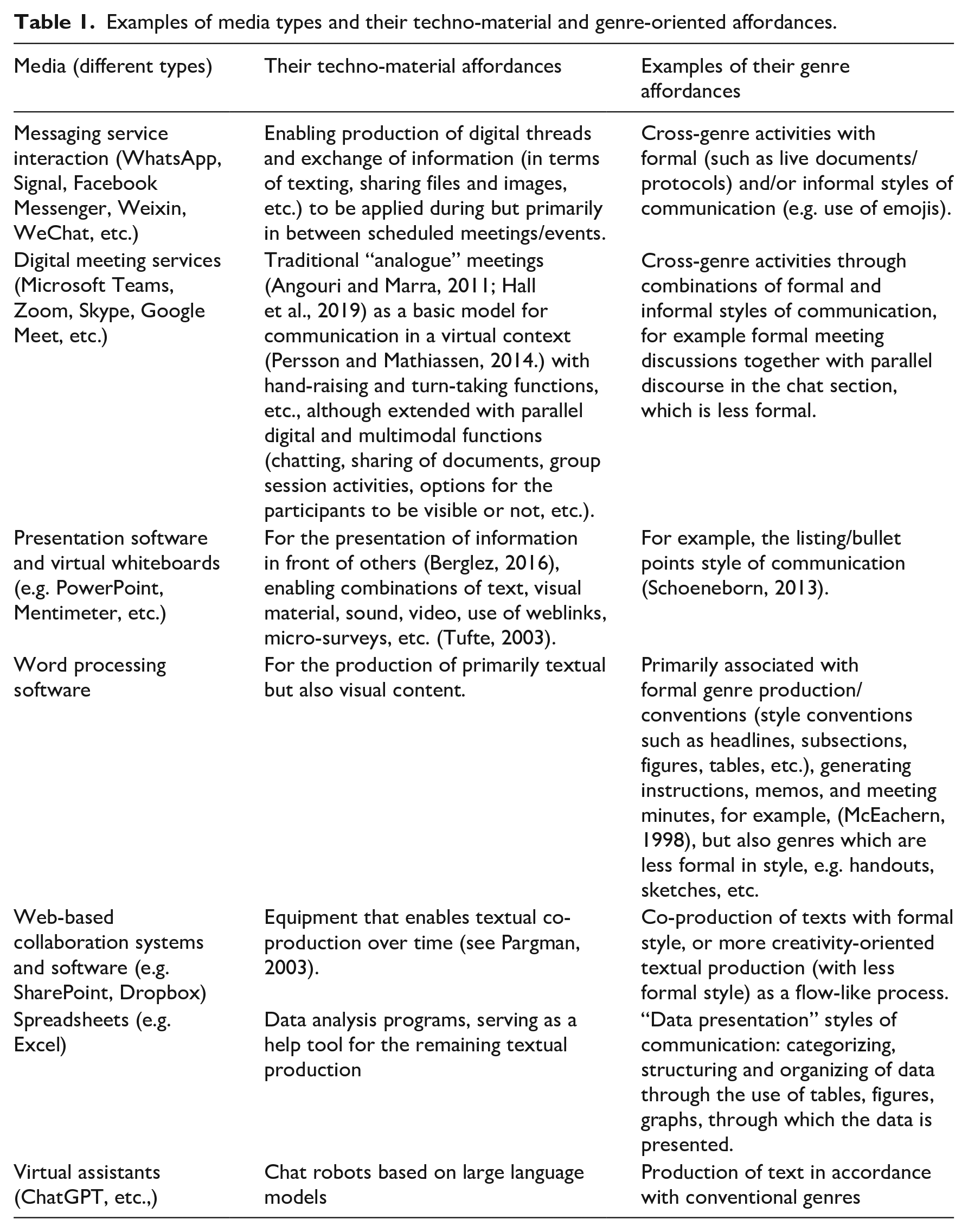
In our view, the concept of affordances (cf. Krause Hansen and Flyverbom, 2015; Saludadez, 2022, etc.) enables analyses of exactly this, that is, how media-driven communication materializes in different ways and to different extents – but also through complex relations – into stable ideas, decisions, or solutions for the IOC. More precisely, affordances mean that media will always, in one way or another, invite certain discursive and techno-material potentials to produce meaning and to make people understood in social interaction, while also having limitations (Jewitt and Kress, 2003). The potentials and limitations are further understood as genre affordances (Jaakkola, 2019), thus being interlinked with “conventions of representation” in the context of media use (Machin, 2007: 183; cf. Van Leeuwen, 2005: 122–123). As exemplified in Table 1, certain media, for example a digital meeting service such as Zoom, is endowed with certain techno-material affordances, that is, solutions for combining oral and written communication, visuality, virtual presentations, etc. This also paves the way for specific genre affordances, that is, established ways of communicating, such as using emojis in the chat or inserting moving images in a shared PowerPoint presentation, which are characterized by both potentials and limitations in terms of their communicative outreach.
Examples of media types and their techno-material and genre-oriented affordances.
In contrast to media-driven materializations, articulations of ideas, proposals, and solutions in an IOC might also de-materialize. They could lose their fixed and authoritative status; for example, when an idea imprinted in an e-mail thread is repealed and exchanged by another idea. Another dimension, we would suggest, are processes of intermaterialization. This is when a text is immediately transferred from one material form to another, for instance when some content in a PowerPoint presentation is transported straight away to a written protocol, thereby receiving the status of being a decision. Hence, an important aspect is to understand these processes and practices over time, that is, diachronically (see Plotnikof and Pedersen, 2019: 5), in which the collaboration is characterized by both planned and unforeseen actions of media use and affordances (cf. Yates and Orlikowski, 1992). This then leads us to the chains and switches.
Media-driven chains of IOC
In the media-driven communication of IOC, the texts produced through aforementioned affordances influence each other and become connected in accordance with an intertextual rationale (Hardy et al., 2005; Koschmann, 2013), thus operating as a chain. In relation to the idea of both organizations and IOC, the chain can be understood as a series of connected events that “happen” (Schatzki, 2006). The production and use of documents, digital threads, virtual presentations, app-based chats, etc. diachronically form a chain of communication with such discernible events throughout the process (Linell, 1998); they have beginnings and endings and become the links of the chain. Some events might be less apparent and micro-oriented than the obvious ones, such as scheduled meetings (Hall et al., 2019).
The chain might be more or less media dense (Norris, 2004: 110), that is, involving either few or many media. The more media-dense the communication, the more challenging the multimodal characteristics of the activities, involving “. . .many different modes and media which are co-present in a communicational ensemble” (Kress and Van Leeuwen, 2001: 111, cf. LeVine and Scollon, 2004), and which testify to the fact that “the way we communicate is seldom by one single mode of communication, by language, it is done simultaneously through a number of modes – multi-modally, by combinations of the visual, sound, language, etc.” (Machin, 2007: X).
At least three different levels of density can be analytically distinguished. First, low-level media density, that is, centered around face-to-face interaction in a shared physical space, with sparse use of digital equipment/systems. Following this is mid-level media density, that is, face-to-face interaction in a shared physical space in combination with moderate use of digital meeting services and apps, for example. Finally there is high-level media density, in which the communication is permeated by digital multitasking activities (Stephens and Davis, 2009), such as recurrent co-production through Sharepoint of Google Docs, the use of interactive educational tools, different digital meeting devices, etc. The lower the media density of the IOC, thus dominated by oral interaction with little involvement from techno-material affordances, the more “open” or “free-floating” the direction of the collaboration. This is because ideas, proposals, solutions, etc. have been properly materialized to a lesser extent in this case. Furthermore, one can assume that the more media-dense the chain, the more likely that the communication is characterized by disorganization (Ratner and Plotnikof, 2022) and the “. . .messy aspects of organizational life” (p. 1053). This is a consequence of many media being involved.
Both the chain in its entirety and each and every link, that is, defined events such as the scheduled meeting (Angouri and Marra, 2011; Hall et al., 2019) or the spontaneous digital chat, can be media-dense to differing extents (Figure 1). For example, while one event (such as a meeting) might be fairly media-free, another event could be endowed with complex combinations of media use, forming rather chaotic media intertextualities. The latter case particularly occurs when many different digital tools (such as apps and programs) are used within a digital meeting, for example. To classify the development of the entire chain’s media density, each and every event needs to be analyzed, that is, the formal events (the planned meeting, etc.) and the spontaneous communication in between them (i.e. an email thread, a digital chat, etc.) all together (see Figure 1).
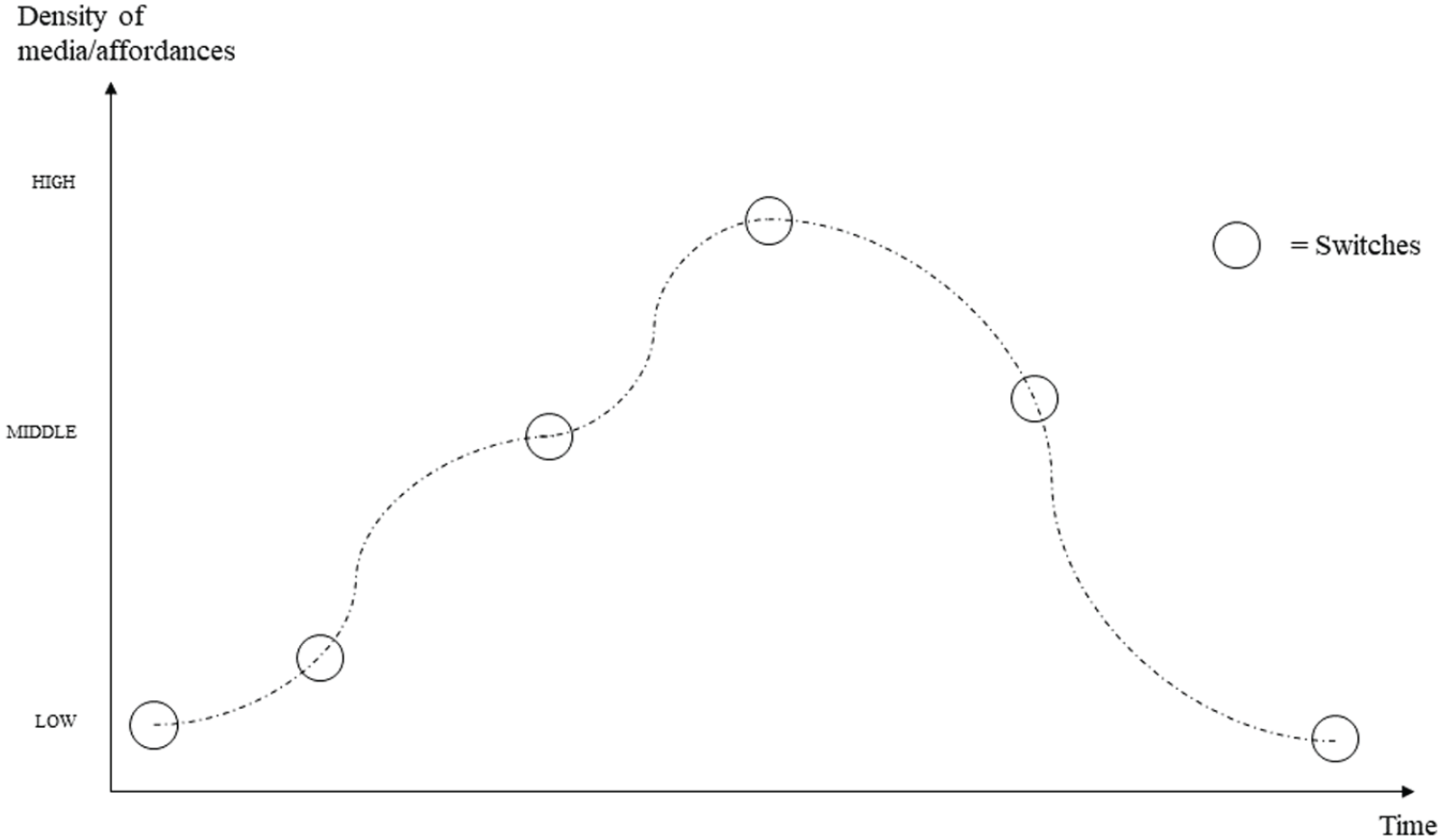
Affordances, chains, and switches of IOCs.
Media-driven switches within IOC
After exploring the media-driven intertextual chain and its links/events, we propose moving on to examine the potential switches (cf. Castells, 2011: 786). Here, the idea is to scrutinize the change from one kind of communication to another (e.g. from basic digital communication to advanced digital communication, etc.), and from one type of media to another. The temporal distance between each switch could vary from several months (e.g. a 1-year project with only four events) to less than a minute (when using several media simultaneously during an event). When switching from the formal meeting in a “real” conference room to a discussion on Zoom 2 weeks later, or from a session centered around some presented PowerPoint slides to a subsequent chat on Signal, something potentially “happens” (Schatzki, 2006) whereby the change in affordances indicates a critical transfer point. Aspects of this include the participation structure. That is, who or how many of the participants and their organizations will now, after the switch, contribute to the chain’s textual production, and in what ways? What changes are made to the so far highly, partly, or barely established ideas, proposals or solutions, when moving forward in the chain? In what ways are they transformed? Does a new constellation of participating organizations perhaps start to take the lead? This touches strongly upon the role of media in recontextualization (Koschmann and Burk, 2016), or what sociolinguists refer to as resemiotization of meaning-making. As a hypothesis, the more media switches in an IOC, the more volatile and changeable the production of meaning is. The production of meaning entails “. . .making shifts from context to context. . .” (Iedema, 2003: 41) in more “dramatic” ways than if only one mode of communication (for example oral interaction) dominated the entire IOC, thereby also making it less predictable which discursive content will survive (i.e. materialize) throughout the chain.
As suggested in Figure 1, we can understand the diachronic communication process as a few or many switching “stations” within one formal meeting/event or between multiple such events (x-axis), in which the density of media usage might shift throughout the process (y-axis). Let us imagine the following process: the initial ideas from some of the participants during the kick-off of a collaborative project give rise to a joint workshop discussion that generates minutes, which are – at the next meeting – partly transferred and thus recontextualized into a PowerPoint presentation given by the coordinator of the project. This content then generates a post-meeting chat on WhatsApp, which produces certain feedback on the PowerPoint that is brought up at the following regular meeting. Hence, these switching points altogether involve a solidification of the communication (Koschmann, 2013: 66) in which the media-driven meaning-making gradually materializes and turns into a more stable/official text (protocol).
A switch could also be interpreted as a form of re-negotiation of what level of media density the collaboration should involve thereafter. Further, the more media density in the chain process as a whole – involving many advanced media solutions and multimodal forms of communication more or less all the time, and in which switches occur many times during one and the same collaboration event – the more complex and demanding the exploration of the impact of the “materializing” role of switches on the IOC process becomes.
Critically analyzing the mediatedness of collaborative outcome
Every introduction of new media, from the telegraph to radio broadcasting, television, and beyond, has given rise to utopian ideas about the new medium’s potential to abolish unequal communication, but these hopes have always been dashed (Carey, 1989). Therefore, it would be problematic to view the increasingly media-driven IOCs as a straightforward path toward more democratic and participatory forms of communication (cf. Milam and Heath, 2014; Stohl and Cheney, 2001). Although some media tools, such as messaging services, seem very inclusive and many-to-many oriented (Berglez, 2016), media-driven communication, as in the case of other forms of communication, are to be understood as oscillations between asymmetric power relations vs symmetric and participatory processes, in which the former is never entirely absent.
In the following step, then, the media-driven activities of IOC can be examined as “social practice” (Fairclough, 2009), in which we also consider how the participants, and the organizations they represent, bring their norms, intentions, strategies, etc. into the textual production. In this context, the process of moving from “matters of concern” to “matters of authority” (Vásquez et al., 2018) is interpreted as intertextual struggles (Koschmann, 2013) in which some participants and their organizations become more influential than others. This is not to say that all types of collaboration are equally hierarchical and permeated by power relations (Foucault, 1984), but that communication always develops an “authoritative text” in one way or another (Koschmann, 2013; Kuhn, 2008), leading to some of the participating organizations having “. . .genuine access to influence its direction” (Vangen et al., 2015: 1246; cf. Plotnikof, 2015: 6–7; Purdy, 2012). This could be a manifest process, or something that is more latent and occurring “under the radar” (Vangen et al., 2015). In both cases, however, media use is deemed to be part of the process and to have an impact. More precisely, the idea should be to see how the asymmetric communication occurs through participants’ application of affordances and their potential materializations of meaning-making. This involves analyses of when and how not the majority of the participants but a select few become favored in the sense that their ideas, proposals, or solutions become materialized (documented in a note; added to a PowerPoint slide; summarized in the final section of a long digital thread, etc.), thereby making important advancement part of the authoritative text and steering the direction of the IOC.
Interorganizational affordances, chains and switches through the dimension of media literacy
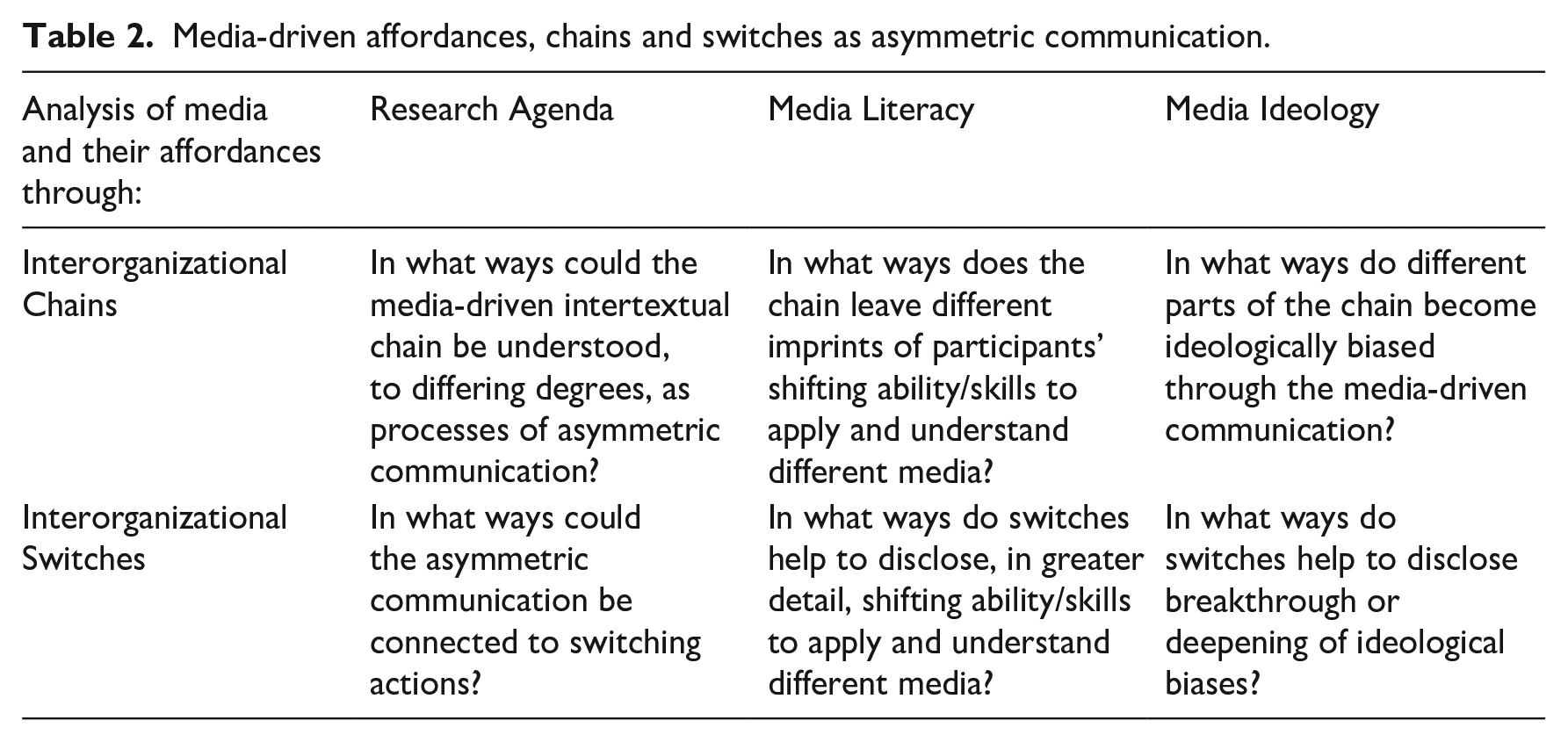
First, our suggestion is to concentrate on how the asymmetric communication might derive from the participants’ media literacy (Table 2). More precisely, media literacy entails the participants’ “. . . ability to access, analyze, evaluate, and create messages in a variety of forms” (Christ and Potter, 1998; Livingstone, 2004: 5; Olsson et al., 2019). What is at stake is the ability to “handle” media, technically and socially, with different participants potentially having different skills due to their organizational background. As indicated by Livingstone (2004), this refers to actively producing texts by means of different media, as well as responding to, making use of, critically examining, etc. others’ text production or media use. This could involve situations of one-to-many communication (one person’s presentation in front of the others) and many-to-many communication (co-production, etc.). The organization formally leading the collaboration (cf. Ansell and Gash, 2007; Kramer et al., 2017; Provan and Kenis, 2007) is presumed to establish a media governance of the IOC. In clear cases of top-down oriented leadership (Crosby and Bryson, 2005), the entire techno-material infrastructure of the chain (cf. Ratner and Plotnikof, 2022), that is, the combination of media types and affordances, including the level of media density, is relatively pre-decided. In contrast to this vertical form of governance, one can also imagine a more horizontal one (Vangen et al., 2015) whereby the media in use throughout the IOC develop in more informal and contingent ways. No matter the governance, this then sets the standards for required media literacy which will inevitably be to some participants’ and thus organizations’ disadvantage or advantage. To exemplify: a participant who is not among those dominating the discussions, and/or is considered to have less expert knowledge than the others, ends up obtaining unexpected insider insights about the selected digital app for the collaboration, for example. They therefore gain certain advantages when it comes to transporting ideas, proposals or solutions further along the chain (cf. Jahanmir and Cavadas, 2018).
Media-driven affordances, chains and switches as asymmetric communication.
Managing many media throughout the chain
A central task of analysis should thus be to examine in greater detail how different participants and their organizations influence the IOC through their “media literacy authority,” in which their media skills lead to their ideas, proposals, or solutions more easily materializing and becoming part of the authoritative text of the collaboration and thus its central outcome. In general, the higher the media density of the chain, the more (digital) media literacy is required. This involves the ability to perform a “digital reflexivity,” namely to quickly alternate between different media solutions and their affordances, as well as to manage, or rapidly learn, their additional functions. Consequently, basic literacy, that is, managing the most basic functions of an app or program – competencies which are usually common across organizational boundaries – is seldom the decisive factor.
The centrality of the switches
Accordingly, the switches are essential for detecting media literacy imbalances across the participating organizations. More precisely, what is the media literacy impact when switching from the Zoom workshop to the chat on Messenger? Or from the offline oral conversation around a conference table to the co-writing of a document on Google Docs? Or from an offline meeting to a hybrid meeting, in which half of the group is participating remotely instead? All of these moments of transition might influence existing relations. Not every switch necessarily shakes up existing hierarchies, but they have this potential, albeit temporarily. If person or group A is very dominant, well-spoken, creative, highly innovative, etc. when using a particular messaging service interaction app, but less active when switching to other forms of communication, this might indicate person/group A’s particular skill/advantage or disposition in using this device for strategic purposes.
Interorganizational affordances, chains, and switches through the dimension of ideology
Besides the participants’ shifting tech-skills and “media smartness,” another source of asymmetric communication are the media themselves (Table 2). They are thus viewed as potential actors (Saludadez, 2022). It is well-established that media are not neutral transmitters of meaning-making (Innis, 1951; Manovich, 2001), but instead will favor some interests over others. This has been demonstrated in Kvåle’s (2006) studies of the ideological bias of software, for example. Different software will involve a “stylistic normativity,” which means “shaping and constraining how knowledge is and can be represented” (Kvåle, 2006: 259). Consequently, IOCs are characterized by the participants’ and their organizations’ underlying ideals and desires about what a society is and ought to be (Poncelet, 2004), but these desires will not simply be fulfilled and channeled through media and their affordances, be they digital chat services, presentation software, etc. but instead will be more or less shaped by them and their inherent ideological biases. More precisely, media types and their affordances might have a particular epistemic and normative slant, such as promoting short-term rather than long-term thinking and instant instead of long-term perspectives, etc. Through their affordances, some media will facilitate the value of efficiency, for example, though they may also repress critical reflection or innovation/creative thinking. The use of word cloud software and virtual sticky notes, for instance, could potentially “sort out” the challenges of the collaboration and provide a solid overview of things, but they could also lead to reified thinking in which important and highly connected issues become epistemologically disconnected. Popular spreadsheets such as Excel – which are endowed with an economic rationale, organizing society into data stacks – might create a sense of order and control, but could also repress a deeper social or cultural understanding of what should be done in the IOC and in what ways, and so forth.
Hence, if the ideological bias of the IOC is not in the interest of the entire group of stakeholders but only a few, a state of asymmetric communication is likely to crystallize. The central analytical task then becomes to examine how media and their affordances materialize ideological discourses (e.g. business thinking, commercialism, tech-optimism, etc.) which thereby become authoritative for the collaboration and its outcome.
The chain as an ideologically unreflective use of affordances
Ideological biases in the chain could be the consequence of a media governance’s unreflective selection and introduction of apps, educational programs, digital meeting services, etc. (cf. Yates and Orlikowski, 1992: 308; Madianou and Miller, 2013). 3 Consequently, those formally or, indeed, informally, taking the lead and influencing the IOC might lack, or ignore, critical insights about the selected media’s epistemic and normative impact on the collaboration. For example, some affordances might be endowed with a certain “charisma” due to their association with novelty or tech-smartness, therefore being selected and imbued with importance due to their contribution to the overall authoritative text of the IOC, but in fact producing an ideological “slant” that has no clear benefit for the basic purpose of the IOC.
Chains could include strategic use of affordances with ideological impact
However, ideological analyses of the chain also need to be combined with a focus on how the selection and use of media affordances might serve strategic interests which are more clearly intentional, thus providing particular participants and the organizations they represent with greater authority over the textual production. This is when participants are allowed to apply media-solutions and perform affordances, which ultimately harmonize with their aim to establish (and thus materialize) certain ideas, proposals or solutions in the IOC (“I have prepared some rather telling figures about the critical situation in an Excel sheet, which I will soon show you. . .,” and so forth). Imagine how, in an IOC on the role of universities in society, some participants’ repeated use of a PowerPoint’s bullet-point rationale, with a particular font size, “boxes and arrow” diagram affordances, etc. rhetorically establish new public management (NPM) as normal discourse (Ledin and Machin, 2015; cf. Djonov and Van Leeuwen, 2013; Schoeneborn, 2013; Zhao et al., 2014), suggesting that universities should increasingly operate as commercial enterprises.
Switches could be ideologically biased switches
In this context, a focus on media switches facilitates the empirical identification of how ideological biases, be they generated by conscious actions or in less reflective ways by the participants, operate and leave an imprint on the chain: When it comes to ideological biases in the textual production, is there a significant difference between a meeting, when a particular combination of affordances was used, in comparison to the following meeting, in which a rather different combination of affordances was applied (and so on)?
Concluding notes
To summarize, we present below a second version of Figure 1 that intends to outline how elements for media-driven analyses of IOC chains as presented above could be organized and divided into different materialization zones.
In Figure 2, these zones appear as A-B, B-C, and C-D. The zones can be determined through the identification of what seemed to be particularly important switches throughout the chain. However, they could also be divided on the basis of apparent shifts in media density, or in relation to important events, such as central meeting occasions. Here, the idea is that by assessing zone by zone, we are able to examine in greater detail gradual or more sudden media-driven materializations in which ideas, suggestions, or solutions become authoritative for the IOC. The x-axis’s D point thus represents the end result/outcome of the IOC, that is, its central ideas/proposals/solutions, etc., which we can call X. The empirical question to guide the study of zones is how X becomes a more or less media-driven authoritative text through different stages, involving both progression and potential backlashes whereby X instead de-materializes (cf. Koschmann et al., 2012) and is challenged by idea Y or Z. As a suggestion, we can begin with the A-B zone and then move analytically forward in time. However, it would also be possible to start with the C-D zone and then move back in time, whereby the final task of the analysis would be to find the origin of X and how it first appeared. For each zone, we can focus on the kind of questions suggested in Table 2, elaborating with media literacy and mediated ideologization and their materializing/de-materializing functions in different contexts. Furthermore, it also becomes possible to focus on how each particular zone constitutes different space-time regimes, that is, different ways of organizing time and space, and how this influences the IOC in different directions (see Sabelis, 2009; Vásquez and Cooren, 2013).
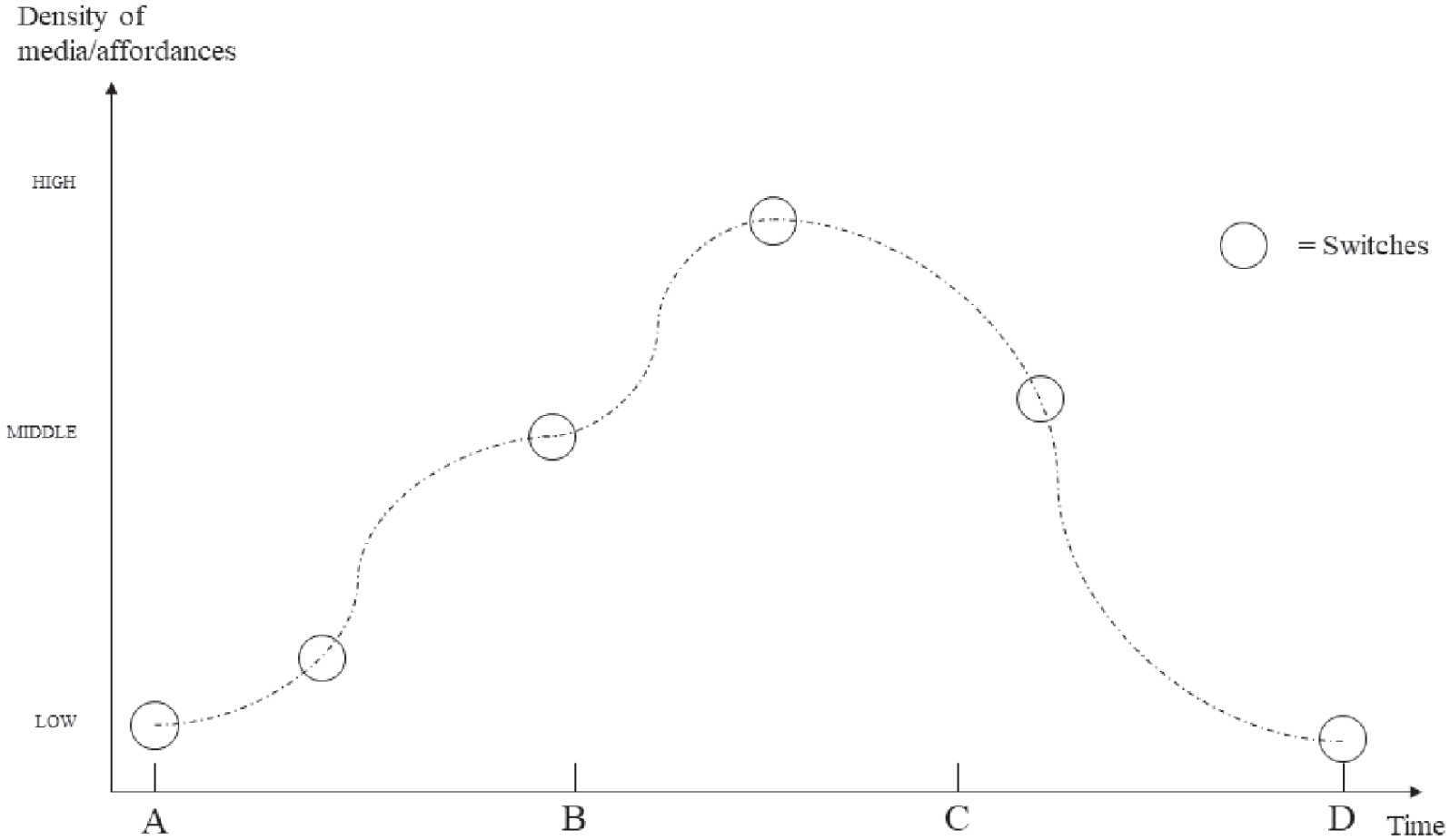
The chain divided into materializing zones.
Above, we have primarily presented our approach in relation to the question about IOC outcomes, be they a product, action plan, or innovative solution. However, the proposed media-driven approach to studies of IOCs could be applied to a number of topics that provide specific keys to understanding IOC in different ways. For example, one option could be to use – as well as further develop and improve – this media-oriented conceptual toolkit to examine in detail how membership is constituted in an IOC (cf. Cooper, 2016). More precisely, in what ways do shifting media literacy and ideological biases present in different media influence the participants’ actual or perceived inclusion or exclusion in the collaborative group? In what ways are membership structures and dynamics connected to different levels of media density? and so forth. In the same way, the model presented above for analyzing the complex mediatedness of IOC could serve as a springboard for studying the matter of “failure” (Koschmann, 2016b); conditions of “stalemate” (Koschmann, 2013: 73); “interactional trouble” (Nguyen and Janssens, 2019: 5–6) or “problems of understanding” (Vlaar et al., 2006), to name some important examples.
Finally, we would like to mention that the critical approach suggested in this contribution could be complemented by an approach that views things from the other side, namely primarily focusing on how the entire mediatedness of IOC democratically enriches IOC, and how different media solutions and their affordances primarily empower certain repressed categories of organizations, or small organizations, and their ideas/proposals/suggestions. However, an excessively idealistic understanding of the democratic potentials of media is to be avoided here (see discussion above).
Footnotes
Acknowledgements
The authors would like to thank the three anonymous reviewers for their highly valuable input, Several of their suggestions had a profound impact on the final version of the article.
Declaration of conflicting interests
The author(s) declared no potential conflicts of interest with respect to the research, authorship, and/or publication of this article.
Funding
The author(s) disclosed receipt of the following financial support for the research, authorship, and/or publication of this article: The study is funded by the School of Education and Communication at Jönköping University and the Climate Council of Jönköping County, Sweden.
