




Abstract
The idea of planning has reappeared as an object of interest for critical research on post-capitalist organizational futures. This article offers a critical review of the emerging scholarship on planning, with reference to historical and contemporary precursors to democratic planning. Building on this review, the article develops a critical political ecology of planning that situates planning thought and practice within the matrix of the oikos. This encompasses not only the sphere of production and commodity exchange, but also the household of reproductive labor and the planetary household of the natural world. In this way, it is argued that democratic planning is indispensable for generating the forms of collective intelligibility and power needed to heal the metabolic relations of society and nature. By reimagining and reframing planning, the article aims to expand “the archive” of social imaginaries, as part of broader efforts to envision and develop more desirable organizational futures.
Keywords
Introduction
The dream implied by the capital form is one of utter boundlessness, a fantasy of freedom as the complete liberation from matter, from nature. This “dream of capital” is becoming the nightmare of that from which it strives to free itself—the planet and its inhabitants.
Out of the wreckage of capitalism’s neoliberal period, the idea of planning has reappeared as a legitimate object of inquiry for critical social research. In the wake of the global economic crisis of the late 2000s, Galbraith (2008) argued that addressing our greatest challenges would require revisiting and rehabilitating the vocabularies and practices of planning. Critical scholars across the social sciences and humanities have also started to argue that planning must be reimagined and reframed as part of broader struggles to envision and develop alternative organizational futures (Davies, 2018; Jones, 2020). The question, then, for much of the new planning literature, is no longer about whether to embrace or reject planning, but about the organizational pre-conditions for democratic planning (Bernes, 2020: 55; Malm, 2021). This is, in short, “about where economic planning takes place, how economic planning is done, and who is included in the processes of economic planning” (Jones, 2020: 7).
When considering the conjunctural realities of the last decades it is not difficult to see why the question of planning is back on the agenda. Neoliberal modes of governance have weakened the capacities and power of workers and communities for collective control over re/production (Battilana et al., 2022: 5; Fleming, 2017). As experienced during the coronavirus pandemic, their commodity logics have also proven inadequate for meeting healthcare needs effectively and equitably (Davies, 2020; Zanoni and Mir, 2022). This has, likewise, obscured and delayed meaningful action against the horrors of climate change (Böhm et al., 2012; Malm and The Zetkin Collective, 2021). This confluence of socio-ecological domination and alienation must, moreover, be understood as part of the longue durée of capitalist modes of organizing society and nature, and not as accidental exceptions to their “proper functioning” (Adler et al., 2007; Moore, 2015).
The systemic nature, spatial scales, and temporal horizons of averting the planetary ecological crisis have profound implications for questions of organizing (IPCC, 2023; Wright et al., 2018). The interwoven crises of the coronavirus pandemic and climate change, for instance, have required coordinated and sustained efforts to meet collectively determined goals (Adler, 2022a). These socio-ecological crises have also highlighted the need to re-organize for cooperation, solidarity, care, and climate justice (Peredo et al., 2022: 7; Willmott, 2008). This is echoed in recent appeals to planning, which argue that replicating, scaling, and co-articulating organizational alternatives (Zanoni, 2020) can be enabled by the eco-socialist repurposing of new organizational forms and technologies (e.g. Adler, 2022a; Vettese and Pendergrass, 2022). Building on this literature, the case will be made that democratic planning is fundamental to recuperating, expanding, and pluralizing the institutions and capacities needed to re-organize for planetary justice.
To do this, I develop a critical political ecology (see: Conroy, 2022; Gellert, 2018) of planning that situates planning thought and practice within the matrix of oikological phenomena (Kunkel, 2015). 1 Oikos, which is the word for “household” in Ancient Greek, is the root term from which the notions of economy and ecology are derived (Martinez-Alier, 2002: 26, 2020: 2). The oikos, therefore, encompasses not only the sphere of production and commodity exchange, but also the household of reproductive labor and the planetary household of the natural world (Kunkel, 2015; also see: The Care Collective, 2020: 71). 2 Accordingly, the notion of Oikonomia refers to modes of organizing for use value and metabolic value (Salleh, 2010), 3 as opposed to the “chrematistic” value logics of capital accumulation (Martinez-Alier, 2002: 26; Nelson, 2022: ix; O'Neill, 1998: 28). This places questions of social metabolism (the relations of society and nature) at the heart of planning. In this way, the democratic planning of oikonomia is presented as the collective and conscious organizing of social metabolic re/production (Mészáros, 2014: 168).
Given the importance of Friedrich Hayek’s challenge to planning, the article begins with a critical overview of his epistemological and ontological commitments. It will be argued that Hayek provides an instructive, but ultimately reactionary and reductive, challenge to any mode of planned (re)organization for substantive equality and planetary justice (Hayek, 2013: 256; see: O'Neill, 2004: 444 on Hayek and ecological economics). In the second part of the article, I offer a critical review of the new planning literature. This involves an evaluation of the main problematics brought forth by this literature and critical reflections on past and present precursors to democratic planning. By highlighting this literature, I aim to show, contra Hayek, that there are viable and coherent democratic planning alternatives beyond the simplistic opposition between statist central planning and capitalist markets (also see: Lordon, 2022: 149–150).
Finally, taking inspiration from this literature, the case is made for the democratic planning of oikonomia. As argued, this involves developing a critical political ecology of planning that encompasses the various interrelated spheres of social metabolic re/production. That is, production and social reproduction in the “web of life” (Moore, 2015). Accordingly, the article provides an analytic framework for reimagining and reframing democratic planning as an eco-political project (Fraser, 2021) for a world beyond the capitalist organization of society and nature (see: Foster et al., 1997; Purser et al., 1995; Shrivastava, 1994). By exploring the possible pasts and futures of planning, the article also aims to expand “the archive” of social imaginaries (Zanoni et al., 2017: 580–582) and contribute to ongoing and collective efforts to envision and struggle for more desirable organizational futures (Gümüsay and Reinecke, 2022; Wright et al., 2018: 464–465).
The critique of planning reason
Any attempt to reclaim and rehabilitate the notion of planning must return to the problems posed by the calculation debates of the 20th century between figures like Otto Neurath, Oskar Lange, Ludwig von Mises, and Friedrich Hayek. Since I cannot retrace every aspect and period of these debates (see: Adler, 2019: 190n28; Carnevali and Pedersen Ystehede, 2023: 15–21; Foley, 2020; Hahnel, 2021: 3–5), I will focus on Hayek’s challenge to planning thought and practice, providing a critical overview of the socio-ecological implications of his economic philosophy.
A good entry point for any brief survey of Hayek’s thought is the central place he grants to a type of knowledge he describes as dispersed, unreflective, and tacitly embodied by individuals throughout society (Davies, 2015: 437–439). This is a type of knowledge that is, as Hayek puts it, specified by the circumstances of time and place (Hayek, 1945: 8). Crucially, this is seen by Hayek to pose an epistemic challenge to non-market planning, which Hayek could imagine only as purely centralized command planning (Foucault, 2008: 173). This underscores, what critics of planning see, as the practical impossibility of articulating, integrating, and disseminating such unorganized and formless knowledge in codified or discursive form (Hayek, 1945: 8). For Hayek, therefore, it is only the supposed spontaneity, or catallaxy, of market competition, guided by the allegedly real-time information contained in price-signals, that is able to render such knowledge discoverable and performative (Davies, 2015: 437–439; Hayek, 1945; Snow, 2002).
Hayek termed this aspect of market competition a discovery procedure and described it as an atomized and spontaneous process of disclosing knowledge about previously unknown social opportunities (Snow, 2002: 19). This renders superfluous any “survey of the whole field,” mobilizing, through market competition, the “limited individual fields of vision” of individual actors (Hayek, 1945; Krahé, 2022; see: Table 1, Column 2). This assessment leads Hayek to regard all forms of planning as epistemically deficient modes of discovery with politically undesirable consequences. Underlying this reductive view of planning is the assumption that there are no viable alternatives to market competition that do not result in forms of bureaucratic centralism (Morozov, 2019, 2020; Whyte, 2020: 44). In effect, the only real choice is the choice between a planning accomplished through the “freedom” of market competition and a democratic planning that degenerates into the “unlimited totalitarianism” of planners (Neurath, 2004: 546).
Economic Planning Regimes.
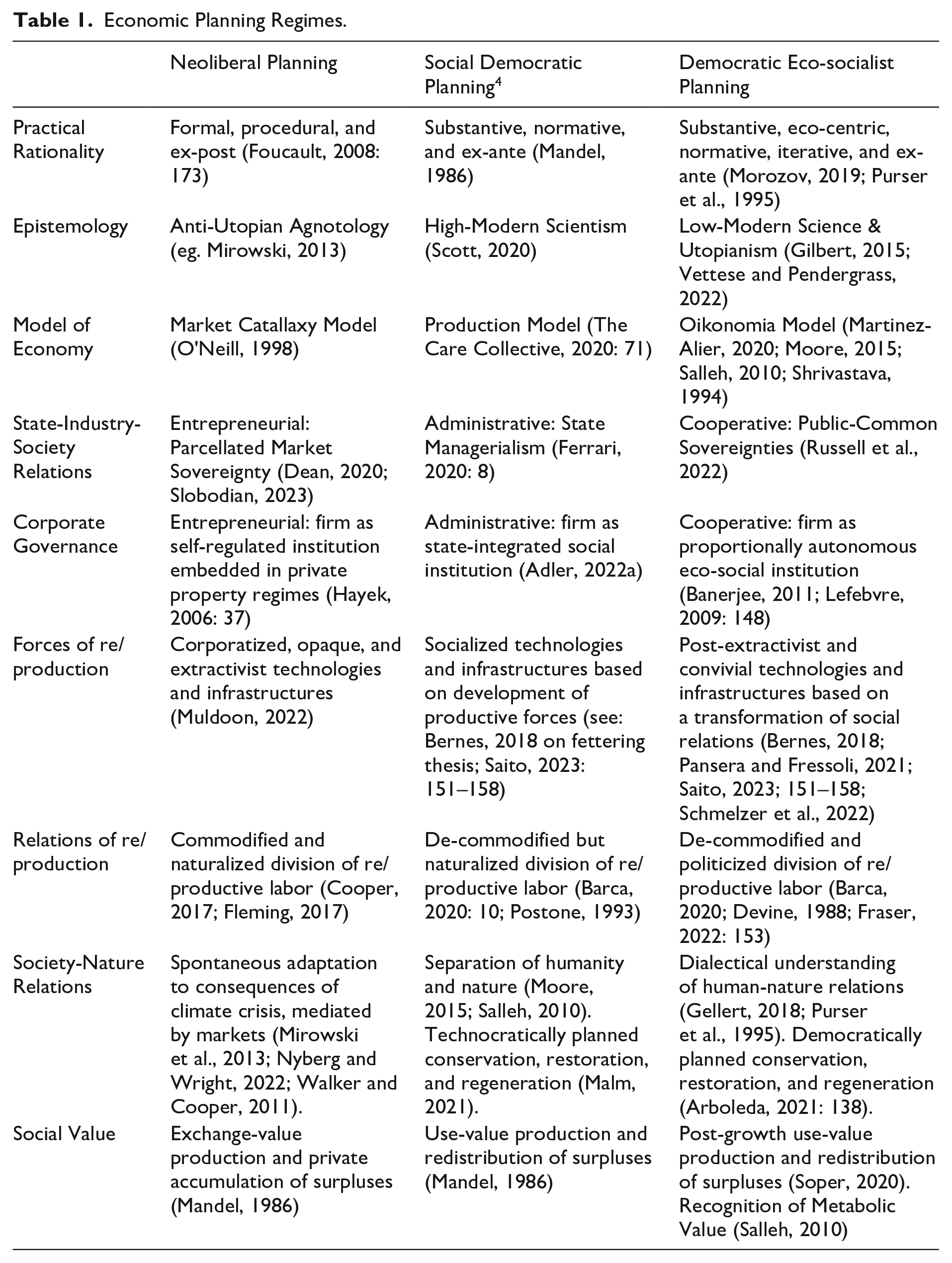
And yet, despite Hayek’s anti-planning proselytizing, he was neither against the state nor against planning as such (Hayek, 2006: 43). On the contrary, he commends a strong state that is an economic planner for competition (Mirowski et al., 2013) one that creates and enforces the formal pre-conditions for a de-politicized market order of entrepreneurial management and administration (Foucault, 2008: 173–174; Slobodian, 2023; see: Table 1, Column 2). Indeed, as Paul du Gay notes, although neoliberal logics of entrepreneurial governance work through market-mechanisms, these mechanisms are “constructed in a particular way, being dependent upon central governmental control and manipulation for their effects” (du Gay, 2004: 46; also see: Fleming, 2020; Fraser, 2022: 119–123). This involves, as implied, models of “planned non-planning” (Wetherell, 2016) that preclude the formation of political communities and democratic considerations of public value and social justice (Streeck, 2014: 58–59). As Hayek puts it, in typically reactionary terms, “so long as the belief in ‘social justice’ governs political action, this process must progressively approach nearer and nearer to a totalitarian system” (Hayek, 2013: 232; see Hirschman, 1991: 11–12 on reactionary rhetoric).
Hayek grounds the distinction between spontaneous markets and planned organization on the notions of cosmos and taxis (Hayek, 2013: 34–52). Cosmos is the term for spontaneous orders that emerge without collective purposive activity. A cosmos is, in other words, a social institution that is not the product of human will, but the aggregated outcome of the dispersed and purpose-independent actions of individuals (Hayek, 2013: 36). Aligned with the Hayekian epistemology presented above, a cosmos may extend to circumstances so complex that no mind can comprehend at all, circumstances, which in their totality, cannot and need not be known to anyone (Hayek, 2013: 36–39). It is to capitalist markets that Hayek attributes such characteristics of omniscient but sublime opacity (Mirowski and Nik-Khah, 2017; Whyte, 2019), conditions within which notions like “planetary justice” become meaningless (Hayek, 2013: 256). In Campbell Jones’s words, “the market here is not the embodiment of us all, but precisely the opposite: the denial of our capacity for reason, will, speech and action” (Jones, 2011: 142).
In contrast, a taxis is an order that is a deliberate and purposive construction. This is an artificial order involving purpose-dependent organizational mediations (Hayek, 2013: 36, 159fn23). The folly of planning reason, as Hayek conceives it, lies in its assumption that economies are amenable to such forms of organizational intelligence and intervention. The mistake would be, therefore, to treat a cosmos, allegedly like the economy, as if it were a taxis that can be rendered intelligible and steerable by political subjects (Mirowski, 2013: 70–72; Whyte, 2019: 170). By ruling out any form of deliberate and conscious planning, however, what is ultimately called for is a submission to market forces (Whyte, 2019: 159). This logic can be extended to neoliberal climate policies that highlight the impossibility of collectively planned prevention, restoration, and management, to make the case for individualized strategies of permanent flexibility, adaptation, and resilience to capitalist metabolisms (Buller, 2022; Nyberg and Wright, 2022; Walker and Cooper, 2011; see: Table 1, Column 2). It is, in effect, society and nature that must be adapted to the interests of capitalist regimes of accumulation (Mirowski et al., 2013).
Capitalist forms of social mediation are, therefore, not only opaque, but also intractable (Bernes, 2020: 54). The politics that follows from this is one that radically limits the scope and quality of democratic will-formation and decision-making (Herzog, 2021). It presumes and reproduces the exclusion of, for example, workers, social movements, indigenous peoples, and even scientific communities (Cumbers, 2012: 67–70, 2014; Gindin, 2019; Staley, 2020). Furthermore, the value-monism of its commodity logics is deficient at addressing ethico-political questions about values and ends, and at recognizing the embeddedness of life-making practices in the material and energetic flows of the natural world (Martinez-Alier, 2002: 26; O'Neill, 2004: 444; Shrivastava, 1994: 712). This further weakens the modes of organizing involved in producing and sustaining the use values and metabolic values needed for human flourishing. In short, capitalist markets obscure the causes and consequences of destructive forms of social metabolic re/production, while robbing us of the forms of collective intelligibility and power needed to re-organize for substantive equality and planetary justice.
While there is a diversity of perspectives within the “neoliberal thought collective” (Plehwe et al., 2020), it is Hayek’s thought that continues to present one of the most influential, if not also compelling, critiques of planning. It has, nevertheless, been argued that the Hayekian critique is politically reactionary, conceptually reductive, and practically inadequate for equitably overcoming the planetary ecological crisis (Krahé, 2022; Neurath, 2004: 546; O'Neill, 2004; Whyte, 2020: 47). In the horizon of a warming planet, such matters of life and death (Mezzadri, 2022) cannot be entrusted to the opaque and intractable rationalities of capitalist markets and/or statist command (Bernes, 2020). Furthermore, the fetishized dichotomy between planning and markets obscures a plurality of ways of thinking about planning for social and planetary justice (Lordon, 2022: 149–150). In the following part of this article, I explore such planning alternatives by reviewing the main contributions to the new planning literature.
Specters of planning
It goes without saying that the metabolism of society and nature cannot, and should not, be planned or engineered in a high-modernist mode (Scott, 2020). But equally, it is necessary to envision and experiment with forms of democratic planning, if we are to achieve and maintain social and planetary justice. This part of the paper is divided into two sections, each exploring the organizational elements of post-capitalist planning futures. While the first section places greater emphasis on developments in industrial and corporate planning (i.e. the forces of production), the second focuses on the interrelated, but normatively distinct, spheres of socio-ecological reproduction (i.e. the forces of reproduction). This literature shows that, contra Hayek, planning thought and practice is irreducible to the dogmatic opposition between statist planning and capitalist markets (Bernes, 2020; Jones, 2020; Lordon, 2022; 149–150). Building on this critical review, I develop a critical political ecology of planning for the collective and conscious organization of production and social reproduction, in the “web of life.”
Red plenty organizing within planetary boundaries
At the heart of planning thought and practice is a close attention to the evolving contradictions and potentialities of organizational forms, infrastructures, and technologies (Ferrari, 2020: 8). Indeed, the new subjectivities, practices, and relations of the emerging organizational landscape (Beverungen, 2021; Davis, 2013) have renewed scholarly interest in the possibilities of post-capitalist planning (Davies, 2018). One of the assumptions of much of this work is that, while developments in the productive forces generate new modes of social domination (Espejo, 2021), they also open possibilities for anti- and post-capitalist alternatives (Adler, 2022b: 14n1). With this dialectical sensibility for the potentialities of the new organizational landscape (Arboleda, 2017: 368–369), we may, indeed, begin to identify some of the key organizational elements of democratic planning futures.
In these terms, Paul Adler explores how the contemporary capitalist corporation might open possibilities for democratic socialist planning (Adler, 2019, 2022a). Adler’s point of departure is that, to coordinate their internal operations, contemporary capitalist firms increasingly “rely on strategic management, not on market competition between their subunits” (Adler, 2019: 5). In contrast to the Hayekian emphasis on the ubiquity of spontaneous orders, this draws attention to the way organizational mediations serve to generate, articulate, and relay social knowledge across multiple scales (Adler, 2015; Fiori, 2010). The argument is, in other words, that planning is possible because it is already taking place in organizational economies that are irreducible to market economies (see: Simon, 1991). For Adler, this suggests the feasibility, and urgency, of democratic socialist experimentation with non-market planning at increasingly larger scales (Adler, 2019: 6).
Placing emphasis on the “system-level” challenges and requirements of the climate crisis, Adler makes the case for the democratization of strategic management and the socialization of productive resources and capacities (Adler, 2022a). The “democratic” in democratic planning is presented as a participatory and dialogical process that involves aspects of centralized representation and decision-making (Adler, 2022a). In contrast to market coordination (Krahé, 2022), such an approach to participatory centralization aims to mobilize distributed qualitative knowledge through discursive institutions, while democratically deciding the degree of centralization needed for coordination at larger scales (Adaman and Devine, 1996; Adler and Heckscher, 2018: 97). Such forms of participatory planning can be complemented by modes of automation and computation that are designed to support the interests of broader publics (Adler, 2022b: 7) and also close the spatio-temporal gap between problem/opportunity recognition and decision-making (Cockshott and Cottrell, 1993).
The People’s Republic of Walmart (2019) complements such appeals to socializing and democratizing the ownership and control of contemporary corporations. Taking inspiration from Jameson’s (2016) Wal-mart as Utopia, Leigh Phillips and Michal Rozworski (2019) echo Adler’s view that the organizational pre-conditions for democratic socialism are already here, unfolding “right under our noses” (Adler, 2022a). However, while Adler’s account draws on developments in strategic management, Phillips & Rozworski’s places greater emphasis on advances in the computational capacities for large-scale non-market coordination. This parallels arguments, like those of Paul Cockshott & Allin Cottrell, that are premised on the idea that advances in technologies for computation and connectivity make capitalist market coordination increasingly obsolete (Cockshott and Cottrell, 1993). But can such developments in the productive forces really be the basis of post-capitalist forms of life (Bernes, 2020)? Does their socialization not also risk recruiting science and nature to state-productivist imperatives (Bernes, 2018)? To what extent, and how, might they be repurposed for democratic forms of social metabolism (Saito, 2023: 151–158)?
Such questions about the political recuperability of organizational forms and technologies can be explored by turning to the renewed interest in the legacy of Project Cybersyn (1971–73), which has offered insight and inspiration for envisioning and experimenting with more distributed and dynamic modes of planning (e.g. Arboleda, 2021: 52; Dyer-Witheford, 2013; Espejo, 2021). Project Cybersyn, which was led by Stafford Beer, began in 1971, as part of Salvador Allende’s program of democratic socialist and anti-imperialist industrial planning (Clark, 2013: 94–95; Morozov, 2014). Beer’s Viable Systems Model (VSM) of organizational cybernetics (see: Swann, 2018) was seen to provide the framework for institutionalizing such political principles in the management of Chile’s key industries, by offering a decentralized but cohesive alternative to statist central planning and market competition (Medina, 2014: 5; see: Table 1, Column 4).
At the heart of Beer’s conception of the VSM is a process of feedback that enables planners to make continual adjustments based on what they aim to achieve (Swann, 2018: 434; Wiener, 1961: 11–12). For this process of dynamic organizing to be effective, however, inter-dependent elements of any given social system must have the autonomy and power to address local manifestations of complexity (Morozov, 2019). Planning in a cybernetic mode, therefore, involves enabling and relying on multi-layered, loosely-coupled, and distributed processes of communication and decision-making (Beer, 1974: 91). In other words, Beer maintained, contra Hayek (2013: 256), that social complexity could be controlled through non-market means, thereby, making purposive forms of democratic planning possible (Beer, 1995: 258; Morozov, 2019). For these reasons, the organizational politics of Project Cybersyn, and cybernetics more generally, has generated interest in the possibilities of replicating and scaling-up locally embedded practices, relations, and processes through a combination of discursive institutions and technologies for computation, communication, and coordination (Swann, 2023).
Along these lines, Swann (2023) argues that local autonomy and economy-wide cohesion are not mutually exclusive, but co-dependent pre-conditions for social freedoms (Swann, 2023). Similarly, Vettese and Pendergrass (2022), to whom I return in the next section, also draw on Beer’s VSM to propose a vision of eco-socialist planning that combines distributed control at an operational level and comprehensive planning at a metasystem level. As implied, the relations between such layers of planning cannot be decided a-priori without democratic deliberation and contestation (Beer, 1974: 70–71; Morozov, 2019). Indeed, for planning to be democratic, it cannot simply draw its ethico-political content from discourses of organizational innovation, control, and prediction (Wilimoft, 1997: 325; see: Table 1). Questions about operational effectiveness must, in other words, be accompanied by questions about the degree and quality of power that people have over the design, operation, and contestation of cybernetic systems (Arboleda, 2020: 154; Muldoon, 2022: 75). This is a necessary condition for the development of discovery procedures based on relations of solidarity (Morozov, 2019, 2020), trust (Adler, 2001), mutual aid (Swann, 2023), and multi-species entanglements (Ehrnström-Fuentes and Biese, 2022). The productive forces are, indeed, not only social forces, but also natural forces, shaped by historically specific relations of production (Bernes, 2018: 335).
Shifts in the relations of production are, in other words, fundamental to the kinds of democratic experimentalism needed to recuperate and redesign organizational forms and technologies for post-capitalist purposes (Dyer-Witheford et al., 2019: 147–149; Schmelzer et al., 2022: 228–231). The Lucas Plan is another example of democratic planning that was arguably a precursor to such reconfigurational practices (Toscano, 2014). This was a counterplan developed by workers at Lucas Aerospace in 1976, as a response to the threat of company-wide redundancies (Wainwright and Elliot, 2018). Drawing on their competencies and knowledge (Cooley, 2015: 119–1289), the workers at Lucas proposed an alternative range of socially useful products for Lucas to produce (Holtwell, 2018; Salisbury, 2020; Smith, 2014). This kind of “popular planning for social need” implied shifting from militarized market production to socially useful production under conditions of cooperative ownership and management (Wainwright, 2020).
The Lucas Plan’s approach involved developing “a network of organizations with an understanding of technological development not as a value-neutral process, autonomous from society, but shaped by social choices” (Wainwright, 2016). This included participatory design practices for human-centered technology that were intended to deepen worker and community control over production, blurring the division of intellectual and manual labor between the planners and the planned (Smith, 2014; also see: Sohn-Rethel, 2020). This proposed shift to socially useful production failed to materialize, given the politico-institutional circumstances of the period. Nevertheless, Lucas’s epistemologically plural and popular politics of defense-conversion makes it an appropriate example for the urgent firm-level changes that any democratically planned socio-ecological transition implies (also see: Pansera and Fressoli, 2021: 393; Table 1, Column 4).
The Lucas Plan and Project Cybersyn are just two of many prefigurative cases of how democratic planning might be organized, offering inspiration for the reconfiguration of organizational forms and technologies. While the Lucas Plan offers lessons on the challenges and possibilities of popular planning for social need, Project Cybersyn highlights how a plurality of distributed plans and counterplans might be effectively supported and aligned for democratically determined goals. Their recollection, in other words, draws attention to how changes within organizations (Battilana et al., 2022) can, and must, be accompanied by changes at the “system-level” of the broader economy (Adler, 2022a). Finally, this also implies that planning democratically cannot simply be about the reverse engineering of corporate planning. On the contrary, it must, as explored further below, recognize the heterogenous and qualitatively rich futures of planning that cannot be conceived with merely managerial and technical expertise (Neilson, 2020: 78).
Ecologies of care and the pluralization of Values
Although the benefits of contemporary advances in technologies for modeling, calculation, prediction, and control cannot be understated, the rationality of democratic planning must be practical and political rather than purely managerial or algorithmic. Post-capitalist forms of planning must, in other words, be animated by forms of popular power and value-pluralism, which, as Aaron Benanav puts it, can only emerge from the qualitative mess of everyday life (Benanav, 2020). This is the realm, where, in Stefano Harney & Fred Moten’s words, planning can be “launched from any kitchen, any back porch, any basement, any hall, any park bench, any improvised party, every night” (Harney and Moten, 2013: 74).
Jasper Bernes has introduced the notion of Planarchy to envision a planning that accepts this inherently self-directed, spontaneous, and creative character of human sociality and action. Bernes maintains that the small price we might have to pay for the realization of post-capitalist planning is “a certain lack of systematicity and also a certain degree of inefficiency and redundancy” (Bernes, 2020: 70). This can be taken, in Brett Neilson’s words, as “a plea to leave the future open to experimental modes of activism and contestation, susceptible to contingency as much as determination, and fuller and more unknowable than data-driven predictions and automated planning techniques might hope to fathom” (Neilson, 2020: 90). The challenge is, as argued, to attend to the heterogenous and qualitatively rich futures that cannot be conceived with purely managerial and technical expertise (Neilson, 2020: 78).
Vettese & Pendergrass’s Half-Earth Socialism (2022) more directly extends these concerns to questions of ecology. In contrast to Hayek’s emphasis on the opacity of the economy, they explore the implications of nature’s greater recalcitrance and unknowability. “A new eco-socialism,” they argue, “must be based on the unknowability of nature and, consequently, the need to control the economy within safe limits” (Vettese and Pendergrass, 2022). In other words, they hold that it is the democratic planning of economies that cannot be relinquished in our context of climate change. While the Half-Earth frame is certainly controversial (Schmelzer et al., 2022: 245–246), their vision of eco-socialist planning can complement calls to reimagine organizing in ways that “respect the ecological limits that constrain the economy and other principles consistent with post-growth thought” (Banerjee et al., 2021). This entails socializing and democratizing ownership and control, and re-organizing for reparative, convivial, and equitable conceptions of value that respect planetary boundaries (see: Table 1, Column 4).
It goes without saying that planning must also be feminist, anti-racist, and anti-colonial (Benschop, 2021; Federici and Jones, 2020). Recognizing this draws attention to not only the variegated forms of extractivism and primitive accumulation, but also to the gendered and racialized divisions of uncompensated labor and social reproduction. The point is, in other words, to re-frame planning as including not only the relationships between capital and labor (narrowly conceived), but also the relationships between capital, life, and nature (Arboleda, 2017; Barca, 2020; Harvey, 2019: xiii). Eco-socialist planning must, therefore, account for “the points where production meets reproduction, economy meets polity, and human society meets non-human nature” (Fraser and Jaeggi, 2018). It must recognize the “background conditions” of capital accumulation (Sorg, 2023) and, thereby, develop capacities and cultures of planning for metabolic value in our neighborhoods, cities, and ecological commons – extending planning to the interwoven ecologies of childcare, eldercare, healthcare, education, transportation, housing, recreation, and conservation (Buck, 2021: 84; Thompson, 2021).
What is wanted, therefore, is to re-organize economies in ways that reckon with “a plurality of units and a host of objectives—trees and gardens, sick days and life expectancy” (Bernes, 2020: 70–71). To this end, John O’Neill proposes a vision of planning rooted in a commitment to institutional and cultural pluralism (O’Neill, 1998, 2007). Targeting the institutional- and value-monism of statist and market organizing (see: Table 1), O’Neill suggests that there are alternative forms of discovery that are sensitive to the logics of distinct life orders (O’Neill, 1998, 2003: 195). Furthermore, in contrast to arguments for planning that are grounded, primarily, on developments in the productive forces (see previous section), a pluralist perspective is grounded on the diverse metabolic values and relationships of associational civil society (also see: Saito, 2022: 120–123). In effect, this is a planning that enables “forms of economy of various kinds to co-exist without being forced into competition” (Neurath quoted in O'Neill, 2003: 195).
Complementing these views, Hilary Wainwright, who led the Greater London Council’s (GLC) Popular Planning Unit in the 1980s (Wainwright, 2020), proposes thinking in terms of ecologies of social ownership and plural knowledge (Wainwright, 2018). The notion of ecologies conveys “the idea of a complex, plural, interdependent system with many levels and relationships,” one that can be contrasted with theories of society as a mechanistic organization that can be engineered from top-to-bottom (Wainwright, 2018). As Wainwright sees it, the GLC took important steps in this direction before being prematurely abolished by the Conservative administration in 1986 (Wainwright, 2018). The conservative reaction against the efforts of the GLC highlights the anti-planning politics of neoliberalism and the continued significance of contemporary municipalist movements (Thompson, 2021) that seek to democratize governance across all institutional spheres of social metabolic re/production (Heynen et al., 2005).
GLC planners were, indeed, well-aware of the need to transform public bureaucracies, emphasizing the importance of making them “more open to, and supportive of, the creative capacities and associational power of the civil economy” (Wainwright, 2018, 2020). The practices of the Popular Planning Unit were driven by a politics of knowledge that recognized and shared the values and capacities of social movements, trade unions, worker cooperatives, and broader counter-publics (Wainwright, 2020; also see: Goode, 2011: 87–88 on the GLC’s “planning for nature”). To this end, it took some first steps in embracing forms of knowledge that “the free-market right treated as exclusively that of ‘entrepreneurs’ [. . .] and that social democrats [. . .] traditionally ignored in favour of the kind of codified statistical knowledge that can be centralized through the state” (Wainwright, 2020). Although the GLC never fully materialized, it continues, like Project Cybersyn and the Lucas Plan, to inspire and mobilize scholarship on, and activism for, organizational futures beyond the capitalist market economy.
Decidim Barcelona (We Decide Barcelona) is a promising example from the present that involves the cooperative organizing of the Lucas Plan, the cybernetic aspirations of Project Cybersyn (Morozov and Bria, 2022), and the public-commons spirit of the Popular Planning Unit. Decidim Barcelona is a participatory planning platform supported and deployed by Barcelona’s City Council (Morozov and Bria, 2018), and its development is arguably aligned with key principles of socio-ecological conviviality (Guenot and Vetter, 2022: 261–264). It is also structured as a public-common partnership (Russell et al., 2022), which means that it is financed by public institutions and governed by an open community of public administrators, researchers, activists, and volunteers (Barandiaran et al., 2018: 8–9). Originally animated by the hopes of transforming key political and administrative institutions, Decidim is now also being used by associations like La Federació d’Associacions Veïnals de Barcelona (Federation of Neighborhood Associations) and cooperatives like Som Energia (Borge et al., 2023: 11). It has also been used for (a “third-generation” of) strategic planning in Barcelona, which encompasses the urban/rural ecologies of metropolitan space (Estela, 2019). Such developments are responsive inter alia to the causes and consequences of the 2008–2014 great recession in Spain, the COVID-19 pandemic, and related problems in the unequal provisioning of basic services and utilities, from housing and care to water and energy.
In short, democratic planning must account not only for the forces of production, but also for the forces of reproduction. That is, in Stefania Barca’s words, “those agencies – racialized, feminized, waged and unwaged, human and nonhuman labours – that keep the world alive” (Barca, 2020). In contrast to arguments for planning that are grounded, primarily, on developments in the productive forces (see previous section), a pluralist perspective is, therefore, grounded on the diverse values and re/productive relationships of all life-making practices (Saito, 2022: 120–123; Salleh, 2010). Considered in this way, democratic planning might, in Neurath’s words, “enable us to be free to an extent hardly heard before,” making “a multiplicity of ways of life possible, non-conformism supported by planned institutions” (quoted in O'Neill, 2003: 194).
Planning as if nature matters: On the democratic planning of Oikonomia
The “web of life” is nature as a whole: nature with an emphatically lowercase n. This is nature as us, as inside us, as around us [. . .] Put simply, humans make environments and environments make humans–and human organization. – Moore (2015: 3)
This part of the paper builds upon the previous review to outline an approach to planning thought and practice that situates itself within the matrix of oikological phenomena (Kunkel, 2015). Following traditions of critical political ecology (see: Conroy, 2022; Gellert, 2018), it is argued that economic regimes are also inherently ecological regimes, and historically specific modes of organizing mediate the relationships between society and nature in historically specific ways. From the standpoint of the oikos, therefore, post-capitalist planning must see the spheres of production, as dialectically interwoven with the households of reproductive labor and the planetary household of the natural world. It is, therefore, argued that the democratic planning of oikonomia is indispensable for recuperating, expanding, and pluralizing the institutions and capacities needed for substantive equality and planetary justice.
By democratic planning I have referred to the process of collectively governing and coordinating the plans and counterplans of a heterogenous mosaic of alternatives, embedded within broader agendas of commonly determined ends. Planning can, therefore, be understood as “a concept of social governance that requires a multiple but structured articulation of social, economic, administrative and political forces and institutions” (Ferrari, 2020: 8). As argued, however, such politico-institutional considerations are also socio-ecological ones (Napoletano et al., 2020). Understood this way, economic planning must be situated in, what Shrivastava terms, an economic biosphere that extends beyond the activities of commodity production and exchange (Shrivastava, 1994: 720). Planning should, therefore, recognize not only the value of waged work, but also the metabolic value (Salleh, 2010) of unwaged work and the work of nature (Gaffney et al., 2019: 181). The point is to open space for the co-articulation of a plurality of plans along multiple paths of development (Gindin, 2019), in a way that recognizes the heterogenous values and relations of the oikos (Bernes, 2018; Nelson, 2022: ix).
For this, it is necessary to develop “cultures of planning” across governments, workplaces, cultural institutions, hospitals, schools, and the broader urban/rural spheres of the oikos (Buck, 2021: 80–84; Harney and Moten, 2013: 74–75; Wainwright, 2020). Planning might, hence, be animated by the plural knowledge of heterogenous social groupings, from local communities and workers to scientists and engineers (Arboleda, 2020: 28; also see: Dussel and Ibarra-Colado, 2006; Gilbert, 2015). A key element of this is the formation of subaltern counterpublics, as spaces for the articulation of oppositional identities, needs, and interests (Fraser, 1990). This potentially offers non-market answers to the Hayekian critique (O'Neill, 2003), without fetishizing managerial elites as the only subjects of knowledge in a planning society (Foucault, 2008: 172; see: Table 1, Column 3). As argued, with reference to the example of Decidim Barcelona, this can be done by integrating translocal discursive institutions (Banerjee, 2018: 812) with cybernetic modes of (anti)control, feedback, and discovery (Morozov, 2019; Swann, 2023).
By drawing on cybernetic thought, it has also been argued that any feasible mode of planning must be continuous and adaptive, based not on purely linear predictions but on the continuous analysis of a dynamic situation (Beer, 1974: 91; Devine et al., 2002: 90). Indeed, admitting the fact of “objective uncertainties” makes aborting, adjusting, and recasting plans unavoidable (Friedmann, 1967: 230–232; Hahnel, 2021: 325). Advances in cybernetic protocols for collaboration, connectivity, and computation can, nonetheless, drastically minimize the shortcomings of such planning iterations (Vettese and Pendergrass, 2022). These technologies and infrastructures must, however, be politicized and recognized as exosomatic elements of social metabolism, given the material and energetic requirements of socio-technical mediations (Chertkovskaya and Paulsson, 2021: 410; Saito, 2023: 158). As implied, organizational forms and technologies do not exist outside of nature (Marx, 1978: 75). They are, on the contrary, part of the metabolism of society and nature (Bernes, 2018; Mau, 2023: 95). It is, therefore, crucial to experiment with and develop more regenerative, restorative, and egalitarian technologies that do not inadvertently reproduce the “metabolic domination” (Mau, 2023: 104) of capitalist imperatives for abstraction, speed, and scale (Pansera and Fressoli, 2021; see: Table 1, Column 4).
These considerations further highlight that planning is not simply about the formal rationality of establishing rules, regulations, and protocols in a bureaucratic mode. Likewise, it is not merely about the rationalization of economic practices, relations, and technologies (Anderson, 1961; Forester, 1981). On the contrary, planning can also generate normative imaginaries, motivating and setting the basis for intra- and inter-organizational practices (Beckert, 2021). As argued, this does not only raise technical questions, but also those that pertain to collective meaning and mutual understanding (Wilimoft, 1997). Along these lines, Anderson (1961: 44) sees planning as an instrument for rendering a community, and its values, visible to itself. Similarly, for Mandel (1986), planning, like markets, has specific internal rationalities, with effects on the subjectivities, motivations, and values of those involved. Indeed, our shared meanings and self-interpretations are dialectically co-implicated with the political, organizational, and technological conditions of any given socio-ecological regime (Levy and Spicer, 2013). When we are dealing with the “web of life,” as Moore puts it, “we are dealing with much more than microbes and metals and the rest of ‘material life’; we are dealing as well with ideas as material forces” (Moore, 2015: 28).
Planning is, in other words, about the relationship between knowledge and action (Friedmann, 1987), a relationship that is tied to issues of subjectivity, ethics, desire, and power (Knights and Morgan, 1991). In the absence of the abstract imperatives of markets, and beyond the formalized rules and protocols of bureaucratic control, planning democratically relies for its social legitimacy on a shared sense of meaning, coherence, and orientation (Adler, 2022a: 9; Bernes, 2020). The challenge is amplified by the need for alternatives to the everyday libidinal economy of Fossil Capital (Ehrnström-Fuentes and Biese, 2022; Malm and The Zetkin Collective, 2021). Such questions of desire are at the heart of counter-hegemonic struggles for, what Kate Soper terms, a “Green Renaissance” (Soper, 2020). What is wanted is certainly not an austere ecologism, but, as Martín Arboleda puts it, “the activation of forms of desire that can expand human capacities towards unimagined cultural and experiential horizons (towards psychic states of well-being, but also towards the hedonistic, the strange and the new)” (Arboleda, 2021: 95, my translation).
Tied to such considerations of subjectivity are questions about the normative value-orientations of democratic planning. This implies re-organizing for the socio-ecological rationality of use-values and metabolic values, as opposed to the market rationality of exchange-value (Friedmann, 1987: 27; Lefebvre, 2009: 148; Mandel, 1986; Salleh, 2010). As argued, the leveling abstractions of the latter’s commodity logics are substantively irrational and, thereby, inadequate for the ethico-political and inter-generational nature of socio-ecological decisions to be made (O'Neill, 2004; Whyte, 2020; 37–38; Shrivastava, 1994: 712). What is needed, then, is a deeper revaluation of value and how it is produced (Hägglund, 2019: 284), and the co-articulation of formally and substantively rational processes of governance and coordination (Willmott, 2011). This is about accounting for the oikos in its “real value” terms (Nelson, 2022: ix), as opposed to the reductive “chrematistic” terms of capitalist markets (Martinez-Alier, 2002: 26). Planning for planetary justice might, hence, become attuned to the plurality of “valuation languages” of struggles over social metabolic re/production (Martinez-Alier, 1992).
By drawing on such heterodox and value-pluralist perspectives, a critical political ecology of planning can be aligned with the urgent need to, for example, reduce the concentration of greenhouse gas emissions (Buck, 2021: 80–84; Wright and Nyberg, 2015: 185–186) and preserve the barriers between humans and non-human vectors of diseases (Vettese and Pendergrass, 2022). This eco-socialist revaluation of value is a pre-condition for not only democratizing and pluralizing the foundational economies of food, housing, energy, education, and care (Estela, 2019), but also for practices of collective expenditure, or public abundance, that subvert productivist and utilitarian conceptions of social wealth (D’Alisa et al., 2014; Soper, 2020). This includes the plurality of life-making and life-sustaining practices, relations, and processes that are central to the healing of urban/rural ecologies (Bernes, 2018; Clegg and Lucas, 2020; Heron and Heffron, 2022; Peredo and McLean, 2020).
In sum, the proposed critical political ecology of planning places questions of social metabolism at the heart of planning thought and practice. These brief considerations suggest that planning must take a critical stance on not only the collective-action-generating-problems of capitalist markets (Thompson, 2022) but also on the variegated forms of neo-colonial and growth-oriented state-productivism (Brenner, 2008; Postone, 2017: 49). This requires a fundamental transformation of the division between the planners and the planned, the spheres of production and social reproduction, and socio-ecological relations (Table 1, Column 4). Accordingly, I have made the case for planning as the conscious and collective organization of social metabolic re/production. The task ahead, therefore, is to experiment with and develop forms of democratic eco-socialist planning that understand the crises of labor, care, and surplus populations as interwoven with the planetary crises of the natural world (Conroy, 2022; Mezzadri, 2022).
Conclusion
What is wanted is a great collective project in which an active majority of the population participates, as something belonging to it and constructed by its own energies. The setting of social priorities – also known in the socialist literature as planning – would have to be a part of such a collective project. It should be clear, however, that virtually by definition the market cannot be a project at all.
There is broad agreement that our age of planetary crises is an age of transitions, requiring profound transformations to existing modes of organizing (IPCC, 2023). In light of these epochal changes, I have argued that democratic planning is indispensable for generating the forms of collective intelligibility and power needed to heal the “web of life.” This involves problematizing the analytic separation between various spheres of life, seeing them, instead, as dialectically interrelated and co-constitutive moments of the totality of socio-natural relations (Benson, 1977; Kunkel, 2015). The democratic planning of oikonomia is, in other words, about the collective and conscious re-organization of social metabolic re/production – for the liberation of “the sensuous, textured, and concrete particularities” (Arboleda, 2020) of all the life-making practices and capacities of the planetary household. Democratic planning is, therefore an eco-political project for substantive equality and planetary justice, against and beyond this world of capitalist economic abstractions.
Struggles for democratic planning futures will surely face strong resistance, particularly from class fractions with interests in maintaining capitalist forms of exploitation and appropriation. This inevitably raises questions about the politics of planning (Krahé, 2022). What are the political strategies (Zanoni, 2020) needed in struggles for democratic planning futures? What are the countervailing powers needed to ensure that planning remain meaningfully democratic? Indeed, the fact that ethico-political concerns are by their very nature contested implies that there must always be a space for conflict and dissensus within the horizon of planning thought and practice (Mandarini and Toscano, 2020: 27). This makes research on democratizing enterprises (Adler, 2022a; Battilana et al., 2022) and state-civil society relations (Zanoni, 2021) vital for post-capitalist governance (D’Alisa and Kallis, 2020). And, this must, furthermore, be grounded in feminist, anti-colonial, ecological, and anti-extractivist scholarship and praxis (Benschop, 2021; Foster et al., 1997; Mezzadri, 2022). As argued, future scholarship can explore these issues further by looking at urban/rural struggles (e.g. Peredo and McLean, 2020; Russell et al., 2022) to re-organize for equitable, sustainable, and desirable forms of social metabolic re/production (Heynen et al., 2005; Saito, 2022: 275–304).
Such struggles around urbanized oikonomia (Thompson, 2023) also show that there are, contra Hayek, a plurality of planning alternatives that are irreducible to the planning/market opposition. Indeed, forms of market coordination and exchange pre-exist capitalism (Cusicanqui, 2018), some of which need not be irreconcilable with planning logics (Devine, 1988; Elson, 2000; Gindin, 2019; Lordon, 2022: 149–150). Future scholarship can explore such issues in more detail, addressing questions about the “organization of markets” (Ahrne et al., 2015) and the possibilities of progressive forms of innovation and entrepreneurship (Lordon, 2022: 151–152; Nieto, 2021). This is also related to the issue of progressive management, which post-capitalist planning cannot do without (Murray, 1987: 98–99). This includes heterodox approaches to re-organizing the relations between public and private actors (Mazzucato, 2021; see: Table 1, Column 3), as well as critical reappraisals of institutions like the Tennessee Valley Authority (Selznick, 2015), Italy’s Institute for Industrial Reconstruction (Monfardini et al., 2022), and France’s historic Planning Commission (Djelic, 1996; Krahé, 2022; Massé, 1991) for the development of Progressive Green New Deals (Riofrancos, 2019). As argued, given the reality of planetary boundaries, it is also urgent to further explore and experiment with the forms of planning (Durand et al., 2023; Foster, 2023; Schmelzer et al., 2022: 295–296) implied by notions of a “Post-Growth Deal,” or a “Green New Deal without Growth” (Mastini et al., 2021).
The aim of this article has been to articulate a conception of planning that situates itself within the matrix of oikological phenomena, raising questions about re/production and human metabolism with(in) nature. In this way, it was argued that planning is indispensable, in our context of planetary crises, for organizing alternatives in, against, and beyond capitalism’s organization of society and nature. Accordingly, I have sought to show that recollecting and understanding the pasts and futures of democratic planning can offer inspiration for researchers, students, policy makers, and activists struggling to envision and build more desirable organizational futures. Nonetheless, and despite the range of this article, it has left many questions unanswered and experiences unexplored. Since much of the new planning literature remains theoretical and speculative, there is, moreover, much to gain through more historically and empirically grounded studies of planning alternatives from around the world. This would enrich dialogs on re-organizing for alternatives, and help envision a decent future for all in the world to come.
Footnotes
Acknowledgements
I am especially grateful to Hugh Willmott for his guidance, feedback, and support in the preparation of this article. I am equally grateful to the anonymous reviewers and Associate Editor Alessandro Sancino, whose comments and suggestions have helped me clarify my arguments. I am also thankful to André Spicer, Bobby Banerjee, Cliff Oswick, Dipsikha Guha Majumdar, Ross Sparkes, and Madeleine Cochet for their encouraging and constructive comments at different stages of this article’s development. The ideas in this paper also benefited greatly from my ongoing collaborations with Matt Thompson on economic planning and urban geography. Finally, I would like to acknowledge the insightful feedback and comments from many other colleagues—notably members of the “Organization Studies in the Anthropocene: System Change, Not Climate Change” Standing Working Group of the European Group of Organization Studies.
Funding
The author received no financial support for the research, authorship, and/or publication of this article.
