




Abstract
The future of work is partially written in the organisation of the welfare state – particularly in social policies and practices which imagine a vibrant labour market with ever-more employment. Here, we offer a genealogy of the peculiar formulation of the term NEETs, ‘Not in Employment, Education or Training’ as emblematic of a deep cultural and organisational commitment to work. To understand this array of policies, we draw on the Foucauldian concept of the dispositif. We move between the authoritarian valency of the concept as used by Agamben, and the looser Deleuzian assemblage, to investigate the policy, discourses and material structures that guarantee the future of work. NEETS conceptually and practically narrows the broad liminal transition from adolescent to adult into a labour market transition – producing work-ready, employable subjects for any future. The future of work need not be NEETs, but to approach that future we need to attend to the overwhelming policy apparatus and assemblage that holds a post-work future at bay.
Introduction
The future of work is already written - in governmental policies and the complex organisations of the welfare state. Since at least the 1930s, welfare states have been cultivated to accomplish full employment, historically moving from labour exchange supports to an ever more complex array of policy instruments, interventions and supports. Indeed, the contemporary welfare state is a highly articulated set of theories, ideas, institutions, and practices that guarantee and actualise participation in work – and thereby manage poverty and maintain political peace. Any ambition for creating a post-work future must encompass understanding the vast complex of policy, processes and institutions of the welfare state, particularly around youth unemployment – where future workers are formed. This intersection of the labour market and welfare governmentality cannot easily be dismantled, but we suggest it is vital to understand it both as a system or ‘apparatus’, and an ‘assemblage’ patched together.
Contemporary Youth Guarantees (YGs) commit states to provide training or offer employment to people aged 15–29. In practice, YGs variously manifest as authoritarian national activation or Active Labour Market Policies (ALMPs) which aspire to bring workless people closer to work by using carrots and sticks to motivate job-seeking, at times sinking to workfare with sanctions of reduced or suspended benefits. Contemporary ALMPs and YGs are shaped by the formulation of ‘NEETs’: ‘Not in Education Employment or Training’, an organising term that subsumes adolescence, and other ways of understanding the liminal transformation of children to adults. NEETs, formulated as both a ‘. . .reasonably memorable and snappy title but also a metaphor for young people who appeared to count for nothing and seemed to be going nowhere’ (Williamson, 2010: 8), enters a discursive space already bristling with categorisations. Over time, the category comes to be realised and managed through the institutions and processes of the welfare state; with ever more authoritarian welfare practices of punitive conditionality (Dwyer, 2019; Wacquant, 2009).
Understanding the constitution and consequences of the policies organised around NEETs is essential to understanding the future of work. So, we deploy Foucault’s concept of the dispositif to capture the breadth of organising around NEETs, a complex thicket of governance and organising that ultimately keeps a post-work society at bay. Specifically, we explore how the seemingly haphazard composition of policy ideas, discourses and ideologies around NEETs became institutionalised in the material, structural apparatuses of the welfare state. In this, we link Deleuzian thinking on hybrid assemblages to Agamben’s more crystalised concept of the apparatus.
Re-considering the future of work requires examining the welfare state as much as capitalism. Since Marx at least, the exploitative, alienating and unsustainable character of capitalism has been made clear (Andersen, 2022; Fleming, 2015). Welfare states, at times, act as a counterbalance to the un(der)-regulated market, a safety net for market failure under capitalism, one that insulates economies from unrest (Ewald, 2020). Strikingly, neo-liberal as much as leftist thinkers have contributed to recent ‘welfare reform’ (Boland and Griffin, 2021), particularly ‘job first’ approaches that use behavioural conditioning to reduce unemployed peoples’ expectations of job quality (Dunn, 2014). There are many future-oriented ‘big ideas’ in welfare such as a universal basic income (Standing, 2017), participation wages (McGann and Murphy, 2023), community capability alternatives (Cottam, 2018), to restoring personal capability (Nussbaum and Sen, 1993) and job guarantees (Kasy and Lehner, 2022) – however, these are stabilising palliatives that perpetuate the future of work, without addressing the state’s relentless cultivation of job-hungry work-ready participants in the labour market. Politicians and policy-makers resort to pro-jobs responses to crises, explicitly investing in education, training and human capital to create full-employment and fiscal rectitude, thereby commodifying labour, driving precarity and fostering unsustainable growth. Contesting this terrain is vital to any post-work model of social organisation (Bastani, 2019; Frayne, 2015; Gorz, 2011; Weeks, 2011), or even just to reorientate society towards more meaningful or democratic work (Graeber, 2018; Yeoman, 2014)
Theorising apparatus and assemblage
We unfold a genealogy of NEETs, situating it in the longer history of unemployment and welfare. From inception to ubiquity, we trace how the problem of NEETs provokes the policy response of YGs, which essentially reformulates welfare around early and intensified ALMPs, targeting young people to ensure their individual future in work. Our genealogy draws on Foucault’s wide-ranging diagnoses of power-relations as a ‘dispositif’ (Raffnsøe et al., 2016; Weiskopf and Munro, 2011). Dispositif is a useful way to consider policies-in-action, how the network of discourses, pieces of knowledge and values connect, translate or are made immanent in the subjects, objects and physical spaces being organised – a form of analytics that bridge the material and immaterial, discursive and non-discursive (Dean, 2013; Jäger, 2001). In short, dispositif conceptually captures the mechanics of how words and ideas become elaborate organisations. Confusingly, Foucault’s extensive writings sometimes use ‘dispositif’, ‘assemblage’ and ‘apparatus’ interchangeably, sometimes carefully separated (De Boever, 2010), while Deleuze and Agamben use their preferred and seemingly irreconcilable perspectives on power-relations in distinctive ways. For Deleuze (1992), all dispositifs are assemblages, haphazard and hybrid deployments of power and knowledge that are always subject to transformation and contestation – ideas such as NEETs are always jostling amongst a range of other ideas lying about. For Agamben (2009) the dispositif of state power is an apparatus, confronting and subjectifying people, characterised by impersonal, systematic power – NEETs is an arrangement put in place by the state or capitalist forces to control individuals. Exploring these disparate vantage points, we hope to reveal the vast range of organising by which the welfare state attempts to guarantee the future of work.
Interestingly, the formulation of NEETs is usually presented without history or politics as a simple discovery revealed in national statistics. If the provenance of the category is acknowledged, (Mascherini, 2019; Williamson, 2010; Wrigley, 2017) it appears as a discovery of an important category, perhaps needing refinement, but nonetheless reflecting rather than constructing reality. Commentators have critiqued the concept on many grounds, for instance, Furlong (2006, 2017) highlights how it flattens populations into mere statistical variables and displaces attention from the absence of high quality work for young people to youth training and education. Ralston et al. (2022) note that NEETs does not measure disengagement or exits to informal work, and that the category fails to capture the gendered trajectory of work, summing up that ‘NEETs is a meaningful concept at least in so far as it is associated with negative outcomes’ (2022: 64). Beyond contributing to these critiques, we revisit the genealogy of NEETs, reconnecting the category to its past, to allow its futures to be unpicked.
‘Every sentiment, particularly the noblest and most disinterested has a history’ (Foucault, 1977: 153). Following Nietzsche, genealogy makes searching for origins foolish, partly because everything is created by hybridisation and adaptation, but also because origin stories are fictitious political rhetoric. Thus, there is no singular source of ‘welfare’. Welfare does not have an origin story in idealised anthropological gift-relations of pre-modern economies, nor in the 1834 Poor Laws, Bismarck’s social insurance or the 1942 Beveridge Report. Indeed, each of these chronological waymarkers highlights the tensions and hybridity within the ‘welfare state’ – a perpetual oscillation between punitive discipline to ‘cradle-to-grave’ care. Genealogies themselves are fictive, not simply in the sense of ‘creative’ and ‘imaginary’, but in that they make (facere) connections, recomposing and reassembling disparate cultural elements in a ‘history of the present’ (Foucault, 1977). Thus, genealogies have the potential to unsettle the way things are, a creative act of ‘possibilizing’ alternative modes of organisation (Lorenzini, 2020).
Our approach involves bringing the various versions of Foucault back together (Legg, 2011) – joining more materialist, structuralist thinking with the altogether much looser, cultural, discursive analytics on the formation of ideas and epistemologies. For Foucault (1977), a dispositif is a: ‘. . .thoroughly heterogeneous ensemble consisting of discourses, institutions, architectural forms, regulatory decisions, laws, administrative measures, scientific statements, philosophical, moral, and philanthropic propositions. . .. such are the elements of the apparatus. The apparatus itself is the system of relations that can be established between these elements’ (p. 194)
Thus, dispositif concerns how the whole combination of state apparatuses exercises power by knowing a population; knowledge and power are tightly interconnected as they govern the ‘conduct of conduct’. Strikingly, the formulation of the problem of NEETs and the solutions of YGs are explicitly conjured by academic disciplines, statistics, and policy to shape young people’s lives in specific ways. The art of governing involves governments continually problematising and reproblematising the problems of their people (Dean, 1998: 185). Evidently, the concept of NEETs sits within the longer genealogy of the tensions within the durable but volatile social compact between market-capitalism and the welfare-state, involving perpetual accommodation and calibration between social demands for redistribution and liberal demands for individual freedom (Ewald, 2020). The welfare state is thus an apparatus combining various theories, ideas, institutions, and practices, assembled together to provide a level of social peace by regulating vital life: birth, death, harvest, work, profit, crime and sanity. Thus, NEETs allows contemporary governments to organise coming-of-age as the formation of future workers.
Agamben’s (2009) ‘What is an apparatus?’ offers a more structuralist-materialist reading of Foucault’s genealogy of governmentality. In these three essays, he draws on Foucault’s early studies of prisons, clinics, and asylums to declare ‘. . .I shall call an apparatus literally anything that has in some way the capacity to capture, orient, determine, intercept, model, control, or secure the gestures, behaviours, opinions, or discourses of living beings’ (Agamben, 2009: 14). In his dystopian rendering, Agamben projects Foucault’s dispositif forward as an apparatus – as a singular strategic expression of negative power. His examples are illustrative; the mobile phone, concentration camp and more recently lockdowns and mass vaccinations. For Agamben, it is less the discursive-material arrangement of the apparatus that is distinctive, than the subject produced by the action of knowledge and power.
In later lectures, Foucault uses the more Deleuzian terms assemblage and apparatus almost interchangeably (Legg, 2011). Deleuze (1992), from the outset sees the dispositif as a ‘tangle, a multilinear ensemble’ (p. 159). Just as genealogy is necessarily concerned with entangled webs of influences, Deleuze and Guattari’s (1987) emphasis on assemblages directs attention to the contested complexity of situated, fluid, hybrid elements which are brought into relation as a ‘constellation’ which hangs loosely together, temporarily stabilised by power and policy, assembling the dispositif of power-relations into what appears as an apparatus. Yet such apparent stability can be resisted and reconfigured, an assemblage in perpetual flux.
Contemporary welfare states may appear as unassailable systems, or ‘apparatuses’ following Agamben (2009), but such apparatuses emerge in response to problematisations (Rabinow and Rose, 2003). While Foucault was always interested in problematisations as emergent historically – like the problem of ‘unemployment’ or ‘welfare’ sketched below – Deleuze brought them to the fore, ‘making them both the start and endpoint of any investigation’ (Legg, 2011: 128). Indeed the ‘conditions of emergence’ which generate significant policy innovations like NEETs can also be understood through Deleuze’s concept of ‘assemblage’ or ‘agencement’ (Deleuze, 1992). In this way of thinking, NEETs is both a new mode of ordering things (Foucault, 2000), and also a disjuncture, a disordering of other, prior or alternative arrangements. Here order and disorder, organisation and disorganisation (Parker and Burrell, 2015; Cooper, 1986), security and resistance are always present. This suggests that rather than any fixed system of power-relations, historical junctures can re-new tensions, re-animating political possibilities which can lead to acute or chronic change – as we shall see herein.
Between apparatus and assemblage, NEETs appears both as an essentialised category of social policy, and an unstable, expanding site of state interventions. These assemblages are composed of multiple rhizomatic contingent elements, and yet accomplish apparent coherence as an apparatus, in Agamben’s (2009) interpretation – particularly to the individuals classified as NEETs and consequently subject to harsh, ineffectual and moralising governmentality. Both the assemblage and the apparatus emerge in this genealogy, where NEETs is ‘assembled up’ by multiple actors but is then imposed as an apparatus on resisting subjects.
The past of worklessness
Unemployment is a key organising concept of the welfare state, a minimal bureaucratic category the state uses to address poverty, worklessness and jobseeking (Boland and Griffin, 2015). Curiously, it is defined by its opposite, by the absence of work. Economists distinguish between various labour market problems – long-term unemployment as those ‘scarred’ by becoming dependent on state handouts, frictional unemployment as the normal, often healthy turnover of jobs, and youth unemployment as individuals stuck in the liminal gap between formal education and gaining work. Thus, unemployment is both the lack of work and a transition. Our concept of unemployment was hewn in the aftermath of wars, a core problem of national governments established in the Treaty of Versailles which instigated the International Labour Organisation (ILO) 1 and clearly a response to the growing international ‘labour question’ in the shadow of soviet socialism in Russia. Once formulated semantically as a problem, unemployment provokes a curious assembly of organised responses, such as the various YGs and youth activation schemes, all at an imponderably vast scale – today the ILO reports on ‘unemployment’ with a standardised definition for 185 countries. 2
Foucault’s (2008) historical diagnosis of the character of power within modern governmentality is useful here. As the sovereign power of monarchs declined, moral judgements of worthiness were set aside for quasi-scientific methods of determining poor relief. Governmentality studies explores how modern states, through discursive practices of expertise, produce power and knowledge about their populations, which are organised into disciplinary institutions which endlessly form and reform subjects (Foucault, 1977: 26–27). Life ‘is separated from the singularity of concrete lives and becomes an abstraction, the object of scientific knowledge, administrative concern and technical improvement’ (Lemke, 2010: 431), constituted as a target for ‘optimisation’ through bio-power. In this view, ‘the state is nothing else but the mobile effect of a regime of multiple governmental actions’ (Foucault, 2008: 77), rendered into institutions such as schools, prisons, and hospitals, which in turn shape individual lives (Dean, 2013). Such power relations should not be thought of as repressive, but as constitutive and productive, and even ‘productivist’ since they are aligned with liberal governmental horizons of functioning markets, economic growth and full employment.
Extensive scholarship has examined the disciplinary governmentality of unemployment, from social policy categories (Brodkin and Marston, 2013; Dean, 1995; Triantafillou, 2011) to the design and processes of offices (Raffass, 2016), from the forms (Boland and Griffin, 2015), client journeys, advice extended to jobseekers, workfare (Fletcher, 2015; Wacquant, 2009) and conditionality (Dwyer, 2019). While policies vary immensely (Peck and Theodore, 2015), there are some broad contours across many jurisdictions. Individuals are first categorised as unemployed, assessed and profiled by caseworkers or algorithms, then prescribed certain measures of activation depending on their perceived ‘distance from the labour market’, all under the threat of sanctions – reduced or suspended welfare benefits for non-compliance. The policy-turn to activation and ALMPs emerges during the 1970s and 80s, 3 in response to the alleged passivity and welfare dependence produced by earlier approaches to welfare. These policies were adopted by the US, with a considerably harsher emphasis on conditionality, then spread to Australia, the UK, Germany, and France before adoption by the OECD in the 1990s, becoming EU-wide policy by the end of the century. Notable examples include welfare reforms under Blair’s Labour Party, the Hartz reforms in Germany, and the erosion of the rights-based French welfare state under Sarkozy (Boland and Griffin, 2015; Hansen, 2019).
The defining mark of an ALMP is the aspiration of the state to reform the dependent individual so they are motivated to work – the metaphor of turning the safety net of passive welfare states into a trampoline inspires this remarkable policy mutation. Animating this logic is the belief that unemployment is primarily a personal deprivation of the social, behavioural, and psychological benefits derived from working (Jahoda, 1982; Warr, 1987). It is this commitment to the deep cultural logic that all must work for their own good that empowers coercive conditionalized ALMPs, particularly given the thin empirical evidence that they are effective or represent value for money (Card et al., 2010). ALMPs are future-oriented, shepherding people into training, internships and work, to manage their individual futures and supply the skills and labours needed by employers, including future forecasts.
Thus, the welfare state emerges as a ‘providential machine’ (Agamben, 2011), compensating for market failures by supporting people back to the labour market. This workfare state operates disciplinary institutions, from traditional welfare dole offices to one-stop shops that seamlessly integrate benefit administration with activation: ‘Work is defined, with isolation, as an agent of carceral transformation’ (Foucault, 1977: 240). Here, the welfare state attempts to alleviate poverty but also to build capacities and potential within the labour market, with work as both the prescription and indicator of success (Fleming, 2015). Repeatedly, the structural problem of unemployment is moralised as an individual failing (Crisp and Powell, 2017), with work positioned as redemptive (Boland and Griffin, 2021; Fleming, 2015; Wright et al., 2020). Effectively, this is the reassertion of Say’s Law, the pre-welfare state notion that ‘labour supply creates its own demand’, under which government interventions to stimulate demand for labour are considered counterproductive, delaying the wage reductions necessary to restore full employment. This view was largely countered in practice by the welfare state and refuted theoretically by Keynesian economics. After the birth of the welfare state, such laissez-faire approaches were no longer feasible, yet the notion that supply-side failures caused unemployment – and that ‘activated’ labour would create its own demand – persisted and become renewed in ALMPs.
Ideological commitments to work have long been noted (Anthony, 2014). Crucially, NEETs and other such formulations of the welfare state compound the individualisation of the worker, turning life into a career or enterprise (Gershon, 2019). Central here is the idea of ‘human capital’ (Fleming, 2017; Foucault, 2008), the idea that investments in the self, through training or experience of any kind can serve to render an individual more valuable in the labour market. Strikingly, economistic models of ‘human capital’ have been adopted by welfare states, where the long-term unemployed and youths particularly are posited as personally deficient and needing reform. Fleming (2017) convincingly argues that ‘human capital’ thinking drives insecure, precarious and tenuous self-employment, and these are also produced by the pressures of the welfare state – indicating that ALMPs actually serve the interest of these employers.
The sheer ubiquity of youth unemployment as a hegemonic concept in social policy and the thicket of organisational practices it produces poses the problem of where to start. Herein, we begin with the philological inflection point, little known even within the UK, when Wales South Glamorgan Training and Enterprise Council’s coined the term NEETs in 1993 (following Mascherini, 2019). From this local analysis of the problem of youth unemployment and resistance to particular welfare programmes, NEETs emerges contingently rather than inevitably, displacing older social policy perspectives and colonising national and eventually global approaches to the problem of youth unemployment. Whilst definitionally crystalised, this supple concept expands – from 16/17-year-olds to up to 30 and 35 years old; from young people at the margins to all young unemployed people, eventually spreading globally. Such policies are explicitly justified as managing transitions and pre-empting problems including a greying population and protecting the social cohesion needed for tax collection, but, evidently, they favour employers by withdrawing stable high-quality work (Fleming, 2015). Ostensibly, the main orchestrators of NEETs and these associated welfare interventions are state actors, with financial savings made through targeting policies. Beyond this, these ALMPs serve to govern the current and future labour market, ensuring a steady flow of applicants for any job-openings whatsoever, as benefits are conditional, which supports the growth of precarious and low-paid work.
The NEETs of Wales, UK in 1993
NEETs was coined, as an afterthought, by David Istance, Gareth Rees and Howard Williamson in a report for South Glamorgan Training and Enterprise Council (Istance et al., 1994). In framing their report, the team went to considerable effort to rebrand their problem, with a memorable and strong title (Williamson, 2010). Whilst noting significant heterogeneity, they worked on a basic technical classification to differentiate groups of young people with education (status 1), training (status 2) or employment (status 3), and status 0, which they then stylised as ‘status zer0’ (Williamson, 1997) to capture the nothingness and nowhereness of the position. Like the negative definition of unemployment, not in work, but available for and seeking work (International Labour Organisation (ILO), 1954), NEET refers to what the individual is not: not in work, not in education, not in training – individuals who count as nothing. Status zer0 was contentious within the project and was hastily redrawn as ‘status A’ for publication (Furlong, 2006). Neither Status zer0 nor Status A were adopted, but to the surprise of the original authors, the subtitle of the report capturing the definition of Status Zer0 was abbreviated into NEETs and emerges as the central concern of the UK’s New Labour flagship policy ‘Bridging the Gap’ (Social Exclusion Unit (SEU), 1999).
The original report and subsequent papers by Istance, Rees and Williamson convey a deep understanding of Welsh communities suffering the end of their Fordist heyday. By 1993, the form of unionised, blue-collar, job-for-life, male-breadwinner labour provided by paternalistic employers had expired (Furlong, 2006). Larger macroeconomic shifts eviscerated the traditional transition to adulthood. Eight years before the Glamorgan study, the UK withdrew transfer payments to young people, replacing it with the ‘youth training guarantee’ which offered places on short-term employability schemes. Generally, none of these schemes could match what they sought to emulate; secure employment and high-quality employer-led training for young people (Simmons et al., 2014).
The original report offered a rich account of 26 young people who refused to work or engage in training; living variously at the margins, begging, involved in petty crime, homeless, squatting or precariously couch surfing. Although alighting on the term Status Zer0, the authors could only join the complex and varied accounts of life with vague terms such as ‘unstable’, eliding the differences between vandalism and petty crime, domestic violence at home and living in care homes. Thus, complex lived experience was flattened into a null category. Paradoxically what united these respondents was their thoughtful personal evaluation of their own economic choices. They had made rational and informed strategic choices to refuse particular labour activation schemes and yet declared strong desires to find real, high-quality work. They also refracted these choices through their politics – actively refusing to participate in what they considered cheap and ineffective labour schemes, generated by Thatcherite politicians who had undermined their communities’ economic vitality and their system of social protection.
The original report distinguished between – ‘Policy Possibilities’ and ‘Policy Problematics’ two categories delineating those NEETs who might be induced to re-engage, ‘essentially confused’, ‘temporarily side-tracked’; against those not worth the effort, ‘deeply alienated’, ‘impervious to changes in provision of any kind’ (Istance et al., 1994). The Glamorgan study echoed other studies in the thicket of overlapping academic fields on welfare policy, labour market economics, education and adolescence that suggested worsening opportunities in both the labour market and welfare contributed to longer and deeper social exclusion (Bynner, 2001; Elder, 1998; Hammer, 2003). Strikingly, NEETs reformulates the policy problem of unemployment as an individualised disengagement from the labour market which prevents human-capital formation – the young not knowing what is good for them. Yet, the young people in the study did not resist the state generally, but refused the new assemblage of activities mandated by the state; nor did they refuse work, all articulated their desire for well-paid and rewarding work, however unlikely its realisation (Bloom, 2013).
Economists use the technical but evocative term ‘scaring’ to describe the life-long lower health and income that correlates with prolonged unemployment (Scarpetta et al., 2010). Overall, rather than targeting regional unemployment blackspots, disadvantaged ethnic minorities or class-based unemployment, NEETs generates a category of individuals at risk and reorients the welfare state towards intervening in the personal liminal transitions to adulthood. With youths defined negatively, by what they are not, they are dissociated from structures which confer status and recognition, made liminal, vulnerable, at risk, yet malleable and reformable through vigorous intervention (Thomassen, 2016).
NEETs goes to London
After 18 years of right-wing Conservative rule, in 1997 New Labour’s Tony Blair came to power emphasising that ‘[. . .] education is social justice. Education is liberty. Education is opportunity’ (Gillborn and Youdell, 2000: 17). This manifesto was rendered into institutional form when his Government established the Social Exclusion Unit (SEU) 4 (Toivonen, 2008) which existed in different forms between 1997 and 2010. The SEU took up a particular interest in the Glamorgan study, refining the NEET formulation in the ‘Bridging the Gap Report’ (SEU, 1999). Blair’s foreword to the Report stated that the ‘the best defence against social exclusion 5 is having a job and the best way to get a job is to have good education with the right training and experience’ (1999: 6). Hence, the Bridging the Gap Report (SEU, 1999) stimulated policy responses to tackle youth unemployment reconceived as the NEET problem.
Deterritorialised from Glamorgan, NEETs become a metonym – both a stylised statistical fact and an evocative signifier, picturing 16 and 17-year-olds outside the pathway to work as troublemakers (Gillies, 2016). The potency of the formulation, perhaps the reason for its portability, is how it appears to marshal impeccable statistical evidence as a quantitative substitute for open-minded investigation. The original Welsh study focused specifically on a population of young people outside the dole who refused the activation programmes on offer, programmes that shoddily replaced high-quality benefits and opportunities; the formulation then split between those who might be recaptured and those beyond the reach of work and education. This distinction was blurred in London, as the formulation becomes distant from the presumed objects of the policy – young people outside the labour market who might resist or refuse governmental interventions. Using Deleuze’s term (Deleuze and Guattari, 1987), the assemblage of people and things that made NEETs is deterritorialised, unmoored geographically and conceptually. This can be swiftly evidenced in the wireframe personas (Exhibit A) that populated the SEU’s original ‘Bridging the Gap Report’ (SEU, 1999).
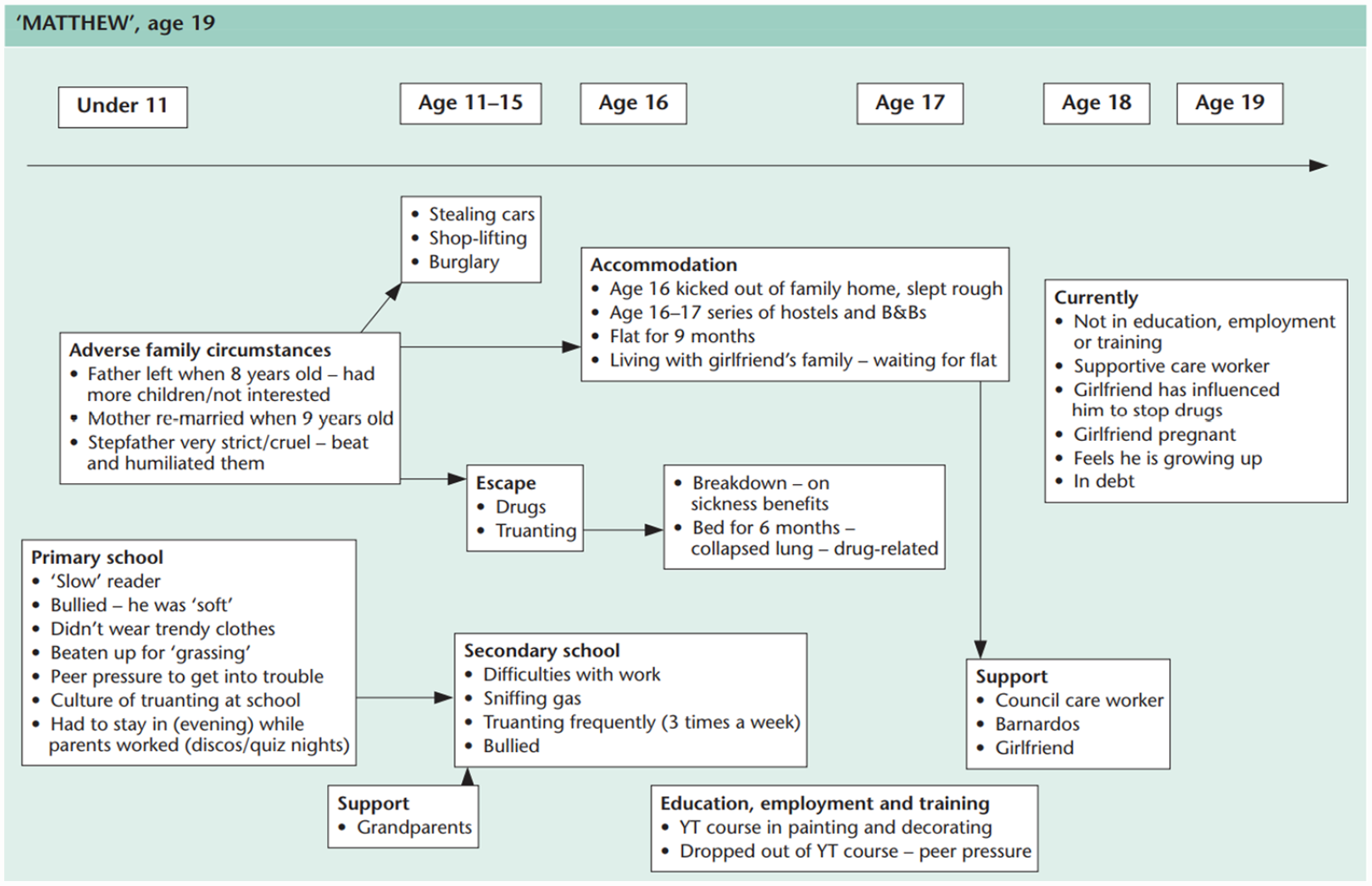
‘Bridging the Gap Report’ (SEU, 1999).
This fictive Mathew contains multiple strands of the welfare imaginary: his family home is unstable, his schooling incomplete, and these compounded disadvantages contextualise his criminality and drug use as ‘acting out’ or marginalisation. In making up Mathew, the SEU conceive of the family as the primary disciplinary institution (Fleming, 2015), but at risk of failing. This notion mandates governmentality suffusing into domestic spaces, where parents are understood to be ‘instruments’ of ‘bio-political state interests’ (Taylor, 2012: 208). Tellingly, ‘society’ emerges here in the nostalgic reliability of grandparents, whereas his peers dissuade him from work. Attempts to reform him through work placements and training have been unsuccessful, yet presumptively, only returns to education or work appear as solutions. The liminal transition through adolescence becomes a disciplinary project of producing good workers. Such policy discourse creates the conditions of possibility for increasingly authoritarian responses to the problem of NEETs, positioned by the state as help or care as they shepherd youth to ‘. . .find a route back to citizenship and the protective bosom of the state’ (Tyler, 2013: 198). This imaginary Mathew exemplifies the epistemic violence that silences and erases the 26 young people in Glamorgan and their complex history and politics of resistance, rejection as well as aspirations for work. The SEU engaged selectively with the Glamorgan study, deep enough to rework its title into a category of significance, but their central gesture is that of subjectification, in Hacking’s (1986) pithy phrase from Making up people: ‘The category and the people in it emerged hand in hand’ (p. 165).
Strikingly, the null category of NEETS is re-coloured here; Mathew’s lack of current employment and education is sutured to an imaginary narrative of family breakup, underachievement, petty crime and homelessness – the staples of the political marketing of harsher welfare policies (Dwyer, 2019). This trajectory is implicitly generalised to a much wider cohort, all youths who fit the NEET category, and later projected to those up to 29 years old. Mathew becomes a proxy for NEETs generally, and his rich – albeit imaginary – life becomes defined by his lack of employment and education. Embedded but eclipsed within the narrative is any tale of resistance, perhaps reflecting the actual voices of the original Glamorgan study, and the traces of power, the interventions of the state, principally reformatory, but also authoritarian and compelling. Thus, the dispositif of NEETs positions actors in tension, but not in stasis, as it disposes unemployed individuals and employment services to seek out any sort of work as a solution.
Coming after decades of ‘welfare reforms’, particularly those of Bill Clinton’s administration, in the UK Tony Blair’s New Labour were coming to terms with the need for populism and pragmatism. They considered the traditional left’s belief in state intervention in the economy ‘as now dead’ (Giddens, 2000: 4), and sought a middle way which they believed could restrain the worst of neo-liberalism (Giddens, 2000). Aligning with this academic programme of Giddens and Crossland, Blair embraced a complex synthesis that emphasised advancing equality of opportunity, institutionalising mutual responsibilities, strengthening communities and embracing globalisation (Leigh, 2003). Tackling the social exclusion of NEETs was one of the first policy ventures.
NEETs thus become ‘reterritorialized’ (Deleuze and Guattari, 1987), in London, occupying new physical and conceptual spaces. Firstly, the SEU itself in offices in Elland House and then Admiralty Arch, staffed by civil servants from other Whitehall departments and secondees from elsewhere – a complement of 30 staff by the time of being reabsorbed into the general civil service. NEETs also became the object of a regular statistical bulletin by the UK Government’s Office of National Statistics. From its original formulation, NEETs relied on the simple computation of existing national statistical measures, becoming pixilated numbers on screens, or the topic of academic papers. A whole of Government phalanx of new rules, procedures, practices and staff training emerged, all underpinned by measurements and accountability, key performance indicators which set targets to reshape policy and people.
By re-deploying the original formulation or using similar categorisations, multiple statistical correlations were made between NEETs and various anti-social behaviours; which reinforced the problem population formulation of NEETs (Rodger, 2012). Unmoored from the complex experience of some people in Wales, NEETs expands as a statistical category that can be correlated with a range of imputed psychological infirmities; low motivation, unwillingness to participate in society, and measurements of delinquency, anti-social behaviour, crime and early or chaotic parenthood.
Once established, NEETs became a key organising concern in media, welfare, government, academia and policy, as well as more generally, as indicating problematic groups, not just implicitly dangerous and politically volatile, but also vulnerable groups, drawn from ‘unstable’ backgrounds with chaotic lives, unable to navigate the complicated transition from youth to the formal labour market or anything like a viable career (Furlong and Cartmel, 2006). A corresponding universe of critique also sprung to life. This is both connected and distinct from Government; in universities, research institutes, think-tanks and media organisations, some of which appear to actively engage as beneficiaries of government initiatives, while others simply observe and oppose. Furthermore, NEETs informs moralising underclass discourse (Levitas, 2005), an acceptable policy term for ‘white trash’ (Preston, 2003) or ‘chavs’ (Jones, 2020), another form of othering the working class (Skeggs, 2014) who need to be accountable, controlled and subjected to intervention so that they learn the hard lessons of responsibility (Gillies, 2016).
Now, those considered NEETs are presented as fully devoid of their own politics, they are not engaged in work and thus society, echoing the lack of recognition of the politics of the 26 young people who participated in the original study. NEETs floats away from actual people to become a profitable problem for society to address – to a media selling salacious headlines about chavs and hoodie-wearing ne’er-do-wells (Tyler, 2020), to policy entrepreneurs consulting on thorny social problems (Peck and Theodore, 2015), and the politicians eager to fix things that voters worry about (Wacquant, 2009). NEETs is enrolled in an array of exploitative actions that are almost fully alienated from those who are actually considered NEETs. Curiously, the original Welsh researchers – particularly Williamson (2010) have also revisited their role in the creation of the term, retelling the haphazard original formulation, directing people back to the rich narratives of the original Welsh study participants, and hinting that their work has been simplified or exploited. Here the cycle of extraction and subjectification that they unleashed and profited from, has also operated back on them.
Global NEETs
From the relative obscurity of Glamorgan, NEETs makes its way into a cluttered landscape of global policy, where ‘structural unemployment’ was an OECD concern since the 1970s: ‘. . .the governing of unemployment was increasingly regarded as a question of ensuring the functioning of the labour market’ (Triantafillou, 2011: 573). In the years immediately after the ‘Bridging the Gap Report’ (SEU, 1999) new primary research was conducted with NEETs, first in the UK, then in other countries for example in South Africa in 2002; Japan in 2008. Initially travelling through ‘third-way’ international networks of the late 1990s, over time ‘the term NEETs has crept into policy discourse’ (Mascherini, 2019: 20), and becomes a policy concern within supranational organisations, the ILO, OECD, EUROfound, WorkBank and IMF; before becoming institutionalised in the UN Sustainable Development Goals.
An official standard definition of NEETs was adopted by the European Commission to support data collection and statistic making in April 2010, wherein NEETs refer to 15–24-year-olds who meet the ILO definition of unemployment, those who are not in training or education – an age range extended to 15–29 in later iterations. Here, the evocative academic formulation of NEETs hardens in the apparatus of national statistical offices. Once NEETs becomes widely measured in national statistical systems, which themselves have international coordinating bodies, it becomes a phenomenon to be managed, the content of political competition. Indeed, ‘policy intermediaries’ propagate techniques of measurement and expertise on NEETs throughout the global north and south (Peck and Theodore, 2015). Responding to mass youth unemployment in the wake of the 2008 global recession which was particularly prolonged in Europe, the YG is also launched, which promises an offer of training, education or a job to all ‘youth’ within 4 months of their becoming unemployed.
In 2015, the NEETs classification was taken up with minor rephrasing as one of the 17 United Nations’ Sustainable Development Goals (SDGs), guiding the development of global development activities in 193 member states; Goal 8 commits member states to ‘substantially reduce the proportion of youth not in employment, education or training’ and ‘to develop and operationalise a global strategy for youth employment’. The SDGs, which replace Millennium Development Goals now incorporate monitoring and targeting, three of which are dedicated to NEET targets. 6 For the time being, these have no direct consequences or enforcement beyond their soft political power. Perhaps due to its cultural resonance or perhaps because it is relatively easily implemented as a statistical measure, NEETs has achieved widespread acceptance within policy and political circles – a central object of concern of various global institutions, national governments and their welfare states, statistical and economic development institutions, and active labour market policy agencies. Certainly, the measure is criticised and resisted, for homogenising a very heterogeneous population into a single category and imposing a singular view on a complex experience (Holte, 2018).
NEETs acting back on individuals
As activating NEETs was embraced by the ‘third way’ political platforms from the 1990s onwards, the range of ALMP interventions in young people’s lives widened to variously include traineeships, apprenticeships, internships, workfare, access, recovery or bridging education programmes, mentoring, counselling, monitored job search; and behavioural modification through case-worker meetings, psychological and algorithmic profiling and workshops (Boland and Griffin, 2015). Such ALMPs are often underwritten by conditionality, a term describing the responsibilities attached to welfare.
Conditionality encompasses mandating activities as compulsory, intensifying the frequency and scale of activities an individual is required to do to maintain benefits, and communication that welfare is contingent at the point of care with sanctioning of cutting or suspending payments – for up to 3 years in the UK (Dwyer, 2019).
The level of conditionality ebbs and flows with political and economic impulses (Crisp and Powell, 2017). Quite broadly conditionality is linked to the rise of food banks, homelessness, poverty and destitution. Beyond causing financial difficulty through sanctions, some welfare conditionality prescribes behaviours and activities, even including mandated spending (Humpage, 2016). In the global north, total welfare cash transfers average at around 1% of GDP, and ALMPs are rapidly rising, currently averaging at 0.6% of GDP – the more aggressive, authoritarian machinery of the state-in-action. This expenditure primarily funds a significant expansion in caseworkers, sometimes with contracted private operators (O’Sullivan et al., 2021), as the OECD recommend a target caseworker ratio of 1:150 unemployed people, arraying ever more professionals around the organisational nub of NEETs. Caseworkers work intimately on unemployed individuals, implementing policy at street-level, by developing personalised plans to return to work, plans which in turn are used to monitor and punish individual NEETs deprived of support until they work or at least work on their worklessness.
Genealogical threads of the apparatus and assemblage
Emerging from a study of a few individual’s complex lives, NEETs becomes a precise statistical concept, which elides the politics of its development to effectively categorise and classify ‘problem people’. It hides the various histories and contexts where it is taken up; an Afghani NEET is one and the same as a Zambian NEET. As a result, it self-presents neutrally as objective statistical truth, without any acknowledgement of the array of organisational and ideological machinery that furtively generates in plain sight the raw material for evidence-based policy – as though data speaks for itself. Holte (2018) demonstrates the multiplicity of accounts overruled in the simplifying category created by policymakers and politicians, disrupting the sense of a neat history and settled present. Both Nietzsche and Foucault’s genealogy disputes origin-stories, and instead attends to the conditions of emergence of particular discourses, practices and subjectivities that are invented, not de novo but by endless recombining of existing ideas and practices. Revisiting the ‘archaeological site’ where NEETs was invented through categorising practices allows us to identify what is encoded in the statistical definition.
Foucault’s formulation of governmentality re-problematises the experts and expertise that actively produce the welfare state – especially how the state categorises subjects and then disciplines their conduct in specific ways (Boland and Griffin, 2015). The category of NEETs potentially enters how people see themselves, reclassifying individual lived experiences through statist categories. Whilst no individual is likely to self-identify as a NEET, they certainly acknowledge unemployment and articulate resistance to welfare categories. Yet NEETs articulates a figure who is both dangerous and docile, but certainly malleable – a process Foucault describes as subjectification.
Measuring the category implies the need for intervention, a cycle of diagnosis and cure. Supposedly discouraged and disaffected youths need to increase their ‘employability’, and idleness needs to be purged. By simulating the toughness of the ‘real world’ through conditionalised rights and responsibilities, the welfare state can ‘emancipate’ the potential of the worker within (Hansen, 2019). Without interventions, the vulnerability and potency of youth can be politically combustible – the future peace and security of society is at stake. Thus, harsh governmental interventions, a phalanx of disciplinary institutions that appear as coherent, integrated projects of biopower directed at the conduct of their lives become vital. NEETs appears as an ‘apparatus’, following Agamben (2009), emphasising how young people are subjected to aggressive and authoritarian ALMPs. Underwritten by sinister conditionality, arranged against them by an indeterminate array of organisational and ideological machinery, unleashed by the formulation of NEETs and YGs – each youth is illiberally reshaped as homo faber, a worker. Thus, NEETs echoes the deep cultural code that all people must work, those who refuse to work must be recaptured and made work, as anything less threatens the whole edifice of society (Boland and Griffin, 2021).
Usefully, Agamben (2007) suggests how we might free ourselves from the massive contemporary accumulation and proliferation of apparatuses; using the term ‘profanation’, to describe the process of restoring objects to common, simpler or ordinary use - and identifies ‘profanation as the political task of the coming generation’ (p. 92). There are opportunities for such profanations; a return to genuine welfare, taking care seriously, or indeed moving from away from extractivist statistical knowledge that has come to dominate social policy, and actually listening and empathising with people subjected to apparatuses. Indeed, thinking with Agamben about those subjects captured by the apparatus, profanation suggests a restoration of patient care for adolescence, the liminal transition to adulthood considered as much more than just becoming a worker in the economy. Specifically, this has implications for what happens in welfare offices. Currently, caseworkers instruct the unemployed, moralise about their conduct and seek to reform them with a range of carrots and sticks. Alternatively, recovering the original meaning of welfare, they could work with people, support, guide and care for them. Here, Agamben’s innate, even romantic conservatism suggests alternative approaches to reform, beyond the perennial big ideas of social policy, but his formulation neglects the productive potential of individuals to shape, remake and resist subjectification.
Thinking with Deleuze allows going beyond merely exposing an apparatus that traps individuals into work: NEETs from its inception was a space for deterritorialising, de-stabilisation and disorder, provoking resistance and refusal. The original NEETs formulation captured refusniks - individuals who refused and abandoned the pathway to work – the fear central to the entire conceptual system of activation. Yet the original Welsh youths are part of this ambivalence; they yearned for good work, to be employable (Bloom, 2013). So too were the authors of the original study; they were ambivalent and sympathetic to the object of their concern, concerned by the unfavourable political macro-economic formations facing those Welsh communities and sympathetic to the ethical stance the young people took. Their formulation of NEETs was haphazard, perhaps even exploited by others for its simple epistemic verifiability; framed as a simple computation of existing statistics.
From qualitative interviews with disaffected youths in depressed regions to the screens and spreadsheets of policymakers, from political campaign speeches to statisticalisation by international organisations, from the welfare office with its forms, processes and categories to actual young people, there is a vast assemblage to accomplish the category of ‘NEETs’, never stabilised, always emergent. There is no singular, centralised, hierarchical structure of power to oppose by critique or resistance, instead, there are legions of sites of implementation. Assemblage thinking allows recognition of the multiplicity of elements which are ‘assembled’ into NEETs. Here, NEETs is a temporary territory where authoritarian discourses of welfare reform gather, and that imaginary is assembled up into a plethora of categories, policies, processes, organisations and actions which appear like an apparatus from certain vantage points (Wacquant, 2009).
Recognising assemblages genealogically traces how an apparatus emerges with organisational heft, generating strategic function and targeting subjects. Assemblages can temporarily congeal into slightly more static apparatuses. Everywhere that is deterritorialised by NEETs, individuals are both subjectified and resistant, actively pulling the concept apart (Boland and Griffin, 2015; Dwyer, 2019; Hansen, 2019). The NEETs formulation emerged from a local site of resistance, refusal and the inaccessibility of orthodox working lives for 26 young people, and today generates micro-struggles worldwide. Only from a distance does resistance disappear – it continues in debates in parliaments, in social policy journals, and directly in the confrontations that happen in welfare offices and on activations schemes. Indeed, there is a new policy concern for ‘hidden NEETs’, individuals whose refusal to participate in many operations of Government means that the state can no longer see them in the NEETs data (Devany, 2018). Muted and sparse as it may be, anti-work refusals of conditionality do occur, usually through hidden resistance, and attempts to create a future outside of work (Finn, 2021). While important thinking about the re-organisation of work is ongoing, rethinking this pre-organisation of work in NEETs is a vital task.
Conclusion
In this paper, we show how the state already answers the fundamental question of whether work itself has a future – it is written into the thicket of governmental policies and the organisation of the welfare state. Here, an elaborate set of theories, ideas, institutions, and practices work to sustain work’s position in people’s lives. Understanding how policy ideas create and shape organisations, institutions and practices is, in a practical sense, one starting point for articulating a post-work future.
The genealogy of NEETs reveals the hybrid dispositif of governmental action that organises and sustains work, where an assemblage of ideas, discourses and ideologies crystalise into the tightly organised apparatus of the welfare state. Here, the neoliberal state works gently to manipulate the environment and context of policy, eschewing any infringement of economic liberty in principle, but in practice organising an authoritarian subjectification of people in the conditionalized support of the welfare office, justified as reacting to the needs of NEETs.
Those categorised as NEET are captured in the world of conditionalized ALMPs, endless inadequate attempts at reformatting them as workers – until they find a future in work. The policy mantra, ‘there is no alternative’ is actualised institutionally as their exits are closed off – in policing, migration and even mobility. From a distance it seems that resistance is futile – what good does shouting at the dole office do you? Here, the pessimistic formulation of Agamben emerges, apparatus without counter-apparatus, and his limited view of the productive potential of the individual has a persuasive realism. Yet, disassembled by a genealogical ‘history of the present’, even globalised NEETs appears as an assemblage, still in flux, fragile, and open to revision, contrary to the appearance of an apparatus. Thinking dialectically between these two concepts allows us to move between vantage points, to seek a more complete glimpse of all this complex organising.
Instigated to mitigate the worst excesses of capitalism, the welfare state now stands as a guarantor of its future, stabilising contemporary capitalism against market shocks and ensuring the pacification of potentially politicised cohorts (Ewald, 2020). It largely accomplishes this through the mechanics of authoritarian administration of worklessness, promoting and enforcing working futures on people – individually and intimately, ensconced in a more light-touch neoliberal world of policymaking.
Those seeking an alternative future for work must contest productivism, not just in the workplace, labour market and capitalism, but also in the welfare state, and contest the conversation around social policy on academic, governmental, political and public levels. The answer is not simply in the contest for ideas, but also in the practices of organisations. That involves not just confronting existing organisations with withering criticism of their apparatus-like power, but reassembling them imaginatively. Alternative futures must seek to re-write the welfare state as a guarantor of well-being, peoples and environments, rather than the handmaiden of full employment. For it is here, in the vast skein running from international organisations to the street-level of welfare services, from ideas and ideologies to the authoritarian administration of those without a clear work future, that the future of work is practically being contested.
Footnotes
Funding
The author(s) disclosed receipt of the following financial support for the research, authorship, and/or publication of this article: This study was supported by funding from the Horizon 2020 Framework Programme, Grant/Award Number: 870702; EU Framework Programme for Research and Innovation.
