



Abstract
In this essay we argue that one way to combat the depressing creep of the neoliberal university is to recuperate and re-use consciousness raising (CR) in teaching, administration, research, and engagement. Consciousness-raising can be roughly characterised as first, an apprehending of one’s place in a system, and second, feeling inspired to do something about that system. We propose that CR is an especially helpful way to think about our work in contexts where more structural changes to advance social justice agendas appear to have stalled, or even to have taken a step backwards. There may be potential to co-opt the increasing dominance of individualism in our worlds, by revisiting the role that individual reflection and development plays in social change, as conceptualised within CR. Through examples drawn from our own experiences, we demonstrate how CR happens in our day-to-day interactions, reigniting a sense of meaning in our working lives whilst potentially creating ripples of positive change. We thus call not just for revisiting, but also for reconceptualising and reframing CR rooted in feminist and intersectional praxis as a methodology for academic activism in the contemporary business school.
Introduction
We almost didn’t submit revisions to this essay. Our professional relationship is built on the writing of optimistic pieces, championing the spaces activism has flourished and rebutting the naysayers. And this is meant to be another piece of optimism, some ‘hope in the dark’ (Solnit, 2016) about our academic purpose, yet when the reviews came in, we must admit that our motivation and our optimism was at an all-time low. Since we began researching consciousness-raising (CR) as a phenomenon in 2018 so many things have changed. Our personal lives have been punctuated by phases of loneliness and isolation; anxiety and stress, and a sense of powerlessness; multiple lockdowns and the grinding frustration at seeing our rights and others’ eroded by our respective governments and corporate power. Our working lives have been underscored by ramping up of the corporatisation of the university, increased workloads and interactions primarily reduced to sad often faceless conversations through the laptop. To top it off, one of us, along with many of her colleagues, faced the threat of redundancy, a threat especially targeted at those who publish on ‘critical management studies and political economy’, for example at Leicester Business School (Leicester UCU, 2021). These challenges create more work, for example fighting back with unions to support our colleagues. We know we are not the only ones who are asking whether it’s time to jump ship. What is the point of academia today? What is the point of struggling for the things we care deeply about (gender, racial and all other forms of equality; sustainability of our planet) within institutions, corporations, and even governments that seemingly do not give a shit about these things, or are part of undermining them? These struggles encapsulate the individualism that invades our worlds: the stress of facing multiple crises in a context where individual, as opposed to collective action, is often all we are presented with as a possible way forward.
This Acting Up! essay is a call to, and proposal for, re-finding our purpose and meaning within the confines of individualising, neoliberal university life, and wider institutional contexts. Feeling burnt out and used up, can we continue to challenge inequality and unsustainability in our working lives? One way we do this, we have realised, is through facilitating consciousness-raising (CR) alongside our research participants and students, as well as others we interact with at work. This isn’t as difficult as it sounds, although evaluating the ‘outputs’ are, as we will discuss. Indeed, it is possible that CR is something you are doing or have done at some point in your academic career without using that label.
We draw on feminist literature and accounts of practice in this essay, whilst acknowledging that CR has been used by many other social movements. Consciousness-raising involves learning about oneself within structures of society, and building connections with others’ experience, to break isolation (Gornick, 2000) and foster a critical position. We build on this conceptualisation to propose that a contemporary approach to CR, informed by intersectional feminism, is useful for our objectives in two ways. The first is that in a time of heightened individualism, where structural, institutional, and organisational causes of problems are denied or foisted onto individuals, CR can be helpful in moving towards radical transformation. This is because somewhat counter-intuitively, CR complements a trend of individualism, or even egoism, with its focus on an individual’s personal experience and emotional cognitive inner world. What is key is that CR is also about building empathy, questioning assumptions and connecting the micro with the macro in order to fight for structural change, usually through more collective means (Sarachild, 1979). This is, we argue, a contemporary way of promoting social change, without pushing too much against the grain. It is the feminist ‘personal is political’ 2.0.
This relates to what we see as a second key aspect of CR. A contemporary, intersectional feminist take on CR stresses solidarity through difference (Keating, 2005). This is useful to us for meaningful engagement in our pedagogy, research, engagement, and administrative roles as it means that during our work building towards social change, we can use CR to raise awareness about common individual experience to build connections, whilst simultaneously acknowledging differences amongst us. We think that CR, facilitated carefully along feminist intersectional lines, can provide a space not only for solidarity based on similar experience, but also ‘a space for rigorous critique, for dissent’ without which ‘we are doomed to reproduce in progressive communities the very forms of domination we seek to oppose’ (hooks, 2012: 78). This is a possible balm to what some have called the ‘culture wars’ whereby identity groups sometimes struggle to work together. Consciousness-raising can raise the uncomfortable truth that we can be both oppressed and an oppressor (hooks, 2000) in a conscious way. Without this awareness that everyone can and does inhabit these dual roles our hopes for social progress are limited.
Facilitating CR is all about creating ‘a-ha moments’ (Ahmed, 2017). That feeling of when something seems to click or resonate – either with our own lived experience or through another’s powerful testimony. Our privilege and power within the university, yes, even now, is that we can facilitate these moments. In this essay, we testify to the fact that re-adopting the new/old concept of CR helps us to see, and articulate how, through seemingly irrelevant, everyday interactions in our teaching, administration, research, and engagement, we can still make a difference. This is academic activism at the margins. And it gives us hope in dark, individualistic times.
Adding feminist consciousness-raising to our academic activist toolkit
Alessia Contu in her 2018 Acting Up! essay, discussing the need for academic praxis to orient towards social change objectives, raised the question: ‘the point is to change it, but how’? Her essay speaks to the growing call within business and management studies to engage in ‘academic activism’, that is, to use our privilege as researchers and educators to leave the world in a better place, not just to simply observe and dispassionately describe the world around us. Contu (2018, 2020) draws on Collins’ (1990) notion of ‘intellectual activism’: ‘the myriad ways in which people place the power of their ideas in service to social justice’ (Collins 2013: ix in Contu, 2018: 283) in her suggestions as to how we make business schools meaningful. Her work joins others who have argued for ‘critical performativity’ (Spicer et al., 2009: 537) in our work, achieved through a focus on ‘engaging with non-academic groups using dialectical reasoning; scaling up insights through movement building; and propagating deliberation’ (Spicer et al., 2016: 227). This moves us beyond ‘intra-academic debates’ on theory (Spicer et al., 2016: 277) to actively engage in progressive change (Bridgman, 2007; Willmott, 2008). Recent suggestions as to how we might do so include: through improving business practice to address grand challenges such as climate change (Wickert and Schaefer, 2015); advising and working with government and intergovernmental bodies (e.g. Grosser, 2021) and collaborating with NGOs in research and practice (Grosser, 2016; Grosser and McCarthy, 2019). Long-standing debates have also focussed on collaborating with research participants to resist organisational injustices such as sexism (Coleman and Rippin, 2000).
We are very much in support of these more large-scale and structural approaches, but struggle on a personal level to keep finding the time and energy to do these things. Even with teaching, where others have focused on more individual level approaches to change, for example, using literature to build empathy (Thexton et al., 2019), within the British and Australian university context we come up against obstacles such as red tape preventing innovation. We love the idea of taking students on field trips to see the realities of slums and how business can be used as a force for good to change things (see Mirvis, 2008). Closer to home, we could design courses so that students were sent to observe management in-situ, amongst hospitals and charities, for example (Auger et al., 2018). However, the sad fact is that within many institutions there is little money to engage in these kinds of teaching. The demands on our time are instead towards increasing administrative loads and ‘pack em in, pile em high’ approaches to education, which sees us teaching programmes with up to 1500 students a year. Increasing demands of evaluation on research such as the UK ‘Research Excellence Framework’ (REF) and relatively new ‘Knowledge Exchange Framework’ (KEF) tie university funding to particular kinds of research assessed through particular lenses of impact (Rhodes et al., 2018) all of which pushes our research into constrained avenues. This is not to complain when we know we are working in contexts with still relatively high access to resources and when we ourselves sit within the privilege of permanent roles. Nonetheless, calls for academic activism in their various guises often exhaust us alongside a nice serving of guilt for not doing more.
Akin to Contu (2018, 2020), we support the idea that our academic lives should be lived in the pursuit of social justice through intellectual activism. We extend Contu’s question by asking ‘how do we do this in the context of pandemic exhaustion and resource depletion, and continued cultural focus on individualism?’ We contribute to the methodological arsenal of a critical academic activist by answering that CR, and in particular a contemporary intersectional approach on CR, is one way forward. Feeling burnt out and used up, we advocate not trying to reinvent the wheel, but reappraising the many, small things we do that are in fact planting seeds for progressive change down the track and providing support to others to think differently.
Consciousness-raising is a well-known concept but flies under the radar within business and management literature. Aspects of CR, such as empathy-building (Thexton et al., 2019), are raised most often in articles related to pedagogy. Consciousness-raising is, however, scarcely named as such (for exceptions see Mirvis, 2008, and Auger et al., 2018). Instead, work draws on the theories of Freire (1970, 1972), reflexive learning (Parker et al., 2020) or feminist pedagogy (e.g. Pullen, 2016). While feminist management scholars have noted the power of research interviews to raise new questions and issues for interviewees (e.g. Grosser, 2016), few scholars in business schools have conceptualised and/or written about CR within research processes (exc. McCarthy and Moon, 2018; Segal, 1996). We see elements of CR practice in action research or in adoptions of conscientization drawn again from Freire (e.g. Wickert and Schaefer, 2015). Contu (2020) noted how a women-only Facebook group for critical management scholars acted as a space for CR. So, it is not as if others have not argued for the importance of elements of CR within business and management schools before. However, little literature in management and organisation studies has centred this approach. We hope here to recuperate this taken-for-granted idea.
In the context where much of the politics we stand for is increasingly marginalised, and systematic, structural change appears to be going in the opposite direction to that we had hoped for, we find that a focus on individual level changes that are far less overtly challenging to the ‘powers that be’ provides opportunities to reconceptualise what we do and why it matters. It is not that we have given up on wider, more structural approaches, but that our strategies have had to change a little. In this context we propose strategically re-framing CR as a methodology (MacKinnon, 1989) for academic activism well-suited to neoliberal, individualistic times, and places. In a sense, we view CR as a trojan horse approach to disrupting the status quo. With a focus on intersectionality (Whittier, 2017), CR presents a promising tool for Contu’s intellectual activism in business schools (2020) since through discussion that centres the individual, differences can be raised whilst building solidarity on social justice issues at the macro level.
What is consciousness-raising?
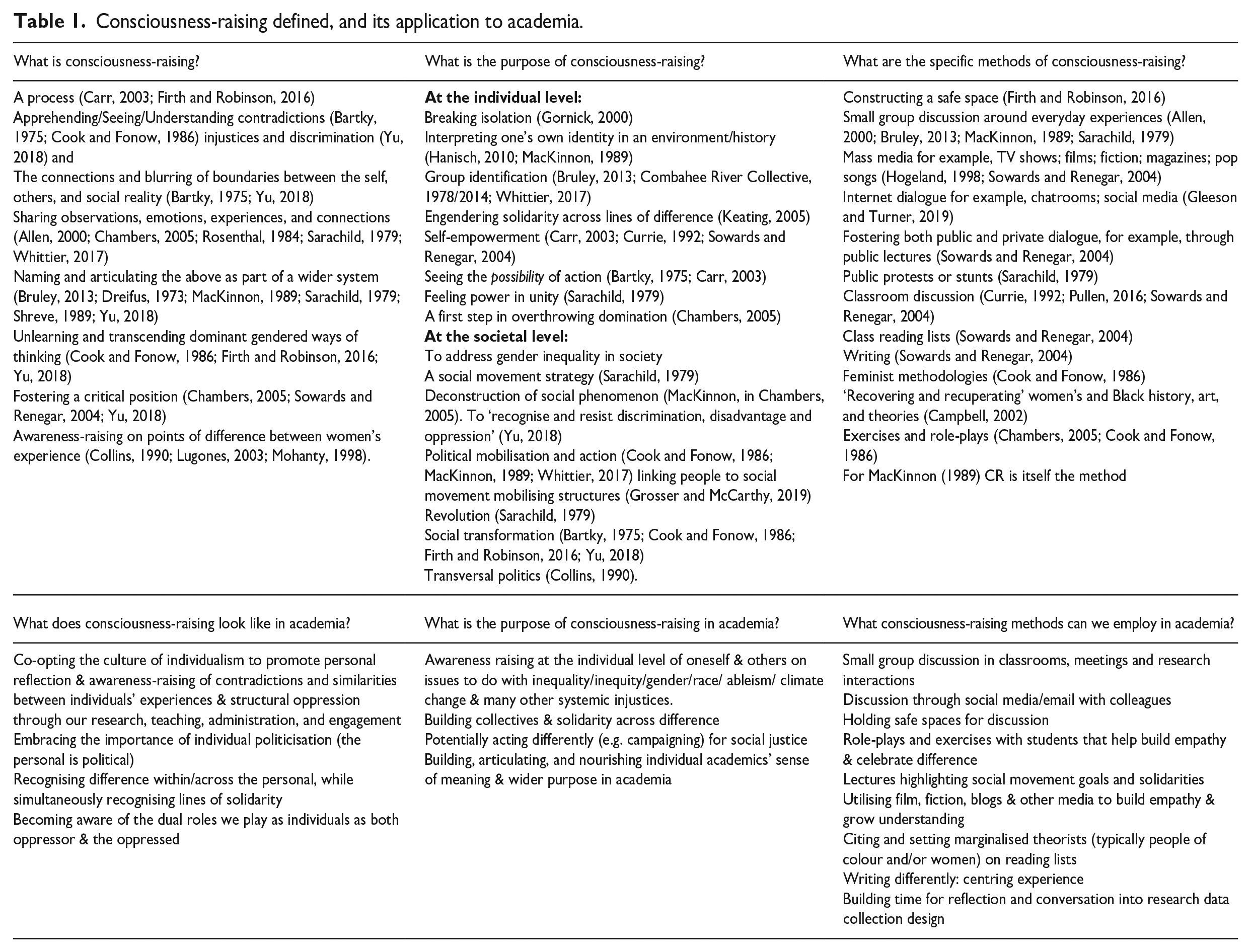
Consciousness-raising as described by feminist theory and activism has roots in diverse social movement activism, including Marxism (Bartky, 1975), Chinese revolutionary communist movements (Mackay, 2015), civil rights movements in the US (Ryan, 2013) and of course, feminism, the literature and accounts of practice from which we draw from. There is no single definition of feminist CR, and as a lived-in praxis it has changed over time. However, we read through the literature asking three key questions: What is CR? What is its purpose? And what are the methods adopted? The answers tended to coalesce around: awareness raising, for individual but ultimately broader social change towards gender equality in particular, facilitated through a variety of forms of in-depth discussions and dialogue. In what follows, we explore these three questions/areas and apply them to our academic lives, sharing experiences where CR has played out and hopefully inspiring you to reappraise what you likely already do, and perhaps take steps to strengthen these small wins for meaningful rehabilitation of intellectual activism in business schools (Table 1).
Consciousness-raising defined, and its application to academia.
What does CR look like in academia?
What does it mean to ‘raise consciousness’? Feminist literature offers various definitions, explaining that raising consciousness involves the ‘apprehending’ (Bartky, 1975) or ‘seeing’ (McCarthy and Moon, 2018) of connections, blurring the boundaries between the self, others, and social reality (Yu, 2018). Consciousness-raising involves a psychological (re)orientation (Combahee River Collective, 1978/2014), often an ‘unlearning’ of taken-for-granted ways of seeing the world (Cook and Fonow, 1986; Firth and Robinson, 2016). Individuals share their own experience with that of others, and connect them with wider macro systems (Sarachild, 1979). Black and postcolonial feminists such as Lugones (2003), Mohanty (1998), Collins (1990) and others point out that CR which only focused on the sameness of experience for women is problematic, calling instead for awareness-raising on points of difference across gender, race, class, and other identities, therefore potentially ‘engendering solidarity across multiple lines of difference’ (Keating, 2005: 87). We believe that this process is facilitated by understanding that we all have roles as both oppressors and oppressed (hooks, 2000) – no blame, just an acknowledgement that in the context of hierarchies of power this is true and seeing it can facilitate understanding and solidarity across boundaries. Consciousness-raising fosters a critical position (Chambers, 2005) that, as we shall discuss later, holds the potential to help develop a ‘transversal politics’ (Collins, 1990) necessary for social transformation in politically fragmented times.
Within the feminist use of CR, this critical reflection is on gender as a social construction and how individual experiences of oppression are connected to societal norms, values, and institutions, increasingly through an intersectional lens (hooks, 1994). In academia, we often explore a host of other ‘social constructions’ that can enable the understanding of the individual within a whole. For example, increasing attention is being paid to race, ethnicity, and the decolonisation of curricula. This topic involves an often-times confronting examination of white supremacy within education. Indeed, within one of our former universities the push towards decolonisation was been met with equal parts celebration and denigration. Some felt so enraged by the accusation that business schools are racist (Dar et al., 2021) that they felt the need to email the entire faculty to refute this. The ensuing email exchanges arguing back, with their attention to broader societal structures of racial inequality and the ways in which smaller elements, such as curricula, play into these, could be positively construed as email-based CR, wherein the micro-connections between individual experience and broader structural oppression in the university context was discussed. Furthermore, the email discussion enabled awareness-raising to take place, particularly that whilst there were similarities between some academics’ experience of migration and Otherness, there was difference, and that should be voiced. In this way the sharing of intersectional experiences can become a slow-burning catalyst for change. We present this small example as a way of showing that CR is happening in our everyday exchanges – including in our more mundane administrative roles.
A good example related to teaching towards social justice action in a business school, and how this can be designed as CR, comes from Pakistan. In the context of attenuated class privilege and social inequality, Zulfiqar and Prasad (2021) memorably explain how asking ‘elite’ students to write reflective essays and interview ‘lower class’ workers led to CR, initially based on awareness-raising. One student on the course recounted that: ‘I realize how these problems were always a part of me, my surroundings, and my subconscious mind but I never really took the time out to actually address them by thinking about them’ (Zulfiqar and Prasad, 2021: 31). Two aspects of this case stand out for us: first, that Zulfiqar knew that this course would be confronting for her students but embraced that tension. Consciousness-raising, with its focus on sharing experience and learning from others, to see oneself within broader systems of inequality, is an uncomfortable apprehension that many of us have experienced ourselves, especially when we come to see that we sit in an oppressor role. This connects to the second aspect of Zulfiqar’s course design, that in order to invite students to open themselves up to reflection, educators too need to show a little of their own experience and reflexivity by admitting uncertainty, privilege, and their own sometimes biased thinking.
This mutual, and often painful, experience of CR chimes with us too. For example, during research into gendered global value chains in Sub-Saharan Africa Lauren experienced CR as a collective experience. Once the formal data gathering had finished each day, the research team gathered for dinner on plastic chairs under the stars, the electricity intermittent but the discussion flowing. She listened as the female translator fiercely discussed the role of women in Ghana with the lead male NGO worker, reflecting on her own struggles to control her choices of contraception within a strictly Christian family, and explaining how she’d not really thought about how unfair it was until now. The conversation moved to the tone of a confessional, with the male worker expressing regret at how he had approached the issue of educating his girl children. All the while, Lauren was realising that her conception of feminism in the Ghanaian context was completely off-kilter, and that her ignorance was likely to do more harm than good in the context of the research. She first felt frustrated and defensive about her naivety, and then realised that in even centring herself in this situation she was aping dominant White feminist narratives. This experience changed how Lauren approached research. In her next research project in sustainable cotton production, she began by visiting local feminist activists, reading deeply, and collaborating more with local researchers. This is just a snapshot of how unlikely and often ‘irrelevant’ interactions in our research roles can provide avenues for CR, rough as they can be.
What is the purpose of CR in academia?
Once our consciousness is raised, what do we do with it? This was a burning question for the feminist movement in the heyday of CR groups, with some arguing that ‘only’ working on individual awareness-raising wasn’t enough (Sisterhood and After Research Team, 2013), and could get lost in a form of individualistic navel-gazing (Rosenthal, 1984). It was argued that for CR to be a gateway to social justice, it needed action, in the form of participants becoming activist. Enabling participants to move from thinking about themselves as an object to a subject, and the potential for agency, especially in collaboration with others (Combahee River Collective, 1978/2014) kick-starts the possibility of action (Bartky, 1975). This might take the form of joining social movements to organise around discrimination and injustice. A contemporary approach to CR, with a focus of acknowledging difference within categories of sameness (i.e. different experiences of Black and White women, or across class) has also been used to develop ‘coalitions of consciousness building’ towards social justice (Keating, 2005).
Returning to Zulfiqar and Prasad (2021), they surveyed students about the effects of CR in the classroom. They found evidence that beyond ‘just’ reflection, some began speaking to friends and family about the stigmatisation and inequity with which domestic workers were treated, or became activist in wage-related campaigns, indicative of wider actions towards social change and justice. Nonetheless, here it is worth stressing that CR is a process (Carr, 2003). It involves people sensing ‘how it came to be this way and that it can be changed’ (MacKinnon, 1989: 91, our emphasis). It is, however, not guaranteed that participants will act, or indeed what kind of action they might take, and Bartky (1975) along with more contemporary writers caution against a metrics-based approach to CR outcomes (Chambers, 2005). Consciousness-raising, like empowerment, doesn’t necessarily take a linear form and since so much of the process is psychological, emotional, and cognitive, ‘measuring’ how much CR is happening or when is often an impossible, and perhaps even a counterproductive, task. Olcoń et al. (2021: 308) found that students on study trips who were ‘emotionally affected by unjust global realities’ questioned ‘their actions and assumptions’. However, ‘few of them questioned the global structures underlying economic injustice’ (p. 11), remaining ‘stuck’ at the micro level of reflection.
Tales of ‘unfinished’ CR to us support the view that we cannot effectively evaluate the impact of CR efforts in the short-term alone (McCarthy and Moon, 2018). Sometimes we might only realise that CR was happening years later. Indeed, in the example from Olcoń et al. (2021) above, how are we to know whether these student experiences informed wider understandings later in life? Sinclair’s (2019) memoir of encountering feminism in her reading at university shows the power that reading others’ accounts had on her position and future working life – but this wasn’t obvious at the time. At a graduation ceremony last year Lauren spoke to a former student who is now looking for work in sustainability. He recounted at length an exercise she had run in the first term of his degree that intended to illustrate the tragedy of the commons. He said that the experience had stuck in his mind because as he slowly began to ‘get it’, he also became enraged that the other students couldn’t see that they would all lose unless they collaborated. After this he had become interested in sustainable business, eventually changing his degree specialisation. In this instance, CR was present as awareness-raising and as an eventual call to action (in wishing to work in sustainability), but Lauren would have had no idea of this until the student told her so. Ultimately, whether an individual starts to see the world in new ways, or becomes an activist, and what form their activism takes, CR provides us with a form of potential emancipation, and hope for new ways of living and being.
Methods to facilitate consciousness-raising
The methods through which to engage in CR have traditionally tended towards small-group discussion and learning, traditionally in person (Allen, 2000) but increasingly through the means of technology such as email, social media, blogs and online video discussion (Gleeson and Turner, 2019). In groups, individuals discuss everyday topics – within women’s groups topics focused on ‘small situations and denigrated pursuits that made up the common life of women. . . housework and sexuality’ (MacKinnon, 1989: 87) because it is in the everyday ‘small stuff’ that we ‘do gender’ (West and Zimmerman, 1987), where patterns of inequality and oppressions can be identified and connected with structures (McCarthy and Moon, 2018). This is where the slogan making ‘the personal political’ (Ryan, 2013) was born, in these rooms of sharing experience. This method can include role-plays. For example, a 1971 activity asked men in CR groups to ‘run a short distance, keeping your knees together. . .Women have been taught it is unfeminine to run like a man with long, free strides. See how far you get running this way for 30 seconds’ (Bordo, 1993: 186 in Chambers, 2005: 333).
Yet sharing experience and raising consciousness is also possible through the consumption of lectures, books, TV, blogs, and other media formats (Sowards and Renegar, 2004). Kate still recalls the electric atmosphere when listening to Catharine MacKinnon give a public lecture to a large assembly of women from a wide range of backgrounds several decades ago. The visceral nature of this experience was elating, and the aftermath of excitement and communal reflection inspiring as people stood outside reflecting on how the talk related to their own experiences, making connections with each other, swapping contact information, and building a sense of solidarity and hope. Indeed, Crenshaw (2010: 159) recalls that MacKinnon’s performance ‘transcended the traditional antinomies that stratified legal thought and social action into separate and unequal spheres’, challenging unconscious expectations about how women speak about women. Perhaps academic lectures are not a waste of time then?! Perhaps we are all engaged in co-creating not just knowledge, but action, in such processes. If this is the case, what should we be doing now? While online lectures obviously offer the opportunity to reach wider audiences, perhaps we need to re-emphasise the importance of face-to-face teaching where groups of people gather and create new possibilities for this. Or can we better facilitate the collective effervescence of such lecture experiences via our online teaching platforms? It would seem that both are necessary.
Our privilege as scholars and educators is that we can facilitate safe spaces where CR can happen. Pedagogical literature is full of examples of educators engaging in CR in the classroom (e.g. Kornbluh et al., 2020; Olcoń et al., 2021), inspired by critical action learning and the theory of conscientization (Freire, 1970, 1972), whereby students develop a critical awareness of social reality through reflection and action. Our aim here is not to traverse the same ground, but to point out that CR inspired by feminism shares a lot in common with, and has in fact inspired many of these now readily accepted practices within education. What is different with an intersectional feminist take is an explicit confrontation with the positionality of both student and educator (Johnson-Bailey and Cervero, 1998), as well as an acceptance and embrace of difference of experience (hooks, 1994) and the emotions that can go with this within the classroom space (Tisdell, 1998). As in Zulfiqar and Prasad’s (2021) example of feminist CR in the classroom, Zulfiqar shared her own reflective essay with her students which ‘described her biases’ (p. 21) and experiences of class-based privilege in Pakistan and inequality as a migrant in the US. In this sense, contemporary approaches to CR in the classroom highlight how we can be both an oppressor and oppressed (hooks, 2000), and our roles in bolstering or tearing down of structural inequities and oppressions.
This all might sound rather overwhelming for us business school scholars. Our point is that as educators we can hold spaces in which students can test out new ideas and share experiences (Firth and Robinson, 2016) to build a critical position, the basis on which CR can occur. Within business schools, classroom discussions can raise awareness and build towards activism on topics such as gender (Pullen, 2016), race and power (Dar et al., 2021) and sustainability, equality, and alternative values within business schools (Fotaki and Prasad, 2014). The small group discussion remains the single most important method for CR, and thus corresponds well with how many of us already teach, in tutorials or seminars. Discussion, asking questions, asking for sharing and reflection: all things we already do. We can do these more mindfully, with explicit attention paid to how discussions might affect students with minority experiences and being ready for the emotions that can arise when discussing confronting topics (Baumgartner and Johnson-Bailey, 2008). Our classrooms are often extremely diverse and multicultural, and therefore an intersectional feminist emphasis on articulating different identities and experiences whilst discussing topics is key. However, this is not always easy. We ourselves have experienced anger, frustration, and outrage when we teach topics such as gender or race in management. Kate recalls mainstreaming gender equality issues across her international business lectures to bring these to the attention of students in different ways. However, the experience of having several male students stand up and leave when she addressed gender equality during lectures on core business and stakeholder topics was unexpectedly challenging and confronting. As aggressive backlashes against gender equality become more apparent in an increasingly divided society, we need to do what we can, while accepting that the questions we raise, and messages we bring, are not always welcomed by everyone, and to try to create safe spaces for dialogue.
Along similar lines, Lauren has had students shout over her in lectures saying that racism doesn’t exist in the same way in their home country of Nigeria, and therefore that the topic was irrelevant to their business education. With experience, she now leans into these interruptions to start conversations (although the first time this happened, she was rattled!) This approach emulates bell hooks’ call for ‘teaching to transgress’ taken-for-granted ways of thinking in the classroom: ‘Confronting one another across differences means that we must change ideas about how we learn; rather than fearing conflict we have to find ways to use it as a catalyst for new thinking, for growth’ (hooks, 1994: 113). Consciousness-raising requires us as educators to relinquish some of that power to be open to learning and contestation.
With discussion as our mainstay, we can add in further innovations. A memorable low-cost example of activity-based CR comes from Fahs (2015), who recounts asking students to carry around their own trash to connect individual level responsibility to broader ecological struggles. If resources allow, partnering with organisations to expose students to the realities of organising (see Auger et al., 2018; Parker et al., 2020) are fantastic methods for CR. Yet some of the most powerful methods remain reading, watching, and listening. Alongside the quest to decolonise curricula is the need to rehabilitate work by marginalised authors (often women and/or people of colour) in our reading lists (Campbell, 2002) and in our citational practices (Ahmed, 2017). Centring ‘other’ experiences can build solidarity and commonality across difference; open up different ways of comprehending the world (Bell et al., 2019) and can break isolation: ‘[Reading these accounts] made me feel less alone. They made me proud to call myself feminist and queer’ (Sowards and Renegar, 2004: 543). The move to digital education modes forced many of us to rethink the traditional reading list, and ours are now supplemented with free-to-view documentaries, podcasts of debates and YouTube clips of films, all intended to inform, but also to provoke. The trick is to marry the reading, watching, and listening of media alongside reflection – in the form of alternative assessments such as reflective essays, or book reviews, or simply to use these media as the basis of small classroom discussions and lectures. Returning to CR within our own departments, look at what a stir the sharing of Dar et al.’s (2021) essay with faculty achieved within a university! Writing that provokes, stirs, and gets people talking about the things that matter can become a method of CR. Writing and reading are arguably the cornerstones of traditional academic practice, but are often activities that we take for granted. Yet they are imbued with so much power to inject meaning into what we do.
We can also hold space for discussion and reflection, and CR, within our research settings. Classically, it’s when you switch off the microphone after research interviews that things get interesting, and we’d argue that these conversations can form the nub of CR too. For example, Kate recalls how a leader in a women’s organisation where she was conducting interviews began a dialogue with her after the interview to reflect on why and how she might bring her organisation to engage in corporate social responsibility, something that she had not had time to consider the value of before the interview stimulated her to think about this. Kate notes also how designing gender research to include questions about race and minority led some of her white corporate interviewees to reflect on the fact that these issues remained invisible in their organisations, and what they might do to rectify this (Grosser and Moon, 2008). Conceptualising these experiences as CR helps to ensure that she builds opportunities for ongoing dialogue and reflection into future research.
Finally, much academic activism takes place within what is now broadly defined as the ‘engagement’ part of our work, involving collaboration with communities, NGOs, government, and business. The literature discussing such engagement as academic activism, briefly reviewed above, does not conceptualise such work as CR, however, in our experience such collaborations provide another key mode through which we can find spaces to facilitate CR. For example, Wickert and Schaefer (2015: 107) draw on Freire (1970) to suggest that researchers should aim to work on a micro-level with ‘activist’ managers and stakeholders and raise the ‘critical consciousness’ of potential change agents. Coleman and Rippin’s (2000: 586) research has been a source of inspiration, in its frank discussion of the challenges of collaboration with a business organisation and the importance of ‘time for people to interrogate their own perceptions, judgements and assumptions’. While not discussed as CR, this clearly links to CR as a process of apprehension and personal questioning during research, which can lead to political change: in this case the instigation of more gender equitable policy in organisations. Kate reflects on her engagement with international policy makers, introducing different ways of understanding and framing gender equality. These engagements seemed to offer partners/participants the opportunity to reflect on and discuss their ambitions to facilitate broader progress, to see more clearly beyond the confines of neo-liberal individualistic solutions towards possibilities for wider change (Grosser, 2021). These hopeful encounters facilitated more ongoing contact and collaboration in policy making in ways that supported several feminist social movement agendas.
Consciousness-raising. . . so what?
We need something to help us out of our growing apathy and frustration with academia. Despite personal drives towards social justice, within the current political and institutional setting it can feel as if we are small fish in big ponds, desperately wanting to make a difference but circling round the boundaries of our individual capacities. We have to remind ourselves and each other that the potential and drive for broader structural change starts with individual agency, a point highlighted by CR, and it is this relationship that is particularly deserving of more attention in our thinking on contemporary meaningful academic work. Further, by centring experience in discussions, CR can close the gap between theory and practice (Keating, 2005), a worry that has nagged at those of us within critical management studies (Spicer et al., 2016). With CR, ‘everyone is a theorist’ (MacKinnon, 1989: 102) in the sense that by drawing connections between micro experiences and macro conditions, questions about ‘why things are why they are, and what can be done to change them’ are surfaced.
Consciousness-Raising isn’t just applicable for ‘our’ research participants, colleagues, students – but crucially for ourselves. It involves grappling ‘with our complicity’ in systems which perpetrate oppressions (Ashcraft, 2018: 613), important given that academic activism often focuses outward without getting its own (racist, sexist, classist) house in order first (Tatli, 2012). It involves breaking isolation and building connection (Gornick, 2000), both crucial to surviving challenging times. We note relatively little detailed discussion of CR in the academic activism literature to date, and yet we have both found hope, encouragement and inspiration through reading feminist CR literature while working on this essay, such that it has been a nourishing exercise supporting and fostering our resilience and resistance. The new-old concept of CR is a powerful tool, a new methodology, for us to help develop more critical stances and potential activism with our collaborators and students. Indeed, thinking through the lens of CR has helped us begin to see ways in which seemingly marginal activities can be powerful opportunities for change.
We do acknowledge the difficulties involved in operationalising such a concept. The fact that the outcomes related to CR are difficult to capture is uncomfortable. How do we evaluate what we are doing? This is something we have mused upon and concluded that to some extent we just have trust our intuition, that sense that people’s minds are expanding, and they are reflecting in new ways, and then to let it go. We can hope to kick-start CR but in which direction this path goes can be unpredictable. Consciousness may be raised at an individual level, but this might not translate into action, or may provoke resistance from those who feel attacked or angry about their recently discovered ways of looking at the world (McCarthy and Moon, 2018). Engaging in CR in the classroom can be confronting for us as well as our students when it doesn’t seem to go the way we ‘want’ it to or provokes our own prejudices. Currie (1992) points out that CR which only focuses on individual subjectivities and emphasises difference can lead to relativism that limits collective action. This is arguably even more the case today, where social movements and politics have become ever more fragmented (Firth and Robinson, 2016). That is why the use of frameworks-theories such as intersectionality (Contu, 2018), and methodologies (such as critical action learning), are needed to link the personal with the political and move beyond the charge of CR becoming just another form of individualistic indulgence. Looking back, Radical Feminist activists stressed that CR was first and foremost about generating the possibility for change amongst individuals (Bartky, 1975). Sarachild (1979: 149) writes ‘part of why consciousness-raising is the radical approach is that women are not coming to take immediate action. We can’t limit our thinking or our action only to that which we can do immediately’. These are important points to reflect on today: cultivating the seeds of CR might appear fruitless, but even if these plants take years to grow and blossom into more radical ideas for social transformation – then we are doing something right. In sum, it’s important to see ourselves as CR facilitators: not ‘brainwashing’ or forcing others into understanding or action but offering new ways of seeing and being in the world that are motivated by social justice understandings and concerns. We do this work, collaboratively, but then have to let go and accept that not everyone takes this offer.
There are also broader challenges with the theory of CR. First, whilst CR has mainly been adopted by movements associated with left-politics, its methods can just as easily be replicated by more conservative and fascist-leaning groups. Consider how Men’s Rights Activists in the ‘Manosphere’ (Bates, 2020) or Trump’s radical supporters adopt the same language of ‘apprehending truths’ and ‘making connections’ between individual and structures to destabilise the status-quo. This suggests we should not accept wholesale that concepts such as CR are intrinsically ‘good’ tools for activism, as they can and have been used to push social change both ways, and as academics we must be alert to this. Again, this reinforces the importance of the frameworks and theories we use, such as intersectionality (Contu, 2020), to help student and research participants to make sense of their experiences.
Second, we note that action, in the form of voice, protest, even illegal activity (e.g. arrest at protests) are privileged practices: the cost of these activities is often much higher, financially, physically, and emotionally for more marginalised and oppressed groups in society (Bartky, 1975; Combahee River Collective, 1978/2014). We acknowledge, and pay tribute to, the fact that CR has emerged from movements in the Global South, as well as black women’s activism in the Global North. Yet there remains much work to be done to ensure that the intersectional oppressions of black, ethnic minority, as well as (dis)abled, LGBITQ+ and other marginalised people, have space, are valued, and heard within CR efforts (Collins, 1990), and this hasn’t historically been the case (Combahee River Collective, 1978/2014; King, 1988). Thus, we call for contemporary, feminist intersectional CR which emphasises the polyphony of voice and experience (Firth and Robinson, 2016) and aims for ‘solidarity in difference’ (Fleischmann et al., 2022), rather than trying to find a one-size-fits-all approach to our diverse human experience. This contemporary application of CR is suitable to our politically fragmented times.
Concluding thoughts
We are not so much proposing more activity but a new lens on what we do. Moreover, this lens can be regarded as a new methodology for doing academic activism. What would it mean for you to reframe some of your ordinary academic practices as CR? Or perhaps more mindfully enter into CR methods in your research, teaching, engagement, or administrative roles? In this essay we wanted to not only explore CR as a process for academic activism (answering Contu’s call to ‘change’ the Business School) but to show how conceptualising many of the small things we already do as CR can help us recapture meaning in academia. Discussing our own ‘a-ha’ moments of CR has brought us hope, optimism and even joy – no small feat in the current context. This in turn has increased our capacity for resilience. While colleagues concerned with social justice are leaving the University in droves, some to retire and many looking for, and sometimes finding, jobs in other sectors, CR fosters our resilience in these very difficult contexts, sowing the optimism to keep going in academia while we work out and build further forms of resistance. This is one way in which we find CR to be somewhat transformational. We thus find ourselves coming to a renewed radical/political, and in fact strategic, framing of CR for current times. We could see the potential in CMS workshops that facilitate sharing of ‘a-ha’ CR moments, including those relating to our oppressor roles. Such events would enable the documenting and further theorising of CR within business school contexts.
Ultimately, we find that the more we conceive of research, teaching, administration, and engagement as a set of collaborative processes of knowledge creation, the more we can see the many spaces for CR. Consciousness-raising accentuates our interconnectedness, with our students, research participants, and colleagues, and our interdependence, revealing how sharing, listening, and organising can be a great equaliser. We find ourselves inspired yet again by social movement theorists who argue that if we interpret political space, and in this case academia, in ways that emphasise opportunity rather than constraint (Gamson and Meyer, 1996) then we help to create a self-fulfilling prophecy, stimulating further opportunities for CR and social change. Our essay is an invitation, a call, to do just this, more and more, and we look forward to hearing others’ stories.
Footnotes
Funding
The author(s) received no financial support for the research, authorship, and/or publication of this article.
