




Abstract
Public Value Theory (PVT) emerged within a broader public administration paradigm that called for the recentering of the state in the identification and management of public activities in response to the attempts of neoliberal politicians to marginalize it. PVT’s advocates remained nonetheless ambivalent about the role of the state in the production of goods and services necessary to create public value. In the decades since, public sector outsourcing has grown in scale and scope, particularly in Anglo-Saxon economies. PVT is unable to account for the implications of this mode of public value production, and why it may undermine the state’s ability to create public value over time. In this article, we argue that the disembedding of the state from the production of public value undermines its capacity for learning and adapting organizations, which are critical if the state is to respond to changing needs and demands. Because what constitutes public value evolves, so too must the resources and capabilities for producing public value be reconfigured. In other words, public value creation is contingent on innovating the means of public value production. We make the case for re-embedding the state in public value production and for public sectors to move beyond outsourcing the delivery of core services and functions.
Introduction
Throughout its existence, the activities of the modern state have been constantly changing. As the social scientist Weber (2004) noted long ago, “there is hardly an activity that modern states (or their historical precursors) have never undertaken and none that they always undertake, let alone exclusively” (p. 32). This paper begins from the premise that the contestation that occurs through the state and its subsequent evolution are affected by the variegated powers of social actors; the state, in other words, is fundamentally a social relation that may not always serve collective interests across all its institutions (Jessop, 2015). It nonetheless has the potential to, and in many countries continues to be viewed by citizens as a key legitimate vehicle for furthering their collective socio-economic interests as defined through democratic structures. In this way, the concept of “public value” that grew to prominence in academia and public policy in Anglo-Saxon economies from the mid-1990s remains relevant.
Although “public value” has been widely contested and remains an unstable concept in both academic literature and public policy (Alford and O’Flynn, 2011; Jørgensen and Bozeman, 2007; O’Flynn, 2021), there are some key characteristics that hold across the various perspectives that render it different to private (market) value. At its core, public value describes what is legitimately created and sustained by government on behalf of the public (Nabatchi, 2018), and in this way is “rooted in a relational ontology of public goods, services, assets, resources, and values” (Bozeman, 2007). 1 Key policy arenas where public value is created in government include education, health, pensions, and the built environment (Benington and Moore, 2010: 21). Goods and services produced by private actors in the pursuit of market value may also create public value. In this paper, we use the term “public activity” to describe a collective good or service that the state is legitimately responsible for providing to achieve the creation of public value. Within contemporary capitalist states, public activities therefore also include services related to monetary, fiscal and industrial policy and regulation (Mazzucato and Ryan-Collins, 2022). They may include the setting and implementation of mission-oriented innovation policies (Mazzucato, 2018, 2021). Public value theorists have nonetheless tended to focus primarily on welfare services and their administration (O’Flynn, 2021).
Emerging in response to reforms introduced in Anglo-Saxon economies during the 1980s, PVT held that the state is the most suitable actor for both identifying what is valuable for society and for managing the processes of creating public value. There is broad consensus across the PVT literature that the involvement of citizens throughout policy design is critical to the realization of public value, which, it is also recognized, is constantly evolving (see, e.g.: Benington, 2009; Benington and Moore, 2010). Critics of PVT have nonetheless suggested that despite these ambitions to involve citizens, PVT sidesteps “foundational questions of power and conflict” (Dahl and Soss, 2014) exploring how the practices espoused by public value theorists might usurp the power of elected politicians (Rhodes and Wanna, 2007). Relatedly, the role of labor and the relationship of public value to forms and questions of economic democracy are notable for their absence in the literature.
Beyond these fundamental issues of public value definition contestation or identification, there remains a further area of inquiry that is critical for making sense of the challenges that have arisen with forms of governance drawing on PVT and related ideas, namely, how it is produced. In the decades since PVT’s emergence, public sector outsourcing has grown in scale and scope, particularly in Anglo-Saxon economies. Although there has been some important engagement among public value scholars with the concept of government production and processes of production in public services (Alford and O’Flynn, 2012; Alford and Yates, 2014; Moore, 2014), an understanding of its relationship to other processes in public value creation remains underdeveloped. PVT is currently unable to account for the implications of outsourced modes of public value production, and why they may undermine the state’s ability to create public value over time.
The public value theorist Bozeman (2007) highlighted the “potential hazard” of public value failure “if government becomes hostage to contractors, which can occur in the absence of a nonmarket means of providing public value” (pp. 150–151). The central thesis of this paper is that outsourcing the production of goods and services that governments are legitimately responsible for undermines the state’s capacity for learning and adapting organizations, which are critical if it is to respond to changing needs and demands. Because what constitutes public value evolves, so too must the resources and capabilities for creating public value be reconfigured, which requires government to remain embedded in processes of producing goods and services. Outsourcing often has the consequence of disembedding the government from production processes. Although it is not the focus of this paper, it goes without saying that the adaptation of resources and capabilities is itself a site of contestation, and that governments’ ability to evolve in this way is contingent on its agents’ willingness.
We show that although public value theorists sought to recenter the state as the key actor in the identification of (public) value and the management of public activities, they did not acknowledge the importance of the state as a productive actor in the economy. Consequently, PVT is unable to account for how outsourcing the operational capacity needed for the production of public activities could undermine the state’s ability to create public value over time. We define identification as the process of understanding what activities would create public value; management as the process of setting strategic objectives and coordinating resources and capabilities to create public value; and production as the process of combining inputs (such as skills, knowledge and resources) in order to make a good or service. Our use of production in this way is akin to its application in economics. In the public administration literature, in contrast, the language of production tends to be used to describe what we refer to as management, in so far as it is about setting objectives, designing goods and services, and coordinating actors to achieve those ends. Thus, in the now extensive literature on “co-production,” for example, the envisioned role of citizens and service users is not to actually produce goods and services, but to contribute to their design, guided by public managers (see, among others: Ewert and Evers, 2011; Loeffler and Bovaird, 2021; Osborne et al., 2016; Ostrom and Whitaker, 1973; Ostrom et al., 1974). In the PVT literature, the terms production and creation tend to be used interchangeably.
We begin by outlining the theoretical and public policy context within which PVT emerged and became influential in response to neoliberal reforms of the 1980s. We unpack how both the neoliberal and Third Way paradigms understood processes of identifying, managing and producing value. Then, drawing on insights from the learning and capabilities literature in evolutionary and institutional economics, we argue that the disembedding of the state from the production of public value in, for example, welfare services, compromises the ability to learn and adapt processes of production, undermining organizations’ and systems’ capacity for innovation. We use the term innovation here to describe the process of developing new goods or services, new processes and new organizations that better enable the organization to achieve its goals (Schumpeter, 1980), rather than the narrow definition of innovation as “new technology” that is currently popular. Using this conceptual critique of PVT, we conclude by making the case for re-embedding the state in public value (co-)production and for public sectors to move beyond outsourcing the delivery of core public services and other activities.
Public sector production reforms: From neoliberalism to the “Third Way”
PVT was developed explicitly as a response to ideas and practices in public administration that became prominent in the 1980s. As a political project, its early proponents sought to provide a direct “challenge to the market models and interests that have transformed governance over the past several decades” (Benington and Moore, 2010: 8; Dahl and Soss, 2014: 496). To make sense of PVT and its assumptions about the sources of operational capacity in (public) value production processes, we therefore contextualize PVT, first, in response to the neoliberal ideas and practices it aimed to critique and, second, within the broader paradigm of Third Way governance thinking that it emerged within.
The economic philosophy of neoliberalism
Developed by a heterogeneous group of economists in the postwar decades, neoliberalism can be understood as an economic philosophy premised on the belief that profit-seeking firms are both the most efficient allocators of resources—and hence producers of goods and services—and, consequently, constitute the site where value is most effectively defined and produced for society (Chang, 1993, 2002a; Mueller, 2003; Palley, 2005). In other words, it represents “a fundamental preference for the market over the state as a means of resolving problems and human ends” (Crouch, 2011: 7). Scholars writing from other critical social science perspectives have variously defined it in terms of its socio-economic consequences, for example with regard to class relations (Jessop, 1990; Overbeek and Apeldoorn, 2012), corporate behavior, oligopolization, and rentierization (Christophers, 2019; Palma, 2009), and the penal and military capacities of the state (Wacquant, 2012; Wang, 2018). Indeed, it has been argued that the multiple and, at times, contradictory uses of “neoliberalism” within the critical social sciences have diminished its analytical value (Venugopal, 2015). By way of “seeking greater precision for the term rather than discarding it” (Slobodian, 2018a), the following discussion focuses on the ideas and practices of neoliberalism as an economic philosophy that are premised on the retrenchment of the state in the identification, management and production of (public) value through the provision of goods and services.
Domestic neoliberal policies included the deregulation of financial markets, the weakening of labor market protections, reducing top tax rates, privatizing public assets, and abandoning the goal of full employment (Palley, 2005). Consequently, neoliberalism is often described as an agenda for shrinking the fiscal size of the state and the scope of its activities in the economy (Thompson, 2014). Governments adopting a neoliberal agenda used similar terms to describe their own economic policies (see, e.g.: Conservative Party, 1979). But while in some countries public budgets were slashed following the introduction of neoliberal policies, particularly in the Global South, and the scale of the state’s activities in particular areas was retrenched, it is more accurate to describe the “actually existing” neoliberal state as one that was reconfigured in order to transfer greater power to market actors (Harvey, 2007; Slobodian, 2018b) – specifically, we suggest, in the processes of identifying what constitutes value, and in its management and production. Indeed, under many neoliberal governments, public spending did not decrease, or did so only marginally. During the terms of Margaret Thatcher in the United Kingdom, for example, total managed government expenditure in real terms increased by 7.7% between 1979 and 1990. Federal spending also grew in the United States under Reagan by 9% each year on average, largely owing to increases in military expenditure (Albertson and Stepney, 2020: 331).
Following their elections in 1979 and 1980 respectively, the Conservative Party in the United Kingdom and the Republican Party in the United States declared that the interventionist economic policies adopted by both countries and many others around the world in the postwar decades lay at the heart of the economic struggles that their populations were then experiencing. The role of the state was consequently transformed instead to ensuring the right conditions exist for the market to efficiently allocate resources and thereby identify what was valuable for society—in other words, to correct “market failures.” Market failure theory (MFT) suggests that it is appropriate for governments to intervene in the production and exchange of goods and services by other actors only when the conditions for market functioning are not met, owing to positive externalities, negative externalities and information asymmetries (Bator, 1958; Furton and Martin, 2019; Samuelson, 1954, 1958). The assumption of the state’s inherent inefficiencies found a theoretical corollary in public choice theory (PCT), which held that public sector actors were inherently less efficient because civil servants lacked the profit-seeking incentives to maximize productivity and act in the interests of citizens, and were liable to corruption (Mueller, 1996, 2003; Ostrom, 1975). In response to the risks of “government failure” (Bator, 1958; Keech and Munger, 2015; Stiglitz, 2009), neoliberal policies thus reduced the state’s ability to secure revenue through taxation; rolled back the scope of its production of public activities, which we might term its internal “operational capacity” (Benington and Moore, 2010; Moore, 2013); and subjected subunits of government to greater competition (Furton and Martin, 2019: 202).
Privatization and external competition in production
Neoliberal governments sought to introduce market-based competition and increase the use of the private sector in the identification of value and the management and production of many goods and services that the state had previously been responsible for providing. This was achieved in part through the privatization of public assets, whereby ownership of state-owned enterprises and infrastructure was transferred to private actors. As a consequence, value came to be defined in terms of market dynamics, the objectives of previously public organizations became oriented toward profit maximization, and the role of the manager within those organizations accordingly was transformed from serving democratically accountable ends to meeting the demands of directors and investors. These dynamics followed a similar pattern in the production of welfare programs and other government services. Reagan, for example, adopted the Competition in Contracting Act (CICA) in 1984, requiring US federal government agencies to arrange “full and open competition through the use of competitive procedures.” The equivalent in the United Kingdom was “Compulsory Competitive Tendering” (CCT), which created an external market for public services. Initially introduced in 1980 for public sector construction projects, CCT was eventually mandated for a wide range of services, culminating in the introduction of the NHS internal market in 1992 (Bovaird, 2016; Christophers, 2020: 237; The Guardian, 2003: 67). Competitive contracting aimed to utilize the perceived efficiencies of market production, which was premised on a narrow profit-maximizing definition of value, and thereby reduce costs for the public sector. But it was also underpinned by an objective to introduce competition dynamics into public services and their administration to foster businesslike behaviors and efficiency-oriented decision making among public sector managers and employees. In this way, although the management of contracts remained within the public sector when the production of goods and services itself was outsourced, the promotion of external competition for existing public sector goods and services was central to the broader managerial reform agenda known as New Public Management (NPM) (Dunleavy and Hood, 1994; Dunsire, 1995; Gruening, 2001).
It was not only the production of frontline goods and services that became subject to marketizing reforms; the private sector also became increasingly involved in the production of critical administrative functions. Indeed, it was this period that gave rise to the emergence of global giants in government consulting services (McKenna, 2010; Weiss, 2019). Data from the United Kingdom illustrates the scale of growth in public sector spending on advice from management consultancies, though it would find parallels in governments from Canada to Australia by the late 1980s and 1990s. At the time of the 1979 General Election in the United Kingdom, the government was spending around £6 million on consulting services annually; when Margaret Thatcher stepped down as Prime Minister eleven years later, the amount was more than 40 times greater at £246 million (Saint-Martin, 2017: 677). The increased role of consultants in government also mirrored their growth in the private sector (Hodge and Bowman, 2006). Consulting firms were contracted, among other tasks, to provide advice on transferring companies into private hands. In 1992, for example, consultants from McKinsey were brought in to assist the British Transport Commission with its “privatization strategy” of the railway system (Weiss, 2019). Under Reagan, private consultants were contracted to conduct evaluations that would help determine whether a good or service should be privatized (as with, e.g. the A-76 Procedure, described in: Tingle, 1988). In sum, although the fiscal size of the state did not necessarily shrink with the adoption of a neoliberal agenda, privatization and contracting reforms in particular resulted in the retrenchment of the role of the state in the identification, management and production of public activities.
The theory of the state in the “Third Way”
It was in response to the marginalization of the state under neoliberal governments that PVT was introduced and developed within a wider set of ideas and practices seeking to recenter the state in these areas. For many scholars writing on neoliberalism, the policy reforms that emerged and gained ground during the 1990s and 2000s among what became known as “Third Way” governments constituted a continuation of neoliberal reforms (Brenner and Fraser, 2017; Crouch, 2011; Dunleavy and Hood, 1994). In what follows, we suggest that the Third Way paradigm in fact offered a very different theory of the state in terms of its role in the identification of value and management of value creation processes. Its advocates remained nonetheless generally ambivalent or antagonistic about the role of the state in the production of public activities.
Neoliberal ideas and practices were subject to staunch critique and scrutiny from the outset, not only within academia across Anglo-Saxon economies, but notably also from wider civil society groups in those countries and the Global South that challenged the imposition of “Washington Consensus” reforms on their economic institutions (Chang, 2002a, 2002b). Nonetheless, it was only in the 1990s that the challenge to neoliberalism’s dominance became institutionalized and influential in the manifestos of opposition governments in Anglo-Saxon economies. By the time President Bill Clinton was elected in 1993, opinion polls showed that confidence in the public sector had plummeted, and disillusionment among government employees was at an all-time high. Along with Thatcher in Britain and Mulroney in Canada, Reagan and Bush Senior had “found that there was plenty of political capital to be made from publicly castigating the public sector” (Saint-Martin, 2001).
The reform agenda endorsed by Clinton during his campaign and subsequently adopted by his administration was inspired in large part by a book published in the run up to the election in 1992. Reinventing Government: How the Entrepreneurial Spirit is Transforming the Public Sector was written by two independent consultants, David Osborne and Ted Gaebler, and its proposals would soon form the basis of wide-reaching reforms across federal government via the National Performance Review (NPR), of which Osborne also became the Chair. The book sought to reclaim a role for the government in ensuring citizens’ needs were met—in other words, in the identification of the economy’s direction. The state would be responsible for meeting public needs by determining the course of action and managing processes of production, without necessarily producing goods and services itself. This “reinforced the belief that a middle way could be found between the market and the state,” captured in the term the “Third Way” (Giddens, 2000, 2013). The “Third Way” had been used to describe similar policies adopted by the Australian governments of Bob Hawke and Paul Keating, but it quickly became associated with the reform programs of Bill Clinton and Tony Blair (Pierson and Castles, 2002; Powell, 2012).
The theory of the state that emerged within the thought of various prominent Third Way academics, policy advisors, and scholar-practitioners, particularly from the mid-1990s to the early 2000s, held that in order to meet social needs, it was the state that would be responsible for identifying what was valuable for society. The public sector would correspondingly manage the process of meeting these social needs. Crucially, however, it was assumed that the production of goods and services could still most effectively be produced by market actors (Frederickson, 1996). The NPR, for example, captured these distinct roles in its calls for government to “steer more, row less” (Gore, 1993; Osborne and Gaebler, 1992). As well as advocating for even greater deregulation of internal administration—or removing “red tape,” as the NPR report put it—and decentralizing functions, the program of Reinventing Government championed “creating market dynamics” and “using market mechanisms to solve problems,” giving examples of “how public bureaucracies can compete with private firms and win the bid to provide a particular service,” such as garbage collection. It pledged that the trend among governments “to contract services competitively. . .will not be reversed,” asserting that “by creating competition between public organizations, contracting services out to private organizations, listening to our customers, and embracing market incentives wherever appropriate, we can transform the quality of services delivered to the American people” (Gore, 1993).
Outsourcing production at scale and scope
Indeed, it was in the decades following the governments of Reagan and Thatcher that the scale and scope of outsourcing the production of public activities accelerated in Anglo-Saxon economies. While contracting out public services had increased significantly under these governments, contracts had tended to be for single services (Bovaird, 2016). But under Third Way governments, new commissioning models were developed and forms of “public-private partnership” were introduced that required much bigger and often much longer contracts.
These included the Private Finance Initiative (PFI) and contracts for aggregated services, such as “strategic” or “joint” commissioning, and “prime contracting.” PFI is “a procurement method where the private sector finances, builds and operates infrastructure and provides long term services and facilities management through long term contractual arrangements” (Thomson Reuters Practical Law, 2021). In the UK, PFI had been introduced by Margaret Thatcher’s Conservative successor, John Major. In opposition, the Labour Party had described PFI as “totally unacceptable” and as “the thin end of the wedge of privatization” (Shaw, 2003: 3). But once in power, the party became a staunch proponent of this form of contracting. In the realm of public services, “strategic” or “joint” commissioning and “prime contracting” were developed as contracting models that aggregated multiple services within single contracts. In strategic commissioning, single companies that provided a range of services would be contracted to deliver them all. In joint commissioning, multiple public sector bodies come together to commission a private company—or occasionally a third sector organization—to provide the same service for all of them (Morphet, 2021). In “prime contracting,” a public body, or sometimes a group of public bodies, would contract a single company (the prime contractor) to become the main point of contact and manage the (sub)contracting of a range of services and functions across a specific area. The prime contractor does not necessarily deliver services itself beyond the contract management. All these forms of aggregated contracting led to an increase in very large contracts within the public sectors of Anglo-Saxon economies (Bovaird, 2016). From the perspective of elected Third Way politicians, as well as reducing the direct costs of delivering services and harnessing capabilities of the private sector, aggregated services contracts were also thought to help streamline procurement and reduce immediate administrative costs associated with managing contractors.
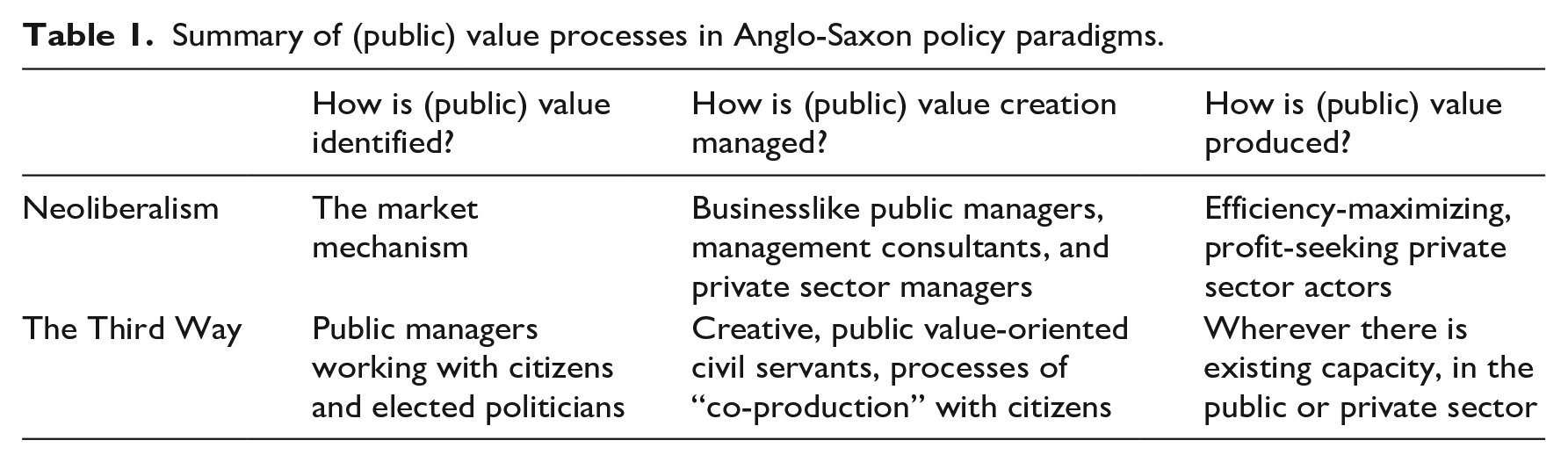
The above discussion has provided a brief overview of the neoliberal and Third Way theoretical and policy context within which Public Value Theory emerged and was developed in Anglo-Saxon economies. Although there were important differences between the reform agendas of Third Way governments (Considine and Lewis, 2003), in general the “actually existing” policies that were introduced in response to neoliberalism were premised on a theory that the appropriate role of the state in creating value for society was confined to identifying what constituted value and managing the processes of delivering public activities, but not necessarily producing goods and services directly. In what follows, we situate PVT within this reform context through a review of public value theorists’ understanding of the appropriate role of the state in the identification, management and production of value (Table 1).
Summary of (public) value processes in Anglo-Saxon policy paradigms.
Public value theory: Actors in public value creation processes
PVT was introduced and developed by public administration scholars “as a kind of provocation to the prevailing ethos in economics, politics, and public management” (Moore, 2019: 353), and was embedded within broader political and academic critiques of neoliberal reforms. Indeed, both the Blair and Clinton governments adopted metrics explicitly seeking to measure the public value of policies and institutions (Kelly et al., 2002), and a number of PVT scholar-practitioners were influential in government policy circles during this period. Although Moore had initially proposed the concept of public value much earlier, it was only in the mid-1990s that PVT began to attract attention, amidst a wave of critical scholarship in public administration assessing the implications of New Public Management reforms and debates on the “hollowing out” of the state through “networked governance” (Holliday, 2000; Matthews, 2012; Rhodes, 1994).
From the outset, PVT constituted both a descriptive framework for making sense of the function of government and public managers in the economy, and a normative proposal for how public sectors could strategically reorganize to create public value. The ideas of PVT scholar-practitioners have found support across the public sectors of advanced economies (Sekera, 2016: 18). In this section, we provide a brief overview of PVT as it relates to the identification of public value, the management of its creation and the sources of operational capacity necessary for its production. As many others have pointed out, PVT is not a singular theory, but encompasses a diverse range of scholarship and conceptual contestation (Jørgensen and Bozeman, 2007; Lindgreen et al., 2019; O’Flynn, 2021). What follows aims to capture key arguments of leading scholars, rather than provide an exhaustive literature review.
Identifying public value
Where neoliberal reforms assumed that what was deemed valuable in society could only be discerned through the dynamics of the market, PVT promoted an alternative approach that viewed society acting through “imperfect” processes of democratic governance as its proper arbiter (Benington and Moore, 2010: 10; Moore, 2014). Beyond the broad agreement that the goal of government agencies was to create public value (Moore and Khagram, 2004: 4), there is nonetheless no single definition of “public value” within the now extensive body of scholarship discussing the concept. What constituted public value, how it came to be defined and what the role of public sector managers was in the process of identifying which activities would create it has been a central debate among PVM scholars.
For Moore (1995), writing in his first book on public value in 1995, it was the role of the public manager to “work hard at the task of defining publicly valuable enterprises” (p. 55) by engaging with their “authorizing environment” – actors that could hold them to account on behalf of “we the people,” such as “elected representatives, courts, audit agencies, interest groups, the media” (Moore, 2017). As interest in PVT increased, two further branches of thought on how public value would be defined emerged. In one were those who viewed it as a fluid, subjective and contested concept that could only be understood through active democratic engagement of members of the public. Drawing on the Habermasian concept of the “public sphere,” Benington’s (2009) reformulation of public value understood it as “part of a deliberative process, embedded within a democratic public sphere within which competing interests and contested values can be debated and negotiated” (p. 233). Citizens’ involvement in the management of public value creation—a process termed “co-production”—was a key source of insight for public managers (Benington and Moore, 2010; Bryson et al., 2017).
In another branch of PVT were writers including Barry Bozeman, whose book Public Values and Public Interest set out a much more normative view of what constitutes public value(s). While recognizing that public value(s) in a democracy are contested, he viewed nonetheless that a “relative consensus is discernible from constitutions, legislative mandates, policies, literature reviews, opinion polls, and other formal and informal sources” (Bryson et al., 2014; Jørgensen and Bozeman, 2007: 448). The involvement of citizens in processes of developing and delivering public value is therefore not critical for its realization. Rather, public value creation depends, first and foremost, on the judgments of public managers. What constitutes public value or—“public interest,” in Bozeman’s terms—is actually existing, and public managers have a duty to keep in mind this “ideal of the public interest” to guide their activity (Bozeman, 2007: 13). It is discernible that in this way, Bozeman’s interpretation of Dewey’s notion of “calling a public into being” diverges with that of Benington’s and Moore’s, which focuses on Dewey’s argument that continuous, deliberative dialog is critical for knowing what the public wants (Alford et al., 2017; Bryson et al., 2014: 450; Moore, 2013: 271).
Departing entirely from the idea that public managers are creators of opportunities for deliberative process with citizens, Kelly et al. (2002) and Stoker (2006) suggest public managers should act as active shapers of citizens’ preferences. According to this view, the issue of “time lags” between the emergence of a problem and the public’s formation of preferences about solutions is insurmountable; with their superior knowledge of problems and governing capabilities, civil servants should seek to bring the public on board with their solutions (Mazzucato and Ryan-Collins, 2022). What all these approaches to PVT nonetheless had in common was a belief in the centrality of the public manager in the process of determining what constituted a public value objective, and that what it constituted was evolving.
Managing public value
Across PVT scholarship, the public manager has also been deemed critical to the management of processes of creating public value. For some scholars, the authority through which the public manager derives the power to act and get others to act was assumed, rather than explained. But for others, the actual resources and authority necessary for achieving public value objectives are derived from the public authority of the state, which itself is derived from “the process of representative government” (Moore, 1995: 30). The legitimacy of the manager’s use of these resources is ascertained through engagement with the “authorizing environment,” and a successful public manager is one that appropriately distributes their “attention, thought, and action across their operational environments” (Moore, 1995: 74), guided by the “strategic triangle.” The “strategic triangle” was proposed as a conceptual tool and practical device to “focus[] managerial attention on the three key questions managers must answer in testing the adequacy of their vision of organizational purpose: whether the purpose is publicly valuable, whether it will be politically and legally supported, and whether it is administratively and operationally feasible” (Moore, 1995: 22).
According to the “strategic triangle” approach, successful management of public value creation processes required the manager to: clarify the definition of public value and goals for particular contexts; create and maintain stakeholder support for action; and build operational capacity, using both public and third party resources (finance, staff, skills and technology) (Benington and Moore, 2010: 4). This concept has subsequently been the focus of numerous empirical and conceptual papers on public value. For example, using an expanded notion of the “public manager” to also include managers in the private and voluntary sectors working to achieve public value objectives, Bryson et al. (2015, 2017) have reimagined the strategic triangle with multiple actors at its core.
Producing public value
Although many public value theorists sought to recenter the state as the key actor in the identification of public value and the management of public activities, they nonetheless did not challenge the assumptions of neoliberalism that operational capacity would tend to be best sourced from private actors. Public value creation thus entailed “not only changing the size and scope of government. . .but also shifting the model to one in which government could pay for things to be produced, but not necessarily produce them itself” (Benington and Moore, 2010: 9). This echoed the broader Third Way paradigm within which PVT developed in public administration scholarship of Anglo-Saxon economies.
From the outset, public value creation was conceptualized as a fundamentally managerial undertaking. In the two chapters dedicated to “delivering public value” in Creating Public Value, Moore describes with the aid of case vignettes the various managerial tactics that operational civil servants could wield in the pursuit of creating public value. But very little is said about the structure of the organizations that those managers are supposed to be acting as overseers of, or even why their particular interests may jar with the objective of public value in a way that renders the manager’s tactics futile. We are simply left with the statement that “operational capacity often lies outside an organization’s boundaries” (Moore, 1995). The relevance of the source of operational capacity for the success of the manager’s tactics is not considered.
It is important to note that Bozeman (2007) deviates from this tendency in PVT, describing how his concept of “Managing Publicness” “maintains skepticism about market solutions as solutions to public value problems” (p. 177). Bozeman (2007) reflects on the risks of “public value failure” when private actors are contracted as the producers of public activities (p. 150). He nonetheless also emphasizes that it “does not require one to eschew market or quasimarket approaches such as contracting and privatization. . .If it is more effective to achieve public purposes through the market, then there is nothing about Managing Publicness that enjoins market solutions” (Bozeman, 2007: 177).
Bozeman’s recognition that a reliance on the private sector can undermine the governing authority of the state and introduce conflicting interests is valuable. The key concern of this paper, however, is that, much like the broader Third Way paradigm, public value theorists have failed to reflect on how and when uses of private actors, which types of private actors, and at what scale and scope they are contracted in the delivery of public activity might in the end undermine the government’s ability to learn and evolve state institutions. As public value theorists themselves recognized, what constitutes public value is evolving; it is thus paramount that the means of achieving today’s public value objectives do not undermine the means of achieving public value objectives of the future. Successful public value creation must thus also be measured in terms of how it supports public sector innovation. And in this, the processes of producing public activities are key.
In what follows, we draw on theories from the learning and capabilities literature in evolutionary and institutional economics to make the case for why the source of operational capacity in the production of public value is a critical factor in the managerial and organizational innovation of public sector actors responsible for creating public value.
Reappraising public value theory: Why production matters for public sector innovation
The critique we develop begins from three premises:
(1) Public value is a meaningful concept for describing what is legitimately created and sustained by government on behalf of the public (Nabatchi, 2018);
(2) What constitutes public value is constantly evolving because it reflects the contested social demands on the state;
(3) Agents within the state may not be willing to create public value, but because it is evolving, the ability of the state to create it depends fundamentally on the ability to adapt operational and managerial capacity. In other words, public value creation is contingent on innovating the means of public value production.
We examine PVT’s assumptions of how organizations innovate and public managers learn, and in doing so uncover important contradictions that undermine the production of public value over time.
Manager-led innovation
In Creating Public Value, Moore recognizes that owing to the mutability of the meaning of public value, the structures of organizations and resources wielded to create it must also have the ability to change. He defines three different types of innovations that are important for changing an organization to respond to public value changes. These are “policy or program innovations,” which “define new ways of using an organization’s resources to accomplish its overall mission”; “administrative innovations,” which “involve new methods for organization, accounting for, or controlling the organization’s operations”; and “strategic innovations,” which “seek to redefine the basic purposes or core technologies of an organization” (Moore, 1995: 233–234). These changes to the organizational means of creating public value are understood as necessarily “managerially led”; it is for the public manager to identify “gaps and incongruities” in the configuration of operational capacity, and then introduce a new “course toward improved performance” (Moore, 1995: 232).
Despite the broad agreement on the importance of the public manager in managing processes of value creation in PVT, an account of how their particular competencies would be developed is conspicuously lacking. Public value theorists recognize that in order to successfully make use of the strategic triangle in managing public value creation, for example, public managers are required to have particular knowledge, skills and techniques (Moore, 1995; O’Flynn, 2007). Without them, public managers are unable “to help governments to become more adaptable to changing material and social conditions, and to changing needs and political aspirations” (Benington and Moore, 2010: 4). Writing in 2007, Janine O’Flynn concluded that “considerable attention will be required to be devoted to the development of new skills if managers are to effectively navigate the complexities that come with paradigmatic change” (O’Flynn, 2007).
But in PVT, the development of the public manager’s competencies appears to be disembedded from the “changing material and social conditions, and to changing needs and political aspirations” to which they are supposed to adapt policy and operational capacity (Benington and Moore, 2010: 4). In other words, there is no theory of managerial learning in PVT, which is surprising given that it emerged within a political climate where the scope of public management and the necessary competencies of civil servants had been retrenched; public managers, whether new recruits or career bureaucrats, would surely need to build insight into public value production processes in addition to any technical training.
In contrast, the processes by which managers come to have the knowledge necessary for identifying challenges in existing processes of production is central to accounts of adaptation and change in some organizational studies research, and in evolutionary and institutional economics. Scholars have focused research on how changes in the firm affect an industry in aggregate. They recognize that how organizations reconfigure resources and capabilities to improve processes or meet new demands is fundamental to technological, organizational and societal change (Dosi et al., 2001). The process of improving ways of doing within organizations is described as organizational learning (Nelson and Winter, 1996).
The “dynamic capabilities” perspective, for example, emphasizes the importance of management decisions in the development of new capabilities that are necessary for creating (private) value for the firm and thus achieving “competitive advantage.” Although much of the literature focuses on investor-led firms, recent analysis and empirical studies have identified similar dynamics in successful cooperative firms (Ammirato, 2018; Basterretxea and Martinez, 2012 ; Thompson, 2016). From this perspective, “entrepreneurial managers are central to the firm’s evolution because they have the ability to decide if existing capabilities will remain in the firm and whether new ones should be added” (Teece, forthcoming). For managers to understand what is required to be changed and how to achieve that innovation, they must also be embedded within other levels of the organization. Lower-level managers, for example, “collect[] and communicat[e] signals as inputs for managerial sensing” and “translate and implement strategy once it has been adopted” (Lee and Teece, 2013; Teece, forthcoming). William Lazonick’s recent work has similarly emphasized the importance of firm strategy by executives, alongside the organizational integration of employees and patient capital, to enable the firm to rise up to the uncertain, collective, and cumulative nature of innovation (Lazonick, 2009; Lazonick et al., 2014; Lazonick and Shin, 2020). Crucially, for Lazonick, although the strategic decisions of executives are important, the executives themselves are “career employees” who have developed a “deep understanding of the evolving technologies and markets of the industries in which the companies that they led competed” (Lazonick, 2020).
In PVT, by contrast, the public manager can best be described as a commissioner or overseer who is largely disembedded from the processes of production. According to such a perspective, the state can outsource the operational capacity for delivering public functions, if that is most effective in the short-term, while still maintaining the ability to adapt services in the future through managerial initiative. What the aforementioned approaches suggest, however, is that managers’ ability to reconfigure resources to meet (evolving) public value objectives requires a deep understanding of those production processes that is unattainable when the operational capacity for producing public activities is consistently outsourced to other organizations.
Innovation as learning-by-doing
Public value theorists acknowledge the importance of “smaller innovations characterized as administrative or programmatic,” possibly adopted “to solve a current operational problem,” in the wider movement of an organization to achieve its strategy (Moore, 1995: 234). Innovation may also benefit from organizational structures that “permit lots of decentralized decision-making.” Nonetheless, in PVT, fundamentally strategic innovations come from the manager.
The assumption that organizational innovation is primarily contingent on managerial prowess is, however, myopic – and indeed has been at the heart of debates within evolutionary and institutional economics. Researchers seeking to understand innovation and technical change within organizations and across economies point to the importance of “learning-by-doing” (Arrow, 1971; Lundvall and Johnson, 1994; Thompson, 2010). The day-to-day activities—or “routines”—of employees across hierarchical levels of the firm are critical sources of incremental learning and insights for more effectively creating public value and adapting processes as it evolves. According to this view, new capabilities also emerge through the exercise of “behavior that is learned, highly patterned, repetitious” (Winter, 2003). The transformation of the firm organization is, at least in part, a passive or bottom-up process, originating through the learning of front-line staff and managers, and filtering up to senior management where it is shaped into strategy. Zollo and Winter (1999) describe the accumulation of knowledge from routines, and the codification and dissemination of this knowledge, as at the heart of “creating and constantly reshaping organizational routines.”
Once codified, the actual value-creating potentiality of embryonic ideas for improving routines can be understood through their diffusion and evaluation, which subjects them to internal selection pressures (Zollo and Winter, 1999: 6). The resulting change within an organization, and the change in its position in the market that occurs as a result, can thus be understood as largely incremental and often unintentional, with a large random component (Teece, forthcoming). Change is “accomplished through the tacit accumulation of experience and sporadic acts of creativity” (Zollo and Winter, 1999: 6). As Lazonick has highlighted, the enhanced capability that evolves through learning processes then becomes a resource input in future learning processes (Lazonick, 2020), though as an exogenous variable, changes in knowledge are notoriously “difficult to measure” (Arrow, 1971). The ability to improve incrementally in this way is what, according to this perspective, enables a firm to adapt its revenue sources (Helfat and Winter, 2011).
Although later writing on co-production explores how citizens feed into the development of services, in focusing on the manager, PVT does not account for the possibility of improvement through wider organizational learning enabled through processes of production—or learning-by-doing. This omission implies that outsourcing production does not affect the learning that is critical to evolving the means of producing public value, because it does not occur through the production processes of the outsourced organizations. Research on learning in firms within evolutionary and institutional economics attests on the contrary that the innovation that is necessary to ensure the means of producing public value match the evolving public value objectives requires both public managers who are embedded in the production processes, as well as the cumulative experiences of other operational employees. Thus, even if outsourcing the production (delivery) of a welfare service may be more (cost-)effective in the short-term—which is by no means guaranteed (Hood and Dixon, 2015)—over time it undermines the public sector’s capacity for adaptation, which has elsewhere been described in terms of the “dynamic capabilities” of the public sector (Kattel and Mazzucato, 2018; Mazzucato and Kattel, 2020). This might be understood as a “strategic cost” (Alford and O’Flynn, 2012).
In addition to the risk of governments becoming dependent on private sector actors as the source of operational capacity to produce public activities once it is outsourced from the public sector (Bozeman, 2007), we propose that this dependence can also be understood in terms of the state’s reliance on actors that hold the capacity for innovation developed through production. Outsourcing the production of goods and services to produce public value then becomes an issue for state power because it increases the leverage of contractors that are needed not just for production, but for the ability to evolve the means of achieving public value objectives. The outsourcing of operational capacity—in contrast to the procurement of market actors for merely “augmenting existing capacity” (Bozeman, 2007: 184) or as sources of learning—therefore undermines the ability of the state to create public value.
Mission-oriented innovation
The preceding discussion indicates that outsourcing the production of public activities undermines both the ability of public managers to innovate public value creation processes, as well as the routine-based learning that can meaningfully contribute to that innovation. Taken together, these can be understood as constituting the capacity for innovation in the creation of public value.
Recent literature suggests that the ability to reconfigure existing resources and capabilities in this way is critical not only for evolving public production but also shaping markets to tackle “grand societal challenges” through mission-oriented innovation policy (MOIP) (Edquist and Zabala-Iturriagagoitia, 2012; Kattel and Mazzucato, 2018; Mazzucato, 2017, 2021; Mazzucato and Kattel, 2020). A MOIP is “a coordinated package of policy and regulatory measures tailored specifically to mobilize innovation in order to address well-defined objectives related to a societal challenge, in a defined timeframe” (OECD, 2022). For example, where the provision of dementia care may be a public activity (i.e. a service delivered by the public sector that creates public value), a national objective to halve the human burden of dementia by 2030 would be a mission, in so far as it would require system-wide transformation across sectors, including within public services but also in pharmaceutical research and development (Mazzucato, 2018). The processes of setting a mission and coordinating organizations across the economy to use their resources and capabilities toward achieving it are public activities, because the state is legitimately responsible for doing them to create public value.
Organizations involved in the creation of public value through missions likely also include private firms. Because by its nature, the societal challenge that a mission confronts is “wicked” or complex (Mazzucato, 2021; Rittel and Webber, 1973), it invariably requires operational capacity beyond that which is embedded within the production of existing public activities. In this way, the learning and adaptation that is required for a mission’s realization also depends on the resources and capabilities that exist within non-state organizations, which could include, for example, industrial manufacturing firms and nonprofit community bodies. The coordination of such actors to achieve missions is invariably challenging because the state cannot be embedded in private sector production processes as it is in the delivery of public activities. The dynamic capabilities of the public sector are thus critical to the creation of public value through missions (Kattel and Mazzucato, 2018; Mazzucato and Kattel, 2020). But so too is the knowledge that emerges through existing public activities that are related to the private sector actors that become involved in the implementation of missions, for example, their regulation. Outsourcing the production of tasks involved in such public activities can thus undermine the ability to create public value systemically through re-orienting ecosystems of organizations toward meeting evolving needs and demands.
Discussion and conclusion
This paper began by recognizing that “public value” remains a relevant concept for analyzing the evolving nature of citizens’ demands on the state and the state’s ability to meet them. The recent Covid-19 pandemic attests that in many countries, the state continues to be viewed by citizens as the legitimate vehicle for furthering common interests. Even states led by parties that have historically sought to retrench the role of the state in the provision of welfare services and the regulation of economic activity have played a central role in the pandemic response, from the coordination of national testing systems to the delivery of income support packages, and the rollout of vaccination programs. The ability to meet the demands of the pandemic—and thereby create public value—has nonetheless been widely divergent across states. Recent comparative analysis has suggested that disparate experiences are a consequence of not merely the political agency of governing parties and civil servants, though this has been important (Weiss and Thurbon, 2022), but also the ability of public sectors to adapt existing sources of operational capacity to produce pandemic-related activities (Mazzucato and Kattel, 2020). Mazzucato et al. (2021), for example, describe how the Rwandan government successfully repurposed its earlier investments in preventing Ebola from crossing the border from the DRC and combating HIV for Covid-19 (p. 12).
The knowledge that is at the heart of innovating processes of production in the public sector, which is necessary for the state to continue to meet evolving demands, is contingent on the state also being embedded in processes of production. Government tasks that are not central to the innovation of public activities may be provided by other actors, though as the literature on “wicked problems” reminds us, what constitutes a public activity is always liable to change (Mazzucato, 2021; Rittel and Webber, 1973). Production is of course not the only avenue for public sector organizational adaptation and the innovation of production processes, and public sectors must also retain the ability to evaluate and absorb knowledge that emerges elsewhere (Cohen and Levinthal, 1990), whether within private sector firms, other public sector organizations, community bodies, or intergovernmental organizations.
The first part of this paper outlined the public policy context within which PVT emerged and became influential. Through a framework that explored key reform paradigms, it began by conceptualizing neoliberalism as a set of ideas and practices that sought to retrench the role of the state in the identification, management and production of value. It explored how this was operationalized in practice through the introduction of reforms that privatized public sector assets and infrastructure, and subjected remaining public services to external competition. The Third Way governance theories that emerged in response to neoliberal reforms are often characterized as a continuation of neoliberalism. We showed that there were important differences in the Third Way paradigm’s theory of the state, which was viewed as central to processes of identifying and managing public activities. Like their neoliberal predecessors, however, these theorists variously were ambivalent or antagonistic about the role of the state in processes of production.
Given this context, it is hardly surprising that while PVT defined key roles for the state as an arbiter of public value definitions and for public managers as overseers of public value creation, the state was not viewed as necessary for the production of public activities. While there was some debate regarding the extent of contracting and privatization that would be compatible with a public value approach, this remained confined to concerns about the risks of contractor dependence (Bozeman, 2007). PVT does not account for the role of production in the innovation of institutions that its advocates recognize as critical for the state to continue meeting changing needs and demands.
The learning and capabilities literature in evolutionary and institutional economics provides a valuable lens for reappraising the role of the state in public value production. In the final section of this paper, we discuss the limitations of PVT’s account of “managerially led” innovation, and propose perspectives that more accurately reflect how the knowledge of managers evolves through processes of production. Managers’ ability to reconfigure resources to meet (evolving) public value objectives requires a deep understanding of those production processes that is unattainable when the operational capacity for producing public activities is consistently outsourced to other organizations.
Research on organizational learning in this field nonetheless also identifies that new capabilities emerge not only through manager-led change, but also the exercise of behavior. Learning through the processes of doing—in this case, in the production of goods and services that create public value—is a critical source of knowledge that enables organizations to adapt to evolving demands. We argue this is true not only of the profit-seeking firm, but also the public sector organization. This perspective would suggest that the outsourcing of public sector production deprives the state of an important source of knowledge that is critical for its ability to innovate and adapt to change. Because the state matters to legitimate governance and public value creation, and the state’s capacity is contingent on adapting the means of producing goods and services to respond to changing demands, state organizations must be embedded in processes of their production.
Footnotes
Acknowledgements
The authors are very grateful to Lukas Fuchs and Matthew Thompson for valuable comments on the paper.
Declaration of conflicting interests
The author(s) declared no potential conflicts of interest with respect to the research, authorship, and/or publication of this article.
Funding
The author(s) received no financial support for the research, authorship, and/or publication of this article.
