




Abstract
Organization studies has (re)turned to affect, a development that has brought affective tensions—build-ups of energy, or vitalities—to the fore of research. Previous studies on affect in organizations underline the organizational and transformational effects of affective milieus or atmospheres. I contribute to this research with a micro perspective on how affect shapes intersubjective relationships. I do so through an ethnographically inspired study of SusPens, a fin-tech start-up that uses algorithmic tools to screen sustainable investments. In the course of my empirical engagement, I identified recurring tensions in the collaboration between tech professionals and business professionals. I unpack these tensions in three collaborative encounters, focusing on how the algorithm functioned as a common reference point as well as a barrier for the collaboration. To conceptualize the observed tensions, the article builds on Sara Ahmed’s concept of objects of emotion and introduces affective boundaries as a theoretical construct for understanding the power effects of affective circulation. The article details how affective boundaries are installed through the affective misalignments that arise as the algorithm circulates as an object of emotion among the team members. The article concludes that the installment of affective boundaries delineates who is included in and who is excluded from the collaboration, pointing to how power works affectively in intersubjective relations, empowering some and disqualifying others.
Introduction
Wonder, MacLure (2013) says, is the liminal state between knowing and unknowing, between ignorance and enlightenment—a passion of both the body and the mind, felt as a gut instinct or a quickening heartbeat. Inspired by Deleuzian thinking, MacLure (2013) invites the scholar to think about the wonder of data as an event only actualized in the act of accepting the invitation it extends. This article addresses such an invitation, extended and accepted, to feel wonder about the palpable tensions experienced at a small fintech start-up, SusPens. Observing the company’s tech developers collaborating with its business professionals, I sensed recurrent tensions as the two groups strove to develop the organization’s algorithmic tool. What, I wondered, was I sensing?
Grounded in empirical curiosity, this article sets out to explore how affect is circulated in mundane collaborative encounters, asking what the organizational consequences of this affective circulation are. I answer this question by using detailed empirical accounts of how the start-up’s tech and business teams interact as they collaborate with and around the algorithm. Following the algorithm’s discursive materializations, which is to say, the ways in which it is called upon in conversations, I demonstrate how it comes to function as an object of emotion (Ahmed, 2014) that circulates among the team members and evokes different affective responses. Thus, this article builds on and enriches the way Ahmed (2014) conceives the object of emotion, a concept pointing to the “sociality” of emotions (Ahmed, 2014: 8), where emotions “do not reside in subjects or objects, but are produced as effects of circulation” (p. 8). I further develop the concept by introducing the notion of affective boundaries, detailing how affective boundaries are installed through the affective misalignments that arise as the algorithm circulates among the team members. Affective boundaries delineate who is and is not affectively aligned, an alignment that leads to the inclusion of some individuals and the exclusion of others. In the case studied here, the affective boundaries came to exclude the tech team from partaking in the collaboration on equal terms with the business team. As such, the tech team became subordinated to the business team, a situation indicating that the power effects of affective boundaries can skew power dynamics in organizations.
Theoretically, the study draws on the (re)turn to affect in organizational studies, a development that has brought tensions—build-ups of energy, or vitalities—to the fore of research (Pullen et al., 2017). Broadly speaking, this turn has (re-)introduced “the bodily and sensory capacities that exist beyond, before or in addition to discursive practices of meaning-making” (Otto and Strauß, 2019: 1809). Affect thus allows an analysis of embodied and often non-articulated forces in organizational processes (Otto and Strauß, 2019), pointing to a variety of ways of sensing and making sense of organizations. By centering the doings of affect, the literature has shown how affect can both enable (Just, 2019) and disable organizing (Johnsen et al., 2019), and has highlighted affect’s transformational potential (Pouthier and Sondak, 2021). Studies focused on affective milieus (Beyes and de Cock, 2017; Borch, 2010; Kantola et al., 2019), and on affect’s role in constituting digital organizing and technology (Just, 2019; Sage et al., 2020) all demonstrate how affect can elucidate the ethical, political, and elusive dimensions of organizing (Fotaki et al., 2017). Building on this rich literature, I explore how the affective circulation of an immaterial object, an algorithm, affects power in the organization. Thus, in this article I build on and further develop the affective workings of power (Ashcraft, 2021; Hunter, 2022) in intersubjective relationships.
This article springs from a study of SusPens, a fin-tech start-up based in Copenhagen, Denmark, founded with an organizational goal of putting pension fund capital to work for a more sustainable future. Choosing to pursue a quantitative approach to sustainable investing, the organization developed an algorithmic tool that automated the process of screening investment portfolios for unwanted stocks. However, founded by a group of business professionals, the organization had to hire tech professionals to develop the tool. For my study, I observed the organization’s status meetings and strategic workshops over a 9-month period from April 2018 to December 2018, during which time I noticed recurring tensions between the two professional groups. Pursuing my own feeling of wonder about these tensions, I gradually linked them to the circulation of the algorithm among the organizational members in collaborative encounters. In what follows, I unpack what happened in three specific collaborative encounters, providing detailed empirical accounts of how affect and discourse are interlinked in and through collaborative encounters.
The article is structured as follows: First, I introduce the literature on affect in organization studies, establishing a starting point for studying the organizational (power) effects of affect. I then provide an account of Ahmed’s concept of objects of emotions, which function as my analytical lens. Second, I present my methodological considerations, focusing on the affective experience in the field. Third, I analyze how affect is generated in collaborative encounters between the tech and the business teams, focusing on the (power) effects of the algorithm’s circulation among the organizational members. Concluding the article, I discuss its empirical and theoretical contributions.
Affect in organization studies
The study of affect can be traced back through the work of Deleuze and Guattari to Spinoza’s writings on the body’s dynamic capacities (Pullen et al., 2017; Thanem and Wallenberg, 2015). Spinozan “vitalism” establishes the body’s power or capability to affect and be affected by other bodies (Massumi, 2015), without involvement of the mind (Thanem and Wallenberg, 2015: 241). This vitalism implies an openness to the world, a simultaneous activity and reactivity of both giving and receiving that is fundamental to social responsiveness (Gibbs, 2002). Following this tradition, Massumi (2015) describes affect as the passing of a threshold, for bodies always affect and are affected in their encounters with each other and with the world. Affect can therefore be understood as a force or vitality that circulates and passes between and within (human and more-than-human) bodies (Blackman, 2012), offering potentialities for becoming and being remade (Gibbs, 2002). As such, Massumi (2015) argues, affective intensities are pre-personal as well as extra-linguistic—meaning that affect is clearly distinguished from emotion. Emotions, he says, are only partial expressions of affect, as they draw on a limited register of memories and cannot encompass the “depth and breadth of our experiencing of experiencing” (Massumi, 2015: 5). In making this distinction, Massumi also separates affect from discourse, implying that language detracts from, rather than adds to, the non-verbal affective experience (Pullen et al., 2017).
Some have argued the Spinozan-Deleuzian conceptualization of affect, which centers it as an “indeterminable force of social ordering” (Just, 2019: 720), to be particularly well suited for studying relational processes of organizing (Beyes and de Cock, 2017). This conceptualization has advanced organizational studies (Ashcraft, 2017; Fotaki et al., 2017; Kenny et al., 2011) by casting light on the intensities and forces of ordinary organizational phenomena (Fotaki et al., 2017) that might otherwise have passed unnoticed (Beyes and de Cock, 2017; Gherardi et al., 2019). Special attention has been paid to affect’s transformational potential with regard to the organization and its members.
One stream of research has scrutinized how such transformation takes place in affective atmospheres (Borch, 2010; Leclair, 2022) or affective milieus (Kantola et al., 2019). For example, Beyes and de Cock (2017) propose color as an affective organizing force holding the potential to rethink, or even disturb, conventional organizational settings and experiences. Similarly, Pouthier and Sondak (2021) emphasize the materiality of artwork as an affective site creating the potential to transgress harmful bodily norms, what they call “affective pathways to freedom.” Also interested in how affective resistance operates in affective atmospheres, Marsh and Śliwa (2022) demonstrate how laughter as an affective force can have liberating effects. However, affective transformation is not an exclusively positive force, as Johnsen et al. (2019) show in their study of the “dark side of affect” (p. 5). Exploring how inmates at Helsinki Prison affectively experiences time and the loss of temporal agency, the scholars demonstrate how such temporal affective experiences obstruct living, thereby highlighting the possibly subjugating qualities of affect (Johnsen et al., 2019). With a similar interest in the limiting or disabling function of affect, Sage et al. (2020) detail how it constitutes technology.
Another stream of research explores affect in intersubjective relations and how this affectivity impacts organizational matters. Focused on the relationship between group affect and group performance, Jeong and Korsgaard (2022) examine what happens when individuals diverge from the group affect. Understanding group affect as “the shared affective state that emerges through interactions between individuals, shared experiences, and social processes” (Jeong and Korsgaard, 2022: 1), the authors show that such individual divergence reduces individual commitment to the group, thereby adversely impacting the group’s performance. Similarly, Wijewardena et al. (2017) investigate how managerial humor produces affective events, pointing to how managerial humor can be used as a tool to manage employee emotions. Although insightful, these studies’ psychological approach focuses on discrete affects or emotions rather than on affect as a flowing intensity or force. Hunter (2022), on the other hand, analyzes happiness in the workplace by following the circulation of happy objects (Ahmed, 2010). The study shows how affect has the power to regulate affective experiences and thus become an affective form of relational control in the workplace. Hence, Hunter’s (2022) findings echo Ashcraft’s (2021) claim that “power has long operated affectively” (p. 579). Being equally interested in how affective objects and power circulate, in this study I employ Ahmed’s (2014) objects of emotions to understand the (power) effects of affect in collaborative encounters.
Objects of emotion
Feminist and queer theorists (e.g. Ahmed, 2010; Butler, 1990; Sedgwick, 2003) offer alternative conceptualizations of affect, seeing body and cognition or physiology and psychology as not necessarily dichotomous. As such, they do not understand affect as being located in a specific part of the body or mind, but as always already being an entanglement of bodily responses, judgments, and emotions (Ahmed, 2014). This understanding avoids distinguishing between affect and discourse, which also means that affect can be articulated as emotion. Such a perspective on affect thus provides an analytical lens for studying how discourse and affect interrelate in organizational matters. Ahmed (2014) understands affective experiences as an entanglement of sensation, thought, feeling, and judgment. This entanglement—as well as the interconnected elements of experiencing affect—does not originate within the subject but arises when a subject comes in contact with other subjects and objects. As such, affect is a matter of contact, of how different human and more-than-human bodies relate with and give shape to each other.
Ahmed (2014) uses the terms affect and emotion interchangeably, defining emotions as involving “bodily processes of affecting and being affected.” According to Ahmed (2014), emotions therefore shape objects—both material and immaterial—just as they are shaped by their contact with objects. All objects, material or immaterial, can, but do not necessarily, become objects of emotion through the circulation and attachment of affect. Affect can stick to an object, but can also slide over it, depending on how the subject reads its contact with the object. Ahmed speaks of this intra-relational shaping and being shaped as the “‘aboutness’ of emotions” (p. 7): a subject comes in contact with an object, and this contact initiates affect, which the subject then interprets as being about something, thus establishing a (re)action or relation toward or away from the object and the feelings attached to it. To describe the entangling of sensation, cognition, and judgment in the experience of affect, Ahmed urges scholars to associate this experience with an impression—experiencing affect is like surfaces meeting, leaving marks and traces on each other.
By focusing on the contact, one can avoid analytically distinguishing between the feeling, knowing, and sensing of affect and instead turn to how affect shapes surfaces and boundaries, the inside and the outside of bodies and organizations. However, although the contact shapes the affective outcome of an encounter, Ahmed (2014) contends that the social context surrounding the encounter can also trigger historic and embodied experiences. As such, it is also important to understand the social context in which affective encounters arise. By acknowledging social contexts as co-shaping the outcome of an encounter, Ahmed further underlines how previous experiences, judgments, and feelings govern the body’s affective reaction to an object. In this article, I look at collaborative encounters as providing the social context for studying ordinary affects. The circulation of the object of emotion is contextualized in the routinized knowledge exchange, which comes to play a part in shaping the team members’ reaction and interaction with the algorithm and other team members. However, before embarking on an empirical investigation of three collaborative encounters, I will first detail my methodological considerations.
Methodological considerations
This section elaborates on the methodological considerations in my pursuit of understanding affect and its organizational effects. There are three methodological issues to address: first, I briefly present the case organization and how I generated data; second, I discuss my affective experiences of being in the field; and, third, I account for my analytical practice.
Empirical setting
SusPens (a pseudonym) is a Copenhagen-based organization that enables sustainable pensions by providing investment tools based on algorithmic technology. The organization’s current conceptualization of sustainable investing aims to exclude all investments in fossil fuel, tobacco, and weapons from the portfolio. The organization has an ambition to provide a cheaper investment product that makes sustainable investing available to the masses. To mainstream sustainability, SusPens chose to automate the traditionally manual process of screening and selecting sustainable investments, a goal it achieved by developing a name-matching algorithm that screens investments for unwanted companies.
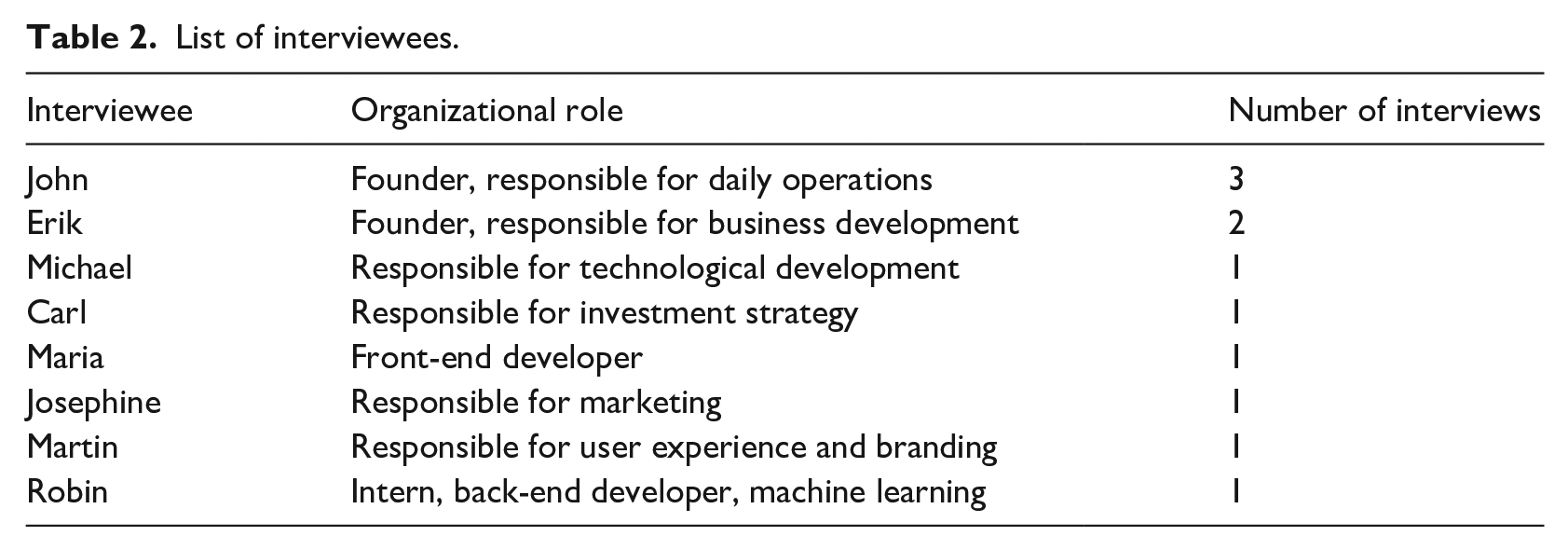
SusPens was founded by two business school graduates harboring idealistic ambitions to make pension savings work for a more sustainable world. They initially wanted to establish a pension fund, but soon discovered that the economic and institutional demands were untenable. Consequently, they opted to develop the tools and intelligence to provide sustainable investments. At this stage, the founders, realizing they lacked technical competencies, brought a back-end developer and an investment-savvy management consultant with coding skills onboard. During the period of my fieldwork, the team grew to a total of eight members: the two founders (Erik and John), a head of technological development (Michael), a back-end developer (Robin), one front-end developer (Maria), a head of investment (Carl), a head of communication and marketing (Josephine), and a brand and user experience manager (Martin). All the names are pseudonyms.
My fieldwork took place from April 2018 to December 2018 and includes observations of status meetings and strategic workshops as well as interviews with all team members. In the following, I provide a more detailed account of the observations and interviews that generated the data.
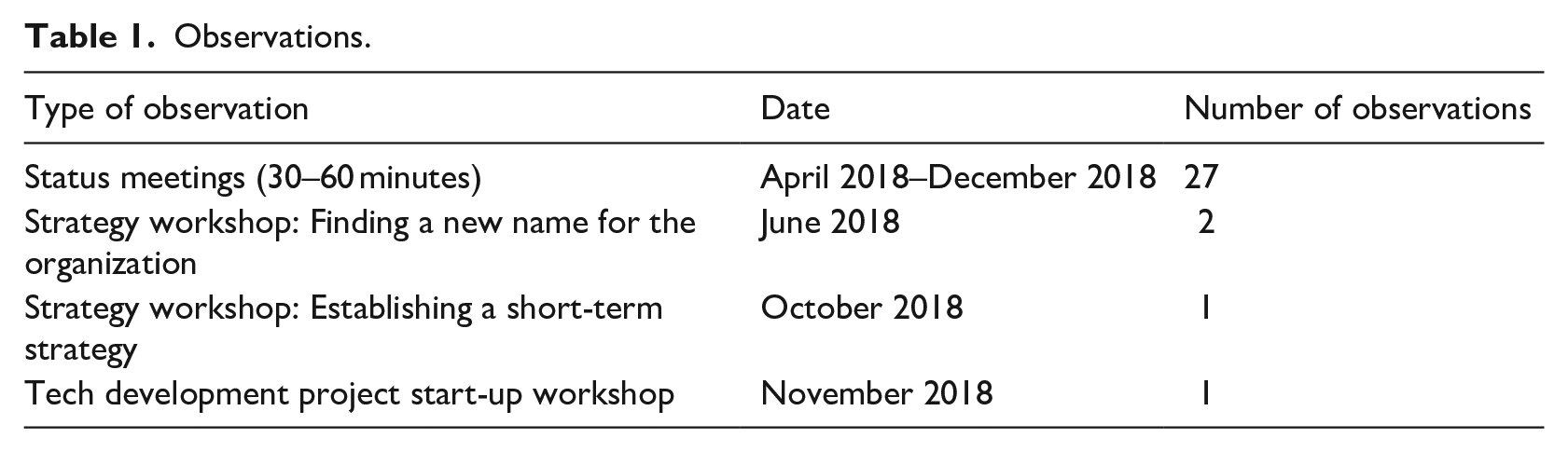
Observations: This article is mainly grounded in observations of collaborative encounters in SusPens. In all, I observed 31 meetings and workshops (see Table 1 for an overview). These observations centered on SusPens’s bi-weekly status meetings, which gave me access to the interactions between the tech and the business teams. On top of these meetings, I also participated in four strategic workshops, with one lasting a full day and the other three a half-day. While my role in the status meetings was purely observational, I participated more actively in the strategy workshops where I was asked to provide input to the strategic discussions. In the field, I was corporally attuned to “more-than-representational layers and emotional and affective practices embodied by informants” (Knudsen and Stage, 2015: 11). In practice, this means my field notes include my own affects, bodily reactions, and accounts of how I understood my informants’ affective states and feelings. The affective states observed were sensed as an atmosphere in the room, as a bodily action or reaction, or expressed verbally by the informants. In addition to the detailed field notes made, all meetings were recorded and professionally transcribed to ensure the accuracy of the quotes.
Observations.
Interviews: I conducted a total of 11 interviews, with all organizational members (see Table 2 for an overview). For the initial interviews with the founders, I used a narrative interviewing technique (Hollway and Jefferson, 1997), asking them to tell the story of SusPens and their personal journey with the organization. Later on in the field work, I interviewed Erik once and John twice more, using an unstructured, conversational approach (Burgess, 2003). I sought in these interviews to clarify organizational events discussed at the status meetings. I used a semi-structured interviewing technique (Denzin and Lincoln, 2018) to interview the other organizational members, asking them to describe their roles at SusPens, the organization, and the algorithmic tool. The interviews with the tech team concerned the finer technicalities of the algorithm, whereas those with the business team members also covered branding, sales, and sustainability. All interviews were conducted in Danish and took place at the organization’s offices. To ensure an accurate record of the interviewees’ statements, all interviews were voice-recorded and professionally transcribed.
List of interviewees.
This study was not initially driven by a theoretical interest in affect, but by an empirical curiosity to understand the particularities of organizing within SusPens. SusPens is in many regards an exciting case, as the organization is situated at the intersection of advanced technological developments, ideological dreams of saving the world, and a profit-making logic. However, as the fieldwork progressed, I felt increasingly curious about the tensions appearing in my field notes, which indicated that something was inhibiting the flow of the everyday collaboration within the organization. Introducing affect theory presented an opportunity to understand what happened in these situations and how the tensions influenced the organization. Understanding affect as endowing “everyday life [with] the quality of a continual motion of relations, scenes, contingencies, and emergencies,” Stewart (2007: 2), points to ordinary collaborative encounters as the focal point for studies of affective circulation. As such, in this instance SusPens is an ordinary case of ordinary affects (Stewart, 2007), thus providing a site to explore the organizational effects of affect in such encounters.
Reflections from the field
In the field, I often felt uncomfortable, not knowing how to act or behave. I struggled with the “hybrid status” (Watson, 1994) my role as an observer imposed on me. Establishing a working role was complicated, as I was neither an insider nor an outsider to the organization (Bell, 1999). This made me unsure what was expected of me, when I was supposed to participate, and when I was meant to “only” observe. Although probably harboring an unrealistic wish, I wanted to avoid awkward situations in the fieldwork (Sløk-Andersen and Persson, 2021). As such, I was affectively drawn to detach myself from the situation, to observe at a distance, like the proverbial fly on the wall. However, I was frequently pulled into conversations about the past weekend’s activities and common acquaintances at the business school where I worked (and from where the founders had graduated) or asked for opinions or short (and very preliminary) analyses of the organization. I never felt sure how to handle these situations, whether to be more active or passive, to keep it professional or be more personal and become “one of them,” to crack jokes or just laugh at theirs. This sense of insecurity made me highly aware of how the organization received and acted on my actions. Turning to affect, my discomfort and heightened awareness became a tool for me to tune into the affectivity in the room, as it made me sensitive to the tensions and atmospheres there.
Analytical practice
As I approached the data in and through my own affective reactions to and relation with it, my ambition was to stay (as long as possible) in a state of wonder (MacLure, 2013), thereby avoiding systematizing, rationalizing, or structuring, and instead dwelling on the detail, particularity, and peculiarity of the data. Data as wonder implies an entangling of data and researcher—a mutual and affective entanglement where data is constituted as data and researcher is constituted as researcher only in relation to each other. Wonder, like any object of emotion, resides in neither the body nor the mind exclusively (Ahmed, 2014). It is at once material and virtual; material in that it resonates in bodies, circulates, and gets attached to objects, and virtual because it points to potentialities and thresholds.
My entry point into the data was the tension I had sensed and jotted down in my field notes from several of the bi-weekly status meetings. The tensions stuck with me because I could not say precisely what they were, why they occurred, what they meant, or how they were resolved (or not) in the group. Seeking to organize the data without prematurely closing off interpretative options, I started by identifying what the organizational members had been talking about in the tension-filled situations. In this process, the centrality of the algorithm in these conversations became clear, as did the extent to which the understandings of the algorithm differed between the tech and the business teams. These differences, it appeared, were not so much the source of the tension, but rather emerged along with the tensions as the algorithm circulated as an object of emotion between the various team members.
Going back to my field notes, I identified 17 situations where palpable tension had been noted in a situation. To further understand the relation of these tensions to the development of the algorithm, I listened to all recordings of these situations and read the transcripts. Some situations did not concern the algorithm and were therefore eliminated. Of the 11 situations left, I looked for ones that could help me elucidate how the object of emotion materialized and circulated, focusing on situations with longer interactions that included several organizational members. This selection process culminated in my identifying the three situations I unfold as three vignettes in the analysis. I have attempted to write about these situations in a way that resists the “supposedly ‘scientific’ norms” (Gilmore et al., 2019: page 4) governing academic work in management and organization studies. My hope is to speak to the reader’s affectivity by evoking “feelings—relief, recognition, drama, disdain, horror—and bodily responses—the flush of recognition and the sharp intake of breath, the tingle as we feel that this might be showing us something we hadn’t thought or experienced before” (Grey and Sinclair, 2006: 452).
To understand how affect operates in collaborative encounters, I examine how affective boundaries were installed through the negotiation of the algorithm. To analyze the vignettes, I focus on three phases: first, the materialization of the algorithm through a discursive naming of the algorithm; second, how the discursive materialization starts circulating between the organizational members; and, third, how affective misalignment that arises through the circulation installs affective boundaries.
The organizing qualities of affect in collaborative encounters
To establish the analytical starting point, I begin by providing an account of the organization to contextualize the three situations of affective disruption, each of which I unfold later in the article.
The context of collaborative encounters at SusPens
When I first encountered SusPens, the organization was housed in a buzzing fintech hub. The organization had five tables facing each other in the corner of a big open office space. One table was occupied by “the Beast,” the tech developer’s supercomputer with two screens, so the business team had to crowd around the other tables to work on their laptops. As the organization grew, it moved to a private office at the same hub, the only difference being the five tables were now in a small room with a door to shut out the noise from the other start-ups. After a couple months, SusPens moved to a spacious office where every member of the organization could have their own, private table, with tech and their big computers, screens, and cables occupying the back of the office, and the business team stationed in the front. SusPens clearly put a premium on gathering its members and creating physical conditions for collaboration, even though each team member had their own areas of responsibility and tasks to perform.
The bi-weekly status meetings on Monday and Wednesday mornings at nine were another important feature aimed to foster a sense of belonging as well as an awareness of what was happening in the organization. During these meetings, everyone present provided an update of their current work and their plans for the coming days. This frequently entailed a quick review of tasks and a notification about office hours, but the updates could also be more elaborate, involving requests for other members’ help or suggesting new solutions requiring discussion. The bi-weekly status meetings were the institutionalized site for collaboration and were characterized by non-hierarchical relationships, an informal tone, and humorous jargon.
Despite determined efforts to promote collaboration and a coherent organization, a clear divide existed between the tech and the business teams, manifested in the daily collaboration. The tech team (consisting of Michael, Robin, and Maria) was an established subgroup in the organization, often referred to simply as “tech.” As more of an analytical construct, the business team included the remaining organizational members: John, Erik, Carl, Josephine, and Martin. Most notably, the algorithm’s importance for the organization did not translate into attention, let alone understanding, on the part of the business team. The inattentiveness to the algorithm ranged from pure ignorance (“it has no relevance to what I’m working with” [Martin]) to a founder’s pointedly stating he was IT-illiterate. The business team was mostly interested in the algorithm’s output and the screenings, not in its actual doings or function. Consequently, the team often referred to the algorithm indirectly as “the screening process” or “the machinery.” The converse was true of the tech team, which, having created and developed the algorithm, had a close, almost personal relationship to it. Being so passionate about its technological development and the nitty gritty details of making it faster and more accurate, the tech team members expressed frustration over the business team’s general disregard for technological development, and for the algorithm in particular. One tech team member said that it was “lonely to be a techie,” and everybody in the tech team articulated that the business team lacked engagement and direction. One tech team member said that the business team’s “demands on the algorithm change as the wind blows” (Michael), and that on several occasions the tech team had had to rebuild the system to accommodate new business team demands.
The diverging understandings of the algorithm and the divide between the two professional groups were also manifested during the bi-weekly status meetings. Most of the meeting time was spent on updates from the founders, who also chaired the meetings. These updates focused on funding rounds, external meetings, calling potential clients, branding, and marketing. The tech team’s updates were usually short and simplified, and seldom led to bigger discussions or follow-up questions. In the next three vignettes, I delve more deeply into three situations where the tech and the business teams discuss the algorithm’s development: The Tamagotchi, The Model and The B2B Offer. In this way, I endeavor to understand how affect is circulated in the collaborative encounters and how they reconfigure SusPens.
The Tamagotchi
The status meeting is winding up, with only the tech team left to deliver its status update.
“Cool. We rush on to your Tamagotchi; it’s training,” says John, one of the founders. The whole team seems to burst into simultaneous laughter. However, on closer examination Robin, who is responsible for training the algorithm, does not look amused; his face is expressionless.
“Keep it alive,” shouts Martin, the UX designer.
“I think we tested it with 200 million data points,” Robin says in a serious voice.
“OK, we need to find a name for it,” Martin says laughingly, ignoring Robin’s attempt to explain what the tech team is doing.
“Yes! You find a name, Robin,” Michael, the chief developer, says, looking expectantly at Robin, who remains serious, his face impassive.
“Birgit!” Martin exclaims.
“AI slash something something. I think it should be called Toke,” John grins.
“Toke Birgit,” Martin says. Both Toke and Birgit are rather old-fashioned but not defunct Danish names; Toke is male and Birgit female.
“It’s called Kirsten Birgit,” Michael decides. This naming is after a Danish satire persona who performs in drag. Everyone around the table talks at once, laughing.
“We tried to make a list of portfolio scenarios, so we could screen some funds, 500 or 1000, like a test. So, we’ll try and see how that goes,” Robin speaks quietly, gazing down at the table.
John, choking with laughter, struggles to strike a serious tone. “Oh, yeah, how exciting. Cool.”
John, a founder and the meeting’s moderator, invites the tech team to deliver a status update by naming the algorithm the Tamagotchi, a popular digital toy from the 1990s. In principle, the analogy is not far-fetched, as the Tamagotchi features a training strategy involving the owner’s use of reward and punishment to improve the Tamagotchi’s evolution, a strategy resembling the training of the algorithm. However, by comparing the complex work of developing a machine-learning algorithm to playing with a Tamagotchi, the business team makes an analogy that highlights its rudimentary understanding of what tech can do. Naming the algorithm a Tamagotchi could be seen as belittling the tech team and its algorithm work, but could also be taken as an invitation to release some pressure and laugh about the tedious, endless process of training the algorithm. When one turns to the affective dimension of the Tamagotchi as an object of emotion in circulation, the ambiguity of the discursive materialization becomes clear.
The Tamagotchi elicits laughter around the table, but this laughter mutes Robin, who was asked to deliver a status update. Tensions arise in the situation because the laughter emphasizes the ambiguity of the Tamagotchi analogy. On the one hand, the laughter might have embodied laughing with the tech team, a joking show of empathy with a never-ending process of training the algorithm without clear results or outputs, a process just like that of keeping a Tamagotchi alive. However, the laughter can also ridicule the tech profession, turning its work tasks into childish play. Whether the laughter is with or at the tech team (or something else), however, becomes less relevant when one turns to what it did to the room. Robin appears not to get the joke and, rather than going along with the laughter, waits for it to stop. However, the initial joke inspires others to join in naming the algorithm. Robin is explicitly invited in, as Michael asks him to give it a name, but Robin either has no opportunity to make a suggestion or prefers not to. Instead, Robin’s status update—and with it the tech voice in the status meeting—is silenced.
The Tamagotchi evokes a wall of laughter that affectively installs a boundary: you are in on the joke, or you are not. In this instance, the object of emotion comes to function as a gatekeeper that includes some and excludes others through affective attachment. The laughter’s silencing effect draws a line between who can and cannot speak in the organization, between who is taken seriously and who is a joke. Michael, who heads tech development, is in on the joke, good-humoredly inviting Robin to cross the affective boundary and join in the joke—an invitation that Robin either fails to pick up on or rejects.
The affective workings of the Tamagotchi point to an organizational arrangement where the business team members are directed to the algorithm while affectively distancing themselves from Robin, and by implication the tech team, through the affective boundary erected between the two groupings. This arrangement reinforces tech’s sense of its being misunderstood, of its being a low priority, and of business’s lack of interest in the algorithm, thus possibly forestalling the collaborative potential. Although Michael tries to maintain this potential, he does so entirely on business’s terms. Indeed, the relation between the two groupings entails more than distance and delimitation, for the affective boundary also implies a power relation, its having a muting effect on the tech team. As such, the Tamagotchi becomes a means for the business team to exercise a power that positions tech as subordinated to business.
The “Model”
At a status meeting a couple of weeks after an incident where the algorithm, showing a false positive, deceived its creators into believing in its total accuracy, the tech team start their status update in an upbeat mood.
“Well, yes, yesterday we trained our model in a smaller arena, to ensure the training was better. We haven’t tested it, so we actually don’t know. We don’t know if it’s good or bad, but that’s what we’re going to do today. Hopefully it improves. We can see in the training data that it was much harder for it to learn, which probably means that we’ll get a bit more counteraction from the real data. Maybe more than before. Our position model is also working, and we have to test it as well,” Robin, who trains the algorithm, says with more animation than usual.
“It’s over 99%, right?” Michael, who heads tech development, asks, exuding excitement.
“Well, it’s 100% in training, but let’s see,” Robin says with a smile.
“Sick!” Michael laughs.
“Nice!” says Erik, one of the founders.
“Problem solved. Check!” proclaims Michael, raising his arms up in the air as a sign of victory.
“Yes!” Robin smiles proudly.
“So, what are the tasks here the coming days?” John, the other founder, asks with an expressionless face, ignoring Michael’s and Robin’s excitement.
“We’re about to test a new model again. It’s not that it takes that much time. And then we’re integrating it, the second model, in our stream; that’s what we’re using. We also have to give what we use a general update. A lot has happened. And optimize it a bit more so it all goes faster. And we’ll see after that what has to be done. I don’t really know in the long run,” says Robin, his smile fading.
“OK, no, that was it. . .. Cool,” John says, distracted.
“So, we’ve got things to do this week,” Robin concludes.
“Said in human terms, is it to get the model, that is, the new things you’ve made on the model, to get those incorporated in the framework that you’ve made? And the new thing is this X that you hope for?” John asks.
“Yes,” Robin answers curtly, looking down at the table.
“It’s tested. It’s not cheating,” Michael adds reassuringly.
“Cool, thank you.” John ends the conversation.
When asked at a status meeting to give an update from the tech team, Robin, who is responsible for training the algorithm, names it the Model. This native term to the tech team cloaked the update in highly tech language, clouding the collaborative potential of the encounter. The naming is not sufficiently robust to translate into business language, and the algorithm thus remains a technical mystery for the business team. The act of giving the algorithm this tech-framed name, “the Model,” can be seen as a bid on the tech team’s part to claim ownership of and gain power over the algorithm, but it can also be understood as a tech team invitation to business to celebrate the Model’s successful training. By virtue of its naming, the Model is manifested as an affective object as it circulates and comes in contact with the team members.
The Model elicits smiling faces of joy and excitement in Robin and Michael, who laugh and move their arms and hands in triumph. The founder Erik is drawn into the happy mood and celebratory feeling, discursively praising the successful training. By bluntly ignoring the tech team’s joy and excitement, however, John affectively delegitimizes those feelings. Whether the delegitimization is a rejection of tech’s invitation to celebrate the algorithm or a counteraction to tech’s power claim is less relevant than the effect it produces. When John ignores tech’s joy, an affective misalignment arises, felt as a tension in the room and functioning to affectively deflate the joy and excitement, thus making it clear that tech’s success is not to be flaunted in public. John continues by steering the conversation into coming tasks, and when Robin answers, John seems uninterested, a disinterest that further stresses the unimportance of tech’s doings. In a final verbal distancing from tech and the algorithm, John translates Robin’s update into what he calls “human terms,” which prompts Michael to anxiously guarantee that the algorithm is not being deceitful (as it has been before). The circulation of the Model causes tension and affective misalignment, changing tech’s affective state from excited to anxious, which changes the group dynamic.
John’s disregard of tech’s joy over successfully training the Model manifests that tech’s joy is not the organization’s. Celebrating technical progress and success is not a matter for the whole organization. This misalignment installs an affective boundary between the tech and the business teams, delineating what is a technical and what is an organizational matter. In moving away from the Model, the business team detaches itself from the tech team, whereas the tech team’s positive affective attachment to the Model moves tech closer to the algorithm. This organizational arrangement polarizes the tech team and the business team, thus demarcating tech’s space of action and, moreover, pointing to a potential confrontation in the tech–business power dynamic. The Model, as with the Tamagotchi, is positioned in the tech sphere but, unlike the Tamagotchi, it is mysterious and hard to grasp. This renders the Model a threat to business, as only the tech team can understand and tame it, which puts tech in a more powerful position. By affectively killing tech’s joy and discursively dehumanizing the tech team, the business team clearly puts the tech team in its place, thus confirming its subordination to business.
The B2B Offer
It is yet another status meeting, this time just before the launch of the organization’s new name, graphic profile, and website. Most of the meeting has focused on launch practicalities, but toward the end of the meeting, John, a founder, asks Michael, the head of tech development, to give an update on tech’s future tasks: “We’ll have a big focus on our B2B offer in the coming months, because, honestly, it’s a big task and it’s hard to get started. There are a couple of central elements that are quite tricky. I hope we’ll have these elements under control within three, four months. So we start to have a B2B offer,” Michael says in all seriousness, sitting confidently with his arms on the table, leaning into the group seated around it.
John glances at the other founder, Erik, and Carl, who is responsible for investments and has developed the first version of the algorithm. He then turns to Michael and asks defensively: “When you say B2B offer, could you just say what you mean by that?” “Well, our B2B offer can be a lot of things, right? It can be services we can provide to our collaborating partners, where they contact our web services with a request, and we can tell them that if they upload a portfolio—then we can tell them how problematic that portfolio is, what ought to be excluded and the impact of the portfolio. It could also be that you could balance your portfolio so that you maximize your impact and things like that. That’s our B2B service. I think it could also be aimed at portfolio managers,” Michael explains. Excitement is in his voice.
Erik, Carl, and John again look at each other. I sense the atmosphere tensing. Irritation.
“The thing you mention at the end, I think we need to think a bit more about that before we get started,” Carl says with a frown, leaning back in his chair, arms crossed, distancing himself from the table.
“Yes, there needs to be some product design in place before we get started,” John adds insistently.
“We really need to talk about this and make a road map before . . . shouldn’t we do that on Monday next week?” Erik says, somewhat distracted.
“Yes, but I don’t think it’s that pressing an issue. It was just to get a context for what you mean by B2B, Michael,” John says, looking at Michael.
“The underlying product will most probably be the same,” Michael says, “like the core that’s . . .”
Carl interrupts him smilingly. “Agree. I totally agree. One could say that we can make loads of offerings based on our getting control of this thing. If we don’t, everything gets much more difficult.”
Michael, the head of technical development, is speaking of the algorithm as the B2B offer, a reference close to the business team’s conceptualization of the algorithm. Framing the algorithm as a B2B offer positions the algorithm in the business sphere and can be seen as an attempt from the tech team to close the cognitive gap between tech and business and thus enable collaboration on the algorithm to occur on business grounds. On the other hand, it can also be seen as tech trying to demonstrate that business is redundant, that tech could do both tech and business, which potentially makes the B2B offer more of an invasion than an invitation.
As the B2B offer circulates, it sparks excitement in Michael; he is animated, smiling and gesticulating with open arms, inviting a discussion about the future of the product offering. Although naming the algorithm a B2B offer potentially brings it into the business sphere, the name does not evoke positive affect in the business team. Silently exchanging looks, crossing their arms and leaning back from the table, the business team members embody animosity, hesitancy, and skepticism. From this affective misalignment arises the felt tension I initially framed as irritation. The business team’s skepticism is discursively expressed in questions of clarification, timing, and direction. The business team’s affective and discursive resistance to the B2B offer disciplines Michael back into the tech sphere, where he renames the algorithm “the underlying product,” a term closer to his domain. This renaming transforms the business team; they start smiling and eagerly validating Michael in the new naming of the algorithm. Carl ends the conversation by underlining the necessity of “getting control of this thing,” which serves to further push the algorithm away from the business team’s sphere of operation.
Michael’s excitement clashes with the business team’s animosity, producing an affective misalignment and installing an affective boundary between the two teams. The B2B offer has the potential to bridge the disciplinary boundary between tech and business as either an invitation or an invasion, but when circulated as an affective object it creates an affective boundary that keeps the two groups separated and pushes the algorithm back into the tech sphere. The business team moves away from the algorithm, accentuating the distance by calling it “this thing.” The tech team moves away from the business team, bringing the algorithm with it in the shape of “the underlying product.” Again, the organization becomes polarized, and the potential for collaboration is not fully realized. Regardless of whether the initial naming of the B2B offer is an invitation or an invasion, the business team’s reaction to the offer displays a power dynamic in which business is free to reject invitations or repel invasions, and the tech team simply has to adjust. Not only is the algorithm bounced back to the tech sphere, but the affective boundary also becomes a means of disciplining tech to focus on technical matters and refrain from branching out into the business sphere.
Discussion: Affect and power in collaborative encounters
I began this article in a state of wonder about the tensions felt in the collaborative encounters between SusPens’s tech and business teams. Using Ahmed’s objects of emotion to entangle these situations, I have shown how the algorithm’s circulation affectively misaligns the organizational members in the collaborative encounters and thus installs affective boundaries between the two professional groups. Although the generated knowledge is localized and situated (Haraway, 2020), the study has implications that contribute to the organizational effects of affect, in particular the power effects of affect in intersubjective relations. Against this backdrop, I will first discuss the empirical implications of the circulation of affect in the collaborative encounters, then the theoretical contribution of affective boundaries.
The circulation of affect in SusPens
Situated in the organization’s status meetings, the three vignettes all start with a discursive naming that enables the two professional groups to collaborate around and with a virtual object—the algorithm. By calling on the algorithm, the name-giver discursively materializes the algorithm with the intention of collaboratively interacting with the other team members. This materialization can be understood as a pressure release or mockery (The Tamagotchi), as exclusion or celebration (The Model), and as an invitation or an invasion (The B2B Offer). Although the virtual object is discursively materialized to initiate collaboration, the specific form of materialization chosen might not be calculated to function with an expressed intent. However, in the materialization of the algorithm, it attains the capacity to affect and become affected in its contact with others; indeed, it becomes an object of emotion.
As the algorithm’s discursive materialization starts to circulate as an object of emotion, it comes in contact with the team members. The three vignettes show how this contact produces different affective attachments and therefore affective misalignments that disrupt the flow of the collaborative encounter, thus producing the tensions I felt in the fieldwork. The Tamagotchi elicits a wall of laughter that intensifies and expands as more and more team members join in the joke. Robin, however, either rejects the laughter or is unable to join in it, which disrupts the flow of the knowledge exchange and silences him, thus canceling the tech team’s status update. Although Robin never laughs and the affective misalignment in The Tamagotchi is thus not resolved, the other two vignettes demonstrate how it can be. In The Model, John’s affective ignorance and his discursive distancing in translating tech’s update into “human terms” effectively kills the tech team’s excitement. The team becomes silent and anxious, discursively assuring the others about the accuracy of their work. The tech team resolves the misalignment by neutralizing their excitement and submissively adjusting to the business team’s mode. Similarly, the business team’s skeptical questions and negative body language in The B2B Offer deflate Michael’s excitement, leading him to rename the algorithm the “the underlying product,” a more technical term. As the business team’s smiles affirm this new materialization, the misalignment is resolved, and the flow restored—because tech adjusts to the business team’s affective state.
All three vignettes demonstrate how the circulation of the algorithm’s discursive materialization installs affective boundaries between the two groups. The affective misalignment between Robin’s unhappiness and the others’ happiness in The Tamagotchi draws a boundary between who is and is not in on the joke, which has a silencing effect on Robin. Likewise, the circulation of the Model installs a boundary between the tech and the business teams, as the business team makes clear that tech success is not tantamount to organizational success. Unlike in The Model, in The B2B Offer tech frames their update in business language, which might functionally close the gap between the teams but instead produces a boundary between them. Repelled by the B2B Offer because the tech team has discursively materialized it, the business team affectively and discursively push the tech team back into tech territories, thus drawing the affective boundary between the two. This boundary polarizes the organization and disables the tech team, preventing them from participating in the routinized knowledge exchange on equal terms.
Affective boundaries and their power effects
I have sought to demonstrate how Ahmed’s (2014) objects of emotion can be used to study affect and its organizational effects. Following the objects of emotion circulating reveals how affect is engendered as the organizational members come in contact with the discursively materialized objects, and how this contact shapes the space of action for the human bodies. The analytical construct of subject-object-affect assemblages shows not only how affect circulates but also its organizational effects in such encounters. As such, unlike earlier studies emphasizing affect as a milieu or atmosphere (Beyes and de Cock, 2017; Borch, 2010; Kantola et al., 2019; Leclair, 2022; Marsh and Śliwa, 2022), this article focuses on how affect organizes intersubjective relations through objects of emotion.
Ahmed’s (2014) notion of affect includes an understanding of how past, embodied experiences, subsequently triggered in social contexts, partially shape affect arising from encounters between bodies. As such, the organizational members do not encounter the discursively materialized algorithm as a tabula rasa, because both the social context and the discursive materialization already hold discursive meaning and affective associations that become activated in the encounter. This suggests that the discursive materializations of the Tamagotchi, the Model, the B2B Offer are in themselves expressions of the name giver’s previous affective relationship to the algorithm. Hence, the discursive materializations are interpreted through combinations of past and present sensation, cognition, and judgment (Ahmed, 2014), which produces the affective attachments (expressed both bodily and discursively) to the specific discursive materialization occurring with the team members’ contact with the algorithm. This does not imply that the algorithm discursively materialized because, for example, the business team saw Michael’s B2B as a threat, but rather that the business team read the contact with the algorithm as threatening. However, this reading of the contact enabled the algorithm to be understood as being so.
The article illuminates how affect not only gives “everyday life the quality of a continual motion” (Stewart, 2007: 2) but also disrupts the flow of everyday life. The disruption, however brief, can have political and ethical consequences. In this case, the circulations of the object of emotion result in the tech team’s being excluded from exchanging knowledge on equal terms with the business team. Ahmed (2014) suggests that the contact between different subjects and objects, that is, the affective boundary work, is what includes and excludes subjects and objects. In this case, the affective boundary work functions as a form of othering where the tech team is both affectively and discursively alienated from the organization in the collaborative encounters.
Thus, the three vignettes show how the business team affectively forces the tech team into submission. Each vignette unfolds differently, but they all have alienation and othering in common. This brings a characteristic feature of the affective boundary to light: an affective boundary delineates who is included and who is excluded, as well as indicates a power relation, as some individuals do the othering to other individuals. In the case of SusPens, the submission of the tech team implies that they are not full-fledged members of the organization. The tech team has less right to speak and act in the organization than the business team does. As a second-order member of the organization, the tech team technically succeeds, but its success does not amount to an organizational success; it has a voice, but this voice is not listened to and is even silenced in the organization; and it must remain in its own domain (tech), deprived of any say in other (business) matters.
On a general note, this means that the installment of affective boundaries has power effects in an organization. Although earlier studies have identified how affect comes to regulate affective experiences in the workplace (Hunter, 2022), affective boundaries imply the installment of power hierarchies between organizational members. Included organizational members can act more freely, whereas excluded team members experience a more limited space of action. While the exclusion (and inclusion) is hardly static, and new collaborative encounters can produce new organizational constellations, the affective experiences of exclusion can have longer effects. Ahmed (2014) notes that “contact is shaped by past histories of contact” (p. 7), meaning that new collaborative encounters are shaped by past experiences with them, and the consequences of these past encounters therefore is a part of shaping future experiences.
To conclude, I initially set out to understand the way affect is circulated in collaborative encounters and the organizational consequences of this affective circulation. With a starting point in the three vignettes, I showed how the algorithm was called upon through discursive materializations that sent it into circulation among the organizational members. The organizational members’ differing affective attachments to the algorithm produced affective misalignments, which then installed affective boundaries. These boundaries drew a line between who was included and who excluded, which demonstrates the power effects of affect in organizations. Accordingly, I have shown how power works affectively in intersubjective relations, empowering some and limiting others. The felt tensions that initiated this article indicate that power is palpably felt in the body, even in bodies (like my own) that are simply observing the affective execution of power.
Footnotes
Acknowledgements
I want to wholeheartedly thank SusPens for participating in my research. I would also like to thank my PhD supervisor, Sine Nørholm Just, for guiding this work. Finally, thank you to the Organization editors and anonymous reviewers for an extremely constructive and developmental review process.
Funding
The author(s) disclosed receipt of the following financial support for the research, authorship, and/or publication of this article: This work was founded by the Velux foundation (grant number:00013146).
