




Abstract
Psychosocial research, which explores the unconscious and affective dynamics of organizational and social phenomena from critical perspectives, often adopts ethnographic methods. However, its locus, the unconscious, has an obscure, diffuse and dynamic nature that calls into question two central assumptions of conventional organizational ethnography: that an organization is a self-contained physical (research) site, and ethnographic research is best led by participant observation. The unconscious is produced by countless agents dispersed across time and space, making it impossible to readily identify a research site. Furthermore, psychosocial phenomena cannot be physically demarcated because a multitude of discourses, imagery, psyches, bodies, and objects are enmeshed in them. These raise contentious ontological, epistemological, and methodological questions for psychosocial researchers. In this article, we ruminate on “the field” in psychosocial organizational ethnography, seeking a robust epistemological and methodological approach to constructing and dwelling in an unconscious research site. Drawing on Lacanian psychoanalysis, we present a conceptual discussion of these issues and translate them into ethnographic methods illustrated by examples from the authors’ research. By critically re-evaluating the question of “the field,” we contribute to ethnographic studies of organizational phenomena with “fuzzy fields” without self-evident boundaries that draw on diverse onto-epistemologies.
Keywords
Introduction
This article offers a theoretically informed contribution to psychosocial ethnography, illustrated with examples from published research. Specifically, we address the question of “the field” in psychoanalytically inflected ethnography as a point of entry into key ontological, epistemological, and methodological puzzles. Moving between these three levels, we unpack the construction of “the field” in relation to the unconscious, a key concept in psychoanalytic theory and practice. Although we extend psychoanalytically inflected methodology primarily in organization studies, we also address the question of “the field” in ethnography as a boundaryless or non-physical object more broadly.
Ethnographers have traditionally viewed “the field” in terms of sites with physical boundaries. However, this understanding does not account for new challenges arising from the growth of non-spatially bound phenomena such as global supply chains, migration, and online communities (Bruni, 2005; Fotaki, 2022; Kozinets, 2018; Nadai and Maeder, 2009; Nicolini, 2009; Van Duijn, 2020). The emergence of “things like global financial trading algorithms, ‘big data’, new symbolic human-machine intelligences, affects” (O’Doherty and Neyland, 2019: 457–458) further complicates matters since they are boundaryless, not only spatially but also empirically and ontologically. Therefore, recent years have seen a growing interest in conceptions of “space” (e.g. Pink, 2009) and “fields” (e.g. Alaimo, 2022), as well as novel ethnographic methodologies (e.g. Beavan, 2021; Gherardi, 2019; Kozinets, 2018; Nadai and Maeder, 2009), which are better suited to researching these new phenomena unfolding in “fuzzy fields . . . that is fields without clear boundaries” (Nadai and Maeder, 2009: 234). These methodologies have also gained further prominence due to disruptions to in-person fieldwork during the COVID-19 pandemic (DeHart, 2020; Fine and Abramson, 2020; Wood et al., 2020).
We contribute to this burgeoning literature by approaching the ontological space called “the unconscious” (Gabriel and Carr, 2002: 349) as a “fuzzy field” and a site where psychoanalytically-inflected ethnography occurs. The unconscious poses contentious methodological questions because it evades conscious examination, is dispersed across time and space, manifests in diverse forms (discursive, visual, embodied, affective, material) and has an obscure ontological status (Gabriel and Carr, 2002; Glynos, 2010; Kenny and Gilmore, 2014; Parker, 2016; Stamenova and Hinshelwood, 2018). Therefore, to construct a research site in the unconscious, we must understand the ontology of psychosocial phenomena, how and where they present themselves empirically, and which methods of observation and analysis are best suited to their study. These issues intersect in “the field,” which we examine by drawing on Lacanian psychoanalysis and new ethnographic methods to which the article contributes.
We employ Lacanian theory because it expounds on the complex and inextricable relations between ontology, epistemology, and technique (method). It theorizes the unconscious through the Imaginary and Real registers of the psyche and links them to the social norms of the Symbolic register, which, taken together, provide a coherent and comprehensive conceptual framework for our discussion of methodology. Nevertheless, our sources of methodological inspiration include diverse onto-epistemologies (Beavan, 2021), and our questions and methodological proposals are relevant to other psychoanalytic and psychodynamic traditions (e.g. Long and Harney, 2013), including psychosocial studies.
Psychosocial studies comprise diverse schools of thought and research traditions originating from psychoanalytic (Dashtipour and Rumens, 2018; Hensmans, 2021), psychodynamic (Padavic et al., 2020; Petriglieri and Petriglieri, 2020), socioanalysis (Long, 2019) and affect theory (Fotaki et al., 2017; Johnsen et al., 2019). To date, relatively little attention has been given to translating their theoretical insights into research methodologies in an epistemologically coherent manner as we aim to do in this article (for exceptions, see de Rond and Tunçalp, 2017; Gherardi, 2019; Gilmore and Kenny, 2015; Kenny and Fotaki, 2014; Vince, 2019; and in other disciplines, Frosh, 2012; Hollway and Jefferson, 2005; Long and Harney, 2013; Mersky, 2012; Walkerdine, 2008).
Psychosocial research employs a range of qualitative approaches, including discourse, narrative, conversation and organizational role analysis, social dream-drawing and social photo-matrices (e.g. Driver, 2021; Kenny et al., 2020b; Mersky, 2008; Picard and Islam, 2020; Sievers, 2014; Sørensen and Villadsen, 2015). Within this broader terrain, we focus on psychoanalytically inflected ethnographic research, which can be used to capture the empirical richness and ontological complexity of psychosocial relations (e.g. Andersen, 2018; Driver, 2009a; Gaggiotti et al., 2017; Gherardi, 2019; Gilmore and Kenny, 2015; Harding, 2007; Müller, 2012; Parker, 2016).
This article critically reviews the methodological psychosocial literature and explores how “the field” is defined and delineated in ethnographic research. We then turn to “the unconscious” as the locus of psychoanalytically-inflected research to reflect on the epistemological approach best suited to its peculiar ontological status. We subsequently focus on apposite methods for constructing an unconscious field and ways of embedding in it as a researcher. To illustrate the proposed approach, we present Author 1′s research on “loving one’s job” in the fine-dining sector in Turkey (Özdemir Kaya and Fotaki, 2022), and Author 2′s research on communities’ self-organization in response to refugees’ and forced migrants’ arrivals in the Greek islands (Fotaki, 2022). We conclude by discussing the theoretical contributions and practical implications of our conceptualization of “the field” for psychosocial (organizational) ethnographic research.
The psychosocial question: How to use psychoanalysis in research
Psychosocial studies uncover emotional and psychic underpinnings of key social and organizational issues, such as work-life balance (Bloom, 2016), motivation (Driver, 2017a), and gendered oppression (Pullen et al., 2017), largely overlooked in modernist thought. Their common aim is to explain how individuals and society are embedded in and shape each other (Stamenova and Hinshelwood, 2018). This co-constitution occurs unconsciously through affective relations, and has concrete organizational, social, political, and economic consequences (Fotaki, 2010). Organizational scholars have shown that individuals’ affective attachments to ideologies are crucial to reproducing capitalist relations in consumerism (Böhm and Batta, 2010), productivism (Bloom, 2016), and entrepreneurialism (Driver, 2017b). In addition to issues of exploitation, power, and subjection, psychosocial studies help us to understand resistance (Pullen et al., 2017) and the organization of ethical (Kenny and Fotaki, 2015) and post-capitalist (Zanoni, 2020) alternatives.
Despite growing interest in these diverse onto-epistemologies in organization studies (e.g. Arnaud and Vidaillet, 2018; Beavan, 2021; Kenny and Fotaki, 2014; Pullen et al., 2017; Zanoni, 2020) and other social science disciplines (Frosh et al., 2003; Parker, 2005; Proudfoot, 2015; Stavrakakis, 1999), how to use psychoanalysis in social research remains unresolved (Frosh, 2012; Glynos, 2010; Kenny and Gilmore, 2014; Neill, 2013; Redman, 2016; Stamenova and Hinshelwood, 2018). Psychosocial researchers agree that the logic and dynamics of clinical encounters cannot be replicated outside the clinic, nor should social research adopt psychoanalytic concepts unquestioningly (Arnaud and Vanheule, 2013: 1673; Glynos, 2010; Hook, 2008; Kenny and Gilmore, 2014: 166; Parker, 2016: 562). This leaves significant room for developments in psychosocial methodology pertaining to theoretical discussions of “ontological and epistemological dimensions of social inquiry” (Glynos, 2010: 38–39), and data collection and analysis methods based on psychoanalytic epistemology (Glynos, 2010: 39).
The methodological literature on how “principles and concepts of psychoanalysis” can be “applied to organizations and society” (Mersky, 2012: 27) has grown in recent years. These address, for example, how to conduct psychoanalytic discourse analysis (Arnaud, 2002; Glynos, 2010; Hoedemaekers, 2010; Hoedemaekers and Keegan, 2010; Kenny, 2012; Müller, 2012; Neill, 2013), how to adapt clinical techniques such as supervision and case consultation to research (Kenny and Gilmore, 2014), how the psychoanalytic notion of transference might inform (self-) reflexivity (Andersen, 2018; Gilmore and Kenny, 2015), and how psychodynamic theory can help theory building in grounded methodology (Vince, 2019). Four tendencies are apparent in this literature: (i) use of conventional social science methodologies (e.g. grounded theory, conversation analysis, narrative analysis) with little or no reconfiguration or accounting for the psychosocial, or the unconscious; (ii) adoption of clinical techniques (e.g. psychoanalytic supervision and case consultation); (iii) adjusting clinical techniques to social research (socioanalysis, system psychodynamics); and (iv) development of new research methods and methodologies drawing on psychoanalytic epistemology and ontology (e.g. paired interviews). These are present, though unevenly distributed, across various psychoanalytic and psychodynamic schools of thought.
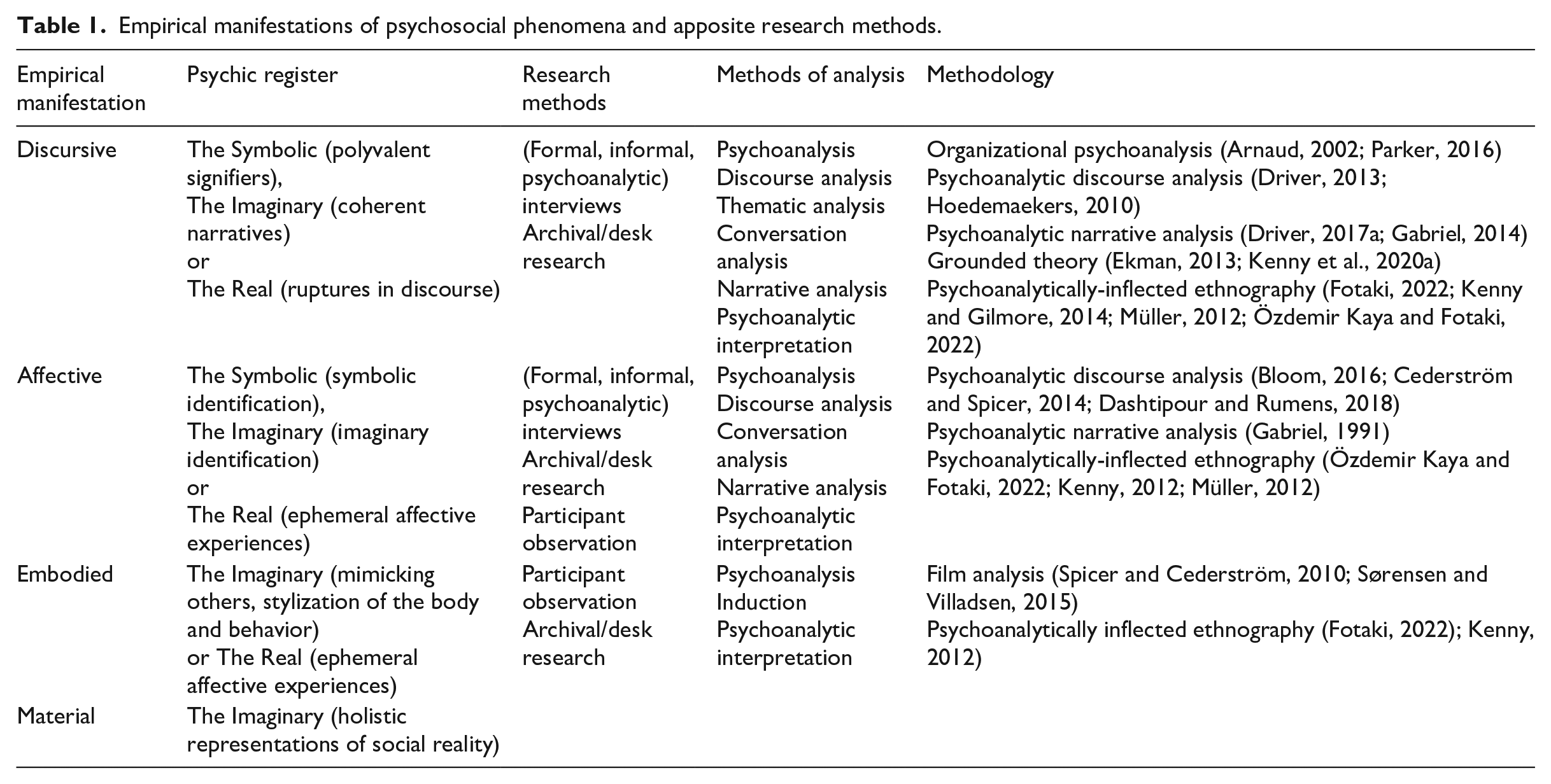
Psychoanalytic discourse analysts predominantly adopt Lacanian psychoanalysis (e.g. Arnaud, 2002; Hoedemaekers, 2009; Parker, 2005). They often blend Lacanian theory with other qualitative research methods, sometimes at the expense of epistemological coherence, because “Lacan does not provide a theory of discourse . . . Still less does he provide a surefire way of analyzing discourse” (Parker, 2005: 166). For example, Hoedemaekers and Keegan (2010: identify “key signifiers on the basis of . . . (1) frequency, (2) distribution, (3) contextual resonance, and (4) literature-related resonance.” However, they neither substantiate why these qualities should make certain words/phrases “key,” nor explain what “key” means in psychoanalytic terms and how these “key signifiers” provide them with “insight into the unconscious properties of the signifying chain.” Müller (2012: 285) draws on grounded theory and Lacanian psychoanalysis to inductively discern “identification processes” in interviews and participant observations. However, she does not clarify how psychoanalytic theory informs her methodology, beyond serving as a heuristic device. In short, psychoanalytic discourse analysis tends to transpose conventional thematic, discourse, narrative and conversation analysis methodologies to psychosocial research (see Table 1). Thus, despite the many valuable contributions to psychosocial studies, it raises more methodological questions than it addresses especially with regards to accessing the unconscious.
Empirical manifestations of psychosocial phenomena and apposite research methods.
Unlike psychoanalytic discourse analysis modeled on conventional social science methodologies, some psychosocial research adopts clinical methods, including Lacanian-inspired approaches (see Arnaud and Vidaillet, 2018; Gabriel and Carr, 2002). For example, Frosh et al. (2003: 43) conduct “clinical-style” interviews, and Proudfoot (2015) uses psychoanalytic supervision and case consultation. However, many psychosocial scholars argue that psychoanalytic tools and concepts cannot simply be transferred from the clinical to the research context without reconfiguration, because these settings differ substantially in their interpersonal and power dynamics and aims (e.g. Glynos, 2010; Hook, 2008; Kenny and Gilmore, 2014: 166). Parker (2004: 108) voices even harsher criticism of these methods as individualizing, essentializing, pathologizing, and ultimately disempowering.
Socioanalysis, specifically developed to analyze group and organizational dynamics, offers a third approach focusing on the social end of the subject–society spectrum (Long and Harney, 2013; Sievers, 2014: 130). It adjusts clinical methods such as free association and dream interpretation to study “a group or a system’s associative unconscious” (Mersky, 2012: 27). For example, Sievers (2014) developed the social photo-matrix technique, in which members of an organization are brought together to “freely associate to photographs of their organization” (p. 129). Similarly, Mersky (2008) uses drawings of dreams by organizational members as a basis for free association. Although Bion and Klein’s psychoanalytic theories are a primary influence in most of these approaches, socioanalysis also draws insights from various psychoanalytic proponents, including Lacan (e.g. Long and Harney, 2013).
A fourth approach, somewhat similar to socioanalysis, is not organized around a particular psychoanalytic strand or method but searches for sound ways of using psychoanalysis outside the clinic. Researchers in this group seek to ground social and organizational research in psychoanalytic epistemology and ontology. For example, drawing on Lacanian ontology and feminist ethnography, Harding (2007) interrogates how researcher and interlocutor become subjects, “curling, enfolding, twisting, intertwining” (p. 1762)and ultimately “achieving” organization during ethnographic research. In so doing, she accounts for how researchers constitute their interlocutors and interlocutors constitute their psychosocial organization through both discursive and embodied interactions (p. 1764). Similarly, Kenny and Gilmore (2014) use clinical techniques and psychoanalytic concepts as inspiration for thinking more deeply about organizational ethnography. They adapt case supervision and case consultation and operationalize the psychoanalytic concept of transference to reflexively explore affective dynamics and power relations in their research encounters. These authors emphasize how the body, matter, discourse, and imagery are intertwined in the unconscious sphere, blurring the ontological and empirical boundaries of the self, the other, and the organization. They also embed themselves in psychoanalytic theory and practice to develop novel approaches to organizational ethnography. However, even these approaches do not consider the issue of ethnographic field in an unconscious domain. We position our article in this strand of psychosocial research in discussing how to ground ethnography in the unconscious, following Lacanian psychoanalysis.
This study contributes to the broader, relatively uncharted territory of psychosocial methodology by elucidating how “the field” works in Lacanian ethnographic research. “The field” is ridden with important methodological questions about the site, its boundaries, how to inhabit it, and what and how to observe it (Van Duijn, 2020). Unlike conventional research objects, psychosocial objects of inquiry do not have distinct physical forms or spatial limits, but instead cut across discourse, body, affect and matter, widely dispersed across time, and space. As mentioned earlier, this makes them potentially useful for ethnographic investigation of new organizational forms and ways of organizing in late capitalism where a growing volume of economic, social, and political activity is digitalized. However, “the field” in psychosocial ethnography is “fuzzy” (Nadai and Maeder, 2009: 234) and challenging to construct in theory and practice. This article considers ontology, epistemology, and methodology in tandem to solve this peculiar puzzle.
Having reviewed the methodological literature on psychosocial research and identified a quandary at the intersection between psychosocial and ethnographic methodologies pertaining to “the field,” next we deconstruct “the field” in ethnographic research and reconstruct it psychoanalytically.
The ethnographic question: “The field” as a social science construct
This section provides a brief history of “the field” as a social science construct since it has an enduring influence on how we conduct ethnography today and question its dominant conception as a physical space with boundaries. “The field” is pivotal to ethnography, developed as a “field science” by anthropologists (Gupta and Ferguson, 1997: 6) who conduct ethnographic fieldwork over extended periods in a particular locale to study cultures closely (O’Doherty and Neyland, 2019: 452–453). This helps them to explore macro-level phenomena by observing everyday micro- and meso-level, concrete, and complex manifestations without obscuring local organizational and individual differences (Burawoy, 2000: 343; Lapegna, 2009: 6; Ybema et al., 2009: 6–7).
Anthropology developed as a colonial enterprise, and established paths for generations of researchers between the imperial metropolis and colonized villages (e.g. Leavitt, 2017). This “spatial separation between field and home” (Gupta and Ferguson, 1997: 12) was naturalized and uncritically reproduced until the turn of the 21st century (see Burawoy, 2000; Clifford, 1997). The colonized village became the archetypal field, while a tacit consensus took root in viewing it as an enclosed entity inhabited by a single, more or less homogeneous community (Nadai and Maeder, 2009). This image of “the field” was firmly reified through decades of ethnographic research, allowing its underpinning assumptions and power relations to escape scrutiny, despite classic anthropology’s emphasis on fieldwork.
Other social science disciplines, gradually adopted ethnography as a research methodology, including organization studies. Although it enriched these, using the same methodology raised questions about disciplinary boundaries, which researchers defended by creating their own archetypical fields, such as urban areas in sociology (Burawoy, 2000; Clifford, 1997; Gupta and Ferguson, 1997). Over time, “conventions and inherited assumptions” (Gupta and Ferguson, 1997: 1) about what constitutes a field in each discipline have been established and uncritically reproduced ad infinitum. In keeping with this tacit interdisciplinary agreement, organizational ethnography has developed as the study of “a specific site, within the boundaries of the organization selected as the unit of observation” (Van der Waal, 2009: 5; see also Ybema et al., 2009: 4).
Nevertheless, villages, cities, and organizations are not self-contained, homogeneous entities that inherently qualify as “the field” (Pink, 2009). Their borders are porous, as subjects and objects move across them seamlessly and/or necessarily every day (Gherardi, 2019; Van Duijn, 2020: 282). Taking borders as the boundaries of “the field” helps contain the fieldwork and focus research on a conventional unit of analysis but may also impose arbitrary limitations and restrict access.
In response, authors interested, for example, in issues of migration (Hall, 2004), commodity exchange (Appadurai, 1986), and foreign correspondence (Hannerz, 2003) developed a new approach to ethnography. This approach, known as “multi-sited ethnography,” “pays attention to the interlocking of multiple social-political sites and locations” (Gupta and Ferguson, 1997: 37). Rather than dwelling in a single, spatially demarcated entity, researchers began to purposely cross organizational, political, and geographical borders in pursuit of “people, things, metaphors, plots, stories, allegories, lives, biographies, and conflicts” (Nadai and Maeder, 2009: 236). More recently, researchers in organization studies (e.g. Nicolini, 2009; Van Duijn, 2020; Zilber, 2014), adopted multi-sited ethnography. In this method, the phenomenon of interest may span across organizations, constantly shifting, blurry or non-existent borders (Van Duijn, 2020).
Nevertheless, multi-sited ethnographers have largely preserved hegemonic territorial imaginaries in ethnographic discourse, despite problematizing conception of “the field” as a self-contained spatial entity. For example, they argue that ethnographers must “dwell” (Gupta and Ferguson, 1997: 31) in locales, be “embedded in sites” (Burawoy, 2000: 4), “establish a terra firma” (Burawoy, 2000: 4) and “ground” their research (Gupta and Ferguson, 1997: 15; Lapegna, 2009: 18). These phrases communicate the need to capture researched communities’ lived experiences, ways of being and thinking (O’Doherty and Neyland, 2019: 453), or “becoming-with and the affective attunement to other (human and more-than-human) bodies and histories, and the material-semiotic construction of place” (Gherardi, 2019: 750). However, they also reify imaginaries of “the field” as one or more spatial entities and imply traveling to “sites” and staying there. Consequently, they establish “embeddedness” in “the field” as the principal criterion for rigor in ethnographic research. They define spending time in physical spaces as a measure of embeddedness (see also Pink, 2009). This criterion is difficult to apply, even in multi-sited ethnography, owing to the difficulty of knowing “what, exactly, should be considered part of the field(s) and to what extent should a subject be followed across these?” (Van Duijn, 2020: 283). The inability to take space for granted in psychosocial ethnography, owing to the distinct ontology of the unconscious, makes these questions even thornier, as discussed in the previous section.
More recently, increasing interest in empirically, ontologically, and epistemologically diverse objects has led ethnographers to develop novel approaches to “the field.” Ethnographic conceptions of space and place have changed from enclosed and static to “contingent and active” (Pink, 2009: 9). Space is variously defined in terms of unfolding events, changing constellations, ongoing stories, etc., which emphasize the making of places through movements of and interactions among living beings and their inanimate environments (Pink, 2009). This fluid conception of space extends to the digital sphere, and researchers of digital phenomena such as social networks build their fields by following “digital traces” (Cochoy et al., 2019: 494). However, other digital objects, such as algorithms, have proved harder to pin down and scrutinize, and are hence considered as “objects of ignorance” teaching ethnographers about their organization through impenetrability (Lange et al., 2019). Similarly, psychosocial researchers are rising to the challenge of researching and writing about diverse onto-epistemologies involving “humans, more-than-humans, texts, discourses, knowledges, and various other materialities” (Gherardi, 2019: 753; see also Beavan, 2021). Nevertheless, although ethnography has moved toward ontologically and epistemologically informed constructions of “the field,” these developments are yet to be reflected in psychoanalytically inflected ethnography. The following sections focus on psychoanalytic ontology, epistemology, and methodology.
The ontological question: The unconscious as the locus of psychosocial phenomena
In this section, we explore the ontology of the unconscious, in which psychosocial ethnographers aim to locate their research site. We follow Lacanian theory because this explains the complex links between ontology, epistemology, and technique that interest us here (see Lacan, 1999, 2006, 2013). Organizational and social researchers commonly prefer Lacanian theory for it offers a psychosocial ontology of the subject, allowing exploration of the psychic and affective dimensions of human experience as social and political, rather than individual, phenomena (Özdemir Kaya and Fotaki, 2022).
Lacan argues that contrary to its popular perception and conceptualization in “ego psychology” (Hoedemaekers, 2009: 187), the unconscious is not internal to the individual (Arnaud and Vidaillet, 2018: 86). In fact, there is neither an individual nor an inner self in which the unconscious might be located (Lacan, 2013: 12). As an illustrative metaphor for the unconscious, Lacan (2006: 16, 379) uses the Klein bottle, which is a two-dimensional manifold with a single, continuous, non-orientable surface (Fink, 2004: 152–153). Despite seeming to have a closed inner space, its inside and outside are a continuous single space. This helps visualize the unconscious as a space where subject and society converge (see Figure 1).

The Klein bottle (Yinweichen, 2015).
To understand this convergence, we must turn to the process of subject formation. According to Lacan, we are born into a world of “hegemonic discourses, images, and fantasies being broadcast all around us” (Fink, 2014: 53), through which we make sense of ourselves and the world (Fink, 1995: 36). This inevitable mediation of embodied and material experience through discursive and visual representations is intrinsic to the process of subject formation, meaning that body, matter, discourse, and imagery are ontologically always already intertwined (see also Fink, 1995: 7). In other words, no embodied, conscious, or unconscious self exists prior to subject formation, nor remains untouched by social norms, views, and desires.
Language plays a dominant role in this process because it introduces prohibitions (most notably on incest) that separate the infant from its primary carers. This forces it to turn to others (and social norms in later life) as objects of attachment, which leads to participation in society as a subject (Frosh et al., 2003: 40). Attachments are formed through two registers of the psyche: the Imaginary and the Symbolic (Hook, 2011), though these are connected to the third register the Real. The Imaginary consists of images/impressions of “visual, auditory, olfactory, gustatory, tactile, or other” (Fink, 2014: 27) objects encountered and said to be desirable by others (Fink, 1995: 36). These sediment and crystallize over time into ideal images, and by identifying with these, one forms an ego (Fink, 1995: 36). The ego refers to the conscious self, the enunciating subject of the Cartesian proclamation “I think, therefore I am.” Turning the Cartesian theory of the subject on its head, Lacan argues that the subject is in “another scene” (Arnaud, 2002: 692) when this announcement is made. This means that he perceives the subject not as the conscious self, but as the unconscious self that escapes the former’s grasp (Fink, 1995: 45). Lacan studies the unconscious to understand subjectivity, a premise generally shared by psychoanalytically informed research.
The other register to which Lacan refers is the Symbolic. This consists of wishes or thoughts articulated using signifiers absorbed into the unconscious randomly or due to repression. Once outside consciousness, they take lives of their own, attracting “phonemes and letters” (Fink, 1995: 8), growing through “displacement and condensation” (Fink, 1995: 5) and creating “a chain of signifying elements” (Fink, 1995: 10). These form polyvalent signifiers that can be heard in multiple ways, including: neologisms such as l’amur derived from amour [love] and mur [wall]; homonyms such as encore [still, more], en-corps [in-body] and un corps [a body]; double entenders such as arriver [arrive, a slang term meaning “to come” in sex]; idiomatic expressions such as il n’y a pas de petites économies [‘“a penny saved is a penny earned” . . . means “there’s no such thing as small savings”’ (Fink, cited in Lacan 2006: 806)].
Lacan uses these examples to demonstrate the workings of the Symbolic (see Lacan, 1999: 4–18; Lacan 2006: 806). A signifying chain is neither the language spoken by people (French, English, etc.) nor an entirely new language that the subject invents, but a cluster of signifiers originating from an existing language that have been absorbed into a space outside the conscious where they take new forms (Fink, 1995). Lacan’s most famous phrase, “the unconscious is structured like a language,” encapsulates this. Nevertheless, signifiers are stored in memory as “foreign, and unassimilated” (Fink, 1995: 9) because they have lasting semantic links with their language of origin. As the latter naturally evolves, the meaning and composition of these signifiers stored in the Symbolic register of the psyche also change. This makes the Symbolic social, as it is composed of linguistic signifiers in constant flux, beyond the subject’s control; yet it can also be seen as subjective to the extent that signifiers are encountered, absorbed, and unconsciously modified by the subject. Therefore, it is impossible to say where the subject begins and society ends: they meet on the unconscious plane called “the Symbolic” where their boundaries are blurred.
Beyond the Imaginary and the Symbolic is the Real. Unlike the other two, the Real is not composed of discourse and imagery. On the contrary, it is an effect of their failure to represent the human experience that retrospectively creates a gaping hole or insurmountable lack in subjectivity (Hoedemaekers, 2010: 380–381). It marks the limit of the Imaginary and the Symbolic, incites the desire to identify, and produces affective responses (particularly anxiety) when encountered.
Having elaborated on Lacanian non-binary ontology and the unconscious as its locus, we next discuss the “terra firma” (Burawoy, 2000: 4)—the solid ground—of Lacanian epistemology and how this might be translated into an ethnographic methodology.
The epistemological question: The Symbolic as the terra firma of psychosocial ethnography
As previously discussed, the psyche consists of three registers: the Imaginary, the Symbolic, and the Real. These are produced by and manifested in the discourses, people, objects, and images we encounter.
Organizational phenomena in the Imaginary sphere include fantasies of a harmonious social and fulfilled individual existence found in stories, myths, and popular discourse (e.g. Müller, 2012; Roberts, 2005; Spicer and Cederström, 2010), as well as artifacts and the material environment (Gabriel and Carr, 2002: 356; see Table 1). They also involve identification with others and popular images expressed in discourse (Driver, 2017a; Hoedemaekers, 2010; Kenny, 2010) and through stylization of the body and behavior (Butler, 1988). According to Lacanian theory, the meanings of these phenomena are not inherent or transparent to observers but are discursively constructed. Therefore, psychoanalysts and researchers studying imaginary phenomena inevitably transpose their own selves onto their interlocutors and objects of study: “The imaginary involves looking at others and seeing myself, believing that others have the same motives, hang-ups, and anxieties I have” (Fink, 2014: 9). Insights into imaginary psychosocial phenomena are thus partial (see Driver, 2017a: 622–623) and tell more about the researcher’s ego than the researched subject or object (Fink, 2014). Such transposition afflicts all conventional research methods, including participant observation and interviews, used by ethnographers to immerse themselves in interlocutors’ worlds. From a Lacanian perspective, these fail to capture what makes interlocutors unique and radically different from the researchers themselves (Fink, 2014: 27–35). This type of research thus remains imaginary, in Lacanian terms, and uses Lacanian psychoanalysis as a heuristic device rather than a comprehensive epistemological approach with its own methods. For the latter, the researcher must dwell in the Symbolic, the locus of the unconscious subject (Lacan, 2006).
Notably, the Symbolic is not the same as language or discourse and hence cannot be studied by employing conventional social science methodologies; nor is psychosocial research synonymous with clinical encounters (Arnaud and Vanheule, 2013: 1673; Glynos, 2010; Hook, 2008; Kenny and Gilmore, 2014: 166; Parker, 2016: 562). Dwelling in the Symbolic entails adopting the psychoanalytic technique of listening and interpreting. This is based on the idea that both ego and subject express themselves in discourse using “the same mouthpiece at the same time” (Fink, 1995: 3). While the ego’s conscious discourse offers well-rounded, coherent fantasy narratives (Costas and Taheri, 2012: 1200), the subject’s unconscious discourse tears the veil of fantasy with polyvalent signifiers and exposes “truths” pertaining mainly to unconscious desires, suppressed thoughts and sources of enjoyment (Lacan, 2006; see also Kenny et al., 2020b).
This disruption of conscious discourse by unconscious interventions may create garbled, unintelligible speech: “The unconscious seems to delight far more in nonsense than in sense, to rejoice in enigmas, rebuses, and condensations rather than in comprehensible propositions” (Fink, 2014: 141) and speaks “utter stupidities” (Lacan, 1999: 22). These ostensibly meaningless phrases might be brushed aside by conventional social methods such as narrative analysis, but Lacanian psychoanalysis focuses precisely on them (Lacan, 1999: 22). Listening to these peculiar discursive constructs, analyzing their structure, and deciphering their latent meanings gives access to unconscious truths.
The researchers of the Real have also opted to approach their object through the Symbolic register, paying particular attention to such breakdowns of speech, because the Real reveals itself in “contradictions and breakdowns of the narrative” (Hoedemaekers, 2010: 379), “the gaps and holes that emerge in people’s accounts” (Kenny, 2012: 1179) and “inconsistencies as manifestations of how affective anxiety emerges from a lack with the symbolic” (Kenny et al., 2020b: 108). As such, the Real exposes the limits of imaginary phenomena such as hegemonic ideologies (Müller, 2012: 281), fantasies (Hoedemaekers, 2010), and identities (Driver, 2009b), as well as anxiety in the face of these limits (Kenny et al., 2020b).
The following subsections explain and illustrate how this psychoanalytic method can be applied in research. Specifically, we show how “condensed,” unconscious signifiers manifest in idiomatic expressions and linguistic ambivalence.
Interpretative method 1: Accessing the unconscious through idiomatic expressions
As previously mentioned, idiomatic expressions are among the polyvalent signifiers Lacan used in clinical practice and elaborated on in his psychoanalytic theory (e.g. Lacan, 2006: 806). If one listens to these attentively, the expressions can “be heard and understood by anyone” (Fink, 2004: 10) who speaks the language, including the researcher, by virtue of being socially constructed signifiers rather than the interlocutor’s unconscious, subjective creations. Yet, at the same time, their use by an interlocutor indicates the internalization of the unconscious thoughts and beliefs they encapsulate (see Böhm and Batta, 2010; Kenny, 2010; Müller, 2012). As such, they occupy the point of convergence between a subject and society in the unconscious in which psychosocial researchers are interested. Their multiple meanings are available to all speakers of the language, minimizing the risk of projection. These peculiar discursive formations are thus particularly conducive to psychosocial research.
Author 1 adopted this method in ethnographic research on the Turkish culinary sector, identifying and interpreting idiomatic culinary expressions invoked in discursive data (interviews, audiovisual media, print media, etc.). In interpreting them, Author 1 inferred their latent, unconscious sense from their literal meanings and considered these within the conversational context. For example, an interlocutor invoked the Turkish expression aşka gelmek to explain how watching the film Julie and Julia, which portrays culinary work as a passionate and life-affirming pursuit, had given her an urge to pursue the culinary profession (Özdemir Kaya, 2019: 114–127). The apparent, conscious meaning of the expression is “to be enraptured,” while its literal, unintended meaning (translation) is “to come to love.” Particularly when considered in the conversational context, the latter resonates with the discourse of “do what you love (DWYL)” (Conor et al., 2015: 2), which captures the neoliberal ideology of work that produces subjects affectively attached to jobs offering poor pay and conditions (Özdemir Kaya, 2019: 123). Drawing on further supporting evidence discussed in the next section, the author concludes that the film provoked the interlocutor into forming a passionate attachment to the culinary profession. The reason was that it encapsulated the contemporary ideology of loving one’s job (Spicer and Cederström, 2010) with which she identified and portrayed culinary work as the actual object of this love.
In clinical psychoanalysis, idiomatic expressions are used as a point of entry into the unconscious (Fink, 2004). Yet this interpretative method is unprecedented in the organizational literature and apparently in other psychosocial research. In redressing this significant omission, we contribute to symbolic analysis methods in Lacanian scholarship (e.g. Arnaud, 2002; Dashtipour and Rumens, 2018; Kenny et al., 2020a).
Author 1 was able to anchor the analysis in the Symbolic and minimize projection by constructing it around the psychoanalytic interpretation of an idiomatic expression as a form of polyvalent signifier opening the door to the unconscious as discussed earlier. However, the analysis is still partly imaginary and involves some projection because it is informed by the author’s understanding of the conversational and socio-cultural context.
Interpretative method 2: Tracing unconscious expressions in slips of the tongue
Another psychoanalytic method used to access the unconscious is focusing on mid-narrative contradictions, breaks in speech, slips of the tongue, and parapraxes (see Andersen, 2018: 244; Arnaud, 2002: 697; Driver, 2009a: 496; Kenny, et al. 2020b; Parker, 2016: 560, 563; Stein, 2007: 1228). These expose encounters with the Real when the subject’s experience resists signification (being expressed in language), for example, in cases of trauma (Hoedemaekers, 2010: 381) or when language fails to account for it (Kenny, 2012: 1179; Kenny et al., 2020b: 102, 108).
Using this method, Author 2 investigated the difficulty of dealing with the irreducible other (Butler, 2004; Kristeva, 1991) in local communities in the Greek islands during the mass refugee and forced migrant movements to the European Union in 2015–2016 (Fotaki, 2022). For instance, a founder of an organization established to help refugees, who had been involved as a volunteer assisting forced migrants from Iraq and Afghanistan since the early 2000s, said of the mass arrivals in 2015: “we were working day and night but still could not offer help to all needy people . . . the hordes of people seemed unstoppable.” Here, referring to “the hordes” (a dehumanizing expression often used by anti-migrant groups) while expressing genuine regret about being unable to offer much-needed assistance to all was a slip of the tongue, revealing ambivalence about and suppressed fear of the refugees whom she was helping voluntarily and selflessly. According to Freudian and Lacanian theory, slips of the tongue and parapraxes may result from repressed feelings and impulses that cannot be legitimately expressed in social settings (Holt, 2004: 264). Such manifestations, Author 2 argues, indicate how those offering the migrants unconditional assistance experienced a split between their own undesired and undesirable fears and emotions evoked by encounters with “foreignness,” “strangeness” and refugees’ destitution, and the dire predicament of being unwanted and placeless.
Yet, the researcher reflected on how her past and present experience as an outsider, relief worker, and ultimately an academic working with refugees might have influenced this interpretation. The identification with the refugees depending on the kindness of strangers due to no fault of their own made her vigilant toward those offering help. Having to perform the role of “the grateful refugee” (Nayeri, 2019) in the past could have influenced her focus on the imaginary projections. Author 2 reflected on the intra-psychic conflicts coming to the fore when researching “otherness” in “the field,” inevitably riven with unconscious flows of affects and projections between the researchers and the researched via transference and countertransference. 1
In the preceding sections, we have discussed how to ground research in the unconscious and have explained two methods of achieving this in psychosocial research and psychosocially informed ethnography. Based on Lacan’s comments on psychoanalytic technique, we have argued that a coherent Lacanian epistemology necessitates the adoption of psychoanalytic methods of inquiry, that is, listening to and interpreting polyvalent signifiers and parapraxes to allow researchers to embed their analysis in the Symbolic, because “The truth speaks, and . . . it has no other means by which to become grounded” (Lacan, 2006: 737). This is key, we suggest, to unearthing how the unconscious intrudes and manifests itself in the Symbolic. Therefore, we critique organizational (and social) research, focusing exclusively on the Imaginary, because it uses psychoanalysis only as a heuristic device rather than a comprehensive epistemological approach. While these studies shed some light on the unconscious, ultimately, they are but fantasy narratives infused with researchers’ projections and disconnected from interlocutors’ unique unconscious truths, as discussed earlier. Limiting the analysis to the Imaginary realm was precisely what Lacan sought to avoid in his practice and for which he heavily criticized other psychoanalytic approaches (Fink, 2004, 2014).
We counter this tendency with our proposed epistemological approach. This is rooted in psychoanalytic interpretation rather than participant observation because, we argue, psychosocial ethnographic research must be led primarily by the former rather than the latter. Especially in constructing “the field,” we advocate a leading role for (but not complete reliance on) psychoanalytic interpretation focusing on the Symbolic, which differs crucially from other discursive psychosocial methodologies (see Table 1). This may be anathema to some ethnographers, but many now rely on methods other than participant observation to study non-spatially bound phenomena. For example, some multi-site researchers argue that the multiplicity of and restricted access to sites limit the duration of fieldwork and advocate increased use of interviews to complement shorter periods of participant observation (Nadai and Maeder, 2009: 244). Researchers interested in “online social interaction and experience” use “technologically mediated and archived forms of communication and information” rather than participant observation to conduct “netnography” (Kozinets, 2018: 2). Their prioritization of other methods arises from methodological and logistical concerns (Nadai and Maeder, 2009: 244), whereas our rationale is epistemological coherence, as argued above.
The methodological question: Constructing “the field” in psychosocial research
As previously mentioned, psychosocial phenomena form a nexus of discourse and imagery originating from countless sources, from cultural artifacts to workplace chatter, which are absorbed into the Symbolic and the Imaginary throughout our lives. The innumerable images and signifiers constituting individuals’ affective psychic apparatuses sometimes have centuries-old sociocultural histories, packed with multiple layers of meanings and references to other signifiers and images (consider, for example, religious symbols such as the cross). Furthermore, in parallel with their existence in the unconscious, they continue to be used and re/produced by others, acquiring new meanings and connections in the social domain. This constant flux of the Imaginary and the Symbolic means that the sociocultural building blocks, actors, and manifestations of any psychosocial phenomenon span long stretches of time and space. We argue that the broad spatio-temporal spread and empirical variety of psychosocial phenomena make the unconscious a fuzzy field that can best be researched by employing multi-sited psychosocial ethnography.
In multi-sited ethnography, phenomena are studied in a processual manner by either observing as they unfold (Marcus, 1995: 96) or establishing interconnections between “people, things, metaphors, plots, stories, allegories, lives, biographies, and conflicts” (Nadai and Maeder, 2009: 236). Subjects/objects of study can be physically followed from one site to another, or their connections can be established through “the text and the arguments” (Lapegna, 2009: 8) in resulting publications. Unlike the linear process of fieldwork, analysis, and writing-up of traditional ethnography, the researcher repeats these cycles several times, potentially in different orders. Building on the multi-sited approach and our epistemological discussion in the previous section, we argue that constructing “the field” in the unconscious requires finding relevant sites and connecting them to others. This process must be guided by the psychoanalytic interpretation of polyvalent signifiers in discursive data to unearth unconscious dynamics. Two examples of this proposed methodology are presented below.
To locate empirical manifestations of love while grounding the analysis in the Symbolic, Author 1 conducted preliminary research involving 16 interviews with chefs and identified and interpreted idiomatic expressions relating to the phenomenon. In the next stage of fieldwork, she pursued actors (renowned chefs, restaurant owners, and gastronomy writers), organizations (especially culinary schools and restaurants), and the cultural artifacts (films, TV programs, interior décor of organizations, etc.) to which they pointed. Where access could be gained, Author 1 involved them purposively to construct “the field” in a manner consistent with Lacanian epistemology. The researcher iterated between findings and theory through field trips, interviews, participant observations, an extended period of desk research, and deskwork in between various stages of data collection. This cycle was repeated three times in total.
The resulting ethnographic narrative comprises both Symbolic and Imaginary dimensions of the phenomenon. For example, after identifying aşka gelmek, used by an interlocutor to express how Julie and Julia incited her desire to pursue culinary work (as described previously), and psychoanalytically interpreting it, Author 1 watched and analyzed the film, using Lacanian theory as a heuristic device. Following an object identified through psychoanalytic interpretation of a polyvalent signifier helped anchor the analysis in the Symbolic. The movie narrates how Julie is inspired by famous TV presenter and chef Julia Child’s passion for cooking and finds her own calling in the culinary profession, which “saves her life.” This narrative epitomizes the fantasy of love for work as an antidote to the ills of neoliberal work and life imprinted on the contemporary psyche (Spicer and Cederström, 2010). In psychoanalysis, fantasy refers to narrative structures through which subjects make sense of the world, which belongs to the Imaginary (Kenny et al., 2020b). As mentioned earlier, by veiling the existential lack in the subject and irredeemable divisions in society, fantasies provide us with a sense of wholeness, fulfillment, and social cohesion. In the case of Julie and Julia, we are presented with a narrative of passionate labor, saving Julia’s soul from the cold grip of neoliberal life and work, and helping her rise above her relative precarity. This analysis builds on the interpretation of aşka gelmek presented in the previous section. It is grounded in the Symbolic while illuminating the Imaginary dynamics of passion at work.
Author 2 researched humanitarian organizations’ work in assisting refugees and displaced people in the Greek islands between 2016 and 2018, drawing on on-site participant and non-participant observations within and outside the camps, images of the sites studied (photographic and video materials taken by the researcher) and their architecture (refugee camps, aid organizations’ workplaces, mobile kitchens, etc.). Her focus was on emerging spatial-affective entanglements expressed by aid workers and other participants (refugees, police guards in the camps, citizens) to explore attitudes to refugee arrivals over time.
Author 2′s analysis involved tracing through chronologically-ordered raw data (interview transcripts, observation notes, video diaries) to identify contradictory behaviors, parapraxes, and slips of the tongue. This was followed by comparisons across the cases to identify commonalities. Deskwork involved studying archival documentation of comparable experiences of refugees in both the media and professional publications. The process then involved iteration back and forth between the data and psychoanalytic theory, primarily inspired by Lacanian theory on subject formation and insights from the object relations view of social defenses.
Instances of self-less and heroic assistance were interspersed with resentment and genuine fear of the newcomers. Fishermen from Lesbos who hauled stranded refugees from the sea during the night reported that “the Afghan men were horrible, and I hated them when they trampled over others, not minding the children and elderly to get into the safe boat first.” This outpouring may be understandable, but it also signifies an unrealistic expectation of people in utter distress. Put differently, this generous fisherman evoked the norms of the Symbolic to cover up his own unconscious (imaginary) fear of annihilation and destruction experienced by when faced with human despair. Author 2 also came across people who openly resented the arrivals, secretly donating food and unwanted clothes. They wanted the displaced people gone but could not tolerate seeing their plight. Others distanced themselves from the refugees’ suffering by dehumanizing them as deserters of their homeland in wartime while simultaneously questioning their status as genuine refugees entitled to protection.
Author 2 used Lacanian insights to theorize unconscious dimensions of the discourses and their enactment by the islanders and demonstrate how the Imaginary intersects with the Symbolic (Fotaki, 2022). It is suggested that rationalizing the rejection as “justified” aims to fend off fragmentation in the psyche, offering an illusion of stability by covering hitherto unarticulated material from the realm of the unconscious (Fotaki, 2022: 313). Lacanian analyst and philosopher Kristeva (1991) posits that we externalize the “otherness” of our unconscious that we cannot bear in ourselves onto conceptual “others.” Author 2 focused on interpreting how these defensive mechanisms could unconsciously lead to splitting off one’s negative feelings (such as fear and aggression) and projecting them onto unwanted others. These feelings were often consciously manipulated by right-wing politicians and the media (Fotaki, 2022: 309–316; Arcimaviciene and Baglama, 2018). As Born (1998: 380) explains, “some agents are intuitively attuned to primitive psychic dynamics and show artistry in their discursive orchestration.” “The field,” in this instance, concerned people’s changing affective reactions and unconscious conflicts manifested in contradictory parapraxes and slips of the tongue, often reflecting shifts in official discourses and policies by the Greek government and the EU.
In both projects, taking cues from psychoanalytic interpretation of polyvalent signifiers and parapraxes ensured that connections pursued in “the field” were coherent with the Lacanian epistemology adopted. The analyses of imaginary phenomena, which are inevitably partial and subjective, were built on unconscious truths unearthed through psychoanalytic interpretation. This allowed us to ground our studies in the unconscious, as Lacan envisaged. However, we also recognize that, as researchers, we are constantly in the thrall of our imaginary projections we must reflect upon.
Delimiting “the field” in psychosocial ethnography
The final challenge regarding the construction of “the field” in psychosocial ethnography is drawing its boundaries. This is shared with other types of multi-sited ethnography (Van Duijn, 2020: 283), and compounded in research on non-spatially bound, empirically, and ontologically fuzzy phenomena (Nadai and Maeder, 2009: 234). On this point, we concur that the rule of thumb is to stop iterating between fieldwork, deskwork, and textwork “when you can provide a convincing and defensible account” (Nicolini, 2009: 121) and are convinced that this account makes a significant contribution to the literature. What matters is being reflexive and transparent about the decisions taken in constructing the field (Van Duijn, 2020: 292) and ensuring that these are coherent with the underpinning ontology and epistemology. This is especially true in psychosocial research, whose terrain of study, the unconscious, is vast and perpetually expanding, and hence has no “natural” boundaries.
Discussion: Pulling the threads together
This article addresses the question of “the field” in organizational psychosocial ethnography by expounding on the ontology and epistemology of the unconscious (Lacan, 1999, 2006, 2013), and advances new ethnographic methods designed for the study of non-spatially bound phenomena such as migration, algorithms and affects (Beavan, 2021; Gherardi, 2019; Nadai and Maeder, 2009; O’Doherty and Neyland, 2019). Specifically, it elucidates how an ethnographic site can be carved out in the unconscious, and how a researcher may dwell in it. We offer an ontologically and epistemologically informed comprehensive technique for studying the unconscious. The proposed technique draws on Lacanian psychoanalysis (e.g. Fink, 2014; Hook, 2008; Lacan, 2006) and new onto-epistemologies concerned with the affective, unconscious, embodied, and material dimensions of social and organizational phenomena (e.g. Beavan, 2021; Gherardi, 2019; Harding, 2007).
The article makes three key contributions. First, it addresses the question of how to use psychoanalysis in research (Frosh, 2012; Glynos, 2010; Kenny and Gilmore, 2014; Long and Harney, 2013; Neill, 2013; Redman, 2016; Stamenova and Hinshelwood, 2018). We argue that psychoanalytic listening and interpretation (of polyvalent signifiers such as idiomatic expressions and parapraxes) should guide the research to truly embed it in the unconscious. In Lacanian terms, this means engaging with interlocutors through the Symbolic, which is the locus of the subject and unconscious truths (Driver, 2017a: 622–623; Fink, 2004: 14; Lacan, 2006: 737). In psychosocial research, there is undoubtedly a place for analysis of imaginary phenomena such as fantasy, using psychoanalytic theory as a heuristic device (e.g. Bloom, 2016; Hensmans, 2021). Nevertheless, epistemological coherence requires that we ground such analyses in the Symbolic register of the psyche.
While organizational and social researchers using psychoanalysis widely recognize the need to access the unconscious through peculiar discursive formations, such as slips of the tongue and parapraxes (e.g. Arnaud, 2002: 693; Arnaud and Vanheule, 2013: 1666; Hoedemaekers and Keegan, 2010: 1026), this is too often conflated with collecting discursive data and adopting established thematic, narrative or discourse analysis methods for their interpretation (see Table 1). In other words, psychoanalytic terms are operationalized through social science methods that are native to neither clinical technique nor psychoanalytic epistemology. This reflects broader issues around the use of psychoanalysis in research, which we address by considering ontology, epistemology, and methodology simultaneously.
Therefore, our second contribution concerns translating psychoanalytic ontology and epistemology into a psychosocial methodology. In ethnographic terms, this article elucidates the ontological ground on which to dwell in “the field” of the unconscious. It explains how it finds empirical expression in places, subjects, and objects, and provides guidance on research methods to identify, connect, pursue, and analyze these to construct an unconscious field. We draw on recent advances in ethnographic and psychosocial methodology based on diverse onto-epistemologies (e.g. Beavan, 2021; Gherardi, 2019; Harding, 2007), but are guided primarily by Lacan’s (1999, 2006, 2013) onto-epistemology in building and framing these connections.
Our theoretically informed methodological propositions are as follows. First, we make a case for a multi-sited processual approach, which best suits psychosocial ethnography. The fieldwork should start from and be guided by a specific form of discursive data, namely polyvalent signifiers (idiomatic expressions, puns, witticisms, parapraxes, contradictions, etc.), as a gateway to unconscious truths. Here, we expand the Lacanian literature by emphasizing the importance of polyvalent signifiers (e.g. Arnaud, 2002; Dashtipour and Rumens, 2018; Kenny, 2012) and demonstrating that idiomatic expressions are particularly conducive to psychosocial research. A psychoanalytic interpretation of polyvalent signifiers can reveal relevant actors, artifacts, sites, etc., which the researcher can follow to build a meaningful field embedded in the unconscious. These can be analyzed using psychoanalysis as a heuristic device. The researcher can repeat these steps until she is confident of having reached a convincing account and should be transparent about decisions taken throughout the process, as advised by multi-sited ethnographers (Nicolini, 2009: 121; Van Duijn, 2020: 292).
We know that dwelling in the unconscious does not allow us to shine a light on all its mysteries. Lacanian psychoanalyst Fink (2014) argues that even after decades of analytic work with analysands sharing the most intimate details of their (psychic) lives, the analyst cannot “understand” their world. This is because analytic work constitutes only a fraction of the analysand’s life, which undergoes repression of the unconscious and incessant mutations due to societal influences. Yet this does not make analytic work futile. In clinical contexts, interpretation entails following threads in analysands’ speech and experimenting with potential meanings in light of the analysands’ cultural milieux and social backgrounds, allowing unconscious truths to surface. Our proposed methodology of wrapping analysis of imaginary relations (identifications, fantasies, etc.) around psychoanalytic interpretations of polyvalent signifiers aligns with this approach.
Lacanian psychoanalysis also acknowledges that no discourse can express the whole truth, because language, in which it finds expression, is itself fractured and incomplete (Özdemir Kaya and Fotaki, 2022: 5). Similarly, any ethnographic or other scholarly work that claims mastery of interlocutors’ cultural/organizational contexts and unconscious lives is but a fantasy narrative. Psychosocial research dwells on the limitless, amorphous, and perpetually moving surface of the unconscious, making it impossible to mark “the field” permanently. In all psychosocial ethnography we must repeatedly make painstaking methodological decisions in light of theory, to address this “limitation.”
Adopting a psychosocial methodology has unmatched advantages too. The lack of established conventions and ready-made blueprints forces the researcher to consider every methodological decision in a theoretically informed manner. It also requires transparent fieldwork reporting, enabling scrutiny by peers who are often suspicious of the unorthodox theoretical constructs and methods of psychosocial studies, leading to greater self-reflexivity throughout the research process.
This brings us to our final contribution to the broader field of organizational ethnography. In exploring the vital links between ontology, epistemology, and methodology that shape “the field,” we contribute to recently developed novel methodologies such as multi-sited organizational ethnography (Van Duijn, 2020), and “netnography” (Kozinets, 2018). In these studies, the “fuziness” of “the filed” stems from not being contained in a physical site with boundaries (Nadai and Maeder, 2009: 234), whereas in psychosocial research “the field” is doubly fuzzy because psychosocial phenomena are diffuse not only spatio-temporally, but also ontologically and empirically (Gherardi, 2019). These additional challenges raise methodological, ontological and epistemological questions for researchers to consider when designing an ethnographic study. We address these questions by employing Lacanian psychoanalysis and engaging with novel onto-epistepologies in organizational research (e.g. Beavan, 2021; Gherardi, 2019). Our contribution extends existing ethnographic literature, which argues that researchers must take account of logistical challenges (Nadai and Maeder, 2009: 244) and the potential for theoretical contributions (Marcus, 1995) when constructing “the field,” but pays little or no attention to the ontological base and epistemological coherence. The proposed approach can provide a helpful framework for researching new ethnographic objects such as Artifical Intelligence (AI), algorithms and digital platforms that blur the ontological boundaries between the living and non-living, intelligent and non-intelligent, sentient and non-sentient, etc. (see also O’Doherty and Neyland, 2019: 457–458) to offer a counterpoint to sanitized abstract narratives of late capitalism (Özdemir Kaya and Fotaki, 2022). We hope this article will inspire organizational ethnographers with diverse theoretical convictions to provide reflexive, transparent, and theoretically-informed accounts of how they construct “the field.”
Conclusion
This article addresses the question of “the field” in psychoanalytically inflected research. We propose a theoretically informed method for translating psychoanalytic ontology and epistemology into a psychosocial methodology and illustrate it with examples from our published research (Fotaki, 2022; Özdemir Kaya and Fotaki, 2022). Owing to the ontologically and empirically “fuzzy” nature of the unconscious where psychosocial inquiry takes place, our discussion also contributes to the new ethnographic methods employing diverse onto-epistemologies for studying non-spatially bound phenomena. These methods will only increase in importance as globalization, financialization and digitalization continue to re-organize work and lives in unprecedent ways.
Footnotes
Funding
The author(s) received no financial support for the research, authorship, and/or publication of this article.

