




Abstract

What is art? To what extent are assumptions held by the dominant majority about what art is (or can be) a product of individuals’ socialization into a distinctly Western, euro-centric concept of art, deeply entangled with Western idea(l)s of esthetics, myths of the artist as an individual, male, creative genius, and narratives about the Renaissance as a critical turning point in the (Western) history of art? These are just some of the questions that popped into mind as the authors walked through the venerable Fridericianum, a main venue of the 15th edition of documenta. And judging by the behavior and conversations of the other visitors, mostly white upper-middle class, we were not the only ones. The most common question heard was: “But. . . where is the art?!”
Documenta is a major international art exhibition that has been held in Kassel, Germany, every 5 years since 1955. With its beginnings in post-war Germany, it has always been politically ambitious and often scandalous. But documenta fifteen, held between June 18 and September 25, 2022, topped it off. Its artistic directors, the Indonesian art collective ruangrupa, were very explicit about their wish to challenge, question, and disrupt collectively held Western assumptions about art and art exhibitions. Their criticism of the current state of “Western” art, the organization of its production, and its entanglement in the global circuits of capital was omnipresent throughout documenta’s multiple venues. For example, in the basement of the Fridericianum, a neoclassical building that opened in 1779 as one of Europe’s first public art museums, an art installation was almost hidden besides the staircase leading to the restrooms (see Figure 1).
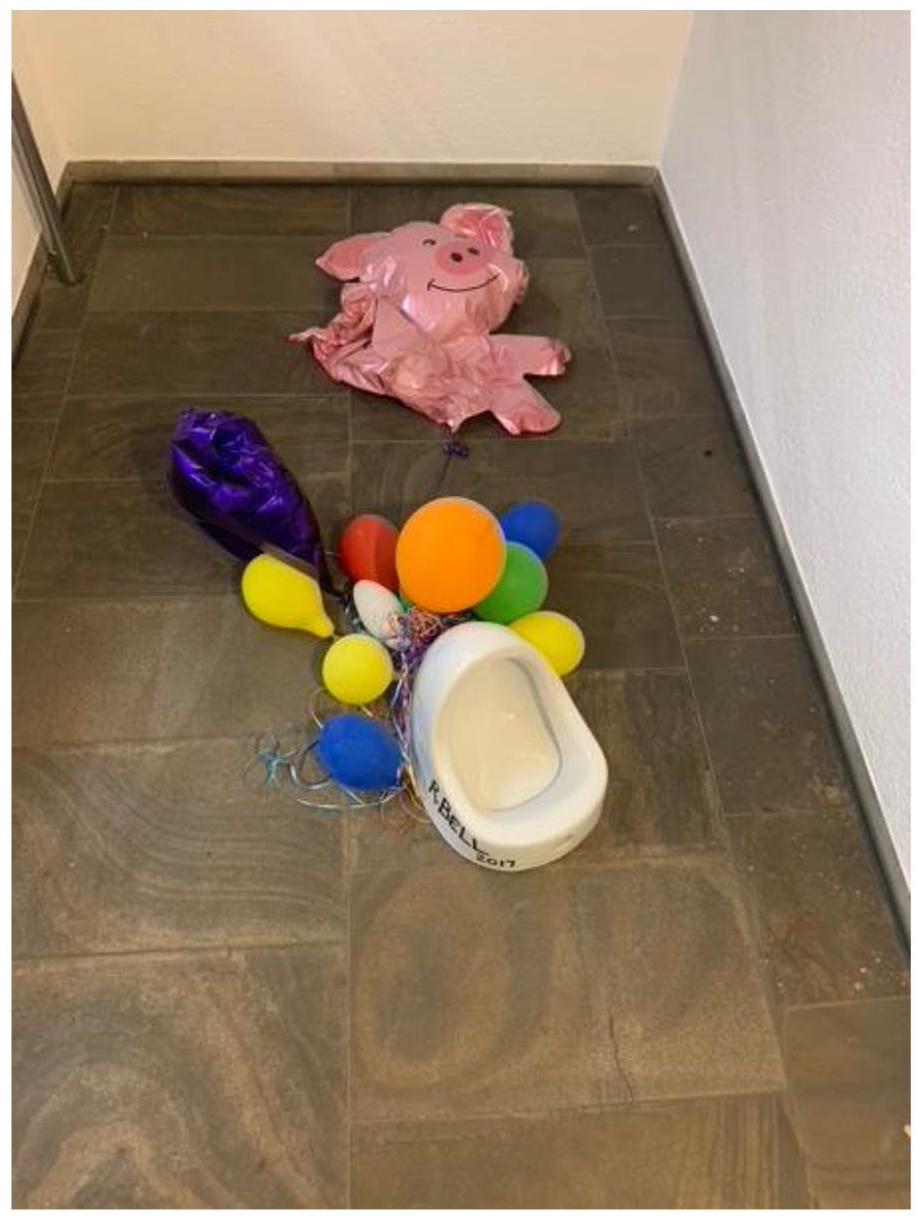
Western Art by Richard Bell (2017) (photograph taken by the authors).
Called “Western Art,” the installation consists of a pissoir lying on the floor and connected with a set of shiny, semi-inflated, colorful balloons, one of which is shaped like a smiling pink pig. The positioning of the piece next to the restrooms in the basement, and its references to artworks by Marcel Duchamp and Jeff Koons, immediately evoke thoughts about what Westerners usually view as the foundations of contemporary art: are those foundations a solid ground on which to build, or rather a decaying pile of (plastic) garbage that is not even capable of standing on its own feet? To what extent are the individualistic assumptions of the Western contemporary art world, with its celebration of individual mega-star (and often ultra-rich) artists, even sustainable in a world marked by multiple overlapping crises: a crisis of anthropogenic climate change, a crisis of deepening global inequality, and a crisis of human rights? Can and should the contemporary art world continue its trajectory, or do we need to fundamentally rethink many of the ways in which it is organized?
The art directors of documenta fifteen unequivocally argued for the latter. Instead of showcasing artworks by world-famous, and predominantly Western, artists they attempted to make the processes of organizing and producing art visible to their audiences. Documenta fifteen foregrounded not individual artists but art collectives and their work processes. This focus on collective processes is epitomized in the term lumbung, “a concept of collective sharing that lies at the heart of documenta fifteen” (documenta handbook, p. 9). Lumbung, which is an Indonesian word for a communal rice barn in which farmers share their harvest surplus, also served as a central organizing principle for ruangrupa’s own work processes that led up to documenta fifteen. Rather than simply taking curation into their own hands, ruangrupa extended invitations to a number of collectives, primarily but not exclusively from the Global South, effectively forming a global network of collectives, a lumbung inter-lokal. The entire curatorial process was organized in a bottom-up way and governed through a series of ongoing formal and informal exchanges within this network, some carried out in specific working groups, whereby the needs and views of the network members were considered more important than the expectations of the German institutions behind documenta. The entire process, in other words, was to be carried out collectively by the network and its members and in dialogue with local communities in Kassel.
It is this collective, community-centered approach to organizing art that took center stage at this year’s documenta. What visitors saw throughout the exhibition venues or experienced in various workshops are the material and immaterial traces left by this organizational process and collected through what ruangrupa calls harvest. The harvest can take any kind of form, including “a sticky note, a story, drawings, a film, a sound piece, or a meme” (documenta handbook, Glossary). In many ways, the harvests pushed the boundaries of what Westerners typically call art, in terms of media, topics, and esthetics.
Besides the harvests scattered everywhere, there were many films, but also everyday objects such as carpets, pillows, wood pallets, or bottles, as well as installations made out of e-waste, piles of secondhand clothes, and moving sculptures composed of plastic waste. The choice of media mirrors the material realities of art production at the various geographic locales of the lumbung members: whatever is abundantly at hand could be turned into art. Simultaneously, the choice of media often seems to serve a documentary purpose. Both videos and materials that one could see, smell, and sometimes even touch worked like a window into the lifeworlds of the involved artists. They showcased the struggles and challenges of doing art under sometimes severe resource constraints, often repressive political and societal systems, and within self-empowering but often tension-ridden collectives.
However, whereas documenta fifteen’s lumbung philosophy clearly succeeded in challenging Western assumptions about art and managing art exhibitions, it also produced severe clashes with local stakeholders in Germany. While the authors, as critical organization scholars, were still wondering whether the collective, officially non-hierarchical organizing had perhaps been portrayed a bit too harmoniously and without pointing out the well-known phenomena of informal power hierarchies and exclusion of some socio-demographic groups, the team behind documenta fifteen was accused of antisemitism—a particularly sensitive topic in the German context.
What had happened? Several months before the opening of documenta fifteen, it turned out that several artist groups invited by ruangrupa had a political anti-Israel stance. In the first days after the show opened its doors in June 2022, the public spotted a controversial, 20-year-old agitprop-style banner by the Indonesian art collective Taring Padi that displayed Israeli soldiers wearing scarves with the star of David and depicted as pigs. The exhibit was first covered and then removed. Politicians and parts of the German public demanded the resignation of the director general, who had given ruangrupa all leeway in curating and continuously highlighted the high good of artistic freedom. Ruangrupa perceived censorship and racism, emphasized their fundamental stance that the invited art collectives were allowed to choose exhibits on their own, and apologized that German sensitivities had been violated. In August 2022, the director-general resigned, and a panel of experts was appointed to come to terms with what had happened.
Since the first allegations of antisemitism, there have been calls for ruangrupa, other documenta decision-makers, and the Jewish community to engage in dialogue. The incidents were also seen as an opportunity to discuss the problem of antisemitism in contemporary Germany within the broader public sphere. However, hardly any such discussion events were realized, followed by mutual accusations that the respective other parties had refused to enter dialogue. In the end, the public media, supported by the report of the expert panel, concluded that the collectivist form of organization had failed. The radically collaborative, hands-off organizational approach spearheaded by ruangrupa, it seemed, had resulted in a loss of an overall curatorial control over the exhibition as a whole. This loss of control, in turn, clashed with a public expectation that there should be someone to take responsibility for the antisemitism present at documenta fifteen.
Thus, the story of documenta fifteen is also a cautionary tale for all those who seek to uncritically embrace collectivist, self-organizing, and self-managing forms of organizing. It points toward a key tension at the heart of such forms: the gap between the aspirations of collectives and the reality of operating in a highly institutionalized—and, what is more, unfamiliar—environment. One of documenta fifteen’s great merits is that it has dealt more comprehensively than ever before with issues such as environmental devastation, economic and social inequalities, colonialism, postcolonialism, and racism, while at the same time blasting the boundaries of the art world. It is a pity that the potential for enacting a better togetherness, and a shared space for reflection on pressing issues such as antisemitism could not be realized.
https://documenta-fifteen.de/en
Documenta fifteen Handbook. Ruangrupa and Artistic Team. Berlin: Hatje Cantz, 2022. 304 pp. € 25. ISBN 9783775752824
Lumbung Stories. harriett c. brown. Abuja, Nigeria: Cassava Republic Press, 2022. 225 pp. € 18. ISBN 9783775752862
Majalah Lumbung. A Magazine on Harvesting and Sharing. Ruangrupa and Team Majalah Lumbung. Berlin: Hatje Cantz, 2022. 224 pp. ISBN 9783775752855
Footnotes
Funding
The author(s) received no financial support for the research, authorship, and/or publication of this article.
